Buddy Punch Review 2026: Pricing, Pros, Cons, Alternatives
Buddy Punch starts at $4.99. What each tier gates, the 10 limitations reviewers name, and 6 alternatives with published prices.
Page at a glance
Buddy Punch is A cheap, narrow time clock for contractors who already have a payroll provider and only need hours captured against job codes, not dispatch, estimates or invoicing. It starts at $4.99 per user, per month, plus a $19 base fee per month. Administrators are free and unlimited; only Employees and Managers consume paid seats. But seats are bought as a block for the term, not metered continuously. The vendor's billing doc states: 'if you begin with 15 active users, you will have 15 user slots for the entire year' and 'no refunds or credits are given if the user count drops below the initial count.' On monthly billing the price re-rates each month against the active count; on annual billing a crew that shrinks after signup keeps paying the peak rate until renewal. That sits awkwardly beside the pricing FAQ's simpler claim: 'We only count active employees. You control who is active or inactive.' It fits Crews of roughly 5 to 40 W-2 field employees doing residential or commercial project work who already run payroll somewhere else and want job-code time capture with geofencing. It's the wrong buy for Contractors whose field labour is mostly 1099 subcontractors and who book labour cost through QuickBooks, because The QuickBooks integration can't transmit time for 'Vendors, Contractors/1099 workers, or other non-employees' at all. So the core promised workflow, hours to job cost to books, simply doesn't run for that labour, and you end up hand-keying the majority of your cost. Alternatives that publish their prices are ExakTime (now Arcoro Time) from $9, busybusy from $0, Connecteam from $29. Seven priced tiers, ten evidenced gaps and six alternatives, six of which publish a figure.
Start here if Buddy Punch is on your shortlist
Buddy Punch earns its money with Crews of roughly 5 to 40 W-2 field employees doing residential or commercial project work who already run payroll somewhere else and want job-code time capture with geofencing. If that's you, it does the job. The sections below are the parts worth checking before you sign. But the fit is narrower than the marketing suggests, and the price isn't the whole cost.
It starts at $4.99. And pricing was verified on 7 August 2026, so you can check every figure below in a browser tab.
| Pricing model | Published tiers |
|---|---|
| Entry price | $4.99 |
| Users | Administrators are free and unlimited; only Employees and Managers consume paid seats. But |
| Ownership | Independent |
| Best fit | Crews of roughly 5 to 40 W-2 field employees doing residential or commercial project work who already run payroll somewhere else and want job-code time capture with geofencing. |
| Accounting sync | QuickBooks Online (one-way), QuickBooks Desktop (one-way) |
What works
- Job codes are attached at the punch, and geofences can be wired to them
- Project-specific pay rates are a named feature, but the overtime split isn't exported
- Spanish is built in, and the app is deliberately punch-only
- Two survival routes for a winter shutdown, and the cheaper one keeps your data visible
- The vendor disclaims the numbers it produces
What does not
- Time for 1099 subcontractors can't be pushed to QuickBooks at all
- QuickBooks receives one lump sum, with no overtime split
- Cancelling deletes your timekeeping records immediately and permanently
- On annual billing you buy seat slots, and a shrinking crew gets no credit
- Missed punches are a recurring, cross-platform complaint
Buddy Punch is A cheap, narrow time clock for contractors who already have a payroll provider and only need hours captured against job codes, not dispatch, estimates or invoicing. It sells to Cross-trade contractors, and the shape of the product follows from that: Buddy Punch's construction page describes creating a job code per project, assigning it to employees, and having employees select the code when clocking in, with reports showing project labour hours. Geofences can be connected to job codes so the code is effectively enforced by location. But the gap is downstream: the hours reach QuickBooks as a single undifferentiated block, so the cost split you built at the punch is flattened on the way to the books.
Buddy Punch fit, and where it stops
It fits Crews of roughly 5 to 40 W-2 field employees doing residential or commercial project work who already run payroll somewhere else and want job-code time capture with geofencing. That's the half most reviews print. Here's the other half, which is the one worth your time.
Don't buy it if you're Contractors whose field labour is mostly 1099 subcontractors and who book labour cost through QuickBooks. The QuickBooks integration can't transmit time for 'Vendors, Contractors/1099 workers, or other non-employees' at all. So the core promised workflow, hours to job cost to books, simply doesn't run for that labour, and you end up hand-keying the majority of your cost. Look at busybusy instead.
Don't buy it if you're Contractors who want one system for scheduling work, dispatching techs, quoting, invoicing and collecting payment. Buddy Punch is a time clock with job codes bolted on. There's no estimating, no invoicing, no customer record and no dispatch board, and the entire published integration directory is payroll processors plus QuickBooks and Zapier. So you'd be buying a second system immediately. Look at FieldPulse instead.
Don't buy it if you're Sharply seasonal trades that shut down for winter and want to keep their records visible year round. The seasonal hold runs up to nine months but blanks your access while it's on, and cancelling deletes everything immediately and permanently. On annual billing you also get no credit when the crew drops. So the product's economics assume a stable headcount that seasonal contractors don't have. Look at Connecteam instead.
Don't buy it if you're Owner-operators and two or three person crews watching every dollar. The $19 monthly base fee dominates at low headcount. Three employees on Starter monthly is $19 plus $17.97, roughly $37 a month, which is about $12.30 per person before a single add-on. Competitors with genuinely free small-team tiers cost nothing at that size. Look at Connecteam instead.
Pricing: what Buddy Punch publishes and what it doesn't
The tiers are public. And that's worth more than it sounds in a category where half the vendors make you ask.
| Tier | Price | Billing unit | What it unlocks |
|---|---|---|---|
| Starter, billed annually | $4.99 | per user, per month, plus a $19 base fee per month | annual commitment, can't downgrade to monthly until the annual term expires |
| Starter, billed monthly | $5.99 | per user, per month, plus a $19 base fee per month | Nothing beyond the tier below |
| Pro, billed annually | $6.99 | per user, per month, plus a $19 base fee per month | annual commitment, Developer API is available on Pro and Advanced only |
| Pro, billed monthly | $7.99 | per user, per month, plus a $19 base fee per month | Nothing beyond the tier below |
| Advanced, billed annually | $12.99 | per user, per month, plus a $19 base fee per month | annual commitment |
| Advanced, billed monthly | $13.99 | per user, per month, plus a $19 base fee per month | Nothing beyond the tier below |
| Buddy Punch Payroll (add on to any plan) | $8 | per user, per month, plus a 49 base fee per month | requires an existing Buddy Punch time tracking plan |
Administrators are free and unlimited; only Employees and Managers consume paid seats. But seats are bought as a block for the term, not metered continuously. The vendor's billing doc states: 'if you begin with 15 active users, you will have 15 user slots for the entire year' and 'no refunds or credits are given if the user count drops below the initial count.' On monthly billing the price re-rates each month against the active count; on annual billing a crew that shrinks after signup keeps paying the peak rate until renewal. That sits awkwardly beside the pricing FAQ's simpler claim: 'We only count active employees. You control who is active or inactive.'
There is a discount for paying annually up front: Annual billing takes exactly $1.00 per user per month off every tier: Starter $5.99 to $4.99, Pro $7.99 to $6.99, Advanced $13.99 to $12.99. The $19 monthly base fee does not change. The lock is one-directional, per the vendor's FAQ: 'You can upgrade to annual at any time, however once you are on an annual plan you can only switch to monthly once your annual term is up.' And an annual prepay discount tells you an annual commitment exists, which is worth knowing before anyone mentions a term length out loud.
The Buddy Punch costs that show up later
Payment processing. Stripe. The pricing FAQ states: 'We use Stripe to process your payment. It's the same payment provider used by products such as Twitter, Pinterest, and Lyft. We do not handle your credit card information directly.' A Stripe ACH payment option is documented separately.
Implementation and onboarding. No implementation or setup fee is charged. The pricing FAQ states: 'There is a per employee fee and then a base fee each month. This can be paid monthly or annually. If paid annually there is a discount. There are no other setup fees, termination fees, or hidden fees.' Onboarding is self-serve; the free trial requires no credit card.
Minimum term. Month-to-month if you choose monthly billing. Buddy Punch's own construction comparison table lists its 'Minimum Contract Length' as 'One month'. Choosing annual billing creates a one-year floor you cannot exit early: the Terms of Use state 'Annual plans cannot be downgraded until the annual term has expired,' and the refund policy repeats it. There is also a documented pause: an account can be held for 'up to 9 months' for seasonal shutdowns, though you lose all access to the data while paused.
Getting out. No termination fee, but no money back either. The pricing FAQ promises 'no other setup fees, termination fees, or hidden fees,' while the Terms of Use say the service 'is non-refundable. There will be no refunds or credits for partial months of Service, upgrade or downgrade refunds, or refunds for months unused with an open account.' Cancelling an annual plan mid-term therefore forfeits the balance. Unpaid balances carry collection exposure: 'Customer will be liable for attorneys' and collection fees arising from Company's efforts to collect unpaid balances.'
Auto-renewal. Auto-renews by default on both cycles. The pricing FAQ states: 'Your Buddy Punch subscription, annual or monthly, will automatically renew until you cancel it.' Cancellation is self-serve under Settings, then Billing, then Cancel my Account. A failed card does not simply pause the account: 'Payments may be retried up to 4 times within the next month. After this, if the payment did not succeed, your account will be cancelled' — and cancellation is what triggers data deletion.
Modules sold separately. , , , , , . So price the Buddy Punch configuration you'll really run rather than the entry tier, because an add-on you need on day one is part of the price.
Third-party services you will also pay for. . These are not on Buddy Punch's invoice, and they are still part of what this decision costs you every month.
Worth a detour here. Buddy Punch's own competitor comparison table quotes its price as '$4.99/user/month' and omits the $19 monthly base fee that every plan carries, while quoting rivals at their flat per-user rates. So the comparison isn't like for like. At five employees the base fee adds $3.80 per user per month, making the real Starter cost $8.79 rather than $4.99 — inside a dollar of the $9 Workyard and ClockShark figures the table presents as more expensive. Always re-run the comparison at your actual headcount; the advertised gap only holds for very large crews.
The Buddy Punch costs that land afterwards
The subscription is the part everyone quotes. These are the lines that land afterwards, and the ones we could not find are named as unpublished rather than left blank.
Sold separately. , , , , , . Price the configuration you'll really run, because an add-on you need on day one is part of the price.
Third-party services you'll also pay for. . None of these are on Buddy Punch's invoice, and all of them are part of what this decision costs every month.
"Buddy Punch Starter, billed annually is $4.99, per user, per month, plus a $19 base fee per month."
Buddy Punch pricing page (2026)
"Buddy Punch Starter, billed monthly is $5.99, per user, per month, plus a $19 base fee per month."
Buddy Punch pricing page (2026)
"Administrators are free and unlimited; only Employees and Managers consume paid seats. But seats are bought as a block for the term, not metered continuously. The vendor's billing doc states: 'if you begin with 15 active users, you will have 15 user slots for the entire year' and 'no refunds or credits are given if the user count drops below the initial count.' On monthly billing the price re-rates each month against the active count; on annual billing a crew that shrinks after signup keeps paying the peak rate until renewal. That sits awkwardly beside the pricing FAQ's simpler claim: 'We only count active employees. You control who is active or inactive.'"
Buddy Punch pricing page (2026)
The five workflows you pay for
Feature totals are noise. So a shop in this category lives or dies on five things, and those are the five to grade, and each one below carries the evidence it's graded on.
Job codes are attached at the punch, and geofences can be wired to them Buddy Punch's construction page describes creating a job code per project, assigning it to employees, and having employees select the code when clocking in, with reports showing project labour hours. Geofences can be connected to job codes so the code is effectively enforced by location. But the gap is downstream: the hours reach QuickBooks as a single undifferentiated block, so the cost split you built at the punch is flattened on the way to the books.
Project-specific pay rates are a named feature, but the overtime split isn't exported The vendor addresses prevailing wage directly, offering variable pay rates set per project. That handles the rate side. But it doesn't handle the reporting side: because time exports to QuickBooks without a regular-versus-overtime breakdown, a contractor on a public job still has to assemble certified payroll figures from the separate Payroll Export report rather than from a clean integration feed.
Spanish is built in, and the app is deliberately punch-only The app offers English or Spanish as a per-employee default, which matters on mixed-language crews. But it's also, by design, not an onboarding surface: when a Play reviewer complained there was no way to create an account, the vendor replied that this is intentional, 'Our app is a companion app, which means that you need to sign up on our website for an account first and can't signup directly on the app.' Every account action starts on the desktop site. And a reviewer, writing on 2025-01-07, writes the same thing: "You might think this is user error, but given that one normally doesnt search "how to create account" in the help topics, I think there might be an ease of interface issue. I can request forgotten usernames and passwords, etc. But there are no obvious links or routing trails that lead to "create new account". Soooooooo I guess I cant even try the app. Not sure why its not an obvious button somewhere."
Two survival routes for a winter shutdown, and the cheaper one keeps your data visible The documented pause holds an account for up to nine months, but you can't see anything while it's held. The vendor's own better answer is buried in the same article's FAQ: deactivate every employee instead, and on monthly pricing 'your monthly payment would go down to just the $19 base fee for as long as all employees stayed inactive,' while you keep admin access. So that's the single most useful operational fact in Buddy Punch's help centre for a seasonal trade, and it isn't mentioned on the pricing page.
The vendor disclaims the numbers it produces The Terms of Use put every compliance and calculation risk on the customer, including for the paid payroll module: 'Customer acknowledges that Buddy Punch is not a payroll system and Customer agrees to take full responsibility to validate the accuracy of data produced by the Service.' Rate multiplication is called out as convenience only and 'can never be relied on' as a payment calculation. Liability is capped at twelve months of fees, and Buddy Punch 'is not liable for the loss of any Customer Data.'
Buddy Punch trade fit
Fit differs by trade rather than by company size alone, and a blended paragraph hides that. Here is the split for the trades this one sells to.
Cross-trade. The workflow that decides it is job codes are attached at the punch, and geofences can be wired to them, and the shop profile that gets value is 5 to 15 w-2 employees with payroll already running elsewhere doing residential and commercial and service work. Where it stops being a fit is Contractors whose field labour is mostly 1099 subcontractors and who book labour cost through QuickBooks.
Your books, and whether Buddy Punch connects to them
QuickBooks Online connects one way only, so edits made in your books do not come back, on every plan. QuickBooks Desktop connects one way only, so edits made in your books do not come back, on every plan. Your costs map through cost codes, so test yours against your own chart of accounts before you commit. A code your books don't recognise is how a labour charge quietly lands somewhere useless.
Past those, the road ends. Field service management platforms (ServiceTitan, Jobber, Housecall Pro, FieldPulse, Buildertrend and similar), Xero, Sage, Wave and every accounting package other than QuickBooks, QuickBooks Online Simple Start, and the Australian and UK QuickBooks editions do not connect. So if your books run on an ERP rather than the platforms named above, weigh that before anything else.
Beyond accounting it connects to ADP Workforce Now (payroll export), Gusto (payroll export), Paychex Flex (payroll export), Paycor (payroll export), Paylocity / Webpay (payroll export), Rippling (payroll export), Deltek ComputerEase (construction payroll export), Viewpoint (construction payroll export), Workday, iSolved, Justworks, TriNet, SurePayroll, Deluxe Payroll, PayPlus, Wagepoint, Payment Evolution (payroll export), Zapier (general automation bridge), Google, Apple, Okta, OneLogin, Microsoft Entra (single sign-on). A public API exists: A REST developer API is served from api2.buddypunch.com with interactive docs covering authentication, endpoints, rate limits, pagination, webhooks, idempotency and code samples in curl, Node.js, Python and C#, plus a migration guide off the legacy API. Keys are administrator-only, scoped per resource with read and write permissions, and shown once at creation. It is restricted to the Pro and Advanced tiers and may need support to switch on.
Buddy Punch support, and what it costs you
Support is the line item nobody prices and everybody eventually needs. Onboarding for Buddy Punch: No implementation or setup fee is charged. The pricing FAQ states: 'There is a per employee fee and then a base fee each month. This can be paid monthly or annually. If paid annually there is a discount. There are no other setup fees, termination fees, or hidden fees.' Onboarding is self-serve; the free trial requires no credit card.
The review corpus we read on 7 August 2026 carries no consistent signal on response times either way, so treat support as untested rather than good. Open a real ticket during the trial and time the reply, because that is the number no pricing page gives you.
Buddy Punch lock-in, in plain terms
Nobody reads this section before they buy, and it's the one that costs money afterwards. Four terms decide what leaving looks like.
Minimum term. Month-to-month if you choose monthly billing. Buddy Punch's own construction comparison table lists its 'Minimum Contract Length' as 'One month'. Choosing annual billing creates a one-year floor you cannot exit early: the Terms of Use state 'Annual plans cannot be downgraded until the annual term has expired,' and the refund policy repeats it. There is also a documented pause: an account can be held for 'up to 9 months' for seasonal shutdowns, though you lose all access to the data while paused.
Auto-renewal. Auto-renews by default on both cycles. The pricing FAQ states: 'Your Buddy Punch subscription, annual or monthly, will automatically renew until you cancel it.' Cancellation is self-serve under Settings, then Billing, then Cancel my Account. A failed card does not simply pause the account: 'Payments may be retried up to 4 times within the next month. After this, if the payment did not succeed, your account will be cancelled' — and cancellation is what triggers data deletion.
Early termination. No termination fee, but no money back either. The pricing FAQ promises 'no other setup fees, termination fees, or hidden fees,' while the Terms of Use say the service 'is non-refundable. There will be no refunds or credits for partial months of Service, upgrade or downgrade refunds, or refunds for months unused with an open account.' Cancelling an annual plan mid-term therefore forfeits the balance. Unpaid balances carry collection exposure: 'Customer will be liable for attorneys' and collection fees arising from Company's efforts to collect unpaid balances.'
Payment processing. Stripe. The pricing FAQ states: 'We use Stripe to process your payment. It's the same payment provider used by products such as Twitter, Pinterest, and Lyft. We do not handle your credit card information directly.' A Stripe ACH payment option is documented separately.
One oddity, filed under things nobody mentions on a demo. Cancellation destroys the records immediately, the only export is a manual report download, and a lapsed credit card can trigger the whole sequence without anyone choosing to leave. Time records are evidence in wage disputes and are subject to statutory retention. Treat Buddy Punch as a system whose contents you must mirror out on a schedule, not a system of record. Keep the billing email on a monitored address and diarise the card expiry, because the failure path from expired card to deleted payroll history involves no human decision.
"I signed up for the pro plan. I thought it was $5.99 a month per user with a $19.00 base fee per month to be billed every month. I did not know it was billed annually and was surprised when I got an invoice for almost $600. The wording when selecting a plan was not very clear and while I like the app itself, I wish the billing was better detailed."
Apple App Store (2 stars, app version 3.15.88), R&J Auto (5-11)
"We have a catering business with about 75 employees that we pull from based on the size of our events. Having to inactivate them all and then reactivate every month led to errors and hold ups when employees would clock in. The software would be better if it only charged for employees that actively punch in during a month while letting us leave all of our employees active in the system. Also - we had a pattern of some employees with darker skin having problems with facial recognition. So that was bit embarrassing and led to the final decision to put everyone back on punchcards."
Apple App Store (2 stars, app version 3.13.93), South Florida Caterer (1-15)
"When punching in and out this app will not punch you in all the time. It's been multiple times I start work to realize it never punched me in, same as for punching in and out for lunch. You may think you did but when it's time to punch back in. There you see that it never punched you out. Think you punched out for work. Nope you're gonna get a email saying you been punched in for 12 hours! dumb"
Apple App Store (3 stars, app version 3.2.42), DatBoiMario (5-27)
Where Buddy Punch falls short
Six things worth raising, and each one's answerable with a yes or a no on a call.
Time for 1099 subcontractors can't be pushed to QuickBooks at all Buddy Punch will happily track a 1099 sub's hours. But the QuickBooks Online integration refuses to send them. The vendor doc is explicit: 'We can only send time to QuickBooks Online for those set up as Employees in their system. We cannot send time to QuickBooks for Vendors, Contractors/1099 workers, or other non-employees.' So for a contractor running a mixed W-2 and 1099 crew, half the labour cost gets re-keyed by hand every pay period, which quietly destroys the job-costing accuracy the tool was bought for. Count what share of your field labour is 1099. And if it's more than a token amount, ask Buddy Punch in writing how that time reaches your books, and price the manual re-entry hours into the comparison before you sign.
QuickBooks receives one lump sum, with no overtime split The same doc lists it under QuickBooks Online Limitations: 'We can only send time activities to QuickBooks Online in one lump sum. We cannot export the hours into Regular, Overtime, or separate time off hours.' And punch notes don't travel either. So any contractor running overtime-heavy schedules or prevailing wage work has to split the hours manually from the separate Payroll Export report, which is the vendor's own recommended workaround. If overtime is a routine part of your payroll, treat the QuickBooks link as a convenience, not an integration, and budget for the Payroll Export reconciliation step each cycle.
Cancelling deletes your timekeeping records immediately and permanently This is the single most consequential mechanic in the product. The cancellation doc says: 'Once you cancel your account, you will no longer be able to log in. Additionally, all of your account data will be immediately and permanently deleted.' And the FAQ confirms there's no grace period: 'once an account is canceled, it's deleted and is no longer accessible.' Because a card that fails four times auto-cancels the account, a lapsed credit card can destroy the payroll evidence a contractor is legally required to keep. So the only export route the vendor offers is running reports by hand before you go. Export the Employee Detail Report and Payroll Export for your full history BEFORE you cancel, pause, or let a card expire. Set a calendar reminder tied to your card's expiry date, and keep the billing email on a monitored address, not a departed office manager's.
On annual billing you buy seat slots, and a shrinking crew gets no credit The billing doc describes slots, not metering: 'if you begin with 15 active users, you will have 15 user slots for the entire year' and 'no refunds or credits are given if the user count drops below the initial count.' So a roofing or landscaping outfit that signs in August at peak headcount pays that peak all winter. And the pricing FAQ's friendlier line, 'We only count active employees. You control who is active or inactive,' is true of monthly billing and misleading about annual. Seasonal crews should sign monthly, not annually, and sign at trough headcount rather than peak. The $1 per user per month annual discount rarely covers the cost of carrying dead winter seats.
Missed punches are a recurring, cross-platform complaint Reviewers on both app stores describe punches that appear to register and don't. One iOS reviewer describes discovering the app 'never punched me in' repeatedly and receiving a twelve-hour shift alert; an Android reviewer says it 'sometimes doesn't register a punch if you close it too soon.' Another reports being clocked in six minutes late because the app wouldn't load. For a contractor, a silently dropped punch is a payroll dispute and a job-cost error at the same time. But a field employee, puts it it differently: "When punching in and out this app will not punch you in all the time. It's been multiple times I start work to realize it never punched me in, same as for punching in and out for lunch. You may think you did but when it's time to punch back in. There you see that it never punched you out. Think you punched out for work. Nope you're gonna get a email saying you been punched in for 12 hours! dumb" Turn on the missed-punch and long-shift alerts during the free trial, and have a foreman spot-check the first two pay periods against the crew's own account of hours before you retire paper backup.
The Android app rates a full point below the iOS app Buddy Punch's App Store listing carries a 4.87 average across 709 ratings. But the same company's Google Play listing carries 3.82 across 417 ratings, per the structured data Google publishes on the listing itself. That's a wide, verifiable split for one product. Field crews skew Android, so the app most of a contractor's employees will hold is the lower-rated one, while the buying decision is usually made by an office admin on a different platform. Trial on the phones your crew carries, not the owner's iPhone. And put the app on two or three Android handsets of different ages before you commit.
The reports you would assume are standard sit behind an undisclosed $2 add-on The Custom Reporting add-on costs $2.00 per user per month and gates the Actual vs Scheduled Hours report, the Enhanced Employee Time Card, the Paid and Unpaid Break Time report and the Future PTO report. Actual versus scheduled is the core labour-variance view for anyone doing job costing. But the add-on appears nowhere on the public pricing page, which lists only Scheduling, Real-Time GPS, Onboarding and Data Retention. It's documented only inside the help centre. Write down every report you need by name during the trial, then confirm in writing which tier or add-on each one requires. And don't assume the pricing page's add-on list is complete.
Keeping records past three years is a per-user charge on every tier, including the top one Standard retention is three years. The Data Retention add-on extends it to six for $2.00 per user per month, and unlike every other add-on it isn't bundled into the $12.99 Advanced plan. The pricing table shows '+Add' in all three tier columns. And it can't be applied selectively: 'the add-on applies to all users in your account at the per-user monthly rate.' Drop it and 'data older than this will no longer be accessible.' Check your state's record-retention window and any prevailing-wage or union contract requirement first. If you need six years, add $2 per user per month to every tier price before comparing Buddy Punch to anything else.
Facial recognition has been reported failing on darker skin A reviewer running a 75-person operation reported 'a pattern of some employees with darker skin having problems with facial recognition' and named it as a reason the company abandoned the software for punchcards. And Buddy Punch markets facial recognition as a headline feature. So for a contractor with a diverse field crew, a biometric check that fails unevenly is both an operational problem and an employment-relations one, on top of the biometric-consent exposure the Terms of Use push onto the customer. On 2024-01-15, a reviewer describes it: "We have a catering business with about 75 employees that we pull from based on the size of our events. Having to inactivate them all and then reactivate every month led to errors and hold ups when employees would clock in. The software would be better if it only charged for employees that actively punch in during a month while letting us leave all of our employees active in the system. Also - we had a pattern of some employees with darker skin having problems with facial recognition. So that was bit embarrassing and led to the final decision to put everyone back on punchcards." So if you're considering face-verified punching, test it during the trial with the actual crew, in real site lighting, and keep PIN or QR punching enabled as a fallback. Check your state's biometric privacy law, Illinois BIPA in particular, before you collect anything.
The developer API is tier-gated and not self-serve The API that would let you sync Buddy Punch to a field-service platform or a custom job-costing sheet is 'available on the Pro and Advanced plans,' and even there it may not be switched on: 'If you don't see it under Settings --> Integrations, reach out to our support team, and we'll turn it on for you.' Starter buyers have no programmatic route out of the product at all beyond manual report downloads. If any custom integration is on your roadmap, price Pro as your floor rather than Starter, and get the API switched on during the trial so you can confirm the endpoints you need exist.
One more thing worth knowing. There's a fifth paid add-on, Custom Reporting at $2.00 per user per month, that appears nowhere on the public pricing page. And it gates the Actual vs Scheduled Hours report, which is the labour-variance view most contractors buy time tracking to get. A buyer who priced the tool from the pricing page and needs actual-versus-scheduled reporting will be $2 per user per month over budget on day one. List your required reports by name and get each one's tier or add-on confirmed in writing before signing.
One more thing worth knowing. Buddy Punch publishes three incompatible refund positions across three of its own pages, and the two that carry legal weight both say no refunds. The Terms of Use is the document that governs, and it doesn't contain the 72-hour or 30-day window at all. So anyone relying on the marketing-page refund promise should get it restated in writing by support before paying for an annual plan, because the contract they agreed to contradicts it.
One more thing worth knowing. The Terms of Use disclaim two of the things the company sells. It states Buddy Punch 'is not a payroll system' while the pricing page sells a payroll module at $8 per user per month plus a base fee. And it forbids using the service for archiving while a Data Retention add-on is sold at $2 per user per month for six-year compliance record keeping. You can pay for compliance retention and payroll processing and still have no contractual recourse if either fails, on top of a liability cap set at twelve months of fees. Keep independent copies of payroll-critical records regardless of which add-ons you buy.
One more thing worth knowing. Record retention is metered as a per-user subscription rather than treated as a property of the data, and it's the only add-on not bundled into the top tier. So compliance retention becomes a permanent per-head tax that scales with crew size and can't be turned off for the office staff who don't need it. A 25-person contractor pays $600 a year purely to keep records the law may already require them to hold, and stopping payment makes the older records inaccessible.
Small thing that turns out to matter. The same product is rated a full point lower by the crews than by the office. iOS averages 4.87 across 709 ratings; Android averages 3.82 across 417. Aggregate review scores on software directories are dominated by the admin who bought the tool, not the tradesperson who punches on it twice a day. A one-point platform split is a warning that the daily experience is materially worse than the purchase experience, and it lands on Android, which is what most field crews carry.
What people running Buddy Punch tell you
Every quote below is transcribed from a published review, named to the platform that carries it and to the reviewer as that platform displays them. We read the corpus by complaint type rather than by star rating, which is how the disqualifying detail buried inside a five-star review gets found.
"I signed up for the pro plan. I thought it was $5.99 a month per user with a $19.00 base fee per month to be billed every month. I did not know it was billed annually and was surprised when I got an invoice for almost $600. The wording when selecting a plan was not very clear and while I like the app itself, I wish the billing was better detailed."
A reviewer who reviewed it on 2026-05-11 says on Apple App Store (2 stars, app version 3.15.88)
"We have a catering business with about 75 employees that we pull from based on the size of our events. Having to inactivate them all and then reactivate every month led to errors and hold ups when employees would clock in. The software would be better if it only charged for employees that actively punch in during a month while letting us leave all of our employees active in the system. Also - we had a pattern of some employees with darker skin having problems with facial recognition. So that was bit embarrassing and led to the final decision to put everyone back on punchcards."
A reviewer, writing on 2024-01-15, puts it on Apple App Store (2 stars, app version 3.13.93)
"When punching in and out this app will not punch you in all the time. It's been multiple times I start work to realize it never punched me in, same as for punching in and out for lunch. You may think you did but when it's time to punch back in. There you see that it never punched you out. Think you punched out for work. Nope you're gonna get a email saying you been punched in for 12 hours! dumb"
A field employee who reviewed it on 2020-05-27 reports it on Apple App Store (3 stars, app version 3.2.42)
"it works ok but sometimes doesn't register a punch if you close it too soon. And it would help a lot if it could send some kind of text or push notification when you go into overtime."
And a reviewer, writing on 2026-03-20, reports it the same thing on Google Play (3 stars)
"Clocked in 6 minutes late because the app took forever to load and punch me in, no matter how many times I closed it and opened it again."
And a reviewer, writing on 2024-10-01, reports it the same thing on Apple App Store (2 stars, app version 3.14.81)
"You might think this is user error, but given that one normally doesnt search "how to create account" in the help topics, I think there might be an ease of interface issue. I can request forgotten usernames and passwords, etc. But there are no obvious links or routing trails that lead to "create new account". Soooooooo I guess I cant even try the app. Not sure why its not an obvious button somewhere."
But a reviewer, writes it differently on Google Play (3 stars)
"This app has been working great for our company for the last few years. It's easy to use on desktop or phone or a combination. The one thing I find frustrating is that the time punched in or out is displayed in time mode whereas the hours worked is displayed as a decimal. It makes it hard for employees and managers to figure out how much longer they have to work on a given day to get in their 8 hours. Would love to see a fix for this."
On 2024-10-22, a reviewer reports it on Google Play (4 stars)
"Can't see how much PTO time I have left. iOS app is useless for anything other then submitting a time card."
A reviewer, writing on 2019-11-22, says on Apple App Store (1 star, app version 2.2.5)
"This is a good app for punching in and out at work. However the website and app do not always work together. What is visible on the website is not always viewable on the app. It can be a little frustrating to have to go back and forth from the app to the website to make sure something has been done correctly."
A reviewer who reviewed it on 2018-12-30 writes on Apple App Store (2 stars, app version 1.6.8)
"Our team has been using this for about 5 years and it has greatly simplified keeping track of time. We use the QRO code which makes for a good punch system and just hang an iPad on the wall 24-7. Even those who struggle with technology seem to be fairly competent."
A reviewer, about 5 years on the platform, reports it it plainly on Apple App Store (5 stars, app version 3.15.84)
"I like that employees can clock in and out on their phones since we have construction sites where there isn't a mobile office. It also lets them select the job they are working on so we can have accurate billing."
A manager, construction, puts it it plainly on Buddy Punch construction industry page (vendor-curated testimonial)
"Employees can punch in wherever they are assigned. We can use a geofence if employees are not punching in at the yard. We can see where they are when they punch in. It's prevented stealing time."
A payroll administrator, construction describes it on Buddy Punch construction industry page (vendor-curated testimonial)
"It's not easy to use for the admin side of things, you cannot take to a person."
But an operations manager, non-profit organization management, puts it it differently on Capterra (3 stars) — retrieved via rendered summary only; Capterra returns 403 to direct requests, so this quote couldn't be re-verified against raw HTML
How Buddy Punch compares
Four or five products a shop looking at Buddy Punch would also be looking at. Each row carries what the vendor publishes, plus what it does better and worse.
| Tool | Entry price | Billing unit | Users included | Published? |
|---|---|---|---|---|
| Buddy Punch | $4.99 | per user, per month, plus a $19 base fee per month | Administrators are free and unlimited; only Employees and Ma | Yes |
| ExakTime (now Arcoro Time) | $9 | per employee per month, billed annually | none bundled; priced per employee | Yes |
| busybusy | $0 | per account (Free tier); Pro is $9.99 per user per month billed annually or $11.99 billed monthly | Free tier available | Yes |
| Connecteam | $29 | per account per month billed yearly, covering the first 30 users, then $0.80 per additional user per month | first 30 users included in the account fee; a free Small Business plan covers up to 10 users | Yes |
| ClockShark | $9 | per user per month (figure as published by Buddy Punch, not verified at ClockShark; ClockShark's own pricing page renders its figures in JavaScript and returned no price strings in raw HTML) | not stated in the source consulted | Yes |
| Workyard | $6 | per user per month (figure as published by Buddy Punch, not independently verified) | not stated in the source consulted | Yes |
| QuickBooks Time | $10 | per user per month (figure as published by Buddy Punch, not independently verified) | not stated in the source consulted | Yes |
ExakTime (now Arcoro Time). Construction-native rugged field time capture and a payroll-bundled tier, from a vendor whose whole product line is built for contractors rather than for small business generally. But Roughly double Buddy Punch's Starter seat rate, and Buddy Punch's own comparison table claims Arcoro carries a one-year minimum contract against its own one month.
busybusy. A genuinely free entry tier, and construction-first equipment and job costing that handles subcontractor labour more naturally than a W-2-shaped time clock. But Pro costs roughly twice Buddy Punch's Starter seat rate once you outgrow free, and it's a narrower tool outside construction.
Connecteam. Flat account pricing rather than per seat, which inverts Buddy Punch's economics for crews above about 8 people, plus a free tier for very small teams. But Hub-based packaging is harder to price accurately, and it's a broader workforce app rather than a focused time clock with construction job costing.
ClockShark. Construction and field-service specialisation with a long track record in trade time tracking. But Buddy Punch's comparison table claims a three-year minimum contract length against its own one month, which if accurate is by far the heaviest commitment in this set. So treat it as a vendor claim about a rival and confirm directly.
Workyard. Positioned on GPS accuracy for construction crews, and the closest competitor to Buddy Punch on seat price in the vendor's own table. But Unverified pricing in this bank, and typically a base fee applies on top as with Buddy Punch. Confirm directly with the vendor.
QuickBooks Time. Native QuickBooks lineage, which removes the employee-matching step and the 1099 and lump-sum export limits that constrain Buddy Punch's QuickBooks link. But Roughly double Buddy Punch's Starter seat rate on the figure Buddy Punch publishes, and it ties you further into the Intuit stack.
"it works ok but sometimes doesn't register a punch if you close it too soon. And it would help a lot if it could send some kind of text or push notification when you go into overtime."
Google Play (3 stars), Google Play reviewer (display name not present in the page markup) (3-20)
"Clocked in 6 minutes late because the app took forever to load and punch me in, no matter how many times I closed it and opened it again."
Apple App Store (2 stars, app version 3.14.81), Rguevarra (0-01)
Who should not buy Buddy Punch
Don't buy Buddy Punch if you're Contractors whose field labour is mostly 1099 subcontractors and who book labour cost through QuickBooks. The QuickBooks integration can't transmit time for 'Vendors, Contractors/1099 workers, or other non-employees' at all. So the core promised workflow, hours to job cost to books, simply doesn't run for that labour, and you end up hand-keying the majority of your cost. Look at busybusy instead.
Don't buy Buddy Punch if you're Contractors who want one system for scheduling work, dispatching techs, quoting, invoicing and collecting payment. Buddy Punch is a time clock with job codes bolted on. There's no estimating, no invoicing, no customer record and no dispatch board, and the entire published integration directory is payroll processors plus QuickBooks and Zapier. So you'd be buying a second system immediately. Look at FieldPulse instead.
Don't buy Buddy Punch if you're Sharply seasonal trades that shut down for winter and want to keep their records visible year round. The seasonal hold runs up to nine months but blanks your access while it's on, and cancelling deletes everything immediately and permanently. On annual billing you also get no credit when the crew drops. So the product's economics assume a stable headcount that seasonal contractors don't have. Look at Connecteam instead.
Don't buy Buddy Punch if you're Owner-operators and two or three person crews watching every dollar. The $19 monthly base fee dominates at low headcount. Three employees on Starter monthly is $19 plus $17.97, roughly $37 a month, which is about $12.30 per person before a single add-on. Competitors with genuinely free small-team tiers cost nothing at that size. Look at Connecteam instead.
The verdict, by shop size
Owner-operator to 4 employees
No. The $19 monthly base fee is the whole problem at this size. Three employees on Starter monthly runs about $37 a month, roughly $12.30 per head, which is more per person than tiers aimed at much bigger crews. Connecteam is free to 10 users and busybusy has a free tier. So there's no version of this maths where a four-person crew should pay a base fee for a punch clock. This band runs 1 to 4 on the crew, doing residential and service work, and that's the profile the recommendation is written for.
5 to 15 W-2 employees with payroll already running elsewhere
Yes, and this is the shape the product is built for. This is the band Buddy Punch is built for. Ten employees on Starter monthly is about $79 a month all in, the base fee stops dominating, job codes and geofencing cover the real field need, and the free trial takes no card. So sign monthly rather than annually, so a shrinking crew doesn't leave you paying for empty slots, and export your reports before you ever cancel. This band runs 5 to 15 on the crew, doing residential and commercial and service work, and that's the profile the recommendation is written for.
15 to 40 employees, mixed W-2 and 1099, job costing through QuickBooks
Only under conditions, and they are worth being honest about. It's conditional entirely on your labour mix. If the crew is W-2, this works and Pro at $7.99 monthly buys you scheduling and API access. But if a meaningful share is 1099, the QuickBooks integration won't carry that time at all and you'll hand-key it, which defeats the purpose. Add the $2 Custom Reporting add-on to get Actual vs Scheduled, and the $2 Data Retention add-on if you need more than three years, before you compare prices with anyone else. This band runs 15 to 40 on the crew, doing commercial and residential work, and that's the profile the recommendation is written for.
Seasonal trades that shut down for winter
Only under conditions, and they are worth being honest about. It's workable, but only if you set it up deliberately. Stay on monthly billing, and over the shutdown deactivate every employee rather than using the formal pause, which blanks your access. The vendor confirms that route drops you to just the $19 base fee while keeping admin access. But sign annually at peak headcount and you'll pay for the whole crew through a winter when nobody is punching. This band runs 5 to 60 on the crew, doing residential and commercial work, and that's the profile the recommendation is written for.
40+ employees needing dispatch, estimating and invoicing in one system
No. Wrong category of product. Buddy Punch has no customer record, no estimate, no invoice and no dispatch board, and its entire integration directory is payroll processors plus QuickBooks and Zapier. So at this size you're buying a field-service platform and letting it handle time, not bolting a time clock onto a business that needs an operating system. This band runs 40 or more on the crew, doing commercial and insurance and service work, and that's the profile the recommendation is written for.
Where we come into the Buddy Punch question
We should declare an interest, or rather the absence of one. Fervor takes nothing from Buddy Punch or any of its rivals. What we've got is data on the demand side.
Buddy Punch charges per active seat on top of a $19 monthly base fee, which means every crew member a contractor hires becomes a recurring cost the day they start, while the software only meters hours against jobs already sold. One reviewer running a 75-person operation abandoned Buddy Punch partly because of 'a pattern of some employees with darker skin having problems with facial recognition' — a feature shipped without testing across the people who use it, which is exactly the failure mode Fervor found on the demand side, where 95.8% of 380 inspected contractor sites carry a serious WCAG violation and 61.3% a critical one.
But we can put a figure on it. Of 380 contractor sites we inspected, 95.8% carried a serious accessibility violation. And the method is public, because a number you cannot audit is not evidence. The workings are public in the Contractor CRO Index.
"95.8% of the 380 contractor websites inspected carried a serious accessibility violation."
Fervor Studio Contractor CRO Index (2026)
Buy the platform if it fits. But spend ten minutes on your own site first, on a phone, on mobile data, the way a homeowner would. The numbers are all public.
See where your site is losing the jobs Buddy Punch would have managed
Fervor inspects your site the way a homeowner uses it, then shows you where calls leak out. About three days.
Get a Site InspectionWhat we checked on Buddy Punch, and what we didn't
Worth saying plainly: this is desk research on Buddy Punch, not a season in the field with it. And what stands behind it is documentary: 18 vendor pages read on 7 August 2026, and a review corpus sorted by what went wrong. Prices were checked the same day. Nothing here is carried forward from an older sweep.
So: 13 quotes on this page, two from Google Play (3 stars), two from Buddy Punch construction industry page (vendor-curated testimonial), one from Apple App Store (2 stars, app version 3.15.88), one from Apple App Store (2 stars, app version 3.13.93), one from Apple App Store (3 stars, app version 3.2.42), one from Apple App Store (2 stars, app version 3.14.81), one from Google Play (4 stars), one from Apple App Store (1 star, app version 2.2.5), one from Apple App Store (2 stars, app version 1.6.8), one from Apple App Store (5 stars, app version 3.15.84) and one from Capterra (3 stars) — retrieved via rendered summary only; Capterra returns 403 to direct requests, so this quote couldn't be re-verified against raw HTML.
And https://www.capterra.com/p/134003/Buddy-Punch/reviews/ — HTTP 403 to direct requests (Gartner property), https://www.getapp.com/hr-employee-management-software/a/buddy-punch/reviews/ — HTTP 403 (Gartner property, same review pool as Capterra), https://www.softwareadvice.com/time-clock/buddy-punch-profile/ — HTTP 403 (Gartner property, same review pool as Capterra), https://www.g2.com/products/buddy-punch/reviews — not retrieved; G2 blocks automated access and https://www.clockshark.com/pricing — returns HTTP 200 but renders all price figures in JavaScript, so no ClockShark price could be confirmed against raw HTML refused automated retrieval for Buddy Punch. Where their scores appear in third-party roundups we have left them out rather than pass on a number we could not open.
What that leaves untested: https://api2.buddypunch.com/docs/ — the full interactive API reference; endpoint coverage, rate limits and webhook behaviour were read about but not exercised. And everything above is 18 vendor pages and a review corpus, which is documentary rather than hands-on.
What Buddy Punch users say
I signed up for the pro plan. I thought it was $5.99 a month per user with a $19.00 base fee per month to be billed every month. I did not know it was billed annually and was surprised when I got an invoice for almost $600. The wording when selecting a plan was not very clear and while I like the app itself, I wish the billing was better detailed.
We have a catering business with about 75 employees that we pull from based on the size of our events. Having to inactivate them all and then reactivate every month led to errors and hold ups when employees would clock in. The software would be better if it only charged for employees that actively punch in during a month while letting us leave all of our employees active in the system. Also - we had a pattern of some employees with darker skin having problems with facial recognition. So that was bit embarrassing and led to the final decision to put everyone back on punchcards.
When punching in and out this app will not punch you in all the time. It's been multiple times I start work to realize it never punched me in, same as for punching in and out for lunch. You may think you did but when it's time to punch back in. There you see that it never punched you out. Think you punched out for work. Nope you're gonna get a email saying you been punched in for 12 hours! dumb
it works ok but sometimes doesn't register a punch if you close it too soon. And it would help a lot if it could send some kind of text or push notification when you go into overtime.
Clocked in 6 minutes late because the app took forever to load and punch me in, no matter how many times I closed it and opened it again.
You might think this is user error, but given that one normally doesnt search "how to create account" in the help topics, I think there might be an ease of interface issue. I can request forgotten usernames and passwords, etc. But there are no obvious links or routing trails that lead to "create new account". Soooooooo I guess I cant even try the app. Not sure why its not an obvious button somewhere.
This app has been working great for our company for the last few years. It's easy to use on desktop or phone or a combination. The one thing I find frustrating is that the time punched in or out is displayed in time mode whereas the hours worked is displayed as a decimal. It makes it hard for employees and managers to figure out how much longer they have to work on a given day to get in their 8 hours. Would love to see a fix for this.
Can't see how much PTO time I have left. iOS app is useless for anything other then submitting a time card.
This is a good app for punching in and out at work. However the website and app do not always work together. What is visible on the website is not always viewable on the app. It can be a little frustrating to have to go back and forth from the app to the website to make sure something has been done correctly.
Our team has been using this for about 5 years and it has greatly simplified keeping track of time. We use the QRO code which makes for a good punch system and just hang an iPad on the wall 24-7. Even those who struggle with technology seem to be fairly competent.
I like that employees can clock in and out on their phones since we have construction sites where there isn't a mobile office. It also lets them select the job they are working on so we can have accurate billing.
Employees can punch in wherever they are assigned. We can use a geofence if employees are not punching in at the yard. We can see where they are when they punch in. It's prevented stealing time.
It's not easy to use for the admin side of things, you cannot take to a person.
Frequently asked questions
How much does Buddy Punch cost for a 10-person crew?
On Starter billed monthly, $5.99 per user plus the $19 base fee, so about $78.90 a month. Billed annually it drops to $4.99 per user, about $68.90 a month. Add-ons stack on top per user: Scheduling $1, Real-Time GPS $2, Data Retention $2 and Custom Reporting $2, each per user per month. Note that Buddy Punch's own construction comparison table advertises its starting price as $4.99 per user per month without mentioning the base fee, so a ten-person crew's real cost is roughly 38 percent above the headline.
What happens to my time records if I cancel?
They're destroyed. The cancellation article states that once you cancel 'all of your account data will be immediately and permanently deleted,' and the FAQ confirms there's no way back in. But the Terms of Use say something different, reserving the right to delete customer data 'thirty (30) days after termination'. The help centre describes immediate deletion, the contract describes a thirty-day window, and the customer has no access during either. So run the Employee Detail Report and the Payroll Export for your entire history before you cancel. Because four failed card charges auto-cancel the account, an expired credit card can trigger this without anyone deciding to leave.
Can Buddy Punch send my subcontractors' hours to QuickBooks?
No. The integration doc is unambiguous: 'We cannot send time to QuickBooks for Vendors, Contractors/1099 workers, or other non-employees.' Buddy Punch will track their time inside the app. But getting it into QuickBooks is a manual job. And it sends W-2 hours as one lump sum with no regular-versus-overtime split, and it needs a QuickBooks Online Essentials, Plus or Advanced subscription rather than Simple Start.
Is Buddy Punch refundable if I sign up and change my mind?
The vendor gives two different answers and you should assume the stricter one. The pricing page FAQ promises a full, non-prorated refund 'if you cancel your subscription within 72 hours of signing up for monthly billing, or within 30 days of signing up for annual billing.' But the Terms of Use say the service 'is non-refundable' with 'no refunds or credits for partial months of Service,' and the help centre's refund policy article repeats that all fees are non-refundable and never mentions the 72-hour or 30-day window. So two of the three sources say no refunds. And if the refund window matters to your decision, get it confirmed in writing before you pay.
Can I pause the account over the off-season?
Yes, for up to nine months, arranged through live chat rather than self-serve. But you can't see any of your data while the hold is on. The vendor's own better suggestion sits in the same article's FAQ: deactivate all employees instead, and on monthly pricing your bill drops 'to just the $19 base fee for as long as all employees stayed inactive' while you keep admin access. For a roofing or landscaping outfit that's almost always the right move.
Do I pay for administrators and for employees who have left?
Administrators are free and unlimited; only Employees and Managers consume paid seats, and terminated or seasonal staff can sit in the system as inactive without counting. But the catch is the seat-slot model. You buy a block of slots at the start of the term, and 'no refunds or credits are given if the user count drops below the initial count.' Monthly billing re-rates each month against your active count, so it self-corrects. Annual billing doesn't: a crew that shrinks after signup pays the peak rate until renewal.
How good is the mobile app my crew will use?
It depends which phone they carry, and the gap is large. The iOS app averages 4.87 across 709 ratings. But the Android app averages 3.82 across 417, per Google's own structured data on the listing. Since field crews skew Android and the buying decision usually gets made on an office iPhone, trial it on the handsets your people own. The recurring complaint across both platforms is punches that appear to register and don't.
Where do disputes get settled?
Binding arbitration in Brown County, Wisconsin, before a panel of three arbitrators, with each side picking one and those two picking the third, and arbitrator fees split equally. So a three-arbitrator panel is an expensive forum for a dispute over a subscription this size. Buddy Punch's total liability is capped at whatever you paid in the preceding twelve months, and the terms state it 'is not liable for the loss of any Customer Data.'
Freshness
How we keep this page current
Three dates govern this review, and they carry different meanings. The initial source sweep is dated August 7, 2026; when only part of the evidence set is recaptured later, that later date is stated beside the refreshed claim. We last revised the page on August 7, 2026. And the user reviews we quote were posted over roughly the last 24 months, so their individual dates remain part of the evidence instead of being overwritten by a later pricing update.
We revise the page when Buddy Punch changes a published price or a contract term, when a rating we cite moves by more than a few tenths, or when the vendor ships something big enough to change the verdict. We never bump the date just to look fresh, because Google treats that as manipulation and so do we. If a figure here reads as stale by the time you land on it, treat it as a floor and check the vendor's own page. We linked it at every number for exactly that reason.
Sourcing
How this review was researched
Every figure on this page traces to a captured source linked inline where it appears. The initial sweep is dated August 7, 2026; any later, partial recapture is dated at the claim rather than relabelling the whole evidence set. Ratings come from Capterra, GetApp, Software Advice and the Apple App Store. Note that Capterra, GetApp and Software Advice share one Gartner Digital Markets review pool, so an identical score across all three is a single sample rather than three corroborating ones, and this page treats it that way. G2, TrustRadius and Trustpilot block automated access, so where their numbers appear they are labelled as reported rather than verified. No claim here is sourced from Reddit or from a contractor Facebook group, because neither could be retrieved and quoting them would mean inventing attribution. Pricing marked as reported comes from third-party roundups, never from Fervor. Fervor's own findings come from the Contractor CRO Index 2026.
About
About Fervor Studio
Fervor Studio is a conversion rate optimization (CRO) and web design studio for home services contractors across North America, based in Cochrane, Alberta. Fervor does not sell field service management software and is not an alternative to Buddy Punch. It publishes the Contractor CRO Index, a public benchmark measuring contractor website conversion potential using reproducible, open-source methods such as axe-core and Google Lighthouse. Fervor Studio is operated by Fervor Group Inc.
 Aug 2, 2026
 Tech Stack
Best Plumbing Software in 2026: Ten Ranked Across Four Classes
A plumbing company’s work runs through four classes of software that do not substitute for each other, and it only buys two of them. Ten products, each with a published price or an explicit statement that the vendor publishes none.
Read Article Jul 31, 2026
 Tech Stack
NiceJob vs Birdeye 2026: Pricing, Contracts and Review Gating
One of these vendors puts its price on the page and its cancellation terms in writing. The other puts a form in front of both, and the complaint record is where its contract length shows up.
Read Article Jul 31, 2026
 Tech Stack
Podium vs Birdeye 2026: Pricing, Contracts and Review Gating
Only one of these two will tell you what it costs before a sales call, and even that number carries a carve-out aimed squarely at trade contractors.
Read Article Jul 31, 2026
 Tech Stack
Best Electrical Contractor Software 2026: 11 Ranked and Priced
An electrical contracting business makes two software purchases that do not substitute for each other, and every roundup answering this query covers only one of them. Eleven platforms, with a published price or an explicit statement that the vendor publishes none.
Read Article Jul 31, 2026
 Tech Stack
Best HVAC Software in 2026: Eleven Ranked Across Three Classes
An HVAC contracting business buys across three classes of software that do not substitute for each other, and every roundup answering this query covers only one of them. Eleven products, each with a published price or an explicit statement that the vendor publishes none.
Read Article Jul 30, 2026
 Tech Stack
AccuLynx Pricing 2026: The Real Cost of a Quote-Gated Plan
One published figure, two blank plan cards, and a contract that says things the pricing page does not. A line-by-line breakdown of what AccuLynx really bills.
Read Article Jul 30, 2026
 Tech Stack
Houzz Pro Canada Review 2026: Pricing and Alternatives
Houzz Pro serves different pricing renderings. What Canadian buyers see, how GST/HST and payments work, what Custom gates, and what the annual contract commits you to.
Read Article Jul 30, 2026
 Tech Stack
JobNimbus Pricing in 2026: What the Quote Does Not Cover
JobNimbus prints no figure on any of its four plans. So the only rate you can read before a sales call is the payments meter, and it is the biggest line on the bill.
Read Article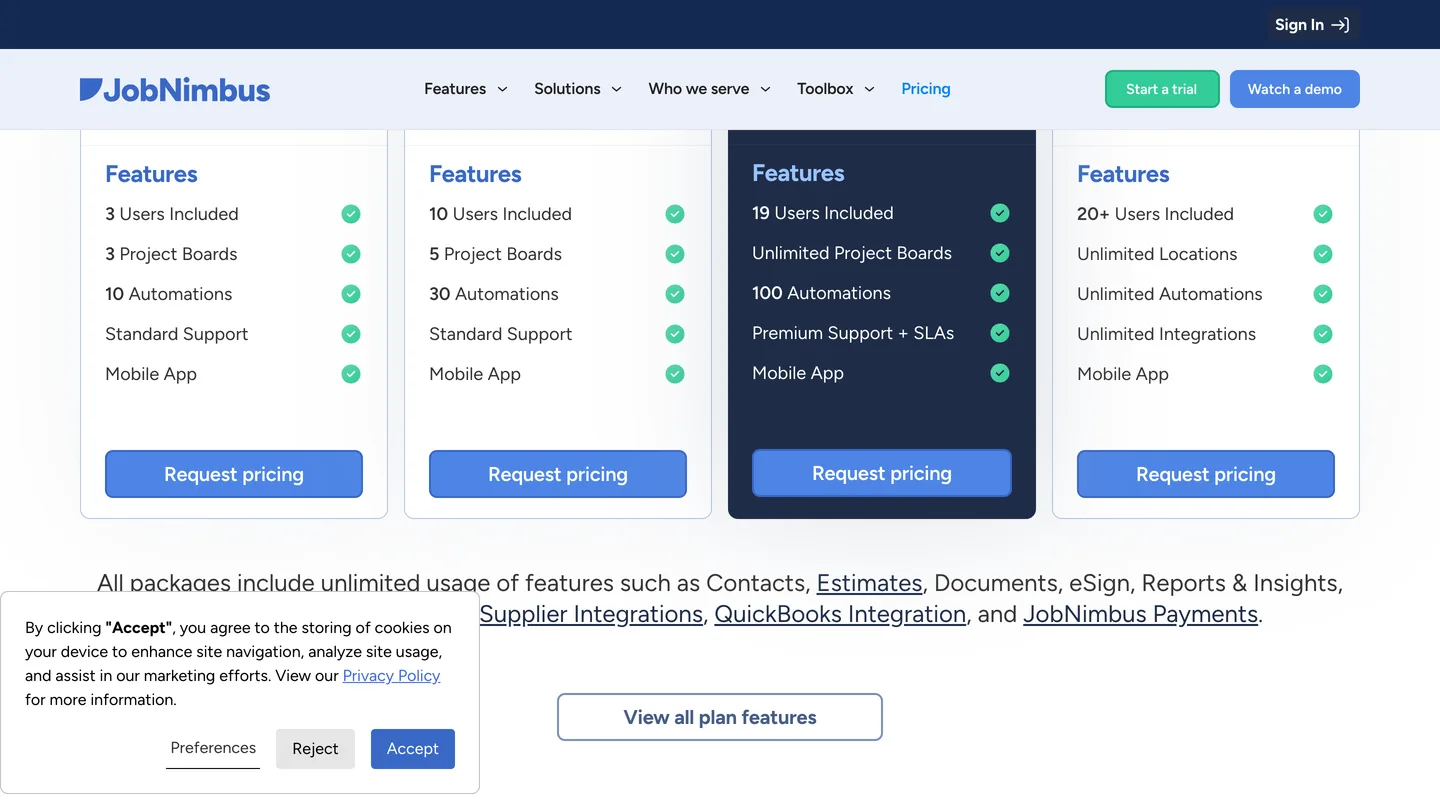 Jul 30, 2026
 Tech Stack
JobNimbus Review 2026: Pricing, Pros, Cons and Alternatives
JobNimbus rates 4.6 on Capterra and orders material straight from ABC Supply and SRS. But it publishes no price, and its supplement route carries a note.
Read Article Jul 30, 2026
 Tech Stack
BuildOps Review 2026: Pricing, Contract Terms and Alternatives
BuildOps runs commercial service and projects on one platform, and publishes no pricing at all. The billing unit, the 30-day data-export window, and who it suits.
Read Article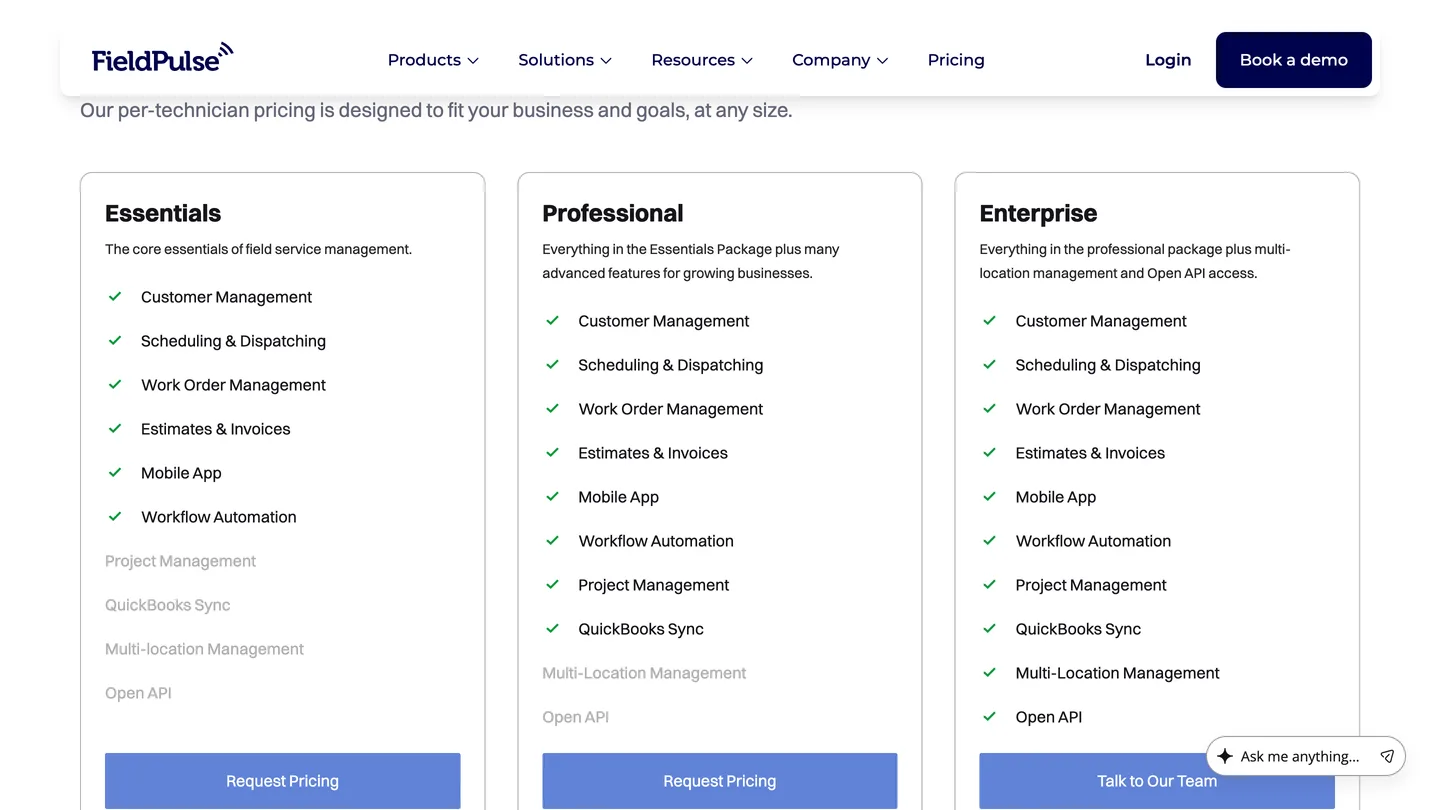 Jul 30, 2026
 Tech Stack
FieldPulse Review 2026: Pricing, Pros, Cons and Alternatives
FieldPulse rates 4.6 on Capterra and is the platform contractors name when they leave a bigger system. But it publishes no price, and the contract runs a year.
Read Article Jul 30, 2026
 Tech Stack
Service Fusion Review 2026: Pricing, Contract and Alternatives
Service Fusion bills flat per company with unlimited users, which is the best structural deal in field service software. The published plans, the contract behind the no-contract line, and the app score every other review gets wrong.
Read Article Jul 30, 2026
 Tech Stack
Knowify Review 2026: Pricing, Job Costing and Alternatives
Knowify rates 4.5 on Capterra and its weakest sub-score is features. What the $99 Core plan withholds, which way the QuickBooks sync really runs, and who should not buy it.
Read Article Jul 29, 2026
 Tech Stack
AccuLynx Review 2026: Pricing, Tier Gating, Alternatives
AccuLynx rates 4.6 across 846 reviews and now publishes an entry price. What that price omits, which tier holds the insurance workflow, and who should skip it.
Read Article Jul 29, 2026
 Tech Stack
Unitel Voice Review 2026: Pricing, Features and Alternatives
Unitel Voice rates 4.6 on Capterra and gives a one-truck shop a business number for $9.99 a month. The published plans, the cost per call, and what it won't do.
Read Article Jul 29, 2026
 Tech Stack
NiceJob vs Podium 2026: Pricing, Contracts and Review Gating
Both vendors print a price, at very different scale and in different currencies. The gap that matters is what Podium will not print: the billing unit, and whether a trade shop gets the number on the page.
Read Article Jul 28, 2026
 Tech Stack
CompanyCam Review 2026: Pricing, Pros, Cons and Alternatives
Every page ranking for CompanyCam still quotes a per-user price the vendor no longer charges. Here are the real plans, the seat math, and who should skip it.
Read Article Jul 28, 2026
 Tech Stack
NiceJob Review 2026: Pricing, Pros, Cons and Alternatives
NiceJob rates 4.9 on Capterra and refuses to gate negative reviews. Real plan pricing, the active-customer threshold nobody publishes, and who should skip it.
Read Article Jul 27, 2026
 Tech Stack
Buildertrend Review 2026: Pricing, Limits and Alternatives
Buildertrend rates 4.5 across 2,486 Capterra reviews and quotes against your revenue rather than your seat count. The workflows, the export problem, the alternatives.
Read Article Jul 27, 2026
 Tech Stack
CallRail Review 2026: Pricing, Pros, Cons and Alternatives
CallRail rates 4.5 on Capterra, and its tracking numbers port out free. But the two usage rates that decide your real bill are the two it does not print.
Read Article Jul 27, 2026
 Tech Stack
Roofr Review 2026: Pricing, Pros, Cons and Alternatives
Roofr rates 4.6 on Capterra and sells $13 measurement reports against a market charging triple. But it will not import a report from anywhere else.
Read Article Jul 25, 2026
 Tech Stack
Housecall Pro Review 2026: Pricing, Pros, Cons, Alternatives
Housecall Pro has the shortest learning curve in the category and the widest review spread. Real pricing, the Instapay math, and the migration trap to plan around.
Read Article Jul 24, 2026
 Tech Stack
Jobber Review 2026: Pricing, Pros, Cons and Alternatives
Jobber rates 4.6 on Capterra with the best mobile app in the category. Real plan pricing, the feature gating that changes your entry price, and who it suits.
Read Article Jul 23, 2026
 Tech Stack
ServiceTitan Review 2026: Pricing, Pros, Cons, Alternatives
ServiceTitan rates 4.3 on Capterra but its weakest score is value for money. Real reported pricing, the 12-month contract, the exit fees, and who it actually suits.
Read Article Jun 3, 2026
 Tech Stack
HVAC Online Scheduling: The 43% Losing After-Hours Bookings
HVAC leads every trade on online booking at just 56.7%, which still leaves 43% of sites forcing an after-hours customer to wait for a business-hours phone call.
Read Article