AccuLynx Pricing 2026: The Real Cost of a Quote-Gated Plan
AccuLynx prints one price for three plans. What 250 dollars covers, the seat floor buried in the contract, the unpublished fees, and 4 rivals compared.
Disclosure This article features tools from our brand partners. If you choose to use them, we may receive compensation at no extra cost to you.
Our editorial choices are independent of these affiliate arrangements. Read our full affiliate disclosure.
Fervor is a CRO and web design studio, not a software reseller, and no vendor paid for placement here or for a kinder verdict. Affiliate links are flagged where they appear, and they never change what we report.
Page at a glance
AccuLynx publishes one figure for a three-plan ladder: $250 a month on Essential, with no billing unit printed beside it. Pro and Elite carry no number at all. The billing unit is per user licence, and it is disclosed on a blog post and in the terms rather than on the pricing page. Read the vendor's own plan matrix and Pro matches Essential on every single row, while twelve rows sit on Elite alone, including supplement tracking, permits, commissions and the production calendar. The agreement behind the "No contracts" line carries a minimum user count you pay regardless of seats removed, a 30 days notice window, nonrefundable prepaid annual fees, and a data storage fee after you leave above 15 users. Add-on prices appear only inside the software at activation. Every figure here was verified July 30, 2026.
The one number AccuLynx prints
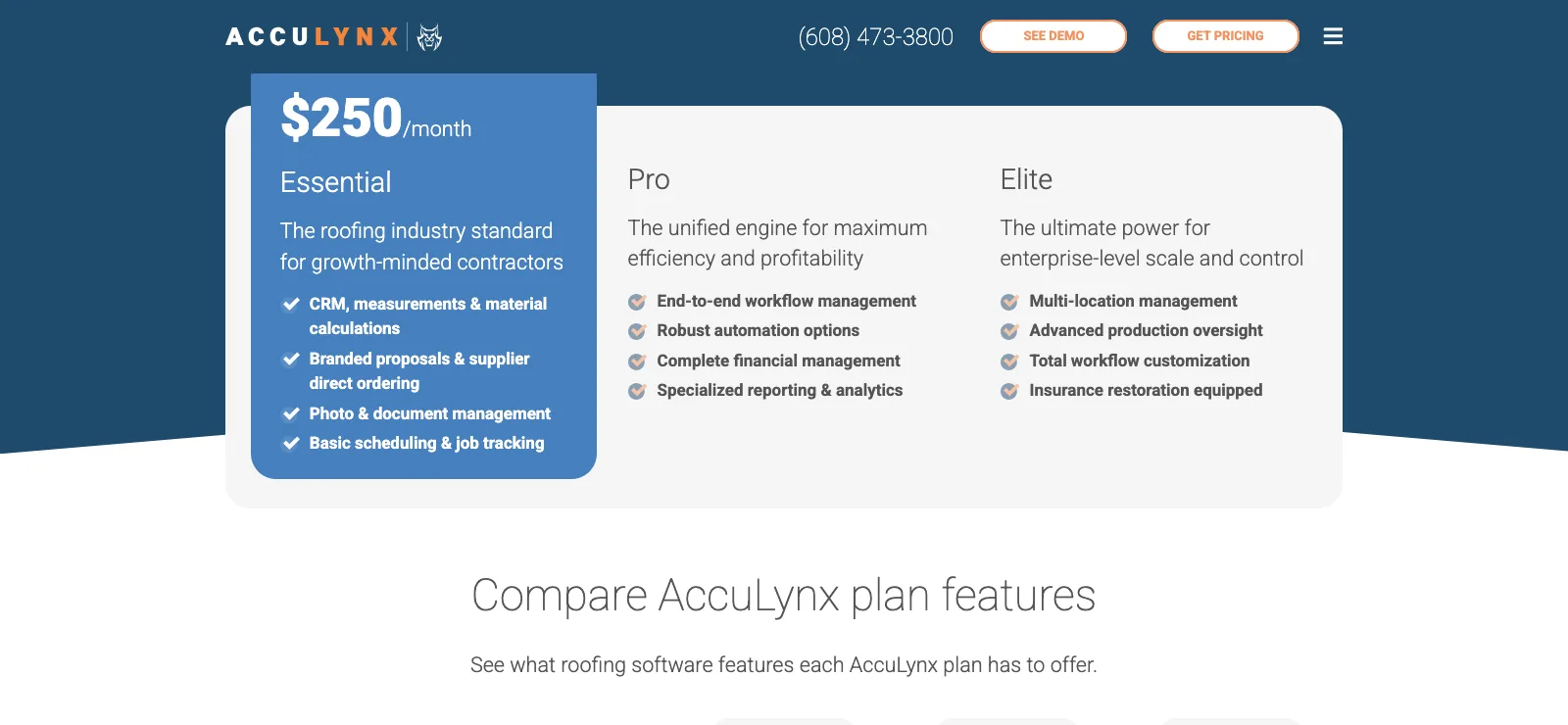
AccuLynx's plan options page shows three plans and exactly one price. Essential reads $250 /month. Pro and Elite show four marketing bullets each and no figure, and the page says its teams "can help you determine the right plan and provide you with a custom price quote." So for two of three plans, AccuLynx publishes no pricing.
So that single number is the reason this page exists. It looks like an answer and it isn't one, because a roofing company owner reading it cannot tell whether $250 buys one seat, five seats or the company. Everything below traces to a page we opened and captured: AccuLynx's plan options page and its full plan matrix, its add-ons page, its own myth-busting article, its General Terms and Conditions, and the pricing pages of four competitors. Where AccuLynx publishes nothing, this page says so instead of borrowing a number.
"AccuLynx publishes $250 a month for Essential and no figure at all for Pro or Elite."
AccuLynx (2026)
| Plan | Published price | Billing unit | What is gated behind it |
|---|---|---|---|
| Essential | $250 a month | Per user licence, stated in the terms, not on the card | CRM, aerial measurement ordering, supplier direct ordering, estimates, invoicing, job costs |
| Pro | None published | Not stated | Nothing the matrix shows. Every row Essential lacks, Pro lacks too |
| Elite | None published | Not stated | Supplement tracking, permits tracking, mortgage check tracking, commissions, production calendar, pipeline reports, multi-location, custom workflow manager |
What the $250 leaves out
Two things are missing from that figure, and both of them change the bill. Start with the unit. AccuLynx's own article answering the long-term-contract question says it plainly: "Customers are charged a monthly fee for each user license." The agreement repeats it in the language of a contract, reserving the right to change "the monthly license fee per User subscription." So the pricing page prints a number without the word it needs, and you have to leave the pricing page to learn what you are buying.
And then there's the floor. No minimum seat count appears anywhere public, so a shop with five people in the office can't multiply its way to a budget. But a floor does exist, and it lives in the contract rather than on the website. More on that below, because it's the single clause most likely to surprise a roofing contractor twelve months in.
The tier ladder has nothing in the middle
AccuLynx publishes a full feature matrix under the three cards, and it repays reading line by line rather than trusting the summary bullets. Forty rows across four groups. Twelve of them are Elite only: custom workflow manager, multiple company location set-up, embedded web forms, mortgage check tracking, permits tracking, production calendar, production status and trade reports, prospecting reports, sales pipeline and closing percentage reports, supplement tracking, advances and paybacks tracking, and commissions.
And now count the rows where Pro differs from Essential. There are none. Every row marked Not Included under Essential is also marked Not Included under Pro, and every row marked Included under Essential is Included under Pro. The Pro card promises "Complete financial management" and "Specialized reporting & analytics", and the matrix directly under it shows the same ticks and the same crosses as the plan below.
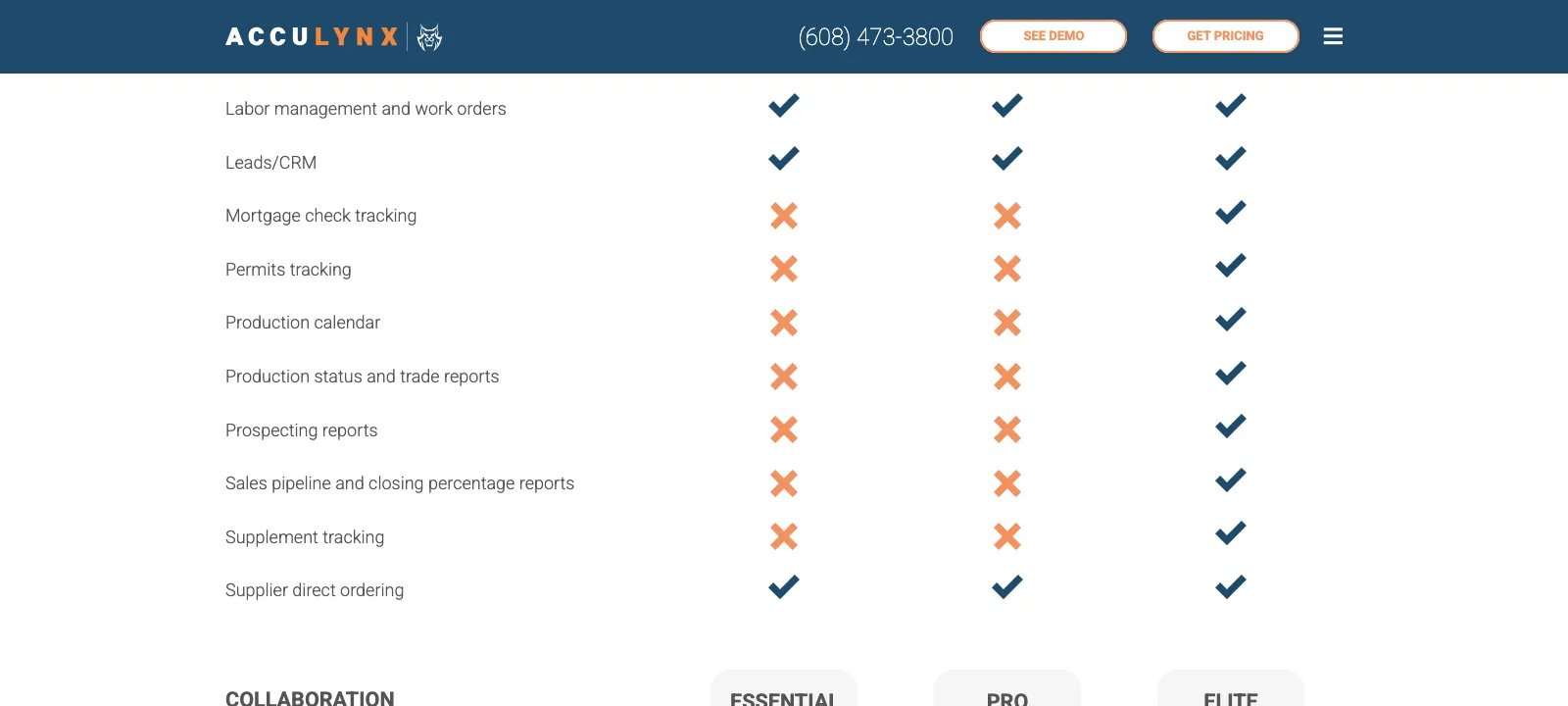
So read as a buyer, the published matrix gives you no documented reason to pay for Pro, and the plan that carries the insurance restoration workflow is the one with no price. If you write supplements, chase mortgage checks and pay your sales team on commission, the number on the website belongs to a company that does none of those things. Ask for the Elite quote first and treat Essential as a floor rather than a starting point.
What the subscription does not cover
Six cost classes usually decide whether roofing software lands on budget. So this is what AccuLynx discloses on each one, and where it discloses nothing at all.
- Implementation and onboarding. No setup fee is published anywhere. AccuLynx does publish a duration, saying customers "can get up and running quickly, typically in as little as 2 weeks." But a duration isn't a fee, so get the onboarding line priced separately in the proposal.
- Payment processing. AccuPay is the in-product payments add-on, and AccuLynx says only that it "charges a small fee for certain types of credit card transactions" and describes itself as backed by WorldPay. No percentage, no per transaction figure, no ACH rate. The terms separately name PayRix as a credit card billing service. And on a re-roof averaging five figures, a single point of processing is real money, so make the rate a written line item.
- Required third-party services. Aerial measurement ordering is on every plan, but the reports are billed by the provider. EagleView publishes no per-report price on its own roofing product page. Roofr does publish one, at $13 a report on its paid plans and $19 on the free one, which is the only public anchor in the category. Call tracking is the same shape: AccuLynx integrates CallRail and a phone system rather than including one, so those bills sit outside the licence.
- Add-on modules. Eight sit outside the plans on the add-ons page: AccuPay, Customer Portal, Smart(er) Docs, ReportsPlus, Data Mart, Texting, Crew App and App Connector. AccuLynx publishes a price for none of them. And the terms explain why nobody outside can print one: the cost of an add-on "will be indicated" at the moment you activate it inside the software. So the number exists, and it exists only where a prospect can't see it.
- Per user overage. Additional seats are added at the same rate as the existing ones and expire with them, which is the fair version of this clause. But removing seats is the expensive direction, and that's covered below.
- Training. This one is genuinely free and AccuLynx says so twice, offering one-to-one training and live phone and email support "for free with every user license". And that's unusual in this category, so weigh it against the quote.
"AccuLynx publishes no setup fee and says customers are typically up and running in as little as 2 weeks."
AccuLynx (2026)
What the agreement says that the pricing page does not
AccuLynx markets flexibility, and on the headline question it earns it. No minimum term is published, the plan options page prints "No contracts", and the vendor says you can cancel without penalty at any time. There is no two-year lock and no early termination or cancellation fee to argue about, which separates AccuLynx from the enterprise end of contractor software.
But the General Terms and Conditions are a different document from the pricing page, and five clauses in the Billing and Termination sections move money. And none of them appear in any pricing roundup we could find.
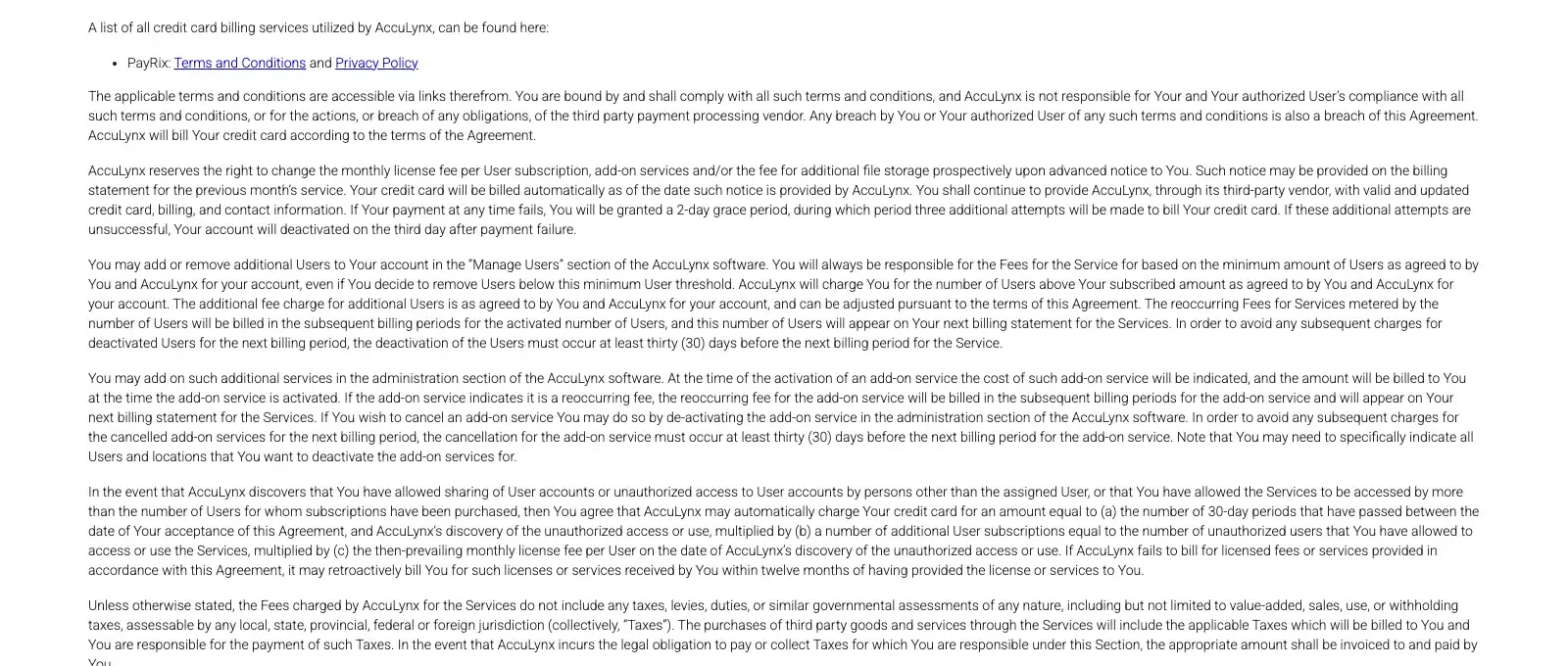
You cannot shrink below your minimum seat count. The agreement states you "will always be responsible for the Fees for the Service for based on the minimum amount of Users as agreed to by You and AccuLynx for your account, even if You decide to remove Users below this minimum User threshold." Roofing is seasonal and crews shrink after the storm work dries up. So that clause means a mid-term downgrade below the floor you negotiated doesn't reduce the invoice, and the seat floor in your proposal is the number that matters rather than the seat count you're running in February.
Removing a seat takes 30 days to take effect. Deactivation "must occur at least thirty (30) days before the next billing period", and the same 30-day rule applies to cancelling an add-on. Cancelling the whole service works the same way: you avoid the next auto-renewal charge only if the request lands 30 days ahead of the billing period ending.
"Deactivating an AccuLynx user takes effect only if it happens at least 30 days before the next billing period."
AccuLynx General Terms and Conditions (2026)
Annual prepay is nonrefundable, and it does not renew as an annual deal. "Any prepaid annual fees made are nonrefundable." At the end of an annual term the service auto-renews "on a monthly billing basis at the then standard rates", so whatever discount you negotiated for paying a year up front quietly evaporates on the anniversary unless you email sales for a fresh quote 30 days out. That is the annual-versus-monthly delta nobody warns you about, and it runs the wrong way.
The per-user rate can change on a billing statement. AccuLynx "reserves the right to change the monthly license fee per User subscription, add-on services and/or the fee for additional file storage prospectively upon advanced notice", and the agreement says that notice "may be provided on the billing statement for the previous month's service." So the notice can arrive on the invoice itself.
Leaving can cost money if you are big enough. "If you leave AccuLynx and have a base user count greater than 15, you are subject to a monthly data storage fee to keep your account active." And on termination, AccuLynx "shall have no obligation to maintain, store or provide any of Your information and data and may delete such data" unless you ask in writing before the termination date, in which case "we may charge You a reasonable fee to fulfill that request." So export your job records, photos, signed contracts and financials before the last billing period ends, in writing, and treat the export as a scheduled task rather than an afterthought.
"A base user count above 15 makes a departing AccuLynx account subject to a monthly data storage fee."
AccuLynx General Terms and Conditions (2026)
Modelling year one when the vendor will not
This is the table every pricing page in the category refuses to build, and we can only half build it, because AccuLynx's per-user rate isn't public. What follows shows the shape of the arithmetic at three seat counts, with the two roofing platforms that do publish a per-seat rate and a flat rate sitting alongside for calibration.
| Seats | AccuLynx Essential | RoofLink | Roofr Essentials |
|---|---|---|---|
| 3 users | 3 seats at a quote-gated per-user rate, times 12, with your negotiated seat floor as the minimum | 3 seats at $400 a month, times 12, plus a one-time $1,500 setup fee | $249 a month, times 12, unlimited users, plus $13 a measurement report |
| 8 users | 8 seats at the same quote-gated rate, times 12, plus any add-ons priced at activation | 8 seats at $400 a month, times 12, plus the same one-time setup fee | Unchanged. The plan fee does not move with headcount |
| 20 users | 20 seats at the quote-gated rate, times 12, and a monthly data storage fee applies if you later leave | 20 seats at $400 a month, times 12, plus the same one-time setup fee | Unchanged, though a 20-seat roofing company is past what a proposal tool covers alone |
The useful reading is not the totals. It is that two of three columns can be finished by a contractor sitting at a kitchen table on a Sunday, and one of them cannot be finished without a sales call. If your buying process involves a partner, a bookkeeper or a lender who wants a number before the meeting, that difference is the whole decision.
"RoofLink publishes $400 a month per user plus a one-time $1,500 setup fee."
RoofLink (2026)
"Roofr publishes $249 and $349 a month for unlimited users, with measurement reports at $13."
Roofr (2026)
List price against what teams pay
List is not what teams pay in this category, and AccuLynx is quote-based by design for two plans out of three, which means the published $250 is an opening position rather than a rate card. And the levers that move a quote-based per-seat deal are boring, which is usually a sign that they work: commit to an annual term for a discount, but read the renewal clause above first, because the discount does not survive the anniversary on its own. Ask for the seat floor to be set at your February headcount instead of your August one. Ask for the add-ons you expect to switch on to be priced in the proposal rather than discovered at activation. And ask what happens to the rate at renewal, in writing, because the agreement lets it change on an invoice.
One caution about the numbers circulating elsewhere. Search "AccuLynx pricing" and you'll find confident per-user ranges. We checked the pages printing them and every one is published by a company selling a competing roofing platform or by an aggregator with no stated method. None of those figures appear here. If you have a real quote in hand, that quote is better evidence than anything on the open web, including this page.
How the roofing shortlist prices, side by side
| Platform | Published entry price | Billing unit | Setup fee | Free trial |
|---|---|---|---|---|
| AccuLynx | $250 a month on Essential, nothing for Pro or Elite | Per user licence | None published | None published |
| JobNimbus | Quote only, all four tiers | Banded by seats at 3, 10, 19 and 20-plus | None published | 14-day free trial, no credit card |
| Roofr | $0 a month Starter, then $249 and $349 | Flat plan, unlimited users | No setup or onboarding fees | Free Starter plan |
| RoofLink | $400 a month | Per user, flat rate, everything included | One-time $1,500 setup fee | None published |
| Leap | $79 a month Essential, $298 a month Team | Single user on Essential, then $99 per added user | None published | 14-day free trial |
Two things fall out of that table. RoofLink is the useful comparison for AccuLynx because it's the only roofing platform publishing a real per-user rate, and it isn't a low one. So a per-seat roofing platform costing serious money per user is normal in this market, which makes AccuLynx's silence a choice about disclosure rather than a sign of a bad price.
"Leap publishes $79 a month for a single user and $298 a month for Team, at $99 per added user."
Leap (2026)
"JobNimbus publishes no price on any tier and bands its seats at 3, 10, 19 and 20-plus."
JobNimbus (2026)
And the transparency ranking inverts the feature ranking. Roofr publishes every figure including per-report costs. RoofLink publishes its rate and its setup fee. Leap publishes an entry price and a per-seat increment. AccuLynx publishes one number out of three. JobNimbus and ServiceTitan publish none. If you need a budget before you take a sales call, that is your shortlist order.
What roofing contractors say about the bill
The pattern in the public review corpus is unusual and worth naming. The price complaints are not in the one-star reviews. They sit inside four and five-star ones, written by people who like the product, which is exactly why a contractor scanning by star rating never finds them. A CEO writing on April 16, 2026 rated it five stars and still wrote that "The price of Acculynx can be a tough pill to swallow", adding that it is cheaper than the horizontal alternative. An office manager on November 15, 2025, also five stars, wrote "Honestly the price. Although it is very worth it, but it makes it less accessible for a small business."
"A CEO rating AccuLynx five stars on April 16, 2026 still called the price a tough pill to swallow."
Capterra (2026)
The add-ons draw the sharpest version of it. A vice president on April 17, 2026 wrote that "The cost for additional add ons is a lot" and that some of what her team asks for costs so much she cannot agree to it. An owner on April 16, 2026 said "the only thing I could complain about is the add ons all cost." A business development manager the same day gave "Expensive cost for add-ons" as his single con. And a senior sales consultant on December 3, 2025 named the structural version: "If you want to use them, the entire company must adopt it at the management level. You cannot choose to use one yourself."
So read those six together and the shape of the real bill appears. The licence is defensible and the add-ons are where the budget goes. And because the add-on price is only shown at activation inside the software, that part of the bill can't be estimated until you already own the software.
Who should not pay for this
Do not buy it if you run more than one trade. AccuLynx is roofing software and never claims otherwise, so a roofing and siding company will keep half the business in a spreadsheet while paying a per-seat premium for depth on one side of the house. If a second trade is more than a tenth of your revenue, stay on a horizontal platform and accept shallower roofing coverage.
And there's a volume floor. Below roughly 10 re-roofs a month, per-seat billing outruns the admin hours a platform gives back, and a free proposal-and-measurement tool covers the work. What you give up by going vertical is the wider integration marketplace a generic FSM carries and any path into commercial project management inside the same tool. What you get back is your distributor's catalogue, your measurement provider, and a job stage list that reads like a re-roof. AccuLynx connects supplier direct ordering to ABC Supply, SRS Distribution and QXO, imports measurements from EagleView, GAF QuickMeasure, Hover and RoofSnap, and syncs to QuickBooks. It carries no Xactimate or Symbility bridge, so carrier estimating stays a separate system and a separate bill.
What to get in writing before you sign
- The per-user rate, the seat count it applies to, and the minimum user threshold going into your proposal.
- The Elite quote, if you touch insurance work at all, before anyone quotes you Essential.
- A price for every add-on you expect to switch on, in the proposal rather than at activation.
- The AccuPay processing rate as a percentage and a per-transaction figure.
- What the rate does at renewal, and what happens to an annual discount on the anniversary.
- The data export format and whether the fee named in the termination clause will be waived.
The part the price cannot buy
Fervor is a CRO and web design studio, not an AccuLynx competitor, and we have no quote to sell you. But there is a gap between what a per-seat platform collects and what your website does with it, and that gap is the one we have numbers on.
AccuLynx stores unlimited photos and documents against every job on every plan, so a roofing company two years in is sitting on thousands of documented re-roofs. We inspected 130 roofing contractor websites for the roofing State of the Industry report, and only 8.5% shipped a before-and-after gallery signal in retrievable HTML. So the photo library you are paying a per-user subscription to build is doing nothing for the homeowner comparing three quotes on a phone.
So that sequence is worth checking before you upgrade a tier. The full statistics are public and the roofing hub covers the marketing side.
See whether your website uses the job photos you already pay to store
Fervor inspects your site the way a homeowner comparing roofers uses it, then shows you the exact places proof of work goes missing. It takes about three days and the first several each week are free.
Get a Site InspectionWhat we read, and what we would not print
We did not run AccuLynx on a live roofing company and we are not going to imply otherwise. What this page is instead: AccuLynx's plan options page and its plan matrix read row by row, its add-ons page, its AccuPay page, its FAQ, its own article answering the contract question, and its General Terms and Conditions read clause by clause, which is where most of the findings above came from. Competitor figures come from JobNimbus, Roofr, RoofLink, Leap and ServiceTitan, two of which publish nothing. The dated contractor comments come from the Capterra review profile, which returns an error to automated fetch and was therefore read in a browser and captured by hand. Bear in mind that Capterra, GetApp and Software Advice share one review pool, so a matching rating across all three is one sample rather than three.
What we could not verify, and would not guess at: any per-user dollar rate for AccuLynx, any Pro or Elite figure, any add-on price, the AccuPay processing rate, and any EagleView per-report cost. Third-party pages print all of them. Every page we checked that carries an AccuLynx per-user number is published by a company selling a competing roofing platform or by an aggregator that states no method, and the EagleView ranges we found disagree with each other by more than fourfold. So those figures are user-reported at best, the vendor did not confirm them, and none of them belong on a page a roofing contractor is going to budget against.
If you want to price AccuLynx roofing software directly, its plan options page carries the published Essential figure and the quote request.
What AccuLynx roofing software users say
The price of Acculynx can be a tough pill to swallow but I must be fair in stating that it is well worth that price and is still cheaper than Service Titan.
The cost for additional add ons is a lot. Sometimes my team will ask for something or look at something and it costs so much money that I just can't agree to it even if I think it would help. I wish some of these add ons were included.
Expensive cost for add-ons
There isn’t anything. Overall the experience has been delightful the only thing I could complain about is the add ons all cost.
Honestly the price. Although it is very worth it, but it makes it less accessible for a small business.
Finally, they have several nice enhancements, many of which are additional fees. If you want to use them, the entire company must adopt it at the management level. You cannot choose to use one yourself.
Frequently asked questions
How much does AccuLynx cost per month?
AccuLynx publishes exactly one figure: $250 a month on the Essential plan. Pro and Elite show marketing bullets and no number, and the plan options page directs you to sales for a custom price quote. The $250 also carries no billing unit next to it, so the page does not tell you whether it buys one seat or the company. The unit is published elsewhere: AccuLynx states that customers are charged a monthly fee for each user license, and its General Terms and Conditions reserve the right to change the monthly license fee per User subscription. So budget per seat, and treat $250 as the opening of a quote conversation rather than as your bill.
Does AccuLynx charge per user?
Yes. Billing is per user licence, and licences cannot be shared between people. Additional seats can be added during any 30-day period at the same rate as your existing subscriptions, and they expire when the rest of your term does. Removing seats is the harder direction: the agreement says you remain responsible for the fees based on the minimum number of users agreed for your account even if you drop below that threshold, and a deactivation has to happen at least 30 days before the next billing period to avoid the next charge. For a roofing company whose headcount swings with storm season, the minimum seat count in your proposal is the number that decides your winter invoice.
Which AccuLynx plan includes supplement tracking?
Elite, and only Elite. AccuLynx publishes a full plan comparison matrix and supplement tracking shows a cross on both Essential and Pro. Permits tracking, mortgage check tracking, the production calendar, production status and trade reports, prospecting reports, sales pipeline and closing percentage reports, commissions, advances and paybacks tracking, embedded web forms, the custom workflow manager and multi-location set-up are Elite as well. Twelve rows in total. If you run insurance restoration work, the one published price belongs to the plan that does not carry your workflow, and the plan that does carries no published price.
What is the difference between the AccuLynx Essential and Pro plans?
On the published feature matrix, nothing. Every row marked Not Included under Essential is also Not Included under Pro, and every row marked Included under Essential is Included under Pro. The Pro card promises end-to-end workflow management, robust automation, complete financial management and specialized reporting, but the matrix printed directly beneath it shows the same ticks and the same crosses as Essential. Whatever Pro adds, AccuLynx does not document it publicly and does not price it publicly either. Ask for the specific capabilities Pro unlocks in writing before you accept a Pro quote.
Does AccuLynx have hidden fees?
Not hidden so much as unpublished. Eight add-ons sit outside the plans, including AccuPay, Customer Portal, Smart(er) Docs, ReportsPlus, Data Mart, Texting, the Crew App and the App Connector, and AccuLynx publishes a price for none of them. The terms explain why: the cost of an add-on is indicated at the moment you activate it inside the software, so the figure only exists where a prospect cannot see it. The AccuPay payment processing rate is also unpublished, described only as a small fee on certain card transactions. Onboarding carries no published fee, and training and support are free with every user licence. One real exit cost does appear in the terms: leaving with a base user count above 15 makes you subject to a monthly data storage fee to keep the account active.
Does AccuLynx require a contract?
No long-term contract, and that is genuinely a strength. AccuLynx says it does not require customers to sign long term contracts, offers monthly billing and lets you cancel without penalty at any time, and the plan options page prints No contracts. No minimum term, no early termination fee and no cancellation fee is published. The agreement does add three timing rules that matter: a cancellation request has to arrive 30 days before the billing period ends to avoid the next charge, any prepaid annual fees are nonrefundable, and an annual term auto-renews on a monthly basis at then standard rates rather than as another annual deal.
Is AccuLynx cheaper than JobNimbus, Roofr or RoofLink?
You cannot fully answer that from public pages, which is the point. AccuLynx publishes one price out of three plans and JobNimbus publishes none across four tiers, banded at up to 3, up to 10, up to 19 and 20-plus users. Roofr publishes everything: a free Starter plan with unlimited users and $19 measurement reports, then $249 and $349 monthly plans with $13 reports and no setup or onboarding fees. RoofLink publishes $400 per user per month plus a one-time $1,500 setup fee. Leap publishes $79 a month for a single-user plan and $99 for each added user. On per-seat economics RoofLink is the closest published comparison to AccuLynx, and it shows that a serious per-user rate is normal in roofing software.
What should I ask for before signing an AccuLynx quote?
Six things, in writing. The per-user rate and the minimum user threshold that will go in your proposal. The Elite quote first if you touch insurance work at all, because supplements, permits and commissions live there. A price for every add-on you expect to switch on, in the proposal rather than at activation. The AccuPay processing rate as a percentage and a per-transaction figure. What the rate does at renewal, since the agreement allows the per-user fee to change on notice that may arrive on a billing statement. And the data export format plus whether the reasonable fee named in the termination clause will be waived.
Freshness
How we keep this page current
Three dates govern this review, and they carry different meanings. The initial source sweep is dated July 30, 2026; when only part of the evidence set is recaptured later, that later date is stated beside the refreshed claim. We last revised the page on July 30, 2026. And the user reviews we quote were posted over roughly the last 24 months, so their individual dates remain part of the evidence instead of being overwritten by a later pricing update.
We revise the page when AccuLynx roofing software changes a published price or a contract term, when a rating we cite moves by more than a few tenths, or when the vendor ships something big enough to change the verdict. We never bump the date just to look fresh, because Google treats that as manipulation and so do we. If a figure here reads as stale by the time you land on it, treat it as a floor and check the vendor's own page. We linked it at every number for exactly that reason.
Sourcing
How this review was researched
Every figure on this page traces to a captured source linked inline where it appears. The initial sweep is dated July 30, 2026; any later, partial recapture is dated at the claim rather than relabelling the whole evidence set. Ratings come from Capterra, GetApp, Software Advice and the Apple App Store. Note that Capterra, GetApp and Software Advice share one Gartner Digital Markets review pool, so an identical score across all three is a single sample rather than three corroborating ones, and this page treats it that way. G2, TrustRadius and Trustpilot block automated access, so where their numbers appear they are labelled as reported rather than verified. No claim here is sourced from Reddit or from a contractor Facebook group, because neither could be retrieved and quoting them would mean inventing attribution. Pricing marked as reported comes from third-party roundups, never from Fervor. Fervor's own findings come from the Contractor CRO Index 2026.
About
About Fervor Studio
Fervor Studio is a conversion rate optimization (CRO) and web design studio for home services contractors across North America, based in Cochrane, Alberta. Fervor does not sell field service management software and is not an alternative to AccuLynx roofing software. It publishes the Contractor CRO Index, a public benchmark measuring contractor website conversion potential using reproducible, open-source methods such as axe-core and Google Lighthouse. Fervor Studio is operated by Fervor Group Inc.
 Aug 2, 2026
 Tech Stack
Best Plumbing Software in 2026: Ten Ranked Across Four Classes
A plumbing company’s work runs through four classes of software that do not substitute for each other, and it only buys two of them. Ten products, each with a published price or an explicit statement that the vendor publishes none.
Read Article Jul 31, 2026
 Tech Stack
NiceJob vs Birdeye 2026: Pricing, Contracts and Review Gating
One of these vendors puts its price on the page and its cancellation terms in writing. The other puts a form in front of both, and the complaint record is where its contract length shows up.
Read Article Jul 31, 2026
 Tech Stack
Podium vs Birdeye 2026: Pricing, Contracts and Review Gating
Only one of these two will tell you what it costs before a sales call, and even that number carries a carve-out aimed squarely at trade contractors.
Read Article Jul 31, 2026
 Tech Stack
Best Electrical Contractor Software 2026: 11 Ranked and Priced
An electrical contracting business makes two software purchases that do not substitute for each other, and every roundup answering this query covers only one of them. Eleven platforms, with a published price or an explicit statement that the vendor publishes none.
Read Article Jul 31, 2026
 Tech Stack
Best HVAC Software in 2026: Eleven Ranked Across Three Classes
An HVAC contracting business buys across three classes of software that do not substitute for each other, and every roundup answering this query covers only one of them. Eleven products, each with a published price or an explicit statement that the vendor publishes none.
Read Article Jul 30, 2026
 Tech Stack
Houzz Pro Canada Review 2026: Pricing and Alternatives
Houzz Pro serves different pricing renderings. What Canadian buyers see, how GST/HST and payments work, what Custom gates, and what the annual contract commits you to.
Read Article Jul 30, 2026
 Tech Stack
JobNimbus Pricing in 2026: What the Quote Does Not Cover
JobNimbus prints no figure on any of its four plans. So the only rate you can read before a sales call is the payments meter, and it is the biggest line on the bill.
Read Article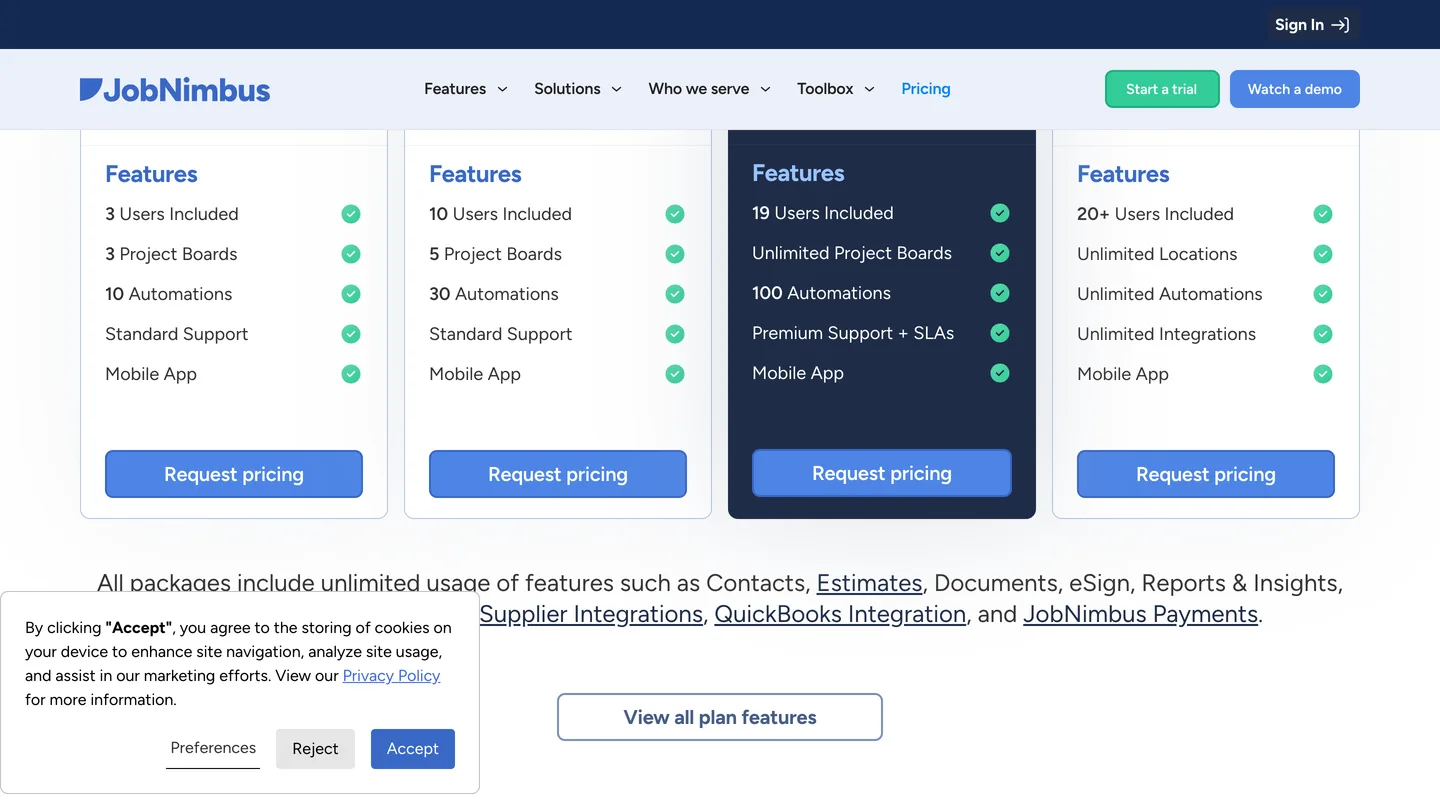 Jul 30, 2026
 Tech Stack
JobNimbus Review 2026: Pricing, Pros, Cons and Alternatives
JobNimbus rates 4.6 on Capterra and orders material straight from ABC Supply and SRS. But it publishes no price, and its supplement route carries a note.
Read Article Jul 30, 2026
 Tech Stack
BuildOps Review 2026: Pricing, Contract Terms and Alternatives
BuildOps runs commercial service and projects on one platform, and publishes no pricing at all. The billing unit, the 30-day data-export window, and who it suits.
Read Article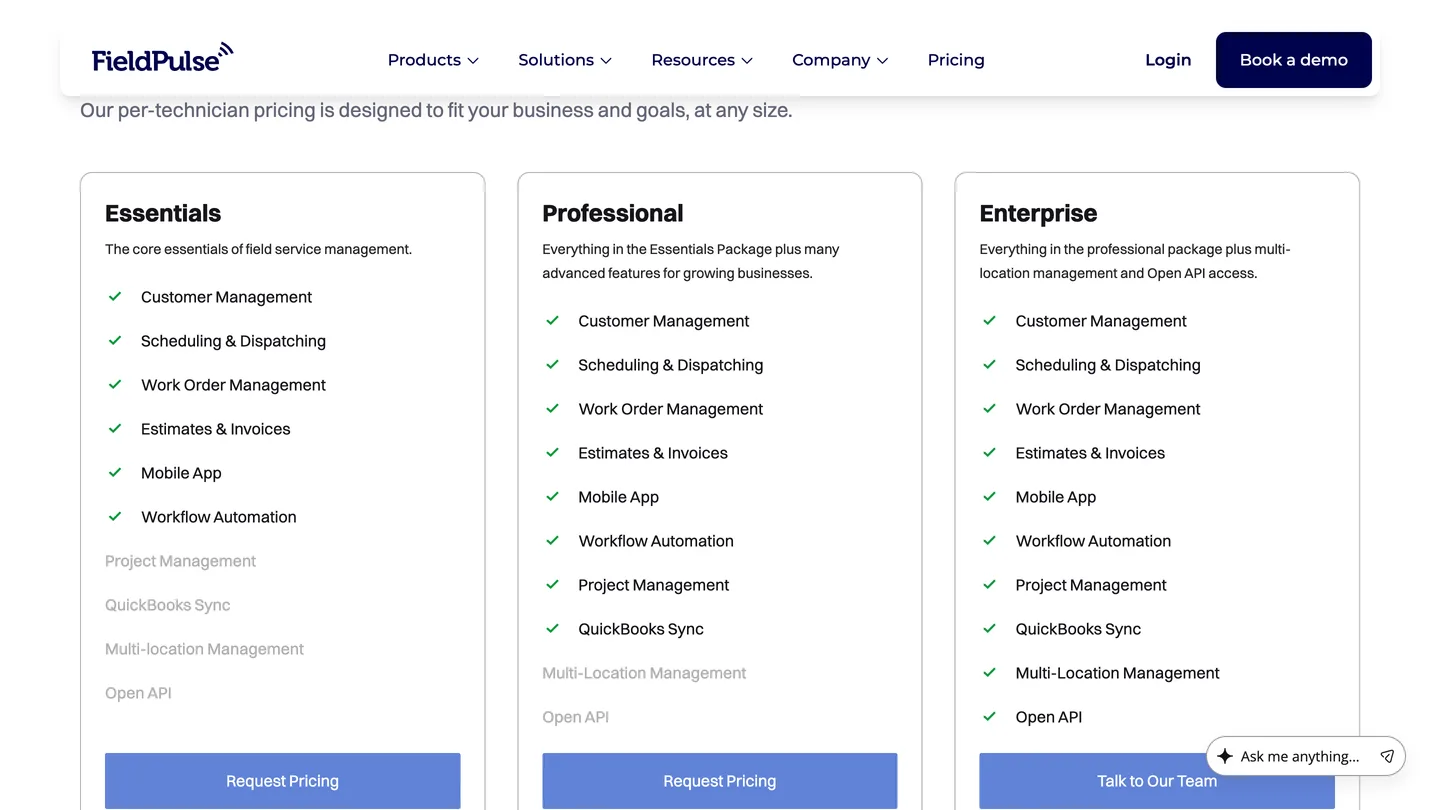 Jul 30, 2026
 Tech Stack
FieldPulse Review 2026: Pricing, Pros, Cons and Alternatives
FieldPulse rates 4.6 on Capterra and is the platform contractors name when they leave a bigger system. But it publishes no price, and the contract runs a year.
Read Article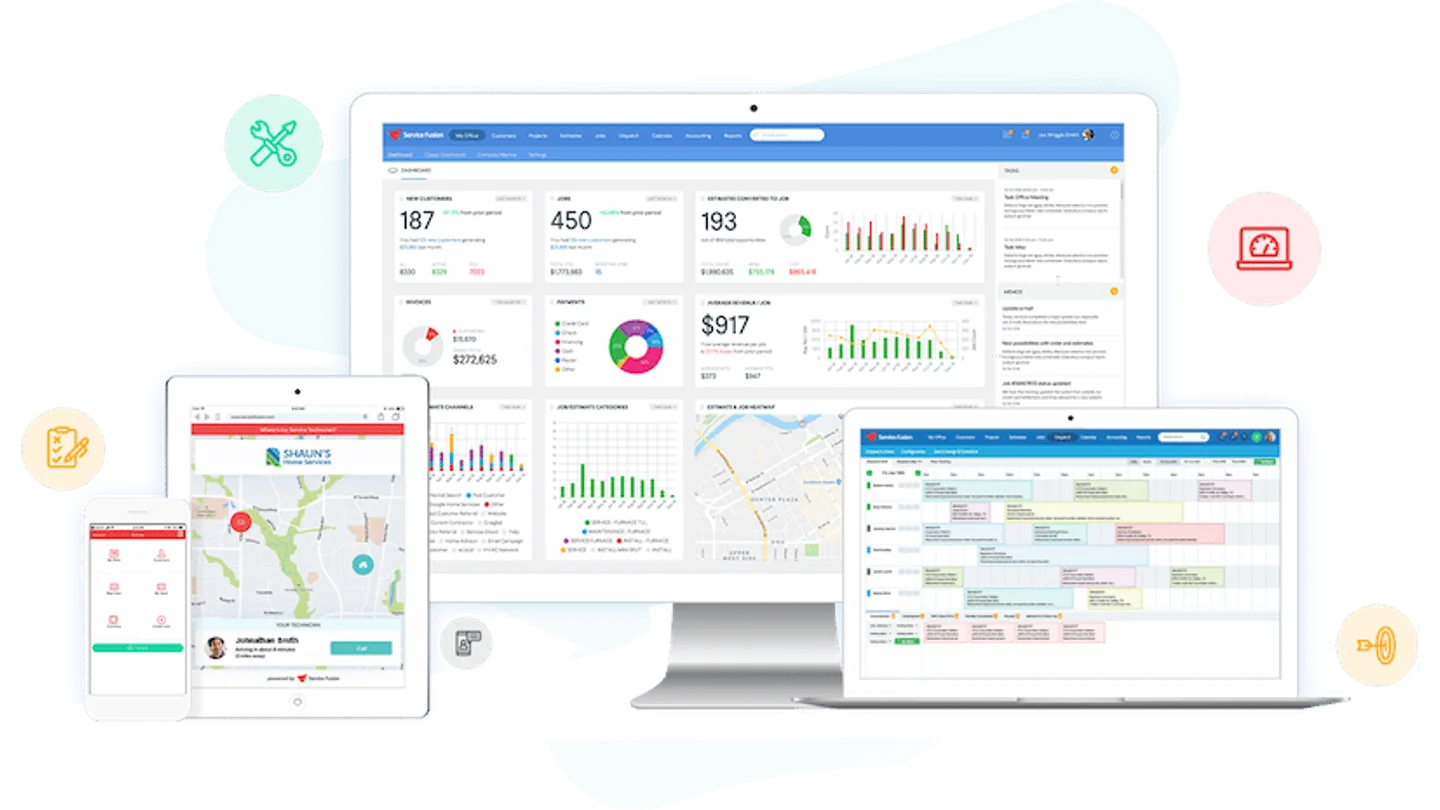 Jul 30, 2026
 Tech Stack
Service Fusion Review 2026: Pricing, Contract and Alternatives
Service Fusion bills flat per company with unlimited users, which is the best structural deal in field service software. The published plans, the contract behind the no-contract line, and the app score every other review gets wrong.
Read Article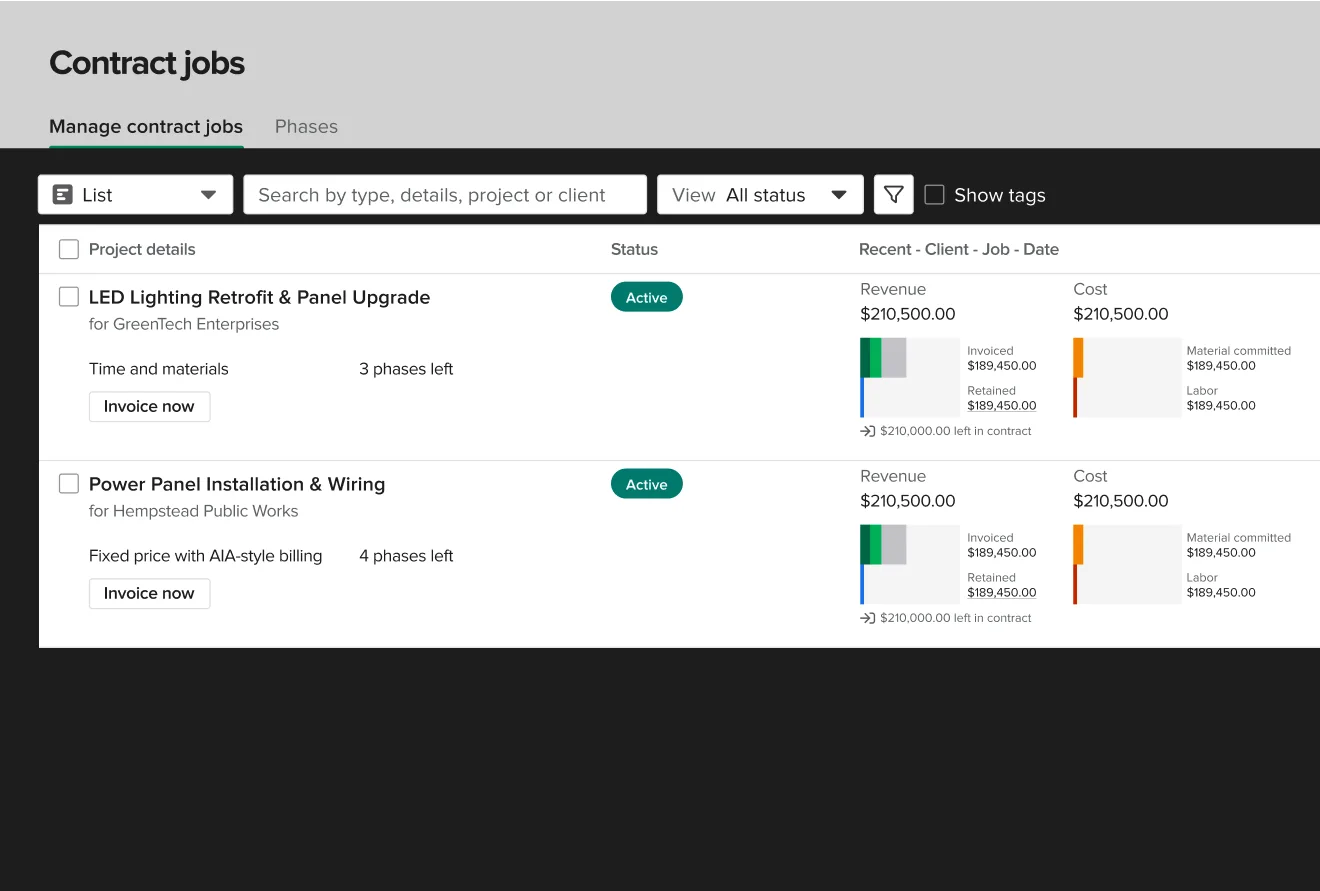 Jul 30, 2026
 Tech Stack
Knowify Review 2026: Pricing, Job Costing and Alternatives
Knowify rates 4.5 on Capterra and its weakest sub-score is features. What the $99 Core plan withholds, which way the QuickBooks sync really runs, and who should not buy it.
Read Article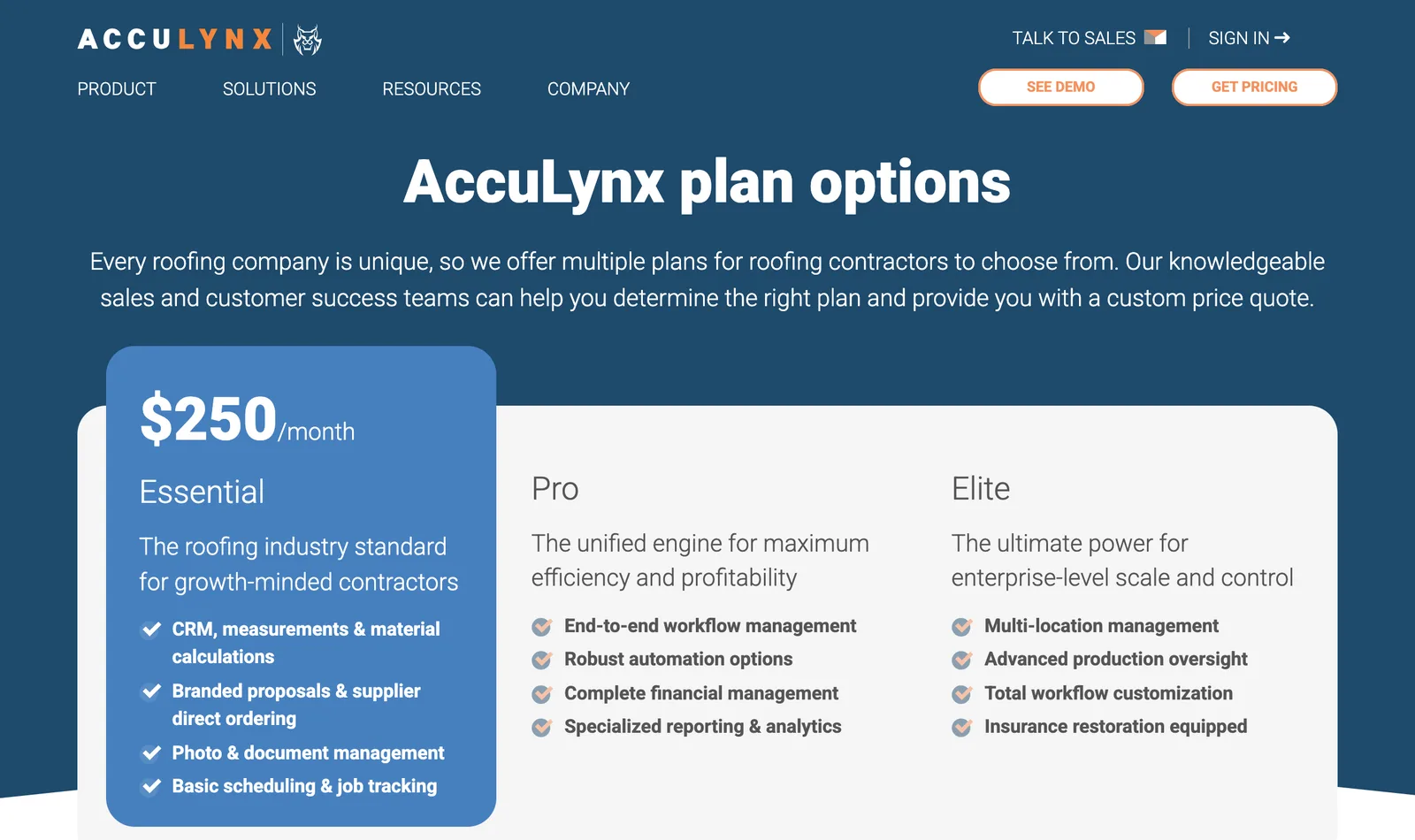 Jul 29, 2026
 Tech Stack
AccuLynx Review 2026: Pricing, Tier Gating, Alternatives
AccuLynx rates 4.6 across 846 reviews and now publishes an entry price. What that price omits, which tier holds the insurance workflow, and who should skip it.
Read Article Jul 29, 2026
 Tech Stack
Unitel Voice Review 2026: Pricing, Features and Alternatives
Unitel Voice rates 4.6 on Capterra and gives a one-truck shop a business number for $9.99 a month. The published plans, the cost per call, and what it won't do.
Read Article Jul 29, 2026
 Tech Stack
NiceJob vs Podium 2026: Pricing, Contracts and Review Gating
Both vendors print a price, at very different scale and in different currencies. The gap that matters is what Podium will not print: the billing unit, and whether a trade shop gets the number on the page.
Read Article Jul 28, 2026
 Tech Stack
CompanyCam Review 2026: Pricing, Pros, Cons and Alternatives
Every page ranking for CompanyCam still quotes a per-user price the vendor no longer charges. Here are the real plans, the seat math, and who should skip it.
Read Article Jul 28, 2026
 Tech Stack
NiceJob Review 2026: Pricing, Pros, Cons and Alternatives
NiceJob rates 4.9 on Capterra and refuses to gate negative reviews. Real plan pricing, the active-customer threshold nobody publishes, and who should skip it.
Read Article Jul 27, 2026
 Tech Stack
Buildertrend Review 2026: Pricing, Limits and Alternatives
Buildertrend rates 4.5 across 2,486 Capterra reviews and quotes against your revenue rather than your seat count. The workflows, the export problem, the alternatives.
Read Article Jul 27, 2026
 Tech Stack
CallRail Review 2026: Pricing, Pros, Cons and Alternatives
CallRail rates 4.5 on Capterra, and its tracking numbers port out free. But the two usage rates that decide your real bill are the two it does not print.
Read Article Jul 27, 2026
 Tech Stack
Roofr Review 2026: Pricing, Pros, Cons and Alternatives
Roofr rates 4.6 on Capterra and sells $13 measurement reports against a market charging triple. But it will not import a report from anywhere else.
Read Article Jul 25, 2026
 Tech Stack
Housecall Pro Review 2026: Pricing, Pros, Cons, Alternatives
Housecall Pro has the shortest learning curve in the category and the widest review spread. Real pricing, the Instapay math, and the migration trap to plan around.
Read Article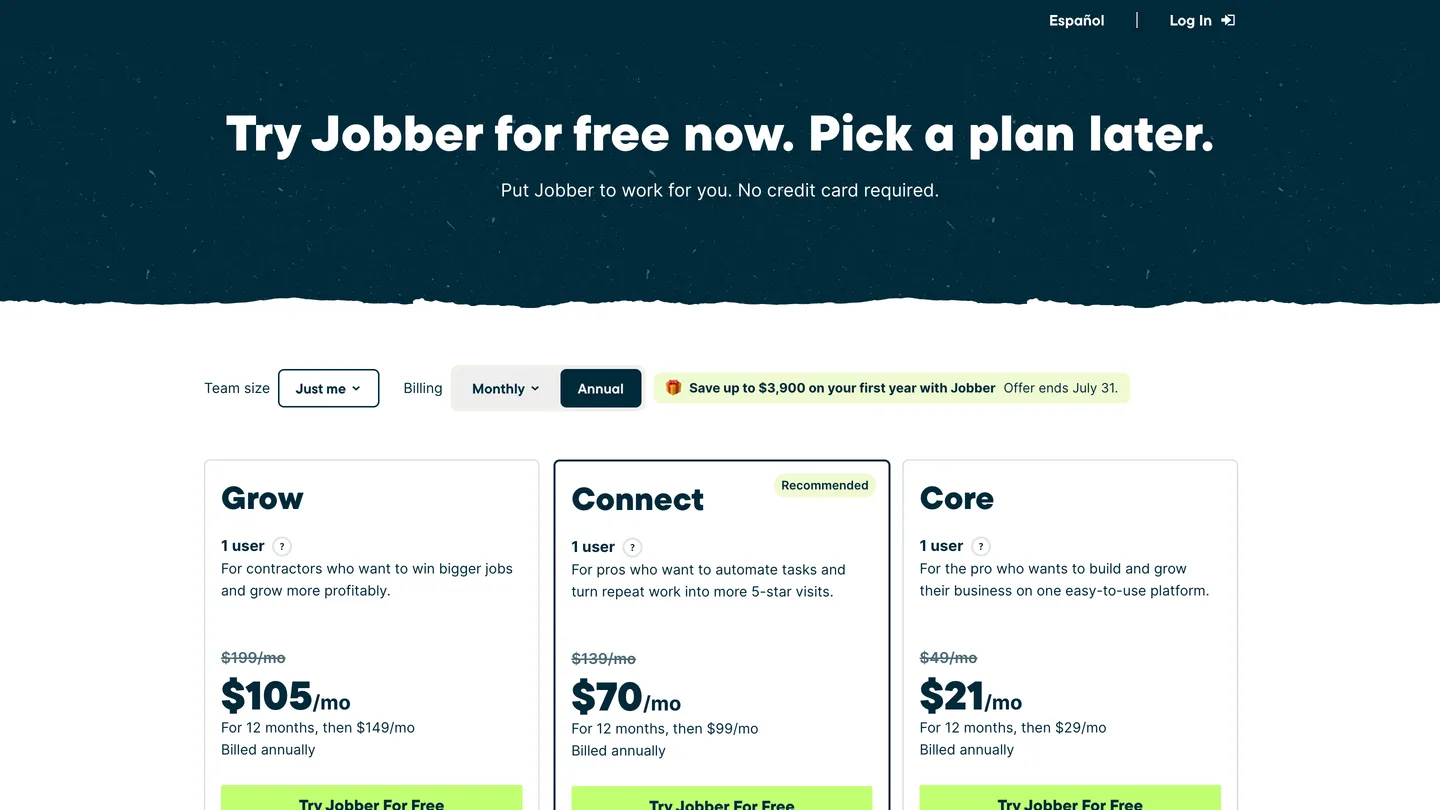 Jul 24, 2026
 Tech Stack
Jobber Review 2026: Pricing, Pros, Cons and Alternatives
Jobber rates 4.6 on Capterra with the best mobile app in the category. Real plan pricing, the feature gating that changes your entry price, and who it suits.
Read Article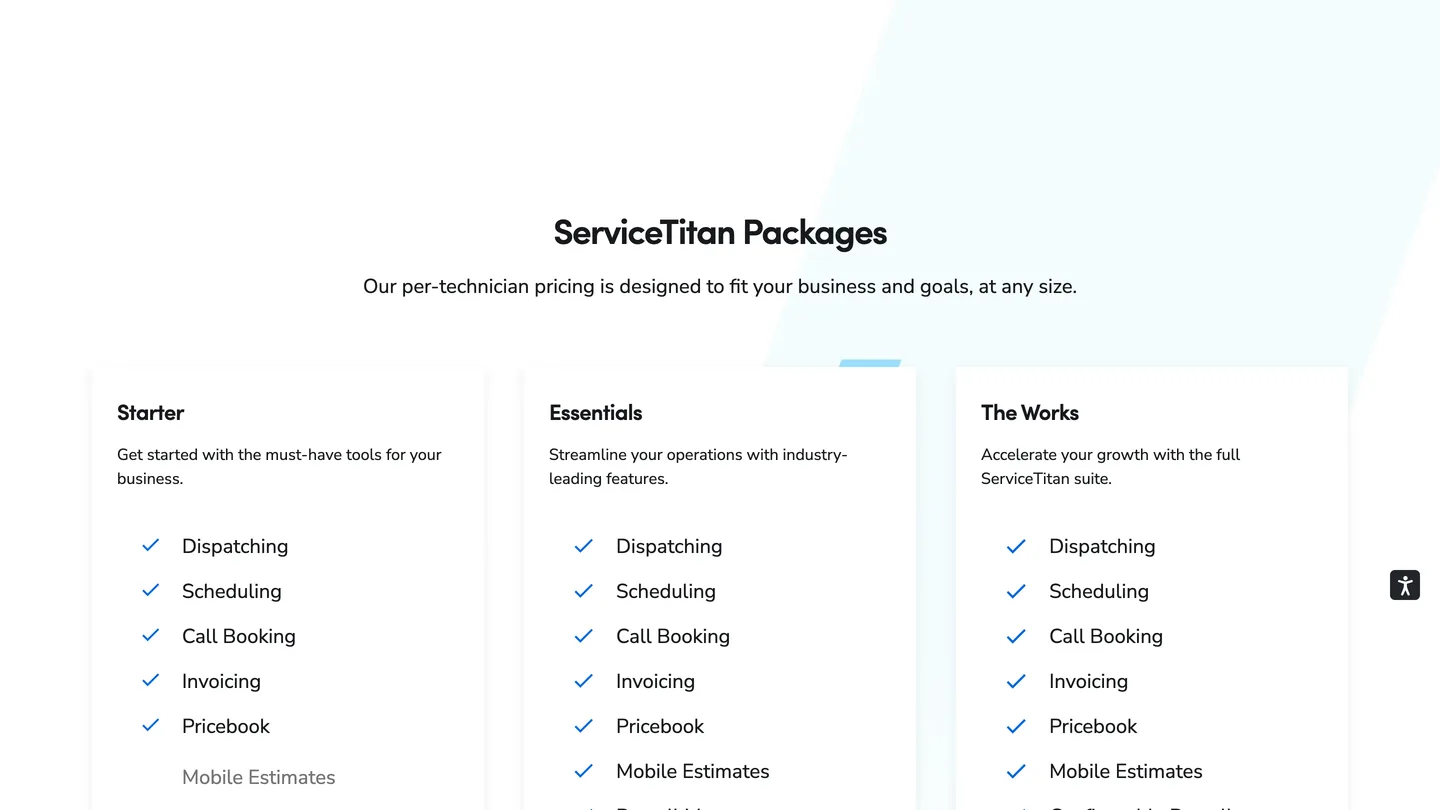 Jul 23, 2026
 Tech Stack
ServiceTitan Review 2026: Pricing, Pros, Cons, Alternatives
ServiceTitan rates 4.3 on Capterra but its weakest score is value for money. Real reported pricing, the 12-month contract, the exit fees, and who it actually suits.
Read Article Jun 3, 2026
 Tech Stack
HVAC Online Scheduling: The 43% Losing After-Hours Bookings
HVAC leads every trade on online booking at just 56.7%, which still leaves 43% of sites forcing an after-hours customer to wait for a business-hours phone call.
Read Article