Roofr Review 2026: Pricing, Pros, Cons and Alternatives
Roofr publishes every plan price, $0 to $349 a month, with $13 roof reports. What it will not do is import a measurement report you already own.
Page at a glance
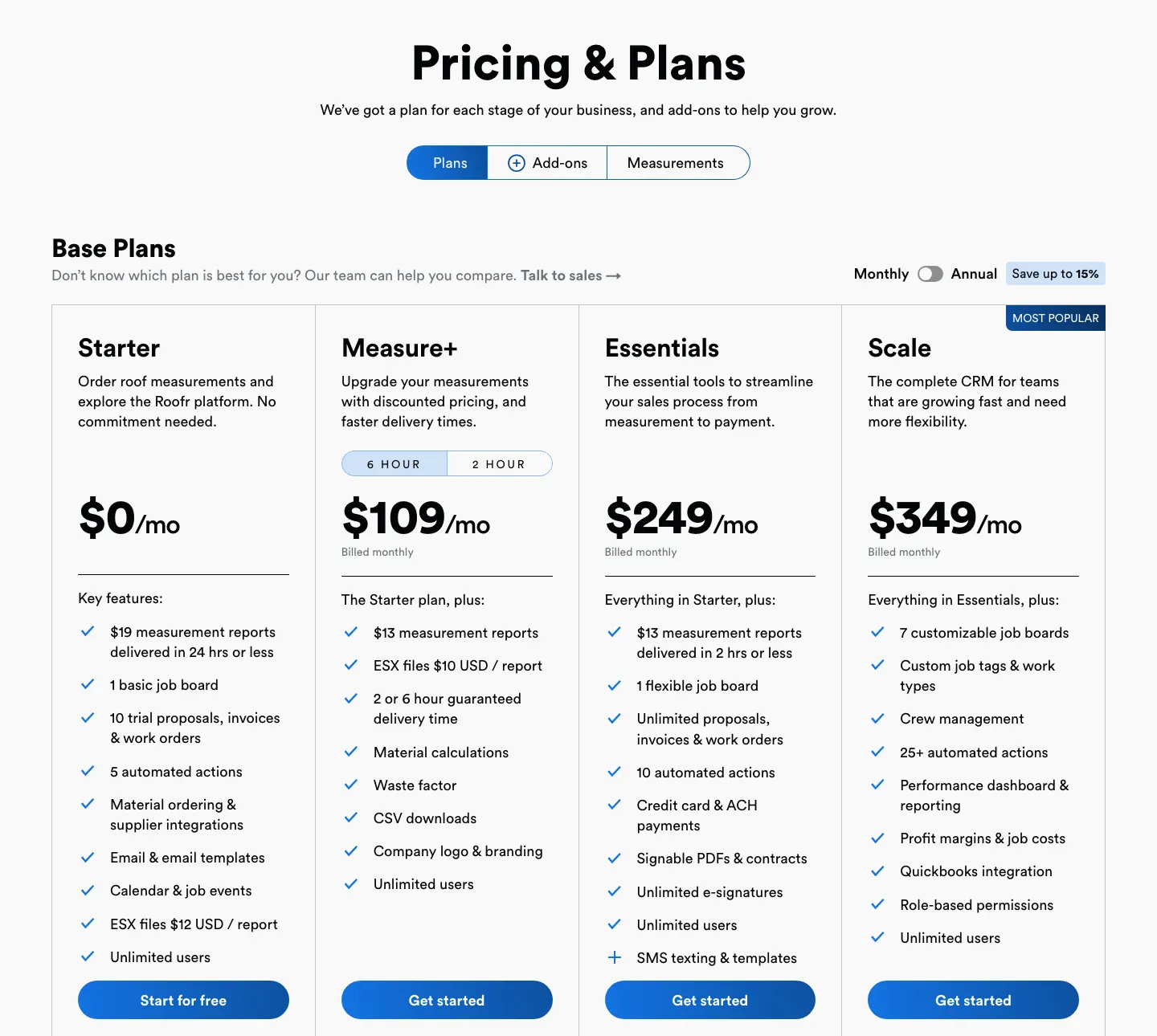
Roofr is a roofing-only business platform: aerial measurement reports, proposals, invoicing, material ordering and a Kanban job board, sold as one subscription. Plans run $0, $109, $249 and $349 a month, every plan carries unlimited users rather than per-seat billing, and measurement reports are pay-as-you-go at $19 on the free Starter tier and $13 on any paid one. That report price is the whole argument, because EagleView's own sheet starts at $32.75 for a small residential roof and Hover starts at $59. Supplier integrations with ABC Supply, QXO and SRS Roof Hub ship on every plan. But Roofr will not import a measurement report you bought elsewhere, its pricing page never says supplement, adjuster or carrier, and QuickBooks is beta and gated to the $349 Scale tier. So a supplement-heavy storm shop and a roofing-and-siding shop should both look elsewhere. Capterra rates it 4.6 across 101 reviews. The closest alternatives are AccuLynx, JobNimbus and Leap.
"Hover starts at $59 for a roof measurement report."
Hover (2026)
The short verdict
Roofr is the right buy for a residential re-roof contractor running 2 to 25 people who measures more roofs than he sells and wants the estimate, the proposal and the material order to live in one place. Best for retail replacement work rather than insurance restoration. And if you run a second trade, or your money is in supplements, this is the wrong platform and no add-on fixes it.
Pricing verified July 27, 2026, against the vendor's own page. Roofr publishes more of its numbers than anyone else in this category, which is genuinely rare and worth saying up front.
| Pricing model | Flat monthly plan, plus pay-as-you-go reports |
|---|---|
| Plan prices | $0, $109, $249 and $349 a month |
| Billing unit | Per company. Unlimited users on every plan |
| Measurement report | $19 on the free plan, $13 on any paid plan |
| Trade focus | Roofing only. No siding or gutter reports |
| Contract | Month-to-month or annual, your choice |
| Setup fee | None |
| Best fit | Retail re-roof shops that bid a lot and close some |
What works, and what to watch
Strong: published prices on every tier, unlimited users at no extra cost, $13 measurement reports against a market that charges triple, guaranteed two-hour delivery on the paid plans, supplier integrations with ABC Supply, QXO and SRS Roof Hub on every plan including the free one, no setup fee, and a month-to-month option.
Weak: no supplement or carrier workflow of any kind, a hard refusal to import measurement reports from anywhere else, QuickBooks gated to the top tier and still in beta, payments and financing limited to US businesses, job costing and crew management only on the $349 plan, and a public review corpus mostly written before the CRM existed.
What Roofr does
A homeowner calls about a leak. You pull the address into Roofr, order a measurement report, and somewhere between two and twenty-four hours later you have squares, roof pitch, ridges, hips, valleys and flashing lengths without putting a ladder on the house. That report feeds a proposal, the proposal converts to a material order, and the order goes to your distributor. So the pitch is simple: one system from address to shingle bundle.
So the measurement engine is the reason anyone shows up. Roofr's pricing page lists the Roofr Report at $19 per report on the free Starter plan and $13 on Measure+, Essentials and Scale, with delivery time falling from 24 hours to 2 hours as you move up. There is also a DIY mode where you trace the roof yourself over satellite imagery, which several reviewers use as their default rather than as a fallback.
"Roofr lists the Roofr Report at $19 per report on the free Starter plan and $13 on Measure+, Essentials and Scale, with delivery falling from 24 hours to 2 hours."
Roofr (2026)
And everything else is a roofing CRM built around that report. Kanban job boards with named job stages, proposals with e-signature, invoices, work orders, crew management on the top plan, and a material ordering flow that turns a proposal into a purchase order. Calling it a dispatch board would overstate it, and Roofr never does. There are no service calls here, no truck stock, no maintenance agreements. This is a sales-to-production pipeline for a trade that sells projects.
Who Roofr is for
The honest test is your bid-to-close ratio, not your headcount. A roofing contractor who measures four roofs for every one he sells is buying a measurement service with a CRM attached, and that arithmetic works beautifully. A roofing company owner who closes most of what he looks at, because the leads come from a supply house referral and a handshake, is paying a monthly fee to solve a problem he does not have.
It suits retail replacement work best. Storm chasers who live in Xactimate will find the ESX file export useful and everything around it thin. Paul J., an office administrator at an 11-to-50 employee construction company writing on Capterra on 16 June 2025, gives the practical version: he says the controls are intuitive and the autosave feature prevents losing progress, and adds that his shop mainly uses it for DIY measuring and the material orders have always been accurate. That is the whole product working as intended.
Who should not buy Roofr
Do not buy Roofr if you run more than one trade. There is no siding report and no gutter report, so a roofing and siding shop measures half its work here and the other half in a spreadsheet or a second subscription. Juan B., an owner writing on 27 August 2020, asked for siding reports back then. Six years later the plan comparison still lists none. And if you are a remodeler who does roofs on the side, stay on a horizontal platform and accept shallower roofing depth.
Skip it if fewer than 18 projects a month cross your desk as bids. Below that the free Starter plan plus $19 reports beats any subscription on pure arithmetic, and the arithmetic is in the next section.
And walk away if your revenue is insurance supplements. Roofr's pricing page and full feature comparison never use the words supplement, adjuster, carrier or scope of loss. What you get is an ESX file at $10 to $12 per report that you upload to Xactimate yourself, and only for gable, hipped and flat roofs. AccuLynx by contrast puts "Insurance restoration equipped" on its top tier as a named capability. That is the clearest capability line between the two products, and it is not close.
What Roofr costs
The published plans
Starter is $0 a month with one basic job board, ten trial proposals, five automated actions, material ordering and supplier integrations, and unlimited users. Measure+ is $109 a month billed monthly and buys $13 reports plus a two or six hour guaranteed delivery time, material calculations, waste factor and CSV downloads. Essentials is $249 a month, or $209 billed yearly, and adds unlimited proposals and work orders, credit card and ACH payments, signable PDFs and unlimited e-signatures. Scale is $349 a month, or $299 billed yearly, and adds seven customizable job boards, custom job tags, crew management, twenty-five or more automated actions, a performance dashboard, profit margins and job costs, QuickBooks and role-based permissions.
One number on that page does not work, and I would rather say so than paper over it. The Measure+ card prints "$109 /mo Billed monthly" and then "or $209 /mo billed yearly", which is higher than the monthly price. The full comparison table further down the same page renders Measure+ as "$109 - $169 /mo". So the monthly figure is solid, the annual figure as rendered is not usable, and if you are budgeting an annual Measure+ commitment you should get the number in writing before you sign anything.
Two add-ons sit outside the plan ladder. Instant Estimator, the widget that gives a homeowner a price on your website, is $149 a month or $125 billed yearly. Roofr Sites, still in beta, is $99 a month or $85 billed yearly. SMS texting is $49 a month billed annually and only on Essentials and Scale.
What the reports cost, and why that is the whole argument
Here is where a roofing estimator should pay attention, because this is the comparison Roofr was built to win. EagleView publishes its own construction price sheet, and at the Bronze tier a small residential report covering up to 20 roofing squares is $32.75, a medium report at 40 squares is $60, and anything above that is $87. Silver, Gold and Platinum bring those down, with Platinum quoted rather than printed. Roofr charges $13 for a report on any paid plan.
"EagleView prices a small residential report covering up to 20 roofing squares at $32.75 at the Bronze tier, a medium report at 40 squares at $60, and anything above that at $87."
EagleView (2026)
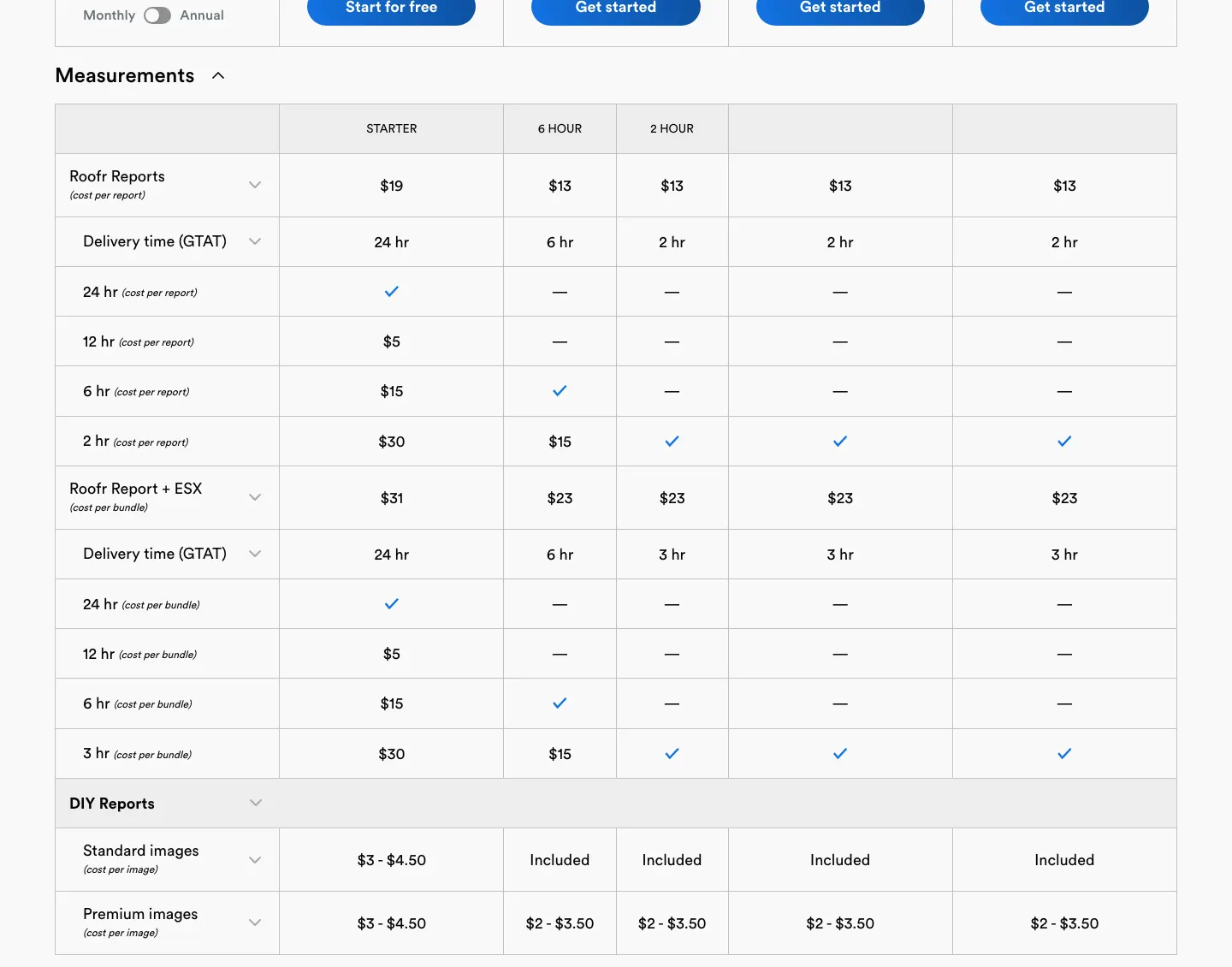
But the rush fees only apply to the free plan, and they are steep. A Starter user pays $19 for a 24-hour report, plus $5 for 12-hour, plus $15 for 6-hour, plus $30 for 2-hour. On the paid plans that speed is included instead of surcharged, and Roofr states that guaranteed delivery is met or the report is free. That guarantee does not apply to Starter, where delivery is an estimate, and it excludes multi-family reports.
What a roof measurement costs everywhere else
Roofr is cheap, and it is worth knowing by how much before you rearrange your whole software stack around it. Every aerial-measurement vendor in this market publishes prices, so the comparison is unusually easy to run. RoofSnap charges $13 pay-as-you-go for a Half Snap and $10 on a subscription, then $35 to $55 pay-as-you-go for a FULL Snap depending on how many squares and facets the roof carries, plus $15 for a gutter measurement Roofr does not sell at all. Hover prices by complexity rather than by size, and on its Starter plan a simple structure of up to four facets is $59, an average single-family home of five to eight facets is $99, and a complex home of nine or more facets is $139.
"RoofSnap charges $13 pay-as-you-go for a Half Snap and $10 on a subscription, then $35 to $55 pay-as-you-go for a Full Snap."
RoofSnap (2026)
So the honest ranking on price puts Roofr and a RoofSnap Half Snap at the bottom, EagleView in the middle, and Hover at the top for a cut-up roof. But price is not the only axis, and the coverage complaints in the reviews point straight at the reason. Nearmap, which sells the imagery layer underneath a lot of this category, describes its own capture as refreshed up to 3x per year at a resolution measured in inches per pixel. A vendor flying more often over your county produces a usable roof pitch more often, and that is exactly what a roofing contractor in a rural market is paying the extra for.
iRoofing sits in a third position worth understanding, because it resells rather than produces: its site offers a roof report at a discount to subscribers rather than a flat per-report price of its own. Its pricing page returned a 404 when we fetched it, so it carries no figure in the comparison table below.
So run the crossover yourself. The gap between a Starter report and a paid-plan report is six dollars. Measure+ costs $109 a month. Divide one by the other and the subscription pays for itself at about 18 reports a month, on report discount alone, before you have used a single CRM feature. Essentials at $249 needs roughly 42 reports a month to break even the same way, and Scale at $349 needs about 58. Above 58 reports a month the most expensive plan on the page is cheaper than the free one.
A six-truck retail re-roof shop bidding 60 roofs a month lands at $349 for Scale plus $780 in reports, so $1,129 a month, or $13,548 a year. The same shop on Starter pays $1,140 a month in reports and gets no CRM at all. That is the shape of the pricing: the plan fee is close to free if you bid volume, and expensive if you do not.
What it costs beyond the subscription
This column is unusually clean, and it beats most software a contractor buys. Roofr states there are no setup or onboarding fees to get started. There is no minimum term unless you choose one: the vendor's own answer is that you can use Roofr month-to-month or sign an annual contract, so there is no forced annual commitment and nothing to auto-renew out of. No early termination fee and no notice period appear anywhere on the pricing page or in its billing FAQ.
But payment processing is the one figure Roofr does not print. Roofr Payments collects credit card and ACH or EFT payments and the feature table says "No hidden fees, no minimums", but no percentage per transaction is published anywhere on that page. I am not going to borrow a rate from a third-party roundup and call it a fact, because every page I found quoting one sells against Roofr. Ask for the processing rate in writing before you turn payments on. And note that Roofr Payments is US businesses only, as is the GoodLeap financing integration, so a Canadian roofing contractor buys the CRM without either.
Our read on the features
Measurement, and the accuracy complaints
The reports are cheap and mostly good. But the failure mode is imagery rather than mathematics. The complaint that repeats across six years of reviews is coverage: rural addresses, tree cover and stale satellite imagery produce a flat 2D report with no roof pitch. Ben S., an estimator writing on 30 May 2023, put a number on it and said the low percentage of roofs available, about 50% in our experience so far was his one real objection, while praising the refunds he got on every failed report.
"An estimator writing on 30 May 2023 puts roof availability at about 50% in their experience, with rural addresses, tree cover and stale imagery producing a flat 2D report."
Capterra (2023)
Christopher S., an owner at an 11-to-50 employee company writing on 10 July 2022, is the harshest voice in the corpus and worth reading in full before you buy. He rates it 2.0 and says measurements are regularly incorrect and roof pitches are regularly incorrect, which he points out is a big deal when the difference between 7/12 and 9/12 is $25 per square. He also reports a price increase and a subscription he could not cancel. That review is four years old and predates the current platform, but the pitch-accuracy complaint recurs in 2023 and 2025 reviews too, so it is not stale.
Proposals, material ordering and the distributor link
And material ordering is the quietly excellent part. Supplier integrations with ABC Supply, QXO and SRS Roof Hub ship on every plan, including the free one, which means a roofing crew on Starter can push a proposal straight into a distributor order without paying a monthly fee. Most vertical platforms gate the distributor link behind a paid tier. Roofr does not.
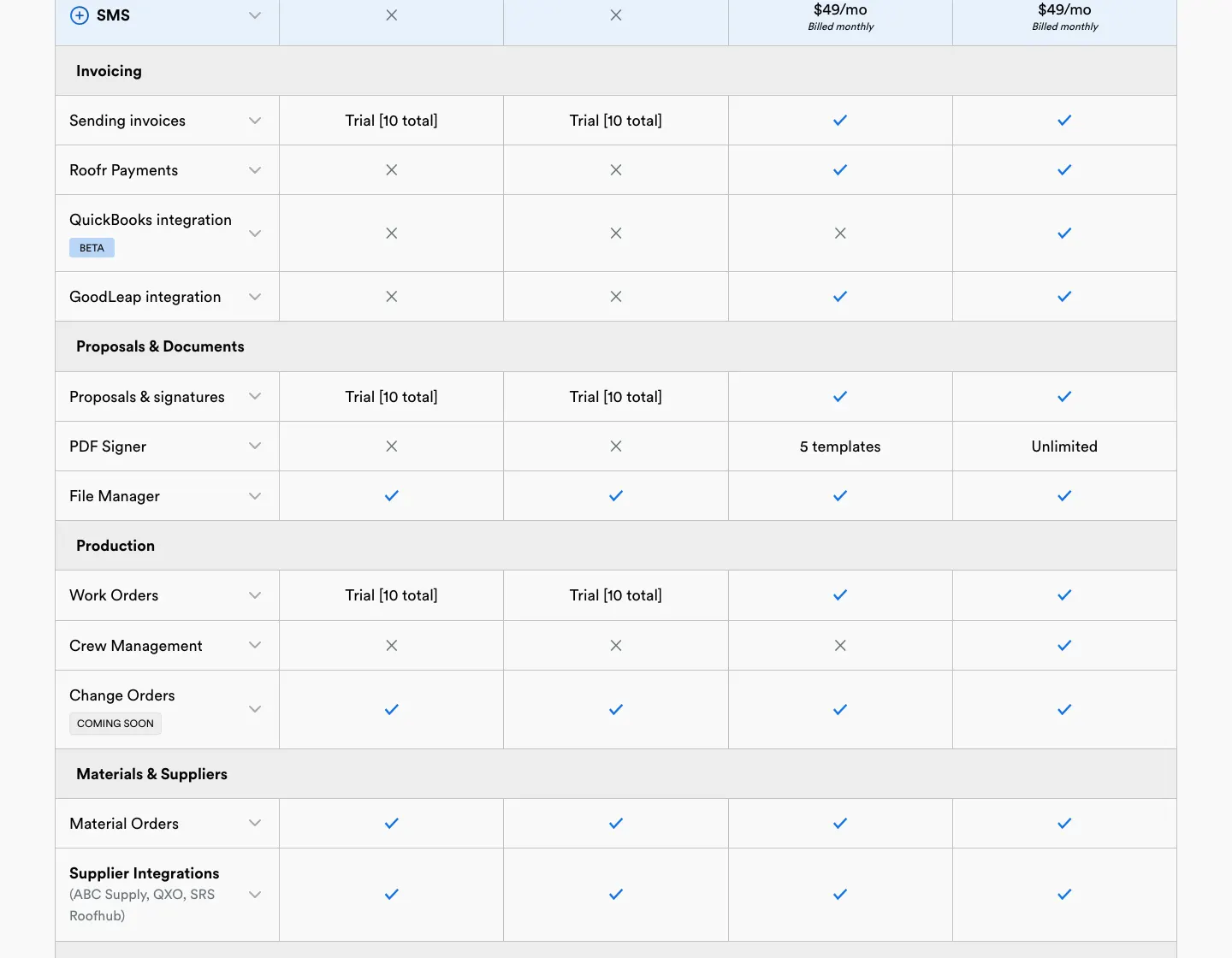
Proposals and unlimited e-signatures start at Essentials, with ten trial documents on the free tiers so you can see the format before you commit. And that trial allowance is the right way to test a proposal tool, because a template you have not sent to a real homeowner tells you nothing. Jason T., an owner at a 2-to-10 employee construction company writing on 18 August 2025, credits the onboarding rather than the software: he says his rep setup a wonderful proposal template for each manufacturer, integrated our catalog, and walked us through each feature on Zoom calls. Onboarding and a dedicated account manager are included on Essentials and Scale at no extra charge, which is where that experience comes from.
Job boards, and what the Scale tier buys
Every plan below Scale gets exactly one job board, which is easy to miss. Scale gets seven, plus custom job tags and work types, plus role-based permissions. So the hundred-dollar step from Essentials to Scale is really a step from one pipeline to a production department: you get job costing, crew management, profit margins against job costs and the performance dashboard in the same move. If you have a production manager and a separate sales pipeline, that step is not optional. If the owner is still writing every proposal, it is.
Where it falls short
Six specific gaps. Every one of them is checkable on Roofr's own pages before you spend anything.
You cannot import a measurement report from anywhere else. Roofr's own FAQ answers this flatly: no, because measurement reports are generated within Roofr to ensure accuracy, consistency and full compatibility with the rest of the platform. So an EagleView report your supplier gave you free, a QuickMeasure your GAF rep pulled, a drone survey your competitor did last spring, none of it enters the system. For a roofing company that already has a measurement relationship, that is a hard wall and it is the strongest lock-in mechanism in the product.
There is no supplement or carrier workflow. No scope sheet, no adjuster correspondence, no claim record. The insurance answer is an ESX file at $10 to $12 that you upload by hand into Xactimate, which Verisk describes as property claims estimating software for restoration jobs, and the file is available only for gable, hipped and flat roofs. Complex roofs get nothing.
Roofr will not plug into your existing CRM. Its own answer is that it does not embed or integrate its tools into external CRMs or systems, because keeping everything connected in one place provides a more consistent workflow. Read that as written. Roofr expects to be your system of record, and it is priced and built on that assumption.
The QuickBooks integration is beta, Scale-only and US-only. It exports contacts, catalog items, invoices and payment info, it does not support QuickBooks Desktop, and it does not appear on any plan below $349 a month. That last exclusion is not cosmetic, because QuickBooks Desktop Enterprise is a separate Intuit product line from QuickBooks Online, and plenty of established roofing companies still keep their books there. There is no Xero and no Sage either.
Coverage and pitch accuracy are the recurring complaint, not a one-off. The same objection appears in 2020, 2021, 2022, 2023 and 2025 reviews. Rich M., an owner writing on 6 August 2021, went back to EagleView over it and said so in capitals in his "switched from" field.
No bulk report packages and no volume pricing. Roofr says plainly that it does not offer bulk measurement packages, so a shop ordering 200 reports a month pays the same $13 as a shop ordering four. Every serious aerial-measurement vendor discounts on volume. This one does not, and at high volume that is real money left on the table.
What you give up by going vertical
Every page selling a trade-vertical platform sells the depth and none of them price the loss, so here it is. Compared to a horizontal FSM, you give up the integration marketplace. Roofr's own integration list is Gmail, Google Calendar, CompanyCam, QuickBooks and limited Zapier workflows. Jobber and Housecall Pro each carry app marketplaces with hundreds of entries. If your stack already includes a call-tracking layer, a review platform and a payroll system, most of those connections will be manual or absent here.
You also give up scheduling depth. There is a calendar and there are job boards, but there is no dispatch board, no drag-and-drop technician assignment, no offline mode described anywhere on the pricing page. A roofing crew on a rural tear-off with no cell service is not a use case this product documents.
What you get back is real, and it is worth naming because the trade-off is not one-sided. A $13 measurement report and a native ABC Supply order are things no horizontal FSM does at all. So the honest framing is this: Roofr replaces your measurement vendor and your proposal tool and calls the result a CRM. If those two line items are your biggest software spend, the maths favours going vertical. If your biggest problem is scheduling twelve crews across three counties, it does not.
Where the trade ecosystem plugs in
Three endpoints decide whether an order gets placed once or re-keyed three times. Distributors are covered: ABC Supply, QXO and SRS Roof Hub connect on every plan for real-time material pricing and direct ordering, and those are the right three names for a roofer. ABC Supply runs the myABCsupply portal and carries steep slope, low slope and metal roofing lines, and QXO sells residential and commercial roofing after a run of acquisitions that included TopBuild. So if your branch is one of theirs, the order really does leave Roofr and land in your supplier's system. Field documentation is covered: CompanyCam syncs photos, proposals and Roofr Reports both ways, and it is worth knowing what that connection costs on the other side, because CompanyCam bills per seat at $29 for each additional user on top of the users its plans include. So the tool Roofr connects to scales with headcount even though Roofr does not. Accounting is half covered: QuickBooks Online only, beta only, Scale only, US only.
"CompanyCam bills per seat at $29 for each additional user on top of the users its plans include."
CompanyCam (2026)
But aerial measurement is the interesting one, because Roofr is the measurement vendor rather than a consumer of one. There is no EagleView integration, no Hover, no GAF QuickMeasure. That is a deliberate product decision and not an oversight, and it is the same decision that produces the no-import rule. If your GAF or Owens Corning rep supplies measurement reports as part of a contractor programme, understand that Roofr will not accept them and price the subscription accordingly.
Contracts, cancellation and getting your data out
So the exit terms are the best thing in this review, and they are worth more than they look. Roofr states you can run month-to-month or sign an annual contract, and that changing plans takes effect at your next billing cycle. On cancellation its answer is that your data belongs to you, that it will help you export your data no questions asked, and that it keeps your account data so you can reactivate later without starting from scratch.
But "we'll help you export" is a support promise, not a self-serve button, so treat it as one. Get your customer list, your job history and your closed proposals out while the account is open and in a format you can read without Roofr. Every plan from Measure+ up includes CSV downloads, which is the mechanism to use. And the reports themselves are PDFs you already hold, so the measurement history is the one asset here that does not evaporate.
Compare that to what the rest of the category does. JobNimbus answers the same question on its pricing page and confirms it offers monthly or annual agreements with no required setup or onboarding fees, which is the same posture. Neither publishes an early termination figure, because neither locks you into a term you would need to terminate.
What the reviewers report
Roofr scores 4.6 out of 5 across 101 Capterra reviews, with Ease of use at 4.6 and Customer Service at 4.6. Those are the only two sub-scores that page carries. There is no Value for Money breakdown at all, which is the one sub-score you would most want on a product whose entire argument is price.
And read the dates before you read the average. Of the twenty-five reviews on the first page, fourteen were written in 2020, when Roofr sold $10 measurement reports and no CRM existed. Four more are from 2021 to 2023. Only a handful land in 2024 and 2025. So a 4.6 average is largely a verdict on a measurement service, not on the platform you would be buying today, and no aggregator will tell you that because none of them weight by date.
And the sentiment splits cleanly. Consistent praise: price, turnaround time, ease of use, refunds when a report fails, and support people who answer. Consistent complaints: imagery coverage, pitch accuracy on the failures, mobile experience, and no report separation on multi-building projects. Tina W., writing on 13 September 2024, names the pricing objection that survives into the current product: she says the cost for premium monthly options doesn't have much incentive, and that her shop is happy buying reports on a need basis. That is a customer sitting on Starter and telling you the subscription ladder has not earned her.
How it compares
A real alternative covers the same roofing workflow. A horizontal FSM is a downgrade path rather than an alternative, and saying so is the recommendation this category almost never makes. Every cell below is the vendor's own wording from the vendor's own page, verified July 27, 2026. Where a vendor prints no price, its cell carries what the vendor offers instead, because "not published" is itself a finding rather than a gap in this article.
| Roofr | AccuLynx | JobNimbus | Leap | |
|---|---|---|---|---|
| Published starting price | $0 a month on the free Starter plan | $250 /month | None. A pricing request form instead | $79 /month, Single-User Only |
| Plan names | Starter, Measure+, Essentials, Scale | Essential, Pro, Elite | Essentials, Pro, Premium, or Enterprise | Essential, then Starting at $298 and $750 |
| What decides your bill | Flat per company. Unlimited users | A custom price quote | The plan, the number of users you need, and add-ons | Includes First User and $99 per/mo per add. user |
| Who the vendor says it serves | Roofing only. No siding or gutter reports | Multiple plans for roofing contractors to choose from | Roofing, restoration roofing, solar, gutters, and siding | The Complete Platform for Contractors |
| Trial, demo or free tier | Free Starter plan with no time limit | Demo our Essential plan | No required setup or onboarding fees | Start your 14-day free trial with Leap Essential |
So the shape is clear. Roofr wins on transparency and on the measurement line item. AccuLynx wins on insurance restoration depth and on being the platform your supplier rep has heard of. JobNimbus wins on breadth across roofing, siding, gutters and solar, which matters exactly as much as whether you run one trade or four. Leap wins on entry price for a single user and loses it back the moment you add a second, at $99 a month each.
And EagleView is not on that table on purpose, because it is not a CRM. But it is the real alternative for a lot of readers, since plenty of roofing contractors want a measurement report and nothing else. If that is you, compare $13 against EagleView's published $32.75 to $87 and decide whether Roofr's coverage rate is worth the saving in your market. That is a local question, not a national one.
The verdict, by how many roofs you bid
Under 18 bids a month
Stay on Starter. So pay $19 a report, use the free job board, and revisit this when the volume arrives. A subscription at that level is a monthly fee to save less than a hundred dollars.
18 to 60 bids a month
Measure+ at $109 pays for itself on report discount alone at about 18 reports, so start there and let the CRM decision come later. Move to Essentials at $249 when you want proposals and payments in the same system, not before. And run the two-hour delivery on a real address during the first week, because guaranteed turnaround is the feature that step up the ladder buys.
Over 60 bids a month with a production team
Scale at $349, and it is close to free at that volume. But price AccuLynx and JobNimbus in the same fortnight, because at your size the question stops being report cost and starts being whether the platform handles supplements and multiple trades. Roofr does neither. That is the honest ceiling on this product.
The number nobody checks first
Fervor is a conversion rate optimization and web design studio rather than a Roofr alternative. But every proposal Roofr sends starts with a homeowner deciding to contact you, and that decision happens on your website. So it is worth testing the step before the software, and that is the gap we happen to have data on.
In May 2026 we inspected 380 home services contractor websites for the Contractor CRO Index 2026. Only 61.6% carry a phone number in a persistent header. That is 234 sites where the number follows a homeowner down the page, and 146 where it does not. Roofr's Instant Estimator costs $149 a month to put a quote widget on a website, which is money well spent on a site people can reach and money burned on one they leave. And 82.8% of the sites we inspected loaded poorly enough on mobile that some visitors are gone before any widget renders.
The texting number tells the same story. Roofr charges $49 a month for SMS, yet only 19.2% of the sites we inspected offer any text channel at all, so most contractors would be paying to text people their website never invited to text. So fix the front door first. It costs nothing per month, and it makes every subscription behind it worth more. The full statistics are public, and our roofing marketing hub covers where the rest of the leaks sit.
See whether your site earns the estimate before you pay to send one
Fervor inspects your site the way a homeowner uses it, then shows you the specific places a roof replacement enquiry leaks out before any proposal software gets involved. It takes about three days.
Get a Site InspectionWhat we tested, and what we didn't
We did not run Roofr on a live roofing account, so nothing here is a hands-on performance claim. What this page is instead: Roofr's pricing page and its full plan comparison read line by line including every billing, measurement and integration FAQ, the public review corpus on Capterra, and the published pricing pages of AccuLynx, JobNimbus, Leap and EagleView read directly rather than through a roundup. All figures verified July 27, 2026.
And three things we could not close, said plainly. Roofr's payment processing rate is not published anywhere we could find, and every third-party page quoting one sells against Roofr, so we reported the absence rather than borrowing a number. The Measure+ annual price renders higher than its own monthly price, so we published the monthly figure and flagged the annual one instead of guessing which is right. And G2, TrustRadius and Trustpilot block automated access, so nothing here comes from any of them.
Fervor has no affiliate relationship with Roofr. The link below goes to the vendor's own site untracked. If you want to evaluate Roofr directly, its product site is where the free plan starts, and the free plan is a genuine no-commitment way to test the coverage rate on your own addresses before you spend a dollar.
What Roofr users say
Inexpensive and covers a wide range of locations.
not optimized for mobile use, price increased 50% after we started using it more regularly, costumer service has a coverall approach to every issue (3 free credits), Measurements are regularly incorrect, roof pitches are regularly incorrect (which is a big deal when the difference between 7/12 and 9/12 is $25 per square).
I love that for $10 they will measure the structure and generate a report in 24 hours or less.
Controls are intuitive and the autosave feature prevents losing progress.
Low percentage of roofs available, about 50% in our experience so far.
It seems that about once a month, they are unable to measure the pitch of a roof.
The cost for premium monthly options doesn't have much incentive. We are happy with buying reports on a need basis.
Poor coverage area. Miscalculations on area and pitch.
She setup a wonderful proposal template for each manufacturer, integrated our catalog, and walked us through each feature on Zoom calls.
Frequently asked questions
How much does Roofr cost?
Roofr publishes four base plans. Billed monthly they are Starter at 0 dollars, Measure+ at 109, Essentials at 249 and Scale at 349. Essentials drops to 209 and Scale to 299 when billed yearly. Every plan carries unlimited users, so the price does not move when you hire. Add-ons sit outside the ladder: Instant Estimator is 149 dollars a month or 125 billed yearly, Roofr Sites is 99 or 85, and SMS texting is 49 a month billed annually on Essentials and Scale only. All pricing is in US dollars.
How much is a Roofr measurement report?
You pay for each report as you order it, on every plan. A Roofr Report is 19 dollars on the free Starter plan and 13 dollars on Measure+, Essentials and Scale. A Roofr Report bundled with an ESX file is 31 dollars on Starter and 23 on the paid plans. Starter also carries rush fees on top of the base price: 5 dollars for 12-hour delivery, 15 for 6-hour and 30 for 2-hour. The paid plans include the faster turnaround instead of surcharging it, and Roofr states guaranteed delivery is met or the report is free. Roofr does not sell bulk report packages, so a high-volume shop pays the same per report as a small one.
Does Roofr require a contract?
No. Roofr states you can use it month-to-month or sign an annual contract, and that plan changes take effect at your next billing cycle. There are no setup or onboarding fees. No early termination fee and no notice period appear on the pricing page or in its billing FAQ, because there is no forced term to terminate. The one commitment is annual billing, which Roofr describes as roughly 15 percent cheaper than paying monthly.
Can I import an EagleView report into Roofr?
No, and Roofr says so in its own FAQ. Measurement reports are generated within Roofr, which it explains as ensuring accuracy, consistency and full compatibility with the rest of the platform. So an EagleView report, a GAF QuickMeasure or a drone survey you already paid for cannot be brought in. If your manufacturer programme supplies measurement reports, price the Roofr subscription knowing you will be paying for measurements twice or abandoning the ones you already get.
Does Roofr handle insurance supplements?
Not as a workflow. The pricing page and full feature comparison never use the words supplement, adjuster, carrier or scope of loss. What Roofr offers the insurance side is an ESX file at 10 dollars per report on the paid plans and 12 on Starter, which uploads directly to Xactimate, and which is only available for gable, hipped and flat roofs. AccuLynx by contrast lists insurance restoration as a named capability on its Elite tier. A supplement-driven storm restoration contractor should shortlist AccuLynx or JobNimbus instead.
What happens to your data if you cancel Roofr?
Roofr states that your data belongs to you, that it will help you export your data no questions asked, and that it keeps your account data so you can reactivate later without starting over. Treat that as a support promise rather than a self-serve button: export your customer list, job history and closed proposals while the account is still open. CSV downloads are included from Measure+ up, and the measurement reports themselves are PDFs you already hold.
Which distributors and accounting tools does Roofr connect to?
Supplier integrations cover ABC Supply, QXO and SRS Roof Hub for real-time material pricing and direct ordering, and they ship on every plan including the free Starter tier. CompanyCam, Gmail, Google Calendar and limited Zapier workflows are also on every plan. Accounting is thinner: QuickBooks Online only, labelled beta, gated to the 349 dollar Scale plan, available only to US-based businesses, and with no support for QuickBooks Desktop. There is no Xero and no Sage. Roofr also states it does not embed its tools into external CRMs, so this is a replacement platform rather than a component of one.
Freshness
How we keep this page current
Three dates govern this review, and they carry different meanings. The initial source sweep is dated July 27, 2026; when only part of the evidence set is recaptured later, that later date is stated beside the refreshed claim. We last revised the page on July 27, 2026. And the user reviews we quote were posted over roughly the last 24 months, so their individual dates remain part of the evidence instead of being overwritten by a later pricing update.
We revise the page when Roofr changes a published price or a contract term, when a rating we cite moves by more than a few tenths, or when the vendor ships something big enough to change the verdict. We never bump the date just to look fresh, because Google treats that as manipulation and so do we. If a figure here reads as stale by the time you land on it, treat it as a floor and check the vendor's own page. We linked it at every number for exactly that reason.
Sourcing
How this review was researched
Every figure on this page traces to a captured source linked inline where it appears. The initial sweep is dated July 27, 2026; any later, partial recapture is dated at the claim rather than relabelling the whole evidence set. Ratings come from Capterra, GetApp, Software Advice and the Apple App Store. Note that Capterra, GetApp and Software Advice share one Gartner Digital Markets review pool, so an identical score across all three is a single sample rather than three corroborating ones, and this page treats it that way. G2, TrustRadius and Trustpilot block automated access, so where their numbers appear they are labelled as reported rather than verified. No claim here is sourced from Reddit or from a contractor Facebook group, because neither could be retrieved and quoting them would mean inventing attribution. Pricing marked as reported comes from third-party roundups, never from Fervor. Fervor's own findings come from the Contractor CRO Index 2026.
About
About Fervor Studio
Fervor Studio is a conversion rate optimization (CRO) and web design studio for home services contractors across North America, based in Cochrane, Alberta. Fervor does not sell field service management software and is not an alternative to Roofr. It publishes the Contractor CRO Index, a public benchmark measuring contractor website conversion potential using reproducible, open-source methods such as axe-core and Google Lighthouse. Fervor Studio is operated by Fervor Group Inc.
 Aug 2, 2026
 Tech Stack
Best Plumbing Software in 2026: Ten Ranked Across Four Classes
A plumbing company’s work runs through four classes of software that do not substitute for each other, and it only buys two of them. Ten products, each with a published price or an explicit statement that the vendor publishes none.
Read Article Jul 31, 2026
 Tech Stack
NiceJob vs Birdeye 2026: Pricing, Contracts and Review Gating
One of these vendors puts its price on the page and its cancellation terms in writing. The other puts a form in front of both, and the complaint record is where its contract length shows up.
Read Article Jul 31, 2026
 Tech Stack
Podium vs Birdeye 2026: Pricing, Contracts and Review Gating
Only one of these two will tell you what it costs before a sales call, and even that number carries a carve-out aimed squarely at trade contractors.
Read Article Jul 31, 2026
 Tech Stack
Best Electrical Contractor Software 2026: 11 Ranked and Priced
An electrical contracting business makes two software purchases that do not substitute for each other, and every roundup answering this query covers only one of them. Eleven platforms, with a published price or an explicit statement that the vendor publishes none.
Read Article Jul 31, 2026
 Tech Stack
Best HVAC Software in 2026: Eleven Ranked Across Three Classes
An HVAC contracting business buys across three classes of software that do not substitute for each other, and every roundup answering this query covers only one of them. Eleven products, each with a published price or an explicit statement that the vendor publishes none.
Read Article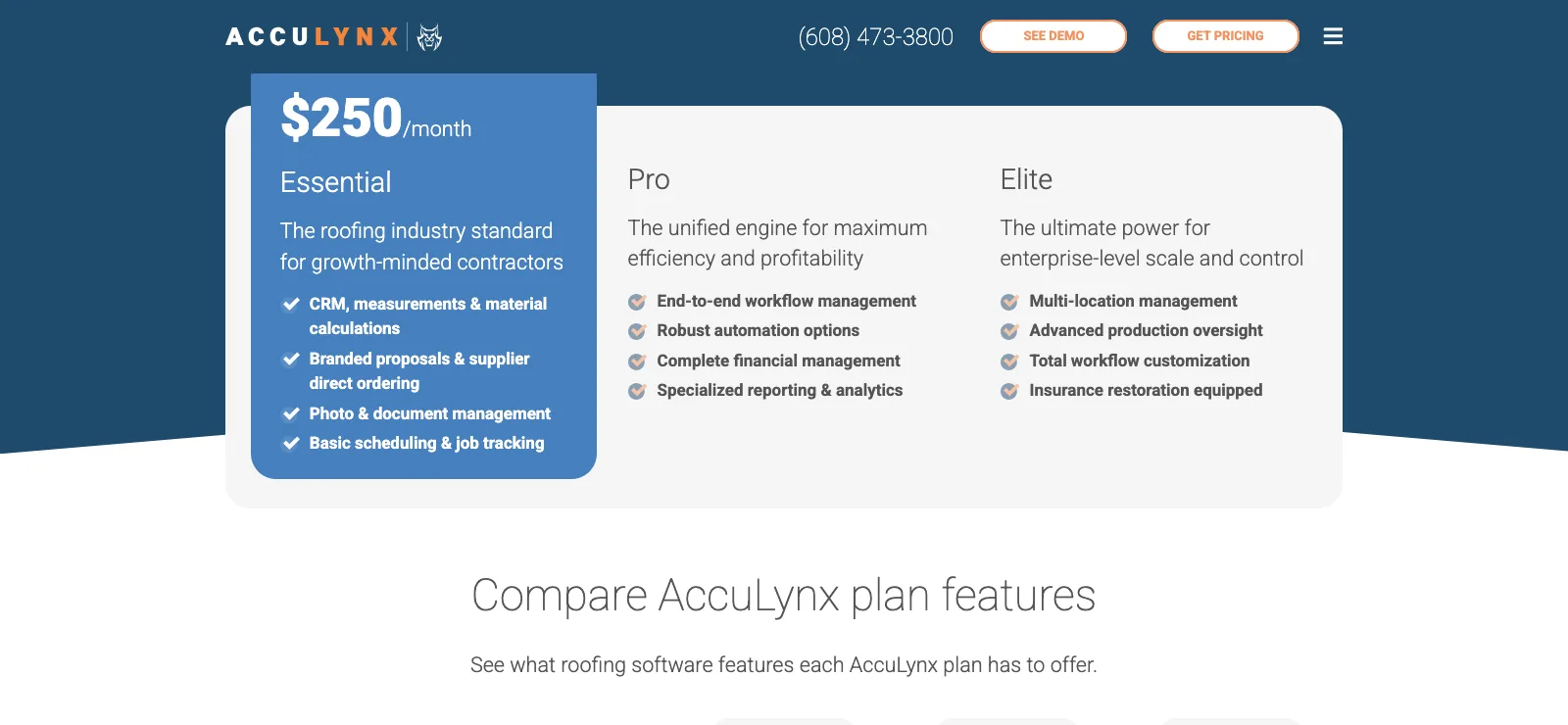 Jul 30, 2026
 Tech Stack
AccuLynx Pricing 2026: The Real Cost of a Quote-Gated Plan
One published figure, two blank plan cards, and a contract that says things the pricing page does not. A line-by-line breakdown of what AccuLynx really bills.
Read Article Jul 30, 2026
 Tech Stack
Houzz Pro Canada Review 2026: Pricing and Alternatives
Houzz Pro serves different pricing renderings. What Canadian buyers see, how GST/HST and payments work, what Custom gates, and what the annual contract commits you to.
Read Article Jul 30, 2026
 Tech Stack
JobNimbus Pricing in 2026: What the Quote Does Not Cover
JobNimbus prints no figure on any of its four plans. So the only rate you can read before a sales call is the payments meter, and it is the biggest line on the bill.
Read Article Jul 30, 2026
 Tech Stack
JobNimbus Review 2026: Pricing, Pros, Cons and Alternatives
JobNimbus rates 4.6 on Capterra and orders material straight from ABC Supply and SRS. But it publishes no price, and its supplement route carries a note.
Read Article Jul 30, 2026
 Tech Stack
BuildOps Review 2026: Pricing, Contract Terms and Alternatives
BuildOps runs commercial service and projects on one platform, and publishes no pricing at all. The billing unit, the 30-day data-export window, and who it suits.
Read Article Jul 30, 2026
 Tech Stack
FieldPulse Review 2026: Pricing, Pros, Cons and Alternatives
FieldPulse rates 4.6 on Capterra and is the platform contractors name when they leave a bigger system. But it publishes no price, and the contract runs a year.
Read Article Jul 30, 2026
 Tech Stack
Service Fusion Review 2026: Pricing, Contract and Alternatives
Service Fusion bills flat per company with unlimited users, which is the best structural deal in field service software. The published plans, the contract behind the no-contract line, and the app score every other review gets wrong.
Read Article Jul 30, 2026
 Tech Stack
Knowify Review 2026: Pricing, Job Costing and Alternatives
Knowify rates 4.5 on Capterra and its weakest sub-score is features. What the $99 Core plan withholds, which way the QuickBooks sync really runs, and who should not buy it.
Read Article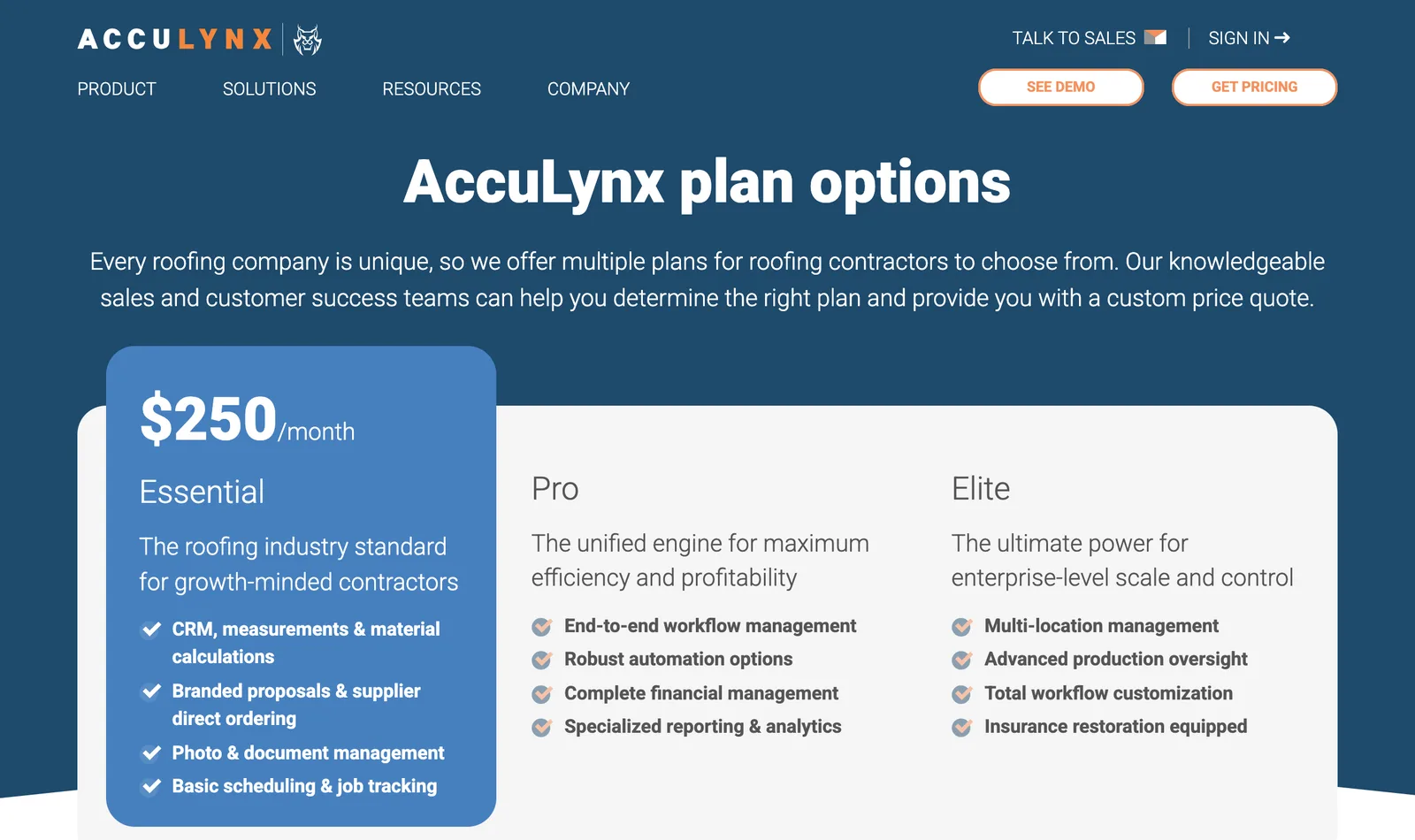 Jul 29, 2026
 Tech Stack
AccuLynx Review 2026: Pricing, Tier Gating, Alternatives
AccuLynx rates 4.6 across 846 reviews and now publishes an entry price. What that price omits, which tier holds the insurance workflow, and who should skip it.
Read Article Jul 29, 2026
 Tech Stack
Unitel Voice Review 2026: Pricing, Features and Alternatives
Unitel Voice rates 4.6 on Capterra and gives a one-truck shop a business number for $9.99 a month. The published plans, the cost per call, and what it won't do.
Read Article Jul 29, 2026
 Tech Stack
NiceJob vs Podium 2026: Pricing, Contracts and Review Gating
Both vendors print a price, at very different scale and in different currencies. The gap that matters is what Podium will not print: the billing unit, and whether a trade shop gets the number on the page.
Read Article Jul 28, 2026
 Tech Stack
CompanyCam Review 2026: Pricing, Pros, Cons and Alternatives
Every page ranking for CompanyCam still quotes a per-user price the vendor no longer charges. Here are the real plans, the seat math, and who should skip it.
Read Article Jul 28, 2026
 Tech Stack
NiceJob Review 2026: Pricing, Pros, Cons and Alternatives
NiceJob rates 4.9 on Capterra and refuses to gate negative reviews. Real plan pricing, the active-customer threshold nobody publishes, and who should skip it.
Read Article Jul 27, 2026
 Tech Stack
Buildertrend Review 2026: Pricing, Limits and Alternatives
Buildertrend rates 4.5 across 2,486 Capterra reviews and quotes against your revenue rather than your seat count. The workflows, the export problem, the alternatives.
Read Article Jul 27, 2026
 Tech Stack
CallRail Review 2026: Pricing, Pros, Cons and Alternatives
CallRail rates 4.5 on Capterra, and its tracking numbers port out free. But the two usage rates that decide your real bill are the two it does not print.
Read Article Jul 25, 2026
 Tech Stack
Housecall Pro Review 2026: Pricing, Pros, Cons, Alternatives
Housecall Pro has the shortest learning curve in the category and the widest review spread. Real pricing, the Instapay math, and the migration trap to plan around.
Read Article Jul 24, 2026
 Tech Stack
Jobber Review 2026: Pricing, Pros, Cons and Alternatives
Jobber rates 4.6 on Capterra with the best mobile app in the category. Real plan pricing, the feature gating that changes your entry price, and who it suits.
Read Article Jul 23, 2026
 Tech Stack
ServiceTitan Review 2026: Pricing, Pros, Cons, Alternatives
ServiceTitan rates 4.3 on Capterra but its weakest score is value for money. Real reported pricing, the 12-month contract, the exit fees, and who it actually suits.
Read Article Jun 3, 2026
 Tech Stack
HVAC Online Scheduling: The 43% Losing After-Hours Bookings
HVAC leads every trade on online booking at just 56.7%, which still leaves 43% of sites forcing an after-hours customer to wait for a business-hours phone call.
Read Article