NiceJob vs Birdeye 2026: Pricing, Contracts and Review Gating
NiceJob publishes $75 and $125 a month with no contract. Birdeye publishes nothing and quotes by location count. Contract terms, gating and reach compared.
Disclosure This article features tools from our brand partners. If you choose to use them, we may receive compensation at no extra cost to you.
Our editorial choices are independent of these affiliate arrangements. Read our full affiliate disclosure.
Fervor is a CRO and web design studio, not a software reseller, and no vendor paid for placement here or for a kinder verdict. Affiliate links are flagged where they appear, and they never change what we report.
Page at a glance
NiceJob and Birdeye do the same job. Both watch your field service software, and when a job closes they ask that customer for a review. The difference is the paperwork. NiceJob publishes its prices, at 75 US dollars a month for Reviews and 125 for Pro, bills per account rather than per seat, runs month to month, and its documented request flow puts no satisfaction screen before the public ask. Birdeye publishes no price anywhere, routes you to a configurator asking how many locations you run, requires 90 days written notice before renewal, and makes every payment non-refundable. Birdeye holds an A plus rating from the Better Business Bureau alongside 108 complaints in three years, with cancellation the recurring theme. And it ships a template collecting a satisfaction score before the review request. One paying customer describes a live setup routing happy customers to Google and unhappy ones to a private inbox. Your location count and the job software you already run decide the rest.
"Birdeye holds an A plus rating from the Better Business Bureau alongside 108 complaints in three years, with cancellation the recurring theme."
Better Business Bureau (2026)
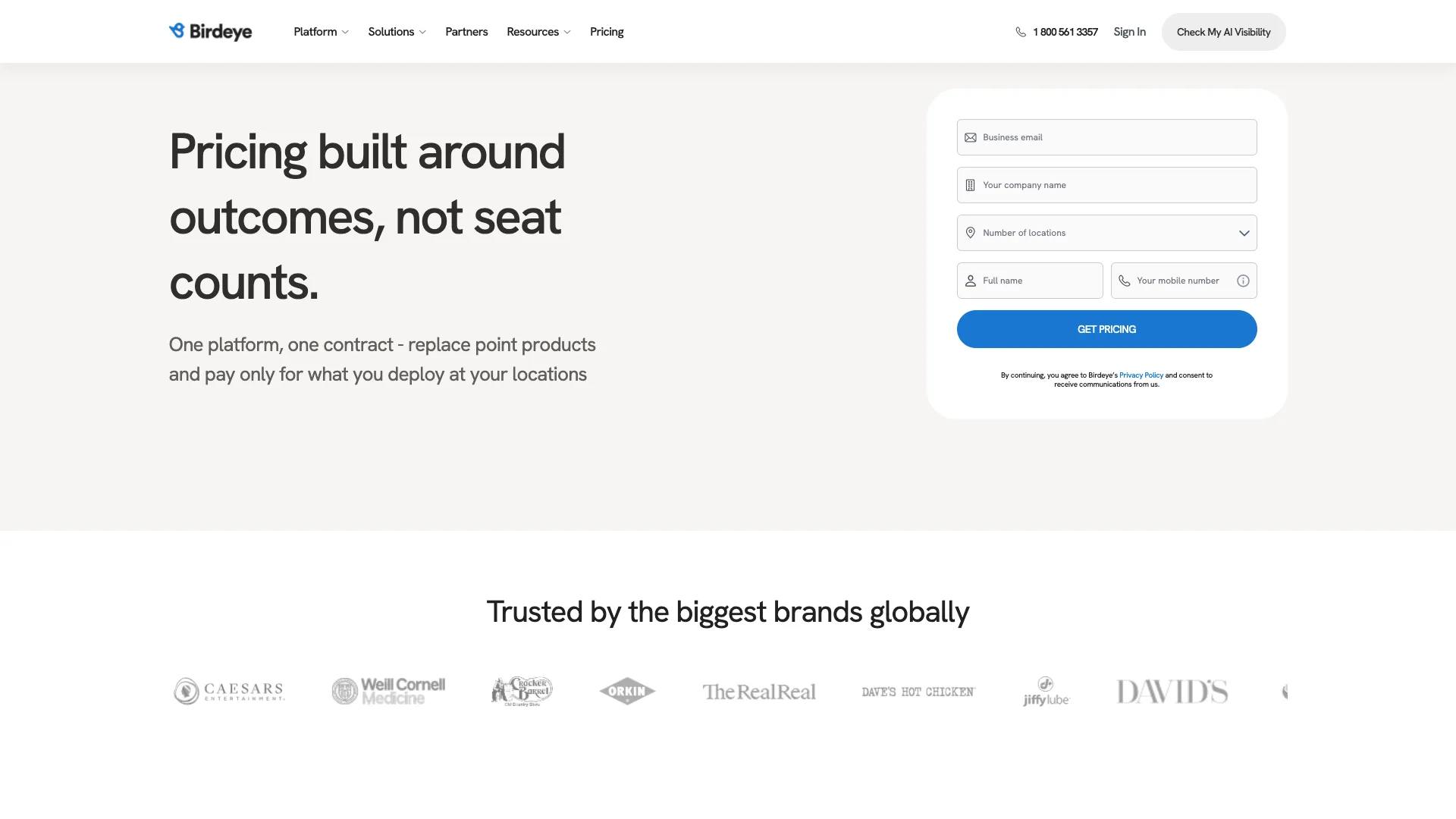
"Birdeye publishes no price anywhere and routes buyers to a configurator with location bands from 1-3 up to 1000+."
Birdeye (2026)
Quick answer
Choose NiceJob if you run one location, you want a price you can read before a sales call, and you want to be able to stop paying at the end of any month. Choose Birdeye if you run several locations, your shop lives inside ServiceTitan or JobNimbus or Buildertrend, and you can absorb an annual term that needs 90 days written notice to end.
That is the whole decision, and the rest of this page is the evidence behind it. Figures were last researched 27 July 2026.
The decision facts, side by side
| NiceJob | Birdeye | |
|---|---|---|
| Published monthly price | Yes. $75 / Month (USD), Reviews plan | No. The page ends at a GET PRICING button |
| Second tier | Pro at $125 / Month (USD) | Starter, Growth and Dominate, all Custom Quote Available |
| Billing unit | Per account, not per seat. Priced by "How many customers do you have?" | Not published. The form asks Number of locations |
| Multi-location rate card | None. Franchise and multi-location go to custom pricing | None. Location bands from 1-3 locations to 1000+ locations |
| Contract term | Month to month. The pricing page states "No contracts" | Set in your Order Form. Complaint record shows one year |
| Cancellation notice | Written or in-app notice before the end of the current monthly term | 90 days written notice of non-renewal |
| Auto-renewal | Payment renews automatically at the end of your monthly term | Auto renews for the same period of time as the initial term |
| Refunds | No refund policy of any kind in the terms | Non-cancellable obligations, and all payments made are non-refundable |
| Setup fees | $199 setup fee on the Sites website add-on only | Not published anywhere on the GET PRICING form |
| BBB record | No results for "NiceJob" in the BBB directory | A plus, accredited, 108 total complaints in the last 3 years |
| What fires the request | Job closed in a connected CRM, then 1 SMS text message | After a transaction has been completed in a connected integration |
| Named contractor integrations | Jobber, HouseCall Pro, QuickBooks | 43 under Contractor, including ServiceTitan and JobNimbus |
| Review sites named | Nine, including Google, Facebook, BBB, Homestars | Monitors 200+ sites. Request points at up to three |
| Yelp supported | No. Not in "Which Review Sites does Nicejob work with?" | Not named on the pages read. It monitors 200+ sites |
| Does the flow gate unhappy customers | No. Text message immediately, then emails. No written policy either | Not by default, but display logic and a Request review question both ship |
| Messaging or webchat included | No. One-way Broadcasts and AI Replies only | Sold as separate products. Mass texting billed on top |
| Free trial | 14 days, no credit card up front | Not published. The page offers WATCH DEMO instead |
What each one costs
NiceJob puts the number on the page
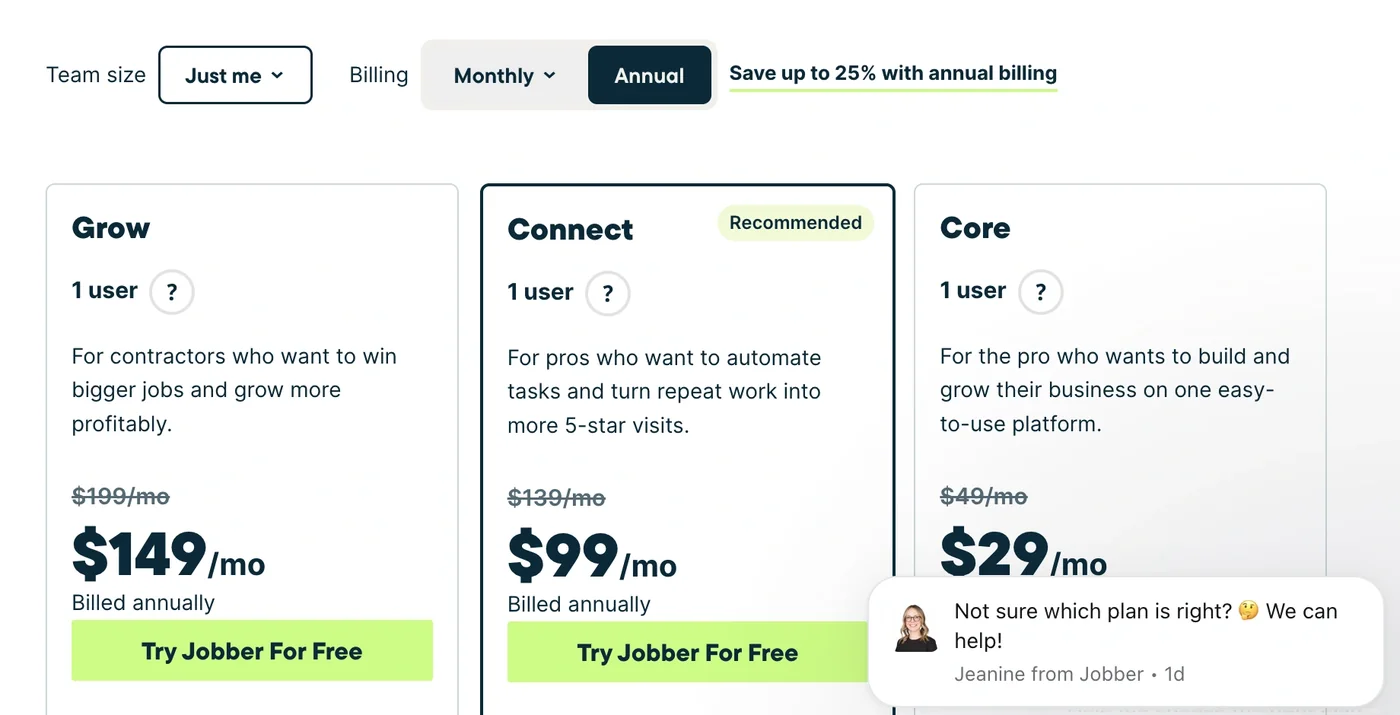
NiceJob publishes its prices, which shouldn't be remarkable and is. The Reviews plan is 75 US dollars a month. Pro is 125 a month and carries the "Most Popular" label. A bundled tier called Grow shows at 75, and Grow plus Sites at 174, with the website add-on Sites at 99 a month plus a 199 setup fee. Extra landing pages run 145 one-time plus 15 a month each, and extra CMS collections run 245 setup plus 15 a month. The same page states a 14-day free trial, no contracts and no credit card up front.
The unit is the account, not the seat. So going from four technicians to twelve costs you nothing on this line, which is unusual in a contractor's stack. But the figure moves with your customer count. The pricing page carries a slider reading 1-2,500, then 2,500 plus, 5,000 plus and 10,000 plus customers, and the prices behind the higher bands did not render when we read it. FieldPulse's documentation confirms the threshold without naming what sits above it. Its NiceJob integration article says: "If you have more than 2,500 customers or want additional functionality, visit the NiceJob Pricing page to learn more." So read the published 75 as a price per location under 2,500 customers, and multiply by your branch count, because franchise and multi-location setups get routed off the rate card entirely.
"NiceJob bills per account rather than per seat, so going from 4 technicians to 12 costs nothing on that line."
NiceJob (2026)
Birdeye asks how many locations you have
Birdeye's pricing page carries no plan names and no figures. It is a configurator: you pick a location band from 1-3, 4-9, 10-39, 40-249, 250-999 or 1000 plus, hand over a mobile number, and press a button labelled GET PRICING. The headline over it reads "Pricing built around outcomes, not seat counts." And the neutral aggregator confirms the gap rather than filling it. Capterra's vendor-supplied pricing tab names three plans, Starter, Growth and Dominate, and prices none of them: each one reads "Custom Quote Available" at a payment frequency of Per Month, and Starter lists unlimited users and unlimited contacts.
So you cannot budget, you cannot compare, and you cannot sanity-check a quote before you talk to someone. The only dollar figures anyone has published are what two customers say they paid. An Apple App Store reviewer posting as .Stev. wrote on 12/14/2024: "I would give this company zero stars if I could. I've been paying $350 per month for the last 7 to 8 months, and I honestly feel it has been a complete waste of money." On Trustpilot, a reviewer listed as Kevin P on an Australian account wrote on 19 March 2026 that "Despite paying approximately $440 per month, the platform offered limited value, and ongoing requests for support or development were not properly addressed." Neither reviewer gives a location count, and neither names a currency. Kevin P's account is Australian, so the two figures may not even be in the same dollars. Treat them as anecdotes. And watch what is bundled: Julie C., an owner in automotive services (Capterra, 5 out of 5, 1 September 2025), notes that "Mass texting campaigns are a separate cost and are kind of expensive."
| Plan | What it covers | Published monthly | Setup fee |
|---|---|---|---|
| NiceJob Reviews | Review automation, social proof widgets, AI replies | 75 US dollars | None |
| NiceJob Pro | Adds referrals, repeat booking, gifting, NPS surveys | 125 US dollars | None |
| NiceJob Grow | Bundled tier shown on the same pricing page | 75 US dollars | None |
| NiceJob Sites | Managed website add-on | 99 US dollars | 199 US dollars |
| NiceJob Grow plus Sites | Reviews and website together | 174 US dollars | 199 US dollars |
| Birdeye Starter, Growth, Dominate | Three plans on Capterra. Starter lists unlimited users and contacts | Not published. Custom quote on all three | Not published |
The contract is the product here
NiceJob: monthly, but get your cancellation in writing
NiceJob's terms of service renew you monthly and automatically: your payment renews at the end of the monthly term unless you cancel, and entering a card authorises monthly processing until you give notice. Fee changes need 30 days notice before the end of the current term. Cancellation is self-serve, by written or in-app notice before the term ends, by emailing support with the subject "Cancellation of Membership" or by following the in-app steps.
But read the next clause twice, because it decides a billing dispute. The terms state that no cancellation is valid until receipt of confirmation of cancellation is received. On the plain wording, emailing support and hearing nothing back does not stop the next charge. So cancel, chase the confirmation, keep it. There is also no refund policy of any kind in those terms, and the 199, 145 and 245 setup fees sit outside the monthly promise, so they are sunk the moment you leave.
On billing disputes there is nothing to check, and that itself is the finding. A Better Business Bureau Canada directory search for NiceJob returns the words "No results for "NiceJob"". So there is no BBB profile for the company in that directory, which means no letter rating and no complaint history to read.
The parent company does have a profile under Paystone, and it carries no accreditation seal, no letter rating and no complaint counts. Where the rating would sit, the page says only "This business profile is under review." So that is missing evidence, not a clean record, and reading an absence as an endorsement is how people get burned.
Birdeye: 90 days notice, non-refundable, and 108 BBB complaints
Birdeye's terms put the initial term in your Order Form rather than in public, then tie renewal to it. Section 2.3, headed Auto Renew, says any agreement will auto renew for the same period of time as the initial term unless written notice of non-renewal reaches Birdeye at least 90 days prior to the date of renewal. The same terms state that all payment obligations are non-cancellable and all payments made are non-refundable, with pro rata refunds only where Birdeye is in breach. And Birdeye's own cancellation page publishes no notice period, no method and no refund rule. It tells you to find the terms on the original contract you signed.
Do the arithmetic on that. If your initial term is a year, the window to escape opens at month nine. Miss it and you owe another full year, non-refundable. And a year is what the complaint record keeps describing. A Trustpilot reviewer, Collin M, posting six days before we read the page on 27 July 2026, wrote "I was told it could be a monthly contract, then after I signed, they said they made a mistake and it was a year contract, but billed monthly." Further down the same review: "they said they needed 90 days notice to cancel. 90 days for what??"
Birdeye's BBB complaint page shows it accredited and A plus rated, and on the same page states 108 total complaints in the last 3 years and 30 complaints closed in the last 12 months. Those two facts are not in tension, because the rating rewards responsiveness and Birdeye's written replies land within days.
But the themes repeat. A complaint dated 06/10/2026 says "Each phone call has always included a series of extreme upselling and the customer service staff seems to be useless." One dated 05/12/2026 describes Birdeye re-billing a charge after the customer's card company reversed it. Birdeye replied on 05/15/2026 that the account "will be canceled" and that billing had been instructed to stop further payment attempts. The customer answered the next day that the reply was "written in the future tense" with no direct written confirmation received. Birdeye then posted the four written confirmations on 05/19/2026: the account cancelled and processed on 5/14/26, the invoice voided at a zero balance, no further charges to be attempted, and no collections activity. BBB still logs it as Answered rather than Resolved. So the customer did get what he asked for, eventually. It just should not take a chargeback and a BBB file to get a cancellation acknowledged.
Review gating, and whose Google profile pays for it
Google's Maps user-generated content policy is short and unambiguous on this. Under Rating Manipulation, merchants must not "Discourage or prohibit negative reviews, or selectively solicit positive reviews from customers". Screening customers by satisfaction and sending only the happy ones to Google is selective solicitation. And the profile that carries the penalty is yours, not the vendor's, which is the part every feature page leaves out.
NiceJob: no screen in the documented flow, and no policy either
NiceJob's help article on sending an invite describes the customer getting a text asking for a review immediately, then up to three follow-up emails over the next 14 days. No rating step, no survey, no satisfaction question in front of the public ask. The product page describes the same campaign as one SMS text message and a three email sequence. NPS surveys exist, but only on Pro, and the help centre lists Review, Referral, Repeat Business and NPS survey campaigns as separate choices you enrol a customer into, not as a filter in front of the review request.
So the honest verdict is: not gated as documented, and not disavowed in writing either. No NiceJob page we read carries an explicit anti-gating policy. We checked the pricing page, the terms of service, the reviews product page, and the help articles on sending an invite and on which review sites are supported. Ask in the demo whether any campaign template conditions the public ask on a score, and get the answer in an email.
Birdeye: the parts to build a gate ship in the box
Start with what is not gating, because it matters. Birdeye's standard review request presents both options to everyone: its help documentation says customers have the option to leave a public review on one of the review sites mentioned in the request, or to send a private message using the Contact us directly button. Two doors offered to every recipient is compliant.
Now the part that isn't. Birdeye's Customer Experience template collects a satisfaction score before the review request. Per Birdeye's own setup article, the template carries six configurable sections, and the Customer Experience Email section is documented ahead of the Review request page. The score is an NPS question from 0 to 10, a 1 to 5 star rating, or sentiment buttons. Then, in the separate survey builder, Birdeye supports a Request review question pointed at up to three review sites, plus display logic that shows a question only when the previous answer meets conditions you set, using operators including "is greater than". Every component of a gate is therefore a supported feature: a score question, a public review ask, and a rule that fires one off the other. Birdeye's help centre never documents wiring the review ask to the score, and never rules it out either. That silence is the risk, because what it leaves available is textbook review gating.
We are not claiming Birdeye routes by score automatically, because no vendor page says it does. What we can show is a paying customer describing that split running live. Julie C., an owner in automotive services (Capterra, 5 out of 5, 1 September 2025), wrote: "We appreciate the way the request is formatted with "Green" for a review for positive experiences sent to Google or Facebook and the "Red" for less than satisfied customers that comes in as direct feedback." Happy customers go to Google. Unhappy ones go to a private inbox. And the profile carrying that exposure belongs to the business running the campaign, not to Birdeye.
One more finding points the same way. Birdeye's Write a Review feature asks the customer to rate you 1 to 5 stars, then collects the text onto Birdeye's own property as a Birdeye certified review. The article's stated reason for using it instead of a Google link on an office device is that review sites flag reviews written from the same IP address. Read that slowly. It is a first-party review destination positioned as a way around another platform's fraud detection, and what it produces is not a Google review.
What fires the request, and where the review lands
The trigger and the integrations
Both fire on the same event: a job or transaction marked complete inside software you already pay for. NiceJob's product page names Jobber, Housecall Pro and QuickBooks. It does not name ServiceTitan on any page we read, so a ServiceTitan shop should treat that connector as unconfirmed. Phil R., an owner in facilities services (Capterra, 5 out of 5, 7 August 2018), describes it working as sold: "It's easy to use and integrates with my CRM (Jobber). Once the job is closed, the review invite gets sent out up to 4 times."
Birdeye's integration directory lists 43 systems under Contractor and 9 under Home Services, including ServiceTitan, Housecall Pro, Jobber, FieldEdge, FieldPulse, Buildertrend, JobNimbus, Roofr, Service Fusion, ServiceTrade, MarketSharp, Sera, LawnPro and Skimmer. Its Housecall Pro page states the trigger as sending review requests automatically after a transaction has been completed, without naming the event hook, so pin that down during setup. Breadth is Birdeye's real advantage and it is not close. But breadth is only worth what reliably fires: Samantha M., a senior client manager (Capterra, 4 out of 5, 28 May 2025), reports that "We are not always notified when integrations break. So i will check on a client a realize nothing has been sent out for months."
Syndication, and the thing Google is missing from
NiceJob's supported review sites article names nine: Google, Facebook, Better Business Bureau, Capterra, CitySearch, G2, Homestars, TripAdvisor and Zillow. Yelp is not among them. Strip out the software directories and the travel and real estate sites and the practical list is four: Google, Facebook, BBB and Homestars, the last of which still produces leads in Canada. Ramiro O., a construction president (Capterra, 4 out of 5, 26 March 2022), flagged the friction on one of them: "I wish we could fix the BBB link it's hard to get reviews there."
Birdeye monitors more than 200 review sites and its request can point at up to three. But read its syndication page carefully, because the marketing blends monitoring, listings and syndication into one word. Birdeye distributes organic reviews to 50 plus partner sites reaching more than 140 million monthly users, and the named partners include AOL Yellow Pages, Bing, Citysearch, Kudzu, Mapquest, Yellowpages and Urbanspoon. Google is not among them. So a Birdeye certified review travels a directory network and does nothing to your Google Business Profile star rating. For a homeowner deciding in the map pack, that distinction is the whole ballgame.
Where each one falls short
NiceJob's named gaps
Yelp is absent from the supported list, and in a Yelp-heavy market that is a coverage hole rather than a rounding error. Only four of the nine named sites matter to a contractor at all. There is no two-way messaging and no webchat, because the engage product ships one-way broadcasts and AI replies. There is no live mobile app either: the Apple listing at NiceJob's known app ID returns 404 and a Google Play search returns no NiceJob app. Pricing above 2,500 customers is unpublished, multi-location gets no rate card, and setup fees survive cancellation. Reporting is thin by its own reviewers' account: Radha S., a legal assistant (Capterra, 5 out of 5, 27 April 2026), wrote that "Reporting and analytics are also fairly basic, which may not be ideal for businesses looking for deeper insights into review performance or customer behavior." And support scores high in aggregate but not uniformly. The lowest-rated review we found, from Shane K., a manager in consumer services (Capterra, 2 out of 5, 2 March 2021), lists as cons: "Poor quality website. Unresponsive customer support".
Birdeye's named gaps
Set the contract gaps aside, since they are covered above, and the product gaps still stack up. Birdeye publishes no pricing at all, its syndication network excludes Google, and its review kiosk produces Birdeye certified reviews rather than Google ones. Integrations can break without firing an alert. Messaging and mass texting are not clearly bundled into a quote. Then there are the retention and upsell calls sitting in the cancellation path, which Noah N., a marketing manager in construction (Capterra, 4 out of 5, 7 March 2025), describes from the customer side: "During most monthly meetings, they tried to upsell us on products that we didn't really need." And the weakest surface is mobile: 3.0 stars from 273 reviews on Google Play against 4.3 from 502 ratings on Apple, a gap that matters when your crew works from a phone.
Worth holding both rating pictures side by side, because they disagree. NiceJob shows 4.9 out of 5 across 203 Capterra reviews, with Software Advice and GetApp reporting the same score off the same Gartner pool, so treat all three as one sample of 203. Birdeye shows 4.7 from 704 on Capterra, but 3.4 from 664 on Trustpilot, where 22 percent of reviews are one star and cancellation sits among the top mentions. Directory scores measure the software. Trustpilot, in this category, measures the exit.
Which one wins at your size
| Your shape | Which one wins | Why |
|---|---|---|
| Solo operator, one location | NiceJob, if anything | Published price, no contract, and a trial you can leave |
| 3 to 10 employees, one location | NiceJob | Flat per-account billing, so hiring does not raise this line |
| 10 to 30 employees, one location | NiceJob unless your FSM is ServiceTitan | NiceJob names no ServiceTitan connector. Birdeye does |
| 30 plus, or multiple branches | Birdeye, with the term negotiated first | Neither publishes a multi-location rate. Birdeye is built for it |
How the answer differs by trade
Review software is horizontal. The value of a review is not, and neither is the software your trade already runs, so the answer differs more by trade than either vendor's site suggests.
An HVAC contractor with a maintenance base is the easiest call. Volume is high and the same household triggers several events a year, so on Jobber or Housecall Pro the cheaper tool wins on price alone. But an HVAC contractor on ServiceTitan flips it, because NiceJob never names that connector and Birdeye does. A roofing contractor closes far fewer jobs and nearly every one is a new household, so each review is worth more and there are fewer chances to earn one. At 30 roofs a year the 75 dollar line buys maybe two dozen asks. At 300 it is the cheapest line in the budget.
A plumbing contractor splits by work mix, because scheduled service feeds the trigger and a 2am emergency does not. An electrical contractor sits in between, and the deciding factor is usually whether Yelp drives calls in your market, which NiceJob does not cover. A landscape contractor on recurring maintenance visits looks like enormous volume until you notice the same names keep coming back around, so raw job count overstates the number of new reviews on offer. And if you run a multi-branch operation in any of those trades, the comparison collapses into one question: what does each vendor quote per location, in writing.
Switching from one to the other
Your reviews move, because they were never the platform's to hold. A Google review belongs to the reviewer and lives on your Google Business Profile, so it stays exactly where it is when you cancel either product. Same for Facebook. What does not move is everything downstream: campaign history, contact lists, widget embeds, and any review sitting on a vendor property. Birdeye certified reviews live on Birdeye's own network, so they leave with Birdeye. Neither vendor publishes a migration path to the other, and we found none, so plan on rebuilding campaigns rather than importing them.
Time it around the contracts, not the software. Moving off NiceJob takes days: cancel before the current monthly term ends, keep the confirmation, connect the new tool. Moving off Birdeye takes a quarter at minimum, because the 90 day non-renewal notice means deciding at month nine of a twelve month term. So budget one overlap month leaving NiceJob, and up to three months of double subscription leaving Birdeye.
Choose NiceJob if, choose Birdeye if, and when neither is right
Choose NiceJob if you run a single location, you close 15 or more jobs a month, your field service platform is Jobber or Housecall Pro, and you want to see a price before you see a sales rep. At 75 dollars a month, month to month, with a 14 day trial and no card, it is about as low-risk as software buying gets in this category. Just cancel in writing and keep the confirmation.
Choose Birdeye if you run several branches, your shop lives inside ServiceTitan or JobNimbus or Buildertrend, and you need directory listings and messaging in one platform. Go in with your eyes open on the term: get the initial length, the renewal length and the 90 day notice date in writing before you sign, put the notice date in your calendar the day the contract starts, and require that the deployed request template shows the public review option to every customer regardless of how they rate.
Neither is right if you run a single location and your field service software already sends a review request when you mark a job complete. Jobber says it will automatically send review requests at key moments, such as after a completed job or a paid invoice, and Housecall Pro says it will send automated review requests after every job or payment. If that is switched on and firing, you do not need a separate review platform, and paying a second subscription to send the same text is the most common waste in this category. Check first. It takes ten minutes. And it may save you 900 dollars a year.
The number nobody checks
Fervor is a CRO and web design studio, not a competitor to either of these. But there is a gap between winning reviews and getting paid for them, and that gap is the one we have data on.
In May 2026 we inspected 380 home services contractor websites for the State of HVAC report and the wider index. 65.5% of them surfaced a Google review anywhere on the page, which leaves 131 sites out of 380 showing a homeowner no social proof at all. It runs 76.9% for HVAC and 71.5% for roofing.
So picture the sequence you are paying for. Either platform wins you 200 five-star reviews, a homeowner finds you, clicks through, and lands on a page that says nothing about any of them. Both ship widgets for exactly this. But a widget earns nothing switched off. The full statistics are public, and the Contractor CRO Index carries the per-brand teardowns.
See whether your website does anything with the reviews you already have
Fervor inspects your site the way a homeowner uses it, then shows you the specific places trust signals go missing. It takes about three days and the first several each week are free.
Get a Site InspectionWhat we read, and what we could not
We did not run either platform on a live shop, and we are telling you that plainly rather than implying a hands-on test. What this page is instead: both vendors' pricing pages, both sets of terms, Birdeye's cancellation policy, both help centres read for the trigger, gating and syndication mechanics, the BBB records, the Capterra corpora for both, Software Advice, GetApp, Trustpilot and both app stores. Figures were last researched 27 July 2026.
Four things we could not establish, because a comparison that reports only what it found is half a comparison. NiceJob's higher customer-volume prices did not render on the pricing page, and the third-party figures circulating for them cite no primary source. NiceJob's historical iOS rating and removal date come only from app trackers that returned 403. G2 blocked us as well, so Birdeye's widely quoted G2 score is not on this page. And several Birdeye pricing tables circulate on sites that sell competing review software, cite no Birdeye source and disagree with each other. None of that informed a figure here.
One disclosure matters more on a head-to-head than on a single review: Fervor earns a commission if you sign up with NiceJob vs Birdeye through the link below, and earns nothing from Birdeye. That asymmetry is exactly what bends comparison pages, which is why the contract section above is the longest one here and why the verdict sends a whole class of reader to neither product. To evaluate NiceJob vs Birdeye directly, its product site carries the published pricing and the trial signup, and Birdeye's own site carries the configurator you have to fill in to get a number.
What NiceJob vs Birdeye users say
It's easy to use and integrates with my CRM (Jobber). Once the job is closed, the review invite gets sent out up to 4 times.
Their software is integrated into Jobber which makes it super convenient
NiceJob allows us to collect reviews on multiple platforms and share those reviews with ease.
I wish we could fix the BBB link it's hard
The dashboard is a little confusing but I really don't spend much time in there
Understanding how to navigate the campaigns for referrals and add widgets to our website has been challenging.
Poor quality website. Unresponsive customer support
sometimes have trouble logging in, it lags
Reporting and analytics are also fairly basic, which may not be ideal for businesses.
Would like to see a feature that adds a review given for one platform to all platforms.
The price feels a little high when you're just starting out.
Frequently asked questions
How much do NiceJob and Birdeye cost?
NiceJob publishes its rates. The Reviews plan is 75 US dollars a month and Pro is 125, with a website add-on called Sites at 99 a month plus a 199 setup fee. The unit is the account rather than the seat, so crew size does not move the bill, though the figure rises once your customer count passes thresholds NiceJob does not publish. FieldPulse names 2,500 customers as the first rung. Birdeye publishes no pricing at all. Its pricing page is a configurator that asks how many locations you run and collects a mobile number, and Capterra lists its one named plan, Starter, as a custom quote. The only Birdeye dollar figures on record are what two customers say they paid, 350 and roughly 440 a month, and neither states a location count.
Does Birdeye really need 90 days notice to cancel?
Yes, per its own terms. Section 2.3, headed Auto Renew, says an agreement renews for the same period as the initial term unless written notice of non-renewal reaches Birdeye at least 90 days before the renewal date. The same terms state that payment obligations are non-cancellable and payments made are non-refundable, with pro rata refunds only where Birdeye is in breach. Birdeye keeps the initial term in your Order Form rather than in public, and its cancellation page publishes no notice period at all, telling you to check the contract you signed. On a twelve month term the escape window opens at month nine.
Does either one filter out unhappy customers before asking for a review?
Google's Rating Manipulation policy bars merchants from discouraging negative reviews or selectively soliciting positive ones, and the profile that carries the penalty is the contractor's. NiceJob's documented default has no screening step: one SMS goes out immediately, then up to three emails over 14 days, with no rating question in front of the public ask. NiceJob also publishes no anti-gating policy anywhere we could read, so treat it as not gated as documented rather than as a written commitment. Birdeye's standard request offers a public review and a private message to everyone, which is compliant. But its Customer Experience template collects a satisfaction score before the review-request step, and its survey display logic can make the public ask conditional on that score. One verified Birdeye customer describes running exactly that split in production.
Which one works with ServiceTitan, Jobber or Housecall Pro?
Both fire on a job or transaction marked complete inside connected software. NiceJob names Jobber, Housecall Pro and QuickBooks on its own pages, and it names no ServiceTitan connector anywhere we read, so a ServiceTitan shop should treat that as unconfirmed until the vendor puts it in writing. Birdeye lists 43 systems under Contractor and 9 under Home Services in its integration directory, including ServiceTitan, Housecall Pro, Jobber, FieldEdge, FieldPulse, Buildertrend, JobNimbus, Roofr and Service Fusion. Breadth is where Birdeye wins outright. One caution applies to both: a Birdeye reviewer reports integrations breaking with no alert, so check that requests are still going out.
Do reviews collected in Birdeye show up on Google?
Only the ones the customer completes on Google's own form. Birdeye's syndication page says it distributes organic reviews to 50 plus partner sites, and the partners it names are AOL Yellow Pages, Bing, Citysearch, Kudzu, Mapquest, Yellowpages and Urbanspoon. Google is not among them. Reviews collected through Birdeye's native Write a Review feature land on Birdeye's own property as Birdeye certified reviews, and its help article recommends that route because review sites flag reviews written from the same IP address. Those do not raise a Google Business Profile star rating. NiceJob names nine destinations, and the four that matter to a contractor are Google, Facebook, the Better Business Bureau and Homestars. Yelp is on neither list from what either vendor publishes.
Is it hard to switch between NiceJob and Birdeye?
The reviews themselves are not the problem, because a Google review belongs to the reviewer and lives on your Google Business Profile, so it stays put when you cancel either product. What does not travel is campaign history, contact lists, widget embeds and any review sitting on a vendor property, and Birdeye certified reviews leave with Birdeye. Neither vendor publishes a migration path to the other, so plan on rebuilding campaigns rather than importing them. Time it around the contracts. Leaving NiceJob takes days because you cancel before the current monthly term ends. Leaving Birdeye takes a quarter, because the 90 day notice means deciding at month nine.
Which is better for a roofing or HVAC contractor?
It depends on job volume and on the software you already run. An HVAC contractor with a maintenance base has the volume to make either worthwhile, and on Jobber or Housecall Pro the cheaper tool wins on price alone. On ServiceTitan the answer flips to Birdeye, because NiceJob names no ServiceTitan connector. A roofing contractor closes far fewer jobs and nearly every one is a new household, so each review is worth more but there are fewer chances to earn one, and at 30 roofs a year the published 75 dollar rate buys only a couple of dozen asks. A plumbing contractor splits by work mix, since scheduled service feeds the trigger and a 2am emergency does not.
Who should not buy either one?
A single-location shop whose field service software already sends a review request on job completion. Jobber says it will automatically send review requests after a completed job or a paid invoice, and Housecall Pro says it will send automated review requests after every job or payment. If that is switched on and firing, you do not need a separate review platform, and paying a second subscription to send the same text is the most common waste in this category. Check your existing software before you buy anything. Skip both as well if you wanted scheduling, dispatch, quoting or invoicing, because neither product does any of that.
Freshness
How we keep this page current
Three dates govern this review, and they carry different meanings. The initial source sweep is dated July 27, 2026; when only part of the evidence set is recaptured later, that later date is stated beside the refreshed claim. We last revised the page on July 31, 2026. And the user reviews we quote were posted over roughly the last 24 months, so their individual dates remain part of the evidence instead of being overwritten by a later pricing update.
We revise the page when NiceJob vs Birdeye changes a published price or a contract term, when a rating we cite moves by more than a few tenths, or when the vendor ships something big enough to change the verdict. We never bump the date just to look fresh, because Google treats that as manipulation and so do we. If a figure here reads as stale by the time you land on it, treat it as a floor and check the vendor's own page. We linked it at every number for exactly that reason.
Sourcing
How this review was researched
Every figure on this page traces to a captured source linked inline where it appears. The initial sweep is dated July 27, 2026; any later, partial recapture is dated at the claim rather than relabelling the whole evidence set. Ratings come from Capterra, GetApp, Software Advice and the Apple App Store. Note that Capterra, GetApp and Software Advice share one Gartner Digital Markets review pool, so an identical score across all three is a single sample rather than three corroborating ones, and this page treats it that way. G2, TrustRadius and Trustpilot block automated access, so where their numbers appear they are labelled as reported rather than verified. No claim here is sourced from Reddit or from a contractor Facebook group, because neither could be retrieved and quoting them would mean inventing attribution. Pricing marked as reported comes from third-party roundups, never from Fervor. Fervor's own findings come from the Contractor CRO Index 2026.
About
About Fervor Studio
Fervor Studio is a conversion rate optimization (CRO) and web design studio for home services contractors across North America, based in Cochrane, Alberta. Fervor does not sell field service management software and is not an alternative to NiceJob vs Birdeye. It publishes the Contractor CRO Index, a public benchmark measuring contractor website conversion potential using reproducible, open-source methods such as axe-core and Google Lighthouse. Fervor Studio is operated by Fervor Group Inc.
Fervor's full cross-trade dataset lives in the CRO Index statistics.
 Aug 2, 2026
 Tech Stack
Best Plumbing Software in 2026: Ten Ranked Across Four Classes
A plumbing company’s work runs through four classes of software that do not substitute for each other, and it only buys two of them. Ten products, each with a published price or an explicit statement that the vendor publishes none.
Read Article Jul 31, 2026
 Tech Stack
Podium vs Birdeye 2026: Pricing, Contracts and Review Gating
Only one of these two will tell you what it costs before a sales call, and even that number carries a carve-out aimed squarely at trade contractors.
Read Article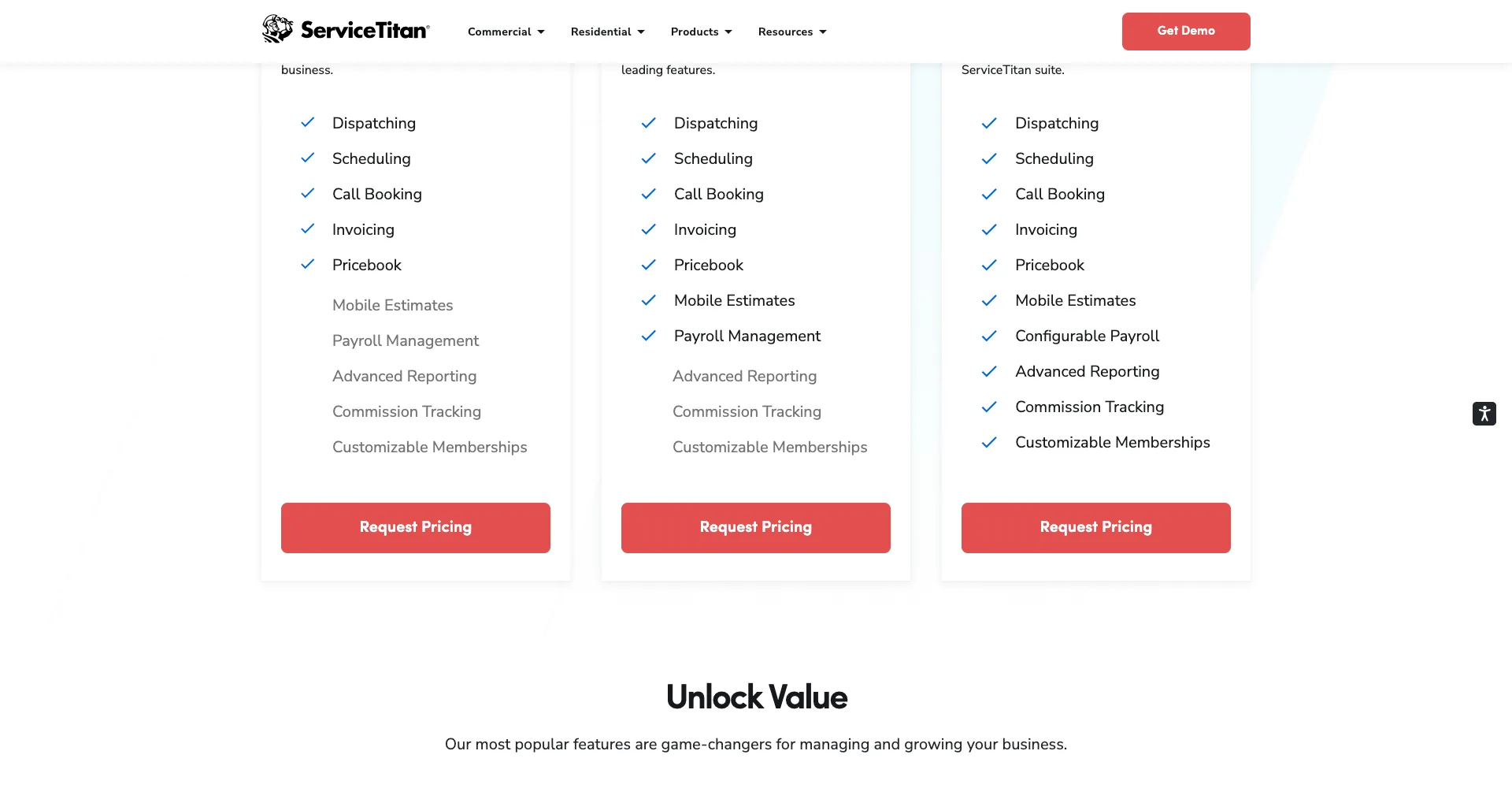 Jul 31, 2026
 Tech Stack
Best Electrical Contractor Software 2026: 11 Ranked and Priced
An electrical contracting business makes two software purchases that do not substitute for each other, and every roundup answering this query covers only one of them. Eleven platforms, with a published price or an explicit statement that the vendor publishes none.
Read Article Jul 31, 2026
 Tech Stack
Best HVAC Software in 2026: Eleven Ranked Across Three Classes
An HVAC contracting business buys across three classes of software that do not substitute for each other, and every roundup answering this query covers only one of them. Eleven products, each with a published price or an explicit statement that the vendor publishes none.
Read Article Jul 30, 2026
 Tech Stack
AccuLynx Pricing 2026: The Real Cost of a Quote-Gated Plan
One published figure, two blank plan cards, and a contract that says things the pricing page does not. A line-by-line breakdown of what AccuLynx really bills.
Read Article Jul 30, 2026
 Tech Stack
Houzz Pro Canada Review 2026: Pricing and Alternatives
Houzz Pro serves different pricing renderings. What Canadian buyers see, how GST/HST and payments work, what Custom gates, and what the annual contract commits you to.
Read Article Jul 30, 2026
 Tech Stack
JobNimbus Pricing in 2026: What the Quote Does Not Cover
JobNimbus prints no figure on any of its four plans. So the only rate you can read before a sales call is the payments meter, and it is the biggest line on the bill.
Read Article Jul 30, 2026
 Tech Stack
JobNimbus Review 2026: Pricing, Pros, Cons and Alternatives
JobNimbus rates 4.6 on Capterra and orders material straight from ABC Supply and SRS. But it publishes no price, and its supplement route carries a note.
Read Article Jul 30, 2026
 Tech Stack
BuildOps Review 2026: Pricing, Contract Terms and Alternatives
BuildOps runs commercial service and projects on one platform, and publishes no pricing at all. The billing unit, the 30-day data-export window, and who it suits.
Read Article Jul 30, 2026
 Tech Stack
FieldPulse Review 2026: Pricing, Pros, Cons and Alternatives
FieldPulse rates 4.6 on Capterra and is the platform contractors name when they leave a bigger system. But it publishes no price, and the contract runs a year.
Read Article Jul 30, 2026
 Tech Stack
Service Fusion Review 2026: Pricing, Contract and Alternatives
Service Fusion bills flat per company with unlimited users, which is the best structural deal in field service software. The published plans, the contract behind the no-contract line, and the app score every other review gets wrong.
Read Article Jul 30, 2026
 Tech Stack
Knowify Review 2026: Pricing, Job Costing and Alternatives
Knowify rates 4.5 on Capterra and its weakest sub-score is features. What the $99 Core plan withholds, which way the QuickBooks sync really runs, and who should not buy it.
Read Article Jul 29, 2026
 Tech Stack
AccuLynx Review 2026: Pricing, Tier Gating, Alternatives
AccuLynx rates 4.6 across 846 reviews and now publishes an entry price. What that price omits, which tier holds the insurance workflow, and who should skip it.
Read Article Jul 29, 2026
 Tech Stack
Unitel Voice Review 2026: Pricing, Features and Alternatives
Unitel Voice rates 4.6 on Capterra and gives a one-truck shop a business number for $9.99 a month. The published plans, the cost per call, and what it won't do.
Read Article Jul 29, 2026
 Tech Stack
NiceJob vs Podium 2026: Pricing, Contracts and Review Gating
Both vendors print a price, at very different scale and in different currencies. The gap that matters is what Podium will not print: the billing unit, and whether a trade shop gets the number on the page.
Read Article Jul 28, 2026
 Tech Stack
CompanyCam Review 2026: Pricing, Pros, Cons and Alternatives
Every page ranking for CompanyCam still quotes a per-user price the vendor no longer charges. Here are the real plans, the seat math, and who should skip it.
Read Article Jul 28, 2026
 Tech Stack
NiceJob Review 2026: Pricing, Pros, Cons and Alternatives
NiceJob rates 4.9 on Capterra and refuses to gate negative reviews. Real plan pricing, the active-customer threshold nobody publishes, and who should skip it.
Read Article Jul 27, 2026
 Tech Stack
Buildertrend Review 2026: Pricing, Limits and Alternatives
Buildertrend rates 4.5 across 2,486 Capterra reviews and quotes against your revenue rather than your seat count. The workflows, the export problem, the alternatives.
Read Article Jul 27, 2026
 Tech Stack
CallRail Review 2026: Pricing, Pros, Cons and Alternatives
CallRail rates 4.5 on Capterra, and its tracking numbers port out free. But the two usage rates that decide your real bill are the two it does not print.
Read Article Jul 27, 2026
 Tech Stack
Roofr Review 2026: Pricing, Pros, Cons and Alternatives
Roofr rates 4.6 on Capterra and sells $13 measurement reports against a market charging triple. But it will not import a report from anywhere else.
Read Article Jul 25, 2026
 Tech Stack
Housecall Pro Review 2026: Pricing, Pros, Cons, Alternatives
Housecall Pro has the shortest learning curve in the category and the widest review spread. Real pricing, the Instapay math, and the migration trap to plan around.
Read Article Jul 24, 2026
 Tech Stack
Jobber Review 2026: Pricing, Pros, Cons and Alternatives
Jobber rates 4.6 on Capterra with the best mobile app in the category. Real plan pricing, the feature gating that changes your entry price, and who it suits.
Read Article Jul 23, 2026
 Tech Stack
ServiceTitan Review 2026: Pricing, Pros, Cons, Alternatives
ServiceTitan rates 4.3 on Capterra but its weakest score is value for money. Real reported pricing, the 12-month contract, the exit fees, and who it actually suits.
Read Article Jun 3, 2026
 Tech Stack
HVAC Online Scheduling: The 43% Losing After-Hours Bookings
HVAC leads every trade on online booking at just 56.7%, which still leaves 43% of sites forcing an after-hours customer to wait for a business-hours phone call.
Read Article