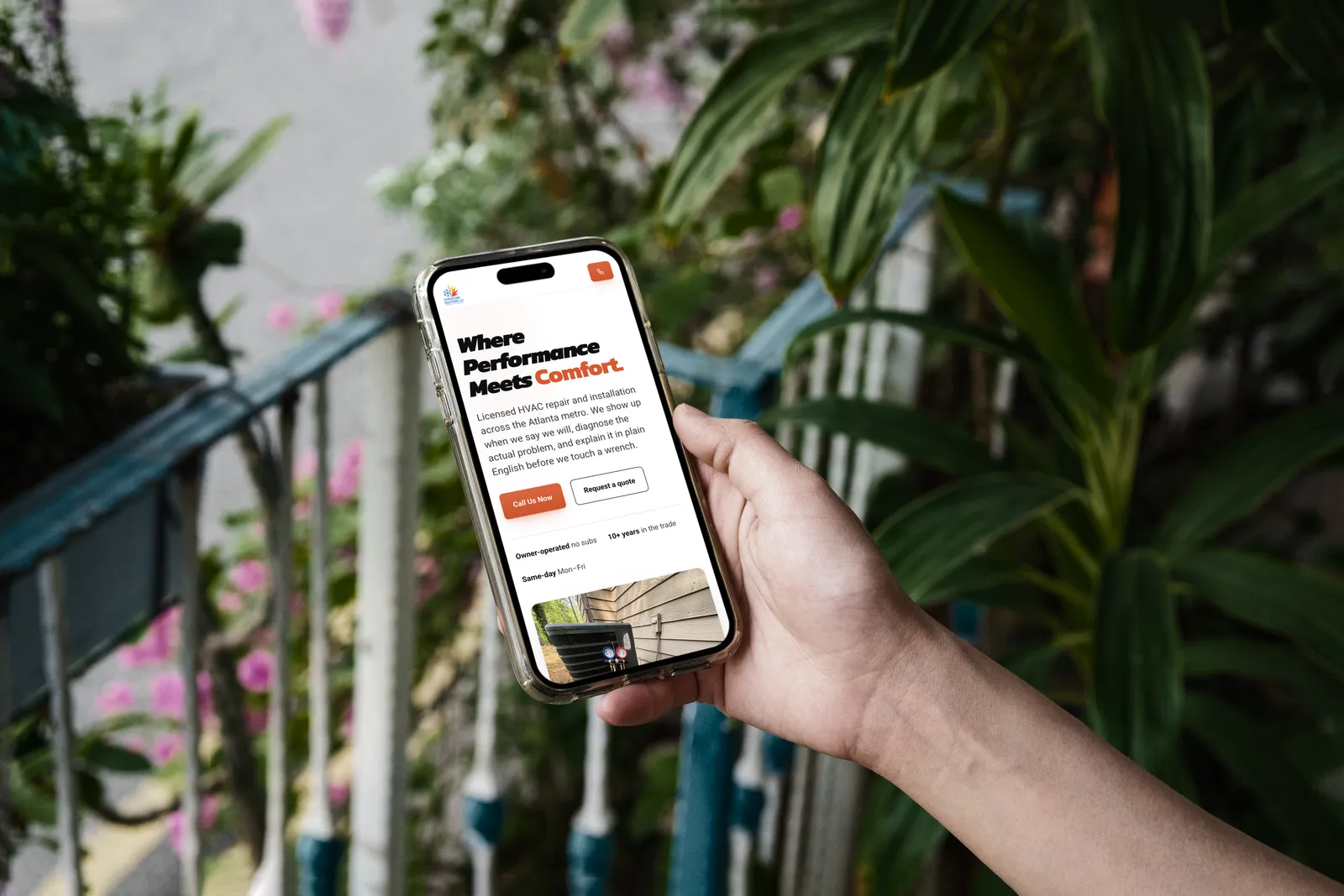




























































A HVAC website built to get the phone ringing.

You're getting clicks. They're just not calling. We rebuild your site around the one job that matters: turning a visitor into a booked job.

Starts with a Site Inspection, so you see the plan before any build begins.

HyperTemp HVAC — Fervor Studio clientJeorgy's Landscape Construction — Fervor Studio clientFour Eleven Contracting — Fervor Studio client
Trusted by home services companies across Canada and the USA

64.4% of HVAC sites we tested fail a critical accessibility check

Digital State of the HVAC Industry 2026
1 380

A grade out of 380 contractor sites

We graded 380 of them against one framework. Exactly one earned an A: Crown Industrial Roofing in Toronto, at 90 out of 100. The rest left money on the table. Here is what separates the top from the bottom.

The local detail

What actually moves the needle for HVAC web design.

Real research into what hvac contractors actually struggle with, cross-checked against what Fervor's own Site Inspections found across the trade.

  1. 94.2% of HVAC Sites Miss Google's Mobile Speed Bar

    Median mobile load lands at 6.24 seconds, and every additional second of delay costs roughly 7% of conversions. A homeowner standing in a hot house with a broken AC is searching on a phone, not waiting.

  2. Financing Has to Be Visible, Not Buried

    A system replacement runs $5,000 to $15,000, and homeowners who don't see a financing option on the homepage often assume they can't afford the job and leave. It has to sit above the fold, not on a separate page.

  3. The Phone Number Belongs on Every Page, Not Just Contact

    Some HVAC sites still put the number only on a Contact page. It needs to live in the header, the mobile sticky bar, and repeated in body copy, because a homeowner mid-emergency won't go hunting for it.

  4. Manufacturer Badges Are Trust Signals Most Sites Skip

    Carrier Factory Authorized, Trane Comfort Specialist, Lennox Premier Dealer, NATE certification: proof a homeowner can verify in seconds. Most HVAC sites either bury them or leave them off entirely.

  5. Stock Photos of Actors in Hard Hats Signal Fake

    A generic photo of a model posing next to an HVAC unit reads as inauthentic even subconsciously. Real technician photos on real jobs are the trust signal stock photography can never substitute for.

  6. Accessibility Is HVAC's Weakest Category, By a Wide Margin

    Across 104 HVAC sites Fervor tested, accessibility scored 43.8% of available points, the single weakest result in the entire framework. 64.4% carry at least one critical WCAG violation somewhere on the site.

  7. First Impression Only Clears 70% of the Bar

    HVAC sites average 14 of 20 possible first-impression points, meaning most fall short on the handful of seconds that decide whether a visitor stays or bounces. That gap is the difference between a call and a closed tab.

  8. Above the Fold Needs Five Things, Not One

    Trade-plus-location headline, visible phone number, a trust-badge strip, and a dual call-to-action (call now, schedule online) all have to appear before a scroll. Most HVAC sites lead with a hero photo and little else.

Plenty of HVAC websites still look like they were built in 2014. And honestly? They perform like it too. Slow load times, stock photos of smiling families pointing at thermostats, a "Request a Quote" form buried three clicks deep. Your hvac website design is the first thing a homeowner sees when their furnace dies at 11 PM, and if that first impression feels cheap, they're calling someone else. Every hvac web design choice you make either earns the call or loses it. There's no middle ground. If you're searching for an hvac website design company or an hvac web design company that actually understands how HVAC contractors win jobs online, you're in the right place. And if you've been burned by a generic hvac web design agency that treated your business like a template, we should talk. Because hvac websites built without conversion strategy are just expensive business cards. An hvac website design agency that knows this trade builds something different entirely.

HVAC service van with organized equipment bay parked at residential home at night

Why Most HVAC Websites Fail Before They Even Launch

Here's what happens. You hire a web designer, maybe a freelancer, maybe one of those companies cranking out sites for $500, and they hand you something that looks "nice." Clean layout. Some blue and orange. A slider on the homepage. But nobody calls.

The problem isn't aesthetics. It's architecture. Most hvac web design projects start with the wrong question. They ask "what should this look like?" instead of "what should this make someone do?" And that gap, between looking professional and actually generating leads, is where HVAC contractors lose thousands of dollars every month.

Your website isn't a brochure. It's a system. Every page has a job. Every element either moves a visitor toward picking up the phone or it doesn't. Most designers don't think this way because they've never had to. They've never sat across from a contractor who spent $8,000 on a site that generated four leads in six months.

We have. Repeatedly.

The Template Trap

Template websites are everywhere in the HVAC industry. They're cheap. They're fast. And they all look identical. Which means your heating and cooling company looks identical to every other contractor in your market. So when a homeowner is comparing three websites at midnight with a broken AC unit, nothing about yours stands out. Nothing says "these are the people to call." You just blend into the noise.

But the real damage goes deeper than appearance. Template sites ship with bloated code, unnecessary plugins, and page speed problems that tank your Google rankings before you ever publish a single page. They weren't built for your service area, your services, or your customers. They were built to be sold in volume.

What an HVAC Website Design Company Should Actually Deliver

A professional website for an HVAC contractor isn't a collection of pretty pages. It's a lead generation machine with specific, measurable components. This is what separates a real hvac website design company from a logo-on-a-template shop:

Conversion-centered page structure. Every service page . from AC repair to furnace installation to duct cleaning . follows a layout engineered to move visitors toward a phone call or form submission. Not because it "feels right" but because the data says so.

Speed that doesn't kill your rankings. Page speed isn't a nice-to-have. It's a ranking factor. It's a conversion factor. It's the difference between someone staying on your site and bouncing to your competitor.

"A 10-second delay will often make users leave a site immediately. You can easily lose half your sales simply because your site is a few seconds too slow."

, Nielsen Norman Group (2020)

Half your sales. Gone. Because your website takes too long to load. And most HVAC contractor websites are running on shared hosting with uncompressed images and seventeen tracking scripts. The math is brutal.

Mobile-first design. Over 60% of your traffic is coming from phones. Not desktops. Not tablets. Phones. So every element . your call to action buttons, your service descriptions, your contact forms . needs to work flawlessly on a 6-inch screen. Responsive design isn't optional. It's the baseline.

Local SEO integration from day one. Your site structure, your schema markup, your Google My Business connection, your NAP consistency . all of it needs to be baked into the build. Not bolted on later. Not "we'll handle SEO in phase two." Phase two never comes for most contractors.

The Phone Call Is the Conversion

New high-efficiency furnace installed next to old unit in residential basement

This is where most web design services for HVAC companies get it completely wrong. They optimize for form fills. For email submissions. For "leads" that sit in an inbox while the homeowner calls someone else.

In the HVAC business, the phone call is king. Period.

"Phone calls convert to 10-15x more revenue than web leads for home services businesses."

, BIA/Kelsey + Forrester (2025)

Ten to fifteen times more revenue. So every design decision . where you place your phone number, how big the tap target is on mobile, whether it's sticky or static . directly impacts your bottom line. Your hvac web design needs to make calling effortless. Not just possible. Effortless.

And the thing is most hvac web design agencies won't tell you: the form is a backup, not the primary conversion. Forms exist for after-hours visitors, for people who want to schedule non-emergency work, for the small percentage who genuinely prefer typing over talking. But the phone number? That's your money line. It belongs at the top of every page, visible without scrolling, and it better be click-to-call on mobile.

Speed Isn't a Feature . It's the Foundation

We keep coming back to speed because it's that important. Your HVAC company's website is competing for attention in a moment of urgency. Somebody's house is 95 degrees. Their pipes are frozen. Their furnace is making a sound that definitely isn't normal. They're not patient.

"Three critical response time thresholds: 0.1 seconds feels instantaneous. 1.0 second keeps flow of thought. 10 seconds is the limit."

, Nielsen Norman Group (2024)

Ten seconds is the absolute ceiling. And yet . pull up most HVAC contractor websites on Google PageSpeed Insights. Watch the scores. You'll see load times of 8, 12, sometimes 15+ seconds on mobile. Those aren't websites. They're lead repellent.

A properly built hvac website design prioritizes core web vitals from the start. That means optimized images, minimal JavaScript, clean CSS, proper caching, and hosting infrastructure that can handle traffic spikes when a storm hits and everyone in your service area needs emergency HVAC service at the same time.

What Fast Actually Looks Like

Sub-2-second load time on mobile. That's the target. Not 4 seconds. Not "pretty fast." Under two seconds. Because at that speed, the experience feels instant. The visitor doesn't think about your website at all . they think about your services. And that's exactly what you want. Every millisecond of load time you eliminate removes friction between a visitor and a phone call.

Service Pages That Actually Convert

HVAC technician servicing outdoor condenser unit on a summer day

Your homepage matters. But your service pages are where the real conversion happens. When someone searches "AC repair near me" or "furnace installation [your city]," they're not landing on your homepage. They're landing on a specific service page. And that page needs to do one thing: convince them you're the right contractor to call. Right now.

Service pages are where hvac websites quietly give up. A paragraph of generic text, a stock photo, and a button that says "Contact Us." That's not a service page. That's a missed opportunity. A real service page for an HVAC contractor includes:

  • A clear headline stating the specific service and location
  • Your phone number above the fold . click-to-call on mobile
  • Social proof: reviews, ratings, certifications, years in business
  • A direct explanation of your process so the customer knows what to expect
  • Pricing transparency (at minimum, "starting at" ranges)
  • A strong call to action that creates urgency without being sleazy

Every service you offer . heating, cooling, indoor air quality, duct work, maintenance plans . deserves its own dedicated page. Not a bullet point on a single "Services" page. Individual pages with unique content, targeted keywords, and location-specific details. This is how you build an online presence that actually ranks.

The Weekend Problem

This is a stat that should keep every HVAC business owner up at night:

"18% of home services calls go unanswered on weekdays, while 41% go unanswered on weekends."

, Invoca (2025)

Forty-one percent. On weekends. When do HVAC emergencies happen most? Evenings and weekends. When are most contractors least prepared to answer the phone? Evenings and weekends.

Your website design needs to account for this reality. That means after-hours functionality that goes beyond a form. Online scheduling. Chat widgets that don't feel like talking to a robot. Clear messaging about response times. "We answer 24/7" only works if you actually answer 24/7 . but your website can at least capture and route those leads intelligently so they don't vanish into the void.

(Side note: this is one of those problems that seems like a staffing issue, not a website issue. But it's both. A well-designed site reduces friction for after-hours visitors so dramatically that even a simple "leave your number, we'll call you back within 15 minutes" workflow . automated via your CRM . can recover leads that your competitors are losing every single weekend.)

Local SEO and Your HVAC Website Are Inseparable

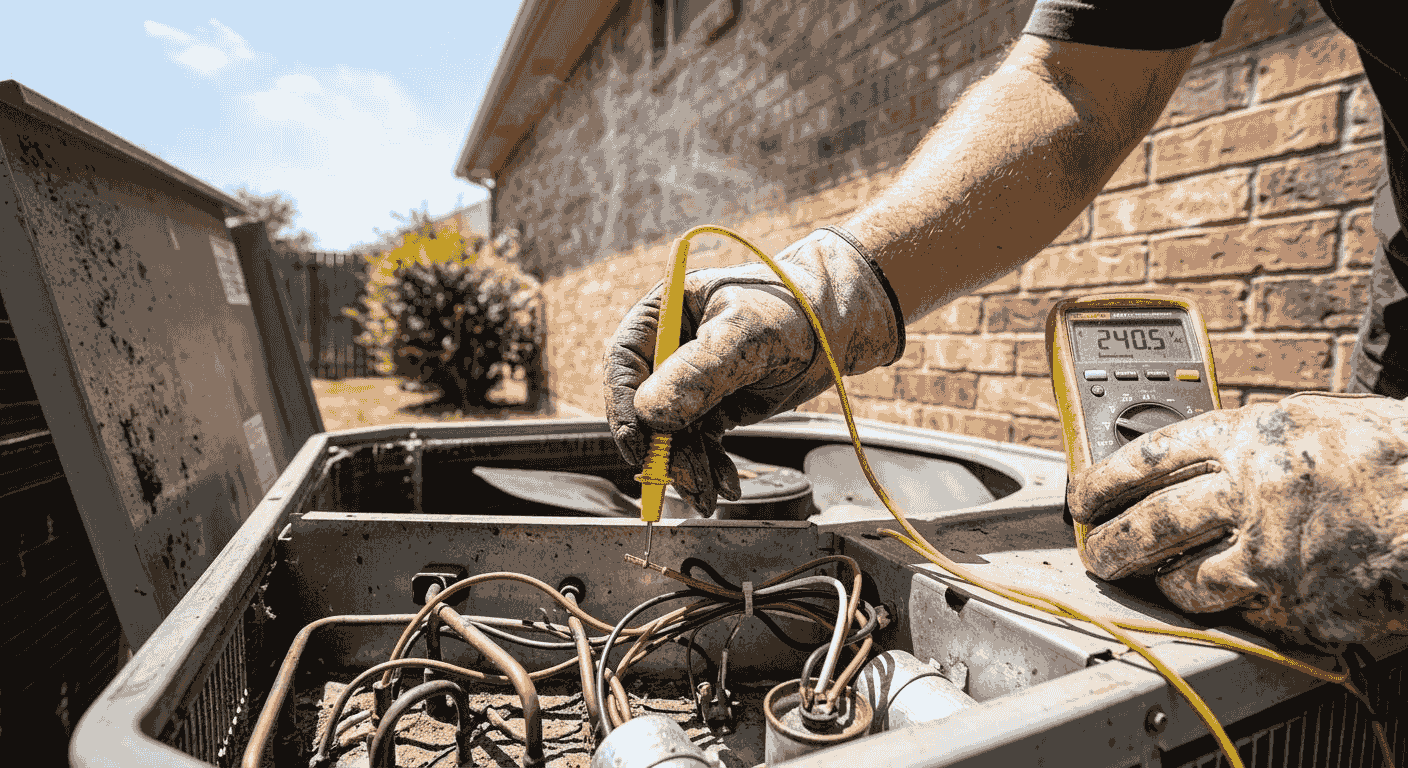
HVAC technician testing circuit board with multimeter on Lennox furnace

You can't separate your website from your local SEO strategy. They're the same thing. Your site structure determines which keywords you rank for. Your content determines how Google understands your service area. Your technical foundation determines whether Google trusts your site enough to show it in the local pack.

A proper hvac web design company builds SEO into the architecture. Not as an add-on. Not as a "phase two" project. From the first wireframe, every decision considers search visibility:

  • URL structure that reflects your services and locations
  • Header hierarchy (H1, H2, H3) that signals topic relevance to Google
  • Schema markup for local business, services, and reviews
  • Internal linking between related services (your HVAC SEO strategy starts here)
  • Google My Business integration and consistent NAP data
  • Location-specific landing pages for every city you serve

Most web designers treat SEO like something the marketing team handles after launch. But by then, the damage is done. Rebuilding a site's SEO architecture after it's live costs twice as much and takes three times as long as building it right from the start.

What "Custom" Actually Means

Every hvac website design agency claims they build "custom websites." But custom doesn't mean they drew a new header image. Custom means the entire user experience was designed around how YOUR customers behave in YOUR market.

A genuinely custom website for an HVAC contractor starts with data. What services generate the most revenue? Which zip codes are you targeting? What's your average ticket size? How do customers currently find you . Google search, Google Local Services ads, referrals, PPC? The answers to these questions shape every aspect of the site, from information architecture to page priority to call to action placement.

Then tthis is the competitive analysis. What do the top three HVAC companies in your market look like online? Wthese are they weak? Where can you differentiate? If every competitor leads with "Family Owned Since 1987," maybe your homepage should lead with something else entirely. Something that actually matters to the person whose air conditioner just died.

Custom means researched. Custom means strategic. Custom means your site doesn't look or function like anyone else's in your market because it wasn't built from anyone else's blueprint.

Content Management You'll Actually Use

Your website needs a content management system that doesn't require a computer science degree. You should be able to update your phone number, add a seasonal promotion, or publish a blog post without calling your web developer. And yet . the number of HVAC contractors locked out of their own websites is staggering. Either the CMS is too complex, the login credentials were never shared, or the developer built everything in hard-coded HTML that only they can edit.

A good hvac web design agency builds on a CMS that's intuitive, reliable, and gives you ownership. Not dependency. You paid for the website. You should be able to use it.

The Real Cost of a Cheap Website

Contractor handing maintenance agreement to homeowner at front door

Let's talk money. You can get an HVAC website for $500. You can get one for $50,000. The question isn't "how much does it cost?" . it's "what does it cost you when it doesn't work?"

If your average HVAC job is worth $1,200 and your website generates 5 fewer leads per month than it should . that's $6,000 in lost revenue. Every month. Seventy-two thousand dollars a year. Suddenly that "expensive" custom website with a proper conversion strategy looks like the bargain of the century.

The cheap site costs you more. It always does. Not because cheap things are automatically bad, but because a $500 website cannot include conversion research, custom design, speed optimization, SEO architecture, and ongoing support. It just can't. The math doesn't work. So you get a template, a logo swap, and a "good luck." And then you wonder why the phone isn't ringing.

What to Budget Realistically

For an HVAC business, a properly built website . one that's designed to generate leads, optimized for speed, structured for local SEO, and built on a platform you can actually manage . typically runs between $5,000 and $25,000 depending on scope. That includes custom design, development, content strategy, and launch optimization. It does not include ongoing digital marketing, PPC management, or monthly SEO services. Those are separate investments with separate returns.

The website is the foundation. Everything else . your Google Ads, your social media, your email campaigns, your HVAC contractor marketing strategy . sits on top of it. Build the foundation wrong and everything above it underperforms.

Portfolio: Look at the Work, Not the Pitch

When you're evaluating an hvac website design company, ignore the sales deck. Look at the portfolio. Specifically, look for these things:

Do they have HVAC clients? Or at least home services clients? Building a website for a restaurant and building one for an HVAC contractor are completely different problems. The user intent is different. The urgency is different. The conversion path is different. Industry-specific experience matters more than a pretty Dribbble profile.

Do the sites actually perform? Ask for case studies with real numbers. Not "we increased traffic by 200%" . increased from what? To what? Ask for conversion rates. Lead volume. Revenue impact. Any hvac web design company worth hiring will have data, not just screenshots.

Run the sites through PageSpeed Insights. Right now. If their portfolio sites score below 70 on mobile, they're not prioritizing performance. And if they're not prioritizing performance on their showcase work, imagine what your site will look like.

Check on mobile. Pull up their portfolio sites on your phone. Tap the phone number. Try to fill out a form. Move through between pages. If anything feels clunky or slow, that's what your customers will experience. And your customers won't be as forgiving as you are.

Why HVAC Contractors Specifically Need Specialized Design

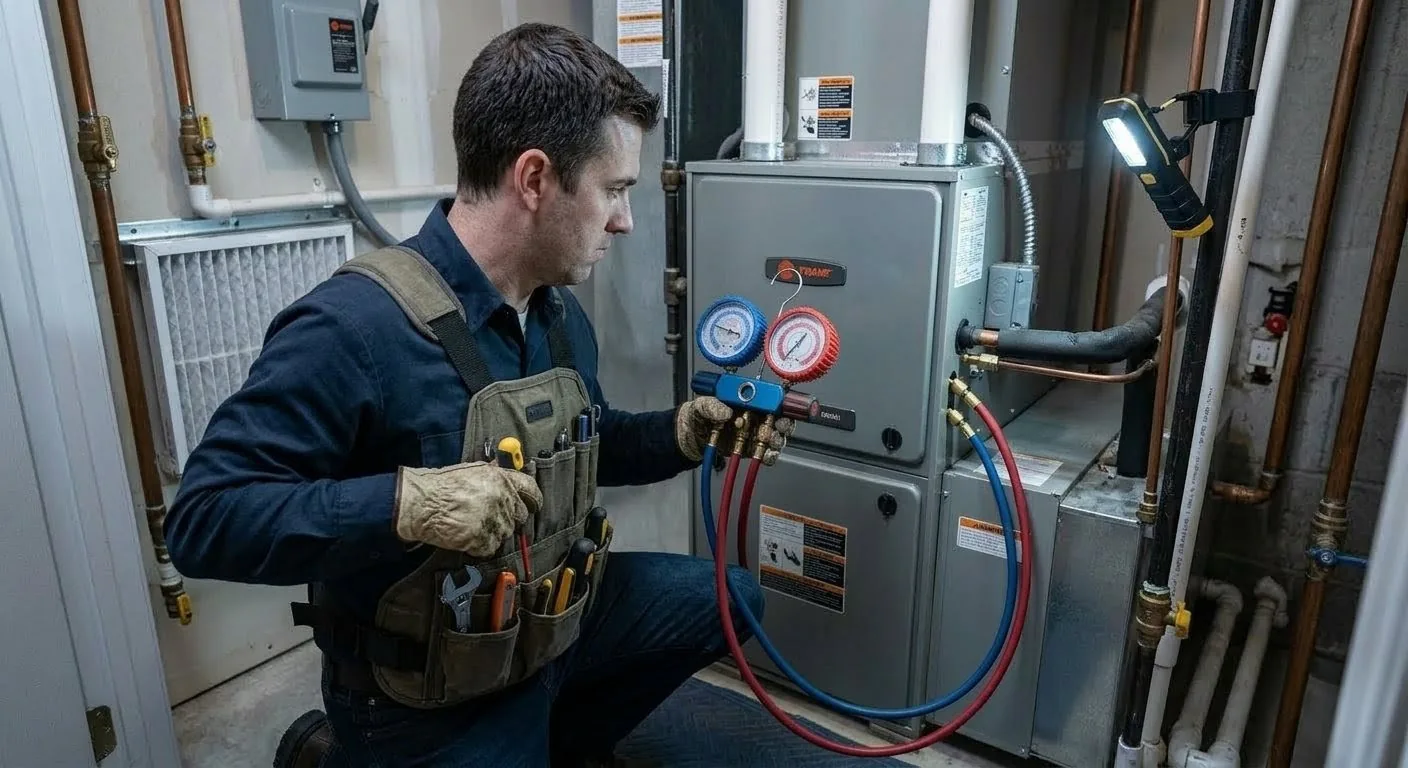
HVAC technician connecting refrigerant gauges to furnace unit

The HVAC industry has specific challenges that generic web designers don't understand. Seasonal demand swings. Emergency vs. planned service dynamics. The difference between residential and commercial. Maintenance agreement sales cycles. Financing options for equipment replacements. These aren't things you can learn from a brief. They're things you learn from working with HVAC contractors for years.

A specialized hvac website design agency understands that your January traffic patterns look nothing like your July traffic. That your AC repair page needs to convert differently than your new system installation page. That the homeowner whose furnace just died at 2 AM has fundamentally different needs than the homeowner researching a system upgrade they've been considering for months.

This understanding shapes everything. Page layout. Content tone. Call to action urgency. Form length. Even the images you use. A stock photo of a pristine furnace tells a visitor nothing. A photo of YOUR tech working on a real system tells them you're legitimate. The details matter because in a competitive market, details are the only thing that differentiates you.

The Website Redesign Question

If you already have a website that isn't performing, you're facing a decision: fix it or start over? The answer depends on the foundation.

If your current site is built on modern technology with clean code and decent hosting, a website redesign might be the right move. Keep what works, rebuild what doesn't. This is faster, often cheaper, and preserves any SEO equity you've built.

But if your site is built on outdated technology, runs on shared hosting, has no SEO foundation, and was never designed for conversion . a redesign is just putting new paint on a crumbling structure. Start fresh. Build it right. The short-term cost is higher but the long-term return is dramatically better.

Either way, start with an audit. Not a vague "your site needs work" audit . a specific, data-driven analysis of what's working, what's not, and what's costing you money. Our Site Inspection does exactly that. No fluff. No generic recommendations. Just the specific problems with your site and what it'll take to fix them.

What Happens After Launch

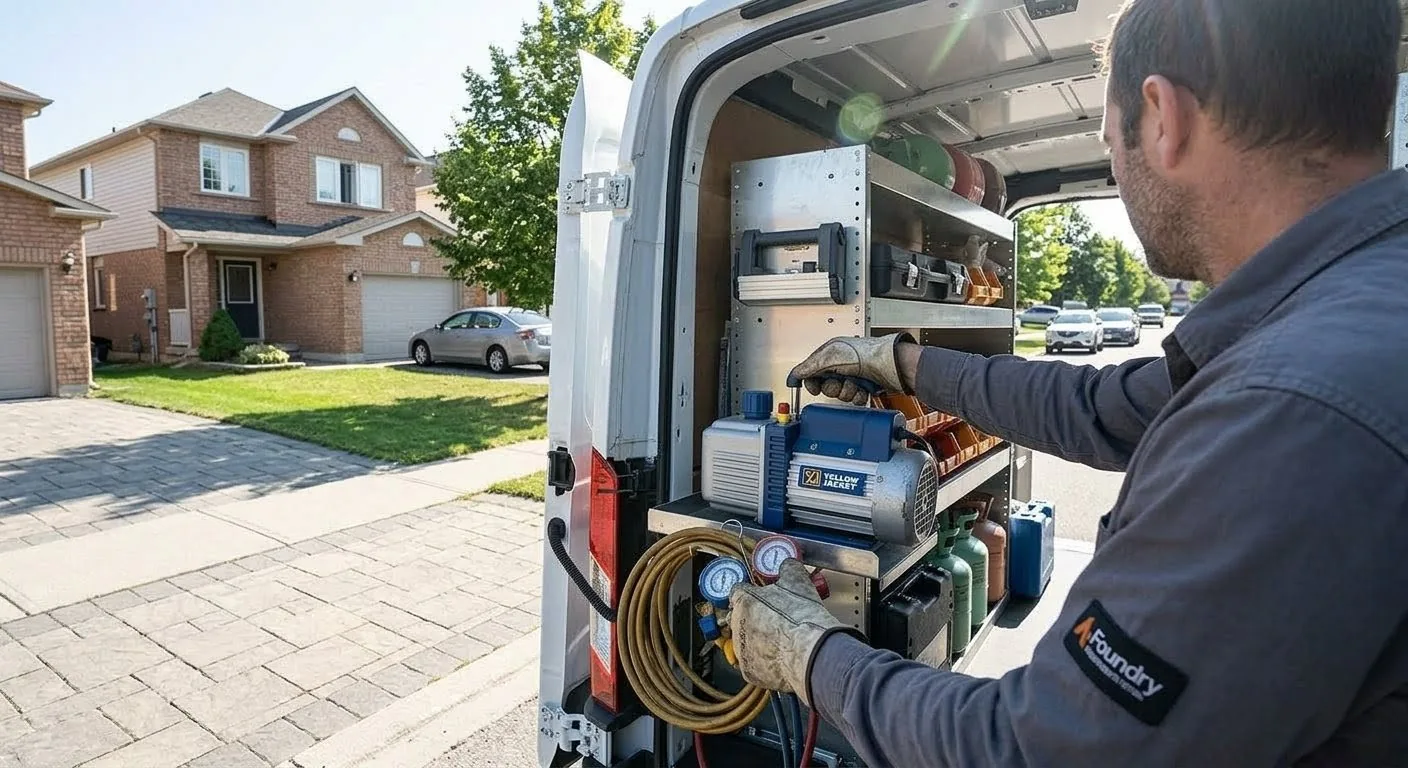
HVAC technician organizing equipment in service van on suburban street

Your website isn't done when it launches. It's done when it's consistently generating the lead volume your HVAC business needs to hit its revenue targets. And that requires ongoing work.

Website maintenance. Software updates, security patches, hosting management, uptime monitoring. This isn't glamorous but it's necessary. One security breach or extended downtime event during peak season can cost you thousands in lost leads.

Performance monitoring. Page speed can degrade over time as you add content, install plugins, or your hosting environment changes. Monthly performance checks keep your site fast and your conversion rate stable.

Content updates. New services, new service areas, seasonal promotions, blog content for SEO, updated reviews and testimonials. Your site needs fresh content to maintain and improve rankings. Google rewards sites that demonstrate ongoing activity and relevance.

Conversion optimization. Your first launch is a hypothesis. You think this layout will convert. You think this headline will resonate. You think this form placement will generate leads. But you don't know until real visitors interact with the site. Ongoing conversion rate optimization . testing headlines, adjusting layouts, refining calls to action . is what turns a good website into a great one.

The mechanical contractors who dominate their markets aren't the ones with the fanciest websites. They're the ones who treat their website like a living system that gets maintained, measured, and improved. Continuously.

Choosing the Right HVAC Web Design Company

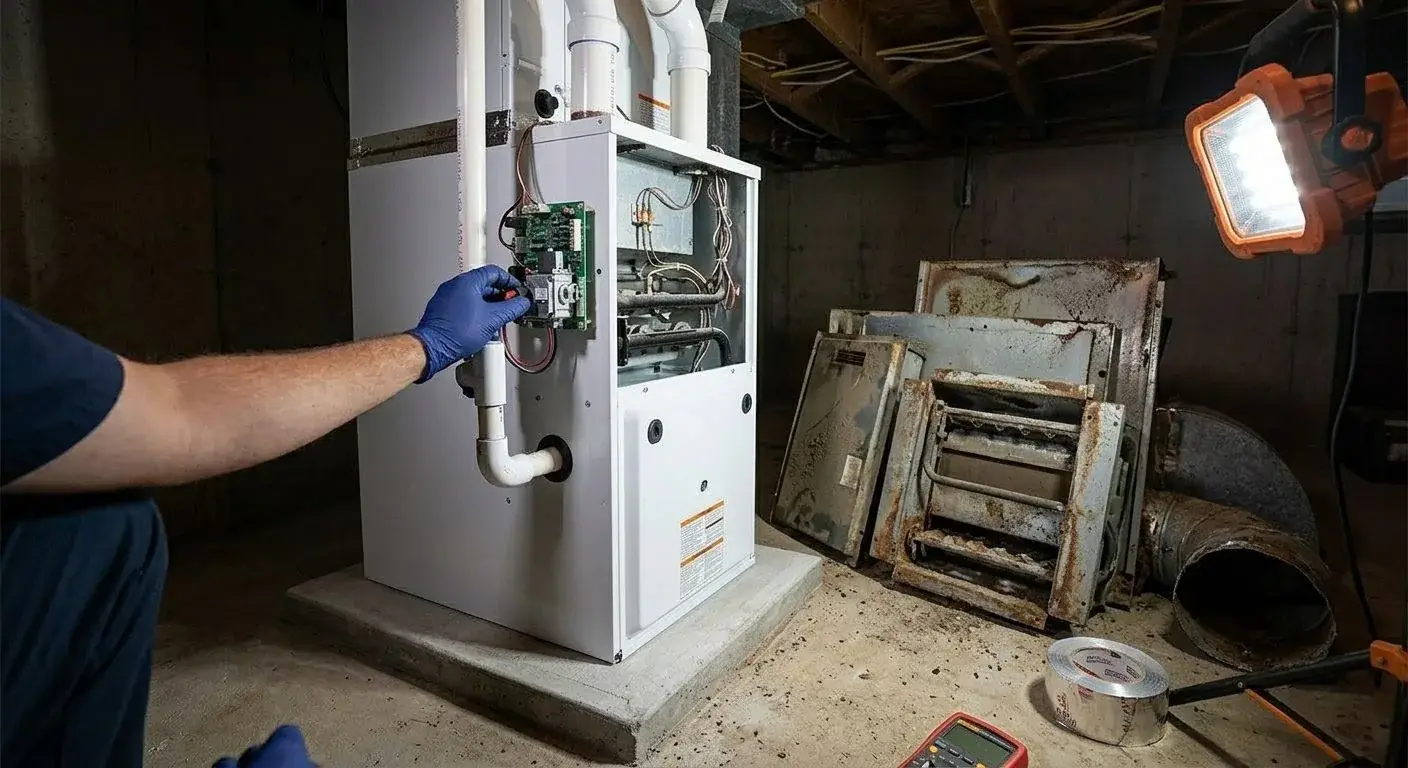
HVAC technician working on equipment with work light in dark basement

So. You need a website that actually generates leads for your HVAC company. This is what to look for in a partner:

They ask hard questions first. Before they talk about design or pricing, they want to know about your business. Revenue goals. Service mix. Target markets. Competition. Average ticket size. If an hvac web design company starts with "pick a template," walk away.

They show you data, not just designs. Conversion rates. Load times. Lead generation metrics. Before-and-after case studies from real HVAC clients. Any agency can show you a beautiful mockup. Few can show you a beautiful mockup that also converts well.

They understand the HVAC industry. Not just "home services." Specifically HVAC. They know the difference between a system replacement lead and a maintenance call. They understand seasonal demand. They've worked with contractors like you, not just e-commerce brands and SaaS startups.

They build for speed first. Ask about their approach to page speed before you ask about colors. A gorgeous website that loads in 7 seconds is worse than a plain website that loads in 1.5 seconds. Every time.

They plan for after launch. The best hvac website design company doesn't disappear after the site goes live. They have a maintenance plan. They monitor performance. They're available when something breaks at 6 AM on a Monday in July . because that's when your AC repair page is getting the most traffic and you can't afford downtime.

"40% of home services consumers who call from search make a purchase."

, Google via Invoca (2025)

Forty percent. When someone calls from search, nearly half of them buy. That's the conversion rate your website needs to enable. Not by being pretty. Not by being clever. By being fast, clear, trustworthy, and relentlessly focused on getting the phone to ring.

Your HVAC business deserves a website that works as hard as you do. Not a template. Not a digital brochure. A conversion system built specifically for how HVAC contractors earn business in 2026. That's what we build. And it starts with understanding exactly where your current site is falling short . which is exactly what our Site Inspection is designed to uncover.

The evidence

What separates the sites that book work from the ones that do not.

Fervor HVAC State of the Industry report cover Read the full report →

0

contractor sites graded, one A

Across the whole CRO Index, a single site earned an A. The median landed at a D. The grade gap is a conversion gap.

Fervor Contractor CRO Index, 2026

0 %

of HVAC sites fail a critical accessibility check

Scored against WCAG 2.1 AA with axe-core. A page that blocks a screen reader also blocks a paying customer.

Fervor HVAC State of the Industry, 2026

Accessibility violation severity across HVAC contractor sites
Critical and serious WCAG failures across 104 HVAC sites.

0 %

miss Google's mobile load-speed bar

Median mobile load lands at 6.24 seconds. Most of your traffic is on a phone, and most of them are gone before the hero paints.

Fervor HVAC State of the Industry, 2026

Mobile Core Web Vitals distribution for HVAC contractor sites
Mobile Largest Contentful Paint across 104 HVAC sites.

0 /100

is the average HVAC grade

That is a D. The sites booking the work are not the ones with the biggest crews. They are the ones a few points higher on the things homeowners feel.

Fervor HVAC State of the Industry, 2026

Two ways to start

Improve what you have, or build it right.

Tell us where you are. We point you at the right next step — no sales call to get there.

Client review

What working with Fervor looks like.

“Nay did an amazing job, you know. He was really patient. He got the work done the way I told him and he was just on point with the website. Pretty straightforward process. No going around the bush. He just did amazing work and I would 100% recommend.”
Ruben Mederos 1 review · 2 months ago
View on Google

How Fervor can help

The services that move hvac sites from graded to booked.

01

Booked by Design™

From $9,997–$12,997

Complete website system built to convert storm leads, planned projects, and research-phase homeowners into booked jobs.

  • Custom design + trade-specific conversion architecture
  • Mobile-first, SEO-ready build
  • CallRail tracking + NiceJob review integration
See what's included
02

Leak Plug Sprint

From $4,997

Identify and patch the top conversion killers on your existing site. No full rebuild needed.

  • Full site inspection across 6 categories
  • Top 3–5 fixes ranked by revenue impact
  • Conversion path + speed + mobile repairs
  • CallRail tracking installation
See what's included
03

Performance Partner™

From $1,497/mo

Monthly SEO, content, and CRO. Fixed deliverables. No credits, no rollover. The compound growth engine.

  • Monthly SEO content + technical monitoring
  • Conversion rate optimization
  • Revenue-tied reporting + dedicated account manager
See what's included
04

The Local Pick

One-time $2,497

GBP optimization, citation building, and review system foundation. The infrastructure that gets you into the Map Pack.

  • Google Business Profile overhaul + schema
  • Citation inspection, cleanup, and building
  • NiceJob review automation setup
  • NAP consistency + competitor gap analysis
See what's included
05

Referral Closer

One-time $495

One conversion-built landing page for the referrals, paid clicks, and cold-call leads you send. They land on a page built to book them, not your generic homepage.

  • One dedicated, conversion-built landing page
  • Built for referral, paid, and cold-outreach traffic
  • Click-to-call, lead form, and trust proof above the fold
  • CallRail tracking on every lead
See what's included

Your move

Two ways forward. Both start with a real look at your site.

Tell us where you are. We point you at the right next step — no sales call to get there.

Get My Site Inspection