Podium vs Birdeye 2026: Pricing, Contracts and Review Gating
Podium publishes $459 CAD for Core and $689 for Pro, with an HVAC carve-out. Birdeye publishes nothing at all. Contract terms, gating and integrations inside.
Page at a glance
Podium and Birdeye are review platforms sold to home services contractors, and only one shows you a price. Podium publishes Core at $459 CAD a month and Pro at $689 CAD, Signature custom, and every tier tells HVAC businesses to contact sales for applicable pricing. Podium never states whether that month buys a location or a user. Birdeye publishes no figure: its pricing page is a configurator that asks your location count and mobile number. Podium's terms carry a twelve month term with one month written notice before renewal. Birdeye's require ninety days. Podium holds a BBB rating of A- against Birdeye's A+. Podium's shipped invite does not gate. Birdeye's Customer Experience template collects an NPS or star rating first, and its display logic can make the public ask conditional on a good score, which Google's review policy prohibits. Both fire the request from a job completion event in the field service system you already run, from ServiceTitan to Jobber, and Birdeye names far more contractor platforms.
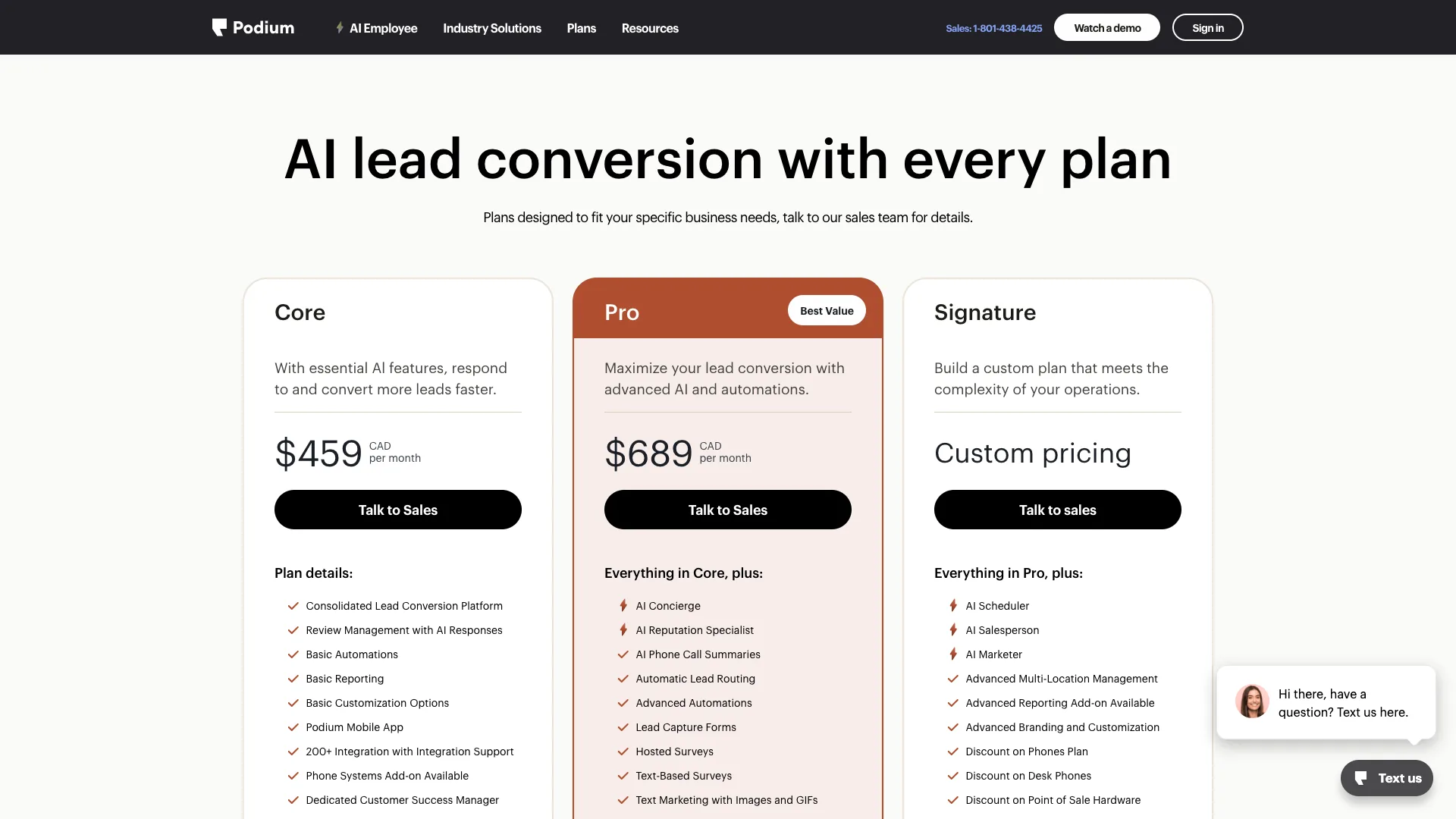
"Podium publishes Core at $459 CAD a month."
Podium (2026)
Quick answer
Pick Birdeye if you run more than one location and you need the review request to fire from a contractor specific system like JobNimbus, Buildertrend or FieldPulse, because Birdeye names 43 contractor integrations against Podium's shorter published list. Pick Podium if your problem is messaging rather than reviews, because webchat, a shared text inbox and bulk messaging are core to the platform rather than a second purchase, and because you can see what it costs before anyone calls you back. Podium publishes $459 CAD a month for Core and $689 CAD for Pro. Birdeye publishes nothing and asks for your mobile number first.
But read the pricing section before you budget against that figure, because it comes with strings. It rendered in Canadian dollars, and Podium never says whether the month covers one location, one user or the whole account. And every tier on that page carries a line telling HVAC businesses to contact sales for applicable pricing, so if you run HVAC the number on screen belongs to somebody else's quote.
Read the contract section before you sign either one. Both auto renew, both make their money on the notice window you forget, and the complaint record on both is dominated by the same sentence: I cancelled and they kept billing me.
Last researched 27 July 2026. Every figure below was fetched from a live page on that date and linked where it appears.
What each one costs, and which one puts it on the page
Start here, because the gap between these two pricing pages is the comparison. One vendor prints figures you can hold a rep to. The other one wants your mobile number before it will say anything at all. That difference decides whether you walk into the call with a budget or with a blank sheet.
Podium publishes two figures. Its own pricing page prices Core at $459 CAD per month and Pro at $689 CAD per month, badges Pro as "Best Value", and leaves Signature on "Custom pricing". Every plan's button reads Talk to Sales, and the subhead still says "Plans designed to fit your specific business needs, talk to our sales team for details." Two footnotes sit underneath: "Every additional number is $5/month" and "A base 10DLC fee of $5/month is charged for all US locations."
What the money buys is published too. Core covers review management with AI responses, basic automations, basic reporting, the mobile app, 200+ integrations with integration support, a dedicated customer success manager and one-on-one onboarding, with phone systems listed as an available add-on. Pro adds the AI Concierge, the AI Reputation Specialist, AI phone call summaries, automatic lead routing, advanced automations, lead capture forms, hosted and text-based surveys, text marketing, advanced customer segmentation and lower payment processing fees. Signature adds the AI Scheduler, AI Salesperson, AI Marketer, advanced multi-location management, account migration, quarterly business reviews and custom processing rates. Phones never fold in. Core lists them as an add-on and the tiers above it inherit that.
The software directories disagree with the vendor, and the vendor wins. Capterra still records "Custom Quote Available" against every Podium plan. So any pricing table built from a directory will tell you Podium publishes nothing, and it will be wrong. What Capterra is still good for is the negative space: no free trial and no free version, which means you cannot run Podium against your own jobs before you sign.
And then there's the line a contractor has to read twice. All three tiers carry the same sentence: "HVAC businesses should contact sales for applicable pricing." So the published number is published with a carve-out written into it, and the carve-out names one of the trades most likely to be reading that page. So if you run HVAC, the $459 on screen belongs to somebody else's quote until a rep tells you what yours is. Podium doesn't say whether HVAC pays more, pays less, or just gets packaged differently, and that ambiguity is worth two minutes at the top of the sales call rather than a surprise at the bottom of the proposal.
One more caveat on those figures, because it decides whether they're yours. The page rendered in Canadian dollars from a Canadian connection, and it carries no country picker and no currency selector anywhere on it. So we can tell you the page publishes those two figures in Canadian dollars. We can't tell you what a visitor in Dallas sees, and we're not going to convert them and hand you a conversion dressed up as a fact. That same page does serve US visitors, because one of its own footnotes reads "A base 10DLC fee of $5/month is charged for all US locations." Check the currency on your own screen before you build anything on it.
What Podium still doesn't publish is the unit, and that's the gap a multi-location shop feels. Nothing on the page says whether $459 buys one location, one user or one account. That missing word is the difference between a three branch bill of $459 and a three branch bill of $1,377, which is not a rounding error on anybody's P&L. The only nod to branches in the whole plan list is a Signature feature called Advanced Multi-Location Management, which suggests multi-location is a tier rather than a multiplier. Or both. Get the unit stated in writing before you get anything else stated in writing.
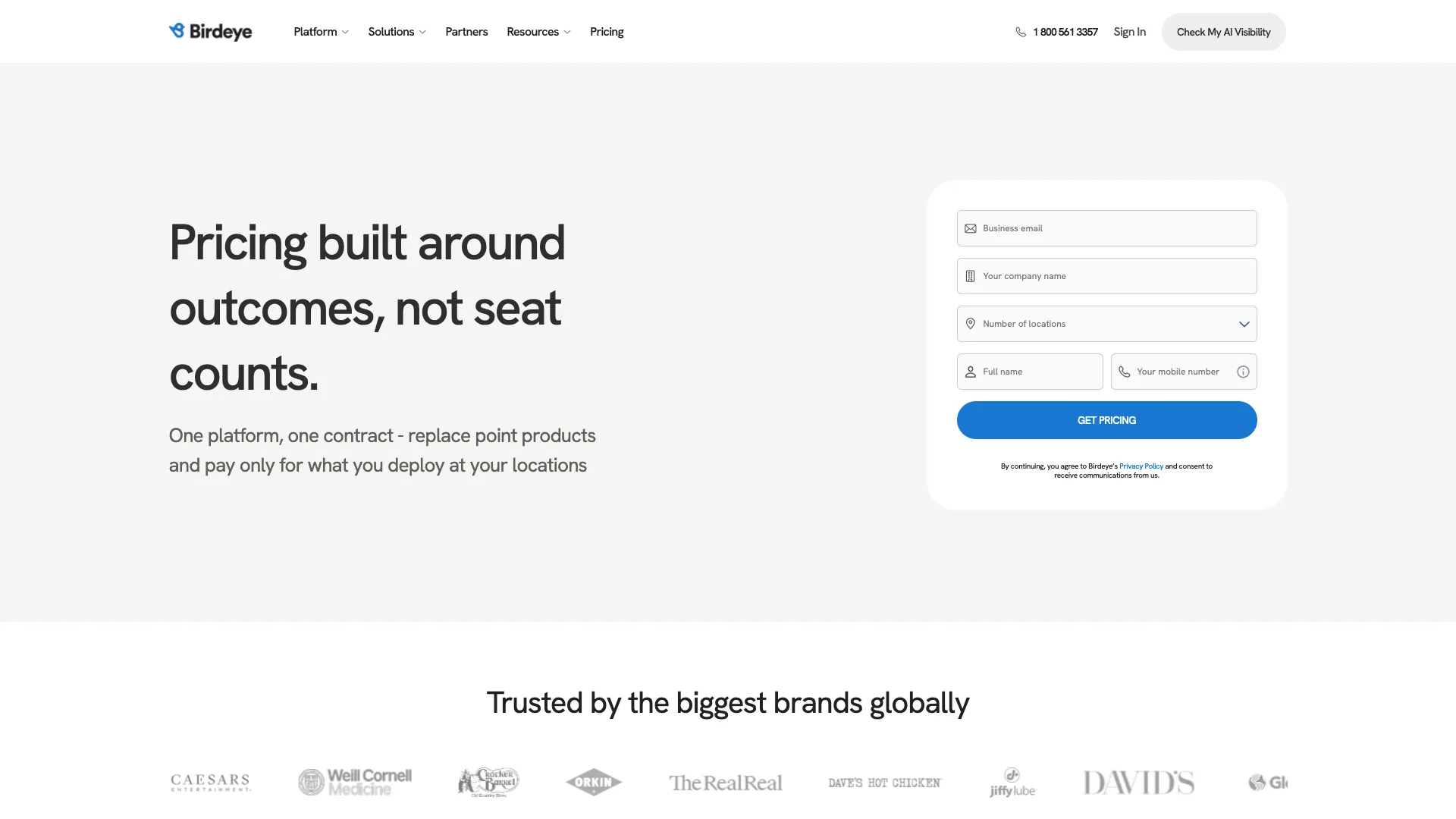
Birdeye publishes no figure at all. Its pricing page is a lead capture configurator: you pick a location band from 1-3, 4-9, 10-39, 40-249, 250-999 or 1000+, fill in the field labelled "Best mobile number to reach you", and press a button that reads "GET PRICING". Nothing on the page says what comes back or when. The positioning copy reads "Pricing built around outcomes, not seat counts" and "One platform, one contract", and that is the closest thing to a rate on the page. Capterra's vendor supplied tab names three plans, Starter, Growth and Dominate, and every one of them reads "Custom Quote Available" with Unlimited Users and a Payment Frequency of Per Month.
So the two vendors leave you holding different halves of the same answer. Podium gives you a monthly figure and withholds the unit. Birdeye gives you the unit and withholds the figure, because the configurator is keyed to location count and the copy disclaims seat based pricing, so per location is the working assumption and a three branch contractor multiplies. Neither of those is a quote. But one of them is something you can check a proposal against, and if a rep comes back at $900 a month for Core you now have a page to point at.
| Podium | Birdeye | |
|---|---|---|
| Published price | Core $459 CAD per month. Pro $689 CAD per month. Signature custom | None. Quote only, after a form and a mobile number |
| Named plans | Core, Pro, Signature | Starter, Growth and Dominate on Capterra, each Custom Quote Available |
| Billing unit | Not stated. No per location, per user or per account wording anywhere on the page | Not stated as a price, but the configurator is keyed to location count |
| Currency shown | CAD, rendered from a Canadian connection. No currency or region selector | No figure shown, so no currency |
| Trade carve-out | "HVAC businesses should contact sales for applicable pricing", on all three tiers | None published. Every trade goes through the same form |
| Published extras | $5 per month per additional number. $5 per month 10DLC fee on US locations | Not published |
| Free trial | No free trial, no free version | Capterra records a free trial. No free version |
| Phones and messaging | Messaging core. Phone Systems listed as an add-on | Messaging AI and Chatbot AI sold as separate products |
| Customer reported spend | $10,400 on a contract in dispute; $4,000 quoted to cancel | $350 per month and roughly $440 per month |
That last row is the only place on this page where the numbers came from a buyer instead of a vendor, and none of them are rates. A Birdeye user on the Apple App Store wrote about paying $350 per month, and a Trustpilot reviewer wrote about paying approximately $440 per month, neither saying how many locations that covered. On the Podium side, one Trustpilot reviewer put the committed total at $10,400 and one BBB reviewer said the quote to get out was about $4,000. Treat all four as anecdotes about what a contract can reach once a term and an add-on stack are on it.
"Birdeye publishes no price and routes buyers to a configurator with location bands from 1-3 up to 1000+."
Birdeye (2026)
"A Birdeye user on the Apple App Store wrote about paying $350 per month for seven to eight months."
Apple App Store (2026)
The contract is the product risk
In most software categories the contract is a formality you skim. Here it is the purchase. Both platforms text your customer asking for a review, and the difference that matters is what happens when you want to stop paying.
Podium: twelve months, one month to get out
Podium's published terms state that "the initial term for any Subscription to the Services is twelve (12) months" unless the paperwork says otherwise, and that the subscription "will automatically renew for subsequent periods of equal duration" unless one side gives written notice of non-renewal "at least one (1) month before the end of the then-current Subscription Term." Notice goes by email to the support address, and fees are "non-refundable and non-creditable" outside two narrow exceptions.
So the practical shape is a thirty day window once a year. Miss it and you've bought another twelve months. And that one sentence is the origin of nearly every complaint in Podium's public record.
Birdeye: ninety days, decided at month nine
Birdeye's terms put the initial term in your individual Order Form rather than in the public document, then tie renewal to it: the agreement "will auto renew for the same period of time as the initial term of the agreement unless written notice of non-renewal is provided to BirdEye at least 90 days prior to the date of renewal." Payment obligations are "non-cancellable" and payments "non-refundable." Birdeye's separate cancellation page publishes no notice period at all and tells you to find the terms on the contract you signed.
On a twelve month term, ninety days means you decide in month nine about a service you have used for three quarters of a year. Which is a strange thing to ask a contractor to do in August about next February. The complaint record says people find out about the ninety days when they try to leave.
The billing after cancellation record
Both platforms have one, neither is hidden, and the difference is in how the vendor responds.
Podium's BBB complaints page reports "64 total complaints in the last 3 years" and "23 complaints closed in the last 12 months", and its status filter splits those 64 into 44 answered, 19 resolved and 1 unanswered. The profile page is where the letter grade lives: it shows an A-, gives the reason as "Failure to respond to 1 complaint(s) filed against business", and records that Podium is not BBB accredited. Read that A- next to the complaint volume rather than on its own. In a complaint dated 15 May 2026 a small business writes that after four written cancellation notices, "Podium charged $998.47 on May 8, 2026". The same complaint says of the settlement proposal that followed, "Podium has not responded substantively." Podium answered three days later. BBB now records that one as Resolved. Another, dated 24 January 2026, says billing continued while collections were threatened.
Birdeye's BBB complaints page shows "108 total complaints in the last 3 years" and "30 complaints closed in the last 12 months", against a profile that reads A+ Rated by BBB and BBB Accredited Business. Every complaint I read carried a business response within one to three days. The most detailed, dated 12 May 2026, describes a renewal charged to a dead card, two written cancellation requests ignored, a chargeback the customer won, and then a re-bill "with a line item that openly references the chargeback." Birdeye confirmed the cancellation three days later. So escalation works there. It shouldn't be the mechanism.
Read the two records together and the honest summary is this: Podium has fewer complaints and answers them less; Birdeye has more complaints and answers nearly all of them. Trustpilot lists "Cancellation" among the top mentions on both profiles.
Review gating, and whose Google profile pays for it
Google's user generated content policy prohibits the practice in plain words. Merchants must not "Discourage or prohibit negative reviews, or selectively solicit positive reviews from customers." Surveying customers first and sending only the happy ones to Google is review gating, it violates that policy, and the profile that carries the consequence is yours. Not the vendor's.
Podium says it does not gate, and its shipped flow supports that. Podium's own article on the subject states that its customers' "reviews have always been earned and are reflective of their customer's experience without relying on practices like gating or filtering." Its reviews product page describes automated textable invites and reminders, with no rating step or survey standing in front of the public link. But Pro tier adds Hosted Surveys and Text-Based Surveys, and nothing stops an operator from sending the survey first and the invite only to the people who scored well. One Capterra reviewer describes doing exactly that, writing that from the dashboard "you are able to connect with your past customers via email or text to prequalify their experience with your business was good prior to sending them a link to leave a review." He filed it under pros.
Podium also published a whitepaper on the practice (PDF), and the definition inside it is the part worth carrying forward. It splits the behaviour in two. Verbal gating is a person deciding who gets asked, and digital gating "occurs when businesses use software to gauge whether or not the customer had a good experience before directing them to a review site." Podium rates the software version as the better of the two, then says the quiet part anyway: "it still skews public reviews to be more positive than they likely should be." So hold that sentence for the next paragraph, because Birdeye ships a template that meets the definition its competitor wrote.
Birdeye ships the gating mechanism, and a paying customer describes running it. The default single step request is fine, because the review request email can offer both routes at once. It shows review site buttons pulled from your monitoring list, and beside them a Contact us sub-section that Birdeye documents as a way to "configure communication for customers who may not be completely satisfied with their experience and want to write to you privately on Birdeye". Offering both to everyone is not gating. That Contact us sub-section also sits behind a toggle, so whoever builds the template decides whether the private route is there at all. But the Customer Experience template puts a satisfaction score in front of the review ask. The help article documents three scales: NPS, which "asks the customer to rate how likely they are to recommend you, on a scale of 0 to 10", a 5-star rating that "asks the customer to rate their experience on a scale of 1 to 5 stars", or Sentiment buttons that resolve to positive, neutral or negative, with a checkbox that drops the neutral option so only two answers remain. Add the survey builder's display logic, which shows a question only "if the following conditions are met", point it at the Request review question, and the public ask becomes conditional on a good score. That is gating built out of documented, supported features.
And a five star Birdeye customer describes the live version. Julie C., an owner in automotive, wrote on 1 September 2025 that she appreciates "the way the request is formatted with 'Green' for a review for positive experiences sent to Google or Facebook and the 'Red' for less than satisfied customers that comes in as direct feedback." So the happy ones go to Google and the unhappy ones go to a private inbox, which is the configuration the policy names.
Birdeye's Write a Review feature belongs here too. It collects reviews onto Birdeye's own property, where they "show up as Birdeye certified reviews", and the stated reason for using it instead of sending customers to Google from an office device is that "Review sites flag reviews written from the same IP address, and hence, this should be avoided." Those aren't Google reviews and they won't move the star rating homeowners look at.
So the buying instruction is the same for both. Require in writing that the deployed flow shows the public review option to every customer regardless of how they rate, and ask to see the live template before go-live.
What fires the request, and where the review lands
Neither platform is worth anything if nobody presses the button. Both read a job completion event out of your field service system and send a text, whether that system is Housecall Pro, ServiceTitan or something built for your trade. So the trigger is the whole mechanism.
Podium's own Housecall Pro marketplace page states the trigger in five words: "Request a review after a Job is completed in Housecall Pro." Its marketplace publishes the same page for ServiceTitan and for FieldEdge, and its pricing page counts the rest in one line rather than naming them, at 200+ Integration with Integration Support. So Housecall Pro, ServiceTitan and FieldEdge are the contractor systems Podium puts its own page behind, and everything past that is a number. One caveat surfaced in ServiceTitan's own community discussion: job status drives the send, so a job pushed across while still scheduled for a future date produces nothing until it reads as complete. Your dispatch hygiene decides whether the invite ever goes out.
Birdeye's Housecall Pro page states it as "Send review requests to your clients automatically after a transaction has been completed", and its integration directory lists 43 entries under Contractor and 9 under Home Services. That list is what separates these two platforms: ServiceTitan, Housecall Pro, Jobber, FieldEdge, FieldPulse, Buildertrend, JobNimbus, JOBPROGRESS, Roofr, Service Fusion, ServiceTrade, Contractor Foreman, MarketSharp, Briostack, LawnPro, Skimmer and Estimate Rocket, among others. If you run JobNimbus or Buildertrend, that's the answer to this comparison and you can stop reading.
Where the reviews go is the part both vendors blur. Podium's reviews product page names Google and Facebook and no other destination, and it publishes no list of supported review sites anywhere on it. Its All-in-one Inbox feature offers to consolidate all of your review sites, and it doesn't say which sites those are. A Capterra reviewer in construction put it plainly in March 2021: "Google reviews are king and the Podium works great with Google Reviews." Treat Podium as a Google first engine with Facebook second.
Birdeye markets three separate things as one. It monitors 200+ review sites, its listings product covers 50+ directories, and its syndication page says it "distributes your organic reviews to 50+ partner sites, reaching 140M+ monthly users", naming Bing, Citysearch, Mapquest, Yellowpages, Kudzu and AOL Yellow Pages. Google is not among the partners it enumerates. So syndication doesn't put reviews on the Google Business Profile, and getting them there still depends on the request pointing the customer at Google's own form. A Birdeye certified review on a partner directory won't lift your star rating in the map pack.
The comparison table
| Podium | Birdeye | |
|---|---|---|
| Monthly price, and whether it is per location | $459 CAD Core, $689 CAD Pro, Signature custom. Whether that is per location is not published | Not published. Quote only, and the configurator is keyed to location count |
| Pricing carve-out by trade | HVAC businesses told to contact sales for applicable pricing, on every tier | None published |
| Initial contract term | 12 months, stated in the public terms | Set in your Order Form. Not published |
| Auto-renewal | Yes, for an equal period | Yes, for a period equal to the initial term |
| Notice to cancel | 1 month written notice, by email | 90 days written notice |
| Refunds | Non-refundable and non-creditable, two narrow exceptions | Non-cancellable and non-refundable, pro rata only on vendor breach |
| BBB rating and complaints | A-, not accredited, 64 complaints in 3 years | A+ Rated by BBB, accredited, 108 complaints in 3 years |
| Does the flow gate? | Shipped invite does not gate. Pro tier surveys make gating buildable | CX template scores satisfaction before the ask. Gating is buildable and reported in use |
| What triggers the request | Job completion in the connected system, sent by text | Transaction or job completion in the connected system |
| Named contractor integrations | ServiceTitan, Housecall Pro and FieldEdge have their own marketplace pages | 43 listed under Contractor, including Jobber, JobNimbus, Buildertrend, Roofr, FieldPulse |
| Review destinations named | Google and Facebook only. No published site list | Google and Facebook in the docs, plus 50+ syndication partners excluding Google |
| Messaging and webchat | Included. Website Chat Widget, Inbox and Bulk Messages | Marketed separately. One owner reports mass texting campaigns are a separate cost |
| Phones | Add-on. Discounted at Signature tier | Not listed. Messaging AI and Chatbot AI are the adjacent products |
| iOS app rating | 4.7 from 31K Ratings | 4.3 from 502 Ratings |
| Android app rating | 4.4 from 3.45K reviews | 3.0 from 273 reviews |
| Trustpilot | 4.2 from 349 reviews. Replied to 4% of negative reviews | 3.4 from 664 reviews. Replied to 96% of negative reviews |
Which one wins by company size
| Company size | Which wins | Why |
|---|---|---|
| Solo operator | Neither | An annual commitment with a non-refundable clause against a handful of jobs a month is the worst trade in this category |
| 3 to 10 employees, one location | Neither, usually | Your field service platform almost certainly sends a request on completion already. Check that first |
| 10 to 30 employees, one location | Podium | Messaging and webchat are bundled, so one subscription covers the shared inbox as well as the reviews, and Core is published at $459 CAD a month so you can check the quote against something |
| 30+ or multi-location | Birdeye | Location keyed pricing, multi-location reporting and 43 contractor integrations. Podium's published figure stops helping here, because it never says whether the month is per location. Budget for the 90 day exit |
What the reviewers report
Both score well on the software directories and badly on the sites people visit when they are angry. Podium reads 4.3 across 525 on Capterra against 4.2 from 349 reviews on Trustpilot, which also records that Podium replied to 4% of negative reviews. Birdeye reads 4.7 across 704 on Capterra against 3.4 from 664 reviews on Trustpilot.
On the Podium side, the roofing quote is the one to read twice. Brian Tabaczynski, one star on Trustpilot, 4 July 2026: "I tried podium to help with our roofing business. It was the worst experience we ever had. They have zero support they do not respond to anything." MillzAI, one star, 12 June 2026, put the sunk figure on it: "To bad you have to pay $10,400 for a service you don't use." And Amy M, one star on BBB, 13 April 2026, made the sharpest allegation in the set, that an auto-renewal clause "directly contradicted our original written agreement" after being folded into an AI add-on document.
It isn't all one direction. Tiffany G., an operations manager in consumer services, gave Podium five stars on Capterra on 18 March 2021 and wrote that "The podium has been instrumental in the overall growth of our company. From google reviews to sales, to collections, Podium has been part of the experience every step of the way."
On the Birdeye side, the ninety days is the theme. Collin M, one star on Trustpilot, published 20 July 2026: "they said they needed 90 days notice to cancel. 90 days for what??" Karsten Jacobson gave three stars on 20 May 2026 and landed the line this whole category deserves: "You would think a review company would have better service so they don't get bad reviews."
And the most useful Birdeye complaint is not about billing at all. Samantha M., four stars on Capterra, 28 May 2025: "We are not always notified when integrations break. So i will check on a client a realize nothing has been sent out for months." Silent trigger failure is the failure mode that costs you reviews without ever showing up on an invoice, so put a calendar reminder on it.
The app your crew opens every day
Nobody in a van ever sees the dashboard you bought. Your techs see the phone app, and the two stores rate these two very differently. Podium's iOS listing shows 4.7 from 31K Ratings, and its Android listing shows 4.4 from 3.45K reviews at 100K+ Downloads. Birdeye's iOS listing shows 4.3 from 502 Ratings, and its Android listing shows 3.0 from 273 reviews at 50K+ Downloads.
So the Android column is where this stops being a tie. Birdeye's 3.0 is the lowest rating either vendor carries on any page in this comparison, and it belongs to the platform whose whole pitch is that it runs across all your locations. But read the counts beside the stars before you decide how much weight that carries. Birdeye's iOS rating rests on 502 people against Podium's 31K, which tells you something about how many of each vendor's customers ever open the thing. And if your crew is on Android handsets they bought themselves, install both before you sign anything. It costs ten minutes, and it's the part of either product your people will touch every day.
Where each one falls short
Podium
The published price arrives with a missing unit and a trade carve-out. Core is $459 CAD a month and Pro is $689 CAD, which is more than Birdeye will tell you, but nothing on the page says whether that month covers a location, a user or the account, and all three tiers tell HVAC businesses to contact sales for applicable pricing. So you still can't model a multi branch bill before the call, and if you're an HVAC contractor you can't model a single branch one either.
No free trial and no free version. Capterra records both absences, and Podium's own page offers a demo request rather than a signup, so the first time the flow runs against your real jobs is after the paperwork.
Phones cost extra. Core lists "Phone Systems Add-on Available", so the call handling reviewers complain about most is a separate line item.
The A- rating is misleading on its own. It sits beside 64 complaints in three years, a stated reason of failing to respond to one of them, and no accreditation.
No published list of supported review sites. Google and Facebook are the only platforms named on the reviews product page. So you cannot check, before you sign, whether Podium posts anywhere beyond the two platforms it names.
The reviewer base skews to car dealerships, so contractor specific evidence is thinner than the review counts suggest.
Birdeye
No published price at any location count. The pricing page is a form, the quote only starts moving once you hand over a mobile number, and "Pricing built around outcomes, not seat counts" is the only pricing statement on it. So you cannot put Birdeye in a budget line, or next to a competing proposal, until you have taken a sales call.
Ninety days written notice, decided at month nine, with payments non-refundable and obligations non-cancellable, and no mention of the ninety days on the cancellation page.
Retention calls sit inside the exit path. One BBB complainant dated 10 June 2026 wrote that every call "included a series of extreme upselling", and Trustpilot says the same.
The CX template collects a satisfaction score before the review ask, display logic can condition the public request on it, and a five star customer describes running that split live.
Syndication does not include Google, so reviews collected natively never raise the rating on the profile that decides local search.
Integration breakage is silent, and duplicate requests to the same customer are reported by more than one reviewer.
The Android app is the weakest surface either vendor ships, at 3.0 from 273 reviews against 4.3 from 502 on iOS. If your crew is on Android, test it before you sign.
Messaging is not clearly bundled. Webchat and Messaging AI are marketed as separate products, Capterra's Starter list carries Team Chat rather than a webchat line, and one owner reports that "Mass texting campaigns are a separate cost and are kind of expensive." Pin it down in the quote.
Switching from one to the other
The good news first, and it's bigger than it sounds. Your Google reviews aren't portable because they were never the vendor's to hold. A Google review belongs to the reviewer and lives on your Business Profile, so it stays exactly where it is when you cancel either platform. Same with Facebook. So the asset you spent the money building doesn't move, and it doesn't need to.
What does not survive the move is everything the vendor holds on its own property: the Birdeye certified reviews and their syndicated copies on the partner directories, or on Podium the shared inbox history and whatever sits in the phones add-on. Neither vendor publishes an export procedure or a retention window for any of it, and that's the honest answer rather than a number I'd rather be giving you.
So the timeline is set by the contract, not by the data. Leaving Podium means written notice at least one month before your anniversary, then living out the term. Leaving Birdeye means notice ninety days before renewal, so you start the conversation about four months out. Neither vendor publishes an implementation timeline, so budget a full quarter, expect to pay both bills for part of it, and put the notice deadline in the same calendar as your insurance renewals.
How the answer changes by trade
Review software looks horizontal until you count the jobs feeding it, and then it stops being horizontal at all. The answer differs by trade because the trigger fires on completed work, and completed work looks different in every truck.
For a roofing contractor, the integration decides it rather than the price. Plenty of roofing shops run JobNimbus, Roofr or Rooflink, and Birdeye's directory names all three while Podium's marketplace names none of them. A re-roof produces one review opportunity per household per decade, so a broken trigger costs you a review you won't get another shot at.
For an HVAC contractor, volume solves the arithmetic and messaging becomes the tiebreak. A maintenance agreement base generates completions all year, both platforms connect to ServiceTitan and Housecall Pro, and Podium's bundled webchat and shared text inbox start to earn their place because the summer phone load is the real problem. But you're also the one trade Podium singles out on its pricing page, where all three tiers say HVAC businesses should contact sales for applicable pricing. So the $459 CAD figure is an anchor for you rather than a rate, and the first thing to establish on the call is which direction your number moves from it.
For a plumbing contractor the work mix splits it. Scheduled service feeds the trigger cleanly. Emergency work doesn't, because a homeowner whose basement flooded at two in the morning isn't in a reviewing mood on day one, and by the time she is, the automation has already spent its message.
For a landscape contractor on recurring maintenance, the same names come around every week, so raw completion volume overstates how many review opportunities you have. And for a restoration contractor working third party administrator assignments, the customer who signs is often not the customer who pays, which is a conversation to have with the rep before you buy anything.
The verdict
Choose Podium if you run one location with ten to thirty people, your phone and webchat load is the live problem, and reviews are the thing you keep forgetting rather than the thing you're buying. Bundled messaging is the real differentiator here and the shipped invite doesn't gate. And the two things you'll have to live with are both written down in public: $459 CAD a month for Core, and a twelve month term with a one month notice window. You can read them both before you sign, which is more than the other column offers. Take two questions to the call. What is the unit, and does the HVAC line apply to me.
Choose Birdeye if you run several locations, or if your field service platform is JobNimbus, Buildertrend, FieldPulse, Roofr or another contractor specific system that Podium does not name. The 43 contractor integrations, the location keyed pricing model and the multi-location reporting are the reasons. You pay for them twice: once in the ninety day notice window, and once in the fact that you can't put a number on Birdeye until you've given it your mobile and sat through the call. Put the notice date in your calendar the week you sign, and require in writing that the deployed template shows the public review option to every customer.
Neither is right if you run a single location and your Housecall Pro already sends a review request on job completion. Jobber and ServiceTitan ship a version of the same thing. Paying a second annual subscription to send the same text message is the most common waste in this whole category, and no comparison page will tell you because the page earns nothing when you keep your money. Go and check your existing platform's settings first. It takes ten minutes, and if the request is already firing, you do not need a separate review platform at all. The same goes if you close fewer than fifteen jobs a month: at that volume a phone call from the owner converts better than any automation, and an annual commitment against a dozen requests is a bad trade. If you want something in between, NiceJob publishes its prices and carries no contract, and GatherUp publishes per location pricing. Both publish the figure with the unit attached, which is one step further than either platform on this page manages.
Where to look if neither one fits
That last paragraph named GatherUp without a number attached to it, so here it is, along with one more. Both of these vendors print a rate you can drop into a budget line today, which is the only reason they're in this section at all.
GatherUp publishes both halves of the answer on one page. Its Small Business plan runs $99 a month for one location. Its Multi Location plan runs $60 a month per location, across bands that start at 2-10 locations and climb to 101+ locations, so a three branch shop can do the arithmetic before the call instead of during it. That's the exact gap this whole comparison keeps landing on. And it offers a Free 14-Day Trial, which is the thing Capterra records as absent on Podium.
Broadly goes the other way and publishes one flat number for everything. Its page prices the Broadly 24/7 AI Workforce Package at $799 a month, and its own FAQ repeats the figure: "Broadly's AI Workforce Package is $799". No location band sits underneath it and no seat count sits beside it, so what you're reading is the package rate rather than an opening position. Reviews, web chat, missed call text-back, campaigns and a website all sit inside that one line item, which makes it a different shape of purchase than either platform on this page. But whether it's worth $799 to you depends entirely on how many of those pieces you're already paying somebody else for.
And the one you already pay for
Before you buy any of them, open the software that already runs your jobs. Housecall Pro's review management page says it will "Send automated review requests after every job or payment", and its help centre puts it more flatly: "Review requests are automatically sent when a job is completed." Jobber's reviews page describes its own trigger firing "after a completed job or a paid invoice". So the mechanism this entire comparison turns on is already sitting in your account, either switched on or switched off, and neither vendor is going to email you about which.
The number nobody checks
Fervor is a CRO and web design studio, not a competitor to either platform. But there's a gap between winning reviews and getting paid for them, and in May 2026 we inspected 380 home services contractor websites for the State of Roofing report and the wider index. Only 65.5% of those sites surfaced a single Google review anywhere on the page. That is 249 sites showing social proof and 131 showing none.
So picture the sequence you're about to buy. The platform wins you 200 five star reviews, a homeowner finds you, clicks through, and lands on a page that says nothing about any of them. Both vendors ship widgets for exactly this. Neither earns anything switched off. The full statistics are public and the Contractor CRO Index carries the per-brand teardowns.
See whether your website does anything with the reviews you already have
Fervor inspects your site the way a homeowner uses it, then shows you the specific places trust signals go missing. It takes about three days and the first several each week are free.
Get a Site InspectionWhat we read, and what we could not
We didn't run either platform on a live shop, and neither vendor puts a self-serve signup on its site. What this page is instead: both pricing pages opened in a browser, both sets of published terms and cancellation policies, Birdeye's help centre read in full because that is where the survey logic lives, Podium's article on gating and its reviews product page, both BBB profiles with their complaint sections, both Trustpilot profiles, both Capterra listings, both app store listings, and Google's own policy pages. All of it fetched 27 July 2026.
One methodological note, because it's the difference between a right answer and a wrong one here. Both pricing pages were opened in a real browser rather than pulled as text. Podium's plan cards are rendered by JavaScript, so a plain fetch of that URL comes back with the sales copy, the "talk to our sales team" subhead and none of the figures. That is where "Podium publishes no pricing" comes from, and it is how an earlier version of this article got it wrong before the browser check. If you are reading a comparison that says Podium hides its prices, that page was probably read by a robot.
Two gaps, stated plainly because they change how much weight to put on the gating section. Podium's help centre doesn't resolve, so the conclusion above rests on its marketing statements, its shipped product page, its published plan feature lists and one customer description rather than on configuration docs. And we excluded every third party pricing table for both platforms, including a widely repeated claim of a D- BBB rating for Podium that the live profile contradicts. None of those sites cites a primary source and their figures disagree with each other.
If you check two pages before a sales call, make them Podium's terms and Birdeye's terms. Read the renewal clause in each. That is the whole comparison in two paragraphs of someone else's legal copy.
What Podium vs Birdeye users say
I tried podium to help with our roofing business. It was the worst experience we ever had. They have zero support they do not respond to anything. You can't cancel and you cannot talk to anyone. It's the biggest scam going out of all platforms. I was referred by Owens Corning. Never again.
The AI language model is subpar. When we request support, they reply with video on how we supposed to fix it. It repeatedly asks the same questions after the customer answers..... So, I asked to cancel and even though they added apart from the renewal, they can't cancel it until the renewal. To bad you have to pay $10,400 for a service you don't use.
We were explicitly promised in writing that our agreement would not auto-renew and that we would sign a new contract annually. However, when Podium later launched an AI add-on option, we were asked to sign what was presented as an exciting update. Buried in that document was an auto-renewal clause that directly contradicted our original written agreement.
I am now being told that I must pay approximately $4,000 to cancel my agreement.
They throw you to the wolves. You have to get everything figured out yourself. Communication is a huge issue. We had a manager leave at our company and they continued sending emails to her email address for a year and a half! Despite me contacting support and calling in, saying I am the main point of contact. They were sending emails to a non existent inbox. Half of the things we were paying for did not work.
It is easy to use, easy to train people, and it works to get customer reviews in the right place on the internet. Google reviews are king and the Podium works great with Google Reviews.
We've seen an undeniable ROI through a massive spike in our Google review volume and inbound local leads. Additionally, the smooth onboarding process and helpful support team made getting our text lines compliant completely stress-free.
We appreciate the way the request is formatted with "Green" for a review for positive experiences sent to Google or Facebook and the "Red" for less than satisfied customers that comes in as direct feedback.
Then, after no communication from them for months, I tried canceling the contract, but they said they needed 90 days notice to cancel. 90 days for what?? Its a tech company that requests reviews, there is no need for a 90 day notice other than to rip you off and take your money. I also NEVER received notice they needed 90 days notice before the 90 days had passed, just another disgusting business practice by this awful company.
Beware of Birdeye's deceptive renewal policy. I have tried to cancel my service for over a year, but they refuse to accept a simple email termination. Instead, they force you into a high-pressure retention phone call disguised as an "account review" to block your exit.
I am trying to cancel and they are suggesting that I have to give them a 90 day notice. After reading other peoples similar problems it is sad. I got some reviews from the use of birdeye but not enough for the cost. You would think a review company would have better service so they don't get bad reviews.
Despite paying approximately $440 per month, the platform offered limited value, and ongoing requests for support or development were not properly addressed.
I've been paying $350 per month for the last 7 to 8 months, and I honestly feel it has been a complete waste of money. For the past month or two, I've been trying to cancel my policy, but every time I reach out, they just refer me to someone else and continue to push more products on me that I have no interest in.
We are not always notified when integrations break. So i will check on a client a realize nothing has been sent out for months.
The core product does exactly what we need to help us capture more online reviews, communicate virtual and capture actionable insights. As we've been a customer longer, we see them leaning deeper into AI components that can produce more robust data and insights.
Frequently asked questions
How much do Podium and Birdeye cost?
Only one of them tells you. Podium prints Core at $459 a month and Pro at $689, with Signature on custom pricing, read in a browser on 27 July 2026; the cards are JavaScript-rendered, which is why G2 and several roundups still list all three editions as Contact Us. Birdeye publishes nothing at any tier. Its pricing page is a configurator that asks how many locations you run before it will quote, and Capterra records its single named plan, Starter, as Custom Quote Available. Two caveats sit on the Podium figures. The page rendered in Canadian dollars with no currency selector, and every tier carries the line that HVAC businesses should contact sales for applicable pricing, so the printed rate is not the trade rate. Neither vendor states its billing unit. Beyond that the only figures anyone can verify are what customers say they paid: one Birdeye user on the Apple App Store reported $350 per month and a Trustpilot reviewer roughly $440, while one Podium reviewer put his committed total at $10,400. Those are anecdotes, not rates.
Does Podium or Birdeye offer a free trial?
Capterra records Podium as having no free trial and no free version. Birdeye publishes no trial terms anywhere we could reach, and Capterra records none either, so treat both as sales-call-first purchases. Neither vendor gives you a way to test the review flow on your own jobs before you sign paperwork, which is the single biggest practical difference between this pair and the cheaper end of the category.
How long is the Podium contract, and how do I cancel?
Podium's published terms state that the initial term is twelve months unless your subscription documentation says otherwise, and that the subscription automatically renews for periods of equal duration unless either party gives written notice of non-renewal at least one month before the end of the current term. Notice goes by email to the support address. Fees are described as non-refundable and non-creditable outside two narrow exceptions, one of which only applies if Podium materially degrades the service. So a missed thirty day window commits you to another full year.
How long is the Birdeye contract, and how do I cancel?
Birdeye does not publish the initial term. Its terms put that in your individual Order Form, then state that the agreement auto renews for the same period as the initial term unless written notice of non-renewal reaches Birdeye at least 90 days before the renewal date. Payments are described as non-refundable and payment obligations as non-cancellable. Birdeye's dedicated cancellation page publishes no notice period at all and tells you to check the contract you signed. On a twelve month term, 90 days means deciding in month nine.
Do Podium or Birdeye filter out negative reviews before the Google ask?
Podium states publicly that it does not gate, and its shipped review invite is a direct textable link with no rating step in front of it. But Pro tier adds Hosted Surveys and Text-Based Surveys, and one Capterra reviewer describes using Podium to prequalify a customer's experience before sending the review link. Birdeye ships the mechanism outright: its Customer Experience template collects an NPS score, a star rating or sentiment buttons before the review request, and survey display logic can make the public ask conditional on that answer. A five star Birdeye customer describes routing positive experiences to Google and less satisfied customers to private feedback. Google's review policy prohibits selectively soliciting positive reviews, and the profile that carries the consequence is the contractor's, not the vendor's.
Do Podium and Birdeye work with ServiceTitan, Housecall Pro and Jobber?
Both fire the review request from a job completion event in your field service system. Podium's Housecall Pro marketplace page states the trigger as requesting a review after a job is completed, and its G2 verified list names ServiceTitan, Housecall Pro, FieldEdge, ServiceBridge, Simpro, AccuLynx, CompanyCam, QuickBooks Online and Zapier. Birdeye's integration directory lists 43 entries under Contractor and 9 under Home Services, including ServiceTitan, Housecall Pro, Jobber, FieldEdge, FieldPulse, Buildertrend, JobNimbus, Roofr, Service Fusion, ServiceTrade, MarketSharp, LawnPro and Skimmer. If your platform is contractor specific rather than one of the big three, Birdeye is far more likely to name it.
Do Birdeye reviews show up on Google?
Only the ones your customers write on Google. Birdeye monitors 200+ review sites and syndicates your organic reviews to what it calls 50+ partner sites reaching 140M+ monthly users, naming Bing, Citysearch, Mapquest, Yellowpages, Kudzu and AOL Yellow Pages among them. Google is not among the partners it enumerates. Reviews collected natively through Birdeye's Write a Review feature appear as Birdeye certified reviews on Birdeye's own property, and they do not raise your Google star rating. Getting reviews onto Google still depends on the request routing the customer to Google's own form.
Which is better for a roofing or HVAC contractor?
For a roofing contractor the integration usually decides it. Roofing shops commonly run AccuLynx, JobNimbus or Roofr, and Birdeye names all three while Podium names AccuLynx, and a re-roof gives you one review opportunity per household per decade so a broken trigger is expensive. For an HVAC contractor the volume from a maintenance base makes either workable, both connect to ServiceTitan and Housecall Pro, and Podium pulls ahead because webchat, a shared text inbox and bulk messaging are core rather than a second purchase, which matters when the summer phone load is the real problem.
How hard is it to switch from Podium to Birdeye?
The reviews themselves do not move and do not need to, because a Google review belongs to the reviewer and lives on your Business Profile, so it survives cancelling either platform. What you lose is whatever the vendor holds on its own property: Birdeye certified reviews and their syndicated copies, or on Podium the shared inbox history and anything in the phones add-on. Neither vendor publishes an export procedure or a retention window. The timeline is set by the contract rather than the data: leaving Podium needs written notice a month before your anniversary, leaving Birdeye needs 90 days, and G2 buyer figures put Podium implementation at about one month, so budget a full quarter and expect overlapping bills.
Freshness
How we keep this page current
Three dates govern this review, and they carry different meanings. The initial source sweep is dated July 27, 2026; when only part of the evidence set is recaptured later, that later date is stated beside the refreshed claim. We last revised the page on July 31, 2026. And the user reviews we quote were posted over roughly the last 24 months, so their individual dates remain part of the evidence instead of being overwritten by a later pricing update.
We revise the page when Podium vs Birdeye changes a published price or a contract term, when a rating we cite moves by more than a few tenths, or when the vendor ships something big enough to change the verdict. We never bump the date just to look fresh, because Google treats that as manipulation and so do we. If a figure here reads as stale by the time you land on it, treat it as a floor and check the vendor's own page. We linked it at every number for exactly that reason.
Sourcing
How this review was researched
Every figure on this page traces to a captured source linked inline where it appears. The initial sweep is dated July 27, 2026; any later, partial recapture is dated at the claim rather than relabelling the whole evidence set. Ratings come from Capterra, GetApp, Software Advice and the Apple App Store. Note that Capterra, GetApp and Software Advice share one Gartner Digital Markets review pool, so an identical score across all three is a single sample rather than three corroborating ones, and this page treats it that way. G2, TrustRadius and Trustpilot block automated access, so where their numbers appear they are labelled as reported rather than verified. No claim here is sourced from Reddit or from a contractor Facebook group, because neither could be retrieved and quoting them would mean inventing attribution. Pricing marked as reported comes from third-party roundups, never from Fervor. Fervor's own findings come from the Contractor CRO Index 2026.
About
About Fervor Studio
Fervor Studio is a conversion rate optimization (CRO) and web design studio for home services contractors across North America, based in Cochrane, Alberta. Fervor does not sell field service management software and is not an alternative to Podium vs Birdeye. It publishes the Contractor CRO Index, a public benchmark measuring contractor website conversion potential using reproducible, open-source methods such as axe-core and Google Lighthouse. Fervor Studio is operated by Fervor Group Inc.
Fervor's full cross-trade dataset lives in the CRO Index statistics.
 Aug 2, 2026
 Tech Stack
Best Plumbing Software in 2026: Ten Ranked Across Four Classes
A plumbing company’s work runs through four classes of software that do not substitute for each other, and it only buys two of them. Ten products, each with a published price or an explicit statement that the vendor publishes none.
Read Article Jul 31, 2026
 Tech Stack
NiceJob vs Birdeye 2026: Pricing, Contracts and Review Gating
One of these vendors puts its price on the page and its cancellation terms in writing. The other puts a form in front of both, and the complaint record is where its contract length shows up.
Read Article Jul 31, 2026
 Tech Stack
Best Electrical Contractor Software 2026: 11 Ranked and Priced
An electrical contracting business makes two software purchases that do not substitute for each other, and every roundup answering this query covers only one of them. Eleven platforms, with a published price or an explicit statement that the vendor publishes none.
Read Article Jul 31, 2026
 Tech Stack
Best HVAC Software in 2026: Eleven Ranked Across Three Classes
An HVAC contracting business buys across three classes of software that do not substitute for each other, and every roundup answering this query covers only one of them. Eleven products, each with a published price or an explicit statement that the vendor publishes none.
Read Article Jul 30, 2026
 Tech Stack
AccuLynx Pricing 2026: The Real Cost of a Quote-Gated Plan
One published figure, two blank plan cards, and a contract that says things the pricing page does not. A line-by-line breakdown of what AccuLynx really bills.
Read Article Jul 30, 2026
 Tech Stack
Houzz Pro Canada Review 2026: Pricing and Alternatives
Houzz Pro serves different pricing renderings. What Canadian buyers see, how GST/HST and payments work, what Custom gates, and what the annual contract commits you to.
Read Article Jul 30, 2026
 Tech Stack
JobNimbus Pricing in 2026: What the Quote Does Not Cover
JobNimbus prints no figure on any of its four plans. So the only rate you can read before a sales call is the payments meter, and it is the biggest line on the bill.
Read Article Jul 30, 2026
 Tech Stack
JobNimbus Review 2026: Pricing, Pros, Cons and Alternatives
JobNimbus rates 4.6 on Capterra and orders material straight from ABC Supply and SRS. But it publishes no price, and its supplement route carries a note.
Read Article Jul 30, 2026
 Tech Stack
BuildOps Review 2026: Pricing, Contract Terms and Alternatives
BuildOps runs commercial service and projects on one platform, and publishes no pricing at all. The billing unit, the 30-day data-export window, and who it suits.
Read Article Jul 30, 2026
 Tech Stack
FieldPulse Review 2026: Pricing, Pros, Cons and Alternatives
FieldPulse rates 4.6 on Capterra and is the platform contractors name when they leave a bigger system. But it publishes no price, and the contract runs a year.
Read Article Jul 30, 2026
 Tech Stack
Service Fusion Review 2026: Pricing, Contract and Alternatives
Service Fusion bills flat per company with unlimited users, which is the best structural deal in field service software. The published plans, the contract behind the no-contract line, and the app score every other review gets wrong.
Read Article Jul 30, 2026
 Tech Stack
Knowify Review 2026: Pricing, Job Costing and Alternatives
Knowify rates 4.5 on Capterra and its weakest sub-score is features. What the $99 Core plan withholds, which way the QuickBooks sync really runs, and who should not buy it.
Read Article Jul 29, 2026
 Tech Stack
AccuLynx Review 2026: Pricing, Tier Gating, Alternatives
AccuLynx rates 4.6 across 846 reviews and now publishes an entry price. What that price omits, which tier holds the insurance workflow, and who should skip it.
Read Article Jul 29, 2026
 Tech Stack
Unitel Voice Review 2026: Pricing, Features and Alternatives
Unitel Voice rates 4.6 on Capterra and gives a one-truck shop a business number for $9.99 a month. The published plans, the cost per call, and what it won't do.
Read Article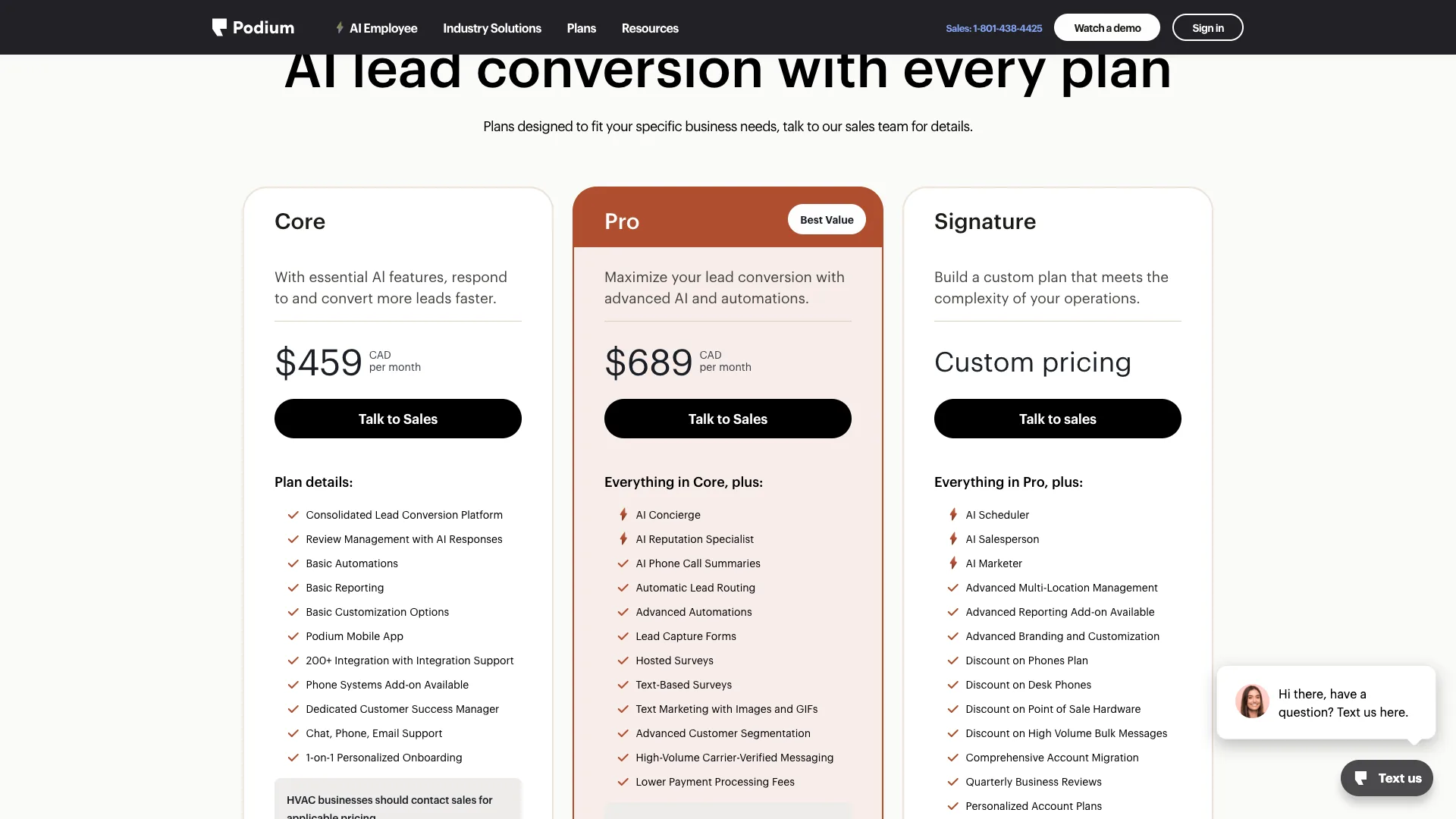 Jul 29, 2026
 Tech Stack
NiceJob vs Podium 2026: Pricing, Contracts and Review Gating
Both vendors print a price, at very different scale and in different currencies. The gap that matters is what Podium will not print: the billing unit, and whether a trade shop gets the number on the page.
Read Article Jul 28, 2026
 Tech Stack
CompanyCam Review 2026: Pricing, Pros, Cons and Alternatives
Every page ranking for CompanyCam still quotes a per-user price the vendor no longer charges. Here are the real plans, the seat math, and who should skip it.
Read Article Jul 28, 2026
 Tech Stack
NiceJob Review 2026: Pricing, Pros, Cons and Alternatives
NiceJob rates 4.9 on Capterra and refuses to gate negative reviews. Real plan pricing, the active-customer threshold nobody publishes, and who should skip it.
Read Article Jul 27, 2026
 Tech Stack
Buildertrend Review 2026: Pricing, Limits and Alternatives
Buildertrend rates 4.5 across 2,486 Capterra reviews and quotes against your revenue rather than your seat count. The workflows, the export problem, the alternatives.
Read Article Jul 27, 2026
 Tech Stack
CallRail Review 2026: Pricing, Pros, Cons and Alternatives
CallRail rates 4.5 on Capterra, and its tracking numbers port out free. But the two usage rates that decide your real bill are the two it does not print.
Read Article Jul 27, 2026
 Tech Stack
Roofr Review 2026: Pricing, Pros, Cons and Alternatives
Roofr rates 4.6 on Capterra and sells $13 measurement reports against a market charging triple. But it will not import a report from anywhere else.
Read Article Jul 25, 2026
 Tech Stack
Housecall Pro Review 2026: Pricing, Pros, Cons, Alternatives
Housecall Pro has the shortest learning curve in the category and the widest review spread. Real pricing, the Instapay math, and the migration trap to plan around.
Read Article Jul 24, 2026
 Tech Stack
Jobber Review 2026: Pricing, Pros, Cons and Alternatives
Jobber rates 4.6 on Capterra with the best mobile app in the category. Real plan pricing, the feature gating that changes your entry price, and who it suits.
Read Article Jul 23, 2026
 Tech Stack
ServiceTitan Review 2026: Pricing, Pros, Cons, Alternatives
ServiceTitan rates 4.3 on Capterra but its weakest score is value for money. Real reported pricing, the 12-month contract, the exit fees, and who it actually suits.
Read Article Jun 3, 2026
 Tech Stack
HVAC Online Scheduling: The 43% Losing After-Hours Bookings
HVAC leads every trade on online booking at just 56.7%, which still leaves 43% of sites forcing an after-hours customer to wait for a business-hours phone call.
Read Article