HVAC Online Scheduling: The 43% Losing After-Hours Bookings
HVAC online scheduling leads every trade at just 56.7%. That still leaves 43% forcing a 9pm customer to wait for business hours. See where the gap is.

Here's a stat that cuts two ways at once. Across 104 HVAC contractor websites Fervor scored this spring, 56.7% let a homeowner book a job right on the site. That's the highest rate of any trade Fervor has measured. So if you offer HVAC online scheduling, you're already ahead of roofing, ahead of remodeling, ahead of the contractor pack. Congratulations. Sort of.
Because flip the same number over. 56.7% is barely past half. Which means 43% of sites in the trade, close to two in five, still make a customer pick up the phone during business hours to get on the calendar. No booking widget. No "pick a time" button. Just a number and an implied "call us between 8 and 5."
And the homeowner with a furnace clicking off at 9pm on a Tuesday doesn't want to wait until 8am to leave a voicemail. They want a slot. Tonight. So let's walk through what the booking gap actually costs you, why the trade leads and still loses, and what a working HVAC online scheduling path looks like when it's done right.
What "leading the trades" actually means
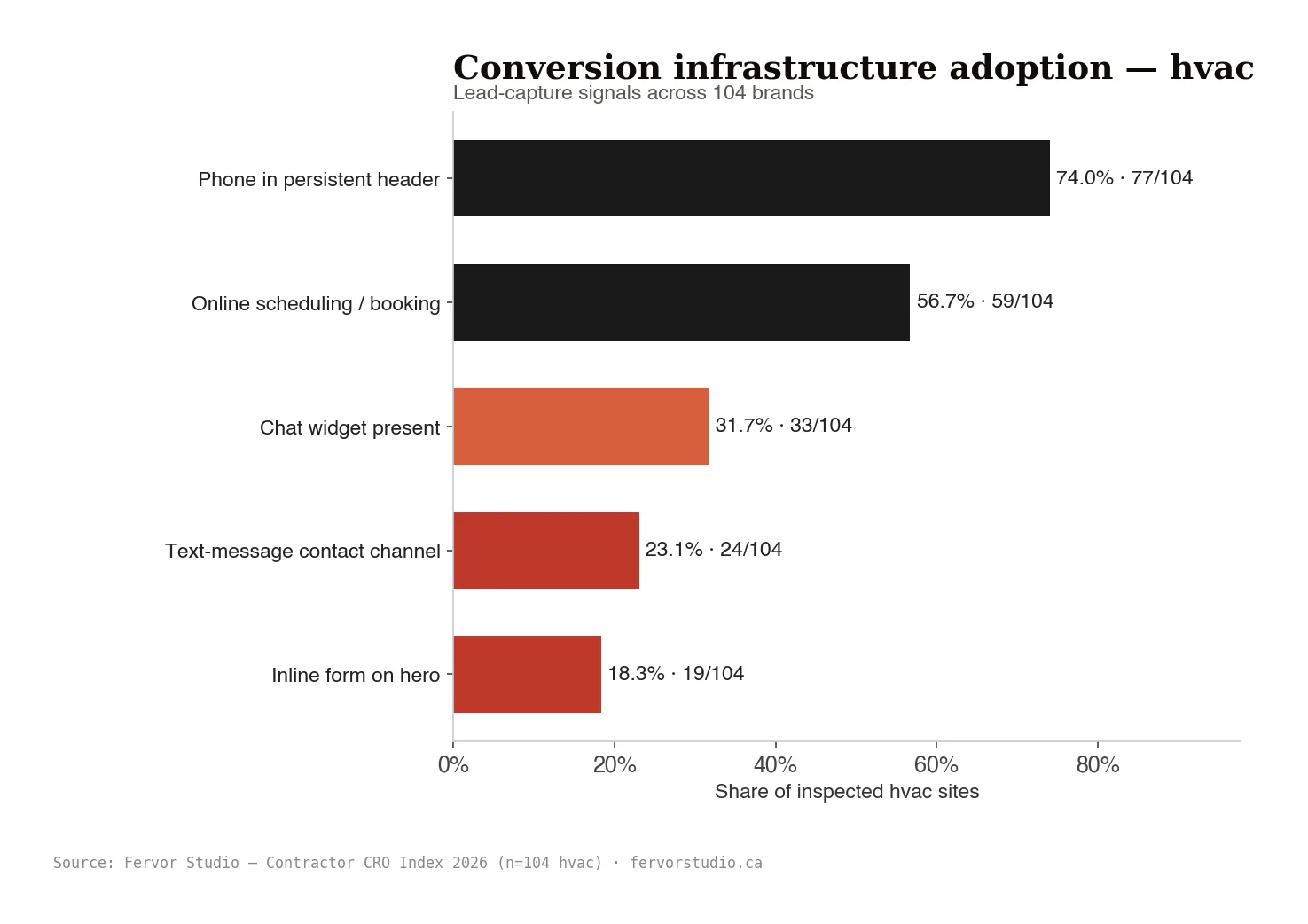
Let me give you the full spread, because one number alone is easy to shrug off. The State of HVAC report checked every site in the sample for a working way to book a service call without a phone. A real HVAC online booking path, not a contact form that vanishes into an inbox.
- 56.7% of the sample, 59 of 104 sites, let a customer self-book. The highest of any trade scored.
- Roofing sits at 33.8%.
- Remodeling sits at 33.6%.
- So the trade roughly doubles the next two on letting a customer book themselves in.
That gap isn't an accident. The trade runs on emergency and seasonal demand. A dead furnace in January, an AC that quits in the first July heat wave. When demand spikes hard and fast, the contractors who can absorb after-hours bookings without a human answering the phone pull ahead. So they learned to book HVAC service online earlier than the slower, project-driven trades did. Roofing and remodeling can survive on "we'll call you back Monday." A no-heat call can't, not when the house is 58 degrees and dropping.
But here's the thing the 56.7% number hides. Leading the field isn't the same as being good. It's the same as being least bad. And 43% is a lot of sites still parked on a phone-only front door.
The 43% who still answer the phone
Picture the other side of that statistic. Forty-three percent of the sample, call it 45 of the 104, have no way to book on the site at all. A homeowner lands on the page, decides they want you, looks for the button, and finds a phone number instead.
During business hours, fine. That customer calls, someone picks up, the job gets booked. But the report found something else worth sitting with. 74% of these sites keep a phone number pinned in the persistent header. Top of the page, every page, always visible. The phone is the trade's reflex. It's the thing contractors trust. So a lot of operators look at their site, see the phone number front and center, and think the booking job is handled.
But it isn't. The phone only works when someone's there to answer it. And the most expensive calls, the no-heat emergency, the midnight AC failure, happen exactly when nobody's at the desk. So the persistent-header phone number is doing great work from 8 to 5 and zero work at 11pm. That's the window where the 43% leak.
Where the after-hours customer actually goes
Think about what that 9pm homeowner does next. They hit your "call us" wall. Then they hit the back button. Then they land on a competitor whose site has a "Book a Tune-Up" button that takes a date, a time, and a phone number at 9pm without anyone lifting a finger.
And you didn't lose that job because your work is worse. You lost it because their site stayed open and yours closed at 5. The customer never even knew you'd have done a better job. They booked the site that let them book.
That's the quiet brutality of the booking gap. It doesn't announce itself. No angry voicemail, no bad review. The lead just silently routes to whoever made the next step easy. And you never see the ones you lose this way, which is exactly why so many contractors underrate it.
Run the napkin math on one lost slot
Let's put a number on it, because abstract conversion talk never moves anyone. Say your average HVAC job is worth $400. Say your site gets 50 service-intent visitors a month, people who landed ready to book.
If even three of those land after hours, hit the phone-only wall, and bounce to a competitor with a booking widget, that's three jobs gone. Three times $400 is $1,200 a month. Over a year, roughly $14,000 walking out the door. Not because your crew's bad, but because your site clocked out at 5pm and theirs didn't.
And that's the conservative read. After-hours and weekend traffic is a huge share of how emergency leads actually arrive, because that's when the equipment breaks. So the real number for a lot of operators is bigger. The point stands either way: every month you run a phone-only site, a measurable stack of dollars routes to the contractor who lets people book HVAC service online. The leak has a number on it, and it compounds.
What good HVAC online scheduling looks like
The encouraging part: closing this gap isn't a rebuild. The 56.7% who already do it didn't all buy enterprise tools. Most just added a real booking path to the site they had. So what separates a self-booking system that works from a contact form pretending to be one? A short list.
- A visible "Book Now" button, not buried three clicks deep. Same prominence as the phone number, ideally right next to it in that persistent header 74% of you already use.
- Real time slots, so the customer picks a window instead of "requesting a callback." A request isn't a booking. It's a phone call with extra steps.
- It works at 9pm. The whole point is capturing the after-hours customer the phone can't. If the booking path only confirms during business hours, you've rebuilt the phone with more friction.
- Mobile-first. A dead furnace gets searched on a phone, in the cold, one-handed. If the booking flow fights a thumb, it fails the exact moment it matters most.
- Fast and short. Name, address, problem, time slot. Every extra field is a place the panicked homeowner gives up and dials the competitor instead.
None of that requires you to fire your phone line. The phone stays. The booking path sits beside it as the second door, the one that's open when the first one's locked.
The software is the easy part
A quick aside, because contractors hear "booking system" and picture a six-month migration. It's not that. Plenty of HVAC scheduling software bolts onto an existing site in an afternoon. A widget, a calendar sync, a confirmation text. The hard part was never the tool. It's deciding the after-hours customer is worth catching, then putting the button where they'll find it.
And most of the 43% aren't holding out on purpose. They just never added the button, because the phone "works fine" during the hours they're watching it. The fix is mechanical. The decision is the whole game.
Why this is a conversion problem, not a tech problem
One more angle, because it reframes the whole thing. A booking path isn't a feature you tack on for the tech-savvy. It's a conversion mechanism, and it's the reason Fervor scores it at all.
Every site has a moment where intent peaks. The visitor has decided they want you and they're looking for the next step. If that next step is "call during business hours" and it's currently 9pm, the intent evaporates while they wait. A "Book Now" button catches that intent at its peak instead of asking it to survive until morning. That's not a convenience. That's the difference between a booked job and a bounce.
And it's measurable, which is why it's one of the categories the same report scores. A site that lets people book HVAC service online converts more of the traffic it already has. No extra ad spend, no new SEO, no more leads at the top of the funnel. Just fewer leaking out the bottom because the door was locked. Most contractors chase more traffic when the cheaper win is plugging the hole the 43% are standing in.
So being the booking leader of the field is a real edge. But 56.7% means even the front-runner leaves a lot of money on the table after hours. And the contractors who close that last gap aren't smarter. They just decided the 9pm customer counts, and built the door to prove it.
Frequently asked questions
What is HVAC online scheduling?
It's any path on your website that lets a homeowner book a service call, pick a date, a time, leave their details, without phoning during business hours. A real booking widget with live time slots, not a "request a callback" form that lands in an inbox until someone checks it. The State of HVAC report found 56.7% of the sample offers it, the highest rate of any trade scored.
Do customers actually use it?
The demand pattern says yes. The trade runs on emergencies, the furnace that dies overnight, the AC that quits on the hottest weekend of the year. Those happen outside business hours, which is exactly when a phone-only site can't help and a booking button can. That's a big part of why the field leads on HVAC online booking: the demand curve forced it to catch the after-hours customer.
Is self-booking better than a phone number?
It's not either-or. 74% of these sites keep a phone number in the persistent header, and they should, because the phone converts well during business hours. The booking path is the second door for the hours the phone is unmanned. So the 43% with no self-service aren't losing daytime calls. They're losing the 9pm and weekend customers the phone never reaches.
What HVAC scheduling software should I use?
Plenty of HVAC scheduling software plugs into an existing site in an afternoon. A widget, a calendar sync, an automatic confirmation text. The specific tool matters far less than whether the "Book Now" button is visible and the flow works on a phone at 9pm. Pick something that confirms around the clock, not only during business hours, or you've just rebuilt the phone with extra friction.
How much does the booking gap cost?
Run the math on your own numbers. If your average job is worth $400 and even three after-hours visitors a month hit a phone-only wall and bounce to a competitor, that's $1,200 a month, roughly $14,000 a year, routing to whoever let them book. For a trade where emergencies cluster after hours, the real figure is often higher.
Methodology
Where these numbers come from
Every booking figure in this post traces to the State of HVAC report, part of the Contractor CRO Index. Fervor scored 104 HVAC contractor websites against a six-category conversion framework, checking each for a working self-booking path and a persistent-header phone number across every captured page. Cross-trade comparisons (roofing 33.8%, remodeling 33.6%) come from the companion State of Roofing and State of Remodeling reports. Every site in the sample is named and publicly graded inside the Contractor CRO Index — this report is the aggregate layer on top of those public teardowns.
See where your site actually stands
You don't have to guess which side of 56.7% you're on. The State of HVAC report shows exactly how the trade scores on self-booking and five other conversion categories, all measured against the same framework. And if you want your own site checked, whether the booking button's visible, whether it works at 9pm, the specific gaps a homeowner hits before they bounce, the free Site Inspection returns the exact list of what's costing you bookings. Better to read that list from us than to keep losing the 9pm customer to the site next door.
Get My Free Inspection → Sep 28, 2026
 Agency Selection
Best Concrete Contractor CRO Agencies in 2026
A concrete site quietly serves two different buyers: a homeowner picking a patio pattern and a GC scoping a foundation pour. Here are 5 CRO agencies scored on the split.
Read Article Sep 27, 2026
 Agency Selection
Best Deck Builder CRO Agencies in 2026
Deck projects concentrate into a hard spring rush most builder sites are not built to catch. Here are 5 CRO agencies scored on whether they solve for it.
Read Article Sep 27, 2026
 Agency Selection
Best Landscaping CRO Agencies in 2026
A landscaping site has to sell a five-figure hardscape build and a renewing maintenance contract at the same time. Here are 5 CRO agencies scored on the split.
Read Article