HVAC Maintenance Plan Website: The Upsell 2 in 3 Surface
Two in three HVAC sites surface the maintenance-plan upsell. See what a strong HVAC maintenance plan website does, and the recurring revenue the rest give up.
Here's the number that should reframe how you think about your site. Across 104 HVAC contractor websites Fervor scored this spring, 67.3% surfaced tune-up or maintenance-plan messaging somewhere on the page. Two in three. Which sounds like most of the trade has figured out the recurring-revenue play. Then you flip it around and realize a full third of HVAC companies don't put their maintenance plan anywhere a customer can find it. So if your hvac maintenance plan website buries the membership three clicks deep, or skips it entirely, you're in the group leaving the most reliable margin in this whole trade uncaptured.
And the maintenance plan is the margin. You already know this. A one-off furnace repair pays once. A signed maintenance agreement pays every spring and every fall, books the slow shoulder seasons, and turns a stranger into a customer who calls you first when the AC dies in July. The recurring revenue isn't a nice-to-have. It's the difference between a business worth selling and a business that's just a job with trucks.
So let's walk through what the data actually says about how the trade markets its plans, what a strong maintenance-plan page does that a weak one doesn't, and the napkin math on what surfacing the upsell properly is worth to you. No fluff. Just the numbers and the fixes.
What 104 HVAC sites tell us about the maintenance plan
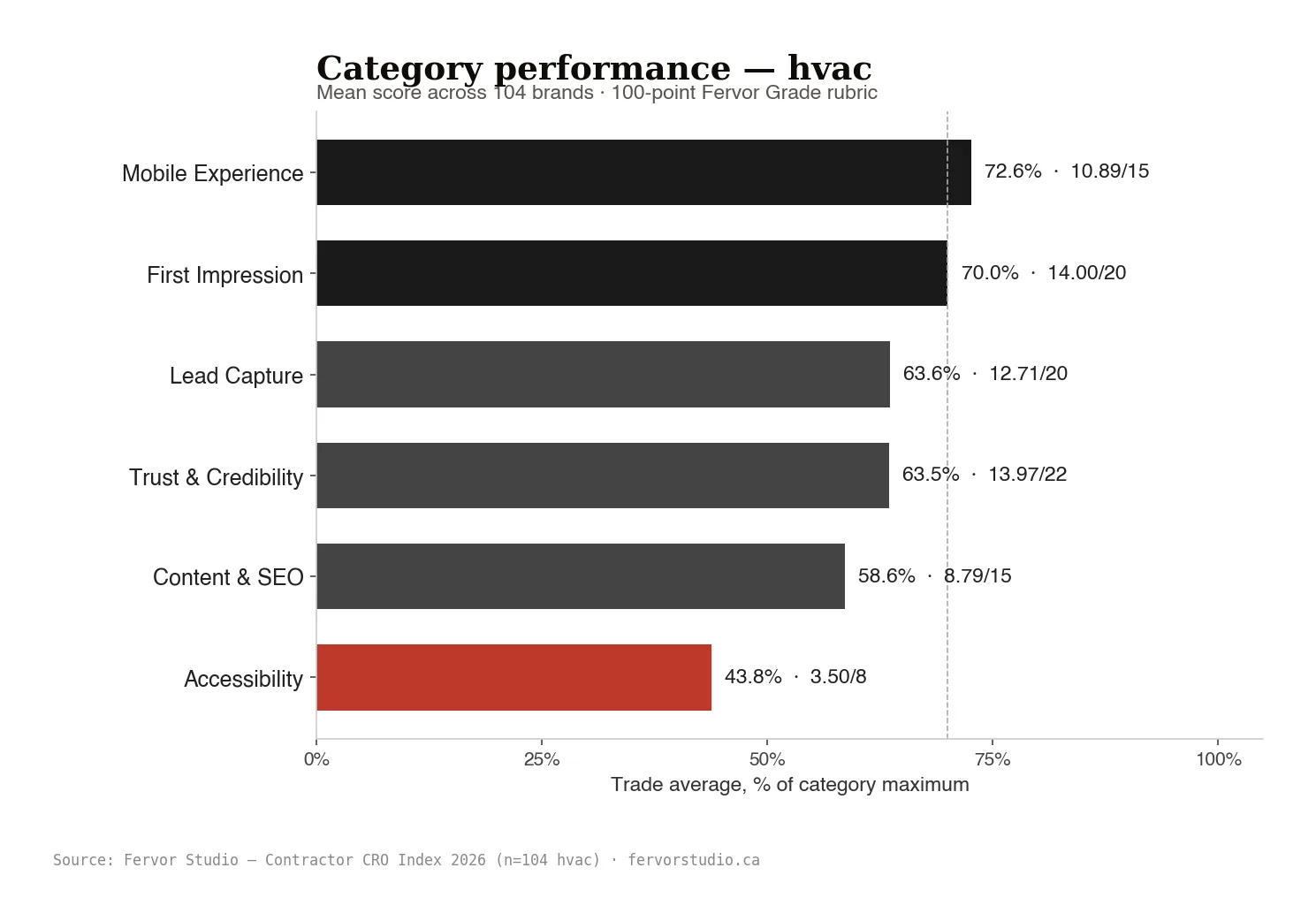
Let me give you the full spread, because one stat on its own is easy to dismiss. The State of HVAC report measured every site in the sample against the same framework, and the messaging patterns line up into a clear picture of where the trade puts its attention.
- Tune-up or maintenance-plan messaging visible: 67.3%, which is 70 of the 104 sites.
- Emergency or 24-7 service messaging: 77.9%, or 81 sites.
- Financing offered: 70.2%, which is 73 sites.
- Indoor air quality mentioned: 67.3%.
- Heat pump service mentioned: 63.5%.
Look at the gap between the first two lines. Emergency service shows up on 77.9% of sites, the maintenance plan on 67.3%. So the panic call wins the homepage and the recurring revenue gets the leftovers. So the trade leads with the panic call, the dead furnace at midnight, and treats the recurring agreement as the afterthought. That's backwards from a revenue standpoint. The emergency call is unpredictable and one-time. The maintenance plan is the thing you can actually forecast, the thing that fills the calendar in the dead weeks, the thing that compounds.
The whole HVAC sample averaged a Fervor Score of 65.32 out of 100, a failing average. That's not a slap at the trade. It's the reason the recurring-revenue gap matters so much. When the average site is leaking conversions everywhere, the one lever that pays you back forever, the membership, is exactly the lever most worth getting right first. Two in three sites surface it. Fewer than that surface it well.
The upsell most sites bury
Surfacing the plan and selling the plan aren't the same thing. A line in the footer that says "ask about our maintenance plans" technically counts as surfacing it. It also converts nobody. So here's the difference between a page that mentions the membership and a page that actually moves it.
So here's the contrast. A weak maintenance-plan page hides the offer below the fold, names no price, lists no benefits, and asks the customer to call to "learn more." A strong one puts the plan where the eye lands, shows what's included in plain terms (two tune-ups a year, priority scheduling, a discount on repairs), and gives a number the customer can say yes to without picking up the phone. The first asks for effort. The second removes it. And friction is where recurring revenue quietly dies.
That's the upsell two in three sites technically have and far fewer actually use. The plan exists. The page just doesn't sell it.
Why the maintenance plan beats every other line on your site
Run the math with me, because this is where it gets obvious. Say your average HVAC service call is worth $300, and your site brings in 50 leads a month. Some convert, some don't, and every one of them is a fresh acquisition cost you pay again next month. Now say you sign even 8 of those into a $200-a-year maintenance agreement. That's $1,600 in booked recurring revenue from one month of traffic, and it renews next year without you spending a dollar to re-acquire them.
So stack that up over a year. Eight memberships a month is roughly 96 members signed, call it $19,000 in annual recurring revenue layered on top of the one-off calls you were already getting. And those members don't just pay the membership fee. They're the people who call you first for the $6,000 system replacement, because you're the company that's been in their basement twice a year. The plan isn't the revenue. It's the door to the revenue.
That's the part a one-time-job mindset misses. Recurring HVAC revenue isn't a side product. It's the asset. A book of 400 maintenance members is a predictable cash floor under your whole operation. It's what carries you through a mild winter when the emergency calls don't come. So when your hvac maintenance plan website treats the membership as a footnote, it's not under-selling a service. It's under-building the most valuable thing your company owns.
And here's the loss-framing version, because contractors feel the leak harder than the gain. Every month your site fails to surface and sell the plan, the customers who'd have signed instead buy a one-off repair and walk. You got the $300. You lost the $200-a-year-forever. Multiply that miss across a year of traffic and the number you're leaving on the table isn't small. It's the most expensive thing your site isn't doing.
Financing: claimed everywhere, productized almost nowhere
Here's a pattern in the data that should make you sit up. Financing showed up on 70.2% of HVAC sites, 73 of the 104. More sites mention financing than mention the maintenance plan. But only about 3% of the sample named a specific financing partner.
Sit with that gap for a second. Seven in ten say "financing available." Three in a hundred tell you who, what the terms are, or how to apply. So the word "financing" is doing decorative work on most of these sites. It's a reassurance bullet, not an actual offer a customer can act on. A homeowner staring at a $9,000 system replacement doesn't need to know financing exists in the abstract. But they do need to see "as low as $X a month," a named lender, and an apply button. That's productized financing. The rest is a word on a wall.
Why does this belong on a page about maintenance plans? Because financing and the membership solve the same problem from two directions. Financing makes the big-ticket replacement say-yes-able. The maintenance plan makes the relationship recurring so you're the one who gets the replacement call in the first place. Both convert a price objection into a payment a customer can live with. And both are claimed far more often than they're actually built into the site as a working offer.
So if you're reviewing your own hvac maintenance plan website, check the financing the same way you check the membership. Is it a real offer with a number and a name? Or is it a word you put there to look complete?
What a strong maintenance-plan page actually does
The encouraging part: closing this gap isn't a rebuild. The sites that sell the membership well aren't running special software. They got a handful of fundamentals right, and you can copy every one of them.
- The plan is above the fold or one obvious click away, not buried in a footer link.
- The price is stated. A real number the customer can decide on without calling.
- The benefits are concrete: two seasonal tune-ups, priority scheduling, a repair discount, no overtime fees.
- There's a single clear action (join, enroll, sign up), not a vague "contact us to learn more."
- The recurring nature is framed as the value, not the catch: "we maintain your system so it doesn't fail in the first place."
And not one of those requires a developer to disappear for a month. They're copy and layout decisions. They're the difference between a page that lists the plan and a page that signs members while you're out on a job.
Make the membership the spine, not the afterthought
The strongest HVAC sites don't treat the maintenance plan as a single page off the menu. They thread it through the whole site. The repair page mentions that members skip the diagnostic fee. The contact page offers the plan as the natural next step after the job. The homepage leads with it instead of leading with the emergency call everyone else leads with.
And that's a structural choice, the one most contractors never make. They build the site around the panic call, the 77.9% pattern, and bolt the membership on as a tab. Flip it. Build the site around the recurring relationship, and let the emergency service be the thing that proves you're worth keeping on retainer. Your hvac maintenance plan website should read like a company that wants customers for ten years, not callers for one night.
Don't make the customer do the math
One quiet conversion killer: making the customer calculate whether the plan is worth it. If a tune-up costs $120 on its own and the plan includes two for $200, say that out loud. Show the savings. Show the priority scheduling that means they're not waiting four days in a heat wave. The membership wins on value every time the value is visible, and loses every time you make a tired homeowner do the arithmetic themselves. Remove the friction. Do the math for them, on the page.
How your site stacks up against the trade
So where does this leave you? Two in three HVAC sites surface the maintenance plan. Fewer than that price it, benefit it, and put it where it converts. Seven in ten claim financing. Three in a hundred make it a real offer. The trade is sitting on its most reliable recurring-margin lever and, on the average middling site, barely pulling it.
That's not bad news. That's the opening. The bar across the trade is low enough that getting the membership right, surfaced and priced and benefited and threaded through the site, puts you ahead of most of your market on the one number that compounds. Your competitors are leaving the recurring revenue on the table. The question is whether you're going to be the one who picks it up.
Frequently asked questions
Should the maintenance plan be on its own page or the homepage?
Both. The membership deserves its own dedicated page with full pricing and benefits, and it should also be surfaced on the homepage and threaded through your repair and contact pages. The 67.3% of sites that mention it at all often hide it on a single buried page. The ones that convert make the plan visible everywhere a customer is already deciding whether to call.
Why does showing a price matter so much?
Because a price the customer can see is a decision they can make without picking up the phone, and every step you remove from "interested" to "enrolled" keeps more people in the funnel. A page that says "call to learn about our plans" asks for effort. A page that says "$199 a year, two tune-ups, priority service, join now" removes it. Friction is where recurring revenue leaks.
How is financing connected to the maintenance plan?
They solve the same objection from two angles. Financing makes a big-ticket replacement affordable in monthly terms; the maintenance plan makes the customer relationship recurring so you're the company they call for that replacement. The data shows 70.2% of sites mention financing but only about 3% name a specific partner, so most sites under-build both offers the same way.
What benefits should a maintenance plan list?
The concrete ones a customer can picture: two seasonal tune-ups a year, priority or same-day scheduling, a discount on repairs, waived diagnostic or overtime fees, and a documented service history that protects their warranty. Vague "peace of mind" language doesn't convert. Specific, named benefits with a price beside them do.
Is recurring revenue really worth redesigning my site around?
Yes. It's the most predictable money in the trade. A one-off repair pays once; a signed member pays every year and calls you first for the big replacement. A book of recurring members is the cash floor that carries you through a slow season. Building your site around that relationship, rather than around the one-time emergency call, is the highest-impact change most HVAC companies can make.
My site already mentions the plan. Isn't that enough?
Probably not. Mentioning the plan and selling it are different things. A footer line that says "ask about maintenance plans" counts as surfacing it but converts almost nobody. The plan needs a price, concrete benefits, a clear enroll action, and placement where the customer's eye actually lands. Surfacing is the floor, not the finish line.
Methodology
Where these numbers come from
Every figure in this post traces to the State of HVAC report, part of the Contractor CRO Index. Fervor scored 104 HVAC contractor websites against the same six-category framework, with the trade averaging a Fervor Score of 65.32, a D. The messaging figures (maintenance-plan visibility 67.3%, emergency service 77.9%, financing 70.2%, indoor air quality 67.3%, heat pump service 63.5%) reflect what was present on each site at capture. Every site in the sample is named and publicly graded inside the Contractor CRO Index — this report is the aggregate layer on top of those public teardowns.
Build the page that signs members
You don't have to guess where your site falls. The State of HVAC report shows exactly how the trade markets its maintenance plans, its financing, and its emergency service, all measured against the same framework. And if you want a site built to surface and sell the recurring revenue most contractors leave buried, with the membership priced, benefited, and threaded through every page that matters, Booked by Design builds it. Far better to own the most reliable margin in your trade than to keep handing it to the company across town.
Get Booked by Design → Sep 27, 2026
 Agency Selection
Best Concrete Contractor CRO Agencies in 2026
A concrete site quietly serves two different buyers: a homeowner picking a patio pattern and a GC scoping a foundation pour. Here are 5 CRO agencies scored on the split.
Read Article Sep 26, 2026
 Agency Selection
Best Deck Builder CRO Agencies in 2026
Deck projects concentrate into a hard spring rush most builder sites are not built to catch. Here are 5 CRO agencies scored on whether they solve for it.
Read Article Sep 26, 2026
 Agency Selection
Best Landscaping CRO Agencies in 2026
A landscaping site has to sell a five-figure hardscape build and a renewing maintenance contract at the same time. Here are 5 CRO agencies scored on the split.
Read Article