HVAC Website Conversion: Where 26% of Sites Lose the Call
74% of HVAC sites nail the phone-in-header, then leak the rest. See where HVAC website conversion falls apart: online scheduling, SMS, and a missing hero form.

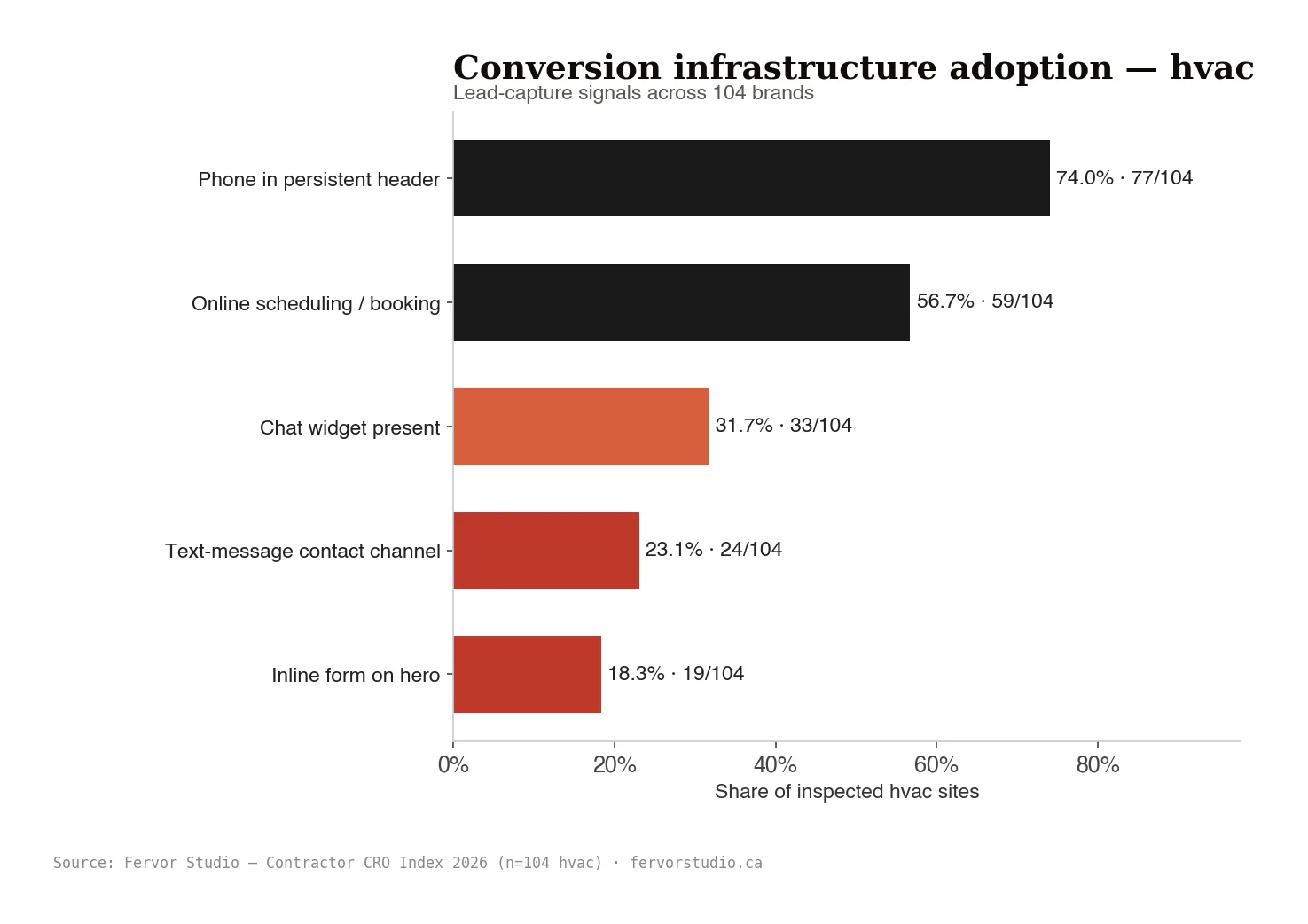
Here's the good news first, because the trade earned it. Across 104 HVAC contractor websites Fervor scored this spring, 74% put a phone number in a persistent header, the kind that follows you down the page on a phone. That's 77 of 104 sites. It's the single highest-adoption conversion signal in the whole trade, and it's the right one to nail. So if you're worried your HVAC conversion rate optimization setup is hopeless, relax. Most of you got the most important tap right.
But that's also where the good news stops. The other 26% don't. And the sites that nailed the header mostly stopped there, leaving scheduling, text, and a hero form sitting on the table.
So let's walk through the real gap. What the trade does well, what it leaves broken, and where the leaks add up to actual jobs you're not booking. No theory. Just the spread from the report and the math underneath it.
The phone-in-header is the one thing the trade nails
Picture the buyer for a second. It's 11pm, the furnace is dead, the house is dropping a degree every twenty minutes, and there's a kid who won't sleep because it's cold. That person isn't filling out a form. They're not booking a slot for Tuesday. They want one thumb, one tap, one ringing phone.
So that's why the phone-in-header matters more than anything else on an HVAC site. And it's why the State of HVAC report treating it as the top conversion signal isn't an accident. 74% of the sample, 77 of 104 sites, keep the number pinned in a header that travels down the page. The emergency buyer never has to scroll back up to find you.
The 26% that don't? They bury the number in a footer, or worse, behind a "Contact" link. Two extra taps for someone whose house is freezing. And in a dead-furnace moment, two taps is enough to lose the call to whoever's number was easier to find. That's not a small miss. That's the whole game for the buyer who's most ready to spend.
Online scheduling is the next gap, and it's a wide one
Not every HVAC lead is an emergency. A lot of them are the homeowner thinking ahead: the fall tune-up, the maintenance plan, the quote on a system that's limping but not dead. That person wants to book without talking to anyone. And they want to see Thursday at 2pm and grab it.
So how's the trade doing on that? The State of HVAC report found online scheduling or booking on 56.7% of HVAC sites, 59 of 104. Better than half, which sounds fine until you flip it. Roughly 43% of HVAC contractors are still routing every single booking through a phone call somebody has to answer.
So run the napkin math on why that hurts. Say you get 60 site visitors a week who'd book if they could, but a third of them land after hours, when nobody's picking up. That's 20 people a week who wanted to book and couldn't. Even if half of them call back the next morning, you just lost ten. At a $400 average ticket, that's $4,000 a week walking past a "call us during business hours" wall. Online booking catches the after-hours buyer while your phone is dark. The contractor without it is paying a tax every single night.
The hero form: 18.3% adoption, and a real opportunity
Now here's a number that surprised people on our side. An inline lead form on the hero, the first thing a visitor sees with no scrolling, shows up on only 18.3% of HVAC sites. That's 19 of 104. Fewer than one in five.
And some of that's defensible. Emergency-heavy trades lean on the phone, and a long form fights the dead-furnace buyer. Fair. But "name, phone, what's wrong" as three fields above the fold? That captures the homeowner who's ready but hates calling. It catches the lead at the exact moment of highest intent, before they bounce to compare you against the next three results.
And the fact that 81.7% of the trade skips it entirely means the few who do it well stand out fast. Strong contractor website conversion comes down to giving the ready buyer the path that fits them: phone for the panicked, a short form for the hesitant, booking for the planner. Most HVAC sites offer one of those three. The ones that win offer the buyer a choice.
Text and chat: the channels HVAC barely touches
Some buyers won't call and won't fill out a form. They text. It's how a whole generation of homeowners prefers to reach a business, and HVAC has mostly ignored them.
The State of HVAC report found a text-message or SMS contact channel on just 23.1% of HVAC sites, 24 of 104. So more than three-quarters of the trade has no way to catch the homeowner who'd happily fire off "AC's not cooling, can someone come Saturday?" but would never pick up the phone to say it. That lead doesn't convert worse. It just doesn't convert at all, because there's no door for it. And you'll never see it in your numbers, which is what makes it so easy to ignore.
Chat's a little better but still thin. Under a strict detection standard, an actual working widget and not a dead "chat" icon, 29% of HVAC sites run one. That leaves 71% with no live capture for the visitor who has one quick question standing between them and booking. "Do you service my furnace brand?" goes unanswered, and the visitor leaves to ask someone who'll reply.
You don't need all of these. Stacking five channels on one page is its own kind of mess. But picking up even one of the two the trade ignores, text or chat, puts you ahead of most of your market on the exact channel a younger homeowner defaults to.
Why the missing channels cost more than they look
And this part's easy to underrate. Every channel you skip isn't a small slice of lost leads. It's the entire segment of buyers who only use that channel.
The homeowner who only texts and the homeowner who only books online aren't going to switch to your preferred method because you made them. So they'll switch to the competitor who speaks their language. So a missing SMS line doesn't cost you a fraction of your text-preferring leads. It costs you all of them. That's HVAC lead generation math most contractors never run, because the leads they're losing never showed up in the first place to be counted.
What the trade gets right: reviews are everywhere
Let me give credit where it's due, because the trade isn't failing across the board. Google reviews show up on 76.9% of HVAC sites, 80 of 104. That's the strongest trust signal in the sample, and it's nearly as well-adopted as the phone-in-header.
And that matters because the dead-furnace buyer at 11pm is also a nervous buyer. They've never met you. They're about to let a stranger into their house and hand over a credit card. Reviews are the thing that turns "this company exists" into "this company is safe." So the trade got two of the big ones right: the easy tap to call, and the proof that you won't rip them off.
But notice the pattern. The two highest-adoption signals, phone and reviews, are the ones that take no real engineering. A header link and a review widget. The signals that take actual build work, scheduling and forms and text, are exactly where adoption falls off. That's the shape of the conversion gap. The trade does the easy conversion wins and skips the ones that move the needle hardest.
The HVAC website conversion gap, in one sentence
So here's the whole picture stacked up. The phone in the header is at 74%, reviews at 76.9%, and the trade nailed both. Online scheduling drops to 56.7%. Chat sits at 29%, text at 23.1%, and the hero form bottoms out at 18.3%.
Read that top to bottom and the story tells itself. The trade is strong at the top of the buyer's options and weak everywhere a buyer might prefer a different door. You've built the front entrance beautifully and left the side doors locked.
The trade mean Fervor Score backs this up. Across all 104 sites, the average came in at 65.32 out of 100. Not a failing-everywhere site. A "did the obvious things, skipped the hard ones" site. And the gap between that average and the top of the trade isn't a rebuild. It's three or four channels you haven't turned on yet.
The math on one closed gap
Run it on a single fix. Say you add online booking, and it catches just the after-hours buyers your dark phone was losing. Call it eight a month who would've slipped away. At a $400 average ticket, that's $3,200 a month. Just under $40,000 a year. From turning on one channel the report says 43% of your trade still doesn't have.
Now layer a text line on top of that, catching the homeowner who'd never call. Then a hero form for the one who's ready but hates the phone. None of those is a redesign. Each one's a feature you switch on. And each one's a segment of buyers your competitors down the street are quietly catching while you wait for the phone to ring.
Where to start, and what to leave alone
You don't fix all of this at once, and you shouldn't try. Pick the gap that's costing you most.
If you're in the 26% without a persistent header number, that's your week-one job. It's the cheapest fix on this list, and it serves the buyer with the most urgent wallet. After that, online scheduling, because the after-hours leak runs every night whether you're watching or not. Then pick one of text or chat, whichever fits how you'd rather answer people. The hero form comes when you've got the bandwidth to handle the volume it'll bring.
And leave the rest alone. You don't need every channel the report measures. The contractor with a clean phone-in-header, working reviews, online booking, and a text line is already ahead of most of the trade. The point of strong HVAC website conversion isn't maximum chrome. It's matching the buyer to the door they'd actually use. And right now most HVAC sites only have one door open.
Frequently asked questions
What's the most important conversion feature on a contractor's site?
A phone number in a persistent header, one that stays visible as a visitor scrolls on mobile. The State of HVAC report found it on 74% of sites, the highest-adoption conversion signal in the trade, because the emergency buyer with a dead furnace at 11pm wants one tap to call, not a form. If you only fix one thing, fix this.
Do contractors need online booking if they have a phone number?
Yes, because they catch different buyers. The phone serves the emergency. Online scheduling serves the planner who wants to grab Thursday at 2pm without talking to anyone, plus the after-hours visitor your phone can't answer. Only 56.7% of these sites offer it, so adding it puts you ahead of nearly half the trade.
Should a contractor's homepage have a lead form?
A short one can help. An inline hero form with three fields, name and phone and what's wrong, appears on just 18.3% of these sites, so it's a real differentiator. Keep it to three fields so it doesn't fight the emergency buyer who'd rather call. It catches the ready homeowner who hates the phone but won't dig for a contact page.
Is text messaging worth adding?
For a lot of homeowners, it's the only channel they'll use. Just 23.1% of these sites offer an SMS contact line, which means three-quarters of the trade has no door for the buyer who texts but never calls. A missing channel doesn't cost you a fraction of those leads. It costs you all of them.
What's a good Fervor Score for an HVAC website?
The trade mean across 104 sites was 65.32 out of 100. That's the bar to beat, and it's not a high one. Most of the gap between that average and the top of the trade comes from turning on the conversion channels the trade skips, scheduling and text and a hero form, not from rebuilding the site.
Methodology
Where these numbers come from
Every conversion figure in this post traces to the State of HVAC report, part of the Contractor CRO Index. Fervor scored 104 HVAC contractor websites against a six-category framework, capturing each conversion signal mechanically across every page: persistent-header phone, online scheduling, hero lead form, SMS contact, chat widget (strict detection), and surfaced Google reviews. The trade mean Fervor Score was 65.32, a D. The every site in the sample is named and publicly graded inside the Contractor CRO Index — this report is the aggregate layer on top of those public teardowns.
See where your site actually stands
You don't have to guess which door you've left locked. The State of HVAC report shows exactly how the trade scores on conversion and five other categories, all measured mechanically against the same framework, part of the broader Contractor CRO Index. And if you want your own site checked, the persistent-header phone test, the booking gap, the channels you're missing that your competitors aren't, the free Site Inspection returns the exact list of what's leaking. Better to read that list from us than to keep wondering why the phone's quiet.
Get My Free Inspection → Sep 27, 2026
 Agency Selection
Best Concrete Contractor CRO Agencies in 2026
A concrete site quietly serves two different buyers: a homeowner picking a patio pattern and a GC scoping a foundation pour. Here are 5 CRO agencies scored on the split.
Read Article Sep 26, 2026
 Agency Selection
Best Deck Builder CRO Agencies in 2026
Deck projects concentrate into a hard spring rush most builder sites are not built to catch. Here are 5 CRO agencies scored on whether they solve for it.
Read Article Sep 26, 2026
 Agency Selection
Best Landscaping CRO Agencies in 2026
A landscaping site has to sell a five-figure hardscape build and a renewing maintenance contract at the same time. Here are 5 CRO agencies scored on the split.
Read Article