OpenSolar Review 2026: Pricing, Pros, Cons, Alternatives
OpenSolar starts at $0. What each tier gates, the 8 limitations reviewers name, and 4 alternatives with published prices.

Page at a glance
OpenSolar is the solar platform whose software line is genuinely $0, where the money instead moves through the things attached to the proposal: the lender who funds it, the distributor who ships the panels, the imagery you buy per roof, and the API you now rent per project. It starts at $0 per user per month. There is no per-seat price at all on the core product, which is the single most unusual thing about OpenSolar's economics in a category where Aurora Solar and HelioScope both bill per license. The vendor states it plainly: 'We pride ourselves as a free of charge platform that will always be free for you to use' and 'OpenSolar works with partners who all pay us to be a part of the platform, making OpenSolar free for solar professionals.' The meters that do exist are not seats. Two of them are per-project: API Access is 'billed as a per-project fee' applied 'when you create a project', and premium Nearmap imagery is bought per roof out of a prepaid Wallet. Two of them are flat per-account: the Xero or QuickBooks connector at $49 USD a month, and the Enterprise Services plans at US$500 and US$1,350 a month. So headcount never moves your bill, but project volume does the moment you want your data in another system. It fits a residential solar installer running roughly 1 to 25 designers, closers and office staff on rooftop retrofit and battery attach work, where the same tool has to produce the design, the interactive proposal, the finance comparison and the deposit request, and where paying nothing for seats matters more than owning a two-way accounting sync. It's the wrong buy for Any contractor who isn't doing solar. Roofers, HVAC shops, remodelers and electricians without a PV arm., because OpenSolar is built entirely around the solar object model: modules, inverters, batteries, racking, shading, tariffs, incentives, STC and MACRS. And there's no generic job type. The trade taxonomy on the platform is solar and adjacent electrification (batteries, EV chargers, heat pumps), so a roofing crew would be fighting the data model on day one. Alternatives that publish their prices are Aurora Solar from $159, HelioScope from $159 USD, Solargraf from $2799 USD. Six priced tiers, eight evidenced gaps and four alternatives, four of which publish a figure.
Start here if OpenSolar is on your shortlist
OpenSolar earns its money with a residential solar installer running roughly 1 to 25 designers, closers and office staff on rooftop retrofit and battery attach work, where the same tool has to produce the design, the interactive proposal, the finance comparison and the deposit request, and where paying nothing for seats matters more than owning a two-way accounting sync. If that's you, it does the job. The sections below are the parts worth checking before you sign. But the fit is narrower than the marketing suggests, and the price isn't the whole cost.
It starts at $0. And pricing was verified on 7 August 2026, so you can check every figure below in a browser tab.
| Pricing model | Published tiers |
|---|---|
| Entry price | $0 |
| Users | There is no per-seat price at all on the core product, which is the single most unusual th |
| Ownership | Independent |
| Best fit | a residential solar installer running roughly 1 to 25 designers, closers and office staff on rooftop retrofit and battery attach work, where the same tool has to produce the design, the interactive proposal, the finance comparison and the deposit request, and where paying nothing for seats matters more than owning a two-way accounting sync. |
| Accounting sync | Xero (one-way), QuickBooks Online (one-way), Accounting Connectors (pricing, both connectors) (one-way) |
What works
- The whole product is arranged so a roof becomes a signable, financed proposal in one sitting, and the free tier is the complete version of that path
- Finance is a market-by-market grid of 20 named lenders, not a single global rail
- CashFlow is the most transparently priced thing OpenSolar sells, and the surcharge switch is the decision that matters
- Getting data out is possible but rationed three different ways: a 2,000-row export cap, a paid per-project API, and a one-way accounting push
- The Shop is where OpenSolar's revenue model becomes visible, and the vendor says so out loud
What does not
- The mobile app and the web platform aren't the same product, and the app is where the one-star reviews live
- The API stopped being free in March 2026 and now bills per project at a rate OpenSolar doesn't publish
- An empty Wallet stops you creating projects
- Accounting sync is one-way only, and the vendor says so in its own usage guide
- Project export is capped at 2,000 projects per run, and admins are the only ones who can export the full field set
OpenSolar is the solar platform whose software line is genuinely $0, where the money instead moves through the things attached to the proposal: the lender who funds it, the distributor who ships the panels, the imagery you buy per roof, and the API you now rent per project. It sells to Solar contractors, and the shape of the product follows from that: Auto Design, Mounting Designer and Single Line Diagrams sit on the design side; Sales Machine Proposal, Integrated Finance, CashFlow and E-signature sit on the sell side; Shop and Bill of Materials, Supplier Assist, Expo, Project Management CRM and On-demand Permitting sit on the manage side. And none of those are gated behind a paid tier. The vendor's own framing on the API page is 'OS 3.0 is a full solar operating system offered free of charge. Use the API when you choose to run workflows in third-party systems and move data in and out of OpenSolar.' In other words, staying inside OpenSolar is free and leaving it is what costs money.
OpenSolar: right buyer, wrong buyer
It fits a residential solar installer running roughly 1 to 25 designers, closers and office staff on rooftop retrofit and battery attach work, where the same tool has to produce the design, the interactive proposal, the finance comparison and the deposit request, and where paying nothing for seats matters more than owning a two-way accounting sync. That's the half most reviews print. Here's the other half, which is the one worth your time.
Don't buy it if you're Any contractor who isn't doing solar. Roofers, HVAC shops, remodelers and electricians without a PV arm.. OpenSolar is built entirely around the solar object model: modules, inverters, batteries, racking, shading, tariffs, incentives, STC and MACRS. And there's no generic job type. The trade taxonomy on the platform is solar and adjacent electrification (batteries, EV chargers, heat pumps), so a roofing crew would be fighting the data model on day one. Look at JobNimbus instead.
Don't buy it if you're A solar business whose bookkeeper works inside QuickBooks or Xero and expects the two systems to stay in step both ways.. The Xero usage guide states 'Direction: One-way from OpenSolar to Xero', and QuickBooks Online behaves the same way. And corrections made in the accounting package never flow back. On top of that, the connector is a $49 USD a month subscription on a platform sold as free, and the Enterprise Services page separately lists 'Accounting integrations' as an Enterprise-plan inclusion, so which envelope it belongs in is genuinely unclear until you ask. Look at Aurora Solar instead.
Don't buy it if you're A dealer or EPC building a real integration between OpenSolar and Salesforce, NetSuite or a proprietary ops system on a fixed budget.. API access became paid on 17 March 2026 and is billed per project created, and the fee isn't published in any of the three places OpenSolar discusses it. And worse, the contractual fair-use limits in the terms and the published throttle limits in the developer docs describe different ceilings, so the cost and the technical envelope of the integration are both unknown until you're in a sales conversation. Look at Aurora Solar instead.
Don't buy it if you're A team that needs a dependable offline-tolerant field app for site surveys and in-home closing on phones.. The app carries repeated blank-screen and login-loop reports across the US, UK and Australian storefronts spanning 2019 to 2026, and the most recent Android review says 'Very buggy for Android. Pretty good for Pc Web browser'. And the web platform is the strong half of this product. Look at CompanyCam instead.
The money question on OpenSolar
The tiers are public. And that's worth more than it sounds in a category where half the vendors make you ask.
| Tier | Price | Billing unit | What it unlocks |
|---|---|---|---|
| OpenSolar core platform (design, proposal, CRM, e-signature) | $0 | per user per month | Nothing beyond the tier below |
| Accounting Connectors (Xero or QuickBooks Online) | $49 USD | per account per month, flat monthly subscription, also quoted as $69 AUD and £49 GBP | Xero or QuickBooks Online connector, first month free, billing commences on the 1st of the month following trial expiry, billed through OpenSolar Wallet |
| Enterprise Services: Support | US$500 | per account per month | 2-hour SLA response time, Bug escalation within 1 business day, Up to 4 hours of monthly support time, Live troubleshooting and scheduled support calls, API support, Process discovery session, admin training, team design training, Account setup including pricing scheme, cost scheme, adders, payment options, hardware favorites |
| Enterprise Services: Customize | US$1,350 | per account per month | Everything in Support, 1 exclusive proposal template tailored to your brand, 1 custom form, 1 custom document, 3 custom showcase components |
| Enterprise Services: Enterprise | Custom pricing | per account, quoted | Direct access to in-region support, Dedicated Slack channel with OpenSolar support, Sandbox environment, Design backup and recovery support, Security and compliance tools (auditing, SOC 2), Scale purchase offers on Shop products, Accounting integrations, Fully bespoke proposal, 3 custom forms, 3 custom documents, 5 custom showcase components, Enterprise reporting dashboards |
| Nearmap premium imagery, pay per project (Imagery Marketplace) | $4.50 USD | per project, plus tax in the US; quoted as $5.45 plus $0.55 GST in AU and £3.99 plus tax in the UK | OpenSolar Wallet set up and funded, Provider enabled by an org admin under Control > Integrations, Availability varies by market |
There is no per-seat price at all on the core product, which is the single most unusual thing about OpenSolar's economics in a category where Aurora Solar and HelioScope both bill per license. The vendor states it plainly: 'We pride ourselves as a free of charge platform that will always be free for you to use' and 'OpenSolar works with partners who all pay us to be a part of the platform, making OpenSolar free for solar professionals.' The meters that do exist are not seats. Two of them are per-project: API Access is 'billed as a per-project fee' applied 'when you create a project', and premium Nearmap imagery is bought per roof out of a prepaid Wallet. Two of them are flat per-account: the Xero or QuickBooks connector at $49 USD a month, and the Enterprise Services plans at US$500 and US$1,350 a month. So headcount never moves your bill, but project volume does the moment you want your data in another system.
There is a discount for paying annually up front: No annual discount is published, and there is no annual plan to discount. The core platform is free, the Accounting Connectors are described as a 'flat monthly subscription', and the two priced Enterprise Services plans are both quoted '/ month' with no annual toggle on the page. The only volume mechanism disclosed anywhere sits inside CashFlow, where the transaction-rate articles say 'Volume discounts may be available - speak to your account manager for more details' without naming a threshold or a rate. And an annual prepay discount tells you an annual commitment exists, which is worth knowing before anyone mentions a term length out loud.
What a OpenSolar quote leaves out
Payment processing. CashFlow is the in-product payment rail and it is where OpenSolar's published pricing gets genuinely detailed. The framing is 'With CashFlow, you only pay when you get paid. There is no cost to signing up, and no recurring fees.' US rates: Credit Card Standard (US personal Visa and Mastercard) 2.9%, Credit Card Premium (all other US-issued credit cards) 3.25%, Credit Card International 4.0%, the same 2.9 / 3.25 / 4.0 ladder on debit, and ACH Direct Debit at 0.2% with a $15 cap per transaction. UK rates run much lower: 1.3% standard, 2.1% premium, 3.2% international, and bank transfers are 'Free'. AU rates are 1.5% standard, 1.7% premium, 3.4% international, with BECS Direct Debit at 0.3% capped at $15. Then there are the failure fees most installers will never model. A declined card authorisation costs $0.10. A first-time ACH payer costs a $1.50 account validation fee because 'Nacha, the US governing body for the ACH payment network, requires businesses to validate the bank account details of any consumer that sends them ACH payments.' A reversed ACH payment costs $15. A chargeback costs $25 USD / $25 AUD / £25 GBP, and fighting it costs a further $10 USD / $10 AUD / £10 GBP representment fee, which are 'non-refundable and will not be returned, regardless of the outcome of your representment.' Card payouts land 2 business days after approval in the US and 3 business days in the UK and AU.
Implementation and onboarding. No separate one-off implementation or onboarding fee is published, because onboarding is bundled into the monthly Enterprise Services plans rather than sold as a project. The US$500 a month Support plan is what carries 'Guided setup, faster response times, and hands-on support', and its inclusions list reads 'Process discovery session', 'Admin training', 'Team design training' and an 'Account setup' block covering company info, pricing scheme, cost scheme, adders, payment options, hardware favorites and contract and file template upload. Self-serve onboarding on the free platform costs nothing and comes with no committed setup help.
Minimum term. The free platform carries no minimum term, and the User Terms and Conditions say 'You may close your Account at any time.' Anything paid is different, because it sits under a separate Service Agreement whose term you do not see until you are shown it. Clause 5 says a Service Agreement will set out 'the start date for the Service Agreement and any applicable term during which the services will be provided' and 'the fees payable for any services and the payment terms for those fees (set out in the respective Fee Schedule)', and that 'Each Service Agreement will commence at the time that you click "agree"'. The public terms never state a default minimum, so the term is whatever the unpublished Fee Schedule says.
Getting out. There is no published early-termination percentage or buyout figure. The terms push it into the per-service paperwork: 'You may terminate the Additional Services as set out in the terms of the respective Service Agreement, and you will be liable for Fees due and owing, as set out in the respective Service Agreement.' Breach is treated more aggressively. If OpenSolar closes your account for breach, 'you must pay us all fees owed to us and reimburse us for all losses and costs (including any and all of our employee time) and reasonable expenses (including legal fees) related to investigating such breach and collecting such fees.'
Auto-renewal. Ask for the actual Service Agreement and Schedule A Fee Schedule before you click agree on any paid product, and ask three things of it in writing: does the term auto-renew, what notice window cancels it, and what happens to the Enterprise Services customisations (bespoke proposal templates, custom forms, custom documents, showcase components) if you stop paying. And the public terms define 'Fees Schedule' as 'Schedule A of a Services Agreement which sets out the fees payable by you' and never publish one, so renewal mechanics are invisible until you're inside the flow.
Modules sold separately. , , , , , , , . But the entry tier is not the price you'll pay. Add the modules your shop needs on day one and compare OpenSolar on that total.
Third-party services you will also pay for. , , , . These are not on OpenSolar's invoice, and they are still part of what this decision costs you every month.
Small thing that turns out to matter. OpenSolar is the only platform in this research set where running out of prepaid credit stops you creating new work. And the Wallet is a gate, not a payment method. On a subscription tool a failed card gets you a dunning email and a grace period. But here it gets you a Monday morning where the surveyor can't open the address they just measured. So any shop with paid products enabled should treat the Wallet minimum balance as an operational threshold, not a finance setting, and should give at least two admins the ability to top it up.
The OpenSolar costs that land afterwards
The subscription is the part everyone quotes. These are the lines that land afterwards, and the ones we could not find are named as unpublished rather than left blank.
Sold separately. , , , , , , , . Price the configuration you'll really run, because an add-on you need on day one is part of the price.
Third-party services you'll also pay for. , , , . None of these are on OpenSolar's invoice, and all of them are part of what this decision costs every month.
"OpenSolar OpenSolar core platform (design, proposal, CRM, e-signature) is $0, per user per month."
OpenSolar pricing page (2026)
"OpenSolar Accounting Connectors (Xero or QuickBooks Online) is $49 USD, per account per month, flat monthly subscription, also quoted as $69 AUD and £49 GBP."
OpenSolar pricing page (2026)
"There is no per-seat price at all on the core product, which is the single most unusual thing about OpenSolar's economics in a category where Aurora Solar and HelioScope both bill per license. The vendor states it plainly: 'We pride ourselves as a free of charge platform that will always be free for you to use' and 'OpenSolar works with partners who all pay us to be a part of the platform, making OpenSolar free for solar professionals.' The meters that do exist are not seats. Two of them are per-project: API Access is 'billed as a per-project fee' applied 'when you create a project', and premium Nearmap imagery is bought per roof out of a prepaid Wallet. Two of them are flat per-account: the Xero or QuickBooks connector at $49 USD a month, and the Enterprise Services plans at US$500 and US$1,350 a month. So headcount never moves your bill, but project volume does the moment you want your data in another system."
OpenSolar pricing page (2026)
The five workflows you pay for
Feature totals are noise. So a shop in this category lives or dies on five things, and those are the five to grade, and each one below carries the evidence it's graded on.
The whole product is arranged so a roof becomes a signable, financed proposal in one sitting, and the free tier is the complete version of that path Auto Design, Mounting Designer and Single Line Diagrams sit on the design side; Sales Machine Proposal, Integrated Finance, CashFlow and E-signature sit on the sell side; Shop and Bill of Materials, Supplier Assist, Expo, Project Management CRM and On-demand Permitting sit on the manage side. And none of those are gated behind a paid tier. The vendor's own framing on the API page is 'OS 3.0 is a full solar operating system offered free of charge. Use the API when you choose to run workflows in third-party systems and move data in and out of OpenSolar.' In other words, staying inside OpenSolar is free and leaving it is what costs money.
Finance is a market-by-market grid of 20 named lenders, not a single global rail The Integrated Finance page splits the world four ways. The UK gets a Finance Marketplace (Propensio Finance, Selina, Hometree Finance, Smart Ease) framed as a way to 'Offer flexible financing without the cost or regulatory burden of becoming a credit broker'. The US gets direct lender and TPO options (Deep Green Solar, Dividend Finance, Energy Loan Network, EnFin, Figure HELOC, Goodleap, LightReach, Sungage, Sunlight Financial). Australia gets 28Watt, Handypay, Humm, LoanOptions.ai, Parker Lane, Plenti and Smart Ease. And Germany gets Cloover alone. The vendor is explicit that it takes no credit risk: 'No. OpenSolar connects the proposal to supported finance providers and marketplace options. Finance products, rates, applications, approvals, and agreements are handled by the finance provider.' But dealer fees are yours to model, and OpenSolar gives you a percentage field, a fixed-dollar field and a Dealer Fee Adjustment that decides how much of it the customer sees.
CashFlow is the most transparently priced thing OpenSolar sells, and the surcharge switch is the decision that matters You configure payment methods per milestone, so the deposit can accept cards while the final balance is ACH or bank transfer only. And the lever that changes your margin is smart surcharging: 'When this is enabled on a payment method and the project’s region allows surcharging, the maximum allowable card fee is added onto the invoice amount for the customer to pay. If surcharging is not applied to a payment method, the payment method fee is deducted from the original invoice amount upon payout.' Australia adds a regulatory constraint: 'AU regulations require merchants to offer at least one payment method that does not include a surcharge. As a result, the BECS Direct Debit payment method is ineligible for surcharging.' And UK bank transfers are free and instant; US ACH is 0.2% capped at $15 but takes 3 business days to approve and 2 more to pay out.
Getting data out is possible but rationed three different ways: a 2,000-row export cap, a paid per-project API, and a one-way accounting push The CSV route is free, admin-gated for the full field set, and truncates silently at 2,000 projects. The API route is paid per project created and its fee is unpublished. The accounting route pushes invoices and payments to Xero or QuickBooks for $49 a month and never reads back. And there's also a DXF export for CAD. So taken together, an installer can leave OpenSolar with their project list, but reconstructing designs, proposal history and payment records elsewhere is real work rather than a button.
The Shop is where OpenSolar's revenue model becomes visible, and the vendor says so out loud The help centre article on the Solar Outlet hardware ordering partner doesn't dress it up: 'Help OpenSolar stay free. OpenSolar generates revenue through partnerships and integrations, so whenever you put an order through with Solar Outlet, OpenSolar gets a small portion of the total order amount.' And there are stated incentives for routing procurement through the platform, including a 0.5% rebate for every $5,000 ordered online and a $25 deposit per $5,000 transaction against pay-per-project premium imagery. So that's a clean, honest disclosure, and it also tells you exactly whose interests shape the roadmap.
OpenSolar trade fit
Fit differs by trade rather than by company size alone, and a blended paragraph hides that. Here is the split for the trades this one sells to.
Solar. The workflow that decides it is the whole product is arranged so a roof becomes a signable, financed proposal in one sitting, and the free tier is the complete version of that path, and the shop profile that gets value is owner-operator to 5-person residential solar shop doing residential and commercial and service work. Where it stops being a fit is Any contractor who isn't doing solar. Roofers, HVAC shops, remodelers and electricians without a PV arm..
The OpenSolar integration that decides everything else
Xero connects one way only, so edits made in your books do not come back, gated to a higher tier. QuickBooks Online connects one way only, so edits made in your books do not come back, gated to a higher tier. Accounting Connectors (pricing, both connectors) connects one way only, so edits made in your books do not come back, gated to a higher tier. Your costs map through cost codes, so test yours against your own chart of accounts before you commit. A code your books don't recognise is how a labour charge quietly lands somewhere useless.
Past those, the road ends. Any accounting package other than Xero and QuickBooks Online, A publicly countable integrations directory, Two-way sync with anything, A published price for API Access do not connect. So if your books run on an ERP rather than the platforms named above, weigh that before anything else.
Beyond accounting it connects to Stripe (Payment processing behind CashFlow for integrated online payments, replacing BlueSnap for new customers), Nearmap (Premium high-resolution 2D and 3D imagery bought per project out of the OpenSolar Wallet), MetroMap and 3D Plus (The other two Imagery Marketplace providers, priced per image and not published), SolarAPP+ (Automated residential permitting submission in participating US jurisdictions), UtilityAPI (Pulling homeowner utility interval usage data into the design, US only), Solar Outlet (Solar Juice) (Hardware ordering and bill-of-materials fulfilment from inside the design, Australia), Palmetto / LightReach (Third-party ownership (TPO) lease and PPA origination from the proposal, US), Bridge Select (STC (small-scale technology certificate) claiming, Australia), Amber Electric (Wholesale-price savings modelling for Australian battery proposals), Finance partner directory (20 lenders counted) (Named finance providers listed in the Integrated Finance directory grid). A public API exists: A REST API at https://api.opensolar.com/api/ covering organizations and projects, systems and designs, contacts, roles and workflows, pricing, payments and costing, the hardware component catalog, incentives and tariffs, teams and sharing, plus events, IDs and webhooks. It became a paid product on 17 March 2026 under two plans. API Access is core access where 'Some endpoints return a reduced set of data' (the System Details response omits custom_data and the Projects design field 'is omitted or null'). Raw Data API Access returns 'full design-related data where applicable'. Both carry a 30-day free trial and both are billed as a per-project fee applied at project creation, deducted from the OpenSolar Wallet, with an unfunded Wallet blocking new projects entirely. Documented throttle limits include 10 project creations per minute per user against 10,000 per day per org, and 100 project reads per minute per user. Note that the User Terms and Conditions state a different and much tighter fair-use ceiling: 1,000 Google Solar API calls per calendar month, 200 per calendar day, and 2,000 webhook calls per calendar month.
OpenSolar support, and what it costs you
Support is the line item nobody prices and everybody eventually needs. Onboarding for OpenSolar: No separate one-off implementation or onboarding fee is published, because onboarding is bundled into the monthly Enterprise Services plans rather than sold as a project. The US$500 a month Support plan is what carries 'Guided setup, faster response times, and hands-on support', and its inclusions list reads 'Process discovery session', 'Admin training', 'Team design training' and an 'Account setup' block covering company info, pricing scheme, cost scheme, adders, payment options, hardware favorites and contract and file template upload. Self-serve onboarding on the free platform costs nothing and comes with no committed setup help.
A reviewer who reviewed it on 2019-08-22 puts it: "Not sure what happened. Always says there is an app upgrade which renders the current app useless. However, there is no upgrade in the iOS App Store. So I can’t use the app. Have submitted multiple ticks via the OpenSolar zendesk, (which also is not iOS friendly) no response. Seems like a great product, but currently lacking on the support aspect. For the record, the founders are based in Australia I believe, not sure if that impacts responsiveness though."
But a reviewer, reports it it differently: "I could not find my address while starting a project . I think this only works for U.S. Mailed for help. Didn't get any answer."
The OpenSolar term, and what leaving costs
Nobody reads this section before they buy, and it's the one that costs money afterwards. Four terms decide what leaving looks like.
Minimum term. The free platform carries no minimum term, and the User Terms and Conditions say 'You may close your Account at any time.' Anything paid is different, because it sits under a separate Service Agreement whose term you do not see until you are shown it. Clause 5 says a Service Agreement will set out 'the start date for the Service Agreement and any applicable term during which the services will be provided' and 'the fees payable for any services and the payment terms for those fees (set out in the respective Fee Schedule)', and that 'Each Service Agreement will commence at the time that you click "agree"'. The public terms never state a default minimum, so the term is whatever the unpublished Fee Schedule says.
Auto-renewal. Ask for the actual Service Agreement and Schedule A Fee Schedule before you click agree on any paid product, and ask three things of it in writing: does the term auto-renew, what notice window cancels it, and what happens to the Enterprise Services customisations (bespoke proposal templates, custom forms, custom documents, showcase components) if you stop paying. And the public terms define 'Fees Schedule' as 'Schedule A of a Services Agreement which sets out the fees payable by you' and never publish one, so renewal mechanics are invisible until you're inside the flow.
Early termination. There is no published early-termination percentage or buyout figure. The terms push it into the per-service paperwork: 'You may terminate the Additional Services as set out in the terms of the respective Service Agreement, and you will be liable for Fees due and owing, as set out in the respective Service Agreement.' Breach is treated more aggressively. If OpenSolar closes your account for breach, 'you must pay us all fees owed to us and reimburse us for all losses and costs (including any and all of our employee time) and reasonable expenses (including legal fees) related to investigating such breach and collecting such fees.'
Payment processing. CashFlow is the in-product payment rail and it is where OpenSolar's published pricing gets genuinely detailed. The framing is 'With CashFlow, you only pay when you get paid. There is no cost to signing up, and no recurring fees.' US rates: Credit Card Standard (US personal Visa and Mastercard) 2.9%, Credit Card Premium (all other US-issued credit cards) 3.25%, Credit Card International 4.0%, the same 2.9 / 3.25 / 4.0 ladder on debit, and ACH Direct Debit at 0.2% with a $15 cap per transaction. UK rates run much lower: 1.3% standard, 2.1% premium, 3.2% international, and bank transfers are 'Free'. AU rates are 1.5% standard, 1.7% premium, 3.4% international, with BECS Direct Debit at 0.3% capped at $15. Then there are the failure fees most installers will never model. A declined card authorisation costs $0.10. A first-time ACH payer costs a $1.50 account validation fee because 'Nacha, the US governing body for the ACH payment network, requires businesses to validate the bank account details of any consumer that sends them ACH payments.' A reversed ACH payment costs $15. A chargeback costs $25 USD / $25 AUD / £25 GBP, and fighting it costs a further $10 USD / $10 AUD / £10 GBP representment fee, which are 'non-refundable and will not be returned, regardless of the outcome of your representment.' Card payouts land 2 business days after approval in the US and 3 business days in the UK and AU.
Worth a detour here. Uploading anything to OpenSolar grants a perpetual, irrevocable, sublicensable licence over it, and any review or rating you leave on the platform becomes OpenSolar's copyright outright. Two practical consequences. First, the engineering designs, customer proposals, pricing data and photographs your team uploads carry a licence that outlives the account. Second, if you build a five-star rating on the OpenSolar directory, you can't lawfully export it to your own marketing without written permission, so the reputation you accumulate there stays there. Build your review equity somewhere you own.
"We have used OpenSolar for the last three months, we’re a five year old solar company and we’ve used all the big boys for design tools and proposals. I’ve never found it easier to train new hires than with OpenSolar. I think it’s really changing the industry, and a lot of the other players, are struggling to play catch-up, and the support team is amazing."
Apple App Store (US storefront), 5 stars, review title "OpenSolar is fantastic", blueknight12 (8-15)
"Not sure what happened. Always says there is an app upgrade which renders the current app useless. However, there is no upgrade in the iOS App Store. So I can’t use the app. Have submitted multiple ticks via the OpenSolar zendesk, (which also is not iOS friendly) no response. Seems like a great product, but currently lacking on the support aspect. For the record, the founders are based in Australia I believe, not sure if that impacts responsiveness though."
Apple App Store (US storefront), 3 stars, review title "Worked great - for one day", Kirk App Tester (8-22)
"Can’t be used without an account"
Apple App Store (US storefront), 1 star, review title "Can’t be used without an account", TooMuchReddit (8-04)
The OpenSolar problems that survive onboarding
So here's what breaks, sourced to the person who hit it.
The mobile app and the web platform aren't the same product, and the app is where the one-star reviews live The web platform draws consistent praise while the app draws blank screens and login loops across three storefronts and multiple years. One UK reviewer got 'a blank screen which says “welcome to myenergy”', an Australian reviewer got 'Just shows blank white screen', and an Android reviewer in 2026 summarised it as 'Very buggy for Android. Pretty good for Pc Web browser'. And the Google Play histogram on the US listing backs that split up: 44 five-star ratings sit alongside 17 one-star ratings out of 104. So if your closers sell at the kitchen table on a phone rather than a laptop, test the app on their actual handsets before you commit the sales process to it. And a reviewer, writing on 2026-01-29, says the same thing: "Very buggy for Android. Pretty good for Pc Web browser" Before you standardise on OpenSolar for field sales, have two reps run five real proposals end to end on their own phones, including login after the app has been backgrounded overnight, and see whether the session survives.
The API stopped being free in March 2026 and now bills per project at a rate OpenSolar doesn't publish The developer docs state it flatly: 'From 17 March, 2026 onwards, API access is restricted to organisations that have opted into a paid plan.' The pricing page for the API says 'API Access is billed as a per-project fee. The fee is applied when you create a project', and the help centre confirms 'An API Access fee (or Raw Data API Access fee) will be deducted from the organisation’s wallet for each new project created.' But nowhere on the API page, the developer docs or the help centre is the actual fee amount stated. And all three say the pricing is geo-specific and point at each other. If any part of your stack reads or writes OpenSolar, get the per-project API Access fee for your country in writing before the 30-day trial ends, and multiply it by your annual project count, not your annual deal count, because the charge fires on project creation rather than on sale.
An empty Wallet stops you creating projects This is the sharpest operational edge on a platform that markets itself as free. The help centre says 'If there are insufficient funds in the wallet, project creation will be blocked', and the API page repeats it: 'If Wallet is not enabled or does not have enough balance, new projects will not be created.' The Wallet is a prepaid balance topped up by card, and it funds premium imagery, API Access and the accounting connectors. So a lapsed card on a Friday afternoon can stop a Monday morning site visit becoming a project. And OpenSolar's own mitigation is to 'Enable auto top-up as a best practice'. Turn on auto top-up with a minimum balance set well above one month of imagery and API spend, and put a second admin on the Wallet so a single person's expired card can't freeze project creation.
Accounting sync is one-way only, and the vendor says so in its own usage guide The Xero usage guide states 'Direction: One-way from OpenSolar to Xero.' Invoices, credit notes and payments push out of OpenSolar into Xero, and nothing comes back. And QuickBooks Online behaves the same way, with the only reverse read being a duplicate check: 'if you have already manually marked an invoice as "Paid" directly inside QuickBooks, OpenSolar will detect this and will not push a duplicate payment record.' So if your bookkeeper works in the accounting package and expects OpenSolar to reflect what they do there, that expectation is wrong. Decide now which system is the source of truth for invoice status. And if it's Xero or QuickBooks, expect your team to keep reconciling by hand, because OpenSolar won't read the correction back.
Project export is capped at 2,000 projects per run, and admins are the only ones who can export the full field set The export article is explicit: 'Each export can include a maximum of 2,000 projects' and 'Exports larger than this limit will only include up to the first 2,000 matching projects', with the workaround being to 'Apply filters to break the export into smaller batches (for example by stage, created date, sold status, or assignee).' And non-admin roles can't choose 'All projects data' at all. So for an installer with several years of history who wants a clean copy of everything before a migration, that's a batching exercise rather than a single download, and the silent truncation is the part that bites: an over-limit export doesn't fail, it just returns the first 2,000 rows. Run a full export once a quarter as an admin, batched by created-date year, and reconcile the row counts against your project total so a silent truncation never becomes the archive you rely on.
Deleting your personal data doesn't delete your project data, and closing the account doesn't clear the record either The privacy path is narrower than most buyers assume. The removal article lists what goes (email address, phone number, name, job title, all login information, external system links) and then lists what stays: 'Relational information associated with your account (e.g. links to projects/orgs)' and 'Historical events associated with your account (e.g. you modified project X at time Y)'. And the terms say the same thing at the account level: 'Closing your account does not necessarily delete or remove all of the information we hold.' Separately, uploading anything into OpenSolar grants the vendor 'a worldwide, perpetual, irrevocable, royalty-free, sublicensable (through multiple tiers) right' over that content for the purpose of providing the services. If you handle homeowner data under GDPR, PIPEDA or a state privacy law, read clause 8 and clause 9 of the User Terms with whoever signs off your data processing agreements, because the retention carve-out and the perpetual content licence both survive account closure.
OpenSolar can end the relationship on two days' notice, or close your account at any time without reason Clause 18 reads 'We may terminate these User Terms and Conditions and any Service Agreement with you at any time by giving you two days’ notice in writing, unless otherwise set out in a Service Agreement.' Clause 13 goes further: 'We may close, suspend or limit your access to your Account at any time without reason', with listed triggers that include inactivity, 'to manage any risk of loss to us', and a catch-all 'for other reasons'. And 'In the event that we close, limit or suspend your Account, you will have no claim whatsoever against us'. But free software doesn't usually come with a two-day exit ramp written into it, and this is the clause that should decide how much of your business you run inside it. Keep a standing quarterly CSV export of projects and invoices outside OpenSolar, so a two-day notice window is an inconvenience rather than the loss of your customer history.
Two different OpenSolar documents give two different API usage limits The User Terms and Conditions set fair-use limits of 'Google Solar API calls are limited to 1,000 per calendar month and 200 per calendar day' and 'Webhook calls are limited to 2,000 per calendar month'. But the developer throttle page describes a completely different regime, with per-user and per-org quotas such as 10 project creations per minute per user against 10,000 per day per org. Both are current, both are OpenSolar's, and they don't describe the same ceiling. And the terms also reserve the right to 'contact you to request corrective action or suggest an upgrade to a commercial usage plan' if you breach fair use, which is a commercial plan the free platform never mentions elsewhere. Before an integration partner quotes you a build, send them both the terms fair-use clause and the throttle page and ask which one governs, because a webhook design that assumes 10,000 a day breaks against a 2,000 a month contractual cap.
One more thing worth knowing. A platform marketed as 'always be free for you to use' reserves the right to terminate on two days' written notice and to close your account 'at any time without reason'. Free removes the invoice, not the dependency. The correct read is that OpenSolar is a superb place to do the work and a poor place to be the only copy of the work. So a standing quarterly CSV export, batched under the 2,000-project cap, converts a two-day notice from an extinction event into an inconvenience.
One more thing worth knowing. The reviewer split is web-versus-app rather than good-versus-bad, and it's been stable for six years across three countries. Don't read the app-store score as the platform's score. But read it as a warning about one delivery surface. So if your sales motion is in-home on a phone, pilot that specific journey before you retire whatever you use today; if your reps work off laptops or tablets in the browser, the app ratings are close to irrelevant to your decision.
One more thing worth knowing. Every exit route out of OpenSolar is metered differently, and the free one truncates without telling you. The dangerous part is the word 'only'. An over-limit export succeeds, emails you a file, and quietly leaves the rest behind. So any installer treating that CSV as their backup should reconcile the exported row count against their live project count every single time, and batch by created-date year so the count is predictable.
Small thing that turns out to matter. OpenSolar tells you in its own help centre that ordering hardware through the platform is how the free software gets funded, and pays you a rebate for doing it. This is unusually candid and it's also the roadmap in plain sight. The features that get investment are the ones sitting next to a partner transaction: the shop, the finance grid, the imagery marketplace, the checkout. And the features with no partner behind them, like the mobile app, are where the one-star reviews cluster. So judge the product by which side of that line your daily workflow sits on.
OpenSolar, from the people who bought it
Every quote below is transcribed from a published review, named to the platform that carries it and to the reviewer as that platform displays them. We read the corpus by complaint type rather than by star rating, which is how the disqualifying detail buried inside a five-star review gets found.
"We have used OpenSolar for the last three months, we’re a five year old solar company and we’ve used all the big boys for design tools and proposals. I’ve never found it easier to train new hires than with OpenSolar. I think it’s really changing the industry, and a lot of the other players, are struggling to play catch-up, and the support team is amazing."
But a reviewer, describes it it differently on Apple App Store (US storefront), 5 stars, review title "OpenSolar is fantastic"
"Not sure what happened. Always says there is an app upgrade which renders the current app useless. However, there is no upgrade in the iOS App Store. So I can’t use the app. Have submitted multiple ticks via the OpenSolar zendesk, (which also is not iOS friendly) no response. Seems like a great product, but currently lacking on the support aspect. For the record, the founders are based in Australia I believe, not sure if that impacts responsiveness though."
On 2019-08-22, a reviewer describes it on Apple App Store (US storefront), 3 stars, review title "Worked great - for one day"
"Can’t be used without an account"
A reviewer who reviewed it on 2021-08-04 says on Apple App Store (US storefront), 1 star, review title "Can’t be used without an account"
"After logging in just get a blank screen which says “welcome to myenergy”. No other options. Same on website."
On 2022-09-25, a reviewer reports it on Apple App Store (UK storefront), 1 star, review title "Blank screen"
"Just want to say a massive thanks to the Open Solar team, (and Segen Solar for integration) for providing this unbelievable technology and software platform for FREE, I can’t believe it, THANKS so much, this will help small startup solar panel installers like us at switchsolarpv.co.uk to streamline our sales and marketing strategy and provide valuable information to our customers on the spot. (sorry had to add a link)"
On 2022-06-15, a small startup solar panel installer writes on Apple App Store (UK storefront), 5 stars, review title "Amazing"
"Just shows blank white screen. ???"
A reviewer, writing on 2023-07-22, reports it on Apple App Store (AU storefront), 1 star, review title "Doesn’t work at all"
"Brilliant tool to have to design solar arrays. Includes all the mainstream brands of equipment you'd like to find. My only bad point would be the satellite images it uses, some are not 3D so it can become a little more difficult to create the building, epically complication roof structures. Other than that one small point, which I'm sure will be eventually solved, it's fantastic. They are quick to help you when you raise a ticket, have training events often. And its FREE!!!"
And a reviewer, writing on 2023-02-26, describes it the same thing on Google Play, 5 stars
"Its an ok app for proposals. But I am in the USA and the app resources are most limited to Australian 3rd party resources. I would like to see linking ability from U.S. lenders like green bank as well as other choices in North America and electrical plans/permitting with sun shading for initial site analysis. Supplier contact/account CRM access would be good. Thanks. So far no bugs."
But a reviewer, writes it differently on Google Play, 2 stars
"I haven't been able to log in for it seems like a month. I've uninstalled and reinstalled. It gets stuck on "logging in with Nearmap""
On 2025-09-14, a reviewer reports it on Google Play, 2 stars
"I'm finding the movements very slow and jerky, both on the desktop and phone. But the features are extremely useful, it just needs to be smooth in use."
A reviewer who reviewed it on 2022-10-26 puts it on Google Play, 3 stars
"Very buggy for Android. Pretty good for Pc Web browser"
But a reviewer, says it differently on Google Play, 3 stars
"Good. Not great. Have to log in every time I use the app no matter what device I'm on. It's a pain in the ass."
But a reviewer, reports it it differently on Google Play, 3 stars
"Open Solar is a good app, I am operating from India, 3D map, solar api, android app notification is not working, everything else is open solar super, operation is very simple, you can create many user. immediately design, estimate, payment, bom , document attachment etc etc are useful. The support team is also very quick to help and solve the problem. thanks to Andrew Birch, Adam Pryor and all team members. Jai Shri Ram"
But a reviewer, says it differently on Google Play, 5 stars
"I could not find my address while starting a project . I think this only works for U.S. Mailed for help. Didn't get any answer."
A reviewer who reviewed it on 2021-12-04 says on Google Play, 1 star
The realistic shortlist against OpenSolar
Here's the shortlist OpenSolar competes against in real deals. Some of these will tell you the price tonight. That difference tells you how the sales conversation is going to go.
| Tool | Entry price | Billing unit | Users included | Published? |
|---|---|---|---|---|
| OpenSolar | $0 | per user per month | There is no per-seat price at all on the core product, which | Yes |
| Aurora Solar | $159 | per user per month, billed monthly | 1 user, 50 projects per month | Yes |
| HelioScope | $159 USD | per license per month, or $1,620 USD per license per year | 1 user and 10 projects per month (120 per year on the annual plan) | Yes |
| Solargraf | $2799 USD | per account per year (Starter), plus $11 per additional project and $1,440 per additional user | 240 projects and 2 users | Yes |
| Pylon | $4.00 | per project (Standard), with Pro at $10.00 per project and the Solar CRM from $49.00 per user per month | unlimited users on the pay-as-you-go design plans; the CRM is the seat-priced part | Yes |
Aurora Solar. LIDAR-assisted modelling, bankable shade reports that survive lender underwriting, and battery modelling for backup, self-consumption and arbitrage. And it's the tool most US lenders recognise on sight. But Costing anything at all. A three-designer shop pays roughly $5,700 a year on Basic monthly before any add-on, where the same three designers pay nothing on OpenSolar, and Aurora meters projects per seat on top of the seat price.
HelioScope. Commercial and industrial PV simulation. The Basic plan claims 'Accuracy within 1% of PVsyst' and designs up to 1.25 MW DC, with the Pro plan at $259 USD a month reaching 5 MW DC and Enterprise reaching 30 MW DC with PVsyst export. But Residential sales. There's no CRM, no proposal-to-payment rail and no finance marketplace, and the 10-projects-per-month license cap is brutal for a residential shop that opens dozens of addresses a week.
Solargraf. Publishing a fully worked annual price with the overage rates attached, which almost nobody in this category does. And every plan includes proposals, shading, permitting, financing and CRM, and Enterprise at $12,999 USD a year includes public API access that other plans buy at $4,000 annually. But Sunk cost. You commit a year up front against a project and user allowance, where OpenSolar charges nothing until you touch imagery, the API or the accounting connector.
Pylon. Being the honest middle. And it runs the same per-project economics OpenSolar runs on imagery and API, but it publishes the number on a page headed 'Simple, transparent pricing. Only pay for what you use', where OpenSolar makes you start a trial to learn its per-project API fee. But Breadth of the free surface. Pylon charges per project from the first design; OpenSolar's design, proposal, CRM, e-signature, permitting and bill-of-materials workflow costs nothing at all.
"After logging in just get a blank screen which says “welcome to myenergy”. No other options. Same on website."
Apple App Store (UK storefront), 1 star, review title "Blank screen", Benjo1980 (9-25)
"Just want to say a massive thanks to the Open Solar team, (and Segen Solar for integration) for providing this unbelievable technology and software platform for FREE, I can’t believe it, THANKS so much, this will help small startup solar panel installers like us at switchsolarpv.co.uk to streamline our sales and marketing strategy and provide valuable information to our customers on the spot. (sorry had to add a link)"
Apple App Store (UK storefront), 5 stars, review title "Amazing", Switch Solar (6-15)
Who should not buy OpenSolar
Don't buy OpenSolar if you're Any contractor who isn't doing solar. Roofers, HVAC shops, remodelers and electricians without a PV arm.. OpenSolar is built entirely around the solar object model: modules, inverters, batteries, racking, shading, tariffs, incentives, STC and MACRS. And there's no generic job type. The trade taxonomy on the platform is solar and adjacent electrification (batteries, EV chargers, heat pumps), so a roofing crew would be fighting the data model on day one. Look at JobNimbus instead.
Don't buy OpenSolar if you're A solar business whose bookkeeper works inside QuickBooks or Xero and expects the two systems to stay in step both ways.. The Xero usage guide states 'Direction: One-way from OpenSolar to Xero', and QuickBooks Online behaves the same way. And corrections made in the accounting package never flow back. On top of that, the connector is a $49 USD a month subscription on a platform sold as free, and the Enterprise Services page separately lists 'Accounting integrations' as an Enterprise-plan inclusion, so which envelope it belongs in is genuinely unclear until you ask. Look at Aurora Solar instead.
Don't buy OpenSolar if you're A dealer or EPC building a real integration between OpenSolar and Salesforce, NetSuite or a proprietary ops system on a fixed budget.. API access became paid on 17 March 2026 and is billed per project created, and the fee isn't published in any of the three places OpenSolar discusses it. And worse, the contractual fair-use limits in the terms and the published throttle limits in the developer docs describe different ceilings, so the cost and the technical envelope of the integration are both unknown until you're in a sales conversation. Look at Aurora Solar instead.
Don't buy OpenSolar if you're A team that needs a dependable offline-tolerant field app for site surveys and in-home closing on phones.. The app carries repeated blank-screen and login-loop reports across the US, UK and Australian storefronts spanning 2019 to 2026, and the most recent Android review says 'Very buggy for Android. Pretty good for Pc Web browser'. And the web platform is the strong half of this product. Look at CompanyCam instead.
The verdict, by shop size
Owner-operator to 5-person residential solar shop
Yes, and this is the shape the product is built for. At this size the seat-price arithmetic is the whole decision, and OpenSolar wins it by default. Design, proposal, CRM, e-signature, permitting and bill of materials cost nothing, where Aurora Solar's Basic plan would be about $1,908 a year for one designer and HelioScope the same. And the paid edges barely apply: you're unlikely to need the API, the free base imagery covers most suburban roofs, and CashFlow only charges when money moves. So the one thing to do on day one is set up the Wallet with auto top-up so a premium-imagery purchase never stalls a live design, and export your projects to CSV once a quarter so the two-day termination clause stays theoretical. This band runs 1 to 5 on the crew, doing residential work, and that's the profile the recommendation is written for.
6 to 25 designers and closers, residential and light commercial, still running one system of record
Only under conditions, and they are worth being honest about. The free platform still scales here, because nothing is priced per seat. But what changes is that the paid edges start firing. Once your bookkeeper wants invoices in Xero, that's $49 USD a month. Once you want a 2-hour SLA and a named contact, that's US$500 a month, which is still less than four Aurora seats. And the condition is the accounting sync: it's one-way, so decide before you commit whether OpenSolar or the accounting package is the source of truth for invoice status, because you'll be reconciling by hand in one direction forever. Also budget for the mobile app being the weak half, and keep the field workflow on tablets or laptops until you've tested the app on your reps' actual phones. This band runs 6 to 25 on the crew, doing residential and commercial and service work, and that's the profile the recommendation is written for.
Multi-branch or dealer-network solar business integrating OpenSolar with Salesforce, NetSuite or a proprietary ops stack
No. This is the band where free stops being the relevant number. Your integration is the product, and OpenSolar's API went paid on 17 March 2026 at a per-project fee it doesn't publish anywhere, with an unfunded Wallet able to block project creation outright. And on top of that, the contractual fair-use ceiling in the User Terms (1,000 Google Solar API calls a month, 2,000 webhook calls a month) and the published throttle limits in the developer docs (10,000 project operations a day per org) describe different systems, so nobody quoting your build can size it honestly. Then read clause 18: OpenSolar can terminate 'at any time by giving you two days’ notice in writing', and clause 13 lets it close your account 'at any time without reason' with 'no claim whatsoever against us'. So a business whose revenue runs through a bespoke integration shouldn't sit on a two-day notice period with an unpriced meter attached. Price Aurora Solar's Enterprise tier against it and pay for the contract you can plan around. This band runs 26 or more on the crew, doing residential and commercial work, and that's the profile the recommendation is written for.
Non-solar home-services contractor evaluating OpenSolar because it's free
No. Free isn't a reason to adopt a tool built around modules, inverters, batteries, racking, shading, tariffs, STC and MACRS. And there's no generic job object in OpenSolar. A roofing, HVAC or restoration shop would spend more time bending the data model than it would ever save on licence fees, and none of the integrations (SolarAPP+, UtilityAPI, Solar Outlet, Bridge Select, twenty solar lenders) do anything for a non-solar job. This band runs 1 or more on the crew, doing residential and service and insurance work, and that's the profile the recommendation is written for.
One thing to check before you sign with OpenSolar
We should declare an interest, or rather the absence of one. Fervor takes nothing from OpenSolar or any of its rivals. What we've got is data on the demand side.
OpenSolar costs the installer nothing because manufacturers, distributors, permitting companies and twenty named lenders pay to sit inside the proposal instead, which means every dollar of product investment follows the partner's checkout rather than the installer's own front door. And that model buys you a beautiful interactive proposal and leaves the website that has to earn the click into it completely unfunded. Across the 380 contractor sites Fervor inspected, 95.8% carried a serious WCAG violation and 61.3% a critical one, so the homeowner often hits an inaccessible site before they ever reach the OpenSolar proposal that OpenSolar's partners paid so much to perfect.
So we went and looked. We inspected 380 contractor websites for the Contractor CRO Index, and 95.8% of them carried a serious accessibility violation. But check the method before you take the number, which is why it is published. Method and sample sizes live in the Contractor CRO Index.
"95.8% of the 380 contractor websites inspected carried a serious accessibility violation."
Fervor Studio Contractor CRO Index (2026)
And none of that argues against the purchase. It argues for checking the cheaper problem first. The numbers are all public.
See where your site is losing the jobs OpenSolar would have managed
And it takes about three days. We use your site the way a homeowner would, then hand you the specific leaks.
Get a Site InspectionOur OpenSolar sources, and their limits
And here's what we can and can't stand behind on OpenSolar. The basis is 40 vendor pages for OpenSolar, read on 7 August 2026, and every review we could retrieve, sorted by complaint. Pricing was verified the same day, and every figure above traces to a page we opened.
So: 14 quotes on this page, three from Google Play, 3 stars, two from Google Play, 5 stars, two from Google Play, 2 stars, one from Apple App Store (US storefront), 5 stars, review title "OpenSolar is fantastic", one from Apple App Store (US storefront), 3 stars, review title "Worked great - for one day", one from Apple App Store (US storefront), 1 star, review title "Can’t be used without an account", one from Apple App Store (UK storefront), 1 star, review title "Blank screen", one from Apple App Store (UK storefront), 5 stars, review title "Amazing", one from Apple App Store (AU storefront), 1 star, review title "Doesn’t work at all" and one from Google Play, 1 star.
And Capterra: direct curl returns HTTP 403. Guessed product URL https://www.capterra.com/p/181802/OpenSolar/reviews/ returned 404 via WebFetch, https://www.capterra.com/search/?q=OpenSolar renders results client-side and returned only loading text, and OpenSolar doesn't appear in the 30 products listed on https://www.capterra.com/solar-software/. No Capterra review pool located., Software Advice: direct curl returns HTTP 403. https://www.softwareadvice.com/solar/opensolar-profile/ returned 404 and OpenSolar isn't among the 45 products on https://www.softwareadvice.com/solar/. No Software Advice profile located., GetApp: direct curl returns HTTP 403. https://www.getapp.com/all-industries-software/a/opensolar/reviews/ returned 403 and OpenSolar isn't among the 38 products on https://www.getapp.com/operations-management-software/solar/. Note that Capterra, Software Advice and GetApp are all Gartner properties reading one review pool, so their absence is one missing source, not three., https://support.opensolar.com/hc/en-us (HTML help centre) returns HTTP 403 to both curl and WebFetch; the underlying Zendesk REST API at /api/v2/help_center/ was open and was used instead, https://www.opensolar.com/partners/ 301s into the authenticated app at https://app.opensolar.com/expo, so the full partner and integration roster is behind login and couldn't be counted, G2, TrustRadius, Trustpilot and Reddit weren't reachable for quotation and no content from them appears in this bank and DuckDuckGo HTML, DuckDuckGo Lite, Bing and Mojeek all returned zero usable result links for site-scoped review-platform queries refused automated retrieval for OpenSolar. Forum and social threads are the ones people most want quoted, and they are exactly the ones we cannot verify, so none of them are here.
What that leaves untested: the OpenSolar app itself, which requires a Pro account, so no first-hand verification of the reported blank-screen and login-loop behaviour. And everything above is 40 vendor pages and a review corpus, which is documentary rather than hands-on.
What OpenSolar users say
We have used OpenSolar for the last three months, we’re a five year old solar company and we’ve used all the big boys for design tools and proposals. I’ve never found it easier to train new hires than with OpenSolar. I think it’s really changing the industry, and a lot of the other players, are struggling to play catch-up, and the support team is amazing.
Not sure what happened. Always says there is an app upgrade which renders the current app useless. However, there is no upgrade in the iOS App Store. So I can’t use the app. Have submitted multiple ticks via the OpenSolar zendesk, (which also is not iOS friendly) no response. Seems like a great product, but currently lacking on the support aspect. For the record, the founders are based in Australia I believe, not sure if that impacts responsiveness though.
Can’t be used without an account
After logging in just get a blank screen which says “welcome to myenergy”. No other options. Same on website.
Just want to say a massive thanks to the Open Solar team, (and Segen Solar for integration) for providing this unbelievable technology and software platform for FREE, I can’t believe it, THANKS so much, this will help small startup solar panel installers like us at switchsolarpv.co.uk to streamline our sales and marketing strategy and provide valuable information to our customers on the spot. (sorry had to add a link)
Just shows blank white screen. ???
Brilliant tool to have to design solar arrays. Includes all the mainstream brands of equipment you'd like to find. My only bad point would be the satellite images it uses, some are not 3D so it can become a little more difficult to create the building, epically complication roof structures. Other than that one small point, which I'm sure will be eventually solved, it's fantastic. They are quick to help you when you raise a ticket, have training events often. And its FREE!!!
Its an ok app for proposals. But I am in the USA and the app resources are most limited to Australian 3rd party resources. I would like to see linking ability from U.S. lenders like green bank as well as other choices in North America and electrical plans/permitting with sun shading for initial site analysis. Supplier contact/account CRM access would be good. Thanks. So far no bugs.
I haven't been able to log in for it seems like a month. I've uninstalled and reinstalled. It gets stuck on "logging in with Nearmap"
I'm finding the movements very slow and jerky, both on the desktop and phone. But the features are extremely useful, it just needs to be smooth in use.
Very buggy for Android. Pretty good for Pc Web browser
Good. Not great. Have to log in every time I use the app no matter what device I'm on. It's a pain in the ass.
Open Solar is a good app, I am operating from India, 3D map, solar api, android app notification is not working, everything else is open solar super, operation is very simple, you can create many user. immediately design, estimate, payment, bom , document attachment etc etc are useful. The support team is also very quick to help and solve the problem. thanks to Andrew Birch, Adam Pryor and all team members. Jai Shri Ram
I could not find my address while starting a project . I think this only works for U.S. Mailed for help. Didn't get any answer.
Frequently asked questions
Is OpenSolar free, or is that a trial?
The core platform is genuinely free with no trial clock and no seat charge, and OpenSolar's own head of APAC, Maaike Gobel, puts it in writing: 'We pride ourselves as a free of charge platform that will always be free for you to use.' The funding model is stated too: 'OpenSolar works with partners who all pay us to be a part of the platform, making OpenSolar free for solar professionals', with partners including 'product manufacturers, finance companies, distributors, solar permitting companies, education providers'. But what isn't free is the edge of the product. The Xero or QuickBooks connector is $49 USD a month, the Enterprise Services plans are US$500 and US$1,350 a month, premium Nearmap imagery is $4.50 US a project, and API Access is billed per project at a rate that isn't published.
What is the OpenSolar Wallet and why does it matter?
The Wallet is a prepaid balance you top up by card, and it's how OpenSolar bills every paid product: premium imagery, API Access, Raw Data API Access and the accounting connectors all draw down from it. But the reason it matters more than a normal billing method is the failure mode. OpenSolar states that 'If Wallet is not enabled or does not have enough balance, new projects will not be created', and the help centre repeats it as 'If there are insufficient funds in the wallet, project creation will be blocked.' So on a platform with paid products enabled, an empty Wallet is a stop on new work, not a late invoice. Turn on auto top-up and put a minimum balance above a month of expected spend.
How much does OpenSolar's payment processing cost?
CashFlow publishes full rate cards per country. In the US: 2.9% on standard US personal Visa and Mastercard credit and debit, 3.25% on other US-issued cards, 4.0% on international cards, and 0.2% on ACH Direct Debit capped at $15 per transaction. In the UK: 1.3% standard, 2.1% premium, 3.2% international, and bank transfers are free and instant. In Australia: 1.5% standard, 1.7% premium, 3.4% international, and BECS Direct Debit at 0.3% capped at $15. But the fees people forget are the failure fees. A declined card authorisation costs $0.10, a first-time ACH payer triggers a $1.50 validation fee, a reversed ACH costs $15, and a chargeback costs $25 plus a further $10 if you fight it, both of which are 'non-refundable and will not be returned, regardless of the outcome of your representment.'
Can I sync OpenSolar with QuickBooks or Xero?
Yes, for $49 USD / $69 AUD / £49 GBP a month with the first month free, but only in one direction. The Xero usage guide is explicit: 'Direction: One-way from OpenSolar to Xero.' Invoices, credit notes and payments push out of OpenSolar; nothing flows back. And QuickBooks Online works the same way, with one reverse read used purely to avoid duplicates. Worth knowing before you budget: the Enterprise Services page separately lists 'Accounting integrations' and 'Xero or QuickBooks integration' among the Enterprise plan's inclusions, while the help centre sells the same connectors standalone. So ask which envelope yours falls into rather than assuming.
Is the OpenSolar API free?
Not since 17 March 2026. The developer docs state 'From 17 March, 2026 onwards, API access is restricted to organisations that have opted into a paid plan', with API Access for core endpoints and Raw Data API Access for full design data. Both carry a 30-day free trial and both bill per project: 'API Access is billed as a per-project fee. The fee is applied when you create a project.' But the fee amount isn't published on the API page, in the developer docs or in the help centre, all of which say pricing is geo-specific and refer you elsewhere. And there's also a live discrepancy in the usage limits: the User Terms cap Google Solar API calls at 1,000 a month and webhooks at 2,000 a month, while the developer throttle page describes per-org quotas of 10,000 a day.
How do I get my data out of OpenSolar?
Three routes, all rationed. The free CSV export runs from the Projects list in List View and is capped: 'Each export can include a maximum of 2,000 projects', with over-limit exports silently returning only the first 2,000 rows, and only Admins can select 'All projects data' for the full field set. Designs can be exported individually as DXF for CAD. And everything else goes through the paid per-project API. For personal data removal you email privacy@opensolar.com, but the article is clear that relational information and historical events stay, and the terms add that 'Closing your account does not necessarily delete or remove all of the information we hold.'
What happens if OpenSolar decides to stop working with me?
Faster than most contracts allow. Clause 18 of the User Terms says 'We may terminate these User Terms and Conditions and any Service Agreement with you at any time by giving you two days’ notice in writing', and clause 13 says 'We may close, suspend or limit your access to your Account at any time without reason', with listed triggers including inactivity and a catch-all 'for other reasons'. If that happens, 'you will have no claim whatsoever against us in respect of any such suspension, termination or closure'. But none of that is unusual language for a free consumer product; it's unusual for the system holding your entire customer pipeline. So quarterly exports are the cheap insurance.
Does OpenSolar work outside Australia and the United States?
Yes, but the depth varies sharply by market and the finance grid is the tell. The UK gets a Finance Marketplace (Propensio Finance, Selina, Hometree Finance, Smart Ease). The US gets nine direct lenders and TPO providers. Australia gets seven. Germany gets one, Cloover. And imagery follows the same pattern: MetroMap is Australia only, Nearmap is Australia and New Zealand, and 3D Plus covers 'the UK, USA, Canada, New Zealand, parts of Europe, and other supported countries'. A 2020 Google Play reviewer in the US complained that 'the app resources are most limited to Australian 3rd party resources', and while the US lender list has grown a lot since, the underlying point still holds: check your own market's provider grid before you commit.
Freshness
How we keep this page current
Three dates govern this review, and they carry different meanings. The initial source sweep is dated August 7, 2026; when only part of the evidence set is recaptured later, that later date is stated beside the refreshed claim. We last revised the page on August 7, 2026. And the user reviews we quote were posted over roughly the last 24 months, so their individual dates remain part of the evidence instead of being overwritten by a later pricing update.
We revise the page when OpenSolar changes a published price or a contract term, when a rating we cite moves by more than a few tenths, or when the vendor ships something big enough to change the verdict. We never bump the date just to look fresh, because Google treats that as manipulation and so do we. If a figure here reads as stale by the time you land on it, treat it as a floor and check the vendor's own page. We linked it at every number for exactly that reason.
Sourcing
How this review was researched
Every figure on this page traces to a captured source linked inline where it appears. The initial sweep is dated August 7, 2026; any later, partial recapture is dated at the claim rather than relabelling the whole evidence set. Ratings come from Capterra, GetApp, Software Advice and the Apple App Store. Note that Capterra, GetApp and Software Advice share one Gartner Digital Markets review pool, so an identical score across all three is a single sample rather than three corroborating ones, and this page treats it that way. G2, TrustRadius and Trustpilot block automated access, so where their numbers appear they are labelled as reported rather than verified. No claim here is sourced from Reddit or from a contractor Facebook group, because neither could be retrieved and quoting them would mean inventing attribution. Pricing marked as reported comes from third-party roundups, never from Fervor. Fervor's own findings come from the Contractor CRO Index 2026.
About
About Fervor Studio
Fervor Studio is a conversion rate optimization (CRO) and web design studio for home services contractors across North America, based in Cochrane, Alberta. Fervor does not sell field service management software and is not an alternative to OpenSolar. It publishes the Contractor CRO Index, a public benchmark measuring contractor website conversion potential using reproducible, open-source methods such as axe-core and Google Lighthouse. Fervor Studio is operated by Fervor Group Inc.
 Aug 2, 2026
 Tech Stack
Best Plumbing Software in 2026: Ten Ranked Across Four Classes
A plumbing company’s work runs through four classes of software that do not substitute for each other, and it only buys two of them. Ten products, each with a published price or an explicit statement that the vendor publishes none.
Read Article Jul 31, 2026
 Tech Stack
NiceJob vs Birdeye 2026: Pricing, Contracts and Review Gating
One of these vendors puts its price on the page and its cancellation terms in writing. The other puts a form in front of both, and the complaint record is where its contract length shows up.
Read Article Jul 31, 2026
 Tech Stack
Podium vs Birdeye 2026: Pricing, Contracts and Review Gating
Only one of these two will tell you what it costs before a sales call, and even that number carries a carve-out aimed squarely at trade contractors.
Read Article Jul 31, 2026
 Tech Stack
Best Electrical Contractor Software 2026: 11 Ranked and Priced
An electrical contracting business makes two software purchases that do not substitute for each other, and every roundup answering this query covers only one of them. Eleven platforms, with a published price or an explicit statement that the vendor publishes none.
Read Article Jul 31, 2026
 Tech Stack
Best HVAC Software in 2026: Eleven Ranked Across Three Classes
An HVAC contracting business buys across three classes of software that do not substitute for each other, and every roundup answering this query covers only one of them. Eleven products, each with a published price or an explicit statement that the vendor publishes none.
Read Article Jul 30, 2026
 Tech Stack
AccuLynx Pricing 2026: The Real Cost of a Quote-Gated Plan
One published figure, two blank plan cards, and a contract that says things the pricing page does not. A line-by-line breakdown of what AccuLynx really bills.
Read Article Jul 30, 2026
 Tech Stack
Houzz Pro Canada Review 2026: Pricing and Alternatives
Houzz Pro serves different pricing renderings. What Canadian buyers see, how GST/HST and payments work, what Custom gates, and what the annual contract commits you to.
Read Article Jul 30, 2026
 Tech Stack
JobNimbus Pricing in 2026: What the Quote Does Not Cover
JobNimbus prints no figure on any of its four plans. So the only rate you can read before a sales call is the payments meter, and it is the biggest line on the bill.
Read Article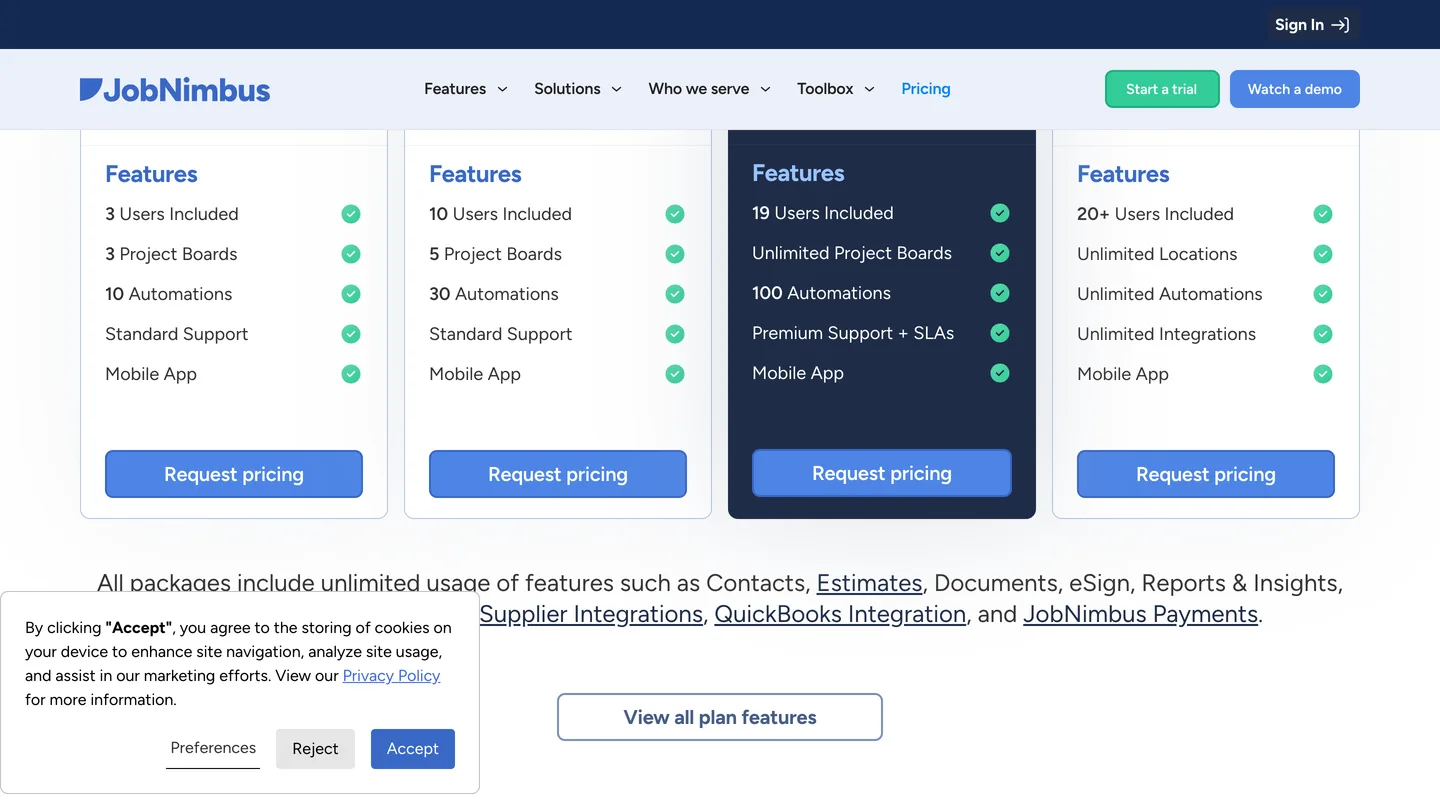 Jul 30, 2026
 Tech Stack
JobNimbus Review 2026: Pricing, Pros, Cons and Alternatives
JobNimbus rates 4.6 on Capterra and orders material straight from ABC Supply and SRS. But it publishes no price, and its supplement route carries a note.
Read Article Jul 30, 2026
 Tech Stack
BuildOps Review 2026: Pricing, Contract Terms and Alternatives
BuildOps runs commercial service and projects on one platform, and publishes no pricing at all. The billing unit, the 30-day data-export window, and who it suits.
Read Article Jul 30, 2026
 Tech Stack
FieldPulse Review 2026: Pricing, Pros, Cons and Alternatives
FieldPulse rates 4.6 on Capterra and is the platform contractors name when they leave a bigger system. But it publishes no price, and the contract runs a year.
Read Article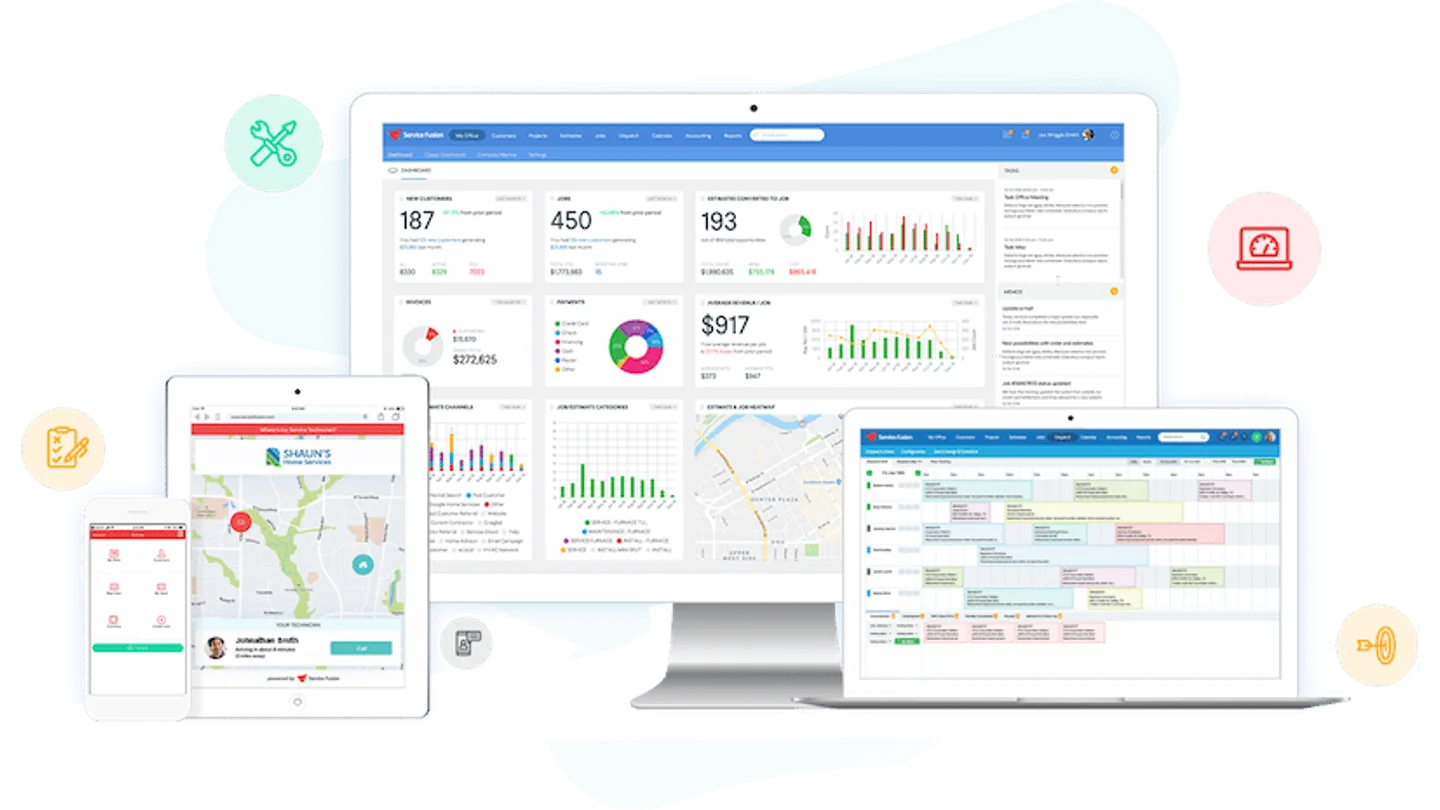 Jul 30, 2026
 Tech Stack
Service Fusion Review 2026: Pricing, Contract and Alternatives
Service Fusion bills flat per company with unlimited users, which is the best structural deal in field service software. The published plans, the contract behind the no-contract line, and the app score every other review gets wrong.
Read Article Jul 30, 2026
 Tech Stack
Knowify Review 2026: Pricing, Job Costing and Alternatives
Knowify rates 4.5 on Capterra and its weakest sub-score is features. What the $99 Core plan withholds, which way the QuickBooks sync really runs, and who should not buy it.
Read Article Jul 29, 2026
 Tech Stack
AccuLynx Review 2026: Pricing, Tier Gating, Alternatives
AccuLynx rates 4.6 across 846 reviews and now publishes an entry price. What that price omits, which tier holds the insurance workflow, and who should skip it.
Read Article Jul 29, 2026
 Tech Stack
Unitel Voice Review 2026: Pricing, Features and Alternatives
Unitel Voice rates 4.6 on Capterra and gives a one-truck shop a business number for $9.99 a month. The published plans, the cost per call, and what it won't do.
Read Article Jul 29, 2026
 Tech Stack
NiceJob vs Podium 2026: Pricing, Contracts and Review Gating
Both vendors print a price, at very different scale and in different currencies. The gap that matters is what Podium will not print: the billing unit, and whether a trade shop gets the number on the page.
Read Article Jul 28, 2026
 Tech Stack
CompanyCam Review 2026: Pricing, Pros, Cons and Alternatives
Every page ranking for CompanyCam still quotes a per-user price the vendor no longer charges. Here are the real plans, the seat math, and who should skip it.
Read Article Jul 28, 2026
 Tech Stack
NiceJob Review 2026: Pricing, Pros, Cons and Alternatives
NiceJob rates 4.9 on Capterra and refuses to gate negative reviews. Real plan pricing, the active-customer threshold nobody publishes, and who should skip it.
Read Article Jul 27, 2026
 Tech Stack
Buildertrend Review 2026: Pricing, Limits and Alternatives
Buildertrend rates 4.5 across 2,486 Capterra reviews and quotes against your revenue rather than your seat count. The workflows, the export problem, the alternatives.
Read Article Jul 27, 2026
 Tech Stack
CallRail Review 2026: Pricing, Pros, Cons and Alternatives
CallRail rates 4.5 on Capterra, and its tracking numbers port out free. But the two usage rates that decide your real bill are the two it does not print.
Read Article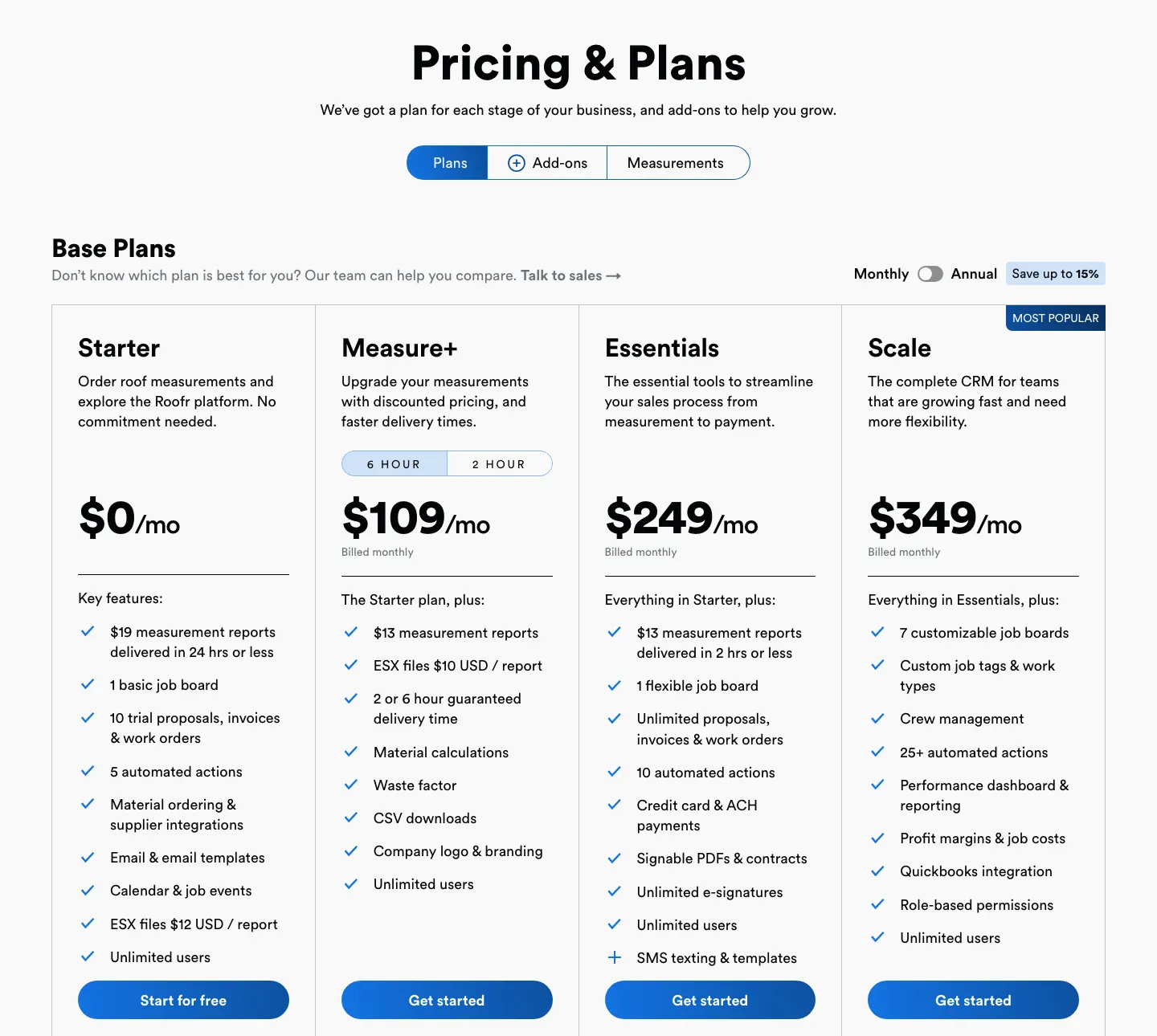 Jul 27, 2026
 Tech Stack
Roofr Review 2026: Pricing, Pros, Cons and Alternatives
Roofr rates 4.6 on Capterra and sells $13 measurement reports against a market charging triple. But it will not import a report from anywhere else.
Read Article Jul 25, 2026
 Tech Stack
Housecall Pro Review 2026: Pricing, Pros, Cons, Alternatives
Housecall Pro has the shortest learning curve in the category and the widest review spread. Real pricing, the Instapay math, and the migration trap to plan around.
Read Article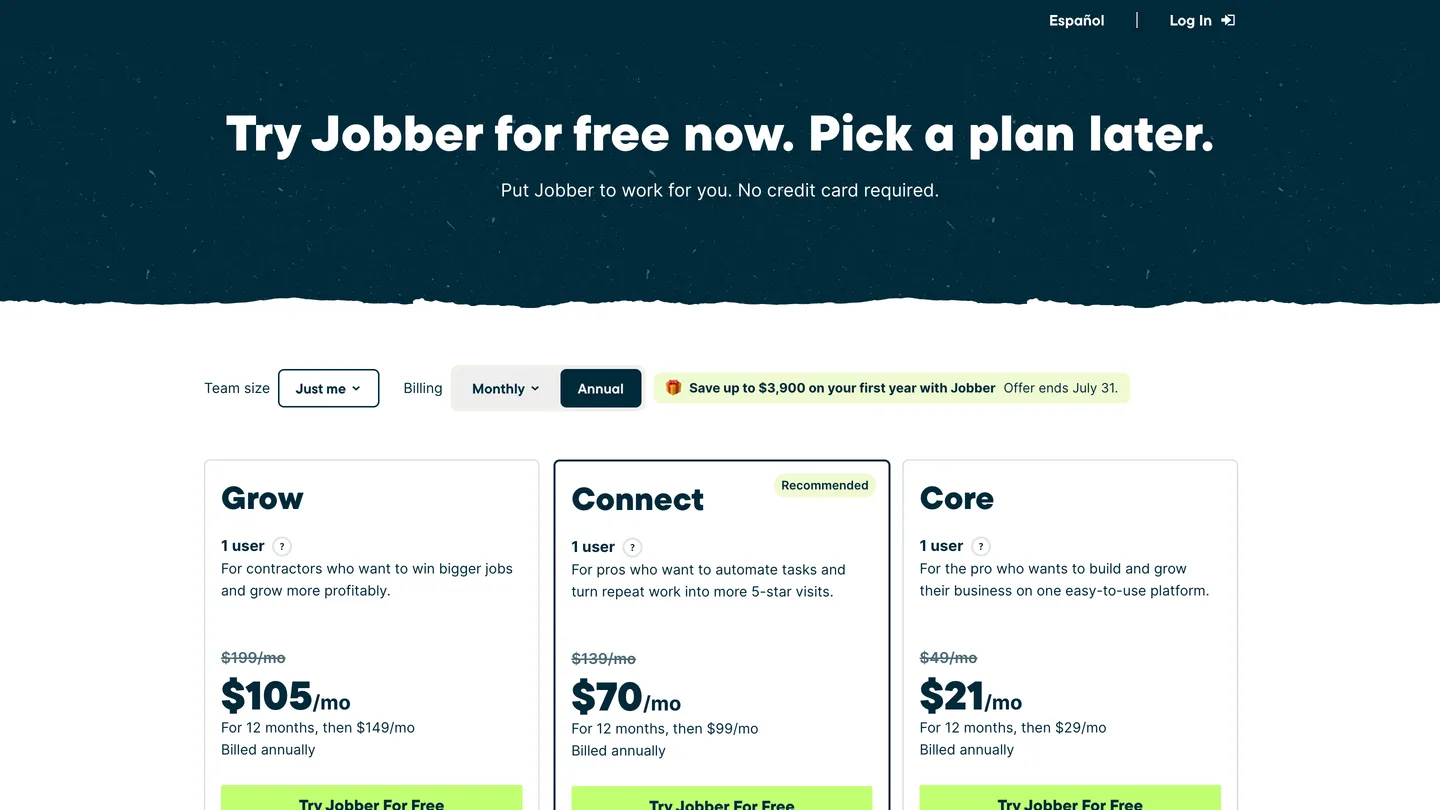 Jul 24, 2026
 Tech Stack
Jobber Review 2026: Pricing, Pros, Cons and Alternatives
Jobber rates 4.6 on Capterra with the best mobile app in the category. Real plan pricing, the feature gating that changes your entry price, and who it suits.
Read Article Jul 23, 2026
 Tech Stack
ServiceTitan Review 2026: Pricing, Pros, Cons, Alternatives
ServiceTitan rates 4.3 on Capterra but its weakest score is value for money. Real reported pricing, the 12-month contract, the exit fees, and who it suits.
Read Article Jun 3, 2026
 Tech Stack
HVAC Online Scheduling: The 43% Losing After-Hours Bookings
HVAC leads every trade on online booking at just 56.7%, which still leaves 43% of sites forcing an after-hours customer to wait for a business-hours phone call.
Read Article