HelioScope Review 2026: Pricing, Pros, Cons, Alternatives
HelioScope starts at $159 USD. What each tier gates, the 11 limitations reviewers name, and 5 alternatives with published prices.
Page at a glance
HelioScope is the browser-based C&I solar design and simulation tool that lenders will accept production estimates from, sold on a licence that meters site addresses rather than seats, so ten new commercial opportunities a month is the real ceiling on a $159 plan. It starts at $159 USD per licence per month, and one licence includes 1 user and 10 projects per month. Per licence, not per seat, and the licence carries a project quota rather than unlimited use. The pricing page prints "per license* per month" against both paid tiers, with the asterisk resolving to "*Includes 1 user and 10 projects per month" on monthly and "*Includes 1 user and 120 projects" on annual. The comparison table gives Basic and Pro "Users: 1" and "Projects: 10/month, 120/year" while giving both "Designs: Unlimited", so a licence buys unlimited design iterations on a capped number of site addresses. The Terms of Use define a Project as "a location or address for which you initiate creating a solar design(s) via HelioScope" and note that "It is possible for multiple designs to exist for a given Project." Quotas stack across licences: the vendor's own worked example is "if you have 3 monthly Basic licenses, that equates to 30 projects to use monthly across your whole team." Basic and Pro cap out at 5 licences per team, after which the only path is an Enterprise quote. It fits a commercial and industrial solar EPC or developer running roughly 1 to 5 licensed designers, doing rooftop, carport and ground-mount C&I projects under 5 MW DC, where a bank or a lender has to accept the production estimate and the team opens fewer than ten new site addresses per licence per month. It's the wrong buy for A residential solar installer doing rooftop retrofits under 15 kW, running a sales team that needs tablet proposals, e-signature and integrated lender financing at the kitchen table, because HelioScope is sold explicitly as the commercial product in Aurora's own navigation, which files HelioScope under Commercial and Aurora under Residential. The project meter makes it worse for residential volume specifically, because residential shops open far more addresses per designer per month than C&I shops do, and every one of those addresses spends a slot from a pool of ten. And a residential team burning through 60 site visits a month would need six licences it can't buy, since Basic and Pro cap at five. Alternatives that publish their prices are Aurora Solar from $159, OpenSolar from $0, SurgePV from $1,899. Five priced tiers, eleven evidenced gaps and five alternatives, three of which publish a figure.
The short verdict on HelioScope
HelioScope earns its money with a commercial and industrial solar EPC or developer running roughly 1 to 5 licensed designers, doing rooftop, carport and ground-mount C&I projects under 5 MW DC, where a bank or a lender has to accept the production estimate and the team opens fewer than ten new site addresses per licence per month. If that's you, it does the job. The sections below are the parts worth checking before you sign. But the fit is narrower than the marketing suggests, and the price isn't the whole cost.
It starts at $159 USD. And pricing was verified on 7 August 2026, so you can check every figure below in a browser tab.
| Pricing model | Published tiers |
|---|---|
| Entry price | $159 USD |
| Users | Per licence, not per seat, and the licence carries a project quota rather than unlimited u |
| Ownership | Aurora Solar Inc. (Aurora Inc.), which acquired Folsom Labs, the original developer. Every HelioScope page footer reads ©2026 Helioscope, an Aurora Inc. Company, folsomlabs.com 301-redirects to helioscope.aurorasolar.com, and the Terms of Use are executed by "Aurora Solar inc., on behalf of itself and its wholly-owned subsidiary, Folsom Labs, Inc." |
| Best fit | a commercial and industrial solar EPC or developer running roughly 1 to 5 licensed designers, doing rooftop, carport and ground-mount C&I projects under 5 MW DC, where a bank or a lender has to accept the production estimate and the team opens fewer than ten new site addresses per licence per month. |
| Accounting sync | QuickBooks (none), Xero (none), Sage Intacct (none) |
What works
- You're buying site addresses, and the counter runs on creation date rather than on activity
- The whole value proposition is that a lender takes the number without re-running it
- Export is genuinely good, and it's the only way anything leaves
- Sharing is by expiring single-use link in the new experience, and only owners or admins can issue one
- Battery modelling exists on every plan, which contradicts the most-repeated third-party claim about this tool
What does not
- The meter is site addresses, not seats, and archiving a project doesn't give the quota back
- Unused projects expire with no refund, and on a monthly plan they never roll over at all
- Basic and Pro stop at five licences, so seat six is a sales conversation with no published price
- Single-axis trackers are Enterprise-only, and the documented workaround is to fake the gain in the soiling-loss field
- There's no accounting integration at all, and the API that would let you build one is Enterprise-only
HelioScope is the browser-based C&I solar design and simulation tool that lenders will accept production estimates from, sold on a licence that meters site addresses rather than seats, so ten new commercial opportunities a month is the real ceiling on a $159 plan. It sells to Solar contractors, and the shape of the product follows from that: One licence equals one user plus ten projects a month, or 120 a year on annual. Quotas pool across licences, so three Basic licences give the whole team thirty a month. The consumption tracker sits in the bottom left of the V2 interface and a twelve-month usage graph lives on the Billing and Usage page. But three things confuse the count in practice: archived projects still count, projects shared into your team from another team's link don't count against you, and usage is tracked by the date a project was created rather than the date it was last touched, so a project you reopened today still belongs to the month you started it.
Ownership matters here more than it usually does. HelioScope is owned by Aurora Solar Inc. (Aurora Inc.), which acquired Folsom Labs, the original developer. Every HelioScope page footer reads ©2026 Helioscope, an Aurora Inc. Company, folsomlabs.com 301-redirects to helioscope.aurorasolar.com, and the Terms of Use are executed by "Aurora Solar inc., on behalf of itself and its wholly-owned subsidiary, Folsom Labs, Inc.", so weigh roadmap risk alongside the feature list. An independent product can be bought and folded into somebody else's plan two years after you sign.
HelioScope: right buyer, wrong buyer
It fits a commercial and industrial solar EPC or developer running roughly 1 to 5 licensed designers, doing rooftop, carport and ground-mount C&I projects under 5 MW DC, where a bank or a lender has to accept the production estimate and the team opens fewer than ten new site addresses per licence per month. That's the half most reviews print. Here's the other half, which is the one worth your time.
Don't buy it if you're A residential solar installer doing rooftop retrofits under 15 kW, running a sales team that needs tablet proposals, e-signature and integrated lender financing at the kitchen table. HelioScope is sold explicitly as the commercial product in Aurora's own navigation, which files HelioScope under Commercial and Aurora under Residential. The project meter makes it worse for residential volume specifically, because residential shops open far more addresses per designer per month than C&I shops do, and every one of those addresses spends a slot from a pool of ten. And a residential team burning through 60 site visits a month would need six licences it can't buy, since Basic and Pro cap at five. Look at Aurora Solar instead.
Don't buy it if you're A utility-scale developer modelling anything above 30 MW DC, or a team whose lender specifically requires PVsyst output. Design size is capped by tier at 1.25 MW DC on Basic, 5 MW DC on Pro and 30 MW DC on Enterprise. The vendor is candid that pushing past the cap technically works but degrades: designs above the limit "can run into difficulties such as slow simulation speed, CAD exports failing, layout images not rendering". And export to PVsyst is itself an Enterprise feature, so on Basic or Pro you can't even hand the model over. Look at PVsyst instead.
Don't buy it if you're Any contractor who wants one system to carry design, estimating, job costing, scheduling and invoicing. HelioScope is a design and simulation engine with a proposal layer bolted on at Pro. It has no accounting module and no accounting integration: QuickBooks, Xero, Sage Intacct, Salesforce, HubSpot, Zapier, Procore and Stripe appear zero times across all 240 help-centre articles, and there's no integrations page on the vendor site to check. And the API that would let you build the bridge yourself is Enterprise-only. Look at A trade platform such as Buildertrend or BuildOps, run alongside HelioScope rather than instead of it instead.
Don't buy it if you're A shop that needs a design tool with unlimited projects because its pipeline is unpredictable, or one whose procurement requires signed vendor security questionnaires. The project quota is the product's central commercial mechanic and it doesn't flex: consistently repeated overage is defined in the Terms as a material breach that can lead to suspension or termination. And Aurora separately refuses to complete customer-specific onboarding or policy documents on licence-based subscriptions, which stops some procurement processes dead. Look at OpenSolar, which is free and doesn't meter projects, or SurgePV, which advertises unlimited projects on every tier instead.
What you'll pay HelioScope in year one
And HelioScope publishes its tiers, which puts it ahead of most of this category before you compare a single feature.
| Tier | Price | Billing unit | What it unlocks |
|---|---|---|---|
| Basic (billed monthly) | $159 USD | per licence per month, and one licence includes 1 user and 10 projects per month | Nothing beyond the tier below |
| Basic (billed annually) | $1,620 USD | per licence per year, and one licence includes 1 user and 120 projects for the year | one year commitment |
| Pro (billed monthly) | $259 USD | per licence per month, and one licence includes 1 user and 10 projects per month | LIDAR-assisted modeling, AI-based obstruction detection, Independent Tilt (for fixed-tilt systems), Parcel boundaries (for select regions), Financial modeling and sales proposals, P90, P95, and P99 values, Designs up to 5 MW (DC) |
| Pro (billed annually) | $2,640 USD | per licence per year, and one licence includes 1 user and 120 projects for the year | one year commitment, LIDAR-assisted modeling, AI-based obstruction detection, Independent Tilt (for fixed-tilt systems), Parcel boundaries (for select regions), Financial modeling and sales proposals, P90, P95, and P99 values, Designs up to 5 MW (DC) |
| Enterprise | Quote only | per licence, on custom per-project pricing | Unlimited users, Single-Axis Trackers, Export to PVsyst, Direct API access, SSO, Designs up to 30 MW (DC), Premium support, Advanced team management tools, Access to an account manager, more than 5 licences on a team |
Per licence, not per seat, and the licence carries a project quota rather than unlimited use. The pricing page prints "per license* per month" against both paid tiers, with the asterisk resolving to "*Includes 1 user and 10 projects per month" on monthly and "*Includes 1 user and 120 projects" on annual. The comparison table gives Basic and Pro "Users: 1" and "Projects: 10/month, 120/year" while giving both "Designs: Unlimited", so a licence buys unlimited design iterations on a capped number of site addresses. The Terms of Use define a Project as "a location or address for which you initiate creating a solar design(s) via HelioScope" and note that "It is possible for multiple designs to exist for a given Project." Quotas stack across licences: the vendor's own worked example is "if you have 3 monthly Basic licenses, that equates to 30 projects to use monthly across your whole team." Basic and Pro cap out at 5 licences per team, after which the only path is an Enterprise quote.
There is a discount for paying annually up front: 15%, printed on the pricing page as "per license* per year (a 15% discount!)". The arithmetic checks out on both tiers: Basic is $159 x 12 = $1,908 monthly against $1,620 annually, and Pro is $259 x 12 = $3,108 against $2,640. The annual plan also changes the quota mechanic rather than only the price, because 120 projects become spendable at any point in the year instead of expiring 10 at a time each month. Switching from monthly to annual is not self-serve: "Please reach out to support@helioscope.com to upgrade your plan from monthly to annual or purchase additional licenses." And an annual prepay discount tells you an annual commitment exists, which is worth knowing before anyone mentions a term length out loud.
The HelioScope costs that show up later
Payment processing. Not applicable in the usual sense, because HelioScope does not process homeowner or client payments. It has no payment rails, no financing marketplace and no invoicing of your customers. The only money it moves is your own subscription fee, charged to a credit card managed on the Billing page, where you can add a second card and view or download invoices. The Terms of Use reserve a broad charging right: "You agree that we may bill your credit card or other payment method you provide for renewals, additional users, Overages, expenses, and unpaid fees, as applicable."
Implementation and onboarding. No implementation fee is published and none is required. A free trial runs 14 days, is limited to one per customer, and carries Pro-level features including LIDAR, AI obstruction detection, Independent Tilt, financial modeling and designs up to 5 MW. Extensions are granted case by case by emailing support. Nonprofits get free Pro access for a year for up to 3 users and a 50% discount above that, subject to documentary proof of nonprofit status.
Minimum term. One month on the monthly plan and one year on the annual plan. The Terms of Use state that "HelioScope is offered either on a monthly subscription basis or an annual subscription basis, as indicated in your Service Order." Cancelling is self-serve and takes effect at the end of the paid cycle: "A subscription can be canceled at any time by a subscription admin from the Billing page by clicking the Cancel Subscription link" and "canceling a subscription will terminate it at the end of the current billing cycle."
Getting out. There is no named early-termination fee, but there are two clauses that behave like one. Cancelling mid-term forfeits money already paid: "Cancelling your subscription by electing non-renewal means that you will not be charged for the next billing cycle, but you will not receive any refunds or credits for amounts that have already been charged." And if Aurora terminates you for cause, the remainder of the term accelerates: "If we terminate this Agreement in accordance with Section 12.2 (Termination for Cause), you will pay any unpaid fees covering the remainder of the then-current Subscription Term after the effective date of termination." Repeated project overage is defined as exactly that kind of cause: "You agree that consistently repeated Overage is a material breach of this Agreement subject to Section 12.2."
Auto-renewal. Automatic, for a term equal to the one you just finished, at whatever the price is then. "Except as otherwise specified in your Service Order, unless either party elects not to renew your subscription prior to expiration of the current Subscription Term, your subscription will automatically renew for another Subscription Term of a period equal to your initial Subscription Term." The repricing right is explicit in the same clause: "All renewals are subject to HelioScope continuing to be offered and will be charged at the then-current rates." A separate clause adds "We reserve the right to change the Fees or applicable charges and to institute new charges and Fees at the end of a Subscription Term." Note the mismatch between the two documents: the Terms say non-renewal notice goes through support ("You will provide any notice of non-renewal by contacting our support team"), while the later help-centre article says an admin can cancel from the Billing page directly.
Modules sold separately. . The HelioScope figure worth writing down is the one with your day-one modules already in it, not the headline tier.
Third-party services you will also pay for. , , , . These are not on HelioScope's invoice, and they are still part of what this decision costs you every month.
Small thing that turns out to matter. HelioScope and Aurora Solar carry byte-for-byte identical sticker prices, $159 and $259 a month, $1,620 and $2,640 a year, from the same parent company, on completely different meters. Aurora's pricing page prices per user and prints no monthly project cap on Basic or Premium. HelioScope's prices per licence and hangs an asterisk off every tier reading "*Includes 1 user and 10 projects per month". Same money, different unit. Anyone benchmarking the two on price alone will conclude they cost the same and pick on features. But they don't cost the same for a high-volume shop. So convert both to cost per site address you expect to open, not cost per designer, before you compare anything else.
The HelioScope costs that land afterwards
The subscription is the part everyone quotes. These are the lines that land afterwards, and the ones we could not find are named as unpublished rather than left blank.
Sold separately. . Price the configuration you'll really run, because an add-on you need on day one is part of the price.
Third-party services you'll also pay for. , , , . None of these are on HelioScope's invoice, and all of them are part of what this decision costs every month.
"HelioScope Basic (billed monthly) is $159 USD, per licence per month, and one licence includes 1 user and 10 projects per month."
HelioScope pricing page (2026)
"HelioScope Basic (billed annually) is $1,620 USD, per licence per year, and one licence includes 1 user and 120 projects for the year."
HelioScope pricing page (2026)
"Per licence, not per seat, and the licence carries a project quota rather than unlimited use. The pricing page prints "per license* per month" against both paid tiers, with the asterisk resolving to "*Includes 1 user and 10 projects per month" on monthly and "*Includes 1 user and 120 projects" on annual. The comparison table gives Basic and Pro "Users: 1" and "Projects: 10/month, 120/year" while giving both "Designs: Unlimited", so a licence buys unlimited design iterations on a capped number of site addresses. The Terms of Use define a Project as "a location or address for which you initiate creating a solar design(s) via HelioScope" and note that "It is possible for multiple designs to exist for a given Project." Quotas stack across licences: the vendor's own worked example is "if you have 3 monthly Basic licenses, that equates to 30 projects to use monthly across your whole team." Basic and Pro cap out at 5 licences per team, after which the only path is an Enterprise quote."
HelioScope pricing page (2026)
The six workflows you pay for
Feature totals are noise. So a shop in this category lives or dies on six things, and those are the six to grade, and each one below carries the evidence it's graded on.
You're buying site addresses, and the counter runs on creation date rather than on activity One licence equals one user plus ten projects a month, or 120 a year on annual. Quotas pool across licences, so three Basic licences give the whole team thirty a month. The consumption tracker sits in the bottom left of the V2 interface and a twelve-month usage graph lives on the Billing and Usage page. But three things confuse the count in practice: archived projects still count, projects shared into your team from another team's link don't count against you, and usage is tracked by the date a project was created rather than the date it was last touched, so a project you reopened today still belongs to the month you started it.
The whole value proposition is that a lender takes the number without re-running it Sunstone Credit reaffirmed HelioScope as a bankable source for underwriting in October 2025, and the vendor's pricing page promises "Accuracy within 1% of PVsyst" on every tier including Basic. But P90, P95 and P99 values, which are the figures a lender usually wants, are gated to Pro and above. Export to PVsyst for an independent cross-check is gated to Enterprise. So on Basic you get the accuracy claim but neither the probability bands nor the ability to hand the model to a third-party validator.
Export is genuinely good, and it's the only way anything leaves Bulk Download from a project's Overview page pulls the hourly CSV, shade report, production report and DXF together, and the file set can be configured at team level. The 8760 CSV is a fixed-format file of one row per hour with a final grid_power column, which is what makes the Energy Toolbase and HOMER handoffs work even without a live link. But the catch is that all of this is per-project and manual, there's no scheduled backup, and after termination access ends with no grace period.
Sharing is by expiring single-use link in the new experience, and only owners or admins can issue one In V2 a project is shared by copying a link from the ellipsis menu, and the article is explicit about the friction: "The URL will expire once it has been used. Therefore, this process will need to be repeated to share with multiple users." The recipient also needs their own HelioScope account. But in Classic the same link could be reused by a group. Usefully, projects shared into your team from another team don't spend your project quota, because "Project usage is based on the team that created the project."
Battery modelling exists on every plan, which contradicts the most-repeated third-party claim about this tool Third-party directories still list "No native battery storage modeling" as a HelioScope con. But the vendor's own help centre, updated 6 August 2026, says otherwise: storage is added on the design canvas after arrays and keepouts, it's "available to users in all pricing plans", and it currently supports AC-coupled systems. Basic users enter energy capacity, power rating, max charge power and count, with a minimum of 10 kWh and a maximum of 20,000 kWh. Pro and Enterprise add SOC min, SOC max and round-trip efficiency for storage simulations. So record both versions and check the feature yourself during the trial.
Fourteen days at Pro feature level, one per customer, ever The trial includes LIDAR, AI obstruction detection, Independent Tilt, parcel boundaries, financial modeling and proposals, P90 through P99, and designs up to 5 MW. It runs fourteen days and "HelioScope free trials are limited to one trial per customer." And extensions are granted individually by emailing support. Because there's no second bite, the trial is the only window in which to validate accuracy against your own built jobs.
HelioScope per trade, not per company size
Fit differs by trade rather than by company size alone, and a blended paragraph hides that. Here is the split for the trades this one sells to.
Solar. The workflow that decides it is you're buying site addresses, and the counter runs on creation date rather than on activity, and the shop profile that gets value is solo designer or two-person c&i shop, under 10 new commercial sites a month doing commercial work. Where it stops being a fit is A residential solar installer doing rooftop retrofits under 15 kW, running a sales team that needs tablet proposals, e-signature and integrated lender financing at the kitchen table.
The HelioScope integration that decides everything else
QuickBooks connects, on every plan. Xero connects, on every plan. Sage Intacct connects, on every plan. Your costs map through cost codes, so test yours against your own chart of accounts before you commit. A code your books don't recognise is how a labour charge quietly lands somewhere useless.
Past those, the road ends. Every accounting package (QuickBooks, Xero, Sage Intacct), Every CRM (Salesforce, HubSpot) and every automation layer (Zapier), Construction and field platforms (Procore, and any scheduling or job-costing system), A published integrations directory of any kind do not connect. So if your books run on an ERP rather than the platforms named above, weigh that before anything else.
Beyond accounting it connects to Energy Toolbase (One-click import of solar PV designs, 8760 production data, layout images and equipment from HelioScope into Energy Toolbase for financial modelling and proposals. Linked by entering your HelioScope username and password inside Energy Toolbase's Solar PV Settings, or fed manually via the hourly CSV.), HOMER Energy (HOMER Pro) (Import of HelioScope designs into HOMER through HOMER's HelioScope Wizard, or by loading a HelioScope CSV file from your computer.), PVBID (Bid and pricing tool that imports a HelioScope design into its Bid Wizard. Linked by generating an auth token in HelioScope and pasting it into PVBID. Token generation may need support to enable it on your account.), Unirac U-Builder (Racking design handoff. Export runs at field-segment level, so a design with several field segments needs several separate imports. Linked with your HelioScope username and password stored in U-Builder preferences.), IronRidge (Import of HelioScope designs into IronRidge for tilt mount and BX ballasted flat-roof systems, aimed at setback compliance and procurement-ready documentation. Added in 2026.), Nearmap (High-resolution aerial imagery in the designer. You supply your own Nearmap subscription and generate a HelioScope-specific API key with no IP restrictions. And a Nearmap key already used with Aurora won't work here.), SolarAnywhere (Premium weather dataset pulled in by API key and selectable as a weather source in Condition Sets or as a default in Preferences. It requires your own SolarAnywhere licence and licence-manager rights to mint the key.), OpenEI Utility Rates (Utility rate data feeding the Utility Rate Editor and the financial analysis tools, which sit at Pro and above.), EagleView (File-level rather than API-level. EagleView KMZ files are imported into HelioScope as site geometry, with a documented set of common KMZ problems to work around.), PVsyst (Two separate bridges. Component characterisation comes in through PAN and OND files from PVsyst 6.4 or later. Design geometry goes out through .DAE export, which is an Enterprise feature.), AutoCAD and other CAD packages (DXF export with a documented block and layer structure, available on all plans. This is the handoff for permit-ready electrical documentation, which HelioScope doesn't finish itself.), Google Sunroof and Aurora LIDAR (The two selectable LIDAR data sources behind the Pro-tier LIDAR-assisted modelling feature, toggled between Mesh, Imagery and Point Cloud styles.). A public API exists: Enterprise plan only, quoted rather than priced, and read-oriented as described: it pulls Project, Design and Simulation data out of HelioScope into other software. The pricing page lists "Direct API access" under Enterprise tools alongside SSO. There is no public developer documentation on the HelioScope site, which has eleven pages in total; Aurora's own navigation links to API Documentation under For Customers, but that sits on the Aurora side of the house. Note that PVBID uses an auth token generated at beta.helioscope.com/auth-tokens which support may need to enable, so some token-based access exists below Enterprise for specific named partners.
HelioScope support, and what it costs you
Support is the line item nobody prices and everybody eventually needs. Onboarding for HelioScope: No implementation fee is published and none is required. A free trial runs 14 days, is limited to one per customer, and carries Pro-level features including LIDAR, AI obstruction detection, Independent Tilt, financial modeling and designs up to 5 MW. Extensions are granted case by case by emailing support. Nonprofits get free Pro access for a year for up to 3 users and a 50% discount above that, subject to documentary proof of nonprofit status.
The review corpus we read on 7 August 2026 carries no consistent signal on response times either way, so treat support as untested rather than good. Open a real ticket during the trial and time the reply, because that is the number no pricing page gives you.
Before you sign with HelioScope: the exit
Nobody reads this section before they buy, and it's the one that costs money afterwards. Four terms decide what leaving looks like.
Minimum term. One month on the monthly plan and one year on the annual plan. The Terms of Use state that "HelioScope is offered either on a monthly subscription basis or an annual subscription basis, as indicated in your Service Order." Cancelling is self-serve and takes effect at the end of the paid cycle: "A subscription can be canceled at any time by a subscription admin from the Billing page by clicking the Cancel Subscription link" and "canceling a subscription will terminate it at the end of the current billing cycle."
Auto-renewal. Automatic, for a term equal to the one you just finished, at whatever the price is then. "Except as otherwise specified in your Service Order, unless either party elects not to renew your subscription prior to expiration of the current Subscription Term, your subscription will automatically renew for another Subscription Term of a period equal to your initial Subscription Term." The repricing right is explicit in the same clause: "All renewals are subject to HelioScope continuing to be offered and will be charged at the then-current rates." A separate clause adds "We reserve the right to change the Fees or applicable charges and to institute new charges and Fees at the end of a Subscription Term." Note the mismatch between the two documents: the Terms say non-renewal notice goes through support ("You will provide any notice of non-renewal by contacting our support team"), while the later help-centre article says an admin can cancel from the Billing page directly.
Early termination. There is no named early-termination fee, but there are two clauses that behave like one. Cancelling mid-term forfeits money already paid: "Cancelling your subscription by electing non-renewal means that you will not be charged for the next billing cycle, but you will not receive any refunds or credits for amounts that have already been charged." And if Aurora terminates you for cause, the remainder of the term accelerates: "If we terminate this Agreement in accordance with Section 12.2 (Termination for Cause), you will pay any unpaid fees covering the remainder of the then-current Subscription Term after the effective date of termination." Repeated project overage is defined as exactly that kind of cause: "You agree that consistently repeated Overage is a material breach of this Agreement subject to Section 12.2."
Payment processing. Not applicable in the usual sense, because HelioScope does not process homeowner or client payments. It has no payment rails, no financing marketplace and no invoicing of your customers. The only money it moves is your own subscription fee, charged to a credit card managed on the Billing page, where you can add a second card and view or download invoices. The Terms of Use reserve a broad charging right: "You agree that we may bill your credit card or other payment method you provide for renewals, additional users, Overages, expenses, and unpaid fees, as applicable."
Worth a detour here. The liability cap and the marketing claim point in opposite directions. HelioScope is sold on lenders accepting its numbers "no questions asked", while the contract caps Aurora's total liability at the fees you paid in the preceding twelve months and disclaims any warranty that Aurora "WILL REVIEW YOUR DATA FOR ACCURACY". On an annual Basic licence the entire financial backing behind a bankable production estimate is $1,620. If you give a client a production guarantee built on a HelioScope number, the risk sits with you, not with Aurora. So price that risk, or keep an independent check on anything that backs a performance warranty.
"HelioScope has not only cut our design time several fold, but it helps us optimize our designs. We can rapidly run several iterations of a project’s design and find the ideal solution for our customer in a matter of minutes."
HelioScope pricing page (vendor-published customer testimonial, not an independent review), Alex Keally (2026)
"HelioScope has transformed our workflow. We can now generate layouts within minutes, giving the customer, the system designer, the installer, and the inspector a clear visual indication of system design."
HelioScope pricing page (vendor-published customer testimonial, not an independent review), Jeff Nicholson (2026)
"HelioScope allows me to run 4x as many iterations of layout in the same amount of time, helping us find the best solutions for our customers. The detailed and professional HelioScope reports help our presentations stand out against our competitors."
HelioScope pricing page (vendor-published customer testimonial, not an independent review), Phil Schneider (2026)
What HelioScope does badly
Six things worth raising, and each one's answerable with a yes or a no on a call.
The meter is site addresses, not seats, and archiving a project doesn't give the quota back A Basic or Pro licence includes 1 user and 10 projects per month. A Project is defined in the Terms as "a location or address for which you initiate creating a solar design(s) via HelioScope", so every new opportunity you open consumes one, whether it closes or not. But the trap sits one level deeper. The help centre confirms that tidying up doesn't refund the meter: "Archived projects: archive projects still count towards the total number of projects used." Usage is also stamped by creation date, not by last-modified date, so the project list on your homepage won't match the consumption tracker. So a designer who opens ten speculative sites in a week has spent the month. Before you sign, pull twelve months of your own CRM data and count distinct site addresses opened per designer per month, not deals won. And if any month exceeded ten, price the annual plan instead, because 120 projects spendable at any time absorbs a lumpy month that 10-per-calendar-month can't.
Unused projects expire with no refund, and on a monthly plan they never roll over at all The Terms allow rollover inside a longer Subscription Term but shut it off for monthly subscribers entirely: "If your subscription is monthly, i.e. your Subscription Term is one (1) Month, you may not roll over any unused portion of any Monthly Project Allowance and all unused Projects expire without any refund at the end of each Subscription Term." The help centre says the same in plainer language: "No, unused projects do not roll over to the next monthly billing cycle." So a seasonal C&I shop that designs nothing in January and eighteen sites in June pays for twenty slots across the two months and can use only ten of them in June. If your pipeline is seasonal, the monthly plan is the wrong instrument regardless of cash flow preference. So model the annual 120-project pool against your worst month, and remember the annual pool also expires at term end with no refund.
Basic and Pro stop at five licences, so seat six is a sales conversation with no published price The self-serve ladder has a ceiling that isn't on the pricing page. It's stated only in the help centre: "There is a maximum of 5 licenses per team on the Basic and Pro plans. If you require more than 5 licenses, you may be a good fit for our Enterprise plan." Because quota and headcount are welded to the same licence, a team that needs 60 projects a month is already at the ceiling even if only two people ever touch the software. And at that point the pricing page offers nothing but "Custom per-project pricing" and a "Talk to Sales" button. Work out the licence count your project volume implies, not the count your headcount implies. And if that number is above five, get the Enterprise quote before you start, because you'll hit the wall on volume rather than on hiring.
Single-axis trackers are Enterprise-only, and the documented workaround is to fake the gain in the soiling-loss field Trackers sit behind the top tier: "Single-axis Trackers are exclusively available for our Enterprise Plan." The vendor then publishes a workaround telling Basic and Pro users to build a flat fixed-tilt array and manufacture the tracker uplift by editing a loss term: "To incorporate gains from single-access trackers, edit the soiling losses in your Condition Set. The production gain from using single-access trackers is a boost of between 15 - 36%. An estimated average expected gain in HelioScope with trackers is 24%." But that number is a wide band applied to the same production estimate a lender is being asked to underwrite. If any part of your pipeline is single-axis tracker ground mount and the estimate goes to a lender, treat Enterprise as the entry tier rather than an upgrade. And ask the lender directly whether a soiling-loss-adjusted fixed-tilt model clears their underwriting.
There's no accounting integration at all, and the API that would let you build one is Enterprise-only Across all 240 published help-centre articles there are zero occurrences of QuickBooks, Xero, Sage Intacct, Salesforce, HubSpot, Zapier, Procore or Stripe. The vendor site itself has no integrations directory to check: the full sitemap lists eleven pages and none of them is an integrations page. The documented partner list is seven named integrations, all of them adjacent design, imagery, weather, racking or bid tools. And the one escape hatch is gated: "HelioScope offers API access for our Enterprise plan user to automatically pull Project, Design, and Simulation data from HelioScope directly into other software." Plan for the bill of materials and the production numbers to reach your accounting system by CSV and by hand. And if that handoff is load-bearing, price the Enterprise API into the comparison rather than assuming it comes with a paid plan.
Two of the seven integrations still ask you to hand your HelioScope username and password to a third party Nearmap and SolarAnywhere use API keys. PVBID uses an auth token. But Energy Toolbase links by asking you to "Under HelioScope enter your username and password" inside the Energy Toolbase settings, and Unirac U-Builder does the same, linking your "HelioScope account (including adding username and password) under the U-Builder User Preferences page". And HelioScope knows this is the weaker pattern, because the Nearmap article explains that the two companies moved away from it deliberately: they changed the process "to improve security, moving from the usage of a username and password to a more secure option that uses a generated API Key." Don't reuse a password anywhere that also protects email or banking, because the Energy Toolbase and Unirac paths store it in a third-party system. And the Terms also disclaim responsibility for what those partners do with your data.
Your data disappears when the subscription does, and the Terms put the export burden entirely on you There's no post-termination grace window and no export-on-request obligation: "You will not have access to Your Data (and we may delete all of Your Data unless legally prohibited) after expiration or termination of this Agreement (or its applicable Subscription Term), so you should make sure to export Your Data using the functionality of HelioScope during the applicable Subscription Term." Export exists and it's decent, with a Bulk Download covering the hourly CSV, shade report, production report and DXF. But it's a per-project action you have to run before the lights go out. Meanwhile the licence Aurora holds over your data survives you: it's "irrevocable and perpetual" for archiving and aggregated analytics. Run a Bulk Download on every live and recently closed project at least a fortnight before any renewal date you might not honour. And budget real hours for it, because there's no account-level one-click archive.
The liability cap is twelve months of fees on a product sold on its bankability HelioScope's central marketing claim is that lenders will underwrite its production estimates without re-checking them. But the contract prices that promise at your own annual subscription: aggregate liability "WILL NOT EXCEED THE AMOUNT ACTUALLY PAID OR PAYABLE BY YOU TO US UNDER THIS AGREEMENT IN THE TWELVE (12) MONTHS IMMEDIATELY PRECEDING THE CLAIM." On an annual Basic licence that's $1,620. The warranty disclaimer is broader still: Aurora doesn't warrant "THAT WE WILL REVIEW YOUR DATA FOR ACCURACY", and the only express warranty is about viruses. Keep your own independent check on any estimate that backs a performance guarantee to a client. Because the bankability designation is a lender's acceptance policy, not a contractual warranty you can enforce.
The Terms bar you from publishing performance information about the product you're being asked to stake projects on Two clauses combine into a benchmarking gag. The restrictions list forbids you to "publicly disseminate information regarding the performance of HelioScope" and to use it "for competitive analysis". The confidentiality section then classifies that material by default: "Any of Our Technology and any performance information relating to HelioScope will be deemed our Confidential Information without any marking or further designation." And that restriction survives termination. It's the reason independent, quantified comparisons of HelioScope against PVsyst by working designers are thin on the ground. Do your accuracy validation during the 14-day trial and keep the results internal. And if a client contract requires you to disclose modelling-tool benchmarks, raise it with Aurora before signing rather than after.
Aurora won't complete your vendor onboarding or security questionnaire on a licence-based plan Larger EPCs and any customer with a procurement function usually needs the software vendor to sign a supplier form, a security questionnaire or an insurance certificate request. HelioScope declines as policy: "HelioScope maintains its own internal policies for its employees and does not agree to or complete customer-specific policies or documents for our license-based subscriptions." So what you get instead is a fixed Customer Welcome Packet containing payment details, a W-9, bank confirmation, a Tax Residency Certificate and a Certificate of Liability Insurance. Send the Customer Welcome Packet to your procurement team before you commit, and confirm it satisfies them. And if your client contracts require signed vendor security attestations, that requirement pushes you toward an Enterprise agreement.
Support hours are business hours in one time zone, and the published window reads oddly There's no phone number anywhere in the help centre. Contact is email and in-app chat only, with a "Talk to a human" step in the chat widget. The published window is "Monday to Friday, 12 AM to 6 PM Pacific Standard Time (PST)", which as printed would end the support day at 6pm Pacific and start it at midnight. So for a designer in Europe or on the US East Coast chasing a simulation failure against a Friday bid deadline, the practical overlap is narrow either way. Ask what Premium support on Enterprise adds, since the comparison table lists Basic support on both paid tiers and Premium only at the top, with no response-time commitment published anywhere.
One more thing worth knowing. The Terms of Use contain a benchmarking gag that survives termination. You may not "publicly disseminate information regarding the performance of HelioScope" or use it "for competitive analysis", and the confidentiality clause pre-classifies the material: "any performance information relating to HelioScope will be deemed our Confidential Information without any marking or further designation." Section 3.4 Restrictions is on the survival list. It explains the empty review shelf. And it means a contractor who validates HelioScope against PVsyst on their own built jobs can't publish the comparison, so the buyer after them starts from zero. So do the validation, keep it internal, and treat the absence of published head-to-heads as a contractual artefact rather than as evidence nobody has concerns.
One more thing worth knowing. Two of the seven documented integrations still work by storing your HelioScope username and password inside a third party, and the vendor already knows that pattern is the weak one. Energy Toolbase asks you to "enter your username and password" in its Solar PV Settings and Unirac U-Builder asks for the same in User Preferences, while the Nearmap article explains that HelioScope and Nearmap deliberately moved off exactly that approach. Use a unique password on the HelioScope account and never reuse it, because it's sitting in at least two other vendors' systems. And the Terms also disclaim all responsibility for what those partners do with your data.
One more thing worth knowing. The one recurring complaint that shows up outside vendor channels is the project meter, and it dates precisely. HelioScope wrote the 10-project allowance into its Terms on 6 September 2022 and then switched on in-app enforcement in October 2023, alongside raising Basic's design ceiling from 500 kW to 1.25 MW. Third-party write-ups now lead with the cap rather than with the software. The capacity increase was the sweetener attached to the enforcement. So anyone comparing HelioScope against notes or advice written before late 2023 is comparing against a product that let you open as many sites as you liked.
One more thing worth knowing. Third-party sources contradict the vendor on two specifications that would change a buying decision, and the vendor is the one with the receipts. The solar directory apps.list.solar lists "Hard cap at 15 MW" and "No native battery storage modeling" as cons and a "45,000-component library". But HelioScope's pricing page says "Designs up to 30 MW (DC)" at Enterprise and "50,000 component module and inverter library", and its help centre says storage "is available to users in all pricing plans". Both conflicts are recorded here rather than resolved, because both sources were read directly. So the practical move is to test storage and the design ceiling yourself inside the single 14-day trial, since you only get one.
A tangent, but stay with it. The vendor publishes a help-centre article teaching Basic and Pro users to manufacture single-axis tracker production gains by editing the soiling-loss field, quoting a range of 15 to 36% with 24% as the average. That instruction sits in the same product whose commercial premise is that a lender will accept its production estimate unchecked. A 21-point spread applied by hand to a loss term isn't a bankable model, whatever the tier badge says. So if trackers are in your pipeline and the estimate leaves your building, Enterprise is the entry price, not the upgrade.
What HelioScope users report
Every quote below is transcribed from a published review, named to the platform that carries it and to the reviewer as that platform displays them. We read the corpus by complaint type rather than by star rating, which is how the disqualifying detail buried inside a five-star review gets found.
"HelioScope has not only cut our design time several fold, but it helps us optimize our designs. We can rapidly run several iterations of a project’s design and find the ideal solution for our customer in a matter of minutes."
A solect, says on HelioScope pricing page (vendor-published customer testimonial, not an independent review)
"HelioScope has transformed our workflow. We can now generate layouts within minutes, giving the customer, the system designer, the installer, and the inspector a clear visual indication of system design."
A sigora solar describes it on HelioScope pricing page (vendor-published customer testimonial, not an independent review)
"HelioScope allows me to run 4x as many iterations of layout in the same amount of time, helping us find the best solutions for our customers. The detailed and professional HelioScope reports help our presentations stand out against our competitors."
A creative energies solar, puts it on HelioScope pricing page (vendor-published customer testimonial, not an independent review)
"HelioScope System flexibility is great…service and assistance is world class. Great to see an organization committed to service excellence…we are extremely grateful."
An aegis renewables, puts it on HelioScope pricing page (vendor-published customer testimonial, not an independent review; the ellipses and the capitalised "System flexibility" are as printed)
"If we know HelioScope generated the production estimate and optimized the system size, we’ll basically accept the output in our analysis of the system’s performance — no questions asked."
A chief commercial officer at sunstone credit (the lender, not a helioscope licensee), writing on 2025-10-14, describes it on Aurora Solar press release, quoted in the vendor's own newsroom
"HelioScope gives us confidence in our design accuracy without the hours of engineering work other solutions require,"
A director of business development, solargain (epc installer), writing on 2025-10-14, reports it on Aurora Solar press release (quoted with the trailing comma as printed, because the attribution interrupts the sentence)
"Working with lenders like Sunstone that trust HelioScope’s production estimates makes the financing approval process smoother and faster."
And a director of business development, solargain (epc installer), writing on 2025-10-14, writes the same thing on Aurora Solar press release, second half of the same attributed statement
"With financing playing such a critical role in scaling commercial and industrial solar, lenders need confidence that production estimates are accurate and defensible. Bankable production estimates are the key that unlock access to capital for developers and customers alike. Our latest forecast calls for continued C&I market growth despite policy headwinds and bankable production estimates can help developers take advantage of this demand."
And a CEO of ohm analytics (industry analyst commenting on why bankability matters, not a helioscope user review), writing on 2025-10-14, describes it the same thing on Aurora Solar press release
What else you should be pricing beside HelioScope
Here's the shortlist HelioScope competes against in real deals. Some of these will tell you the price tonight. That difference tells you how the sales conversation is going to go.
| Tool | Entry price | Billing unit | Users included | Published? |
|---|---|---|---|---|
| HelioScope | $159 USD | per licence per month, and one licence includes 1 user and 10 projects per month | Per licence, not per seat, and the licence carries a project | Yes |
| Aurora Solar | $159 | per user per month, or $135 per user per month billed annually at $1,620 per user per year | 1 user per seat on Basic and Premium; unlimited users on Enterprise | Yes |
| PVsyst | Quote only | per user licence, term unspecified publicly | Not published | No |
| OpenSolar | $0 | per user, permanently free to solar professionals, funded by partner payments | Unlimited | Yes |
| SurgePV | $1,899 | per user per year plus 18% GST for the Individual plan, falling to $1,499 per user per year at 3 users and $1,299 per user per year at 5 users | 1 on Individual, 3 and 5 on the team tiers, unlimited on Enterprise | Yes |
| Solargraf | Quote only | not published | Not published | No |
Aurora Solar. Residential. Tablet-friendly sales proposals, integrated lender financing, contract management and e-signature, AI-assisted site models, and battery modelling for backup, self-consumption and arbitrage at Premium. And critically for high-volume shops, Aurora's published pricing page prices per user and doesn't print a monthly project cap against Basic or Premium the way HelioScope does. But Commercial and industrial depth. Aurora's own site navigation files HelioScope under Commercial and Aurora under Residential, which is the vendor telling you where the line sits. And HelioScope carries the Sunstone Credit bankability designation and the within-1%-of-PVsyst claim, not Aurora.
PVsyst. Being the reference standard that HelioScope measures itself against. HelioScope's own marketing claims accuracy "within 1% of PVsyst" and its component library is fed by PVsyst PAN and OND files, which is a fair description of who is calibrating to whom. And PVsyst has no project quota and no design-size ceiling. But Speed, collaboration and browser access. It's desktop software with a per-seat licence rather than a shared cloud workspace, and it doesn't produce sales proposals. And its prices aren't visible at all without an account: the shop redirects to a login stating "You need to be registered in order to access the PVsyst online shop."
OpenSolar. Cost, obviously, and the absence of any meter. The company's position is unambiguous: "We pride ourselves as a free of charge platform that will always be free for you to use." It also covers ground HelioScope does not, including CRM, project management, bill of materials, e-signature and on-demand permitting. But Lender credibility for C&I. HelioScope holds the Sunstone Credit bankable designation as, per Aurora, the first web-native platform to do so. And OpenSolar's economics mean the platform is monetised through manufacturers, finance companies and distributors, which is a different set of incentives to read a design tool through.
SurgePV. Removing exactly the two frictions this bank is about. Its pricing page headline is "One Platform. One Price. No Feature Gates." and every tier includes "Unlimited projects" plus AI roof modelling, shading analysis, financial modelling and proposal generation, with no add-ons. And at 5 users it's $6,495 a year against $8,100 for five annual HelioScope Basic licences that between them allow 600 projects. But Track record and independent validation for lender-facing work. It has no bankability designation from a named lender, and its own sister company Heaven Green Energy discloses the relationship when recommending it. And the GST line on the pricing page signals an India-centred billing entity, which matters for North American procurement.
Solargraf. Being visible to buyers researching on the mainstream review platforms, which HelioScope simply isn't. And Solargraf carries 15 Capterra reviews at 3.2 out of 5 and a Software Advice profile, so there's at least a public record of user sentiment to read before you commit. But Everything HelioScope is bought for. Its published rating is the lowest of the solar tools on Capterra's solar software category page, and it publishes no pricing at all, so you can't compare cost without a sales call.
"HelioScope System flexibility is great…service and assistance is world class. Great to see an organization committed to service excellence…we are extremely grateful."
HelioScope pricing page (vendor-published customer testimonial, not an independent review; the ellipses and the capitalised "System flexibility" are as printed), Tom Flynn (2026)
"If we know HelioScope generated the production estimate and optimized the system size, we’ll basically accept the output in our analysis of the system’s performance — no questions asked."
Aurora Solar press release, quoted in the vendor's own newsroom, Duncan Hinkle (0-14)
Who should not buy HelioScope
Don't buy HelioScope if you're A residential solar installer doing rooftop retrofits under 15 kW, running a sales team that needs tablet proposals, e-signature and integrated lender financing at the kitchen table. HelioScope is sold explicitly as the commercial product in Aurora's own navigation, which files HelioScope under Commercial and Aurora under Residential. The project meter makes it worse for residential volume specifically, because residential shops open far more addresses per designer per month than C&I shops do, and every one of those addresses spends a slot from a pool of ten. And a residential team burning through 60 site visits a month would need six licences it can't buy, since Basic and Pro cap at five. Look at Aurora Solar instead.
Don't buy HelioScope if you're A utility-scale developer modelling anything above 30 MW DC, or a team whose lender specifically requires PVsyst output. Design size is capped by tier at 1.25 MW DC on Basic, 5 MW DC on Pro and 30 MW DC on Enterprise. The vendor is candid that pushing past the cap technically works but degrades: designs above the limit "can run into difficulties such as slow simulation speed, CAD exports failing, layout images not rendering". And export to PVsyst is itself an Enterprise feature, so on Basic or Pro you can't even hand the model over. Look at PVsyst instead.
Don't buy HelioScope if you're Any contractor who wants one system to carry design, estimating, job costing, scheduling and invoicing. HelioScope is a design and simulation engine with a proposal layer bolted on at Pro. It has no accounting module and no accounting integration: QuickBooks, Xero, Sage Intacct, Salesforce, HubSpot, Zapier, Procore and Stripe appear zero times across all 240 help-centre articles, and there's no integrations page on the vendor site to check. And the API that would let you build the bridge yourself is Enterprise-only. Look at A trade platform such as Buildertrend or BuildOps, run alongside HelioScope rather than instead of it instead.
Don't buy HelioScope if you're A shop that needs a design tool with unlimited projects because its pipeline is unpredictable, or one whose procurement requires signed vendor security questionnaires. The project quota is the product's central commercial mechanic and it doesn't flex: consistently repeated overage is defined in the Terms as a material breach that can lead to suspension or termination. And Aurora separately refuses to complete customer-specific onboarding or policy documents on licence-based subscriptions, which stops some procurement processes dead. Look at OpenSolar, which is free and doesn't meter projects, or SurgePV, which advertises unlimited projects on every tier instead.
The verdict, by shop size
Solo designer or two-person C&I shop, under 10 new commercial sites a month
Yes, and this is the shape the product is built for. This is the shape the product is priced for. One Basic licence at $1,620 a year covers 120 site addresses, the within-1%-of-PVsyst claim applies at that tier, and the Sunstone Credit bankability designation means a lender will take the production estimate without a fight. So buy annual rather than monthly, because the annual pool absorbs a lumpy pipeline that a 10-per-calendar-month cap can't. Spend the single 14-day trial validating output against two jobs you've already built and metered. This band runs 1 to 2 on the crew, doing commercial work, and that's the profile the recommendation is written for.
Growing C&I EPC, 3 to 5 designers, 30 to 50 new sites a month, projects mostly under 5 MW DC
Only under conditions, and they are worth being honest about. It works, but you're running at the edge of the self-serve ladder and you should know that before you sign. Five Pro licences is $13,200 a year and buys 600 projects, and there's no sixth licence available at any price: Basic and Pro cap at five per team. So condition the purchase on three things. Get the Enterprise quote now so you know what the cliff costs. Confirm that no part of your pipeline needs single-axis trackers, since those are Enterprise-only and the published workaround is to fabricate the uplift in the soiling-loss field. And confirm your procurement team accepts the fixed Customer Welcome Packet, because Aurora won't complete customer-specific vendor or security documents on a licence plan. This band runs 3 to 5 on the crew, doing commercial work, and that's the profile the recommendation is written for.
Residential solar installer or dealer, any size, doing rooftop retrofit and battery attach
No. The meter breaks before anything else does. Residential shops open far more site addresses per designer per month than C&I shops, and every address spends one of ten slots per licence, whether or not it becomes a deal. A team opening 60 sites a month needs six licences, which Basic and Pro don't sell. Aurora's own navigation files HelioScope under Commercial and its sibling product under Residential, at an identical $159 and $259 sticker, so the vendor is already telling you which door to use. So go to Aurora Solar, or to OpenSolar if the budget is zero. This band runs undefined or more on the crew, doing residential work, and that's the profile the recommendation is written for.
Utility-scale developer or anyone routinely modelling above 30 MW DC
No. Enterprise tops out at 30 MW DC and the vendor is honest that pushing past a tier limit degrades the tool, with slow simulations, failing CAD exports and layout images that don't render. On Basic and Pro you also can't export to PVsyst for an independent check, because that's an Enterprise feature. So at that scale you want PVsyst or a dedicated utility-scale package, with HelioScope kept for the sub-5 MW C&I work if at all. This band runs undefined or more on the crew, doing commercial work, and that's the profile the recommendation is written for.
Any contractor looking for one system to run design, estimating, scheduling and the books
No. HelioScope is a simulation engine with a proposal layer, and it isn't pretending otherwise. There's no accounting, no job costing, no scheduling and no CRM, and there's no accounting integration to compensate: QuickBooks, Xero, Intacct, Salesforce, HubSpot, Zapier and Procore appear zero times in the entire 240-article help centre. And the API that could bridge the gap is Enterprise-only. So treat HelioScope as one specialist tool sitting beside your trade platform, and budget for the manual re-keying. This band runs undefined or more on the crew, doing commercial and residential and service work, and that's the profile the recommendation is written for.
One thing to check before you sign with HelioScope
We should declare an interest, or rather the absence of one. Fervor takes nothing from HelioScope or any of its rivals. What we've got is data on the demand side.
HelioScope is one of the few contractor tools where a bad lead costs money the moment it arrives, because the licence meters site addresses rather than seats: opening a project consumes one of ten slots a month, archiving it doesn't give the slot back, and a Basic licence works out to roughly $13.50 per address opened. So that makes the qualifying step on a solar company's website a line item rather than a nicety, which is awkward when Fervor's inspection of 380 contractor sites found 95.8% carrying a serious WCAG violation and 61.3% a critical one, most of them in exactly the form fields where address, roof type, utility and project size should be captured before a designer ever opens HelioScope.
So we went and looked. We inspected 380 contractor websites for the Contractor CRO Index, and 82.8% of them loaded slowly enough that a quote form went unseen. So the sample is not curated: it is every contractor site the tooling could reach. All of it is documented in the Contractor CRO Index.
"82.8% of the 380 contractor websites inspected loaded slowly enough that a quote form went unseen."
Fervor Studio Contractor CRO Index (2026)
Buy the platform if it fits. But spend ten minutes on your own site first, on a phone, on mobile data, the way a homeowner would. The numbers are all public.
See where your site is losing the jobs HelioScope would have managed
Fervor inspects your site the way a homeowner uses it, then shows you where calls leak out. About three days.
Get a Site InspectionWhat we read on HelioScope, and what we couldn't get to
And here's what we can and can't stand behind on HelioScope. The basis is 59 vendor pages for HelioScope, read on 7 August 2026, and every review we could retrieve, sorted by complaint. Prices were checked the same day. Nothing here is carried forward from an older sweep.
So: eight quotes on this page, three from HelioScope pricing page (vendor-published customer testimonial, not an independent review), one from HelioScope pricing page (vendor-published customer testimonial, not an independent review; the ellipses and the capitalised "System flexibility" are as printed), one from Aurora Solar press release, quoted in the vendor's own newsroom, one from Aurora Solar press release (quoted with the trailing comma as printed, because the attribution interrupts the sentence), one from Aurora Solar press release, second half of the same attributed statement and one from Aurora Solar press release.
And G2 (https://www.g2.com/products/helioscope/reviews) — HTTP 403 to WebFetch and to curl with a browser user agent. A search summary reported 4.5 out of 5 from 19 reviews and sub-scores of 8.9 ease of use and 5.2 financial analysis, but NONE of that could be verified against raw HTML, so none of it is recorded as fact anywhere in this bank., TrustRadius (https://www.trustradius.com/products/helioscope/reviews) — HTTP 403, Trustpilot (https://www.trustpilot.com/review/helioscope.com) — HTTP 403, Crozdesk (https://crozdesk.com/software/helioscope) — HTTP 403, Gartner Peer Insights (https://www.gartner.com/reviews/market/solar-design-software/vendor/aurora-solar/product/helioscope) — HTTP 403, SaaSworthy (https://www.saasworthy.com/product/helioscope/reviews) — HTTP 403, Reddit r/solar (https://www.reddit.com/r/solar/search.json?q=helioscope) — HTTP 403, help-center.helioscope.com HTML pages — HTTP 403 to both curl and WebFetch; all help-centre content in this bank was retrieved through the open Zendesk JSON API instead and SourceForge and Slashdot raw HTML — both returned a ~5.7 KB bot-interstitial to curl, so the "$79 per month" starting price their rendered pages report COULD NOT be confirmed in raw HTML and is deliberately NOT recorded refused automated retrieval for HelioScope. Forum and social threads are the ones people most want quoted, and they are exactly the ones we cannot verify, so none of them are here.
What that leaves untested: the live application at v2.helioscope.com, which requires an account. All in-product behaviour described here comes from vendor documentation rather than from hands-on use.. And everything above is 59 vendor pages and a review corpus, which is documentary rather than hands-on.
What HelioScope users say
HelioScope has not only cut our design time several fold, but it helps us optimize our designs. We can rapidly run several iterations of a project’s design and find the ideal solution for our customer in a matter of minutes.
HelioScope has transformed our workflow. We can now generate layouts within minutes, giving the customer, the system designer, the installer, and the inspector a clear visual indication of system design.
HelioScope allows me to run 4x as many iterations of layout in the same amount of time, helping us find the best solutions for our customers. The detailed and professional HelioScope reports help our presentations stand out against our competitors.
HelioScope System flexibility is great…service and assistance is world class. Great to see an organization committed to service excellence…we are extremely grateful.
If we know HelioScope generated the production estimate and optimized the system size, we’ll basically accept the output in our analysis of the system’s performance — no questions asked.
HelioScope gives us confidence in our design accuracy without the hours of engineering work other solutions require,
Working with lenders like Sunstone that trust HelioScope’s production estimates makes the financing approval process smoother and faster.
With financing playing such a critical role in scaling commercial and industrial solar, lenders need confidence that production estimates are accurate and defensible. Bankable production estimates are the key that unlock access to capital for developers and customers alike. Our latest forecast calls for continued C&I market growth despite policy headwinds and bankable production estimates can help developers take advantage of this demand.
Frequently asked questions
How much does HelioScope cost?
Basic is $159 USD per licence per month or $1,620 USD per licence per year, and Pro is $259 USD per licence per month or $2,640 USD per licence per year. Both figures are printed on the vendor's pricing page and both are verifiable in that page's raw HTML. And annual billing is described as "a 15% discount!" and the arithmetic holds on both tiers. Enterprise is "Custom per-project pricing" behind a Talk to Sales button. But the number that matters more than the sticker is the asterisk: one licence includes 1 user and 10 projects per month, or 120 projects per year on annual billing.
What counts as a project, and what happens when I run out?
The Terms of Use define a Project as "a location or address for which you initiate creating a solar design(s) via HelioScope", and note that multiple designs can live inside one Project. So you get unlimited design iterations on a capped number of site addresses. But archiving a project doesn't return the slot, because archived projects still count towards usage. Quotas stack across licences, so three Basic licences give a team thirty projects a month. When you run out, the vendor's guidance is to buy another licence or switch to annual, and the Terms warn that consistently repeated overage is a material breach that can lead to suspension or termination.
Can I cancel HelioScope myself, and do I get a refund?
Yes to cancelling, no to a refund. A subscription admin can cancel from the Billing page using the Cancel Subscription link, and the subscription then terminates at the end of the current billing cycle with access continuing until the scheduled renewal date. The Terms are explicit that money already taken stays taken: cancelling "means that you will not be charged for the next billing cycle, but you will not receive any refunds or credits for amounts that have already been charged." But note a discrepancy worth knowing: the Terms, last updated 1 June 2022, say non-renewal notice goes "by contacting our support team", while the 2025 help-centre article says an admin can do it in-app.
What happens to my designs if I stop paying?
They go. The Terms state that "You will not have access to Your Data (and we may delete all of Your Data unless legally prohibited) after expiration or termination", and put the export duty on you: "you should make sure to export Your Data using the functionality of HelioScope during the applicable Subscription Term." There's no grace period and no export-on-request obligation. So practically, use Bulk Download from each project's Overview page to pull the hourly CSV, shade report, production report and DXF together, and do it well before the renewal date you might not honour. Aurora's own licence to archive and run aggregated analytics on your data is separately described as "irrevocable and perpetual".
Does HelioScope integrate with QuickBooks or my accounting system?
No, and neither does it integrate with Xero, Sage Intacct, Salesforce, HubSpot, Zapier, Procore or Stripe. All of those strings appear zero times across the 240 published help-centre articles, and there's no integrations page on the vendor site to check: helioscope.aurorasolar.com/integrations/ returns a 404 and the whole site sitemap lists eleven pages. The seven documented partner integrations are Energy Toolbase, HOMER Energy, PVBID, Unirac U-Builder, IronRidge, Nearmap and SolarAnywhere, and all seven are design, imagery, weather, racking or bid tools. And direct API access, which is how you'd build the bridge yourself, is an Enterprise feature.
Is HelioScope accurate enough for a lender?
That's the whole pitch, and there's a named lender on record. Sunstone Credit reaffirmed HelioScope as bankable in October 2025, with its Chief Commercial Officer saying that if HelioScope generated the estimate they will "basically accept the output in our analysis of the system's performance — no questions asked." The pricing page claims accuracy within 1% of PVsyst on every tier. But two caveats belong next to that. P90, P95 and P99 values, which lenders usually want, start at Pro. And the contract caps Aurora's total liability at the fees you paid in the preceding twelve months, so on an annual Basic licence the accuracy promise is backed by $1,620.
Does HelioScope model batteries and single-axis trackers?
Batteries yes, trackers only at the top. The help centre, updated 6 August 2026, says energy storage "is available to users in all pricing plans" for AC-coupled systems, with Basic entering capacity, power rating, max charge power and count, and Pro and Enterprise adding SOC min, SOC max and round-trip efficiency. That directly contradicts the widely repeated third-party claim that HelioScope has no native battery modelling, so verify it during the trial. And single-axis trackers are "exclusively available for our Enterprise Plan", and the vendor's published workaround for Basic and Pro is to build a flat fixed-tilt array and add the tracker uplift by editing the soiling loss, using a band of 15 to 36% with 24% as the suggested average.
Why can't I find HelioScope reviews on Capterra or G2?
Because most of them aren't there to find. HelioScope has no profile on Capterra's solar software category page, no Software Advice profile, and no GetApp listing. SourceForge, Slashdot, SoftwareSuggest and AlternativeTo all carry a listing with zero reviews on it. G2, TrustRadius, Trustpilot, Crozdesk, Gartner Peer Insights and Reddit all returned HTTP 403 to every attempt. So that leaves vendor testimonials and press-release quotes as the only attributable voices, which is worth weighing on its own. And the Terms may be part of the reason: they forbid you to "publicly disseminate information regarding the performance of HelioScope" and deem performance information confidential by default, and that restriction survives termination.
Freshness
How we keep this page current
Three dates govern this review, and they carry different meanings. The initial source sweep is dated August 7, 2026; when only part of the evidence set is recaptured later, that later date is stated beside the refreshed claim. We last revised the page on August 7, 2026. And the user reviews we quote were posted over roughly the last 24 months, so their individual dates remain part of the evidence instead of being overwritten by a later pricing update.
We revise the page when HelioScope changes a published price or a contract term, when a rating we cite moves by more than a few tenths, or when the vendor ships something big enough to change the verdict. We never bump the date just to look fresh, because Google treats that as manipulation and so do we. If a figure here reads as stale by the time you land on it, treat it as a floor and check the vendor's own page. We linked it at every number for exactly that reason.
Sourcing
How this review was researched
Every figure on this page traces to a captured source linked inline where it appears. The initial sweep is dated August 7, 2026; any later, partial recapture is dated at the claim rather than relabelling the whole evidence set. Ratings come from Capterra, GetApp, Software Advice and the Apple App Store. Note that Capterra, GetApp and Software Advice share one Gartner Digital Markets review pool, so an identical score across all three is a single sample rather than three corroborating ones, and this page treats it that way. G2, TrustRadius and Trustpilot block automated access, so where their numbers appear they are labelled as reported rather than verified. No claim here is sourced from Reddit or from a contractor Facebook group, because neither could be retrieved and quoting them would mean inventing attribution. Pricing marked as reported comes from third-party roundups, never from Fervor. Fervor's own findings come from the Contractor CRO Index 2026.
About
About Fervor Studio
Fervor Studio is a conversion rate optimization (CRO) and web design studio for home services contractors across North America, based in Cochrane, Alberta. Fervor does not sell field service management software and is not an alternative to HelioScope. It publishes the Contractor CRO Index, a public benchmark measuring contractor website conversion potential using reproducible, open-source methods such as axe-core and Google Lighthouse. Fervor Studio is operated by Fervor Group Inc.
 Aug 2, 2026
 Tech Stack
Best Plumbing Software in 2026: Ten Ranked Across Four Classes
A plumbing company’s work runs through four classes of software that do not substitute for each other, and it only buys two of them. Ten products, each with a published price or an explicit statement that the vendor publishes none.
Read Article Jul 31, 2026
 Tech Stack
NiceJob vs Birdeye 2026: Pricing, Contracts and Review Gating
One of these vendors puts its price on the page and its cancellation terms in writing. The other puts a form in front of both, and the complaint record is where its contract length shows up.
Read Article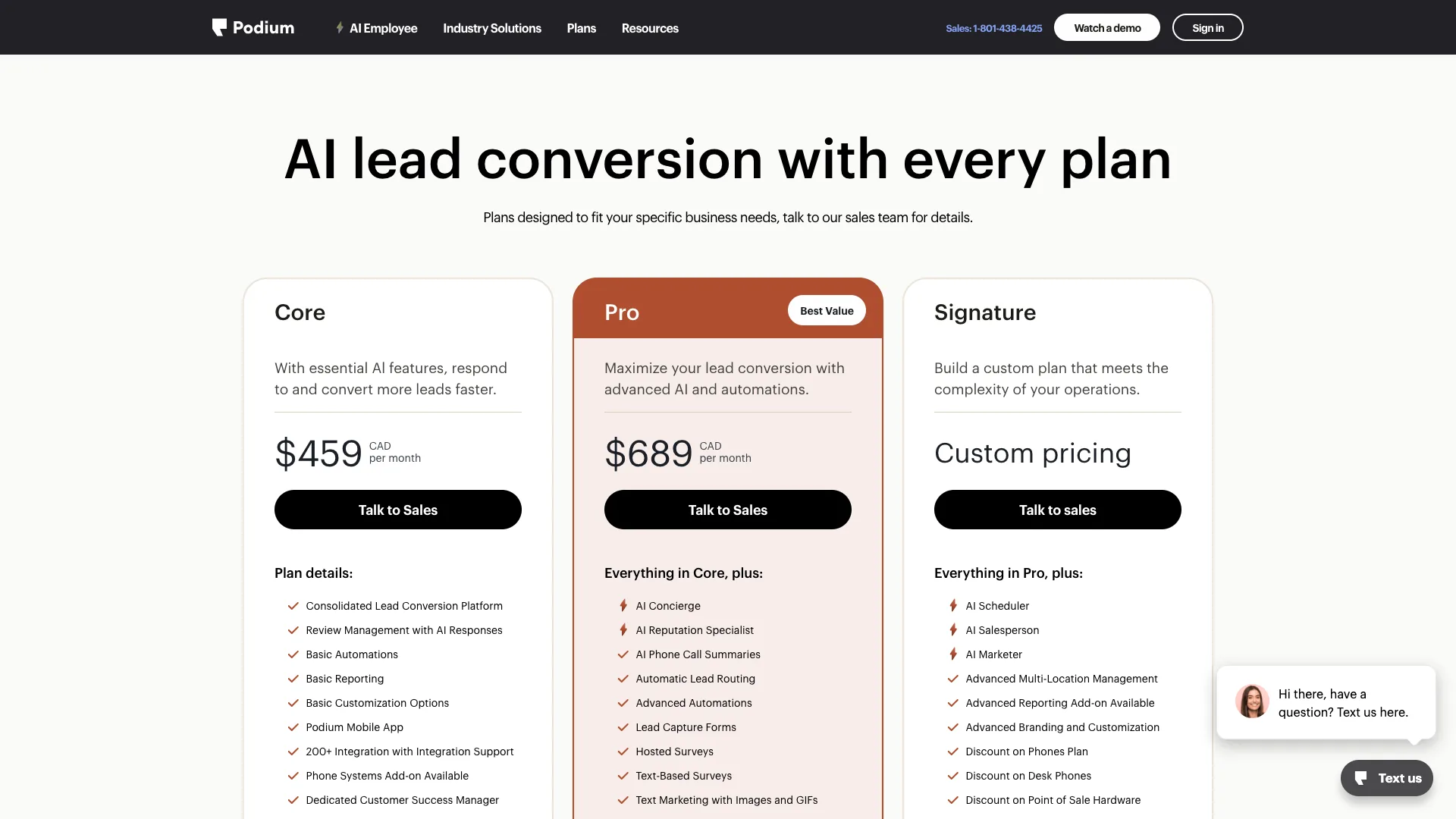 Jul 31, 2026
 Tech Stack
Podium vs Birdeye 2026: Pricing, Contracts and Review Gating
Only one of these two will tell you what it costs before a sales call, and even that number carries a carve-out aimed squarely at trade contractors.
Read Article Jul 31, 2026
 Tech Stack
Best Electrical Contractor Software 2026: 11 Ranked and Priced
An electrical contracting business makes two software purchases that do not substitute for each other, and every roundup answering this query covers only one of them. Eleven platforms, with a published price or an explicit statement that the vendor publishes none.
Read Article Jul 31, 2026
 Tech Stack
Best HVAC Software in 2026: Eleven Ranked Across Three Classes
An HVAC contracting business buys across three classes of software that do not substitute for each other, and every roundup answering this query covers only one of them. Eleven products, each with a published price or an explicit statement that the vendor publishes none.
Read Article Jul 30, 2026
 Tech Stack
AccuLynx Pricing 2026: The Real Cost of a Quote-Gated Plan
One published figure, two blank plan cards, and a contract that says things the pricing page does not. A line-by-line breakdown of what AccuLynx really bills.
Read Article Jul 30, 2026
 Tech Stack
Houzz Pro Canada Review 2026: Pricing and Alternatives
Houzz Pro serves different pricing renderings. What Canadian buyers see, how GST/HST and payments work, what Custom gates, and what the annual contract commits you to.
Read Article Jul 30, 2026
 Tech Stack
JobNimbus Pricing in 2026: What the Quote Does Not Cover
JobNimbus prints no figure on any of its four plans. So the only rate you can read before a sales call is the payments meter, and it is the biggest line on the bill.
Read Article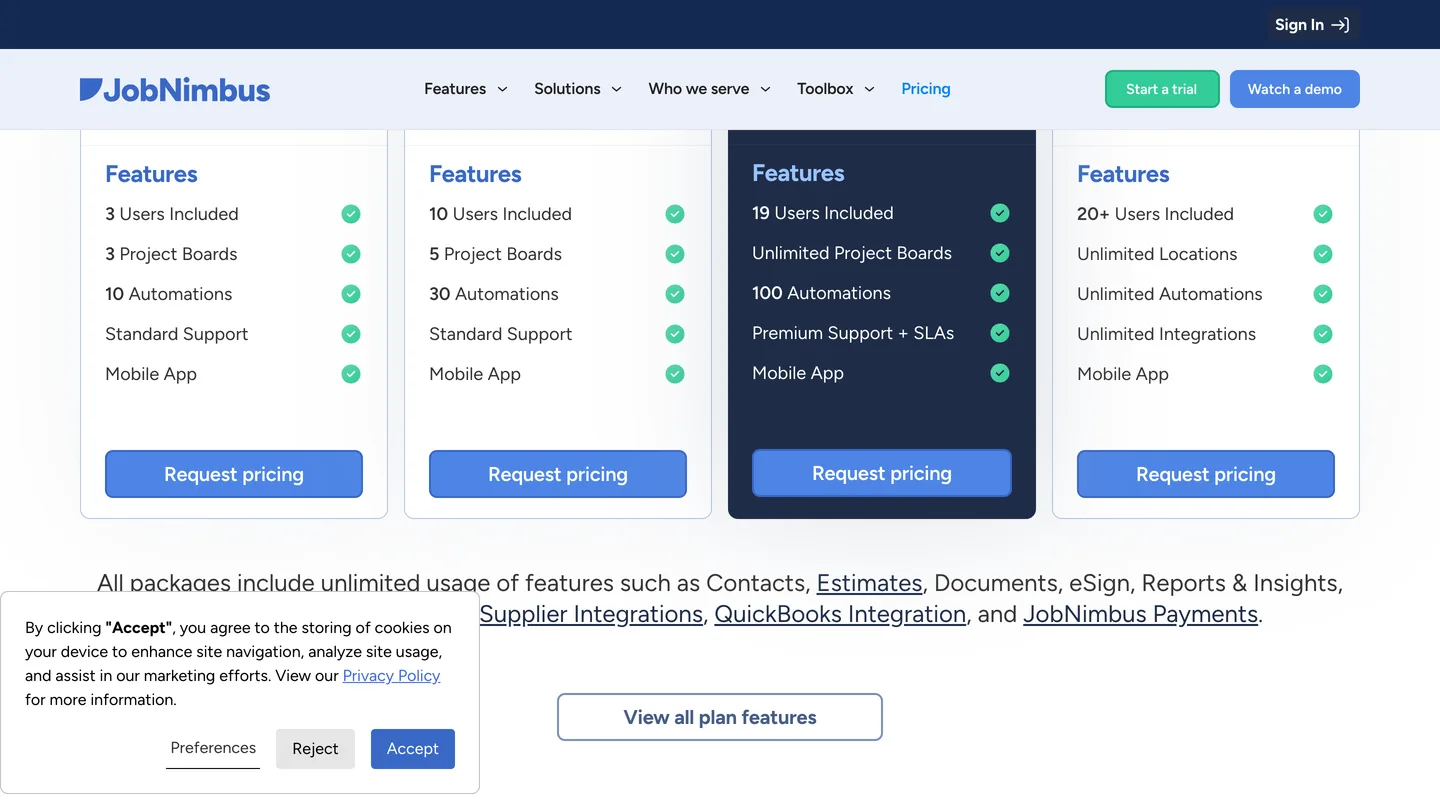 Jul 30, 2026
 Tech Stack
JobNimbus Review 2026: Pricing, Pros, Cons and Alternatives
JobNimbus rates 4.6 on Capterra and orders material straight from ABC Supply and SRS. But it publishes no price, and its supplement route carries a note.
Read Article Jul 30, 2026
 Tech Stack
BuildOps Review 2026: Pricing, Contract Terms and Alternatives
BuildOps runs commercial service and projects on one platform, and publishes no pricing at all. The billing unit, the 30-day data-export window, and who it suits.
Read Article Jul 30, 2026
 Tech Stack
FieldPulse Review 2026: Pricing, Pros, Cons and Alternatives
FieldPulse rates 4.6 on Capterra and is the platform contractors name when they leave a bigger system. But it publishes no price, and the contract runs a year.
Read Article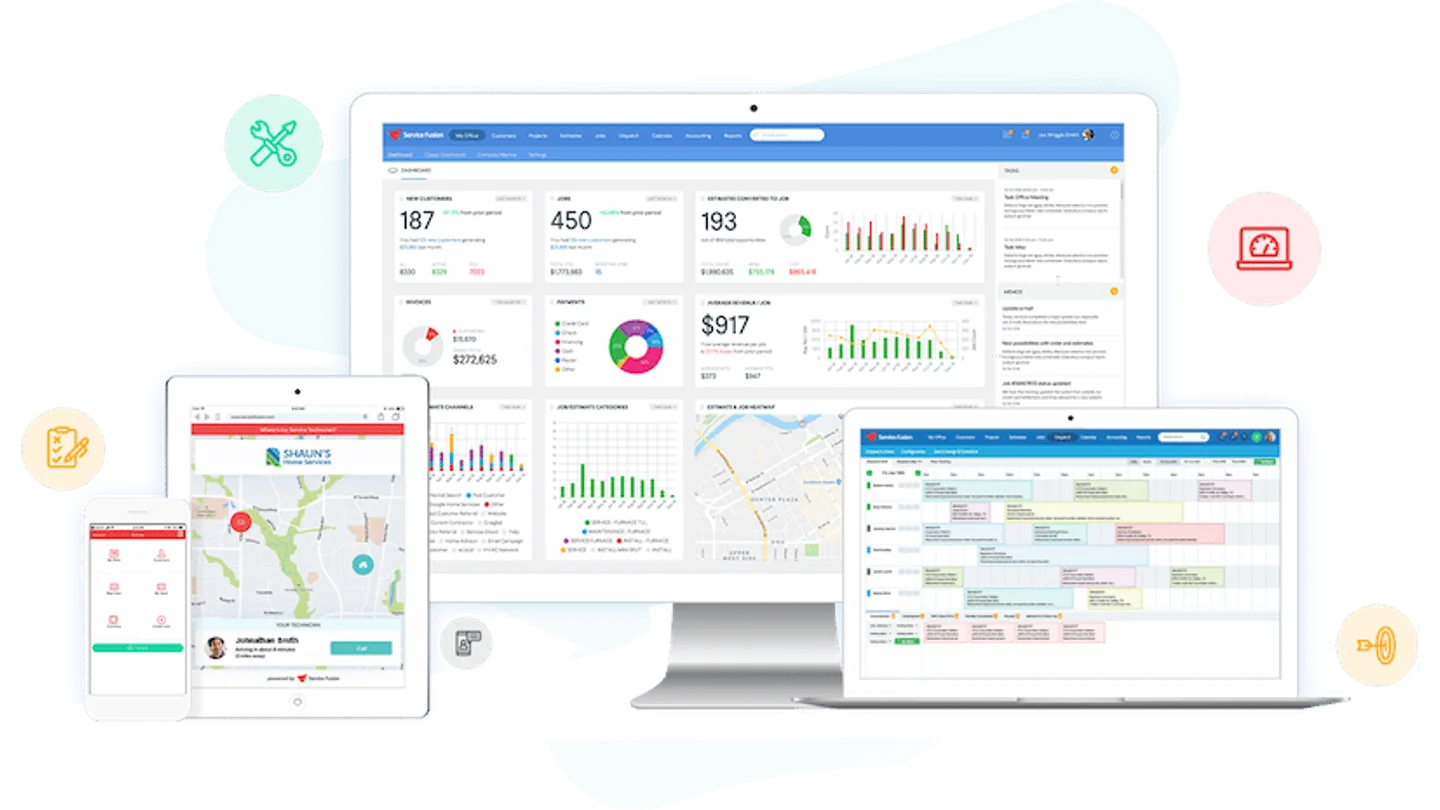 Jul 30, 2026
 Tech Stack
Service Fusion Review 2026: Pricing, Contract and Alternatives
Service Fusion bills flat per company with unlimited users, which is the best structural deal in field service software. The published plans, the contract behind the no-contract line, and the app score every other review gets wrong.
Read Article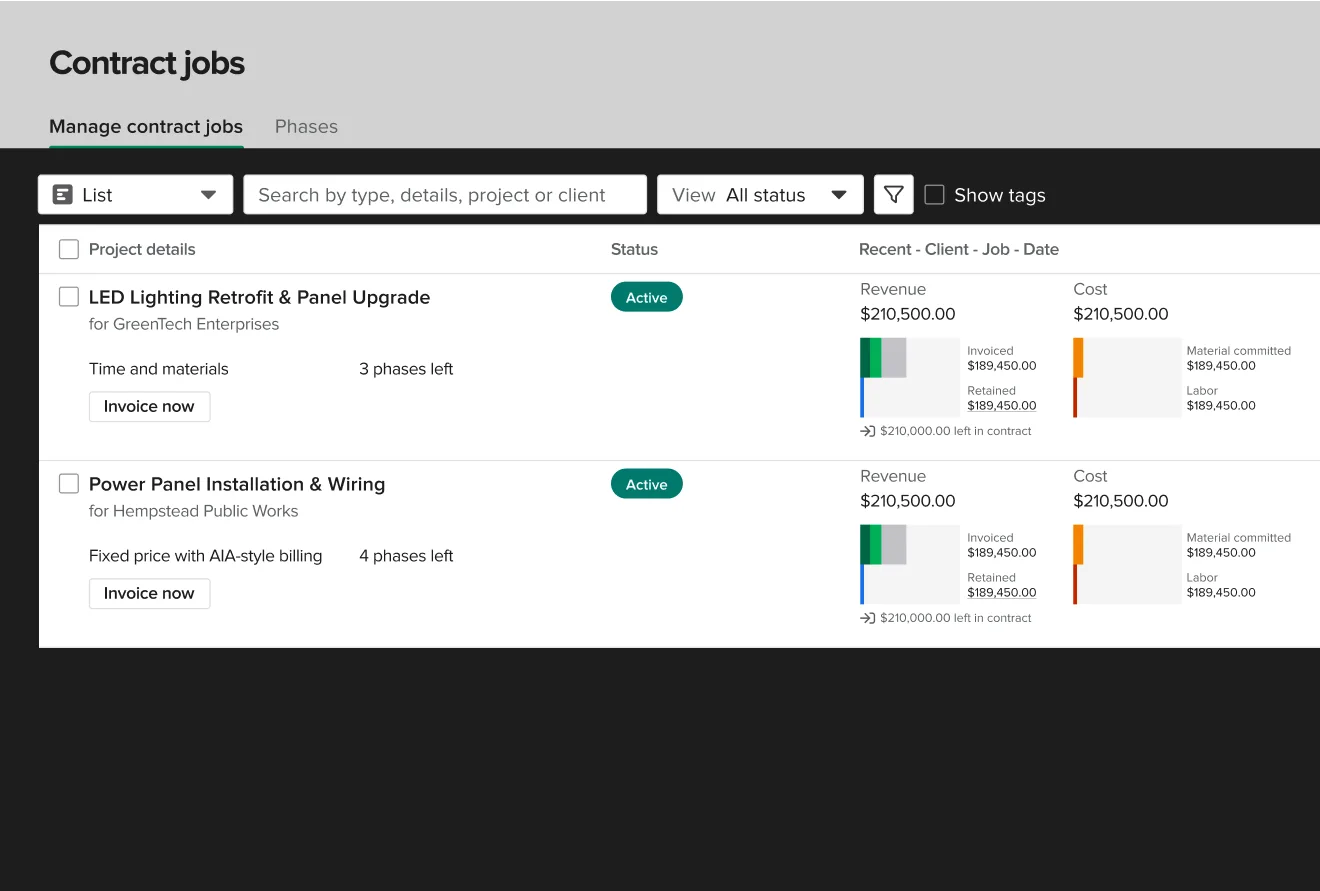 Jul 30, 2026
 Tech Stack
Knowify Review 2026: Pricing, Job Costing and Alternatives
Knowify rates 4.5 on Capterra and its weakest sub-score is features. What the $99 Core plan withholds, which way the QuickBooks sync really runs, and who should not buy it.
Read Article Jul 29, 2026
 Tech Stack
AccuLynx Review 2026: Pricing, Tier Gating, Alternatives
AccuLynx rates 4.6 across 846 reviews and now publishes an entry price. What that price omits, which tier holds the insurance workflow, and who should skip it.
Read Article Jul 29, 2026
 Tech Stack
Unitel Voice Review 2026: Pricing, Features and Alternatives
Unitel Voice rates 4.6 on Capterra and gives a one-truck shop a business number for $9.99 a month. The published plans, the cost per call, and what it won't do.
Read Article Jul 29, 2026
 Tech Stack
NiceJob vs Podium 2026: Pricing, Contracts and Review Gating
Both vendors print a price, at very different scale and in different currencies. The gap that matters is what Podium will not print: the billing unit, and whether a trade shop gets the number on the page.
Read Article Jul 28, 2026
 Tech Stack
CompanyCam Review 2026: Pricing, Pros, Cons and Alternatives
Every page ranking for CompanyCam still quotes a per-user price the vendor no longer charges. Here are the real plans, the seat math, and who should skip it.
Read Article Jul 28, 2026
 Tech Stack
NiceJob Review 2026: Pricing, Pros, Cons and Alternatives
NiceJob rates 4.9 on Capterra and refuses to gate negative reviews. Real plan pricing, the active-customer threshold nobody publishes, and who should skip it.
Read Article Jul 27, 2026
 Tech Stack
Buildertrend Review 2026: Pricing, Limits and Alternatives
Buildertrend rates 4.5 across 2,486 Capterra reviews and quotes against your revenue rather than your seat count. The workflows, the export problem, the alternatives.
Read Article Jul 27, 2026
 Tech Stack
CallRail Review 2026: Pricing, Pros, Cons and Alternatives
CallRail rates 4.5 on Capterra, and its tracking numbers port out free. But the two usage rates that decide your real bill are the two it does not print.
Read Article Jul 27, 2026
 Tech Stack
Roofr Review 2026: Pricing, Pros, Cons and Alternatives
Roofr rates 4.6 on Capterra and sells $13 measurement reports against a market charging triple. But it will not import a report from anywhere else.
Read Article Jul 25, 2026
 Tech Stack
Housecall Pro Review 2026: Pricing, Pros, Cons, Alternatives
Housecall Pro has the shortest learning curve in the category and the widest review spread. Real pricing, the Instapay math, and the migration trap to plan around.
Read Article Jul 24, 2026
 Tech Stack
Jobber Review 2026: Pricing, Pros, Cons and Alternatives
Jobber rates 4.6 on Capterra with the best mobile app in the category. Real plan pricing, the feature gating that changes your entry price, and who it suits.
Read Article Jul 23, 2026
 Tech Stack
ServiceTitan Review 2026: Pricing, Pros, Cons, Alternatives
ServiceTitan rates 4.3 on Capterra but its weakest score is value for money. Real reported pricing, the 12-month contract, the exit fees, and who it suits.
Read Article Jun 3, 2026
 Tech Stack
HVAC Online Scheduling: The 43% Losing After-Hours Bookings
HVAC leads every trade on online booking at just 56.7%, which still leaves 43% of sites forcing an after-hours customer to wait for a business-hours phone call.
Read Article