Estimate Rocket Review 2026: Pricing, Pros, Cons, Alternatives
Estimate Rocket starts at $139. What each tier gates, the 7 limitations reviewers name, and 6 alternatives with published prices.

Disclosure This article features tools from our brand partners. If you choose to use them, we may receive compensation at no extra cost to you.
Our editorial choices are independent of these affiliate arrangements. Read our full affiliate disclosure.
Fervor is a CRO and web design studio, not a software reseller, and no vendor paid for placement here or for a kinder verdict. Affiliate links are flagged where they appear, and they never change what we report.
Page at a glance
Estimate Rocket is estimating-and-follow-up software built around a proposal the homeowner opens, reads and e-signs in a client portal, with an automated email and SMS campaign chasing it until they do. It starts at $139 per account per month, includes 3 full users. Two seat types, and the difference is the whole pricing story. A full user is a normal login. A field user is a restricted login that can clock in and out of a project, see assignments, add photos and notes, and review this week's hours, and it costs $10 a month on every plan. Full users are metered on a rate that gets CHEAPER as the plan gets bigger: $79 on Launch, $39 on Accelerate, $19 on Expand. So the plan you should be on is decided by how many people write estimates, not by how many people work for you. It fits a residential painting, roofing, landscaping or remodeling company running roughly 3 to 15 office and estimating seats on project work that gets sold off a written proposal rather than dispatched as a service call. It's the wrong buy for a strictly seasonal operator who shuts down for three or four months a year, because You can't pause. The vendor's own FAQ answers this directly and says it charges through the off-season because it stores your data year-round, and that the alternative is rebuilding your account from scratch each spring. So a landscaping or holiday-lighting business running Expand pays $359 a month through a dead January. Alternatives that publish their prices are Contractor Foreman from $49, Housecall Pro from $59, Tradify from $47. Seven priced tiers, seven evidenced gaps and six alternatives, six of which publish a figure.
Whether Estimate Rocket is worth it
Estimate Rocket earns its money with a residential painting, roofing, landscaping or remodeling company running roughly 3 to 15 office and estimating seats on project work that gets sold off a written proposal rather than dispatched as a service call. If that's you, it does the job. The sections below are the parts worth checking before you sign. But the fit is narrower than the marketing suggests, and the price isn't the whole cost.
It starts at $139. And pricing was verified on 7 August 2026, so you can check every figure below in a browser tab.
| Pricing model | Published tiers |
|---|---|
| Entry price | $139 |
| Users | Two seat types, and the difference is the whole pricing story. A full user is a normal log |
| Ownership | Logical Engine Inc. |
| Best fit | a residential painting, roofing, landscaping or remodeling company running roughly 3 to 15 office and estimating seats on project work that gets sold off a written proposal rather than dispatched as a service call. |
| Accounting sync | QuickBooks Online (one-way), QuickBooks Desktop (one-way) |
What works
- Trade-specific item templates do the pricing arithmetic for you
- The client portal is where the sale closes, and it's the strongest part of the product
- Automated follow-up campaigns are the retention hook
- And field users clock in against a project with location services on
- Your proposals go out from a domain that isn't yours, and the vendor knows it lands in spam
What does not
- There's exactly one built-in integration, and it's CompanyCam
- The QuickBooks sync is one direction, and it's a Zapier recipe you build yourself
- There's no native mobile app, and offline is still unshipped
- The support you were sold and the support you contracted for aren't the same thing
- The documented self-serve export is a client list, and only a client list
Estimate Rocket is estimating-and-follow-up software built around a proposal the homeowner opens, reads and e-signs in a client portal, with an automated email and SMS campaign chasing it until they do. It sells to Landscaping and Painting and Remodeling and Roofing contractors, and the shape of the product follows from that: The estimating layer is production-rate based rather than line-item based. A power-wash item is configured as square feet per hour against a labour rate, so changing the production rate changes the customer price automatically. And there are prebuilt templates for interior and exterior painting, landscaping and hardscaping, concrete raising, holiday lighting, countertop installation and general time-and-material work, plus a Sherwin-Williams materials catalogue with photos and their top 50 interior and exterior colours loaded through a digital alliance.
Ownership matters here more than it usually does. Estimate Rocket is owned by Logical Engine Inc., so weigh roadmap risk alongside the feature list. An independent product can be bought and folded into somebody else's plan two years after you sign.
Who should be shortlisting Estimate Rocket
It fits a residential painting, roofing, landscaping or remodeling company running roughly 3 to 15 office and estimating seats on project work that gets sold off a written proposal rather than dispatched as a service call. That's the half most reviews print. Here's the other half, which is the one worth your time.
Don't buy it if you're a strictly seasonal operator who shuts down for three or four months a year. You can't pause. The vendor's own FAQ answers this directly and says it charges through the off-season because it stores your data year-round, and that the alternative is rebuilding your account from scratch each spring. So a landscaping or holiday-lighting business running Expand pays $359 a month through a dead January. Look at Contractor Foreman instead.
Don't buy it if you're a shop that needs a real two-way accounting sync or an open REST API. The QuickBooks connection is a one-way Zapier push of new invoices and payments, and the User Agreement states that 'Subscription Plans purchased on EstimateRocket may not be used in conjunction with EstimateRocket APIs and are available for use with a limited number of integrations.' And a reviewer named this exact problem as the reason they couldn't move data out. Look at Knowify instead.
Don't buy it if you're a solo owner-operator with nobody else logging in. The cheapest door is $139 a month for three full users. So you're paying for two seats you won't fill, and per head that's $139 rather than the $46 the plan implies. Look at Tradify instead.
Don't buy it if you're a service and repair business dispatching short same-day calls. The product is built around a proposal that gets read, considered and e-signed, with a follow-up campaign chasing it. But none of that machinery helps you move a technician from a no-heat call to the next one, and there's no native dispatch app for the van. Look at Housecall Pro instead.
Pricing: what Estimate Rocket publishes and what it doesn't
The tiers are public. And that's worth more than it sounds in a category where half the vendors make you ask.
| Tier | Price | Billing unit | What it unlocks |
|---|---|---|---|
| Launch | $139 | per account per month, includes 3 full users | Nothing beyond the tier below |
| Accelerate | $259 | per account per month, includes 7 full users | Nothing beyond the tier below |
| Expand | $359 | per account per month, includes 15 full users | Nothing beyond the tier below |
| Additional full user (Launch) | $79 | per user per month | Nothing beyond the tier below |
| Additional full user (Accelerate) | $39 | per user per month | Nothing beyond the tier below |
| Additional full user (Expand) | $19 | per user per month | Nothing beyond the tier below |
| Additional field user (all plans) | $10 | per user per month | Nothing beyond the tier below |
Two seat types, and the difference is the whole pricing story. A full user is a normal login. A field user is a restricted login that can clock in and out of a project, see assignments, add photos and notes, and review this week's hours, and it costs $10 a month on every plan. Full users are metered on a rate that gets CHEAPER as the plan gets bigger: $79 on Launch, $39 on Accelerate, $19 on Expand. So the plan you should be on is decided by how many people write estimates, not by how many people work for you.
There is a discount for paying annually up front: None published. Every figure on the pricing page is quoted '/ month' and there is no annual toggle, no billed-yearly column and no yearly saving anywhere in the page source. The User Agreement backs this up: 'The Service is billed in advance on a monthly basis.' And an annual prepay discount tells you an annual commitment exists, which is worth knowing before anyone mentions a term length out loud.
What isn't in the Estimate Rocket number you get quoted
Payment processing. Estimate Rocket is not the processor and publishes no rate. You bring your own Stripe account and connect it, so the card and ACH rate you pay is Stripe's, negotiated with Stripe, not with Estimate Rocket. The vendor's own help article is explicit about the mechanism: 'Select the Connect with Stripe button and follow the prompts to create a Stripe account or login to your existing Stripe account.' The User Agreement goes further and disclaims the relationship entirely, saying payment processing is 'communication activities between You and a third party' and 'At no time does EstimateRocket receive or hold payments'. One consequence worth knowing before you sell on financing: the vendor implemented Stripe/Affirm financing and then Affirm dropped service-contractor projects, so that option is currently gone.
Implementation and onboarding. Basic onboarding is included on every plan and it is genuinely specified rather than vague: a 45-minute live personalised training session, terms-and-conditions customisation, configuration of one basic Zap, data cleanup and preparation for import, and help adapting templates. Above that sits a paid 'Advanced Done for You Setup Package' listed at $1,595 with a limited-time discounted price of $995, which adds up to 3 custom estimating templates, up to 3 email templates, up to 3 automated campaigns, historical project data loading and weekly status meetings.
Minimum term. None stated. The service is billed monthly in advance with no term commitment in the User Agreement, and the trial is 30 days. But note that the trial is not a free-and-clear window: the terms say 'An upgrade or downgrade made during a 30-day free trial period will immediately bill you.'
Getting out. No termination fee, and cancellation is self-serve. The catch is the mechanism and the timing. The terms say 'You are solely responsible for properly canceling your account' through Settings, Account Billing, Cancel Subscription, and that 'An email or phone request to cancel your account is not considered cancellation.' Cancellation then 'will take effect immediately', so you lose the remainder of a month you already paid for, and 'no refunds will be issued for any previous charges, in whole or in part.'
Auto-renewal. Monthly, automatic, on the card on file, and the price can move under you with notice given by posting rather than by contacting you. The terms say prices 'are subject to change upon 30 days notice from us' and that 'Such notice may be provided at any time by posting the changes to the Service site.' A contractor who never revisits estimaterocket.com has received notice under this clause.
Modules sold separately. , . But the entry tier is not the price you'll pay. Add the modules your shop needs on day one and compare Estimate Rocket on that total.
Third-party services you will also pay for. , . These are not on Estimate Rocket's invoice, and they are still part of what this decision costs you every month.
Worth a detour here. The additional-seat rate runs BACKWARDS relative to every other tool in this category. Estimate Rocket charges $79 for an extra full user on the $139 plan, $39 on the $259 plan and $19 on the $359 plan. So the cheapest plan has the most expensive marginal seat, by a factor of four. Launch stops making sense at five full users, where $139 plus two seats at $79 is $297 against Accelerate's $259 for seven. And Accelerate stops making sense at ten, where $376 beats Expand's $359 for fifteen. Don't budget the cheap plan and add seats. So count the people who will write estimates in eighteen months and buy the plan that includes them, because the seat you bolt on is the most expensive one on the price list.
What a Estimate Rocket quote leaves out
The subscription is the part everyone quotes. These are the lines that land afterwards, and the ones we could not find are named as unpublished rather than left blank.
Sold separately. , . Price the configuration you'll really run, because an add-on you need on day one is part of the price.
Third-party services you'll also pay for. , . None of these are on Estimate Rocket's invoice, and all of them are part of what this decision costs every month.
"Estimate Rocket Launch is $139, per account per month, includes 3 full users."
Estimate Rocket pricing page (2026)
"Estimate Rocket Accelerate is $259, per account per month, includes 7 full users."
Estimate Rocket pricing page (2026)
"Two seat types, and the difference is the whole pricing story. A full user is a normal login. A field user is a restricted login that can clock in and out of a project, see assignments, add photos and notes, and review this week's hours, and it costs $10 a month on every plan. Full users are metered on a rate that gets CHEAPER as the plan gets bigger: $79 on Launch, $39 on Accelerate, $19 on Expand. So the plan you should be on is decided by how many people write estimates, not by how many people work for you."
Estimate Rocket pricing page (2026)
The five workflows you pay for
Feature totals are noise. So a shop in this category lives or dies on five things, and those are the five to grade, and each one below carries the evidence it's graded on.
Trade-specific item templates do the pricing arithmetic for you. The estimating layer is production-rate based rather than line-item based. A power-wash item is configured as square feet per hour against a labour rate, so changing the production rate changes the customer price automatically. And there are prebuilt templates for interior and exterior painting, landscaping and hardscaping, concrete raising, holiday lighting, countertop installation and general time-and-material work, plus a Sherwin-Williams materials catalogue with photos and their top 50 interior and exterior colours loaded through a digital alliance.
The client portal is where the sale closes, and it's the strongest part of the product. A proposal is a saved snapshot of the estimate. It goes to the homeowner in a portal, they read it, they sign it in the portal, and the assigned user plus the project owner get an email and a bell notification the moment they do. Change orders work the same way. And reviewers consistently name the professionalism of the output as the reason they bought, and it's the one thing the tool is unambiguously built to do well. But one constraint from the terms: e-signature is available only if your business is located in the United States or Canada. An owner, Less than 6 months on the platform, writing on 2019-06-07, reports it: "The customer service of Estimate Rocket is amazing"
Automated follow-up campaigns are the retention hook. A campaign is a series of emails, and now SMS, that fire at set points in the project lifecycle: after the estimate goes out, before an appointment, after completion, chasing an unpaid invoice, asking for a review. SMS templates cap at 300 characters and support the same merge tokens as the email templates. And this is the feature owners cite when they talk about doubling revenue without adding office staff, and it's the reason the product survives against cheaper estimating tools.
And field users clock in against a project with location services on. A $10-a-month field user logs in the same way anyone else does, hits a punch button, picks the type of work and the project, and adds a comment. Photos and notes attach to the project. Hours plus tracked material expenses produce an actual margin against the estimate. So that's real job costing, but it's thinner than a dedicated costing tool, and one reviewer said they still ran a second system for costs and sales percentages. But an owner, 2+ years on the platform, puts it it differently: "Still have to use Marketsharp for entering costs and seeing sales percentages."
Your proposals go out from a domain that isn't yours, and the vendor knows it lands in spam. Estimate Rocket publishes a help article about its own email deliverability. It names Yahoo and ymail as providers that file the first message from a new sender straight into spam by default, and it advises telling clients in advance that the estimate will arrive from the EstimateRocket.net domain. And the vendor's own remedy is to text the document instead. So if your proposal is the sale, this is the single most consequential operational detail in the whole product.
Estimate Rocket per trade, not per company size
Fit differs by trade rather than by company size alone, and a blended paragraph hides that. Here is the split for the trades this one sells to.
Landscaping. The workflow that decides it is trade-specific item templates do the pricing arithmetic for you, and the shop profile that gets value is 3 to 7 office and estimating seats doing residential and service work. Where it stops being a fit is a strictly seasonal operator who shuts down for three or four months a year.
Painting. The workflow that decides it is trade-specific item templates do the pricing arithmetic for you, and the shop profile that gets value is 3 to 7 office and estimating seats doing residential and service work. Where it stops being a fit is a strictly seasonal operator who shuts down for three or four months a year.
Remodeling. The workflow that decides it is trade-specific item templates do the pricing arithmetic for you, and the shop profile that gets value is 3 to 7 office and estimating seats doing residential and service work. Where it stops being a fit is a strictly seasonal operator who shuts down for three or four months a year.
Roofing. The workflow that decides it is trade-specific item templates do the pricing arithmetic for you, and the shop profile that gets value is 3 to 7 office and estimating seats doing residential and service work. Where it stops being a fit is a strictly seasonal operator who shuts down for three or four months a year.
Your books, and whether Estimate Rocket connects to them
QuickBooks Online connects one way only, so edits made in your books do not come back, on every plan. QuickBooks Desktop connects one way only, so edits made in your books do not come back, on every plan. Your costs map through cost codes, so test yours against your own chart of accounts before you commit. A code your books don't recognise is how a labour charge quietly lands somewhere useless.
Past those, the road ends. Xero, Open public REST API, Native two-way accounting sync, Consumer financing do not connect. So if your books run on an ERP rather than the platforms named above, weigh that before anything else.
Beyond accounting it connects to CompanyCam (The only built-in integration. Set up under Settings, Integrations with an API key, no Zapier account needed. Job-site photos flow between the two.), Zapier (The real integration layer. Triggers cover New Client, New Project, New Invoice, New Payment, New Assignment, Updated Assignment, New Proposal and Proposal Status Update. Searches cover Find Invoice, Client, Project, Projects and Proposal. But actions are limited to three: Create Project, Create Payment, Create Client.), Stripe (Card and ACH payment through the client portal, via Stripe Connect on your own Stripe account. Payments record back into Estimate Rocket with a link to the Stripe transaction, and the receipt report export carries Fee and Net columns for reconciliation.), YouCanBookMe (Client self-booking. Marketed on the integrations page as a peer of QuickBooks and CompanyCam, but the help article title gives the mechanism away: 'Setting up an Estimate Rocket/YouCanBookMe Integration in Zapier'.), Google Calendar (One-way calendar feed. Estimate Rocket updates the feed immediately, but the vendor says it can't control how often Google reads it and that updates usually appear within an hour.). A public API exists: There is an API, but calling it public overstates it. You log in at estimaterocketapi.com with the account-owner credentials, then join a PRIVATE Zapier app by invite link, because as the vendor puts it, 'Estimate Rocket will not come up in the Zapier search as it is private.' Webhook endpoints exist for proposals, assignments and project lookup. And the User Agreement carries a clause that appears to restrict API use on subscription plans outright, which sits awkwardly against a knowledge base full of API articles. Both statements are the vendor's; the conflict is theirs to resolve, not ours to smooth over.
Getting help from Estimate Rocket, and getting it fast
Support is the line item nobody prices and everybody eventually needs. Onboarding for Estimate Rocket: Basic onboarding is included on every plan and it is genuinely specified rather than vague: a 45-minute live personalised training session, terms-and-conditions customisation, configuration of one basic Zap, data cleanup and preparation for import, and help adapting templates. Above that sits a paid 'Advanced Done for You Setup Package' listed at $1,595 with a limited-time discounted price of $995, which adds up to 3 custom estimating templates, up to 3 email templates, up to 3 automated campaigns, historical project data loading and weekly status meetings.
On 2019-06-07, an owner, Less than 6 months on the platform, reports it: "The customer service of Estimate Rocket is amazing"
Before you sign with Estimate Rocket: the exit
Nobody reads this section before they buy, and it's the one that costs money afterwards. Four terms decide what leaving looks like.
Minimum term. None stated. The service is billed monthly in advance with no term commitment in the User Agreement, and the trial is 30 days. But note that the trial is not a free-and-clear window: the terms say 'An upgrade or downgrade made during a 30-day free trial period will immediately bill you.'
Auto-renewal. Monthly, automatic, on the card on file, and the price can move under you with notice given by posting rather than by contacting you. The terms say prices 'are subject to change upon 30 days notice from us' and that 'Such notice may be provided at any time by posting the changes to the Service site.' A contractor who never revisits estimaterocket.com has received notice under this clause.
Early termination. No termination fee, and cancellation is self-serve. The catch is the mechanism and the timing. The terms say 'You are solely responsible for properly canceling your account' through Settings, Account Billing, Cancel Subscription, and that 'An email or phone request to cancel your account is not considered cancellation.' Cancellation then 'will take effect immediately', so you lose the remainder of a month you already paid for, and 'no refunds will be issued for any previous charges, in whole or in part.'
Payment processing. Estimate Rocket is not the processor and publishes no rate. You bring your own Stripe account and connect it, so the card and ACH rate you pay is Stripe's, negotiated with Stripe, not with Estimate Rocket. The vendor's own help article is explicit about the mechanism: 'Select the Connect with Stripe button and follow the prompts to create a Stripe account or login to your existing Stripe account.' The User Agreement goes further and disclaims the relationship entirely, saying payment processing is 'communication activities between You and a third party' and 'At no time does EstimateRocket receive or hold payments'. One consequence worth knowing before you sell on financing: the vendor implemented Stripe/Affirm financing and then Affirm dropped service-contractor projects, so that option is currently gone.
Worth a detour here. The exit is a client list. The knowledge base documents exactly one self-serve export of your own data, and it's three clicks to a client CSV. And there's no documented bulk export of projects, estimates, proposals, invoices, payments or job photos. Behind that, the terms say twice that 'After canceling your Service we reserve the right to irrevocably delete all of your Content', and separately note that a DOWNGRADE 'may cause the loss of Content, features, or capacity of your Account' with no liability accepted. Run the client export during your trial so you know what leaving looks like on day one instead of on your last day. And get a written answer on how you retrieve signed proposals and invoice history, because nothing on the site tells you.
"The fact it doesn't have open API, stopping us from sending our data to other software we use."
Capterra, Alec T., Marketing Director, Construction, 11-50 employees (2-02)
"There isn't a built-in scheduling module that accompanies it"
Capterra, Jen L., District Manager, Consumer Services, 11-50 employees (7-10)
"A LOT of cumbersome features."
Capterra, Jen L., District Manager, Consumer Services, 11-50 employees (7-10)
What Estimate Rocket reviewers keep running into
But the gaps are specific rather than atmospheric, which is what makes them useful.
There's exactly one built-in integration, and it's CompanyCam. The marketing pages present Zapier, CompanyCam, QuickBooks, YouCanBookMe and Google Workspace as a set of peers. But the help centre draws a line the marketing doesn't. Its 'Built-In Integrations' article, which exists specifically to list what connects natively, lists one item under 'Offered Built-In Integrations': CompanyCam. And everything else on that marketing list is reached through Zapier, which is a separate account you pay for. Counted, not estimated: 5 named partners on the integrations page, 1 of them native. Before you sign, write down every tool you expect to connect and check each one against the built-in list rather than the marketing list. Because everything not on it carries a Zapier subscription and a Zap you maintain.
The QuickBooks sync is one direction, and it's a Zapier recipe you build yourself. The FAQ says Estimate Rocket 'syncs with QuickBooks Online for accounting'. The setup article spells out what that means in practice: 'Estimate Rocket can automatically send your new invoices and new payments to QuickBooks online using Zapier.' New invoices out, new payments out, and nothing comes back. There's no chart-of-accounts pull, no customer-record reconciliation, no vendor bill flow. And because QuickBooks Online is a Zapier premium app, the vendor tells you plainly that you need a paid Zapier tier to run it at all. Add the Zapier Starter subscription to your monthly cost before you compare Estimate Rocket to anything with a native two-way QuickBooks connector. And ask your bookkeeper whether one-way invoice push is enough.
There's no native mobile app, and offline is still unshipped. Estimate Rocket runs as a mobile web app. The help centre's field guidance is to add a home-screen shortcut in Safari or Chrome, and the vendor's own FAQ says offline isn't here yet: 'Offline access is a feature currently in development.' And reviewers have been asking for a real app since at least 2019 and were still asking in 2020, which tells you how long that request has been open. So for a roofing crew in a basement or a landscaping crew on a rural lot, no signal means no clock-in and no photos. But a manager, Less than 6 months on the platform, says it differently: "There is not an app for the guys to use in the field." Trial it on the worst phone your worst-signal crew carries, at an actual job site, before you buy field-user seats.
The support you were sold and the support you contracted for aren't the same thing. The 'Legendary Support' page advertises four channels: Phone Support, Live Chat, Email Support and a 24/7 hub. But the User Agreement you accept at signup says something narrower: 'Technical support is only provided to paying account holders and is only available via email.' Reviewers genuinely rate the support highly, and Capterra shows a 5.0 customer-service sub-rating, so this isn't a complaint about the team. It's a note about what is promised in writing if a phone line ever goes away. If phone support is part of why you're buying, get it named in your order form. Because the agreement you sign says email only.
The documented self-serve export is a client list, and only a client list. The knowledge base has one export article for your own data and it's three steps long: Settings, Client Export, Download (.CSV). And there's no documented one-click export of projects, estimates, proposals, invoices, payments or photos. The reports can be exported individually, which means reassembling your history report by report. Sitting behind that, the terms reserve the right to wipe the rest: 'After canceling your Service we reserve the right to irrevocably delete all of your Content.' Ask, in writing and before you migrate anything in, exactly which objects you can export yourself, and in what format. Then run the export on day one so you know what a leaving day looks like.
Scheduling depth is sold twice: as included, and as a separate module. The pricing page says every plan includes the full platform, so 'you never have to worry about missing features, paying for upgrades, or choosing the right package.' But Job Rocket has its own product page positioned as the answer to 'your scheduling headaches', its own setup-requirements article and its own onboarding data collection, and it carries no price anywhere on the site. And a 2024 reviewer's complaint that there's no built-in scheduling module lands in exactly that gap. A district manager, 2+ years on the platform, writing on 2024-07-10, says: "There isn't a built-in scheduling module that accompanies it" Ask whether Job Rocket is inside your plan or beside it. And get the answer in the quote rather than the demo.
Proposal text is a formatting exercise, not a word processor. Several reviewers across five years describe the same friction in the text fields: markup you have to learn, no spell check, and small edit windows. And that matters more here than in most tools because the proposal is the product. It's the document the homeowner reads and signs, and a typo in it is a typo in your sales pitch. An owner who reviewed it on 2019-01-07 says: "The text input to be a bit clunky as you need to learn some markup." Have whoever writes your proposals build one real, ugly, multi-option estimate during the trial. Not a demo template.
One more thing worth knowing. The vendor contradicts itself on refunds, in public, on two pages that are both live. The pricing page carries a '90 Day Money Back Guarantee' and promises to 'refund 100% of the payments you made in the first 90 days'. The User Agreement, which is the document you accept, says the service 'is billed in advance on a monthly basis and is non-refundable' with 'no refunds or credits for partial months of service, upgrade/downgrade refunds, or refunds for months unused with an open account'. Neither document references the other. The terms win in a dispute unless the guarantee is in your order form. So ask for the 90-day language to be attached to your account in writing before the card is charged.
One more thing worth knowing. The integrations page and the help centre tell two different stories, and the help centre is the true one. Marketing presents five partners as peers. But the article that exists specifically to list native connections says: 'This eliminates the need for 3rd party service subscriptions such as Zapier for these integrations. Offered Built-In Integrations: CompanyCam.' One. And everything else, including the QuickBooks sync the FAQ calls a sync, runs through a PRIVATE Zapier app you join by invite link, because 'Estimate Rocket will not come up in the Zapier search as it is private.' So add a Zapier subscription to the true monthly cost, and budget the hours to build and maintain the Zaps. A 23-step Zap is a small internal project with an owner, not an integration.
One more thing worth knowing. The same four asks recur across nine years of reviews and the vendor has shipped two of them. Reviewers wanted a native field app in 2019 and 2020, direct texting as recently as June 2024, an open API in 2019, and inbound customer email replies landing in the project file in 2017 and 2019. Texting shipped as 2-Way Client Messaging. The rest haven't. But note the wrinkle on texting: the pricing page insists every plan includes the full platform with no upgrades to worry about, while the deliverability article pitches texting with 'Upgrade your account today! Text your clients documents directly with 2-Way Client messaging.' Treat the roadmap as flat. So buy Estimate Rocket for what it does today, specifically proposals and follow-up, and confirm in writing whether 2-way messaging sits inside your plan or beside it.
A tangent, but stay with it. Estimate Rocket refuses seasonal pausing on the record, and explains the economics rather than hiding behind policy. Its FAQ says: 'we pay year-round to store and protect your data so it's available to you when you need it. Because of this, it's necessary to charge your account even during the off-season. Otherwise, you'd need to re-create your account from scratch each new year.' But note that the article's own helpfulness counter shows more thumbs-down than thumbs-up. For painting, landscaping, roofing and holiday lighting, multiply the monthly price by 12, not by your working season. Because four idle months on Expand is $1,436.
Estimate Rocket, from the people who bought it
Every quote below is transcribed from a published review, named to the platform that carries it and to the reviewer as that platform displays them. We read the corpus by complaint type rather than by star rating, which is how the disqualifying detail buried inside a five-star review gets found.
"The fact it doesn't have open API, stopping us from sending our data to other software we use."
And a marketing director, 6-12 months on the platform, writing on 2019-12-02, says the same thing on Capterra
"There isn't a built-in scheduling module that accompanies it"
A district manager, 2+ years on the platform, puts it it plainly on Capterra
"A LOT of cumbersome features."
A district manager, 2+ years on the platform, reports it it plainly on Capterra
"There is not an app for the guys to use in the field."
But a manager, Less than 6 months on the platform, writes it differently on Capterra
"An App would probably make it more user friendly."
On 2020-10-09, an owner, 2+ years on the platform, puts it on Capterra
"Would like it to have direct text messaging capability."
But an owner, 2+ years on the platform, puts it it differently on Capterra
"It has saved me thousands of dollars in admin overhead cost!"
An owner, 2+ years on the platform, writing on 2024-06-26, describes it on Capterra
"It is difficult to automate some things with zapier, such as customers' into fields from Calendly."
An owner, 6-12 months on the platform, says it plainly on Capterra
"Customer emails have to copied and pasted into the project file."
A manager/owner, 2+ years on the platform, reports it it plainly on Capterra
"cannot get the customer email responses in the system"
A sales VP who reviewed it on 2017-09-12 reports it on Capterra
"The text input to be a bit clunky as you need to learn some markup."
But an owner, Less than 6 months on the platform, says it differently on Capterra
"It does not keep track of or display a list of the estimates that have not been viewed by customers."
A president, 2+ years on the platform, writing on 2020-01-18, puts it on Capterra
"There is so much customizing that we are still editing and customizing things in the app."
But an owner, 2+ years on the platform, says it differently on Capterra
"The CRM functionality needs some improvement."
A president who reviewed it on 2017-09-15 says on Capterra
"My only con would be the learning curve learning how to format text within their text fields."
And a CEO, 2+ years on the platform, writing on 2022-05-27, writes the same thing on Capterra
"The customer service of Estimate Rocket is amazing"
On 2019-06-07, an owner, Less than 6 months on the platform, puts it on Capterra
"Still have to use Marketsharp for entering costs and seeing sales percentages."
An owner, 2+ years on the platform, writing on 2017-11-13, puts it on Capterra
The realistic shortlist against Estimate Rocket
And these are the products Estimate Rocket loses deals to. Some publish a price; that tells you how long each evaluation will take.
| Tool | Entry price | Billing unit | Users included | Published? |
|---|---|---|---|---|
| Estimate Rocket | $139 | per account per month, includes 3 full users | Two seat types, and the difference is the whole pricing stor | Yes |
| Contractor Foreman | $49 | per month, billed annually at $588 | 1 user on Basic; the $332 Unlimited plan carries unlimited users | Yes |
| Housecall Pro | $59 | per month billed annually, $79 monthly, 1 user | 1 | Yes |
| Tradify | $47 | USD per user per month (Lite) | 1 (priced strictly per user) | Yes |
| Knowify | $99 | per month billed annually, $149 monthly, includes 1 user, extra users $29 | 1 on Core, 10 on Advanced | Yes |
| Buildxact | $169 | per month billed annually at $2,030, unlimited users | Unlimited | Yes |
| Arborgold | $149 | per month on Starter, $173 equivalent on the monthly-payment column | Not stated on the pricing page | Yes |
Contractor Foreman. Sheer breadth per dollar, a real 100-day money-back guarantee rather than a guarantee that contradicts the terms, and an unlimited-user ceiling that doesn't punish you for hiring estimators. But It's a construction project-management tool first. So the proposal-and-follow-up machinery that is the whole point of Estimate Rocket is thinner, and the trade-specific production-rate estimating templates aren't there.
Housecall Pro. A genuine native mobile app for the field, dispatch, online booking and a much deeper payments and consumer-financing stack. Everything Estimate Rocket lacks for same-day service work. But It's built for dispatched service calls. So multi-option project proposals, production-rate estimating and the trade item templates aren't its strength, and per-seat pricing climbs faster once the office grows.
Tradify. Honest per-user pricing with no seat allowance to game, a native mobile app, and two-way accounting sync with both Xero and QuickBooks Online included at the entry tier. But No client-facing proposal portal of the same depth, no automated multi-touch follow-up campaigns, and per-user pricing gets expensive fast past about six people compared with Estimate Rocket's $19 marginal seat on Expand.
Knowify. Job costing against budget, AIA billing, prevailing wage, and a real two-way QuickBooks relationship rather than a Zapier push. But There's nothing like the follow-up automation, and the seat allowance is stingier: 1 user for $99 against Estimate Rocket's 3 users for $139.
Buildxact. Digital takeoff from plans, and unlimited users at every paid tier, which removes the per-seat maths entirely for a growing remodeling shop. But Takeoff-and-estimate focused rather than lead-to-paid, no client follow-up campaigns, and the AI features that carry the marketing are $99 to $149 a month add-ons on top.
Arborgold. Purpose-built for green-industry work: route optimisation, unlimited land measurements, chemical tracking, plant and tree inventory mapping and automated renewals, none of which Estimate Rocket has. But Its own pricing page states 'Annual contract required', so unlike Estimate Rocket you can't walk away monthly. And it's narrower: a painter or roofer gets nothing from the chemical and plant modules they're paying for.
"There is not an app for the guys to use in the field."
Capterra, Tim H., Mgr, Construction, 11-50 employees (4-23)
"An App would probably make it more user friendly."
Capterra, Yasser K., Business owner, Construction, 11-50 employees (0-09)
Who should not buy Estimate Rocket
Don't buy Estimate Rocket if you're a strictly seasonal operator who shuts down for three or four months a year. You can't pause. The vendor's own FAQ answers this directly and says it charges through the off-season because it stores your data year-round, and that the alternative is rebuilding your account from scratch each spring. So a landscaping or holiday-lighting business running Expand pays $359 a month through a dead January. Look at Contractor Foreman instead.
Don't buy Estimate Rocket if you're a shop that needs a real two-way accounting sync or an open REST API. The QuickBooks connection is a one-way Zapier push of new invoices and payments, and the User Agreement states that 'Subscription Plans purchased on EstimateRocket may not be used in conjunction with EstimateRocket APIs and are available for use with a limited number of integrations.' And a reviewer named this exact problem as the reason they couldn't move data out. Look at Knowify instead.
Don't buy Estimate Rocket if you're a solo owner-operator with nobody else logging in. The cheapest door is $139 a month for three full users. So you're paying for two seats you won't fill, and per head that's $139 rather than the $46 the plan implies. Look at Tradify instead.
Don't buy Estimate Rocket if you're a service and repair business dispatching short same-day calls. The product is built around a proposal that gets read, considered and e-signed, with a follow-up campaign chasing it. But none of that machinery helps you move a technician from a no-heat call to the next one, and there's no native dispatch app for the van. Look at Housecall Pro instead.
The verdict, by shop size
Solo, or one owner plus a helper
No. The floor is $139 a month for three full users you won't fill. So per head that's $139, not the $46 the plan implies, and you get no discount for being small. And a per-user tool like Tradify at $47 does the estimating and invoicing half for a third of the money. This band runs 1 to 2 on the crew, doing residential work, and that's the profile the recommendation is written for.
3 to 7 office and estimating seats
Yes, and this is the shape the product is built for. This is the sweet spot the product is priced for. Launch at $139 covers three full users, Accelerate at $259 covers seven, and the automated follow-up plus the signable client portal is the part reviewers say paid for itself in admin hours. But just check the crossover: at five full users Launch costs $297 and Accelerate costs $259, so move up before the maths inverts on you. This band runs 3 to 7 on the crew, doing residential and service work, and that's the profile the recommendation is written for.
8 to 20 seats across office and field
Only under conditions, and they are worth being honest about. Expand at $359 for fifteen full users plus $10 field users is genuinely cheap per head. So yes if your estimators live in the browser and your accounting needs are one-way invoice push. But no if you need a two-way QuickBooks sync, a native offline field app, or scheduling depth, because you'll be buying Job Rocket at an undisclosed price and a Zapier plan on top. This band runs 8 to 20 on the crew, doing residential work, and that's the profile the recommendation is written for.
Strictly seasonal work, any size
No. The vendor won't let you pause. It says so in its own FAQ and explains why: it pays to store your data year-round, so it charges year-round, and the alternative is rebuilding your account from scratch each new year. And four dead months on Expand is $1,436 for nothing. This band runs undefined or more on the crew, doing residential work, and that's the profile the recommendation is written for.
Commercial or insurance-restoration work
No. There's no AIA billing, no certified payroll, no prevailing wage, no lien waiver workflow and no carrier or Xactimate path. And the estimating templates are residential production-rate templates. So this is the wrong tool for a general contractor billing progress on a schedule of values. This band runs undefined or more on the crew, doing commercial and insurance work, and that's the profile the recommendation is written for.
Something adjacent to Estimate Rocket, then we'll get out of your way
Now, this next bit is our own research, so weigh it accordingly. We don't sell contractor software and we're not an alternative to anything on this page.
Estimate Rocket meters the seat that writes estimates, and on the Launch plan the fourth full user costs $79 a month, more than half the base plan again. But that maths only pays back if every estimator gets enough at-bats, and at-bats come from the website, not the software. And Fervor inspected the contractor sites in its index and found 95.8% carry a serious WCAG violation and 61.3% a critical one, which means the homeowner who can't complete the quote form never becomes a project in the system you're paying per seat to run.
But we can put a figure on it. Of 380 contractor sites we inspected, 82.8% loaded slowly enough that a quote form went unseen. But check the method before you take the number, which is why it is published. The workings are public in the Contractor CRO Index.
"82.8% of the 380 contractor websites inspected loaded slowly enough that a quote form went unseen."
Fervor Studio Contractor CRO Index (2026)
So price the platform properly. Then open your own site on a phone and time how long it takes before you could tap a call button. The numbers are all public.
See where your site is losing the jobs Estimate Rocket would have managed
Fervor inspects your site the way a homeowner uses it, then shows you where calls leak out. About three days.
Get a Site InspectionWhere all of this Estimate Rocket detail came from
And here's what we can and can't stand behind on Estimate Rocket. And what stands behind it is documentary: 19 vendor pages read on 7 August 2026, and a review corpus sorted by what went wrong. And every figure above traces to a page we opened on that date, pricing included.
So: 17 quotes on this page, 17 from Capterra. Capterra sits in the Gartner Digital Markets pool, which is worth knowing if you compare its average against GetApp or Software Advice: those are the same reviewers.
And Software Advice (no resolvable profile URL found on any category path tried; construction, construction-estimating and field-service-management all 404), GetApp (403 to direct fetch, and no resolvable profile slug found), G2, TrustRadius, Trustpilot, Reddit and Capterra raw HTML (returns 403 to non-browser clients, so its figures could not be grep-verified against source the way every vendor figure here was) refused automated retrieval for Estimate Rocket. Forum and social threads are the ones people most want quoted, and they are exactly the ones we cannot verify, so none of them are here.
What that leaves untested: we didn't run a project through Estimate Rocket end to end, so the estimating speed and margin accuracy reviewers describe are reported, not verified by us.. And everything above is 19 vendor pages and a review corpus, which is documentary rather than hands-on.
What Estimate Rocket users say
The fact it doesn't have open API, stopping us from sending our data to other software we use.
There isn't a built-in scheduling module that accompanies it
A LOT of cumbersome features.
There is not an app for the guys to use in the field.
An App would probably make it more user friendly.
Would like it to have direct text messaging capability.
It has saved me thousands of dollars in admin overhead cost!
It is difficult to automate some things with zapier, such as customers' into fields from Calendly.
Customer emails have to copied and pasted into the project file.
cannot get the customer email responses in the system
The text input to be a bit clunky as you need to learn some markup.
It does not keep track of or display a list of the estimates that have not been viewed by customers.
There is so much customizing that we are still editing and customizing things in the app.
The CRM functionality needs some improvement.
My only con would be the learning curve learning how to format text within their text fields.
The customer service of Estimate Rocket is amazing
Still have to use Marketsharp for entering costs and seeing sales percentages.
Frequently asked questions
How much does Estimate Rocket cost?
Three published monthly plans, billed monthly with no annual option shown. Launch is $139 a month and includes 3 full users. Accelerate is $259 and includes 7. Expand is $359 and includes 15. Extra field users are $10 a month on every plan. And extra full users cost $79 on Launch, $39 on Accelerate and $19 on Expand, which is the number most buyers miss.
What is the difference between a full user and a field user?
A field user is a $10-a-month restricted login. They can clock in and out of a project, see their assignments, add photos and notes, and review the current week's hours. But they can't estimate, invoice or manage clients. So anyone who writes an estimate or touches money is a full user, and full users are what the plan tiers meter.
When should I move from Launch to Accelerate?
At five full users. Launch with five costs $139 plus two extra seats at $79, which is $297. Accelerate is $259 and covers seven. And the same inversion happens again between Accelerate and Expand: at ten full users Accelerate costs $376 against Expand's $359. Because the marginal seat gets cheaper as the plan gets bigger, staying on a small plan and adding seats is the expensive path.
Is there really a 90-day money-back guarantee?
The pricing page says yes: cancel any time and 'we will refund 100% of the payments you made in the first 90 days.' But the User Agreement says the opposite: the service 'is billed in advance on a monthly basis and is non-refundable', with 'no refunds or credits for partial months of service, upgrade/downgrade refunds, or refunds for months unused'. Both are live on the vendor's own site as of 7 August 2026. So get the guarantee written into your order form rather than relying on the marketing page.
Can I pause my subscription over the winter?
No. The vendor answers this in its knowledge base and is straightforward about it: it pays year-round to store your data, so it charges year-round, and the alternative would be re-creating your account from scratch each new year. So for a landscaping or holiday-lighting business, price the dead months into the annual cost before you compare.
Does Estimate Rocket sync with QuickBooks?
One direction, through Zapier, and it costs extra. New invoices and new payments push from Estimate Rocket into QuickBooks Online via a Zap you build in 23 steps, and the vendor's own instructions say you need a paid Zapier Starter plan because QuickBooks Online is a Zapier premium app. And nothing syncs back from QuickBooks. The only genuinely built-in integration is CompanyCam.
Is there a mobile app?
No native app. It's a mobile web app you add to your phone's home screen as a shortcut, and the vendor's FAQ says offline access is still in development. And reviewers have asked for a real app repeatedly since 2019. So if your crews work where signal drops, test that first.
How do I cancel, and what happens to my data?
You cancel yourself in Settings, Account Billing, Cancel Subscription. The terms are explicit that 'An email or phone request to cancel your account is not considered cancellation', so calling support doesn't stop the billing. Cancellation takes effect immediately with no refund for the rest of the month you paid for. And the terms twice reserve the right to 'irrevocably delete all of your Content' afterwards. But the only documented self-serve export is a client list CSV, so pull what you need before you cancel, not after.
Who is behind Estimate Rocket?
Logical Engine Inc., based at 222 Merrimac Street, Newburyport, Massachusetts. And the User Agreement is governed by United States law with Massachusetts as the court of first instance, and Logical Engine reserves the right to assign the agreement without restriction.
What do reviewers complain about?
Four themes repeat on Capterra, where it holds 4.9 from 36 reviews. No native field app, and no open API for getting data out. Text formatting in proposals that requires learning markup and has no spell check. And CRM gaps, specifically that inbound customer email replies don't land back in the project file. But support is the standout positive, with a 5.0 customer-service sub-rating.
Freshness
How we keep this page current
Three dates govern this review, and they carry different meanings. The initial source sweep is dated August 7, 2026; when only part of the evidence set is recaptured later, that later date is stated beside the refreshed claim. We last revised the page on August 7, 2026. And the user reviews we quote were posted over roughly the last 24 months, so their individual dates remain part of the evidence instead of being overwritten by a later pricing update.
We revise the page when Estimate Rocket changes a published price or a contract term, when a rating we cite moves by more than a few tenths, or when the vendor ships something big enough to change the verdict. We never bump the date just to look fresh, because Google treats that as manipulation and so do we. If a figure here reads as stale by the time you land on it, treat it as a floor and check the vendor's own page. We linked it at every number for exactly that reason.
Sourcing
How this review was researched
Every figure on this page traces to a captured source linked inline where it appears. The initial sweep is dated August 7, 2026; any later, partial recapture is dated at the claim rather than relabelling the whole evidence set. Ratings come from Capterra, GetApp, Software Advice and the Apple App Store. Note that Capterra, GetApp and Software Advice share one Gartner Digital Markets review pool, so an identical score across all three is a single sample rather than three corroborating ones, and this page treats it that way. G2, TrustRadius and Trustpilot block automated access, so where their numbers appear they are labelled as reported rather than verified. No claim here is sourced from Reddit or from a contractor Facebook group, because neither could be retrieved and quoting them would mean inventing attribution. Pricing marked as reported comes from third-party roundups, never from Fervor. Fervor's own findings come from the Contractor CRO Index 2026.
About
About Fervor Studio
Fervor Studio is a conversion rate optimization (CRO) and web design studio for home services contractors across North America, based in Cochrane, Alberta. Fervor does not sell field service management software and is not an alternative to Estimate Rocket. It publishes the Contractor CRO Index, a public benchmark measuring contractor website conversion potential using reproducible, open-source methods such as axe-core and Google Lighthouse. Fervor Studio is operated by Fervor Group Inc.
 Aug 2, 2026
 Tech Stack
Best Plumbing Software in 2026: Ten Ranked Across Four Classes
A plumbing company’s work runs through four classes of software that do not substitute for each other, and it only buys two of them. Ten products, each with a published price or an explicit statement that the vendor publishes none.
Read Article Jul 31, 2026
 Tech Stack
NiceJob vs Birdeye 2026: Pricing, Contracts and Review Gating
One of these vendors puts its price on the page and its cancellation terms in writing. The other puts a form in front of both, and the complaint record is where its contract length shows up.
Read Article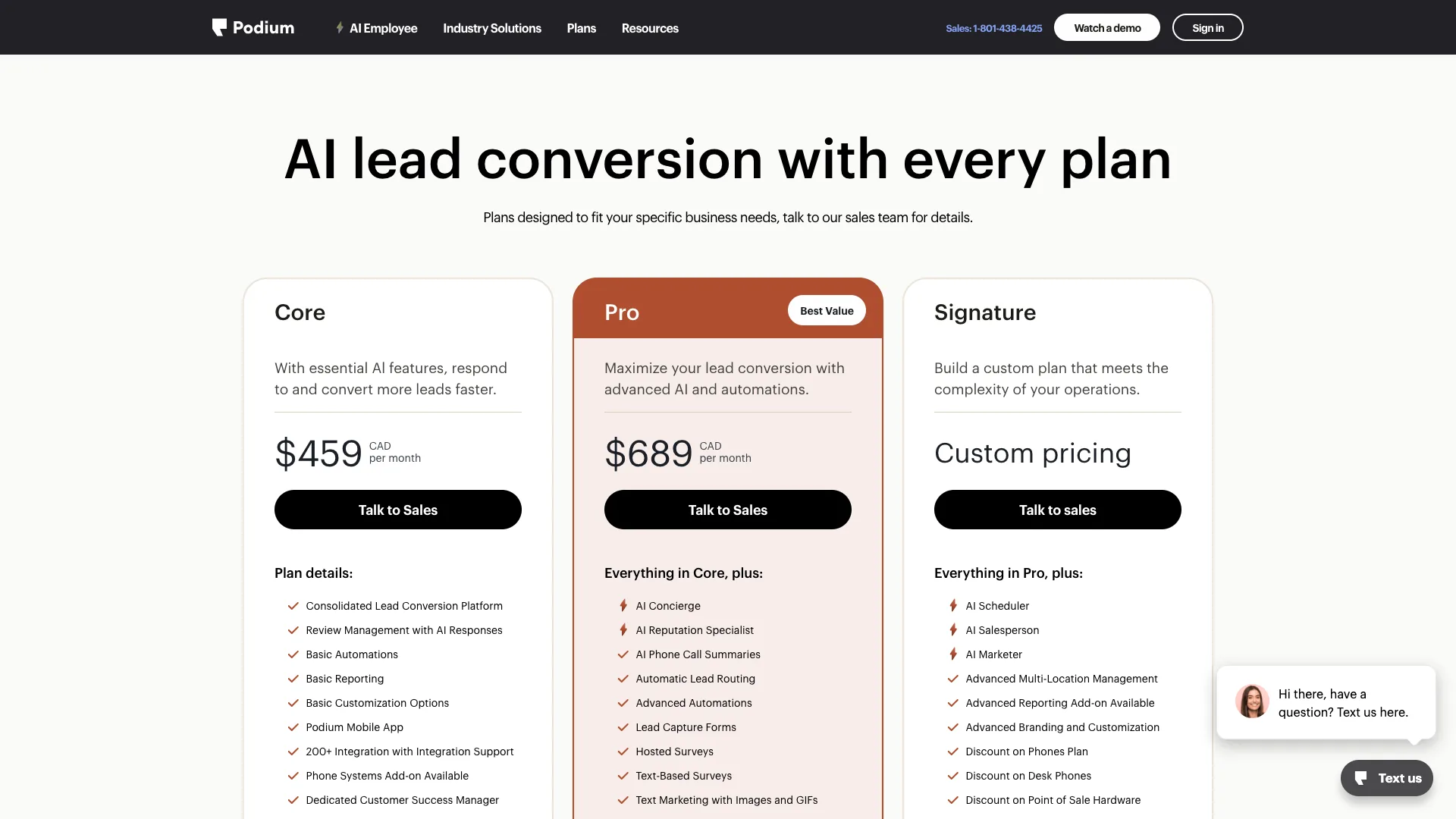 Jul 31, 2026
 Tech Stack
Podium vs Birdeye 2026: Pricing, Contracts and Review Gating
Only one of these two will tell you what it costs before a sales call, and even that number carries a carve-out aimed squarely at trade contractors.
Read Article Jul 31, 2026
 Tech Stack
Best Electrical Contractor Software 2026: 11 Ranked and Priced
An electrical contracting business makes two software purchases that do not substitute for each other, and every roundup answering this query covers only one of them. Eleven platforms, with a published price or an explicit statement that the vendor publishes none.
Read Article Jul 31, 2026
 Tech Stack
Best HVAC Software in 2026: Eleven Ranked Across Three Classes
An HVAC contracting business buys across three classes of software that do not substitute for each other, and every roundup answering this query covers only one of them. Eleven products, each with a published price or an explicit statement that the vendor publishes none.
Read Article Jul 30, 2026
 Tech Stack
AccuLynx Pricing 2026: The Real Cost of a Quote-Gated Plan
One published figure, two blank plan cards, and a contract that says things the pricing page does not. A line-by-line breakdown of what AccuLynx really bills.
Read Article Jul 30, 2026
 Tech Stack
Houzz Pro Canada Review 2026: Pricing and Alternatives
Houzz Pro serves different pricing renderings. What Canadian buyers see, how GST/HST and payments work, what Custom gates, and what the annual contract commits you to.
Read Article Jul 30, 2026
 Tech Stack
JobNimbus Pricing in 2026: What the Quote Does Not Cover
JobNimbus prints no figure on any of its four plans. So the only rate you can read before a sales call is the payments meter, and it is the biggest line on the bill.
Read Article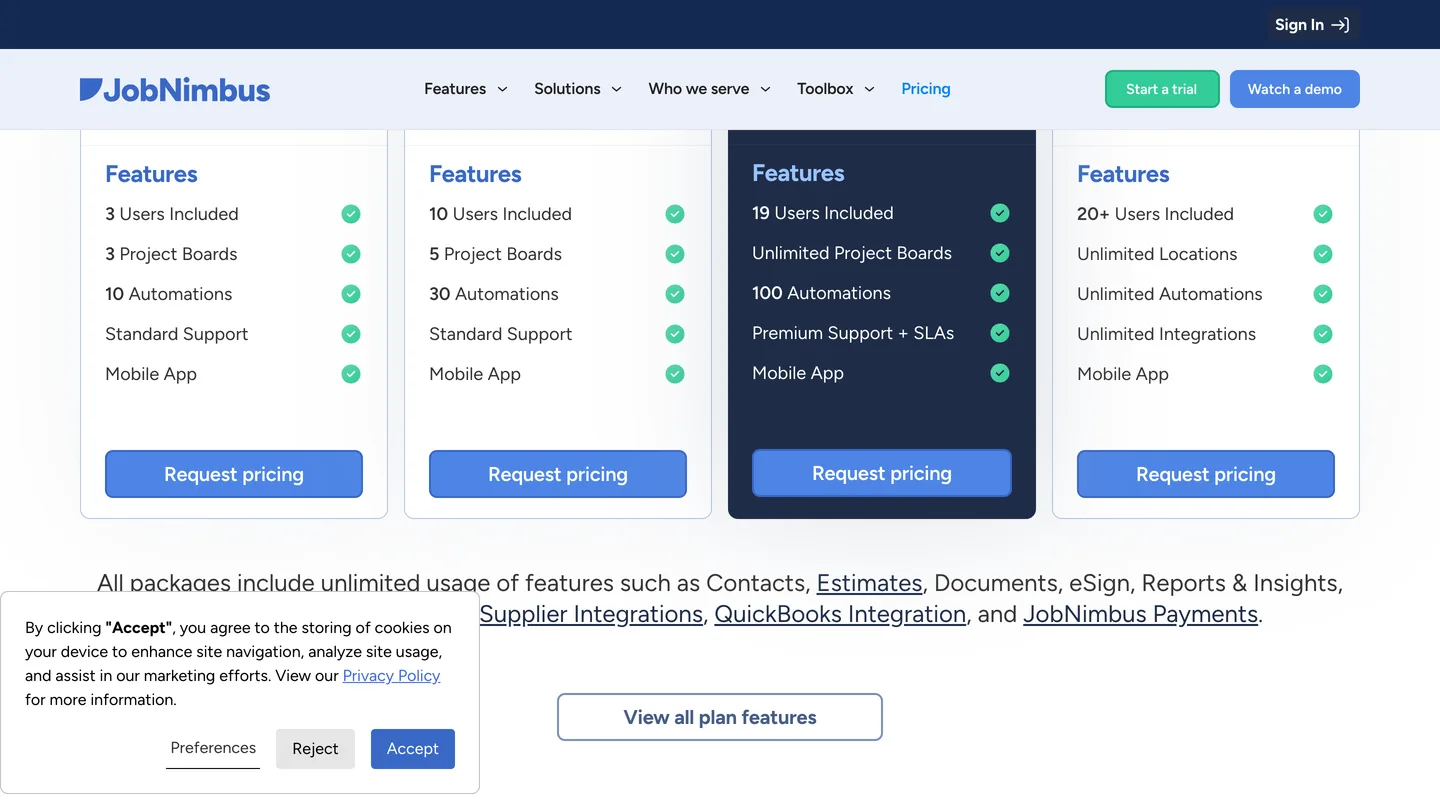 Jul 30, 2026
 Tech Stack
JobNimbus Review 2026: Pricing, Pros, Cons and Alternatives
JobNimbus rates 4.6 on Capterra and orders material straight from ABC Supply and SRS. But it publishes no price, and its supplement route carries a note.
Read Article Jul 30, 2026
 Tech Stack
BuildOps Review 2026: Pricing, Contract Terms and Alternatives
BuildOps runs commercial service and projects on one platform, and publishes no pricing at all. The billing unit, the 30-day data-export window, and who it suits.
Read Article Jul 30, 2026
 Tech Stack
FieldPulse Review 2026: Pricing, Pros, Cons and Alternatives
FieldPulse rates 4.6 on Capterra and is the platform contractors name when they leave a bigger system. But it publishes no price, and the contract runs a year.
Read Article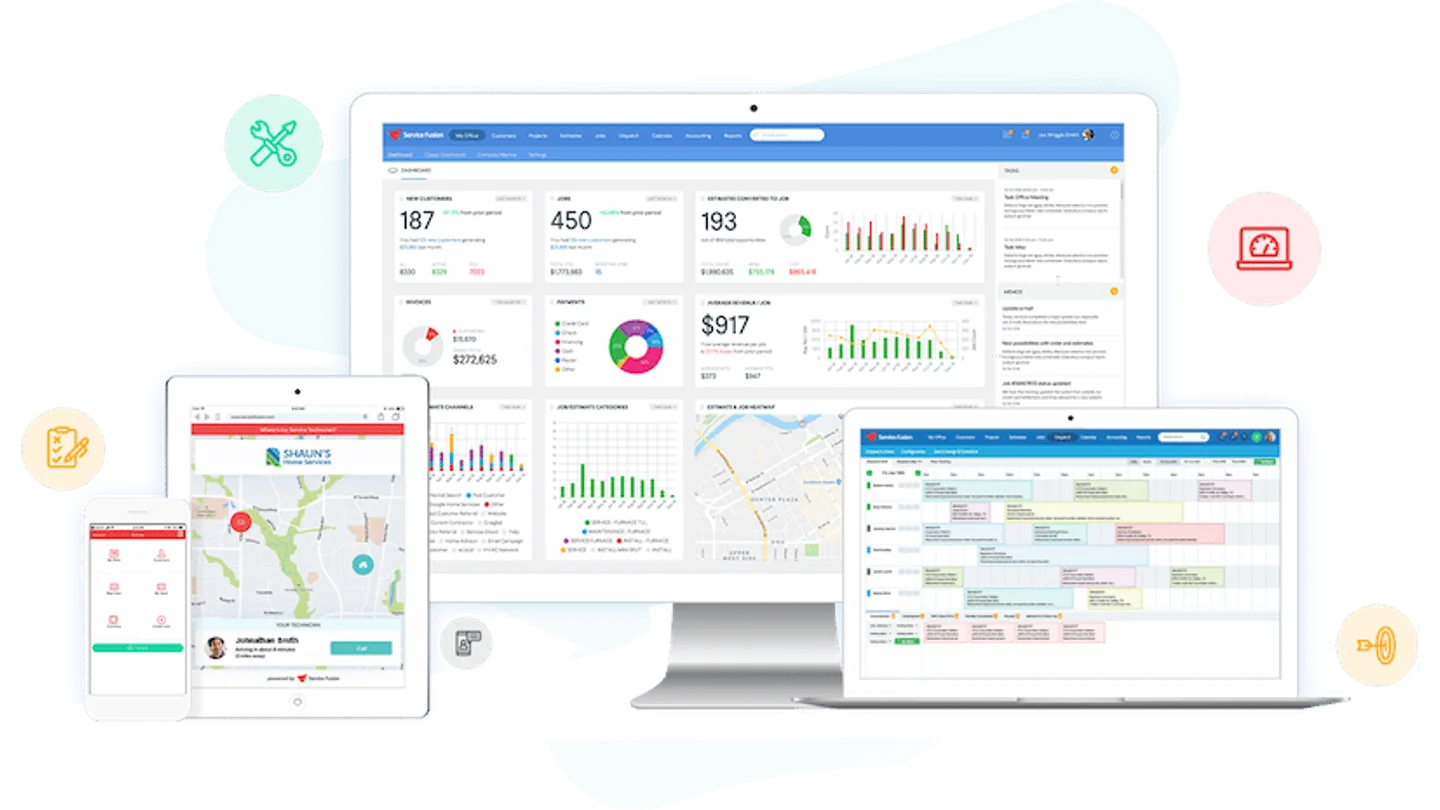 Jul 30, 2026
 Tech Stack
Service Fusion Review 2026: Pricing, Contract and Alternatives
Service Fusion bills flat per company with unlimited users, which is the best structural deal in field service software. The published plans, the contract behind the no-contract line, and the app score every other review gets wrong.
Read Article Jul 30, 2026
 Tech Stack
Knowify Review 2026: Pricing, Job Costing and Alternatives
Knowify rates 4.5 on Capterra and its weakest sub-score is features. What the $99 Core plan withholds, which way the QuickBooks sync really runs, and who should not buy it.
Read Article Jul 29, 2026
 Tech Stack
AccuLynx Review 2026: Pricing, Tier Gating, Alternatives
AccuLynx rates 4.6 across 846 reviews and now publishes an entry price. What that price omits, which tier holds the insurance workflow, and who should skip it.
Read Article Jul 29, 2026
 Tech Stack
Unitel Voice Review 2026: Pricing, Features and Alternatives
Unitel Voice rates 4.6 on Capterra and gives a one-truck shop a business number for $9.99 a month. The published plans, the cost per call, and what it won't do.
Read Article Jul 29, 2026
 Tech Stack
NiceJob vs Podium 2026: Pricing, Contracts and Review Gating
Both vendors print a price, at very different scale and in different currencies. The gap that matters is what Podium will not print: the billing unit, and whether a trade shop gets the number on the page.
Read Article Jul 28, 2026
 Tech Stack
CompanyCam Review 2026: Pricing, Pros, Cons and Alternatives
Every page ranking for CompanyCam still quotes a per-user price the vendor no longer charges. Here are the real plans, the seat math, and who should skip it.
Read Article Jul 28, 2026
 Tech Stack
NiceJob Review 2026: Pricing, Pros, Cons and Alternatives
NiceJob rates 4.9 on Capterra and refuses to gate negative reviews. Real plan pricing, the active-customer threshold nobody publishes, and who should skip it.
Read Article Jul 27, 2026
 Tech Stack
Buildertrend Review 2026: Pricing, Limits and Alternatives
Buildertrend rates 4.5 across 2,486 Capterra reviews and quotes against your revenue rather than your seat count. The workflows, the export problem, the alternatives.
Read Article Jul 27, 2026
 Tech Stack
CallRail Review 2026: Pricing, Pros, Cons and Alternatives
CallRail rates 4.5 on Capterra, and its tracking numbers port out free. But the two usage rates that decide your real bill are the two it does not print.
Read Article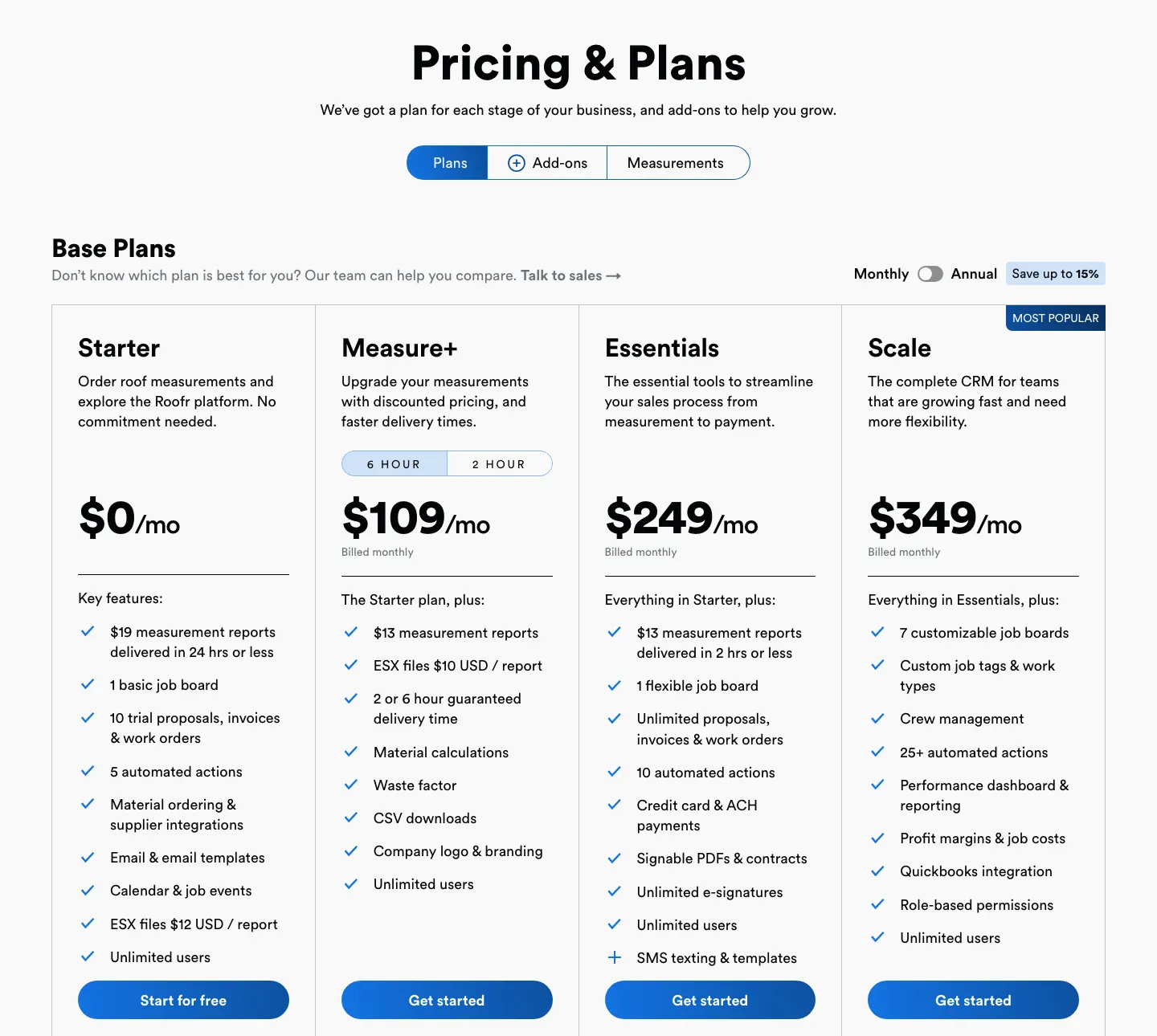 Jul 27, 2026
 Tech Stack
Roofr Review 2026: Pricing, Pros, Cons and Alternatives
Roofr rates 4.6 on Capterra and sells $13 measurement reports against a market charging triple. But it will not import a report from anywhere else.
Read Article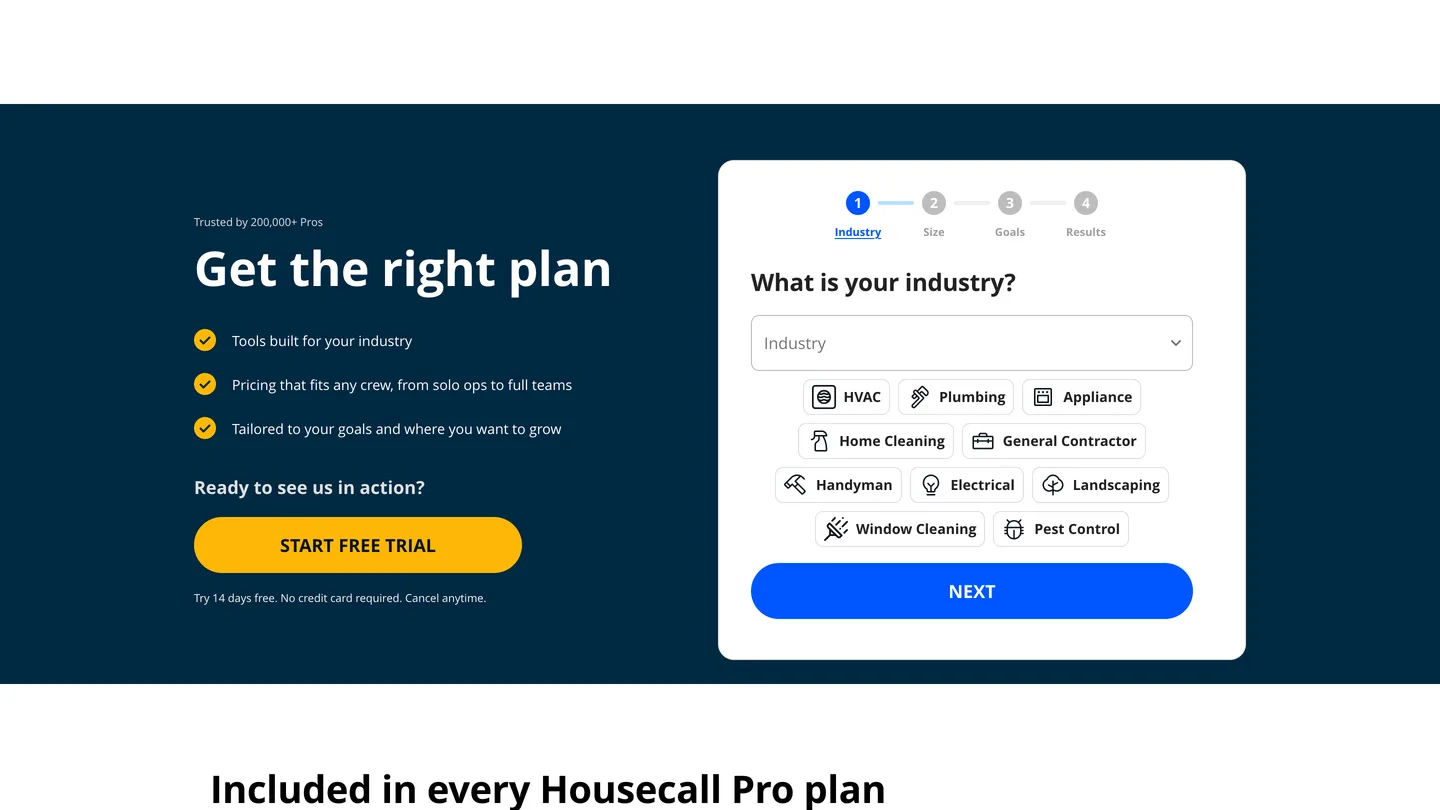 Jul 25, 2026
 Tech Stack
Housecall Pro Review 2026: Pricing, Pros, Cons, Alternatives
Housecall Pro has the shortest learning curve in the category and the widest review spread. Real pricing, the Instapay math, and the migration trap to plan around.
Read Article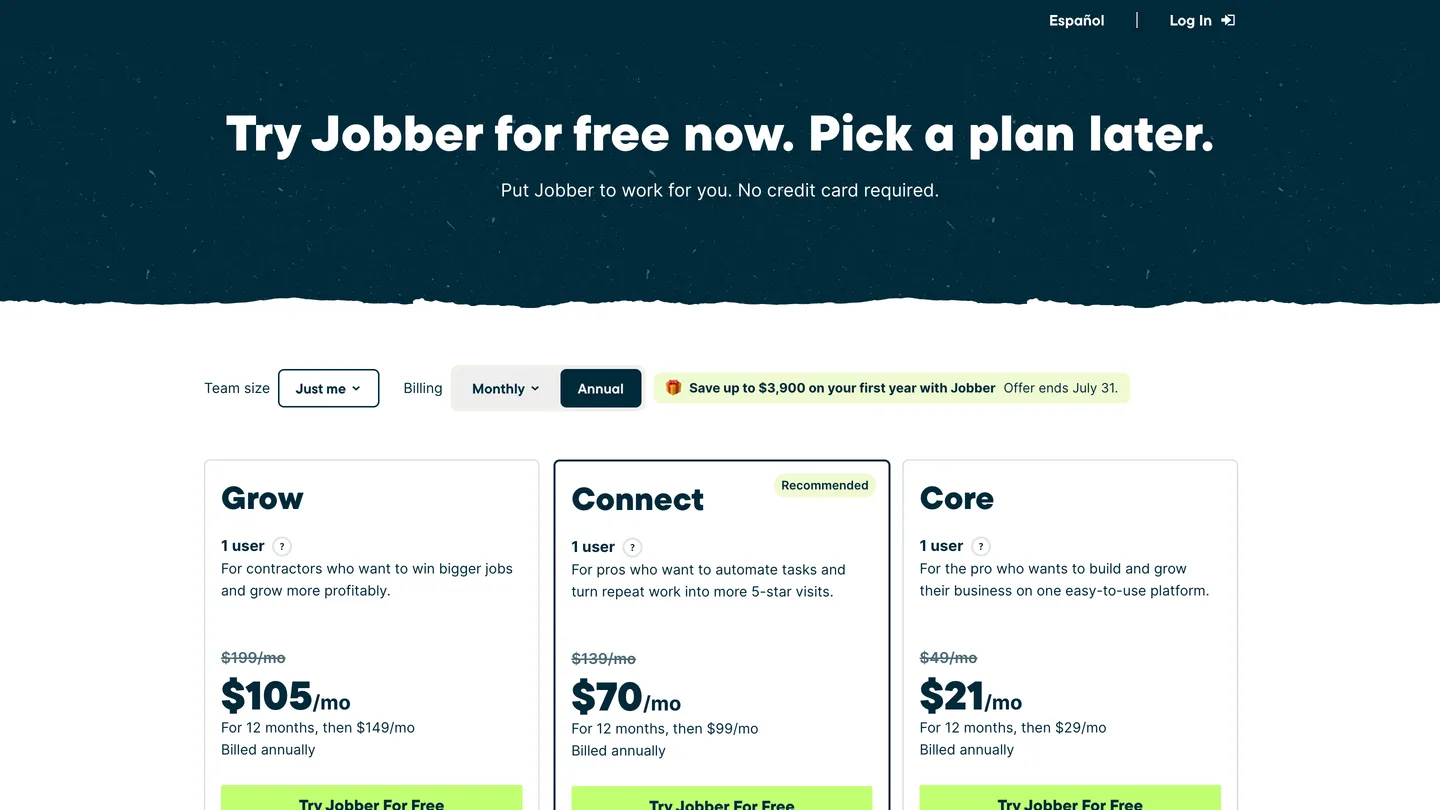 Jul 24, 2026
 Tech Stack
Jobber Review 2026: Pricing, Pros, Cons and Alternatives
Jobber rates 4.6 on Capterra with the best mobile app in the category. Real plan pricing, the feature gating that changes your entry price, and who it suits.
Read Article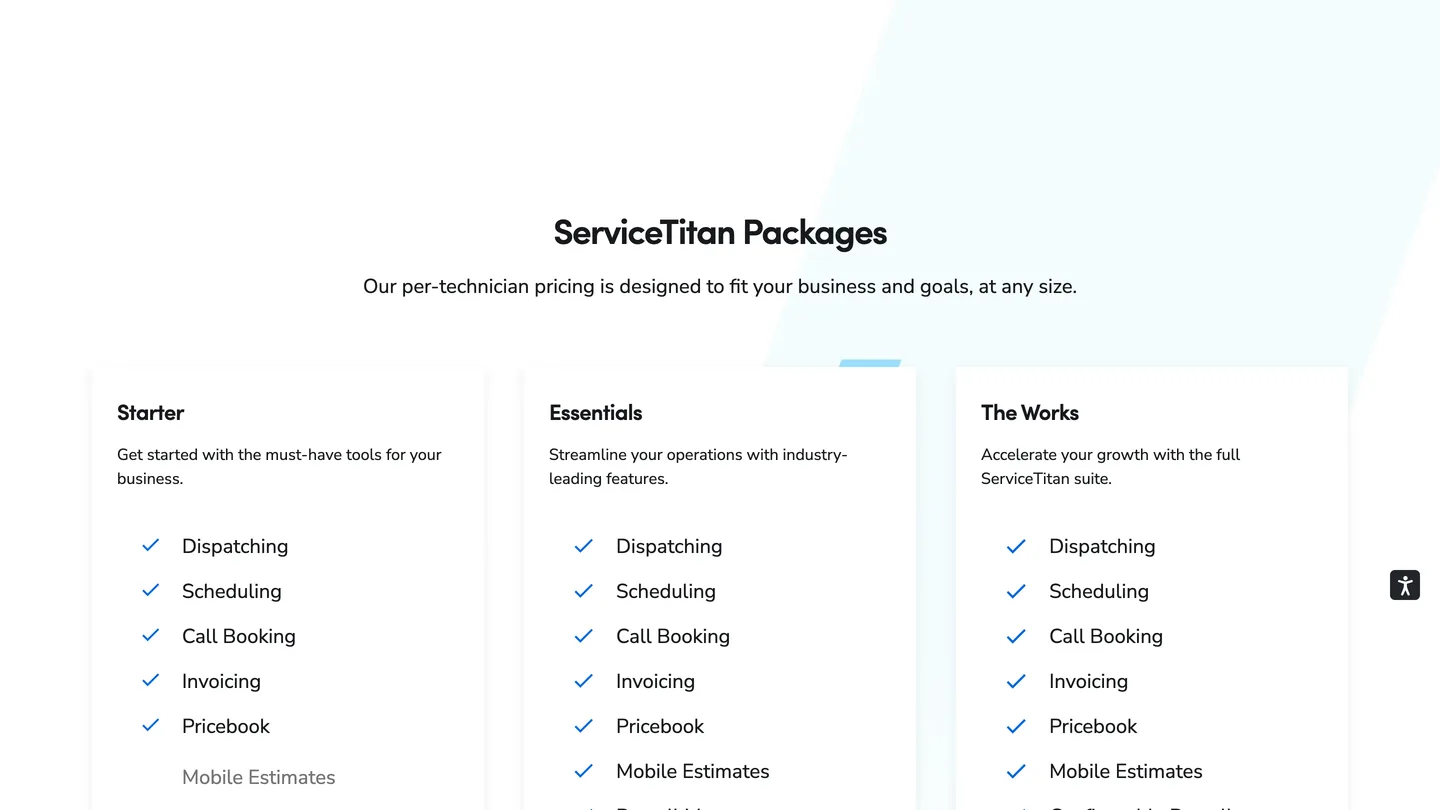 Jul 23, 2026
 Tech Stack
ServiceTitan Review 2026: Pricing, Pros, Cons, Alternatives
ServiceTitan rates 4.3 on Capterra but its weakest score is value for money. Real reported pricing, the 12-month contract, the exit fees, and who it actually suits.
Read Article Jun 3, 2026
 Tech Stack
HVAC Online Scheduling: The 43% Losing After-Hours Bookings
HVAC leads every trade on online booking at just 56.7%, which still leaves 43% of sites forcing an after-hours customer to wait for a business-hours phone call.
Read Article