DroneDeploy Review 2026: Pricing, Pros, Cons, Alternatives
DroneDeploy starts at $4,188. What each tier gates, the 8 limitations reviewers name, and 5 alternatives with published prices.

Page at a glance
DroneDeploy is Automated drone mapping with a per-roof measurement report attached, priced and contracted for a company running a drone programme rather than a roofer who wants one number off one house. It starts at $4,188 per account per year, single admin user license, billed annually. DroneDeploy is not straightforwardly per-user, and the contract says so. The Master Services Agreement defines the billing unit as whatever the Order Form says it is: 'Usage Metrics may be denominated in number of Users, number of Sites, Construction Volume, or such other metric as may be set forth on the applicable Order Form.' The published single-seat plans are per-account with one licence ('Single admin user license'). Above that, seat count, site count or dollar-value-of-construction can each be the meter, and a contractor who negotiates on seats without checking which metric landed on the Order Form can be billed on a metric they never priced. Layered on top, the Fair Usage Policy meters annual upload volume per licence in gigapixels: Lite/Ag Lite 1,000, Individual 2,000, Advanced 3,500, Project '3,500 / per site', and Teams '5,000 plus 2,000 / per pilot'. It fits A 15 to 60 person commercial roofing or siding contractor with at least one Part 107 pilot on payroll, doing repeat inspection and low-slope maintenance work across a portfolio, where the same buildings get flown more than once a year. It's the wrong buy for A one to five person residential roofing or siding crew that wants squares, pitch and a report to hand a homeowner, because The cheapest priced entry point is $4,188 a year for a single seat, before you buy a drone, before you pass Part 107, and before the Roof Report bundle a salesperson has to enable. But EagleView will sell you a small residential report for $32.75 with no subscription and no aircraft, and Roofr will sell you one for $19 on a $0/month plan. So at even one report a week you're ahead by thousands and you never carry a licensing exposure or an FAA obligation. Alternatives that publish their prices are EagleView from $32.75, Hover from $29, Roofr from $0. Eight priced tiers, eight evidenced gaps and five alternatives, four of which publish a figure.
Whether DroneDeploy is worth it
DroneDeploy earns its money with A 15 to 60 person commercial roofing or siding contractor with at least one Part 107 pilot on payroll, doing repeat inspection and low-slope maintenance work across a portfolio, where the same buildings get flown more than once a year. If that's you, it does the job. The sections below are the parts worth checking before you sign. But the fit is narrower than the marketing suggests, and the price isn't the whole cost.
It starts at $4,188. And pricing was verified on 7 August 2026, so you can check every figure below in a browser tab.
| Pricing model | Published tiers |
|---|---|
| Entry price | $4,188 |
| Users | DroneDeploy is not straightforwardly per-user, and the contract says so. The Master Servic |
| Ownership | Independent |
| Best fit | A 15 to 60 person commercial roofing or siding contractor with at least one Part 107 pilot on payroll, doing repeat inspection and low-slope maintenance work across a portfolio, where the same buildings get flown more than once a year. |
| Accounting sync | QuickBooks (none), Xero (none), Any accounting or ERP system, self-built (two-way) |
What works
- The flying is the strong part, and the complaints cluster on the device rather than the mission
- A real contractor deliverable exists, priced per roof and sold off-menu
- Export is broad, but organisation-scoped, tier-scoped and switched off when you leave
- The MSA is the document that decides what this costs, not the pricing page
- Genuine dispute-protection value when it works, on the least-exercised half of the product
What does not
- Cancel first and you lose the ability to export, which is the opposite of what the contract promises
- The Roof Report is the reason a roofer buys this and it isn't on any plan you can price
- Construction Volume billing charges you for the whole job even when you own a slice of it
- The API, the Procore sync and every automated export sit behind an Enterprise contract
- Each pilot licence covers two drones a month, and upload volume is capped annually
DroneDeploy is Automated drone mapping with a per-roof measurement report attached, priced and contracted for a company running a drone programme rather than a roofer who wants one number off one house. It sells to Roofing and Siding contractors, and the shape of the product follows from that: Autonomous mission planning is what long-tenured reviewers consistently praise, including one who moved from a competitor and describes auto-tagging ground control points and exporting straight to AutoCAD. But what breaks is the layer underneath: mission resume across battery swaps, camera parameter overrides, landing behaviour, tablet overheating and SD-card upload. So those failures cost a re-fly, and a re-fly on a commercial roof costs a half day. The Advanced tier adds Vertical Flight for facade and elevation capture, which is the feature that makes the platform relevant to siding work at all, and it's the tier with no published price.
Who should be shortlisting DroneDeploy
It fits A 15 to 60 person commercial roofing or siding contractor with at least one Part 107 pilot on payroll, doing repeat inspection and low-slope maintenance work across a portfolio, where the same buildings get flown more than once a year. That's the half most reviews print. Here's the other half, which is the one worth your time.
Don't buy it if you're A one to five person residential roofing or siding crew that wants squares, pitch and a report to hand a homeowner. The cheapest priced entry point is $4,188 a year for a single seat, before you buy a drone, before you pass Part 107, and before the Roof Report bundle a salesperson has to enable. But EagleView will sell you a small residential report for $32.75 with no subscription and no aircraft, and Roofr will sell you one for $19 on a $0/month plan. So at even one report a week you're ahead by thousands and you never carry a licensing exposure or an FAA obligation. Look at EagleView instead.
Don't buy it if you're An insurance-restoration roofer whose estimating runs through Xactimate. DroneDeploy exports PDF and DXF from the Roof Report and a long list of GIS and CAD formats elsewhere, but nothing in the 35-entry integrations directory or the help centre produces an ESX file. Roofr sells a Roofr Report plus ESX bundle at $23 on the Measure+ plan and states plainly that 'ESX files can be uploaded directly to Xactimate'. So buying an aerial platform that can't feed your estimating system means paying twice. Look at Roofr instead.
Don't buy it if you're A contractor with no Part 107 certificate, no drone and no intention of hiring a pilot. The subscription is the smallest line in the total. You're also buying an aircraft, a tablet, the certification, the insurance and the airspace authorisation workflow, and DroneDeploy's own answer to this objection is to sell you a capture service instead of a cheaper plan. But a phone-based measurement product removes the entire hardware and regulatory stack: Hover measures from a phone camera and its Starter plan is free for the first three projects with roof-only simple structures at $29 after that. Look at Hover instead.
Don't buy it if you're A commercial contractor buying primarily for interior 360 documentation rather than aerial. Ground is the acquired StructionSite product, it carries 32 App Store ratings against the Flight app's 5,305, and the reviewers who migrated describe data loss, login failure and crashes. So if the interior walk is the job to be done rather than a bonus attached to a drone programme, the aerial half isn't paying for itself and a purpose-built competitor is the safer buy. Look at OpenSpace instead.
What you'll pay DroneDeploy in year one
DroneDeploy prints its numbers on its own site. Good. That means you can price your real configuration tonight instead of waiting on a rep.
| Tier | Price | Billing unit | What it unlocks |
|---|---|---|---|
| Flight & Analysis Plan (Individual Pilots) | $4,188 | per account per year, single admin user license, billed annually | Nothing beyond the tier below |
| Ag Lite Plan (Agriculture Pilots) | $1,908 | per account per year, single pilot license, billed annually | Nothing beyond the tier below |
| Advanced Flight & Analysis Plan (Individual Pilots) | Quote only | per account, single seat, billing period not stated | 10k image upload per map, Cut / Fill vs. Design Surface, Vertical Facade Inspection, Radiometric Thermal, Unlimited GCP Mapping, Phone support |
| DroneDeploy Unified Plan | Quote only | per account, seat count set on the Order Form | Aerial Pro, Aerial, Ground Pro (Beta), Ground |
| DroneDeploy Aerial Pro | Quote only | per account, seat count set on the Order Form | Automated GCP tagging, In-app accuracy alerts and expert map review, Earthworks cut/fill by region |
| DroneDeploy Aerial | Quote only | per account, seat count set on the Order Form | Docked drone automation via Flight app, Design overlays and issue tagging, Esri, Autodesk and Procore sync |
| DroneDeploy Ground | Quote only | per account, seat count set on the Order Form | 360 Walks, BIM and drawing overlays, Safety AI, Autonomous robotics |
| DroneDeploy Ground Pro (Beta, marked 'Coming soon') | Quote only | per account, not yet generally available | Mobile 3D scans on iPhone/iPad with LiDAR and RTK, Measurement from 360 Walks, .e57 and .PLY laser scan upload, 8K 360 Walks |
DroneDeploy is not straightforwardly per-user, and the contract says so. The Master Services Agreement defines the billing unit as whatever the Order Form says it is: 'Usage Metrics may be denominated in number of Users, number of Sites, Construction Volume, or such other metric as may be set forth on the applicable Order Form.' The published single-seat plans are per-account with one licence ('Single admin user license'). Above that, seat count, site count or dollar-value-of-construction can each be the meter, and a contractor who negotiates on seats without checking which metric landed on the Order Form can be billed on a metric they never priced. Layered on top, the Fair Usage Policy meters annual upload volume per licence in gigapixels: Lite/Ag Lite 1,000, Individual 2,000, Advanced 3,500, Project '3,500 / per site', and Teams '5,000 plus 2,000 / per pilot'.
There is a discount for paying annually up front: The vendor states that monthly billing exists for single-seat plans and that annual saves money, but never publishes the monthly rate or the discount percentage, so the saving cannot be checked. The pricing FAQ reads: 'Do I have to commit annually? No. Individual license users can choose between monthly or annual billing when subscribing. Annual plans offer savings over month-to-month pricing.' Every figure printed on the page is annual, so the month-to-month price is unpublished. Note the scope: the answer says 'Individual license users', not team accounts, and the MSA governs team terms through the Order Form instead. And an annual prepay discount tells you an annual commitment exists, which is worth knowing before anyone mentions a term length out loud.
The DroneDeploy costs that show up later
Payment processing. DroneDeploy does not process a homeowner's payment to you; it processes your payment to DroneDeploy, and it outsources that. The help centre states: 'DroneDeploy does not store your payment details. Instead, we utilize Chargify, a trusted and secure payment service.' Currency is fixed: 'DroneDeploy accepts most major credit and debit cards, with all subscriptions charged in USD. Accepted cards include MasterCard, Visa, American Express, Discover, and Diners Club.' A Canadian contractor therefore carries the exchange spread on every renewal, and the pricing FAQ repeats the same point in different words: 'All charges are in USD.' On invoiced contracts the MSA sets 'invoiced fees are due net 30 days from the invoice date' and prices lateness at 'the lower of 1.5% per month or the maximum rate permitted by law'.
Implementation and onboarding. No implementation fee is published, but implementation is a contracted, separately-warranted line item rather than something bundled by default. The MSA carries its own warranty for it: 'Company warrants that the Implementation Services will be performed in a professional and workmanlike manner in accordance with generally accepted industry standards,' with the remedy capped at re-performance and a 30-day claim window. DroneDeploy also maintains a standalone Professional Services Agreement on its legal index. On the product side, the pricing page frames onboarding help as a services network rather than a free ramp: 'No pilots? No hardware? No problem. With our network of professional service providers, you'll get value from DroneDeploy from day zero.' Ask for the Implementation Services fee and the Professional Services Agreement in writing before signing.
Minimum term. There is no fixed floor in the MSA; the term is whatever the Order Form says. The contract reads: 'The term of each subscription shall be as specified in the applicable Order Form or Online Purchase Portal.' In practice both published single-seat plans are marked 'Billed annually', and the MSA adds that mid-term additions inherit the parent end date: 'subscriptions for additional Purchased Services may be added during a subscription term, prorated for the portion of that subscription term remaining at the time the subscriptions are added, and (c) any added subscriptions will terminate on the same date as the underlying subscriptions.' Adding a seat in month nine buys three months, not twelve.
Getting out. The vendor answers this question twice and the two answers do not agree. The help centre says walking away is free and clean: 'Are there any fees associated with canceling an account? A: No, we do not charge any cancellation fees. If you click through on the cancellation of your account, the account will cancel at the end of the subscription period,' and 'Upgrades take effect immediately, while downgrades or cancellations occur at the end of the current billing cycle.' The MSA says the money is already spent: 'payment obligations are non-cancelable and fees paid are non-refundable, and (iii) quantities purchased cannot be decreased during the relevant subscription term.' Both can be technically true, because 'no cancellation fee' is not the same as 'a refund', but a contractor reading only the help centre will believe they can shed seats mid-term and they cannot. A refund exists in one direction only: if you terminate for the vendor's uncured material breach, 'Company will refund Customer any prepaid fees covering the remainder of the term of all Order Forms after the effective date of termination.'
Auto-renewal. Renewal is automatic with a 30-day escape hatch, and the repricing clause underneath it is the part that costs money. The MSA: 'subscriptions will automatically renew for additional periods equal to the expiring subscription term or one year (whichever is shorter), unless either party gives the other written notice (email acceptable) at least 30 days before the end of the relevant subscription term.' Then the penalty for shrinking: 'Except as expressly provided in the applicable Order Form or Online Purchase Portal, renewal of promotional or one-time priced subscriptions will be at Company's applicable list price in effect at the time of the applicable renewal. Notwithstanding anything to the contrary, any renewal in which subscription volume or subscription length for any Services has decreased from the prior term will result in re-pricing at renewal without regard to the prior term's per-unit pricing.' Cutting from ten pilots to six does not cut your bill by 40 percent; it resets your per-unit rate. Separately, the help centre's instruction for stopping auto-billing is stale: 'To deactivate automatic billing, downgrade your account to Explorer,' where Explorer is a free tier the current pricing page no longer offers.
Modules sold separately. , , , , , , . The DroneDeploy figure worth writing down is the one with your day-one modules already in it, not the headline tier.
Third-party services you will also pay for. , , , . These are not on DroneDeploy's invoice, and they are still part of what this decision costs you every month.
"Third-party reporting puts DroneDeploy at $329 to $599 per user per year across the Individual and Advanced tiers as listed, with Teams and Enterprise shown as 'Contact Vendor for Pricing', reported 2026-08-07."
Capterra lists DroneDeploy's starting price as '$329' with the pricing model shown as 'Per User, Per Year', alongside 'Yes, has free trial' and 'No free version'. Two separate Capterra URLs, the profile page and the dedicated pricing page, returned the identical string. Treat this figure with suspicion for two reasons. First, it could not be confirmed against raw HTML: every Gartner property (Capterra, GetApp, Software Advice) returned HTTP 403 to curl with browser, mobile and crawler user agents, so the only reader was the fetch tool's summarising model, which is exactly the failure mode that invents a price. Second, it contradicts the vendor by a factor of roughly twelve. DroneDeploy's own single-seat Flight & Analysis plan is $4,188 billed annually. $329 multiplied by twelve is $3,948, which is close enough to the vendor's annual figure to suggest Capterra is showing a monthly rate under an annual label, or a stale legacy price. Do not quote $329 as an annual cost. (8-07)
A tangent, but stay with it. If your Order Form meters on Construction Volume, DroneDeploy bills against the full value of every project the software touches, not your share of it, and it says so in the joint-venture case in plain language. So a siding sub with a $1.8M scope on a $40M joint-venture build is measured against $40M. And the clause is new: the MSA's own revision summary, dated 2026-02-20, lists 'Certain provisions have been added to clarify terms related to subscriptions based on Construction Volume utilization' as the headline change. Read the Usage Metric line on the Order Form before you read the price. Because two contractors quoted the same headline number can end up with wildly different bills depending on whether the meter says Users or Construction Volume, and the second one only reveals itself at the annual audit. And if Construction Volume is on the form, negotiate a participation-share carve-out in writing or move the meter to seats.
The DroneDeploy line items nobody mentions
The subscription is the part everyone quotes. These are the lines that land afterwards, and the ones we could not find are named as unpublished rather than left blank.
Sold separately. , , , , , , . Price the configuration you'll really run, because an add-on you need on day one is part of the price.
Third-party services you'll also pay for. , , , . None of these are on DroneDeploy's invoice, and all of them are part of what this decision costs every month.
"DroneDeploy Flight & Analysis Plan (Individual Pilots) is $4,188, per account per year, single admin user license, billed annually."
DroneDeploy pricing page (2026)
"DroneDeploy Ag Lite Plan (Agriculture Pilots) is $1,908, per account per year, single pilot license, billed annually."
DroneDeploy pricing page (2026)
"DroneDeploy is not straightforwardly per-user, and the contract says so. The Master Services Agreement defines the billing unit as whatever the Order Form says it is: 'Usage Metrics may be denominated in number of Users, number of Sites, Construction Volume, or such other metric as may be set forth on the applicable Order Form.' The published single-seat plans are per-account with one licence ('Single admin user license'). Above that, seat count, site count or dollar-value-of-construction can each be the meter, and a contractor who negotiates on seats without checking which metric landed on the Order Form can be billed on a metric they never priced. Layered on top, the Fair Usage Policy meters annual upload volume per licence in gigapixels: Lite/Ag Lite 1,000, Individual 2,000, Advanced 3,500, Project '3,500 / per site', and Teams '5,000 plus 2,000 / per pilot'."
DroneDeploy pricing page (2026)
The five workflows you pay for
Feature totals are noise. So a shop in this category lives or dies on five things, and those are the five to grade, and each one below carries the evidence it's graded on.
The flying is the strong part, and the complaints cluster on the device rather than the mission Autonomous mission planning is what long-tenured reviewers consistently praise, including one who moved from a competitor and describes auto-tagging ground control points and exporting straight to AutoCAD. But what breaks is the layer underneath: mission resume across battery swaps, camera parameter overrides, landing behaviour, tablet overheating and SD-card upload. So those failures cost a re-fly, and a re-fly on a commercial roof costs a half day. The Advanced tier adds Vertical Flight for facade and elevation capture, which is the feature that makes the platform relevant to siding work at all, and it's the tier with no published price.
A real contractor deliverable exists, priced per roof and sold off-menu The Roof Report produces two PDFs and a DXF: a Roof Contractor Report with 'a full diagram, face measurements, and edge classifications' where 'Each section shows the perimeter, area, slope, pitch, and azimuth', a Roof Measurement Grid with 'a reference table with X, Y locations for points of interest and obstructions', and a CAD-ready design file. The vendor claims 'measurements are 99.4% accurate' when recommended flight practices are followed, and multi-building capture is supported so one flight over a strip mall returns a separate report per building. But the catch is commercial rather than technical: pre-paid bundles, per-roof billing, sales-gated activation, and two different published turnaround times.
Export is broad, but organisation-scoped, tier-scoped and switched off when you leave Exports run per layer with coordinate-system and resolution options, delivered by emailed download link rather than in-browser. But three constraints matter. A 'DroneDeploy Organization is required to export map data', so a single seat outside an Organization is limited. 'Exporting data shared with you is restricted. The map owner controls the data when sharing', which is exactly the complaint one owner made about clients who 'can pul up map but can not use the simple tools unless they are subscribers'. And the richer formats are tier-gated: LAS, XYZ, SHP and DXF start at Individual, not Ag Lite. Automated exports, including the Procore sync, are Enterprise-admin only.
The MSA is the document that decides what this costs, not the pricing page Four clauses do most of the work. Fees are 'non-cancelable' and 'non-refundable' and 'quantities purchased cannot be decreased during the relevant subscription term'. Renewal is automatic unless you give 30 days' written notice, email accepted. Shrinking at renewal triggers repricing 'without regard to the prior term's per-unit pricing'. And the whole agreement opens with a rights waiver in capitals: 'UNDER THIS AGREEMENT, YOU AND DRONEDEPLOY WAIVE ANY RIGHT TO JURY TRIAL OR TO PARTICIPATE IN A CLASS-ACTION LAWSUIT.' The company can also unilaterally amend: 'Such modifications will take effect on the stated update date unless you have a then-active Order Form disclaiming the applicability of updates.' So that disclaimer is worth asking for. The current MSA was last updated 2026-02-20, and its own change summary confirms the Construction Volume clauses are new.
Genuine dispute-protection value when it works, on the least-exercised half of the product The strongest positive review in the pool is a superintendent describing pre-drywall sign-off captures circulated to design teams and owner reps ahead of OAC meetings, avoiding the cost of reopening walls. That's the real job Ground does, and for a siding contractor the equivalent is a timestamped record of substrate and flashing conditions before cladding goes on. But against it sits a review pool full of camera disconnections, failed walk processing, iOS-only capture and login failure, on an app with 32 total ratings.
Which trades get value from DroneDeploy
Fit differs by trade rather than by company size alone, and a blended paragraph hides that. Here is the split for the trades this one sells to.
Roofing. The workflow that decides it is the flying is the strong part, and the complaints cluster on the device rather than the mission, and the shop profile that gets value is 60+ person contractor or self-perform gc running a formal drone programme across many sites doing commercial and insurance and residential work. Where it stops being a fit is A one to five person residential roofing or siding crew that wants squares, pitch and a report to hand a homeowner.
Siding. The workflow that decides it is the flying is the strong part, and the complaints cluster on the device rather than the mission, and the shop profile that gets value is 60+ person contractor or self-perform gc running a formal drone programme across many sites doing commercial and insurance and residential work. Where it stops being a fit is A one to five person residential roofing or siding crew that wants squares, pitch and a report to hand a homeowner.
The DroneDeploy accounting link, and where it stops
QuickBooks connects, on every plan. Xero connects, on every plan. Any accounting or ERP system, self-built connects both ways, gated to a higher tier. Your costs map through cost codes, so test yours against your own chart of accounts before you commit. A code your books don't recognise is how a labour charge quietly lands somewhere useless.
Past those, the road ends. QuickBooks and Xero, AccuLynx and JobNimbus, Xactimate (ESX output), Any accounting or ERP category at all, Ground data into Procore do not connect. So if your books run on an ERP rather than the platforms named above, weigh that before anything else.
Beyond accounting it connects to Procore (One-way automated sync of aerial maps, panos, standard photos and field notes (as Observations) into a Procore project's Documents or Photos module. Requires Auto Exports, which are Enterprise-admin only, plus Admin rights in both systems, plus sales enablement. Aerial only, one DroneDeploy project to one Procore project, photo cap 500MB, and no backfill of anything captured before setup.), Autodesk Construction Cloud (Listed in the integrations directory; the pricing page describes instant export and sync to Autodesk Build and BIM 360. A separate help article covers exporting DroneDeploy data for Autodesk use via Recap.), Esri / ArcGIS (Web Tile Layer for ArcGIS is one of the 35 directory entries, and Esri is named as a first-class sync destination on the pricing page.), Cloud storage: Box, Egnyte, OneDrive, SharePoint, Google Drive, Google Cloud Storage, Amazon S3, Azure (Eight storage destinations, each with its own Sync article in the help centre. And this is the widest and most reliable part of the integration surface, and for most contractors it's the practical export path.), Salesforce (via Real Drones) (The only CRM connector in the directory, and it's built by a third party rather than by DroneDeploy. Listed as 'Salesforce Sync, by Real Drones'.), Airdata UAV (Flight-log sync for fleet compliance and maintenance tracking. One App Store reviewer reports it failing: 'I use Airdata to sync my flight records and recently DroneDeploy has not been able to sync my logs as they do not seem to exist.'), PlanGrid (Sync destination with its own help-centre article, alongside the cloud storage connectors.), Insurance: DroneInsurance.com and Verifly (Two drone-insurance listings in the directory, which is a reminder that operating an aircraft commercially carries a cover requirement the subscription doesn't include.). A public API exists: There are four API surfaces and all of them are Enterprise-gated: a GraphQL API the vendor recommends, JavaScript APIs, an app-platform SDK, and legacy REST APIs kept alive mainly for image transfer. The REST Export API takes a plan_id and a parameters object covering file_format, layer, merge, projection and resolution, and supports a webhook callback on completion, so a real automated pipeline is possible once you are on Enterprise. Access needs an API key that only an Enterprise admin can generate in Account Preferences. Public documentation lives at developer-docs.dronedeploy.com, which returned HTTP 403 to every unauthenticated fetch attempted here, so the schema itself could not be read.
Getting help from DroneDeploy, and getting it fast
Support is the line item nobody prices and everybody eventually needs. Onboarding for DroneDeploy: No implementation fee is published, but implementation is a contracted, separately-warranted line item rather than something bundled by default. The MSA carries its own warranty for it: 'Company warrants that the Implementation Services will be performed in a professional and workmanlike manner in accordance with generally accepted industry standards,' with the remedy capped at re-performance and a 30-day claim window. DroneDeploy also maintains a standalone Professional Services Agreement on its legal index. On the product side, the pricing page frames onboarding help as a services network rather than a free ramp: 'No pilots? No hardware? No problem. With our network of professional service providers, you'll get value from DroneDeploy from day zero.' Ask for the Implementation Services fee and the Professional Services Agreement in writing before signing.
A CEO, security and investigations who reviewed it on 2020-09-10 says: "lack of responsibility to respond for software failures."
And a safety officer, construction, 2+ years on the platform, writing on 2021-12-13, writes the same thing: "DroneDeploy makes it easy to plan, execute, and process a UAV mission, and create a deliverable acceptable to our clients. If ever there is an issue, the help from customer service is immediate."
What happens when you want to leave DroneDeploy
Nobody reads this section before they buy, and it's the one that costs money afterwards. Four terms decide what leaving looks like.
Minimum term. There is no fixed floor in the MSA; the term is whatever the Order Form says. The contract reads: 'The term of each subscription shall be as specified in the applicable Order Form or Online Purchase Portal.' In practice both published single-seat plans are marked 'Billed annually', and the MSA adds that mid-term additions inherit the parent end date: 'subscriptions for additional Purchased Services may be added during a subscription term, prorated for the portion of that subscription term remaining at the time the subscriptions are added, and (c) any added subscriptions will terminate on the same date as the underlying subscriptions.' Adding a seat in month nine buys three months, not twelve.
Auto-renewal. Renewal is automatic with a 30-day escape hatch, and the repricing clause underneath it is the part that costs money. The MSA: 'subscriptions will automatically renew for additional periods equal to the expiring subscription term or one year (whichever is shorter), unless either party gives the other written notice (email acceptable) at least 30 days before the end of the relevant subscription term.' Then the penalty for shrinking: 'Except as expressly provided in the applicable Order Form or Online Purchase Portal, renewal of promotional or one-time priced subscriptions will be at Company's applicable list price in effect at the time of the applicable renewal. Notwithstanding anything to the contrary, any renewal in which subscription volume or subscription length for any Services has decreased from the prior term will result in re-pricing at renewal without regard to the prior term's per-unit pricing.' Cutting from ten pilots to six does not cut your bill by 40 percent; it resets your per-unit rate. Separately, the help centre's instruction for stopping auto-billing is stale: 'To deactivate automatic billing, downgrade your account to Explorer,' where Explorer is a free tier the current pricing page no longer offers.
Early termination. The vendor answers this question twice and the two answers do not agree. The help centre says walking away is free and clean: 'Are there any fees associated with canceling an account? A: No, we do not charge any cancellation fees. If you click through on the cancellation of your account, the account will cancel at the end of the subscription period,' and 'Upgrades take effect immediately, while downgrades or cancellations occur at the end of the current billing cycle.' The MSA says the money is already spent: 'payment obligations are non-cancelable and fees paid are non-refundable, and (iii) quantities purchased cannot be decreased during the relevant subscription term.' Both can be technically true, because 'no cancellation fee' is not the same as 'a refund', but a contractor reading only the help centre will believe they can shed seats mid-term and they cannot. A refund exists in one direction only: if you terminate for the vendor's uncured material breach, 'Company will refund Customer any prepaid fees covering the remainder of the term of all Order Forms after the effective date of termination.'
Payment processing. DroneDeploy does not process a homeowner's payment to you; it processes your payment to DroneDeploy, and it outsources that. The help centre states: 'DroneDeploy does not store your payment details. Instead, we utilize Chargify, a trusted and secure payment service.' Currency is fixed: 'DroneDeploy accepts most major credit and debit cards, with all subscriptions charged in USD. Accepted cards include MasterCard, Visa, American Express, Discover, and Diners Club.' A Canadian contractor therefore carries the exchange spread on every renewal, and the pricing FAQ repeats the same point in different words: 'All charges are in USD.' On invoiced contracts the MSA sets 'invoiced fees are due net 30 days from the invoice date' and prices lateness at 'the lower of 1.5% per month or the maximum rate permitted by law'.
Small thing that turns out to matter. DroneDeploy tells you two incompatible things about getting your data out, and the version that appears in the product is the worse one. The help centre and the pricing FAQ both say export is disabled the moment you cancel; the MSA says the company will make your content available for export on request during the same 30 days. Nothing reconciles them. And the practical effect is that the contractor who trusts the contract loses the window. Treat export as something you do on a schedule, not something you do at the end. So sync to Box, S3 or Google Drive from day one so a copy of every roof already lives somewhere you control, because the 30-day window isn't a window you want to be arguing about while a support ticket ages.
"DroneDeploy is reported at $329 to $599 per user per year across the Individual and Advanced tiers as listed, with Teams and Enterprise shown as 'Contact Vendor for Pricing' as of 2026-08-07."
Capterra lists DroneDeploy's starting price as '$329' with the pricing model shown as 'Per User, Per Year', alongside 'Yes, has free trial' and 'No free version'. Two separate Capterra URLs, the profile page and the dedicated pricing page, returned the identical string. Treat this figure with suspicion for two reasons. First, it could not be confirmed against raw HTML: every Gartner property (Capterra, GetApp, Software Advice) returned HTTP 403 to curl with browser, mobile and crawler user agents, so the only reader was the fetch tool's summarising model, which is exactly the failure mode that invents a price. Second, it contradicts the vendor by a factor of roughly twelve. DroneDeploy's own single-seat Flight & Analysis plan is $4,188 billed annually. $329 multiplied by twelve is $3,948, which is close enough to the vendor's annual figure to suggest Capterra is showing a monthly rate under an annual label, or a stale legacy price. Do not quote $329 as an annual cost. (8-07)
"DroneDeploy is reported at No price stated; feature-to-tier mapping only as of 2026-01-21."
The vendor's own help centre publishes a feature comparison for the single-seat plans that maps cleanly onto the three cards on the pricing page, which is the most reliable way to work out what the unpriced Advanced plan actually buys before you take the sales call. Ag-Lite gets 'Up to 1,000 images per map' and 'Support: Email support.' Individual gets 'Up to 3,000 images per map', overlays, 'Additional Exports: LAS, XYZ, SHP, DXF' and 'Support: Chat and Email support.' Advanced gets 'Up to 10,000 images per map', Vertical Flight, 'Ground Control Points: Unlimited GCP map processing', Earthworks, Radiometric Thermal and 'Support: Phone, Chat and Email support.' Phone support is a paid-tier feature, not a baseline. (1-21)
"Pretty expensive software for pilots, and also for "analyst" users who can only view the data."
Capterra, Stefanie F. (8-12)
The DroneDeploy gaps worth raising on the call
What follows is drawn from complaints rather than from star averages.
Cancel first and you lose the ability to export, which is the opposite of what the contract promises DroneDeploy answers the leaving question in two places and the two answers conflict on the single point that matters. The help centre and the pricing FAQ both say export is switched off the moment you cancel, and both tell you to get your data out beforehand. But the Master Services Agreement says the opposite: it commits the company to make your content available for export or download on request inside the same 30-day window. So a roofing contractor who cancels in the belief that the MSA protects them, then finds the export button greyed out, has 30 days to argue a contract clause with a support queue before the maps are deleted. And every roof measurement, thermal pass and before/after record for every building you've ever flown sits on the wrong side of that argument. Export everything before you touch the cancel button, not after. And ask your Account Executive in writing which of the two statements governs, and get the answer in email before renewal. If the answer is the help centre version, budget a full export run as a scheduled task in the last month of your term.
The Roof Report is the reason a roofer buys this and it isn't on any plan you can price Nothing on the pricing page mentions the Roof Report. It's enabled by a salesperson, sold as a pre-paid bundle, and metered per roof, so the cost of the deliverable you want is invisible until you're already in a sales conversation. And the same help article contradicts itself on turnaround inside 700 words: the opening line promises the report 'within 8 hours of data processing' and the Limitations section says 'Generating the report typically takes 24 hours or less.' So for a storm-chasing roofing contractor trying to get an adjuster a measurement on the same day, 8 hours and 24 hours are entirely different businesses. Get the bundle size, the per-roof price, the expiry date on unused reports and the guaranteed turnaround in writing on the Order Form. Then divide the all-in cost by your realistic annual roof count and compare it against $32.75 for an EagleView Bronze small residential report, which needs no drone, no pilot and no subscription.
Construction Volume billing charges you for the whole job even when you own a slice of it If your Order Form meters on Construction Volume rather than seats, DroneDeploy bills against the total value of every project the software touches, not your share. The clause spells out the joint-venture case explicitly and lands on 100 percent of project value. So a siding sub on a $40M mixed-use build whose own scope is $1.8M is charged against $40M. And on top of that sits an annual audit with a 15-business-day production deadline, overages invoiced at undiscounted list price, and a fallback that lets the vendor estimate your usage if your paperwork is late. Read the Usage Metric line on the Order Form before you read the price. And if it says Construction Volume, price it against your worst joint-venture year, not your average one, and negotiate a participation-share carve-out in writing.
The API, the Procore sync and every automated export sit behind an Enterprise contract A roofing contractor who wants finished maps to land in Procore or a project folder without somebody manually exporting them is buying Enterprise, not a plan with a price on it. Both API families are Enterprise-only. Auto Exports, which the Procore integration depends on, are Enterprise-admin-only and have to be switched on by sales. And the sync is one-way, aerial-only, and doesn't backfill: anything captured before you configure it stays where it is. If integration is why you're buying, price Enterprise from the first conversation and ignore the published single-seat numbers entirely. And configure the Procore sync before your first capture, because there's no way to backfill later.
Each pilot licence covers two drones a month, and upload volume is capped annually The Fair Usage Policy sets a hardware limit per licence that nothing on the pricing page mentions, and it's the wrong shape for a roofing company. So a three-truck roofing outfit that puts a drone in each truck and rotates crews through one login is outside the policy from the first month. Above that sits an annual gigapixel ceiling that a busy inspection season eats: at 20MP images, roughly 50 images per gigapixel, an Individual licence's 2,000 gigapixels is around 400 maps a year. And the enforcement language is broad. The remedies include billing you more. Count your drone bodies, not your pilots, then count your annual flights and multiply by images per flight. Then take both numbers into the quote conversation and get the allowance written onto the Order Form rather than inferred from the policy page.
The Ground half is the ex-StructionSite product and reviewers describe losing data in the move DroneDeploy didn't grow Ground. It absorbed StructionSite and rebranded it, and the vendor still runs a migration training article for those users. Reviewers who lived through that transition describe instability and data loss. And at least one names the competitor they moved to. The Ground app carries only 32 ratings on the App Store against 5,305 for the Flight app, so the ground-capture half is a far less exercised product than the drone half of the same subscription. A reviewer puts it: "Transition from Structionsite to Drone Deploy happened in the middle of a very difficult renovation project. It was dery disruptive and our team lost a lot of data. The new interface is glitchy and does not work well. Not to mention the new name is terrible. We will be stitching to Openspace." If the pitch includes Ground, ask for a named reference who migrated from StructionSite and is still on the platform. And buy Aerial and Ground separately rather than committing to Unified on the first term, which the vendor explicitly permits: 'Yes. You can subscribe to Aerial (drone) or Ground (360/smartphone) capture on their own.'
The integration count on the marketing page is more than double what the directory lists, and none of it is accounting The roofing solution page advertises 'See all 80+ integrations'. But the integrations directory it links to lists 35 entries and has no pagination. More useful than the arithmetic is what's missing from all 35: there's no QuickBooks, no Xero, no Sage, and no roofing CRM. Searching the entire help centre for QuickBooks, Xero, AccuLynx and JobNimbus returns zero articles each. So whatever a roof report costs you to produce, moving it into a job cost, an invoice or a CRM opportunity is manual work. Assume manual re-entry between DroneDeploy and whatever runs your jobs and your books, and cost that admin time into the subscription. And if a roofing CRM is your system of record, check whether it can ingest a DXF or a PDF report before you buy.
Field capture assumes live connectivity, and the sales pitch on offline work doesn't survive contact with a jobsite Two independent reviewers on two different platforms make the same complaint five years apart, which is the pattern worth trusting. One names the sales team directly. And the mobile apps also draw complaints about upload reliability, device overheating and login failures, which is a different problem from the flying working well: a roof you can't upload from the truck is a roof you re-fly. A cio, government administration who reviewed it on 2021-02-28 puts it: "It a bit on the expensive side. In most cases you need to have live internet on your mobile device, thus you need to have data on your phone." Run the trial on your worst-connected site, not your office. And capture, upload and export one full roof end to end on a tethered phone before you sign anything.
One more thing worth knowing. Shrinking your DroneDeploy contract at renewal costs more per unit than staying the same size. The MSA overrides everything else in the agreement to say that any renewal where volume or term length has decreased gets repriced 'without regard to the prior term's per-unit pricing'. So cutting from ten pilot seats to six doesn't save 40 percent, because the six survivors are repriced at whatever list is at that moment. Never size a first-year DroneDeploy contract optimistically. Because roofing is seasonal and headcount moves, and this clause converts a bad year into a rate increase. So start with the smallest seat count that works, add mid-term at the prorated rate the MSA already permits, and diary the 30-day notice window the day the contract begins.
One more thing worth knowing. The Ground half of DroneDeploy is StructionSite wearing a new name, and the customers who were carried across say the move cost them data. That's in the review pool, not inference from a press release, and DroneDeploy's own help centre still runs a migration training article aimed at those users. And the scale gap tells the same story from a different angle: the Flight app has 5,305 App Store ratings, the Ground app has 32. Buy Aerial on its own for the first term rather than Unified. Because the vendor explicitly allows it, the aerial half is the mature product, and it keeps the least-proven component out of a contract whose seat counts you can't reduce mid-term.
One more thing worth knowing. The same complaint appears from independent reviewers years apart and on different platforms: the field workflow assumes live connectivity, and the sales conversation says otherwise. And one Capterra reviewer in 2021 and one App Store reviewer on the Ground app both land on it, and the second names the sales team directly. Run the trial on your worst-connected site, not your office. And capture, upload and export one complete roof end to end on a tethered phone before you sign, and if the demo is on office wifi, ask to repeat it in a parking lot.
Side note, and it's a useful one: a DroneDeploy pilot licence is sized to a person and a fleet at once, and the fleet number is two. And the Fair Usage Policy states that every pilot user licence is designed for up to two different drones per month, which is a constraint no other line of the pricing page mentions and which maps badly onto how a roofing company operates, where drones tend to live in trucks rather than with people. Count drone bodies before you count pilots when you size the contract. Because a three-truck roofing outfit that assumed one seat covers the company will trip the policy in its first month, and the MSA's remedy list starts at 'limit Customer's account' and ends at 'charge Customer for additional amounts'.
DroneDeploy, from the people who bought it
Every quote below is transcribed from a published review, named to the platform that carries it and to the reviewer as that platform displays them. We read the corpus by complaint type rather than by star rating, which is how the disqualifying detail buried inside a five-star review gets found.
"Pretty expensive software for pilots, and also for "analyst" users who can only view the data."
A manager, commercial real estate who reviewed it on 2020-08-12 describes it on Capterra
"it is very had to share with customers. they can pul up map but can not use the simple tools unless they are subscribers."
An owner, telecommunications, 2+ years on the platform, writes it plainly on Capterra
"It a bit on the expensive side. In most cases you need to have live internet on your mobile device, thus you need to have data on your phone."
On 2021-02-28, a cio, government administration, 2+ years on the platform, puts it on Capterra
"lack of responsibility to respond for software failures."
A CEO, security and investigations, Less than 6 months on the platform, puts it it plainly on Capterra
"On the Flight Plannning side, we often have pilots accidentally move the entire flight plan. It is convenient for when you need to do it BUT I would like to see an option to lock it in place."
A pilot success manager, aviation & aerospace who reviewed it on 2022-06-27 puts it on Capterra
"DroneDeploy makes it easy to plan, execute, and process a UAV mission, and create a deliverable acceptable to our clients. If ever there is an issue, the help from customer service is immediate."
On 2021-12-13, a safety officer, construction, 2+ years on the platform, puts it on Capterra
"Transition from Structionsite to Drone Deploy happened in the middle of a very difficult renovation project. It was dery disruptive and our team lost a lot of data. The new interface is glitchy and does not work well. Not to mention the new name is terrible. We will be stitching to Openspace."
A reviewer writes on Apple App Store (DroneDeploy Ground App, v2.177.2, 1 star)
"Your sales team like to sell the idea of being able to do work without internet. While true in very limited circumstances, it's mostly a lie. The “drawings” need more than two supported file formats. They need to be able to be added in the app, THEN (key word here) pins added to the drawing, all without internet until internet access is restored and upload can begin. You have to upload the drawing in advance before heading to site. No photos of the drawing either because of its limited support."
A reviewer says on Apple App Store (DroneDeploy Ground App, v2.177.3, 1 star)
"The app often crashes and becomes unusable. Clearly little to no attention applied to implementing, improving, or operating for the app or web interface since taking this application over from StructionSite."
A reviewer, says on Apple App Store (DroneDeploy Ground App, v2.190.1, 1 star)
"Pre- drywall sign off by all trades,Architectural and MEP’s engineering design teams as well as the owner representatives can sometimes be seen as difficult or challenging getting every single team player on site to sign off the work in place. Drone deploy captures can be emailed to the team and reviewed on OAC meetings to smoothly identify issues and provide feedback prior to closing the walls. Drone deploy saves the entire team the cost from having to remove drywall and provide a smooth transition to the finish stages."
A senior superintendent (self-described in review title) puts it on Apple App Store (DroneDeploy Ground App, v2.247.0, 5 stars)
"Mission was flown, didn’t take one picture during flight, it wouldn’t let me take manual control of the drone , wouldn’t stay at height set , after mission flown instead of staying in one spot or landing it descended to half the height and took off full speed into trees, I do not recommend this faulty app if you value your drone"
A reviewer writes on Apple App Store (DroneDeploy Flight App, v5.55.0, 1 star)
"So you don’t see the full resolution of a map on your iPhone or IPad unless you go to the website and view from there directly. Uploading files from a flight directly from SD card to an iPad or iPhone is glitchy along with unreliable. If you doing it from scratch like wanting to drop files directly on to the app you can’t. Basically anything besides export and sharing data that already exist your gonna need a computer."
A reviewer, puts it on Apple App Store (DroneDeploy Flight App, v5.59.0, 3 stars)
"The best flight planning, mapping and analysis software I’ve used. Very easy to program flights and export data to AutoCAD. Easily create profiles, Point clouds and it even can auto tag GCPs. Have not regretted the move from previous software."
A reviewer reports it on Apple App Store (DroneDeploy Flight App, v4.151.1, 5 stars)
"Hardnesses thing I have ever had to login into. Lots of errors. Will reset my password and even then it is a 50/50 shot. Always a massive pain to get back into the app to use the program. I use this for work and hate using it. Can’t recommend. I have to redownload the app as well to get it work. Glichy."
A reviewer describes it on Apple App Store (DroneDeploy Ground App, v2.224.2, 2 stars)
What DroneDeploy's competition charges
Alternatives a buyer would genuinely shortlist against DroneDeploy. Read the billing unit beside each figure rather than the figure on its own, because a per-seat price and a flat platform fee aren't comparable numbers.
| Tool | Entry price | Billing unit | Users included | Published? |
|---|---|---|---|---|
| DroneDeploy | $4,188 | per account per year, single admin user license, billed annually | DroneDeploy is not straightforwardly per-user, and the contr | Yes |
| EagleView | $32.75 | per report (Bronze tier, Small residential roof up to 20 squares) | No seat licence required; you buy reports, not users | Yes |
| Hover | $29 | per project (Roof-only, simple structure, Starter plan) with the first 3 projects free; Pro is $999/year | Starter has no seat charge; Pro is an annual account subscription | Yes |
| Roofr | $0 | per month (Starter plan) with measurement reports at $19 each; Measure+ is $109/mo billed monthly and drops reports to $13 | Unlimited users on every plan, including the free Starter plan | Yes |
| Pix4D (PIX4Dmapper) | $333 | per user per month, displayed under Pix4D's annual-billing price toggle; PIX4Dreact starts at $55 and PIX4Dmatic at $125 on the same page | 1 licence per subscription | Yes |
| OpenSpace | Quote only | per account, Core or Enterprise subscription, seat model not published | Not published | No |
EagleView. Buying a measurement without owning an aviation programme. The full published rate card covers Medium 40 sq at $60, Large 40+ sq at $87, Commercial at $89.50, Residential Gutter at $13.75, Bid Perfect residential at $18, Walls at $40, Walls Windows & Doors residential at $78 and Full House at $105, with Silver, Gold and Platinum prepay tiers discounting each. No drone, no Part 107, no subscription floor, no fair-use ceiling, and a purpose-built Roofing & Siding vertical. But You get a report, not a platform. There's no thermal pass to find trapped moisture, no repeatable before/after site record, no 360 interior walk, no earthworks, and no ability to fly the same roof on your own schedule. And for portfolio maintenance work across many buildings, per-report pricing stops being cheaper.
Hover. Removing hardware and regulation from the equation entirely. The measurement comes from a phone camera, so a residential siding or roofing crew needs no aircraft and no certificate. Pro at $999/year takes $20 off every project and drops roof-only simple to $9 and full exterior average to $79, and it covers siding, windows, soffit and gutters in one 3D model, which is exactly the scope DroneDeploy only reaches at its unpriced Advanced tier via Vertical Facade Inspection. But Commercial and low-slope work. Hover models a house; it doesn't fly a 200,000 square foot warehouse roof, run a radiometric thermal pass, produce an orthomosaic, or build a timestamped portfolio record for warranty and maintenance programmes.
Roofr. Cost per report and estimating handoff for residential roofing. A $0/month plan with '$19 measurement reports delivered in 24 hrs or less' and unlimited users undercuts every option here, and the Roofr Report + ESX bundle at $31 on Starter or $23 on Measure+ feeds Xactimate directly, which DroneDeploy can't do at all. Essentials at $249/mo and Scale at $349/mo add proposals, payments, e-signature and a QuickBooks integration, so the money side is solved rather than absent. But It isn't aerial capture. Roofr orders a report from imagery it sources, and you can't fly a building on demand, run thermal, capture a facade, document interiors, or hold a repeatable visual record of a commercial portfolio.
Pix4D (PIX4Dmapper). Local processing and price transparency. Pix4D prints a number for every product on one page instead of quoting, and PIX4Dmapper processes on your own machine, so a contractor with connectivity problems on site isn't blocked by a cloud upload. And a DroneDeploy reviewer who abandoned the platform named Pix4D as the fallback. But There's no roof-measurement deliverable, no 360 ground walk, no Procore or Autodesk sync of the same depth, and the same reviewer's complaint about Pix4D still stands: 'Unfortunately Pix4D capture just doesn't have a lot of settings to control.' Photogrammetry software isn't a contractor workflow.
OpenSpace. Ground documentation, which is the half of DroneDeploy that reviewers abandon. OpenSpace sells 'Unlimited capture across projects of any size', device-agnostic capture 'from smartphones to 360° to drones', and BIM comparison, and it is the product named by name in the App Store review of a team that lost data in the StructionSite migration. But It publishes no price at all, so it fails the same transparency test as DroneDeploy's team plans, and API access is Enterprise-only just as it is at DroneDeploy. And it isn't a roof-measurement tool either: there's no per-roof report with pitch, azimuth and edge classifications.
"it is very had to share with customers. they can pul up map but can not use the simple tools unless they are subscribers."
Capterra, steven F. (6-29)
"It a bit on the expensive side. In most cases you need to have live internet on your mobile device, thus you need to have data on your phone."
Capterra, VR (2-28)
Who should not buy DroneDeploy
Don't buy DroneDeploy if you're A one to five person residential roofing or siding crew that wants squares, pitch and a report to hand a homeowner. The cheapest priced entry point is $4,188 a year for a single seat, before you buy a drone, before you pass Part 107, and before the Roof Report bundle a salesperson has to enable. But EagleView will sell you a small residential report for $32.75 with no subscription and no aircraft, and Roofr will sell you one for $19 on a $0/month plan. So at even one report a week you're ahead by thousands and you never carry a licensing exposure or an FAA obligation. Look at EagleView instead.
Don't buy DroneDeploy if you're An insurance-restoration roofer whose estimating runs through Xactimate. DroneDeploy exports PDF and DXF from the Roof Report and a long list of GIS and CAD formats elsewhere, but nothing in the 35-entry integrations directory or the help centre produces an ESX file. Roofr sells a Roofr Report plus ESX bundle at $23 on the Measure+ plan and states plainly that 'ESX files can be uploaded directly to Xactimate'. So buying an aerial platform that can't feed your estimating system means paying twice. Look at Roofr instead.
Don't buy DroneDeploy if you're A contractor with no Part 107 certificate, no drone and no intention of hiring a pilot. The subscription is the smallest line in the total. You're also buying an aircraft, a tablet, the certification, the insurance and the airspace authorisation workflow, and DroneDeploy's own answer to this objection is to sell you a capture service instead of a cheaper plan. But a phone-based measurement product removes the entire hardware and regulatory stack: Hover measures from a phone camera and its Starter plan is free for the first three projects with roof-only simple structures at $29 after that. Look at Hover instead.
Don't buy DroneDeploy if you're A commercial contractor buying primarily for interior 360 documentation rather than aerial. Ground is the acquired StructionSite product, it carries 32 App Store ratings against the Flight app's 5,305, and the reviewers who migrated describe data loss, login failure and crashes. So if the interior walk is the job to be done rather than a bonus attached to a drone programme, the aerial half isn't paying for itself and a purpose-built competitor is the safer buy. Look at OpenSpace instead.
The verdict, by shop size
Solo operator or 1 to 5 person residential roofing or siding crew
No. The economics don't close and nothing about the platform is sized for this shop. The lowest priced seat is $4,188 a year and it explicitly excludes ground capture, the Advanced tier that carries facade inspection has no price, the Roof Report is a sales-gated pre-paid bundle, and none of that includes the aircraft, the Part 107 certificate or the insurance. But Roofr will sell measurement reports at $19 on a $0 per month plan with unlimited users, and EagleView will sell a small residential report for $32.75 with nothing else attached. So you'd need to be flying several roofs a week purely for your own purposes before the fixed cost is defensible, and at that volume you're no longer a five-person crew. This band runs 1 to 5 on the crew, doing residential work, and that's the profile the recommendation is written for.
6 to 14 person contractor doing mixed residential and light commercial, no in-house pilot
No. Without a pilot on payroll you're buying the software plus a capture service with no published rate, which means two unpriced line items stacked on one contract. And the MSA makes that worse rather than better: fees are non-cancelable, seat counts can't be reduced mid-term, and shrinking at renewal reprices you off your negotiated per-unit rate. So buy measurement per report from EagleView or Roofr while you find out whether drone capture changes your close rate. Then revisit DroneDeploy when you have someone certificated and a repeat-inspection book of business to fly. This band runs 6 to 14 on the crew, doing residential and insurance work, and that's the profile the recommendation is written for.
15 to 60 person commercial roofing or siding contractor with a certificated pilot and repeat portfolio work
Only under conditions, and they are worth being honest about. This is the band the product is built for, and it's a real fit if three things are true: you fly the same buildings more than once a year, radiometric thermal genuinely changes what you find on low-slope roofs, and you already live in Procore or Autodesk. But the conditions are contractual. So get the Advanced or Unified price in writing, get the Roof Report bundle size, per-roof price and turnaround on the Order Form, check whether the Usage Metric line says Users or Construction Volume before you sign, and diary the 30-day non-renewal notice the day the contract starts. Buy Aerial alone on the first term rather than Unified, because the Ground half is the acquired StructionSite product and it's the one reviewers leave. This band runs 15 to 60 on the crew, doing commercial and insurance work, and that's the profile the recommendation is written for.
60+ person contractor or self-perform GC running a formal drone programme across many sites
Yes, and this is the shape the product is built for. At this scale the Enterprise gate stops being a tax and starts being the point, because the GraphQL API, automated exports and the Procore sync are what turn per-site capture into a system. SOC 2 Type 2, ISO 27001 and NIST 800-53 compliance, SSO and role-based access clear an enterprise IT review, and 'Used on 3 million sites in 180 countries' is a defensible reference base. So negotiate hard on two clauses specifically: the Construction Volume joint-venture rule that bills you at 100 percent of total project value regardless of your share, and the renewal repricing clause that punishes you for shrinking. And both are the kind of thing that becomes expensive in year three, not year one. This band runs 60 or more on the crew, doing commercial and insurance and service work, and that's the profile the recommendation is written for.
One thing to check before you sign with DroneDeploy
Last thing, and it's ours rather than the vendor's. We run conversion work for contractors and we inspect their sites at scale.
DroneDeploy sells its roof measurement as a pre-paid bundle billed per roof, with the seat starting at $4,188 a year before you have bought a drone, so every report you burn on an enquiry that was never going to close is a hard cost you already paid for. So that makes the quality of the enquiries arriving at your estimating desk a software line item rather than just a sales problem. And when Fervor inspected the contractor sites in its index, 95.8% carried a serious WCAG violation and 61.3% carried a critical one, and the quote form is where that lands hardest: a homeowner who can't complete your form on a phone, or whose screen reader never reaches the submit button, is a roof you never fly and a report you never sell.
So we went and looked. We inspected 380 contractor websites for the Contractor CRO Index, and 82.8% of them loaded slowly enough that a quote form went unseen. But check the method before you take the number, which is why it is published. The full write-up is in the Contractor CRO Index.
"82.8% of the 380 contractor websites inspected loaded slowly enough that a quote form went unseen."
Fervor Studio Contractor CRO Index (2026)
And none of that argues against the purchase. It argues for checking the cheaper problem first. The numbers are all public.
See where your site is losing the jobs DroneDeploy would have managed
So we look at yours the same way we looked at those 380 sites, and tell you what is costing you calls.
Get a Site InspectionWhat we read on DroneDeploy, and what we couldn't get to
Before the sources, the honest caveat. Nobody here's used this product in anger. And what stands behind it is documentary: 18 vendor pages read on 7 August 2026, and a review corpus sorted by what went wrong. Pricing was verified the same day, and every figure above traces to a page we opened.
So: 14 quotes on this page, six from Capterra, one from Apple App Store (DroneDeploy Ground App, v2.177.2, 1 star), one from Apple App Store (DroneDeploy Ground App, v2.177.3, 1 star), one from Apple App Store (DroneDeploy Ground App, v2.190.1, 1 star), one from Apple App Store (DroneDeploy Ground App, v2.247.0, 5 stars), one from Apple App Store (DroneDeploy Flight App, v5.55.0, 1 star), one from Apple App Store (DroneDeploy Flight App, v5.59.0, 3 stars), one from Apple App Store (DroneDeploy Flight App, v4.151.1, 5 stars) and one from Apple App Store (DroneDeploy Ground App, v2.224.2, 2 stars).
And https://www.capterra.com/p/197016/DroneDeploy/pricing/ returned HTTP 403 to curl with desktop Safari, desktop Chrome, mobile Chrome and Googlebot user agents, on both HTTP/2 and HTTP/1.1, so no published figure from Capterra could be confirmed against raw HTML, https://www.getapp.com/all-software/a/dronedeploy/ and https://www.getapp.com/construction-software/a/dronedeploy/reviews/ returned HTTP 403 and HTTP 404 respectively, https://www.softwareadvice.com/construction/dronedeploy-profile/ returned HTTP 403 to curl and HTTP 404 to the fetch tool, https://help.dronedeploy.com/hc/en-us returned HTTP 403 to both curl and the fetch tool; the Zendesk JSON API at https://help.dronedeploy.com/api/v2/help_center/ was used instead and every help-centre fact in this bank comes from that raw JSON, https://developer.dronedeploy.com/ and https://developer-docs.dronedeploy.com returned HTTP 403, https://play.google.com/store/apps/details?id=com.dronedeploy.dronedeploy and ?id=com.dronedeploy.beta both returned HTTP 404, so Android reviews are absent and G2, TrustRadius, Trustpilot and Reddit weren't attempted beyond the known-blocked list and contribute nothing here refused automated retrieval for DroneDeploy. Forum and social threads are the ones people most want quoted, and they are exactly the ones we cannot verify, so none of them are here.
What that leaves untested: the in-product billing portal and the Chargify statement history, which need an authenticated account. And everything above is 18 vendor pages and a review corpus, which is documentary rather than hands-on.
What DroneDeploy users say
Pretty expensive software for pilots, and also for "analyst" users who can only view the data.
it is very had to share with customers. they can pul up map but can not use the simple tools unless they are subscribers.
It a bit on the expensive side. In most cases you need to have live internet on your mobile device, thus you need to have data on your phone.
lack of responsibility to respond for software failures.
On the Flight Plannning side, we often have pilots accidentally move the entire flight plan. It is convenient for when you need to do it BUT I would like to see an option to lock it in place.
DroneDeploy makes it easy to plan, execute, and process a UAV mission, and create a deliverable acceptable to our clients. If ever there is an issue, the help from customer service is immediate.
Transition from Structionsite to Drone Deploy happened in the middle of a very difficult renovation project. It was dery disruptive and our team lost a lot of data. The new interface is glitchy and does not work well. Not to mention the new name is terrible. We will be stitching to Openspace.
Your sales team like to sell the idea of being able to do work without internet. While true in very limited circumstances, it's mostly a lie. The “drawings” need more than two supported file formats. They need to be able to be added in the app, THEN (key word here) pins added to the drawing, all without internet until internet access is restored and upload can begin. You have to upload the drawing in advance before heading to site. No photos of the drawing either because of its limited support.
The app often crashes and becomes unusable. Clearly little to no attention applied to implementing, improving, or operating for the app or web interface since taking this application over from StructionSite.
Pre- drywall sign off by all trades,Architectural and MEP’s engineering design teams as well as the owner representatives can sometimes be seen as difficult or challenging getting every single team player on site to sign off the work in place. Drone deploy captures can be emailed to the team and reviewed on OAC meetings to smoothly identify issues and provide feedback prior to closing the walls. Drone deploy saves the entire team the cost from having to remove drywall and provide a smooth transition to the finish stages.
Mission was flown, didn’t take one picture during flight, it wouldn’t let me take manual control of the drone , wouldn’t stay at height set , after mission flown instead of staying in one spot or landing it descended to half the height and took off full speed into trees, I do not recommend this faulty app if you value your drone
So you don’t see the full resolution of a map on your iPhone or IPad unless you go to the website and view from there directly. Uploading files from a flight directly from SD card to an iPad or iPhone is glitchy along with unreliable. If you doing it from scratch like wanting to drop files directly on to the app you can’t. Basically anything besides export and sharing data that already exist your gonna need a computer.
The best flight planning, mapping and analysis software I’ve used. Very easy to program flights and export data to AutoCAD. Easily create profiles, Point clouds and it even can auto tag GCPs. Have not regretted the move from previous software.
Hardnesses thing I have ever had to login into. Lots of errors. Will reset my password and even then it is a 50/50 shot. Always a massive pain to get back into the app to use the program. I use this for work and hate using it. Can’t recommend. I have to redownload the app as well to get it work. Glichy.
Frequently asked questions
How much does DroneDeploy cost?
Two single-seat plans carry a published number: the Flight & Analysis Plan at $4,188 billed annually and the Ag Lite Plan at $1,908 billed annually, both confirmed in the raw HTML of the pricing page. But everything else, including the Advanced single-seat plan and every team plan, says 'Get a custom quote' or 'Let's talk'. Capterra lists a starting price of $329 described as per user per year, but that figure couldn't be verified against raw HTML because every Gartner property blocks automated fetching, and it contradicts the vendor's own $4,188 by roughly twelve times, which suggests it's a monthly rate or a stale legacy price. So don't budget against it.
Is the Roof Report included in the subscription?
No. The help centre states that the Enterprise Roof Report deliverable 'is available to customers who pre-pay for a bundle of roof reports', that it is 'enabled through your Account Executive, Customer Success Manager or the Support team', and that 'Reports are billed per roof'. And no bundle size and no per-roof price is published anywhere. But the same article also gives two different turnaround times, 'within 8 hours of data processing' in the opening line and '24 hours or less' in the Limitations section, so get the guaranteed number in writing.
What happens to my maps if I cancel?
The vendor gives two different answers. Its help centre and pricing FAQ both say you keep view-only access for 30 days but that 'export and advanced tools are disabled', and both warn you to export before the window closes. But the Master Services Agreement says the opposite, committing the company to make your content available for export or download on request within 30 days of termination, after which it 'may thereafter remove all Customer Content in its possession or control'. So assume the help centre version is what you'll encounter in the product and export everything before you cancel.
Does DroneDeploy renew automatically, and can I reduce seats?
Yes it renews automatically, for a period equal to the expiring term or one year, whichever is shorter, unless either party gives written notice at least 30 days before the term ends. Email counts as written notice. And you can't reduce quantities mid-term: the MSA states that 'quantities purchased cannot be decreased during the relevant subscription term'. You can reduce at renewal, but the contract penalises it: any renewal where subscription volume or length has decreased 'will result in re-pricing at renewal without regard to the prior term's per-unit pricing'.
Will it connect to QuickBooks or my roofing CRM?
No. The integrations directory lists 35 entries and none is an accounting system or a roofing CRM. Help-centre article searches for QuickBooks, Xero, AccuLynx and JobNimbus each return zero results. And the only CRM connector of any kind is a third-party Salesforce sync built by Real Drones. But note that the roofing solution page advertises 'See all 80+ integrations' while the directory it links to lists 35 with no pagination.
Can I use one licence across my whole crew and all my drones?
Not comfortably. The Fair Usage Policy states that 'All pilot user licenses are designed for up to 2 different drones per month', so a roofing outfit with a drone in each of three trucks is outside the policy on one seat. And annual upload volume is capped too, at 1,000 gigapixels for Lite, 2,000 for Individual and 3,500 for Advanced, which at 20MP images works out to roughly 200, 400 and 700 maps a year respectively. The MSA reserves the right to 'limit Customer's account, suspend or terminate Customer's license' or 'charge Customer for additional amounts' if usage doesn't come back into line.
Do I need Enterprise to get data into Procore?
Yes. The Procore sync depends on Auto Exports, and Auto Exports 'are only available to Enterprise-level administrators'. You also need Admin permissions in both systems, and the integration has to be switched on by an Account Executive. And the sync is aerial-only, one DroneDeploy project maps to exactly one Procore project, and there's no backfill: 'The Auto Export feature triggers only for new map completions. Previous data must be exported and uploaded manually.'
Is the mobile app any good?
The two apps are very different products. The DroneDeploy Flight App holds a 4.66 average across 5,305 ratings on the Apple App Store, and long-tenured reviewers praise autonomous mission planning specifically. But the DroneDeploy Ground App, which is the rebranded StructionSite product, holds 4.56 across just 32 ratings, and its recent reviews cluster on crashes, camera disconnections, failed walk processing and login failure. And both figures come from Apple's own lookup API rather than a marketing page.
Freshness
How we keep this page current
Three dates govern this review, and they carry different meanings. The initial source sweep is dated August 7, 2026; when only part of the evidence set is recaptured later, that later date is stated beside the refreshed claim. We last revised the page on August 7, 2026. And the user reviews we quote were posted over roughly the last 24 months, so their individual dates remain part of the evidence instead of being overwritten by a later pricing update.
We revise the page when DroneDeploy changes a published price or a contract term, when a rating we cite moves by more than a few tenths, or when the vendor ships something big enough to change the verdict. We never bump the date just to look fresh, because Google treats that as manipulation and so do we. If a figure here reads as stale by the time you land on it, treat it as a floor and check the vendor's own page. We linked it at every number for exactly that reason.
Sourcing
How this review was researched
Every figure on this page traces to a captured source linked inline where it appears. The initial sweep is dated August 7, 2026; any later, partial recapture is dated at the claim rather than relabelling the whole evidence set. Ratings come from Capterra, GetApp, Software Advice and the Apple App Store. Note that Capterra, GetApp and Software Advice share one Gartner Digital Markets review pool, so an identical score across all three is a single sample rather than three corroborating ones, and this page treats it that way. G2, TrustRadius and Trustpilot block automated access, so where their numbers appear they are labelled as reported rather than verified. No claim here is sourced from Reddit or from a contractor Facebook group, because neither could be retrieved and quoting them would mean inventing attribution. Pricing marked as reported comes from third-party roundups, never from Fervor. Fervor's own findings come from the Contractor CRO Index 2026.
About
About Fervor Studio
Fervor Studio is a conversion rate optimization (CRO) and web design studio for home services contractors across North America, based in Cochrane, Alberta. Fervor does not sell field service management software and is not an alternative to DroneDeploy. It publishes the Contractor CRO Index, a public benchmark measuring contractor website conversion potential using reproducible, open-source methods such as axe-core and Google Lighthouse. Fervor Studio is operated by Fervor Group Inc.
 Aug 2, 2026
 Tech Stack
Best Plumbing Software in 2026: Ten Ranked Across Four Classes
A plumbing company’s work runs through four classes of software that do not substitute for each other, and it only buys two of them. Ten products, each with a published price or an explicit statement that the vendor publishes none.
Read Article Jul 31, 2026
 Tech Stack
NiceJob vs Birdeye 2026: Pricing, Contracts and Review Gating
One of these vendors puts its price on the page and its cancellation terms in writing. The other puts a form in front of both, and the complaint record is where its contract length shows up.
Read Article Jul 31, 2026
 Tech Stack
Podium vs Birdeye 2026: Pricing, Contracts and Review Gating
Only one of these two will tell you what it costs before a sales call, and even that number carries a carve-out aimed squarely at trade contractors.
Read Article Jul 31, 2026
 Tech Stack
Best Electrical Contractor Software 2026: 11 Ranked and Priced
An electrical contracting business makes two software purchases that do not substitute for each other, and every roundup answering this query covers only one of them. Eleven platforms, with a published price or an explicit statement that the vendor publishes none.
Read Article Jul 31, 2026
 Tech Stack
Best HVAC Software in 2026: Eleven Ranked Across Three Classes
An HVAC contracting business buys across three classes of software that do not substitute for each other, and every roundup answering this query covers only one of them. Eleven products, each with a published price or an explicit statement that the vendor publishes none.
Read Article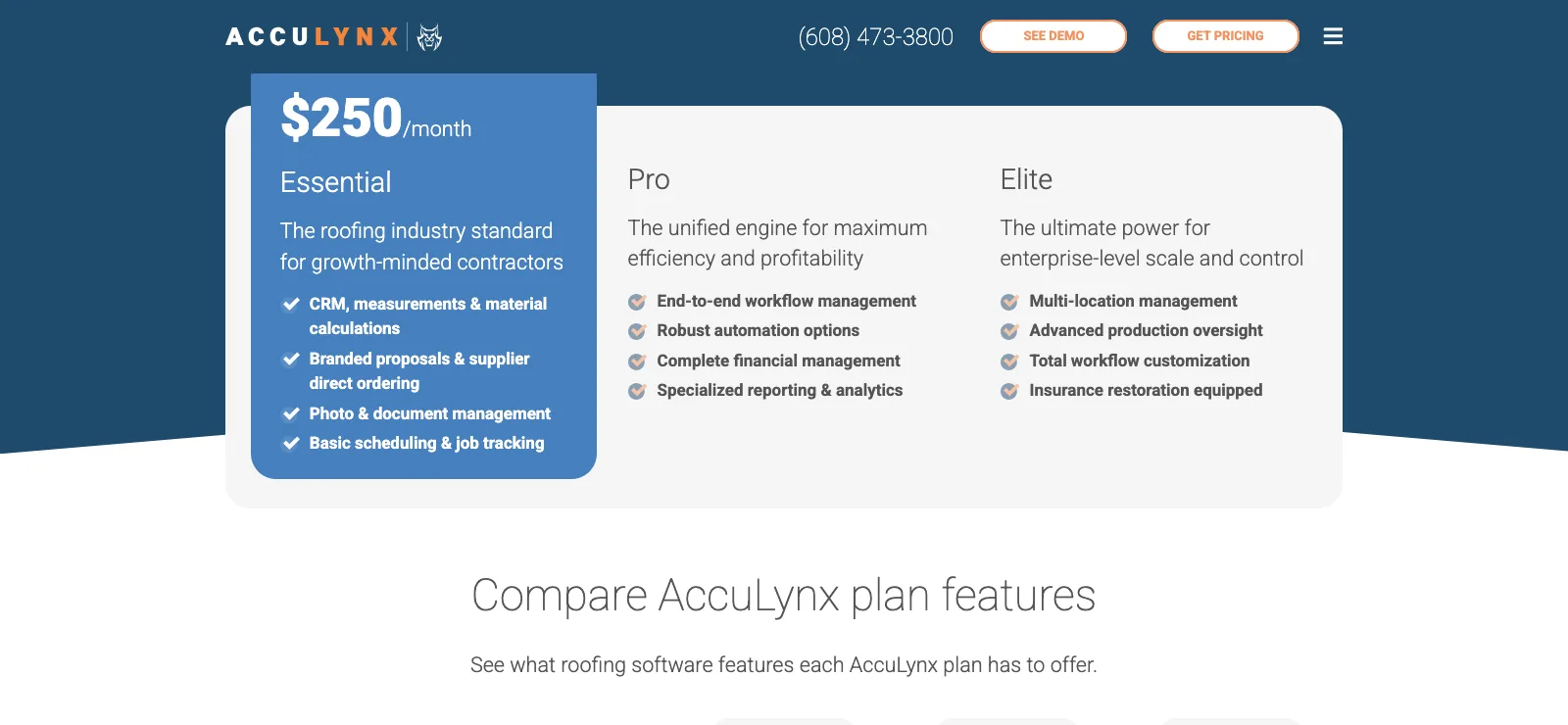 Jul 30, 2026
 Tech Stack
AccuLynx Pricing 2026: The Real Cost of a Quote-Gated Plan
One published figure, two blank plan cards, and a contract that says things the pricing page does not. A line-by-line breakdown of what AccuLynx really bills.
Read Article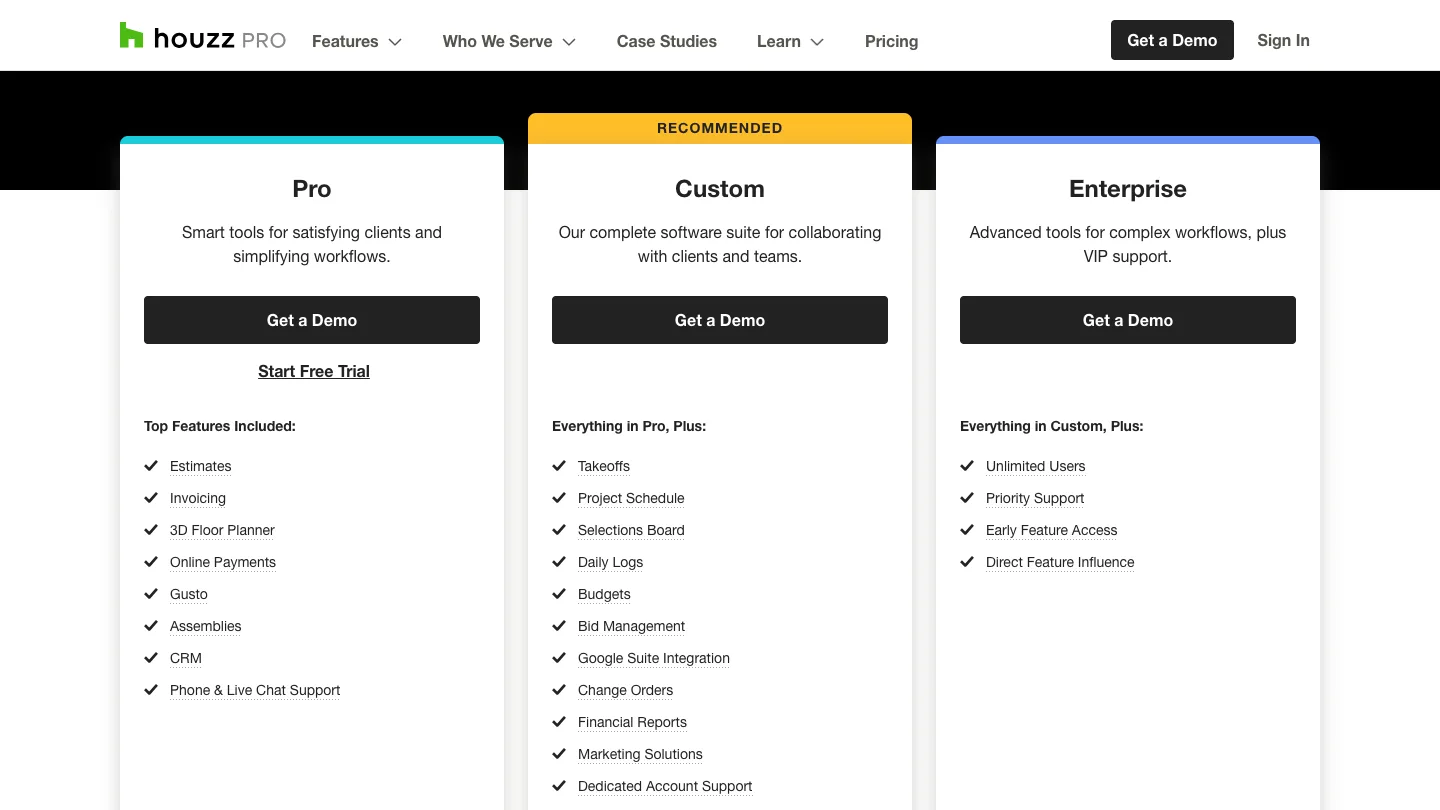 Jul 30, 2026
 Tech Stack
Houzz Pro Canada Review 2026: Pricing and Alternatives
Houzz Pro serves different pricing renderings. What Canadian buyers see, how GST/HST and payments work, what Custom gates, and what the annual contract commits you to.
Read Article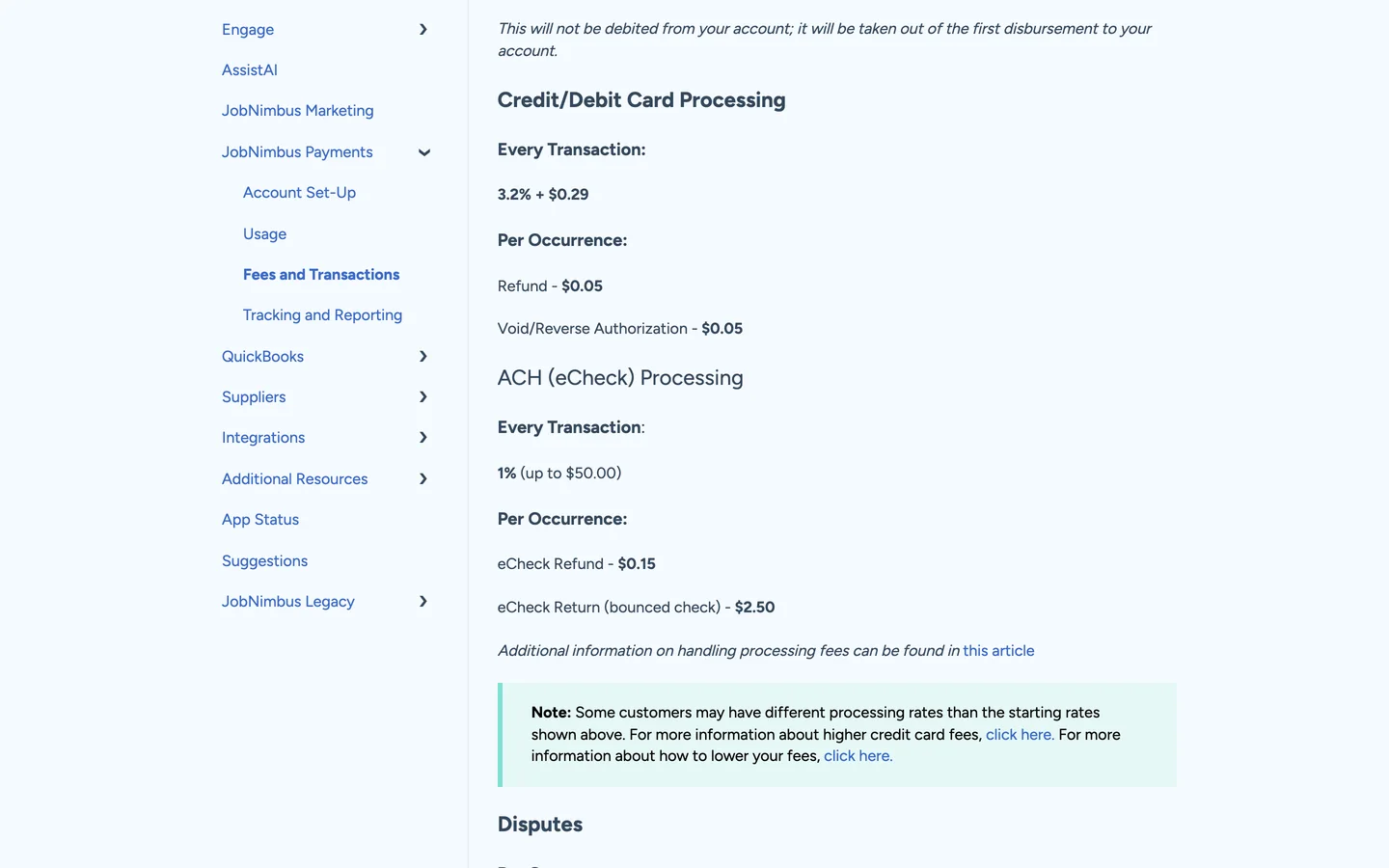 Jul 30, 2026
 Tech Stack
JobNimbus Pricing in 2026: What the Quote Does Not Cover
JobNimbus prints no figure on any of its four plans. So the only rate you can read before a sales call is the payments meter, and it is the biggest line on the bill.
Read Article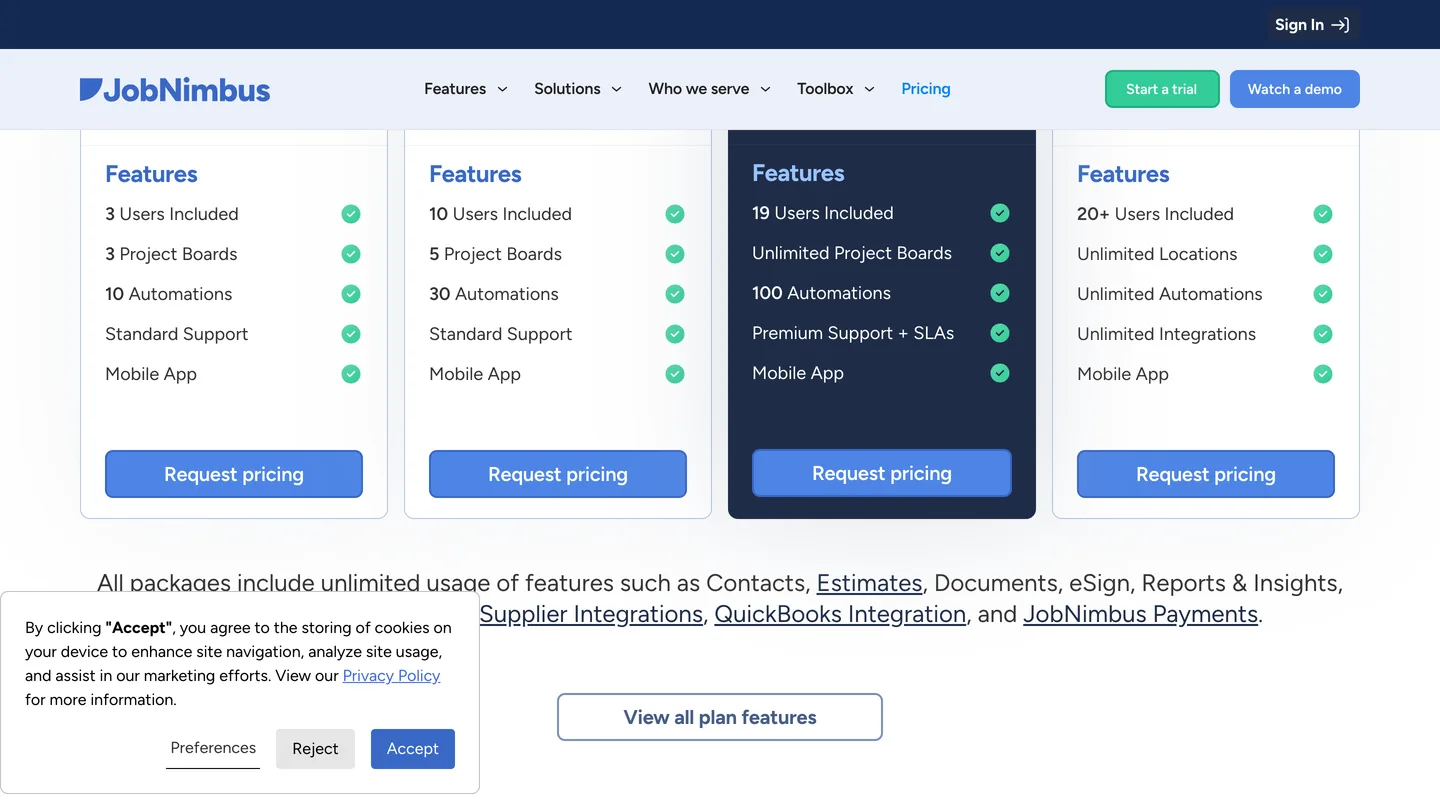 Jul 30, 2026
 Tech Stack
JobNimbus Review 2026: Pricing, Pros, Cons and Alternatives
JobNimbus rates 4.6 on Capterra and orders material straight from ABC Supply and SRS. But it publishes no price, and its supplement route carries a note.
Read Article Jul 30, 2026
 Tech Stack
BuildOps Review 2026: Pricing, Contract Terms and Alternatives
BuildOps runs commercial service and projects on one platform, and publishes no pricing at all. The billing unit, the 30-day data-export window, and who it suits.
Read Article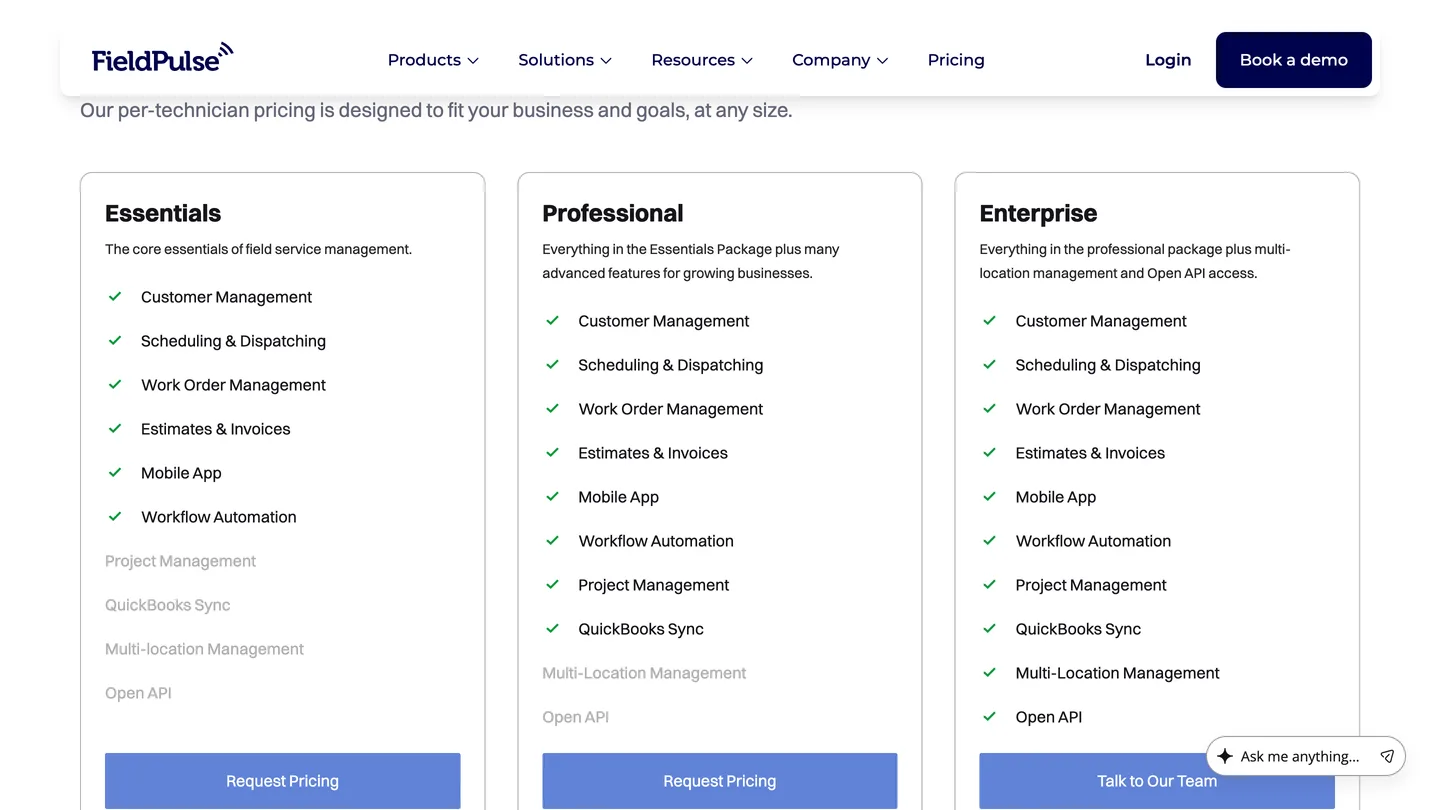 Jul 30, 2026
 Tech Stack
FieldPulse Review 2026: Pricing, Pros, Cons and Alternatives
FieldPulse rates 4.6 on Capterra and is the platform contractors name when they leave a bigger system. But it publishes no price, and the contract runs a year.
Read Article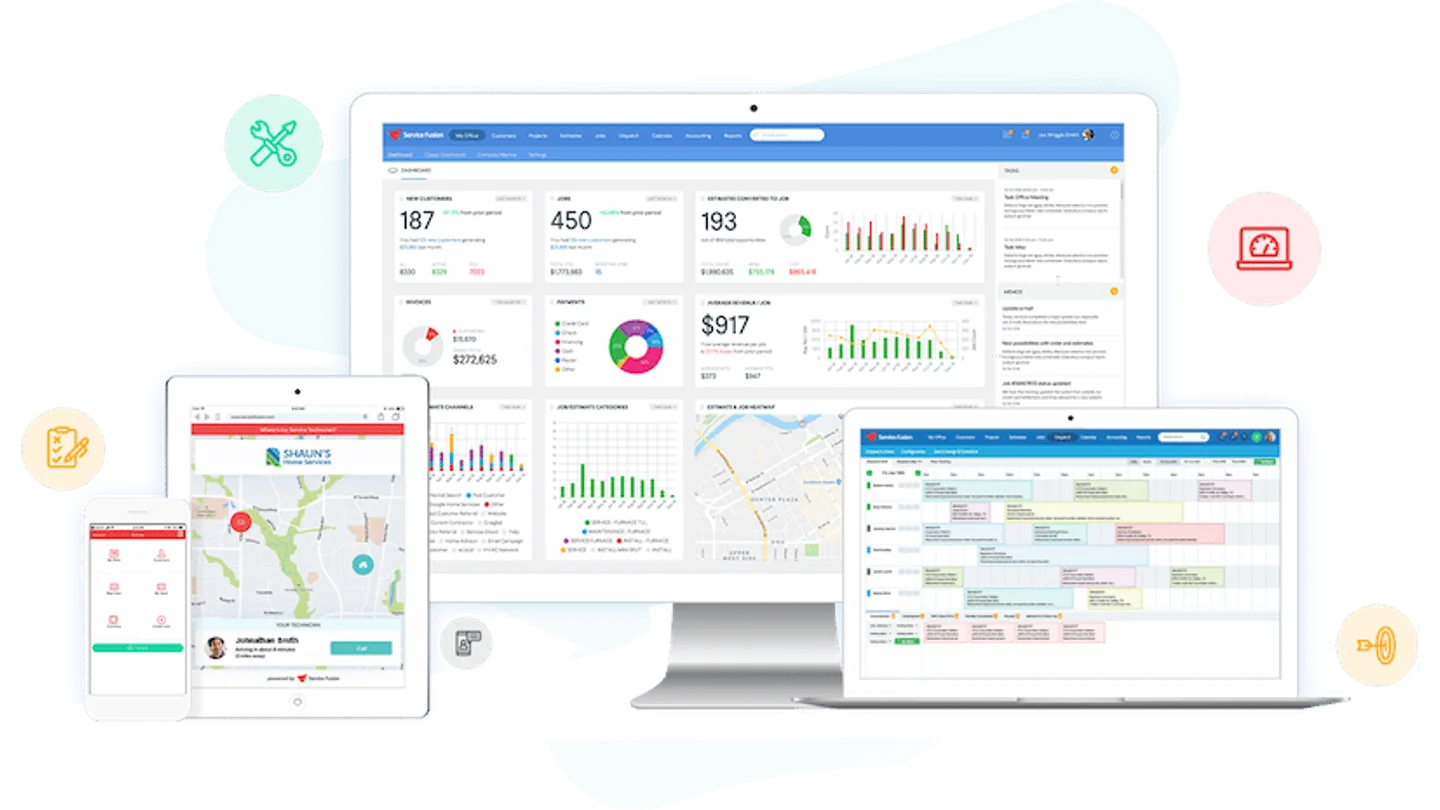 Jul 30, 2026
 Tech Stack
Service Fusion Review 2026: Pricing, Contract and Alternatives
Service Fusion bills flat per company with unlimited users, which is the best structural deal in field service software. The published plans, the contract behind the no-contract line, and the app score every other review gets wrong.
Read Article Jul 30, 2026
 Tech Stack
Knowify Review 2026: Pricing, Job Costing and Alternatives
Knowify rates 4.5 on Capterra and its weakest sub-score is features. What the $99 Core plan withholds, which way the QuickBooks sync really runs, and who should not buy it.
Read Article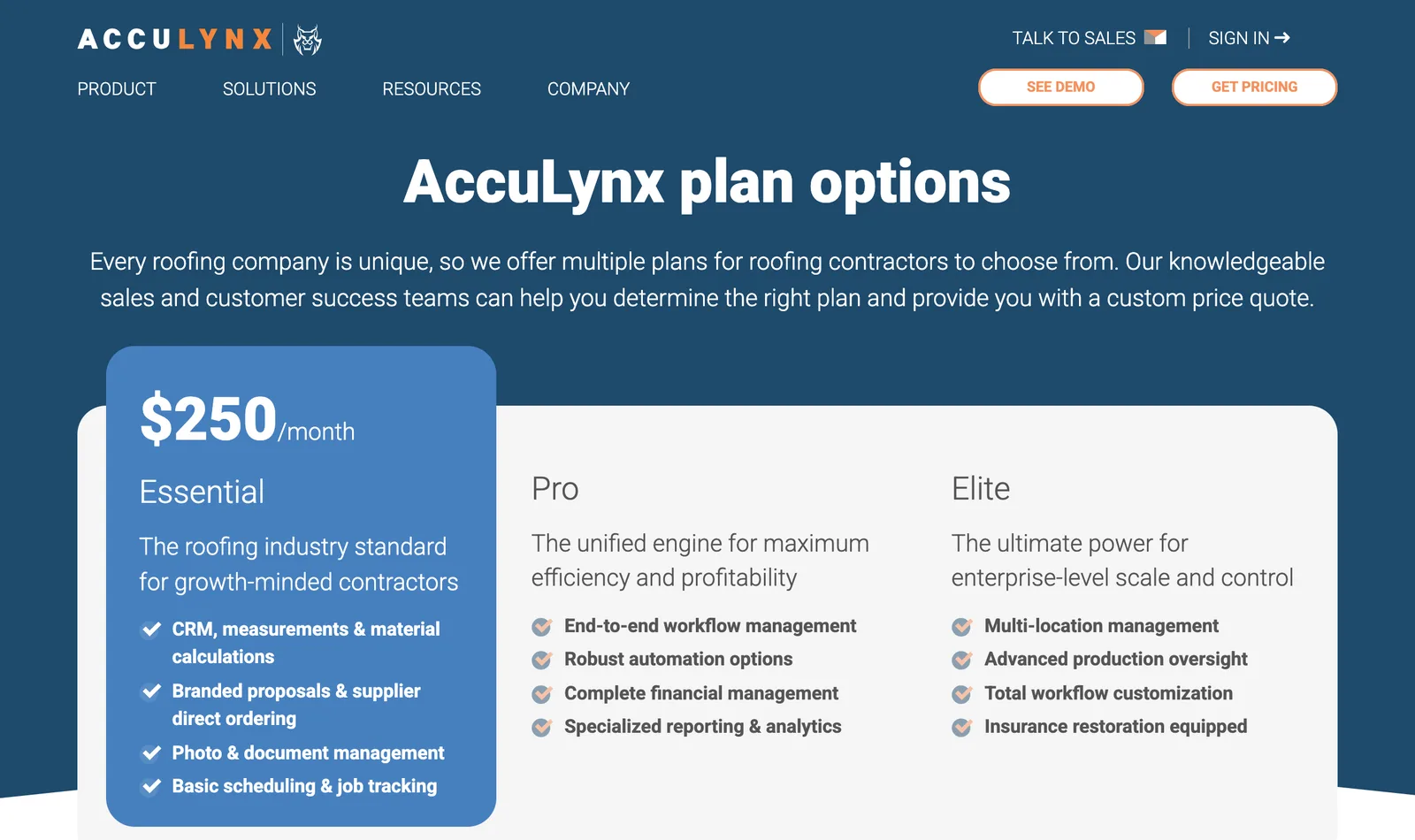 Jul 29, 2026
 Tech Stack
AccuLynx Review 2026: Pricing, Tier Gating, Alternatives
AccuLynx rates 4.6 across 846 reviews and now publishes an entry price. What that price omits, which tier holds the insurance workflow, and who should skip it.
Read Article Jul 29, 2026
 Tech Stack
Unitel Voice Review 2026: Pricing, Features and Alternatives
Unitel Voice rates 4.6 on Capterra and gives a one-truck shop a business number for $9.99 a month. The published plans, the cost per call, and what it won't do.
Read Article Jul 29, 2026
 Tech Stack
NiceJob vs Podium 2026: Pricing, Contracts and Review Gating
Both vendors print a price, at very different scale and in different currencies. The gap that matters is what Podium will not print: the billing unit, and whether a trade shop gets the number on the page.
Read Article Jul 28, 2026
 Tech Stack
CompanyCam Review 2026: Pricing, Pros, Cons and Alternatives
Every page ranking for CompanyCam still quotes a per-user price the vendor no longer charges. Here are the real plans, the seat math, and who should skip it.
Read Article Jul 28, 2026
 Tech Stack
NiceJob Review 2026: Pricing, Pros, Cons and Alternatives
NiceJob rates 4.9 on Capterra and refuses to gate negative reviews. Real plan pricing, the active-customer threshold nobody publishes, and who should skip it.
Read Article Jul 27, 2026
 Tech Stack
Buildertrend Review 2026: Pricing, Limits and Alternatives
Buildertrend rates 4.5 across 2,486 Capterra reviews and quotes against your revenue rather than your seat count. The workflows, the export problem, the alternatives.
Read Article Jul 27, 2026
 Tech Stack
CallRail Review 2026: Pricing, Pros, Cons and Alternatives
CallRail rates 4.5 on Capterra, and its tracking numbers port out free. But the two usage rates that decide your real bill are the two it does not print.
Read Article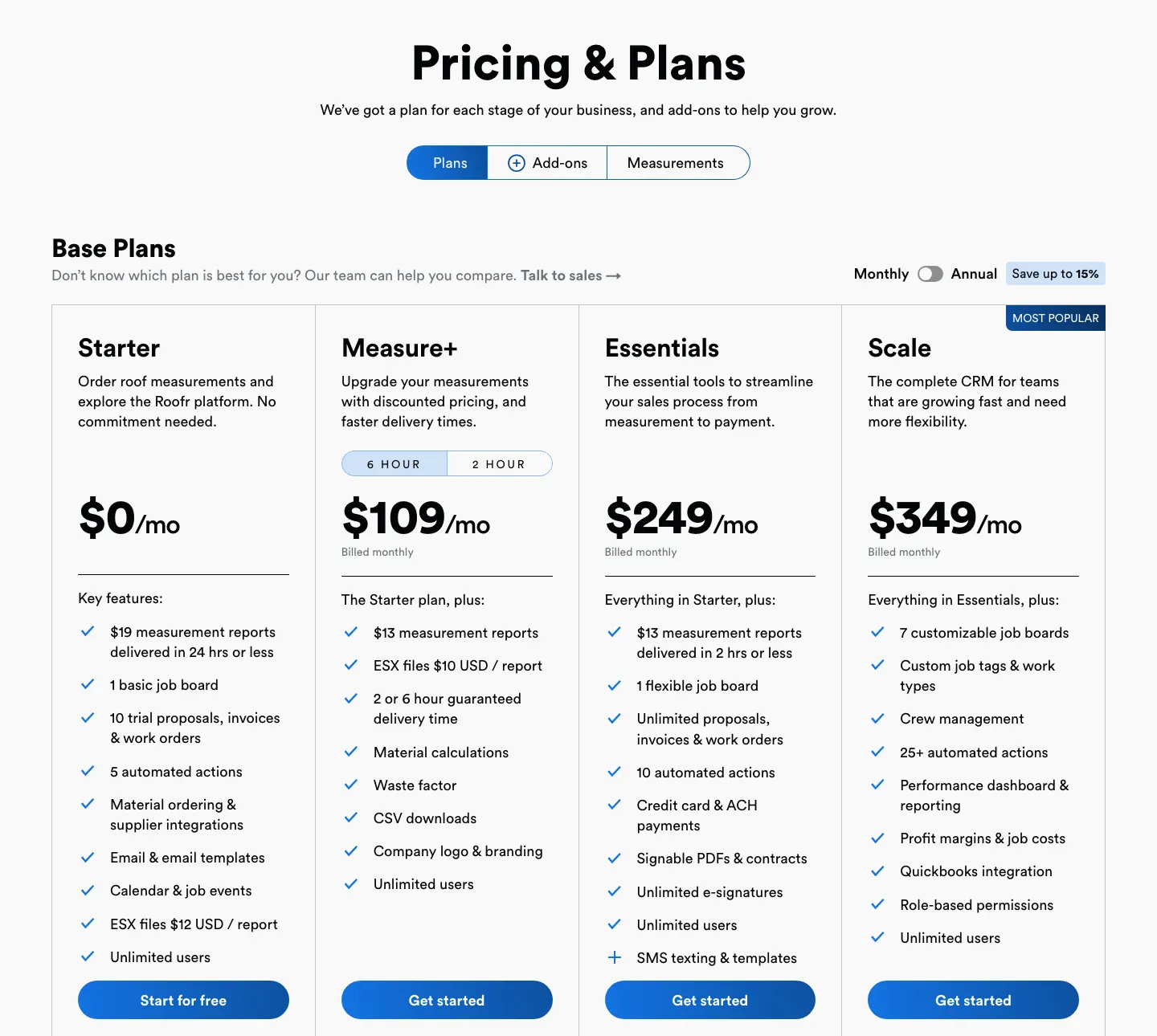 Jul 27, 2026
 Tech Stack
Roofr Review 2026: Pricing, Pros, Cons and Alternatives
Roofr rates 4.6 on Capterra and sells $13 measurement reports against a market charging triple. But it will not import a report from anywhere else.
Read Article Jul 25, 2026
 Tech Stack
Housecall Pro Review 2026: Pricing, Pros, Cons, Alternatives
Housecall Pro has the shortest learning curve in the category and the widest review spread. Real pricing, the Instapay math, and the migration trap to plan around.
Read Article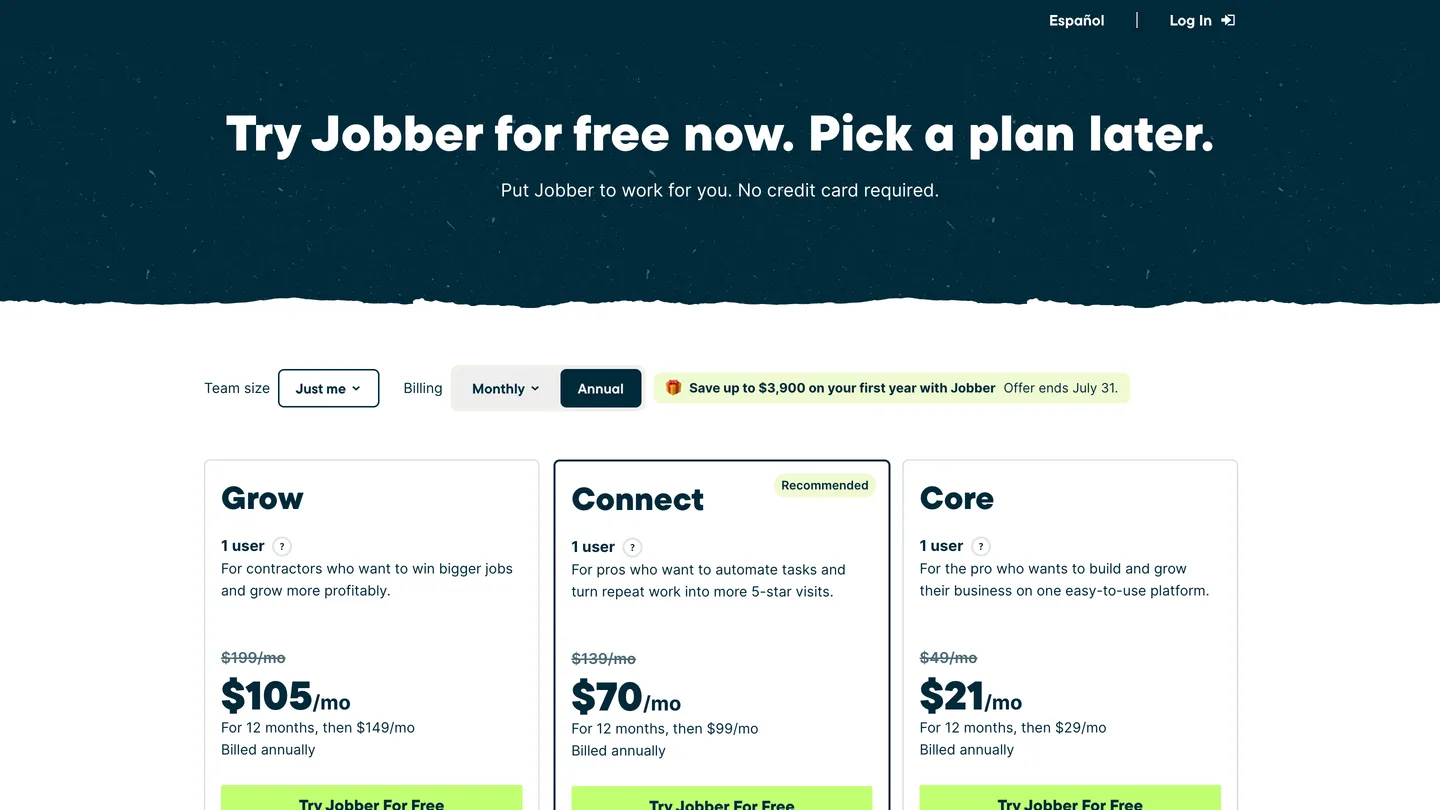 Jul 24, 2026
 Tech Stack
Jobber Review 2026: Pricing, Pros, Cons and Alternatives
Jobber rates 4.6 on Capterra with the best mobile app in the category. Real plan pricing, the feature gating that changes your entry price, and who it suits.
Read Article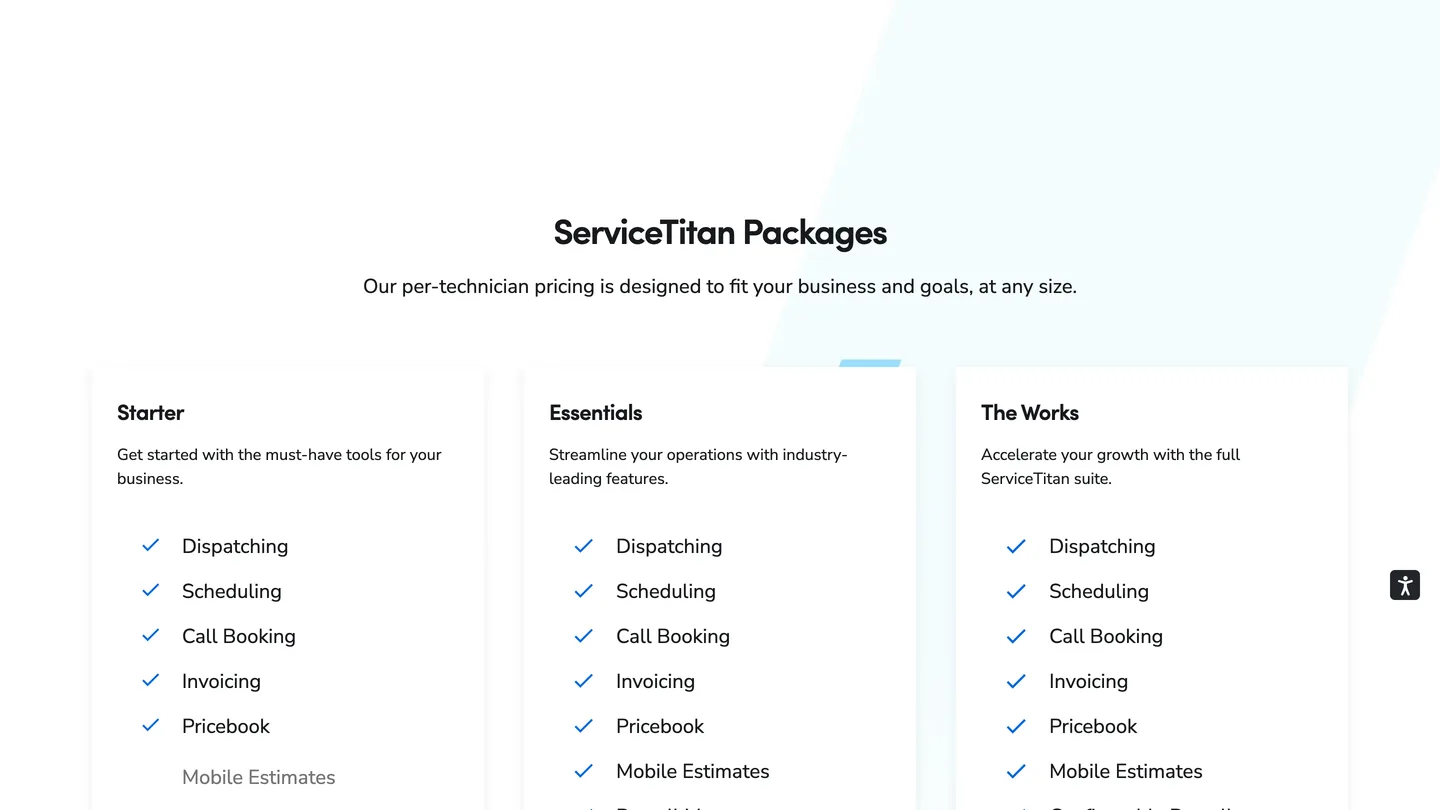 Jul 23, 2026
 Tech Stack
ServiceTitan Review 2026: Pricing, Pros, Cons, Alternatives
ServiceTitan rates 4.3 on Capterra but its weakest score is value for money. Real reported pricing, the 12-month contract, the exit fees, and who it suits.
Read Article Jun 3, 2026
 Tech Stack
HVAC Online Scheduling: The 43% Losing After-Hours Bookings
HVAC leads every trade on online booking at just 56.7%, which still leaves 43% of sites forcing an after-hours customer to wait for a business-hours phone call.
Read Article