Chief Architect Premier Review 2026: Pricing, Pros, Cons, Alternatives
Chief Architect Premier starts at $1,995/yr.. What each tier gates, the 7 limitations reviewers name, and 5 alternatives with published prices.
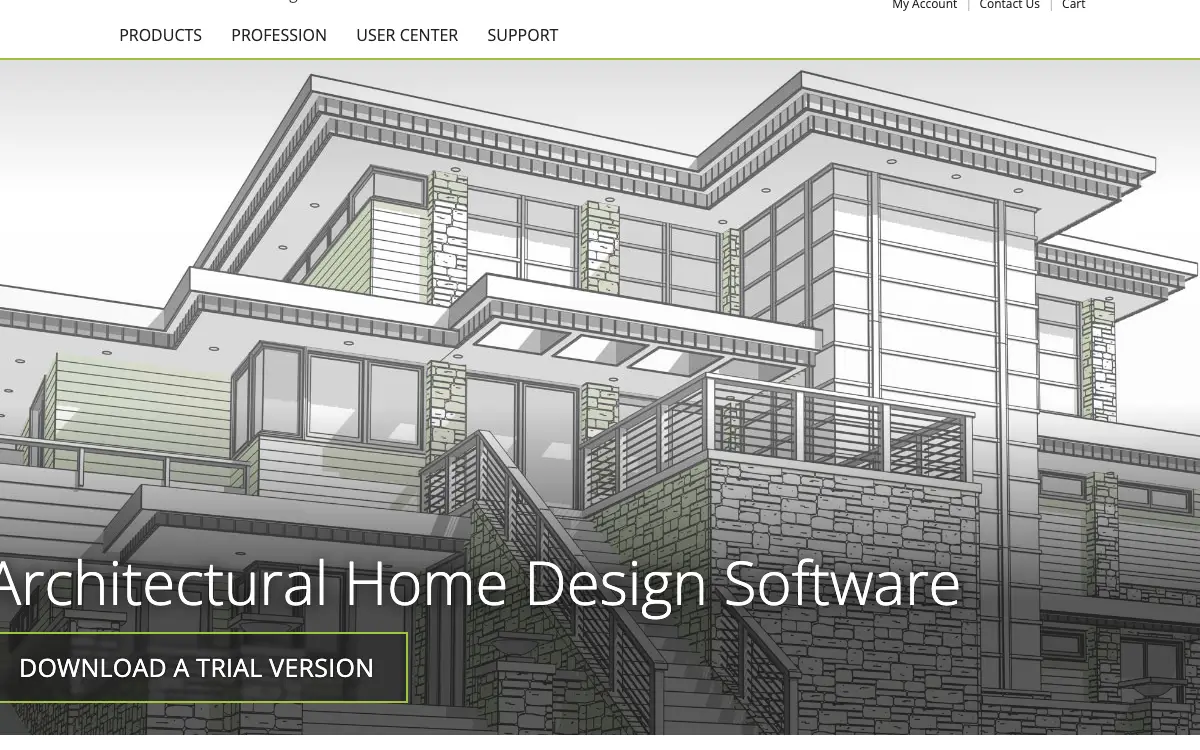
Page at a glance
Chief Architect Premier is Draw the walls, and the framing, roof, schedules and NAHB-coded materials list come out the other side. One seat, one machine at a time, $1,995 a year. It starts at $1,995/yr. per user (single-user license), per year. Strictly one named person per licence, one active machine at a time, enforced by online activation. Vendor wording: 'Chief Architect is a single-user license intended for only one person. The software can be installed on as many computers as needed; however, a single software license can only be active on one computer at a time. You will need your product key and an internet connection to switch between computers. If multiple users will be using the software, you must purchase a separate license for each person.' There is no team plan, no floating/concurrent licence, no admin console and no volume tier published anywhere on the site. Two designers means $3,990/yr. It fits Solo designers and 1-to-8-person design-build shops doing residential custom homes, whole-house remodels and kitchen/bath work who produce their own permit-grade construction documents in-house instead of sending concepts out to an architect. It's the wrong buy for A design team of three or more people who need to work on the same house at the same time, because The licence is one person per seat with one active machine at a time, there's no concurrent or floating option published, and the vendor explicitly advises against putting working files on a network server or cloud storage. Collaboration is a manual .caproj export-and-email. So at three seats you're at $5,985/yr for software that still can't let two people in the same plan. Alternatives that publish their prices are Home Designer from $495, SketchUp Pro from $33.25, Cedreo from $129. Four priced tiers, seven evidenced gaps and five alternatives, three of which publish a figure.
Chief Architect Premier, in one paragraph
Chief Architect Premier earns its money with Solo designers and 1-to-8-person design-build shops doing residential custom homes, whole-house remodels and kitchen/bath work who produce their own permit-grade construction documents in-house instead of sending concepts out to an architect. If that's you, it does the job. The sections below are the parts worth checking before you sign. But the fit is narrower than the marketing suggests, and the price isn't the whole cost.
It starts at $1,995/yr.. And pricing was verified on 7 August 2026, so you can check every figure below in a browser tab.
| Pricing model | Published tiers |
|---|---|
| Entry price | $1,995/yr. |
| Users | Strictly one named person per licence, one active machine at a time, enforced by online ac |
| Ownership | Independent |
| Best fit | Solo designers and 1-to-8-person design-build shops doing residential custom homes, whole-house remodels and kitchen/bath work who produce their own permit-grade construction documents in-house instead of sending concepts out to an architect. |
| Accounting sync | Buildertrend (one-way), Microsoft Excel (one-way) |
What works
- The 3D model, the framing and the materials list are all the same object, so a wall move updates all three
- The materials list carries NAHB accounting codes and exports to Buildertrend or a spreadsheet - one way, as a file
- Free iPhone LiDAR scanning feeds the remodel, and the homeowner can do the scanning
- The render is the product, and it ships to the web as an embeddable 3D model or an 8192x4096 still
- Export is genuinely well documented, which is rare - but it's manual, and it only works while the licence is alive
What does not
- The vendor tells you in writing not to keep your working files on a shared drive, which is the shared-drive workflow every 2-to-8-person shop already runs
- A declined card ends your software rather than pausing it, and your plan files only open in the software
- The drawing looks finished before it's finished, and the field pays for the difference
- Your $1,995/yr doesn't include a machine that can render, and the recommended spec isn't a suggestion
- Support for the version you're running expires on the vendor's schedule, and then costs $125 a call
Chief Architect Premier is Draw the walls, and the framing, roof, schedules and NAHB-coded materials list come out the other side. One seat, one machine at a time, $1,995 a year. It sells to Custom home building and Kitchen and bath and Remodeling contractors, and the shape of the product follows from that: You draw in 2D and the 3D builds alongside, automatically framed. Walls carry layered assemblies and 'All the Wall layers calculate into the Materials List'. Roofs auto-generate with trusses, and the truss chords and webbing report to the materials list. Schedules for doors, windows, cabinets, fixtures, appliances and furniture generate from the same model. And this single-source behaviour is the reason the tool costs what it does, and it's what the positive reviews describe.
Chief Architect Premier: right buyer, wrong buyer
It fits Solo designers and 1-to-8-person design-build shops doing residential custom homes, whole-house remodels and kitchen/bath work who produce their own permit-grade construction documents in-house instead of sending concepts out to an architect. That's the half most reviews print. Here's the other half, which is the one worth your time.
Don't buy it if you're A design team of three or more people who need to work on the same house at the same time. The licence is one person per seat with one active machine at a time, there's no concurrent or floating option published, and the vendor explicitly advises against putting working files on a network server or cloud storage. Collaboration is a manual .caproj export-and-email. So at three seats you're at $5,985/yr for software that still can't let two people in the same plan. Look at Cedreo instead.
Don't buy it if you're A commercial contractor, or anyone whose drawings have to enter a BIM coordination workflow. Chief Architect Premier is residential automation - walls, roofs, framing, cabinets, decks, terrain. It exports DWG, DXF, 3DS, STL and Collada. But it doesn't export IFC, and IFC doesn't appear anywhere on the feature list. A reviewing architect puts it plainly: complex geometry, shell structures and space frames are 'not easy with this application'. So if a GC or engineer asks for a federated model, you have nothing to hand them. Look at Revit, Vectorworks Architect, or Archicad instead.
Don't buy it if you're A kitchen-and-bath dealer whose real job is specifying and ordering a named manufacturer's cabinet line. The library is a paid placement channel - manufacturers pay a '$500 Annual Fee' to get their catalogs hosted - so coverage follows who paid, not what you sell. Two separate reviewers hit the wall: 'Not being able to bring outside furniture from companies an place inside the drawings' and 'So time consuming and challenging compared to other programs specifically when you are using for Kitchen design, which it is marketed as.' And dealer-grade catalog-and-order software solves a different problem. Look at 2020 Design Live instead.
Don't buy it if you're A remodeler who only needs a picture to close the sale and hands permit drawings to an architect anyway. You'd be paying $1,995/yr and buying a $3,000 workstation for the construction-document engine you'll never open. And the same vendor sells Home Designer at $495/yr for exactly this job, with browser-based tools selling the render for less again without tying you to one machine. Look at Home Designer (same vendor, $495/yr) or Cedreo instead.
What you'll pay Chief Architect Premier in year one
Chief Architect Premier prints its numbers on its own site. Good. That means you can price your real configuration tonight instead of waiting on a rep.
| Tier | Price | Billing unit | What it unlocks |
|---|---|---|---|
| Chief Architect Premier - Billed Annually | $1,995/yr. | per user (single-user license), per year | Nothing beyond the tier below |
| Chief Architect Premier - Billed Monthly | $229/mo. | per user (single-user license), per month | Nothing beyond the tier below |
| Legacy-license upgrade (first year) | $995 first year | per user (single-user license), first year only, then $1,995/yr. | must already own a legacy (perpetual) Chief Architect license |
| Home Designer to Premier conversion | $1,495 / $1,795 / $1,895 first year (against a $1,995 reference price) | per user (single-user license), first year only | must already own a Home Designer license, the discount tier depends on WHICH Home Designer product you own - three different prices are wired into the same dropdown |
Strictly one named person per licence, one active machine at a time, enforced by online activation. Vendor wording: 'Chief Architect is a single-user license intended for only one person. The software can be installed on as many computers as needed; however, a single software license can only be active on one computer at a time. You will need your product key and an internet connection to switch between computers. If multiple users will be using the software, you must purchase a separate license for each person.' There is no team plan, no floating/concurrent licence, no admin console and no volume tier published anywhere on the site. Two designers means $3,990/yr.
There is a discount for paying annually up front: Annual billing is $1,995/yr against $229/mo monthly ($2,748/yr), which the vendor labels 'save 27%' and expresses as '$166.25/mo.'. Re-derivation: 1 - (1995 / (229 x 12)) = 27.4%, so the vendor's number is honest. The trap is that the discount is the ONLY route to the refund: annual subscriptions qualify for the 2-week money-back guarantee and monthly subscriptions explicitly do not. And an annual prepay discount tells you an annual commitment exists, which is worth knowing before anyone mentions a term length out loud.
What isn't in the Chief Architect Premier number you get quoted
Payment processing. Credit card only, and the card is load-bearing. 'For annual licenses, payments will be charged to your credit card one year from the day you began your software subscription. For monthly licenses, payments will be charged to your credit card each month on the day you began your software subscription.' No ACH, invoicing or PO option is published. Chief Architect Premier does not process YOUR customers' payments at all - there is no deposit, invoicing or payment feature in the product. It is a drawing tool, and the money is collected somewhere else.
Implementation and onboarding. But training is priced like an implementation fee that the vendor simply declines to call one: one-on-one Personal Training runs $150 for 1 hour, $750 for 5 hours (discounted to $675) and $1,500 for 10 hours (discounted to $1,200), and Custom Virtual Training is $375 per hour for up to 15 trainees. On-demand classes are pitched at a '$495 value'. So ask the sales line whether the free introductory on-demand class currently promoted 'through August 25' is a permanent inclusion or a lapsing promotion, and budget for at least the 10-hour package if nobody on the crew has used the program before - multiple reviewers describe a learning curve they never fully cleared.
Minimum term. One year on the annual plan, one month on the monthly plan, charged on the anniversary of the day you started. 'Software rentals have been replaced with subscriptions.' There is no published multi-year lock and no published enterprise agreement.
Getting out. No early-termination fee, but no proration either, and cancellation is not self-executing. 'Manage your subscription online through your Digital Locker or contact us by phone. Your subscription is only canceled after you receive a cancellation confirmation from Chief Architect. Access to the software will end at the conclusion of the current billing period.' Two harder edges sit next to that: 'What happens if a subscription payment is missed, late, or declined? The subscription will be canceled and your software access will end.' And a separate support article warns that turning the software off is not the same as turning the billing off: 'Deactivating a license on any particular machine does not affect a subscription or an auto-renewal process for payment.'
Auto-renewal. Auto-renewal is the default and is confirmed obliquely rather than in a headline: the multiple-computers article refers to 'a subscription or an auto-renewal process for payment' and the FAQ describes charges recurring automatically on the anniversary date unless you obtain a cancellation confirmation. The 2-week money-back guarantee is one-shot: 'The money-back guarantee is a limited one-time offer. We are happy to refund your purchase one time, but not for subsequent purchases' - so a renewal you meant to cancel is not refundable if you already used the guarantee once.
Modules sold separately. , , , , . The Chief Architect Premier figure worth writing down is the one with your day-one modules already in it, not the headline tier.
Third-party services you will also pay for. , . These are not on Chief Architect Premier's invoice, and they are still part of what this decision costs you every month.
Side note, and it's a useful one: the published price is one number; the first-year cost is three. $1,995 for the licence, a workstation that meets a 32 GB / RTX 5080 / 1 TB SSD recommendation, and training that the vendor prices like consulting - $150 an hour one-on-one, $1,200 for a ten-hour package, $375 an hour for group sessions - while never calling any of it an implementation fee. Don't compare Chief Architect's $1,995 against SketchUp Pro's $33.25/month and stop there. Compare $1,995 + a machine + ten hours of training against the drafting invoices you currently pay. So that's the honest first-year number, and it's still often the right call for a shop producing its own permit sets.
What a Chief Architect Premier quote leaves out
The subscription is the part everyone quotes. These are the lines that land afterwards, and the ones we could not find are named as unpublished rather than left blank.
Sold separately. , , , , . Price the configuration you'll really run, because an add-on you need on day one is part of the price.
Third-party services you'll also pay for. , . None of these are on Chief Architect Premier's invoice, and all of them are part of what this decision costs every month.
"Chief Architect Premier Chief Architect Premier - Billed Annually is $1,995/yr., per user (single-user license), per year."
Chief Architect Premier pricing page (2026)
"Chief Architect Premier Chief Architect Premier - Billed Monthly is $229/mo., per user (single-user license), per month."
Chief Architect Premier pricing page (2026)
"Strictly one named person per licence, one active machine at a time, enforced by online activation. Vendor wording: 'Chief Architect is a single-user license intended for only one person. The software can be installed on as many computers as needed; however, a single software license can only be active on one computer at a time. You will need your product key and an internet connection to switch between computers. If multiple users will be using the software, you must purchase a separate license for each person.' There is no team plan, no floating/concurrent licence, no admin console and no volume tier published anywhere on the site. Two designers means $3,990/yr."
Chief Architect Premier pricing page (2026)
The five workflows you pay for
Feature totals are noise. So a shop in this category lives or dies on five things, and those are the five to grade, and each one below carries the evidence it's graded on.
The 3D model, the framing and the materials list are all the same object, so a wall move updates all three You draw in 2D and the 3D builds alongside, automatically framed. Walls carry layered assemblies and 'All the Wall layers calculate into the Materials List'. Roofs auto-generate with trusses, and the truss chords and webbing report to the materials list. Schedules for doors, windows, cabinets, fixtures, appliances and furniture generate from the same model. And this single-source behaviour is the reason the tool costs what it does, and it's what the positive reviews describe. And a kitchen and bath designer, construction, 2-10 employees, More than 2 years on the platform, writing on 2023-05-03, reports it the same thing: "I love that I can use one-floor plan to create everything I need to provide to the customers, the foreman, the trades, and the designers to be able to have concepts come to light. Notes, dimensions, and materials are all easily accessible in the program."
The materials list carries NAHB accounting codes and exports to Buildertrend or a spreadsheet - one way, as a file Materials lists carry columns for equipment, unit costs, percent markup and labor costs, and a Master Materials List stores your master pricing so it reloads into each new project. Custom formulas are possible through Ruby macros. The export targets are Microsoft Excel, CSV, TXT and HTML, plus a dedicated Buildertrend export. But nothing syncs. You generate a file and you carry it.
Free iPhone LiDAR scanning feeds the remodel, and the homeowner can do the scanning The Chief Architect As-Built app uses iPhone/iPad LiDAR to build a 3D room model, refine it with a Bluetooth laser meter, then push it to Chief Cloud for import into Premier X18. The vendor's own framing of the workflow is the interesting part for a remodeler: 'Even your clients can scan their rooms for you, saving you time.' The app and the cloud access are free. But the catch is platform: it's Apple-only.
The render is the product, and it ships to the web as an embeddable 3D model or an 8192x4096 still Ray-traced and rendered cameras export up to 8192 x 4096, 360-degree spherical views can be shared to the cloud and embedded in websites, and the free 3D Viewer app (iOS and Android) plus web embed lets a client walk the model with AR. Recorded walkthroughs post to a Chief Architect cloud account for sharing by email, hyperlink or website embed. And every positive review in the vendor's own testimonial set is about this, not about framing.
Export is genuinely well documented, which is rare - but it's manual, and it only works while the licence is alive KB-00013 walks through File > Export > Export Current View (DWG, DXF) and Export All Floors, with AutoCAD version targeting, layer options, associative dimensions and index-colour mapping. KB-03212 covers Export Project to a portable .caproj bundle that carries every referenced asset. KB-00001 covers backing up user content for transfer to another machine. Nothing is held hostage. But every one of these paths runs inside the running program.
Which trades get value from Chief Architect Premier
Fit differs by trade rather than by company size alone, and a blended paragraph hides that. Here is the split for the trades this one sells to.
Custom home building. The workflow that decides it is the 3d model, the framing and the materials list are all the same object, so a wall move updates all three, and the shop profile that gets value is solo designer or one-person design-build doing residential custom homes and whole-house remodels, producing their own permit set doing residential work. Where it stops being a fit is A design team of three or more people who need to work on the same house at the same time.
Kitchen and bath. The workflow that decides it is the 3d model, the framing and the materials list are all the same object, so a wall move updates all three, and the shop profile that gets value is solo designer or one-person design-build doing residential custom homes and whole-house remodels, producing their own permit set doing residential work. Where it stops being a fit is A design team of three or more people who need to work on the same house at the same time.
Remodeling. The workflow that decides it is the 3d model, the framing and the materials list are all the same object, so a wall move updates all three, and the shop profile that gets value is solo designer or one-person design-build doing residential custom homes and whole-house remodels, producing their own permit set doing residential work. Where it stops being a fit is A design team of three or more people who need to work on the same house at the same time.
How Chief Architect Premier talks to your books
Buildertrend connects one way only, so edits made in your books do not come back, on every plan. Microsoft Excel connects one way only, so edits made in your books do not come back, on every plan. Your costs map through cost codes, so test yours against your own chart of accounts before you commit. A code your books don't recognise is how a labour charge quietly lands somewhere useless.
Past those, the road ends. QuickBooks / Xero / Sage, IFC / BIM interchange, Revit, CRM, proposal, e-signature and payment tools do not connect. So if your books run on an ERP rather than the platforms named above, weigh that before anything else.
Beyond accounting it connects to AutoCAD (Autodesk) (Two-way DWG and DXF for 2D line work (plan views, elevations, CAD details) with a Compatible Version selector, plus 3D DWG/DXF import and export. And this is the handoff to an engineer or a municipality that wants CAD.), SketchUp (.SKP) (Import only. You can pull SketchUp geometry and 3D Warehouse content in - including a 3D Mass Import that converts a batch of SKP/DWG/DXF/3DS/OBJ files into library objects - but there's no SKP export.), Adobe PDF (PDF import into plans, layouts and CAD details with print resolution retained, plus PDF output for sheet sets sent out for printing.), GPS / GPX devices (Terrain generation from surveyed points captured on a phone or handheld GPS.), Chief Cloud / Chief Architect 3D Viewer (first-party) (Free web and mobile viewer (iOS and Android) with AR, embeddable on your own website via a copy-paste embed code from your cloud account. And there's a free desktop viewer for sending plans to people without a licence.), Chief As-Built (first-party, Apple only) (Free iPhone/iPad LiDAR room scanner that pushes models through Chief Cloud into Premier X18. No Android build.). A public API exists: No public or web API, and no documentation of one anywhere on the site. The closest thing is Ruby scripting that runs INSIDE the application: a Ruby Scripting Console for user-defined macros, Ruby macros that build custom formulas in the materials list, and importable/exportable Ruby scripts. That lets you automate within a plan file. It does not let another system talk to Chief Architect.
Chief Architect Premier support, and what it costs you
Support is the line item nobody prices and everybody eventually needs. Chief Architect Premier publishes no onboarding fee either way, so ask what is included at your tier and what is billed hourly after go-live.
The review corpus we read on 7 August 2026 carries no consistent signal on response times either way, so treat support as untested rather than good. Open a real ticket during the trial and time the reply, because that is the number no pricing page gives you.
Chief Architect Premier contracts, and getting out
Nobody reads this section before they buy, and it's the one that costs money afterwards. Four terms decide what leaving looks like.
Minimum term. One year on the annual plan, one month on the monthly plan, charged on the anniversary of the day you started. 'Software rentals have been replaced with subscriptions.' There is no published multi-year lock and no published enterprise agreement.
Auto-renewal. Auto-renewal is the default and is confirmed obliquely rather than in a headline: the multiple-computers article refers to 'a subscription or an auto-renewal process for payment' and the FAQ describes charges recurring automatically on the anniversary date unless you obtain a cancellation confirmation. The 2-week money-back guarantee is one-shot: 'The money-back guarantee is a limited one-time offer. We are happy to refund your purchase one time, but not for subsequent purchases' - so a renewal you meant to cancel is not refundable if you already used the guarantee once.
Early termination. No early-termination fee, but no proration either, and cancellation is not self-executing. 'Manage your subscription online through your Digital Locker or contact us by phone. Your subscription is only canceled after you receive a cancellation confirmation from Chief Architect. Access to the software will end at the conclusion of the current billing period.' Two harder edges sit next to that: 'What happens if a subscription payment is missed, late, or declined? The subscription will be canceled and your software access will end.' And a separate support article warns that turning the software off is not the same as turning the billing off: 'Deactivating a license on any particular machine does not affect a subscription or an auto-renewal process for payment.'
Payment processing. Credit card only, and the card is load-bearing. 'For annual licenses, payments will be charged to your credit card one year from the day you began your software subscription. For monthly licenses, payments will be charged to your credit card each month on the day you began your software subscription.' No ACH, invoicing or PO option is published. Chief Architect Premier does not process YOUR customers' payments at all - there is no deposit, invoicing or payment feature in the product. It is a drawing tool, and the money is collected somewhere else.
And this is the kind of thing you only find by reading the complaints. A missed payment locks you out rather than downgrading you, and everything you drew lives in a proprietary format on a local hard drive that the vendor explicitly told you not to sync anywhere. 'The subscription will be canceled and your software access will end.' The escape hatches (DWG/DXF export, .caproj project export, the free Desktop Viewer) are all documented and all genuinely good. But every one of them runs inside the program you just lost access to. Treat DWG export as a project-closeout step, not a recovery step. Every permit submission should be accompanied by a DWG of the sheet set and a DAE or 3DS of the model, filed with the job. And that single habit converts a hard lock-in into an inconvenience.
"I love that I can use one-floor plan to create everything I need to provide to the customers, the foreman, the trades, and the designers to be able to have concepts come to light. Notes, dimensions, and materials are all easily accessible in the program."
Capterra, Teresa S (5-03)
"There was a steep learning curve which I still don't feel that I have mastered completely. It works differently than other design programs I am accustomed to used and didn't feel like I naturally knew where tools were."
Capterra, Teresa S (5-03)
"While great for a homeowner, the ease of creating a drawing also is the downfall as the resultant drawing is not accurate when passed off to construction team and the designer should need to spend additional fine tuning time to get it up to quality. May create a perception of great drawings due to the ease of use."
Capterra, Simon W (8-19)
What Chief Architect Premier reviewers keep running into
What follows is drawn from complaints rather than from star averages.
The vendor tells you in writing not to keep your working files on a shared drive, which is the shared-drive workflow every 2-to-8-person shop already runs Chief Architect's own support article says: 'It's also important to remember to only work on Chief Architect files that are saved on your local machine's hard drive. Working on files over a network server, external hard drive, cloud storage service, or USB flash drive is not recommended, as file corruption and data loss can occur.' So read that against the licence model - one person, one active machine, no concurrent licensing - and the picture is clear. This is single-player software. Two designers on the same house means two licences, two local copies, and a manual .caproj export-and-send between them (KB-03212). And there's no check-in/check-out, no worksharing, no cloud project. If more than one person will ever touch the same plan, price two seats ($3,990/yr) and agree the handoff protocol before you buy, not after. And ask sales directly whether there's any concurrent or floating licence available to teams - nothing on the public site says there is.
A declined card ends your software rather than pausing it, and your plan files only open in the software The subscription FAQ is blunt: 'What happens if a subscription payment is missed, late, or declined? The subscription will be canceled and your software access will end.' Chief Architect files are a proprietary .plan / .layout / .caproj format. So a lapse leaves a folder of files on a local hard drive with nothing on the machine that can open them. The mitigation exists but it's prospective, not retroactive: File > Export > Export Current View (DWG, DXF) and Export All Floors, per KB-00013, plus the free Chief Architect Desktop Viewer. But neither helps if you export AFTER the licence dies. Make DWG export part of project closeout, not disaster recovery. Every time a job goes to permit, export the sheet set to DWG and the model to DAE or 3DS and file it with the job. And put the subscription on a card that doesn't expire mid-year.
The drawing looks finished before it's finished, and the field pays for the difference This is the most consistent professional complaint across the third-party pool, and it comes from a project manager rather than a hobbyist. The automation that makes the model appear instantly is the same automation that produces confident-looking output the trades can't build from without rework. And it pairs with the same reviewer set's roof and framing complaints: automatically generated walls and roofs 'come in incorrectly and can be very difficult to edit and manipulate', and complex geometry 'not feasible'. A project manager, construction, 11-50 employees, 6-12 months on the platform, writing on 2021-08-19, writes: "While great for a homeowner, the ease of creating a drawing also is the downfall as the resultant drawing is not accurate when passed off to construction team and the designer should need to spend additional fine tuning time to get it up to quality. May create a perception of great drawings due to the ease of use." So before you commit, run your ugliest real project through the trial - a hip roof over an addition with a level change, or a kitchen with a non-square wall - and take the output to the framer who builds your work. The trial doesn't expire, so this costs you time only. But note the trial can't save, print or export, so plan to evaluate on screen.
Your $1,995/yr doesn't include a machine that can render, and the recommended spec isn't a suggestion Minimum spec is 16 GB RAM. RECOMMENDED spec is 32 GB RAM, a 1 TB SSD and an NVIDIA GeForce RTX 5080 or AMD Radeon RX 7900 - and the 'Physically Based' and 'Clay' rendering techniques require a ray-tracing-compatible card specifically. On Mac the recommendation is an Apple M5 or newer; Intel Macs aren't supported at all, and neither are Windows ARM/Snapdragon machines. A reviewer states the consequence plainly. So the realistic first-year cost is the subscription plus a workstation refresh plus training. Check your current machine against the RECOMMENDED column, not the minimum, before you subscribe. And if you're on an Intel Mac, you're buying a computer too.
Support for the version you're running expires on the vendor's schedule, and then costs $125 a call 'Priority support is available to customers using Chief Architect X17 or X18. Paid support is available for versions X14-X16 on a per-incident basis for $125. Versions X13 and prior are no longer eligible for support.' So this is the mechanic that converts a perpetual licence into a subscription by attrition, and a 2017 reviewer describes living through exactly that: a known bug in his version, a vendor that told him the fix existed only in a later release, and a sales handoff. On subscription you're always current, so this reads as an argument FOR the subscription - which is the point. So if you're sitting on a legacy perpetual licence deciding whether to convert, price the do-nothing option honestly: no upgrades, no priority support, $125 per incident until your version drops off the list entirely.
Cancelling is a confirmation you wait for rather than a button you press, and turning the software off doesn't turn the billing off Two separate vendor statements combine badly. 'Your subscription is only canceled after you receive a cancellation confirmation from Chief Architect.' And, from the licence-management article, 'Deactivating a license on any particular machine does not affect a subscription or an auto-renewal process for payment.' So a user who deactivates their licence to free the seat, assuming that ends the relationship, keeps getting charged. On top of that the refund is one-shot: 'The money-back guarantee is a limited one-time offer. We are happy to refund your purchase one time, but not for subsequent purchases.' Cancel in writing through the Digital Locker and keep the confirmation email. And diary the renewal date at 45 days out, not 7.
There's no integrations page, no API, and no accounting connector - only file exports https://www.chiefarchitect.com/integrations/ returns 404, and the site nav has no integrations section. Across the entire detailed feature list the vendor names exactly THREE third-party pieces of business software: AutoCAD (DWG/DXF), Microsoft Excel, and BuilderTREND. Everything else is a file format. QuickBooks appears zero times on the feature list. So does Revit. So does IFC - which means a $1,995/yr architectural CAD tool with no BIM interchange whatsoever. And the nearest thing to an API is the in-process Ruby Scripting Console, which runs inside the program and can't be called from outside it. If you expected the materials list to land in your accounting or estimating system automatically, it won't. So plan on a CSV or the BuilderTREND export as the handoff, and confirm with your bookkeeper that NAHB-coded lines map to your chart of accounts.
One more thing worth knowing. Three separate vendor statements combine into one trap: turning the software off doesn't turn the billing off, cancelling isn't done until the vendor confirms it, and the refund only ever works once. So a user who deactivates their licence to free a seat, assuming that ends the relationship, keeps being charged - and if they already used the one-time guarantee, the charge isn't refundable. Cancel in writing through the Digital Locker, keep the confirmation email in the same folder as the invoice, and diary the renewal 45 days out. And never assume a deactivated licence is a cancelled subscription.
One more thing worth knowing. The most damaging complaint isn't that the software is hard. It's that the output looks more finished than it is. A project manager describes it precisely: the ease of drawing is 'the downfall as the resultant drawing is not accurate when passed off to construction team,' and it 'may create a perception of great drawings due to the ease of use.' And that pairs with independent reports that auto-generated walls and roofs 'come in incorrectly and can be very difficult to edit', and an architect's verdict that complex geometry is 'not feasible'. Evaluate on the hardest thing you build, not on a rectangle. The trial never expires, so model a hip roof over an addition with a level change and hand the elevations to your framer. If he can build from them, buy it. And if he asks questions, the fine-tuning time is your real cost.
One more thing worth knowing. Support for the version you own expires on the vendor's calendar, and the price of standing still is published: X17 and X18 get priority support, X14-X16 cost $125 per incident, and 'Versions X13 and prior are no longer eligible for support.' X13 is the exact release Capterra still lists at $3,295 as a current perpetual plan. So anyone who bought that licence in good faith now owns unsupported software that a third-party listing is still selling. If you hold a legacy licence, price the do-nothing option honestly before you decide: no upgrades, no priority support, $125 a call, and a support cliff on a schedule you don't control. And the $995 first-year conversion is a discount on a decision that was going to arrive anyway.
Worth a detour here. Chief Architect's 3D library is a paid placement channel, not a catalog. Manufacturers pay a '$500 Annual Fee' that 'covers the cost of setup, hosting, and maintaining the catalogs' to get their products into the library that ships with the software. So library coverage tracks which manufacturers bought in, not which products your clients specify - which is exactly what two separate reviewers ran into. Before you subscribe, search the free 3D Library for the three cabinet, window and appliance brands you specify most. And if they aren't there, you're either importing SKP/OBJ geometry by hand for every job, or you're looking at dealer software instead.
Chief Architect Premier, from the people who bought it
Every quote below is transcribed from a published review, named to the platform that carries it and to the reviewer as that platform displays them. We read the corpus by complaint type rather than by star rating, which is how the disqualifying detail buried inside a five-star review gets found.
"I love that I can use one-floor plan to create everything I need to provide to the customers, the foreman, the trades, and the designers to be able to have concepts come to light. Notes, dimensions, and materials are all easily accessible in the program."
A kitchen and bath designer, construction, 2-10 employees, More than 2 years on the platform, writes it plainly on Capterra
"There was a steep learning curve which I still don't feel that I have mastered completely. It works differently than other design programs I am accustomed to used and didn't feel like I naturally knew where tools were."
And a kitchen and bath designer, construction, 2-10 employees, More than 2 years on the platform, writing on 2023-05-03, describes it the same thing on Capterra
"While great for a homeowner, the ease of creating a drawing also is the downfall as the resultant drawing is not accurate when passed off to construction team and the designer should need to spend additional fine tuning time to get it up to quality. May create a perception of great drawings due to the ease of use."
A project manager, construction, 11-50 employees, 6-12 months on the platform, writing on 2021-08-19, writes on Capterra
"I don't like that major bugs and kinks are never ironed out of the software before the release of a new version. I wish they would fix what is broken first. Each new release for the past 3 years seems to be worse and worse...."
And a project manager, architecture & planning, 2+ years on the platform, writing on 2019-07-22, reports it the same thing on Capterra
"I spent 40+ hours trying to generate drawings for an existing house, while client made changes on the fly. I couldn't overcome the learning curve or the limitations in a timely fashion and not only didn't get paid, but lost the client."
On 2019-03-23, a consultant, construction, Less than 6 months on the platform, reports it on Capterra
"creating and modifying complex geometries with chief architect not feasible, if feasible modify is difficult, even the roof generated might not be my taste, editing roof is difficult,shell structures, complex space frame and trusses are not easy with this application"
And an architect, construction, Less than 6 months on the platform, writing on 2019-06-27, writes the same thing on Capterra
"Like that you could buy only what you needed and it wasn't an annual thing."
An owner, construction who reviewed it on 2025-02-19 puts it on Capterra
"Rendering needs very high and systems and that involves a good cost"
But a manager, civic & social organization, 2-10 employees, More than 2 years on the platform, writes it differently on Capterra
"It's not the industry standard, so unless you are the company owner or principal architect, don't expect to enter the job market as a proficient Chief user. This stuff is mostly used by one and two man shops who can't afford to hire."
An owner/operator, architecture & planning who reviewed it on 2017-12-14 says on Capterra
"So time consuming and challenging compared to other programs specifically when you are using for Kitchen design, which it is marketed as."
A kitchen designer, design, 2-10 employees who reviewed it on 2022-10-12 writes on Capterra
"Not being able to bring outside furniture from companies an place inside the drawings."
But an owner, design, self-employed, More than 2 years on the platform, reports it it differently on Capterra
"This package does not deliver anything near what it promises. OK for a Do yourself a favor, keep looking."
And an architect, Less than 6 months on the platform, writing on 2018-04-30, describes it the same thing on Capterra
"I would like to see chief architect stand behind the product I've spent thousands of dollars on. So far this has been one of the worst customer experiences I've ever had and I definitely feel I have been ripped off by chief architect."
And a reviewer, writing on 2017-03-25, describes it the same thing on Capterra
"I've been using Chief Architect for about 6 years now, and it's honestly become the backbone of my business. It lets me move quickly from early concepts and blocking all the way through to detailed construction drawings, all in one place."
A residential designer, about 6 years on the platform, writes it plainly on Chief Architect (vendor-published testimonial, not independent)
"I've become, almost accidentally, one of Chief Architect's legacy users. Over the decades, I've evaluated countless alternatives - often hoping for a breakthrough elsewhere - yet I always return to Chief because nothing surpasses its capability for the type of work we do."
A design-build owner, decades on the platform, describes it on Chief Architect (vendor-published testimonial, not independent)
Chief Architect Premier and the alternatives, side by side
Four or five real options, each with what it does better and what it does worse. Both halves, or it's marketing.
| Tool | Entry price | Billing unit | Users included | Published? |
|---|---|---|---|---|
| Chief Architect Premier | $1,995/yr. | per user (single-user license), per year | Strictly one named person per licence, one active machine at | Yes |
| Home Designer | $495 | per account, per year (also $79/mo. monthly; $41.25/mo. equivalent annually, 'save 48%') | 1 | Yes |
| SketchUp Pro | $33.25 | per month / per user / billed annually (SketchUp Pro Monthly is $99.99 per user monthly) | 1 | Yes |
| Cedreo | $129 | per user, per month (Pro; $948 billed yearly; a one-time $139 per-project Personal option also exists) | 1 | Yes |
| 2020 Design Live | Quote only | per user | not disclosed | No |
| SoftPlan | Quote only | per seat | not disclosed | No |
Home Designer. Same vendor, same underlying engine, same library, a quarter of the price. If the deliverable is a floor plan and a rendering to close a remodel, this does it. And the upgrade path is real and priced: Home Designer owners convert to Premier for $1,495-$1,895 in year one depending on which edition they hold. But It's positioned as the DIY/home-enthusiast line for a reason. So you don't get Premier's full construction-document and layout toolset, the professional framing depth, or the NAHB-coded materials list export to Buildertrend.
SketchUp Pro. It's roughly a fifth of Chief Architect's annual cost per seat, runs on far weaker hardware, and has the 3D Warehouse for third-party manufacturer content (which is exactly the gap two Chief Architect reviewers complain about). And it IS closer to an industry standard, which matters if you ever hire. But It's a general 3D modeller. Nothing auto-frames, nothing auto-roofs, nothing generates a NAHB materials list, and construction documents mean LayOut plus your own discipline. So everything Chief Architect automates, you build.
Cedreo. It's browser-based, so there's no workstation to buy, no 14-day licence re-authentication, no one-machine-at-a-time activation dance, and no local-hard-drive-only file rule. And it's faster from blank page to a photorealistic PDF you can hand a homeowner in the same sitting. But It's a conceptual selling tool, not a construction-document platform. And there's no framing, no permit set, no schedules at Chief Architect's depth, while its own terms warn the editable project lives in a proprietary format that third-party software can't reinterpret.
2020 Design Live. Manufacturer catalog depth and ordering for kitchen-and-bath dealers - the specific job Chief Architect's paid-placement library doesn't do well, and the one two of its reviewers named. But No published price anywhere reachable, and the product page itself is broken: https://www.cyncly.com/products/2020-design-live redirects into a loop at /en/products//2020-design-live and serves zero bytes. And the scope is kitchen and bath only - no whole-house framing or site plan.
SoftPlan. The closest like-for-like residential design-and-construction-document competitor, long established with US builders and framers. But It publishes nothing. Every pricing path probed (/pricing/, /purchase-softplan/, /buy/, /subscription/) resolves to the same WordPress catch-all page (?page_id=12514) containing no dollar figures at all, so you can't compare cost without a sales call. And Chief Architect at least puts $1,995/yr on the home page.
"I don't like that major bugs and kinks are never ironed out of the software before the release of a new version. I wish they would fix what is broken first. Each new release for the past 3 years seems to be worse and worse...."
Capterra, Rachel J (7-22)
"I spent 40+ hours trying to generate drawings for an existing house, while client made changes on the fly. I couldn't overcome the learning curve or the limitations in a timely fashion and not only didn't get paid, but lost the client."
Capterra, Mark H (3-23)
Who should not buy Chief Architect Premier
Don't buy Chief Architect Premier if you're A design team of three or more people who need to work on the same house at the same time. The licence is one person per seat with one active machine at a time, there's no concurrent or floating option published, and the vendor explicitly advises against putting working files on a network server or cloud storage. Collaboration is a manual .caproj export-and-email. So at three seats you're at $5,985/yr for software that still can't let two people in the same plan. Look at Cedreo instead.
Don't buy Chief Architect Premier if you're A commercial contractor, or anyone whose drawings have to enter a BIM coordination workflow. Chief Architect Premier is residential automation - walls, roofs, framing, cabinets, decks, terrain. It exports DWG, DXF, 3DS, STL and Collada. But it doesn't export IFC, and IFC doesn't appear anywhere on the feature list. A reviewing architect puts it plainly: complex geometry, shell structures and space frames are 'not easy with this application'. So if a GC or engineer asks for a federated model, you have nothing to hand them. Look at Revit, Vectorworks Architect, or Archicad instead.
Don't buy Chief Architect Premier if you're A kitchen-and-bath dealer whose real job is specifying and ordering a named manufacturer's cabinet line. The library is a paid placement channel - manufacturers pay a '$500 Annual Fee' to get their catalogs hosted - so coverage follows who paid, not what you sell. Two separate reviewers hit the wall: 'Not being able to bring outside furniture from companies an place inside the drawings' and 'So time consuming and challenging compared to other programs specifically when you are using for Kitchen design, which it is marketed as.' And dealer-grade catalog-and-order software solves a different problem. Look at 2020 Design Live instead.
Don't buy Chief Architect Premier if you're A remodeler who only needs a picture to close the sale and hands permit drawings to an architect anyway. You'd be paying $1,995/yr and buying a $3,000 workstation for the construction-document engine you'll never open. And the same vendor sells Home Designer at $495/yr for exactly this job, with browser-based tools selling the render for less again without tying you to one machine. Look at Home Designer (same vendor, $495/yr) or Cedreo instead.
The verdict, by shop size
Solo designer or one-person design-build doing residential custom homes and whole-house remodels, producing their own permit set
Yes, and this is the shape the product is built for. This is the exact shape of buyer the product is built for, and a reviewer says so from the inside: 'This stuff is mostly used by one and two man shops.' One seat, one machine, no collaboration problem to solve. $1,995/yr against the drafting fees you stop paying out is a straightforward calculation, and the pricing is published so you can do it before you call anyone. So take the annual plan, not the monthly - it's 27% cheaper and it's the only one that carries the 2-week refund. This band runs 1 to 1 on the crew, doing residential work, and that's the profile the recommendation is written for.
2-to-8-person design-build or remodeling firm with more than one person drawing
Only under conditions, and they are worth being honest about. The software is right; the licensing is the friction. Every drafter is a separate $1,995/yr, there's no concurrent licence, and the vendor advises against network or cloud storage for working files, so your shared-drive habit has to change. So condition it on this: run one seat for a full permit-set cycle first, agree the .caproj handoff protocol in writing, and confirm with sales whether any multi-seat arrangement exists before you buy the second licence. And budget the 10-hour Personal Training package ($1,200) into year one - the learning-curve complaint is the single most repeated theme in the review pool. This band runs 2 to 8 on the crew, doing residential work, and that's the profile the recommendation is written for.
Remodeler or kitchen/bath contractor who sells off a rendering and outsources permit drawings
No. You'd pay $1,995/yr plus a 32 GB / RTX-class workstation for the construction-document and framing engine you're never going to open, and you'd carry a learning curve that a reviewer says cost him 40+ hours and a client. The same vendor's Home Designer is $495/yr for the picture, and Cedreo is $129/mo in a browser with no machine to buy. So buy the render at render prices. This band runs 1 to 15 on the crew, doing residential work, and that's the profile the recommendation is written for.
Commercial contractor, or any residential shop whose drawings must enter a BIM/IFC coordination workflow
No. There's no IFC export - the string doesn't appear once in the entire detailed feature list - and no Revit path beyond DWG. The automation is tuned to residential wall, roof, deck and cabinet assemblies, and an architect reviewing it says complex geometry, shell structures and space frames are 'not easy with this application'. So it's the wrong tool, not a cheaper tool. This band runs 1 or more on the crew, doing commercial work, and that's the profile the recommendation is written for.
The part of the Chief Architect Premier decision that's our lane
Now, this next bit is our own research, so weigh it accordingly. We don't sell contractor software and we're not an alternative to anything on this page.
Chief Architect Premier costs $1,995 a year plus a 32 GB / RTX-class workstation, and almost everything a contractor gets for that money is a picture: renders exporting at up to 8192 x 4096, embeddable 3D Viewer models, walkthrough videos. And every testimonial the vendor publishes is about how the renderings land with clients. Then that 8-megapixel hero goes onto a contractor website with no alt text and no responsive sizing, and it becomes the largest contentful paint - the single heaviest thing standing between a homeowner and the quote form. Fervor inspected the contractor sites in its index and found 95.8% carry a serious WCAG violation and 61.3% a critical one, and unlabelled hero imagery is one of the most common ways a site earns both at once.
And the number is worse than anyone guesses before they check. Across 380 inspected contractor sites, 82.8% had poor mobile loading performance. The sample is every site we could inspect reproducibly, rather than a panel we picked. The workings are public in the Contractor CRO Index.
"82.8% of the 380 contractor websites inspected had poor mobile loading performance."
Fervor Studio Contractor CRO Index (2026)
Buy the platform if it fits. But spend ten minutes on your own site first, on a phone, on mobile data, the way a homeowner would. The numbers are all public.
See where your site is losing the jobs Chief Architect Premier would have managed
We run your site the way a customer does, on a phone, and report exactly where the enquiries stop. Three days.
Get a Site InspectionWhere all of this Chief Architect Premier detail came from
A word on limits. We read Chief Architect Premier's pages and its reviews, but we didn't operate it. And what stands behind it is documentary: 33 vendor pages read on 7 August 2026, and a review corpus sorted by what went wrong. Prices were checked the same day. Nothing here is carried forward from an older sweep.
So: 15 quotes on this page, 13 from Capterra and two from Chief Architect (vendor-published testimonial, not independent).
And capterra.com - HTTP 403 to curl with full Chrome header set (HTTP/2, sec-ch-ua, sec-fetch-*); raw-HTML verification of review text and rating impossible, softwareadvice.com - HTTP 403 to curl; review bodies JavaScript-rendered even via WebFetch, getapp.com - HTTP 403 to curl; only summary excerpts rendered, autodesk.com - HTTP 403 to both curl and WebFetch, so AutoCAD pricing couldn't be recorded as an alternative, cyncly.com (2020 Design Live product page) - permanent redirect loop to /en/products//2020-design-live returning zero bytes on every variant tried, archive.org Wayback availability API - HTTP 429 Too Many Requests, so historic Chief Architect perpetual pricing couldn't be independently confirmed, chiefarchitect.com/search/ - JavaScript-driven, returns no article links in served HTML; KB articles were reached by direct slug instead and G2, TrustRadius, Trustpilot, Reddit - not attempted; these consistently block automated clients and inventing content from them wasn't an option refused automated retrieval for Chief Architect Premier. Forum and social threads are the ones people most want quoted, and they are exactly the ones we cannot verify, so none of them are here.
What that leaves untested: accounts.chiefarchitect.com Digital Locker (authenticated; cancellation and subscription-management UI couldn't be inspected first-hand). And everything above is 33 vendor pages and a review corpus, which is documentary rather than hands-on.
What Chief Architect Premier users say
I love that I can use one-floor plan to create everything I need to provide to the customers, the foreman, the trades, and the designers to be able to have concepts come to light. Notes, dimensions, and materials are all easily accessible in the program.
There was a steep learning curve which I still don't feel that I have mastered completely. It works differently than other design programs I am accustomed to used and didn't feel like I naturally knew where tools were.
While great for a homeowner, the ease of creating a drawing also is the downfall as the resultant drawing is not accurate when passed off to construction team and the designer should need to spend additional fine tuning time to get it up to quality. May create a perception of great drawings due to the ease of use.
I don't like that major bugs and kinks are never ironed out of the software before the release of a new version. I wish they would fix what is broken first. Each new release for the past 3 years seems to be worse and worse....
I spent 40+ hours trying to generate drawings for an existing house, while client made changes on the fly. I couldn't overcome the learning curve or the limitations in a timely fashion and not only didn't get paid, but lost the client.
creating and modifying complex geometries with chief architect not feasible, if feasible modify is difficult, even the roof generated might not be my taste, editing roof is difficult,shell structures, complex space frame and trusses are not easy with this application
Like that you could buy only what you needed and it wasn't an annual thing.
Rendering needs very high and systems and that involves a good cost
It's not the industry standard, so unless you are the company owner or principal architect, don't expect to enter the job market as a proficient Chief user. This stuff is mostly used by one and two man shops who can't afford to hire.
So time consuming and challenging compared to other programs specifically when you are using for Kitchen design, which it is marketed as.
Not being able to bring outside furniture from companies an place inside the drawings.
This package does not deliver anything near what it promises. OK for a Do yourself a favor, keep looking.
I would like to see chief architect stand behind the product I've spent thousands of dollars on. So far this has been one of the worst customer experiences I've ever had and I definitely feel I have been ripped off by chief architect.
I've been using Chief Architect for about 6 years now, and it's honestly become the backbone of my business. It lets me move quickly from early concepts and blocking all the way through to detailed construction drawings, all in one place.
I've become, almost accidentally, one of Chief Architect's legacy users. Over the decades, I've evaluated countless alternatives - often hoping for a breakthrough elsewhere - yet I always return to Chief because nothing surpasses its capability for the type of work we do.
Frequently asked questions
How much does Chief Architect Premier cost in 2026?
$1,995 a year billed annually, or $229 a month billed monthly, for one single-user licence. The vendor expresses the annual plan as $166.25 a month and labels it 'save 27%', which checks out: 229 x 12 is $2,748, so annual saves 27.4%. Legacy perpetual-licence owners pay $995 for their first year, then $1,995/yr. Home Designer owners convert for $1,495, $1,795 or $1,895 in year one depending on which Home Designer edition they hold. And all prices are USD - 'All prices are shown in United States Dollars (USD)' - so a Canadian buyer pays their bank's FX rate on top.
Can I still buy Chief Architect outright instead of subscribing?
No. The site now refers to non-subscription licences as 'legacy licences' and the subscription FAQ says plainly that 'Software rentals have been replaced with subscriptions.' If you already own a perpetual licence you can keep renewing Support & Software Assurance on it, but new buyers get a subscription. And note that Capterra still advertises 'Chief Architect Premier X13: $3,295 Flat Rate, One Time' as a live plan. That listing is out of date and so is the discontinued Interiors X13 entry beside it - chiefarchitect.com/products/interiors/ now redirects to the Premier page.
Can two designers share one Chief Architect licence?
No. The vendor's own words: 'Chief Architect is a single-user license intended for only one person... a single software license can only be active on one computer at a time... If multiple users will be using the software, you must purchase a separate license for each person.' You can install on as many of YOUR machines as you like and switch between them with your product key and an internet connection, but only one is live at a time. So two designers is $3,990 a year.
What happens to my plans if I stop paying?
'The subscription will be canceled and your software access will end.' Your .plan and .layout files stay on your hard drive, but nothing on that machine opens them any more. Export while you still can: File > Export > Export Current View (DWG, DXF) or Export All Floors gets you AutoCAD-compatible drawings, Export Project bundles a whole job into a portable .caproj, and there's a free Chief Architect Desktop Viewer. So make the DWG export part of closing out every permitted job, not something you scramble to do after a card declines.
Does Chief Architect integrate with QuickBooks or my CRM?
No. There's no integrations page on the entire site (chiefarchitect.com/integrations/ returns a 404), no public API, and no marketplace. 'QuickBooks' appears zero times in the full detailed feature list. So the only named construction-business integration is a one-way Buildertrend export - 'Export Materials List with accounting codes, descriptions, quantities, and pricing. Accounting codes conform to the NAHB Standards' - plus generic export of the materials list to Excel, CSV, TXT or HTML. Ruby scripting exists but it runs inside the program; nothing outside can call it.
What computer do I need to run it?
More than the minimum. Minimum is 16 GB RAM and a DirectX 12 card. But the vendor's RECOMMENDED spec is 32 GB RAM, a 1 TB SSD, an NVIDIA GeForce RTX 5080 or AMD Radeon RX 7900, and a 16-inch-plus screen - or on Mac, 32 GB, 1 TB SSD and an Apple M5 or newer. The Physically Based and Clay rendering modes require a ray-tracing-capable card specifically. Intel Macs aren't supported and neither are Windows ARM/Snapdragon machines. And it needs internet for licence authentication 'once every 14 days'. One reviewer sums the cost up: 'Rendering needs very high and systems and that involves a good cost.'
Is there a refund if it doesn't work out?
A 2-week money-back guarantee, on annual subscriptions only. Monthly subscriptions, Support & Software Assurance, 3D Library catalogs, add-on products and mobile apps are all excluded. And it fires once: 'The money-back guarantee is a limited one-time offer. We are happy to refund your purchase one time, but not for subsequent purchases.' But there's a cheaper route to certainty: the trial doesn't expire. It has every tool the paid version has except saving, printing, exporting and virtual tours, so you can model your ugliest real job before you spend anything.
How do I cancel, and does deactivating my licence stop the billing?
Deactivating does NOT stop the billing - the vendor states it directly: 'Deactivating a license on any particular machine does not affect a subscription or an auto-renewal process for payment.' So to cancel you go through your Digital Locker or phone 208-292-3400, and it isn't done when you click: 'Your subscription is only canceled after you receive a cancellation confirmation from Chief Architect. Access to the software will end at the conclusion of the current billing period.' And keep the confirmation email.
Freshness
How we keep this page current
Three dates govern this review, and they carry different meanings. The initial source sweep is dated August 7, 2026; when only part of the evidence set is recaptured later, that later date is stated beside the refreshed claim. We last revised the page on August 7, 2026. And the user reviews we quote were posted over roughly the last 24 months, so their individual dates remain part of the evidence instead of being overwritten by a later pricing update.
We revise the page when Chief Architect Premier changes a published price or a contract term, when a rating we cite moves by more than a few tenths, or when the vendor ships something big enough to change the verdict. We never bump the date just to look fresh, because Google treats that as manipulation and so do we. If a figure here reads as stale by the time you land on it, treat it as a floor and check the vendor's own page. We linked it at every number for exactly that reason.
Sourcing
How this review was researched
Every figure on this page traces to a captured source linked inline where it appears. The initial sweep is dated August 7, 2026; any later, partial recapture is dated at the claim rather than relabelling the whole evidence set. Ratings come from Capterra, GetApp, Software Advice and the Apple App Store. Note that Capterra, GetApp and Software Advice share one Gartner Digital Markets review pool, so an identical score across all three is a single sample rather than three corroborating ones, and this page treats it that way. G2, TrustRadius and Trustpilot block automated access, so where their numbers appear they are labelled as reported rather than verified. No claim here is sourced from Reddit or from a contractor Facebook group, because neither could be retrieved and quoting them would mean inventing attribution. Pricing marked as reported comes from third-party roundups, never from Fervor. Fervor's own findings come from the Contractor CRO Index 2026.
About
About Fervor Studio
Fervor Studio is a conversion rate optimization (CRO) and web design studio for home services contractors across North America, based in Cochrane, Alberta. Fervor does not sell field service management software and is not an alternative to Chief Architect Premier. It publishes the Contractor CRO Index, a public benchmark measuring contractor website conversion potential using reproducible, open-source methods such as axe-core and Google Lighthouse. Fervor Studio is operated by Fervor Group Inc.
 Aug 2, 2026
 Tech Stack
Best Plumbing Software in 2026: Ten Ranked Across Four Classes
A plumbing company’s work runs through four classes of software that do not substitute for each other, and it only buys two of them. Ten products, each with a published price or an explicit statement that the vendor publishes none.
Read Article Jul 31, 2026
 Tech Stack
NiceJob vs Birdeye 2026: Pricing, Contracts and Review Gating
One of these vendors puts its price on the page and its cancellation terms in writing. The other puts a form in front of both, and the complaint record is where its contract length shows up.
Read Article Jul 31, 2026
 Tech Stack
Podium vs Birdeye 2026: Pricing, Contracts and Review Gating
Only one of these two will tell you what it costs before a sales call, and even that number carries a carve-out aimed squarely at trade contractors.
Read Article Jul 31, 2026
 Tech Stack
Best Electrical Contractor Software 2026: 11 Ranked and Priced
An electrical contracting business makes two software purchases that do not substitute for each other, and every roundup answering this query covers only one of them. Eleven platforms, with a published price or an explicit statement that the vendor publishes none.
Read Article Jul 31, 2026
 Tech Stack
Best HVAC Software in 2026: Eleven Ranked Across Three Classes
An HVAC contracting business buys across three classes of software that do not substitute for each other, and every roundup answering this query covers only one of them. Eleven products, each with a published price or an explicit statement that the vendor publishes none.
Read Article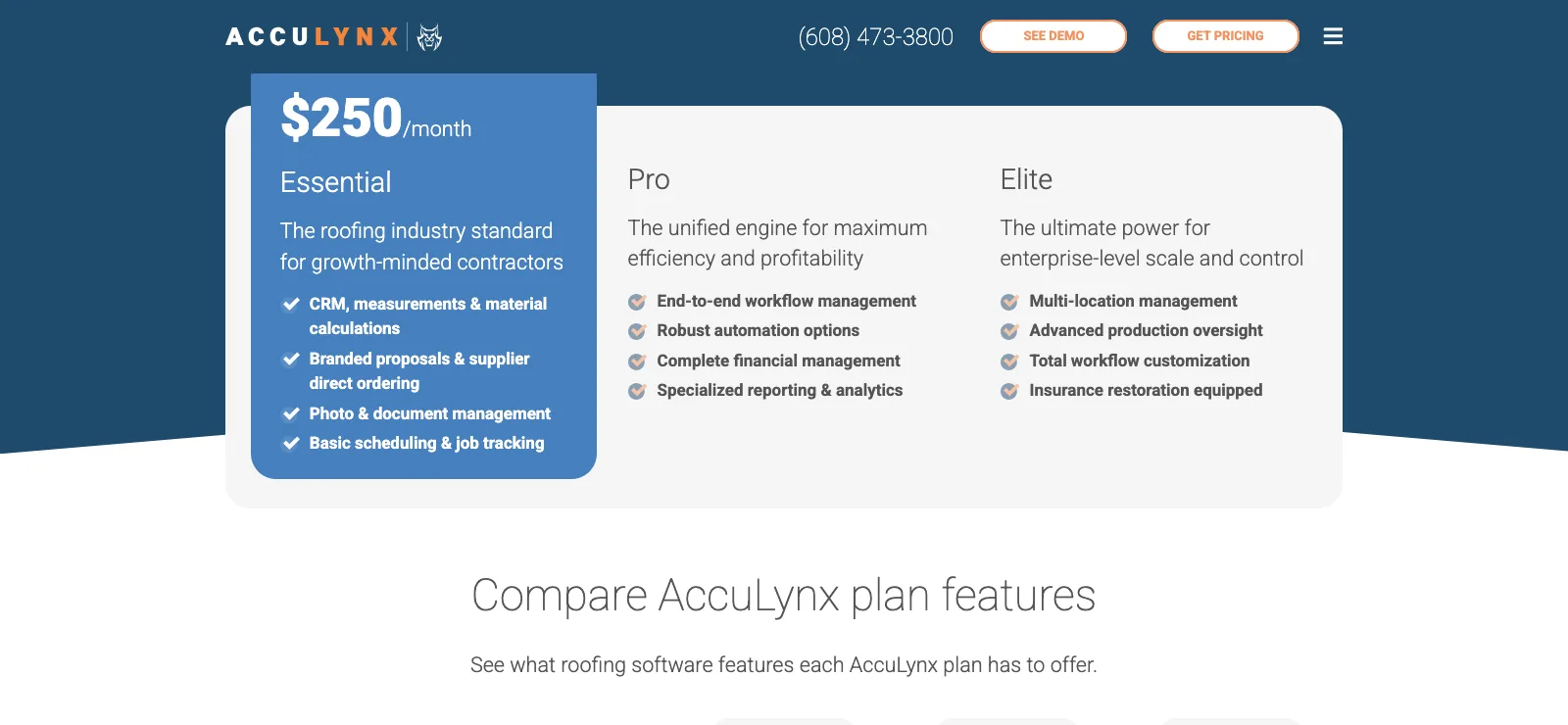 Jul 30, 2026
 Tech Stack
AccuLynx Pricing 2026: The Real Cost of a Quote-Gated Plan
One published figure, two blank plan cards, and a contract that says things the pricing page does not. A line-by-line breakdown of what AccuLynx really bills.
Read Article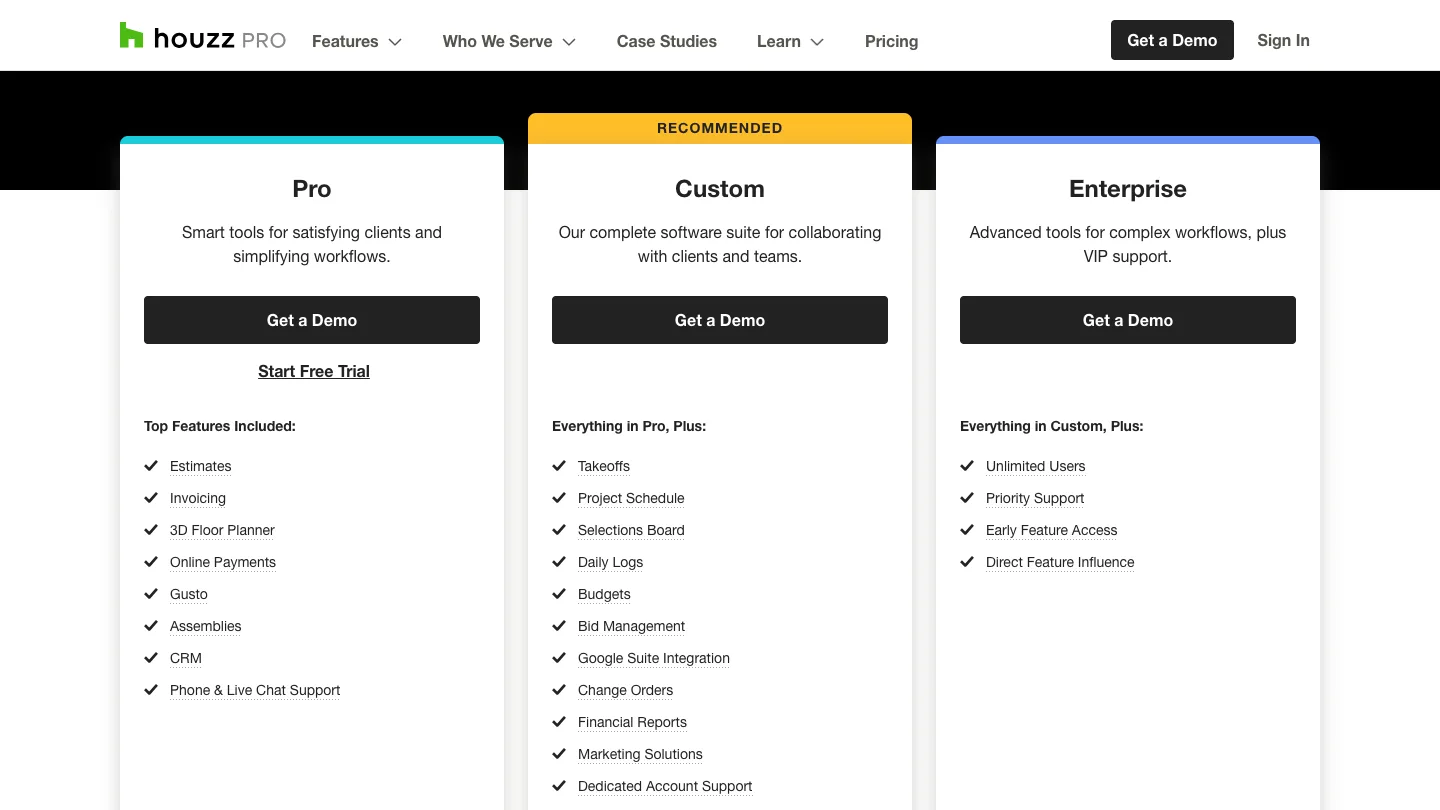 Jul 30, 2026
 Tech Stack
Houzz Pro Canada Review 2026: Pricing and Alternatives
Houzz Pro serves different pricing renderings. What Canadian buyers see, how GST/HST and payments work, what Custom gates, and what the annual contract commits you to.
Read Article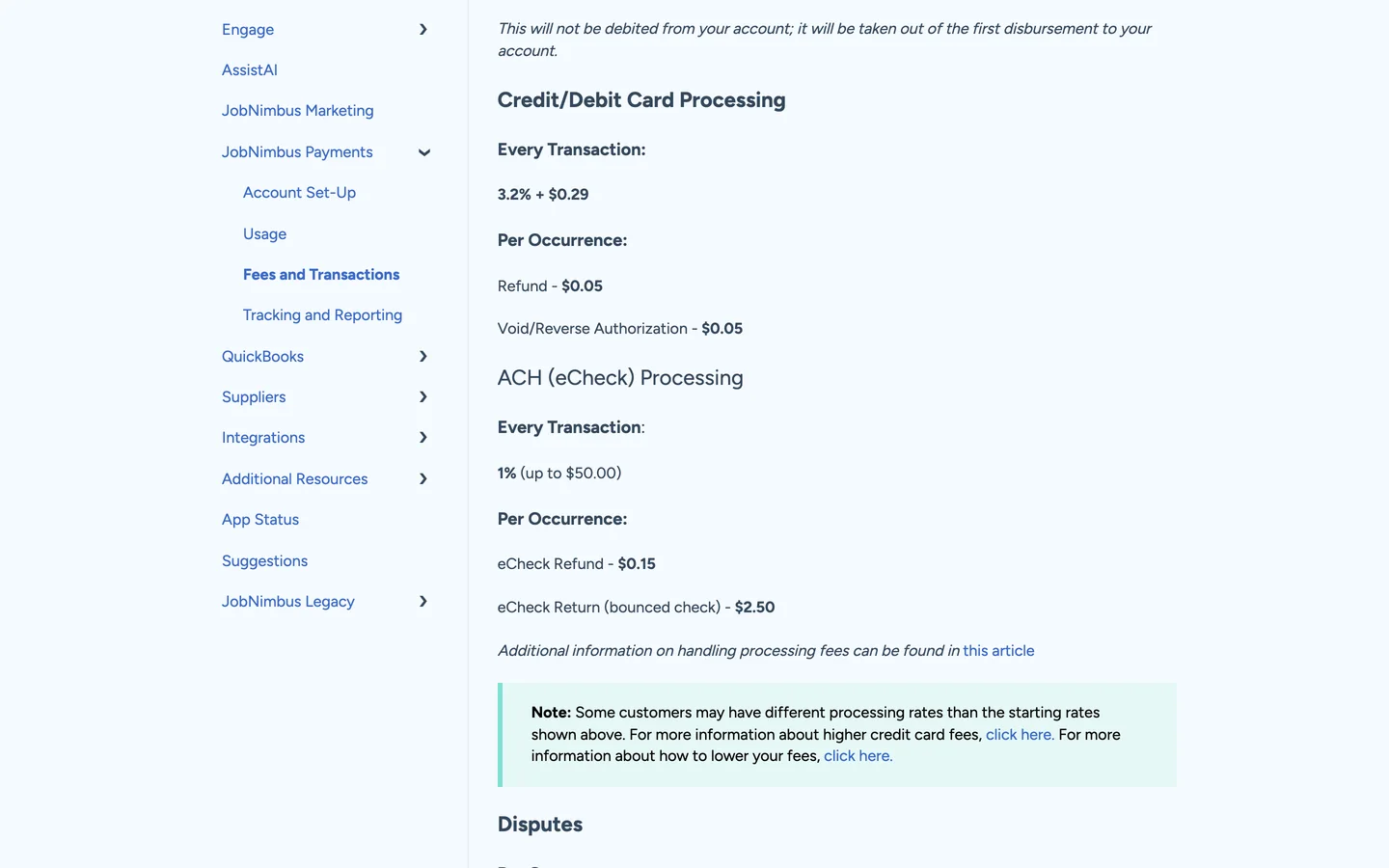 Jul 30, 2026
 Tech Stack
JobNimbus Pricing in 2026: What the Quote Does Not Cover
JobNimbus prints no figure on any of its four plans. So the only rate you can read before a sales call is the payments meter, and it is the biggest line on the bill.
Read Article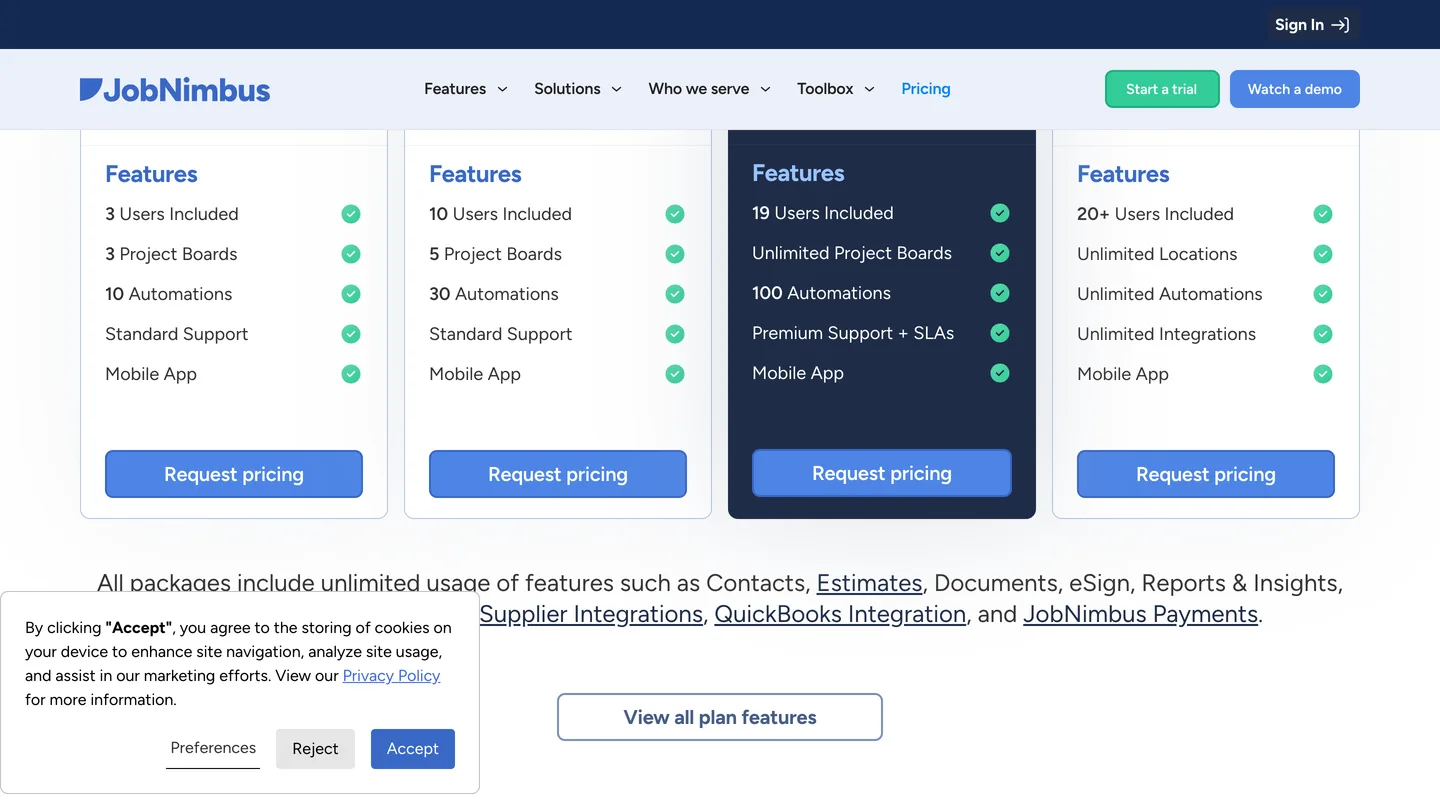 Jul 30, 2026
 Tech Stack
JobNimbus Review 2026: Pricing, Pros, Cons and Alternatives
JobNimbus rates 4.6 on Capterra and orders material straight from ABC Supply and SRS. But it publishes no price, and its supplement route carries a note.
Read Article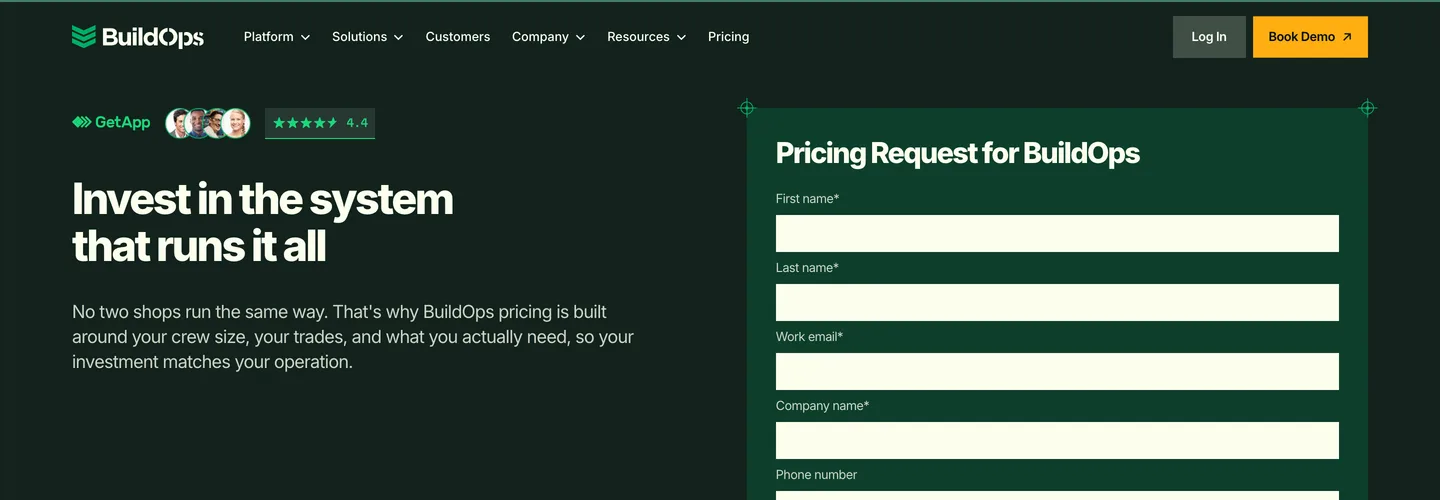 Jul 30, 2026
 Tech Stack
BuildOps Review 2026: Pricing, Contract Terms and Alternatives
BuildOps runs commercial service and projects on one platform, and publishes no pricing at all. The billing unit, the 30-day data-export window, and who it suits.
Read Article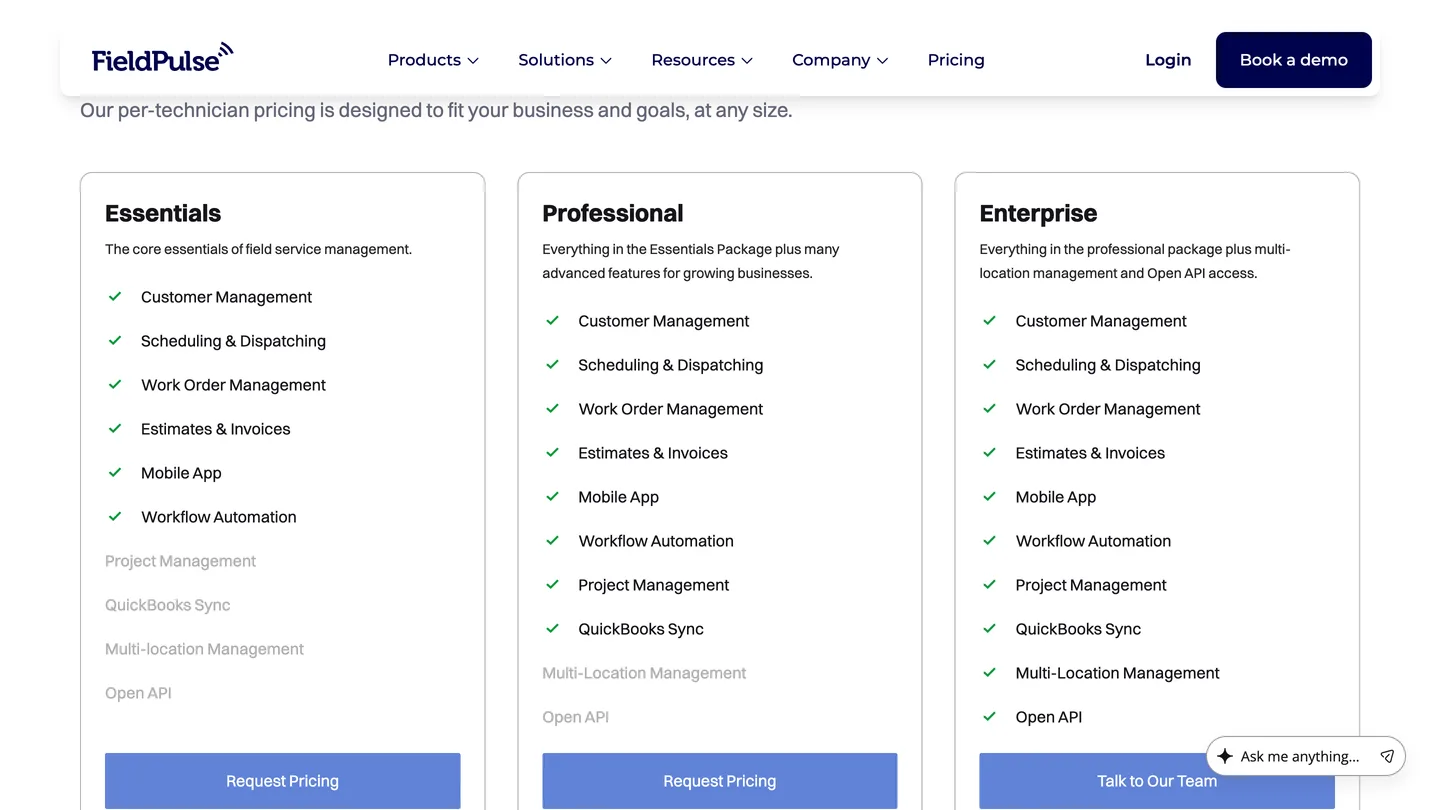 Jul 30, 2026
 Tech Stack
FieldPulse Review 2026: Pricing, Pros, Cons and Alternatives
FieldPulse rates 4.6 on Capterra and is the platform contractors name when they leave a bigger system. But it publishes no price, and the contract runs a year.
Read Article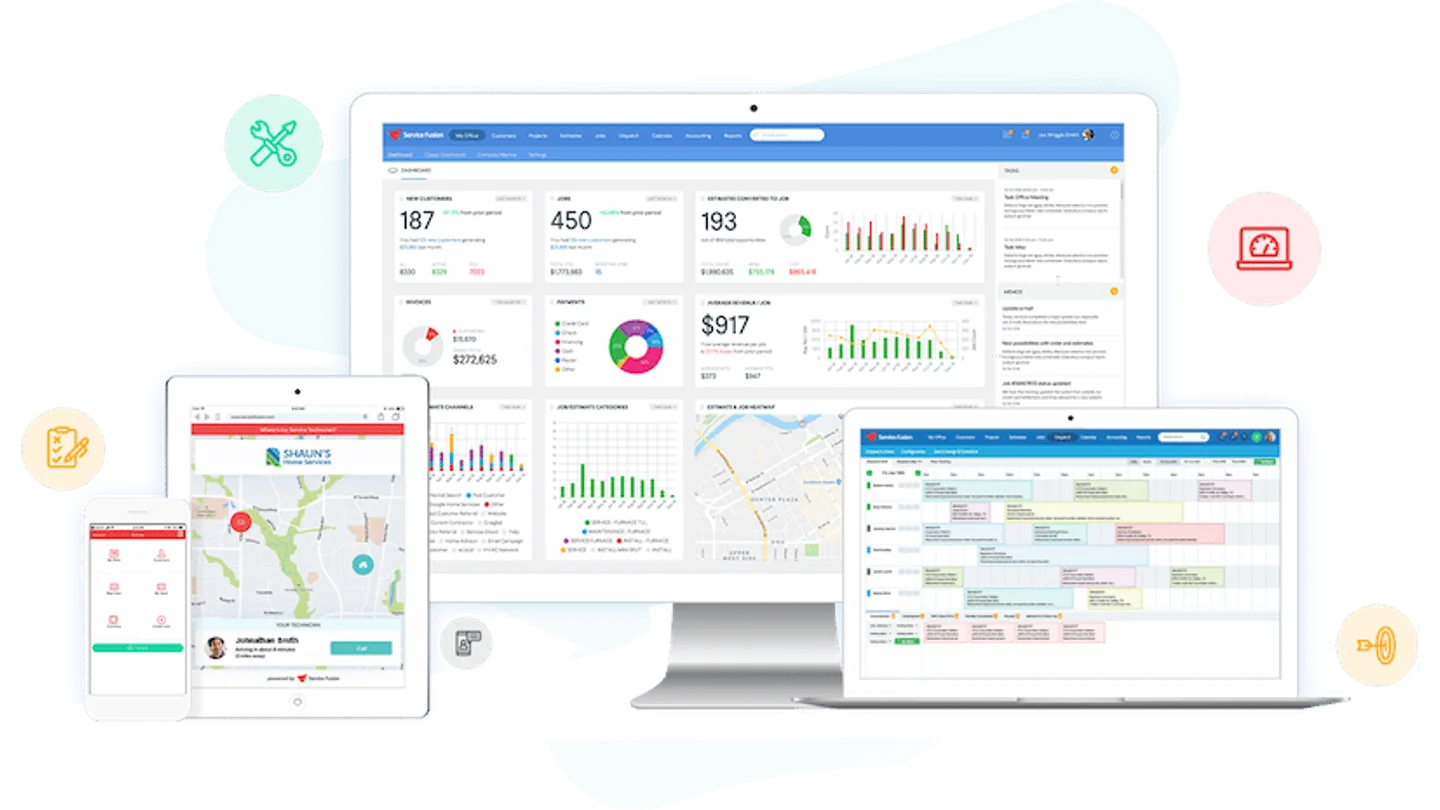 Jul 30, 2026
 Tech Stack
Service Fusion Review 2026: Pricing, Contract and Alternatives
Service Fusion bills flat per company with unlimited users, which is the best structural deal in field service software. The published plans, the contract behind the no-contract line, and the app score every other review gets wrong.
Read Article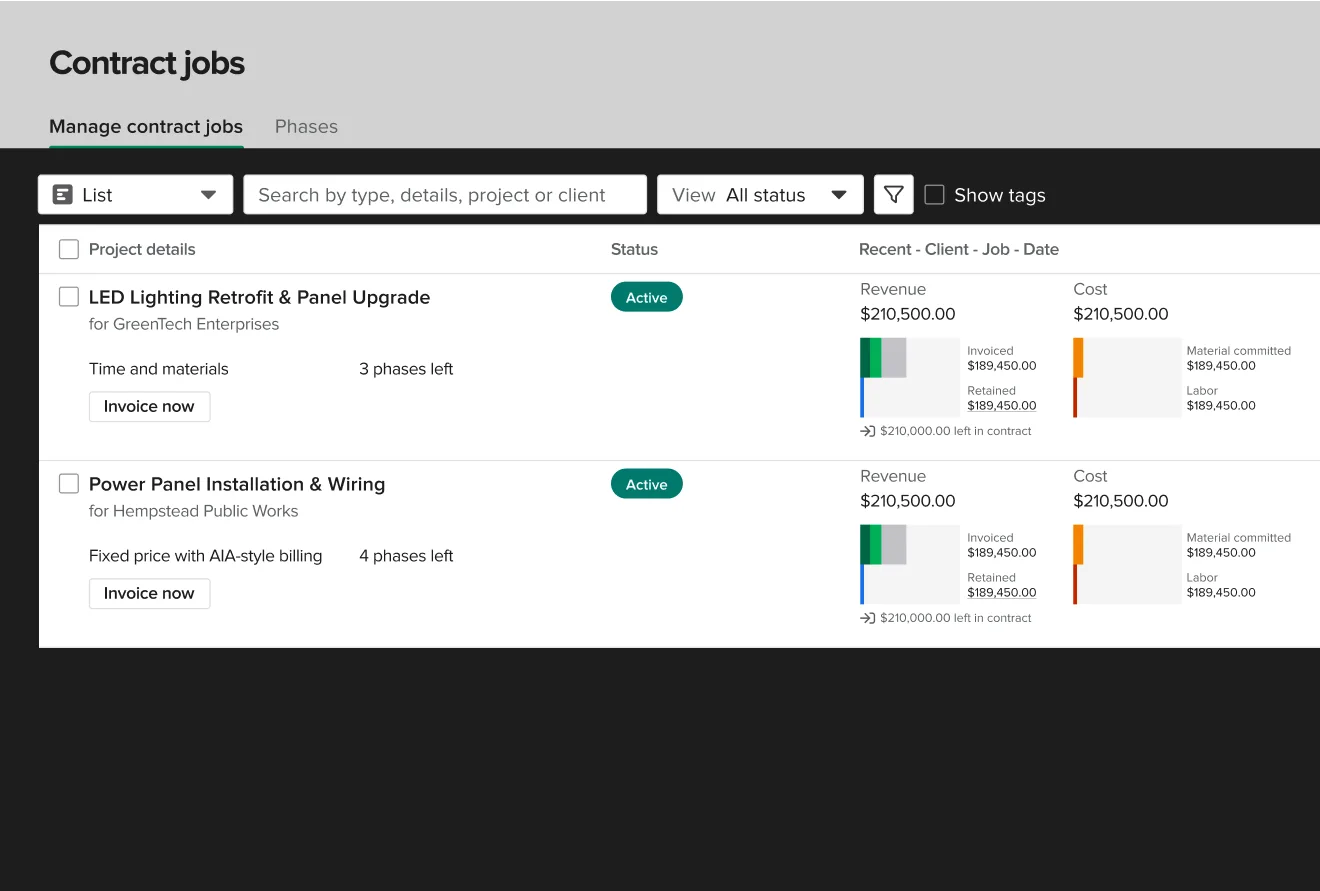 Jul 30, 2026
 Tech Stack
Knowify Review 2026: Pricing, Job Costing and Alternatives
Knowify rates 4.5 on Capterra and its weakest sub-score is features. What the $99 Core plan withholds, which way the QuickBooks sync really runs, and who should not buy it.
Read Article Jul 29, 2026
 Tech Stack
AccuLynx Review 2026: Pricing, Tier Gating, Alternatives
AccuLynx rates 4.6 across 846 reviews and now publishes an entry price. What that price omits, which tier holds the insurance workflow, and who should skip it.
Read Article Jul 29, 2026
 Tech Stack
Unitel Voice Review 2026: Pricing, Features and Alternatives
Unitel Voice rates 4.6 on Capterra and gives a one-truck shop a business number for $9.99 a month. The published plans, the cost per call, and what it won't do.
Read Article Jul 29, 2026
 Tech Stack
NiceJob vs Podium 2026: Pricing, Contracts and Review Gating
Both vendors print a price, at very different scale and in different currencies. The gap that matters is what Podium will not print: the billing unit, and whether a trade shop gets the number on the page.
Read Article Jul 28, 2026
 Tech Stack
CompanyCam Review 2026: Pricing, Pros, Cons and Alternatives
Every page ranking for CompanyCam still quotes a per-user price the vendor no longer charges. Here are the real plans, the seat math, and who should skip it.
Read Article Jul 28, 2026
 Tech Stack
NiceJob Review 2026: Pricing, Pros, Cons and Alternatives
NiceJob rates 4.9 on Capterra and refuses to gate negative reviews. Real plan pricing, the active-customer threshold nobody publishes, and who should skip it.
Read Article Jul 27, 2026
 Tech Stack
Buildertrend Review 2026: Pricing, Limits and Alternatives
Buildertrend rates 4.5 across 2,486 Capterra reviews and quotes against your revenue rather than your seat count. The workflows, the export problem, the alternatives.
Read Article Jul 27, 2026
 Tech Stack
CallRail Review 2026: Pricing, Pros, Cons and Alternatives
CallRail rates 4.5 on Capterra, and its tracking numbers port out free. But the two usage rates that decide your real bill are the two it does not print.
Read Article Jul 27, 2026
 Tech Stack
Roofr Review 2026: Pricing, Pros, Cons and Alternatives
Roofr rates 4.6 on Capterra and sells $13 measurement reports against a market charging triple. But it will not import a report from anywhere else.
Read Article Jul 25, 2026
 Tech Stack
Housecall Pro Review 2026: Pricing, Pros, Cons, Alternatives
Housecall Pro has the shortest learning curve in the category and the widest review spread. Real pricing, the Instapay math, and the migration trap to plan around.
Read Article Jul 24, 2026
 Tech Stack
Jobber Review 2026: Pricing, Pros, Cons and Alternatives
Jobber rates 4.6 on Capterra with the best mobile app in the category. Real plan pricing, the feature gating that changes your entry price, and who it suits.
Read Article Jul 23, 2026
 Tech Stack
ServiceTitan Review 2026: Pricing, Pros, Cons, Alternatives
ServiceTitan rates 4.3 on Capterra but its weakest score is value for money. Real reported pricing, the 12-month contract, the exit fees, and who it actually suits.
Read Article Jun 3, 2026
 Tech Stack
HVAC Online Scheduling: The 43% Losing After-Hours Bookings
HVAC leads every trade on online booking at just 56.7%, which still leaves 43% of sites forcing an after-hours customer to wait for a business-hours phone call.
Read Article