Cedreo Review 2026: Pricing, Pros, Cons, Alternatives
Cedreo starts at $0. What each tier gates, the 7 limitations reviewers name, and 5 alternatives with published prices.
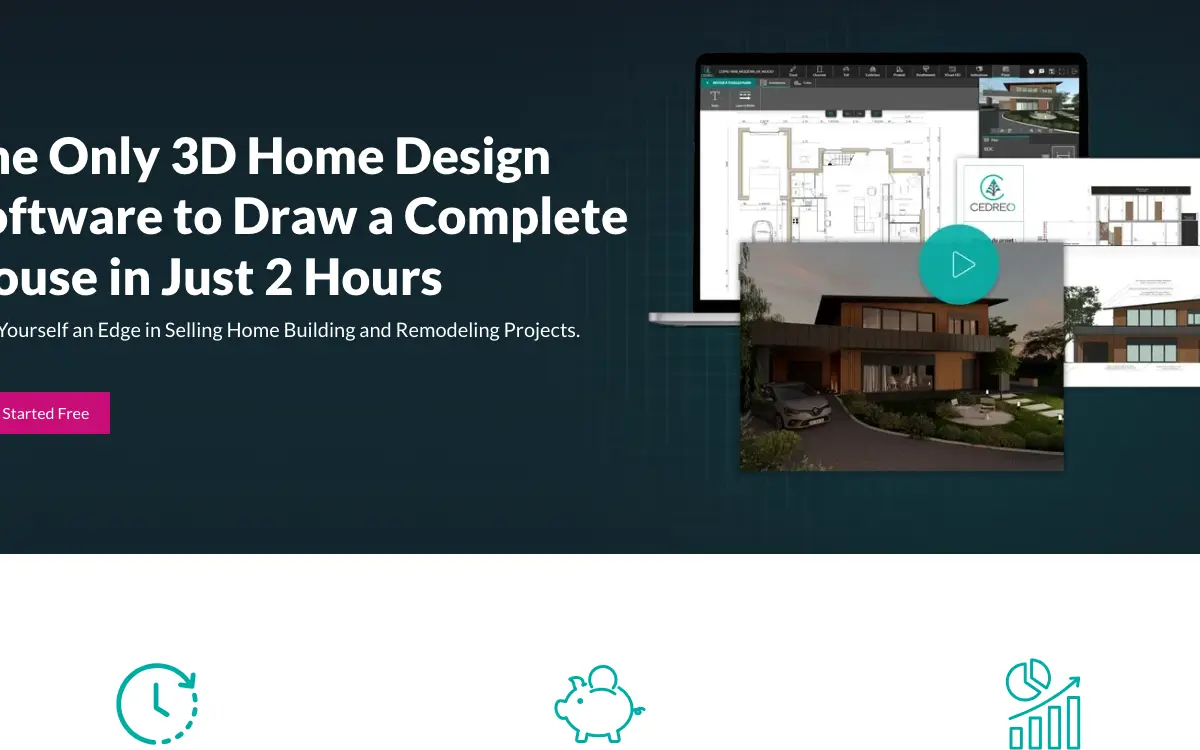
Page at a glance
Cedreo is Draw a house in 2D, get the 3D and a photorealistic rendering out the other side, and hand the homeowner a branded PDF in the same sitting. It starts at $0 per account. One named user per licence, contractually. The Terms of Use state: 'Use of the Software is strictly limited to one [1] User per license.' Free and Personal are single-seat. Pro is priced per user per month. Enterprise is explicitly per-seat ('Pay per user, no user limit'), and every Enterprise rendering allowance is stated per user (80 renderings / month / user). Seat sharing is a termination trigger: 'In the event of Cedreo noting a misuse or sharing of Usernames between multiple users, Cedreo reserves the right to suspend or terminate the Agreement.' It fits Solo-to-small-crew remodelers, kitchen-and-bath designers and custom-home builders (1 to roughly 15 seats) who sell residential renovation and new-build work off a visual, and who hand off to an architect or drafter for permit drawings. It's the wrong buy for A builder or remodeler who needs the model itself to go to an architect, engineer or truss supplier in DWG, IFC or Revit format, because Cedreo's Terms say the editable project sits in 'an optimized proprietary format' that 'cannot be retrieved to be reinterpreted by third-party Software', and an architect reviewer names exactly this gap: 'The impossibility to download an editable model dwg, ifc or step of the designs.' So you'll redraw the whole thing downstream. Alternatives that publish their prices are SketchUp Go from $129, SketchUp Pro from $399, Chief Architect Premier from $1,995. Four priced tiers, seven evidenced gaps and five alternatives, five of which publish a figure.
The short verdict on Cedreo
Cedreo earns its money with Solo-to-small-crew remodelers, kitchen-and-bath designers and custom-home builders (1 to roughly 15 seats) who sell residential renovation and new-build work off a visual, and who hand off to an architect or drafter for permit drawings. If that's you, it does the job. The sections below are the parts worth checking before you sign. But the fit is narrower than the marketing suggests, and the price isn't the whole cost.
It starts at $0. And pricing was verified on 7 August 2026, so you can check every figure below in a browser tab.
| Pricing model | Published tiers |
|---|---|
| Entry price | $0 |
| Users | One named user per licence, contractually. The Terms of Use state: 'Use of the Software is |
| Ownership | Independent |
| Best fit | Solo-to-small-crew remodelers, kitchen-and-bath designers and custom-home builders (1 to roughly 15 seats) who sell residential renovation and new-build work off a visual, and who hand off to an architect or drafter for permit drawings. |
| Accounting sync | QuickBooks, Xero, Sage and every other accounting system (none) |
What works
- The whole product is built around finishing a concept in one sitting
- Thirty days after you cancel, Cedreo may delete everything
- Both are genuinely self-serve in-app, which is rarer than it should be in this category
- Multi-user anything is an Enterprise-only concept
- You keep the data, and Cedreo keeps a worldwide right to publish your visuals by default
What does not
- Cedreo contradicts itself on whether your design can leave Cedreo
- Renderings are a monthly meter that resets to zero and doesn't roll over
- There's no downgrade path. Ever. Any direction
- Zero integrations. Not a thin directory, none
- It's a selling tool, and it won't carry a permit set
Cedreo is Draw a house in 2D, get the 3D and a photorealistic rendering out the other side, and hand the homeowner a branded PDF in the same sitting. It sells to Custom home building and Kitchen and bath and Remodeling contractors, and the shape of the product follows from that: Cedreo claims a complete house in under two hours, a finished site plan in 20 minutes, and photorealistic renderings 'in under 5 minutes' with no rendering queue. Its own comparison table puts its learning curve at 'Easy - 2 to 4 hours' against 'Steep - 2 to 4 months' for Chief Architect and 'Steep - 1 to 3 weeks' for SketchUp. And reviewers corroborate the ease claim without prompting, including one who used it with no tutorials at all.
Cedreo fit, and where it stops
It fits Solo-to-small-crew remodelers, kitchen-and-bath designers and custom-home builders (1 to roughly 15 seats) who sell residential renovation and new-build work off a visual, and who hand off to an architect or drafter for permit drawings. That's the half most reviews print. Here's the other half, which is the one worth your time.
Don't buy it if you're A builder or remodeler who needs the model itself to go to an architect, engineer or truss supplier in DWG, IFC or Revit format. Cedreo's Terms say the editable project sits in 'an optimized proprietary format' that 'cannot be retrieved to be reinterpreted by third-party Software', and an architect reviewer names exactly this gap: 'The impossibility to download an editable model dwg, ifc or step of the designs.' So you'll redraw the whole thing downstream. Look at Chief Architect Premier instead.
Don't buy it if you're A shop that wants design, estimating, change orders and accounting to talk to each other. There isn't a single integration on any tier, no API, and no partner directory across 391 sitemap pages. The Terms treat interoperability requests as refused by default after 30 days of silence. So Cedreo is a design island by construction. Look at Houzz Pro instead.
Don't buy it if you're A commercial GC or multi-family developer. The product, the libraries and the marketing are residential. One reviewer who uses it for offices says so plainly and asks for it to be extended: 'we would love to see this program expanded to officially support commercial office spaces.' Another calls the assets 'very European in look and terminology.' So you'd be fighting the catalogue on every project. Look at SketchUp Pro instead.
Don't buy it if you're A homeowner or a pro designing one house, once. Pro at $948 a year is over-buying for a single project. Cedreo already sells the answer: Personal at $139 per project with 20 renderings. A reviewer asked for exactly this and it now exists: 'I wish there was a novice or casual user tier that was not so expensive.' But don't upgrade, because Personal to Free is a door that doesn't reopen. Look at Cedreo Personal ($139 per project) instead.
What Cedreo costs
And Cedreo publishes its tiers, which puts it ahead of most of this category before you compare a single feature.
| Tier | Price | Billing unit | What it unlocks |
|---|---|---|---|
| Free | $0 | per account | Nothing beyond the tier below |
| Personal | $139 | per project (one-time, per project credit) | Nothing beyond the tier below |
| Pro | $129 | per user, per month (billed monthly) | Nothing beyond the tier below |
| Enterprise | $159 | per user, per month (billed monthly, shown as $1908 per user per year) | Nothing beyond the tier below |
One named user per licence, contractually. The Terms of Use state: 'Use of the Software is strictly limited to one [1] User per license.' Free and Personal are single-seat. Pro is priced per user per month. Enterprise is explicitly per-seat ('Pay per user, no user limit'), and every Enterprise rendering allowance is stated per user (80 renderings / month / user). Seat sharing is a termination trigger: 'In the event of Cedreo noting a misuse or sharing of Usernames between multiple users, Cedreo reserves the right to suspend or terminate the Agreement.'
There is a discount for paying annually up front: Pro drops from $129/user/month to $79/user/month on annual billing ($948/year), a 38.8% cut on the 12-month monthly total of $1,548. Enterprise drops from $159/user/month to $119/user/month ($1,428/user/year) against a monthly-billed annual figure the vendor itself prints as $1908/user/year, a 25.2% cut. The catch is one-directional: 'it is not possible to downgrade your plan to a monthly plan.' And an annual prepay discount tells you an annual commitment exists, which is worth knowing before anyone mentions a term length out loud.
What a Cedreo quote leaves out
Payment processing. Cedreo takes payment for its own subscription only: 'We accept payments by credit card (Visa, MasterCard, American Express) and PayPal.' There is no customer-payment, invoicing or deposit-collection feature in the product. A contractor closing a job off a Cedreo rendering still collects the money somewhere else.
Implementation and onboarding. No onboarding, setup or training fee is published anywhere on the pricing page or in the feature comparison. The Terms tie support eligibility to training: assistance is for customers 'who have subscribed to the Pro or Enterprise offer, as well as the User who has followed the training provided by CEDREO.' So ask whether that training is included in the subscription or billed separately, and whether Enterprise onboarding carries a one-time fee per seat.
Minimum term. 'Unless mentioned otherwise in the Plan, this Contract is concluded for a term of 1 (one) month (for the monthly plan), one (1) year (for the annual plan) or for an unlimited period (for the personal plan) starting from when the Software is provided to the Customer's first User by CEDREO.'
Getting out. No refunds, ever, on either cycle. 'Each billing cycle (annual and monthly) is due and non-refundable, even if the service is not used.' The pricing FAQ repeats it: 'No refund will be issued for the unused subscription period.' Monthly cancellations take effect at the end of the billed month and 'Any month that has been started will be owed.'
Auto-renewal. Tacit renewal with a notice window on annual plans. 'The contract will be tacitly renewed for the same term under the same conditions.' For annual subscriptions, 'notification of the cancellation must be sent no later than one (1) month before the contract's anniversary date.' Miss that window by a day and you own another $948 (Pro) or $1,428 per seat (Enterprise), non-refundable.
Modules sold separately. , , . But the entry tier is not the price you'll pay. Add the modules your shop needs on day one and compare Cedreo on that total.
And this is the kind of thing you only find by reading the complaints. The subscription isn't the meter. Renderings are, and the refill price is the only number Cedreo doesn't publish. Model your render burn, not your seat count. Three revision rounds on eight kitchen presentations is 24 renders before you've shown a single alternate finish. So get the refill unit price in writing before you subscribe, because you can't see it from outside the app.
The Cedreo line items nobody mentions
The subscription is the part everyone quotes. These are the lines that land afterwards, and the ones we could not find are named as unpublished rather than left blank.
Sold separately. , , . Price the configuration you'll really run, because an add-on you need on day one is part of the price.
"Cedreo Free is $0, per account."
Cedreo pricing page (2026)
"Cedreo Personal is $139, per project (one-time, per project credit)."
Cedreo pricing page (2026)
"One named user per licence, contractually. The Terms of Use state: 'Use of the Software is strictly limited to one [1] User per license.' Free and Personal are single-seat. Pro is priced per user per month. Enterprise is explicitly per-seat ('Pay per user, no user limit'), and every Enterprise rendering allowance is stated per user (80 renderings / month / user). Seat sharing is a termination trigger: 'In the event of Cedreo noting a misuse or sharing of Usernames between multiple users, Cedreo reserves the right to suspend or terminate the Agreement.'"
Cedreo pricing page (2026)
The five workflows you pay for
Feature totals are noise. So a shop in this category lives or dies on five things, and those are the five to grade, and each one below carries the evidence it's graded on.
The whole product is built around finishing a concept in one sitting Cedreo claims a complete house in under two hours, a finished site plan in 20 minutes, and photorealistic renderings 'in under 5 minutes' with no rendering queue. Its own comparison table puts its learning curve at 'Easy - 2 to 4 hours' against 'Steep - 2 to 4 months' for Chief Architect and 'Steep - 1 to 3 weeks' for SketchUp. And reviewers corroborate the ease claim without prompting, including one who used it with no tutorials at all. But a controls manager, industrial automation, describes it it differently: "Everything is intuitive and one can use the software even without watching tutorial videos."
Thirty days after you cancel, Cedreo may delete everything Article 19 gives you a temporary re-entry window only if you've paid everything owed and you ask within 30 days: 'CEDREO will grant them temporary access to the Software so they can recover all useful Data.' After that, 'CEDREO is not required to store or provide Data to the Customer and may, unless forbidden by law, delete all of the Customer's Data from its systems.' And trial-version data gets no window at all unless you buy a licence.
Both are genuinely self-serve in-app, which is rarer than it should be in this category Cancelling is four clicks: project manager, your email address, 'Subscription', 'Unsubscribe'. Deleting the account is a separate Profile flow ending in a password confirmation and an emailed confirmation link. The two are sequenced, not independent: attempting deletion while subscribed returns an error, and the help article says 'This means you need to unsubscribe before completing this action.' No phone call, no retention queue, no written notice for monthly plans. But annual plans still need the one-month written notice from Article 18.2.
Multi-user anything is an Enterprise-only concept Multi-user workspace, role and permission management, shared floor plan catalog and project sharing with team members are all Enterprise rows in the comparison table. So Pro, at $948 a year, is a single seat with unlimited projects. The admin help section carries the matching articles: How to Add Licenses, How to Remove an Assigned License, How to Change User Permissions, How to Check my Team's Remaining Rendering Credits.
You keep the data, and Cedreo keeps a worldwide right to publish your visuals by default Article 13.1 confirms 'The Customer is and shall remain the owner of all of the Data it uses through the Software Solutions' and then grants Cedreo a marketing licence over the output. The trigger is generating a visual at all: 'Any request for the creation of visuals made by the User from the Software shall be deemed to constitute authorisation to use and reproduce visuals generated by the User from the Software.' And that right survives cancellation: 'CEDREO retains the right to use and reproduce the designs and visualizations rendered in accordance with the provisions of Article 13.'
How Cedreo lands by trade
Fit differs by trade rather than by company size alone, and a blended paragraph hides that. Here is the split for the trades this one sells to.
Custom home building. The workflow that decides it is the whole product is built around finishing a concept in one sitting, and the shop profile that gets value is solo designer or 1-2 person remodeler selling residential kitchens, baths and renovations doing residential work. Where it stops being a fit is A builder or remodeler who needs the model itself to go to an architect, engineer or truss supplier in DWG, IFC or Revit format.
Kitchen and bath. The workflow that decides it is the whole product is built around finishing a concept in one sitting, and the shop profile that gets value is solo designer or 1-2 person remodeler selling residential kitchens, baths and renovations doing residential work. Where it stops being a fit is A builder or remodeler who needs the model itself to go to an architect, engineer or truss supplier in DWG, IFC or Revit format.
Remodeling. The workflow that decides it is the whole product is built around finishing a concept in one sitting, and the shop profile that gets value is solo designer or 1-2 person remodeler selling residential kitchens, baths and renovations doing residential work. Where it stops being a fit is A builder or remodeler who needs the model itself to go to an architect, engineer or truss supplier in DWG, IFC or Revit format.
How Cedreo talks to your books
QuickBooks, Xero, Sage and every other accounting system connects, on every plan. Your costs map through cost codes, so test yours against your own chart of accounts before you commit. A code your books don't recognise is how a labour charge quietly lands somewhere useless.
Past those, the road ends. QuickBooks / Xero / Sage, Buildertrend / CoConstruct / JobTread / any construction PM platform, Revit / IFC / BIM handoff, Zapier or any automation layer do not connect. So if your books run on an ERP rather than the platforms named above, weigh that before anything else.
Beyond accounting it connects to File-level import (the only inbound path) (Existing plans can be brought in as a trace-over reference in .JPEG, .PNG, .PDF, .DWG and .DXF. This is a background image, not a project import. And a 2026 reviewer states the limit directly: 'Leider kein Import ganzer Projekte via dwg möglich' (no import of whole projects via dwg).), File-level export (the only outbound path) (Plan downloads to JPG, DXF and PDF per the comparison table, gated to the Advanced-house-plans block (Personal and above). But the help centre's download article describes only PNG plan downloads and PDF document generation, and names no CAD format.), Payment rails for the subscription itself (Visa, MasterCard, American Express and PayPal, for paying Cedreo. Not a payment feature for your customers.). A public API exists: No public API and no developer documentation. Cedreo has no /api/ page (404) and no API entry in its sitemap or help centre. Access to the code for interoperability purposes must be requested formally and defaults to refusal if Cedreo does not answer within 30 days.
Cedreo support, and what it costs you
Support is the line item nobody prices and everybody eventually needs. Cedreo publishes no onboarding fee either way, so ask what is included at your tier and what is billed hourly after go-live.
The review corpus we read on 7 August 2026 carries no consistent signal on response times either way, so treat support as untested rather than good. Open a real ticket during the trial and time the reply, because that is the number no pricing page gives you.
Cedreo contracts, and getting out
Nobody reads this section before they buy, and it's the one that costs money afterwards. Four terms decide what leaving looks like.
Minimum term. 'Unless mentioned otherwise in the Plan, this Contract is concluded for a term of 1 (one) month (for the monthly plan), one (1) year (for the annual plan) or for an unlimited period (for the personal plan) starting from when the Software is provided to the Customer's first User by CEDREO.'
Auto-renewal. Tacit renewal with a notice window on annual plans. 'The contract will be tacitly renewed for the same term under the same conditions.' For annual subscriptions, 'notification of the cancellation must be sent no later than one (1) month before the contract's anniversary date.' Miss that window by a day and you own another $948 (Pro) or $1,428 per seat (Enterprise), non-refundable.
Early termination. No refunds, ever, on either cycle. 'Each billing cycle (annual and monthly) is due and non-refundable, even if the service is not used.' The pricing FAQ repeats it: 'No refund will be issued for the unused subscription period.' Monthly cancellations take effect at the end of the billed month and 'Any month that has been started will be owed.'
Payment processing. Cedreo takes payment for its own subscription only: 'We accept payments by credit card (Visa, MasterCard, American Express) and PayPal.' There is no customer-payment, invoicing or deposit-collection feature in the product. A contractor closing a job off a Cedreo rendering still collects the money somewhere else.
Small thing that turns out to matter. Interoperability is a contractual default of 'no', rather than a missing feature. Whatever you build in Cedreo lives and dies in Cedreo. So treat the PDFs and images as the deliverable and the model as disposable, and never let a Cedreo file become the only copy of a design you'd have to reproduce.
"Not enough plan details Cannot hardly even be used for real construction. This is more for a homeowner to start their own design, but at a stupidly high price."
Capterra, Marcus P. (7-27)
"I thought some of the cabinets for kitchen rendering were limited. Not sure why I could change the pulls on some but not others. The kitchen islands were very limited as well. Most islands have a sink in the center with appliances on either side. I wish there was one that you could customize and put in the appliances and drawers, cabinets, etc.... It is also very expensive and then I have to buy more renderings when I run out...that is taxing."
Capterra, Susan M (1-03)
"To expensive for people like me that desnt use the software too much. The impossibility to download an editable model dwg, ifc or step of the designs. Some elements are not very flexible for edition."
Capterra, Antton E. (7-21)
The Cedreo gaps worth raising on the call
Six things worth raising, and each one's answerable with a yes or a no on a call.
Cedreo contradicts itself on whether your design can leave Cedreo The plan comparison table lists 'Download plans to JPG, DXF, and PDF' as an Advanced-house-plans feature, and the features FAQ says you can 'export floor plans and site plans as 300dpi high-resolution images in JPG or DXF files for use in other CAD software.' But the Terms of Use say the opposite about the model itself: 'the Software stores editable projects in an optimized proprietary format for use on the internet and it cannot be retrieved to be reinterpreted by third-party Software unless the CEDREO Software includes a specific export function for that third-party Software.' And the help centre's own download article lists only PNG and PDF outputs and names no DWG, DXF or IFC option at all. Reviewers spanning 2020 to 2026 report the restrictive version. Both statements are recorded here; the conflict is the vendor's, not a research gap. So before you sign, open a trial project and export it, then open the export in whatever your architect or engineer uses. Confirm in writing whether the DXF is a flat 2D plan trace or an editable model. And if your handoff needs DWG, IFC or STEP, assume no.
Renderings are a monthly meter that resets to zero and doesn't roll over Pro includes 40 renderings a month, Enterprise 80 per user per month, Personal 20 per project, Free none at all. Unused ones evaporate: 'renderings don't roll over from one month to the next and unused monthly renderings expire.' And on an annual plan they expire every month on your subscription date, not at year end. So run out mid-proposal and you buy a refill pack whose price Cedreo publishes nowhere on the site. On 2022-11-03, a designer, design says: "I thought some of the cabinets for kitchen rendering were limited. Not sure why I could change the pulls on some but not others. The kitchen islands were very limited as well. Most islands have a sink in the center with appliances on either side. I wish there was one that you could customize and put in the appliances and drawers, cabinets, etc.... It is also very expensive and then I have to buy more renderings when I run out...that is taxing." Count your real render volume before choosing a tier. A remodeler doing eight kitchen presentations a month with three revision rounds each burns 24 renders on revisions alone. So ask sales for the refill-pack unit price in writing before you subscribe, because you can't see it until you're already inside the app.
There's no downgrade path. Ever. Any direction. The pricing FAQ is explicit: 'it is not possible to downgrade your plan from Personal to Free, from Pro to Personal, or from Enterprise to Pro or Personal. Once you have subscribed to any plan, you will not have the possibility to go back to a lower plan.' Billing frequency is the same one-way door: you can move monthly to annual, but 'it is not possible to downgrade your plan to a monthly plan.' So a seasonal remodeler who upgrades to Enterprise for a busy spring can't step back down in the fall. And the only exit is cancelling outright. Start on the tier you can defend in your slowest month, not your busiest. So treat every upgrade as permanent, because contractually it is.
Zero integrations. Not a thin directory, none. Cedreo's own XML sitemap lists 391 pages across 13 languages. Not one is an integrations page, a partner directory, an app marketplace or API documentation. /integrations/, /partners/ and /api/ all return 404. And there's no accounting, CRM, estimating or project-management connector on any tier. The Terms make the posture formal: a customer who wants code access 'to make it interoperable with other software' has to file a request, and 'Should CEDREO fail to respond within thirty [30] days following receipt of this request, the response shall be deemed by default to constitute a refusal.' So silence is a no. So budget for manual re-entry. Whatever you price, estimate or invoice with will never see the Cedreo design, and the Cedreo design will never see your job costs.
It's a selling tool, and it won't carry a permit set Cedreo's own Terms disclaim the output: 'These visualizations have no contract value. CEDREO does not provide any guarantees with regard to the feasibility of the project.' And a general contractor's review lands in the same place. An architect reviewer who rates it 5 stars frames the boundary approvingly: 'The emphasis is on the providing practical and effective tools for the conceptual design stage, not on producing contract documents, or drawings to submit for approvals.' A general contractor, construction who reviewed it on 2022-07-27 reports it: "Not enough plan details Cannot hardly even be used for real construction. This is more for a homeowner to start their own design, but at a stupidly high price." Keep a drafter or architect in the loop for anything that goes to a building department. So price Cedreo as sales enablement against close rate, not as a replacement for construction documents.
One project holds one building, and roofs are the recurring sore spot A 2026 contractor reviewer can't place a house and a barn in the same project and move them independently. Roof complaints recur across six years of reviews from separate reviewers: 'the roofs are hard to navigate at times', 'Some custom made roofs do tend to cause glitches on the walls', 'Drawing the roofs is sometimes a little tricky'. And furnishings also refuse to lock in place once positioned. A project manager, contractor, construction who reviewed it on 2026-04-14 says: "I can't build 2 separate structures on a project (home and barn) and move them independently. If I want to move the barn closer or farther from the home, I have to make physical modifications to do so. A big pain. A bigger pain to move it left to right." If your work is outbuildings, ADUs, detached garages or multi-structure lots, model each structure separately and composite the site plan by hand. And test a complex hip-and-valley roof during the free plan before you pay.
Free and Personal projects have expiry dates measured in years 'A Free account will be accessible for 3 years unless you subscribe to a paid plan before the end of 3-year period. If you don't, your project will be deleted at the end of this 3-year period. A Personal account will be accessible for 10 years unless you subscribe to a Pro or Enterprise plan before the end of 10-year period.' And Cedreo backs up data on a daily cycle and keeps those backups only five days: 'Data shall be stored for a period of five [5] days.' So export finished presentations to PDF and PNG the week you deliver them. Don't treat Cedreo as your archive for a job you may get warranty questions about in year four.
One more thing worth knowing. Cedreo takes a permanent, worldwide right to publish your client's house the moment you press render. If you design custom homes for clients who care about privacy, or you have an NDA on a spec project, this clause is live and it doesn't expire when your subscription does. So raise it before you model anything confidential.
One more thing worth knowing. Every plan change is a ratchet. There's no path back down, in any direction, at any time. Seasonal trades should size for the slow month. Because upgrading for a busy spring means paying Enterprise rates through the following winter, or cancelling entirely and losing access at renewal.
One more thing worth knowing. A vendor tidied up a reviewer's grammar before putting his words on its own marketing page. Read testimonial walls in this category as edited copy, not as evidence. So go to the source listing before you let a quoted reviewer decide anything, because the awkward original often carries the caveat the tidy version dropped.
Small thing that turns out to matter. Roofs are the six-year complaint, and support is the six-year compliment. Both hold across the review base. The Free plan gives you the tool without the humans, which is the wrong way round for evaluating it. So do your roof test during a trial where you can still get chat support, and treat live support as a real part of what Pro's $948 buys.
What Cedreo users report
Every quote below is transcribed from a published review, named to the platform that carries it and to the reviewer as that platform displays them. We read the corpus by complaint type rather than by star rating, which is how the disqualifying detail buried inside a five-star review gets found.
"Not enough plan details Cannot hardly even be used for real construction. This is more for a homeowner to start their own design, but at a stupidly high price."
On 2022-07-27, a general contractor, construction writes on Capterra
"I thought some of the cabinets for kitchen rendering were limited. Not sure why I could change the pulls on some but not others. The kitchen islands were very limited as well. Most islands have a sink in the center with appliances on either side. I wish there was one that you could customize and put in the appliances and drawers, cabinets, etc.... It is also very expensive and then I have to buy more renderings when I run out...that is taxing."
On 2022-11-03, a designer, design writes on Capterra
"To expensive for people like me that desnt use the software too much. The impossibility to download an editable model dwg, ifc or step of the designs. Some elements are not very flexible for edition."
But an architect, architecture & planning, says it differently on Capterra
"Some things are very European in look and terminology, but I know they are actively working to update that. I think functionality can be a bit clunky at times but overall it is user friendly. Our biggest complaint from builders and as users is that the roofs are hard to navigate at times. We wish they were easier to customize and not as glitchy, but customer service has always helped when we could not figure it out."
A senior marketing specialist, real estate who reviewed it on 2021-05-25 says on Capterra
"I can't build 2 separate structures on a project (home and barn) and move them independently. If I want to move the barn closer or farther from the home, I have to make physical modifications to do so. A big pain. A bigger pain to move it left to right."
But a project manager, contractor, construction, describes it it differently on Capterra
"Es können nicht mehrere Wände zusammen markiert und bearbeitet werden - z.B. verschoben oder Wanddicken ändern. Die Möglichkeit die reale Umgebung via Foto einzufügen ist sehr beschränkt bzw die Ansichten die damit gemacht werden können. Leider kein Import ganzer Projekte via dwg möglich."
On 2026-04-22, an immobilienmaklerin u entwicklerin, real estate writes on Capterra
"This software is easy to use and offers me the ability to let customers see their finished product before it is built. Many customers have a hard time visualizing typical construction plans. The 3D view let our customers get a true feeling of the finished product they will be getting. There are many customizable furniture and household items to give the 3D views a very professional outcome."
But a contractor, construction, writes it differently on Capterra
"- Placing furnishings can be difficult. They don't stay locked in place once they are added onto the model. Which can create a mess if you accidentally click it instead of another item. Also getting them in the specific location you want them can get tricky at times. - The demo videos are not always the best to follow along. They seem to skip steps and they never really show you how to place furnishings properly. It seems it always goes from the layout step to full on renderings without actually walking through how to furnish a room or house adequately. - The furnishings tab is also limited to what you can select or create."
A designer, construction who reviewed it on 2022-09-10 writes on Capterra
"The system is not easy to use and I frequently get frustrated with the process, however the support is amazing and the frequently asked questions and demos are a huge help and get the job done."
On 2022-05-13, an owner, mgr, broker, real estate writes on Capterra
"The price is a pretty high monthly subscription. The choices of products are very limited and everything comes in odd dimensions. Also the HD feature is not great. It does not look very realistic."
On 2020-07-21, a real estate agent and developer, real estate reports it on Capterra
"Everything is intuitive and one can use the software even without watching tutorial videos."
And a controls manager, industrial automation, writing on 2021-08-27, puts it the same thing on Capterra
"I do not like its foundation options, and its terrains. I also have not figured out how to produce quick plans in it that are branded by my company for presentation purposes. The new Terrain feature, should have an option to add sloping grades. Also, I wish it would be able to automatically perform simple takeoffs of common finishes, such as decking, flooring, interior walls exterior walls."
A managing director, construction who reviewed it on 2022-03-08 says on Capterra
What Cedreo's competition charges
Four or five products a shop looking at Cedreo would also be looking at. Each row carries what the vendor publishes, plus what it does better and worse.
| Tool | Entry price | Billing unit | Users included | Published? |
|---|---|---|---|---|
| Cedreo | $0 | per account | One named user per licence, contractually. The Terms of Use | Yes |
| SketchUp Go | $129 | per user, per year (published as $10.75 per user per month) | 1 | Yes |
| SketchUp Pro | $399 | per user, per year (published as $33.25 per user per month) | 1 | Yes |
| Chief Architect Premier | $1,995 | per user, per year (or $229 per user per month billed monthly) | 1 | Yes |
| Home Designer (Chief Architect) | $495 | per user, per year (or $79 per user per month billed monthly) | 1 | Yes |
| RoomSketcher Pro | $12 | per user, per month (billed as $144 per year; $24 per user per month if billed monthly) | 1 | Yes |
SketchUp Go. General-purpose 3D modelling, an enormous free component warehouse, and a model that other software can open. It runs in browser and on iPad. But Nothing is residential-specific. No automatic roofs, no surface-area tables, no photorealistic render engine without Studio or a paid plugin, and Cedreo's own comparison rates its learning curve 'Steep - 1 to 3 weeks'.
SketchUp Pro. Desktop modelling with LayOut 2D documentation, extension ecosystem, and real interoperability with the rest of the AEC stack. But It costs 4.2x Cedreo Pro's annual price before you add a render engine, and still needs weeks of ramp. And nothing about it is built to close a homeowner in one meeting.
Chief Architect Premier. Actual construction documents. Site plans, framing plans, section details and elevations, which is precisely where Cedreo stops. But Price and ramp. Cedreo's own comparison table rates the Chief Architect learning curve 'Steep - 2 to 4 months'. And it's a desktop install, not a browser tool.
Home Designer (Chief Architect). Chief Architect's engine at roughly half Cedreo Pro's annual cost, with no per-render meter to run out of. But Aimed at homeowners and DIY remodel planning rather than a professional's client-facing proposal workflow. No team seats, no shared catalog, no branded presentation-document builder.
RoomSketcher Pro. Cost. It's roughly a sixth of Cedreo Pro's annual price, and its Team plan at $35 per month includes five users where Cedreo charges $119 per seat per month on annual Enterprise. But It's also credit-metered, and thinner on exteriors, terrain, roofs and construction-grade plan detail. And it sits closer to real-estate floor plans than to builder-grade conceptual design.
"Some things are very European in look and terminology, but I know they are actively working to update that. I think functionality can be a bit clunky at times but overall it is user friendly. Our biggest complaint from builders and as users is that the roofs are hard to navigate at times. We wish they were easier to customize and not as glitchy, but customer service has always helped when we could not figure it out."
Capterra, Maria T. (5-25)
"I can't build 2 separate structures on a project (home and barn) and move them independently. If I want to move the barn closer or farther from the home, I have to make physical modifications to do so. A big pain. A bigger pain to move it left to right."
Capterra, Jason T. (4-14)
Who should not buy Cedreo
Don't buy Cedreo if you're A builder or remodeler who needs the model itself to go to an architect, engineer or truss supplier in DWG, IFC or Revit format. Cedreo's Terms say the editable project sits in 'an optimized proprietary format' that 'cannot be retrieved to be reinterpreted by third-party Software', and an architect reviewer names exactly this gap: 'The impossibility to download an editable model dwg, ifc or step of the designs.' So you'll redraw the whole thing downstream. Look at Chief Architect Premier instead.
Don't buy Cedreo if you're A shop that wants design, estimating, change orders and accounting to talk to each other. There isn't a single integration on any tier, no API, and no partner directory across 391 sitemap pages. The Terms treat interoperability requests as refused by default after 30 days of silence. So Cedreo is a design island by construction. Look at Houzz Pro instead.
Don't buy Cedreo if you're A commercial GC or multi-family developer. The product, the libraries and the marketing are residential. One reviewer who uses it for offices says so plainly and asks for it to be extended: 'we would love to see this program expanded to officially support commercial office spaces.' Another calls the assets 'very European in look and terminology.' So you'd be fighting the catalogue on every project. Look at SketchUp Pro instead.
Don't buy Cedreo if you're A homeowner or a pro designing one house, once. Pro at $948 a year is over-buying for a single project. Cedreo already sells the answer: Personal at $139 per project with 20 renderings. A reviewer asked for exactly this and it now exists: 'I wish there was a novice or casual user tier that was not so expensive.' But don't upgrade, because Personal to Free is a door that doesn't reopen. Look at Cedreo Personal ($139 per project) instead.
The verdict, by shop size
Solo designer or 1-2 person remodeler selling residential kitchens, baths and renovations
Yes, and this is the shape the product is built for. This is the band the product was built for and the band the reviews come from. $948 a year buys unlimited projects, 40 renders a month and a presentation PDF that closes homeowners who can't read a plan set. A contractor reviewer puts the mechanism plainly: 'Many customers have a hard time visualizing typical construction plans. The 3D view let our customers get a true feeling of the finished product.' So start on Free, prove a hip roof works, then go annual for the 38.8% cut. This band runs 1 to 2 on the crew, doing residential work, and that's the profile the recommendation is written for.
3-15 person residential design/build or custom-home builder
Only under conditions, and they are worth being honest about. Enterprise at $119 per seat per month annually is defensible if only your sales and design people need seats, and if you've already accepted that the design never touches your estimating or accounting system. But condition it on three things: get the refill-pack price in writing before signing, test a real multi-structure lot given the reviewer report that a home and a barn can't move independently, and diarise the annual cancellation notice, because renewal is tacit and the notice window is one full month before the anniversary. This band runs 3 to 15 on the crew, doing residential work, and that's the profile the recommendation is written for.
Contractor whose deliverable is a permit set or who hands models to an engineer
No. Cedreo disclaims the output in its own contract: 'These visualizations have no contract value. CEDREO does not provide any guarantees with regard to the feasibility of the project.' The editable project is proprietary and, per Article 19, cannot be reinterpreted by third-party software. And a general contractor reviewer says it directly: 'Cannot hardly even be used for real construction.' So buy Chief Architect Premier and use Cedreo, if at all, only as a separate selling layer. This band runs undefined or more on the crew, doing residential work, and that's the profile the recommendation is written for.
Commercial GC, multi-family developer or any crew above roughly 25 seats
No. Per-seat Enterprise with no volume break puts 25 seats at $35,700 a year, for a residential catalogue with no API, no integrations and no BIM handoff. Capterra's own profile reports 89% of Cedreo reviewers come from small companies. And the one reviewer using it commercially asks the vendor to add office components, which tells you the answer. This band runs 25 or more on the crew, doing commercial and service work, and that's the profile the recommendation is written for.
The part of the Cedreo decision that's our lane
We should say what our stake is here, which is none. Fervor is a web design and conversion studio for contractors. No vendor on this page pays us. But we measured something adjacent that changes what this purchase is worth.
Cedreo meters the thing contractors put in front of homeowners: 40 photorealistic renders a month on Pro, 80 per seat on Enterprise, expiring monthly, refills sold at a price the vendor won't publish. But a remodeler paying real money per image doesn't then compress it, and the 300dpi exports Cedreo advertises land on the portfolio page at full weight. And across the 380 contractor sites Fervor inspected, the gallery is routinely the slowest thing on the site, and the render a contractor paid for is the render that pushes LCP past the point where the homeowner leaves before seeing it.
But we can put a figure on it. Of 380 contractor sites we inspected, 82.8% had poor mobile loading performance. And the method is public, because a number you cannot audit is not evidence. The workings are public in the Contractor CRO Index.
"82.8% of the 380 contractor websites inspected had poor mobile loading performance."
Fervor Studio Contractor CRO Index (2026)
And none of that argues against the purchase. It argues for checking the cheaper problem first. The numbers are all public.
See where your site is losing the jobs Cedreo would have managed
We run your site the way a customer does, on a phone, and report exactly where the enquiries stop. Three days.
Get a Site InspectionWhere all of this Cedreo detail came from
A word on limits. We read Cedreo's pages and its reviews, but we didn't operate it. The basis is 22 vendor pages for Cedreo, read on 7 August 2026, and every review we could retrieve, sorted by complaint. Prices were checked the same day. Nothing here is carried forward from an older sweep.
So: twelve quotes on this page, twelve from Capterra.
And capterra.com via curl (Cloudflare 403 on direct request; readable only through WebFetch), getapp.com via curl (403), softwareadvice.com via curl (403), G2 (not attempted beyond category knowledge that it blocks automated fetching), TrustRadius (same), Trustpilot (same), Reddit (same), https://www.chiefarchitect.com/products/buy.html (404) and https://www.houzz.com/pro/pricing (returned a 3KB shell, no pricing content) refused automated retrieval for Cedreo. Forum and social threads are the ones people most want quoted, and they are exactly the ones we cannot verify, so none of them are here.
What that leaves untested: apple App Store and Google Play: Cedreo is browser-only ('Cedreo is 100% online, all you need is a strong internet connection'), so there's no mobile app listing to review. And everything above is 22 vendor pages and a review corpus, which is documentary rather than hands-on.
What Cedreo users say
Not enough plan details Cannot hardly even be used for real construction. This is more for a homeowner to start their own design, but at a stupidly high price.
I thought some of the cabinets for kitchen rendering were limited. Not sure why I could change the pulls on some but not others. The kitchen islands were very limited as well. Most islands have a sink in the center with appliances on either side. I wish there was one that you could customize and put in the appliances and drawers, cabinets, etc.... It is also very expensive and then I have to buy more renderings when I run out...that is taxing.
To expensive for people like me that desnt use the software too much. The impossibility to download an editable model dwg, ifc or step of the designs. Some elements are not very flexible for edition.
Some things are very European in look and terminology, but I know they are actively working to update that. I think functionality can be a bit clunky at times but overall it is user friendly. Our biggest complaint from builders and as users is that the roofs are hard to navigate at times. We wish they were easier to customize and not as glitchy, but customer service has always helped when we could not figure it out.
I can't build 2 separate structures on a project (home and barn) and move them independently. If I want to move the barn closer or farther from the home, I have to make physical modifications to do so. A big pain. A bigger pain to move it left to right.
Es können nicht mehrere Wände zusammen markiert und bearbeitet werden - z.B. verschoben oder Wanddicken ändern. Die Möglichkeit die reale Umgebung via Foto einzufügen ist sehr beschränkt bzw die Ansichten die damit gemacht werden können. Leider kein Import ganzer Projekte via dwg möglich.
This software is easy to use and offers me the ability to let customers see their finished product before it is built. Many customers have a hard time visualizing typical construction plans. The 3D view let our customers get a true feeling of the finished product they will be getting. There are many customizable furniture and household items to give the 3D views a very professional outcome.
- Placing furnishings can be difficult. They don't stay locked in place once they are added onto the model. Which can create a mess if you accidentally click it instead of another item. Also getting them in the specific location you want them can get tricky at times. - The demo videos are not always the best to follow along. They seem to skip steps and they never really show you how to place furnishings properly. It seems it always goes from the layout step to full on renderings without actually walking through how to furnish a room or house adequately. - The furnishings tab is also limited to what you can select or create.
The system is not easy to use and I frequently get frustrated with the process, however the support is amazing and the frequently asked questions and demos are a huge help and get the job done.
The price is a pretty high monthly subscription. The choices of products are very limited and everything comes in odd dimensions. Also the HD feature is not great. It does not look very realistic.
Everything is intuitive and one can use the software even without watching tutorial videos.
I do not like its foundation options, and its terrains. I also have not figured out how to produce quick plans in it that are branded by my company for presentation purposes. The new Terrain feature, should have an option to add sloping grades. Also, I wish it would be able to automatically perform simple takeoffs of common finishes, such as decking, flooring, interior walls exterior walls.
Frequently asked questions
What does Cedreo cost?
Four tiers, all self-serve, no sales call required. Free is $0 with one user, one project and no renderings. Personal is $139 per project one-time, with 20 renderings per project. Pro is $129 per user per month billed monthly, or $79 per user per month billed annually at $948 a year, with unlimited projects and 40 renderings a month. Enterprise is $159 per user per month billed monthly, or $119 per user per month billed annually at $1,428 per seat per year, with 80 renderings per user per month plus team roles and permissions. And those figures come straight from the vendor's own pricing endpoint and the rendered pricing table, with Capterra's profile listing the same three paid numbers.
Why does the pricing page look empty when I open it?
Because Cedreo's prices aren't in the served HTML. The page ships an empty container and fills it in the browser from a geo-detecting endpoint at offer-manager.cedreo.com. The script also contains a redirect: French visitors get bounced to the French site. So if you're shopping from outside North America, verify the currency and the number you're being quoted, not the one someone else quoted you.
Can I get my designs out of Cedreo?
Partly, and the vendor tells two stories. The plan comparison table lists 'Download plans to JPG, DXF, and PDF', and the features FAQ says you can export plans as 300dpi JPG or DXF 'for use in other CAD software'. But the Terms of Use say the editable project sits in 'an optimized proprietary format' that 'cannot be retrieved to be reinterpreted by third-party Software'. And the help centre's download article names only PNG and PDF. Reviewers from 2020 through 2026 report no editable dwg, ifc or step export and no whole-project dwg import. So test it in the free plan before you commit.
What happens to my projects if I cancel?
You get a 30-day window, conditional on having paid everything owed and on asking within 30 days, during which Cedreo grants temporary access so you can download your files. After that, 'CEDREO is not required to store or provide Data to the Customer and may, unless forbidden by law, delete all of the Customer's Data from its systems.' Separately, free accounts expire after three years and Personal accounts after ten, at which point the projects are deleted. So export finished work as you deliver it.
How hard is it to cancel?
For monthly Pro and Enterprise, genuinely easy and fully in-app: click your email address, then Subscription, then Unsubscribe. Deleting the account is a separate Profile flow with a password confirmation and an emailed link, and it fails until you've unsubscribed first. But annual plans are the trap: the contract renews tacitly and cancellation 'must be sent no later than one (1) month before the contract's anniversary date.' Nothing is refundable either way, because 'Each billing cycle (annual and monthly) is due and non-refundable, even if the service is not used.'
Does Cedreo integrate with QuickBooks, my CRM or my estimating software?
No, and not with anything else either. There's no integrations page, no partner directory, no marketplace and no API across all 391 URLs in Cedreo's sitemap. /integrations/, /partners/ and /api/ all 404. The Terms treat interoperability as something you formally petition for, with silence after 30 days counting as a refusal. So plan on manual re-entry between your design and your money.
Can I share one Cedreo seat across my crew?
No. 'Use of the Software is strictly limited to one [1] User per license', and Cedreo reserves the right to suspend or terminate the agreement if it detects username sharing between multiple users. So team access means Enterprise, at $119 per seat per month on annual billing, and every seat carries its own 80-render monthly allowance.
If I upgrade for a busy season, can I drop back down afterwards?
No. Cedreo states it four ways: no Personal to Free, no Pro to Personal, no Enterprise to Pro or Personal, and no annual back to monthly. 'Once you have subscribed to any plan, you will not have the possibility to go back to a lower plan.' So every upgrade is permanent until you cancel outright.
Whose law governs the contract?
French law, exclusively. Disputes go to mediation first, with the mediator appointed by the Chair of the Commercial Court of Nantes if the parties can't agree, and then to the courts within the jurisdiction of the Court of Appeal of Rennes. Cedreo's liability is capped at six months of fees. So a North American contractor should read that as: the contract terms are the remedy, because litigating one isn't realistic.
Freshness
How we keep this page current
Three dates govern this review, and they carry different meanings. The initial source sweep is dated August 7, 2026; when only part of the evidence set is recaptured later, that later date is stated beside the refreshed claim. We last revised the page on August 7, 2026. And the user reviews we quote were posted over roughly the last 24 months, so their individual dates remain part of the evidence instead of being overwritten by a later pricing update.
We revise the page when Cedreo changes a published price or a contract term, when a rating we cite moves by more than a few tenths, or when the vendor ships something big enough to change the verdict. We never bump the date just to look fresh, because Google treats that as manipulation and so do we. If a figure here reads as stale by the time you land on it, treat it as a floor and check the vendor's own page. We linked it at every number for exactly that reason.
Sourcing
How this review was researched
Every figure on this page traces to a captured source linked inline where it appears. The initial sweep is dated August 7, 2026; any later, partial recapture is dated at the claim rather than relabelling the whole evidence set. Ratings come from Capterra, GetApp, Software Advice and the Apple App Store. Note that Capterra, GetApp and Software Advice share one Gartner Digital Markets review pool, so an identical score across all three is a single sample rather than three corroborating ones, and this page treats it that way. G2, TrustRadius and Trustpilot block automated access, so where their numbers appear they are labelled as reported rather than verified. No claim here is sourced from Reddit or from a contractor Facebook group, because neither could be retrieved and quoting them would mean inventing attribution. Pricing marked as reported comes from third-party roundups, never from Fervor. Fervor's own findings come from the Contractor CRO Index 2026.
About
About Fervor Studio
Fervor Studio is a conversion rate optimization (CRO) and web design studio for home services contractors across North America, based in Cochrane, Alberta. Fervor does not sell field service management software and is not an alternative to Cedreo. It publishes the Contractor CRO Index, a public benchmark measuring contractor website conversion potential using reproducible, open-source methods such as axe-core and Google Lighthouse. Fervor Studio is operated by Fervor Group Inc.
 Aug 2, 2026
 Tech Stack
Best Plumbing Software in 2026: Ten Ranked Across Four Classes
A plumbing company’s work runs through four classes of software that do not substitute for each other, and it only buys two of them. Ten products, each with a published price or an explicit statement that the vendor publishes none.
Read Article Jul 31, 2026
 Tech Stack
NiceJob vs Birdeye 2026: Pricing, Contracts and Review Gating
One of these vendors puts its price on the page and its cancellation terms in writing. The other puts a form in front of both, and the complaint record is where its contract length shows up.
Read Article Jul 31, 2026
 Tech Stack
Podium vs Birdeye 2026: Pricing, Contracts and Review Gating
Only one of these two will tell you what it costs before a sales call, and even that number carries a carve-out aimed squarely at trade contractors.
Read Article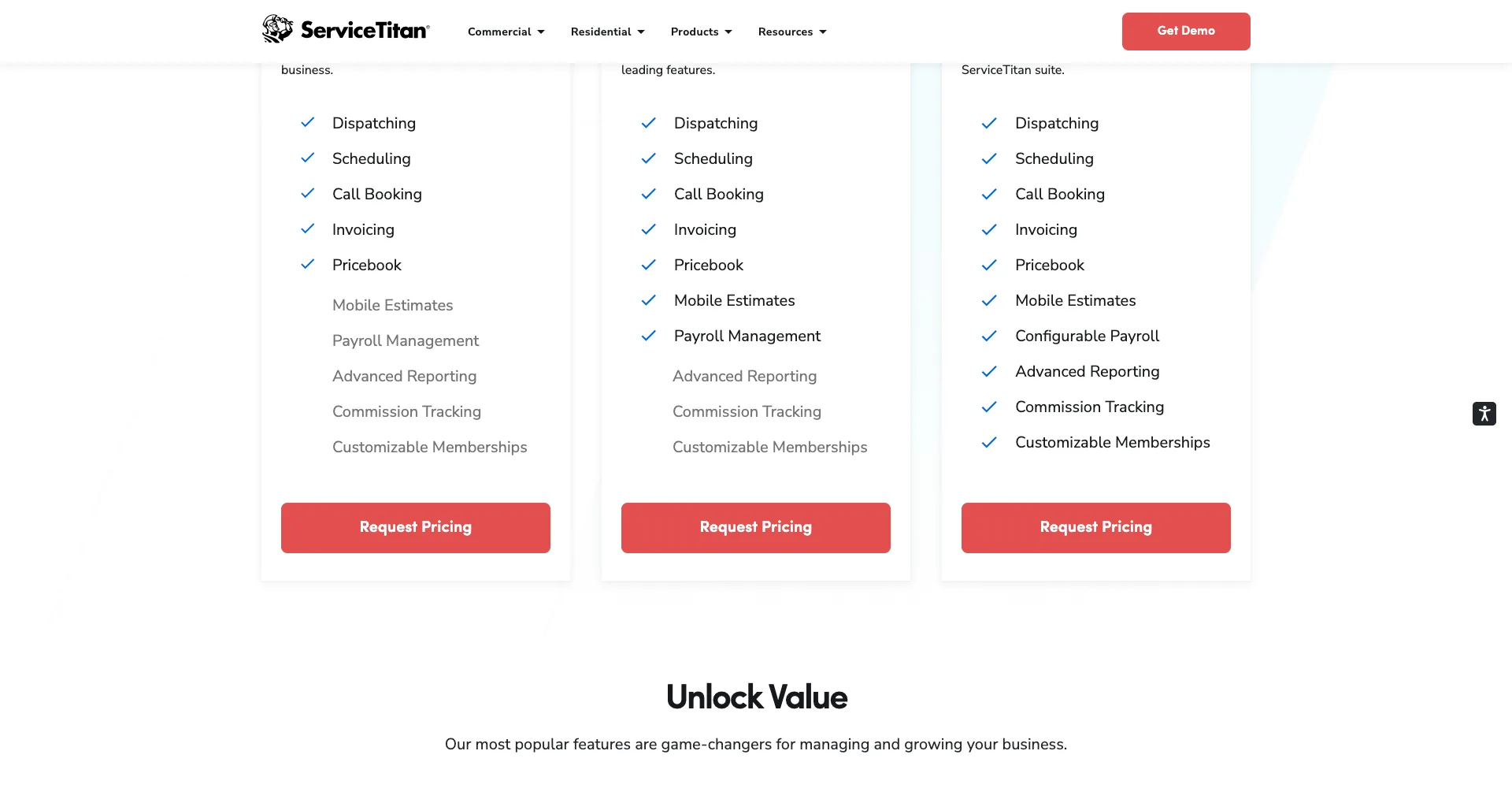 Jul 31, 2026
 Tech Stack
Best Electrical Contractor Software 2026: 11 Ranked and Priced
An electrical contracting business makes two software purchases that do not substitute for each other, and every roundup answering this query covers only one of them. Eleven platforms, with a published price or an explicit statement that the vendor publishes none.
Read Article Jul 31, 2026
 Tech Stack
Best HVAC Software in 2026: Eleven Ranked Across Three Classes
An HVAC contracting business buys across three classes of software that do not substitute for each other, and every roundup answering this query covers only one of them. Eleven products, each with a published price or an explicit statement that the vendor publishes none.
Read Article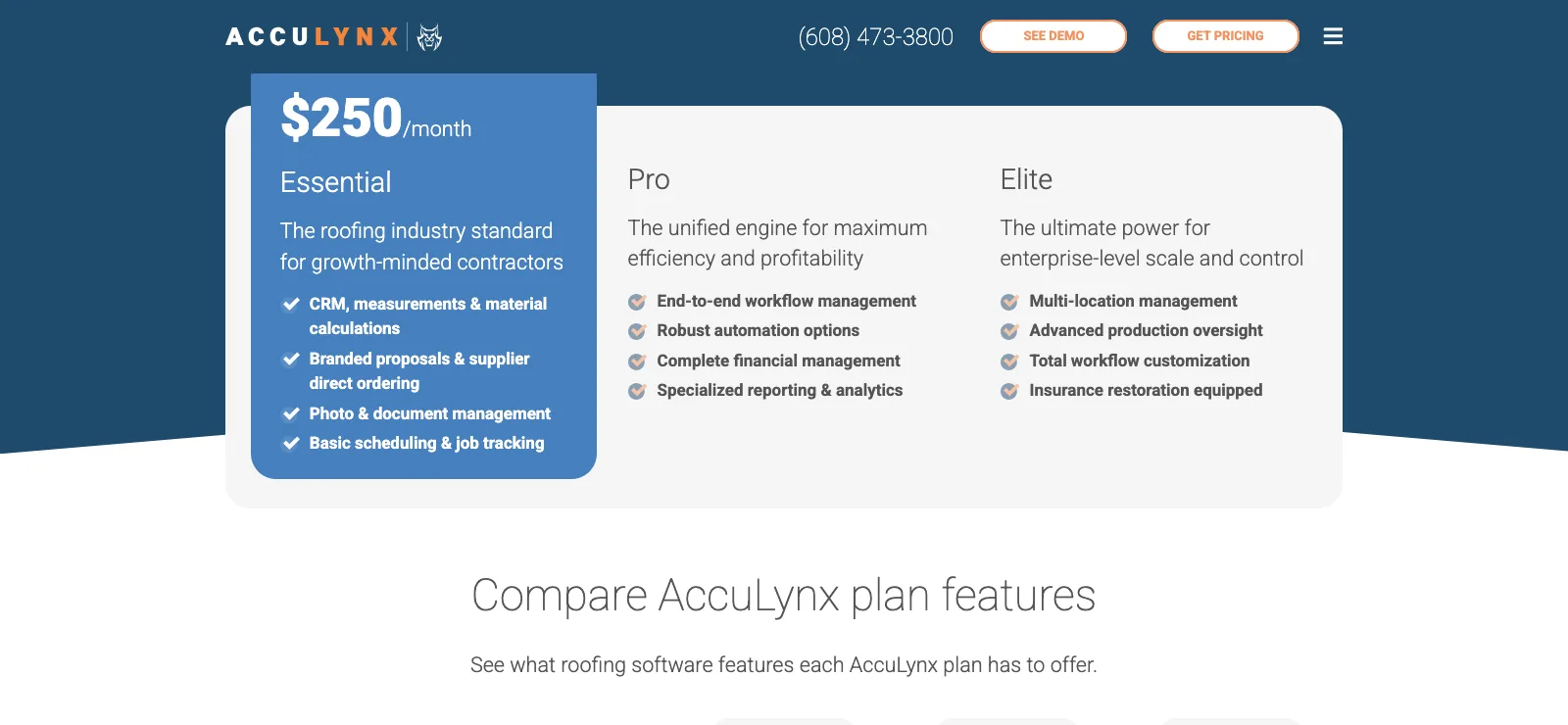 Jul 30, 2026
 Tech Stack
AccuLynx Pricing 2026: The Real Cost of a Quote-Gated Plan
One published figure, two blank plan cards, and a contract that says things the pricing page does not. A line-by-line breakdown of what AccuLynx really bills.
Read Article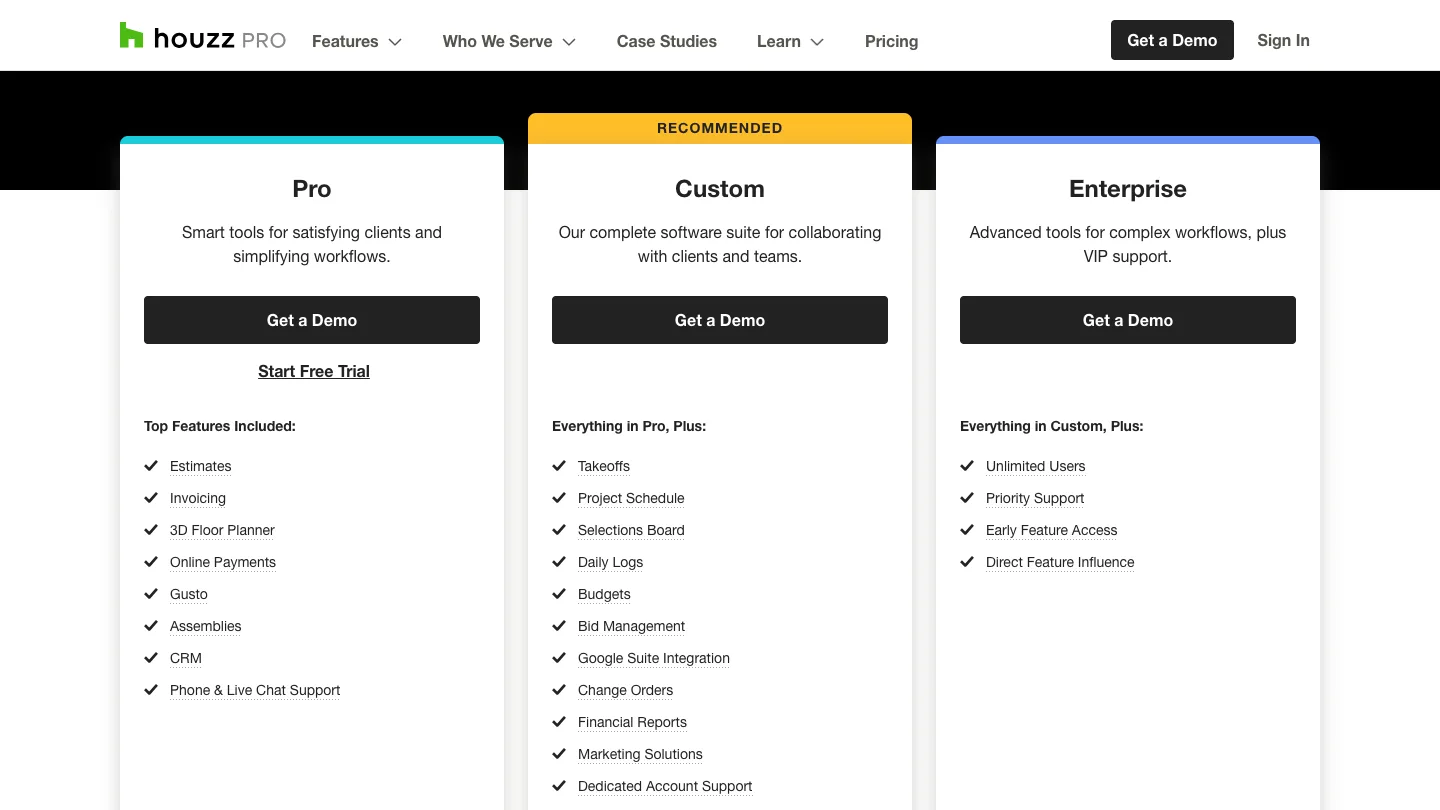 Jul 30, 2026
 Tech Stack
Houzz Pro Canada Review 2026: Pricing and Alternatives
Houzz Pro serves different pricing renderings. What Canadian buyers see, how GST/HST and payments work, what Custom gates, and what the annual contract commits you to.
Read Article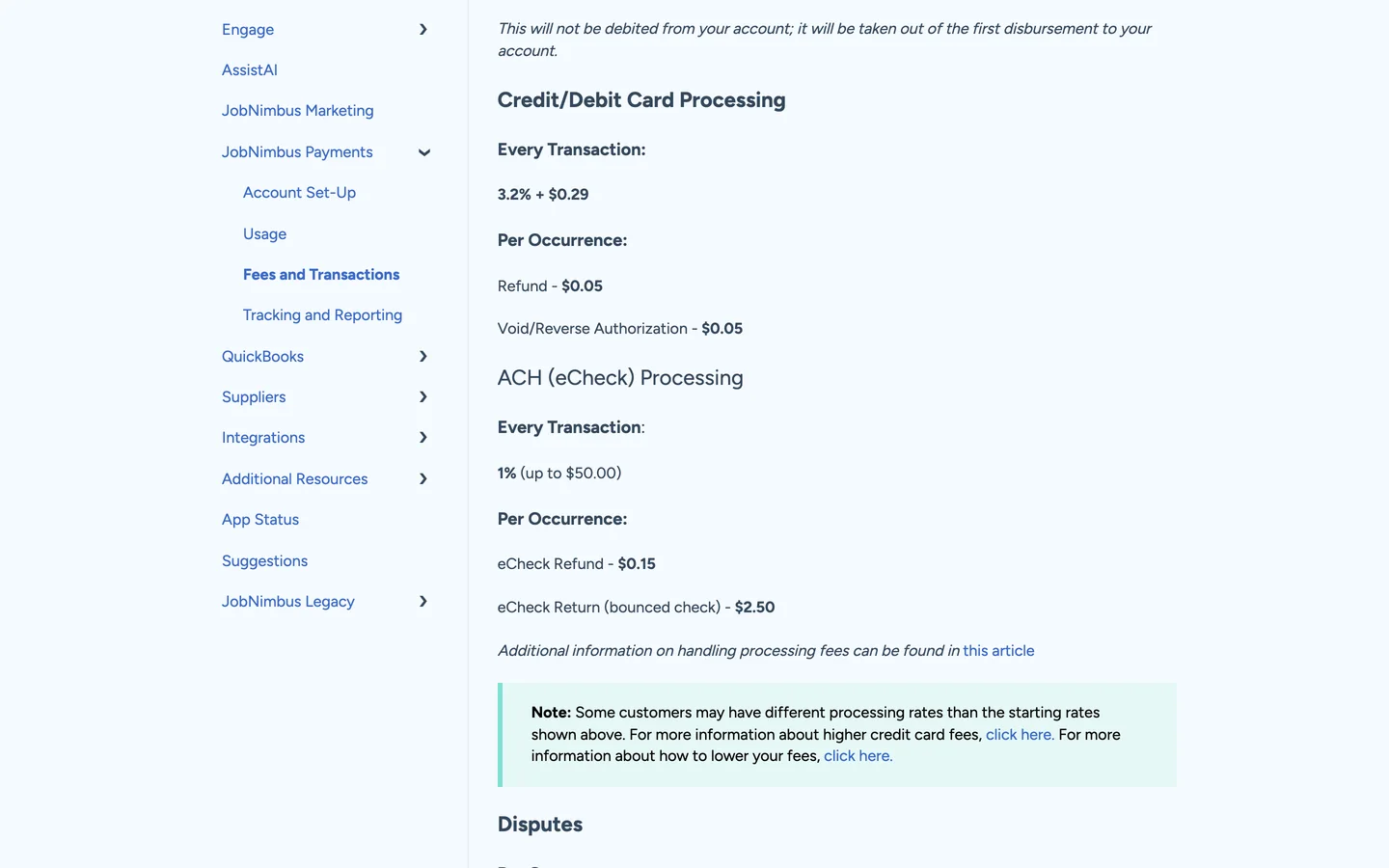 Jul 30, 2026
 Tech Stack
JobNimbus Pricing in 2026: What the Quote Does Not Cover
JobNimbus prints no figure on any of its four plans. So the only rate you can read before a sales call is the payments meter, and it is the biggest line on the bill.
Read Article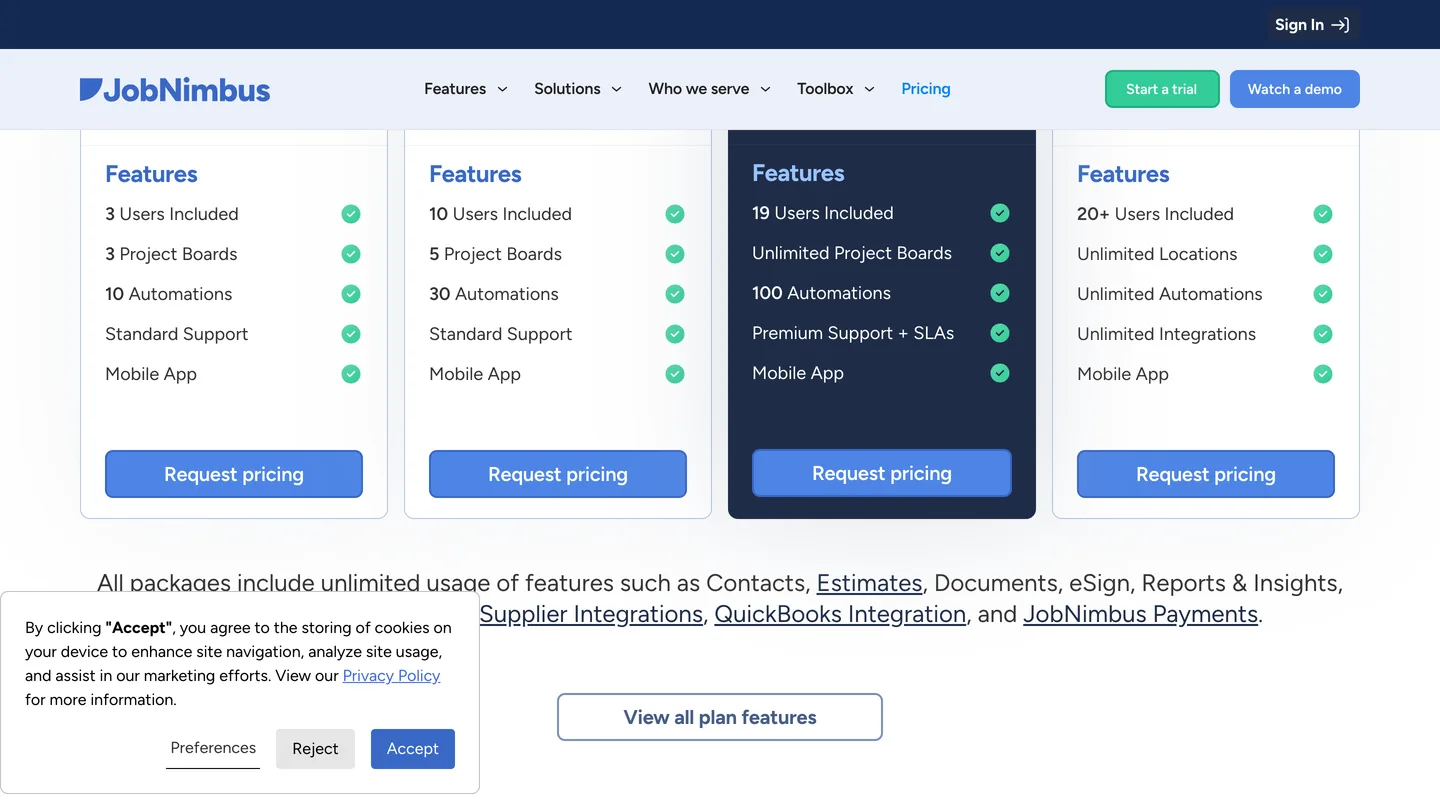 Jul 30, 2026
 Tech Stack
JobNimbus Review 2026: Pricing, Pros, Cons and Alternatives
JobNimbus rates 4.6 on Capterra and orders material straight from ABC Supply and SRS. But it publishes no price, and its supplement route carries a note.
Read Article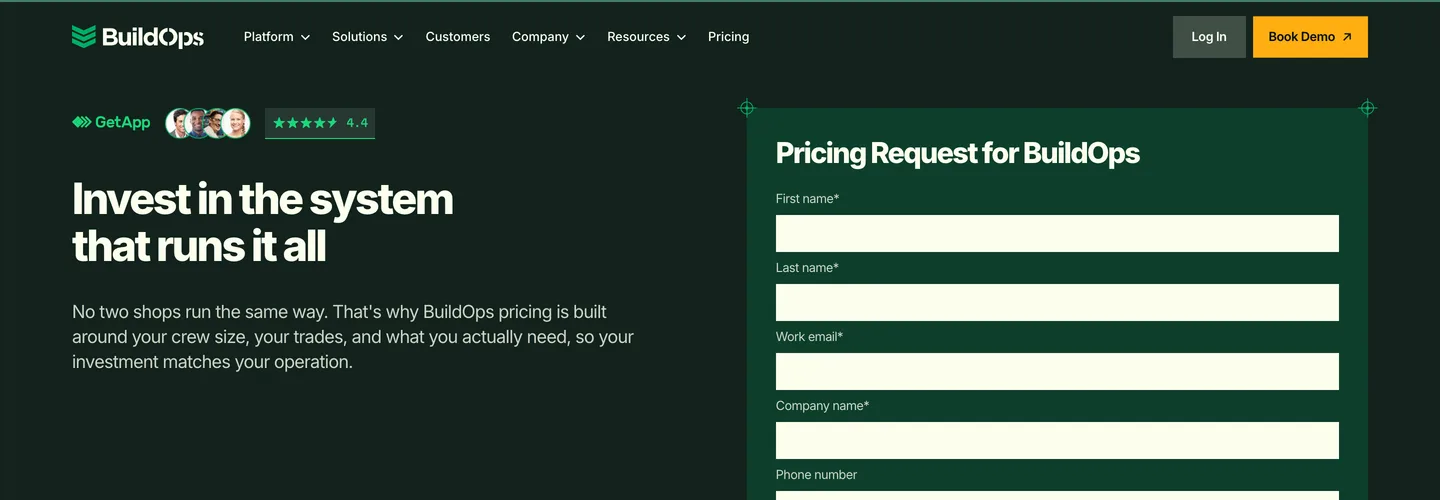 Jul 30, 2026
 Tech Stack
BuildOps Review 2026: Pricing, Contract Terms and Alternatives
BuildOps runs commercial service and projects on one platform, and publishes no pricing at all. The billing unit, the 30-day data-export window, and who it suits.
Read Article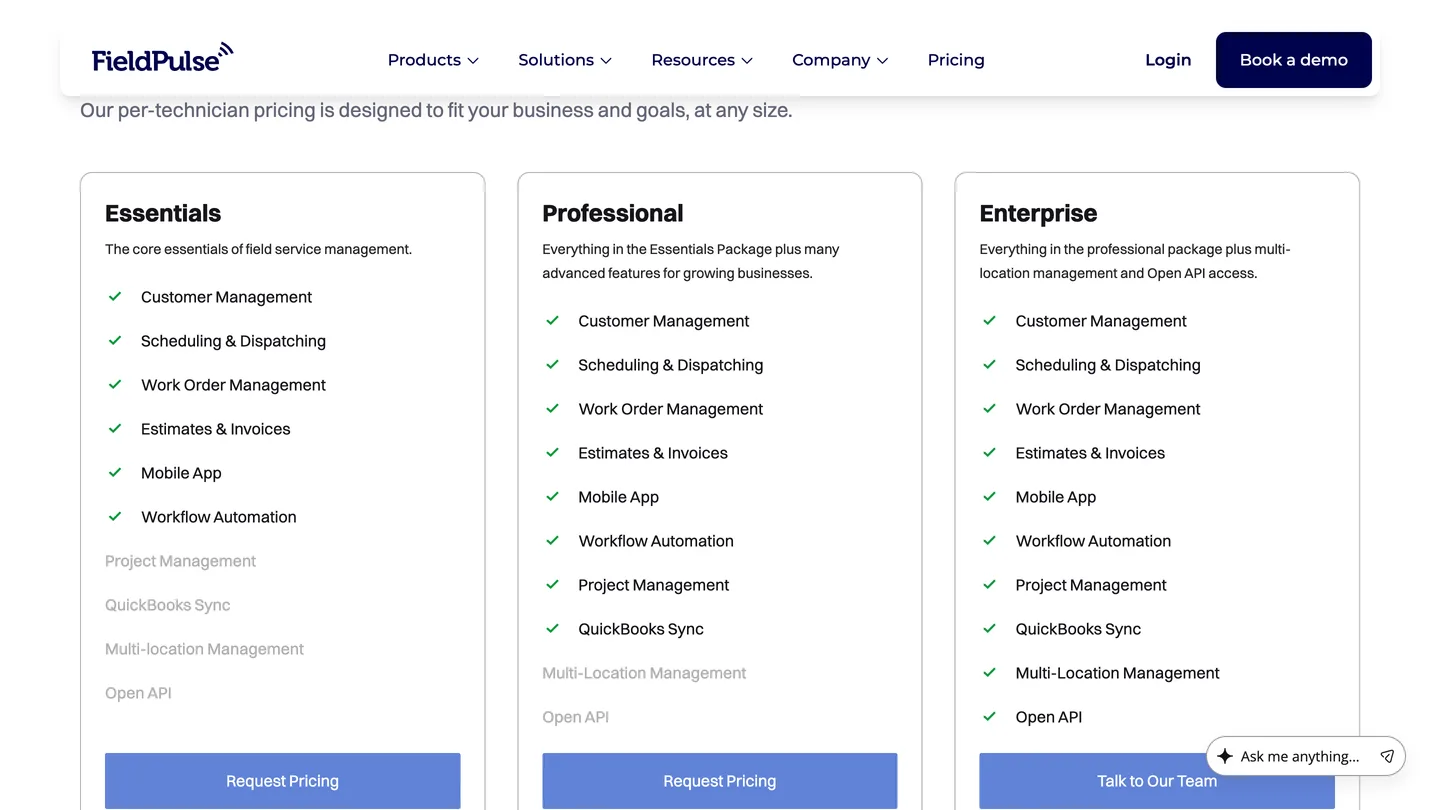 Jul 30, 2026
 Tech Stack
FieldPulse Review 2026: Pricing, Pros, Cons and Alternatives
FieldPulse rates 4.6 on Capterra and is the platform contractors name when they leave a bigger system. But it publishes no price, and the contract runs a year.
Read Article Jul 30, 2026
 Tech Stack
Service Fusion Review 2026: Pricing, Contract and Alternatives
Service Fusion bills flat per company with unlimited users, which is the best structural deal in field service software. The published plans, the contract behind the no-contract line, and the app score every other review gets wrong.
Read Article Jul 30, 2026
 Tech Stack
Knowify Review 2026: Pricing, Job Costing and Alternatives
Knowify rates 4.5 on Capterra and its weakest sub-score is features. What the $99 Core plan withholds, which way the QuickBooks sync really runs, and who should not buy it.
Read Article Jul 29, 2026
 Tech Stack
AccuLynx Review 2026: Pricing, Tier Gating, Alternatives
AccuLynx rates 4.6 across 846 reviews and now publishes an entry price. What that price omits, which tier holds the insurance workflow, and who should skip it.
Read Article Jul 29, 2026
 Tech Stack
Unitel Voice Review 2026: Pricing, Features and Alternatives
Unitel Voice rates 4.6 on Capterra and gives a one-truck shop a business number for $9.99 a month. The published plans, the cost per call, and what it won't do.
Read Article Jul 29, 2026
 Tech Stack
NiceJob vs Podium 2026: Pricing, Contracts and Review Gating
Both vendors print a price, at very different scale and in different currencies. The gap that matters is what Podium will not print: the billing unit, and whether a trade shop gets the number on the page.
Read Article Jul 28, 2026
 Tech Stack
CompanyCam Review 2026: Pricing, Pros, Cons and Alternatives
Every page ranking for CompanyCam still quotes a per-user price the vendor no longer charges. Here are the real plans, the seat math, and who should skip it.
Read Article Jul 28, 2026
 Tech Stack
NiceJob Review 2026: Pricing, Pros, Cons and Alternatives
NiceJob rates 4.9 on Capterra and refuses to gate negative reviews. Real plan pricing, the active-customer threshold nobody publishes, and who should skip it.
Read Article Jul 27, 2026
 Tech Stack
Buildertrend Review 2026: Pricing, Limits and Alternatives
Buildertrend rates 4.5 across 2,486 Capterra reviews and quotes against your revenue rather than your seat count. The workflows, the export problem, the alternatives.
Read Article Jul 27, 2026
 Tech Stack
CallRail Review 2026: Pricing, Pros, Cons and Alternatives
CallRail rates 4.5 on Capterra, and its tracking numbers port out free. But the two usage rates that decide your real bill are the two it does not print.
Read Article Jul 27, 2026
 Tech Stack
Roofr Review 2026: Pricing, Pros, Cons and Alternatives
Roofr rates 4.6 on Capterra and sells $13 measurement reports against a market charging triple. But it will not import a report from anywhere else.
Read Article Jul 25, 2026
 Tech Stack
Housecall Pro Review 2026: Pricing, Pros, Cons, Alternatives
Housecall Pro has the shortest learning curve in the category and the widest review spread. Real pricing, the Instapay math, and the migration trap to plan around.
Read Article Jul 24, 2026
 Tech Stack
Jobber Review 2026: Pricing, Pros, Cons and Alternatives
Jobber rates 4.6 on Capterra with the best mobile app in the category. Real plan pricing, the feature gating that changes your entry price, and who it suits.
Read Article Jul 23, 2026
 Tech Stack
ServiceTitan Review 2026: Pricing, Pros, Cons, Alternatives
ServiceTitan rates 4.3 on Capterra but its weakest score is value for money. Real reported pricing, the 12-month contract, the exit fees, and who it actually suits.
Read Article Jun 3, 2026
 Tech Stack
HVAC Online Scheduling: The 43% Losing After-Hours Bookings
HVAC leads every trade on online booking at just 56.7%, which still leaves 43% of sites forcing an after-hours customer to wait for a business-hours phone call.
Read Article