Service Autopilot Review 2026: Pricing, Pros, Cons, Alternatives
Service Autopilot starts at $49/month. What each tier gates, the 8 limitations reviewers name, and 5 alternatives with published prices.
Disclosure This article features tools from our brand partners. If you choose to use them, we may receive compensation at no extra cost to you.
Our editorial choices are independent of these affiliate arrangements. Read our full affiliate disclosure.
Fervor is a CRO and web design studio, not a software reseller, and no vendor paid for placement here or for a kinder verdict. Affiliate links are flagged where they appear, and they never change what we report.
Page at a glance
Service Autopilot is recurring-route automation software for lawn and landscape maintenance companies, with published tier prices, a deep automation engine, and an Xplor parent contract that carries a 7% annual escalator and a payment-processor exclusivity clause. It starts at $49/month per account, includes 1 business user and 1 mobile license. Two separate seat types, both capped by tier. Every published tier includes exactly 1 business user except Elite, which includes 2. Mobile licenses scale 1 / 2 / 5 / 8 across Startup, Pro, Pro Plus and Elite. The vendor does not publish the price of an additional business user or an additional mobile license anywhere on the pricing page. It fits a 3 to 25 person lawn care or landscape maintenance crew running high-volume recurring residential service routes, where the same jobs repeat weekly and automation of billing and dispatch pays for itself. It's the wrong buy for A design-build or hardscape contractor running long, phased, budget-tracked projects rather than repeating routes, because The product is built around recurring maintenance jobs and automation of those repeats. And a Capterra reviewer who runs construction work summed the fit up as good for maintenance Companies not design build, and flagged the management of large projects was bad. So job costing against a multi-week build with change orders isn't what the dispatch board is for. Alternatives that publish their prices are Jobber from $49/month, SingleOps from $220/month, LMN (Landscape Management Network) from $297/month. Three priced tiers, eight evidenced gaps and five alternatives, three of which publish a figure.
What you're buying with Service Autopilot, and what the demo skips
Service Autopilot earns its money with a 3 to 25 person lawn care or landscape maintenance crew running high-volume recurring residential service routes, where the same jobs repeat weekly and automation of billing and dispatch pays for itself. If that's you, it does the job. The sections below are the parts worth checking before you sign. But the fit is narrower than the marketing suggests, and the price isn't the whole cost.
It starts at $49/month. And pricing was verified on 7 August 2026, so you can check every figure below in a browser tab.
| Pricing model | Published tiers |
|---|---|
| Entry price | $49/month |
| Users | Two separate seat types, both capped by tier. Every published tier includes exactly 1 busi |
| Ownership | [object Object] |
| Best fit | a 3 to 25 person lawn care or landscape maintenance crew running high-volume recurring residential service routes, where the same jobs repeat weekly and automation of billing and dispatch pays for itself. |
| Accounting sync | QuickBooks Online (two-way), QuickBooks Desktop (two-way), Xero (none) |
What works
- The automation engine is the reason to buy it and the reason it's hard to leave
- The dispatch board is the most consistently praised screen in the product
- One accounting path, priced separately, and the most complained-about surface in the product
- The weakest layer, and the one your crews touch every day
- Export is list-by-list from inside the product, so do it while you still have a login
What does not
- Leaving early costs every remaining month of the term, in full
- A 7% annual price increase is written into the contract, not negotiated at renewal
- Card processing is contractually locked to one provider
- The mobile app rates far worse than the desktop product
- QuickBooks sync is an extra monthly fee and is blocked on the entry tier
Service Autopilot is recurring-route automation software for lawn and landscape maintenance companies, with published tier prices, a deep automation engine, and an Xplor parent contract that carries a 7% annual escalator and a payment-processor exclusivity clause. It sells to Landscaping contractors, and the shape of the product follows from that: Service Autopilot's differentiator is rule-based automation over recurring jobs: trigger a follow-up, a price change, a renewal, an upsell or a billing event off a job state without touching it. Reviewers name it first when they name anything positive. One manager wrote that automations were the attraction, an owner called the automations that it offers a game changer, and a construction manager who otherwise rated the product two stars still called automations a great way to reduce the burden on office staff. And the corollary is that the automations you build are the switching cost, because they encode office process that lives nowhere else.
Ownership matters here more than it usually does. Service Autopilot is owned by [object Object], so weigh roadmap risk alongside the feature list. An independent product can be bought and folded into somebody else's plan two years after you sign.
The shops Service Autopilot fits, and the ones it doesn't
It fits a 3 to 25 person lawn care or landscape maintenance crew running high-volume recurring residential service routes, where the same jobs repeat weekly and automation of billing and dispatch pays for itself. That's the half most reviews print. Here's the other half, which is the one worth your time.
Don't buy it if you're A design-build or hardscape contractor running long, phased, budget-tracked projects rather than repeating routes. The product is built around recurring maintenance jobs and automation of those repeats. And a Capterra reviewer who runs construction work summed the fit up as good for maintenance Companies not design build, and flagged the management of large projects was bad. So job costing against a multi-week build with change orders isn't what the dispatch board is for. Look at Buildertrend instead.
Don't buy it if you're An owner-operator or two-person crew under about $250K in revenue who wants to be running this week. The $49 Startup tier blocks the QuickBooks sync, so the realistic entry point is $199 plus a $29 add-on plus an undisclosed sign-up fee, inside a term contract with an early termination fee equal to every remaining month. And reviewers consistently describe a steep ramp, one saying it can be difficult to learn because it's complex. So that's a lot of commitment and setup for a shop that hasn't yet proven its route density. Look at Jobber instead.
Don't buy it if you're Any contractor who has already negotiated a good merchant processing rate, or who runs high card volume. The contract requires engaging only with Clearent for payment services. On a business processing $1M a year in cards, a 30 basis point difference in effective rate is $3,000 a year, which is more than the entire Pro subscription. So losing the ability to shop that rate for the length of the term is a bigger financial decision than the software choice itself. Look at Jobber instead.
Don't buy it if you're A crew whose field staff are on old or shared phones and whose payroll depends on in-app clock in and clock out. The iPhone app sits at 2.4 out of 5 across 90 ratings against a 4.1 desktop-weighted score on Capterra, and the specific failure reviewers report is the app not uploading jobs and clock in/clock out times to the office. And when the mobile layer is the timesheet, an unreliable mobile layer is a payroll defect. Look at Housecall Pro instead.
Pricing: what Service Autopilot publishes and what it doesn't
You can read Service Autopilot's prices without booking anything. So the headline figure is the easy part. What the entry tier quietly leaves out is the question.
| Tier | Price | Billing unit | What it unlocks |
|---|---|---|---|
| Startup | $49/month | per account, includes 1 business user and 1 mobile license | Entry tier. Excludes the QuickBooks two-way sync, which requires Pro or Pro Plus. |
| Pro | $199/month | per account, includes 1 business user and 2 mobile licenses | Lowest tier eligible for the $29/month QuickBooks two-way sync add-on |
| Pro Plus | $499/month | per account, includes 1 business user and 5 mobile licenses | Marked MOST POPULAR on the vendor pricing page |
| Elite | Quote only | per account, includes 2 business users and 8 mobile licenses, price not published | Listed as Contact for pricing |
Two separate seat types, both capped by tier. Every published tier includes exactly 1 business user except Elite, which includes 2. Mobile licenses scale 1 / 2 / 5 / 8 across Startup, Pro, Pro Plus and Elite. The vendor does not publish the price of an additional business user or an additional mobile license anywhere on the pricing page.
What a Service Autopilot quote leaves out
Payment processing. Contractually exclusive to Clearent. The Xplor terms read: Client agrees that, to the extent it requires such services, it will engage only with Clearent and will enter promptly into a merchant agreement with Clearent. The same section states that if Client has agreed to promotional rate Fees which are linked to Client taking payment services from Clearent and Client has not entered into a merchant agreement with Clearent within 30 days of the date of this Agreement, then the promotional rate Fees are to be rescinded retroactively. No processing rate or per-transaction percentage is published.
Implementation and onboarding. Every published tier on the pricing page reads $49 / MO + sign up fee, $199 / MO + sign up fee and $499 / MO + sign up fee. The sign-up fee exists on the page but its amount is never stated. So ask for the sign-up fee in writing for your specific tier before signing, and ask whether it's refundable given that the contract says Xplor does not issue refunds.
Minimum term. Set per customer in the Order Form, not published. The terms say: Following the Initial License Period, this Agreement will automatically renew for successive periods of equivalent length to the Initial License Period (each a Renewal Period). Because the renewal period equals the initial period, a 12-month initial term renews into another 12-month term rather than into month-to-month. The pricing page FAQ separately states you can upgrade whenever you want and you can downgrade plans at the end of your contract period, confirming a contract period exists on the published monthly tiers.
Getting out. Early Termination Fees means the amount equal to the relevant monthly Fees multiplied by the number of months remaining in the Initial License Period or Renewal Period (as appropriate). There is no proration and no partial credit: leaving early costs the full remaining balance of the term.
Auto-renewal. Automatic, with a 30-day notice window. The terms say the agreement renews unless either party provides written notice of termination to the other party at least 30 days prior to the expiration of the Initial License Period or any Renewal Period. Miss the window by a day and the early termination fee applies to the whole new term.
Modules sold separately. , , , , , , , . So price the Service Autopilot configuration you'll really run rather than the entry tier, because an add-on you need on day one is part of the price.
Third-party services you will also pay for. , . These are not on Service Autopilot's invoice, and they are still part of what this decision costs you every month.
A tangent, but stay with it. The early termination fee is the entire remaining balance of the term, and the auto-renewal period equals the initial period rather than dropping to month-to-month. So those two clauses compound: miss the 30-day non-renewal notice on a 12-month contract and you've bought twelve more months, not one. And the cost of getting out of them is all twelve. The notice date, not the renewal date, is the decision date. So put it in the calendar at signing with 45 days of margin, because after it passes the only way out is paying for software you've stopped using.
The Service Autopilot line items nobody mentions
The subscription is the part everyone quotes. These are the lines that land afterwards, and the ones we could not find are named as unpublished rather than left blank.
Sold separately. , , , , , , , . Price the configuration you'll really run, because an add-on you need on day one is part of the price.
Third-party services you'll also pay for. , . None of these are on Service Autopilot's invoice, and all of them are part of what this decision costs every month.
"Service Autopilot Startup is $49/month, per account, includes 1 business user and 1 mobile license."
Service Autopilot pricing page (2026)
"Service Autopilot Pro is $199/month, per account, includes 1 business user and 2 mobile licenses."
Service Autopilot pricing page (2026)
"Two separate seat types, both capped by tier. Every published tier includes exactly 1 business user except Elite, which includes 2. Mobile licenses scale 1 / 2 / 5 / 8 across Startup, Pro, Pro Plus and Elite. The vendor does not publish the price of an additional business user or an additional mobile license anywhere on the pricing page."
Service Autopilot pricing page (2026)
The five workflows you pay for
Feature totals are noise. So a shop in this category lives or dies on five things, and those are the five to grade, and each one below carries the evidence it's graded on.
The automation engine is the reason to buy it and the reason it's hard to leave Service Autopilot's differentiator is rule-based automation over recurring jobs: trigger a follow-up, a price change, a renewal, an upsell or a billing event off a job state without touching it. Reviewers name it first when they name anything positive. One manager wrote that automations were the attraction, an owner called the automations that it offers a game changer, and a construction manager who otherwise rated the product two stars still called automations a great way to reduce the burden on office staff. And the corollary is that the automations you build are the switching cost, because they encode office process that lives nowhere else. A manager, consumer services, puts it it plainly: "Automations were the attraction. They also have a very nice and easy to use dispatch board."A manager, construction, puts it it plainly: "Every communication has to be tested 2-3 times."
The dispatch board is the most consistently praised screen in the product Across Capterra and GetApp, the dispatch board is what people say works. A manager described a very nice and easy to use dispatch board, an office manager said the Dispatch board and scheduling features were what they liked most, and an owner who rated the product four stars singled out the routing/dispatch board. So for a lawn maintenance company where the whole margin question is stops per truck per day, this is the right feature to be the strong one. A manager, consumer services, writing on 2021-05-27, says: "Automations were the attraction. They also have a very nice and easy to use dispatch board."An office manager, says: "What we like the most about SA is the Dispatch board and scheduling features."
One accounting path, priced separately, and the most complained-about surface in the product The QuickBooks sync is marketed as the only platform in our industry that fully integrates with the QuickBooks API, covering roughly eighteen record types across QuickBooks Online, Pro, Premiere and Enterprise. But it also costs $29 a month, requires Pro or above, and is where negative reviews cluster: a president reporting that Quickbooks online integration did not work correctly and we had billing issues, an owner citing issues with QuickBooks sync, and a migrating user writing that it crashed quickbooks, took 2.5 days to import all of my quickbooks info had bugs. But a president, hospitality, 2+ years on the platform, says it differently: "Quickbooks online integration did not work correctly and we had billing issues."But a garden writer, construction, says it differently: "Crashed quickbooks, took 2.5 days to import all of my quickbooks info had bugs"
The weakest layer, and the one your crews touch every day The office product and the field product are rated by different populations and score very differently. Owners rating the browser experience push Capterra to 4.1 out of 5 over 139 reviews. But crew members rating the iPhone app push it to 2.4 out of 5 over 90 ratings, with the specific complaints being crashes, blank screens on app resume, forced re-login and job data not reaching the office. And a newer user described having to close the app, reopen it and re-sign in several times a day. But a field employee, about 2 years on the platform, says it differently: "I've been using this app for maybe 2 years now as an employee and it has had consistent issues the entire time. It doesn't upload jobs and clock in/clock out times to the office. Crashes constantly. Doesn't load half the time, and just boots you out of the app completely sometimes. After the most recent update I have to log in manually every time and go through the entire startup tutorial every time."
Export is list-by-list from inside the product, so do it while you still have a login Service Autopilot supports exporting lists to .xls from several screens including the client list, the Dispatch Board, the invoices screen and the payments list. But there's no documented single-click full-account archive, which makes exiting a manual, screen-by-screen exercise. And that matters more than usual here because the contract gives Xplor a data-deletion obligation on termination rather than a data-delivery one, and because one reviewer describes being cut off from their own account while travelling. A twelve-year user across two companies, 12 years on the platform, says: "Twelve years ago when I started using this software for two different companies, it was great. The people who did the development also did the customer service calls. Now it's just a regurgitation crew who usually doesn't figure out the solution before you do. There are lots of other issues, but basically it was sold out to a British investment firm, and you're locked into their payment processor with no other choices."
Service Autopilot trade fit
Fit differs by trade rather than by company size alone, and a blended paragraph hides that. Here is the split for the trades this one sells to.
Landscaping. The workflow that decides it is the automation engine is the reason to buy it and the reason it's hard to leave, and the shop profile that gets value is a 3 to 25 person lawn care or landscape maintenance crew running high-volume recurring residential service routes, where the same jobs repeat weekly and automation of billing and dispatch pays for itself. doing residential and service and commercial work. Where it stops being a fit is A design-build or hardscape contractor running long, phased, budget-tracked projects rather than repeating routes.
Your books, and whether Service Autopilot connects to them
QuickBooks Online connects both ways, gated to a higher tier. QuickBooks Desktop connects both ways, gated to a higher tier. Xero connects, on every plan. Your costs map through cost codes, so test yours against your own chart of accounts before you commit. A code your books don't recognise is how a labour charge quietly lands somewhere useless.
Past those, the road ends. A counted public integrations directory, Xero, Sage, FreshBooks, Alternative payment processors (Stripe, Square, a existing merchant account), Zapier do not connect. So if your books run on an ERP rather than the platforms named above, weigh that before anything else.
Beyond accounting it connects to Clearent (Payment processing and merchant services. Not an optional integration but a contractual exclusivity: the terms require the client to engage only with Clearent and enter a separate merchant agreement.), FleetSharp (GPS fleet and asset tracking surfaced inside the dispatch view, plus dash cams, driver behaviour and vehicle maintenance alerts. FleetSharp is a separate subscription of its own.), Deep Lawn (AI aerial lawn measurement and instant quote generation, with measurements and custom field data flowing back into Service Autopilot. Announced as available to new and existing members.), Gmail and Outlook (Email Integration, sold as an add-on rather than included. Listed on the pricing comparison chart as Call for Pricing.). A public API exists: No public API documentation, developer portal or API pricing is published on the vendor domain. The support documentation splits integrations into full developer supported integrations and form or email integrations, which implies partner-by-partner development rather than an open self-serve API. Assume you cannot build against it without a vendor conversation.
Service Autopilot support, onboarding and the hours
Support is the line item nobody prices and everybody eventually needs. Service Autopilot publishes no onboarding fee either way, so ask what is included at your tier and what is billed hourly after go-live.
A twelve-year user across two companies, 12 years on the platform, says: "Twelve years ago when I started using this software for two different companies, it was great. The people who did the development also did the customer service calls. Now it's just a regurgitation crew who usually doesn't figure out the solution before you do. There are lots of other issues, but basically it was sold out to a British investment firm, and you're locked into their payment processor with no other choices."
A landscaping, pool and turf services operator, reports it it plainly: "I could write a book about why you should avoid this app and service. The app on the phone or computer is not user friendly at all. Any issue you have will be met with incompetence from both their phone and chat team. The only reason I still have the service is cause I don't want to ask hundreds of people for their cc information."
The Service Autopilot term, and what leaving costs
Nobody reads this section before they buy, and it's the one that costs money afterwards. Four terms decide what leaving looks like.
Minimum term. Set per customer in the Order Form, not published. The terms say: Following the Initial License Period, this Agreement will automatically renew for successive periods of equivalent length to the Initial License Period (each a Renewal Period). Because the renewal period equals the initial period, a 12-month initial term renews into another 12-month term rather than into month-to-month. The pricing page FAQ separately states you can upgrade whenever you want and you can downgrade plans at the end of your contract period, confirming a contract period exists on the published monthly tiers.
Auto-renewal. Automatic, with a 30-day notice window. The terms say the agreement renews unless either party provides written notice of termination to the other party at least 30 days prior to the expiration of the Initial License Period or any Renewal Period. Miss the window by a day and the early termination fee applies to the whole new term.
Early termination. Early Termination Fees means the amount equal to the relevant monthly Fees multiplied by the number of months remaining in the Initial License Period or Renewal Period (as appropriate). There is no proration and no partial credit: leaving early costs the full remaining balance of the term.
Payment processing. Contractually exclusive to Clearent. The Xplor terms read: Client agrees that, to the extent it requires such services, it will engage only with Clearent and will enter promptly into a merchant agreement with Clearent. The same section states that if Client has agreed to promotional rate Fees which are linked to Client taking payment services from Clearent and Client has not entered into a merchant agreement with Clearent within 30 days of the date of this Agreement, then the promotional rate Fees are to be rescinded retroactively. No processing rate or per-transaction percentage is published.
Side note, and it's a useful one: the contract converts a software purchase into a payments purchase. Requiring the client to engage only with Clearent moves the largest recurring cost line in a service business, card processing spread, inside a contract chosen for its dispatch board. And there's also a retroactive clawback if you take a promotional software rate tied to Clearent and then fail to sign the merchant agreement within 30 days. Evaluate this as a payments contract with software attached. On $1M of annual card volume, 30 basis points is $3,000 a year, more than the Pro subscription costs. So if the Clearent rate isn't competitive, no amount of dispatch-board quality makes the deal work.
"There's no way to end your subscription either in-app or online; you have to call-in to customer service, which we did. By the way, the "click-to-subscribe, call to cancel" subscription model is illegal according to the FTC. Then, 4 months later, I discovered that Service Autopilot had continued billing us. Again, we called to cancel, and requested a refund for those 4 months. That didn't cut it for Service Autopilot. They requested another phone call so that they could again receive "verbal confirmation of your (cancellation) request," for "security reasons.""
Apple App Store, Frodochips (6-07)
"Twelve years ago when I started using this software for two different companies, it was great. The people who did the development also did the customer service calls. Now it's just a regurgitation crew who usually doesn't figure out the solution before you do. There are lots of other issues, but basically it was sold out to a British investment firm, and you're locked into their payment processor with no other choices."
Apple App Store, Stop changing the app layout (2026)
"I've been using this app for maybe 2 years now as an employee and it has had consistent issues the entire time. It doesn't upload jobs and clock in/clock out times to the office. Crashes constantly. Doesn't load half the time, and just boots you out of the app completely sometimes. After the most recent update I have to log in manually every time and go through the entire startup tutorial every time."
Apple App Store, Ngacydvjurc (2026)
What Service Autopilot does badly
And these are the gaps worth raising before you sign. They come out of reviewer complaints and out of what the vendor's own pages carefully don't say.
Leaving early costs every remaining month of the term, in full The Xplor contract defines Early Termination Fees as the relevant monthly Fees multiplied by the number of months remaining. On a Pro Plus account at $499 a month, walking away eight months into a twelve-month term is a four-month, roughly $2,000 exit invoice on top of everything already paid. And because the agreement auto-renews for a period equal to the initial one, a missed 30-day notice window restarts that exposure for another full term. Get the Initial License Period written into the Order Form before signing, calendar the notice date 45 days ahead of renewal, and ask in writing for a month-to-month option even at a higher rate.
A 7% annual price increase is written into the contract, not negotiated at renewal Most SaaS contracts let a vendor raise prices with notice. But this one pre-authorises the increase. Xplor is entitled to add 7% to the prior twelve months' fees automatically, and only an increase above 7% triggers the 45-day notice and the 10-day termination window. So compounded, a $499 Pro Plus subscription is about $611 in year three and about $700 in year five without a single conversation. Price the tool over three years, not one. So ask for the escalator to be capped or struck in the Order Form, and treat any quoted first-year discount as temporary.
Card processing is contractually locked to one provider The agreement requires the client to engage only with Clearent for payment services. So that removes the single biggest ongoing cost lever a service business has, because processing spread on a few hundred thousand dollars of card volume dwarfs the software subscription. And two independent reviewers on two platforms describe the same lock from the buyer's side, one calling it stuck with one credit card processor and another saying you're locked into their payment processor with no other choices. Get Clearent's effective rate and per-transaction fee in writing before you sign the software contract, and compare it against your current processor on your actual card mix.
The mobile app rates far worse than the desktop product Service Autopilot holds 4.1 out of 5 across 139 Capterra reviews, which reads as a solid mid-market product. But the iPhone app holds 2.4 out of 5 across 90 ratings. That gap matters because the crew in the truck lives in the app while the owner evaluating the software lives in the browser. And a field employee describes it crashing constantly and failing to upload clock in and clock out times to the office, which is a payroll problem, not a convenience problem. But a field employee, about 2 years on the platform, puts it it differently: "I've been using this app for maybe 2 years now as an employee and it has had consistent issues the entire time. It doesn't upload jobs and clock in/clock out times to the office. Crashes constantly. Doesn't load half the time, and just boots you out of the app completely sometimes. After the most recent update I have to log in manually every time and go through the entire startup tutorial every time." Trial the mobile app on the oldest phone in your fleet, on a real route, for a full week before committing. And verify time entries reach the office.
QuickBooks sync is an extra monthly fee and is blocked on the entry tier The two-way QuickBooks sync is the feature the product markets hardest. But it's neither included nor available at the $49 Startup tier. The vendor's own QuickBooks page prices it at $29 per month and states you MUST have a Pro or Pro Plus membership. So the real entry price for a shop that needs accounting sync is $199 plus $29, not $49. And the pricing page's comparison chart makes this harder to catch by listing the same integration as Call for Pricing. Build your budget from Pro plus every add-on you need, then add the undisclosed sign-up fee, and compare that total against competitors rather than comparing headline tier prices.
The sign-up fee exists on the pricing page but its amount doesn't Every published tier is written as a price plus sign up fee. So the fee is disclosed as a fact and withheld as a number, which is the worst of both worlds for a buyer building a comparison spreadsheet. And combined with six add-ons all marked Call for Pricing, the published $49, $199 and $499 figures are a floor rather than a price. Ask for a written all-in first-year total including sign-up fee, every add-on, and the Clearent processing rate before you take the demo seriously.
Xplor can retire a product you're actively using The contract reserves the right to withdraw or decommission a product, software, Solution or a Service that Client is using, with prior notice only if practicable. And reviewers already describe this happening at feature level, one writing that every update comes filled with bugs and removing really important features. So combined with a liability cap set at twelve months of fees paid, the contractual downside of a removed workflow sits with the contractor. Export your client list, job history and invoice data on a standing quarterly schedule so a decommissioned feature or a disputed cancellation never leaves you without your own records.
There are no refunds, and non-payment escalates fast The contract says plainly that Xplor does not issue refunds and will not issue refunds for any limited or non-use. So paying for a tier you've outgrown or barely touched isn't recoverable. Then late payment adds the greater of 1.5% per month or $35, and at fifteen days past due Xplor may suspend the service entirely until all fees plus a $100 reinstatement fee are paid, which for a routing and dispatch system means your crews lose their schedule. Put the subscription on a card or account that can't fail silently. And never let an invoice dispute run past fourteen days.
One more thing worth knowing. Two vendor pages give two different prices for the same feature. The pricing page's comparison chart lists QuickBooks integration as Call for Pricing. But the dedicated QuickBooks page prices it at $29 per month and states it requires Pro or Pro Plus. And the page a buyer lands on while comparing tiers is the one that hides the number. The $49 headline tier can't sync to accounting at all. So a shop that needs QuickBooks is really being quoted $228 a month plus an unpublished sign-up fee, which is 4.6 times the advertised entry price and changes which competitors it should be compared against.
One more thing worth knowing. Getting out is manual in both directions. Cancellation has no in-app or online path according to a detailed App Store account, and data export is a per-screen .xls action rather than a single account archive. And the contract reinforces this by framing the vendor's termination obligation as returning or deleting personal data on request, not as handing you a complete export of your own operating history. Export quarterly while the account is healthy, not at the moment you decide to leave. Because by then you're inside a 30-day notice window, possibly disputing a bill, and the export is a multi-screen job you have to finish before access ends.
One more thing worth knowing. Two of the four credible landscaping alternatives publish nothing. Aspire and Real Green both decline to give a figure, Aspire saying pricing varies based on company size, complexity, and what solution best fits your business. So against that backdrop, Service Autopilot publishing $49, $199 and $499 reads as transparency, which is exactly what makes the plus sign up fee and the six Call for Pricing add-ons effective. And partial disclosure buys more trust than the disclosure is worth. Don't reward a published number without checking what it excludes. So the correct comparison is total first-year cost including sign-up fee, required add-ons and processing spread, which is a number no vendor in this category volunteers and every one of them will produce if you ask in writing.
Side note, and it's a useful one: the satisfaction gap between the office product and the field product is 1.7 stars, and it runs in the direction that hides it from buyers. The person who chooses the software rates the browser app at 4.1 out of 5. But the people who use it eight hours a day in a truck rate the mobile app at 2.4 out of 5, and their complaints aren't cosmetic: jobs and clock times not reaching the office is a payroll integrity failure. A demo run by a salesperson on a new phone over office wifi tests none of this. So require a one-week field pilot on your oldest crew device and reconcile the exported time entries against paper before you sign.
What people running Service Autopilot tell you
Every quote below is transcribed from a published review, named to the platform that carries it and to the reviewer as that platform displays them. We read the corpus by complaint type rather than by star rating, which is how the disqualifying detail buried inside a five-star review gets found.
"There's no way to end your subscription either in-app or online; you have to call-in to customer service, which we did. By the way, the "click-to-subscribe, call to cancel" subscription model is illegal according to the FTC. Then, 4 months later, I discovered that Service Autopilot had continued billing us. Again, we called to cancel, and requested a refund for those 4 months. That didn't cut it for Service Autopilot. They requested another phone call so that they could again receive "verbal confirmation of your (cancellation) request," for "security reasons.""
A subscriber who cancelled, puts it it plainly on Apple App Store
"Twelve years ago when I started using this software for two different companies, it was great. The people who did the development also did the customer service calls. Now it's just a regurgitation crew who usually doesn't figure out the solution before you do. There are lots of other issues, but basically it was sold out to a British investment firm, and you're locked into their payment processor with no other choices."
A twelve-year user across two companies, 12 years on the platform, describes it it plainly on Apple App Store
"I've been using this app for maybe 2 years now as an employee and it has had consistent issues the entire time. It doesn't upload jobs and clock in/clock out times to the office. Crashes constantly. Doesn't load half the time, and just boots you out of the app completely sometimes. After the most recent update I have to log in manually every time and go through the entire startup tutorial every time."
But a field employee, about 2 years on the platform, puts it it differently on Apple App Store
"I could write a book about why you should avoid this app and service. The app on the phone or computer is not user friendly at all. Any issue you have will be met with incompetence from both their phone and chat team. The only reason I still have the service is cause I don't want to ask hundreds of people for their cc information."
But a landscaping, pool and turf services operator, says it differently on Apple App Store
"Quickbooks online integration did not work correctly and we had billing issues."
A president, hospitality, 2+ years on the platform, writing on 2024-10-03, reports it on Capterra
"The loading speeds, the bugs and the management of large projects was bad"
And an owner, construction, 2+ years on the platform, writing on 2024-11-09, reports it the same thing on Capterra
"Every update they make comes filled with bugs and removing really important features."
But a manager, consumer services, says it differently on Capterra
"Has issues with QuickBooks sync, has some glitches when it comes to adding jobs"
An owner, consumer services who reviewed it on 2019-10-30 writes on Capterra
"I like that I don't need different software to handle different functions. Service Autopilot handles almost everything."
An owner, writing on 2018-01-18, reports it on Capterra
"Crashed quickbooks, took 2.5 days to import all of my quickbooks info had bugs"
But a garden writer, construction, writes it differently on Capterra
"Every communication has to be tested 2-3 times."
But a manager, construction, reports it it differently on Capterra
"Automations were the attraction. They also have a very nice and easy to use dispatch board."
A manager, consumer services, describes it it plainly on Capterra
"Service Autopilot is the most customizable software I've come across that has just about everything you need."
But an owner, puts it it differently on GetApp
"Customer service sucks."
And an owner, writes the same thing on GetApp
"Service AutoPilot was beneficial for automation of invoicing however it was not specifically tied to our industry."
A CFO puts it on GetApp
"What we like the most about SA is the Dispatch board and scheduling features."
But an office manager, writes it differently on GetApp
What else you should be pricing beside Service Autopilot
Here's the shortlist Service Autopilot competes against in real deals. Some of these will tell you the price tonight. That difference tells you how the sales conversation is going to go.
| Tool | Entry price | Billing unit | Users included | Published? |
|---|---|---|---|---|
| Service Autopilot | $49/month | per account, includes 1 business user and 1 mobile license | Two separate seat types, both capped by tier. Every publishe | Yes |
| Jobber | $49/month | per month, Core plan, 1 user included | 1 user on Core, 5 users on Grow ($199/month) and Plus ($499/month) | Yes |
| SingleOps | $220/month | per month, Essential plan, additional office or sales users $55/month each | Base user count not published; additional office or sales users priced at $55, $115 and $150 per month on Essential, Plus and Premier | Yes |
| LMN (Landscape Management Network) | $297/month | per month, Starter plan, after a one-time onboarding fee | 1 office or crew lead license plus 5 crew member licenses on Starter; 3 office plus 15 crew on Professional at $648/month | Yes |
| Aspire | Quote only | single monthly license fee, no limit on users | Unlimited. The vendor states the monthly fee covers unlimited user licenses, implementation, training, post-implementation support and all future updates | No |
| Real Green | Quote only | not published | Not published. Plans named Small Business, Professional and Enterprise | No |
Jobber. Transparency and speed to value. Every tier price is on the page with no plus sign up fee attached, the mobile app is the product's strength rather than its weakness, and the entry tier is genuinely usable rather than a gate in front of the accounting sync. But Deep rule-based automation over recurring routes, and multi-crew route density optimisation for a high-stop lawn maintenance operation. Service Autopilot's automation engine goes further than Jobber's.
SingleOps. Green-industry specificity with published per-seat economics, so you can model the cost of adding an office person before you sign rather than calling for a quote. But Entry price. Essential starts at $220 a month against Service Autopilot's $49, so a small route-based shop pays more on day one.
LMN (Landscape Management Network). Crew seat economics and estimating discipline. Starter bundles five crew licenses at $297 where Service Autopilot's $499 Pro Plus bundles five mobile licenses, and LMN is built around budgeting and estimating rather than around automation of repeats. But Entry price for a very small operator, and it carries its own one-time onboarding fee, so the sign-up-cost problem isn't unique to Service Autopilot.
Aspire. Seat economics at scale and job costing on larger commercial contracts. Unlimited users under one fee removes the per-mobile-license ceiling that pushes Service Autopilot customers up tiers, and implementation is bundled rather than an undisclosed sign-up fee. But Price transparency and small-crew fit. Aspire declines to publish any figure, saying pricing varies based on company size, complexity, and what solution best fits your business, and prices electronic payments, payroll and GPS fleet management separately.
Real Green. Lawn treatment and chemical application workflows specifically, with a long history in that niche. Owned by WorkWave, so it sits inside a different parent ecosystem than Xplor. But Price discovery. The pricing page carries no figure at all, only Contact us today to get a custom quote for your business, so you can't compare it to a published $49 or $199 tier without entering a sales process.
"I could write a book about why you should avoid this app and service. The app on the phone or computer is not user friendly at all. Any issue you have will be met with incompetence from both their phone and chat team. The only reason I still have the service is cause I don't want to ask hundreds of people for their cc information."
Apple App Store, Danward90 (2026)
"Quickbooks online integration did not work correctly and we had billing issues."
Capterra, I M. (0-03)
Who should not buy Service Autopilot
Don't buy Service Autopilot if you're A design-build or hardscape contractor running long, phased, budget-tracked projects rather than repeating routes. The product is built around recurring maintenance jobs and automation of those repeats. And a Capterra reviewer who runs construction work summed the fit up as good for maintenance Companies not design build, and flagged the management of large projects was bad. So job costing against a multi-week build with change orders isn't what the dispatch board is for. Look at Buildertrend instead.
Don't buy Service Autopilot if you're An owner-operator or two-person crew under about $250K in revenue who wants to be running this week. The $49 Startup tier blocks the QuickBooks sync, so the realistic entry point is $199 plus a $29 add-on plus an undisclosed sign-up fee, inside a term contract with an early termination fee equal to every remaining month. And reviewers consistently describe a steep ramp, one saying it can be difficult to learn because it's complex. So that's a lot of commitment and setup for a shop that hasn't yet proven its route density. Look at Jobber instead.
Don't buy Service Autopilot if you're Any contractor who has already negotiated a good merchant processing rate, or who runs high card volume. The contract requires engaging only with Clearent for payment services. On a business processing $1M a year in cards, a 30 basis point difference in effective rate is $3,000 a year, which is more than the entire Pro subscription. So losing the ability to shop that rate for the length of the term is a bigger financial decision than the software choice itself. Look at Jobber instead.
Don't buy Service Autopilot if you're A crew whose field staff are on old or shared phones and whose payroll depends on in-app clock in and clock out. The iPhone app sits at 2.4 out of 5 across 90 ratings against a 4.1 desktop-weighted score on Capterra, and the specific failure reviewers report is the app not uploading jobs and clock in/clock out times to the office. And when the mobile layer is the timesheet, an unreliable mobile layer is a payroll defect. Look at Housecall Pro instead.
The verdict, by shop size
Solo operator or 2-person crew, under roughly $250K revenue
No. The advertised $49 entry isn't the real entry. The Startup tier excludes the QuickBooks sync, which is only available from Pro at $199 and costs a further $29 a month. And every tier carries a sign-up fee whose amount is never published. So wrap that in a term contract whose early termination fee equals every remaining month, plus a 7% automatic annual escalator and a requirement to move card processing to Clearent, and a shop this size is signing multi-year financial commitments to solve a scheduling problem. Jobber's Core at $49 with a published price and no sign-up fee is the honest comparison at this size. This band runs 1 to 2 on the crew, doing residential and service work, and that's the profile the recommendation is written for.
3 to 25 person lawn care or landscape maintenance crew running dense recurring residential routes
Only under conditions, and they are worth being honest about. This is the profile the product was built for, and the automation engine plus the dispatch board are genuinely strong here. So buy it only after three things are in writing: the sign-up fee amount, the Clearent processing rate compared against your current processor on your real card volume, and the Initial License Period. Then test the mobile app on a real route for a week, because the iPhone app sits at 2.4 out of 5 while the desktop-weighted Capterra score is 4.1, and crew time entries failing to reach the office is a payroll problem you inherit. This band runs 3 to 25 on the crew, doing residential and service work, and that's the profile the recommendation is written for.
Commercial landscape maintenance contractor above roughly 25 field staff
Only under conditions, and they are worth being honest about. Above the 8 mobile licenses bundled into Elite, seat economics start to decide this, and Service Autopilot doesn't publish the cost of an additional mobile license. But Aspire's unlimited-user single monthly fee and LMN's 15-crew Professional tier at $648 both give you a modellable number where Service Autopilot gives you a phone call. So price all three on your real headcount over three years, with the 7% escalator applied to the Service Autopilot line, before deciding. This band runs 25 or more on the crew, doing commercial and service work, and that's the profile the recommendation is written for.
Design-build, hardscape or install contractor running phased projects
No. Wrong shape of software. The product optimises the repeat, and a design-build job is the opposite of a repeat. A construction-industry reviewer with two-plus years on the platform put it directly, calling it good for maintenance Companies not design build and saying the management of large projects was bad. So project budgeting, change orders and phased job costing belong in a construction-management tool. This band runs 2 or more on the crew, doing residential and commercial work, and that's the profile the recommendation is written for.
Any contractor who processes significant card volume and already has a negotiated merchant rate
No. The Clearent exclusivity clause converts a software decision into a payments decision, and payments is the larger number. At $1M in annual card volume, a 30 basis point difference in effective rate is $3,000 a year, which exceeds the entire cost of the Pro subscription. So unless Clearent's quoted rate beats what you already have, signing this contract means paying more for processing for the length of the term in order to get a dispatch board. This band runs 1 or more on the crew, doing residential and commercial and service work, and that's the profile the recommendation is written for.
A number worth thirty seconds before you buy Service Autopilot
We should declare an interest, or rather the absence of one. Fervor takes nothing from Service Autopilot or any of its rivals. What we've got is data on the demand side.
Service Autopilot's pricing page publishes three tier prices and then attaches an unpriced sign-up fee to all three and marks six add-ons Call for Pricing. So that's a conversion decision, not a legal one: the page is optimised to survive a comparison shopper's scan rather than to answer their question. And the measurable cost shows up downstream, in demo requests from contractors who were never a fit for the tier they clicked and who bounce once the real number lands. A pricing page that answers the total-cost question on the page filters better than one that defers it to a sales call, and the same discipline applies to how fast that page renders: a contractor comparing four vendors on a phone between jobs gives each one a few seconds, and a slow-loading pricing table loses the comparison before the numbers are even read.
But we can put a figure on it. Of 380 contractor sites we inspected, 82.8% had poor mobile loading performance. But check the method before you take the number, which is why it is published. All of it is documented in the Contractor CRO Index.
"82.8% of the 380 contractor websites inspected had poor mobile loading performance."
Fervor Studio Contractor CRO Index (2026)
Buy the platform if it fits. But spend ten minutes on your own site first, on a phone, on mobile data, the way a homeowner would. The numbers are all public.
See where your site is losing the jobs Service Autopilot would have managed
Fervor inspects your site the way a homeowner uses it, then shows you where calls leak out. About three days.
Get a Site InspectionWhat we read on Service Autopilot, and what we couldn't get to
Nobody here dispatched a crew through Service Autopilot for six months. So here's exactly what this page is built on. And what stands behind it is documentary: 13 vendor pages read on 7 August 2026, and a review corpus sorted by what went wrong. Pricing was verified the same day, and every figure above traces to a page we opened.
So: 16 quotes on this page, eight from Capterra, four from Apple App Store and four from GetApp.
And https://support.serviceautopilot.com/hc/en-us/sections/360009440391-Integrations: HTTP 401 Unauthorized. The Zendesk help centre refuses unauthenticated fetches, so the integrations directory couldn't be counted from the vendor's own list., https://support.serviceautopilot.com/hc/en-us/articles/360045482651-Export-the-Client-List: HTTP 401 Unauthorized on direct fetch. Its contents are cited from the indexed summary of the same article, not from a full read., https://support.serviceautopilot.com/s/article/FAQs: returned a CSS Error loading state with no readable content., https://www.serviceautopilot.com/integrations/: HTTP 404 Not Found. No public integrations directory exists at the obvious path., https://www.serviceautopilot.com/payments/: HTTP 404 Not Found. No public page documenting processing rates., https://play.google.com/store/apps/details?id=com.serviceautopilot.ServiceAutopilot: content truncated before the ratings and reviews block; nothing usable extracted., https://play.google.com/store/apps/details?id=com.serviceautopilot.team: content truncated before the ratings and reviews block; nothing usable extracted., https://www.yardbook.com/: HTTP 403 Forbidden, so Yardbook was dropped as an alternative rather than cited unverified., G2: not reachable for automated fetch., TrustRadius: not reachable for automated fetch., Trustpilot: not reachable for automated fetch. and Reddit: not reachable for automated fetch. refused automated retrieval for Service Autopilot. Forum and social threads are the ones people most want quoted, and they are exactly the ones we cannot verify, so none of them are here.
What that leaves untested: the Elite tier price. Listed as Contact for pricing; no sales conversation was initiated.. And everything above is 13 vendor pages and a review corpus, which is documentary rather than hands-on.
What Service Autopilot users say
There's no way to end your subscription either in-app or online; you have to call-in to customer service, which we did. By the way, the "click-to-subscribe, call to cancel" subscription model is illegal according to the FTC. Then, 4 months later, I discovered that Service Autopilot had continued billing us. Again, we called to cancel, and requested a refund for those 4 months. That didn't cut it for Service Autopilot. They requested another phone call so that they could again receive "verbal confirmation of your (cancellation) request," for "security reasons."
Twelve years ago when I started using this software for two different companies, it was great. The people who did the development also did the customer service calls. Now it's just a regurgitation crew who usually doesn't figure out the solution before you do. There are lots of other issues, but basically it was sold out to a British investment firm, and you're locked into their payment processor with no other choices.
I've been using this app for maybe 2 years now as an employee and it has had consistent issues the entire time. It doesn't upload jobs and clock in/clock out times to the office. Crashes constantly. Doesn't load half the time, and just boots you out of the app completely sometimes. After the most recent update I have to log in manually every time and go through the entire startup tutorial every time.
I could write a book about why you should avoid this app and service. The app on the phone or computer is not user friendly at all. Any issue you have will be met with incompetence from both their phone and chat team. The only reason I still have the service is cause I don't want to ask hundreds of people for their cc information.
Quickbooks online integration did not work correctly and we had billing issues.
The loading speeds, the bugs and the management of large projects was bad
Every update they make comes filled with bugs and removing really important features.
Has issues with QuickBooks sync, has some glitches when it comes to adding jobs
I like that I don't need different software to handle different functions. Service Autopilot handles almost everything.
Crashed quickbooks, took 2.5 days to import all of my quickbooks info had bugs
Every communication has to be tested 2-3 times.
Automations were the attraction. They also have a very nice and easy to use dispatch board.
Service Autopilot is the most customizable software I've come across that has just about everything you need.
Customer service sucks.
Service AutoPilot was beneficial for automation of invoicing however it was not specifically tied to our industry.
What we like the most about SA is the Dispatch board and scheduling features.
Frequently asked questions
How much does Service Autopilot cost?
The vendor publishes three tier prices and withholds a fourth: Startup at $49 a month, Pro at $199, Pro Plus at $499, and Elite as contact for pricing. But every one of those is written as the price plus a sign up fee whose amount is never stated. And six add-on tools, including two-way texting, Smart Maps, the Client Portal and Accelerate, are listed as Call for Pricing on the same chart. The one add-on with a public number is the QuickBooks two-way sync at $29 a month, and that one requires Pro or above. So for a shop that needs accounting sync, the real starting figure is $228 a month plus an undisclosed sign-up fee, not $49.
Is Service Autopilot a contract, and what happens if I want out?
It's a term contract. The length is set in your Order Form rather than published, and the agreement automatically renews for a period equal to the initial one unless either side gives written notice at least 30 days before expiry. And if you leave mid-term, the early termination fee is defined as the monthly fee multiplied by every month remaining, with no proration. The contract also states plainly that Xplor does not issue refunds and will not issue refunds for any limited or non-use. So an unused tier is a sunk cost. One App Store reviewer describes cancelling by phone, being billed for four more months, and being asked to repeat verbal confirmation and return a cancellation form.
Does Service Autopilot raise prices?
Yes, and it's pre-authorised rather than negotiated. The terms state that Xplor will be entitled to increase the fees payable annually by applying an increase of 7% to the fees payable in the immediately prior 12 month period. And only an increase above 7% triggers a 45-day notice and a 10-day window to terminate. Compounded, a $499 Pro Plus subscription is roughly $611 in year three and roughly $700 in year five with no conversation required. So budget the tool over three years, not one, and ask for the escalator to be capped in the Order Form.
Can I use my own credit card processor with Service Autopilot?
No, not under the standard terms. The agreement requires that, to the extent the client requires payment services, it will engage only with Clearent and will promptly enter a merchant agreement with Clearent. And there's also a clawback: if you took promotional-rate fees tied to Clearent and haven't signed the merchant agreement within 30 days, those promotional fees are rescinded retroactively. Two independent reviewers describe the practical effect, one saying they were stuck with one credit card processor and another that you're locked into their payment processor with no other choices. So get Clearent's effective rate in writing before signing anything.
Is Service Autopilot owned by Xplor?
Yes. The product is marketed as Service Autopilot by Xplor and a vendor press release states it is part of Xplor Technologies, a global platform integrating SaaS solutions and embedded payments. So the practical consequence is that the contract you sign is an Xplor master agreement, not a Service Autopilot one: every clause on term, renewal, early termination, the 7% escalator, the Clearent exclusivity, suspension for non-payment and the liability cap names Xplor as the counterparty. And governing law is Delaware, with a jury trial and class action waiver in the agreement.
How do I get my data out of Service Autopilot?
One list at a time, from inside the product, while you still have a login. Support documentation covers exporting the client list from CRM then Clients, and describes the same export action on the Dispatch Board, the invoices screen and the payments list, producing .xls files. But there's no documented single-click full-account archive. And the contract's data obligation on termination is framed as returning or deleting client personal data on request rather than as delivering you a complete export, so treat quarterly manual exports as your own responsibility rather than something you can rely on the vendor to produce after you cancel.
Why does Service Autopilot score 4.1 on Capterra but 2.4 on the App Store?
Because two different populations are rating two different products. Owners and office managers evaluate the browser application, where the automation engine and dispatch board are strong, and they push Capterra to 4.1 out of 5 across 139 reviews. But field crews rate the iPhone app, which sits at 2.4 out of 5 across 90 ratings. The complaints there are specific and operational: crashing, blank screens after switching apps, forced re-login, and jobs and clock in or clock out times failing to upload to the office. So trial the mobile app on your oldest crew phone for a full week before you sign, because that layer is where your timesheets live.
Who is Service Autopilot genuinely a good fit for?
A lawn care or landscape maintenance company of roughly 3 to 25 people running dense, repeating residential routes, where the same jobs recur weekly and there's enough office overhead for rule-based automation to pay for itself. So that's what the automation engine and the dispatch board are built around, and reviewers name both consistently. But it's a poor fit for design-build and hardscape work, for solo operators who need to be running this week, and for anyone whose card processing economics matter more than their scheduling software.
Freshness
How we keep this page current
Three dates govern this review, and they carry different meanings. The initial source sweep is dated August 7, 2026; when only part of the evidence set is recaptured later, that later date is stated beside the refreshed claim. We last revised the page on August 7, 2026. And the user reviews we quote were posted over roughly the last 24 months, so their individual dates remain part of the evidence instead of being overwritten by a later pricing update.
We revise the page when Service Autopilot changes a published price or a contract term, when a rating we cite moves by more than a few tenths, or when the vendor ships something big enough to change the verdict. We never bump the date just to look fresh, because Google treats that as manipulation and so do we. If a figure here reads as stale by the time you land on it, treat it as a floor and check the vendor's own page. We linked it at every number for exactly that reason.
Sourcing
How this review was researched
Every figure on this page traces to a captured source linked inline where it appears. The initial sweep is dated August 7, 2026; any later, partial recapture is dated at the claim rather than relabelling the whole evidence set. Ratings come from Capterra, GetApp, Software Advice and the Apple App Store. Note that Capterra, GetApp and Software Advice share one Gartner Digital Markets review pool, so an identical score across all three is a single sample rather than three corroborating ones, and this page treats it that way. G2, TrustRadius and Trustpilot block automated access, so where their numbers appear they are labelled as reported rather than verified. No claim here is sourced from Reddit or from a contractor Facebook group, because neither could be retrieved and quoting them would mean inventing attribution. Pricing marked as reported comes from third-party roundups, never from Fervor. Fervor's own findings come from the Contractor CRO Index 2026.
About
About Fervor Studio
Fervor Studio is a conversion rate optimization (CRO) and web design studio for home services contractors across North America, based in Cochrane, Alberta. Fervor does not sell field service management software and is not an alternative to Service Autopilot. It publishes the Contractor CRO Index, a public benchmark measuring contractor website conversion potential using reproducible, open-source methods such as axe-core and Google Lighthouse. Fervor Studio is operated by Fervor Group Inc.
 Aug 2, 2026
 Tech Stack
Best Plumbing Software in 2026: Ten Ranked Across Four Classes
A plumbing company’s work runs through four classes of software that do not substitute for each other, and it only buys two of them. Ten products, each with a published price or an explicit statement that the vendor publishes none.
Read Article Jul 31, 2026
 Tech Stack
NiceJob vs Birdeye 2026: Pricing, Contracts and Review Gating
One of these vendors puts its price on the page and its cancellation terms in writing. The other puts a form in front of both, and the complaint record is where its contract length shows up.
Read Article Jul 31, 2026
 Tech Stack
Podium vs Birdeye 2026: Pricing, Contracts and Review Gating
Only one of these two will tell you what it costs before a sales call, and even that number carries a carve-out aimed squarely at trade contractors.
Read Article Jul 31, 2026
 Tech Stack
Best Electrical Contractor Software 2026: 11 Ranked and Priced
An electrical contracting business makes two software purchases that do not substitute for each other, and every roundup answering this query covers only one of them. Eleven platforms, with a published price or an explicit statement that the vendor publishes none.
Read Article Jul 31, 2026
 Tech Stack
Best HVAC Software in 2026: Eleven Ranked Across Three Classes
An HVAC contracting business buys across three classes of software that do not substitute for each other, and every roundup answering this query covers only one of them. Eleven products, each with a published price or an explicit statement that the vendor publishes none.
Read Article Jul 30, 2026
 Tech Stack
AccuLynx Pricing 2026: The Real Cost of a Quote-Gated Plan
One published figure, two blank plan cards, and a contract that says things the pricing page does not. A line-by-line breakdown of what AccuLynx really bills.
Read Article Jul 30, 2026
 Tech Stack
Houzz Pro Canada Review 2026: Pricing and Alternatives
Houzz Pro serves different pricing renderings. What Canadian buyers see, how GST/HST and payments work, what Custom gates, and what the annual contract commits you to.
Read Article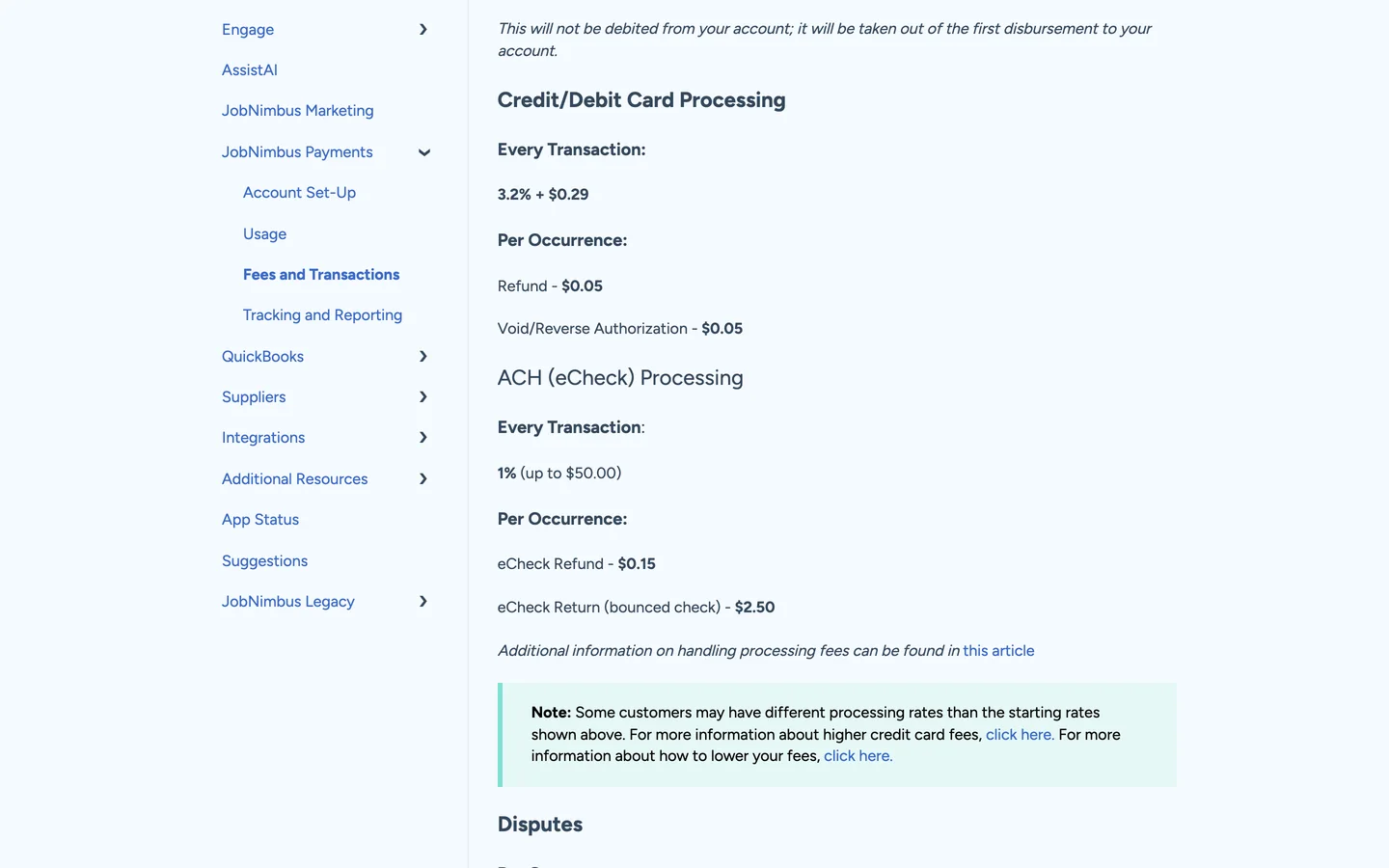 Jul 30, 2026
 Tech Stack
JobNimbus Pricing in 2026: What the Quote Does Not Cover
JobNimbus prints no figure on any of its four plans. So the only rate you can read before a sales call is the payments meter, and it is the biggest line on the bill.
Read Article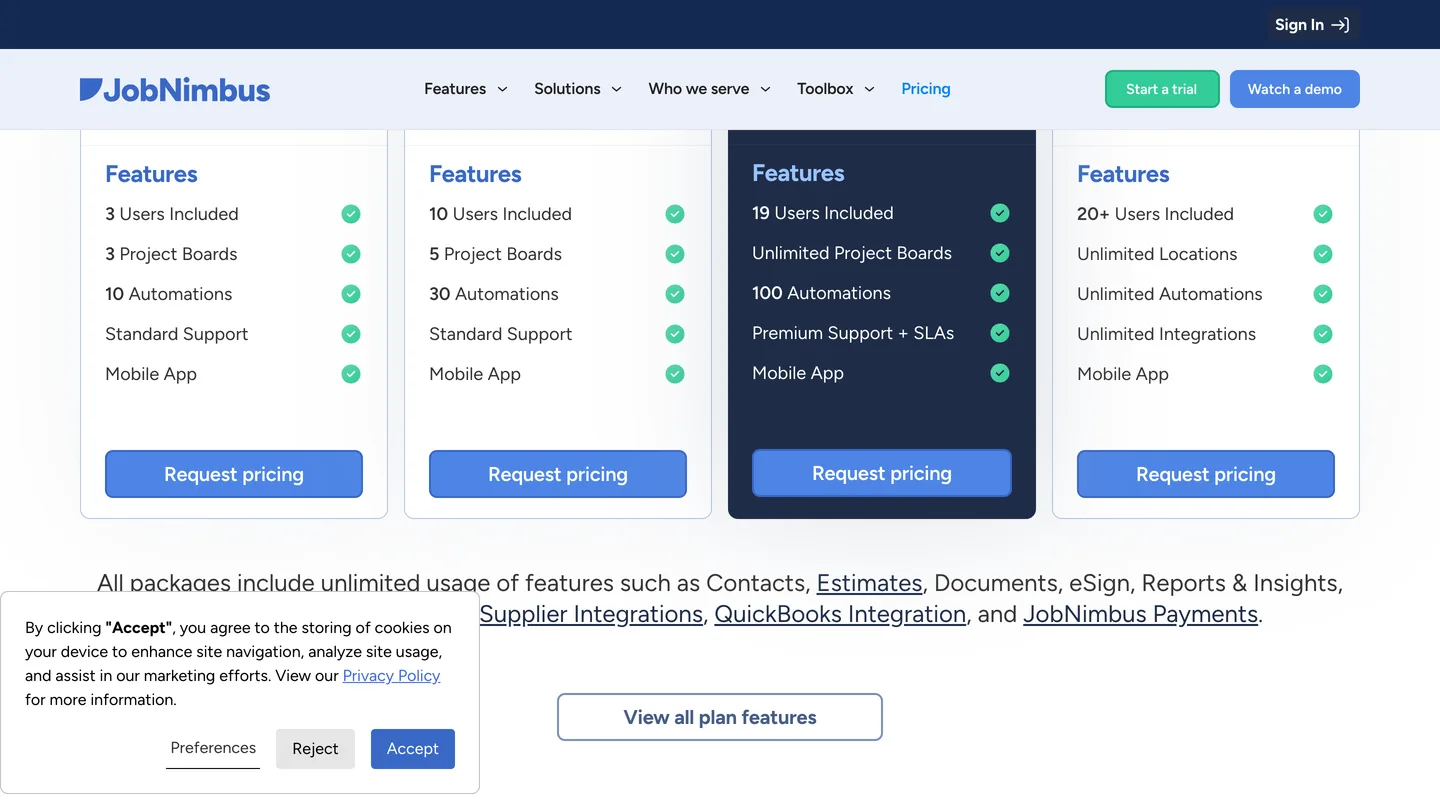 Jul 30, 2026
 Tech Stack
JobNimbus Review 2026: Pricing, Pros, Cons and Alternatives
JobNimbus rates 4.6 on Capterra and orders material straight from ABC Supply and SRS. But it publishes no price, and its supplement route carries a note.
Read Article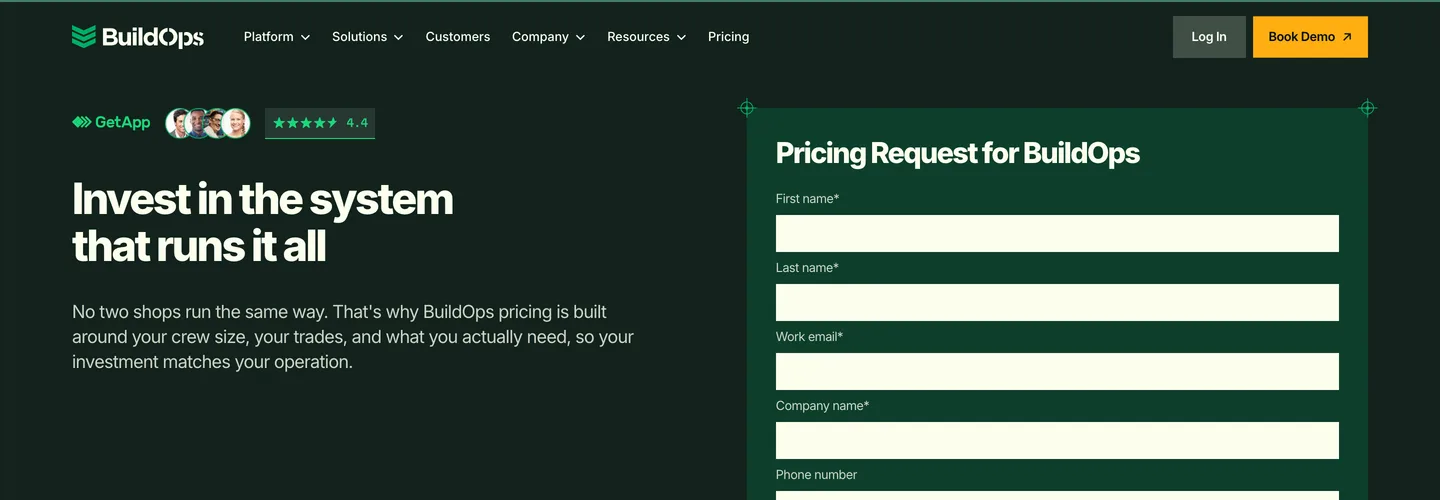 Jul 30, 2026
 Tech Stack
BuildOps Review 2026: Pricing, Contract Terms and Alternatives
BuildOps runs commercial service and projects on one platform, and publishes no pricing at all. The billing unit, the 30-day data-export window, and who it suits.
Read Article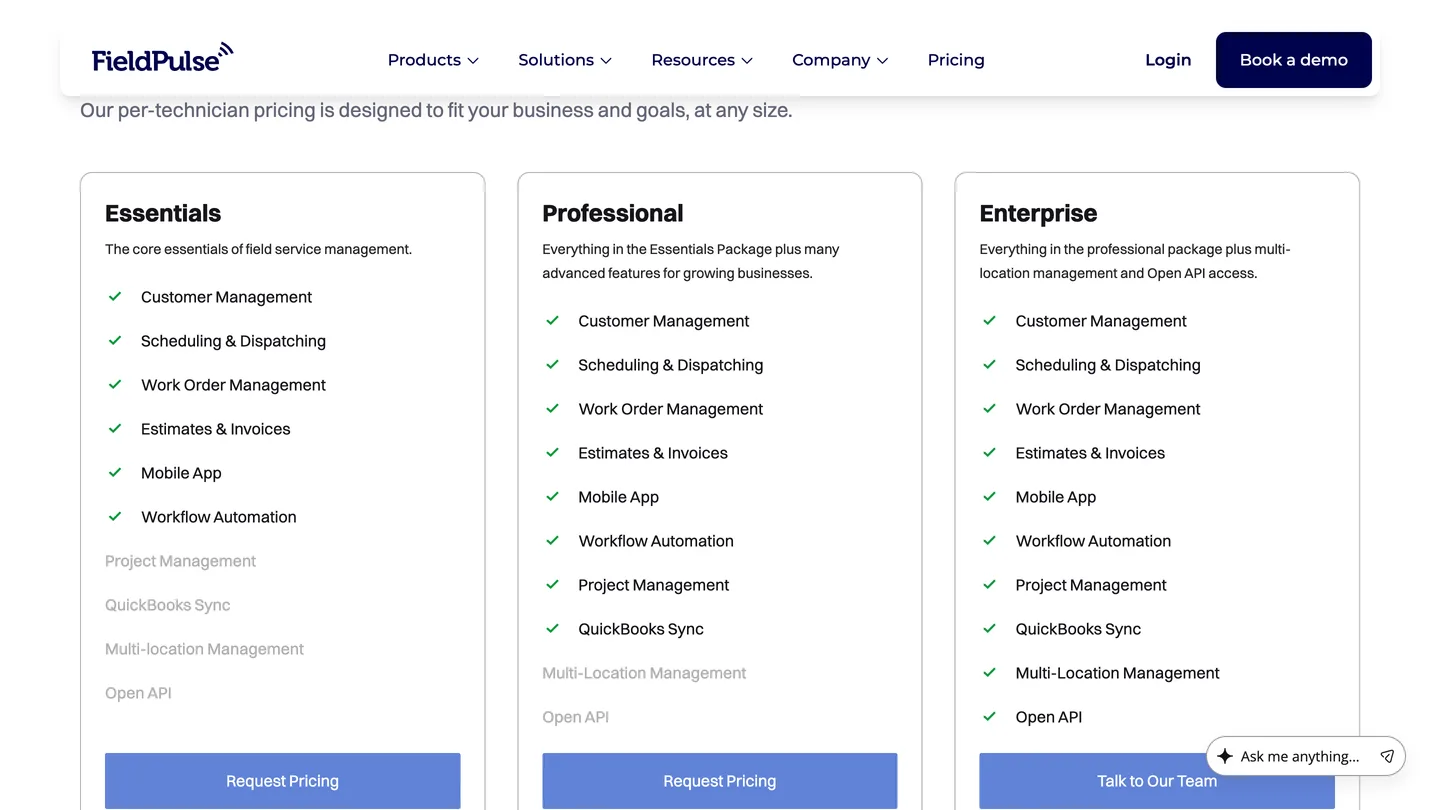 Jul 30, 2026
 Tech Stack
FieldPulse Review 2026: Pricing, Pros, Cons and Alternatives
FieldPulse rates 4.6 on Capterra and is the platform contractors name when they leave a bigger system. But it publishes no price, and the contract runs a year.
Read Article Jul 30, 2026
 Tech Stack
Service Fusion Review 2026: Pricing, Contract and Alternatives
Service Fusion bills flat per company with unlimited users, which is the best structural deal in field service software. The published plans, the contract behind the no-contract line, and the app score every other review gets wrong.
Read Article Jul 30, 2026
 Tech Stack
Knowify Review 2026: Pricing, Job Costing and Alternatives
Knowify rates 4.5 on Capterra and its weakest sub-score is features. What the $99 Core plan withholds, which way the QuickBooks sync really runs, and who should not buy it.
Read Article Jul 29, 2026
 Tech Stack
AccuLynx Review 2026: Pricing, Tier Gating, Alternatives
AccuLynx rates 4.6 across 846 reviews and now publishes an entry price. What that price omits, which tier holds the insurance workflow, and who should skip it.
Read Article Jul 29, 2026
 Tech Stack
Unitel Voice Review 2026: Pricing, Features and Alternatives
Unitel Voice rates 4.6 on Capterra and gives a one-truck shop a business number for $9.99 a month. The published plans, the cost per call, and what it won't do.
Read Article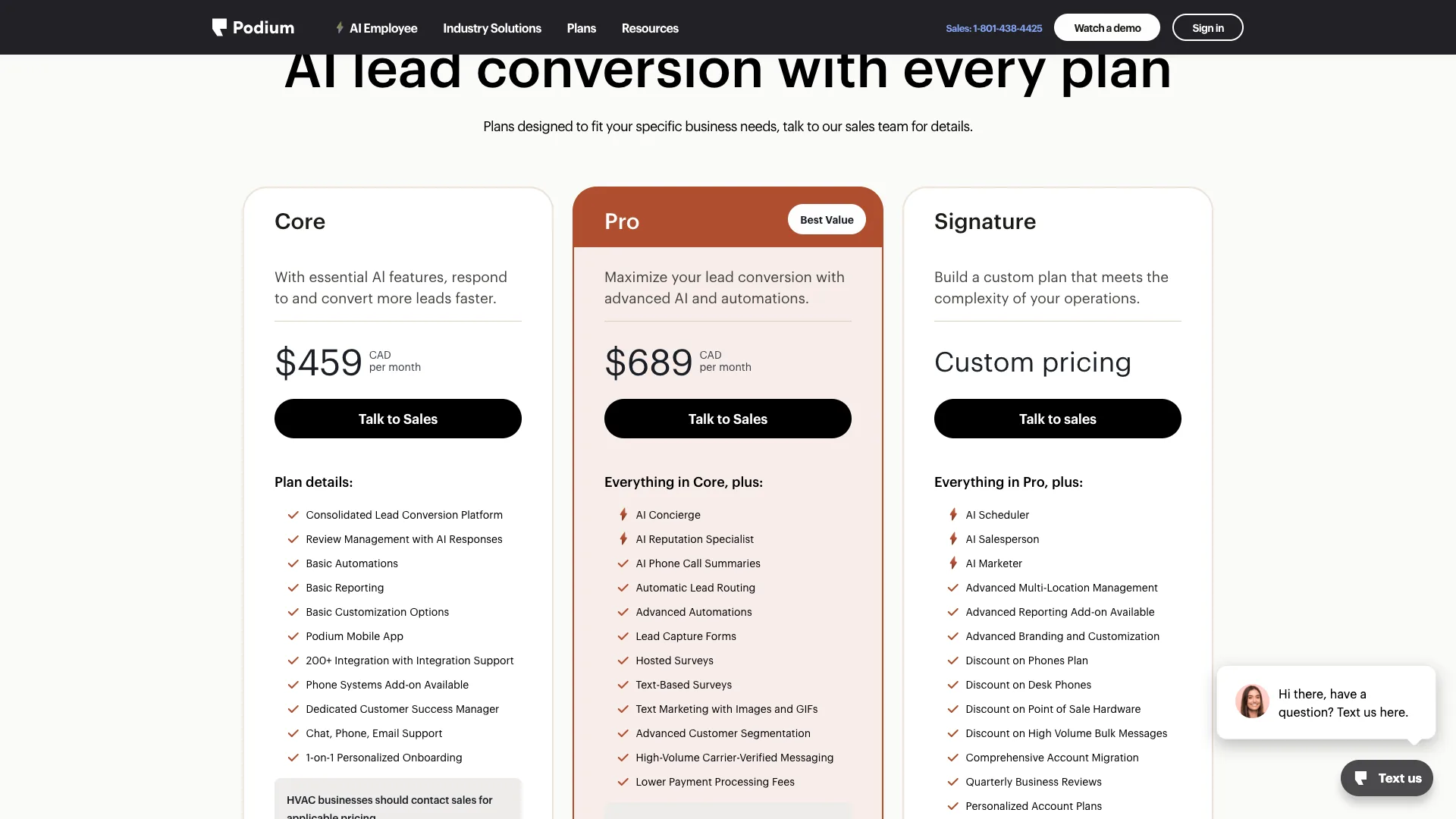 Jul 29, 2026
 Tech Stack
NiceJob vs Podium 2026: Pricing, Contracts and Review Gating
Both vendors print a price, at very different scale and in different currencies. The gap that matters is what Podium will not print: the billing unit, and whether a trade shop gets the number on the page.
Read Article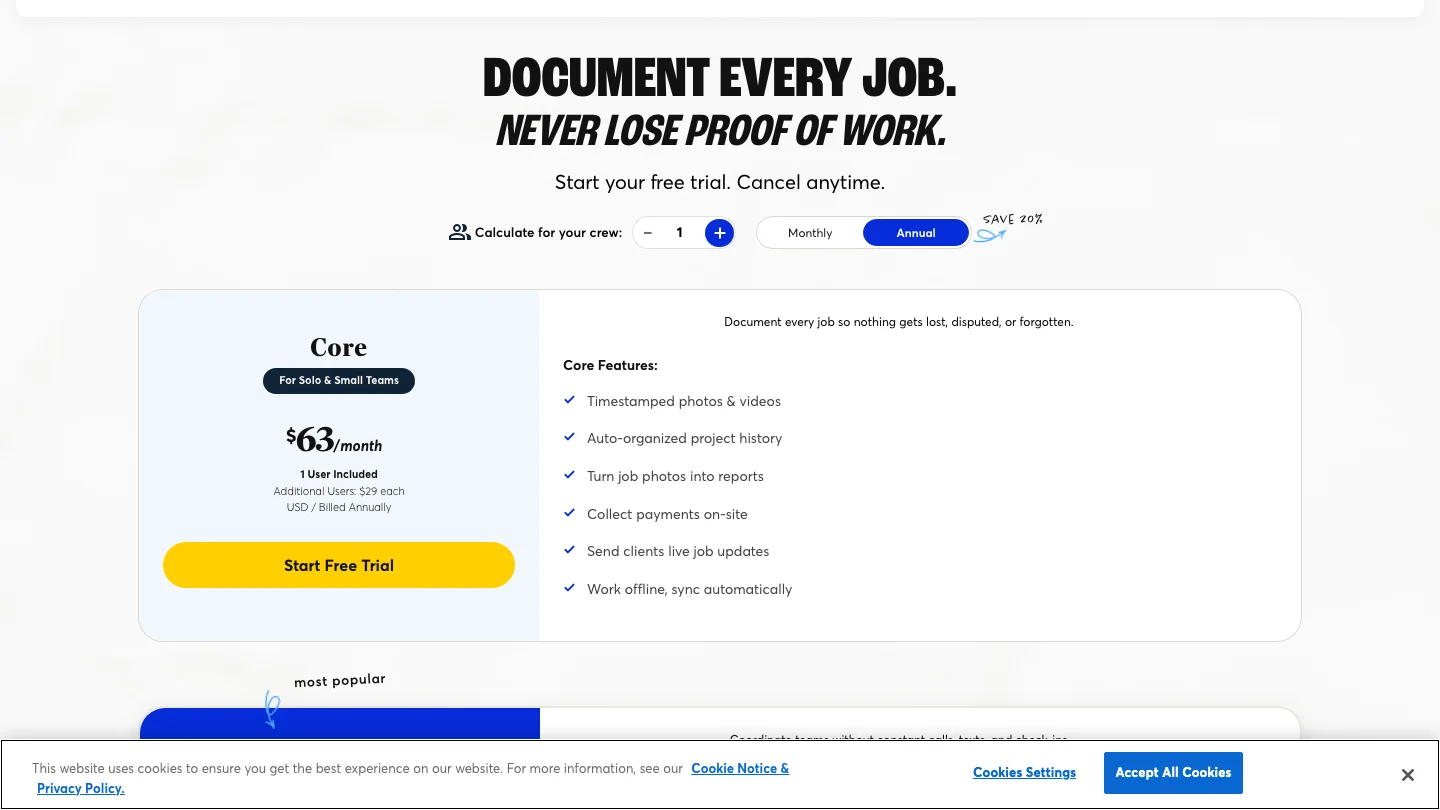 Jul 28, 2026
 Tech Stack
CompanyCam Review 2026: Pricing, Pros, Cons and Alternatives
Every page ranking for CompanyCam still quotes a per-user price the vendor no longer charges. Here are the real plans, the seat math, and who should skip it.
Read Article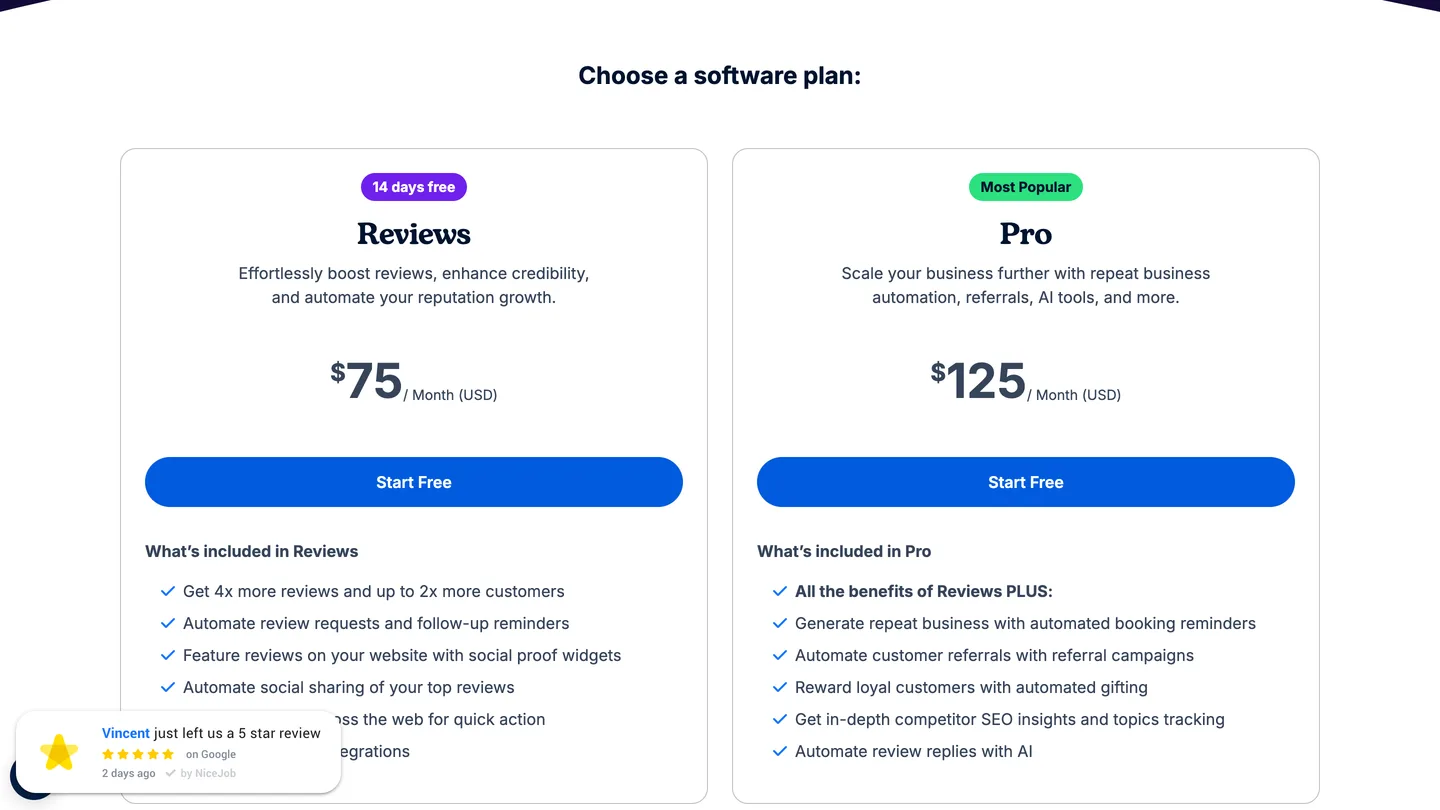 Jul 28, 2026
 Tech Stack
NiceJob Review 2026: Pricing, Pros, Cons and Alternatives
NiceJob rates 4.9 on Capterra and refuses to gate negative reviews. Real plan pricing, the active-customer threshold nobody publishes, and who should skip it.
Read Article Jul 27, 2026
 Tech Stack
Buildertrend Review 2026: Pricing, Limits and Alternatives
Buildertrend rates 4.5 across 2,486 Capterra reviews and quotes against your revenue rather than your seat count. The workflows, the export problem, the alternatives.
Read Article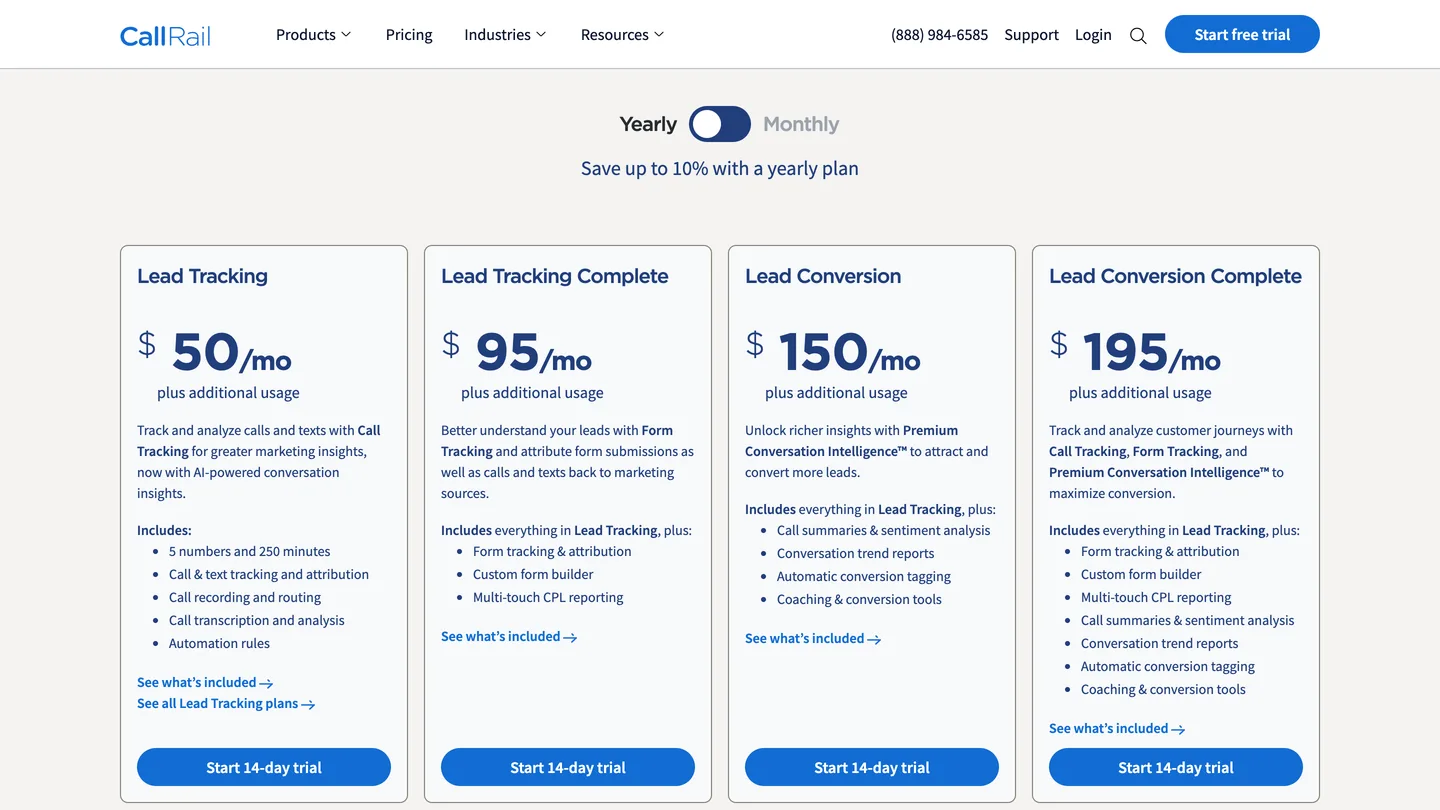 Jul 27, 2026
 Tech Stack
CallRail Review 2026: Pricing, Pros, Cons and Alternatives
CallRail rates 4.5 on Capterra, and its tracking numbers port out free. But the two usage rates that decide your real bill are the two it does not print.
Read Article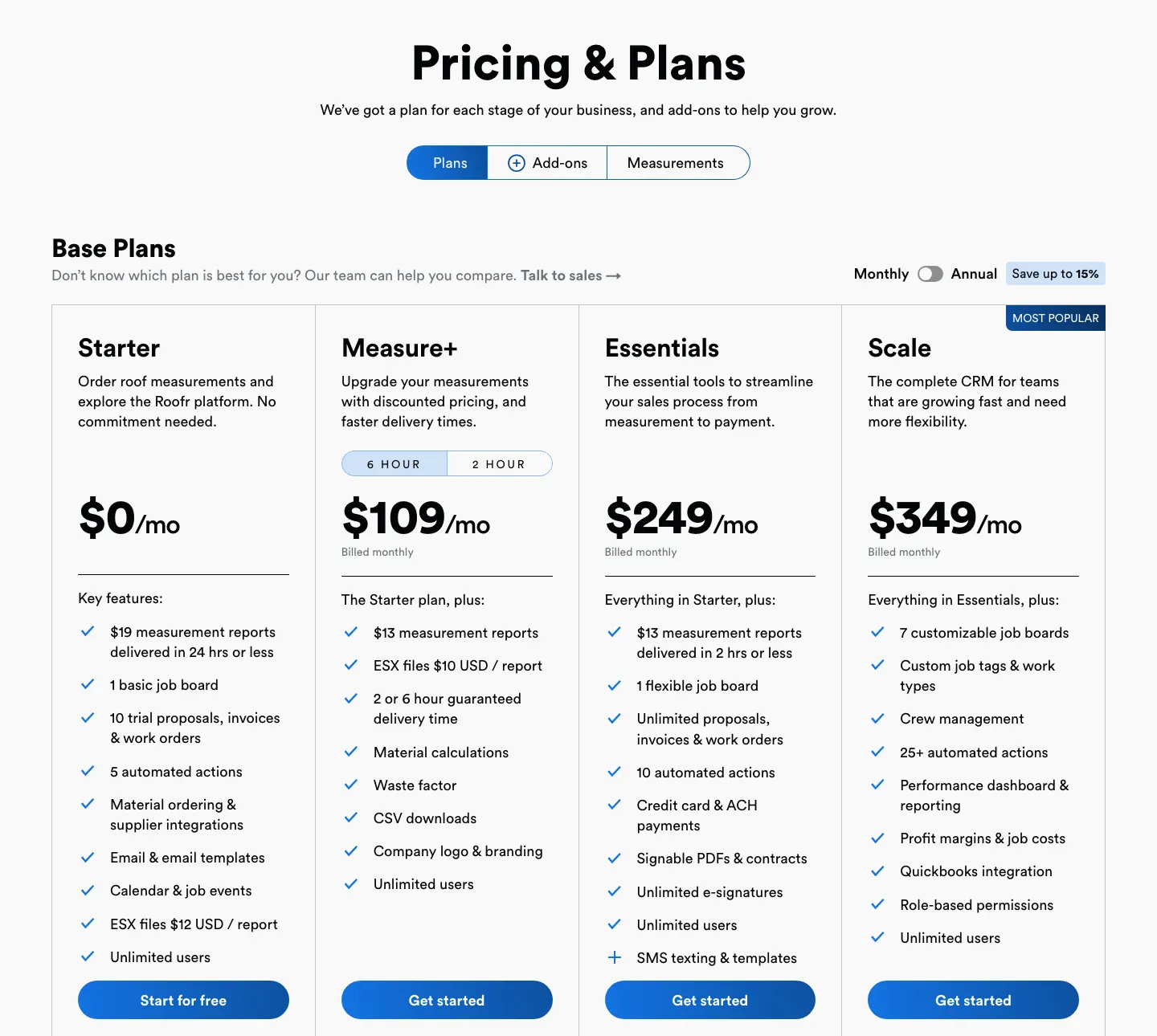 Jul 27, 2026
 Tech Stack
Roofr Review 2026: Pricing, Pros, Cons and Alternatives
Roofr rates 4.6 on Capterra and sells $13 measurement reports against a market charging triple. But it will not import a report from anywhere else.
Read Article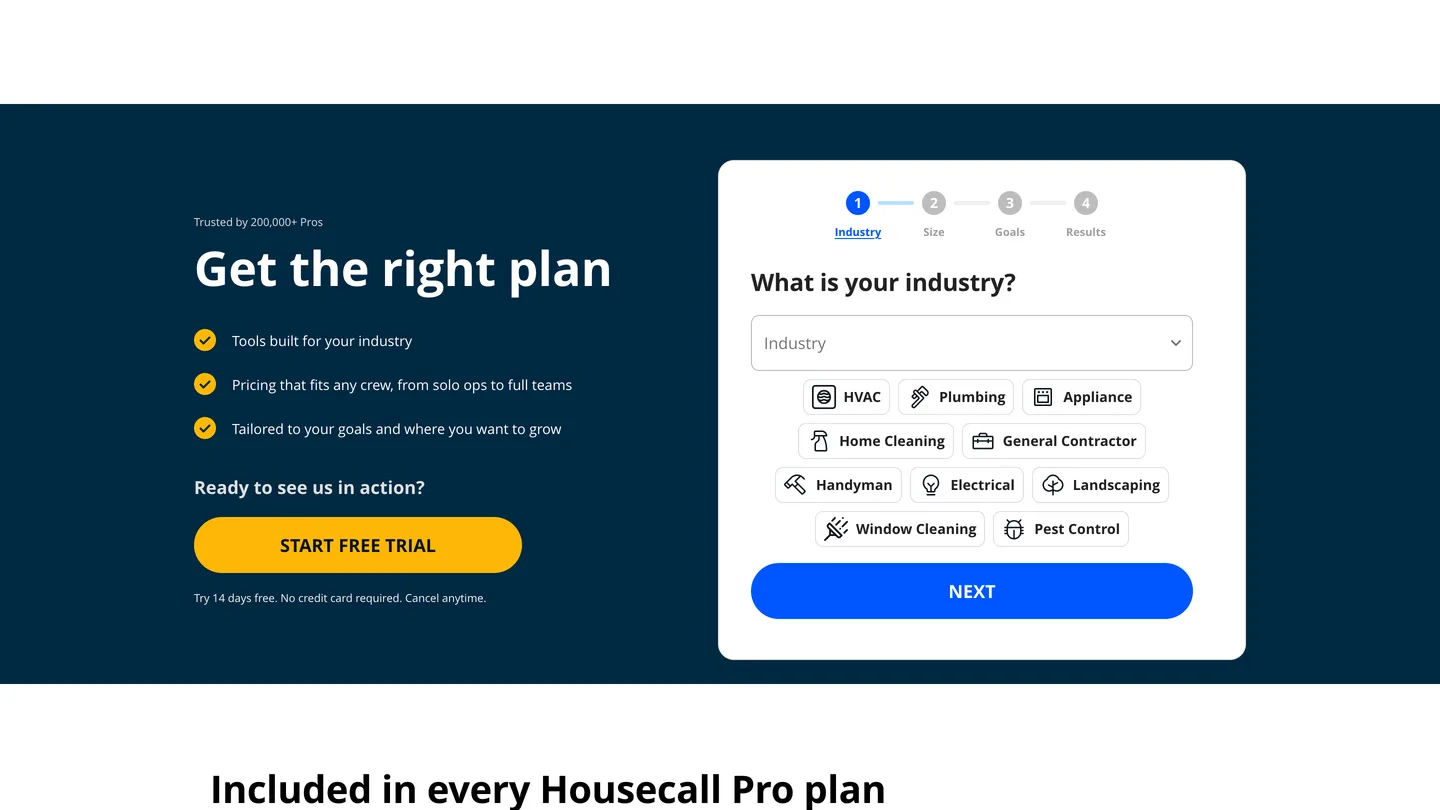 Jul 25, 2026
 Tech Stack
Housecall Pro Review 2026: Pricing, Pros, Cons, Alternatives
Housecall Pro has the shortest learning curve in the category and the widest review spread. Real pricing, the Instapay math, and the migration trap to plan around.
Read Article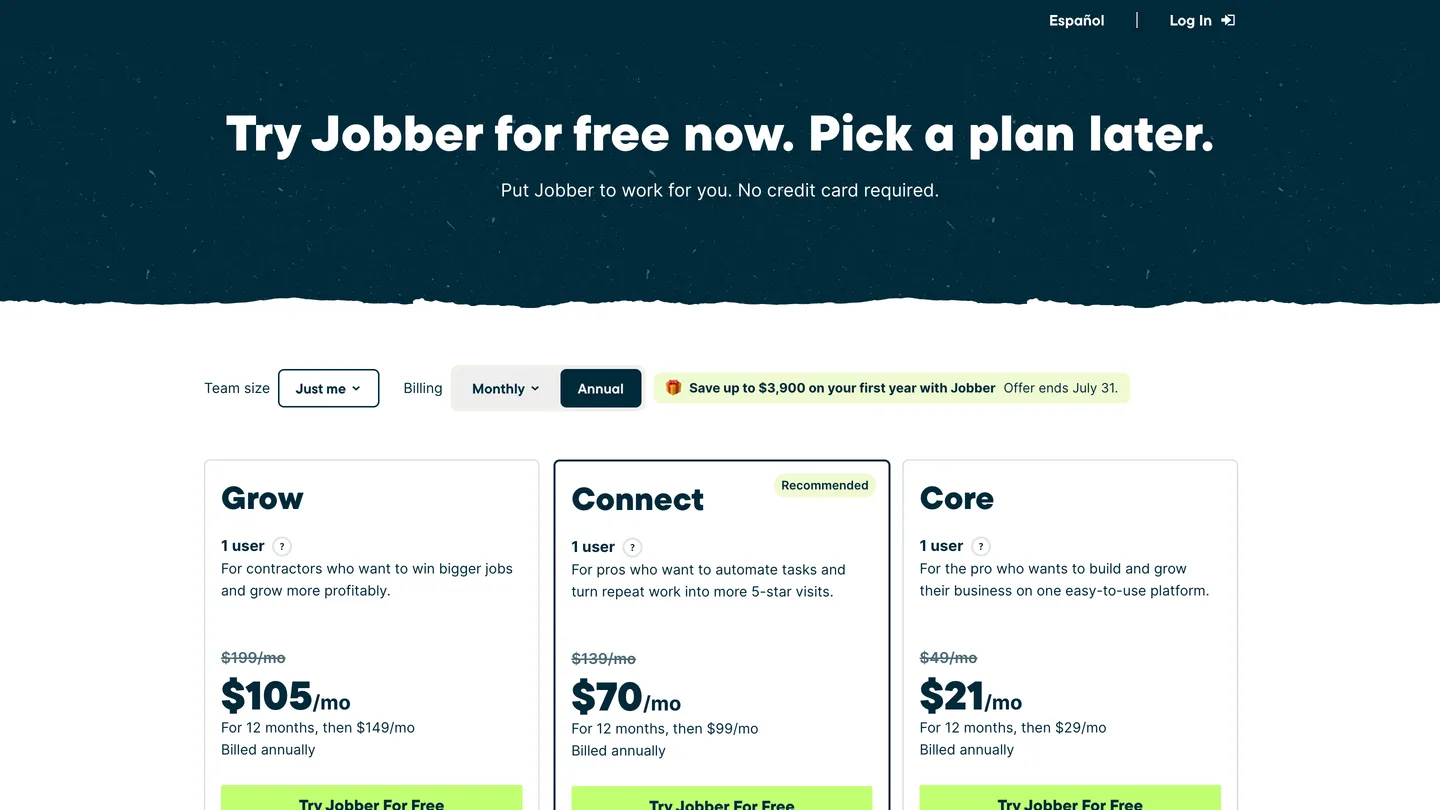 Jul 24, 2026
 Tech Stack
Jobber Review 2026: Pricing, Pros, Cons and Alternatives
Jobber rates 4.6 on Capterra with the best mobile app in the category. Real plan pricing, the feature gating that changes your entry price, and who it suits.
Read Article Jul 23, 2026
 Tech Stack
ServiceTitan Review 2026: Pricing, Pros, Cons, Alternatives
ServiceTitan rates 4.3 on Capterra but its weakest score is value for money. Real reported pricing, the 12-month contract, the exit fees, and who it actually suits.
Read Article Jun 3, 2026
 Tech Stack
HVAC Online Scheduling: The 43% Losing After-Hours Bookings
HVAC leads every trade on online booking at just 56.7%, which still leaves 43% of sites forcing an after-hours customer to wait for a business-hours phone call.
Read Article