Rilla Review 2026: Pricing, Pros, Cons, Alternatives
Third-party contract data puts real numbers on Rilla. The 8 gaps reviewers name, and 5 alternatives that publish a price upfront.

Disclosure This article features tools from our brand partners. If you choose to use them, we may receive compensation at no extra cost to you.
Our editorial choices are independent of these affiliate arrangements. Read our full affiliate disclosure.
Fervor is a CRO and web design studio, not a software reseller, and no vendor paid for placement here or for a kinder verdict. Affiliate links are flagged where they appear, and they never change what we report.
Page at a glance
Rilla is Records the in-home sales appointment and turns it into a coachable transcript, so a sales manager can review twenty ride-alongs a week instead of two. It publishes no price, so the only way to get a number is to ask a salesperson for one. Per-rep seat licensing, billed against a signed Order Form. Rilla itself states no user model publicly. The inference rests on two independent third-party guides that both describe the price as attaching to a user, and on the product's own mechanics: each rep carries the mobile recorder, so seats scale with the sales roster rather than with the account. The two guides disagree on the rate by roughly 3x, so treat the model as confirmed and the number as unconfirmed. It fits Residential replacement and remodeling companies running 8 or more outside sales reps or comfort advisors on in-home appointments, where the close happens at the kitchen table and the manager currently cannot see it. It's the wrong buy for A one to five person shop where the owner runs most of the sales appointments himself, because The entire value of a virtual ride-along is letting a manager review appointments he was not physically present for. So if the owner is the closer, he already has perfect visibility into his own calls, and he's paying a fully-prepaid per-seat annual to review himself. And every buyer-reported figure for Rilla, whether the $80-$150 per user per month low end or the $4,000+ per user per year high end, puts a small crew's annual well into four or five figures with no manager on the other side to consume the output. Alternatives that publish their prices are Avoma from $19/month, Housecall Pro from $79/month. A quote-only price and what third parties report instead, eight evidenced gaps and five alternatives, two of which publish a figure.
Start here if Rilla is on your shortlist
Rilla earns its money with Residential replacement and remodeling companies running 8 or more outside sales reps or comfort advisors on in-home appointments, where the close happens at the kitchen table and the manager currently cannot see it. If that's you, it does the job. The sections below are the parts worth checking before you sign. But the fit is narrower than the marketing suggests, and the price isn't the whole cost.
The vendor publishes no price. But every number below was verified on 7 August 2026 and comes from a named third party that says which.
| Pricing model | Custom quote, no published price |
|---|---|
| Entry price | Quote only |
| Users | Per-rep seat licensing, billed against a signed Order Form. Rilla itself states no user mo |
| Ownership | Independent |
| Best fit | Residential replacement and remodeling companies running 8 or more outside sales reps or comfort advisors on in-home appointments, where the close happens at the kitchen table and the manager currently cannot see it. |
| Accounting sync | ServiceTitan (one-way), QuickBooks (none) |
What works
- One manager reviews a week of appointments instead of sitting in two trucks
- Capture depends on a rep remembering, and the FSM arrival event doesn't reliably start it
- Recording consent is entirely the customer's problem, and the contract says so
- You own the data, but nothing tells you how to get it out or when it's destroyed
- Reps report the notification volume as a nuisance, including weekends
What does not
- The contract is paid in full up front and there's no way to shorten it after the fact
- Auto-renewal rolls you into another full-length, fully-prepaid term
- Transcription accuracy is the most repeated complaint, and it's worst exactly where trades hire
- Scoring applies one rubric to conversations that are not the same job
- The recording trigger is manual, and the workaround for called-ahead appointments failed a real buyer
Rilla is Records the in-home sales appointment and turns it into a coachable transcript, so a sales manager can review twenty ride-alongs a week instead of two. It sells to HVAC and Remodeling and Roofing and Solar contractors, and the shape of the product follows from that: The rep records the appointment on the mobile app, Rilla transcribes and scores it, and the manager reviews asynchronously with comments attached to timestamps. And this is the whole thesis, and it's the thing reviewers consistently confirm works: a sales manager reports his team reviewing their own calls and calls the analytics a change in how he coaches, and a replacement sales rep values the near-instant feedback plus the ability to roleplay against appointments he ran.
Rilla fit, and where it stops
It fits Residential replacement and remodeling companies running 8 or more outside sales reps or comfort advisors on in-home appointments, where the close happens at the kitchen table and the manager currently cannot see it. That's the half most reviews print. Here's the other half, which is the one worth your time.
Don't buy it if you're A one to five person shop where the owner runs most of the sales appointments himself. The entire value of a virtual ride-along is letting a manager review appointments he was not physically present for. So if the owner is the closer, he already has perfect visibility into his own calls, and he's paying a fully-prepaid per-seat annual to review himself. And every buyer-reported figure for Rilla, whether the $80-$150 per user per month low end or the $4,000+ per user per year high end, puts a small crew's annual well into four or five figures with no manager on the other side to consume the output. Look at CompanyCam instead.
Don't buy it if you're A company that cannot commit to a full prepaid term because it is still testing whether it wants outside sales reps at all. Rilla's commercial model has no soft landing. Fees for the whole term are due on the first day, the term auto-renews at equal length, and walking early leaves you liable for the full remaining balance unless Rilla materially breached. And a construction owner who left at 30 days was still held to $24K. So if your rep count might halve in six months, you'll be paying for seats that no longer exist. Look at Avoma instead.
Don't buy it if you're A pure phone-and-dispatch service business with no in-home sales presentation. Rilla's differentiator is capturing the face-to-face kitchen-table conversation that no call recorder can reach. So if your revenue conversation happens on the phone with a CSR, you're buying a field-recording product to solve a call-center problem, and the automotive service writer's complaint about every call being graded on one rubric is exactly what that mismatch feels like in production. Look at CallRail instead.
Don't buy it if you're A crew with heavy accents or consistently noisy job environments where the transcript will be used as a record. The most repeated criticism across independent reviewers is that the literal back-and-forth transcript diverges from the audio, and a VP of Sales names accents, background noise and overlapping speech as the trigger. The AI recap holds up; the transcript does not. So if you intend the transcript to serve as a record rather than a coaching prompt, test it hard before you prepay a year. Look at Siro instead.
What Rilla costs
Rilla doesn't publish a price. That's the finding, not a gap in this page: you can't compare this product on cost until someone quotes you.
The vendor's own wording is this, and nothing more: "Rilla publishes no price anywhere on its own site. https://www.rilla.com/pricing returns HTTP 404 — there is not a gated pricing page, there is no pricing page at all. Every conversion path on the homepage is the same single call to action, and the third-party directories that would normally carry a starting figure record the absence: Capterra's Starting Price field reads 'Contact vendor' with Free Trial and Free Version both marked not available, and GetApp's field reads 'No pricing info'." So treat every third-party page printing tier names and figures for Rilla with careful suspicion. Those numbers are not on the vendor's site today, and a roundup that reprints them is telling you what Rilla used to charge somebody else.
And we aren't going to print a per-month number we can't open a vendor page and read. What exists instead is third-party reporting, dated, from people who saw real contracts. Read it as a range rather than as a quote you can hold anyone to.
| Reported range | Reported on | Source |
|---|---|---|
| $24,000 total contract value (buyer-reported, term length not stated) | 2026-03-26 | A Capterra reviewer who is the named owner of an 11-50 employee construction company states the amount Rilla held him to after he stopped using the product at 30 days: 'Demanded $24K for 30 days of use that did not work the way originally described.' This is the only price figure in this bank that comes from an identified buyer describing his own contract rather than from an aggregator, and it is a contract total, not a rate. |
| $4,000+ per user per year (approx. $333 per user per month) | 2026-08-07 | CraftFlow's Rilla pricing page reports 'Starts at $4,000+ per user per year with required annual contracts' and works the figure to 'a typical 10-person home service business would pay roughly $40,000 per year.' The page sources itself to 'buyers who shared quotes with us' and 'public reviews' and carries its own disclaimer to 'confirm current numbers with Rilla.' It shows no publication or last-updated date. |
| $80-$150 per user per month; $10,000-$20,000 per year contract minimum | 2026-08-07 | SalesAsk's Rilla pricing guide reports '$80 to $150 per user per month' and '$960-$1,800 per user per year', with a 'minimum contract cost: typically starts at $10,000-$20,000 per year'. TREAT THIS AS ADVERSARIAL: SalesAsk is a direct Rilla competitor selling an AI sales coaching platform, the page is a bottom-of-funnel alternatives page, and it carries a customer testimonial headlined '$22k Saved vs Rilla Annually'. It shows no publication or last-updated date. Its per-user figure is roughly one third of CraftFlow's, and both cannot be right. |
Per-rep seat licensing, billed against a signed Order Form. Rilla itself states no user model publicly. The inference rests on two independent third-party guides that both describe the price as attaching to a user, and on the product's own mechanics: each rep carries the mobile recorder, so seats scale with the sales roster rather than with the account. The two guides disagree on the rate by roughly 3x, so treat the model as confirmed and the number as unconfirmed.
There is a discount for paying annually up front: Not disclosed. There is no published monthly option to discount against — the Terms bill the whole term up front, so an annual-versus-monthly comparison does not exist as a buyer choice. And an annual prepay discount tells you an annual commitment exists, which is worth knowing before anyone mentions a term length out loud.
The Rilla costs that show up later
Payment processing. Rilla doesn't process homeowner payments — it's a recording and analytics layer, not a payments product — so there's no card-processing rate to negotiate. So the question to ask instead is whether Rilla accepts ACH or invoice for the full up-front term payment, because the Terms require the entire term's Fees on day one in U.S. dollars, and putting a five-figure annual on a credit card carries its own cost.
Implementation and onboarding. Ask for the onboarding and implementation fee as a separate line on the Order Form, and ask whether it's refundable if you cancel inside the first 30 days. And Capterra lists 'In Person' and 'Live Online' training among the vendor's training options, which are typically billed, but no fee is published.
Minimum term. There is a fixed Initial Term set on the Order Form, and it is enforced financially rather than by notice. The Terms state that Fees are 'due and payable in U.S. dollars on the first day of the applicable Initial Term or Renewal Term, as applicable, and Fees are billed in advance' — the whole term is paid up front, so the minimum term is whatever the Order Form says and you have already funded it before you know whether the product works.
Getting out. Full remaining-term liability. Verbatim: 'If Customer terminates this Agreement or any Order Form for any reason other than a material breach by Rilla, or attempts to do so prior to the end of the agreed Initial Term or Renewal Term, as applicable, Customer shall remain liable for the full amount of Fees due for the remainder of the applicable term'. Note the phrase 'or attempts to do so' — the liability attaches to the attempt, not only to a completed termination. The escape hatch is material breach by Rilla, which the customer has to establish.
Auto-renewal. Yes, and it renews for a term equal to the one you just finished. Verbatim: 'Unless an applicable Order Form states otherwise, each Order Form will automatically renew for successive periods equal in duration to the Initial Term'. Miss the non-renewal notice window on a 12-month deal and you are funded into another 12 months, payable in advance on day one. Published summaries of this clause disagree on whether the notice window is 30 or 60 days, so read the number on your own Order Form rather than trusting a secondhand figure.
Modules sold separately. . And an add-on you need in week one is part of what Rilla costs, so the number to compare is the configuration you'd really run.
"Third-party reporting puts Rilla at $24,000 total contract value (buyer-reported, term length not stated), reported 2026-03-26."
A Capterra reviewer who is the named owner of an 11-50 employee construction company states the amount Rilla held him to after he stopped using the product at 30 days: 'Demanded $24K for 30 days of use that did not work the way originally described.' This is the only price figure in this bank that comes from an identified buyer describing his own contract rather than from an aggregator, and it is a contract total, not a rate. (3-26)
Worth a detour here. The early-termination clause attaches liability to the attempt, not only to a completed termination. The wording is that a customer who terminates for any reason other than Rilla's material breach, 'or attempts to do so prior to the end of the agreed Initial Term or Renewal Term', remains liable for the full remaining Fees. Pair that with fees being 'due and payable in U.S. dollars on the first day of the applicable Initial Term' and billed in advance, so the buyer has zero commercial leverage from the moment of signature: the money is already gone, and the only recognised escape is proving material breach. Every protection a contractor wants from this purchase has to be written onto the Order Form, because the master Terms give none and the Terms themselves say the Order Form can override the defaults. So negotiate a performance window with pro-rata refund before signature, or accept that the first year is unconditional.
Everything that is not the Rilla subscription
The subscription is the part everyone quotes. These are the lines that land afterwards, and the ones we could not find are named as unpublished rather than left blank.
Sold separately. . Price the configuration you'll really run, because an add-on you need on day one is part of the price.
"Rilla answers the question of what it costs with this and nothing else: "Rilla publishes no price anywhere on its own site. https://www.rilla.com/pricing returns HTTP 404 — there is not a gated pricing page, there is no pricing page at all. Every conversion path on the homepage is the same single call to action, and the third-party directories that would normally carry a starting figure record the absence: Capterra's Starting Price field reads 'Contact vendor' with Free Trial and Free Version both marked not available, and GetApp's field reads 'No pricing info'.""
Rilla pricing page (2026)
"Per-rep seat licensing, billed against a signed Order Form. Rilla itself states no user model publicly. The inference rests on two independent third-party guides that both describe the price as attaching to a user, and on the product's own mechanics: each rep carries the mobile recorder, so seats scale with the sales roster rather than with the account. The two guides disagree on the rate by roughly 3x, so treat the model as confirmed and the number as unconfirmed."
Rilla pricing page (2026)
"Rilla is reported at $24,000 total contract value (buyer-reported, term length not stated) as of 2026-03-26."
A Capterra reviewer who is the named owner of an 11-50 employee construction company states the amount Rilla held him to after he stopped using the product at 30 days: 'Demanded $24K for 30 days of use that did not work the way originally described.' This is the only price figure in this bank that comes from an identified buyer describing his own contract rather than from an aggregator, and it is a contract total, not a rate. (3-26)
The five workflows you pay for
Feature totals are noise. So a shop in this category lives or dies on five things, and those are the five to grade, and each one below carries the evidence it's graded on.
One manager reviews a week of appointments instead of sitting in two trucks The rep records the appointment on the mobile app, Rilla transcribes and scores it, and the manager reviews asynchronously with comments attached to timestamps. And this is the whole thesis, and it's the thing reviewers consistently confirm works: a sales manager reports his team reviewing their own calls and calls the analytics a change in how he coaches, and a replacement sales rep values the near-instant feedback plus the ability to roleplay against appointments he ran. A sales manager, consumer services (51-200 employees), Less than 6 months on the platform, writing on 2026-03-20, puts it: "I love that my team are able to review their calls themselves and the analytics changes the game when it comes to coaching."A replacement sales rep, building materials (51-200 employees), 6-12 months on the platform, writing on 2026-05-14, puts it: "The pretty much instant feedback you receive along with the roleplay feature with appointments I have run so you can go over actual scenarios you have already been through and will help you improve at a better pace."
Capture depends on a rep remembering, and the FSM arrival event doesn't reliably start it Recording is initiated on the phone rather than fired automatically off a dispatch state change. A general manager on Rilla reports that it 'doesn't start when you arrive when hit arrive on service titan', and a construction owner cancelled over exactly this: when a tech called ahead, the arrival trigger did not fire. And an iOS reviewer separately describes weeks of the app recording televisions in customers' homes rather than the conversation, which is the same class of failure from the other direction — capture running when it should not. An owner, construction (11-50 employees) who reviewed it on 2026-03-26 reports it: "If the tech called ahead, the call would be recorded but no automatic start of recording when they arrived at job. Their work around created issues. Switched to another system with a better trigger and stopped using Rilla after 30 days. They refused to lower total contract price to get out. Demanded $24K for 30 days of use that did not work the way originally described."An ios app user who reviewed it on 2026-04-03 reports it: "This company cares nothing about their customers only looking to make a quick buck."
Recording consent is entirely the customer's problem, and the contract says so Rilla's Terms place responsibility for obtaining every consent needed before recording squarely on the customer. So in practice that means a contractor recording homeowners inside their homes is the party exposed under two-party-consent state law, not Rilla. One reviewer notes the flip side of the same fact: recorded appointments 'saved us from lawsuits on two separate occasions', while a sales consultant reports customers being visibly uncomfortable when asked. And the recording is an asset and a liability from the same clause. And an owner and sales, construction, 2+ years on the platform, writing on 2026-01-08, describes it the same thing: "I do wish we could retitle the conversations, and delete the ones that don't need to be kept a little easier."
You own the data, but nothing tells you how to get it out or when it's destroyed The Terms confirm the customer owns Customer Data and then say nothing about return or deletion of that data after termination. The Privacy Policy commits only to retaining Personal Data 'for as long as necessary to provide you with our Services or to perform our business or commercial purposes', with concrete retention periods given for profile, payment, device and SMS-consent records but not for recordings or transcripts. And machine-readable export is offered as an EU/UK statutory right rather than as a product feature available to a US contractor.
Reps report the notification volume as a nuisance, including weekends A construction sales manager who otherwise rates the product five stars and praises the customer service names the outbound cadence as his only complaint: relentless texts and emails on both phone and computer, including weekend messages. Separately, an owner who wanted to cancel describes the opposite experience, unresponsiveness. So the pattern to plan for is heavy automated engagement to reps and slower human response on commercial questions. On 2025-11-12, a sales manager, construction, Less than 6 months on the platform, describes it: "The texts and emails are relentless on my phone and computer with messages on the weekend."On 2026-03-26, an owner, construction (11-50 employees), Less than 6 months on the platform, describes it: "If the tech called ahead, the call would be recorded but no automatic start of recording when they arrived at job. Their work around created issues. Switched to another system with a better trigger and stopped using Rilla after 30 days. They refused to lower total contract price to get out. Demanded $24K for 30 days of use that did not work the way originally described."
Which trades get value from Rilla
Fit differs by trade rather than by company size alone, and a blended paragraph hides that. Here is the split for the trades this one sells to.
HVAC. The workflow that decides it is one manager reviews a week of appointments instead of sitting in two trucks, and the shop profile that gets value is 16+ reps across multiple markets with a dedicated sales manager and servicetitan in place doing residential and service work. Where it stops being a fit is A one to five person shop where the owner runs most of the sales appointments himself.
Remodeling. The workflow that decides it is one manager reviews a week of appointments instead of sitting in two trucks, and the shop profile that gets value is 16+ reps across multiple markets with a dedicated sales manager and servicetitan in place doing residential and service work. Where it stops being a fit is A one to five person shop where the owner runs most of the sales appointments himself.
Roofing. The workflow that decides it is one manager reviews a week of appointments instead of sitting in two trucks, and the shop profile that gets value is 16+ reps across multiple markets with a dedicated sales manager and servicetitan in place doing residential and service work. Where it stops being a fit is A one to five person shop where the owner runs most of the sales appointments himself.
Solar. The workflow that decides it is one manager reviews a week of appointments instead of sitting in two trucks, and the shop profile that gets value is 16+ reps across multiple markets with a dedicated sales manager and servicetitan in place doing residential and service work. Where it stops being a fit is A one to five person shop where the owner runs most of the sales appointments himself.
Your books, and whether Rilla connects to them
ServiceTitan connects one way only, so edits made in your books do not come back, on every plan. QuickBooks connects, on every plan. Your costs map through cost codes, so test yours against your own chart of accounts before you commit. A code your books don't recognise is how a labour charge quietly lands somewhere useless.
Past those, the road ends. Rilla's own integrations directory, QuickBooks / Xero / Sage, Dialpad and other phone systems, HubSpot, Jobber, JobNimbus, AccuLynx, Housecall Pro do not connect. So if your books run on an ERP rather than the platforms named above, weigh that before anything else.
Beyond accounting it connects to ServiceTitan (Official partnership since November 2023. Conversation visibility surfaced against the ServiceTitan job. But note the known gap: at least one general manager reports the recording doesn't auto-start when a tech taps arrived in ServiceTitan, so the link is data-sharing rather than event-driven capture.), Ingage (Interactive sales presentation software used by in-home reps. Named on both directory lists.), Salesforce (Listed by Capterra as Salesforce Customer360, and by GetApp as Salesforce Sales Cloud and Salesforce Platform, with Salesforce Service Cloud noted separately. Three or four Salesforce SKU names across two directories describing what is realistically one connector.), LEAP (Home improvement sales and estimating platform. Named on Capterra's integration list only.), MarketSharp (Home improvement CRM. Named on GetApp's integration list only.), improveit 360 (Home improvement CRM built on Salesforce. Mentioned in Capterra's integration context.). A public API exists: No public API documentation, developer portal or API reference is linked from anywhere on rilla.com, and neither aggregator lists an open API among the product's features. The Terms address Customer Data ownership but describe no programmatic access right. Assume any data movement beyond the six named partners is a custom services conversation.
What happens when Rilla breaks
Support is the line item nobody prices and everybody eventually needs. Rilla publishes no onboarding fee either way, so ask what is included at your tier and what is billed hourly after go-live.
The review corpus we read on 7 August 2026 carries no consistent signal on response times either way, so treat support as untested rather than good. Open a real ticket during the trial and time the reply, because that is the number no pricing page gives you.
What happens when you want to leave Rilla
Nobody reads this section before they buy, and it's the one that costs money afterwards. Four terms decide what leaving looks like.
Minimum term. There is a fixed Initial Term set on the Order Form, and it is enforced financially rather than by notice. The Terms state that Fees are 'due and payable in U.S. dollars on the first day of the applicable Initial Term or Renewal Term, as applicable, and Fees are billed in advance' — the whole term is paid up front, so the minimum term is whatever the Order Form says and you have already funded it before you know whether the product works.
Auto-renewal. Yes, and it renews for a term equal to the one you just finished. Verbatim: 'Unless an applicable Order Form states otherwise, each Order Form will automatically renew for successive periods equal in duration to the Initial Term'. Miss the non-renewal notice window on a 12-month deal and you are funded into another 12 months, payable in advance on day one. Published summaries of this clause disagree on whether the notice window is 30 or 60 days, so read the number on your own Order Form rather than trusting a secondhand figure.
Early termination. Full remaining-term liability. Verbatim: 'If Customer terminates this Agreement or any Order Form for any reason other than a material breach by Rilla, or attempts to do so prior to the end of the agreed Initial Term or Renewal Term, as applicable, Customer shall remain liable for the full amount of Fees due for the remainder of the applicable term'. Note the phrase 'or attempts to do so' — the liability attaches to the attempt, not only to a completed termination. The escape hatch is material breach by Rilla, which the customer has to establish.
Payment processing. Rilla doesn't process homeowner payments — it's a recording and analytics layer, not a payments product — so there's no card-processing rate to negotiate. So the question to ask instead is whether Rilla accepts ACH or invoice for the full up-front term payment, because the Terms require the entire term's Fees on day one in U.S. dollars, and putting a five-figure annual on a credit card carries its own cost.
Worth a detour here. Rilla has no published API, no developer documentation, and no integrations directory of its own — the only countable lists live on Capterra and GetApp, and they disagree, naming 4 and 5 partners respectively for a deduplicated union of 6. Meanwhile the Terms confirm you own the Customer Data and then say nothing about returning it, and the Privacy Policy sets no retention period for recordings or transcripts. So you accumulate years of recorded homeowner conversations inside a system with no documented way to get them out in bulk and no contractual deadline for their destruction. Ask for the bulk export format, the delivery deadline in days after termination, and the destruction certificate as written Order Form terms. Because the longer you stay, the larger the archive you can't move, and it's an archive of other people's private conversations.
"Rilla is reported at $4,000+ per user per year (approx. $333 per user per month) as of 2026-08-07."
CraftFlow's Rilla pricing page reports 'Starts at $4,000+ per user per year with required annual contracts' and works the figure to 'a typical 10-person home service business would pay roughly $40,000 per year.' The page sources itself to 'buyers who shared quotes with us' and 'public reviews' and carries its own disclaimer to 'confirm current numbers with Rilla.' It shows no publication or last-updated date. (8-07)
"If the tech called ahead, the call would be recorded but no automatic start of recording when they arrived at job. Their work around created issues. Switched to another system with a better trigger and stopped using Rilla after 30 days. They refused to lower total contract price to get out. Demanded $24K for 30 days of use that did not work the way originally described."
Capterra, Chris D. (3-26)
"The gimmicky tokens and credits you have to buy. The upcharging seems a little too much"
Capterra, Kevin W. (2-19)
The Rilla problems that survive onboarding
Six things worth raising, and each one's answerable with a yes or a no on a call.
The contract is paid in full up front and there's no way to shorten it after the fact The Terms require every Fee for the term on day one, in U.S. dollars, billed in advance. And if you then decide the product is wrong for you, the early-termination clause holds you liable for the full remaining term unless you can establish material breach by Rilla. A named construction owner walked at 30 days and was still held to the full amount. So this is the single most consequential fact about buying Rilla, and it's the reason the trial matters more here than with a month-to-month tool. An owner, construction (11-50 employees), Less than 6 months on the platform, writing on 2026-03-26, says: "If the tech called ahead, the call would be recorded but no automatic start of recording when they arrived at job. Their work around created issues. Switched to another system with a better trigger and stopped using Rilla after 30 days. They refused to lower total contract price to get out. Demanded $24K for 30 days of use that did not work the way originally described." Before signing, negotiate an out clause in writing on the Order Form itself: a 30 or 60 day performance window with a pro-rata refund, or a reduced pilot seat count for term one. And the master Terms won't give you this, so it has to live on the Order Form, which the Terms explicitly let override the defaults.
Auto-renewal rolls you into another full-length, fully-prepaid term The Order Form renews for a period equal in duration to the Initial Term unless someone sends written non-renewal notice inside the window. So on a 12-month deal, one missed calendar reminder funds another 12 months, payable in advance. And published summaries of this same clause disagree on whether the window is 30 or 60 days, which is itself a warning that you can't rely on a secondhand read of your own contract. Read the exact notice-period number on your signed Order Form, then put a calendar reminder 30 days before that window opens, not on the renewal date. Then send non-renewal notice in writing to legal@rilla.com and keep the delivery receipt.
Transcription accuracy is the most repeated complaint, and it's worst exactly where trades hire Reviewers across construction, building materials and real estate independently flag the same failure: the back-and-forth transcript diverges from what was said. And a VP of Sales names the conditions — 'strong accents, background noise, or overlapping talk' — which describes a mechanical room, an attic, a driveway with a truck running, and a crew whose first language is not English. The AI recap is consistently praised; the literal transcript is consistently not. And since coaching decisions and any compliance use rest on the transcript, this gap matters more than the star rating suggests. A sales associate, real estate (51-200 employees), Less than 6 months on the platform, writing on 2025-10-21, writes: "How slow it takes for it to load the conversations after completion. Once the conversation is transcribed if you are solely going off what the transcription says for the whole entire conversation back and forth between the client and sales agent it is hard to understand what is going on because of how it transcribes verses the actual recording of the conversation. The conversation recap is amazing and spot on but the actual back and forth transcription of the entire visit is not acurate of what I am actually saying and what they are actually saying and that bothers me a lot." Run the trial on your five noisiest, most accented reps rather than your cleanest talker, and read the raw transcripts against the audio yourself. And if the recap is right but the transcript is wrong, decide up front whether you'll ever use a transcript as evidence in a dispute.
Scoring applies one rubric to conversations that are not the same job An automotive service writer describes calls being 'graded the same' whether the rep was booking an appointment, selling, or taking a parts order. So for a trade running both service techs and comfort advisors on the same account, this means a tech doing a straight repair diagnostic can score badly against a sales rubric he was never supposed to be running, which corrodes rep trust in the tool faster than any accuracy problem. A service writer, automotive who reviewed it on 2026-02-03 describes it: "It often gets the client and the customer roles confused. Ranking calls based off the same criteria when some calls are booking appointments and some are sales others are calling to order parts yet they are graded the same." Ask in the demo how many distinct scorecards the account supports and whether they can be assigned per role, per job type, or per ServiceTitan job class. And get the answer in writing before you put service techs and sales reps on the same instance.
The recording trigger is manual, and the workaround for called-ahead appointments failed a real buyer A general manager notes that Rilla 'doesn't start when you arrive when hit arrive on service titan', and a construction owner cancelled specifically over it: when a tech called ahead, the call recorded but recording did not auto-start on arrival at the job. But the workaround Rilla proposed created its own problems. And in a trade where techs call ahead as standard practice, an unreliable start trigger means missing appointments entirely, and a coaching tool with holes in its coverage is a coaching tool nobody trusts. And an owner, construction (11-50 employees), Less than 6 months on the platform, writing on 2026-03-26, reports it the same thing: "If the tech called ahead, the call would be recorded but no automatic start of recording when they arrived at job. Their work around created issues. Switched to another system with a better trigger and stopped using Rilla after 30 days. They refused to lower total contract price to get out. Demanded $24K for 30 days of use that did not work the way originally described." Test the exact sequence your techs use — call ahead, drive, arrive, tap arrived in your FSM — during the trial, not a clean lab appointment. And count how many of 20 real appointments recorded end to end without a rep remembering to press anything.
Deleting and re-titling recordings is harder than reviewers expect A two-year owner-operator asks to 'retitle the conversations, and delete the ones that don't need to be kept a little easier', and a Norwegian-accented rep separately wants to abort and restart a recording once it has begun. And Rilla's own Terms are silent on return or deletion of Customer Data after termination, and the Privacy Policy only commits to retaining data 'for as long as necessary to provide you with our Services' with no stated recording retention period. So the in-app friction sits on top of a contract that doesn't promise you a clean exit for the audio. But an owner and sales, construction, 2+ years on the platform, says it differently: "I do wish we could retitle the conversations, and delete the ones that don't need to be kept a little easier." Ask for a written data-deletion and data-export commitment on the Order Form, with a stated format and a deadline in days after termination. Because you're recording homeowners in their kitchens — you want to know what happens to that audio when you leave.
There's a consumable credit layer on top of the subscription that nobody prices publicly A sales manager evaluating on a free trial names 'the gimmicky tokens and credits you have to buy' as his single objection and calls the upcharging excessive. And nothing on Rilla's site, on Capterra, or on GetApp puts a rate on these. So a buyer signing a fully-prepaid annual can't model their real year-one spend from the Order Form, because a variable line item lives outside it. But a sales manager, real estate, Free trial on the platform, writes it differently: "The gimmicky tokens and credits you have to buy. The upcharging seems a little too much" Ask what consumes credits, what the per-credit price is, how many are included per seat per month, and what happens when a heavy-use rep runs out mid-month. And get the answer as a written rate card attached to the Order Form.
The vendor's own Security page is unfinished placeholder text The Security link in Rilla's footer resolves to a page whose body is Lorem ipsum filler, repeated across two blocks, under an unrelated marketing heading. Rilla does operate a real trust center at a separate subdomain, but that's not where the site sends you. And for a product whose entire function is storing recorded audio of private conversations inside customers' homes, the page a buyer clicks to check security posture contains no security information at all. Skip the footer link and request the SOC 2 report and subprocessor list directly through security.rilla.com or from legal@rilla.com, under NDA if needed, before any recording goes live.
One more thing worth knowing. The two most-cited third-party price estimates for Rilla differ by about 3x and neither carries a publication date. CraftFlow says $4,000+ per user per year, which works out near $333 per user per month. SalesAsk says $80 to $150 per user per month. But SalesAsk is a direct Rilla competitor whose page carries a testimonial headlined '$22k Saved vs Rilla Annually', so its low figure serves its argument. And CraftFlow cites 'buyers who shared quotes with us' and adds its own disclaimer to 'confirm current numbers with Rilla'. Layered on top of whichever is closer, reviewers describe a separate consumable credit tier that nobody prices at all: 'The gimmicky tokens and credits you have to buy. The upcharging seems a little too much.' Don't build a budget from any published Rilla number, including the ones in this bank. So get a written quote plus a credit rate card, then multiply by your real seat count including reps you'll hire mid-term, because the seats are prepaid for the whole term.
One more thing worth knowing. The negative signal in Rilla's reviews is not about whether the coaching works — reviewers overwhelmingly say it does, at 4.8 across 361 Capterra reviews and 4.5 across 791 iOS ratings. So it clusters instead into two unrelated buckets. First, capture reliability at the edges: recording not auto-starting on ServiceTitan arrival, no auto-start after a call-ahead, no way to abort and restart a recording, and an iOS reviewer who spent weeks with the app 'recording TV conversations on CX televisions'. Second, commercial conduct after the sale: refusal to reduce a contract for a customer leaving at 30 days, unpriced credit upcharges, and relentless weekend notification volume. High-satisfaction users and one-star users are complaining about entirely different layers of the same company. The star rating is a fair read on whether reps will get value and a poor read on what buying it is like. So diligence the contract and the capture reliability separately from the coaching value, because the reviews that praise the second say nothing about the first.
And this is the kind of thing you only find by reading the complaints. Rilla's own Security page — the one its site footer links to — is unfinished Lorem ipsum placeholder text, repeated across two blocks under an unrelated marketing headline. The company does operate a real trust center, but on a separate subdomain the footer doesn't point at. And this is a product whose entire function is storing recorded audio of private conversations inside homeowners' kitchens and mechanical rooms, sold to contractors who bear the consent liability under their own contract. Three of the four footer trust links on the vendor's site are broken, placeholder, or point somewhere other than the real document. So request the SOC 2 report and subprocessor list directly through the trust center or legal@rilla.com under NDA, and don't treat the marketing site as evidence of security posture.
Rilla, from the people who bought it
Every quote below is transcribed from a published review, named to the platform that carries it and to the reviewer as that platform displays them. We read the corpus by complaint type rather than by star rating, which is how the disqualifying detail buried inside a five-star review gets found.
"If the tech called ahead, the call would be recorded but no automatic start of recording when they arrived at job. Their work around created issues. Switched to another system with a better trigger and stopped using Rilla after 30 days. They refused to lower total contract price to get out. Demanded $24K for 30 days of use that did not work the way originally described."
But an owner, construction (11-50 employees), Less than 6 months on the platform, reports it it differently on Capterra
"The gimmicky tokens and credits you have to buy. The upcharging seems a little too much"
And a sales manager, real estate, Free trial on the platform, writing on 2026-02-19, says the same thing on Capterra
"How slow it takes for it to load the conversations after completion. Once the conversation is transcribed if you are solely going off what the transcription says for the whole entire conversation back and forth between the client and sales agent it is hard to understand what is going on because of how it transcribes verses the actual recording of the conversation. The conversation recap is amazing and spot on but the actual back and forth transcription of the entire visit is not acurate of what I am actually saying and what they are actually saying and that bothers me a lot."
And a sales associate, real estate (51-200 employees), Less than 6 months on the platform, writing on 2025-10-21, describes it the same thing on Capterra
"It often gets the client and the customer roles confused. Ranking calls based off the same criteria when some calls are booking appointments and some are sales others are calling to order parts yet they are graded the same."
A service writer, automotive who reviewed it on 2026-02-03 says on Capterra
"It works well overall and provides solid insights, but I would like to see deeper integrations with tools I already use, such as Dialpad, to make workflows more seamless and efficient."
A sales representative, real estate (5,001-10,000 employees), Less than 6 months on the platform, writing on 2026-05-31, describes it on Capterra
"Sometimes the automatic transcription can misinterpret words or phrases, especially with strong accents, background noise, or overlapping talk."
A VP of sales, construction (51-200 employees) who reviewed it on 2026-01-07 writes on Capterra
"The UI changes frequently so sometimes it can be hard to find past recordings."
A salesman, building materials (11-50 employees), Less than 6 months on the platform, writing on 2026-04-28, writes on Capterra
"The texts and emails are relentless on my phone and computer with messages on the weekend."
A sales manager, construction who reviewed it on 2025-11-12 puts it on Capterra
"I do wish we could retitle the conversations, and delete the ones that don't need to be kept a little easier."
And an owner and sales, construction, 2+ years on the platform, writing on 2026-01-08, puts it the same thing on Capterra
"The pretty much instant feedback you receive along with the roleplay feature with appointments I have run so you can go over actual scenarios you have already been through and will help you improve at a better pace."
But a replacement sales rep, building materials (51-200 employees), 6-12 months on the platform, describes it it differently on Capterra
"I love that my team are able to review their calls themselves and the analytics changes the game when it comes to coaching."
And a sales manager, consumer services (51-200 employees), Less than 6 months on the platform, writing on 2026-03-20, puts it the same thing on Capterra
"This company cares nothing about their customers only looking to make a quick buck."
An ios app user who reviewed it on 2026-04-03 says on Apple App Store
How Rilla compares
So what else is there? Every peer below competes with Rilla in real shortlists, not just in a feature grid.
| Tool | Entry price | Billing unit | Users included | Published? |
|---|---|---|---|---|
| Rilla | Quote only | Custom quote | Per-rep seat licensing, billed against a signed Order Form. | No |
| Siro | Quote only | per user | Not disclosed | No |
| Avoma | $19/month | per user | 1 recorder seat; Startup tier caps at 25 paid seats | Yes |
| SalesAsk | Quote only | per user | Not disclosed | No |
| ServiceTitan | Quote only | per tech | Not disclosed | No |
| Housecall Pro | $79/month | per account | Flat rate at entry tier | Yes |
Siro. The nearest like-for-like competitor, ranked alongside Rilla among the top voice AI analytics partners in the trades. Names the same verticals — home improvement, home services, home builders — plus real-time in-call coaching it calls Halftime, which Rilla does not market. Positions explicitly on adoption, the exact place Rilla loses reps when the recording trigger misfires. But Publishes no price either, so you're comparing two black boxes. And far thinner independent review base than Rilla's 361 Capterra reviews, and no named ServiceTitan partnership of the kind Rilla announced in 2023.
Avoma. Publishes an actual rate card, which is the whole difference. $19 per recorder seat per month billed annually at Startup, $29 at Organization, $39 at Enterprise, with Conversation Intelligence available as a $29 per seat per month add-on. So you can model a year before you talk to anyone, and there's a monthly option at a stated premium rather than a mandatory prepaid annual. But Built for meeting and call recording, not for a rep walking an attic with a phone in his pocket. No field-sales ride-along framing, no ServiceTitan link, no trades vocabulary, and the full conversation intelligence Rilla ships as its core product sits behind Avoma's Enterprise tier or a paid add-on.
SalesAsk. Positions directly against Rilla on cost, with a customer testimonial claiming $22k saved versus Rilla annually. Same AI sales coaching category, aimed at the same in-person seller. But Publishes no price of its own while publishing a detailed page about Rilla's, which tells you where its effort goes. And its reported Rilla figure of $80-$150 per user per month is roughly a third of the independent CraftFlow estimate, and it's a self-interested source. Effectively no independent review base compared with Rilla's.
ServiceTitan. If you already run it, you have the dispatch, job, invoicing and revenue record in one place, and Rilla is a partner rather than a replacement. So for a shop that hasn't yet solved the operational layer, spending the Rilla budget on the system of record first is the better sequence. Rated 4.3 across 339 Capterra reviews. But No speech analytics or ride-along capability of its own — that's precisely why the Rilla partnership exists. And it's quote-only, so it doesn't fix the pricing-opacity problem, and it's a far heavier implementation.
Housecall Pro. Publishes a flat $79 per month starting price on a per-account rather than per-seat basis, which is roughly an order of magnitude below any reported Rilla figure. Rated 4.7 across 2,742 Capterra reviews, the deepest review base in this comparison set. And for a small residential shop, this is where the money should go before a coaching layer. But Not a competitor on function at all — no recording, no transcription, no speech analytics, no ride-along. Listed here because Capterra surfaces it as a Rilla alternative and because it is the honest answer for a crew too small to justify Rilla, not because it does the same job.
"How slow it takes for it to load the conversations after completion. Once the conversation is transcribed if you are solely going off what the transcription says for the whole entire conversation back and forth between the client and sales agent it is hard to understand what is going on because of how it transcribes verses the actual recording of the conversation. The conversation recap is amazing and spot on but the actual back and forth transcription of the entire visit is not acurate of what I am actually saying and what they are actually saying and that bothers me a lot."
Capterra, Desirea M. (0-21)
"It often gets the client and the customer roles confused. Ranking calls based off the same criteria when some calls are booking appointments and some are sales others are calling to order parts yet they are graded the same."
Capterra, Matt W. (2-03)
Who should not buy Rilla
Don't buy Rilla if you're A one to five person shop where the owner runs most of the sales appointments himself. The entire value of a virtual ride-along is letting a manager review appointments he was not physically present for. So if the owner is the closer, he already has perfect visibility into his own calls, and he's paying a fully-prepaid per-seat annual to review himself. And every buyer-reported figure for Rilla, whether the $80-$150 per user per month low end or the $4,000+ per user per year high end, puts a small crew's annual well into four or five figures with no manager on the other side to consume the output. Look at CompanyCam instead.
Don't buy Rilla if you're A company that cannot commit to a full prepaid term because it is still testing whether it wants outside sales reps at all. Rilla's commercial model has no soft landing. Fees for the whole term are due on the first day, the term auto-renews at equal length, and walking early leaves you liable for the full remaining balance unless Rilla materially breached. And a construction owner who left at 30 days was still held to $24K. So if your rep count might halve in six months, you'll be paying for seats that no longer exist. Look at Avoma instead.
Don't buy Rilla if you're A pure phone-and-dispatch service business with no in-home sales presentation. Rilla's differentiator is capturing the face-to-face kitchen-table conversation that no call recorder can reach. So if your revenue conversation happens on the phone with a CSR, you're buying a field-recording product to solve a call-center problem, and the automotive service writer's complaint about every call being graded on one rubric is exactly what that mismatch feels like in production. Look at CallRail instead.
Don't buy Rilla if you're A crew with heavy accents or consistently noisy job environments where the transcript will be used as a record. The most repeated criticism across independent reviewers is that the literal back-and-forth transcript diverges from the audio, and a VP of Sales names accents, background noise and overlapping speech as the trigger. The AI recap holds up; the transcript does not. So if you intend the transcript to serve as a record rather than a coaching prompt, test it hard before you prepay a year. Look at Siro instead.
The verdict, by shop size
Owner-operator to 5 people, no dedicated outside sales reps
No. There's nobody on the other end of the ride-along. The owner is the closer, so he would be paying a prepaid per-seat annual to review recordings of himself. And every reported figure, from the competitor-published $80-$150 per user per month to CraftFlow's $4,000+ per user per year, puts a five-seat account somewhere between five and twenty thousand dollars a year, committed in full on day one with full remaining-term liability if you leave. So spend it on the operational system of record instead. This band runs 1 to 5 on the crew, doing residential and service work, and that's the profile the recommendation is written for.
6 to 15 reps, in-home residential replacement or remodeling sales
Only under conditions, and they are worth being honest about. This is the band the product is built for, and reviewers in exactly this segment — 11-50 and 51-200 employee construction and building materials companies — rate it highly for coaching leverage. But condition it on three things you must settle before signing: get the credit and token rate card in writing so you can model the real annual, test the recording trigger against your reps' actual call-ahead-then-arrive sequence, and negotiate a written performance out onto the Order Form, because the master Terms give you none. This band runs 6 to 15 on the crew, doing residential work, and that's the profile the recommendation is written for.
16+ reps across multiple markets with a dedicated sales manager and ServiceTitan in place
Yes, and this is the shape the product is built for. At this size a manager physically can't ride along enough to matter, which is the problem Rilla is designed to solve, and the math on a fully-prepaid annual stops looking frightening against the cost of a sales manager's windshield time. And the ServiceTitan partnership matters here too. Still hold the same conditions: written non-renewal reminder in your calendar 30 days before the notice window opens, a credit rate card attached to the Order Form, and role-specific scorecards so service techs are not graded on a sales rubric. This band runs 16 or more on the crew, doing residential and service work, and that's the profile the recommendation is written for.
Phone-and-dispatch service business with no in-home sales presentation
No. Rilla's entire differentiator is capturing the face-to-face conversation a call recorder can't reach. So if your revenue conversation happens on the phone, a call-tracking and call-recording product does the job for a fraction of the cost and without a prepaid annual. And the automotive service writer grading complaint — every call scored on one rubric whether it was a booking, a sale or a parts order — is what buying the wrong shape of tool feels like six months in. This band runs 1 or more on the crew, doing service work, and that's the profile the recommendation is written for.
Commercial and new-construction contractors selling through bid and spec
No. The sale is a submitted number and a relationship built over months, not a single recorded kitchen-table presentation with a measurable close rate. And Rilla's scoring model, its rubric, and its whole ride-along premise assume a one-visit consultative close. So there's no version of this that pays back on a commercial bid desk. This band runs 1 or more on the crew, doing commercial work, and that's the profile the recommendation is written for.
One thing to check before you sign with Rilla
Last thing, and it's ours rather than the vendor's. We run conversion work for contractors and we inspect their sites at scale.
Rilla exists because a contractor can't see the most valuable ninety minutes in his business: the rep at the kitchen table. It records that conversation and hands the owner the transcript. But the appointment that conversation depends on was booked somewhere earlier, on a page the owner also can't see, and no amount of speech analytics tells you how many homeowners left before a rep ever got in a truck. So a contractor spending five figures a year to coach the close while his site takes four seconds to render the phone number is optimising the last step of a funnel that's leaking at the first.
But we can put a figure on it. Of 380 contractor sites we inspected, 82.8% had poor mobile loading performance. The sample is every site we could inspect reproducibly, rather than a panel we picked. The full write-up is in the Contractor CRO Index.
"82.8% of the 380 contractor websites inspected had poor mobile loading performance."
Fervor Studio Contractor CRO Index (2026)
And none of that argues against the purchase. It argues for checking the cheaper problem first. The numbers are all public.
See where your site is losing the jobs Rilla would have managed
And it takes about three days. We use your site the way a homeowner would, then hand you the specific leaks.
Get a Site InspectionWhere all of this Rilla detail came from
And here's what we can and can't stand behind on Rilla. What it is instead: Rilla's own 13 pages read line by line on 7 August 2026, plus the review corpus read by complaint type rather than by star rating. Prices were checked the same day. Nothing here is carried forward from an older sweep.
So: twelve quotes on this page, eleven from Capterra and one from Apple App Store.
And https://www.g2.com/products/rilla/reviews — G2 blocks automated fetching; review content not retrievable, https://convin.ai/pricing — HTTP 403 Forbidden; comparison pricing not retrievable, https://www.softwareadvice.com/sales/rilla-profile/ — HTTP 404 at the guessed profile path; the correct Software Advice product ID could not be resolved before the session's web-search budget was exhausted, https://www.salesask.com/pricing — HTTP 404; the competitor publishes no pricing page of its own, https://marketplace.servicetitan.com/ — Rilla's listing is not present in the fetchable marketplace content; the integration is evidenced only via Rilla's own press release and the two aggregator lists and TrustRadius, Trustpilot and Reddit — not reachable within this session's remaining search budget; no content invented refused automated retrieval for Rilla. Forum and social threads are the ones people most want quoted, and they are exactly the ones we cannot verify, so none of them are here.
What that leaves untested: rilla trust center contents at security.rilla.com — SOC 2 status, subprocessor list and any stated retention period are JavaScript-rendered and couldn't be read; treated as unknown rather than absent. And everything above is 13 vendor pages and a review corpus, which is documentary rather than hands-on.
What Rilla users say
If the tech called ahead, the call would be recorded but no automatic start of recording when they arrived at job. Their work around created issues. Switched to another system with a better trigger and stopped using Rilla after 30 days. They refused to lower total contract price to get out. Demanded $24K for 30 days of use that did not work the way originally described.
The gimmicky tokens and credits you have to buy. The upcharging seems a little too much
How slow it takes for it to load the conversations after completion. Once the conversation is transcribed if you are solely going off what the transcription says for the whole entire conversation back and forth between the client and sales agent it is hard to understand what is going on because of how it transcribes verses the actual recording of the conversation. The conversation recap is amazing and spot on but the actual back and forth transcription of the entire visit is not acurate of what I am actually saying and what they are actually saying and that bothers me a lot.
It often gets the client and the customer roles confused. Ranking calls based off the same criteria when some calls are booking appointments and some are sales others are calling to order parts yet they are graded the same.
It works well overall and provides solid insights, but I would like to see deeper integrations with tools I already use, such as Dialpad, to make workflows more seamless and efficient.
Sometimes the automatic transcription can misinterpret words or phrases, especially with strong accents, background noise, or overlapping talk.
The UI changes frequently so sometimes it can be hard to find past recordings.
The texts and emails are relentless on my phone and computer with messages on the weekend.
I do wish we could retitle the conversations, and delete the ones that don't need to be kept a little easier.
The pretty much instant feedback you receive along with the roleplay feature with appointments I have run so you can go over actual scenarios you have already been through and will help you improve at a better pace.
I love that my team are able to review their calls themselves and the analytics changes the game when it comes to coaching.
This company cares nothing about their customers only looking to make a quick buck.
Frequently asked questions
How much does Rilla cost?
Rilla doesn't say, and there's no gated pricing page to fill in — rilla.com/pricing returns a 404. Capterra records the starting price as 'Contact vendor' with no free trial and no free version; GetApp records 'No pricing info'. But the third-party numbers in circulation disagree badly. CraftFlow reports $4,000+ per user per year and models a 10-person home service business at roughly $40,000 annually. SalesAsk reports $80 to $150 per user per month with a $10,000-$20,000 annual contract minimum, but SalesAsk is a direct Rilla competitor running an alternatives page, so weight it accordingly. The one figure from a named buyer describing his own contract is a Capterra reviewer who says Rilla 'Demanded $24K for 30 days of use'. So assume the real answer is a per-seat annual quote in the five figures for a typical crew, and get it in writing.
Can I cancel Rilla if it doesn't work for my team?
Not without paying for the rest of the term. The Terms state that a customer who terminates for any reason other than material breach by Rilla, 'or attempts to do so' before the end of the term, 'shall remain liable for the full amount of Fees due for the remainder of the applicable term'. And fees are billed in advance and due in full on the first day of the term, so you've already paid before you know whether it works. A construction owner who stopped using Rilla at 30 days over a recording-trigger failure reports the company refused to reduce the total and held him to $24K. So if you want an out, negotiate it onto the Order Form before you sign — the Terms explicitly allow the Order Form to override the defaults.
Does Rilla auto-renew?
Yes, and for a term equal in length to the one you just finished. The clause reads: 'Unless an applicable Order Form states otherwise, each Order Form will automatically renew for successive periods equal in duration to the Initial Term'. So on a 12-month deal, missing the written non-renewal notice window funds another 12 months, payable in advance. And published summaries of this same clause disagree on whether that window is 30 or 60 days, which is a good reason to read the number on your own signed Order Form rather than trusting any secondhand account, including this one.
Does Rilla integrate with ServiceTitan?
Yes. Rilla announced an official ServiceTitan partnership on 27 November 2023, framed as giving ServiceTitan customers 'visibility into every conversation their technicians and comfort advisors are having in the field'. But be clear about what it doesn't do: at least one general manager on Capterra reports that recording 'doesn't start when you arrive when hit arrive on service titan', so the link shares data rather than firing capture off a dispatch event. So test that specific sequence during a trial.
How accurate is Rilla's transcription in a real job environment?
The AI recap is consistently praised and the literal transcript is consistently not, and that distinction matters. A sales associate writes that 'the conversation recap is amazing and spot on but the actual back and forth transcription of the entire visit is not acurate'. A VP of Sales names the conditions where it degrades: 'strong accents, background noise, or overlapping talk'. And that describes most of the places trades work. So run your trial on your noisiest and most heavily accented reps, not your clearest talker, and read the transcripts against the audio yourself.
Who is responsible for getting recording consent from homeowners?
You are. Rilla's Terms place the obligation to obtain all necessary consents before recording entirely on the customer, which in a two-party-consent state means the contractor carries the legal exposure, not Rilla. Reviewers see both sides of this: one owner credits recorded appointments with having 'saved us from lawsuits on two separate occasions', while a sales consultant reports that some customers are visibly uncomfortable when asked. So build the consent script into your rep's opening and document it before the first recording goes live.
What happens to my recordings if I leave?
The contract doesn't say. The Terms confirm 'Customer owns and retains ownership in the Customer Data' and then contain no provision at all for return or deletion of that data after termination. The Privacy Policy commits only to retaining Personal Data 'for as long as necessary to provide you with our Services', gives concrete retention periods for profile, payment, device and SMS-consent records, and gives none for recordings or transcripts. And machine-readable export is described as an EU and UK statutory right rather than a product feature. So ask for a written export format and a deletion deadline on the Order Form before signing.
Is there a free trial?
The directories disagree, which is itself worth knowing. Capterra records both Free Trial and Free Version as not available. But GetApp records both as available. And at least one Capterra reviewer is tagged as having used it on a free trial. Since the commercial commitment on the other side is a fully prepaid annual with full remaining-term liability, don't take either directory's word for it — make the trial, its length, and what happens at the end an explicit written term on the Order Form.
Freshness
How we keep this page current
Three dates govern this review, and they carry different meanings. The initial source sweep is dated August 7, 2026; when only part of the evidence set is recaptured later, that later date is stated beside the refreshed claim. We last revised the page on August 7, 2026. And the user reviews we quote were posted over roughly the last 24 months, so their individual dates remain part of the evidence instead of being overwritten by a later pricing update.
We revise the page when Rilla changes a published price or a contract term, when a rating we cite moves by more than a few tenths, or when the vendor ships something big enough to change the verdict. We never bump the date just to look fresh, because Google treats that as manipulation and so do we. If a figure here reads as stale by the time you land on it, treat it as a floor and check the vendor's own page. We linked it at every number for exactly that reason.
Sourcing
How this review was researched
Every figure on this page traces to a captured source linked inline where it appears. The initial sweep is dated August 7, 2026; any later, partial recapture is dated at the claim rather than relabelling the whole evidence set. Ratings come from Capterra, GetApp, Software Advice and the Apple App Store. Note that Capterra, GetApp and Software Advice share one Gartner Digital Markets review pool, so an identical score across all three is a single sample rather than three corroborating ones, and this page treats it that way. G2, TrustRadius and Trustpilot block automated access, so where their numbers appear they are labelled as reported rather than verified. No claim here is sourced from Reddit or from a contractor Facebook group, because neither could be retrieved and quoting them would mean inventing attribution. Pricing marked as reported comes from third-party roundups, never from Fervor. Fervor's own findings come from the Contractor CRO Index 2026.
About
About Fervor Studio
Fervor Studio is a conversion rate optimization (CRO) and web design studio for home services contractors across North America, based in Cochrane, Alberta. Fervor does not sell field service management software and is not an alternative to Rilla. It publishes the Contractor CRO Index, a public benchmark measuring contractor website conversion potential using reproducible, open-source methods such as axe-core and Google Lighthouse. Fervor Studio is operated by Fervor Group Inc.
 Aug 2, 2026
 Tech Stack
Best Plumbing Software in 2026: Ten Ranked Across Four Classes
A plumbing company’s work runs through four classes of software that do not substitute for each other, and it only buys two of them. Ten products, each with a published price or an explicit statement that the vendor publishes none.
Read Article Jul 31, 2026
 Tech Stack
NiceJob vs Birdeye 2026: Pricing, Contracts and Review Gating
One of these vendors puts its price on the page and its cancellation terms in writing. The other puts a form in front of both, and the complaint record is where its contract length shows up.
Read Article Jul 31, 2026
 Tech Stack
Podium vs Birdeye 2026: Pricing, Contracts and Review Gating
Only one of these two will tell you what it costs before a sales call, and even that number carries a carve-out aimed squarely at trade contractors.
Read Article Jul 31, 2026
 Tech Stack
Best Electrical Contractor Software 2026: 11 Ranked and Priced
An electrical contracting business makes two software purchases that do not substitute for each other, and every roundup answering this query covers only one of them. Eleven platforms, with a published price or an explicit statement that the vendor publishes none.
Read Article Jul 31, 2026
 Tech Stack
Best HVAC Software in 2026: Eleven Ranked Across Three Classes
An HVAC contracting business buys across three classes of software that do not substitute for each other, and every roundup answering this query covers only one of them. Eleven products, each with a published price or an explicit statement that the vendor publishes none.
Read Article Jul 30, 2026
 Tech Stack
AccuLynx Pricing 2026: The Real Cost of a Quote-Gated Plan
One published figure, two blank plan cards, and a contract that says things the pricing page does not. A line-by-line breakdown of what AccuLynx really bills.
Read Article Jul 30, 2026
 Tech Stack
Houzz Pro Canada Review 2026: Pricing and Alternatives
Houzz Pro serves different pricing renderings. What Canadian buyers see, how GST/HST and payments work, what Custom gates, and what the annual contract commits you to.
Read Article Jul 30, 2026
 Tech Stack
JobNimbus Pricing in 2026: What the Quote Does Not Cover
JobNimbus prints no figure on any of its four plans. So the only rate you can read before a sales call is the payments meter, and it is the biggest line on the bill.
Read Article Jul 30, 2026
 Tech Stack
JobNimbus Review 2026: Pricing, Pros, Cons and Alternatives
JobNimbus rates 4.6 on Capterra and orders material straight from ABC Supply and SRS. But it publishes no price, and its supplement route carries a note.
Read Article Jul 30, 2026
 Tech Stack
BuildOps Review 2026: Pricing, Contract Terms and Alternatives
BuildOps runs commercial service and projects on one platform, and publishes no pricing at all. The billing unit, the 30-day data-export window, and who it suits.
Read Article Jul 30, 2026
 Tech Stack
FieldPulse Review 2026: Pricing, Pros, Cons and Alternatives
FieldPulse rates 4.6 on Capterra and is the platform contractors name when they leave a bigger system. But it publishes no price, and the contract runs a year.
Read Article Jul 30, 2026
 Tech Stack
Service Fusion Review 2026: Pricing, Contract and Alternatives
Service Fusion bills flat per company with unlimited users, which is the best structural deal in field service software. The published plans, the contract behind the no-contract line, and the app score every other review gets wrong.
Read Article Jul 30, 2026
 Tech Stack
Knowify Review 2026: Pricing, Job Costing and Alternatives
Knowify rates 4.5 on Capterra and its weakest sub-score is features. What the $99 Core plan withholds, which way the QuickBooks sync really runs, and who should not buy it.
Read Article Jul 29, 2026
 Tech Stack
AccuLynx Review 2026: Pricing, Tier Gating, Alternatives
AccuLynx rates 4.6 across 846 reviews and now publishes an entry price. What that price omits, which tier holds the insurance workflow, and who should skip it.
Read Article Jul 29, 2026
 Tech Stack
Unitel Voice Review 2026: Pricing, Features and Alternatives
Unitel Voice rates 4.6 on Capterra and gives a one-truck shop a business number for $9.99 a month. The published plans, the cost per call, and what it won't do.
Read Article Jul 29, 2026
 Tech Stack
NiceJob vs Podium 2026: Pricing, Contracts and Review Gating
Both vendors print a price, at very different scale and in different currencies. The gap that matters is what Podium will not print: the billing unit, and whether a trade shop gets the number on the page.
Read Article Jul 28, 2026
 Tech Stack
CompanyCam Review 2026: Pricing, Pros, Cons and Alternatives
Every page ranking for CompanyCam still quotes a per-user price the vendor no longer charges. Here are the real plans, the seat math, and who should skip it.
Read Article Jul 28, 2026
 Tech Stack
NiceJob Review 2026: Pricing, Pros, Cons and Alternatives
NiceJob rates 4.9 on Capterra and refuses to gate negative reviews. Real plan pricing, the active-customer threshold nobody publishes, and who should skip it.
Read Article Jul 27, 2026
 Tech Stack
Buildertrend Review 2026: Pricing, Limits and Alternatives
Buildertrend rates 4.5 across 2,486 Capterra reviews and quotes against your revenue rather than your seat count. The workflows, the export problem, the alternatives.
Read Article Jul 27, 2026
 Tech Stack
CallRail Review 2026: Pricing, Pros, Cons and Alternatives
CallRail rates 4.5 on Capterra, and its tracking numbers port out free. But the two usage rates that decide your real bill are the two it does not print.
Read Article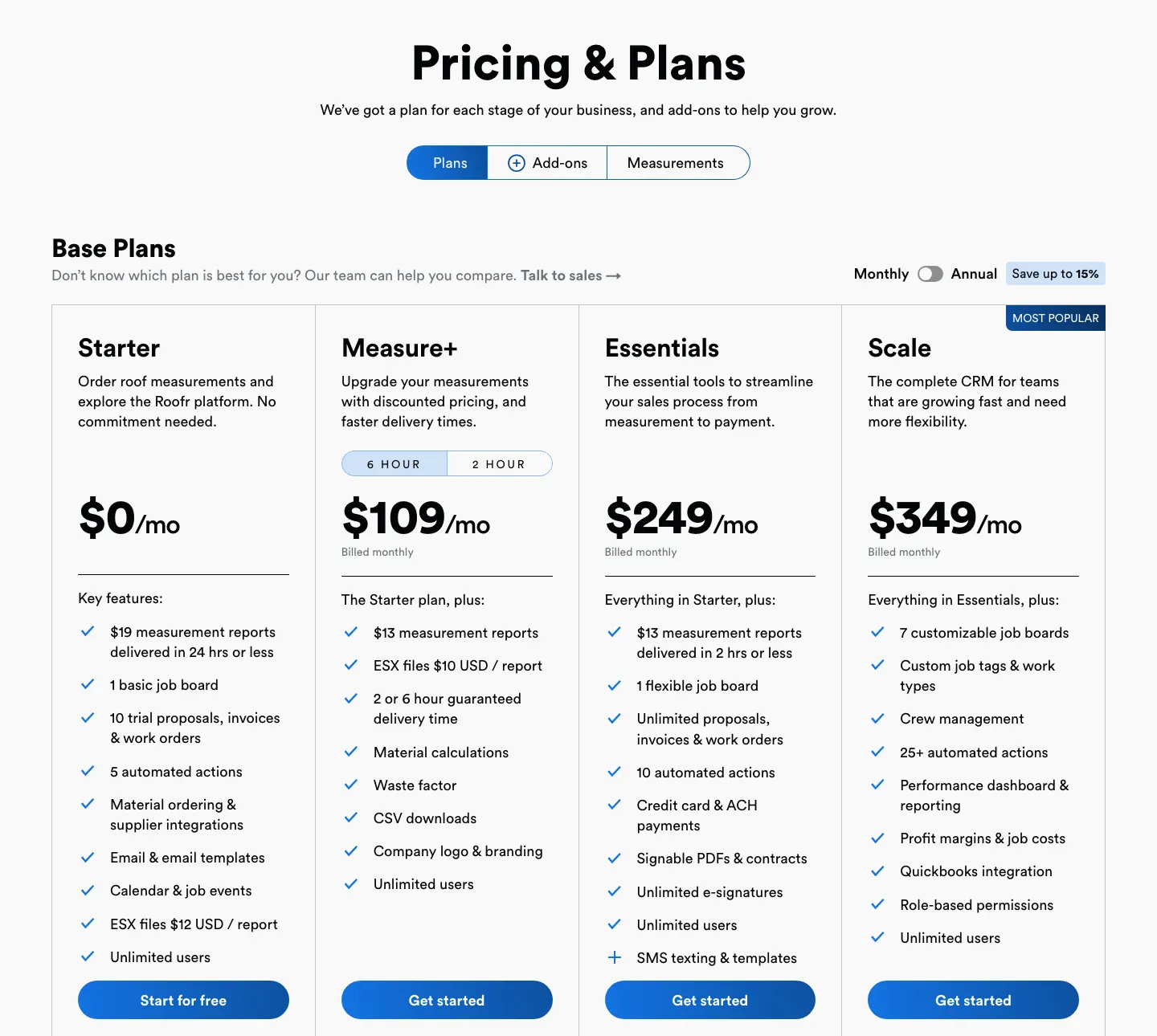 Jul 27, 2026
 Tech Stack
Roofr Review 2026: Pricing, Pros, Cons and Alternatives
Roofr rates 4.6 on Capterra and sells $13 measurement reports against a market charging triple. But it will not import a report from anywhere else.
Read Article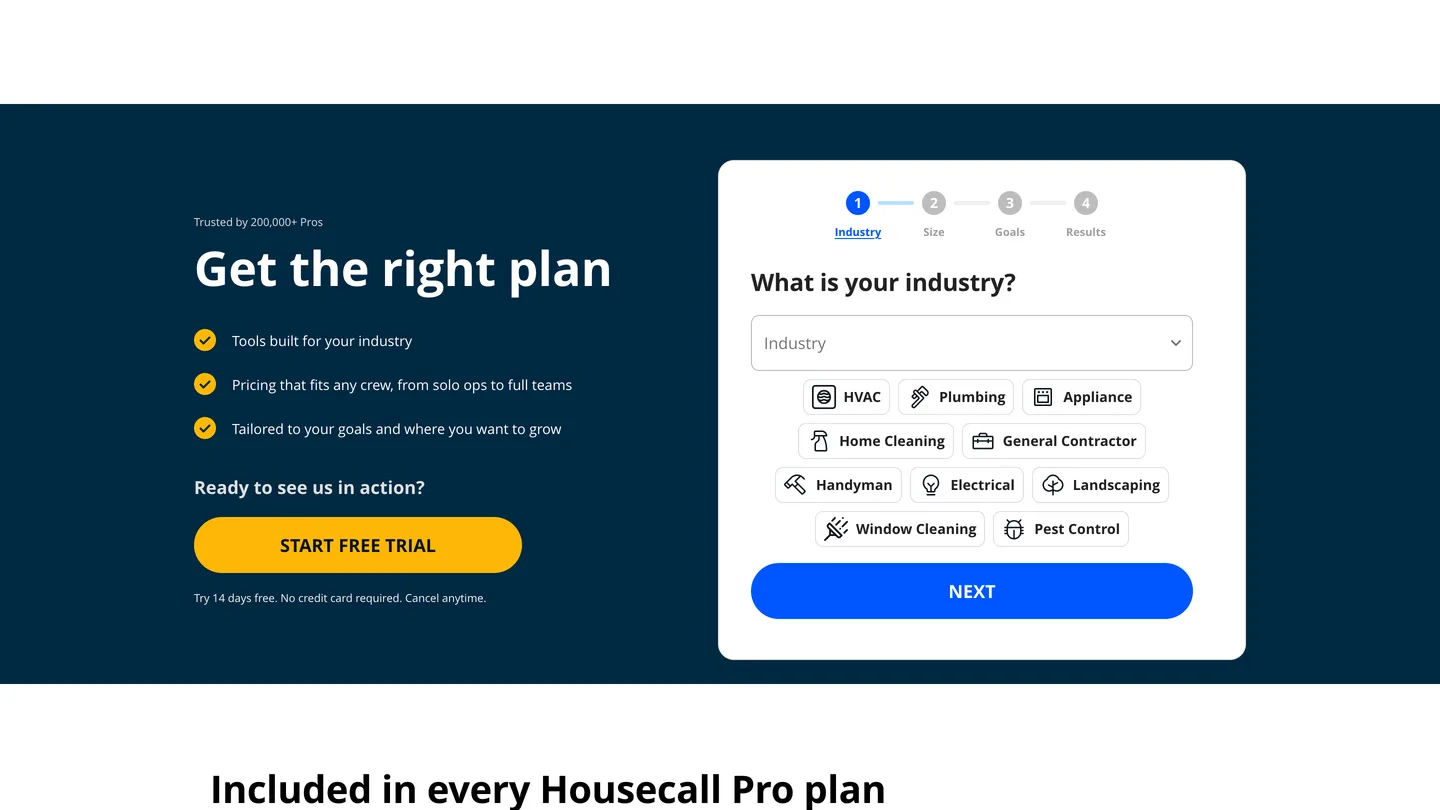 Jul 25, 2026
 Tech Stack
Housecall Pro Review 2026: Pricing, Pros, Cons, Alternatives
Housecall Pro has the shortest learning curve in the category and the widest review spread. Real pricing, the Instapay math, and the migration trap to plan around.
Read Article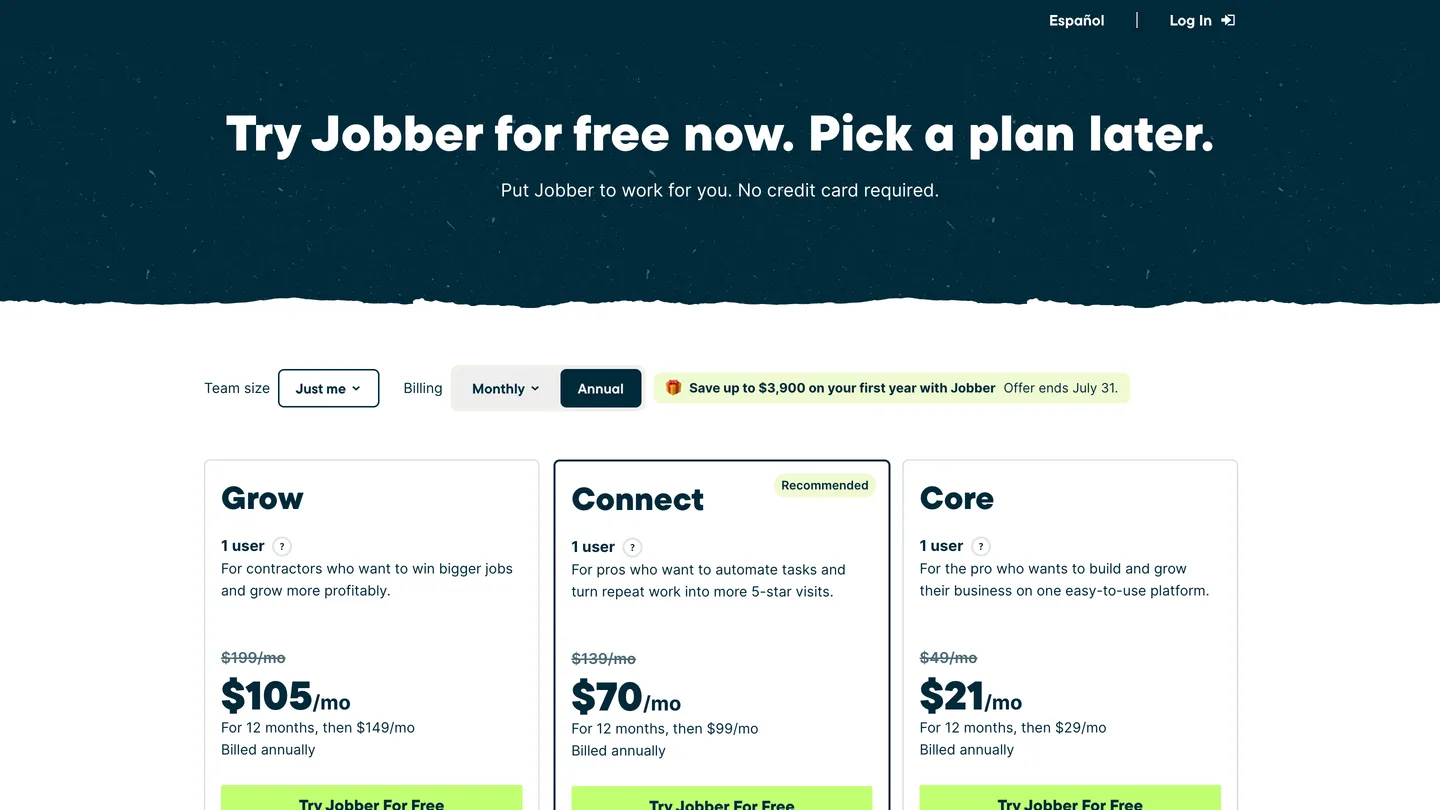 Jul 24, 2026
 Tech Stack
Jobber Review 2026: Pricing, Pros, Cons and Alternatives
Jobber rates 4.6 on Capterra with the best mobile app in the category. Real plan pricing, the feature gating that changes your entry price, and who it suits.
Read Article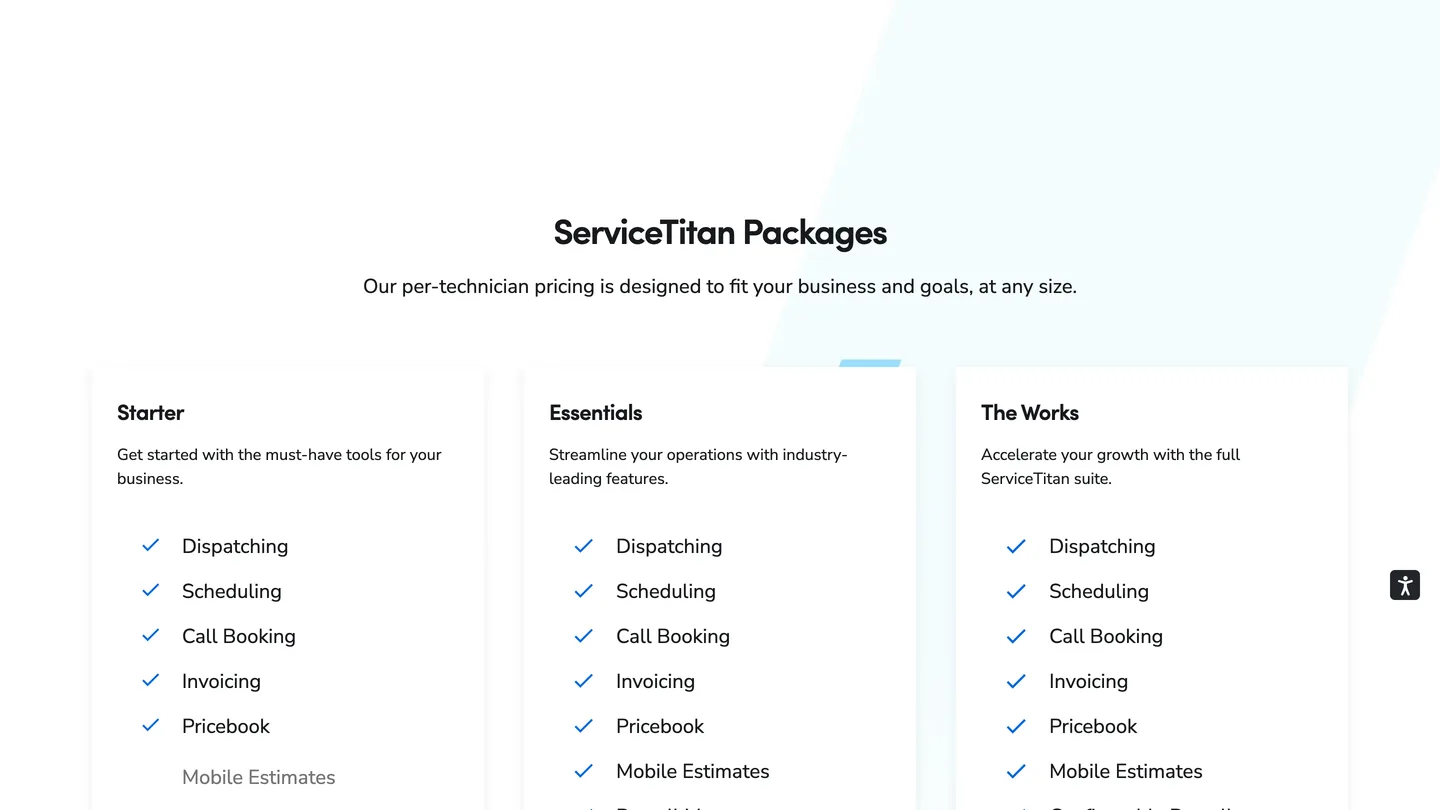 Jul 23, 2026
 Tech Stack
ServiceTitan Review 2026: Pricing, Pros, Cons, Alternatives
ServiceTitan rates 4.3 on Capterra but its weakest score is value for money. Real reported pricing, the 12-month contract, the exit fees, and who it actually suits.
Read Article Jun 3, 2026
 Tech Stack
HVAC Online Scheduling: The 43% Losing After-Hours Bookings
HVAC leads every trade on online booking at just 56.7%, which still leaves 43% of sites forcing an after-hours customer to wait for a business-hours phone call.
Read Article