FieldRoutes Review 2026: Pricing, Pros, Cons, Alternatives
Third-party contract data puts real numbers on FieldRoutes. The 8 gaps reviewers name, and 5 alternatives that publish a price upfront.

Disclosure This article features tools from our brand partners. If you choose to use them, we may receive compensation at no extra cost to you.
Our editorial choices are independent of these affiliate arrangements. Read our full affiliate disclosure.
Fervor is a CRO and web design studio, not a software reseller, and no vendor paid for placement here or for a kinder verdict. Affiliate links are flagged where they appear, and they never change what we report.
Page at a glance
FieldRoutes is route-density software for a recurring-service book: it prices on how many addresses you serve, not how many people you employ, which is a different bet from every per-seat platform in the category. It publishes no price, so the only way to get a number is to ask a salesperson for one. Not per seat. The Terms of Service define the billing unit as an Active Customer, meaning a unique address or unit with an active customer card, and set the increment at $500 per month for each block of up to 1,000 Active Customers. So the bill tracks the size of the book, not the size of the crew, and adding office staff or technicians costs nothing extra. It fits a five-to-fifty-person recurring-service operation running dense residential routes on a subscription plan, where the same addresses get visited on a schedule. It's the wrong buy for a seasonal landscaping or pool operation whose active customer count swings hard between summer and winter, because The pricing tier ratchets up with the summer peak and, by the Terms' own wording, cannot be reduced when the book contracts. And Skimmer prices the same shape, per serviced location, and explicitly doesn't charge for a location that isn't serviced in a given month. Alternatives that publish their prices are Skimmer from $49, Jobber from $49, Housecall Pro from $79. A quote-only price and what third parties report instead, eight evidenced gaps and five alternatives, three of which publish a figure.
Start here if FieldRoutes is on your shortlist
FieldRoutes earns its money with a five-to-fifty-person recurring-service operation running dense residential routes on a subscription plan, where the same addresses get visited on a schedule. If that's you, it does the job. The sections below are the parts worth checking before you sign. But the fit is narrower than the marketing suggests, and the price isn't the whole cost.
The vendor publishes no price. But every number below was verified on 7 August 2026 and comes from a named third party that says which.
| Pricing model | Custom quote, no published price |
|---|---|
| Entry price | Quote only |
| Users | Not per seat. The Terms of Service define the billing unit as an Active Customer, meaning |
| Ownership | ServiceTitan |
| Best fit | a five-to-fifty-person recurring-service operation running dense residential routes on a subscription plan, where the same addresses get visited on a schedule. |
| Accounting sync | QuickBooks Online (one-way), Sage Intacct and Acumatica, via the Inova Payroll marketplace partner (two-way) |
What works
- Intelligent routing is the thing it's good at
- But the scheduler interrupts the schedulers
- No accounting partner appears in the vendor's own marketplace
- Recurring billing and autopay are the real draw for a subscription book
- The technician app is the weak link
What does not
- The pricing tier ratchets up and never comes back down
- A two-year opening term with a ninety-day notice window and a full-remainder exit fee
- Support is the loudest and most repeated complaint in the corpus
- The data export window closes sixty days after termination, and the vendor disclaims the quality of what you get
- If you use FieldRoutes for card processing, it can debit you without notice
FieldRoutes is route-density software for a recurring-service book: it prices on how many addresses you serve, not how many people you employ, which is a different bet from every per-seat platform in the category. It sells to Landscaping and Pools contractors, and the shape of the product follows from that: This is the centre of the product and it shows up in the positive reviews far more consistently than any other module. An operations coordinator says building routes has become very easy, and a manager values seeing where the technician is. And on a dense recurring book that's where the money is.
Ownership matters here more than it usually does. FieldRoutes is owned by ServiceTitan, so weigh roadmap risk alongside the feature list. An independent product can be bought and folded into somebody else's plan two years after you sign.
Who should be shortlisting FieldRoutes
It fits a five-to-fifty-person recurring-service operation running dense residential routes on a subscription plan, where the same addresses get visited on a schedule. That's the half most reviews print. Here's the other half, which is the one worth your time.
Don't buy it if you're a seasonal landscaping or pool operation whose active customer count swings hard between summer and winter. The pricing tier ratchets up with the summer peak and, by the Terms' own wording, cannot be reduced when the book contracts. And Skimmer prices the same shape, per serviced location, and explicitly doesn't charge for a location that isn't serviced in a given month. Look at Skimmer instead.
Don't buy it if you're a one-to-four-person crew that wants to try software before committing. There's no free trial, no published price, and a two-year initial term with a full-remainder termination fee. And Jobber publishes $49 a month on Core and commits you to nothing.
Don't buy it if you're an owner who needs to know the total cost before signing. The subscription is quote-only, onboarding is billed on time and materials at rates set in your own Order Form, and card processing rates aren't published anywhere on the vendor site. So three of the four cost lines are invisible until you're in a sales conversation.
Don't buy it if you're a project-based landscape construction or hardscape business rather than a recurring maintenance one. The whole model prices on active recurring customers and optimises repeat routes. A build business has jobs, not routes, and would be paying for the wrong axis. Look at Aspire instead.
What FieldRoutes costs
There's no published price for FieldRoutes. The pricing page asks you to get in touch, so every figure below comes from somewhere other than the vendor, and each one says where.
The vendor's own wording is this, and nothing more: "The pricing page names two plans, Growth and Corporate, lists an identical feature set under both, and puts a Request Pricing button under each instead of a number. It explains the model without ever pricing it, and it rules out a trial as well." So treat every third-party page printing tier names and figures for FieldRoutes with careful suspicion. Those numbers are not on the vendor's site today, and a roundup that reprints them is telling you what FieldRoutes used to charge somebody else.
And we aren't going to print a per-month number we can't open a vendor page and read. What exists instead is third-party reporting, dated, from people who saw real contracts. Read it as a range rather than as a quote you can hold anyone to.
| Reported range | Reported on | Source |
|---|---|---|
| $350.00 per month, listed as Other rather than per user | 2026-08-07 | Capterra's software catalogue lists a starting price for the Basic plan. |
| Starting at $350/month | 2026-08-07 | Software Advice's profile shows the same starting figure. |
| approximately $364 per month | 2026-08-07 | A Capterra reviewer who owns a consumer-services company states what he actually pays, which is the only first-party number in this corpus. |
Not per seat. The Terms of Service define the billing unit as an Active Customer, meaning a unique address or unit with an active customer card, and set the increment at $500 per month for each block of up to 1,000 Active Customers. So the bill tracks the size of the book, not the size of the crew, and adding office staff or technicians costs nothing extra.
What isn't in the FieldRoutes number you get quoted
Payment processing. The payments page describes agile billing, online payments and reporting and publishes no rate at all. The Terms add that payment processing requires a separate agreement with a designated processor and sub-merchant registration, so ask for the card rate, the ACH rate, the chargeback fee and the name of the underlying processor in writing before signing.
Implementation and onboarding. Not a fixed number. Section 2.B states that unless the Order Form says otherwise, onboarding is billed on a time-and-materials or per-project basis at rates set in that Order Form, so the implementation cost is whatever your own Order Form says and is not knowable in advance.
Minimum term. Two years. Section 9.A sets the Initial Term at two years from the Effective Date, then automatic one-year renewals.
Getting out. Section 9.C: if you terminate before the term expires for any reason other than a FieldRoutes breach, you owe a termination fee equal to all the remaining payments. On a two-year initial term signed in month one, walking away in month six means paying for eighteen months you will not use.
Auto-renewal. Section 9.A: the agreement renews automatically for successive one-year periods, either party must give at least ninety days notice before the end of a term to stop it, and the renewal rate rises by the greater of five percent or FieldRoutes' then-current list prices.
Modules sold separately. , , , . So price the FieldRoutes configuration you'll really run rather than the entry tier, because an add-on you need on day one is part of the price.
Third-party services you will also pay for. . These are not on FieldRoutes's invoice, and they are still part of what this decision costs you every month.
"Third-party reporting puts FieldRoutes at $350.00 per month, listed as Other rather than per user, reported 2026-08-07."
Capterra's software catalogue lists a starting price for the Basic plan. (8-07)
One oddity, filed under things nobody mentions on a demo. The active-customer pricing tier is a one-way ratchet. It rises $500 a month for every block of up to 1,000 active customers, and the Terms then say in as many words that once the tier increases it cannot be reduced even if the customer count falls back into a lower band. And no other platform in this category writes that down. So for anything seasonal, model the July book, not the annual average, because July is what you'll pay for in January. And negotiate a written downward-adjustment clause before signing, because the standard Terms don't give you one.
The FieldRoutes line items nobody mentions
The subscription is the part everyone quotes. These are the lines that land afterwards, and the ones we could not find are named as unpublished rather than left blank.
Sold separately. , , , . Price the configuration you'll really run, because an add-on you need on day one is part of the price.
Third-party services you'll also pay for. . None of these are on FieldRoutes's invoice, and all of them are part of what this decision costs every month.
"FieldRoutes answers the question of what it costs with this and nothing else: "The pricing page names two plans, Growth and Corporate, lists an identical feature set under both, and puts a Request Pricing button under each instead of a number. It explains the model without ever pricing it, and it rules out a trial as well.""
FieldRoutes pricing page (2026)
"Not per seat. The Terms of Service define the billing unit as an Active Customer, meaning a unique address or unit with an active customer card, and set the increment at $500 per month for each block of up to 1,000 Active Customers. So the bill tracks the size of the book, not the size of the crew, and adding office staff or technicians costs nothing extra."
FieldRoutes pricing page (2026)
"FieldRoutes is reported at $350.00 per month, listed as Other rather than per user as of 2026-08-07."
Capterra's software catalogue lists a starting price for the Basic plan. (8-07)
The seven workflows you pay for
Feature totals are noise. So a shop in this category lives or dies on seven things, and those are the seven to grade, and each one below carries the evidence it's graded on.
Intelligent routing is the thing it's good at. This is the centre of the product and it shows up in the positive reviews far more consistently than any other module. An operations coordinator says building routes has become very easy, and a manager values seeing where the technician is. And on a dense recurring book that's where the money is. But an operations coordinator, reports it it differently: "Intelligent routing for our residential technicians has made building routes very easy."But an environmental services, 51-200 employees, reports it it differently: "It's a life saver for scheduling. You can get distance counter, so you know where the tech is."
But the scheduler interrupts the schedulers. A scheduler names the recommended-routes pop-up as repeatedly slowing the process down. Route optimisation that fights the person doing the routing is a real friction cost in an office that books all day. A scheduler describes it: "The recommended routes pop up window is extremely aggravating for schedulers and slows down our process repeatedly."
No accounting partner appears in the vendor's own marketplace. The marketplace lists seventeen partners across eleven categories, counted, and not one of them is an accounting platform. Capterra's catalogue lists QuickBooks Online, and the payroll partner Inova describes bi-directional API integrations with Sage Intacct and Acumatica plus an integration with QuickBooks. So the accounting path exists, but it runs through third parties rather than through anything the vendor merchandises.
Recurring billing and autopay are the real draw for a subscription book. Electronic invoicing, autopay technology and an account updater are named on the lawn care page, and the customer payment portal sits in the base feature list on both plans. And for a business collecting the same amount from the same addresses every month, that machinery is the point.
The technician app is the weak link. Crashes on Android, poor customer information, and an app that reloads while a technician is checked into an appointment. And those are the specific complaints, all about the surface the crew touches every hour. And an owner, consumer services, writing on 2023-08-16, writes the same thing: "The mobile app performs poorly...crashes on android phones. Also customer info is terrible"
Reporting is powerful and hard, in that order. Reviewers who like it call the reporting incredible and describe raw power in finding whatever they need. Reviewers who don't like it describe limitations that create extra administrative work and slow reporting down. And both readings are consistent with a deep reporting engine that needs someone in the office who enjoys it. An environmental services, 11-50 employees who reviewed it on 2026-05 writes: "These limitations are creating extra administrative work, slowing down reporting."
Migration is where the bad reviews cluster. An owner and president calls data migration a nightmare. Another owner calls the onboarding process terrible and says the salesman lied. And onboarding is billed on time and materials, which means a difficult migration is also an open-ended invoice. And an owner & president, environmental services, writing on 2022-08-23, reports it the same thing: "Data migration was a nightmare....The diffculty in creating custom service"And an owner, consumer services, writing on 2023-04-07, reports it the same thing: "Everything else. Terrible onboarding process and the salesman lied to me"
FieldRoutes per trade, not per company size
Fit differs by trade rather than by company size alone, and a blended paragraph hides that. Here is the split for the trades this one sells to.
Landscaping. The workflow that decides it is intelligent routing is the thing it's good at, and the shop profile that gets value is a five-to-fifty-person recurring-service operation running dense residential routes on a subscription plan, where the same addresses get visited on a schedule. doing residential and commercial and service work. Where it stops being a fit is a seasonal landscaping or pool operation whose active customer count swings hard between summer and winter.
Pools. The workflow that decides it is intelligent routing is the thing it's good at, and the shop profile that gets value is a five-to-fifty-person recurring-service operation running dense residential routes on a subscription plan, where the same addresses get visited on a schedule. doing residential and commercial and service work. Where it stops being a fit is a seasonal landscaping or pool operation whose active customer count swings hard between summer and winter.
The FieldRoutes integration that decides everything else
QuickBooks Online connects one way only, so edits made in your books do not come back, on every plan. Sage Intacct and Acumatica, via the Inova Payroll marketplace partner connects both ways, on every plan. Your costs map through cost codes, so test yours against your own chart of accounts before you commit. A code your books don't recognise is how a labour charge quietly lands somewhere useless.
Past those, the road ends. Any accounting platform in the vendor's own marketplace, Xero, Any pool-specific integration do not connect. So if your books run on an ERP rather than the platforms named above, weigh that before anything else.
Beyond accounting it connects to FieldRoutes Payments (First-party integrated card and ACH processing, sold as a marketplace offering and treated in the Terms as an Integrated Service requiring a separate sub-merchant agreement.), Scorpion (Marketing agency partner listed under Marketing Solutions.), LoyaltyLoop (Customer experience platform for Google reviews and Net Promoter Score.), Voice for Pest (Industry phone system with FieldRoutes integration.), Wisetack (Consumer financing under the Financing partner type.), Sentricon (Termite monitoring station integration.), Avoca AI, FleetPro, A.R.M. Solutions, Newport Advisors, Marketing Pro (The remaining five of the nine listings in the marketplace's Integrations category.). A public API exists: A Premium API is listed as an included feature under both the Growth and Corporate plans, so API access is not the thing that separates the tiers. No public developer documentation was reachable without an account.
What happens when FieldRoutes breaks
Support is the line item nobody prices and everybody eventually needs. Onboarding for FieldRoutes: Not a fixed number. Section 2.B states that unless the Order Form says otherwise, onboarding is billed on a time-and-materials or per-project basis at rates set in that Order Form, so the implementation cost is whatever your own Order Form says and is not knowable in advance.
On 2024-08-13, a partner, consumer services puts it: "NO SUPPORT!! Left (and this the truth) 57 voice message when we were not able service a huge account"
On 2024-05-24, an owner, chemicals says: "Customer service is ridiculous...locked out of account for 3 days"
Before you sign with FieldRoutes: the exit
Nobody reads this section before they buy, and it's the one that costs money afterwards. Four terms decide what leaving looks like.
Minimum term. Two years. Section 9.A sets the Initial Term at two years from the Effective Date, then automatic one-year renewals.
Auto-renewal. Section 9.A: the agreement renews automatically for successive one-year periods, either party must give at least ninety days notice before the end of a term to stop it, and the renewal rate rises by the greater of five percent or FieldRoutes' then-current list prices.
Early termination. Section 9.C: if you terminate before the term expires for any reason other than a FieldRoutes breach, you owe a termination fee equal to all the remaining payments. On a two-year initial term signed in month one, walking away in month six means paying for eighteen months you will not use.
Payment processing. The payments page describes agile billing, online payments and reporting and publishes no rate at all. The Terms add that payment processing requires a separate agreement with a designated processor and sub-merchant registration, so ask for the card rate, the ACH rate, the chargeback fee and the name of the underlying processor in writing before signing.
One oddity, filed under things nobody mentions on a demo. FieldRoutes is one of the very few vendors in home services to publish an anti-lock-in pledge, and it's genuinely unusual: self-serve CSV extraction at any time, comprehensive extracts specifically in the context of moving to a competitor, payment data within ten business days, no charge for payment token extraction, and a commitment not to cut off payment processing until you've successfully migrated. And set against a review from 2019 complaining of a $500 charge for a single backup, it reads as a deliberate correction. So reference the pledge by name in your Order Form negotiation and ask for it to be incorporated by reference, because a marketing page isn't a contract term. And note too that the pledge's promises sit alongside a sixty-day post-termination Export Period in the actual Terms.
"FieldRoutes is reported at Starting at $350/month as of 2026-08-07."
Software Advice's profile shows the same starting figure. (8-07)
"Expensive, and it cost me money when a customer uses the system to send emails, texts, or calls to me."
Software Advice, Howard E. (6-05)
"Quite expensive for small companies (~$364/mo)"
Capterra, Chris C. (2026)
The FieldRoutes problems that survive onboarding
Every one of these is checkable on a demo call. None of it is a matter of taste, and each one traces to a vendor page or a named reviewer.
The pricing tier ratchets up and never comes back down. Section 5.A.iv of the Terms says pricing rises by $500 a month for each increment of up to 1,000 Active Customers, and then says the tier cannot be reduced even if the customer count falls back into a lower band. So a seasonal lawn or pool book that peaks in July and empties in November pays the July price all year, forever. Before signing, ask in writing for a downward tier adjustment on a defined annual review date, and get the definition of an inactive customer card so you know exactly how a churned address stops counting.
A two-year opening term with a ninety-day notice window and a full-remainder exit fee. The initial term is two years, renewals are automatic and annual, cancelling needs ninety days advance notice, and leaving early costs all the remaining payments. Miss the notice window by a week and you've bought another year at a rate that rose by at least five percent. Put the ninety-day notice date in a calendar on the day you sign, and ask for the initial term to be cut to one year before the Order Form is countersigned.
Support is the loudest and most repeated complaint in the corpus. It isn't one bad month. A partner records leaving fifty-seven voice messages while a large account went unserviced, an owner records being locked out of his account for three days, and another owner describes waiting days, weeks and even months. But those sit alongside genuinely warm support reviews, which suggests the experience depends heavily on who you get. On 2024-08-13, a partner, consumer services says: "NO SUPPORT!! Left (and this the truth) 57 voice message when we were not able service a huge account" Ask for the published support SLA, the escalation path, and the name of your assigned contact, then ring the support line yourself before you sign.
The data export window closes sixty days after termination, and the vendor disclaims the quality of what you get. Section 9.E gives you an Export Period of no more than sixty days after termination, and states plainly that FieldRoutes makes no representation as to the integrity, completeness or timeliness of any data exported. And after that window the obligation to hold your data ends. Pull a full CSV export on day one and repeat it quarterly, so a migration never depends on a sixty-day sprint against a disclaimer.
If you use FieldRoutes for card processing, it can debit you without notice. Section 5.D lets FieldRoutes immediately, without prior consent or notice, offset or debit amounts owed from merchant funds held in deposit, due to you, held in reserve, or available in your bank account. So bundling processing with software means an invoice dispute can become a cash-flow event. Decide deliberately whether to run processing through FieldRoutes. Keeping it separate keeps a billing dispute out of your operating account.
The mobile app draws consistent reliability complaints, and it's where the crew lives. An owner reports poor performance and crashes on Android alongside weak customer information, and a technician wishes the app would stop reloading mid-appointment. And on a route business the app is the product for everyone except the office. An owner, consumer services who reviewed it on 2023-08-16 reports it: "The mobile app performs poorly...crashes on android phones. Also customer info is terrible" Put the app on the oldest Android handset in your fleet during the demo and complete a full stop, including photos and payment, before deciding.
There's no free trial, so the only way to evaluate it is a demo. The vendor declines a trial on the grounds that each implementation is tailored. So combined with a two-year opening term, the first time you use the software in anger you're already committed. Ask for a sandbox loaded with a sample of your own routes, and ask for an out clause tied to a defined go-live acceptance test.
Neither landscaping nor pool has the depth pest control has. Lawn care is a real named vertical with its own demo page and its own feature list. Pool has no readable dedicated product page on the vendor site, and the platform's language, its named customers and its marketplace partners are all pest-first. And the Sentricon termite-station integration shipping in the base feature list on both plans tells you who this was built for. Ask for three named reference customers in your own trade, not in pest control, and ring them.
One more thing worth knowing. the renewal clause raises your rate by the greater of five percent or FieldRoutes' then-current list prices, automatically, every year, unless you gave ninety days notice. Stack that on a two-year opening term and a ratcheting customer tier and the price can only move in one direction across the life of the relationship. So ask for a cap on the renewal uplift, and put the ninety-day notice date in the calendar the day you countersign. Missing that date is another year at a higher rate, not a slip.
One more thing worth knowing. bundling card processing with the software gives the vendor a direct line into your bank account. Section 5.D lets FieldRoutes immediately, without prior consent or notice, offset or debit amounts from merchant funds held in deposit, due to you, held in reserve, or available in your bank account. The same document caps FieldRoutes' own aggregate liability at the greater of twelve months of fees or one hundred dollars. So the asymmetry is worth pricing. Keeping processing with a separate merchant provider costs you some workflow convenience and buys back a very real cash-flow protection.
One more thing worth knowing. support is the single most repeated theme in the negative reviews, and it spans four years and three platforms. Fifty-seven unreturned voice messages during a service failure on a large account, three days locked out of an account, months waiting for a resolution. It runs directly alongside equally emphatic praise for support from other reviewers, which points at inconsistency rather than absence. So don't accept a support reference from the salesperson. Ring the support line as a prospect, time the answer, and make the SLA and escalation path a written term of the Order Form.
Small thing that turns out to matter. This is the rare platform where hiring is free. Because the meter is the address book and not the seat, adding a technician, a dispatcher or a whole office costs nothing extra. Every per-seat rival in the comparison set, Jobber at $29 per additional user, ServiceTitan per technician, charges you for growth in headcount. So run the crossover maths on your own numbers. If your headcount is growing faster than your customer count, this model wins. But if your customer count is growing faster, or swings seasonally, it loses badly.
What FieldRoutes operators say, in their own words
Every quote below is transcribed from a published review, named to the platform that carries it and to the reviewer as that platform displays them. We read the corpus by complaint type rather than by star rating, which is how the disqualifying detail buried inside a five-star review gets found.
"These guys charge $500 to give you a single backup of your own data."
But a chemicals, 2-10 employees, says it differently on Software Advice
"NO SUPPORT!! Left (and this the truth) 57 voice message when we were not able service a huge account"
A partner, consumer services who reviewed it on 2024-08-13 describes it on Capterra
"Everything else. Terrible onboarding process and the salesman lied to me"
On 2023-04-07, an owner, consumer services describes it on Capterra
"Data migration was a nightmare....The diffculty in creating custom service"
But an owner & president, environmental services, says it differently on Capterra
"The mobile app performs poorly...crashes on android phones. Also customer info is terrible"
On 2023-08-16, an owner, consumer services writes on Capterra
"Customer service is ridiculous...locked out of account for 3 days"
An owner, chemicals who reviewed it on 2024-05-24 writes on Capterra
"I'm at the point where I am fed up with not feeling like a priority...ready to wait for days, weeks, and even months for a solution."
An owner, puts it on GetApp
"Expensive, and it cost me money when a customer uses the system to send emails, texts, or calls to me."
A consumer services, self-employed, writing on 2026-05, describes it on Software Advice
"Quite expensive for small companies (~$364/mo)"
But an owner, consumer services, 2+ years on the platform, puts it it differently on Capterra
"poor customer services when reaching out to support...payment processing fees"
An owner, consumer services, writing on 2022-08-23, reports it on Capterra
"Pricing is a bit much for my small company. I don't like that we can't"
An owner, chemicals, writing on 2022-08-18, writes on Capterra
"The recommended routes pop up window is extremely aggravating for schedulers and slows down our process repeatedly."
A scheduler says on GetApp
"These limitations are creating extra administrative work, slowing down reporting."
On 2026-05, an environmental services, 11-50 employees writes on Software Advice
"It's a life saver for scheduling. You can get distance counter, so you know where the tech is."
An environmental services, 51-200 employees, reports it it plainly on Software Advice
"Intelligent routing for our residential technicians has made building routes very easy."
An operations coordinator, says on GetApp
"FR has been pretty easy for us to use. Getting someone new trained quickly on both office and mobile is a breeze."
But an environmental services, 2-10 employees, puts it it differently on Software Advice
What else you should be pricing beside FieldRoutes
The realistic alternatives, and what each costs to start. Cheaper doesn't win here, and neither does expensive. Fit does.
| Tool | Entry price | Billing unit | Users included | Published? |
|---|---|---|---|---|
| FieldRoutes | Quote only | Custom quote | Not per seat. The Terms of Service define the billing unit a | No |
| Skimmer | $49 | per month minimum, then $1 per serviced location per month on Getting Started | Not metered by user; metered by serviced location | Yes |
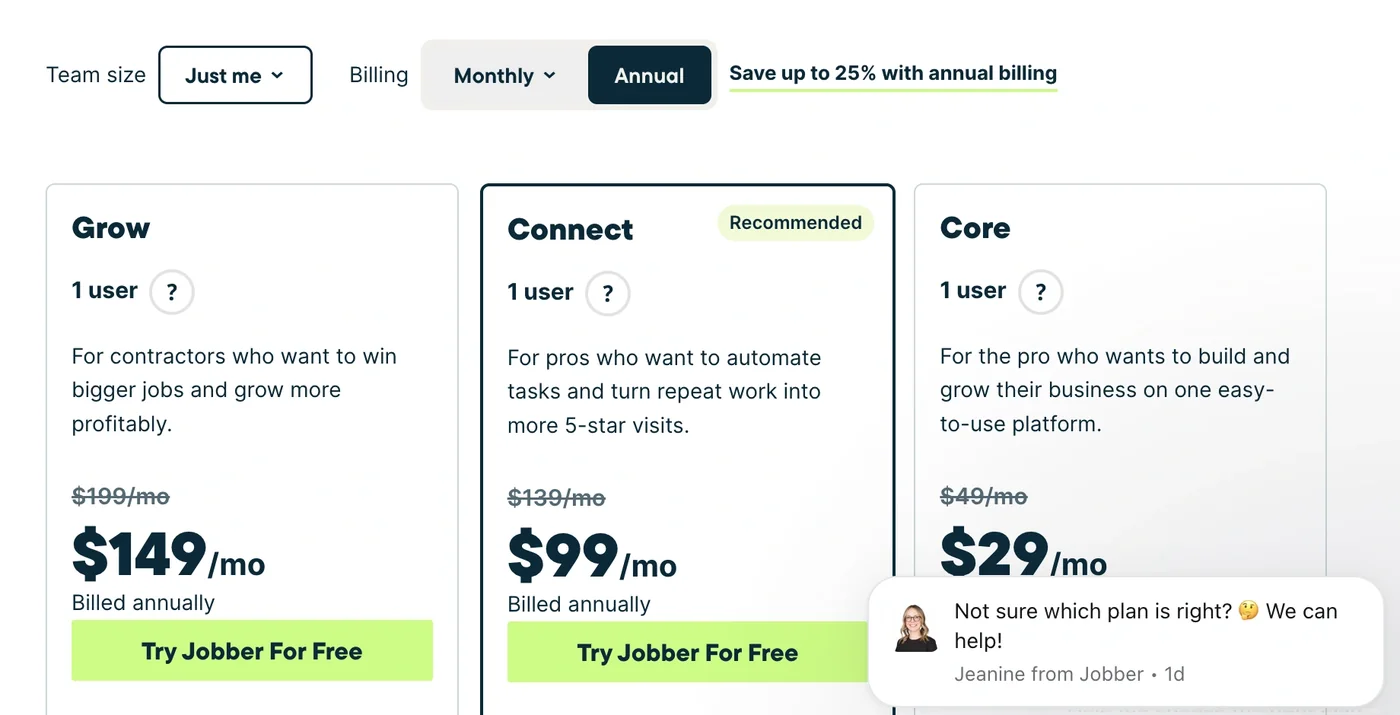
| Jobber | $49 | per month on Core, 1 user included, $29 per additional user | 1 on Core, 5 on Plus | Yes |
| Housecall Pro | $79 | per month on Basic billed monthly, $59 billed annually | Not stated on the pricing page | Yes |
| Aspire | Quote only | Not published; demo and quote request only | Not published | No |
| ServiceTitan | Quote only | Per technician per month | Metered per technician | No |
Skimmer. It prices the identical axis, per address served, but publishes it and doesn't charge for a location that isn't serviced in a given month. And for a seasonal pool book that's the whole ballgame. But it's pool-only, so a mixed pool-and-lawn operation would need a second system, and it has nothing like FieldRoutes' recurring-billing and marketing depth.
Jobber. It publishes every price, includes a trial, and commits you to nothing on a monthly plan. And for a small landscaping crew that's a categorically easier decision. But route optimisation and recurring-subscription billing are thinner than FieldRoutes', and the bill grows with headcount rather than staying flat as the crew grows.
Housecall Pro. Published tiers and a published QuickBooks Online path, which sits in Essentials at $189 a month billed monthly. But it gates the QuickBooks sync behind the middle tier, and is built around jobs rather than dense recurring routes.
Aspire. The landscaping-native sibling inside the same corporate family, built for contract and project landscape businesses rather than pest routes, and used by 35% of the companies on the LM150 list. But it publishes nothing at all, is aimed further up market, and puts you back in the same quote-only, contract-first buying process.
ServiceTitan. The parent platform, with deeper reporting and marketing attribution than any of its verticalised children. But it prices per technician rather than per customer, which inverts the whole reason to choose FieldRoutes when your crew is small and your book is large.
"Pricing is a bit much for my small company. I don't like that we can't"
Capterra, Martin B. (8-18)
"These guys charge $500 to give you a single backup of your own data."
Software Advice, Eric S. (9-02)
Who should not buy FieldRoutes
Don't buy FieldRoutes if you're a seasonal landscaping or pool operation whose active customer count swings hard between summer and winter. The pricing tier ratchets up with the summer peak and, by the Terms' own wording, cannot be reduced when the book contracts. And Skimmer prices the same shape, per serviced location, and explicitly doesn't charge for a location that isn't serviced in a given month. Look at Skimmer instead.
Don't buy FieldRoutes if you're a one-to-four-person crew that wants to try software before committing. There's no free trial, no published price, and a two-year initial term with a full-remainder termination fee. And Jobber publishes $49 a month on Core and commits you to nothing.
Don't buy FieldRoutes if you're an owner who needs to know the total cost before signing. The subscription is quote-only, onboarding is billed on time and materials at rates set in your own Order Form, and card processing rates aren't published anywhere on the vendor site. So three of the four cost lines are invisible until you're in a sales conversation.
Don't buy FieldRoutes if you're a project-based landscape construction or hardscape business rather than a recurring maintenance one. The whole model prices on active recurring customers and optimises repeat routes. A build business has jobs, not routes, and would be paying for the wrong axis. Look at Aspire instead.
The verdict, by shop size
Under five people, any recurring-service trade
No. A two-year initial term, no trial, no published price, onboarding billed on time and materials, and a pricing tier that only goes up. And Jobber publishes $49 and asks for nothing. So at this size the contract is a bigger risk than the software is a benefit. This band runs 1 to 4 on the crew, doing residential and service work, and that's the profile the recommendation is written for.
Seasonal landscaping or pool, any size
No. The Terms say the tier cannot be reduced when the active customer count falls. So a book that swells in spring and empties in autumn buys its summer price permanently. And Skimmer prices the same axis, publishes it, and doesn't bill a location it didn't serve that month. This band runs 1 or more on the crew, doing residential and service work, and that's the profile the recommendation is written for.
Five to fifty, dense year-round residential recurring routes
Only under conditions, and they are worth being honest about. This is the shape the product is built for, and the per-customer model genuinely beats per-seat pricing when your crew grows faster than your book. But the conditions are all commercial: cut the initial term to one year, get the downward tier adjustment in writing, get the card rate in writing, and diarise the ninety-day notice date on the day you sign. This band runs 5 to 50 on the crew, doing residential and service work, and that's the profile the recommendation is written for.
Large commercial recurring-service operation with a dedicated back office
Only under conditions, and they are worth being honest about. The reporting depth and the flat-per-customer model both reward scale, and the Right To Your Data pledge is a real commitment few competitors make. But at this size the support complaints matter more, not less, so make the support SLA a contract term rather than a hope. This band runs 50 or more on the crew, doing commercial and service work, and that's the profile the recommendation is written for.
Project-based landscape construction or hardscape
No. There's no recurring book to price against. So paying per active customer for a business that does each address once is paying for the wrong axis entirely. This band runs 1 or more on the crew, doing residential and commercial work, and that's the profile the recommendation is written for.
One thing to check before you sign with FieldRoutes
We should say what our stake is here, which is none. Fervor is a web design and conversion studio for contractors. No vendor on this page pays us. But we measured something adjacent that changes what this purchase is worth.
FieldRoutes bills by active customer, which means every single address on the book is a line item on the invoice, and the cheapest new address is the one that arrives without a salesperson. Yet the platform's own marketplace routes lead generation to agency partners while the contractor's website, the thing that turns a search into that customer card, sits outside the system entirely. A recurring-service business paying per address has a sharper reason than most to care whether its site loads and converts, because the acquisition cost of each address is being compared against a subscription line that only ever goes up.
And the number is worse than anyone guesses before they check. Across 380 inspected contractor sites, 82.8% had poor mobile loading performance. And the method is public, because a number you cannot audit is not evidence. The full write-up is in the Contractor CRO Index.
"82.8% of the 380 contractor websites inspected had poor mobile loading performance."
Fervor Studio Contractor CRO Index (2026)
Buy the platform if it fits. But spend ten minutes on your own site first, on a phone, on mobile data, the way a homeowner would. The numbers are all public.
See where your site is losing the jobs FieldRoutes would have managed
Fervor inspects your site the way a homeowner uses it, then shows you where calls leak out. About three days.
Get a Site InspectionWhat we checked on FieldRoutes, and what we didn't
We didn't run FieldRoutes on a live job, and we won't imply otherwise. What it is instead: FieldRoutes's own 15 pages read line by line on 7 August 2026, plus the review corpus read by complaint type rather than by star rating. So each number carries the date it was read, and the page it was read from.
So: 16 quotes on this page, eight from Capterra, five from Software Advice and three from GetApp. Capterra, Software Advice and GetApp share one Gartner Digital Markets review pool, so a matching score across them is one sample rather than three corroborating ones.
And G2, TrustRadius, Trustpilot, Reddit, help.fieldroutes.com — the Freshdesk help centre 302s to a Freshworks OAuth login, so no data-export or account-closure article is publicly readable, https://www.fieldroutes.com/solutions/pool-care-software — appears in search results but serves homepage content rather than a pool-specific page and https://www.fieldroutes.com/features and /integrations — both return HTTP 404 refused automated retrieval for FieldRoutes. Forum and social threads are the ones people most want quoted, and they are exactly the ones we cannot verify, so none of them are here.
What that leaves untested: no FieldRoutes quote was obtained and there's no free trial, so no first-party subscription figure and no hands-on assessment exist here. And everything above is 15 vendor pages and a review corpus, which is documentary rather than hands-on.
What FieldRoutes users say
These guys charge $500 to give you a single backup of your own data.
NO SUPPORT!! Left (and this the truth) 57 voice message when we were not able service a huge account
Everything else. Terrible onboarding process and the salesman lied to me
Data migration was a nightmare....The diffculty in creating custom service
The mobile app performs poorly...crashes on android phones. Also customer info is terrible
Customer service is ridiculous...locked out of account for 3 days
I'm at the point where I am fed up with not feeling like a priority...ready to wait for days, weeks, and even months for a solution.
Expensive, and it cost me money when a customer uses the system to send emails, texts, or calls to me.
Quite expensive for small companies (~$364/mo)
poor customer services when reaching out to support...payment processing fees
Pricing is a bit much for my small company. I don't like that we can't
The recommended routes pop up window is extremely aggravating for schedulers and slows down our process repeatedly.
These limitations are creating extra administrative work, slowing down reporting.
It's a life saver for scheduling. You can get distance counter, so you know where the tech is.
Intelligent routing for our residential technicians has made building routes very easy.
FR has been pretty easy for us to use. Getting someone new trained quickly on both office and mobile is a breeze.
Frequently asked questions
Does FieldRoutes publish its prices?
No. The pricing page names two plans, Growth and Corporate, lists an identical feature set under both, and replaces the number with a Request Pricing button. What it does publish is the model: the monthly subscription is based on the number of active customers. The one real figure lives in the Terms of Service, where Section 5.A.iv sets the increment at $500 a month for each block of up to 1,000 Active Customers. And Capterra and Software Advice both list a $350 per month starting point, while one Capterra reviewer says he pays roughly $364.
Who owns FieldRoutes?
ServiceTitan. FieldRoutes was formerly PestRoutes, rebranded after merging with Lobster Marketing, and its own about page says it joined ServicePro and Aspire as part of the ServiceTitan family in 2022. ServSuite became ServSuite by FieldRoutes through the same acquisition. So that matters when you compare it against Aspire or ServiceTitan itself, because you're choosing between siblings, not rivals.
How long is the FieldRoutes contract?
Two years to start, then automatic one-year renewals. Section 9.A of the Terms of Service sets the Initial Term at two years from the Effective Date. Either party has to give at least ninety days notice before the end of a term to stop the renewal, and renewal rates rise by the greater of five percent or the then-current list prices. And leaving early for any reason other than a FieldRoutes breach costs a termination fee equal to all the remaining payments.
Can I get my data out of FieldRoutes?
Yes, and the vendor has gone further than most in writing it down. Its Right To Your Data declaration commits to self-serve CSV extraction of names, addresses, emails and balances at any time, comprehensive extracts when you're migrating to a competitor, payment data from FieldRoutes Payments within ten business days, no charge for extracting payment tokens, and no termination of payment processing until you've successfully migrated. But the counterweight sits in the Terms: the Export Period runs no more than sixty days after termination, and FieldRoutes makes no representation as to the integrity, completeness or timeliness of what you export.
Is there a free trial?
No. The vendor says it does not offer a free trial because of the software's highly customizable nature, and offers a demonstration instead. So read that alongside the two-year initial term: the first time you run real routes through it, you're already committed for twenty-four months.
Does FieldRoutes integrate with QuickBooks?
Capterra's catalogue lists QuickBooks Online among its integrations, but FieldRoutes' own marketplace, seventeen partners across eleven categories, contains no accounting integration at all. The nearest thing to a bi-directional accounting claim comes from the payroll partner Inova, which describes bi-directional API integrations with Sage Intacct and Acumatica plus an integration with QuickBooks desktop and QuickBooks Online. So get the field-level sync map before you assume anything about direction.
Is FieldRoutes a good fit for landscaping or pool?
Lawn care is a genuine named vertical with its own demo page, its own feature list and a claim of 1,700-plus companies on the platform. Pool is thinner. And the base feature set on both plans includes Sentricon, a termite monitoring integration, while the marketplace partners are pest-first throughout. If you run dense year-round recurring routes the routing engine is legitimately strong, but ask for three reference customers in your own trade rather than in pest control.
What does it cost beyond the subscription?
Onboarding is billed on a time-and-materials or per-project basis at rates set in your own Order Form, so it isn't a published number. Card processing runs through a separate agreement with a designated provider on rates the vendor doesn't publish. Marketing Pro, Fleet Pro and Voice for Pest are separate modules. And unpaid invoices accrue interest at 1.5% a month, with service suspension available once payment is thirty days past due.
Freshness
How we keep this page current
Three dates govern this review, and they carry different meanings. The initial source sweep is dated August 7, 2026; when only part of the evidence set is recaptured later, that later date is stated beside the refreshed claim. We last revised the page on August 7, 2026. And the user reviews we quote were posted over roughly the last 24 months, so their individual dates remain part of the evidence instead of being overwritten by a later pricing update.
We revise the page when FieldRoutes changes a published price or a contract term, when a rating we cite moves by more than a few tenths, or when the vendor ships something big enough to change the verdict. We never bump the date just to look fresh, because Google treats that as manipulation and so do we. If a figure here reads as stale by the time you land on it, treat it as a floor and check the vendor's own page. We linked it at every number for exactly that reason.
Sourcing
How this review was researched
Every figure on this page traces to a captured source linked inline where it appears. The initial sweep is dated August 7, 2026; any later, partial recapture is dated at the claim rather than relabelling the whole evidence set. Ratings come from Capterra, GetApp, Software Advice and the Apple App Store. Note that Capterra, GetApp and Software Advice share one Gartner Digital Markets review pool, so an identical score across all three is a single sample rather than three corroborating ones, and this page treats it that way. G2, TrustRadius and Trustpilot block automated access, so where their numbers appear they are labelled as reported rather than verified. No claim here is sourced from Reddit or from a contractor Facebook group, because neither could be retrieved and quoting them would mean inventing attribution. Pricing marked as reported comes from third-party roundups, never from Fervor. Fervor's own findings come from the Contractor CRO Index 2026.
About
About Fervor Studio
Fervor Studio is a conversion rate optimization (CRO) and web design studio for home services contractors across North America, based in Cochrane, Alberta. Fervor does not sell field service management software and is not an alternative to FieldRoutes. It publishes the Contractor CRO Index, a public benchmark measuring contractor website conversion potential using reproducible, open-source methods such as axe-core and Google Lighthouse. Fervor Studio is operated by Fervor Group Inc.
 Aug 2, 2026
 Tech Stack
Best Plumbing Software in 2026: Ten Ranked Across Four Classes
A plumbing company’s work runs through four classes of software that do not substitute for each other, and it only buys two of them. Ten products, each with a published price or an explicit statement that the vendor publishes none.
Read Article Jul 31, 2026
 Tech Stack
NiceJob vs Birdeye 2026: Pricing, Contracts and Review Gating
One of these vendors puts its price on the page and its cancellation terms in writing. The other puts a form in front of both, and the complaint record is where its contract length shows up.
Read Article Jul 31, 2026
 Tech Stack
Podium vs Birdeye 2026: Pricing, Contracts and Review Gating
Only one of these two will tell you what it costs before a sales call, and even that number carries a carve-out aimed squarely at trade contractors.
Read Article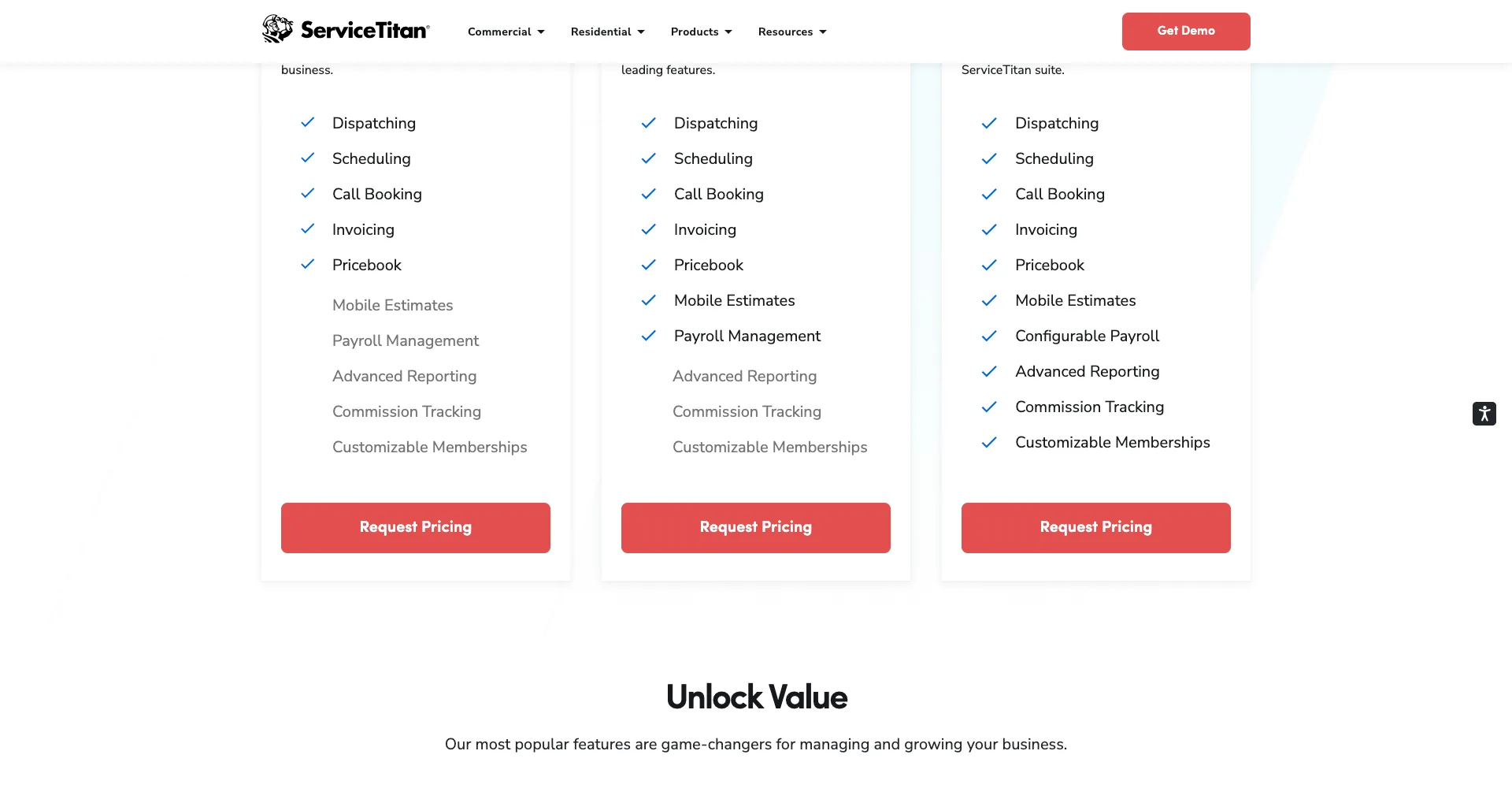 Jul 31, 2026
 Tech Stack
Best Electrical Contractor Software 2026: 11 Ranked and Priced
An electrical contracting business makes two software purchases that do not substitute for each other, and every roundup answering this query covers only one of them. Eleven platforms, with a published price or an explicit statement that the vendor publishes none.
Read Article Jul 31, 2026
 Tech Stack
Best HVAC Software in 2026: Eleven Ranked Across Three Classes
An HVAC contracting business buys across three classes of software that do not substitute for each other, and every roundup answering this query covers only one of them. Eleven products, each with a published price or an explicit statement that the vendor publishes none.
Read Article Jul 30, 2026
 Tech Stack
AccuLynx Pricing 2026: The Real Cost of a Quote-Gated Plan
One published figure, two blank plan cards, and a contract that says things the pricing page does not. A line-by-line breakdown of what AccuLynx really bills.
Read Article Jul 30, 2026
 Tech Stack
Houzz Pro Canada Review 2026: Pricing and Alternatives
Houzz Pro serves different pricing renderings. What Canadian buyers see, how GST/HST and payments work, what Custom gates, and what the annual contract commits you to.
Read Article Jul 30, 2026
 Tech Stack
JobNimbus Pricing in 2026: What the Quote Does Not Cover
JobNimbus prints no figure on any of its four plans. So the only rate you can read before a sales call is the payments meter, and it is the biggest line on the bill.
Read Article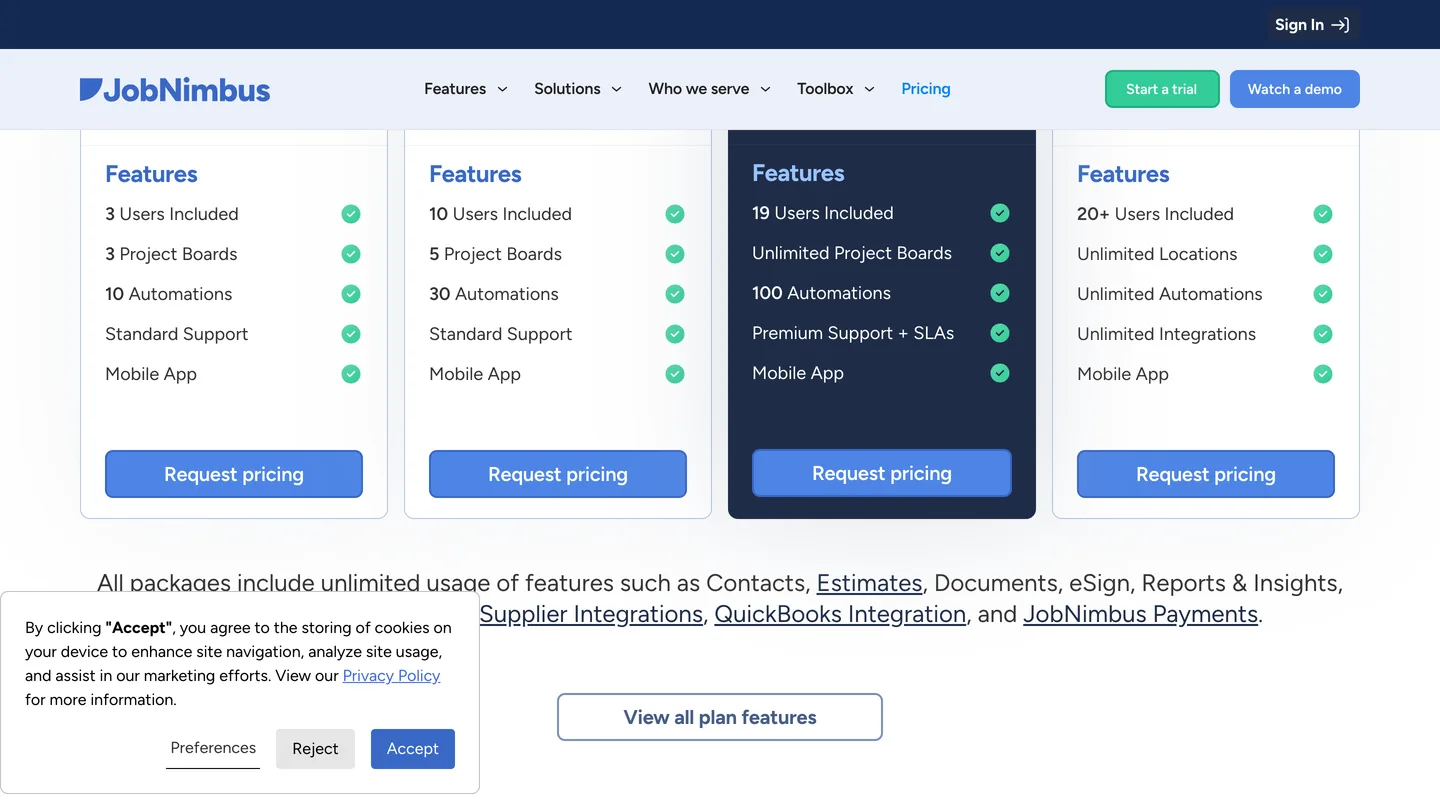 Jul 30, 2026
 Tech Stack
JobNimbus Review 2026: Pricing, Pros, Cons and Alternatives
JobNimbus rates 4.6 on Capterra and orders material straight from ABC Supply and SRS. But it publishes no price, and its supplement route carries a note.
Read Article Jul 30, 2026
 Tech Stack
BuildOps Review 2026: Pricing, Contract Terms and Alternatives
BuildOps runs commercial service and projects on one platform, and publishes no pricing at all. The billing unit, the 30-day data-export window, and who it suits.
Read Article Jul 30, 2026
 Tech Stack
FieldPulse Review 2026: Pricing, Pros, Cons and Alternatives
FieldPulse rates 4.6 on Capterra and is the platform contractors name when they leave a bigger system. But it publishes no price, and the contract runs a year.
Read Article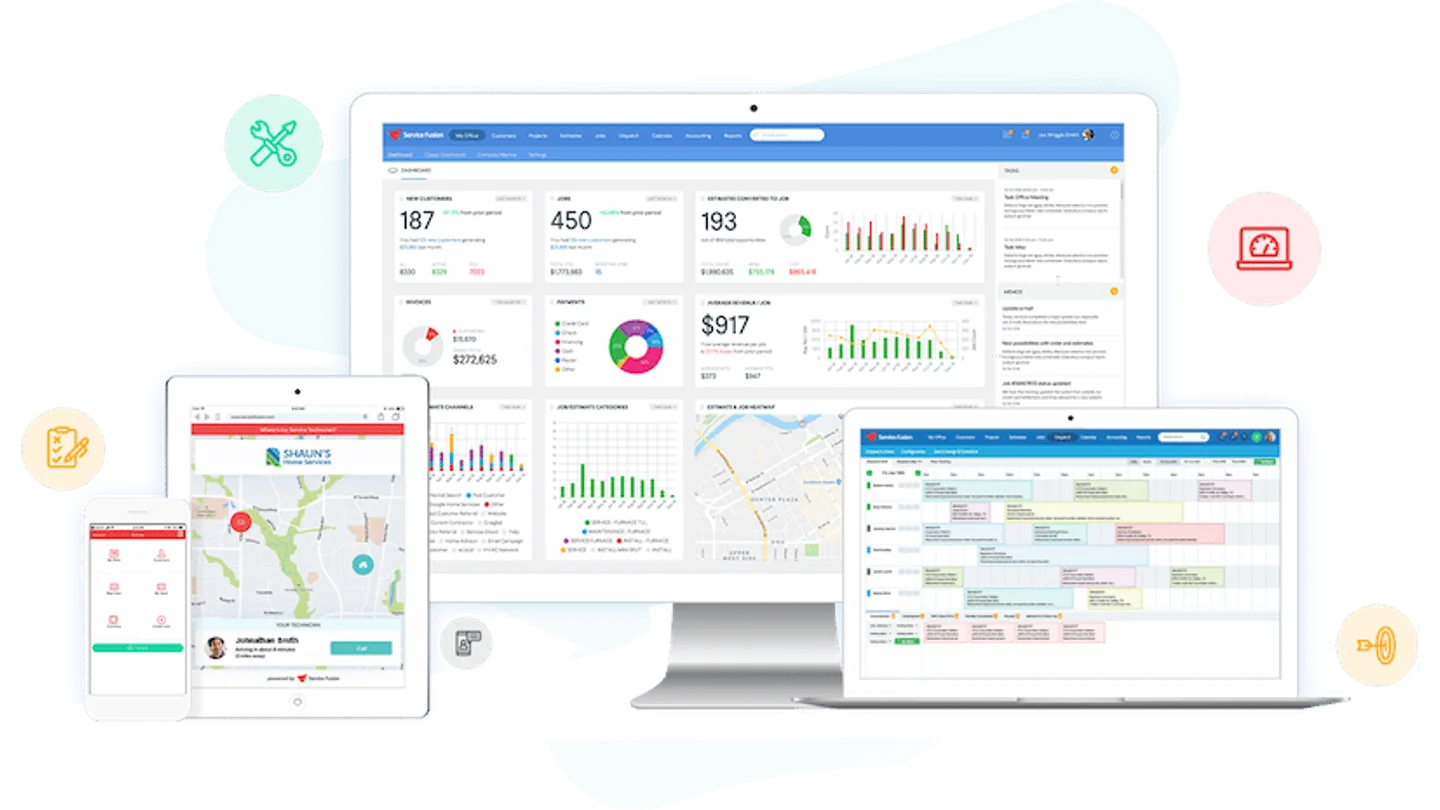 Jul 30, 2026
 Tech Stack
Service Fusion Review 2026: Pricing, Contract and Alternatives
Service Fusion bills flat per company with unlimited users, which is the best structural deal in field service software. The published plans, the contract behind the no-contract line, and the app score every other review gets wrong.
Read Article Jul 30, 2026
 Tech Stack
Knowify Review 2026: Pricing, Job Costing and Alternatives
Knowify rates 4.5 on Capterra and its weakest sub-score is features. What the $99 Core plan withholds, which way the QuickBooks sync really runs, and who should not buy it.
Read Article Jul 29, 2026
 Tech Stack
AccuLynx Review 2026: Pricing, Tier Gating, Alternatives
AccuLynx rates 4.6 across 846 reviews and now publishes an entry price. What that price omits, which tier holds the insurance workflow, and who should skip it.
Read Article Jul 29, 2026
 Tech Stack
Unitel Voice Review 2026: Pricing, Features and Alternatives
Unitel Voice rates 4.6 on Capterra and gives a one-truck shop a business number for $9.99 a month. The published plans, the cost per call, and what it won't do.
Read Article Jul 29, 2026
 Tech Stack
NiceJob vs Podium 2026: Pricing, Contracts and Review Gating
Both vendors print a price, at very different scale and in different currencies. The gap that matters is what Podium will not print: the billing unit, and whether a trade shop gets the number on the page.
Read Article Jul 28, 2026
 Tech Stack
CompanyCam Review 2026: Pricing, Pros, Cons and Alternatives
Every page ranking for CompanyCam still quotes a per-user price the vendor no longer charges. Here are the real plans, the seat math, and who should skip it.
Read Article Jul 28, 2026
 Tech Stack
NiceJob Review 2026: Pricing, Pros, Cons and Alternatives
NiceJob rates 4.9 on Capterra and refuses to gate negative reviews. Real plan pricing, the active-customer threshold nobody publishes, and who should skip it.
Read Article Jul 27, 2026
 Tech Stack
Buildertrend Review 2026: Pricing, Limits and Alternatives
Buildertrend rates 4.5 across 2,486 Capterra reviews and quotes against your revenue rather than your seat count. The workflows, the export problem, the alternatives.
Read Article Jul 27, 2026
 Tech Stack
CallRail Review 2026: Pricing, Pros, Cons and Alternatives
CallRail rates 4.5 on Capterra, and its tracking numbers port out free. But the two usage rates that decide your real bill are the two it does not print.
Read Article Jul 27, 2026
 Tech Stack
Roofr Review 2026: Pricing, Pros, Cons and Alternatives
Roofr rates 4.6 on Capterra and sells $13 measurement reports against a market charging triple. But it will not import a report from anywhere else.
Read Article Jul 25, 2026
 Tech Stack
Housecall Pro Review 2026: Pricing, Pros, Cons, Alternatives
Housecall Pro has the shortest learning curve in the category and the widest review spread. Real pricing, the Instapay math, and the migration trap to plan around.
Read Article Jul 24, 2026
 Tech Stack
Jobber Review 2026: Pricing, Pros, Cons and Alternatives
Jobber rates 4.6 on Capterra with the best mobile app in the category. Real plan pricing, the feature gating that changes your entry price, and who it suits.
Read Article Jul 23, 2026
 Tech Stack
ServiceTitan Review 2026: Pricing, Pros, Cons, Alternatives
ServiceTitan rates 4.3 on Capterra but its weakest score is value for money. Real reported pricing, the 12-month contract, the exit fees, and who it actually suits.
Read Article Jun 3, 2026
 Tech Stack
HVAC Online Scheduling: The 43% Losing After-Hours Bookings
HVAC leads every trade on online booking at just 56.7%, which still leaves 43% of sites forcing an after-hours customer to wait for a business-hours phone call.
Read Article