DASH Review 2026: Pricing, Pros, Cons, Alternatives
Third-party contract data puts real numbers on DASH. The 6 gaps reviewers name, and 5 alternatives that publish a price upfront.

Page at a glance
DASH is The insurance-restoration job management system of record, priced and contracted like enterprise property-data software rather than like a contractor app. It publishes no price, so the only way to get a number is to ask a salesperson for one. Per-user seat licensing according to the third-party listings, which describe the $595 figure as 'Per User, Per Month'. Cotality itself publishes no user model. One reviewer reports materially different pricing between product editions, describing the construction version as far more expensive than the SVM version, which implies edition tiers that are not disclosed publicly either. It fits Established insurance-restoration firms of roughly 10 to 100 field and office staff running water, fire and mould mitigation work under carrier and TPA program requirements, where documentation compliance is the product being sold. It's the wrong buy for An owner-operator or small restoration crew under about ten people doing mostly retail and self-pay work, because At a reported $595 per user per month, a five-seat deployment lands near $36,000 a year before add-ons, implementation or the accounting subscription DASH assumes you already have. An Owner running a small shop already flagged the price as high for a company using a limited slice of the features. So you'd be buying carrier-compliance machinery you don't need. Alternatives that publish their prices are CompanyCam from $63/month. A quote-only price and what third parties report instead, six evidenced gaps and five alternatives, one of which publish a figure.
Start here if DASH is on your shortlist
DASH earns its money with Established insurance-restoration firms of roughly 10 to 100 field and office staff running water, fire and mould mitigation work under carrier and TPA program requirements, where documentation compliance is the product being sold. If that's you, it does the job. The sections below are the parts worth checking before you sign. But the fit is narrower than the marketing suggests, and the price isn't the whole cost.
The vendor publishes no price. But every number below was verified on 7 August 2026 and comes from a named third party that says which.
| Pricing model | Custom quote, no published price |
|---|---|
| Entry price | Quote only |
| Users | Per-user seat licensing according to the third-party listings, which describe the $595 fig |
| Ownership | Cotality (CoreLogic, Inc. d/b/a Cotality), which acquired Next Gear Solutions |
| Best fit | Established insurance-restoration firms of roughly 10 to 100 field and office staff running water, fire and mould mitigation work under carrier and TPA program requirements, where documentation compliance is the product being sold. |
| Accounting sync | QuickBooks Online (two-way), QuickBooks Enterprise (two-way), Sage Accounting (two-way) |
What works
- Compliance tasks and a workflow builder are the real product
- Two-way QuickBooks Online sync, plus QuickBooks Enterprise and Sage connections
- Equipment tracking and drying logs are in the box, but the drying module draws fire
- Photos, notes and signatures on mobile, with a photo pipeline that reviewers don't trust
- A separate training environment called Dash University, with thin admin oversight
What does not
- Getting a full copy of your own data out is a paid, quote-priced service
- No published price, no published contract, and a 'View plans' link that leads nowhere
- The mobile app is the weakest part of the product, and restoration work is a mobile job
- Core DASH is job management, not marketing, and the gap is filled by paid siblings
- There's no third-party integration marketplace to count
DASH is The insurance-restoration job management system of record, priced and contracted like enterprise property-data software rather than like a contractor app. It sells to Restoration contractors, and the shape of the product follows from that: DASH's differentiator is enforcing the documented sequence a carrier program requires, not scheduling: the right task, at the right stage, with the right photo and the right signed document attached before the job can advance. And the help centre gives Compliance Tasks and Work Flow Builder its own 13-article folder, with reviewers who praise DASH almost all praising the workflow builder specifically.
Ownership matters here more than it usually does. DASH is owned by Cotality (CoreLogic, Inc. d/b/a Cotality), which acquired Next Gear Solutions, so weigh roadmap risk alongside the feature list. An independent product can be bought and folded into somebody else's plan two years after you sign.
The shops DASH fits, and the ones it doesn't
It fits Established insurance-restoration firms of roughly 10 to 100 field and office staff running water, fire and mould mitigation work under carrier and TPA program requirements, where documentation compliance is the product being sold. That's the half most reviews print. Here's the other half, which is the one worth your time.
Don't buy it if you're An owner-operator or small restoration crew under about ten people doing mostly retail and self-pay work. At a reported $595 per user per month, a five-seat deployment lands near $36,000 a year before add-ons, implementation or the accounting subscription DASH assumes you already have. An Owner running a small shop already flagged the price as high for a company using a limited slice of the features. So you'd be buying carrier-compliance machinery you don't need. Look at CompanyCam instead.
Don't buy it if you're A contractor who wants a firm total cost of ownership before entering a sales process. There's no published price, no published subscription agreement, no published term, no published renewal notice period and no published export cost. And every number that matters is quote-only, while the one exit cost that has surfaced publicly surfaced through a one-star review rather than through documentation. Look at JobNimbus instead.
Don't buy it if you're A restoration firm whose competitive advantage is field speed on phones. The iOS app rates 2.7 out of 5 across 355 ratings, and the failure mode reported most often is exactly the one that costs you money in restoration: photo uploads that drop, and sessions that log out mid-documentation. So if your crews live in the app rather than in the office web view, the weakest surface of this product is the one you'd use most. Look at CompanyCam instead.
DASH's price, and the part that isn't the price
You won't find a number on DASH's pricing page. What you'll find is a form. So the honest version of this section is about what the form asks and what the quote is indexed to.
The vendor's own wording is this, and nothing more: "Cotality publishes no price for DASH anywhere on the product page. The page carries a 'View plans' call to action, but the pricing section itself renders the empty-collection string 'No items found', and the only route to a number is a phone call to sales." So treat every third-party page printing tier names and figures for DASH with careful suspicion. Those numbers are not on the vendor's site today, and a roundup that reprints them is telling you what DASH used to charge somebody else.
And we aren't going to print a per-month number we can't open a vendor page and read. What exists instead is third-party reporting, dated, from people who saw real contracts. Read it as a range rather than as a quote you can hold anyone to.
| Reported range | Reported on | Source |
|---|---|---|
| $595.00 per user per month, listed as the starting price. No free trial and no free version. | 2026-08-07 | $595.00 Per User, Per Month |
| Displayed both as 'From $595/month 1 plan' and as 'Starting at $595.00 per user per month' on the same listing. | 2026-08-07 | From $595/month, 1 plan |
| $595.00/month with no per-user qualifier, which conflicts with the per-user framing on the two Gartner-owned listings. And the discrepancy is unresolved, so it matters enormously at scale. | 2026-08-07 | $595.00/month |
Per-user seat licensing according to the third-party listings, which describe the $595 figure as 'Per User, Per Month'. Cotality itself publishes no user model. One reviewer reports materially different pricing between product editions, describing the construction version as far more expensive than the SVM version, which implies edition tiers that are not disclosed publicly either.
What a DASH quote leaves out
Payment processing. Ask whether DASH processes customer payments at all or whether invoicing terminates at the QuickBooks export, and if there's a processing rate, what it is.
Implementation and onboarding. Ask for the one-time implementation, configuration and data-migration fee in writing, separated from the recurring subscription line.
Minimum term. Ask for the minimum committed term. Cotality's public legal index lists only a website Terms of Use, a privacy policy and a code of conduct. And no customer subscription agreement, MSA or order-form template is published, so the committed term is invisible until a contract is in front of you.
Getting out. Ask what happens if you cancel mid-term. Because the published Terms of Use governs Cotality's own right to cut you off, not yours to leave: it states that Cotality may terminate your access with or without notice, and is silent on customer-initiated termination, refunds and wind-down.
Auto-renewal. Ask whether the term auto-renews, how many days' written notice of non-renewal is required, and get the notice address in writing.
Modules sold separately. , , , , , . And an add-on you need in week one is part of what DASH costs, so the number to compare is the configuration you'd really run.
Third-party services you will also pay for. , . These are not on DASH's invoice, and they are still part of what this decision costs you every month.
"Third-party reporting puts DASH at $595.00 per user per month, listed as the starting price. No free trial and no free version., reported 2026-08-07."
$595.00 Per User, Per Month (8-07)
Worth a detour here. Cotality publishes seven legal documents and not one of them is the agreement you'd sign. And the only termination clause available to read runs entirely in the vendor's favour. You can't do contract diligence on DASH before a sales conversation, which is itself the tactic. So demand the order form and master agreement as PDFs before the demo rather than after the verbal yes, and read the renewal-notice deadline first, because that clause is where quote-only enterprise software makes its money.
Everything that is not the DASH subscription
The subscription is the part everyone quotes. These are the lines that land afterwards, and the ones we could not find are named as unpublished rather than left blank.
Sold separately. , , , , , . Price the configuration you'll really run, because an add-on you need on day one is part of the price.
Third-party services you'll also pay for. , . None of these are on DASH's invoice, and all of them are part of what this decision costs every month.
"DASH answers the question of what it costs with this and nothing else: "Cotality publishes no price for DASH anywhere on the product page. The page carries a 'View plans' call to action, but the pricing section itself renders the empty-collection string 'No items found', and the only route to a number is a phone call to sales.""
DASH pricing page (2026)
"Per-user seat licensing according to the third-party listings, which describe the $595 figure as 'Per User, Per Month'. Cotality itself publishes no user model. One reviewer reports materially different pricing between product editions, describing the construction version as far more expensive than the SVM version, which implies edition tiers that are not disclosed publicly either."
DASH pricing page (2026)
"DASH is reported at $595.00 per user per month, listed as the starting price. No free trial and no free version. as of 2026-08-07."
$595.00 Per User, Per Month (8-07)
The five workflows you pay for
Feature totals are noise. So a shop in this category lives or dies on five things, and those are the five to grade, and each one below carries the evidence it's graded on.
Compliance tasks and a workflow builder are the real product DASH's differentiator is enforcing the documented sequence a carrier program requires, not scheduling: the right task, at the right stage, with the right photo and the right signed document attached before the job can advance. And the help centre gives Compliance Tasks and Work Flow Builder its own 13-article folder, with reviewers who praise DASH almost all praising the workflow builder specifically. A manager of business development, construction firm of 11 to 50 employees, 2+ years on the platform, describes it it plainly: "DASH was made with restoration experts in mind."
Two-way QuickBooks Online sync, plus QuickBooks Enterprise and Sage connections DASH doesn't replace your general ledger. It pushes and pulls customers, costs and project budgets against QuickBooks, which means the accounting subscription stays on your bill and the sync becomes a thing you maintain. And reviewers cite the QuickBooks link as one of the clearest wins in the product. And an owner, construction firm of 11 to 50 employees, 1 to 2 years on the platform, writing on 2019-04-09, puts it the same thing: "The program links with Quickbooks and Xactimate, allowing you to see all in one program."
Equipment tracking and drying logs are in the box, but the drying module draws fire The equipment manager tracks where each air mover or dehumidifier is, how long it's committed to a job and when it frees up, which is genuinely hard to do on paper at scale. But the drying side is weaker: a company President rated DASH one star and said its Dry Track feature didn't beat the spreadsheet it replaced, and a Managing Partner separately called equipment tracking poor. A president, insurance firm of 11 to 50 employees, 2+ years on the platform, writing on 2020-05-12, puts it: "It is a slow, clunky mess."
Photos, notes and signatures on mobile, with a photo pipeline that reviewers don't trust The mobile app is meant to be where the job is documented: auto-timestamped photos, notes, signatures, checklists. It works well enough that field users praise it when it holds, and it fails in ways that cost real rework when it doesn't. And the complaint set is unusually consistent across platforms and years: session logouts, background crashes, slow or lost uploads, and no way to edit or delete a misfiled photo. A field user who reviewed it on 2023-03-16 puts it: "My biggest issue is the lack of ability to edit or remove pictures and notes from albums."A restoration field user who reviewed it on 2025-06-16 puts it: "The ability to upload photos, notes, and signatures on the go makes our crews more efficient."
A separate training environment called Dash University, with thin admin oversight Cotality runs role-based training through a separate Dash University site. An HR Manager rated the training positively twice, while noting it lacks administrator oversight and interactivity, meaning you can assign training but can't easily verify completion. So for a platform whose value depends on every technician following the workflow exactly, unverifiable training is a real operational gap.
DASH trade fit
Fit differs by trade rather than by company size alone, and a blended paragraph hides that. Here is the split for the trades this one sells to.
Restoration. The workflow that decides it is compliance tasks and a workflow builder are the real product, and the shop profile that gets value is multi-branch restoration operator, 50+ staff under carrier programs doing insurance and commercial and residential work. Where it stops being a fit is An owner-operator or small restoration crew under about ten people doing mostly retail and self-pay work.
The DASH accounting link, and where it stops
QuickBooks Online connects both ways, on every plan. QuickBooks Enterprise connects both ways, on every plan. Sage Accounting connects both ways, on every plan. Your costs map through cost codes, so test yours against your own chart of accounts before you commit. A code your books don't recognise is how a labour charge quietly lands somewhere useless.
Past those, the road ends. Any published integration directory or marketplace, Payments and card processing, Marketing, review generation and lead-source attribution, Documented data export or account-closure path do not connect. So if your books run on an ERP rather than the platforms named above, weigh that before anything else.
Beyond accounting it connects to CompanyCam (Creating a job in DASH auto-creates a matching CompanyCam project, and photos and conversations added in CompanyCam sync back into the DASH photos and notes sections. And it's enabled as a vendor integration in DASH company settings.), Xactimate (Verisk) (Estimate handoff for carrier claims work.). A public API exists: No public API documentation, developer portal or API reference is published on cotality.com, nextgearsolutions.com or in the DASH help centre. The CompanyCam connection is described as a 'vendor integration' toggled on inside DASH company settings, which suggests a private partner integration programme rather than an open API customers can build against.
Getting help from DASH, and getting it fast
Support is the line item nobody prices and everybody eventually needs. DASH publishes no onboarding fee either way, so ask what is included at your tier and what is billed hourly after go-live.
The review corpus we read on 7 August 2026 carries no consistent signal on response times either way, so treat support as untested rather than good. Open a real ticket during the trial and time the reply, because that is the number no pricing page gives you.
DASH lock-in, in plain terms
Nobody reads this section before they buy, and it's the one that costs money afterwards. Four terms decide what leaving looks like.
Minimum term. Ask for the minimum committed term. Cotality's public legal index lists only a website Terms of Use, a privacy policy and a code of conduct. And no customer subscription agreement, MSA or order-form template is published, so the committed term is invisible until a contract is in front of you.
Auto-renewal. Ask whether the term auto-renews, how many days' written notice of non-renewal is required, and get the notice address in writing.
Early termination. Ask what happens if you cancel mid-term. Because the published Terms of Use governs Cotality's own right to cut you off, not yours to leave: it states that Cotality may terminate your access with or without notice, and is silent on customer-initiated termination, refunds and wind-down.
Payment processing. Ask whether DASH processes customer payments at all or whether invoicing terminates at the QuickBooks export, and if there's a processing rate, what it is.
Worth a detour here. Retrieving a complete copy of your own data out of DASH is a priced service, not an account function, and the price surfaced through a one-star review rather than through any Cotality document. Your exit cost is a number you can't discover before you're already inside. So price it into the deal on day one by negotiating a no-charge export right into the order form, with a named format and a maximum turnaround, or accept that the switching cost is whatever Cotality decides it is on the day you want to leave.
"DASH is reported at Displayed both as 'From $595/month 1 plan' and as 'Starting at $595.00 per user per month' on the same listing. as of 2026-08-07."
From $595/month, 1 plan (8-07)
"Cost is insane for the construction version compared to the SVM version."
Capterra, Kevin W. (2-26)
"Your company's data is one of its most valuable assets, and I believe obtaining a complete backup shouldn't come with that kind of cost."
Capterra, Mike H. (7-17)
What DASH reviewers keep running into
What follows came from reading the review corpus by complaint type rather than by star rating, which is how you find the disqualifying detail buried in a five-star review.
Getting a full copy of your own data out is a paid, quote-priced service An owner reports being charged between $450 and $1,200 to obtain a complete backup of his own company's data. Separately, the DASH help centre carries 24 folders and roughly 220 articles covering everything from Release Notes to Work Orders, and not one of them documents bulk data export, backup, account closure or offboarding. And the absence is consistent: leaving is a sales conversation, not a self-service path. But an owner, construction firm of 2 to 10 employees, 2+ years on the platform, reports it it differently: "Your company's data is one of its most valuable assets, and I believe obtaining a complete backup shouldn't come with that kind of cost." So before signing, get in writing what a full historical export costs, what file format it lands in, whether photos and documents come with it or only the database records, and how many days it takes. If the answer is 'contact us for a quote', price that quote into your exit cost now.
No published price, no published contract, and a 'View plans' link that leads nowhere Cotality's DASH page carries a 'View plans' call to action, but the pricing section renders the empty-collection string 'No items found'. The public legal index lists only a website Terms of Use, a privacy policy, a code of conduct and consumer-notice pages. And there's no customer subscription agreement, MSA or order-form template published anywhere, so the term length, auto-renewal, notice period and early-termination mechanics are all invisible until a contract is in front of you. Ask for the order form and the master agreement as PDFs before the demo, not after. And read the term, renewal-notice and termination-for-convenience clauses first, then have a lawyer look at the notice period specifically.
The mobile app is the weakest part of the product, and restoration work is a mobile job The iOS app sits at 2.7 out of 5 across 355 ratings, against 3.1 out of 5 for the platform overall on Capterra. The recurring field complaints are the same three across seven years of reviews: being logged out, crashes when the app is backgrounded, and photo uploads that fail or lose images. So for a business whose entire carrier deliverable is timestamped photo documentation, a photo pipeline that drops files isn't a cosmetic bug. A field user, describes it it plainly: "It lets the phone sleep while uploading and kicks you completely out of the app." Put two real technicians on the app during a live loss for a week before you sign. And have them document a full mitigation with 100+ photos on the actual phones your crews carry, then count how many uploads you have to redo.
Core DASH is job management, not marketing, and the gap is filled by paid siblings Reviewers who like DASH most still flag that referral-source and marketing tracking is thin without paying separately for the Luxor CRM product. The same pattern repeats across the range: timesheets, field scoping, LiDAR capture, job communications and BI reporting are all positioned as separate Cotality products rather than as DASH features. So the subscription line you're quoted is unlikely to be the whole stack you end up buying. Ask for a single quote that includes every module you saw in the demo, itemised. Because demos routinely show Mitigate scans and Engage call handling as if they were DASH.
There's no third-party integration marketplace to count Next Gear's own integrations page markets 'Third-party integrations with the industry's most-used software' and names zero partners. Counted, not estimated: the page lists none. The only third-party connections evidenced anywhere are QuickBooks Online, QuickBooks Enterprise, Sage Accounting, CompanyCam and Xactimate. And every other name in the ecosystem, ProAssist/Engage, MICA, DryTrack, Mitigate, Luxor, is a Cotality product, not an integration. Name every tool in your current stack and make Cotality confirm in writing which have a supported connector, which need the API, and which need manual re-entry. And assume manual until proven otherwise.
The two-star band is stability, and it stretches back to 2017 DASH averages 3.1 out of 5 on Capterra with a 36% negative sentiment share. Crashes, lockouts, lag and lost data appear in reviews from 2017, 2018, 2019, 2020, 2021, 2022, 2023 and 2024. So this isn't a bad quarter that a release fixed. It's the shape of the product's reliability across its whole reviewed life, including three years of CoreLogic ownership. So ask for three reference customers of your size who have been live more than two years, and ask them specifically about uptime and photo-sync reliability rather than about features.
One more thing worth knowing. The three third-party listings that carry a DASH price don't agree on the billing unit, and the disagreement is a roughly tenfold swing at scale. For a fifteen-seat restoration office, the two readings differ by roughly $100,000 a year. So never build a budget from a directory listing on this product. And make Cotality state the billing unit in writing on the first call, then get it onto the order form, because an ambiguity this large isn't going to resolve in your favour by default.
One more thing worth knowing. Restoration job management is a proxy war between two property-data conglomerates rather than a software market, and the contractor is the territory. Your job-management choice is really a choice about which data ecosystem your claim history accumulates inside, and neither owner is incentivised to make leaving easy. So that reframes the export clause from a nice-to-have into the most commercially important sentence in the agreement.
One more thing worth knowing. The demo shows a product that doesn't exist at the quoted price, because half of what you see on screen is a separate SKU. Ask the salesperson to name the SKU behind every screen in the demo, then get one itemised quote covering all of them. Because the gap between the DASH line item and the working configuration you were shown is where the budget overrun lives.
A tangent, but stay with it. The reliability complaints are a continuous eight-year line that survived an acquisition and a rebrand untouched, rather than a bad release. Don't accept a roadmap promise as the answer to a stability question. CoreLogic acquired this product and rebranded to Cotality without moving the line. So ask instead for a service-level commitment with credits attached, and pilot the mobile app on a real loss before you commit crews to it.
What DASH users report
Every quote below is transcribed from a published review, named to the platform that carries it and to the reviewer as that platform displays them. We read the corpus by complaint type rather than by star rating, which is how the disqualifying detail buried inside a five-star review gets found.
"Your company's data is one of its most valuable assets, and I believe obtaining a complete backup shouldn't come with that kind of cost."
But an owner, construction firm of 2 to 10 employees, 2+ years on the platform, puts it it differently on Capterra
"Cost is insane for the construction version compared to the SVM version."
And a managing partner, 2+ years on the platform, writing on 2019-12-26, says the same thing on Capterra
"Overall Dash is a great software program, it is on the higher end of pricing but it gives you a lot for your money."
An office manager, construction firm of 11 to 50 employees, 2+ years on the platform, says it plainly on Capterra
"It is a slow, clunky mess."
A president, insurance firm of 11 to 50 employees who reviewed it on 2020-05-12 describes it on Capterra
"Mobile version is hard to see any documents, always getting error messages"
And a plumber, 6 to 12 months on the platform, writing on 2021-12-04, says the same thing on Capterra
"The online site kept crashing."
An administrative supervisor, construction firm of 11 to 50 employees, 1 to 2 years on the platform, describes it it plainly on Capterra
"DASH was made with restoration experts in mind."
A manager of business development, construction firm of 11 to 50 employees who reviewed it on 2023-05-26 reports it on Capterra
"The program links with Quickbooks and Xactimate, allowing you to see all in one program."
And an owner, construction firm of 11 to 50 employees, 1 to 2 years on the platform, writing on 2019-04-09, says the same thing on Capterra
"This software does a zillion things. In other words 'Jack of all trades, master of none.'"
And a builder, 2+ years on the platform, writing on 2019-01-04, puts it the same thing on Capterra
"The system always crashed."
On 2022-12-07, a director of operations, 2+ years on the platform, writes on Capterra
"We are now being logged out and the app crashes anytime you exit to another app momentarily."
But a field user, puts it it differently on Apple App Store
"It lets the phone sleep while uploading and kicks you completely out of the app."
A field user who reviewed it on 2023-12-01 reports it on Apple App Store
"My biggest issue is the lack of ability to edit or remove pictures and notes from albums."
But a field user, describes it it differently on Apple App Store
"The ability to upload photos, notes, and signatures on the go makes our crews more efficient."
A restoration field user, says it plainly on Apple App Store
What DASH's competition charges
The realistic alternatives, and what each costs to start. Cheaper doesn't win here, and neither does expensive. Fit does.
| Tool | Entry price | Billing unit | Users included | Published? |
|---|---|---|---|---|
| DASH | Quote only | Custom quote | Per-user seat licensing according to the third-party listing | No |
| Encircle | Quote only | per user | Not disclosed | No |
| Restoration Manager | Quote only | per account | Not disclosed | No |
| JobNimbus | Quote only | per account | Essentials up to 3 users, Pro up to 10, Premium up to 19, Enterprise 20+ | No |
| CompanyCam | $63/month | per account | 1 user on Core, 3 on Crew and Scale, additional users $29 each | Yes |
| Buildertrend | Quote only | per account | Not disclosed | No |
Encircle. Field-first documentation. Encircle is built around fast photo, sketch and moisture capture on a phone, which is precisely the surface DASH reviewers complain about most. But It's a documentation tool, not a full job-management system of record. So you'll still need something for job costing, work orders, equipment and accounting sync.
Restoration Manager. Sitting inside the Verisk stack alongside Xactimate, which is where carrier estimating lives. So if your claim volume runs through Xactimate, the same-vendor path removes a handoff. But Same transparency problem as DASH. Verisk publishes no price and no plan detail, so you trade one quote-only conglomerate for another.
JobNimbus. Seat banding rather than pure per-seat pricing, a published 14-day free trial with no credit card, and an explicit statement that there are no required setup or onboarding fees. So it's cheaper to try and cheaper to leave. But Generalist contractor CRM rather than a restoration compliance engine. No carrier program centre, no drying logs, no equipment committal tracking.
CompanyCam. Radical price transparency and a photo pipeline that's the whole product rather than a weak module. And it's roughly one tenth the entry cost of a single DASH seat, while already integrating two-way with DASH. But It's photo documentation and coordination only. No job costing, no invoicing, no accounting sync, no compliance workflow, no equipment tracking.
Buildertrend. Reconstruction and rebuild work after the mitigation phase, with far stronger client-facing selections, change orders and homeowner portal, and a much larger review base at 4.5 out of 5 across 2,486 reviews. But No insurance mitigation DNA. No drying documentation, no carrier program compliance, no equipment committal tracking.
"Overall Dash is a great software program, it is on the higher end of pricing but it gives you a lot for your money."
Capterra, Natalie M. (8-26)
"It is a slow, clunky mess."
Capterra, Glen H. (5-12)
Who should not buy DASH
Don't buy DASH if you're An owner-operator or small restoration crew under about ten people doing mostly retail and self-pay work. At a reported $595 per user per month, a five-seat deployment lands near $36,000 a year before add-ons, implementation or the accounting subscription DASH assumes you already have. An Owner running a small shop already flagged the price as high for a company using a limited slice of the features. So you'd be buying carrier-compliance machinery you don't need. Look at CompanyCam instead.
Don't buy DASH if you're A contractor who wants a firm total cost of ownership before entering a sales process. There's no published price, no published subscription agreement, no published term, no published renewal notice period and no published export cost. And every number that matters is quote-only, while the one exit cost that has surfaced publicly surfaced through a one-star review rather than through documentation. Look at JobNimbus instead.
Don't buy DASH if you're A restoration firm whose competitive advantage is field speed on phones. The iOS app rates 2.7 out of 5 across 355 ratings, and the failure mode reported most often is exactly the one that costs you money in restoration: photo uploads that drop, and sessions that log out mid-documentation. So if your crews live in the app rather than in the office web view, the weakest surface of this product is the one you'd use most. Look at CompanyCam instead.
The verdict, by shop size
Solo operator and small crew, 1 to 9 people
No. The reported $595 per user per month makes even a three-seat deployment cost more per year than most firms this size spend on their entire software stack, and you'd be paying for carrier-compliance machinery you have no carrier requiring. An Owner at a 2 to 10 person firm specifically flagged the price as high relative to the slice of features used, and a second Owner at that size is the person who discovered that a full data backup carries a $450 to $1,200 charge. And small firms have the least leverage in a quote-only negotiation, plus the least ability to absorb an exit fee. This band runs 1 to 9 on the crew, doing residential and service work, and that's the profile the recommendation is written for.
Established insurance restoration firm, 10 to 50 staff
Only under conditions, and they are worth being honest about. This is the band DASH is genuinely built for, and the compliance workflow engine is hard to replicate elsewhere. Nearly every positive review comes from firms this size. But condition the purchase on three things in writing: the full export cost and format, the term length with the renewal-notice deadline, and an itemised quote that includes every module shown in the demo rather than DASH alone. And pilot the mobile app on a live loss with real crews before signing, because the field surface is measurably the weakest part of the product. This band runs 10 to 50 on the crew, doing insurance and residential work, and that's the profile the recommendation is written for.
Multi-branch restoration operator, 50+ staff under carrier programs
Yes, and this is the shape the product is built for. At this scale the compliance and audit trail is the deliverable you sell to carriers and TPAs, and DASH's Program Center, workflow builder and document checklists are built for exactly that. You also finally have the negotiating leverage the pricing model demands: enough seats to push back on the per-user rate, enough legal capacity to strike the auto-renewal and negotiate a contractual data-export right at no cost, and enough volume to justify the Mitigate and BI add-ons. And don't sign without that export clause. This band runs 50 or more on the crew, doing insurance and commercial work, and that's the profile the recommendation is written for.
Reconstruction and remodel contractor with no mitigation division
No. Everything that justifies DASH's price is insurance-mitigation specific: drying logs, equipment committal, carrier program compliance, claim documentation. So if you aren't billing carriers, you're paying an enterprise per-seat rate for modules you'll never open, and a Builder reviewing DASH summed up the outcome precisely as jack of all trades, master of none. This band runs 5 or more on the crew, doing residential and commercial work, and that's the profile the recommendation is written for.
A number worth thirty seconds before you buy DASH
We should declare an interest, or rather the absence of one. Fervor takes nothing from DASH or any of its rivals. What we've got is data on the demand side.
DASH's own field app rates 2.7 out of 5 across 355 ratings, and the complaint that repeats across seven years is waiting rather than a missing feature: uploads that stall, sessions that drop mid-documentation, screens that lag. Restoration contractors have learned to tolerate that in the back office because switching costs are punitive. But their customers haven't learned to tolerate it on the website. A homeowner with three inches of water in a basement is on a phone, on cellular, at 11pm, and the first restoration site that paints something useful wins the call. Slow software you're locked into is an operating cost. But a slow site is a lost job, every time, and unlike the platform contract there's nothing stopping you from fixing it this week.
But we can put a figure on it. Of 380 contractor sites we inspected, 82.8% had poor mobile loading performance. So the sample is not curated: it is every contractor site the tooling could reach. Method and sample sizes live in the Contractor CRO Index.
"82.8% of the 380 contractor websites inspected had poor mobile loading performance."
Fervor Studio Contractor CRO Index (2026)
And none of that argues against the purchase. It argues for checking the cheaper problem first. The numbers are all public.
See where your site is losing the jobs DASH would have managed
And it takes about three days. We use your site the way a homeowner would, then hand you the specific leaks.
Get a Site InspectionWhat we checked on DASH, and what we didn't
Nobody here dispatched a crew through DASH for six months. So here's exactly what this page is built on. What it is instead: DASH's own 8 pages read line by line on 7 August 2026, plus the review corpus read by complaint type rather than by star rating. And every figure above traces to a page we opened on that date, pricing included.
So: 14 quotes on this page, ten from Capterra and four from Apple App Store.
And https://www.g2.com/products/cotality-dash/reviews — G2 blocks automated fetching; not used, nothing inferred from it., https://play.google.com/store/apps/details?id=com.nextgearsolutions.dash — returned HTTP 404; the correct Google Play package id for the Next Gear app couldn't be confirmed without further search budget, so no Android review data is included., https://www.softwareadvice.com/construction/dash-profile/reviews/ — 404, superseded by the working product URL., https://corelogic.freshdesk.com/support/solutions/folders/151000587099 — 404; the Dash Account folder's article list couldn't be opened directly, so the folder-level article counts come from the solutions index page. and TrustRadius, Trustpilot and Reddit — not reachable within this session's search budget; no content inferred from any of them. refused automated retrieval for DASH. Forum and social threads are the ones people most want quoted, and they are exactly the ones we cannot verify, so none of them are here.
What that leaves untested: https://www.getapp.com/operations-management-software/a/dash/reviews/ — fetched successfully but returns a DIFFERENT product also called Dash, a digital-asset-management tool rated 4.8 from 92 reviews at £79/month with marketing and communications job titles. Explicitly discarded as a name collision; none of its data appears in this bank.. And everything above is eight vendor pages and a review corpus, which is documentary rather than hands-on.
What DASH users say
Your company's data is one of its most valuable assets, and I believe obtaining a complete backup shouldn't come with that kind of cost.
Cost is insane for the construction version compared to the SVM version.
Overall Dash is a great software program, it is on the higher end of pricing but it gives you a lot for your money.
It is a slow, clunky mess.
Mobile version is hard to see any documents, always getting error messages
The online site kept crashing.
DASH was made with restoration experts in mind.
The program links with Quickbooks and Xactimate, allowing you to see all in one program.
This software does a zillion things. In other words 'Jack of all trades, master of none.'
The system always crashed.
We are now being logged out and the app crashes anytime you exit to another app momentarily.
It lets the phone sleep while uploading and kicks you completely out of the app.
My biggest issue is the lack of ability to edit or remove pictures and notes from albums.
The ability to upload photos, notes, and signatures on the go makes our crews more efficient.
Frequently asked questions
Is DASH the same thing as Cotality?
No. DASH is the product, Cotality is the company that sells it. DASH was built by Next Gear Solutions, which was acquired by CoreLogic, and CoreLogic rebranded to Cotality in 2025. And you'll still find the software marketed under all three names: nextgearsolutions.com hosts the solutions pages, the iOS app is published by Next Gear Solutions LLC, the support site sits on corelogic.freshdesk.com, and the current product page lives at cotality.com. The legal entity in the terms of use is CoreLogic, Inc. doing business as Cotality.
How much does DASH cost?
Cotality doesn't publish a price. The product page has a View plans call to action, but the pricing section renders as empty and the only route to a figure is a phone call to sales. Two independent third-party listings put the starting price at $595 per user per month with no free trial and no free version, and a third listing shows $595 per month without the per-user qualifier. So that discrepancy is unresolved, and it's the single most important thing to nail down in your first sales call, because at ten seats it's the difference between roughly $7,000 a year and roughly $71,000.
Can I export my data out of DASH if I leave?
Not for free, on the evidence available. An Owner reviewing DASH in July 2026 reports being charged between $450 and $1,200 to obtain a complete backup of his own company's data, and titled the review around not truly controlling your own data. The DASH help centre has 24 folders and roughly 220 articles, including 52 release notes and a dedicated Dash Account folder, and none of them documents bulk export, backup or account closure. So negotiate a contractual export right, at no charge, in a usable format, before you sign.
What does DASH integrate with?
Fewer things than the marketing implies. The vendor's own integrations page advertises third-party integrations and names none. Counted across every source, the confirmed third-party connections are QuickBooks Online (two-way), QuickBooks Enterprise, Sage Accounting, CompanyCam (two-way, documented by CompanyCam rather than Cotality) and Xactimate. Everything else in the ecosystem, Engage, MICA, Mitigate, DryTrack, LuxorCRM, SettleAssist, is a Cotality product sold separately, not an integration. And there's no public API documentation and no marketplace.
Why is the mobile app rated so much lower than the platform?
The iOS app sits at 2.7 out of 5 across 355 ratings while the platform averages 3.1 out of 5 on Capterra. The gap is real and the cause is consistent across seven years of reviews: users get logged out, the app crashes when backgrounded, and photo uploads stall, fail or lose images. Field users also report being unable to edit or delete a photo filed to the wrong album. And in restoration, where timestamped photo evidence is the deliverable you invoice against, that's an operational risk rather than an inconvenience.
Is DASH worth it for a small restoration company?
Usually not. The value in DASH is carrier and TPA compliance at volume, and that value only exceeds the cost once you have enough claim throughput to make the audit trail a competitive asset. Below roughly ten staff you're paying an enterprise per-seat rate for modules you won't open, and you have the least leverage in a quote-only negotiation. And reviewers at the 2 to 10 employee band are the ones who flag the price as disproportionate to the features they use.
What should I ask for before signing a DASH contract?
Six things in writing. The per-seat rate and whether it's genuinely per user. The minimum term and the exact number of days' notice required to avoid auto-renewal. The one-time implementation and migration fee. The cost, format and turnaround of a full data export. An itemised quote covering every module you saw in the demo, since Mitigate scans and Engage call handling are separate products. And confirmation of which of your existing tools have supported connectors. So none of these are published anywhere, which means none of them are answerable without asking.
Freshness
How we keep this page current
Three dates govern this review, and they carry different meanings. The initial source sweep is dated August 7, 2026; when only part of the evidence set is recaptured later, that later date is stated beside the refreshed claim. We last revised the page on August 7, 2026. And the user reviews we quote were posted over roughly the last 24 months, so their individual dates remain part of the evidence instead of being overwritten by a later pricing update.
We revise the page when DASH changes a published price or a contract term, when a rating we cite moves by more than a few tenths, or when the vendor ships something big enough to change the verdict. We never bump the date just to look fresh, because Google treats that as manipulation and so do we. If a figure here reads as stale by the time you land on it, treat it as a floor and check the vendor's own page. We linked it at every number for exactly that reason.
Sourcing
How this review was researched
Every figure on this page traces to a captured source linked inline where it appears. The initial sweep is dated August 7, 2026; any later, partial recapture is dated at the claim rather than relabelling the whole evidence set. Ratings come from Capterra, GetApp, Software Advice and the Apple App Store. Note that Capterra, GetApp and Software Advice share one Gartner Digital Markets review pool, so an identical score across all three is a single sample rather than three corroborating ones, and this page treats it that way. G2, TrustRadius and Trustpilot block automated access, so where their numbers appear they are labelled as reported rather than verified. No claim here is sourced from Reddit or from a contractor Facebook group, because neither could be retrieved and quoting them would mean inventing attribution. Pricing marked as reported comes from third-party roundups, never from Fervor. Fervor's own findings come from the Contractor CRO Index 2026.
About
About Fervor Studio
Fervor Studio is a conversion rate optimization (CRO) and web design studio for home services contractors across North America, based in Cochrane, Alberta. Fervor does not sell field service management software and is not an alternative to DASH. It publishes the Contractor CRO Index, a public benchmark measuring contractor website conversion potential using reproducible, open-source methods such as axe-core and Google Lighthouse. Fervor Studio is operated by Fervor Group Inc.
 Aug 2, 2026
 Tech Stack
Best Plumbing Software in 2026: Ten Ranked Across Four Classes
A plumbing company’s work runs through four classes of software that do not substitute for each other, and it only buys two of them. Ten products, each with a published price or an explicit statement that the vendor publishes none.
Read Article Jul 31, 2026
 Tech Stack
NiceJob vs Birdeye 2026: Pricing, Contracts and Review Gating
One of these vendors puts its price on the page and its cancellation terms in writing. The other puts a form in front of both, and the complaint record is where its contract length shows up.
Read Article Jul 31, 2026
 Tech Stack
Podium vs Birdeye 2026: Pricing, Contracts and Review Gating
Only one of these two will tell you what it costs before a sales call, and even that number carries a carve-out aimed squarely at trade contractors.
Read Article Jul 31, 2026
 Tech Stack
Best Electrical Contractor Software 2026: 11 Ranked and Priced
An electrical contracting business makes two software purchases that do not substitute for each other, and every roundup answering this query covers only one of them. Eleven platforms, with a published price or an explicit statement that the vendor publishes none.
Read Article Jul 31, 2026
 Tech Stack
Best HVAC Software in 2026: Eleven Ranked Across Three Classes
An HVAC contracting business buys across three classes of software that do not substitute for each other, and every roundup answering this query covers only one of them. Eleven products, each with a published price or an explicit statement that the vendor publishes none.
Read Article Jul 30, 2026
 Tech Stack
AccuLynx Pricing 2026: The Real Cost of a Quote-Gated Plan
One published figure, two blank plan cards, and a contract that says things the pricing page does not. A line-by-line breakdown of what AccuLynx really bills.
Read Article Jul 30, 2026
 Tech Stack
Houzz Pro Canada Review 2026: Pricing and Alternatives
Houzz Pro serves different pricing renderings. What Canadian buyers see, how GST/HST and payments work, what Custom gates, and what the annual contract commits you to.
Read Article Jul 30, 2026
 Tech Stack
JobNimbus Pricing in 2026: What the Quote Does Not Cover
JobNimbus prints no figure on any of its four plans. So the only rate you can read before a sales call is the payments meter, and it is the biggest line on the bill.
Read Article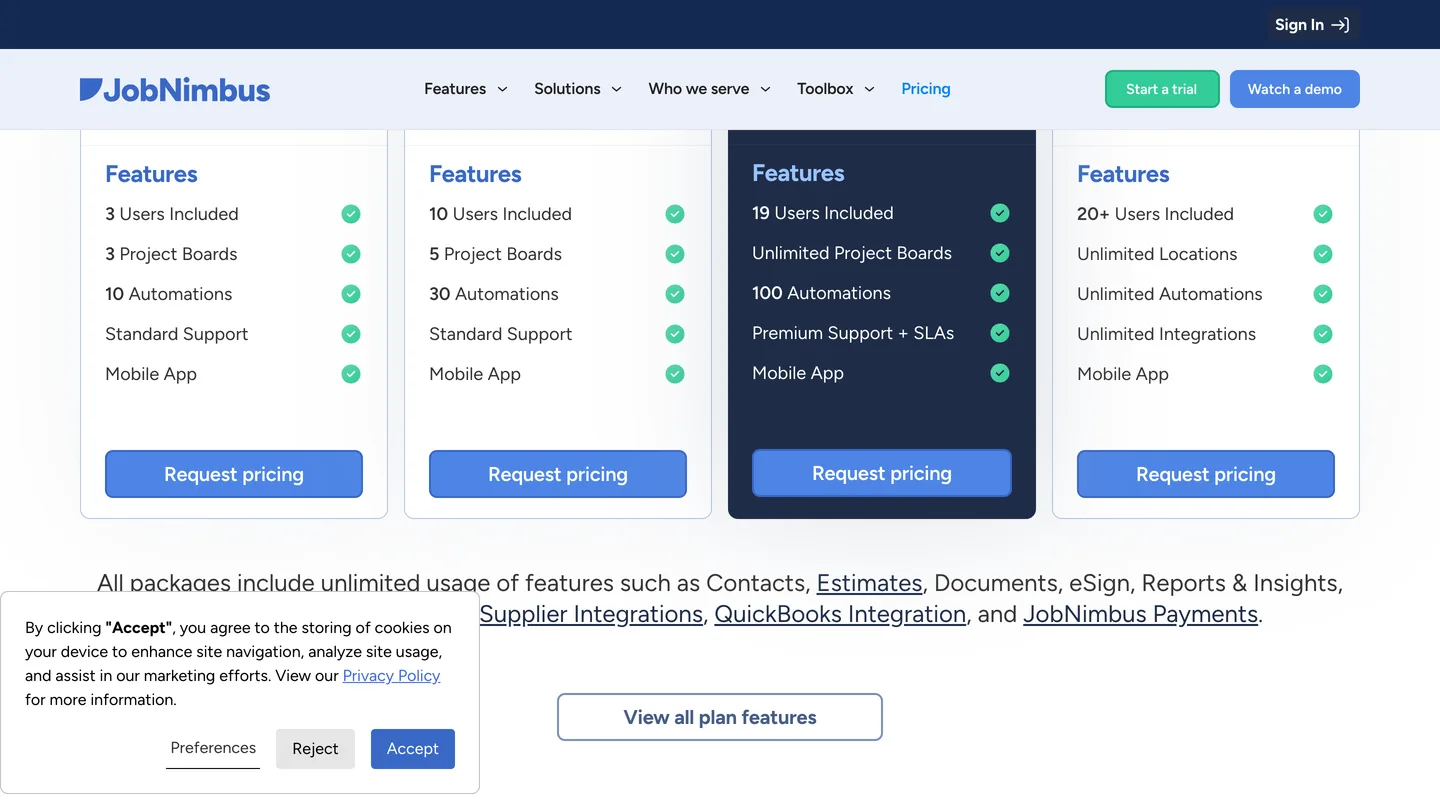 Jul 30, 2026
 Tech Stack
JobNimbus Review 2026: Pricing, Pros, Cons and Alternatives
JobNimbus rates 4.6 on Capterra and orders material straight from ABC Supply and SRS. But it publishes no price, and its supplement route carries a note.
Read Article Jul 30, 2026
 Tech Stack
BuildOps Review 2026: Pricing, Contract Terms and Alternatives
BuildOps runs commercial service and projects on one platform, and publishes no pricing at all. The billing unit, the 30-day data-export window, and who it suits.
Read Article Jul 30, 2026
 Tech Stack
FieldPulse Review 2026: Pricing, Pros, Cons and Alternatives
FieldPulse rates 4.6 on Capterra and is the platform contractors name when they leave a bigger system. But it publishes no price, and the contract runs a year.
Read Article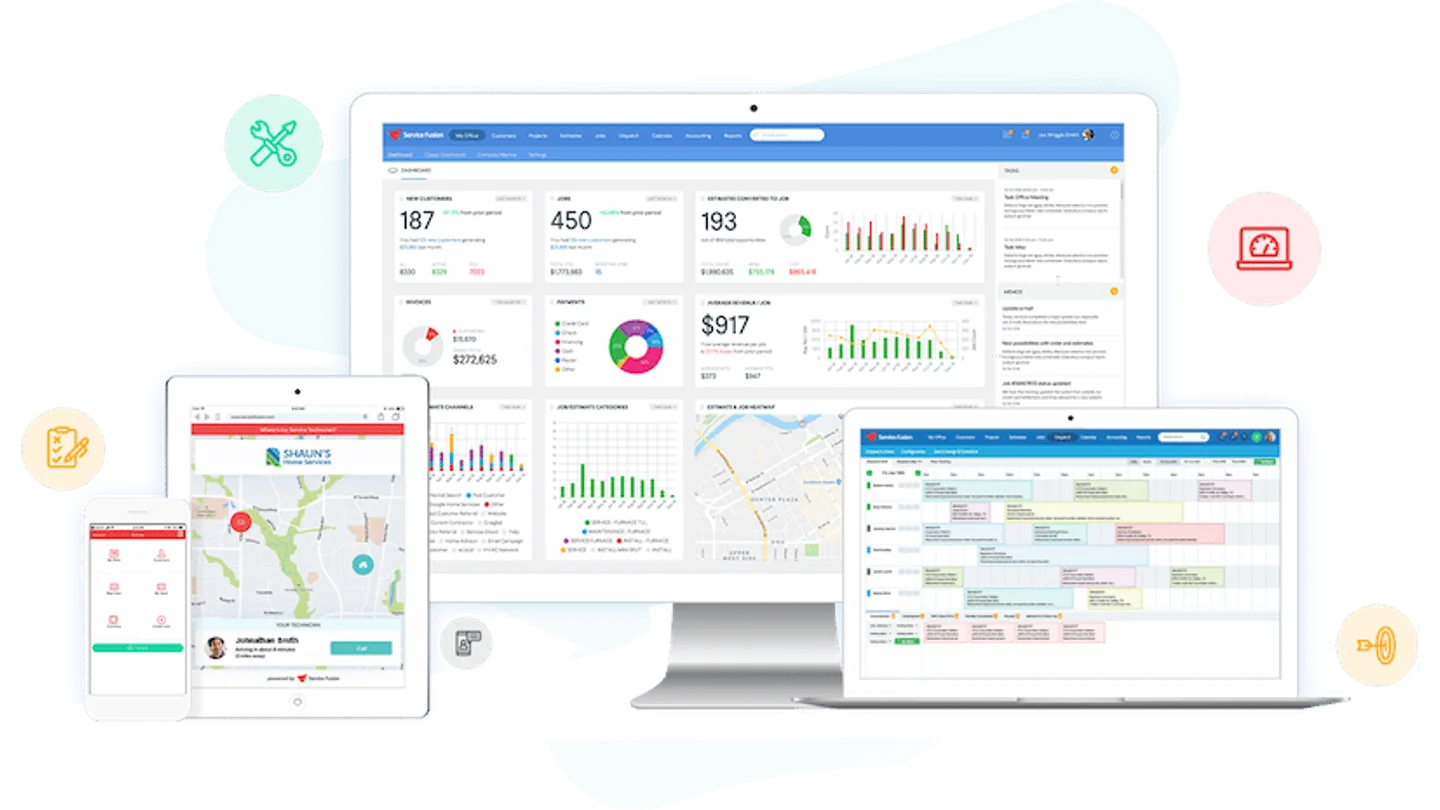 Jul 30, 2026
 Tech Stack
Service Fusion Review 2026: Pricing, Contract and Alternatives
Service Fusion bills flat per company with unlimited users, which is the best structural deal in field service software. The published plans, the contract behind the no-contract line, and the app score every other review gets wrong.
Read Article Jul 30, 2026
 Tech Stack
Knowify Review 2026: Pricing, Job Costing and Alternatives
Knowify rates 4.5 on Capterra and its weakest sub-score is features. What the $99 Core plan withholds, which way the QuickBooks sync really runs, and who should not buy it.
Read Article Jul 29, 2026
 Tech Stack
AccuLynx Review 2026: Pricing, Tier Gating, Alternatives
AccuLynx rates 4.6 across 846 reviews and now publishes an entry price. What that price omits, which tier holds the insurance workflow, and who should skip it.
Read Article Jul 29, 2026
 Tech Stack
Unitel Voice Review 2026: Pricing, Features and Alternatives
Unitel Voice rates 4.6 on Capterra and gives a one-truck shop a business number for $9.99 a month. The published plans, the cost per call, and what it won't do.
Read Article Jul 29, 2026
 Tech Stack
NiceJob vs Podium 2026: Pricing, Contracts and Review Gating
Both vendors print a price, at very different scale and in different currencies. The gap that matters is what Podium will not print: the billing unit, and whether a trade shop gets the number on the page.
Read Article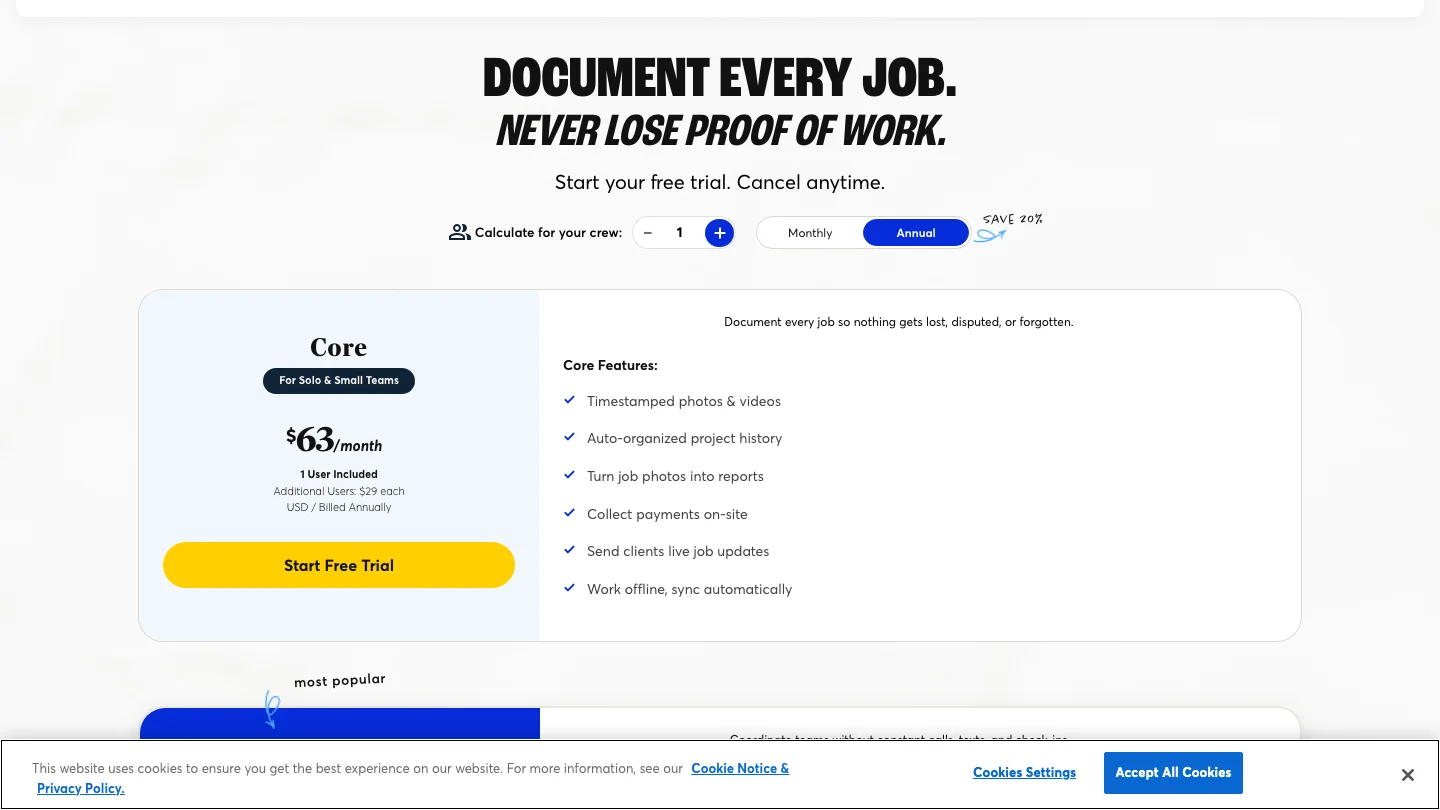 Jul 28, 2026
 Tech Stack
CompanyCam Review 2026: Pricing, Pros, Cons and Alternatives
Every page ranking for CompanyCam still quotes a per-user price the vendor no longer charges. Here are the real plans, the seat math, and who should skip it.
Read Article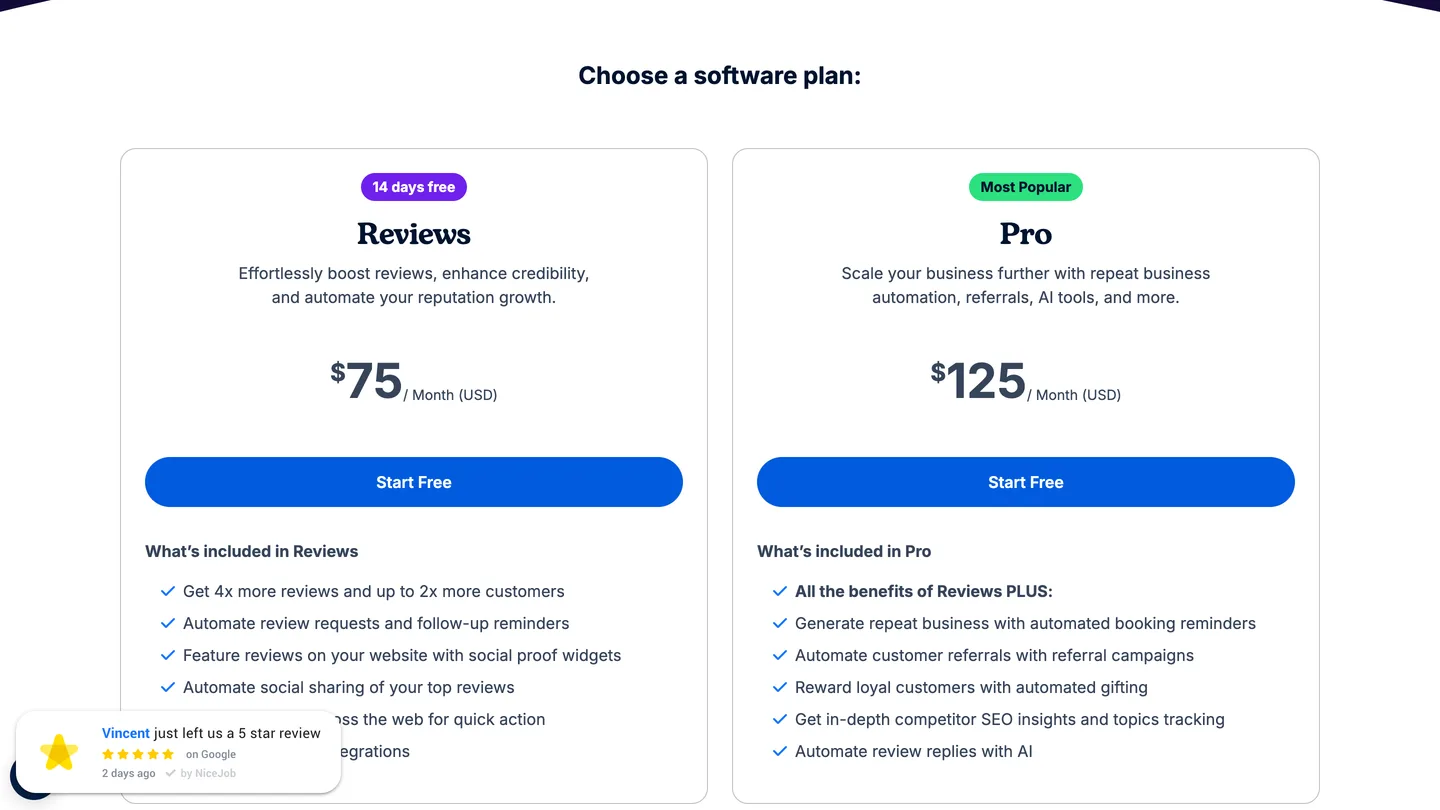 Jul 28, 2026
 Tech Stack
NiceJob Review 2026: Pricing, Pros, Cons and Alternatives
NiceJob rates 4.9 on Capterra and refuses to gate negative reviews. Real plan pricing, the active-customer threshold nobody publishes, and who should skip it.
Read Article Jul 27, 2026
 Tech Stack
Buildertrend Review 2026: Pricing, Limits and Alternatives
Buildertrend rates 4.5 across 2,486 Capterra reviews and quotes against your revenue rather than your seat count. The workflows, the export problem, the alternatives.
Read Article Jul 27, 2026
 Tech Stack
CallRail Review 2026: Pricing, Pros, Cons and Alternatives
CallRail rates 4.5 on Capterra, and its tracking numbers port out free. But the two usage rates that decide your real bill are the two it does not print.
Read Article Jul 27, 2026
 Tech Stack
Roofr Review 2026: Pricing, Pros, Cons and Alternatives
Roofr rates 4.6 on Capterra and sells $13 measurement reports against a market charging triple. But it will not import a report from anywhere else.
Read Article Jul 25, 2026
 Tech Stack
Housecall Pro Review 2026: Pricing, Pros, Cons, Alternatives
Housecall Pro has the shortest learning curve in the category and the widest review spread. Real pricing, the Instapay math, and the migration trap to plan around.
Read Article Jul 24, 2026
 Tech Stack
Jobber Review 2026: Pricing, Pros, Cons and Alternatives
Jobber rates 4.6 on Capterra with the best mobile app in the category. Real plan pricing, the feature gating that changes your entry price, and who it suits.
Read Article Jul 23, 2026
 Tech Stack
ServiceTitan Review 2026: Pricing, Pros, Cons, Alternatives
ServiceTitan rates 4.3 on Capterra but its weakest score is value for money. Real reported pricing, the 12-month contract, the exit fees, and who it actually suits.
Read Article Jun 3, 2026
 Tech Stack
HVAC Online Scheduling: The 43% Losing After-Hours Bookings
HVAC leads every trade on online booking at just 56.7%, which still leaves 43% of sites forcing an after-hours customer to wait for a business-hours phone call.
Read Article