Avoca AI Review 2026: Pricing, Pros, Cons, Alternatives
Third-party contract data puts real numbers on Avoca AI. The 7 gaps reviewers name, and 5 alternatives that publish a price upfront.
Page at a glance
Avoca AI is The AI front office for shops that already run a real FSM — it answers the phone and books the job into ServiceTitan or Housecall Pro, then hands everything else back to the platform you were already paying for. It publishes no price, so the only way to get a number is to ask a salesperson for one. There is no per-user, per-seat or per-tech list price anywhere on avoca.ai. The Master Customer Agreement makes the signed Order the only document where a number exists, and the site has no /pricing page at all: https://www.avoca.ai/pricing returns HTTP 404, and the vendor's own sitemap.xml contains 355 URLs of which zero match /pricing. Avoca sells by module (Responder, Speed to Lead, Outbound, Coach each have their own Product-Specific Terms opening with 'The following terms apply solely if Customer subscribes to...'), so the shape of the bill is per-module and per-account rather than per-seat. It fits Residential service-and-replacement shops of roughly 10 field staff and up that already employ at least two full-time CSRs and clear $3M a year. And that isn't an outside estimate: Avoca's own referral program will only pay out on a demo if the referred company operates in HVAC, plumbing, electrical, roofing or garage door, has 'generated over $3 million annual revenue', employs '2+ customer service representatives', and uses 'ServiceTitan or Housecall Pro CRM'. So the vendor wrote its own qualification gate into a legal document. It's the wrong buy for Solo operator or a two-to-four-person shop under $3M in revenue with no dedicated CSR, because Avoca's own referral program refuses to pay out on a demo unless the referred shop has “generated over $3 million annual revenue” and employs “2+ customer service representatives”. So the vendor has told you in a legal document who it isn't for. At a reported $1,000–$3,000/month with no published entry tier, the arithmetic doesn't close on a shop that misses one truck a week. Alternatives that publish their prices are Rosie from $49, Upfirst from $24.95, Ruby from $250. A quote-only price and what third parties report instead, seven evidenced gaps and five alternatives, four of which publish a figure.
Start here if Avoca AI is on your shortlist
Avoca AI earns its money with Residential service-and-replacement shops of roughly 10 field staff and up that already employ at least two full-time CSRs and clear $3M a year. And that isn't an outside estimate: Avoca's own referral program will only pay out on a demo if the referred company operates in HVAC, plumbing, electrical, roofing or garage door, has 'generated over $3 million annual revenue', employs '2+ customer service representatives', and uses 'ServiceTitan or Housecall Pro CRM'. So the vendor wrote its own qualification gate into a legal document. If that's you, it does the job. The sections below are the parts worth checking before you sign. But the fit is narrower than the marketing suggests, and the price isn't the whole cost.
The vendor publishes no price. But every number below was verified on 7 August 2026 and comes from a named third party that says which.
| Pricing model | Custom quote, no published price |
|---|---|
| Entry price | Quote only |
| Users | There is no per-user, per-seat or per-tech list price anywhere on avoca.ai. The Master Cus |
| Ownership | Independent |
| Best fit | Residential service-and-replacement shops of roughly 10 field staff and up that already employ at least two full-time CSRs and clear $3M a year. And that isn't an outside estimate: Avoca's own referral program will only pay out on a demo if the referred company operates in HVAC, plumbing, electrical, roofing or garage door, has 'generated over $3 million annual revenue', employs '2+ customer service representatives', and uses 'ServiceTitan or Housecall Pro CRM'. So the vendor wrote its own qualification gate into a legal document. |
| Accounting sync | QuickBooks (none), Xero, Sage Intacct, NetSuite and every other general ledger (none) |
What works
- The AI answers, qualifies, handles the objection, and writes the job onto the ServiceTitan board with no rekeying
- Roughly one call in five still needs a person, and after hours that person can be Avoca's
- Speed-to-Lead and Outbound are separate purchases that put TCPA exposure on your side of the table
- Coach scores every call automatically against a rubric you define — and disclaims the output
- Two weeks by the vendor's account, four to twelve by a competitor's — and a dedicated CSM either way
What does not
- There's no price, no rate card and no trial — the demo is the only door
- It auto-renews at whatever Avoca charges that day, and there's no way out for convenience
- “Data Export” is one destination, not a way to take your data and leave
- 68 integration pages, two supported setups
- Zero accounting integrations — by design, but plan the second bill
Avoca AI is The AI front office for shops that already run a real FSM — it answers the phone and books the job into ServiceTitan or Housecall Pro, then hands everything else back to the platform you were already paying for. It sells to Electrical and HVAC and Plumbing and Roofing contractors, and the shape of the product follows from that: Avoca picks up the inbound call, runs your configured script, and pushes the booking back into the CRM over API. On the ServiceTitan side the vendor describes the write as customer details, appointment times, service information, booking sources and conversation notes, and claims existing-customer matching so a repeat caller doesn't create a duplicate record. And this is the whole reason the product costs what it costs: an answering service that writes a message is a different category from one that writes a dispatchable job.
Who should be shortlisting Avoca AI
It fits Residential service-and-replacement shops of roughly 10 field staff and up that already employ at least two full-time CSRs and clear $3M a year. And that isn't an outside estimate: Avoca's own referral program will only pay out on a demo if the referred company operates in HVAC, plumbing, electrical, roofing or garage door, has 'generated over $3 million annual revenue', employs '2+ customer service representatives', and uses 'ServiceTitan or Housecall Pro CRM'. So the vendor wrote its own qualification gate into a legal document. That's the half most reviews print. Here's the other half, which is the one worth your time.
Don't buy it if you're Solo operator or a two-to-four-person shop under $3M in revenue with no dedicated CSR. Avoca's own referral program refuses to pay out on a demo unless the referred shop has “generated over $3 million annual revenue” and employs “2+ customer service representatives”. So the vendor has told you in a legal document who it isn't for. At a reported $1,000–$3,000/month with no published entry tier, the arithmetic doesn't close on a shop that misses one truck a week. Look at Rosie ($49/month for 250 minutes, 7-day free trial) or AnswerConnect if you want humans instead.
Don't buy it if you're Any shop running Jobber, Workiz, ServiceM8, a home-grown system, or no FSM at all. Only ServiceTitan and Housecall Pro have provider-specific setup guides in the help centre, and the referral terms require one of those two. And a marketing page under /integrations/ isn't the same as a supported connector; the dashboard's own badge system distinguishes Connected from “Coming Soon”, which “is informational. It is not a working connection flow.” So without deep CRM write-back, the booking still lands in someone's inbox and you've bought an expensive voicemail. Look at Your FSM's own booking layer, or Upfirst ($24.95/month) which publishes its integration list instead.
Don't buy it if you're Any buyer who needs to try before signing, or who cannot tolerate an unpredictable monthly bill. There's no public free trial — “the demo-and-quote sales process is the only path in” — and every independent account of the billing model says per-minute. So a per-minute meter means your July bill and your November bill are different numbers, and the contract auto-renews at Avoca's then-current rates with no termination for convenience. And if your cash flow needs a flat, cancellable line item, this is structurally the wrong product. Look at Rosie or Upfirst — both publish flat monthly tiers with a free trial instead.
Avoca AI's price, and the part that isn't the price
Avoca AI prices on request. And a quote-only vendor is telling you something before the call even starts, which is that the number moves depending on who's asking.
The vendor's own wording is this, and nothing more: "Avoca's only public statement of how it charges is a pointer to a document you cannot see until you have been through a sales call. Fees live in the Order, renewals are repriced at whatever Avoca's rates are on the renewal date, and neither number is disclosed anywhere public." So treat every third-party page printing tier names and figures for Avoca AI with careful suspicion. Those numbers are not on the vendor's site today, and a roundup that reprints them is telling you what Avoca AI used to charge somebody else.
And we aren't going to print a per-month number we can't open a vendor page and read. What exists instead is third-party reporting, dated, from people who saw real contracts. Read it as a range rather than as a quote you can hold anyone to.
| Reported range | Reported on | Source |
|---|---|---|
| $1,000–$3,000 per month | 2026-05-08 | “Avoca’s pricing is sales-quoted only — no public tiers on the website, no per-call rates, no published estimated range. Third-party industry reports and our own research place” the typical range at “$1,000-$3,000 per month”. The same review confirms the 404 independently: “The pricing page that exists on most enterprise SaaS sites doesn’t exist on avoca.ai (the URL /pricing returns a 404 as of May 2026).” |
| $1,000–$3,500 per month depending on shop size | 2026 (no day-level date shown on page) | “Avoca AI does not publish pricing”. This source splits the estimate by operator size: “Mid-market (around $5M revenue, 6 CSRs, roughly 1,200 calls/month): $1,000–$3,000/month. Enterprise ($20M revenue, 15+ CSRs): $2,500–$3,500/month”, and states the billing model plainly — “Billing is per-minute” and “Per-minute billing is unpredictable”. Note this page is published by ServiceAgent, which sells a competing AI answering product. |
| $1,000–$3,000 per month ($12K–$36K/year) | 2026-07-21 | “Third-party estimates put it at roughly $1,000 to $3,000/month”, with the billing model given as “Largely per minute of AI conversation”, free trial “None advertised”, and contract “Minimum term likely”. Note this page is published by FieldCamp, which sells a competing field-service platform and prices itself against Avoca on the same page. |
| No Avoca-specific figure published | 2026 (no day-level date shown on page) | A fourth review reaches the same conclusion from the buyer-experience side rather than a number: “This is not a tool you buy with a credit card.” It offers no Avoca-specific figure of its own, only a market comparison for generic AI voice platforms. |
There is no per-user, per-seat or per-tech list price anywhere on avoca.ai. The Master Customer Agreement makes the signed Order the only document where a number exists, and the site has no /pricing page at all: https://www.avoca.ai/pricing returns HTTP 404, and the vendor's own sitemap.xml contains 355 URLs of which zero match /pricing. Avoca sells by module (Responder, Speed to Lead, Outbound, Coach each have their own Product-Specific Terms opening with 'The following terms apply solely if Customer subscribes to...'), so the shape of the bill is per-module and per-account rather than per-seat.
What isn't in the Avoca AI number you get quoted
Payment processing. Avoca doesn't take your customers' money — it books the job and hands it to your FSM, so card processing stays wherever it already is. But what's worth asking about is how Avoca charges you: the agreement specifies invoicing (“all Fees are due within 30 days of the invoice date”) and a late charge, but names no payment method, no autopay authorisation and no card-on-file term. So ask whether you're invoiced or auto-charged, and on what cadence.
Implementation and onboarding. No implementation fee is disclosed anywhere public. The only public statement about onboarding is the vendor's answer on the ServiceTitan App Marketplace: “Avoca’s implementation team works closely with your team to integrate ServiceTitan and custom-train AI agents based on your business. Most customers are live within 2 weeks of onboarding.” One competing vendor's comparison table puts real-world setup at “4–12 weeks” against that 2-week claim (serviceagent.ai), so the two figures are in open conflict and neither is invoice-backed.
Minimum term. Not published. The Master Customer Agreement defers term length entirely to the Order: the agreement “continues for the initial term specified in the Order (the “ Initial Term ”)”. There is no default, no floor and no ceiling in the public document, which means the only place you will ever see your minimum commitment is the paper in front of you at signing. One competing vendor's comparison lists contract as “Minimum term likely”, which is a guess, not a disclosure.
Getting out. There is no termination-for-convenience clause. Termination rights run only to cause: either party may terminate “immediately upon written notice if the other Party: (a) fails to cure a material breach... within 30 days after notice; (b) ceases operation without a successor; or (c) seeks protection under a bankruptcy”. Combined with “All Fees are non-refundable except as set forth in Section 9.2(a) (Services Warranty) and Section 12.4 (Mitigation)”, a mid-term walk-away leaves you owing the balance with no stated refund path.
Auto-renewal. Yes, and the exit window is narrow. The agreement “will automatically renew for additional successive renewal terms having the length set forth in the Order (each renewal term, an “ Renewal Term ”), unless either Party gives the other Party notice of non-renewal at least 30 days before the start of the next Renewal Term.” Renewal is repriced at Avoca's discretion: “Fees for Renewal Terms are at Avoca’s then-current rates.” Late payment carries “a service charge of 1.5% per month or the maximum amount allowed by Laws, whichever is less”.
Modules sold separately. , , , , . And an add-on you need in week one is part of what Avoca AI costs, so the number to compare is the configuration you'd really run.
Third-party services you will also pay for. , . These are not on Avoca AI's invoice, and they are still part of what this decision costs you every month.
"Third-party reporting puts Avoca AI at $1,000–$3,000 per month, reported 2026-05-08."
“Avoca’s pricing is sales-quoted only — no public tiers on the website, no per-call rates, no published estimated range. Third-party industry reports and our own research place” the typical range at “$1,000-$3,000 per month”. The same review confirms the 404 independently: “The pricing page that exists on most enterprise SaaS sites doesn’t exist on avoca.ai (the URL /pricing returns a 404 as of May 2026).” (5-08)
Small thing that turns out to matter. Avoca combines three terms that are individually normal and jointly expensive: a bill that every independent account describes as metered per minute, an auto-renewal priced at “Avoca’s then-current rates”, and no termination-for-convenience clause anywhere in the Master Customer Agreement. For a heating contractor, the meter and the calendar work against each other. Because your call minutes spike in the exact months you're too busy to notice a renewal notice, and your only exit is a 30-day window you have to remember a year after signing. So ask for a renewal cap and a convenience-out in the Order, and if the rep says the standard paper covers it, point at the clause list — it doesn't.
The Avoca AI costs that land afterwards
The subscription is the part everyone quotes. These are the lines that land afterwards, and the ones we could not find are named as unpublished rather than left blank.
Sold separately. , , , , . Price the configuration you'll really run, because an add-on you need on day one is part of the price.
Third-party services you'll also pay for. , . None of these are on Avoca AI's invoice, and all of them are part of what this decision costs every month.
"Avoca AI answers the question of what it costs with this and nothing else: "Avoca's only public statement of how it charges is a pointer to a document you cannot see until you have been through a sales call. Fees live in the Order, renewals are repriced at whatever Avoca's rates are on the renewal date, and neither number is disclosed anywhere public.""
Avoca AI pricing page (2026)
"There is no per-user, per-seat or per-tech list price anywhere on avoca.ai. The Master Customer Agreement makes the signed Order the only document where a number exists, and the site has no /pricing page at all: https://www.avoca.ai/pricing returns HTTP 404, and the vendor's own sitemap.xml contains 355 URLs of which zero match /pricing. Avoca sells by module (Responder, Speed to Lead, Outbound, Coach each have their own Product-Specific Terms opening with 'The following terms apply solely if Customer subscribes to...'), so the shape of the bill is per-module and per-account rather than per-seat."
Avoca AI pricing page (2026)
"Avoca AI is reported at $1,000–$3,000 per month as of 2026-05-08."
“Avoca’s pricing is sales-quoted only — no public tiers on the website, no per-call rates, no published estimated range. Third-party industry reports and our own research place” the typical range at “$1,000-$3,000 per month”. The same review confirms the 404 independently: “The pricing page that exists on most enterprise SaaS sites doesn’t exist on avoca.ai (the URL /pricing returns a 404 as of May 2026).” (5-08)
The five workflows you pay for
Feature totals are noise. So a shop in this category lives or dies on five things, and those are the five to grade, and each one below carries the evidence it's graded on.
The AI answers, qualifies, handles the objection, and writes the job onto the ServiceTitan board with no rekeying Avoca picks up the inbound call, runs your configured script, and pushes the booking back into the CRM over API. On the ServiceTitan side the vendor describes the write as customer details, appointment times, service information, booking sources and conversation notes, and claims existing-customer matching so a repeat caller doesn't create a duplicate record. And this is the whole reason the product costs what it costs: an answering service that writes a message is a different category from one that writes a dispatchable job.
Roughly one call in five still needs a person, and after hours that person can be Avoca's The vendor's own containment claim is “80%+ of inbound calls without human intervention”, which is also an admission that up to a fifth of your volume escalates. And the SLA sets a ten-second target for the handoff: “where caller dialog in a call indicates the caller’s need to escalate from an AI agent to a human or other agent, an attempt shall be made to handoff to an appropriate live CSR within ten (10) seconds”. Avoca also sells a Hybrid “Human in the Loop” desk of its own trained CSRs for after-hours coverage — a separately-subscribed module under the same Responder Terms.
Speed-to-Lead and Outbound are separate purchases that put TCPA exposure on your side of the table Speed to Lead answers inbound leads from Google LSA, Angi, Thumbtack and similar sources; Outbound runs campaigns against unsold estimates, maintenance renewals and aged leads. Both are subscribed separately from the AI CSR, and both carry warranties you sign: no calls to anyone on the FTC or state Do Not Call registries, and no calls outside TCPA windows — the terms name the window directly, “may not call before 8 a.m. or after 9 p.m. in the recipient’s local time zone”. And before any SMS sends you also have to clear carrier messaging registration, where “approval and timing depend on the reviewing carriers and providers.”
Coach scores every call automatically against a rubric you define — and disclaims the output Coach ingests call transcripts and produces Performance Reports against “a rubric defined by Customer”, which removes the hours a manager spends spot-checking recordings. Then the terms disclaim the result completely: “THE PERFORMANCE REPORTS ARE PROVIDED ‘AS IS’... THE PERFORMANCE REPORTS ARE NOT PROFESSIONAL ADVICE AND MAY INCLUDE INACCURATE OR ERRONEOUS INFORMATION.” So it's useful for triage, not evidence for a termination file.
Two weeks by the vendor's account, four to twelve by a competitor's — and a dedicated CSM either way Avoca's implementation team connects the CRM, imports the catalogue and custom-trains the agent on your business. And every account gets a named Customer Success Manager. The go-live sequence in the help centre is a readiness review rather than a switch: confirm the team and provider account match, grant only the scopes the setup asks for, sync catalogue data, then “Test one lookup and one write action that your product needs, such as creating a test booking.”
Avoca AI trade fit
Fit differs by trade rather than by company size alone, and a blended paragraph hides that. Here is the split for the trades this one sells to.
Electrical. The workflow that decides it is the ai answers, qualifies, handles the objection, and writes the job onto the servicetitan board with no rekeying, and the shop profile that gets value is 10 to 30 crew, two or more csrs, on servicetitan or housecall pro doing residential and service and commercial work. Where it stops being a fit is Solo operator or a two-to-four-person shop under $3M in revenue with no dedicated CSR.
HVAC. The workflow that decides it is the ai answers, qualifies, handles the objection, and writes the job onto the servicetitan board with no rekeying, and the shop profile that gets value is 10 to 30 crew, two or more csrs, on servicetitan or housecall pro doing residential and service and commercial work. Where it stops being a fit is Solo operator or a two-to-four-person shop under $3M in revenue with no dedicated CSR.
Plumbing. The workflow that decides it is the ai answers, qualifies, handles the objection, and writes the job onto the servicetitan board with no rekeying, and the shop profile that gets value is 10 to 30 crew, two or more csrs, on servicetitan or housecall pro doing residential and service and commercial work. Where it stops being a fit is Solo operator or a two-to-four-person shop under $3M in revenue with no dedicated CSR.
Roofing. The workflow that decides it is the ai answers, qualifies, handles the objection, and writes the job onto the servicetitan board with no rekeying, and the shop profile that gets value is 10 to 30 crew, two or more csrs, on servicetitan or housecall pro doing residential and service and commercial work. Where it stops being a fit is Solo operator or a two-to-four-person shop under $3M in revenue with no dedicated CSR.
Where your data goes when it leaves Avoca AI
QuickBooks connects, on every plan. Xero, Sage Intacct, NetSuite and every other general ledger connects, on every plan. Your costs map through cost codes, so test yours against your own chart of accounts before you commit. A code your books don't recognise is how a labour charge quietly lands somewhere useless.
Past those, the road ends. QuickBooks / Xero / Sage Intacct / NetSuite, Jobber, Workiz, ServiceM8 and every FSM outside the big two, Bulk data portability do not connect. So if your books run on an ERP rather than the platforms named above, weigh that before anything else.
Beyond accounting it connects to ServiceTitan (The deepest connector by a distance and the only one with a Certified Application listing on ServiceTitan's own marketplace. And it pulls current data via AdCap and books jobs back over API, matching repeat callers to existing customer profiles.), Housecall Pro (The second of only two platforms with a provider-specific setup guide in the help centre. And the marketing page describes booking jobs directly into Housecall Pro and syncing automated campaigns to it; no two-way sync is claimed.), Google Calendar (Calendar-based scheduling and availability for shops using calendar booking rather than an FSM dispatch board.), Google Local Services Ads (A direct LSA connection so lead-generated calls route into the same AI answering flow rather than a separate inbox.), Webhooks and public API (Event webhooks plus a documented REST API covering calls, transcripts, call recording streaming, bookings, sessions, leads, Coach evaluations and analytics. API keys are self-managed from the dashboard.), Searchlight (via S3) (The only destination in the Data Export catalogue. Sends Simple Scheduler booking data on a recurring schedule to a configured S3 bucket.), 68 marketed platform connectors (Counted, not estimated: the sitemap carries exactly 68 URLs under /integrations/, covering AccuLynx, Aspire, BigChange, BuildOps, CallRail, CompanyCam, FieldEdge, FieldRoutes, GoHighLevel, GorillaDesk, Housecall Pro, HubSpot, JobNimbus, Jobber, LMN, Microsoft Dynamics, PestPac, RealGreen, Salesforce, Sera, Service Autopilot, Service Fusion, ServiceMinder, ServiceTitan, Successware, Thryv, Workiz, Zoho, Zuper and 39 others. So treat the count as marketing breadth, not supported depth.). A public API exists: A documented public REST API with authentication, plus event webhooks and a lead-intake webhook. Endpoints cover calls (get a call, get a call transcript, list calls, stream a call recording, list pre-call transfers), sessions and bookings, leads, Coach rubrics and evaluations, outbound texting, scheduler analytics, funnel and UTM attribution analytics, teams and enterprise support tickets. API keys are created and managed by admins in Settings → Integrations → API Keys.
Avoca AI support, and what it costs you
Support is the line item nobody prices and everybody eventually needs. Onboarding for Avoca AI: No implementation fee is disclosed anywhere public. The only public statement about onboarding is the vendor's answer on the ServiceTitan App Marketplace: “Avoca’s implementation team works closely with your team to integrate ServiceTitan and custom-train AI agents based on your business. Most customers are live within 2 weeks of onboarding.” One competing vendor's comparison table puts real-world setup at “4–12 weeks” against that 2-week claim (serviceagent.ai), so the two figures are in open conflict and neither is invoice-backed.
The review corpus we read on 7 August 2026 carries no consistent signal on response times either way, so treat support as untested rather than good. Open a real ticket during the trial and time the reply, because that is the number no pricing page gives you.
The Avoca AI term, and what leaving costs
Nobody reads this section before they buy, and it's the one that costs money afterwards. Four terms decide what leaving looks like.
Minimum term. Not published. The Master Customer Agreement defers term length entirely to the Order: the agreement “continues for the initial term specified in the Order (the “ Initial Term ”)”. There is no default, no floor and no ceiling in the public document, which means the only place you will ever see your minimum commitment is the paper in front of you at signing. One competing vendor's comparison lists contract as “Minimum term likely”, which is a guess, not a disclosure.
Auto-renewal. Yes, and the exit window is narrow. The agreement “will automatically renew for additional successive renewal terms having the length set forth in the Order (each renewal term, an “ Renewal Term ”), unless either Party gives the other Party notice of non-renewal at least 30 days before the start of the next Renewal Term.” Renewal is repriced at Avoca's discretion: “Fees for Renewal Terms are at Avoca’s then-current rates.” Late payment carries “a service charge of 1.5% per month or the maximum amount allowed by Laws, whichever is less”.
Early termination. There is no termination-for-convenience clause. Termination rights run only to cause: either party may terminate “immediately upon written notice if the other Party: (a) fails to cure a material breach... within 30 days after notice; (b) ceases operation without a successor; or (c) seeks protection under a bankruptcy”. Combined with “All Fees are non-refundable except as set forth in Section 9.2(a) (Services Warranty) and Section 12.4 (Mitigation)”, a mid-term walk-away leaves you owing the balance with no stated refund path.
Payment processing. Avoca doesn't take your customers' money — it books the job and hands it to your FSM, so card processing stays wherever it already is. But what's worth asking about is how Avoca charges you: the agreement specifies invoicing (“all Fees are due within 30 days of the invoice date”) and a late charge, but names no payment method, no autopay authorisation and no card-on-file term. So ask whether you're invoiced or auto-charged, and on what cadence.
Small thing that turns out to matter. The feature named “Data Export” has exactly one destination in it, and it carries one product's data. And everything else you'd need to leave — recordings, transcripts, the full customer history the AI built — comes out through per-screen CSV downloads or not at all. Two or three years of recorded calls is the training data for whatever you replace Avoca with, and it's also your evidence in a customer dispute. So get an offboarding export — format, scope, deadline, cost — written into the Order at signing, when you still have leverage. Because nobody negotiates data portability on the way out.
"Avoca AI is reported at $1,000–$3,500 per month depending on shop size as of 2026 (no day-level date shown on page)."
“Avoca AI does not publish pricing”. This source splits the estimate by operator size: “Mid-market (around $5M revenue, 6 CSRs, roughly 1,200 calls/month): $1,000–$3,000/month. Enterprise ($20M revenue, 15+ CSRs): $2,500–$3,500/month”, and states the billing model plainly — “Billing is per-minute” and “Per-minute billing is unpredictable”. Note this page is published by ServiceAgent, which sells a competing AI answering product. (age))
"Avoca doesn't get tired, doesn't call in sick, and doesn't have a bad day. If you want to sleep at night knowing that every call is captured and answered the way you want it, Avoca is the clear winner"
ServiceTitan App Marketplace — Avoca AI partner page (vendor-supplied testimonial), Andreas Boris (2026)
"Before Avoca AI, we were on 4 or 5 different platforms. One for text messages, one for web scheduling, one for overflow in the call center, one for the chat box. They all worked in their own unique way, but they didn't communicate with each other"
ServiceTitan App Marketplace — Avoca AI partner page (vendor-supplied testimonial), David Salgado (2026)
What Avoca AI does badly
So here's what breaks, sourced to the person who hit it.
There's no price, no rate card and no trial — the demo is the only door Avoca publishes nothing. Not a tier, not a per-minute rate, not a starting-from number. https://www.avoca.ai/pricing returns HTTP 404 and the vendor's own sitemap.xml lists 355 URLs with zero pricing pages among them. And every module (Responder, Speed to Lead, Outbound, Coach) is subscribed independently, so you can't even estimate the shape of the bill without knowing which modules a quote includes. So every dollar figure circulating publicly traces back to third-party estimation, not to an invoice. Before the demo, write down your monthly inbound call count and your average call length, then make the rep quote against both. And if the model really is per-minute, ask for the rate and the effective bill in your busiest month, not your average one, and get both onto the Order.
It auto-renews at whatever Avoca charges that day, and there's no way out for convenience Three clauses stack badly. The agreement auto-renews “unless either Party gives the other Party notice of non-renewal at least 30 days before the start of the next Renewal Term”. Renewal pricing is unilateral: “Fees for Renewal Terms are at Avoca’s then-current rates.” And the Master Customer Agreement contains no termination-for-convenience right at all — only breach, cessation of operations, or bankruptcy. So miss the 30-day window and you're committed for another full term at a price the vendor sets. Ask for a termination-for-convenience clause with 30 or 60 days' notice, and a renewal-price cap in writing. And if neither is granted, put the non-renewal deadline in your calendar the day you sign — 45 days before term end, not 30.
“Data Export” is one destination, not a way to take your data and leave The help centre's Configure Data Export article documents a catalogue with a single entry: “The current catalog includes Searchlight, which sends Simple Scheduler booking data to Searchlight through its configured S3 destination on a recurring schedule.” So that's one destination, one product's data. Per-page CSV export does exist on the Calls, Booked Calls and Coach screens, but there's no documented bulk export of your call recordings, transcripts and customer records. And the article warns that turning an export off destroys its audit trail: “Disable removes the export configuration and its run history... the deleted history cannot be recovered.” Before signing, ask in writing what a full export of call recordings, transcripts and booking history looks like on the day you leave, in what format, and whether it costs anything. Because the agreement only obliges each party to “promptly return or delete Confidential Information”, with no format, no deadline and an explicit carve-out letting Avoca keep backups.
68 integration pages, two supported setups The marketing sitemap carries 68 pages under /integrations/, one per platform — Jobber, Workiz, Zoho, Salesforce, FieldEdge, ServiceMinder, AccuLynx, JobNimbus and 60 more. But the help centre tells a narrower story: only ServiceTitan and Housecall Pro have provider-specific setup guides, and the integrations list is qualified with a status badge system where “Coming Soon is informational. It is not a working connection flow.” And the referral terms narrow it further still by requiring the referred shop to be on ServiceTitan or Housecall Pro. So a marketing page isn't a working connector. If you're not on ServiceTitan or Housecall Pro, make the demo a live test against your actual FSM sandbox before any paper moves. And ask specifically whether your platform's connector is Connected, Not Connected or Coming Soon in the dashboard today.
Zero accounting integrations — by design, but plan the second bill Avoca books the job. But it doesn't quote, dispatch, invoice or take payment, and it connects to no accounting system: https://www.avoca.ai/integrations/quickbooks returns HTTP 404, and QuickBooks, Xero, Sage Intacct and NetSuite appear nowhere among the 68 integration pages. And that's a coherent product decision, not a defect, but it means the true monthly cost of running Avoca is Avoca plus a full FSM subscription. A competing vendor makes the arithmetic explicit and self-servingly: it puts the combined stack at “$60,000 to $90,000/year” for a 10-tech shop. Budget Avoca as a line item on top of your FSM, never as a replacement for one. And if you're currently paying an answering service, compare Avoca against that line only — not against your whole software stack.
The vendor disclaims what its AI says to your customer, and hands you the compliance burden The Product-Specific Terms are blunt: “RESPONSES ARE PROVIDED ‘AS IS’ AND WITHOUT WARRANTIES OF ANY KIND”, and for outbound, “AVOCA DOES NOT GUARANTEE THE RESULTS OR SUCCESS OF ANY OUTREACH”. Meanwhile you warrant that you have “properly configured the Configurations and its system to make all disclosures to Clients that are required by Law, including that the Clients are interacting with Avoca’s AI-based service and that the Responses are recorded and transcribed”, and for outbound you carry the Do Not Call registry and TCPA calling-window obligations yourself. And breach of those warranties is an “Excluded Claim” and a “Customer Indemnified Claim” — outside the liability cap, and you indemnify Avoca. Get your lawyer to read the Product-Specific Terms for whichever modules you buy, especially Speed to Lead and Outbound. Because two-party-consent recording states and AI-disclosure rules are your exposure, not Avoca's, and the indemnity is one-directional.
The performance numbers you care about earn no service credits Avoca's SLA is well written and unusually specific — answer latency within three seconds, escalation handoff within ten seconds, call connection success, AI conversational quality, voicemail detection accuracy. But those are Service Level Objectives, and the SLA says so plainly: “SLO breaches do not result in Service Credits in accordance with Section 8.” Credits attach only to uptime. So the platform can be 99.9% up while the AI mangles intent on a quarter of your calls and you're owed nothing but an incident ticket. Ask for a booking-rate or conversational-quality floor written into the Order with a credit attached, or a short opt-out window if it's missed. Because the SLA gives you the measurement framework already — the credit is the only piece missing.
One more thing worth knowing. Avoca's SLA measures everything a contractor cares about and pays out on none of it. Answer latency, call connection success, AI conversational quality, escalation handoff time and voicemail detection accuracy are all defined and measured — as Service Level Objectives, which the document explicitly excludes from credits. So only raw uptime earns money back. This is the rare case where a vendor has already built the measurement apparatus you'd need to enforce a quality guarantee — it just declined to attach a remedy. So that makes it an unusually easy negotiation: ask for a booking-rate or conversational-quality floor with a credit, referencing the SLO definitions already in their own document. You're asking them to connect two things they wrote.
One more thing worth knowing. Every reachable review of Avoca AI is vendor-supplied. Capterra, Software Advice, GetApp, G2 and Trustpilot all return 403 or 404 for this product; there's no iOS or Android app with ratings; and FeaturedCustomers — a vendor reference platform, not a review site — shows 14 testimonials with 11 of them paywalled. So the complaint pattern is that there's no complaint pattern to read, which for a company at a $1B valuation with 800+ operators is itself the finding. You can't triangulate this purchase from public reviews the way you can with ServiceTitan or Jobber. So do the thing reviews would have done for you: ask the rep for three reference customers in your trade, your revenue band and your state, call them yourself, and ask each one what their bill was in July versus February. And that single question surfaces the per-minute exposure that no published source can confirm.
Small thing that turns out to matter. Avoca disclaims all warranty on what its AI says to your customer while contractually assigning you the duty to disclose that the AI is an AI, to obtain recording consent, and to comply with TCPA — and it puts breach of those duties outside the liability cap as a Customer Indemnified Claim. In a two-party-consent state, the compliance exposure of an AI answering every inbound call sits entirely on the contractor's licence and insurance, not the vendor's. So before go-live, have the disclosure wording in your call script reviewed by someone who knows your state's recording law — the configuration Avoca ships is defined as Customer Data, which means it's your text, your liability.
Avoca AI, from the people who bought it
Every quote below is transcribed from a published review, named to the platform that carries it and to the reviewer as that platform displays them. We read the corpus by complaint type rather than by star rating, which is how the disqualifying detail buried inside a five-star review gets found.
"Avoca doesn't get tired, doesn't call in sick, and doesn't have a bad day. If you want to sleep at night knowing that every call is captured and answered the way you want it, Avoca is the clear winner"
A director of operations, rescue air & plumbing describes it on ServiceTitan App Marketplace — Avoca AI partner page (vendor-supplied testimonial)
"Before Avoca AI, we were on 4 or 5 different platforms. One for text messages, one for web scheduling, one for overflow in the call center, one for the chat box. They all worked in their own unique way, but they didn't communicate with each other"
A director of operations, brody pennell, says it plainly on ServiceTitan App Marketplace — Avoca AI partner page (vendor-supplied testimonial)
"We used to have days where the manager would call me and say, ‘Barbara’s out—what do we do now?’ Now I'm like 'who cares? We've got Avoca."
And a director of operations, describes it the same thing on FeaturedCustomers — Avoca vendor reference profile
"I was just trying to get my time back. I never expect it would help my business grow the way it did."
And an owner, puts it the same thing on FeaturedCustomers — Avoca vendor reference profile
"Avoca came in with deep industry & Al expertise, worked with me to develop the Sila Standard, and now we're rolling out the system Sila-wide at an exceptional pace."
A chief technology officer, sila services, reports it on FeaturedCustomers — Avoca vendor reference profile
"Ever since we started using Avoca in our call center, call quality is up from 40% to 95%, booking percentage sits comfortably at 85% and we’re averaging 400 calls WEEKLY."
A CEO, describes it on Avoca AI homepage testimonial strip (vendor-published)
"I can run a $100M business with 9 CSRs because Avoca handles 70% of our entire call volume– all while booking at a higher rate than ever before."
A president writes on Avoca AI homepage testimonial strip (vendor-published)
"We used live answering for the first 2/3s of the month and booked 5 calls. We used Avoca for the last ⅓ of the month and booked 43 calls"
And an owner, reports it the same thing on Avoca AI homepage testimonial strip (vendor-published)
"Before Avoca our customers were waiting 4 to 5 minutes, and sometimes they weren't getting answered at all. Now if we don't answer it, it's going straight to Avoca."
A director of operations says on Avoca AI homepage testimonial strip (vendor-published)
"Avoca gave me the ability to extend my service hours without having to extend my staff"
And a founder, reports it the same thing on Avoca AI homepage testimonial strip (vendor-published)
"no public free trial exists; the demo-and-quote sales process is the only path in"
An editor, contractor toolstack (third-party editorial review, scored 4.1/5), writing on 2026-05-08, writes on Contractor ToolStack — Avoca AI Review 2026 (independent editorial, affiliate-disclosed)
What Avoca AI's competition charges
So what else is there? Every peer below competes with Avoca AI in real shortlists, not just in a feature grid.
| Tool | Entry price | Billing unit | Users included | Published? |
|---|---|---|---|---|
| Avoca AI | Quote only | Custom quote | There is no per-user, per-seat or per-tech list price anywhe | No |
| Rosie | $49 | per account, per month (250 minutes included) | Unlimited staff on the account; pricing scales by minutes, not seats | Yes |
| Upfirst | $24.95 | per account, per month (30 calls included, $1.50 per additional call) | Unlimited staff; priced by calls handled, not seats | Yes |
| Ruby | $250 | per account, per month (50 receptionist minutes included) | Unlimited staff on the account; pricing scales by minutes and chats | Yes |
| FieldCamp | $249 | per account, per month | Not disclosed on the comparison page; sold as a platform subscription with a free trial and no contract | Yes |
| Podium | Quote only | per location, per month | Not disclosed | No |
Rosie. Publishing a full ladder on a public page — Professional $49, Scale $149, Growth $299, plus a Website Texting add-on at $50/month — and offering a 7-day free trial you can start without a sales call. So for a shop under $3M with one CSR, this is the whole comparison. But Nowhere near Avoca's CRM write-back depth. No ServiceTitan Certified Application listing, no Coach-equivalent call scoring, no enterprise multi-brand rollout, and 250 minutes disappears fast in an HVAC July.
Upfirst. The cheapest honest entry in the category and the only one here priced per CALL rather than per minute, which makes the bill predictable — 30 calls at $24.95, 90 at $59.95, 300 at $159.95, 600 at $299, with a 20% annual discount and a free trial. And overage is a published rate, not a surprise. But Built for small operators. No Coach-style call scoring, no Human-in-the-Loop desk, no multi-brand enterprise configuration, and nothing approaching Avoca's ServiceTitan integration depth.
Ruby. Real humans, publicly priced — 50 minutes $250, 100 $395, 200 $720, 500 $1,725, with separate and bundled live-chat ladders. And if your callers are elderly, or your jobs are emotionally loaded emergency work, a trained human on the first ring still converts better than a voice model. But Cost per minute is brutal at contractor call volumes, and Ruby takes a message rather than writing a dispatchable job onto your board. So a shop doing 400 calls a week would burn through the $1,725 tier and still be rekeying every booking.
FieldCamp. Bundles the AI front office INTO the field service platform, so there's one bill and no per-minute meter. And it directly targets Avoca's biggest structural cost: you're not paying for Avoca and ServiceTitan side by side. Free trial, no contract. But This price comes from FieldCamp's own page attacking Avoca, so treat the framing as adversarial. And nothing here matches Avoca's ServiceTitan Certified Application depth, its 800-operator install base, or its enterprise multi-brand rollouts — and a bundled AI is only as good as the bundle.
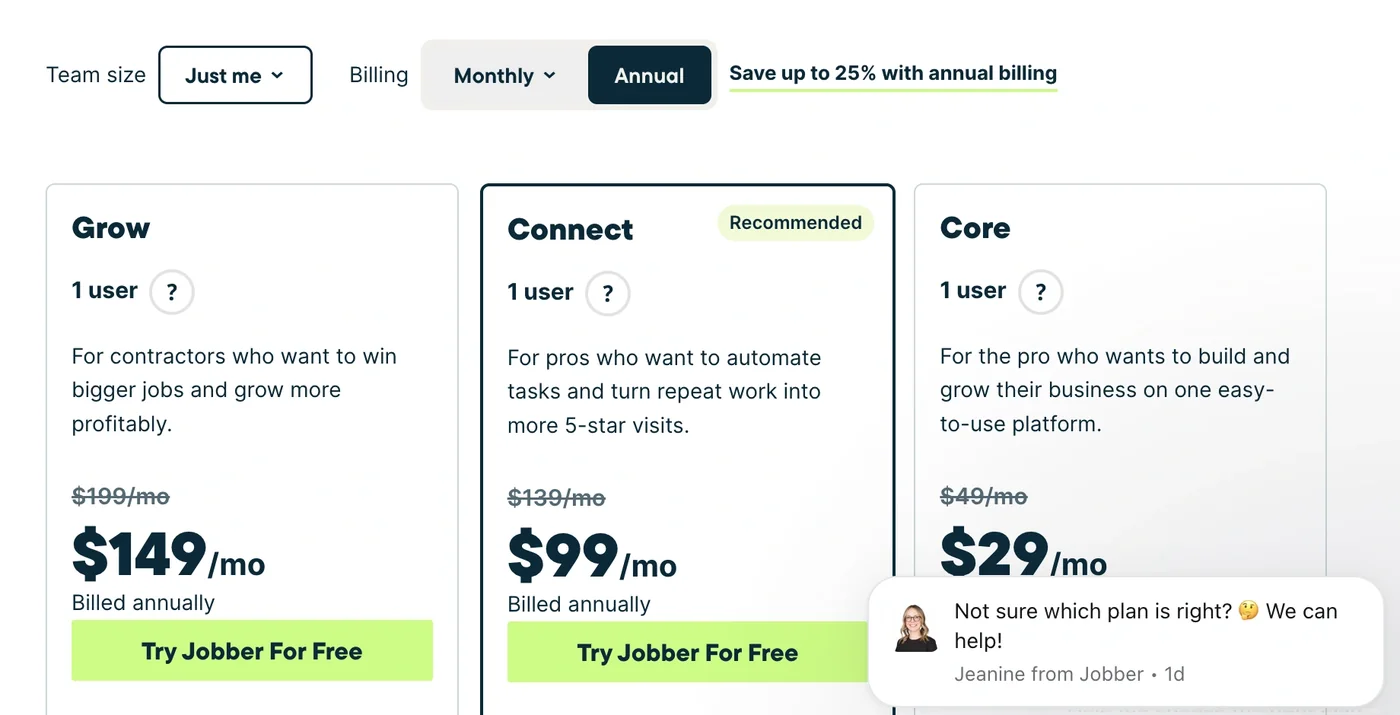
Podium. Bundles the AI answering layer with reviews, webchat and text-based lead capture in one subscription, which suits shops whose real bottleneck is text response and Google reviews rather than the phone line specifically. But Publishes no tier pricing either — its own pricing page carries customer results and no plan prices — so you're in the same demo-and-quote process with the same lack of comparables. And its FSM write-back is shallower than Avoca's ServiceTitan connector.
"We used to have days where the manager would call me and say, ‘Barbara’s out—what do we do now?’ Now I'm like 'who cares? We've got Avoca."
FeaturedCustomers — Avoca vendor reference profile, Andreas Boris (2026)
"I was just trying to get my time back. I never expect it would help my business grow the way it did."
FeaturedCustomers — Avoca vendor reference profile, Nicki Cota (2026)
Who should not buy Avoca AI
Don't buy Avoca AI if you're Solo operator or a two-to-four-person shop under $3M in revenue with no dedicated CSR. Avoca's own referral program refuses to pay out on a demo unless the referred shop has “generated over $3 million annual revenue” and employs “2+ customer service representatives”. So the vendor has told you in a legal document who it isn't for. At a reported $1,000–$3,000/month with no published entry tier, the arithmetic doesn't close on a shop that misses one truck a week. Look at Rosie ($49/month for 250 minutes, 7-day free trial) or AnswerConnect if you want humans instead.
Don't buy Avoca AI if you're Any shop running Jobber, Workiz, ServiceM8, a home-grown system, or no FSM at all. Only ServiceTitan and Housecall Pro have provider-specific setup guides in the help centre, and the referral terms require one of those two. And a marketing page under /integrations/ isn't the same as a supported connector; the dashboard's own badge system distinguishes Connected from “Coming Soon”, which “is informational. It is not a working connection flow.” So without deep CRM write-back, the booking still lands in someone's inbox and you've bought an expensive voicemail. Look at Your FSM's own booking layer, or Upfirst ($24.95/month) which publishes its integration list instead.
Don't buy Avoca AI if you're Any buyer who needs to try before signing, or who cannot tolerate an unpredictable monthly bill. There's no public free trial — “the demo-and-quote sales process is the only path in” — and every independent account of the billing model says per-minute. So a per-minute meter means your July bill and your November bill are different numbers, and the contract auto-renews at Avoca's then-current rates with no termination for convenience. And if your cash flow needs a flat, cancellable line item, this is structurally the wrong product. Look at Rosie or Upfirst — both publish flat monthly tiers with a free trial instead.
The verdict, by shop size
Solo operator to 4-person shop
No. Avoca has told you this itself. Its referral program only pays out on shops over $3M in revenue with 2+ CSRs, and there's no published entry tier, no free trial and no flat monthly number to plan around. At a reported $1,000–$3,000/month against a shop where the owner still answers the phone from the truck, the arithmetic isn't close. So Rosie at $49 for 250 minutes or Upfirst at $24.95 for 30 calls solves the actual problem — missed calls — for roughly 2% of the cost. This band runs 1 to 4 on the crew, doing residential and service work, and that's the profile the recommendation is written for.
5 to 9 crew, one CSR, growing
Only under conditions, and they are worth being honest about. This is the band where it depends entirely on your FSM and your call volume. So if you're already on ServiceTitan or Housecall Pro and taking 300+ inbound calls a month with one CSR who can't cover lunch, evenings or a sick day, the demo is worth taking. But if you're on Jobber, Workiz or a spreadsheet, walk away — only two platforms have supported setup guides. And insist on a per-minute rate plus a modelled July bill before signing, because a per-minute meter turns your busiest month into your most expensive one. This band runs 5 to 9 on the crew, doing residential and service work, and that's the profile the recommendation is written for.
10 to 30 crew, two or more CSRs, on ServiceTitan or Housecall Pro
Yes, and this is the shape the product is built for. This is exactly the profile Avoca wrote into its own referral terms, and the value case holds: the AI answers roughly four calls in five without a human, writes the job onto the ServiceTitan board with the address and notes attached, and Coach scores every call so your CSR reviews stop being anecdotal. And reviewers in this band report the concrete version — booking rates moving from 55% to 90% after replacing an answering service, and hold times dropping from four or five minutes to zero. So negotiate hard on the renewal-price cap and a termination-for-convenience clause before you sign, because the standard agreement gives you neither. This band runs 10 to 30 on the crew, doing residential and commercial and service work, and that's the profile the recommendation is written for.
30+ crew, multi-location or multi-brand roll-up
Yes, and this is the shape the product is built for. Avoca supports “multi-brand, multi-location rollouts with per-brand configuration, including enterprise groups managing dozens of brands under one platform”, and its named references are exactly that shape — Sila Services, H.L. Bowman, Granite Comfort across nine brands. And the SLA is genuinely enterprise-grade: 99.9% platform uptime with tiered service credits to 25% of monthly fees, P1 response in 15 minutes, two-hour RTO, and an explicit promise that “No call processing failure shall be silently discarded.” So buy it, but push the SLO gaps — answer latency and conversational quality carry no credits — into your Order as commercial terms. This band runs 30 or more on the crew, doing residential and commercial and service work, and that's the profile the recommendation is written for.
The part of the Avoca AI decision that's our lane
We should say what our stake is here, which is none. Fervor is a web design and conversion studio for contractors. No vendor on this page pays us. But we measured something adjacent that changes what this purchase is worth.
Avoca AI is metered on the phone — every independent account of its pricing describes a per-minute bill, and its own qualification gate assumes a shop already fielding enough call volume to justify two full-time CSRs. So that makes your website a cost centre in a way most contractors never model: every homeowner who could have self-served a booking online but couldn't, because the form or scheduler was unusable, arrives instead as a billable minute on Avoca AI's clock. And Fervor inspected the contractor sites in its index and found 95.8% carry a serious WCAG violation, 61.3% a critical one — a booking widget a keyboard or screen-reader user can't finish doesn't lose the job, it reroutes it to the meter.
And the number is worse than anyone guesses before they check. Across 380 inspected contractor sites, 95.8% carried a serious accessibility violation. So the sample is not curated: it is every contractor site the tooling could reach. All of it is documented in the Contractor CRO Index.
"95.8% of the 380 contractor websites inspected carried a serious accessibility violation."
Fervor Studio Contractor CRO Index (2026)
And none of that argues against the purchase. It argues for checking the cheaper problem first. The numbers are all public.
See where your site is losing the jobs Avoca AI would have managed
So we look at yours the same way we looked at those 380 sites, and tell you what is costing you calls.
Get a Site InspectionWhat we read on Avoca AI, and what we couldn't get to
And here's what we can and can't stand behind on Avoca AI. What it is instead: Avoca AI's own 24 pages read line by line on 7 August 2026, plus the review corpus read by complaint type rather than by star rating. And every figure above traces to a page we opened on that date, pricing included.
So: eleven quotes on this page, five from Avoca AI homepage testimonial strip (vendor-published), three from FeaturedCustomers — Avoca vendor reference profile, two from ServiceTitan App Marketplace — Avoca AI partner page (vendor-supplied testimonial) and one from Contractor ToolStack — Avoca AI Review 2026 (independent editorial, affiliate-disclosed).
And https://www.capterra.com/ — HTTP 403 to all probes; no resolvable Avoca product ID found, https://www.softwareadvice.com/ — HTTP 403 to probes, HTTP 404 on the guessed profile path, https://www.getapp.com/ — HTTP 403, https://www.g2.com/products/avoca/reviews — HTTP 403 via both curl and WebFetch, https://www.trustpilot.com/review/avoca.ai — HTTP 403 and Reddit — blocked to automated fetch across this run refused automated retrieval for Avoca AI. Forum and social threads are the ones people most want quoted, and they are exactly the ones we cannot verify, so none of them are here.
What that leaves untested: https://trust.avoca.ai/ — returns HTTP 200 but renders client-side only; fetch produced a page title and no content, so no certification, subprocessor or retention detail could be read (the SOC 2 claim used here comes from the homepage, not the trust centre). And everything above is 24 vendor pages and a review corpus, which is documentary rather than hands-on.
What Avoca AI users say
Avoca doesn't get tired, doesn't call in sick, and doesn't have a bad day. If you want to sleep at night knowing that every call is captured and answered the way you want it, Avoca is the clear winner
Before Avoca AI, we were on 4 or 5 different platforms. One for text messages, one for web scheduling, one for overflow in the call center, one for the chat box. They all worked in their own unique way, but they didn't communicate with each other
We used to have days where the manager would call me and say, ‘Barbara’s out—what do we do now?’ Now I'm like 'who cares? We've got Avoca.
I was just trying to get my time back. I never expect it would help my business grow the way it did.
Avoca came in with deep industry & Al expertise, worked with me to develop the Sila Standard, and now we're rolling out the system Sila-wide at an exceptional pace.
Ever since we started using Avoca in our call center, call quality is up from 40% to 95%, booking percentage sits comfortably at 85% and we’re averaging 400 calls WEEKLY.
I can run a $100M business with 9 CSRs because Avoca handles 70% of our entire call volume– all while booking at a higher rate than ever before.
We used live answering for the first 2/3s of the month and booked 5 calls. We used Avoca for the last ⅓ of the month and booked 43 calls
Before Avoca our customers were waiting 4 to 5 minutes, and sometimes they weren't getting answered at all. Now if we don't answer it, it's going straight to Avoca.
Avoca gave me the ability to extend my service hours without having to extend my staff
no public free trial exists; the demo-and-quote sales process is the only path in
Frequently asked questions
How much does Avoca AI cost?
Avoca publishes no price at all. https://www.avoca.ai/pricing returns a 404, and there are zero pricing URLs among the 355 pages in the vendor's sitemap. And its Master Customer Agreement defers every commercial term to the signed Order: “Customer will pay the fees for the Services set forth in the Order.” Four third-party reviews independently place the range at roughly $1,000 to $3,000 per month for a mid-market shop and $2,500 to $3,500 for a $20M operator, with billing described as per-minute of AI conversation. But treat those as estimates. Two of the four are published by companies selling a competing product, and none is backed by a customer invoice.
Is there a free trial?
No public one. The only documented path in is a demo followed by a quote — as one third-party editorial review puts it, “no public free trial exists; the demo-and-quote sales process is the only path in”. But if you want to hear the product before booking a sales call, the vendor does publish a “Talk to our AI” demo line that lets you call the AI CSR live.
Does Avoca work if I don't use ServiceTitan?
Conditionally, and you should verify it in the demo rather than trust the marketing site. Avoca publishes 68 integration pages covering everything from Jobber to Zoho, but the help centre publishes provider-specific setup guides for exactly two platforms: ServiceTitan and Housecall Pro. The dashboard itself distinguishes a live connector from a planned one — “Coming Soon is informational. It is not a working connection flow.” And Avoca's own referral terms will only qualify a referred shop that uses “ServiceTitan or Housecall Pro CRM”.
What happens to my call recordings and customer data if I leave?
There's no documented bulk export. The Data Export feature has a single destination in its catalogue — Searchlight, carrying Simple Scheduler booking data to an S3 bucket. But you can pull per-page CSV exports from the Calls, Booked Calls and Coach screens with date filters and column selection, and recording export “may be available for authorized users and supported calls”. On termination the agreement says only that each party “will promptly return or delete Confidential Information of the other Party”, with an express carve-out letting Avoca retain copies as required by law and “to the extent contained in standard backups”. No format, no deadline. So ask for a written offboarding export commitment before signing.
Can I cancel mid-contract?
Not for convenience. The Master Customer Agreement grants termination only for material breach uncured after 30 days, cessation of operations, or bankruptcy. It auto-renews “unless either Party gives the other Party notice of non-renewal at least 30 days before the start of the next Renewal Term”, and renewals are repriced at “Avoca’s then-current rates”. And fees are non-refundable except under the services warranty and mitigation clauses, and late payment accrues “1.5% per month”. So put the non-renewal date in your calendar the day you sign.
Who is legally on the other side of the contract?
Alphablock Labs Inc., trading as Avoca. The Master Customer Agreement opens: “This Master Customer Agreement (“Agreement”) is between Alphablock Labs Inc. (dba Avoca)…”, and the referral terms use the same entity. The website footer, meanwhile, says “Avoca AI, Inc.” So two different corporate names appear on the same website. And make sure the entity on your Order is the one you intend to sue, and the one your insurer expects to see.
Does the SLA protect me if the AI answers badly?
Only for downtime. The SLA is unusually detailed — three-second answer latency, ten-second escalation handoff, AI conversational quality, voicemail detection accuracy — but those are Service Level Objectives, and the document states plainly that “SLO breaches do not result in Service Credits”. And credits attach to uptime only: below 99.9% platform uptime you get 5% of monthly fees, below 99.0% you get 10%, below 95.0% you get 25%. So a platform that's up but answering poorly earns you an incident ticket, not money.
Who is responsible for telling my customers they are talking to an AI?
You are. The Product-Specific Terms make the contractor warrant that “it has properly configured the Configurations and its system to make all disclosures to Clients that are required by Law, including that the Clients are interacting with Avoca’s AI-based service and that the Responses are recorded and transcribed.” And for outbound, you also carry the Do Not Call registry and TCPA calling-window obligations. So breach of those warranties is an Excluded Claim and a Customer Indemnified Claim, which means it sits outside the liability cap and you indemnify Avoca for it.
Freshness
How we keep this page current
Three dates govern this review, and they carry different meanings. The initial source sweep is dated August 7, 2026; when only part of the evidence set is recaptured later, that later date is stated beside the refreshed claim. We last revised the page on August 7, 2026. And the user reviews we quote were posted over roughly the last 24 months, so their individual dates remain part of the evidence instead of being overwritten by a later pricing update.
We revise the page when Avoca AI changes a published price or a contract term, when a rating we cite moves by more than a few tenths, or when the vendor ships something big enough to change the verdict. We never bump the date just to look fresh, because Google treats that as manipulation and so do we. If a figure here reads as stale by the time you land on it, treat it as a floor and check the vendor's own page. We linked it at every number for exactly that reason.
Sourcing
How this review was researched
Every figure on this page traces to a captured source linked inline where it appears. The initial sweep is dated August 7, 2026; any later, partial recapture is dated at the claim rather than relabelling the whole evidence set. Ratings come from Capterra, GetApp, Software Advice and the Apple App Store. Note that Capterra, GetApp and Software Advice share one Gartner Digital Markets review pool, so an identical score across all three is a single sample rather than three corroborating ones, and this page treats it that way. G2, TrustRadius and Trustpilot block automated access, so where their numbers appear they are labelled as reported rather than verified. No claim here is sourced from Reddit or from a contractor Facebook group, because neither could be retrieved and quoting them would mean inventing attribution. Pricing marked as reported comes from third-party roundups, never from Fervor. Fervor's own findings come from the Contractor CRO Index 2026.
About
About Fervor Studio
Fervor Studio is a conversion rate optimization (CRO) and web design studio for home services contractors across North America, based in Cochrane, Alberta. Fervor does not sell field service management software and is not an alternative to Avoca AI. It publishes the Contractor CRO Index, a public benchmark measuring contractor website conversion potential using reproducible, open-source methods such as axe-core and Google Lighthouse. Fervor Studio is operated by Fervor Group Inc.
 Aug 2, 2026
 Tech Stack
Best Plumbing Software in 2026: Ten Ranked Across Four Classes
A plumbing company’s work runs through four classes of software that do not substitute for each other, and it only buys two of them. Ten products, each with a published price or an explicit statement that the vendor publishes none.
Read Article Jul 31, 2026
 Tech Stack
NiceJob vs Birdeye 2026: Pricing, Contracts and Review Gating
One of these vendors puts its price on the page and its cancellation terms in writing. The other puts a form in front of both, and the complaint record is where its contract length shows up.
Read Article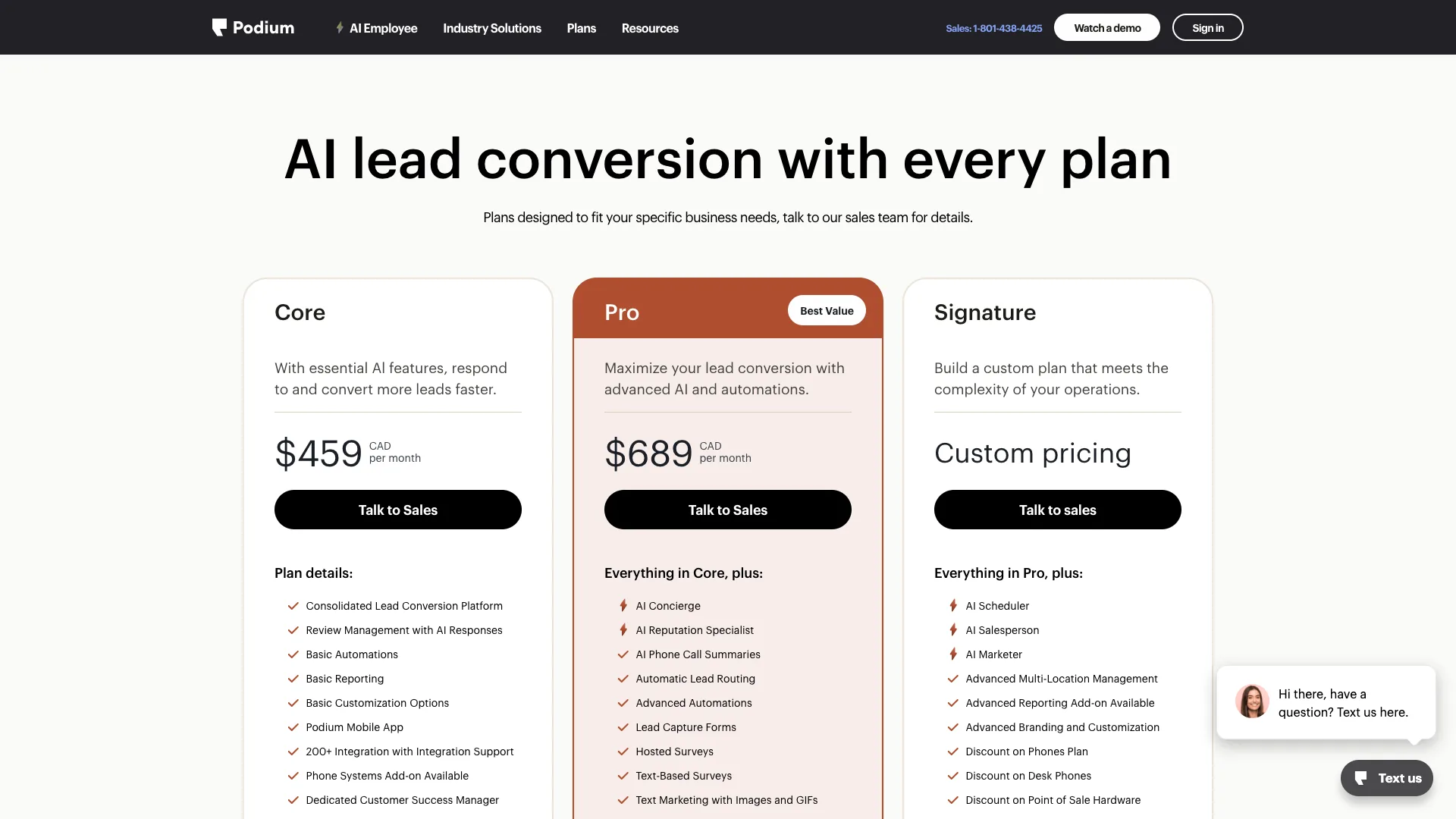 Jul 31, 2026
 Tech Stack
Podium vs Birdeye 2026: Pricing, Contracts and Review Gating
Only one of these two will tell you what it costs before a sales call, and even that number carries a carve-out aimed squarely at trade contractors.
Read Article Jul 31, 2026
 Tech Stack
Best Electrical Contractor Software 2026: 11 Ranked and Priced
An electrical contracting business makes two software purchases that do not substitute for each other, and every roundup answering this query covers only one of them. Eleven platforms, with a published price or an explicit statement that the vendor publishes none.
Read Article Jul 31, 2026
 Tech Stack
Best HVAC Software in 2026: Eleven Ranked Across Three Classes
An HVAC contracting business buys across three classes of software that do not substitute for each other, and every roundup answering this query covers only one of them. Eleven products, each with a published price or an explicit statement that the vendor publishes none.
Read Article Jul 30, 2026
 Tech Stack
AccuLynx Pricing 2026: The Real Cost of a Quote-Gated Plan
One published figure, two blank plan cards, and a contract that says things the pricing page does not. A line-by-line breakdown of what AccuLynx really bills.
Read Article Jul 30, 2026
 Tech Stack
Houzz Pro Canada Review 2026: Pricing and Alternatives
Houzz Pro serves different pricing renderings. What Canadian buyers see, how GST/HST and payments work, what Custom gates, and what the annual contract commits you to.
Read Article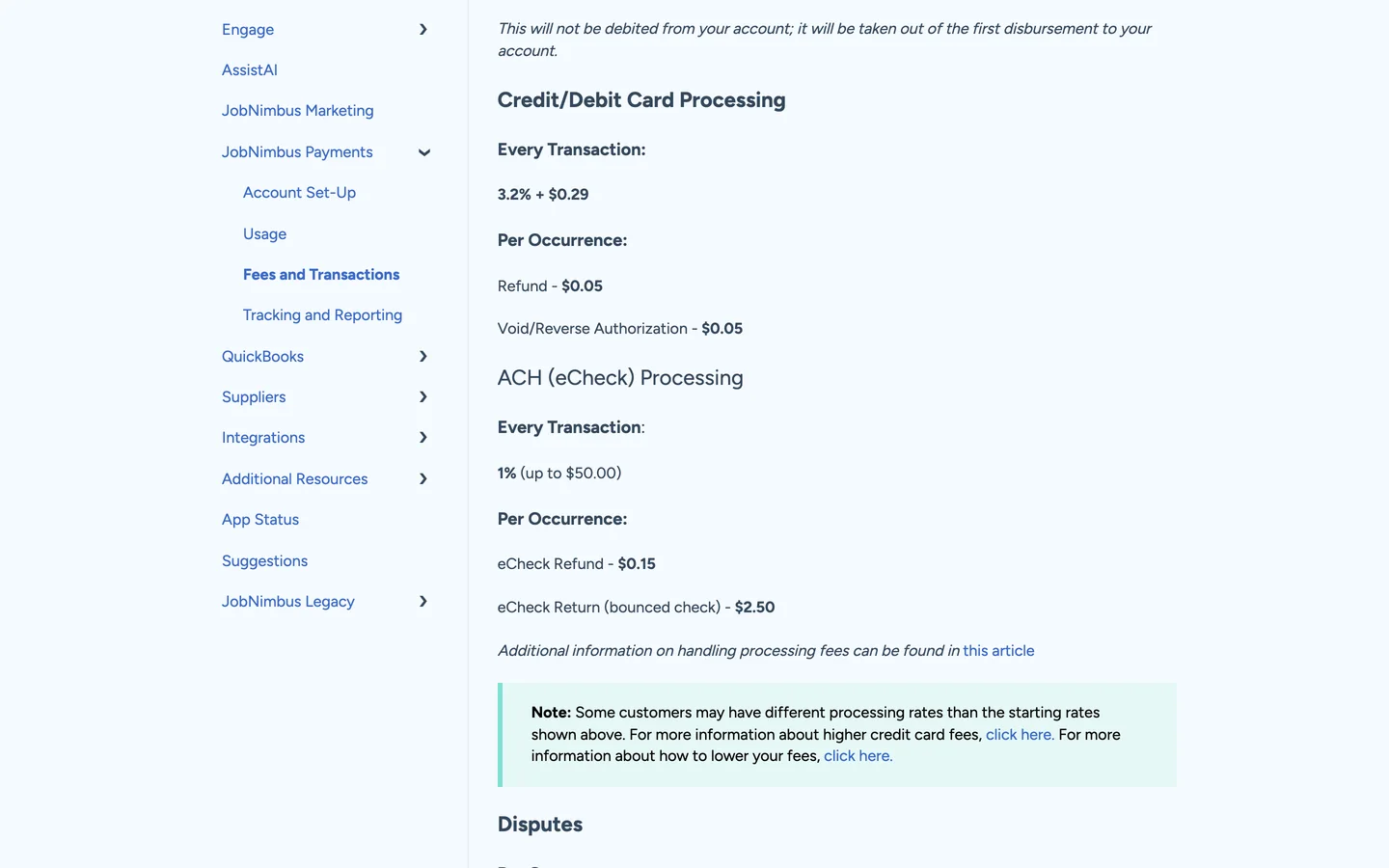 Jul 30, 2026
 Tech Stack
JobNimbus Pricing in 2026: What the Quote Does Not Cover
JobNimbus prints no figure on any of its four plans. So the only rate you can read before a sales call is the payments meter, and it is the biggest line on the bill.
Read Article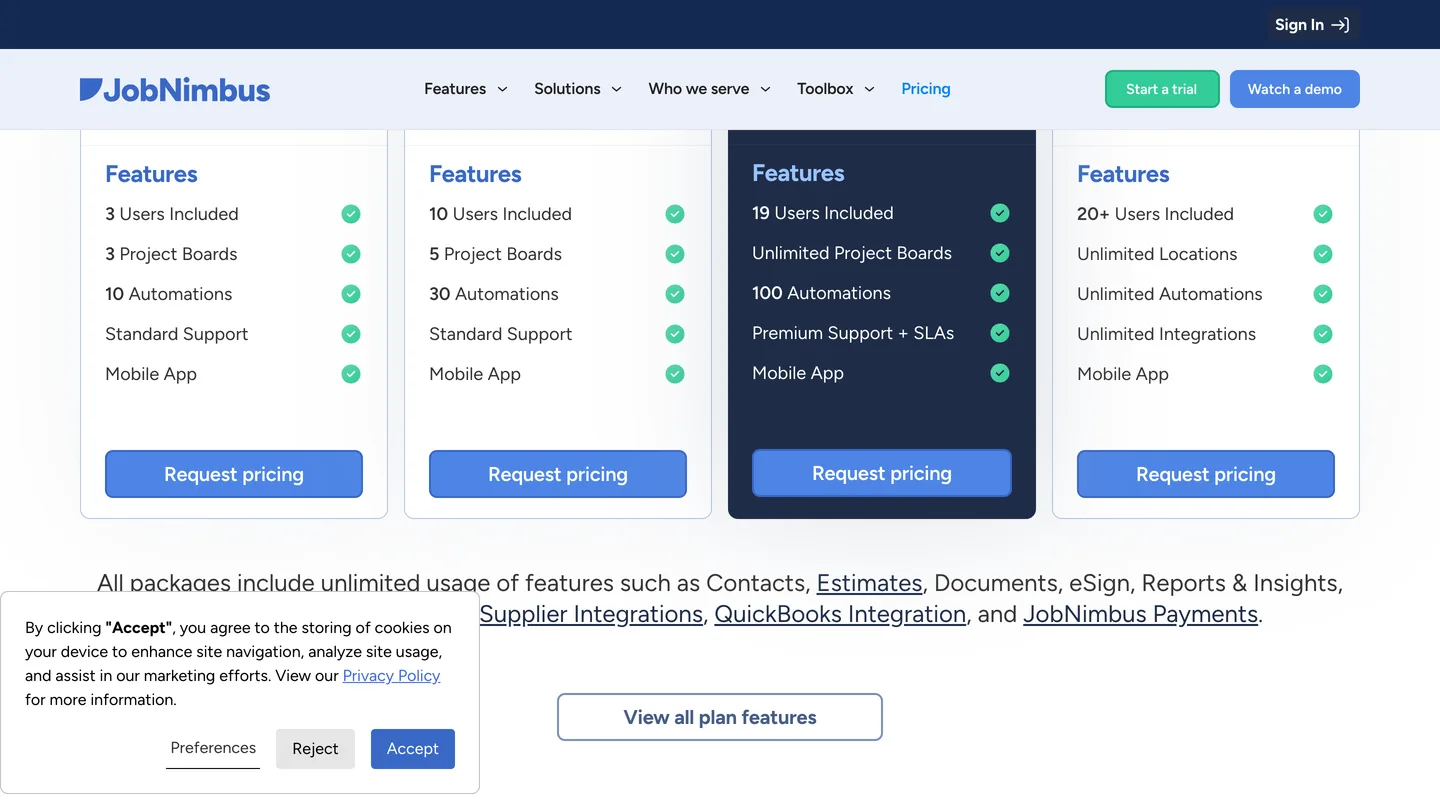 Jul 30, 2026
 Tech Stack
JobNimbus Review 2026: Pricing, Pros, Cons and Alternatives
JobNimbus rates 4.6 on Capterra and orders material straight from ABC Supply and SRS. But it publishes no price, and its supplement route carries a note.
Read Article Jul 30, 2026
 Tech Stack
BuildOps Review 2026: Pricing, Contract Terms and Alternatives
BuildOps runs commercial service and projects on one platform, and publishes no pricing at all. The billing unit, the 30-day data-export window, and who it suits.
Read Article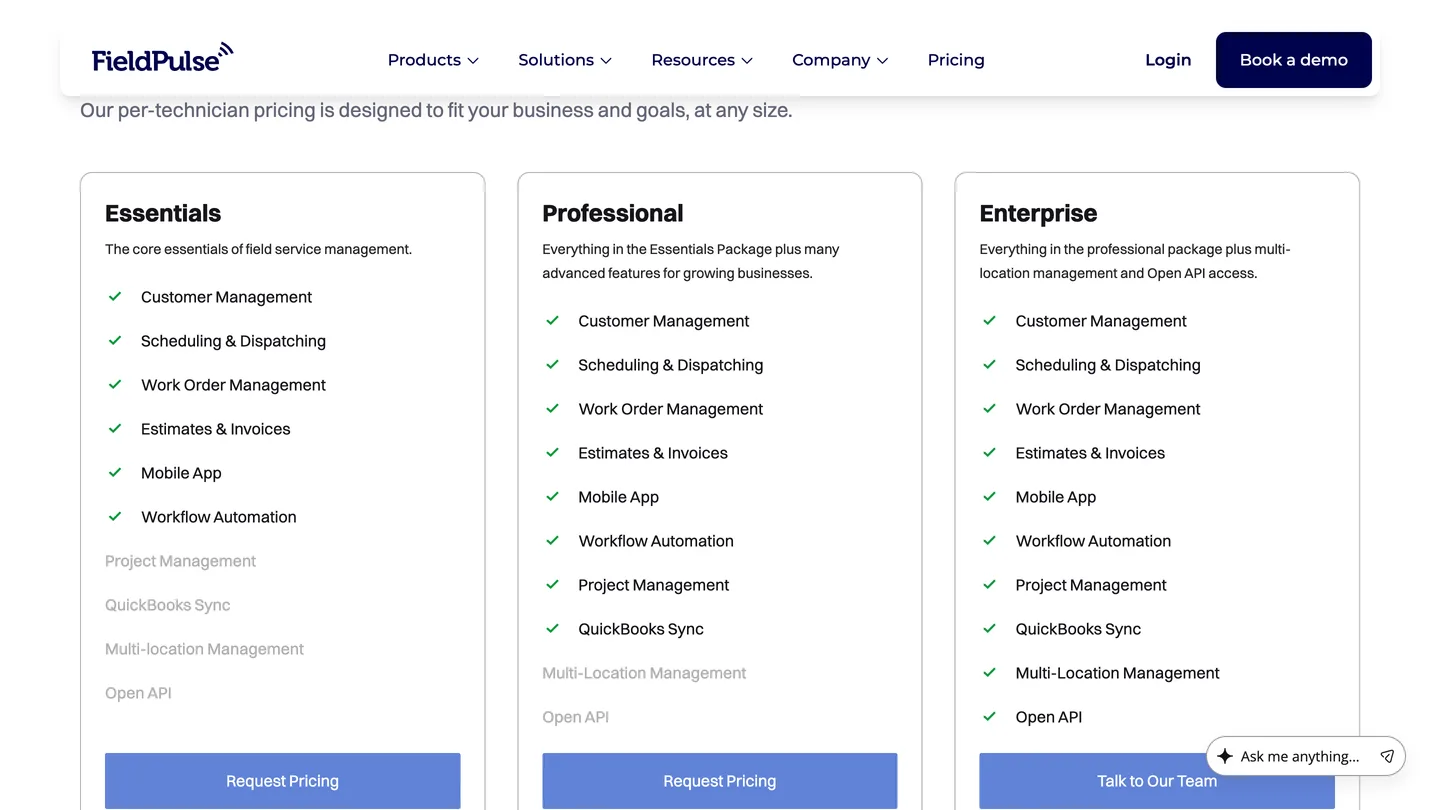 Jul 30, 2026
 Tech Stack
FieldPulse Review 2026: Pricing, Pros, Cons and Alternatives
FieldPulse rates 4.6 on Capterra and is the platform contractors name when they leave a bigger system. But it publishes no price, and the contract runs a year.
Read Article Jul 30, 2026
 Tech Stack
Service Fusion Review 2026: Pricing, Contract and Alternatives
Service Fusion bills flat per company with unlimited users, which is the best structural deal in field service software. The published plans, the contract behind the no-contract line, and the app score every other review gets wrong.
Read Article Jul 30, 2026
 Tech Stack
Knowify Review 2026: Pricing, Job Costing and Alternatives
Knowify rates 4.5 on Capterra and its weakest sub-score is features. What the $99 Core plan withholds, which way the QuickBooks sync really runs, and who should not buy it.
Read Article Jul 29, 2026
 Tech Stack
AccuLynx Review 2026: Pricing, Tier Gating, Alternatives
AccuLynx rates 4.6 across 846 reviews and now publishes an entry price. What that price omits, which tier holds the insurance workflow, and who should skip it.
Read Article Jul 29, 2026
 Tech Stack
Unitel Voice Review 2026: Pricing, Features and Alternatives
Unitel Voice rates 4.6 on Capterra and gives a one-truck shop a business number for $9.99 a month. The published plans, the cost per call, and what it won't do.
Read Article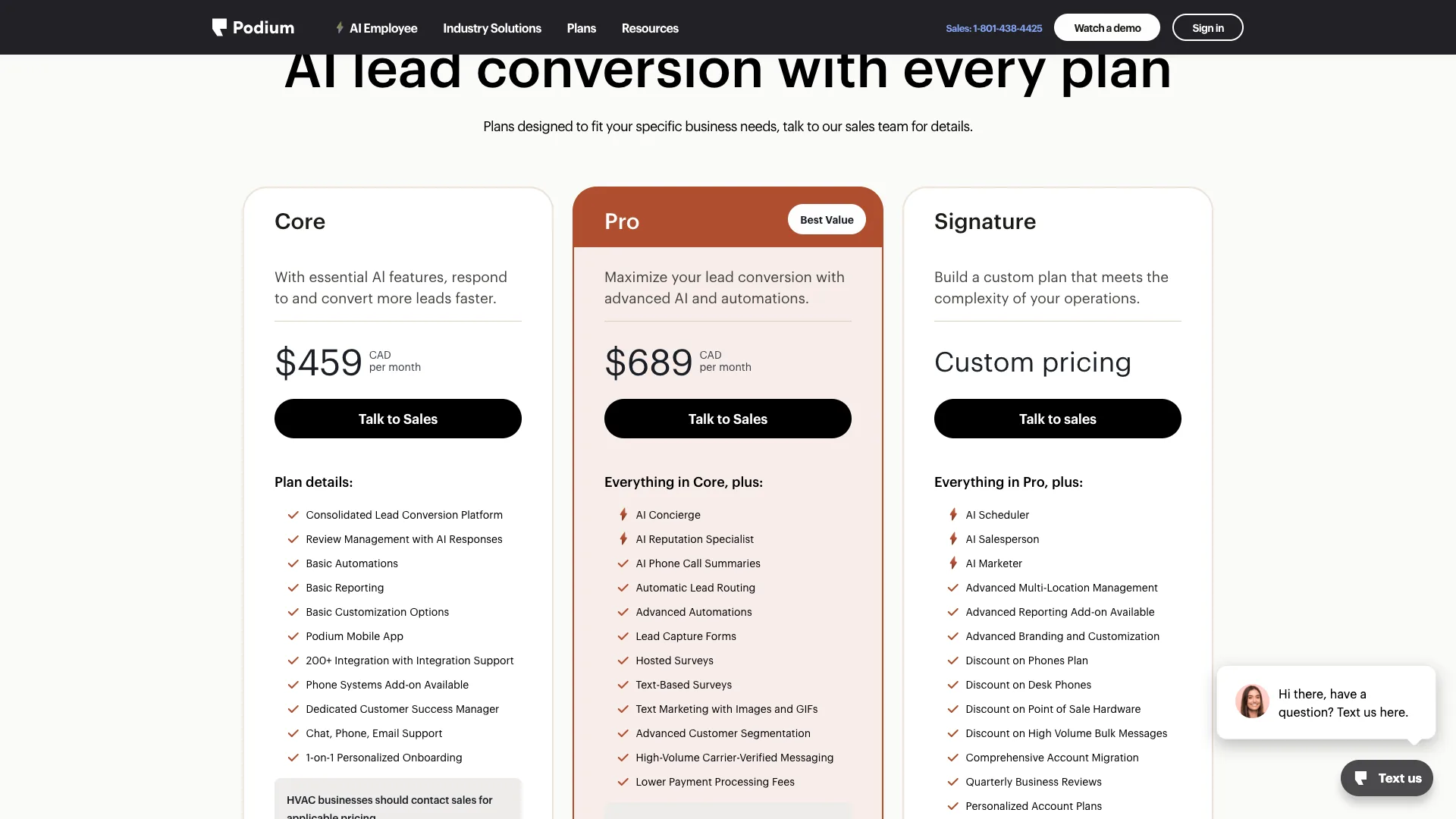 Jul 29, 2026
 Tech Stack
NiceJob vs Podium 2026: Pricing, Contracts and Review Gating
Both vendors print a price, at very different scale and in different currencies. The gap that matters is what Podium will not print: the billing unit, and whether a trade shop gets the number on the page.
Read Article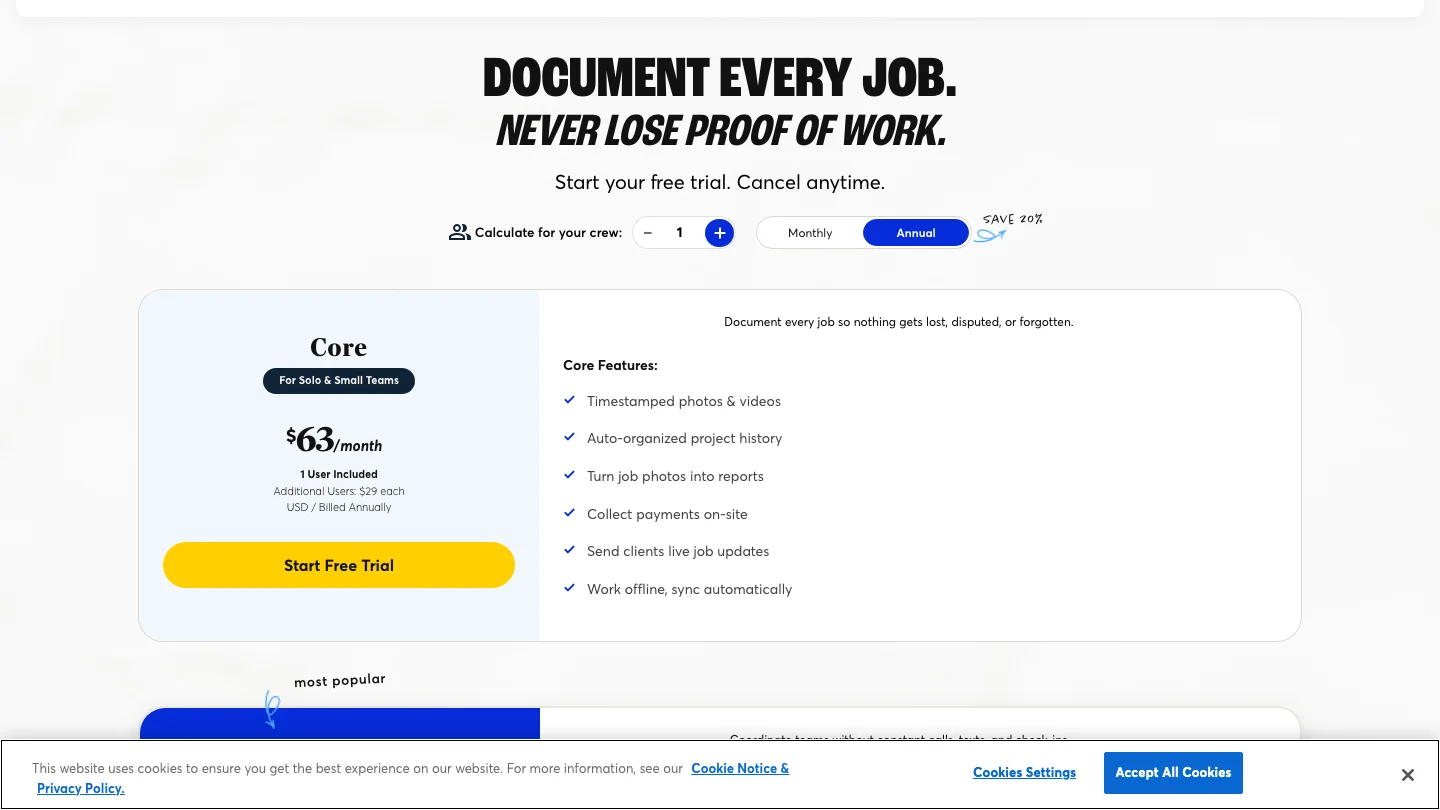 Jul 28, 2026
 Tech Stack
CompanyCam Review 2026: Pricing, Pros, Cons and Alternatives
Every page ranking for CompanyCam still quotes a per-user price the vendor no longer charges. Here are the real plans, the seat math, and who should skip it.
Read Article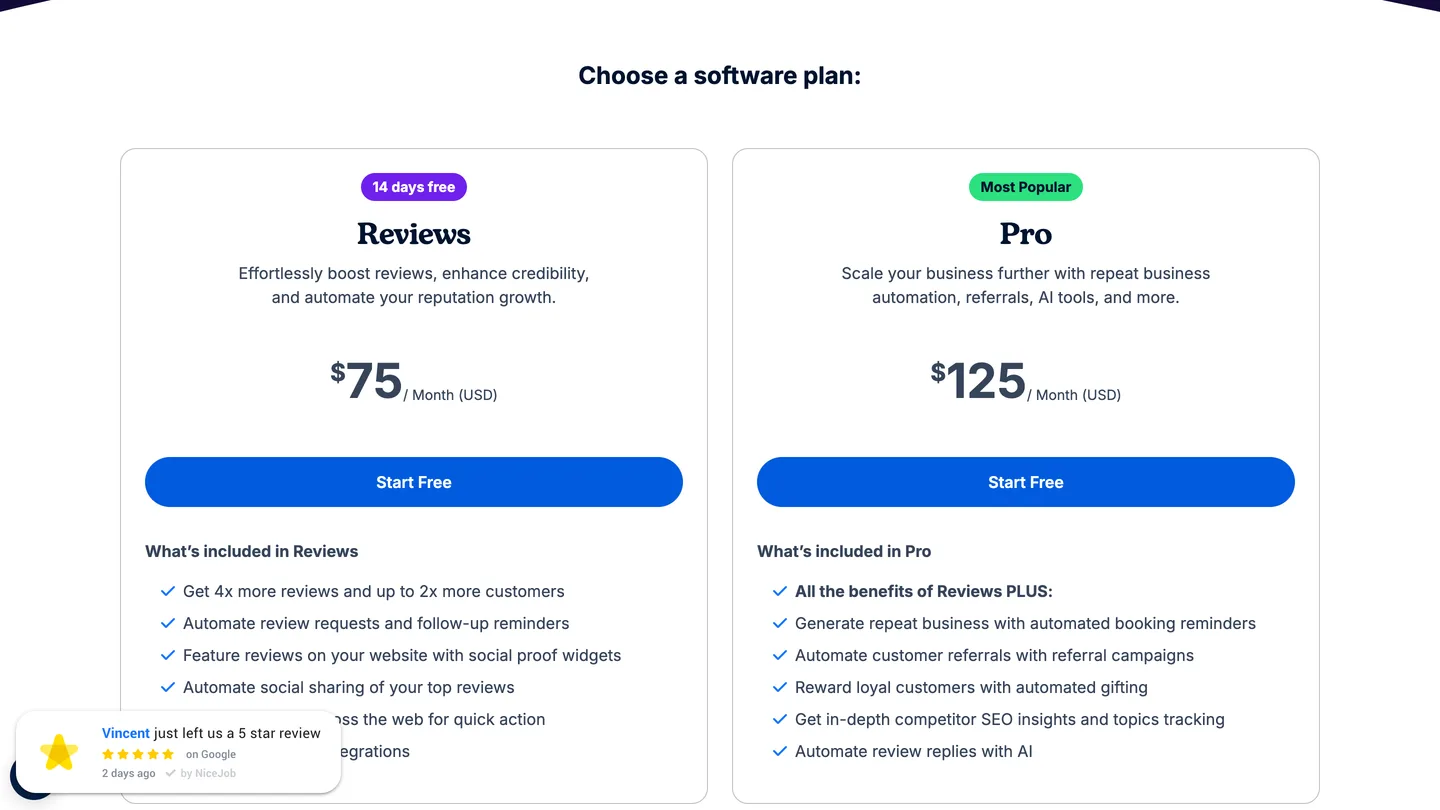 Jul 28, 2026
 Tech Stack
NiceJob Review 2026: Pricing, Pros, Cons and Alternatives
NiceJob rates 4.9 on Capterra and refuses to gate negative reviews. Real plan pricing, the active-customer threshold nobody publishes, and who should skip it.
Read Article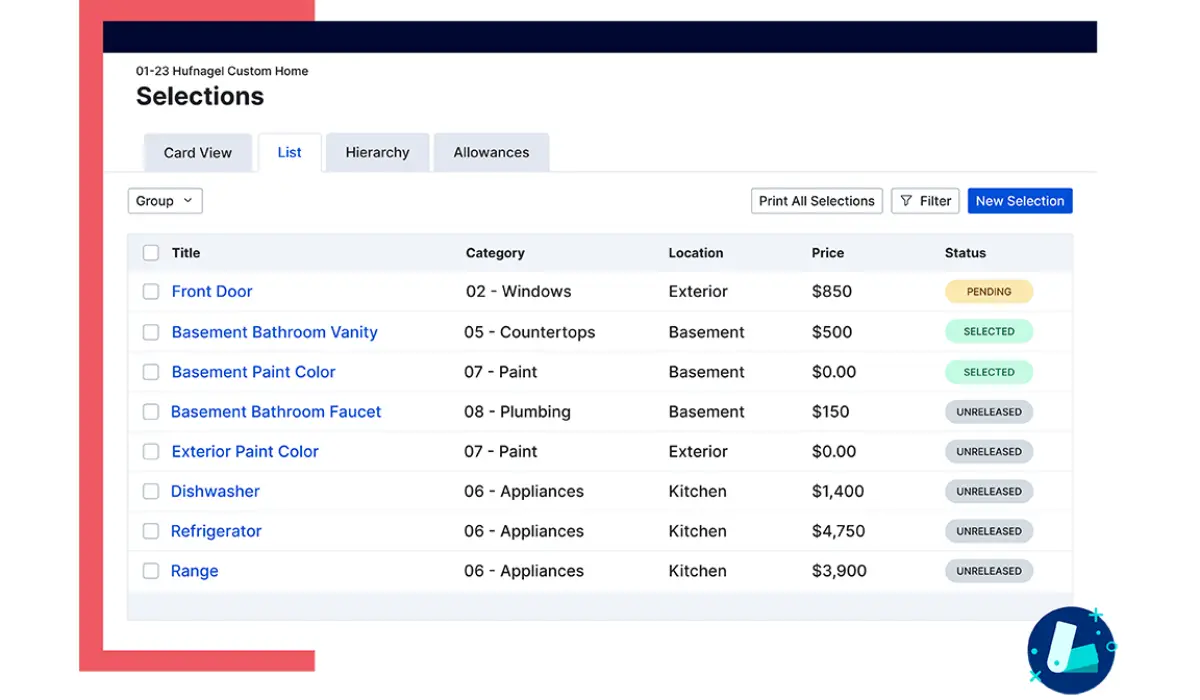 Jul 27, 2026
 Tech Stack
Buildertrend Review 2026: Pricing, Limits and Alternatives
Buildertrend rates 4.5 across 2,486 Capterra reviews and quotes against your revenue rather than your seat count. The workflows, the export problem, the alternatives.
Read Article Jul 27, 2026
 Tech Stack
CallRail Review 2026: Pricing, Pros, Cons and Alternatives
CallRail rates 4.5 on Capterra, and its tracking numbers port out free. But the two usage rates that decide your real bill are the two it does not print.
Read Article Jul 27, 2026
 Tech Stack
Roofr Review 2026: Pricing, Pros, Cons and Alternatives
Roofr rates 4.6 on Capterra and sells $13 measurement reports against a market charging triple. But it will not import a report from anywhere else.
Read Article Jul 25, 2026
 Tech Stack
Housecall Pro Review 2026: Pricing, Pros, Cons, Alternatives
Housecall Pro has the shortest learning curve in the category and the widest review spread. Real pricing, the Instapay math, and the migration trap to plan around.
Read Article Jul 24, 2026
 Tech Stack
Jobber Review 2026: Pricing, Pros, Cons and Alternatives
Jobber rates 4.6 on Capterra with the best mobile app in the category. Real plan pricing, the feature gating that changes your entry price, and who it suits.
Read Article Jul 23, 2026
 Tech Stack
ServiceTitan Review 2026: Pricing, Pros, Cons, Alternatives
ServiceTitan rates 4.3 on Capterra but its weakest score is value for money. Real reported pricing, the 12-month contract, the exit fees, and who it actually suits.
Read Article Jun 3, 2026
 Tech Stack
HVAC Online Scheduling: The 43% Losing After-Hours Bookings
HVAC leads every trade on online booking at just 56.7%, which still leaves 43% of sites forcing an after-hours customer to wait for a business-hours phone call.
Read Article