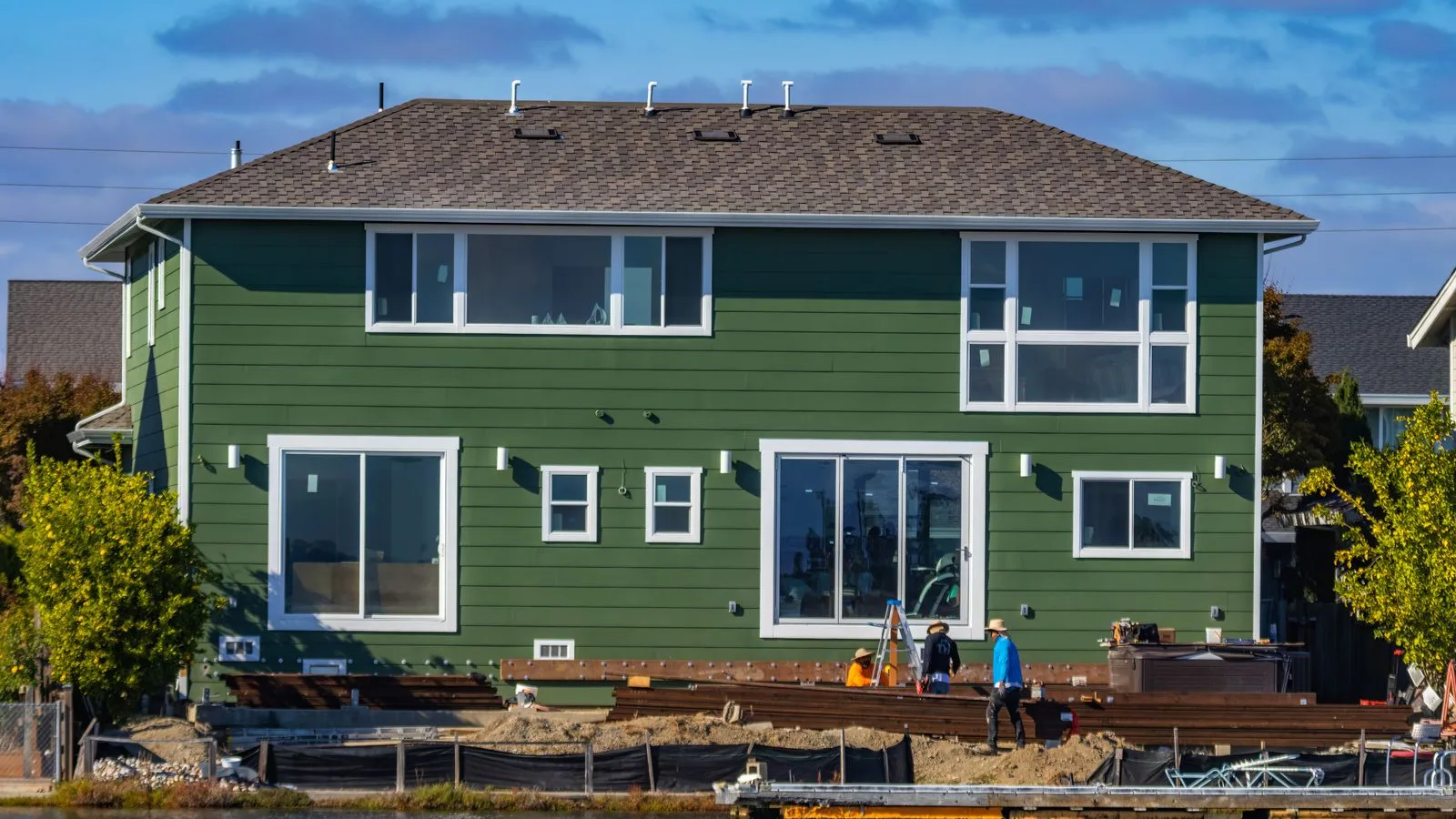
Best Construction Marketing Agencies in 2026
Construction marketing runs on a longer bid cycle than home services. Ten agencies ranked for builders, GCs and commercial construction firms.
Search "construction marketing agency" and you get two completely different businesses answering the same query. One of them markets commercial general contractors bidding on a $4M tenant improvement. The other one runs Facebook ads for a stamped-concrete crew working driveways. Both call it construction marketing. And a foundation repair company shopping that page has no way to tell which is which until the discovery call is already on the calendar. So this ranking sorts the field by the shape of the work instead of by the word "construction". Concrete and foundation specialists. Construction-exclusive generalists. Enterprise firms built for commercial builders. Lead-validation shops that start mattering the moment your pipeline is bid invitations rather than service calls.
Construction spends about 1% of revenue on marketing where the cross-industry average sits near 7.7%.
The ten construction marketing agencies, ranked by fit
Construction work arrives through referral more than almost any other category, and plenty of owners read that as permission to ignore the website. It isn't. The homeowner or project manager who got your name from a friend still opens a browser before they pick up the phone. What they find, on the sites that handle that moment well, is the subject of the ranking of the best construction company websites. And if you build new homes rather than renovate them, the home builder marketing agencies are scored against that cycle instead.
"Even among homeowners who received a word-of-mouth referral, over 60% do due diligence online before deciding to contact the pro."
Houzz Inc. (2025)
Six out of ten warm introductions route through your site before anyone calls. So the site isn't a brochure sitting off to the side of your sales process. It's a checkpoint inside it. Each entry below links to a deeper head-to-head in our agency comparison guide.
References carry more weight than any headline you write, with 64% of homeowners calling them a top-three factor in choosing a contractor.
No. 1 · Best for commercial construction creative and brand assets
Construction Marketing Inc.
Construction Marketing Inc. owns construction.marketing, probably the best domain anybody in this category holds, and it ranks almost by default for the query you typed to get here. The team is small and the work skews commercial: general contractors, manufacturers, equipment suppliers. Video production, drone photography, PR, branding. That's the half of construction marketing most agencies skip entirely, and it's the half a commercial GC needs when a developer is deciding who to shortlist.
Where they're strongest: Creative capability aimed squarely at the construction industry. Project-based pricing runs $3,000 to $50,000, and the founder brings 40+ years of marketing experience to it. If your capability deck and your project photography look like a 2011 template, this is the shop.
What to consider: Roughly five people means capacity is genuinely limited. If they're flying drone footage for a commercial GC that week, your project waits. Their focus is commercial construction rather than the residential trades, and the model is project-based creative work, not ongoing lead generation or conversion optimization.
Best for: Commercial construction companies, manufacturers and equipment suppliers who need polished marketing material rather than another SEO retainer.
Deep dive: Construction Marketing Inc. vs. Fervor Studio
Placement decides what gets read, with 57% of viewing time spent above the fold and 74% inside the first two screenfuls.
"57% of page-viewing time is spent above the fold, and 74% of viewing time is spent in the first two screenfuls."
Nielsen Norman Group (2024)
No. 2 · Best construction depth backed by published scored data
Fervor Studio
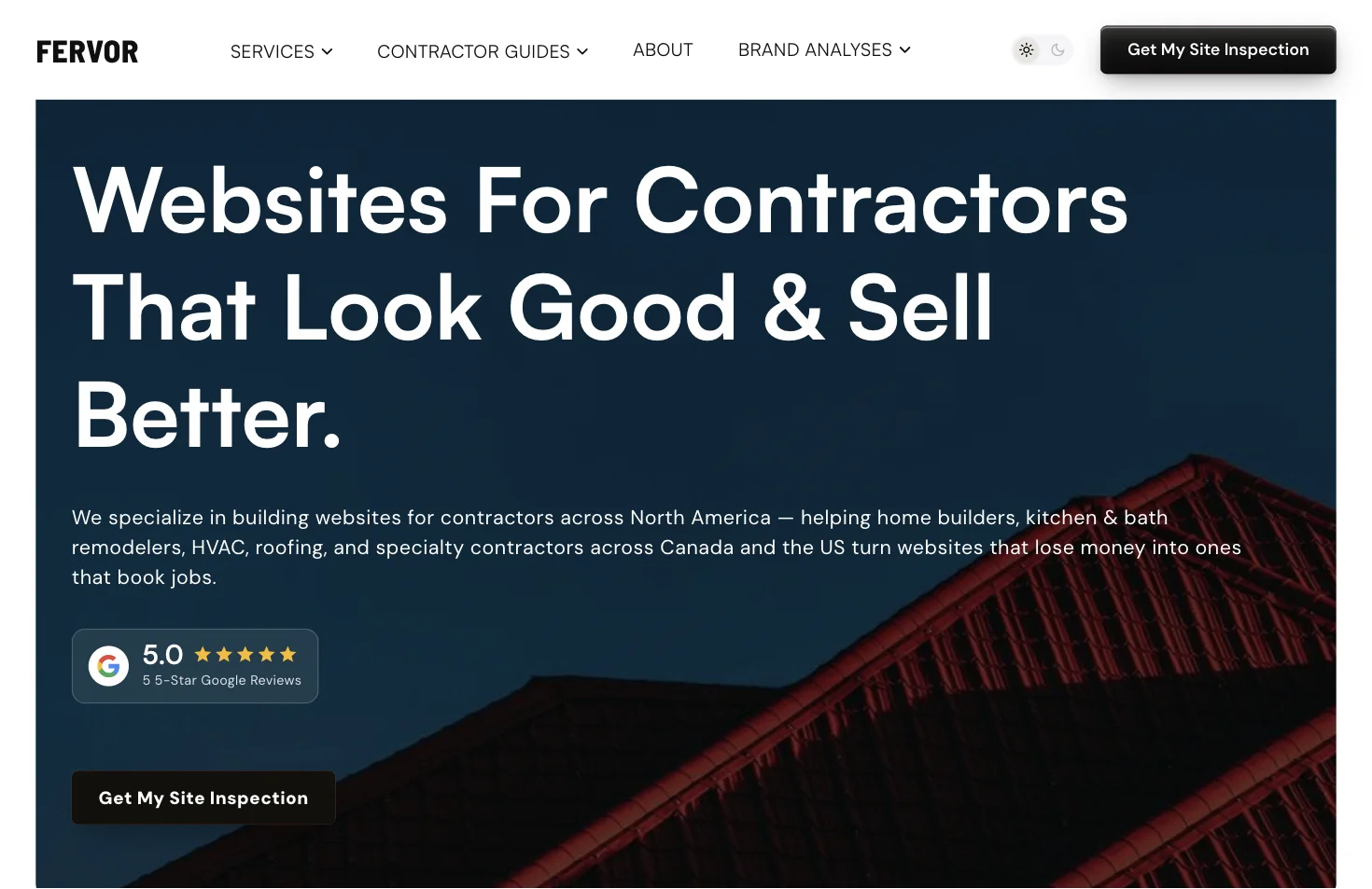
Fervor Studio works only with contractors, and it publishes the scoring framework it uses before anyone signs anything. The Contractor CRO Index grades 380 contractor websites across six conversion-readiness categories. The State of Roofing, State of HVAC and State of Remodeling reports pull the failure patterns apart trade by trade. Booked by Design runs $7,497 to $19,997 depending on the trade, over 30 to 60 days.
Where they're strongest: The diagnostic comes first, and it comes back in 5 business days. When Fervor says a bid-request form is costing you inquiries, the recommendation traces to a scored data point in a public index rather than a playbook borrowed from an ecommerce checkout.
What to consider: Fervor is contractor-only, which makes it the wrong pick for anybody outside home services and the trades. The scored group is roofing, remodeling and HVAC, so a commercial general contractor or a heavy-civil firm is reading adjacent evidence rather than their own category. And the diagnostic-led model moves at a different pace than an enterprise testing shop or a 200-person full-service retainer.
Best for: Construction companies that already get traffic, already get referrals, and still lose the job somewhere between the first page view and the phone call.
Deep dive: Booked by Design™ · The Site Inspection
Trust is the reported bottleneck, named by 48% of homeowners, ahead of clear proposals at 34% and communication at 30%.
"Homeowners' biggest struggles are finding someone they trust (48%), getting clear and detailed proposals (34%), and timely, accurate communication (30%)."
Houzz Inc. (2025)
No. 3 · Best for knowing which construction leads are real
Straight North
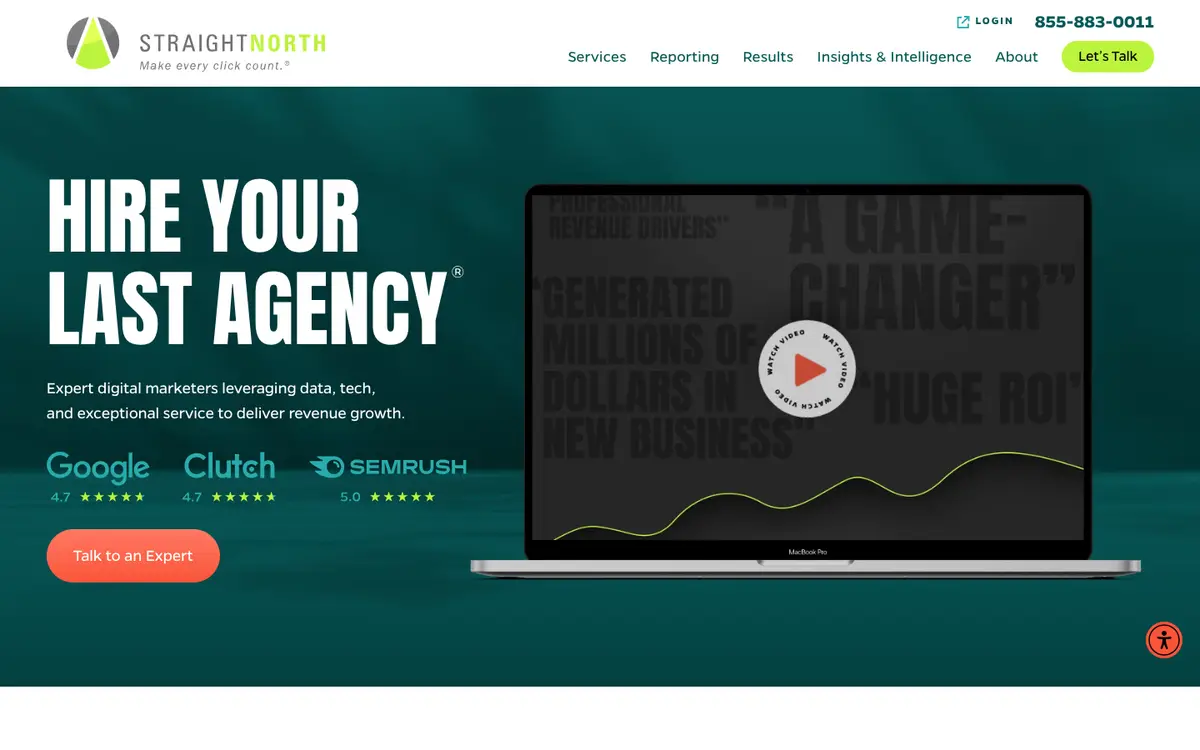
Straight North has been running for 25 years and it's known for one thing above everything else. A human being reviews every lead their campaigns produce before it reaches your report. Spam, bots, wrong numbers, the guy who filled the form to sell you insurance. So the number you see at the end of the month is the number that was actually real.
"Phone calls convert to 10-15x more revenue than web leads for home services businesses. Callers convert 30% faster than web leads. Caller retention rate is 28% higher than web lead retention rate."
BIA/Kelsey + Forrester (2025)
Where they're strongest: Honest counting on a bid-driven pipeline. When a construction lead is a request to bid rather than a booked service call, raw volume is close to meaningless, because one qualified invitation is worth more than forty tire-kickers. Validation puts a real denominator under your cost per lead.
What to consider: Pricing isn't published, so a discovery call comes before any budget clarity. And validation tells you which leads were real. It doesn't tell you why the other visitors left without filling anything out, which is a different diagnosis run with different tools.
Best for: Construction firms spending real money on paid media who suspect their reported lead counts are inflated by junk.
Deep dive: Straight North vs. Fervor Studio
The judgement happens faster than any agency pitch admits, in roughly 50 milliseconds of looking at the page.
"Users form a visual judgment about a website's design within 50 milliseconds."
Lindgaard, Fernandes, Dudek and Brown (2006)
No. 4 · Best for a first agency engagement on a published budget
Construction Marketing Services
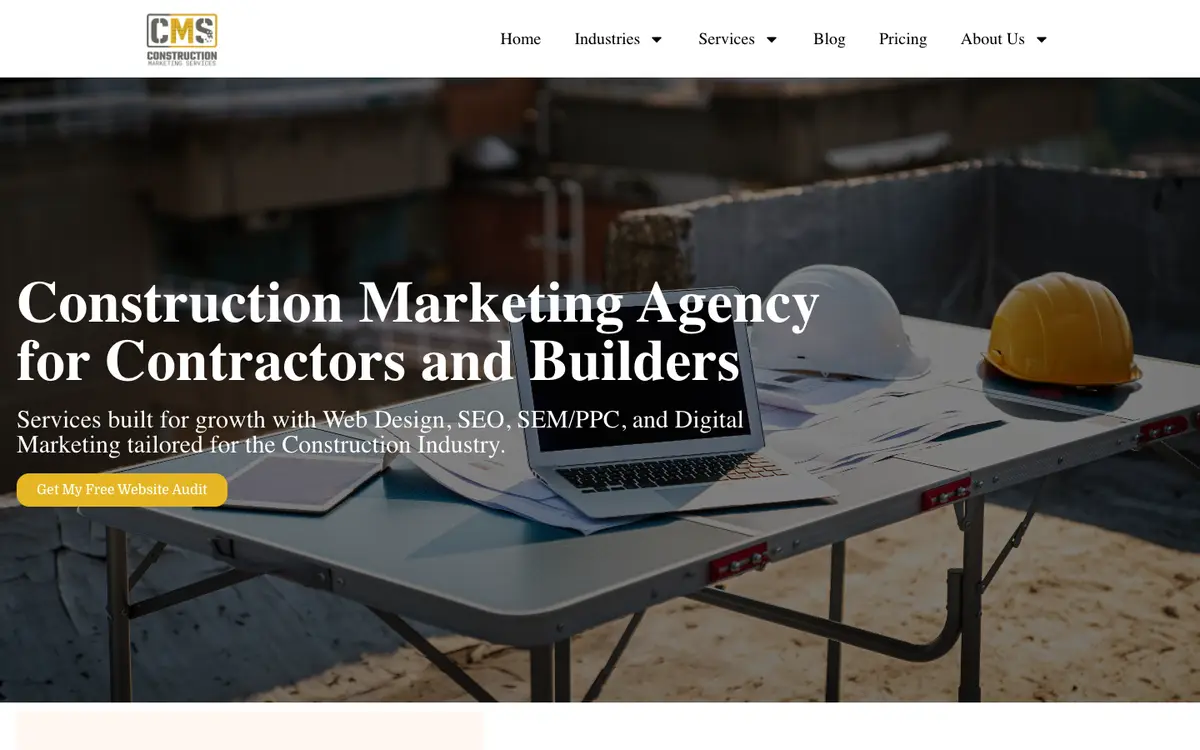
Construction Marketing Services works only in construction, and the trade list is wide: general contractors, home builders, remodelers, HVAC, electrical, roofing, plumbing. What separates them is that they publish the numbers. A $5,000 startup package, monthly retainers starting at $300, and no long-term contract. For an owner who got locked into a twelve-month deal once and swore never again, that structure answers the objection before you have to raise it.
Where they're strongest: Transparency on price and terms, in a category where almost nobody publishes either. You can size the engagement against your revenue before you ever speak to a salesperson.
What to consider: No verified case studies or awards, and the team size isn't verified either. The $300 monthly floor raises a fair question about what you receive at that tier, and the real work probably starts closer to $1,500. Their emphasis is traffic and content rather than conversion work, so they'll bring you more visitors without necessarily changing what those visitors do next.
Best for: Construction companies hiring their first agency who want a defined starting budget and a month-to-month exit.
Deep dive: Construction Marketing Services vs. Fervor Studio
Nobody reads a service page start to finish. Roughly 79% of users scan, and only 16% read word by word.
"79% of test users always scanned any new page they came across; only 16% read word-by-word."
Nielsen Norman Group (2024)
No. 5 · Best for vetting an agency before you ever get on a call
Comrade Digital Marketing
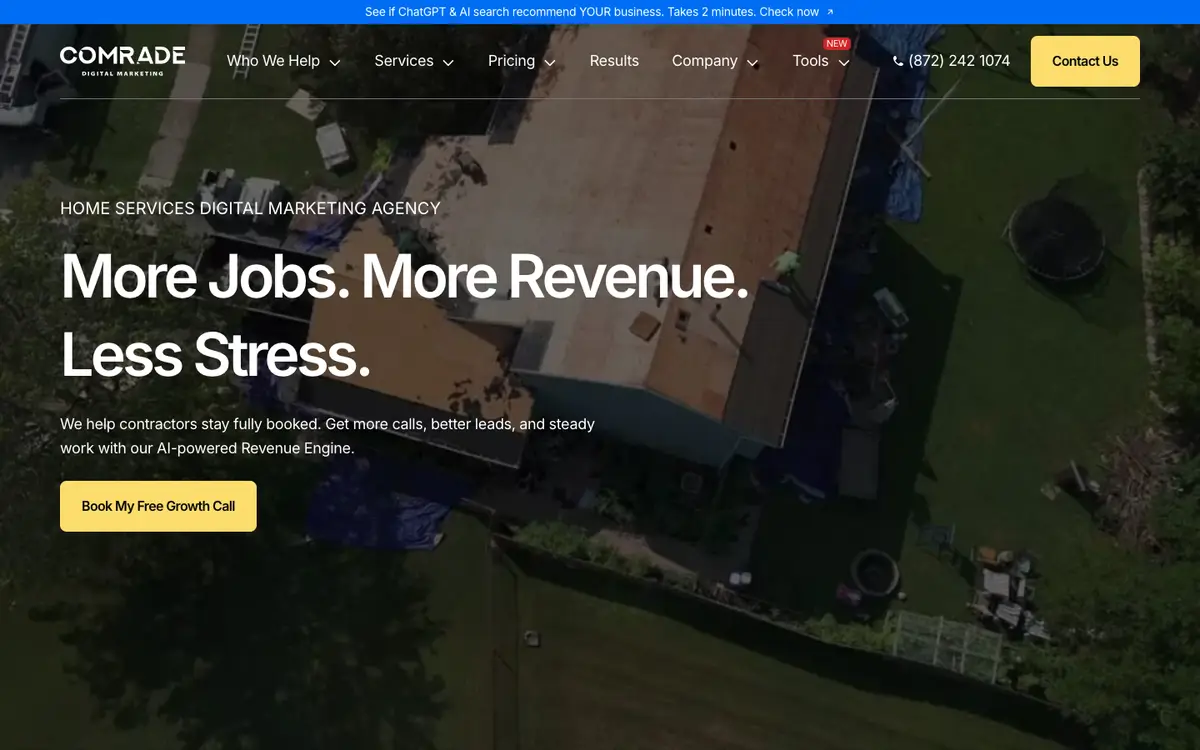
Comrade publishes some of the deepest contractor lead-generation guides in the category, and their case studies carry actual metrics instead of a wall of client logos. Traffic increases, lead volumes, conversion improvements, numbers attached to each. So you can read their thinking, judge whether it holds up, and decide before you book anything. That's rarer than it should be.
Where they're strongest: Showing their work. If you're the kind of owner who reads three agencies' content before taking a single call, and you should be, Comrade makes that homework easier than most firms do.
What to consider: They're multi-industry. Your general contracting account shares the building with ecommerce and B2B clients, so the construction-specific depth is thinner than at a construction-exclusive shop. Pricing isn't published either.
Best for: Construction owners who research hard before hiring and want published thinking they can evaluate on their own time.
Deep dive: Comrade vs. Fervor Studio
Load time is the cheapest fix on this list, and 53% of mobile visitors leave a site that takes more than 3 seconds to appear.
"53% of mobile users abandon sites that take longer than 3 seconds to load."
Google and SOASTA (2017)
No. 6 · Best for concrete contractors whose work sells visually
Concrete Marketing Crew
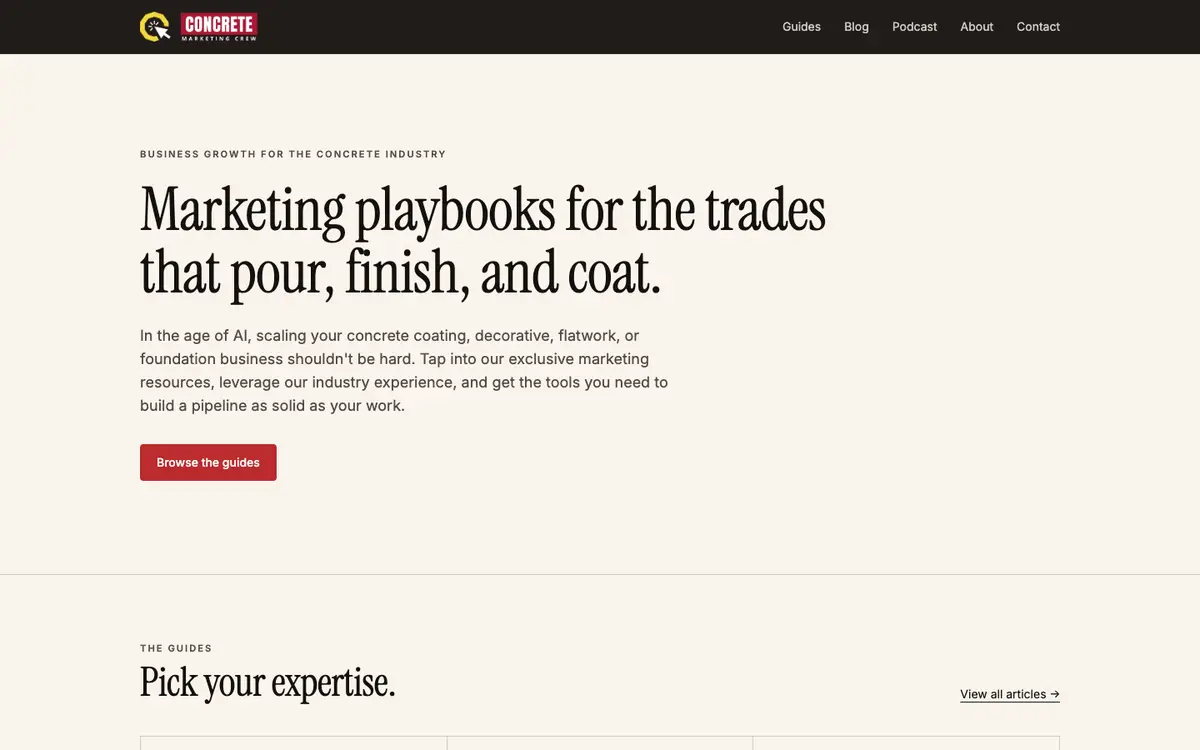
Most contractor agencies lead with Google. Concrete Marketing Crew built their methodology around Facebook Ads instead, and for decorative concrete, stamped overlays and outdoor living work, that choice actually tracks. Nobody searches for a stamped concrete contractor before they've seen a photo that made them want one. They report a client going from four leads a month to two or three a day.
Where they're strongest: Social-first lead generation for a trade where the finished pour is the ad. Meta certification is unusual for a trade-niche agency, and the podcast keeps them inside the concrete community rather than observing it from a strategy deck.
What to consider: Pricing isn't published, so budget fit takes a call. And a paid-social model creates demand rather than capturing it, which makes it a poor match if people already find you and then don't call. Those are opposite problems with opposite fixes.
Best for: Decorative and residential concrete contractors whose portfolio photography is their strongest sales asset.
Deep dive: Concrete Marketing Crew vs. Fervor Studio
No. 7 · Best for foundation repair search terminology
Foundational Marketing Hub
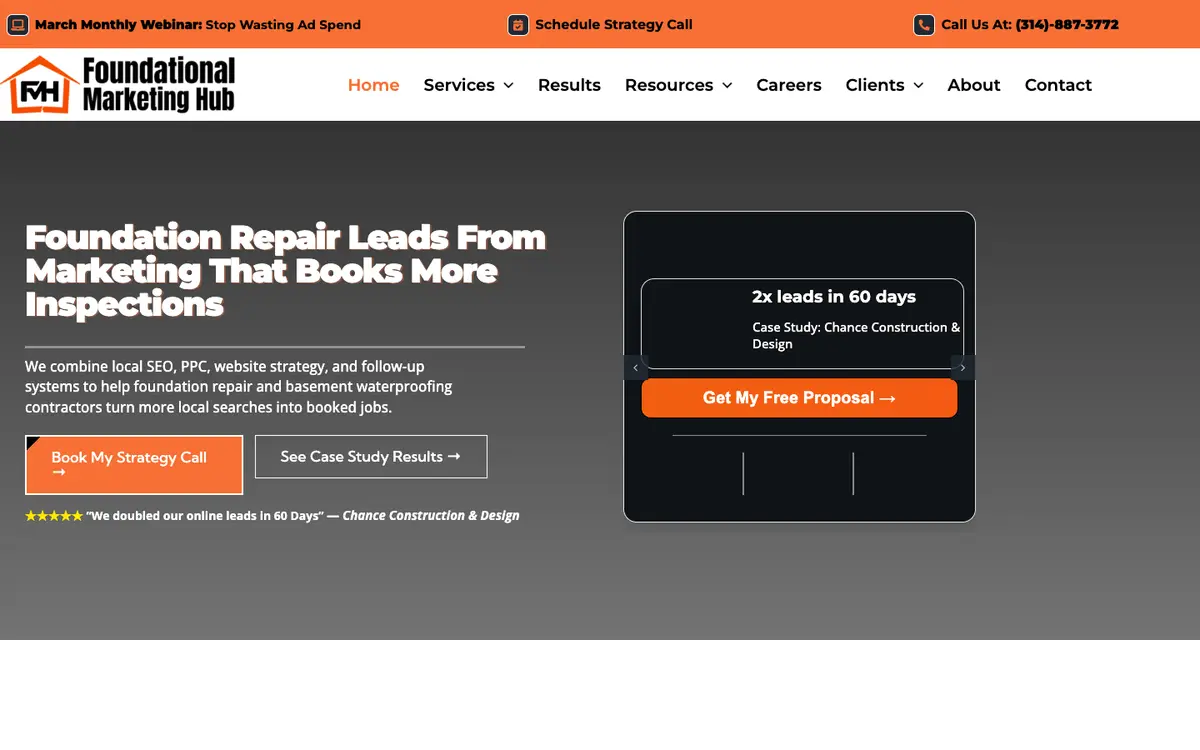
Foundation repair is a vocabulary problem before it's a marketing problem. Push piers, helical piers, wall anchors, crawl space encapsulation, and the enormous gap between the homeowner whose basement wall just bowed at 11pm and the one planning a repair for next spring. Foundational Marketing Hub works only in that niche, published the "3X Your Foundation Repair Business" playbook, and reports 3x call volume in 90 days.
Where they're strongest: Niche terminology and Map Pack execution. If your current agency doesn't know the difference between a pier and a footing, that gap shows up in every page they write for you, and in the search terms they never think to target.
What to consider: One trade, one channel emphasis, no published pricing. Their model is local search visibility rather than site-level conversion work, so they'll get more people to the page and then hand the page whatever it can do with them.
Best for: Foundation repair contractors who need Map Pack visibility and technically literate content in their own vocabulary.
Deep dive: Foundational Marketing Hub vs. Fervor Studio
No. 8 · Best for showing up in AI search
OuterBox Design
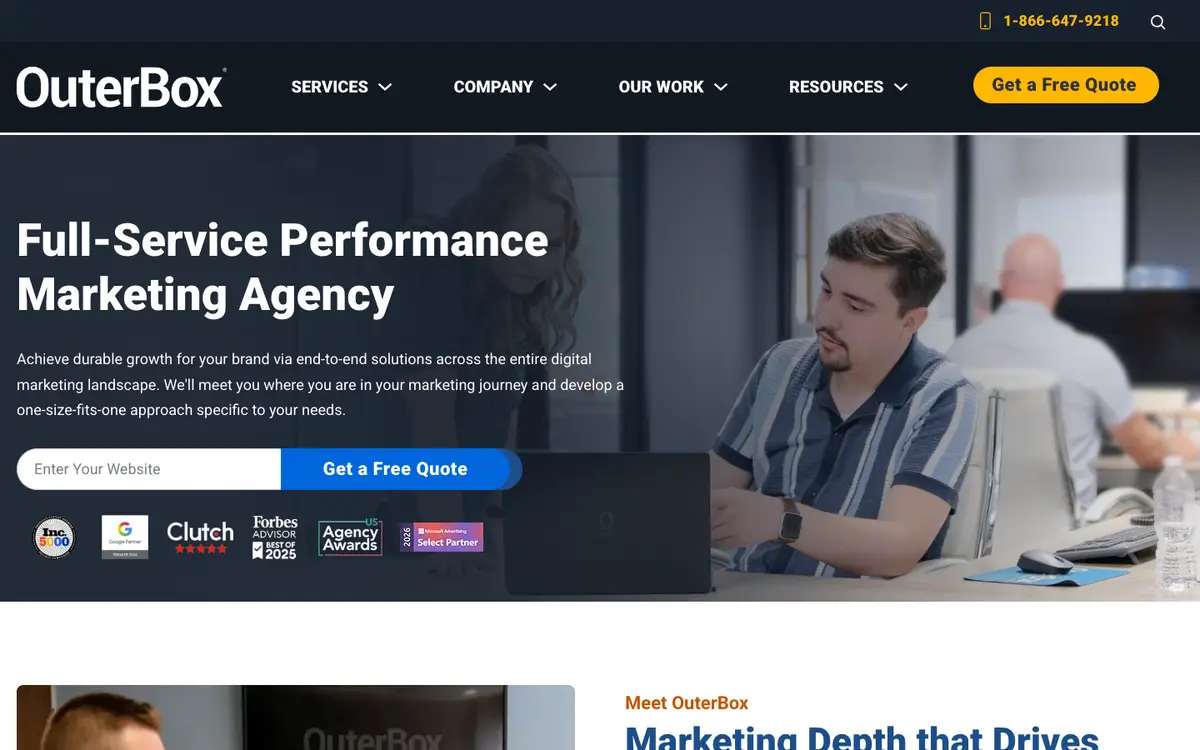
OuterBox has been doing this for 20+ years, and they publish the agency rankings the rest of the industry quotes back at itself. They've also moved early into AI-GEO, optimizing for AI Overviews and answer engines rather than only for ten blue links. That timing looks better every quarter.
"45% of consumers have used ChatGPT or other generative AI tools for local business recommendations in 2026, up from 6% in 2025."
BrightLocal (2026)
From 6% to 45% in twelve months is not a trend line you get to sit out. If nearly half the people looking for a contractor are asking a model instead of a search box, whether that model can find and cite your site is a live distribution question, not a 2028 problem.
Where they're strongest: Content authority plus forward positioning. They're thinking about where your bid invitations come from in 2027, not only where they came from in 2023.
What to consider: Multi-industry across home services and ecommerce, with no construction-exclusive practice and no published pricing. And publishing the industry's agency rankings while selling agency services is a conflict worth naming out loud.
Best for: Established construction firms who want organic and AI-search visibility from a shop with two decades of operating history.
Deep dive: OuterBox vs. Fervor Studio
No. 9 · Best for Toronto and GTA general contractors
Nomadic Advertising
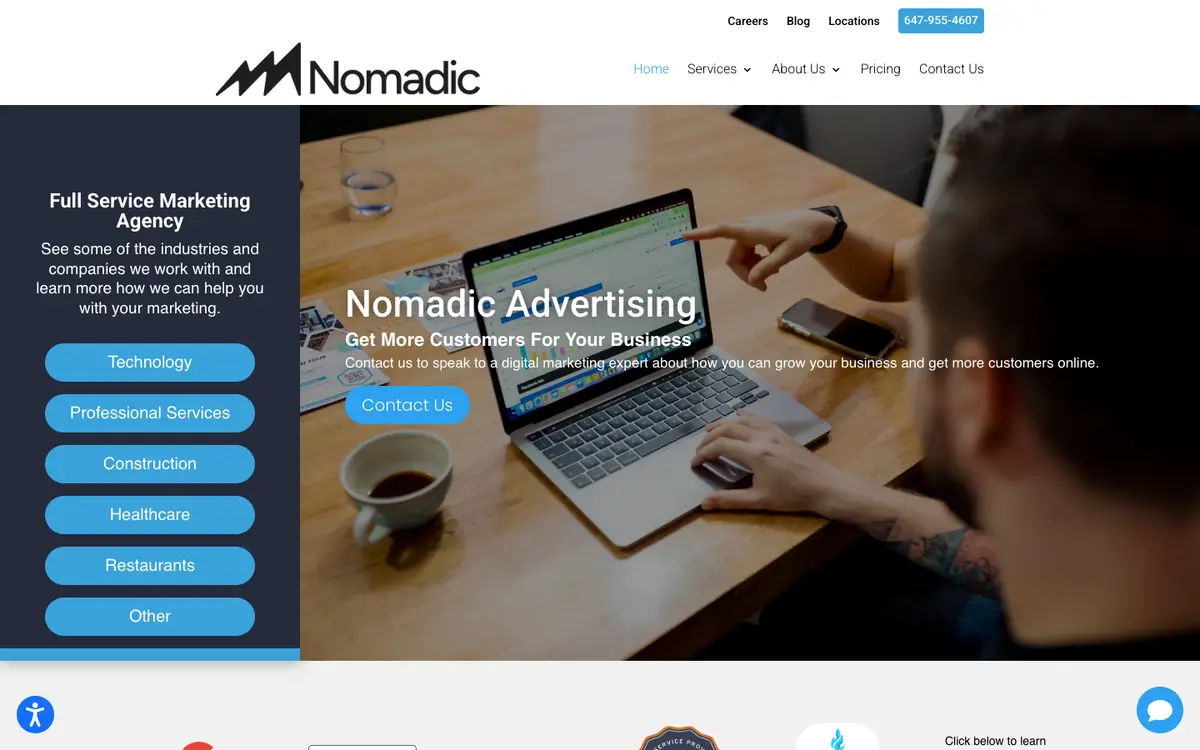
Nomadic is a small Toronto shop running SEO, Google Ads and web work for general contractors and home-service businesses. The pitch is straightforward and the team is reachable, which is the opposite of being client number 847 inside a 200-person U.S. agency where your account manager rotates every six months.
Where they're strongest: Local presence and Ontario context. Same time zone, familiar with provincial licensing and GTA search behaviour, relationship-based rather than platform lock-in.
What to consider: The entire model is traffic generation. If your site already gets visits and the phone still isn't ringing, sending more visitors to a page that doesn't convert won't change the math. Hiring a traffic agency to solve a conversion problem is one of the more expensive mistakes available to a contractor. No published pricing either.
Best for: Toronto and GTA general contractors who want a local, accessible agency without a long-term platform contract.
Deep dive: Nomadic Advertising vs. Fervor Studio
No. 10 · Best for a first website across the widest trade list on this page
Debut Marketing
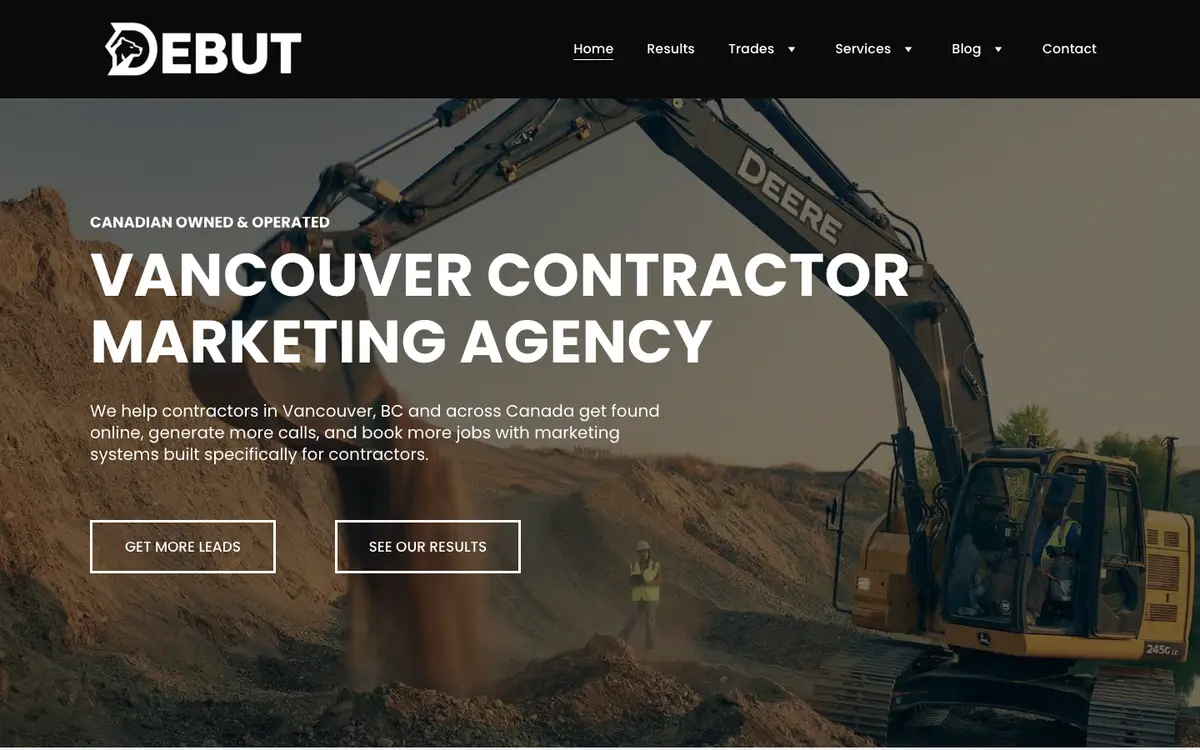
Debut Marketing is the newest shop on this list, started in 2024 by Evan Striemer out of Vancouver. The trade list is wide: concrete, HVAC, roofing, plumbing, electrical, painting, landscaping, carpentry, excavation. And two case studies carry a real client name and a real number instead of a logo wall. Valley West Concrete, a Langley concrete contractor, reports a 17X return after three months of new landing pages and local SEO across Vernon and Kelowna. Mack's Flooring, on Vancouver Island, reports $115,000 in added yearly revenue off its first website. But both figures are self-reported by Debut, not audited by anyone outside the agency, so read them that way.
"Valley West Concrete saw a 17X return on investment from new landing pages and local SEO within three months, without any paid ad spend."
Debut Marketing (2026)
Where they're strongest: Breadth. Clutch lists a $5,000 minimum project and $100 to $149 an hour, in line with the lower end of this list's published pricing, and the trade coverage runs wider than any specialist shop here.
What to consider: The company is barely two years old with a two-to-nine-person team, and Clutch shows exactly one verified review against Debut's own claim of 30-plus testimonials on its site. Their own homepage runs on Astro. No pricing is published beyond Clutch's third-party estimate.
Best for: A contractor in almost any trade who needs a first website and local SEO fast, on a budget starting around $5,000, and doesn't yet need conversion-rate work layered on top.
"The construction industry spends approximately 1% of revenue on marketing, against a cross-industry average of 7.7%."
CMO Survey and Gartner (2025)
"64% of homeowners say having recommendations or references is a top-three factor in choosing a contractor."
Houzz Inc. (2025)
Where construction websites actually score today
"We'll improve your website" means nothing without a scale. Fervor's Contractor CRO Index grades 380 contractor websites against a published framework, and the distribution is not flattering. 323 of them land at C or worse, which is 85% of the roster. Only 2 got every fundamental right. The median site sits at 70 out of 100.
Hold that distribution in your head while you shop. A site sitting at 70 out of 100 usually isn't starved of visitors. It's leaking them. And most of the leaks are boring and mechanical: a form nobody wants to fill out, a phone number that disappears on mobile, a hero image that takes four seconds to paint on jobsite LTE. Which trade you're in changes which leak hits you first, so the fix list a roofer needs is written separately from the one a remodeler does.
"53% of mobile users abandon sites that take longer than 3 seconds to load."
Google / SOASTA (2017)
Half the traffic gone before the page finishes drawing. Now picture paying an SEO retainer to send more people into that. It's why the first question to ask any agency isn't "what will you do" but "what will you measure first".
How to pick the right construction marketing agency
The category sorts into three buyer paths, and picking the wrong path costs more than picking the wrong agency inside the right one.
Path 1: You bid commercial and institutional work
Your conversion event isn't a booked service call. It's a qualified invitation to bid, decided by a developer, an architect, or a facilities manager screening six firms on credibility before anybody talks price. So you need proof of similar scope, documentation somebody can forward internally, and a contact path that survives procurement. Construction Marketing Inc. fits when the creative assets are the weak link. Straight North fits when you're already spending on paid media and can't tell which inquiries were real. And check the form on your own bid-request page while you're at it. Baymard found that 68% of users would not submit a form that requested too much personal information.
"68% of users would not submit a form if it required too much personal information."
Baymard Institute (2024)
Path 2: You run a specialty trade
Concrete, foundation repair, flatwork, waterproofing, specialty coatings. Generalist agencies write your pages without knowing your vocabulary, and the wrong vocabulary is invisible to you and obvious to your buyer. Concrete Marketing Crew fits the visual, social-led side of decorative concrete. Foundational Marketing Hub fits foundation repair local search. Both of those buyers should also check whether their project portfolio is doing the work it's supposed to.
"47% of homeowners look for pros with experience in projects of similar scope (not style) to theirs. 39% look for pricing that works for their budget."
Houzz Inc. (2025)
Scope, not style. So the gallery of your prettiest pour does less work than a page saying plainly that you've done eleven driveways that size in that neighbourhood. Most specialty trade sites have it backwards.
Path 3: You're a general contractor selling to homeowners
Additions, whole-house work, custom builds, design-build. Long consideration windows, big ticket sizes, and a buyer quietly terrified of picking wrong. Comrade and Nomadic both fit here on the traffic side. Fervor fits when the traffic already exists and the conversion doesn't.
"When looking for pros, homeowners' biggest struggles are: finding someone they trust (48%), getting clear/detailed proposals (34%), and timely/accurate communication (30%)."
Houzz Inc. (2025)
Trust, proposal clarity, and communication. Not one of those three is a traffic problem. They're all things your website either demonstrates in the first thirty seconds or fails to.
The gap almost no construction agency quotes on
Here's a category of defect that shows up on the scoring sheet and almost never shows up on an agency proposal. Across the 380 sites in Fervor's State of the Industry group, 95.8% carry at least one serious WCAG accessibility violation and 61.3% carry at least one critical violation. That's 364 sites with a serious failure sitting in the markup right now.
And before anybody writes this off as a compliance footnote, it isn't only contractors. The problem is the entire web, which is exactly why nobody treats it as a differentiator.
"96.3% of the top 1 million homepages had detectable WCAG 2 failures. Average of 56.8 errors per page."
WebAIM (2025)
A contrast failure on a "Request a Bid" button is not an abstract legal risk. It's a button somebody couldn't read on a phone in daylight. Ask any agency you're interviewing whether they run an accessibility audit as part of a build, and watch how fast the answer turns into a sentence about plugins. The full per-trade breakdown lives on the contractor conversion statistics page if you want the numbers behind the chart.
Methodology
How this list was built
Every Fervor figure on this page traces to the Contractor CRO Index (n=380 scored contractor websites) and the Digital State of the Industry reports covering roofing, HVAC and remodeling: 85% of graded sites at C or worse, a median score of 70 out of 100, 95.8% carrying a serious WCAG violation and 61.3% carrying a critical one across the 380-site group. Third-party statistics come from the Fervor published source list and link to the original source.
"Best construction marketing agency" and "best construction marketing agency for my kind of construction company" are different questions. The first rewards breadth, headcount, and how well a firm ranks for the phrase itself. The second rewards knowing what a bid invitation is worth, why a concrete buyer behaves nothing like an HVAC buyer, and which trade vocabulary a page has to carry. The criteria below skew hard toward the second question.
Scored against: construction-domain depth (has the firm actually worked in general contracting, concrete, foundation or commercial construction?), transparency (published pricing, real case studies with numbers, terms you can read before a call), service shape (creative and brand assets vs traffic generation vs conversion work vs outbound), buyer-size fit (whether the firm serves an $800K specialty crew or a $50M commercial builder, because almost nobody serves both well), and original research (published, checkable data vs a services page with the word CRO on it).
Excluded: Abstrakt Marketing Group (outbound B2B lead generation across many industries, with solar as the named vertical rather than construction); Anchour (branding-first creative shop, solar vertical, no construction-specific practice); 253 Media (Webflow and Shopify development, portfolio leans ecommerce and DTC); Summit Digital Marketing ($10,000/month minimum across 70+ industries, which prices out most construction companies); Geek Powered Studios, Easy Mode Media, Concrete Marketing, Concrete Marketers and Concrete CEO (all real options in their niches, but each overlaps a specialist already ranked above and would have made the list a directory rather than a ranking). Marketing platforms and lead-resale marketplaces are not agencies and were not considered.
Acknowledged: Fervor is on this list, ranked first, under the same criteria as every other agency and written up the same way, with both strengths and limitations. Agency claims about pricing, headcount, and results are sourced from those firms' own sites and public profiles, not independently verified. Where an agency reports its own result (a 3x call volume claim, a leads-per-day figure), it is presented as their claim and labelled that way.
Find out what your site scores before you hire anyone
The Contractor CRO Index publishes the scoring system, the per-brand grades, and the trade-level findings behind the 380-brand data on this page. The statistics page carries the per-trade breakdown. And if you want your own site scored against the same framework before you sign an agency contract, the Site Inspection comes back in about three days with a specific list of structural gaps. Other rankings in this series live on the Fervor blog.
Get My Free Inspection →Questions to ask before hiring a construction marketing agency
What should a construction company look for in a marketing agency?
Evidence that the agency understands how homeowners actually choose a contractor, not just the marketing discipline. Relevant experience, transparent deliverables, measurable KPIs, credible examples and a grasp of calls, estimates and booked jobs matter more than vocabulary.
Should I hire a contractor-specialist agency or a general marketing agency?
A specialist starts ahead because it already understands contractor search behaviour, seasonality, service-area businesses and lead economics. A broader agency is still the better choice when it has stronger expertise in the specific problem you need solved.
What questions should I ask a contractor marketing agency before hiring it?
Ask what it will actually change, which metrics it will be accountable for, how reporting works, whether the work is outsourced, who owns the website and marketing assets, what happens if performance stalls, and how it tells a traffic problem apart from a conversion problem.
How much should a construction company pay for marketing?
Pricing swings widely on market competition, scope, number of locations and whether the agency is doing strategy, execution or both. Compare the scope and the expected business outcome rather than the monthly fee on its own.
Why is my construction website getting traffic but not enough calls?
Traffic does not guarantee leads. Visitors run into weak calls to action, poor mobile usability, unclear service information, thin trust signals, confusing forms, slow pages or a mismatch between the search intent and the landing page. At that point, buying more traffic just sends more people into the same problem.
Should contractors invest in SEO or CRO first?
It depends entirely on where the bottleneck sits. A contractor with little qualified traffic needs acquisition work first. A contractor already pulling meaningful search traffic but booking few jobs should investigate conversion before buying more traffic.
What makes a good construction website?
It makes clear within seconds what the company does, where it works and how a homeowner takes the next step. Then it needs strong mobile usability, trust signals, real service information, fast access to phone and booking actions, and a structure that lets individual services and markets rank.
How do I know whether an SEO agency is actually generating business results?
Rankings and traffic have to connect to commercial outcomes. Track qualified calls, estimate requests, booked appointments and, where you can, revenue, rather than judging the work on keyword positions alone.
Fervor's full cross-trade dataset lives in the CRO Index statistics.
 Sep 28, 2026
 Agency Selection
Best Concrete Contractor CRO Agencies in 2026
A concrete site quietly serves two different buyers: a homeowner picking a patio pattern and a GC scoping a foundation pour. Here are 5 CRO agencies scored on the split.
Read Article Sep 27, 2026
 Agency Selection
Best Deck Builder CRO Agencies in 2026
Deck projects concentrate into a hard spring rush most builder sites are not built to catch. Here are 5 CRO agencies scored on whether they solve for it.
Read Article Sep 27, 2026
 Agency Selection
Best Landscaping CRO Agencies in 2026
A landscaping site has to sell a five-figure hardscape build and a renewing maintenance contract at the same time. Here are 5 CRO agencies scored on the split.
Read Article