Best Construction Company Websites in 2026
Five construction company websites scored on a published 100-point framework. What they do well, and the tests to run at any traffic level.
Construction buys differently than home services. Nobody calls a builder at 2am. Instead somebody spends weeks shortlisting, pulls three bids, and quietly checks whether your website makes you look like a company that finishes. So the five below were ranked against 276 building-trade contractor websites on the same published framework, and the order is whatever the scores said it was.
Construction spends about 1% of revenue on marketing where the cross-industry average sits near 7.7%.
The five best construction company websites, ranked
No. 1 · Best overall, and the only A in the building trades
Crown Industrial Roofing
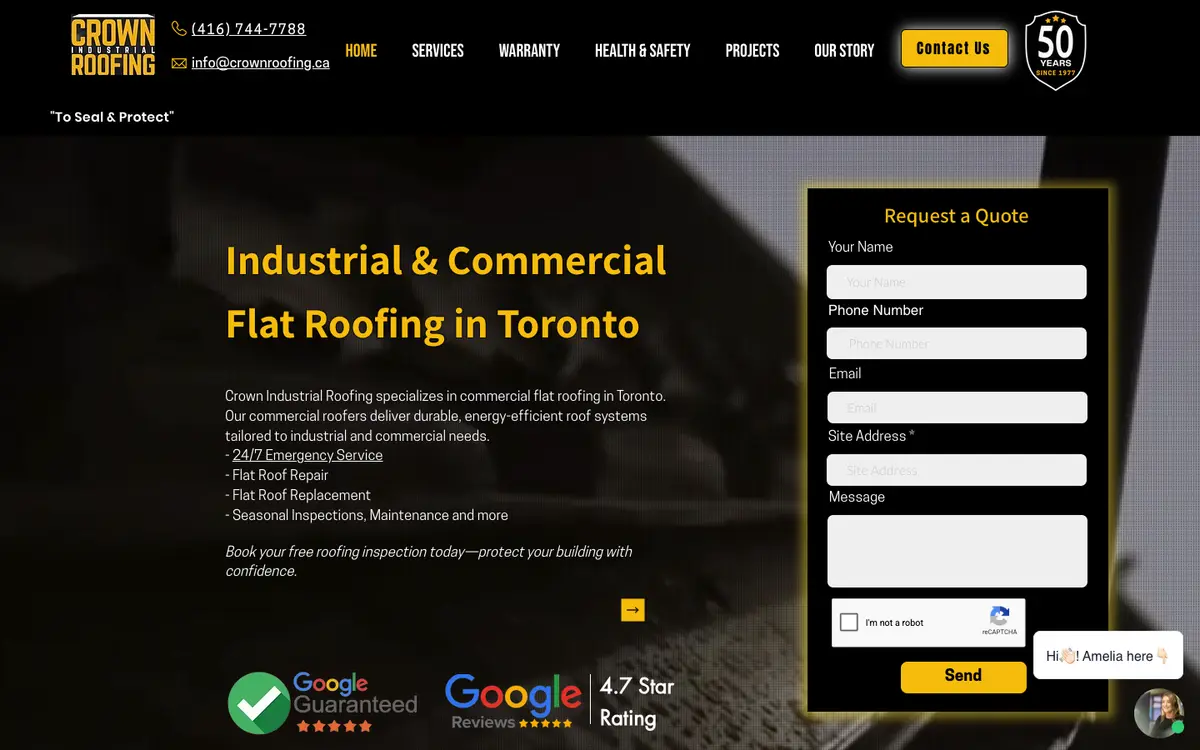
- First impression 18/20
- Trust and credibility 19/21
- Lead capture 17/20
- Mobile experience 13/15
- Content and SEO 14/15
- Accessibility 8/8
No. 2 · Best lead capture of any building-trade site
Great Canadian Roofing, Siding, Exteriors
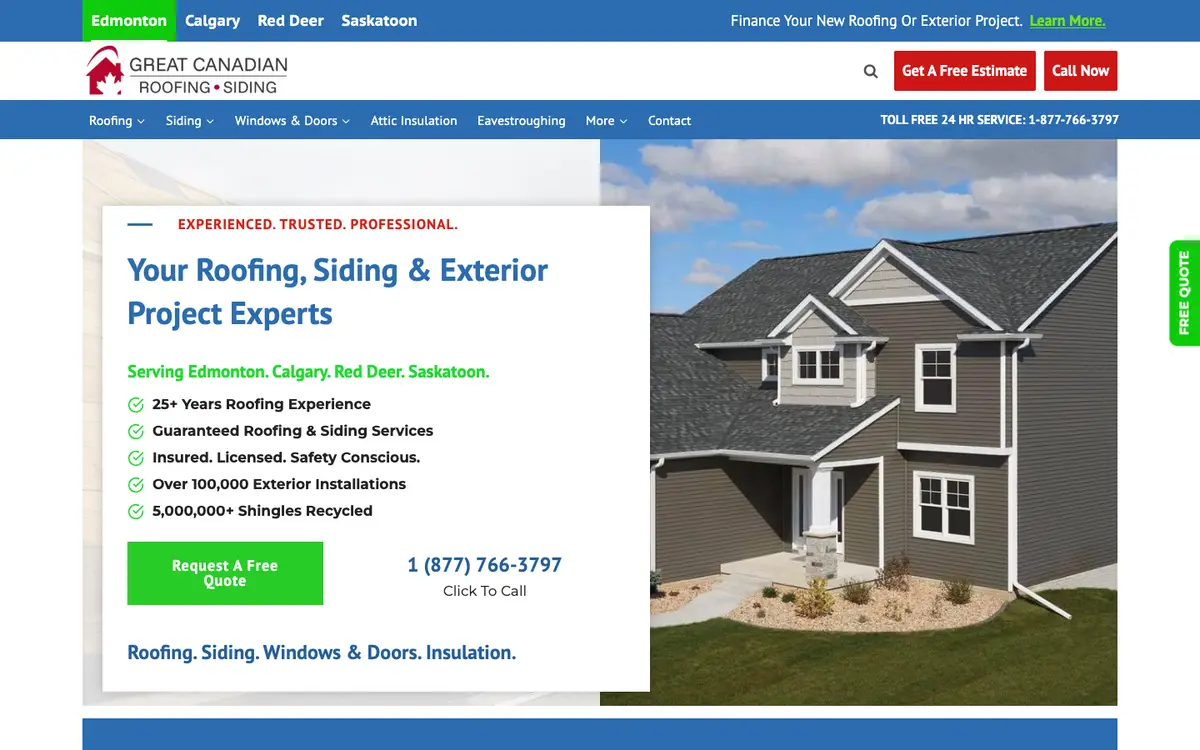
- First impression 18/20
- Trust and credibility 19/21
- Lead capture 19/20
- Mobile experience 12/15
- Content and SEO 14/15
- Accessibility 6/8
No. 3 · Best trust stack in the entire roster
Wegner Roofing & Solar
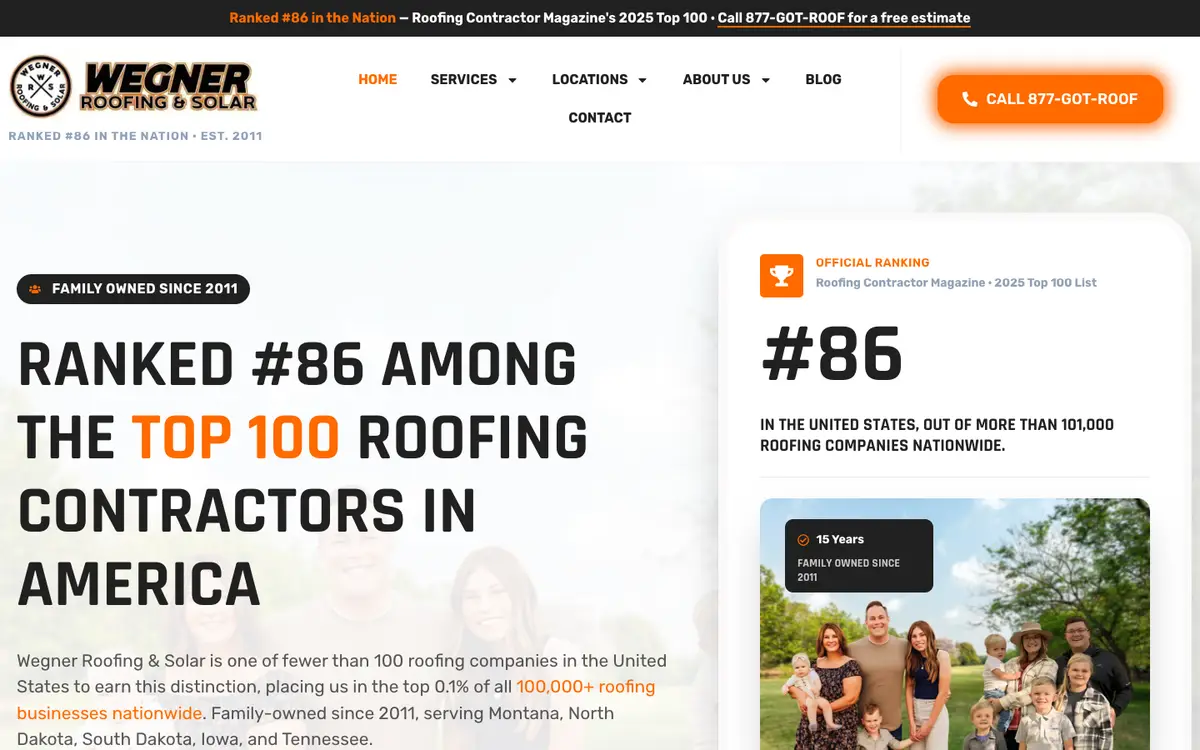
- First impression 17/20
- Trust and credibility 21/21
- Lead capture 18/20
- Mobile experience 14/15
- Content and SEO 13/15
- Accessibility 4/8
No. 4 · Best opening screen for a design-build firm
Capable Group Inc.
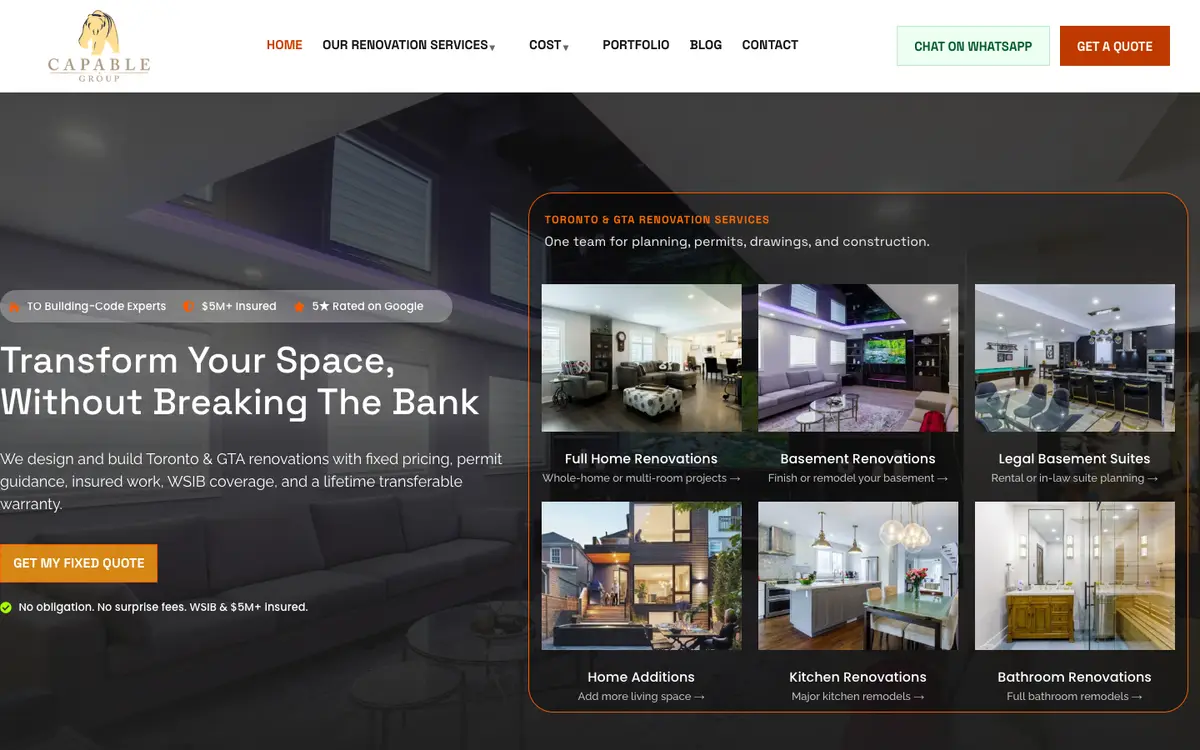
- First impression 18/20
- Trust and credibility 17/21
- Lead capture 16/20
- Mobile experience 12/15
- Content and SEO 12/15
- Accessibility 4/8
No. 5 · Best single-category positioning
Garage Living
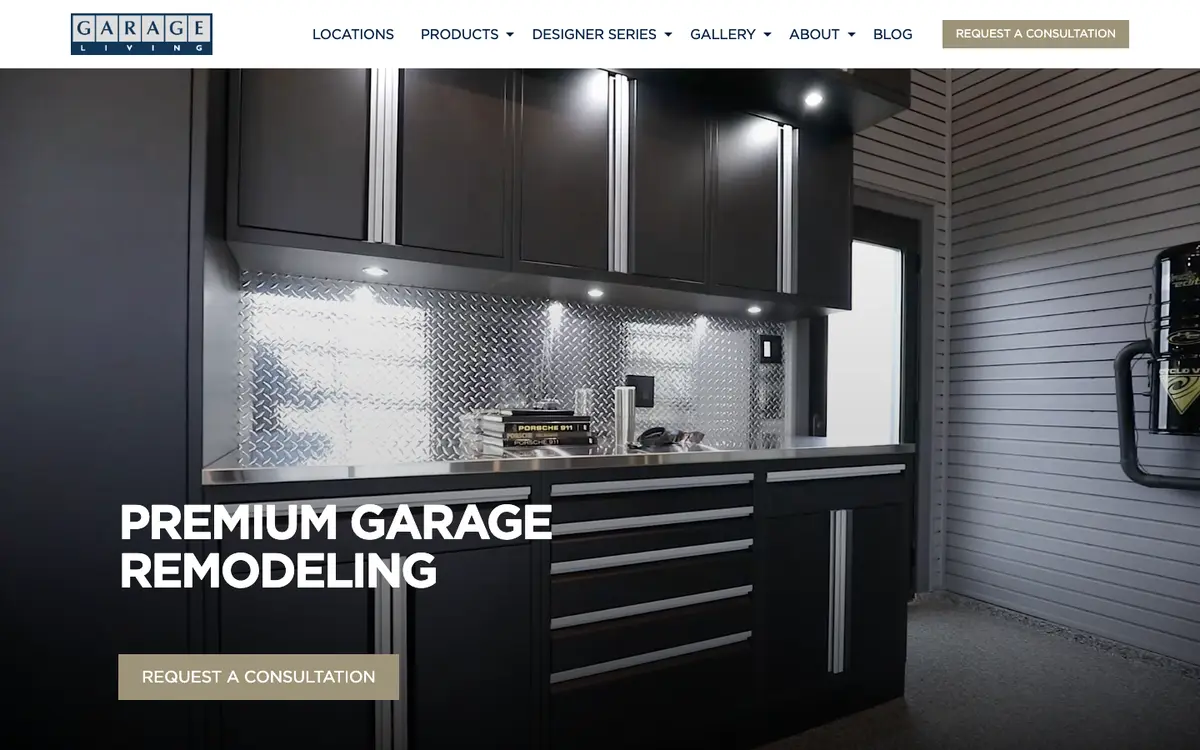
- First impression 18/20
- Trust and credibility 18/21
- Lead capture 16/20
- Mobile experience 13/15
- Content and SEO 11/15
- Accessibility 4/8
Trust is the reported bottleneck, named by 48% of homeowners, ahead of clear proposals at 34% and communication at 30%.
"Homeowners' biggest struggles are finding someone they trust (48%), getting clear and detailed proposals (34%), and timely, accurate communication (30%)."
Houzz Inc. (2025)
How these five were picked, and why the scored group is scoped
A word on the sample, because it changes what the ranking means. Fervor's full roster covers 380 contractor websites across three trades, but two of those trades build and one of them services. Ranking a construction firm against an emergency HVAC site would compare two different buying motions, so this page uses the 276 roofing and remodeling sites only. And that scoping is the reason a couple of names here differ from our cross-trade lists.
Six weighted categories carry the score: first impression, trust and credibility, lead capture, mobile experience, content and SEO, and accessibility. One company in the scored group cleared 90, which is where the A band begins. Everything else on this list is a B, and the median building-trade site scored 70. So "best" here means measurably ahead of a weak field, which is a more useful thing to know than a compliment.
References outweigh anything you write about yourself, with 64% of homeowners calling them a top-three factor in choosing a contractor.
"64% of homeowners say having recommendations or references is a top-three factor in choosing a contractor."
Houzz Inc. (2025)
Why these five convert
Crown Industrial Roofing tops the scored group at 90 and it does it without a single category maxed out. Content and SEO at 14 out of 15 and accessibility at 8 out of 8 are both the strongest of this group, which is the profile of a site built to be found and then to be usable once found. Not a site built to win a design award. The Crown Industrial Roofing Site Inspection walks the page roles that produced it.
Great Canadian Roofing, Siding, Exteriors posts 19 out of 20 on lead capture, the highest in the building trades. And Wegner Roofing & Solar carries 21 out of 21 on trust, which is the highest trust score anywhere in the roster. Two different bets: one company makes it easy to start a conversation, the other makes it obvious you should. Both land in the top three. The trust bet is the harder one to copy, and the Wegner Roofing & Solar Site Inspection shows what it took.
Then Capable Group Inc. and Garage Living arrive from the remodeling side with a 18-out-of-20 first impression each. Which tells you something about how a construction buyer reads a homepage: the opening screen carries more weight when the transaction is large and infrequent, because there is no second chance at a first bid.
The first judgement lands in about 50 milliseconds, well before anyone reads a word.
"Users form a visual judgment about a website's design within 50 milliseconds."
Lindgaard, Fernandes, Dudek and Brown (2006)
What they did well
- The work is qualified before it's shown. Every one of the five signals project type and scale early, which filters a bid list down to jobs worth quoting.
- Credibility is structural, not a logo strip. The trust scores in this group run from 17 to 21 out of 21, well clear of the scored group norm.
- Somebody wrote the service pages on purpose. Content scores here cluster high, and in a trade averaging 1% of revenue on marketing, published depth is close to a free win.
- The enquiry path assumes a long decision. The best lead-capture scores belong to sites that let a visitor start small rather than demanding a full project brief up front.
- Accessibility is not an afterthought at the top. Crown Industrial Roofing at 8 out of 8 shows the ceiling is reachable, and most of the scored group is nowhere near it.
Accessibility failures are close to universal, detectable on 96.3% of the top million homepages.
"96.3% of the top 1 million homepages had detectable WCAG 2 failures."
WebAIM (2025)
What to A/B test if you get 16,000+ visitors a month
Here is where that number comes from, since construction sites in particular tend to be told to A/B test things they cannot possibly measure. At a 5% enquiry rate, detecting a 20% relative lift at 95% confidence and 80% power needs roughly 8,200 sessions per variant, so about 16,300 across two variants in a four-week window. A regional builder doing forty projects a year will not see that. If you do, these are the tests worth the traffic.
- Project scale stated in the hero versus a general capability statement (for example "Commercial builds from 20,000 sq ft" against "Building excellence since 1994"). You want fewer, better-qualified bids, not more enquiries.
- A named project lead with a photo versus a company-level about block on the primary service page.
- Completed-project detail pages versus a single combined portfolio grid, since the individual page is the thing that ranks and the grid is the thing that looks tidy.
- A short enquiry form versus a full project brief. The average form flow runs well past what anyone finishes, and construction forms are among the worst offenders.
- Trade credentials and bonding details in the header versus buried on a credentials page.
Form length decides more than copy does, because 68% of people will not submit a form that asks for too much personal information.
"68% of users would not submit a form if it required too much personal information."
Baymard Institute (2024)
What to test instead if you get fewer than 16,000 visitors a month
Which describes nearly every construction company reading this. Low traffic makes quantitative A/B testing impractical, so the goal shifts to usability testing, semi-structured interviews, and observational testing. You are gathering directional feedback, learning the mindset a prospect arrives with, and finding the underlying friction points. And in construction you have an advantage most industries don't: you can run these sessions with people who have actually hired a builder, because your past clients will take the call.
- Whether your project scale is legible
Method: five-second impression test with a comparative group.
Execution: show two groups of six the homepage for five seconds, one with a scale-qualified headline and one with a general one, then ask each to describe the size of job this company handles.
Key question: "In your own words, what size of project is this company built for, and would they be interested in yours?" - What signals a builder will actually finish
Method: observational scan-path study with a think-aloud overlay.
Execution: watch six participants browse without a task and note whether bonding, licensing, insurance, or completed-project evidence registers before they leave the first screen.
Key question: "What on this page tells you these people finish on time and on budget?" - Whether the portfolio answers or raises questions
Method: task-based comprehension and expectation audit.
Execution: ask participants to pick the project most like theirs and explain what it probably cost and how long it took, then compare their guesses against reality.
Key question: "Looking at this work, do you know what your version of it would cost, or are you still guessing?" - The hesitation before requesting a bid
Method: friction identification protocol.
Execution: bring participants to the moment before submitting an enquiry and have them voice every concern, separating worries about commitment from worries about being sold.
Key question: "Right before you send this, what do you think happens next, and does that put you off at all?" - Decision clarity when there is more than one path
Method: path-finding and decision clarity test.
Execution: show one group a single enquiry route and another a paired route such as "Request a bid" beside "Book a site visit", then observe which group names a clear next step unprompted.
Key question: "Given these options, what's your next move, and does anything feel like it's pushing you further than you're ready to go?"
Placement decides what gets read, with 57% of viewing time above the fold and 74% inside the first two screenfuls.
"57% of page-viewing time is spent above the fold, and 74% of viewing time is spent in the first two screenfuls."
Nielsen Norman Group (2024)
What separates the top five from the median construction site
The median building-trade site scored 70 against Crown Industrial Roofing at 90. And almost none of that spread is money. The five above answer scope, then credibility, then process, in an order a person shortlisting three builders can follow. The middle of the scored group opens with a mission statement and leaves the evidence somewhere below the fold, which is a problem when most of the viewing time never gets there.
So if you take one thing from this: your website is not competing on beauty. It's competing against two other bids from companies the buyer also cannot verify. Whichever site makes verification easiest tends to get the call. Which is the test we put every firm through in the ranking of the construction marketing agencies, if you're hiring rather than building.
Methodology
How this ranking was built
Every company here was scored as part of the Contractor CRO Index, which grades 380 contractor websites against a published framework across six categories. This page ranks the 276 building-trade sites within that roster, documented in the State of Roofing and State of Remodeling reports. Ranks are computed from the dataset at build time.
Scored against: first impression, trust and credibility, lead capture, mobile experience, content and SEO, and accessibility, each weighted and each assessed across several captured pages rather than the homepage alone.
Excluded: mechanical service trades, because an emergency service buying motion is not a bid-cycle buying motion and mixing them would make the ranking less useful to a builder, not more.
Acknowledged: Fervor publishes the framework behind these ranks, so this is not an independent survey and we would rather state that than imply otherwise. Every score is reproducible from the public index. The write-ups describe what the scoring measured rather than a visual review of each site, and nothing here should be read as a claim about a page element we did not measure. Grades follow American school bands, so an A begins at 90.
Nobody reads a service page start to finish. About 79% of users scan it, and only 16% read word by word.
"79% of test users always scanned any new page they came across; only 16% read word-by-word."
Nielsen Norman Group (2024)
Want your construction site scored the same way?
The Contractor CRO Index publishes the scoring system and the per-brand grades behind this ranking. If you want your own site run through the same six categories, the Site Inspection returns a specific list of structural gaps rather than a score on its own.
Get My Free Inspection →What to check on your own construction website
What makes a good construction website?
It makes clear within seconds what the company does, where it works and how a homeowner takes the next step. Then it needs strong mobile usability, trust signals, real service information, fast access to phone and booking actions, and a structure that lets individual services and markets rank.
Can a beautiful contractor website still perform poorly?
Routinely. Visual quality and commercial performance are different things. A site can look premium while burying the phone number, weakening its calls to action, hiding service information or adding friction before an estimate request.
Why is my construction website getting traffic but not enough calls?
Traffic does not guarantee leads. Visitors run into weak calls to action, poor mobile usability, unclear service information, thin trust signals, confusing forms, slow pages or a mismatch between the search intent and the landing page. At that point, buying more traffic just sends more people into the same problem.
Should a construction company redesign its website or optimize the existing one?
A full redesign is often unnecessary. If the site is technically sound and already receives meaningful traffic, targeted conversion work is usually faster and cheaper. A redesign earns its cost when structure, technology, branding or user experience block incremental improvement.
Does web design affect local SEO?
Yes, sometimes directly. Site architecture, mobile usability, crawlability, internal linking, page speed and the way service and location content is organised all feed search performance.
Are service pages or city pages more important for contractor SEO?
They do different jobs. Service pages establish what the contractor does; location pages establish where. Strong local SEO usually needs an architecture that connects both rather than a choice between them.
What is conversion rate optimization for contractors?
Contractor CRO is the work of increasing the share of existing visitors who become calls, estimate requests or booked appointments. It covers messaging, trust signals, page structure, mobile experience, calls to action, forms and booking flows.
Should contractors invest in SEO or CRO first?
It depends entirely on where the bottleneck sits. A contractor with little qualified traffic needs acquisition work first. A contractor already pulling meaningful search traffic but booking few jobs should investigate conversion before buying more traffic.
Fervor's full cross-trade dataset lives in the CRO Index statistics.
 Sep 28, 2026
 Agency Selection
Best Concrete Contractor CRO Agencies in 2026
A concrete site quietly serves two different buyers: a homeowner picking a patio pattern and a GC scoping a foundation pour. Here are 5 CRO agencies scored on the split.
Read Article Sep 27, 2026
 Agency Selection
Best Deck Builder CRO Agencies in 2026
Deck projects concentrate into a hard spring rush most builder sites are not built to catch. Here are 5 CRO agencies scored on whether they solve for it.
Read Article Sep 27, 2026
 Agency Selection
Best Landscaping CRO Agencies in 2026
A landscaping site has to sell a five-figure hardscape build and a renewing maintenance contract at the same time. Here are 5 CRO agencies scored on the split.
Read Article