Best Home Builder Marketing Agencies in 2026
Ten home builder marketing agencies ranked on community launches, model home traffic and long sales cycles. Who fits custom, who fits production.
Search "home builder marketing agency" and you get two very different kinds of firms in one list. Shops that have lived inside new-home sales for decades, and shops that added "home builders" to a services page last year. That gap matters more in building than in any other trade, because a builder's website carries a job no roofing site carries. It has to hold a buyer's attention for most of a year, show which lots are still open, let someone walk a floor plan at 11pm on a Tuesday, and hand an already-informed name to a sales counselor in a model home. So this ranking scores ten agencies on that job: interactive floor plans, live lot and pricing inventory, CRM depth, and whether the firm has watched a buyer go quiet for six weeks and come back ready to sign.
Construction spends about 1% of revenue on marketing where the cross-industry average sits near 7.7%.
The 10 home builder marketing agencies, ranked
Each entry links to a deeper head-to-head in our agency guide. And a note on the ordering: this isn't a ranking of which firm is "best" in the abstract. It's a ranking of fit against the new-home buying cycle, which is long, staged, and almost never linear. The Census Bureau puts the average custom build alone at nearly a year, and that's after the buyer has picked you. If your work sits closer to general construction than to new-home sales, the construction marketing agencies are the better-matched list.
"Custom home: average build timeline: 11.9 months"
U.S. Census Bureau (2025)
Add the research and selection window in front of that build, and your website is doing sales work for well over a year per buyer. Most contractor marketing advice is written for a two-day decision. Yours isn't.
Remodeling buyers take their time, spending about 9.6 months planning a kitchen against 5.1 months building it.
No. 1 · Best for turning the website into a virtual sales center
ONeil Interactive
ONeil built Homefiniti, the platform name most people inside builder marketing recognize on sight. Floor plan customization, real-time lot availability, virtual tours, and lead capture all run inside one engine rather than four bolted-together plugins. And their client list includes Top 200 builders, so the platform holds up at community volume.
Where they're strongest: The website behaving like a sales center instead of a brochure. If your buyers expect to configure a plan and check lot availability before they call, this is the shortest path there.
What to consider: The engagement is a platform license plus monthly services, so you're adopting their stack, not just their strategy. Conversion optimization isn't among their named specialties either, so testing and measurement are yours to insist on.
Best for: Production builders and multi-community operators who want an industry-standard builder platform rather than a custom build.
Deep dive: ONeil Interactive vs. Fervor Studio
References carry more weight than any headline you write, with 64% of homeowners calling them a top-three factor in choosing a contractor.
"64% of homeowners say having recommendations or references is a top-three factor in choosing a contractor."
Houzz Inc. (2025)
No. 2 · Best builder depth backed by published scored data
Fervor Studio
Fervor is the only firm on this list that publishes the framework it scores sites against. The Contractor CRO Index grades 380 contractor websites across six conversion-readiness categories, and the State of Remodeling and State of Roofing reports break the failure patterns out trade by trade. So when a recommendation lands in your inbox, you can trace it back to a number you can go check yourself. Booked by Design runs $7,497 to $19,997 depending on trade, over 30 to 60 days.
Where they're strongest: Diagnosis before build. The Site Inspection returns a specific list of structural gaps scored against the same public framework, which helps when you already have a site full of floor plans and still can't tell where the buyer drops out.
What to consider: Fervor is contractor-only, so it's the wrong call outside home services. And the diagnostic-led model moves at a different pace than a 200-person full-service retainer. If you want a proprietary builder platform with lot inventory baked in, the specialists below own that ground.
Best for: Builders who already have a site and want the conversion gaps named with evidence before anyone rebuilds anything.
Deep dive: Booked by Design™ · The Site Inspection
Trust is the reported bottleneck, named by 48% of homeowners, ahead of clear proposals at 34% and communication at 30%.
"Homeowners' biggest struggles are finding someone they trust (48%), getting clear and detailed proposals (34%), and timely, accurate communication (30%)."
Houzz Inc. (2025)
No. 3 · Best for real-time lot availability and pricing
Blue Tangerine
Blue Tangerine has run web design and digital marketing exclusively for home builders for more than twenty years, and they're known for the interactive site plan that updates continuously. Which lot is open. What it costs. Right now, without a phone call. That sounds small until you count how many buyer conversations stall on those two questions.
Where they're strongest: Removing the back-and-forth that stretches your sales cycle. Buyers reach the sales office already knowing what's available and what it costs.
What to consider: Pricing isn't published, so you'll be in a custom-retainer conversation from the first call. And like most builder specialists here, conversion optimization isn't among their listed services, so the tooling is strong but the testing discipline is on you.
Best for: Builders selling from defined communities where lot inventory and price are the buyer's first two questions.
Deep dive: Blue Tangerine vs. Fervor Studio
Worth pausing on why live inventory pays. Buyers screen on scope and budget before style.
"47% of homeowners look for pros with experience in projects of similar scope (not style) to theirs. 39% look for pricing that works for their budget."
Houzz Inc. (2025)
So a site plan showing real prices is screening, not decoration. It answers the budget question before a salesperson has to.
Even a warm referral gets checked, because over 60% of homeowners still research online before making contact.
"Even among homeowners who received a word-of-mouth referral, over 60% do due diligence online before deciding to contact the pro."
Houzz Inc. (2025)
No. 4 · Best for interactive floor plans across many markets
Builder Designs
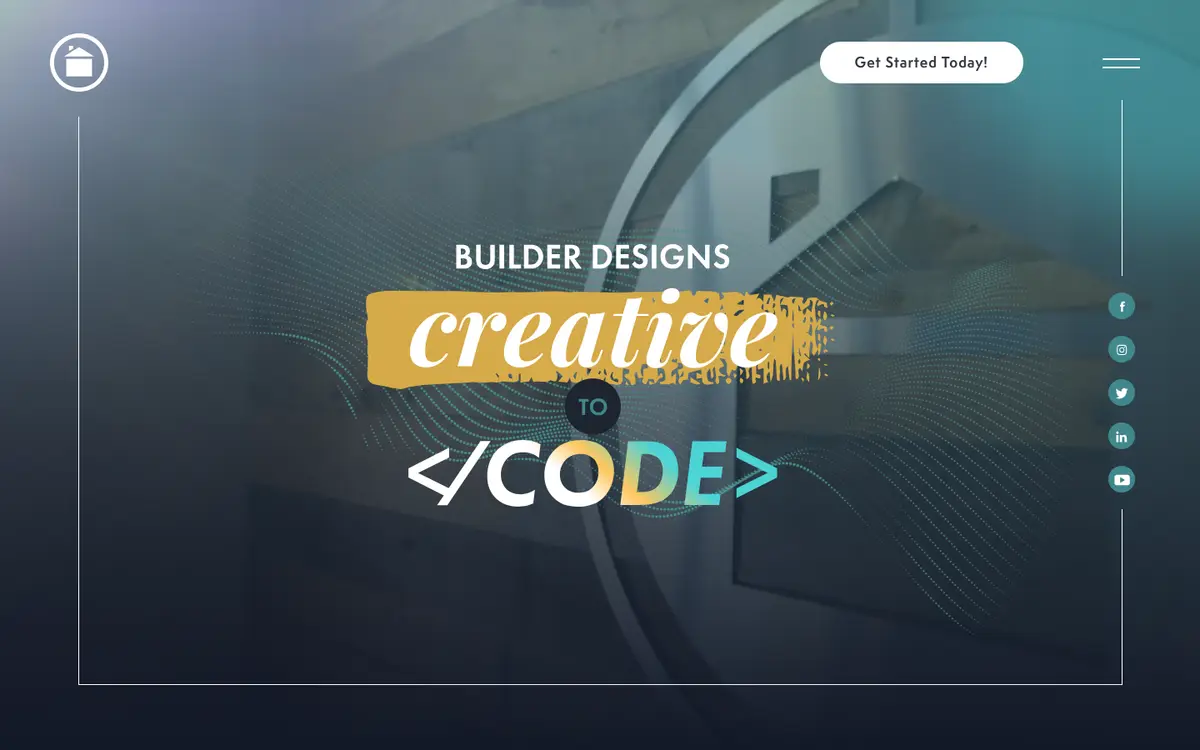
Builder Designs has served home builders in 44 states since 2008, a wider spread than anyone else here can claim. Their signature work is interactive floor plans and community maps that let a buyer explore layouts and lot availability on their own schedule. They also present at NAHB's International Builders' Show, so the ideas get pressure-tested in front of the people who buy them.
Where they're strongest: Interactive tools that pre-qualify. Eighteen years and 44 states means the floor-plan and map patterns have been refined across very different buyers, not one regional taste.
What to consider: Pricing is a custom monthly retainer and isn't published. Their listed specialties cover web design, SEO, PPC, interactive tools, and CRM, but not conversion optimization, so measured lift is not what they sell.
Best for: Builders operating across multiple states or metros who need floor-plan and community tooling that travels.
Deep dive: Builder Designs vs. Fervor Studio
Placement decides what gets read, with 57% of viewing time spent above the fold and 74% inside the first two screenfuls.
"57% of page-viewing time is spent above the fold, and 74% of viewing time is spent in the first two screenfuls."
Nielsen Norman Group (2024)
No. 5 · Best for CRM-heavy nurture across a long buying cycle
SmartTouch Interactive

SmartTouch built NexGen, a CRM designed around how builders actually sell rather than a generic pipeline tool with builder fields bolted on. By their count it has processed over a million leads that turned into more than $2B in new home sales. And they've taken "Best Email Volume Builder" four years running, which matters more than it sounds when your buyer needs months of contact before a contract.
Where they're strongest: Nurture. Geofencing around competitor communities, email sequencing, and a CRM that knows the difference between a lot reservation and a signed contract.
What to consider: You're buying a monthly retainer plus a CRM license, so switching later means migrating your pipeline. And they serve real estate developers alongside builders, so the focus is broader than the builder-only shops above.
Best for: Builders whose leads are plentiful but go cold in month three, and who need the follow-up system more than the website.
Deep dive: SmartTouch Interactive vs. Fervor Studio
Form length is the other one, because 68% of people will not submit a form that asks for too much personal information.
"68% of users would not submit a form if it required too much personal information."
Baymard Institute (2024)
No. 6 · Best for brand strategy with half a century of builder pattern recognition
Group Two Advertising
Fifty years in one vertical. No other agency in any trade Fervor has researched comes close, and Group Two has spent all of it on homebuilders, production and custom alike, including nationally ranked names like Dream Finders Homes. They've watched every rate cycle since the 1970s change how buyers behave, which is institutional memory you can't hire for.
Where they're strongest: Brand strategy and creative for builders who compete on positioning rather than price. When the market turns and everyone else panics into discounting, this firm has seen the turn before.
What to consider: Their model is project-based plus retainer, and the specialty list runs brand, creative, SEO, content, web, and lead generation. Interactive lot and floor-plan tooling isn't the pitch, so if that's your gap, pair them with a platform.
Best for: Established builders whose problem is brand differentiation in a crowded metro, not missing website features.
Deep dive: Group Two Advertising vs. Fervor Studio
"When looking for pros, homeowners' biggest struggles are: finding someone they trust (48%), getting clear/detailed proposals (34%), and timely/accurate communication (30%)."
Houzz Inc. (2025)
Trust leads, and it isn't close. Which is the argument for the next three firms on this list, because each of them attacks the trust problem from a different side: journey design, staffed sales floors, and luxury-buyer psychology.
The judgement happens faster than any agency pitch admits, in roughly 50 milliseconds of looking at the page.
"Users form a visual judgment about a website's design within 50 milliseconds."
Lindgaard, Fernandes, Dudek and Brown (2006)
No. 7 · Best for mapping the buyer journey before touching tactics
Bokka Group
Bokka starts with journey mapping and customer experience consulting rather than a channel plan. They map how buyers research, compare, and decide, then build the marketing around what they found. They've worked with Taylor Morrison and helped Holt Homes reach the Top 100 Builder list, so the strategy work has cashed out at enterprise level, not only in a workshop deck.
Where they're strongest: Strategy before execution. If your marketing is a pile of tactics nobody can connect to a buyer decision, journey mapping is the right first move.
What to consider: Consulting plus a monthly retainer means a slower start and a higher floor than a straightforward website project. And if what you need is a faster site with a working floor-plan tool, this is more process than the problem requires.
Best for: Enterprise and multi-division builders who need the whole buyer experience designed, from first click to move-in.
Deep dive: Bokka Group vs. Fervor Studio
No. 8 · Best for tying model-home selling to digital demand
New Home Star
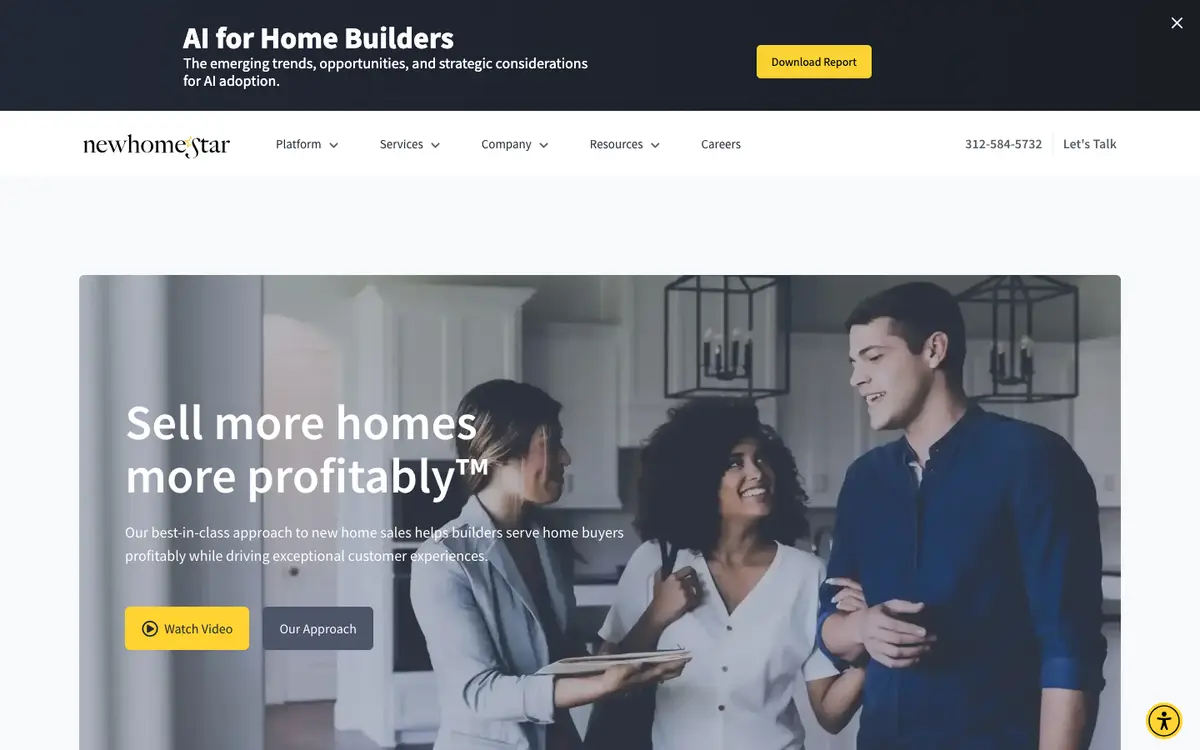
New Home Star does the thing almost no marketing agency will touch. They put trained salespeople in your model homes and run the SEO, PPC, and social that drives traffic to those same doors. One company owns the click and the handshake. So the familiar standoff where marketing blames sales and sales blames marketing has nowhere to live.
Where they're strongest: Full-funnel accountability from click to close, plus HubSpot implementation so the handoff is recorded instead of remembered.
What to consider: You're paying a monthly retainer plus sales team placement fees, and outsourcing the sales floor is a bigger organizational decision than picking a web vendor. Some builders will never want that.
Best for: Builders opening new communities who need staffed model homes and the traffic to fill them at the same time.
Deep dive: New Home Star vs. Fervor Studio
No. 9 · Best for custom and luxury builders
Meredith Communications
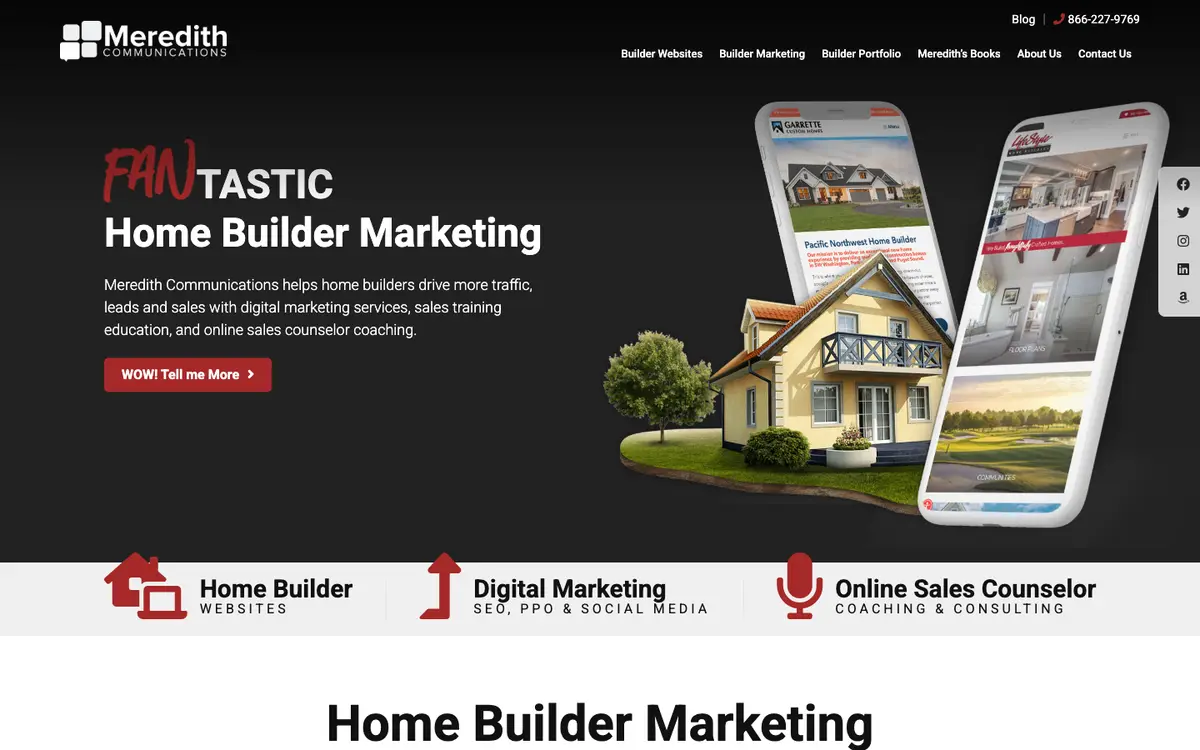
Meredith works only with custom and luxury home builders, and the founder wrote "Click Power" on digital marketing for the building industry. A buyer commissioning an $800,000 custom home behaves nothing like a homeowner booking a repair, and the difference isn't budget so much as patience. Longer research, and far more allergy to anything that smells like volume marketing.
Where they're strongest: High-end buyer psychology. If your last agency kept applying lead-volume tactics to a pipeline of six-figure projects, this firm lives in your actual market.
What to consider: Small team, project-based plus retainer, and the service mix is strategy, web design, and content. No interactive lot inventory, no proprietary CRM, no paid-media machine. Production builders will outgrow the fit fast.
Best for: Custom and luxury builders selling craftsmanship and reputation rather than community inventory.
Deep dive: Meredith Communications vs. Fervor Studio
No. 10 · Best for content-led organic growth
Builder Funnel
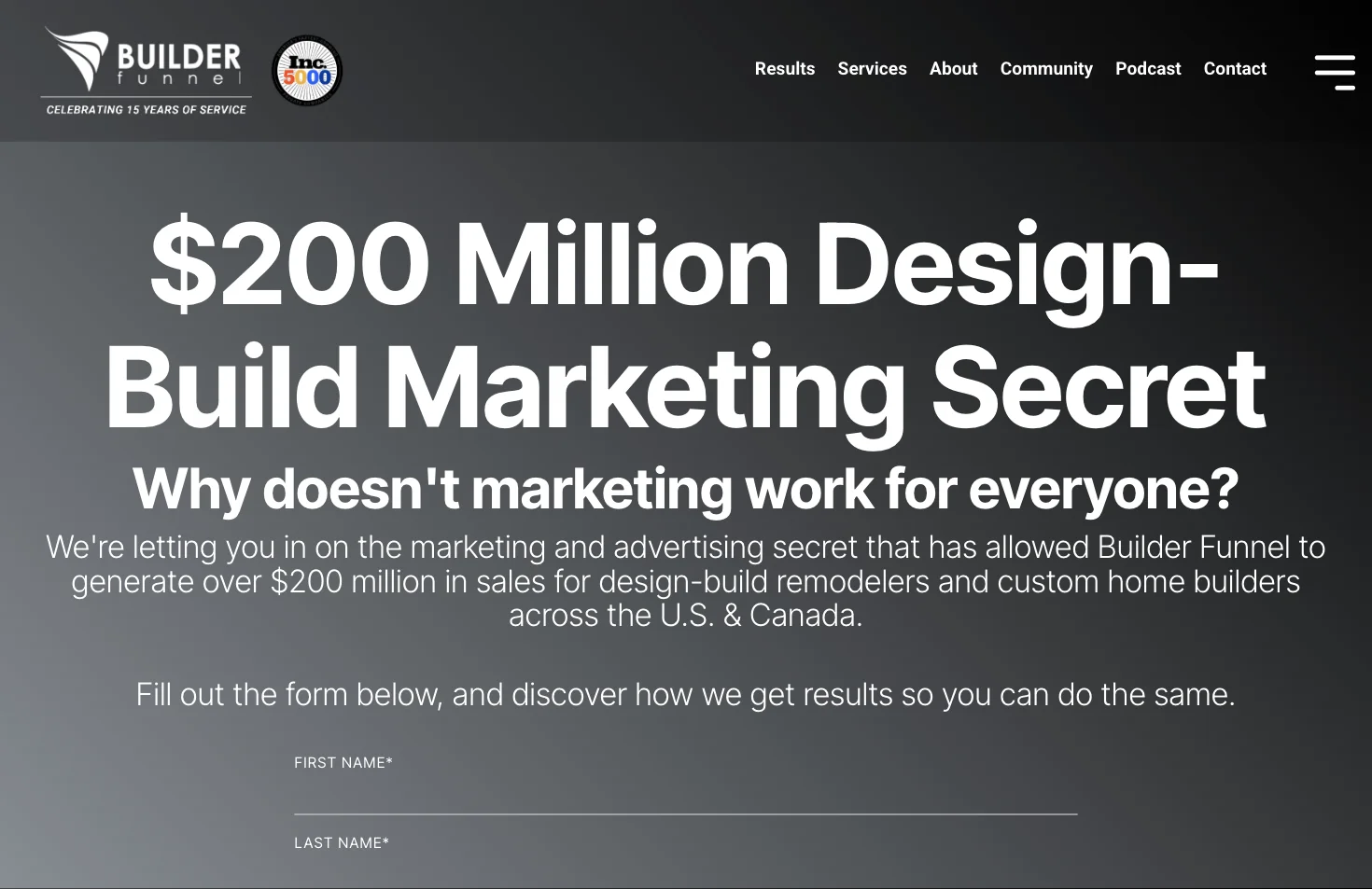
Builder Funnel has spent 12+ years with remodelers and custom home builders on an inbound model. Guides, educational content, HubSpot workflows, all aimed at a homeowner months before they're ready to call. It compounds slower than paid, but it doesn't evaporate the day you pause the budget. And their clients stay 4x longer than the industry average, which is the retention number I'd want from any content shop.
Where they're strongest: Organic traffic that builds over quarters, plus the Remodeler Growth Community, which keeps them in the room where their buyers already talk.
What to consider: Inbound is a long play, and if your community opens in nine weeks it will not carry you. Pricing isn't published. And their focus spans remodelers too, so production builders sit outside the sweet spot.
Best for: Custom builders and design-build firms who want organic demand that keeps working after the ad spend stops.
Deep dive: Builder Funnel vs. Fervor Studio
"The construction industry spends approximately 1% of revenue on marketing, against a cross-industry average of 7.7%."
CMO Survey and Gartner (2025)
"Homeowners spend on average 9.6 months on the planning phase for a kitchen renovation, compared to 5.1 months on the construction phase."
Houzz Inc. (2024)
What the contractor data says about long-cycle websites
Fair warning before the numbers: the Contractor CRO Index group is roofing, remodeling, and HVAC. Home builders are not in it. But remodeling is the closest adjacent trade in the study, and it shares what defines builder marketing: a considered purchase on a multi-month clock. So the patterns below are directional, not a builder census. I'd rather say that plainly than let you assume a sample you weren't given. If you want the builder-specific version rather than the adjacent one, it's on the custom home builder guide.
Start with progressive forms. Across the 380 sites in the combined State of the Industry group, only 3.7% use a multi-step form anywhere. Remodeling leads at 6.4%, roofing sits at 3.1%, HVAC at 1%. For a builder, that's the mechanism that lets a buyer start with "which community" and reach financing three screens later instead of all at once.
Long forms are where considered purchases go to die, and builder forms run long by default: budget, timeline, community, lot, financing status.
"68% of users would not submit a form if it required too much personal information."
Baymard Institute (2024)
But don't read that as "multi-step always wins," because the usability research pushes back. Splitting a form across screens costs something too, and if you split a short form you just made it worse.
"In a usability study of digital form formats, the single-page layout achieved higher usability (average SUS=76) than multi-page (SUS=67) and conversational formats (SUS=57), and had the shortest completion time."
JMIR Human Factors (via ScienceDirect) (2021)
So the honest read: keep the short form short, and save the multi-step treatment for the long one, the lot reservation or the build-your-plan request. Any agency recommending progressive forms for every form on your site is selling a pattern, not a diagnosis.
The second pattern is the free-offer gap. Only 8.7% of the 380 studied sites surface a free inspection or assessment, and the spread is severe: 21.5% in roofing, 4.8% in HVAC, zero in remodeling. Zero. The trade with the longest consideration window gives a hesitant buyer the least reason to raise a hand early.
For builders the equivalent is the low-commitment first step: a design consultation, a lot walk, a build-cost worksheet. Something a buyer eleven months out can say yes to without feeling like they've signed a mortgage. And the online experience carries more of that call than you'd think.
"Over 70% of homeowners report that a strong online presence, including online collaboration tools, is very important in helping them decide which professional to hire."
Houzz Inc. (2025)
Every measurement behind these figures sits on the Contractor CRO Index statistics page, method attached, across all 380 studied sites.
How to pick the right agency for your building company
Builders get into trouble the same way contractors do, by picking a vendor before picking a problem. Three paths cover nearly every case.
Path 1: Your website can't show inventory
Buyers keep calling to ask which lots are open and what they cost, and your sales team burns hours on questions a page could answer. So you need platform capability, not brand work. ONeil Interactive, Blue Tangerine, and Builder Designs all stake their reputation on interactive floor plans, community maps, and live lot inventory. Pick on whether you want an established platform (ONeil), live pricing depth (Blue Tangerine), or multi-market reach (Builder Designs).
Path 2: You get leads and lose them in month three
Traffic is fine. Form fills are fine. But the pipeline leaks somewhere between the first inquiry and the contract, and nobody can tell you where. That's a diagnostic problem before it's a marketing problem. Fervor's Site Inspection names the structural gaps on the site side, SmartTouch's NexGen CRM handles the nurture side, and Bokka's journey mapping covers the case where the leak sits in the experience itself. Review volume is worth checking here too.
"Displaying five or more reviews on a product page lifts conversion rates by up to 270% compared to product pages with zero reviews."
Spiegel Research Center, Northwestern University (2017)
Path 3: You have referrals but no digital credibility
Word of mouth still fills your calendar, and you've decided the website is a formality. It isn't, and this is the stat I'd tape to the wall.
"Even among homeowners who received a word-of-mouth referral, over 60% do due diligence online before deciding to contact the pro."
Houzz Inc. (2025)
So the referral gets you searched, not hired. If the search doesn't back up the recommendation, that's brand and content work: Group Two for positioning, Meredith for luxury buyers, Builder Funnel for content that compounds. And if you're staffing new communities at the same time, New Home Star covers the sales floor alongside the demand.
Production builders and custom builders want different things
One more split worth naming, because the SERP keeps mashing these together. A production builder selling from four communities needs inventory tooling, CRM throughput, and paid media that fills model homes on weekends. A custom builder selling eight homes a year needs proof of craft and content that earns trust across a long quiet stretch. Different websites, different agencies.
Production side: ONeil Interactive, Blue Tangerine, Builder Designs, SmartTouch, New Home Star. Custom side: Meredith Communications, Builder Funnel, Group Two. Bokka and Fervor sit across both, because journey mapping and conversion diagnosis apply whether you sell from a lot map or a portfolio. More agency breakdowns in our research and analysis.
Methodology
How this list was built
Every Fervor number here traces to the Contractor CRO Index (n=380 scored contractor websites) and the Digital State of the Industry reports for roofing, remodeling, and HVAC: 3.7% use a multi-step form, 8.7% surface a free inspection offer, and the per-trade splits sit in the two charts above. That group excludes home builders, which the data section says up front rather than burying here.
"Best home builder marketing agency" and "best marketing agency" are different questions. The first rewards new-home domain knowledge: lot inventory, floor plan configurators, model home traffic, sales counselor handoffs, an eleven-month build clock. The second rewards channel breadth and headcount. These criteria skew hard toward the first.
Scored against: builder-domain depth (builders exclusively, or one vertical among many?), inventory and configurator tooling (floor plans, community maps, live lot and pricing data), CRM and nurture capability across a multi-month cycle, published methodology you can read before you buy, and engagement shape (platform license, retainer, project, or sales-team placement).
Excluded: Chatter Buzz Media and LAIRE Digital, both capable inbound shops, but both serving real estate and general construction alongside builders rather than building exclusively. Atlas Marketing, a PR and brand storytelling firm rather than a lead-generation agency by its own positioning. Also A/B testing platforms and any agency with no builder work visible on its own site.
Acknowledged: Fervor is on this list, ranked first, under the same criteria as every other agency and written up the same way, with both strengths and limitations. Agency claims about pricing, headcount, and results are sourced from those firms' own sites and public profiles, not independently verified.
Want your builder site scored before you hire anyone?
The Contractor CRO Index publishes the scoring system, the per-brand grades, and the findings behind the charts above. The State of Remodeling and State of Roofing reports break the conversion-failure patterns down trade by trade. And if you want your own site run through the same framework, the Site Inspection returns a specific list of structural gaps in 5 business days.
Get My Free Inspection →Questions to ask before hiring a home builder marketing agency
What should a home builder company look for in a marketing agency?
Evidence that the agency understands how homeowners actually choose a contractor, not just the marketing discipline. Relevant experience, transparent deliverables, measurable KPIs, credible examples and a grasp of calls, estimates and booked jobs matter more than vocabulary.
Should I hire a contractor-specialist agency or a general marketing agency?
A specialist starts ahead because it already understands contractor search behaviour, seasonality, service-area businesses and lead economics. A broader agency is still the better choice when it has stronger expertise in the specific problem you need solved.
How much should a home builder company pay for marketing?
Pricing swings widely on market competition, scope, number of locations and whether the agency is doing strategy, execution or both. Compare the scope and the expected business outcome rather than the monthly fee on its own.
What makes a good home builder website?
It makes clear within seconds what the company does, where it works and how a homeowner takes the next step. Then it needs strong mobile usability, trust signals, real service information, fast access to phone and booking actions, and a structure that lets individual services and markets rank.
Why is my home builder website getting traffic but not enough calls?
Traffic does not guarantee leads. Visitors run into weak calls to action, poor mobile usability, unclear service information, thin trust signals, confusing forms, slow pages or a mismatch between the search intent and the landing page. At that point, buying more traffic just sends more people into the same problem.
Should contractors invest in SEO or CRO first?
It depends entirely on where the bottleneck sits. A contractor with little qualified traffic needs acquisition work first. A contractor already pulling meaningful search traffic but booking few jobs should investigate conversion before buying more traffic.
What questions should I ask a contractor marketing agency before hiring it?
Ask what it will actually change, which metrics it will be accountable for, how reporting works, whether the work is outsourced, who owns the website and marketing assets, what happens if performance stalls, and how it tells a traffic problem apart from a conversion problem.
How do I know whether an SEO agency is actually generating business results?
Rankings and traffic have to connect to commercial outcomes. Track qualified calls, estimate requests, booked appointments and, where you can, revenue, rather than judging the work on keyword positions alone.
Fervor's full cross-trade dataset lives in the CRO Index statistics.
 Sep 28, 2026
 Agency Selection
Best Concrete Contractor CRO Agencies in 2026
A concrete site quietly serves two different buyers: a homeowner picking a patio pattern and a GC scoping a foundation pour. Here are 5 CRO agencies scored on the split.
Read Article Sep 27, 2026
 Agency Selection
Best Deck Builder CRO Agencies in 2026
Deck projects concentrate into a hard spring rush most builder sites are not built to catch. Here are 5 CRO agencies scored on whether they solve for it.
Read Article Sep 27, 2026
 Agency Selection
Best Landscaping CRO Agencies in 2026
A landscaping site has to sell a five-figure hardscape build and a renewing maintenance contract at the same time. Here are 5 CRO agencies scored on the split.
Read Article