Roofing Website ADA Compliance: The 60.8% That Risk a Lawsuit
60.8% of roofing websites carry a critical accessibility violation. See what roofing website ADA compliance requires, and what failing the WCAG audit costs.
Here's a number that should bother you. Across 130 roofing contractor websites Fervor scored this spring, 60.8% shipped at least one critical accessibility violation. Not a typo, not a rounding artifact. Critical, as the axe-core scanner defines it. So if you run a roofing company and you've never thought hard about roofing website ADA compliance, the odds say your site is already sitting in the failing column with most of the trade.
And you probably can't see it. That's the part that gets people. A contrast failure or a missing form label doesn't show up when you glance at your own homepage on your own laptop. But a screen reader hits it instantly. A plaintiff's lawyer hits it instantly. The gap between "looks fine to me" and "fails WCAG 2.1 AA" is exactly where the risk lives, and it's a gap your own eyes are hiding from you.
So let's walk through what an ADA compliant website actually requires, what your roofing site is most likely getting wrong, and what it costs you when you leave it broken. No legal jargon you'd need a lawyer to decode. Just the math and the fixes.
What ADA compliance actually means for a roofing website
Quick reality check, because the term gets thrown around loosely. The Americans with Disabilities Act doesn't ship a checklist for websites. There's no government form, no certificate you hang in the truck. What courts and the Department of Justice have settled on instead is the Web Content Accessibility Guidelines (WCAG 2.1 Level AA) as the working standard. So when someone tells you that you need an ADA compliant website, what they mean in practice is WCAG 2.1 AA conformance.
That standard is mostly mechanical. And it's a list of things a machine can check: does your text have enough contrast, do your form fields have labels, do your headings nest in order, do your links have names. One of the most-cited rules is the contrast ratio.
"WCAG 2.1 AA compliance requires: normal text ≥4.5:1 contrast ratio, large text ≥3:1 contrast ratio." W3C / WAI (2024)
That contrast rule is one of dozens. But it's one roofing sites fail constantly. Pale gray body copy on a white background. A faint slate-blue "Free Estimate" button that technically reads but doesn't clear the ratio. The trade loves a clean, photo-heavy, low-contrast look, and that aesthetic is quietly failing the standard on a lot of these sites.
So WCAG compliance isn't an abstract standards exercise you can file under "someday." It's the literal mechanism a blind homeowner uses to figure out whether your storm-damage page has a phone number. When the markup breaks, they can't book you. They book the next roofer whose site actually works.
The 60.8% number, and the rest of the picture
Let me give you the full spread, because one stat in isolation is easy to wave off. The State of Roofing report measured every site with axe-core, the same WCAG 2.1 AA scanner accessibility consultants run when they're building a case.
- 60.8% of roofing sites carry at least one critical violation.
- 97.7% carry at least one serious violation.
- Only 39.2% ship zero critical issues.
- Accessibility scored the weakest of any category: a mean of 3.88 out of 8, just 48.6% of the available points.
Read that last bullet again. Accessibility wasn't just weak, it was the worst-performing category in the whole framework. Roofing sites left more than half the available points on the table. So whatever your site happens to do well, accessibility is almost certainly the place it does worst. It's the soft spot of the trade.
And this isn't a roofing-only failure. It's the contractor pattern. HVAC sat at 64.4% critical, remodeling at 59.6%. Roughly six in ten sites in every trade Fervor has scored would fail an accessibility scan today. Your competitors are in the same hole you are. Which is either cold comfort or a genuine opening, depending on whether you're the one who decides to climb out first.
The severity breakdown across the trade
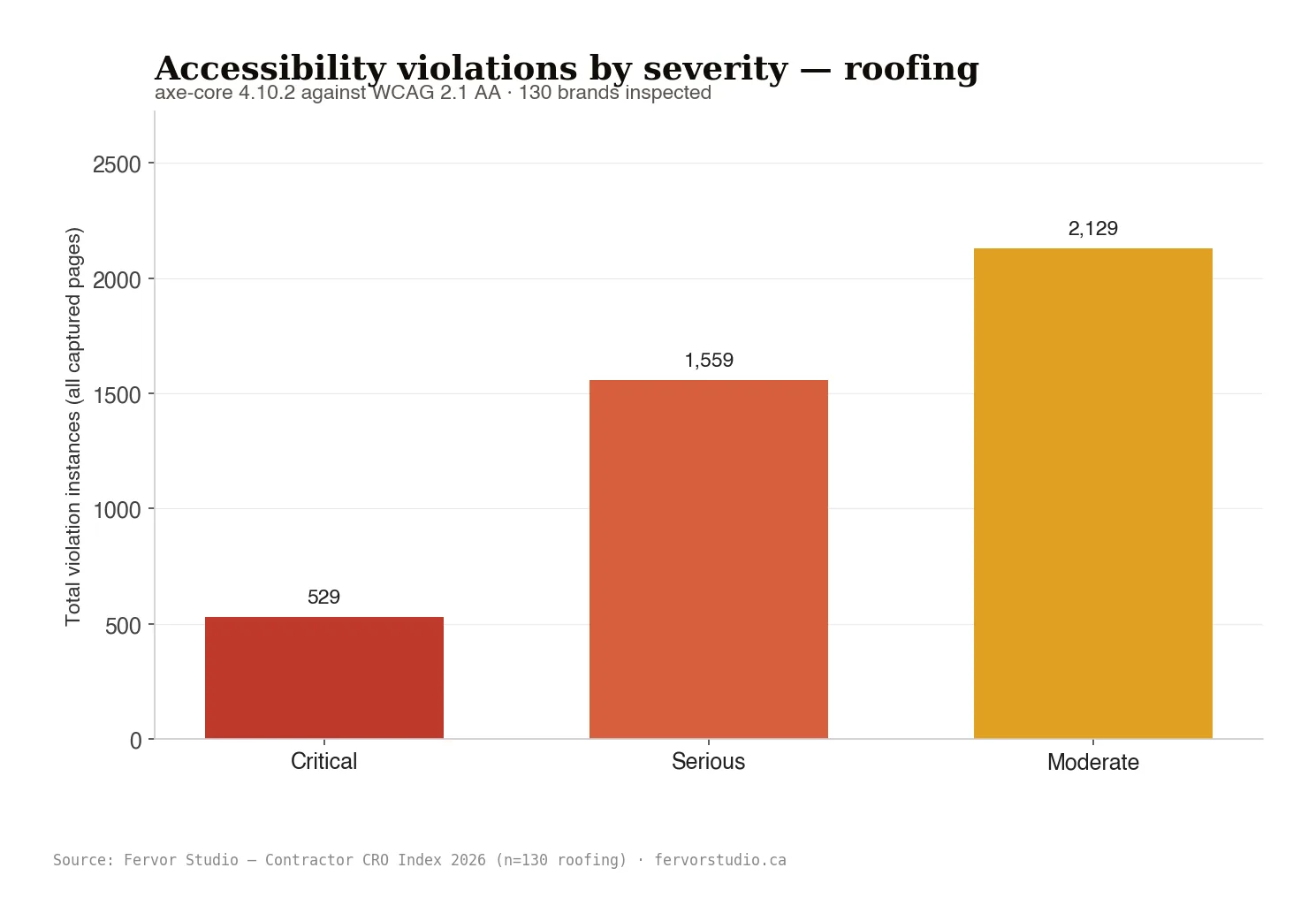
Averages are easy to ignore. Raw counts are harder. So here's what axe-core actually logged across every captured page in the roofing sample, sorted by severity:
| Severity | Violations flagged | What it means |
|---|---|---|
| Critical | 529 | A barrier that blocks a screen-reader user outright |
| Serious | 1,559 | A major obstacle that degrades or breaks the experience |
| Moderate | 2,129 | A real defect that frustrates assistive tech, short of blocking |
Look at the shape of that. More than 500 critical violations across the trade, and over 1,500 serious ones on top. None of these are exotic. And none of them require a developer to puzzle over for a week. They're the kind of thing that creeps in when a site gets built fast, by a template, with nobody checking the markup. And they're exactly why roofing website accessibility scores bottom out across the trade. Not because contractors don't care, but because nobody ever ran the accessibility scan.
Why "it looks fine" is the trap
You've looked at your site the only way you can. Working eyes, a big monitor, a mouse. None of the people the rules protect browse that way, and that's the whole problem.
A homeowner using a screen reader doesn't see your layout. They hear it, link by link, heading by heading, in a linear march from top to bottom. If your "Book an Inspection" button is an unlabeled icon, they hear "button" and nothing else. If your service pages skip from an H1 straight to an H4, the document outline falls apart and they lose their place. If your phone number is baked into an image instead of live text, it's invisible to them entirely. None of that shows up to you. All of it is mechanical, and all of it is measurable.
So the reason roofing website ADA compliance keeps blindsiding contractors is simple. The failures are invisible to the person who owns the site and glaring to the person filing the complaint. You can't fix what your own browser is actively hiding from you. That accessibility scan is the only honest mirror.
The legal exposure isn't theoretical
Here's where the math gets uncomfortable. Website accessibility lawsuits have turned into a volume business for a handful of plaintiff's firms. The play is straightforward: run an automated accessibility scan across hundreds of small-business sites, flag the WCAG failures, fire off demand letters, settle. A 97.7% serious-violation rate across the trade means almost every roofing site would light up that accessibility scan on the very first pass. You don't have to do anything wrong beyond ship broken markup.
A website accessibility lawsuit doesn't require a homeowner to prove they were harmed. It requires your site to fail a standard. And the axe-core results say it does, on 97.7% of sites. That's the uncomfortable asymmetry. The cost of finding your violations is about thirty seconds of a lawyer's time, and the cost of fixing them after a demand letter lands is a settlement plus legal fees plus the rush job.
If you do any business in Ontario, it's not only U.S. case law in play. The Accessibility for Ontarians with Disabilities Act carries penalties of up to $50,000 per day for an individual and $100,000 per day for a corporation. So for any roofing company doing business in the province, WCAG compliance carries actual regulatory teeth on top of the litigation risk. Per-day penalties, in writing.
You don't need to panic about any of this. But you do need to stop filing it under "someday." Someday is the most expensive day to deal with it. The risk doesn't wait for a redesign, and a website accessibility lawsuit lands on whoever's site fails first, not on whoever deserves it least.
What good looks like
The encouraging part, and it's a big one: most of this is fixable in an afternoon, not a rebuild. The 39.2% of roofing sites that ship zero critical violations didn't buy special software or rebuild from scratch. They got the fundamentals right.
- Text that clears the 4.5:1 contrast ratio. Darken the gray. Done.
- Every form field labeled, so a screen reader announces "phone number" instead of "edit text."
- Real heading structure: one H1, then H2s and H3s in order, no skipped levels.
- Named links and buttons. "Schedule a roof inspection," not a bare icon with no text.
- Landmark regions so assistive tech can jump straight to your nav, your main content, your footer.
Not one of those changes how your site looks to a sighted visitor. They change whether the other ten-to-twenty percent of your market can use it at all, and whether your site survives an accessibility scan. So an ADA compliant website isn't a design downgrade or a compromise. Most of the fixes are completely invisible to everyone except the people who currently can't get through your door.
What to fix first
If you only do one thing this week, run a WCAG scan and fix contrast. It's one of the most common failures, it's a pure CSS change, and it's the one a homeowner on a phone in direct sunlight notices anyway. After that, walk your most-trafficked pages (home, the main roofing-services page, the contact page) and check three things by hand: does every form field have a visible label, does every link have real text, and does the heading order go 1-2-3 without skipping. That short list knocks out the majority of what the scanner flags.
Then put it on a recurring schedule, because accessibility rots. Every time you add a new service page or swap a hero photo of a fresh shingle install, you can reintroduce a violation. The sites that stay compliant treat roofing website accessibility as a habit, not a one-time project. A quick accessibility scan after every site change keeps you out of the failing column for good.
Why roofing is the worst trade to get this wrong
Here's the part specific to your trade, and it's worth sitting with. Roofing is a phone-first emergency business. A branch goes through someone's kitchen ceiling at 9pm in a windstorm, and that homeowner is on their phone in the dark looking for whoever can answer right now. That's the exact moment your site has to work, for everyone, including the homeowner using voice control because they're holding a flashlight, or the one running a screen reader because that's how they use the web every day.
So a low-contrast "Emergency Roof Repair" button that fails the ratio isn't a tidy little compliance footnote. It's a missed call during the highest-intent moment your business ever gets. The trades where the work is urgent and the searches happen under stress are precisely the trades where a broken booking path costs the most. And roofing sits right at the top of that list.
That's also why the 60.8% number stings more for roofing than the headline suggests. Six in ten roofing sites would fail an accessibility scan a plaintiff's firm runs in seconds, on the exact pages homeowners hit during a storm. The failure and the demand are the same trade-wide problem, just measured by different people: a lawyer measures it as exposure, a homeowner measures it as a door that wouldn't open.
Where accessibility and conversion overlap
One more angle, because it reframes the whole question and it's the reason Fervor scores accessibility at all. The same gaps that fail WCAG also leak leads.
A button a screen reader can't identify is also a button a distracted homeowner misreads at 11pm with water coming through the ceiling. Heading structure that confuses assistive tech also confuses Google's crawler, which is part of why so many of these sites quietly underperform on search too. Low contrast that fails the ratio is also low contrast that's hard to read on a phone screen, outdoors, in the rain, one-handed, which is how a huge share of roofing leads actually arrive. So WCAG compliance isn't a tax bolted on top of conversion. It's frequently the exact same fix wearing a different label.
That's the lens the framework uses. Accessibility is one of the scored categories, sitting right next to lead capture and mobile experience, because in the real world they're tangled together. Fix the markup and you usually move more than one number at once. That's the part most contractors miss. They think accessibility is charity. It's plumbing. When it's broken, money leaks out, and not only from the customers you were trying to protect.
Run the numbers on it. Say your average roofing job is worth $9,000, and your site brings in 25 inspection requests a month. If even one in twenty of those visitors bounces because a screen reader couldn't read your booking button, or because the contrast was so low they gave up on a phone in the driveway, that's one job a month walking out the door. Call it $9,000. Over a year, north of $100,000 in lost work, from a fix that's a CSS change and an afternoon. And that's before you put a single dollar on the legal column. The accessibility gap isn't a compliance line item you tolerate. It's a leak with a number on it, and the number compounds every month you leave it open.
Frequently asked questions
Is my roofing website legally required to be ADA compliant?
If you serve the public, courts have broadly treated business websites as places of public accommodation under the ADA, using WCAG 2.1 AA as the benchmark. There's no government certification to earn, but the legal exposure is real, and in Ontario, AODA layers on explicit per-day penalties. Given that 60.8% of roofing sites carry a critical violation, the safe assumption is that yours has issues until an accessibility scan proves otherwise.
How do I know if my roofing website is ADA compliant?
Run it through a WCAG 2.1 AA scanner like axe-core, the same tool Fervor uses. It'll flag contrast failures, missing labels, broken heading order, and unnamed links in seconds. You can also test by hand: try navigating your own site with only the keyboard, or turn on your phone's built-in screen reader and see if you can book a roof inspection without your eyes.
How much does it cost to fix roofing website accessibility?
Most critical violations (contrast, labels, heading order, link names) are markup and CSS changes, not a rebuild. The 39.2% of sites that pass aren't running anything special. They got the fundamentals right. The genuinely expensive path is ignoring it until a demand letter shows up and you're paying a settlement plus a rush fix.
Could my roofing site really get hit with a website accessibility lawsuit?
It can. These suits run on automated scans, not on whether a real customer complained, and 97.7% of roofing sites carry at least one serious violation a scan would catch. The firms that file them work in volume. Fixing the underlying markup before a demand letter lands is far cheaper than settling after one does.
Do accessibility overlay widgets make my site compliant?
No. Automated overlay tools have repeatedly failed to deliver real WCAG conformance, and several have themselves been named in accessibility lawsuits. Real roofing website ADA compliance comes from fixing the underlying markup, not bolting a widget over the top and hoping. The scanner, and the screen reader, see right through the overlay.
Will fixing accessibility change how my website looks?
Almost never in a way a sighted visitor would notice. Darkening gray text a few shades to clear the contrast ratio is the most visible change, and most people read it as the site simply looking sharper. Labeling form fields, naming links, and fixing heading order all happen in the markup, invisible on the page. So you get a site that passes an accessibility scan and reads cleaner, without redesigning anything. The roofers who pass aren't running an uglier site. They're running a more correct one.
Methodology
Where these numbers come from
Every accessibility figure in this post traces to the State of Roofing report, part of the Contractor CRO Index. Fervor ran 130 roofing contractor websites through axe-core, a WCAG 2.1 AA scanner, across every captured page, and scored accessibility as one of the categories in the Fervor Grade Framework. The trade's mean Fervor Score was 67.82, a D. Cross-trade comparisons (HVAC 64.4%, remodeling 59.6%) come from the companion State of HVAC and State of Remodeling reports. The contrast-ratio thresholds are the published WCAG 2.1 AA requirements. Every site in the sample is named and publicly graded inside the Contractor CRO Index. This report is the aggregate layer on top of those public teardowns.
See where your site actually stands
You don't have to guess. The State of Roofing report shows exactly how the trade scores on accessibility and the other conversion categories, all measured mechanically against the same framework. And if you want your own site scored (the critical violations, the contrast failures, the specific gaps a homeowner hits before they bounce), the free Site Inspection returns the exact list of what's broken on your own site. Far better to read that list from us, on your schedule, than from a lawyer on theirs.
Get My Free Inspection → Sep 27, 2026
 Agency Selection
Best Concrete Contractor CRO Agencies in 2026
A concrete site quietly serves two different buyers: a homeowner picking a patio pattern and a GC scoping a foundation pour. Here are 5 CRO agencies scored on the split.
Read Article Sep 26, 2026
 Agency Selection
Best Deck Builder CRO Agencies in 2026
Deck projects concentrate into a hard spring rush most builder sites are not built to catch. Here are 5 CRO agencies scored on whether they solve for it.
Read Article Sep 26, 2026
 Agency Selection
Best Landscaping CRO Agencies in 2026
A landscaping site has to sell a five-figure hardscape build and a renewing maintenance contract at the same time. Here are 5 CRO agencies scored on the split.
Read Article