Roofing Website Speed: 11-Second Loads Are Losing You Leads
The average roofing site loads in 11.23 seconds on mobile. A storm-damaged homeowner bounces before your form appears. See the roofing website speed fix.

Here's a number that should bother you. Across 130 roofing contractor websites Fervor scored this spring, the average mobile homepage took 11.23 seconds to paint its largest piece of content. Eleven seconds. That's not a glitch on one slow site dragging the average up. That's the middle of the road for roofing website speed, and it means a homeowner with a tarp on their roof is staring at a blank screen long enough to give up and call the next guy.
And you probably can't feel it. That's the part that gets people. You load your own site on your own phone, on your own wifi, with the page already cached, and it snaps right up. Fast. Looks fine. But a stranger hitting it cold, on cell data, in the rain, after a hailstorm, they get the 11-second version. The gap between "loads fast for me" and "loads in 11 seconds for them" is exactly where the lead leaks out, and your own phone is hiding it from you.
So let's walk through what roofing website load time actually costs you, what's making your site slow, and how to fix it without a rebuild. No developer jargon, no abstract benchmarks here. Just the math and the moves.
What 11 seconds actually does to your lead
Google's threshold for a "good" Largest Contentful Paint, the moment your main image or headline finishes loading, is 2.5 seconds. That's the bar. Two and a half seconds and you're in the green.
The roofing trade's median mobile LCP? 7.89 seconds. The average? 11.23. So the typical roofing site isn't a little over the line. It's three to four times slower than the standard Google built around how real people behave on real phones.
And people do not wait. A homeowner who just watched shingles peel off their roof isn't browsing leisurely. They're anxious, they're on their phone, and they've got three other roofers' tabs open. Every second your page stalls is a second they spend deciding you're not worth the wait. By second eleven, most of them are gone, and they never saw your form, your reviews, or your phone number. They bounced before the page even finished assembling itself.
This is the part that stings. The roofing report puts the trade mean at 67.82 out of 100, a middling result. Speed is a big reason why. When mobile page speed drags, it pulls down first impression, it pulls down conversion, it pulls down the whole grade. One slow load isn't one problem. It's the first domino.
The 82.3% number, and the rest of the picture
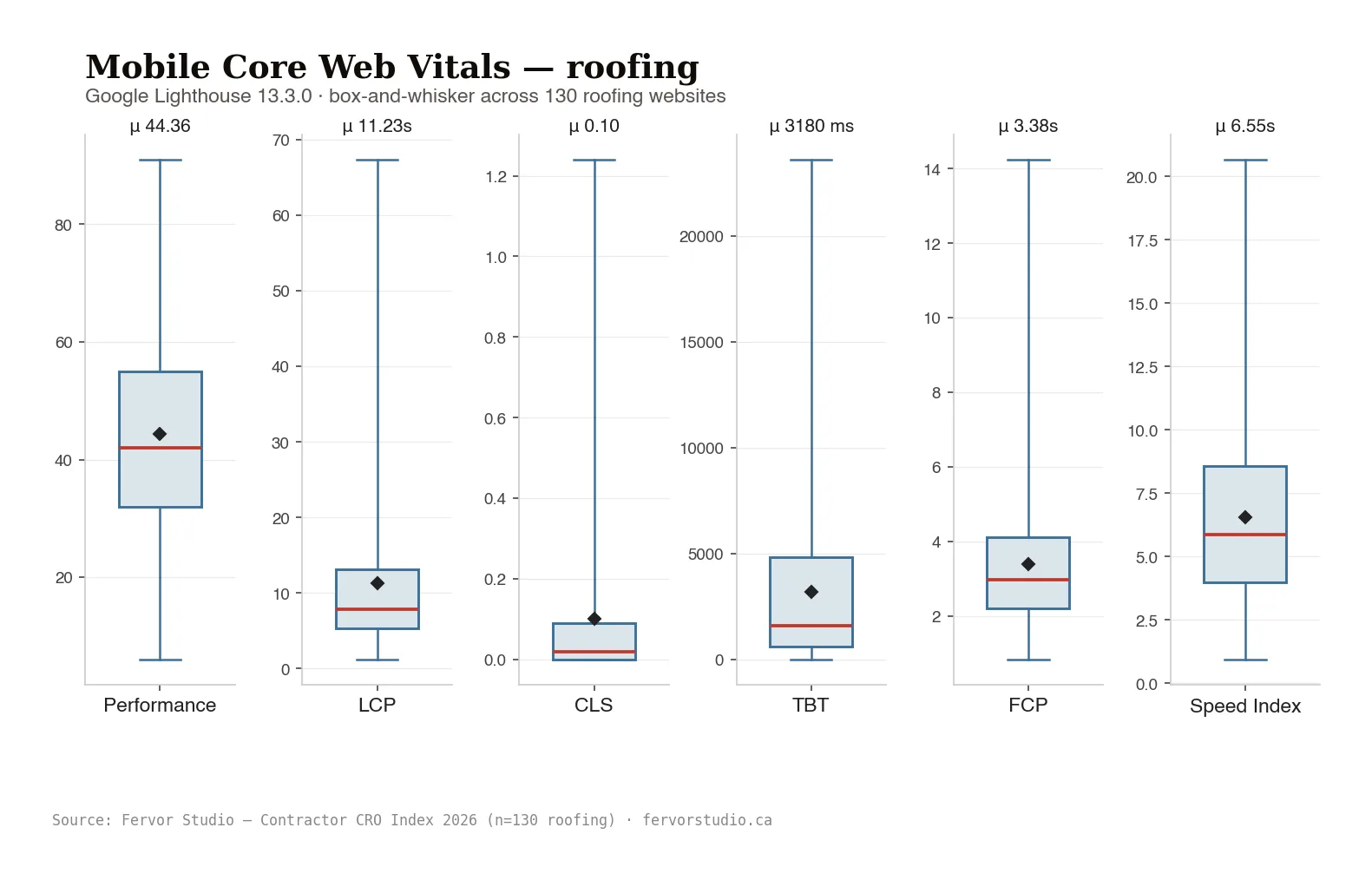
Let me give you the full spread, because one average is easy to wave off. The State of Roofing report measured every site against the same Lighthouse and Core Web Vitals tooling Google uses to grade page experience.
- 82.3% of roofing homepages fall in Google's "poor" LCP band, over 4 seconds.
- The median mobile LCP is 7.89 seconds; the mean is 11.23 seconds.
- The median mobile Lighthouse performance score is 42 out of 100. The mean is 44.
- Google's "good" LCP threshold is 2.5 seconds, so the median roofing site is more than three times over it.
A 42 out of 100 on Lighthouse isn't a passing grade with room to improve. It's a failing grade. And it's the middle of the trade, not the bottom. Half the roofing sites scored even lower. So whatever your site happens to do well, mobile page speed is almost certainly where it does worst.
Now think about what "poor LCP" means for four out of every five roofing sites. And Google has been explicit that Core Web Vitals (and LCP is the headline metric) feed search ranking. So the same slowness that bounces your visitors also quietly buries you in the results they'd have reached you through. Slow doesn't just lose the people who land. It thins out the people who land at all.
Why roofing sites are slow in a way other trades aren't
Roofing has a specific problem, and it's hiding in plain sight: photos. Your work is visual. A finished metal roof, a clean tear-off, a drone shot of a completed job. That's your portfolio, and it sells. So roofing sites pile on images.
The data backs it up. The median roofing site carries 114 images. A hundred and fourteen. And here's the kicker: only 41.5% of sites use any modern image format like WebP or AVIF. So most of those 114 images are old, heavy JPEGs and PNGs, two to five times larger than they need to be, all firing at once when a homeowner's phone is trying to load the page on cell data.
That's the whole slow-roofing-site story in one sentence. Photo-heavy by necessity, uncompressed by neglect. The images that win the job are the same images choking the load. Most contractors never connect those two facts, because the photos look great on the desktop where the site got built, and the desktop never feels the weight a phone does.
Why "it looks fine" is the trap
You've checked your site the only way you can. Your phone, your network, your cached copy. None of that is how your next customer arrives, and that's the entire problem.
A homeowner finding you for the first time gets nothing cached. They're on cellular, maybe one bar in a storm. Their phone has to download all 114 of those images, parse them, and lay them out before the hero finishes painting. On your fast connection that takes a second. On theirs it takes eleven. Same site, completely different experience, and the only one that matters is theirs.
So the reason roofing website speed keeps blindsiding contractors is simple. The slowness is invisible to the person who owns the site and brutal to the person trying to hire you. You can't fix what your own cache is hiding from you. A cold test on a throttled connection is the only honest mirror.
What it's costing you, in dollars
Here's where the math gets uncomfortable. Let's run it the way you'd run a job estimate, because that's the only way these numbers land.
Say your average roofing job is worth $11,000, and your site pulls in 50 storm-damage and replacement inquiries a month when it's working. Studies on page speed are consistent: a meaningful share of mobile visitors abandon a page that takes more than a few seconds, and you're sitting at eleven. Be conservative: say one in ten of those visitors bounces purely because the page was too slow to load before they lost patience. That's five lost inquiries a month.
If even one of those five would have closed, that's one $11,000 job walking out the door every month. And over a year, that's roughly $132,000 in work you never quoted. Not because your crew isn't good, not because your price was wrong, but because a slow page lost the lead before you ever knew it existed. All from a fix that's mostly image compression and an afternoon.
And that's the conservative version. Push the bounce rate to two in ten, which an 11-second load easily justifies, and you double it. The point isn't the exact figure. The point is that roofing website load time isn't a technical metric for your developer to fret over. It's a leak with a dollar sign on it, and the number compounds every month you leave it open.
There's a second cost most contractors miss. The leads you lose to a slow page aren't random. They're disproportionately the urgent, high-intent ones. A homeowner casually researching a future re-roof might wait the eleven seconds. The one with active water coming through the ceiling won't. So the slower your site, the more it filters out exactly the storm-damage and emergency calls that close fastest and at the highest ticket. You're not losing a flat ten percent across the board. You're losing the best ten percent first.
You don't need to panic about this. But you do need to stop filing it under "someday." Someday is the most expensive day to deal with it.
What good looks like
The encouraging part, and it's a big one: most of this is fixable in an afternoon, not a rebuild. The roofing sites that hit a fast load didn't strip out their photos or hire a performance engineer. They got the fundamentals right.
- Every image converted to WebP or AVIF, the modern formats only 41.5% of the trade bothers with. That alone cuts most image weight by half or more.
- Images sized to the slot they fill. A thumbnail doesn't need to ship a 4000-pixel-wide original.
- Lazy loading, so the 100 photos below the fold don't fire until someone scrolls to them.
- A hero image compressed and prioritized, so the largest contentful paint happens fast instead of waiting behind a queue of gallery shots.
Not one of those changes how your work looks to a visitor. The drone shot of the finished roof still looks like a drone shot of a finished roof. It just weighs a tenth of what it did and shows up in two seconds instead of eleven. So fixing mobile page speed isn't a visual downgrade or a compromise on your portfolio. The fix is almost entirely invisible to the eye and obvious to the stopwatch.
What to fix first
If you only do one thing this week, compress your images and convert them to WebP. It's where the weight is (114 images, most of them uncompressed) and it's a batch job, not a custom build. After that, turn on lazy loading so your gallery doesn't load until someone scrolls, and make sure your hero image is sized and prioritized for a fast first paint.
Then test it the honest way. Don't reload your own cached site. Run it through Google's PageSpeed Insights on the mobile setting, which throttles the connection to mimic real cell data, and watch your LCP and Lighthouse score. That cold number is the one your customers actually live with. Get it under 2.5 seconds and you've moved from the bottom of the trade to the top of it.
Where roofing website speed and conversion overlap
One more angle, because it reframes the whole question and it's the reason Fervor scores speed at all. The same slowness that fails Core Web Vitals also leaks leads. They're not two problems, they're one.
A page that takes 11 seconds to paint is a page a panicked homeowner abandons at second four. But Core Web Vitals that fail Google's threshold are also signals that drag your search ranking, so you lose visibility on top of losing patience. And a heavy, image-bloated page that's slow on a phone is exactly the page a storm-stressed customer hits, on a phone, on cell data, in a hurry. So speed isn't a tax bolted on top of conversion. It's frequently the exact same fix wearing a different label.
That's the lens the framework uses. Speed sits right next to lead capture and first impression as a scored category, because in the real world they're tangled together. Fix the load and you usually move more than one number at once. That's the part most contractors miss. They treat speed as a vanity metric. It's not. When it's broken, money leaks out, and not only from the people who were patient enough to wait.
So the contractor who fixes roofing website speed properly often watches three things climb at once: the page experience score, the search ranking, and the share of visitors who actually reach the form. One fix, three problems closed. That's the kind of math that makes this worth doing this month instead of next year.
Frequently asked questions
What's a good load time for a roofing website?
Google's "good" threshold for Largest Contentful Paint, when your main content finishes loading, is 2.5 seconds on mobile. The median roofing site sits at 7.89 seconds, and the average is 11.23, so most of the trade is three to four times over the line. Aim to get your cold mobile LCP under 2.5 seconds and you're ahead of more than 80% of your competitors.
Why is my roofing website so slow?
Almost always, it's the images. The median roofing site carries 114 of them, and only 41.5% of the trade uses modern formats like WebP or AVIF. So most roofing sites are shipping dozens of oversized JPEGs and PNGs that fire all at once on a phone. Your photos sell the job, but uncompressed they're also what's killing your load.
How do I test my roofing website's speed?
Run it through Google's PageSpeed Insights on the mobile setting. It throttles the connection to mimic real cell data and reports your LCP and a Lighthouse performance score out of 100. Don't trust how fast your own cached site feels on wifi. That's not the experience a new customer gets. The throttled, cold number is the honest one.
What is Core Web Vitals and does it affect my Google ranking?
Core Web Vitals are Google's metrics for page experience (load speed, interactivity, and visual stability) with LCP as the headline. Google has confirmed they feed search ranking. So a slow roofing site doesn't just bounce the visitors who land; it also ranks lower, which means fewer homeowners find you in the first place.
Will compressing my images make my roofing photos look worse?
No, not in a way a visitor would notice. Converting to WebP or AVIF and sizing each image to its slot can cut file weight by half or more while keeping the photo sharp on screen. The drone shot still looks like a drone shot. It just loads in a fraction of the time, which is the whole point.
How long does it take to fix roofing website speed?
For most sites, it's an afternoon, not a rebuild. Compressing and converting 114 images is a batch job, and good tooling handles it in one pass. Turning on lazy loading and prioritizing the hero image are configuration changes, not custom development. You're not rebuilding the site. You're putting the existing one on a diet. The genuinely expensive path is ignoring it until you've quietly lost a year of leads to an 11-second load.
Methodology
Where these numbers come from
Every speed figure in this post traces to the State of Roofing report, part of the Contractor CRO Index. Fervor scored 130 roofing contractor websites, measuring mobile Largest Contentful Paint, Lighthouse performance, image counts, and modern-format adoption across captured pages, and scored speed as one category in the Fervor Grade Framework, which placed the trade at a mean of 67.82, a D. The "good LCP = 2.5 seconds" threshold is Google's published Core Web Vitals standard. Every site in the sample is named and publicly graded inside the Contractor CRO Index. This report is the aggregate layer on top of those public teardowns.
See where your site actually stands
You don't have to guess. The State of Roofing report shows exactly how the trade scores on speed and five other conversion categories, all measured mechanically against the same framework. And if you want your own site scored (the real mobile load time, the LCP, the image weight a homeowner hits before they bounce) the free Site Inspection returns the exact list of what's slowing you down. Far better to read that number from us, on your schedule, than to keep losing leads to it without ever knowing why.
Get My Free Inspection → Sep 27, 2026
 Agency Selection
Best Concrete Contractor CRO Agencies in 2026
A concrete site quietly serves two different buyers: a homeowner picking a patio pattern and a GC scoping a foundation pour. Here are 5 CRO agencies scored on the split.
Read Article Sep 26, 2026
 Agency Selection
Best Deck Builder CRO Agencies in 2026
Deck projects concentrate into a hard spring rush most builder sites are not built to catch. Here are 5 CRO agencies scored on whether they solve for it.
Read Article Sep 26, 2026
 Agency Selection
Best Landscaping CRO Agencies in 2026
A landscaping site has to sell a five-figure hardscape build and a renewing maintenance contract at the same time. Here are 5 CRO agencies scored on the split.
Read Article