Roofing Website Phone Number: Why 35% Make Buyers Hunt
Only 64.6% of roofing sites keep a phone number in the header, so 35% make a panicked homeowner hunt for it. The roofing website phone number fix is simple.
Here's the number that should stop you. Across 130 roofing contractor websites Fervor scored this spring, only 64.6% kept a phone number visible in the persistent header. So a full 35% (better than one in three) made a homeowner hunt for the one thing that turns a roofing emergency into a booked job. If you run a roofing company and you've never checked where your roofing website phone number actually sits, the odds say it's buried somewhere a panicked customer won't find it in time.
And think about who's on the other end of that search. A homeowner with water coming through the ceiling during a storm. A shingle pile in the driveway after a windstorm. They're not in a research mood. They're not going to fill out a form and wait for a callback. They want to tap a number and talk to a human in the next ten seconds. That's the whole transaction.
So let's walk through why roofing lives and dies on the phone, what the data says most sites are getting wrong, and the single fix that moves the needle harder than anything else on the page. No fluff. Just the math and what to change.
Why roofing is a phone-first trade
Most home-services advice treats every trade the same. Get a form, get a chatbot, nurture the lead. That works fine when someone's planning a kitchen remodel six months out. It falls apart the moment the demand is urgent, and roofing demand is almost always urgent.
A leak doesn't schedule itself. Neither does a branch through the roof, or a missing section of shingles the morning after a hailstorm. When a homeowner's roof fails, the clock is the enemy. Water's already finding the drywall. So they grab the nearest phone and call the first roofer who picks up. Not the one with the prettiest site. The one they can reach.
That's why the header phone number isn't a nice-to-have for your trade. It's the conversion. Every second a customer spends scrolling to find your number is a second they could spend calling your competitor instead. And on mobile, where most of these searches happen, "scroll to find the number" usually means "give up and hit the next result." You don't get a second chance with a wet ceiling.
The 64.6% number, and the rest of the picture
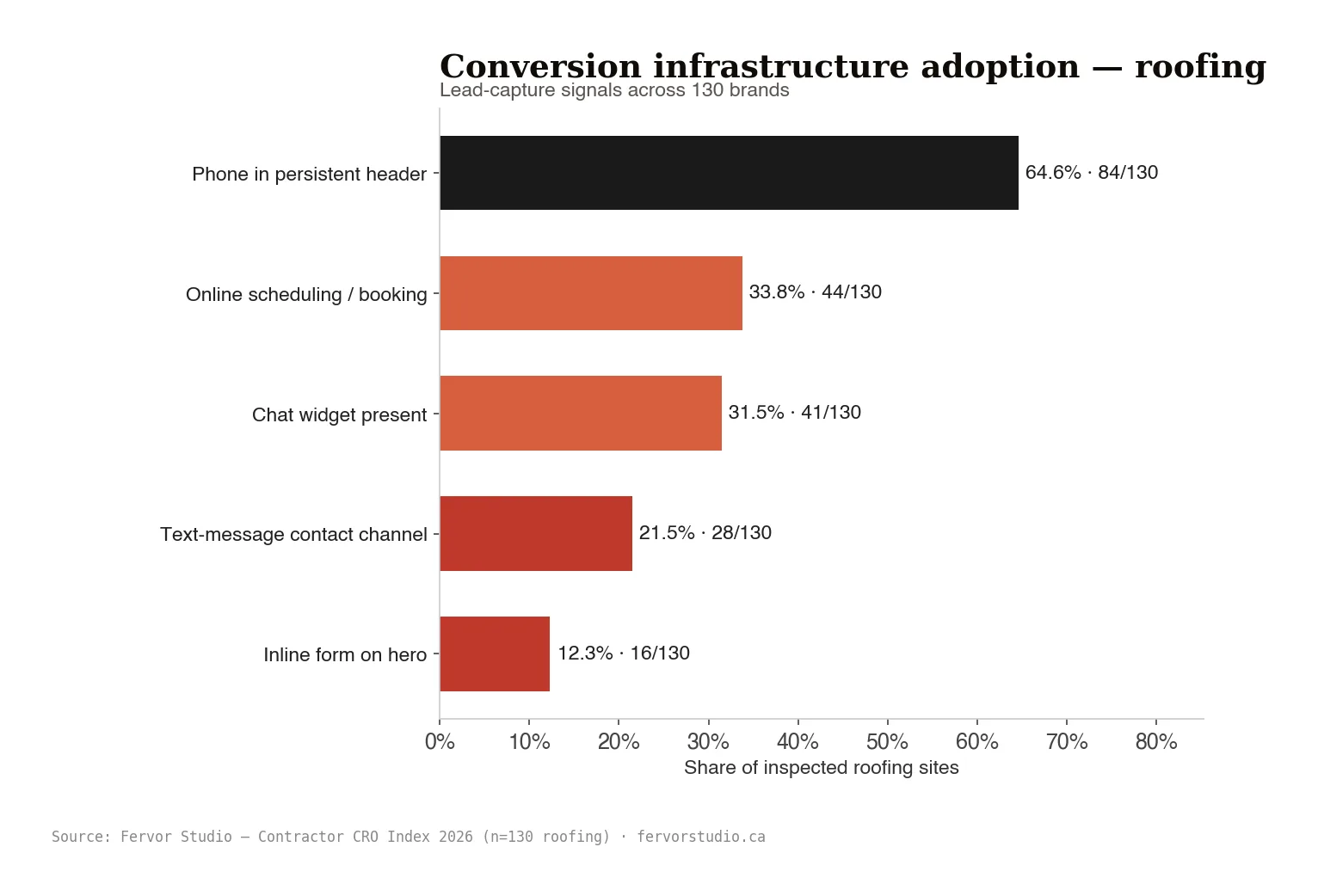
Let me give you the full spread, because one stat in isolation is easy to shrug off. The State of Roofing report measured all 130 sites against the same conversion framework: the elements a homeowner actually needs to reach you and book.
- 64.6% (84 of 130) keep a phone number in the persistent header. Which means 35% don't.
- 71.5% (93 of 130) surface Google reviews somewhere on the page.
- 33.8% (44 of 130) offer any online scheduling or booking.
- 12.3% (16 of 130) put an inline lead form right on the hero, the lowest-adoption conversion element of the bunch.
The trade scored a 67.82 mean out of 100 on the full framework. A middling result, nowhere near where a phone-first business needs to be when the front door is the phone. So whatever else your site does well, the path from "homeowner in a panic" to "homeowner on the line with you" is where the trade is leaking hardest.
And notice the gap between reviews and reachability. Roofers are clearly thinking about trust. A solid 71.5% surface their Google reviews. Good instinct. But reviews don't book the job if the customer can't find the number to call after reading them. You've done the hard part of earning the five stars, then hidden the button that cashes them in.
What "the phone number is on the site" actually misses
Here's the trap most contractors fall into. They look at their homepage, see the number in the footer or on the contact page, and figure they're covered. The number IS on the site, after all.
But "on the site" and "in front of the customer the instant they need it" are two completely different things. A number that lives only on your contact page means the homeowner has to know the contact page exists, navigate to it, and find the number: three steps, on a phone, with water dripping behind them. A number baked into a hero image instead of live text can't even be tapped; they have to memorize it and switch apps to dial. Every one of those is friction, and friction at the moment of urgency is just a competitor's name you handed them.
The persistent header is the only spot that solves this. It rides along no matter where they scroll, no matter which service page they land on from a Google search. On mobile it should be a tap-to-call link, so one thumb-tap dials you. Not a number to read. A button to press. That's the difference between a roofing website phone number that converts and one that just technically exists.
The single highest-impact fix on your site
If you change one thing this month, make it this: put a tap-to-call number in the persistent header on every page, mobile and desktop. That's it. That's the fix.
Why this one over everything else? Because it sits at the exact pinch point where roofing demand turns into revenue. Online scheduling is great, but only 33.8% of the trade has it and a leaking-roof homeowner won't wait for a booking confirmation anyway. An inline hero form helps capture the slower, project-based leads (the re-roof-next-spring crowd) but at 12.3% adoption it's clearly nobody's priority, and it's not what an emergency caller wants. The header phone number serves the urgent buyer AND gives the casual browser an obvious next step. One change, both audiences.
Run the napkin math on it. Say your average roofing job is worth $9,000, and your site pulls 60 visitors a month who are ready to call. If even one in twenty of them bounces because they couldn't spot your number fast enough, that's three lost calls a month. Close half and that's roughly $13,500 walking out the door every month, all from a fix that's an afternoon of work on the header. Over a year you're looking at more than $160,000 in jobs you never got the chance to bid. The number compounds every month you leave it buried.
And here's the part that stings: you already paid to get those visitors there. The ad spend, the SEO, the truck wraps: all of it did its job and delivered a ready buyer to your homepage. Then a hidden number sent them to the roofer down the road. You didn't lose the lead at the top of the funnel. You lost it at the doorstep.
Where roofing website conversion actually breaks
Step back and the pattern across the trade gets clearer. Roofing website conversion isn't failing because contractors don't have good reviews or decent photos. It's failing at the handoff. That's the moment a warm visitor needs to become a phone call or a booked appointment, and the path isn't there.
Think of your site as a funnel with one job: get a homeowner from "I have a roof problem" to "I'm talking to a roofer." Reviews build the belief. Service pages answer the questions. But the phone number is the exit door, and 35% of the trade has it propped half-shut. The reviews convince the customer you're the right call. Then they can't find where to make it.
That's why roofing lead generation advice that obsesses over traffic misses the point for most contractors. You probably don't have a traffic problem. You have a conversion problem at the very bottom, where the cheapest fix lives. More visitors to a site that hides its number just means more people bouncing to a competitor. Fix the exit door first, then worry about sending more people through the front.
What good looks like
The reassuring part: getting this right costs an afternoon, not a rebuild. The 64.6% of roofing sites that already nail the header phone number didn't buy special software. They just made the number impossible to miss.
- A phone number in the persistent header, live on every page, scrolling along with the visitor.
- On mobile, that number is a tap-to-call link. One thumb-tap dials, no memorizing, no app-switching.
- Real text, not a number baked into an image, so it's tappable and a search engine can read it too.
- Google reviews surfaced near the top, so the trust is built before the customer reaches for the phone.
- Online scheduling for the non-urgent buyer who'd rather book a re-roof estimate at 11pm than call.
None of that is a redesign. It's plumbing, connecting the warm visitor to the phone with the fewest possible steps in between. So a high-converting roofing website phone number setup isn't a design flourish. It's the most boring, most profitable change on the whole page.
What to fix this week
Pull up your own site on your phone right now. Not your laptop. Your phone, the way 7 in 10 of your customers actually arrive. Can you see and tap your number without scrolling? If you have to hunt for it, so does every homeowner with a leak. That's the test, and it takes ten seconds.
Then check three things. One, is the header number live tap-to-call text and not an image. Two, does it stay visible as you scroll down a service page. Three, does it show up on every page, not just the homepage, because a Google search drops people onto your "roof repair" page far more often than your front door. Knock out those three and you've fixed the highest-impact gap on the site.
How your roofing website phone number pulls double duty
One more angle, because it reframes the whole thing. A visible contractor phone number doesn't just book urgent calls. It builds trust before anyone dials.
A number you can see immediately reads as "this is a real business that wants to talk to me." A number you have to dig for reads, fairly or not, as "they don't really want my call." Homeowners pattern-match on this instantly, even if they never consciously think it. So the header number is doing trust work and conversion work at the same time, which is exactly why it sits at the center of roofing website conversion rather than off in some checklist corner.
It feeds your roofing lead generation in a quieter way too. Tap-to-call numbers are trivially trackable — you can route them through a call-tracking line and finally see which pages and which ads actually drive phone calls, instead of guessing. Most roofers fly blind on this because the number's buried and untracked. Surface it, track it, and you stop wondering whether your marketing works. You watch the calls come in, attributed to the source. One fix, three wins: more booked jobs, more trust, and finally some honest data on what's working.
Methodology
Where these numbers come from
Every figure in this post traces to the State of Roofing report, part of the Contractor CRO Index. Fervor scored 130 roofing contractor websites against the Fervor Grade Framework, measuring conversion elements (persistent-header phone visibility, inline hero lead forms, online scheduling, and surfaced Google reviews) across every captured page. The trade posted a 67.82 mean, a D. Every site in the sample is named and publicly graded inside the Contractor CRO Index. This report is the aggregate layer on top of those public teardowns.
See where your site actually stands
You don't have to guess where your number sits or how the rest of your site stacks up. The State of Roofing report shows exactly how the trade scores on phone visibility, reviews, scheduling, and the other conversion elements that turn a roof emergency into a booked job. And if you want your own site checked, whether your number's tappable, where it hides, the specific gaps a homeowner hits before they bounce, the free Site Inspection returns the exact list of what's costing you calls. Better to read that list from us than to keep losing the next storm's worth of leads to the roofer who simply made their number easier to tap.
Get My Free Inspection → Sep 27, 2026
 Agency Selection
Best Concrete Contractor CRO Agencies in 2026
A concrete site quietly serves two different buyers: a homeowner picking a patio pattern and a GC scoping a foundation pour. Here are 5 CRO agencies scored on the split.
Read Article Sep 26, 2026
 Agency Selection
Best Deck Builder CRO Agencies in 2026
Deck projects concentrate into a hard spring rush most builder sites are not built to catch. Here are 5 CRO agencies scored on whether they solve for it.
Read Article Sep 26, 2026
 Agency Selection
Best Landscaping CRO Agencies in 2026
A landscaping site has to sell a five-figure hardscape build and a renewing maintenance contract at the same time. Here are 5 CRO agencies scored on the split.
Read Article