Digital State of the Roofing Industry: What the Best Roofing Websites Do
An analysis of every scored roofing website in our index. The best pull ahead on lead capture and trust signals, not budget, and the gap is copyable.
This is the roofing entry in our Digital State of the Industry series, and it answers one question with data rather than screenshots. Across 130 roofing contractor sites Fervor scored, the top quartile beat the bottom quartile by 17.47 points on a 100-point scale. That's not a rounding gap. That's the difference between a site that books jobs and one that quietly loses them. And when you actually pull apart what the best roofing websites do that the worst ones don't, almost none of it comes down to money.
Companion analyses: the State of Roofing report this piece draws from, plus the same treatment for HVAC and remodeling. If you came looking for a ranked list of named roofing companies instead, this is a group analysis, not a leaderboard.
That last part surprises people. You'd assume the gap is budget, that the top sites hired a fancy agency or bought something the rest can't afford. But the data doesn't say that. The ceiling is 90, and somebody hit it. The floor is 30. The whole spread is executional. Same trade, same tools, wildly different execution.
So let's walk through what the top sites actually do differently. The measured gap, category by category, and what you can copy this week.
What "best" actually means when you score 130 roofing sites
Quick grounding, because "best" gets thrown around loosely. Most roofing roundups you'll find online are pay-to-play: somebody's design portfolio, ranked by who linked back. That's not what this is. The State of Roofing report scored 130 roofing contractor sites mechanically, on six conversion categories, and ranked them by a single number out of 100.
The trade mean came in at 67.82 out of 100. A middling result. And the median was 70. So the typical roofing site isn't good. It's barely getting by, and half the trade sits below even that.
Now the spread. Only 14.6% of sites cleared the top of the field, 19 out of 130. Exactly one got every fundamental right. On the other end, 49.2% failed the basics outright. So roughly half the trade is losing leads, a slim 15% is genuinely good, and Crown Industrial Roofing cleared the bar everyone says is impossible. It scored a 90 out of 100, the only site in the trade with no real gaps. The best roofing websites aren't a crowd. They're a short list.
That's the shape of it. A reachable ceiling, a crowded basement, and a canyon between the top quartile and the bottom quartile that has almost nothing to do with how much anybody spent.
What separates the top from the bottom, in plain numbers
Let me put the two ends side by side, because the contrast is the whole story. The top quartile is 34 sites. The bottom quartile is 34 sites. Same trade, same scoring framework, same week.
- Top-quartile sites scored 17.47 points higher than bottom-quartile sites, out of 100.
- The full range ran from barely usable at the floor to near-flawless at the ceiling.
- The trade mean was 67.82 out of 100 with a median of 70.
- Only 19 of 130 sites (14.6%) cleared the top of the field.
- 49.2% of the trade failed at least one fundamental test.
Seventeen points on a hundred-point scale doesn't sound dramatic until you remember what each point represents. A labeled form field, a real review widget, a phone number that's actually tappable. The gap is built out of small, boring, completely copyable things. Stack thirty of them and you've got the difference between the top quartile and the bottom.
And none of those thirty things has a price tag that a $1.5M roofing company can't cover. That's the part worth sitting with.
Lead capture: the widest gap of all
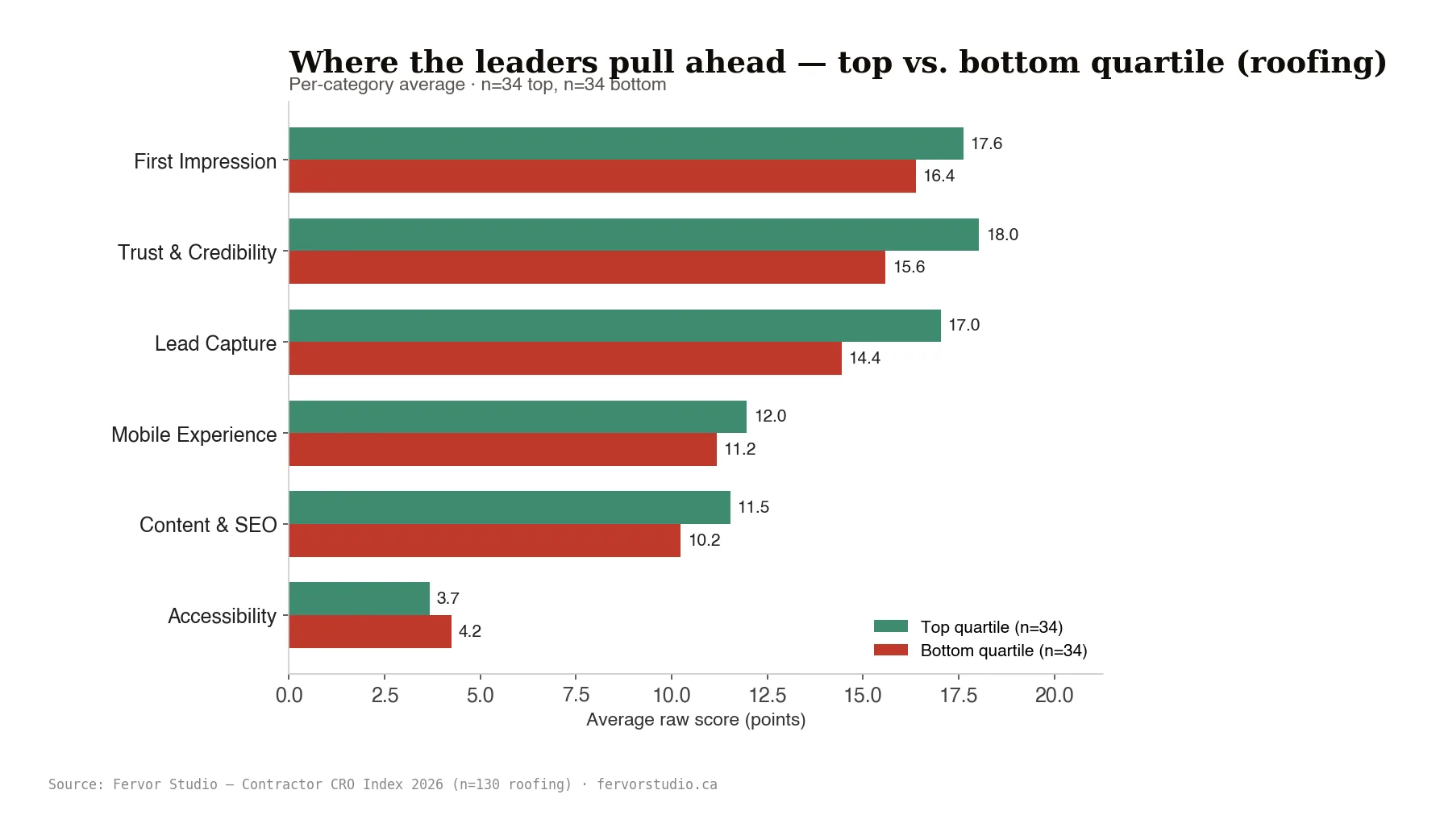
Here's where the top and bottom roofing websites separate the most. Of all six scored categories, Lead Capture showed the single widest gap between the quartiles: 2.59 points, 12.9% of the category max. Wider than trust. Wider than speed. Wider than anything else on the page. It's the machinery that turns a curious homeowner into a phone call, and it's exactly where the bottom quartile leaks hardest.
Think about how a roofing lead actually arrives. It's 9pm, a homeowner just found a wet patch on the ceiling, and they're on their phone, half-panicked, scrolling fast. So the top roofing sites meet that moment. A phone number that's tappable, fixed to the top of the screen, present on every page. A short form that asks for the four things you need and nothing else. And a clear next step above the fold so nobody has to hunt.
The bottom quartile, as a group, fumbles that exact moment. A phone number that's an image, so a tap does nothing. A contact form with eleven fields including "how did you hear about us." A "request a quote" button three scrolls down, in faint gray, easy to miss. Every one of those is a small friction. Stacked together, they're a closed door.
Run the napkin math on it. Say your average roofing job is worth $9,000. If a clumsy form and a buried phone number cost you just two leads a month (two people who gave up and called the next roofer), that's $18,000 a month walking out. Roughly $216,000 a year, gone, from friction you could remove in an afternoon. The fix costs a fraction of one of those lost jobs.
That's the brutal part of lead capture. Cheapest category to fix, one of the most expensive to leave broken.
Trust and credibility: the second separator
Lead capture gets them to reach out. Trust gets them to believe you enough to do it. And it's the second-widest gap between the quartiles: 2.44 points, 11.1% of the category max, a hair behind lead capture and well clear of everything else.
Which makes sense the second you think like a homeowner. A new roof is a five-figure decision, made by someone who's never bought one before, often after a storm, usually in a hurry. They're scared of getting ripped off. So before they call anyone, they're hunting for reasons to trust, or reasons to bail. The top roofing sites hand them reasons to trust. The bottom ones leave them guessing.
What does that look like in practice? The top quartile, as a group, tends to put proof where a nervous buyer looks for it. Real review counts, not a vague "5-star service" banner. License and insurance details stated plainly, not buried. Manufacturer certifications shown as actual badges. Project photos that look like the crew took them, not stock images of a roof in a state nobody recognizes. Named warranties with real terms.
The bottom quartile, as a group, skips most of that. A homepage that talks about "quality workmanship" and "family owned" without a single number to back it. No review widget. No license number. Maybe a logo or two with no context. It's not that those contractors do worse work. Plenty are excellent roofers. It's that their site gives a scared buyer nothing to hold onto, so the buyer leaves to find one that does.
That's the executional gap in one category. The roofer who shows 200 real reviews and a verifiable license isn't a better roofer than the one who doesn't. He's just a better-trusted one, by people who've never met him, because his site did the work.
What roofing website design actually controls
Here's where I want to puncture a myth, because it keeps contractors from acting. Most people assume roofing website design means how the thing looks: the colors, the hero image, whether it feels modern. And looks matter some. But across 130 sites, the prettiest sites weren't reliably the highest-scoring ones.
But good roofing web design, the kind that actually scores, is mostly about whether the site does its job under pressure. Does it load fast on a phone on a weak signal? Does it put the phone number where a thumb can reach it? Does it show proof before it asks for a commitment? And does it work at 9pm for a panicked homeowner as well as it works at 11am for the contractor admiring it on his desktop?
The best roofing websites tend to be the ones that nailed the boring stuff. The worst ones often look fine and fail the function. That's the executional gap again: design that's decorative versus design that converts. One photographs well. The other books jobs. They're not the same skill, and the score knows the difference.
So when you look at roofing website examples for ideas, don't just screenshot the ones that look slick. Open them on your phone. Try to call them. Try to fill the form. Look for the proof. The site that makes all four easy is the one worth copying, whether or not it won a design award.
Why the ceiling is reachable and almost nobody reaches it
Back to that lone A. One site out of 130 cleared 90. Which proves the ceiling is real and reachable. It's not a theoretical max nobody can hit. A roofing company hit it.
So why doesn't everyone? Not budget, we've established that. The honest answer is that nobody's measuring, so nobody knows where they stand. A roofer looks at his own site, sees his logo and his phone number and a nice photo, and thinks it's fine. It looks fine to him. He's never opened it on a cracked phone in a parking lot. He's never counted his form fields against a competitor's. He's never checked whether his license number is even on the page.
The top quartile didn't get there by spending more. As a group, they got there by getting the unglamorous fundamentals right: trust signals where buyers look, lead capture that works one-handed, a site that holds up under real conditions. Boring, copyable, mostly free. The reason the basement is so crowded isn't that the good ones are expensive. It's that almost nobody checks their own.
And that's the opportunity, if you want to read it that way. Half the trade is failing. The bar for "top quartile" is 17.47 points above the bottom on a 100-point scale, built out of fixes you can make without a rebuild. You don't have to be the one A. You just have to do what the top 34 did. Stop ignoring the parts of your site a buyer actually uses.
How to close the gap on your own site
You don't need a redesign to climb out of the bottom quartile. You need to fix the things the top quartile already fixed. Here's the short version, in the order that moves the score fastest. And if you'd rather hand it to somebody, the roofing marketing agencies are ranked by which of these gaps they're actually built to close.
Start with lead capture, because it's the widest gap. Make your phone number live, tappable, and stuck to the top of every page on mobile. Cut your contact form to four fields. And put one clear call to action above the fold. None of that takes a developer a week.
Then shore up trust, the next-widest gap. Put your real review count on the homepage. Add your license and insurance details in plain text. Show your manufacturer certifications as badges. Swap stock roof photos for your crew's actual work. Every one of those is a content change, not a code change.
Last, pressure-test the design. Open your site on a phone, on a weak signal, the way your customer does. If it's slow, if the number won't tap, if the form fights you, that's where your leads are leaking. Fix the function before you touch the colors.
Do those three things and you've copied most of what separates the top from the rest. Not all of it. But most of the 17 points.
Frequently asked questions
What makes a roofing website one of the "best"?
Not the design alone. Across 130 sites, the highest scorers got trust and lead capture right: real reviews, plain license details, manufacturer badges, a tappable phone number, a short form. The ones that score work under pressure for a panicked homeowner, not just the ones that photograph well for the contractor.
Do I need to spend more to have a top-quartile roofing website?
No, and that's the headline finding. The gap between the top and bottom quartiles is executional, not budget-driven. The top sites got the boring fundamentals right: trust signals, working lead capture, a site that holds up on a phone. Most of those fixes are content and CSS changes, not a five-figure rebuild.
How does my roofing website compare to the trade?
The trade mean was 67.82 out of 100 with a median of 70. Only 14.6% of sites cleared the top of the field, and 49.2% failed the basics. So if your site is "fine," the odds say it's actually below average. The honest way to know is to score it against the same six categories the report uses, instead of guessing.
What's the single biggest thing the best roofing websites do?
They make it effortless to reach out. Lead Capture was the widest single-category gap between the top and bottom quartiles, at 2.59 points. A tappable phone number fixed to the header, a short form that asks for four things, and a clear call to action above the fold move your score (and your booked jobs) more than almost anything else on the page. Trust signals run a close second.
Are pretty roofing website examples worth copying?
Only if they also work. A slick design that buries the phone number and hides the proof scores worse than a plain site that nails both. When you study roofing website examples, open them on your phone, try to call, try to fill the form, and look for the trust signals. Copy the function, not just the look.
Methodology
Where these numbers come from
Every figure in this post traces to the State of Roofing report, part of the Contractor CRO Index. Fervor scored 130 roofing contractor websites against six conversion categories in the Fervor Grade Framework, producing a single score out of 100 for each site. The 17.47-point gap compares the top quartile (34 sites) against the bottom quartile (34 sites). Trade mean 67.82, median 70, score range 30 to 90. Category-level gaps (Lead Capture widest at 2.59 points, Trust and Credibility second at 2.44) come from the same per-site scoring. Each of those 130 roofing sites is also named and scored individually in the Contractor CRO Index; this post reports the patterns those public teardowns share.
See which side of the gap you're on
You don't have to guess which side of that gap you're on. The State of Roofing report shows how the trade scores on trust, lead capture, and four other conversion categories, measured the same way for all 130 sites. And if you want a roofing website that lands in the top quartile by design (trust signals where buyers look, lead capture that works one-handed, a site built to convert and not just to look good), that's what Booked by Design builds. Start by seeing the gap. Then close it.
Get Booked by Design → Sep 27, 2026
 Agency Selection
Best Concrete Contractor CRO Agencies in 2026
A concrete site quietly serves two different buyers: a homeowner picking a patio pattern and a GC scoping a foundation pour. Here are 5 CRO agencies scored on the split.
Read Article Sep 26, 2026
 Agency Selection
Best Deck Builder CRO Agencies in 2026
Deck projects concentrate into a hard spring rush most builder sites are not built to catch. Here are 5 CRO agencies scored on whether they solve for it.
Read Article Sep 26, 2026
 Agency Selection
Best Landscaping CRO Agencies in 2026
A landscaping site has to sell a five-figure hardscape build and a renewing maintenance contract at the same time. Here are 5 CRO agencies scored on the split.
Read Article