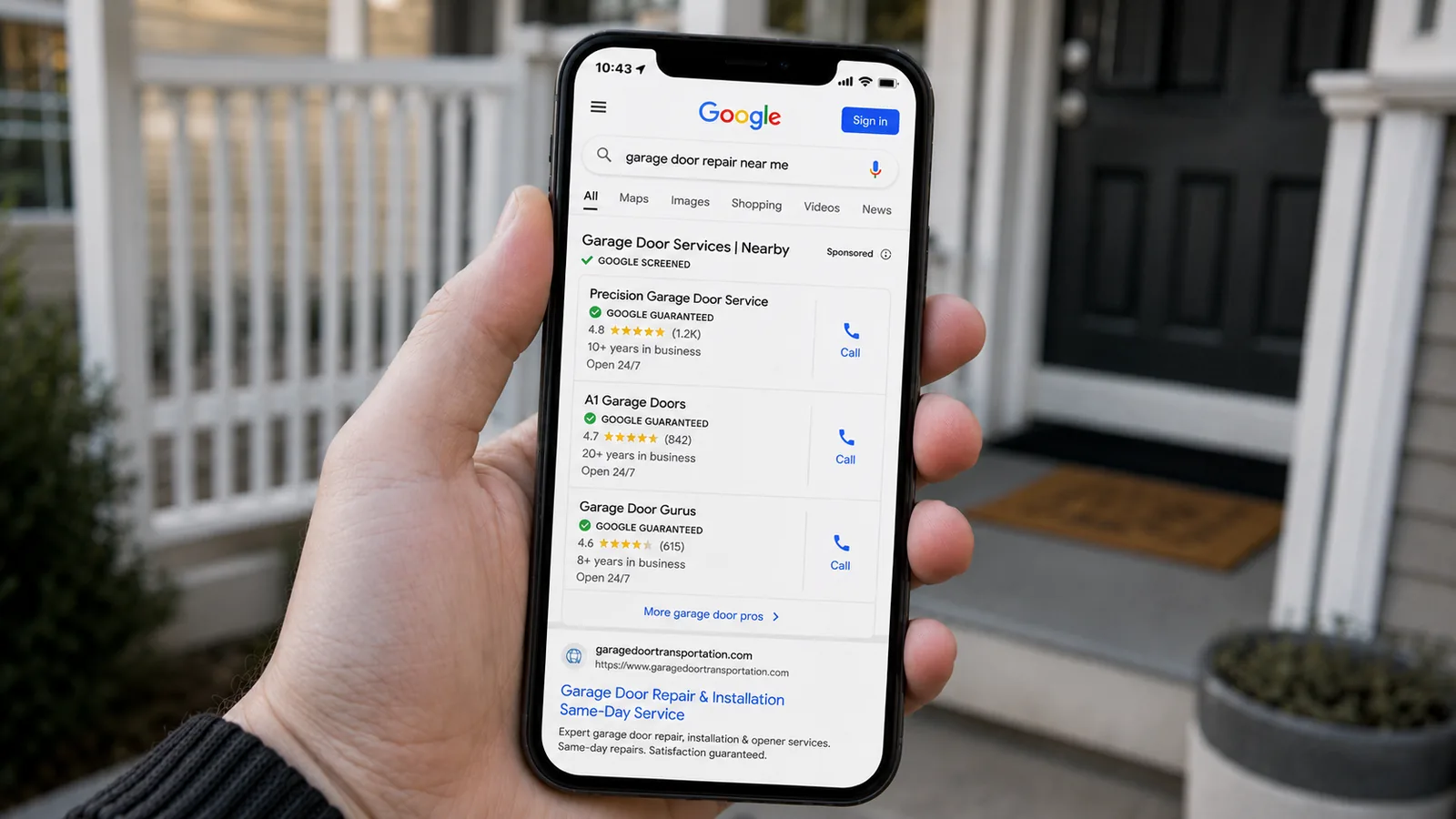
Rank on Google for "Garage Door near me" in Minneapolis.
Right now, someone in Minneapolis is Googling "Garage Door near me." We get you showing up first, then turn that click into a booked job.
How Can We Help?
Choose the option that suits your needs.
Let’s Investigate
We will send your Site Inspection to the email you provided.
You’re in.
We’ll send your Site Inspection within 5 business days.
Let’s Chat
Book a time that works for you.

“Attentive, listened to every revision request, delivered on time. Would work with him again.”
- Hamza Najam

“Patient, on point, straightforward. Did amazing work. Would 100% recommend.”
- Ruben Mederos, HyperTemp HVAC

“Responsive, creative, exceeded expectations. Already seeing greater engagement from our clients.”
- George Jeorgy, Jeorgy's Landscape Construction

“Top-tier professionalism, real web design expertise, ideas I hadn't considered. Confidently recommend.”
- Aws Nassani, Four Eleven Contracting















































































Let’s talk about what your website could be doing for your business.
Call Us TodayThe Minneapolis garage door specifics your website needs
One Skill Needs No Licence
Minnesota lists garage door installation as a general installation specialty, and a contractor providing only one special skill does not need a state residential building contractor licence, with roofers the exception. The Minneapolis garage door specialist is lawfully unlicensed. And a page explaining that honestly outranks one implying a licence nobody in this trade is required to hold.
Two Skills Changes Everything
The Minnesota licence requirement triggers when you contract directly with a homeowner and the work involves two or more special skills. So the Minneapolis company that adds siding or a service door alongside garage doors crosses into licensed territory. That threshold is the single most useful thing you can tell a customer comparing bids.
Ask Which Skills They Sell
Because the Minnesota trigger is the count of special skills rather than the trade itself, two Minneapolis companies quoting the same door can sit on opposite sides of the licence line. So the question a homeowner should ask is what else the company sells. Nobody in this market is telling them to ask it.
Cold Puts the Door Inside
When a Minneapolis garage sits inside the conditioned envelope, the energy code wants a U-factor tested and labelled to NFRC 100 or ANSI/DASMA 105 rather than a brochure R-value. So the heated shop and the garage under living space are code questions here, not comfort preferences. That is a page worth owning.
Air Infiltration Is Half the Story
ANSI/DASMA 105 tests thermal transmittance and air infiltration together, because a door that leaks air performs worse than its insulation rating suggests. So in a Minneapolis winter the perimeter seal matters as much as the panel. A product page that separates the two numbers is telling a truth the R-value alone hides.
One Date Splits Every Opener
Automatic residential garage door operators manufactured on or after January 1, 1991 must meet UL 325 entrapment protection, carried into federal law at 16 CFR Part 1211. The older Minneapolis housing stock still runs openers that predate the requirement. That is a fact about a specific motor housing, not a sales line.
Cold Storage Buys Different Doors
DASMA publishes a separate commercial family covering rolling doors, fire rated rolling assemblies, sheet doors and grilles. The Minneapolis distribution and cold storage buyer is searching a different product set from the homeowner. A single service list that mixes them serves neither buyer well, because the language that reassures a homeowner reads as vague to a facilities manager.
Certification Carries the Weight Here
Since Minnesota does not license single skill garage door specialists, IDEA certification is what a Minneapolis buyer can actually check. Naming which technicians hold the residential, commercial sectional or rolling steel fire door certificate fills the gap the licence rules leave. It is the strongest credential available in this market.
What this Minneapolis page is built from
Eight checkable facts about garage door work in Minneapolis, not national talking points.
Get My Site Inspection Questions Contractors Ask Before Hiring Us
What does Garage Door SEO in Minneapolis actually get me?
Calls from homeowners in Minneapolis who are already searching for your trade. The work is to rank you for the high-intent local queries that move revenue, then make sure the page converts the click once it lands.
How is this different from the last agency that burned me?
You see the scoring framework, the benchmark data behind it, and your ranked fix list before any remediation work begins. It is a diagnosis you can evaluate, not a promise you have to trust.
How do you know this works for my trade?
The Fervor Grade framework was built by scoring 380 contractor sites across roofing, remodeling, and HVAC. Your trade's patterns are in the data, not borrowed from SaaS or dentists.
How long does it take?
The Site Inspection takes 5 business days, and it needs about three minutes from you. The ranking work that follows is ongoing, because search is.
Who owns the website and the accounts?
You do. The domain, the content, the analytics, every account we touch. Day one. No ownership traps, no holding your site hostage if you leave.
What if I do not like what the inspection finds?
Then you found out something that was already costing you, and now you know where. The inspection surfaces what is actually wrong on the site so you can decide what to fix.
Do you only work with contractors in Minneapolis?
No. We work with Garage Door contractors across the region, and the research covers national brands too, so the benchmark holds whether you are downtown or two towns over.
How much does it cost?
The Site Inspection is free. You only pay for the remediation work once you have seen the diagnosis and decided it is worth fixing.
Will the changes hurt my current rankings?
No. The work protects what already ranks. We map the URLs and the equity first, fix the conversion leaks, and improve the pages that search already trusts rather than wiping them.
What do I have to do during the project?
Very little. The intake takes minutes, and the build work is ours to run from there. You keep running crews. We will only ask for things no one else can give us, like your real service area and your best photos.
Still Have Questions?
Give us a call expressing your specific needs, and we’ll see if we are a good fit for each other.
Google's Local Pack ranking runs on review volume and how recent those reviews are. Contractors tend to under-collect reviews they've already earned, because asking after every job is easy to forget in a busy week. NiceJob sends the ask automatically once a job wraps, so new reviews keep flowing without you remembering. You can also set it up to ask your past clients for reviews. If your CRM already handles review requests, use that. Either way, it works better as a system than as a task on someone's to-do list.