Best PPC Agencies for Contractors in 2026
Ten contractor PPC agencies ranked on landing-page quality and lead handling, not just account management. Strengths and real limits.
You can win the auction and still lose the job. That's the flaw in almost every "best PPC agency" list: they rank media buyers on media-buying credentials, and a contractor's paid budget usually dies somewhere downstream of the click. So this one sorts differently. It scores each firm on what happens between the ad impression and the booked job, which means channel coverage (Google Ads, Local Services Ads, Meta, retargeting), attribution that reaches the dispatch board, and whether anybody owns the page the click lands on. Nine of the ten firms below buy paid media for a living. One doesn't, and it's ranked first, which is a claim this piece has to earn rather than assert.
Answering matters as much as ranking, and 18% of home services calls go unanswered on weekdays against 41% at weekends.
The 10 PPC agencies, ranked for contractor fit
Each entry links to a deeper head-to-head in our agency comparison guide. The ranking criterion isn't ad spend under management, and it isn't award count either. It's whether the firm can trace a dollar of spend to a job on the calendar, because paid search behaves differently in the trades than it does in ecommerce. A homeowner searching for an emergency plumber at 6am is not comparison shopping. They're dialling.
"40% of home services consumers who call from search make a purchase. Consumers searching for plumbing, appliance repair, and fencing services are most likely to call after making a search."
Google (via Invoca) (2025)
Four in ten. That's what every agency below is really competing over, because a call-driven category rewards a different skill set than a form-driven one. Call tracking stops being a nice report and starts being the scoreboard.
Calls are worth more than form fills, converting to roughly 10 to 15 times the revenue of a web lead.
No. 1 · Best for Google Ads and Local Services Ads with no contract
SearchKings
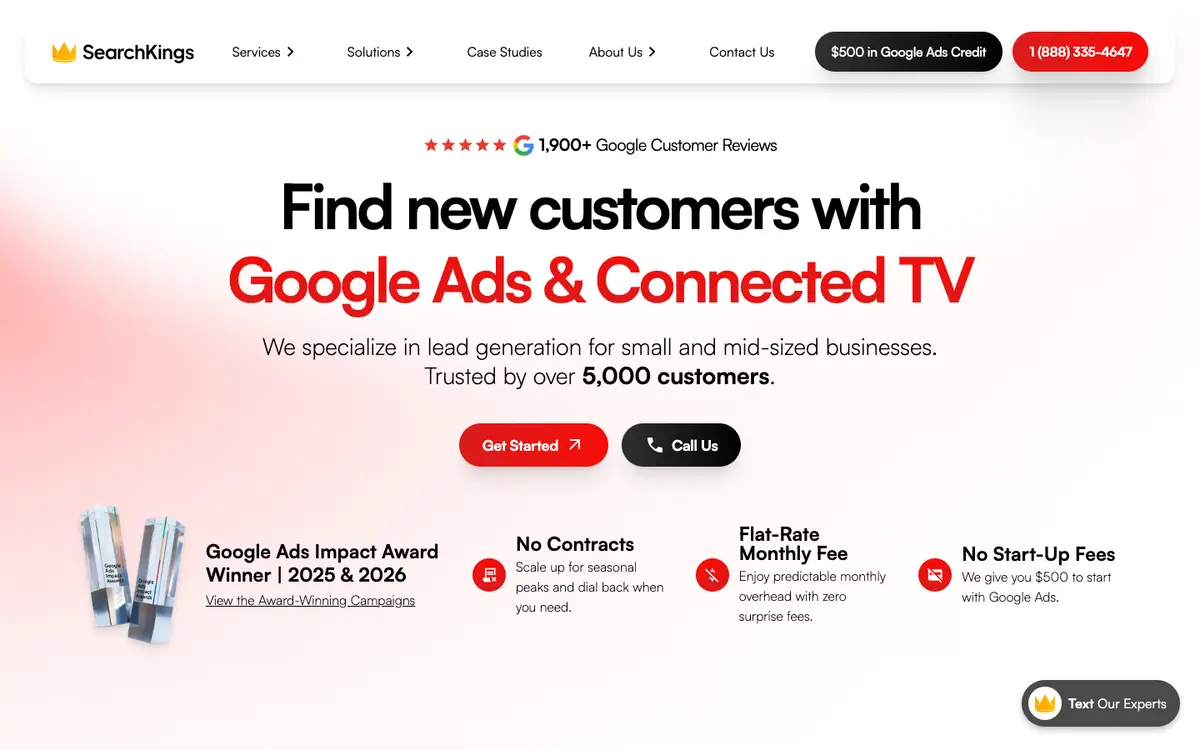
SearchKings is the purest paid-acquisition specialist in this pool, selling Google Ads, LSAs, Call Intelligence™, and a Connected TV product called SKTV at a flat monthly fee with no contract. And the credential stack isn't decorative: Premier Partner status held since 2012, a Google Customer Satisfaction Award running back to 2009, plus 2025's Google Ads AI Excellence Award and the Google Canada AI Agency of the Year title.
Where they're strongest: LSA management, the highest-intent paid unit in home services and the one most generalist agencies quietly skip. Month-to-month terms let you test them for a quarter without signing away a year.
What to consider: Five thousand customers is a book that has to be templated to function, so your account manager is looking after a couple hundred other businesses. SearchKings is multi-industry by design. And the entire model is paid traffic, so if the clicks land on a page that doesn't convert, no amount of bid optimization fixes the page.
Best for: Small to mid-sized contractors who want professional Google Ads and LSA management at a predictable flat fee.
Deep dive: SearchKings vs. Fervor Studio
Form length decides more than copy does, because 68% of people will not submit a form that asks for too much personal information.
"68% of users would not submit a form if it required too much personal information."
Baymard Institute (2024)
No. 2 · Best for tying paid spend to tracked phone calls
RYNO Strategic Solutions
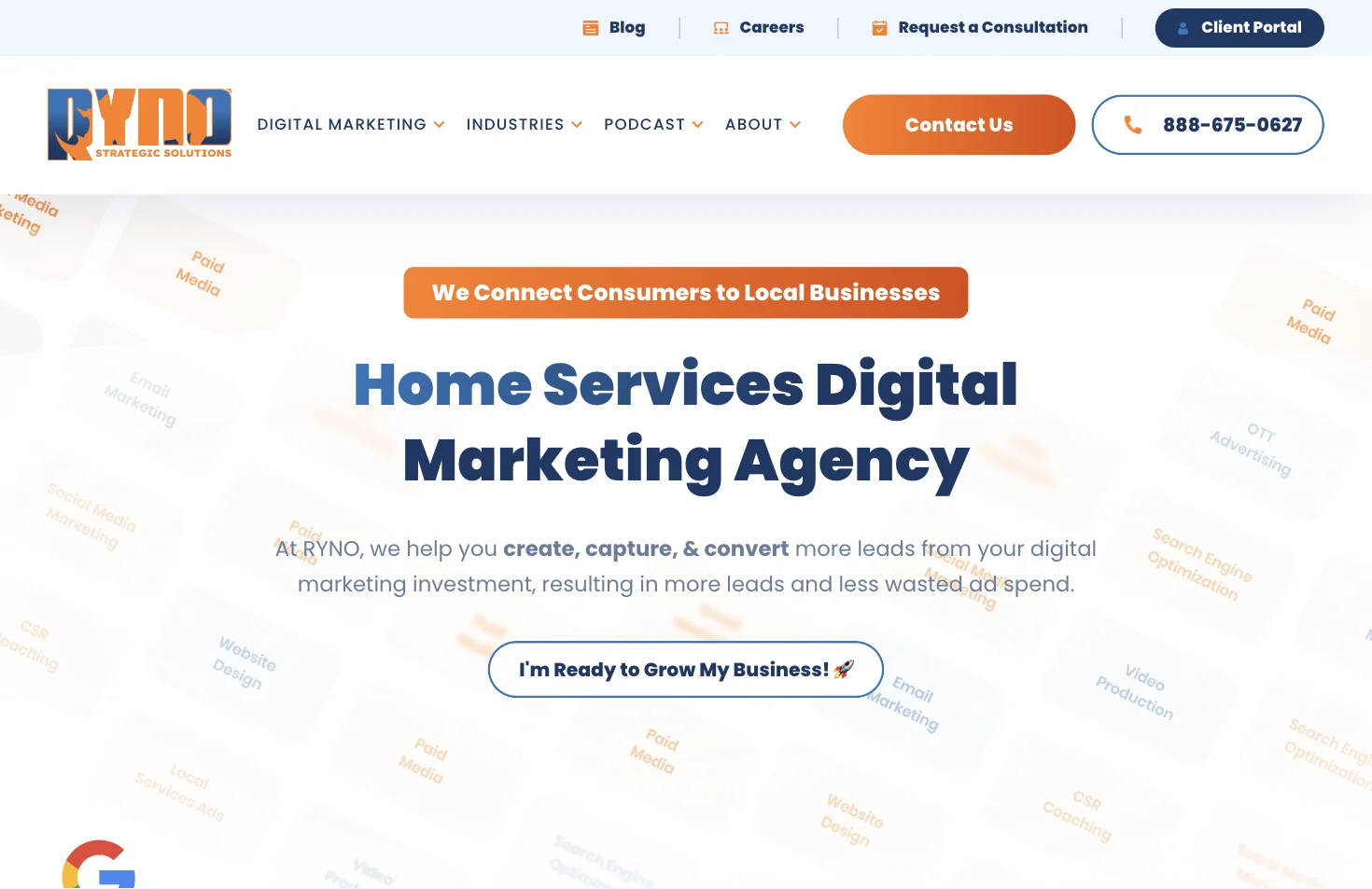
The Blue Corona merger made RYNO one of the largest home-services-only marketing operations in North America, covering 10+ trades. Their RYNOtrax 2.0 platform is why they rank this high on a paid-media list: it traces a phone call back to the campaign that produced it, and it integrates with ServiceTitan. So the reporting answers the only question a contractor cares about, which is which ad produced which job.
Where they're strongest: Attribution and scale. Home-services-only focus means you're not sharing an account team with dentists, and the Sunstone Partners backing funds platform work smaller shops can't afford.
What to consider: Pricing isn't published, which usually signals a minimum spend threshold, and the engagement carries a six-month minimum. RYNO's model is traffic generation. If your site already pulls 2,000 visits a month and the phone still isn't ringing, more traffic into the same path won't change the math.
Best for: Home service companies past $1M in revenue, already on ServiceTitan, who want PPC, LSAs, and call attribution under one roof.
Deep dive: RYNO vs. Fervor Studio
Load time is the cheapest fix on this list, and 53% of mobile visitors leave a site that takes more than 3 seconds to appear.
"53% of mobile users abandon sites that take longer than 3 seconds to load."
Google and SOASTA (2017)
No. 3 · Best for ad spend wired straight into the dispatch board
Scorpion

Scorpion consolidates SEO, PPC, web, chat, and analytics into one dashboard called RevenueMAX, and they're ServiceTitan's only preferred digital marketing partner. That integration is the pitch: you see which campaigns generated which booked jobs without stitching two reports together by hand at month end.
Where they're strongest: Technology and CRM integration. The ServiceTitan partnership is earned through integration depth rather than bought, and the 2026 BIG Innovation Award plus Google Premier SMB Partner status back the platform claims up.
What to consider: Contracts run 12 to 24 months, setup fees land between $5,000 and $50,000, and the platform creates lock-in. If you leave, you may lose your website, because it was built on their system. Estimated spend runs $3,000 to $25,000 a month and up. Scorpion also serves legal and healthcare, so your roofing company shares infrastructure with personal injury firms.
Best for: Established contractors past $2M in revenue on ServiceTitan, with the appetite for a multi-year platform commitment.
Deep dive: Scorpion vs. Fervor Studio
Ratings act as a filter before they act as persuasion, and 68% of consumers will only consider a business rated 4 stars or better.
"68% of consumers will only use a business with a rating of 4 or more stars."
BrightLocal (2026)
No. 4 · Best at the destination half of paid search
Fervor Studio
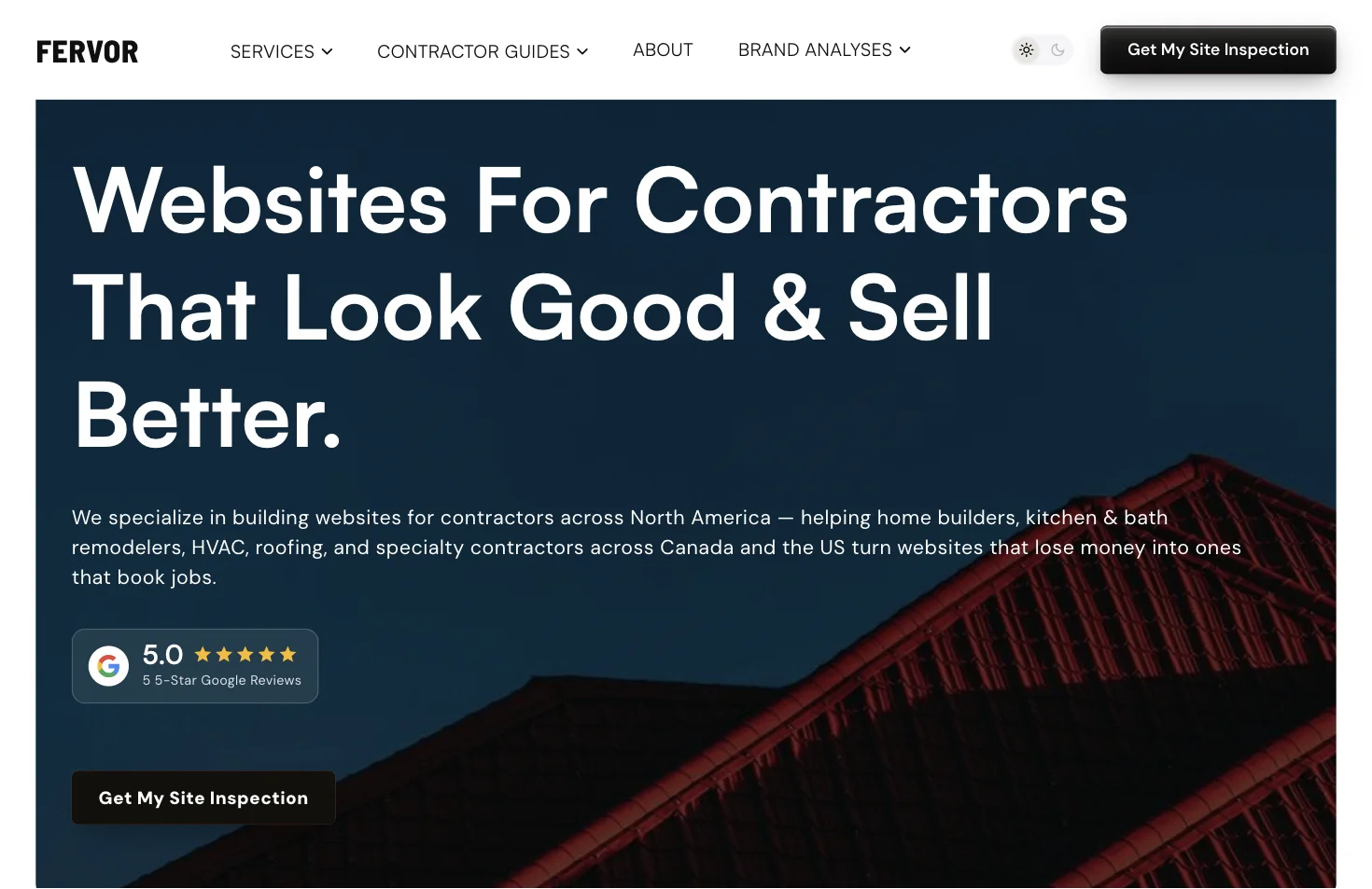
Fervor doesn't buy your media, which is exactly why it sits below the media buyers here rather than above them. It earns the placement on the half of paid search the bidders rarely own: the destination decides what the traffic is worth. The Contractor CRO Index scores 380 contractor websites against a published framework, and the State of Roofing, State of HVAC, and State of Remodeling reports break the failure patterns down trade by trade.
Where they're strongest: Diagnosing whether your cost per booked job is a bidding problem or a page problem, before you renegotiate a retainer. Booked by Design™ runs $9,997 to $19,997 by trade over 30 to 60 days. The Leak Plug Sprint runs $4,997 over 30 days when the site is fine and the leaks are specific.
What to consider: Fervor is contractor-only, so it's the wrong pick outside home services. And the diagnostic-led model runs at a different pace than a 200-person full-service retainer. If your mandate is "somebody take over the Google Ads account by Monday," hire one of the media buyers below and point Fervor at the pages those campaigns feed.
Best for: Contractors already spending on Google Ads or LSAs whose lead volume is fine and whose booked-job count isn't moving.
Deep dive: Booked by Design™ · The Site Inspection
A page repeating one goal beats a page with competing goals by roughly 20 to 30%.
"Pages with a single repeated CTA goal outperform pages with competing CTAs by 20 to 30% on average."
Apexure (2026)
No. 5 · Best for cutting ad spend without cutting revenue
Intellibright

Intellibright's LASR framework stands for Leads, Attribution, Sales, Revenue, and it ties spend to closed jobs rather than lead count. Their headline case number is why they're here: $225K more in monthly revenue with 15% less ad spend. Fewer dollars out, more revenue back. That's a different philosophy from the standard agency answer, which is almost always "raise the budget."
Where they're strongest: Spend efficiency. If your cost per lead has climbed for three straight quarters and your agency's only lever is more budget, a firm whose framework starts with attribution is worth a call.
What to consider: Pricing isn't published, so you go into the first call without a range. The portfolio centres on roofing, which is a strength if you roof and a gap if you don't. And a single headline case study is a smaller evidence base than the track records further down this list.
Best for: Roofing contractors with a meaningful paid budget whose cost per booked job is drifting the wrong way.
Deep dive: Intellibright vs. Fervor Studio
Nobody reads a service page start to finish. About 79% of users scan it, and only 16% read word by word.
"79% of test users always scanned any new page they came across; only 16% read word-by-word."
Nielsen Norman Group (2024)
No. 6 · Best for roofing paid search and seasonal bid strategy
Webrunner Media Group
Webrunner has been running paid search for roofing contractors since 2010, which is fifteen years of pattern recognition inside one trade: seasonal bid dynamics, when to scale spend and when to pull back, the storm-chaser competition that floods a market overnight, and the geographic targeting quirks that make roofing paid search harder than it looks on a keyword planner.
Where they're strongest: Roofing-specific paid search. And the 100+ testimonials matter more here than they would elsewhere, because roofers talk to each other at every trade show in the country. Results that don't hold up get discussed in the hallway.
What to consider: Pricing isn't published, so budget fit is a discovery-call question. The practice is roofing-first, which narrows things if you run HVAC or remodeling. And unlike RYNO or Scorpion, there's no proprietary attribution platform, so call tracking comes from whatever stack you bring.
Best for: Roofing contractors who want a paid search partner with more than a decade inside their trade.
Deep dive: Webrunner Media Group vs. Fervor Studio
References outweigh anything you write about yourself, with 64% of homeowners calling them a top-three factor in choosing a contractor.
"64% of homeowners say having recommendations or references is a top-three factor in choosing a contractor."
Houzz Inc. (2025)
No. 7 · Best for filtering small-ticket leads out of remodeling campaigns
Leads4Build
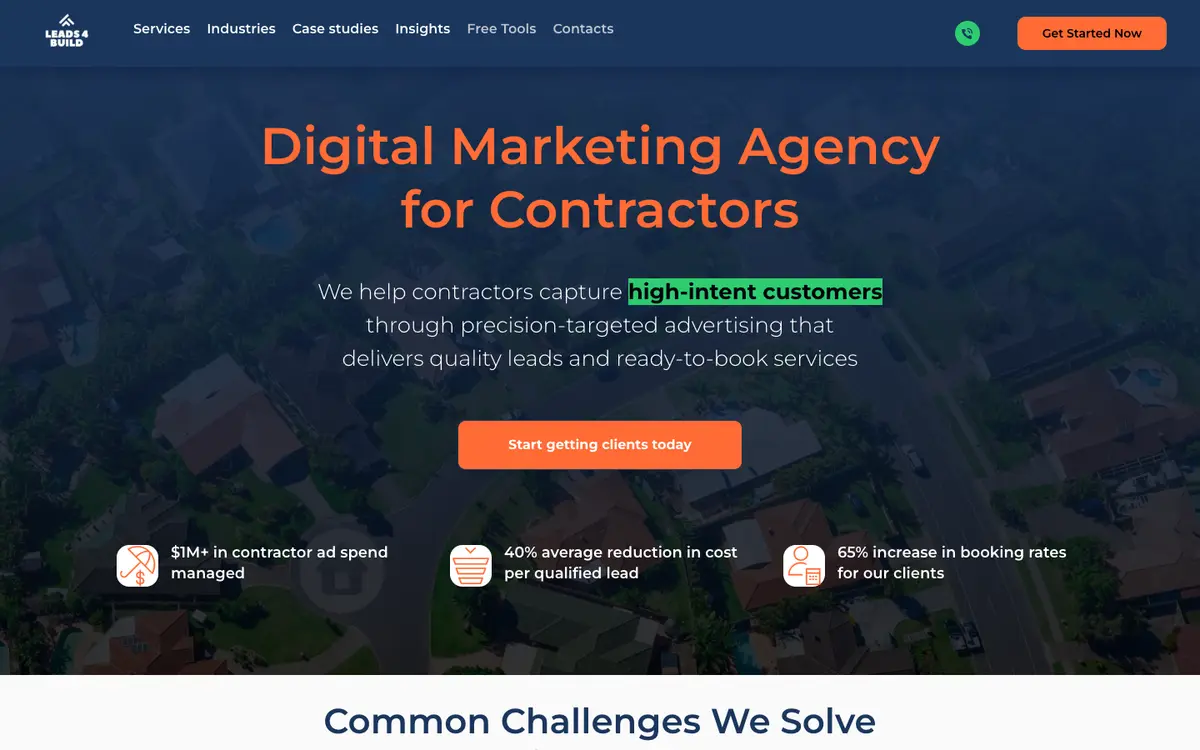
Leads4Build runs Google Ads and social ads for remodelers with a filter in front of the inbox. They pre-qualify leads before those leads reach you, they target projects valued at $25K or more, and they report a 40% reduction in cost per qualified lead against unfiltered approaches. A remodeler drowning in $5,000 bathroom refresh enquiries doesn't have a lead problem. They have a qualification problem, and those two get solved very differently.
Where they're strongest: Pre-qualification on high-ticket remodeling work. When your average project is $40K, a sales rep chasing an unqualified enquiry costs more than the click that produced it.
What to consider: It's a small team focused on remodeling and construction, so the fit narrows fast outside that lane. The $25K+ threshold is a deliberate exclusion, which makes a small-job operator the wrong customer. And pricing runs either monthly retainer or per lead, so compare the two carefully.
Best for: Remodelers with an average project over $25K who are paying for volume they can't convert.
Deep dive: Leads4Build vs. Fervor Studio
No. 8 · Best for large ad budgets that need serious buying muscle
Logical Position
When a firm has managed over $2.15 billion in ad spend, it has seen most of the ways a campaign fails. Logical Position is a Google Premier Partner and was Microsoft's Global Channel Partner of the Year in 2024, running PPC, SEO, paid social, email, SMS, and Amazon advertising. They also hold a BBB Torch Award for Ethics from 2020 and 2024, which is a strange credential to encounter in this industry and a welcome one.
Where they're strongest: Paid media at scale, with platform partnerships that bring early feature access. Published entry pricing too: PPC from $599/mo, SEO from $449/mo, discounts for longer terms.
What to consider: Home services is one vertical among many, not a specialty, and most case studies live in ecommerce and retail. A contractor account may get a capable manager who has never had to think about the difference between "emergency plumber" and "plumbing installation" in lead-quality terms. Percentage-of-spend pricing also means costs scale with your budget.
Best for: Contractors with $5K+ monthly ad budgets who want a large, credentialed buyer across Google, Microsoft, and Meta.
Deep dive: Logical Position vs. Fervor Studio
No. 9 · Best for paid media with a real CRO practice attached
Disruptive Advertising
Disruptive is one of very few full-service shops here where CRO is a core service rather than a line item on a capabilities page. They run paid search, paid social, CRO, web design, and analytics across ecommerce, B2B SaaS, lead generation, healthcare, and home services. So the same team that buys your media can be told to fix the landing page it feeds, which removes a handoff most contractors never manage to coordinate across two vendors.
Where they're strongest: Scale plus conversion depth. Managing $500M+ in annual client spend produces bid signals and creative benchmarks smaller shops can't access.
What to consider: The portfolio is dominated by ecommerce and B2B SaaS, so the CRO team on your account also handles DTC stores and SaaS funnels. Pricing is custom and sits in the mid-to-enterprise tier, which means Disruptive isn't built to run a $4,000 a month retainer for a $700K plumbing company.
Best for: Mid-market and enterprise contractors spending $20K+ a month who want media buying and conversion work inside one contract.
Deep dive: Disruptive Advertising vs. Fervor Studio
No. 10 · Best for published PPC pricing with no quote-form theatre
WebFX
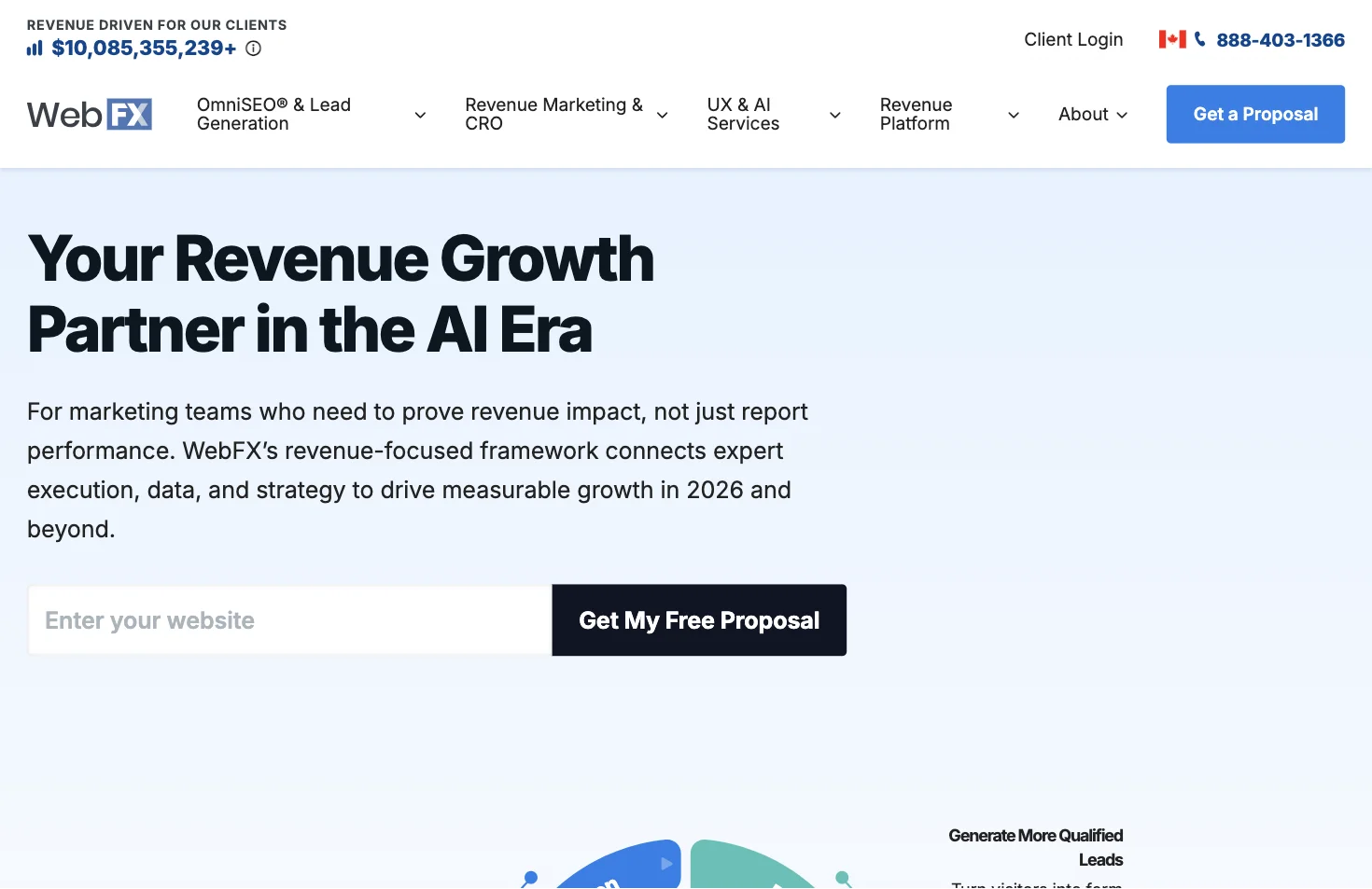
WebFX is one of the few agencies at this size that publishes its pricing instead of hiding behind a quote form, and in a category where "request a proposal" is the default, that's worth a rank on its own. PPC starts at $650/mo, commitments run 3 to 6 months, and their RevenueCloudFX platform consolidates campaign reporting, lead tracking, and ROI in one place.
Where they're strongest: Scale and transparency. You know the price before the sales call, and they staff a dedicated CRO service with ten specialists they call CRO UXPerts, with plans from around $1,500/mo.
What to consider: The operation is built for volume, and your plumbing company sits in the same pipeline as an ecommerce brand and a SaaS startup. Their case studies lean heavily on traffic metrics. If your site already pulls 2,500 visits a month and books nine jobs, doubling the traffic into the same path doubles the spend without doubling the revenue.
Best for: Contractors past $1M in revenue who want published pricing and one vendor across channels.
Deep dive: WebFX vs. Fervor Studio
"18% of home services calls go unanswered on weekdays, while 41% go unanswered on weekends."
Invoca (2025)
"Phone calls convert to 10-15x more revenue than web leads for home services businesses."
BIA/Kelsey and Forrester (2025)
Where contractor paid traffic actually leaks
Here's the part your monthly PPC report doesn't cover. You won the auction, you paid for the click, the homeowner landed. And then they hit a form.
Across the 380 contractor websites in Fervor's State of the Industry group, 318 shipped a form we could capture and measure field by field. Of those, 39% ask for 11 or more user-facing fields on their most complex form. Roofing is the worst offender at 49.5%, remodeling sits at 35.8%, HVAC at 29.9%.
"68% of users would not submit a form if it required too much personal information."
Baymard Institute (2024)
Read that next to the chart and the cost gets concrete. If half your roofing competitors ship an 11-field form and two thirds of users abandon forms that ask too much, a meaningful share of every paid click in the trade is bought and then thrown away at the last step. Not at the ad. Not at the keyword. At the form. Nothing a media buyer does reaches that, which is why the form and the page around it get treated as their own workstream under roofing conversion rate optimization.
"The average e-commerce checkout asks 11.3 form fields in 2024, while a fully-optimized checkout runs around 8."
Baymard Institute (2024)
That comparison is worth sitting with. An ecommerce checkout, where the buyer has already decided to spend money and expects to hand over an address and a card, averages 11.3 fields. A contractor quote request, where the homeowner has decided nothing yet, routinely asks for more. The median roofing brand's most complex form runs 10 visible fields. At the 75th percentile it's 16. And only 25.5% of those 318 sites keep their most complex form to five fields or fewer, with roofing worst again at 17.1%.
"Removing four optional contact-form fields produced a 160% increase in submitted forms and a 120% lift in conversion rate."
Imaginary Landscape (2008)
That study is old enough to vote, and it keeps replicating because the underlying behaviour hasn't changed. Four fields. Not a redesign, not a rebrand, not a new agency. So before you approve another budget increase, go count the fields on the page your ads point at. It's the cheapest thing on this page.
Page speed is a media cost, not a web problem
Paid traffic is more speed-sensitive than organic traffic, and the reason is simple. An organic visitor chose you off a results page and has some patience invested. A paid visitor was interrupted, so their tolerance for a spinner sits near zero.
"53% of mobile users abandon sites that take longer than 3 seconds to load."
Google / SOASTA (2017)
Half the traffic gone before the headline renders, and you already paid for all of it. That line item never shows up in a PPC report, because the platform counted the click and your analytics never saw the session.
"Conversion rates drop approximately 12% for each additional second of page load time."
Google / Deloitte (2020)
Run that against a $6,000 monthly spend and two seconds of avoidable load time. You don't need a model to see the shape of it. The CRO Index statistics page holds the trade-level speed distributions if you want to see where your own site would land.
Local Services Ads, and the call nobody answers
Paid search in the trades is a call channel first and a form channel second, which is why LSA coverage got weighted so heavily in this ranking. SearchKings and RYNO both manage LSAs directly. Most of the generalist buyers do not.
"Phone calls convert to 10-15x more revenue than web leads for home services businesses. Callers convert 30% faster than web leads. Caller retention rate is 28% higher than web lead retention rate."
BIA/Kelsey + Forrester (2025)
Ten to fifteen times. So an agency optimizing for form fills because forms are easier to attribute is optimizing against your revenue, and the fix is boring: put the number in the header, make it tappable, let call tracking do the attribution. But there's a second half to this that gets skipped in almost every agency onboarding.
"18% of home services calls go unanswered on weekdays, while 41% go unanswered on weekends. Each unanswered call is revenue left on the table and a lead handed to a competitor."
Invoca (2025)
Four in ten weekend calls. Your agency bought those clicks at weekend CPCs, which in storm-driven trades are the expensive ones, and the phone rang into nothing. No agency on this list can fix that for you, and any of them will say so if you ask directly. It's an operations problem wearing a marketing costume.
How to pick the right PPC agency for your contracting business
The category sorts into three buyer paths, and picking the wrong path is a more expensive mistake than picking the wrong agency inside the right one. This list is scoped to contractors broadly, so if you're specifically in the emergency-and-maintenance trades, the home services PPC agencies cover the same firms against a landing-page-first test.
Path 1: You are not running paid media yet
You've lived off referrals and organic, the phone goes quiet in the shoulder season, and you want Google Ads and LSAs running without a two-year platform contract. SearchKings is the cleanest pick, because flat fees and month-to-month terms let you find out whether paid works in your market before you commit. Webrunner fits if you roof and want trade-deep bid strategy from day one.
Path 2: You are spending, the leads arrive, and the jobs do not
Your cost per lead looks fine on the report. Your cost per booked job climbs anyway. This is the most common shape in the trades and the most commonly misdiagnosed, because the media buyer's dashboard genuinely cannot see the problem. So the first move is a diagnostic on the destination, not a renegotiation on the media. That's Fervor's lane, and the Site Inspection produces exactly that output. Intellibright attacks the same question from the attribution side, and Disruptive can run media and conversion work under one contract if you'd rather have one throat to choke.
Path 3: You want every channel and one dashboard
You run multiple locations, you're on ServiceTitan, and coordinating four vendors stopped being worth the savings. Scorpion and RYNO are built for this, with RYNO the home-services-only option and Scorpion the deeper platform play. WebFX is the pick if published pricing matters more than trade specialization. Just go in knowing the trade-off: the consolidation is real, and so is the switching cost when a platform owns your website.
Methodology
How this list was built
Every Fervor number here traces to the Contractor CRO Index (n=380 scored contractor websites) and the Digital State of the Industry reports for roofing, HVAC, and remodeling. The form figures come from the 380-site group, measured on the 318 sites that shipped a capturable form: 39% at 11 or more user-facing fields, 25.5% at five or fewer, a roofing median of 10 fields and a 75th percentile of 16. The full stat set lives on the statistics page, and the other agency rankings sit in the news archive.
"Best PPC agency" and "best PPC agency for contractors" are different questions with different answers. The first rewards managed ad spend, platform partnerships, and award counts. The second rewards LSA coverage, call tracking that reaches the dispatch board, seasonal bid discipline in storm and emergency trades, and an honest answer about what happens after the click. The criteria below skew hard toward the second question.
Scored against: paid-channel coverage (Google Ads, Local Services Ads, paid social, retargeting), contractor-domain depth (does the firm work in home services or merely list it), attribution quality (call tracking, CRM integration, revenue traced to campaign), pricing transparency (published rates and contract terms versus quote-gated proposals), and destination ownership (does anyone in the engagement own the landing page the spend feeds).
Excluded: pure lead resellers who sell the same lead to your competitors rather than manage your account, local-search shops whose paid offering is a bolt-on to Google Business Profile work, ad platforms and bid-management tools (software, not agencies), and generalist buyers with no home services presence. RGR Marketing was excluded on the lead-reseller criterion, Contractor Marketing Pros on the local-search-first criterion.
Acknowledged: Fervor is on this list, ranked first, under the same criteria as every other agency and written up the same way, with both strengths and limitations. Fervor does not buy media, which is stated plainly in its entry and is the biggest caveat on that ranking. Agency claims about pricing, headcount, and results are sourced from those firms' own sites and public profiles, not independently verified.
Find out whether your problem is the bid or the page
The Contractor CRO Index publishes the scoring system, the per-brand grades, and the trade-level findings behind the form and speed numbers above. And if you want your own landing pages scored under the same framework before you approve another budget increase, the Site Inspection returns a specific list of the structural gaps between your paid click and your booked job.
Get My Free Inspection →Questions to ask before hiring a contractor PPC agency
What should a contractor company look for in a PPC agency?
Evidence that the agency understands how homeowners actually choose a contractor, not just the marketing discipline. Relevant experience, transparent deliverables, measurable KPIs, credible examples and a grasp of calls, estimates and booked jobs matter more than vocabulary.
How much should a contractor company pay for PPC?
Pricing swings widely on market competition, scope, number of locations and whether the agency is doing strategy, execution or both. Compare the scope and the expected business outcome rather than the monthly fee on its own.
Is the cheapest PPC agency a bad choice?
Not automatically, but price only means something next to scope, specialisation and expected return. Two agencies both selling "PPC" can be doing substantially different work, which makes a price-only comparison misleading.
Why is my contractor website getting traffic but not enough calls?
Traffic does not guarantee leads. Visitors run into weak calls to action, poor mobile usability, unclear service information, thin trust signals, confusing forms, slow pages or a mismatch between the search intent and the landing page. At that point, buying more traffic just sends more people into the same problem.
Can better SEO fix a contractor website that does not convert?
No. SEO can raise the number of relevant visitors reaching the site, but it cannot make those visitors contact the business. Where conversion is weak, more traffic widens the leak instead of sealing it.
Does a contractor need more traffic or a better website?
The data should answer that, not the agency. If the site receives very little relevant traffic, visibility is the priority. If it already attracts high-intent homeowners but produces few enquiries, the website itself is the larger opportunity.
What questions should I ask a contractor marketing agency before hiring it?
Ask what it will actually change, which metrics it will be accountable for, how reporting works, whether the work is outsourced, who owns the website and marketing assets, what happens if performance stalls, and how it tells a traffic problem apart from a conversion problem.
How do I know whether an SEO agency is actually generating business results?
Rankings and traffic have to connect to commercial outcomes. Track qualified calls, estimate requests, booked appointments and, where you can, revenue, rather than judging the work on keyword positions alone.
Fervor's full cross-trade dataset lives in the CRO Index statistics.
 Sep 28, 2026
 Agency Selection
Best Concrete Contractor CRO Agencies in 2026
A concrete site quietly serves two different buyers: a homeowner picking a patio pattern and a GC scoping a foundation pour. Here are 5 CRO agencies scored on the split.
Read Article Sep 27, 2026
 Agency Selection
Best Deck Builder CRO Agencies in 2026
Deck projects concentrate into a hard spring rush most builder sites are not built to catch. Here are 5 CRO agencies scored on whether they solve for it.
Read Article Sep 27, 2026
 Agency Selection
Best Landscaping CRO Agencies in 2026
A landscaping site has to sell a five-figure hardscape build and a renewing maintenance contract at the same time. Here are 5 CRO agencies scored on the split.
Read Article