Best HVAC Websites in 2026
Five HVAC websites ranked on a published 100-point framework, with the A/B tests and interview scripts to copy what they get right.
Most "best HVAC websites" roundups are a screenshot gallery. Somebody liked the photography, the site made the list. So this one works differently. Every company below was scored against the same published 100-point framework as 104 other HVAC contractor websites, and the order you see is the order the scores came out in. No editorial thumb on the scale, because the ranking was computed before the writing started.
Answering matters as much as ranking, and 18% of home services calls go unanswered on weekdays against 41% at weekends.
The five best HVAC websites, ranked
No. 1 · Best overall, and the only A in the trade
Anderson Plumbing, Heating & Air
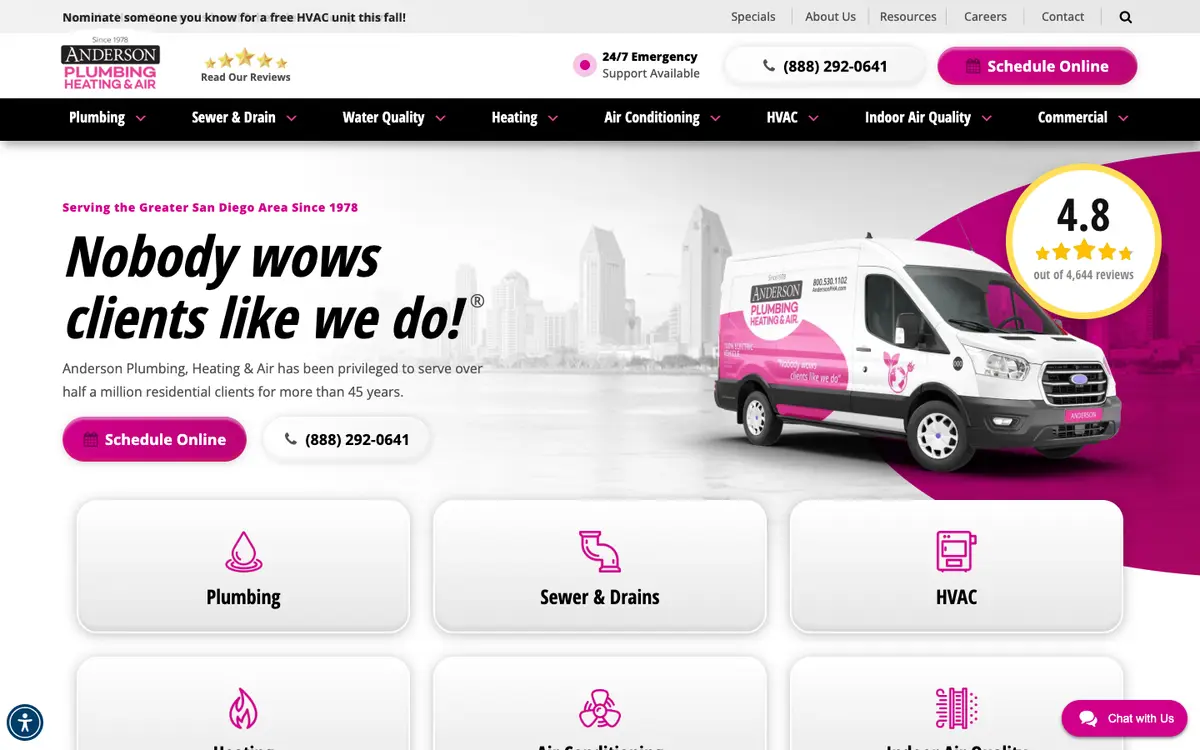
- First impression 19/20
- Trust and credibility 20/21
- Lead capture 17/20
- Mobile experience 15/15
- Content and SEO 10/15
- Accessibility 6/8
No. 2 · Best trust stack behind the leader
Reliable Heating & Air
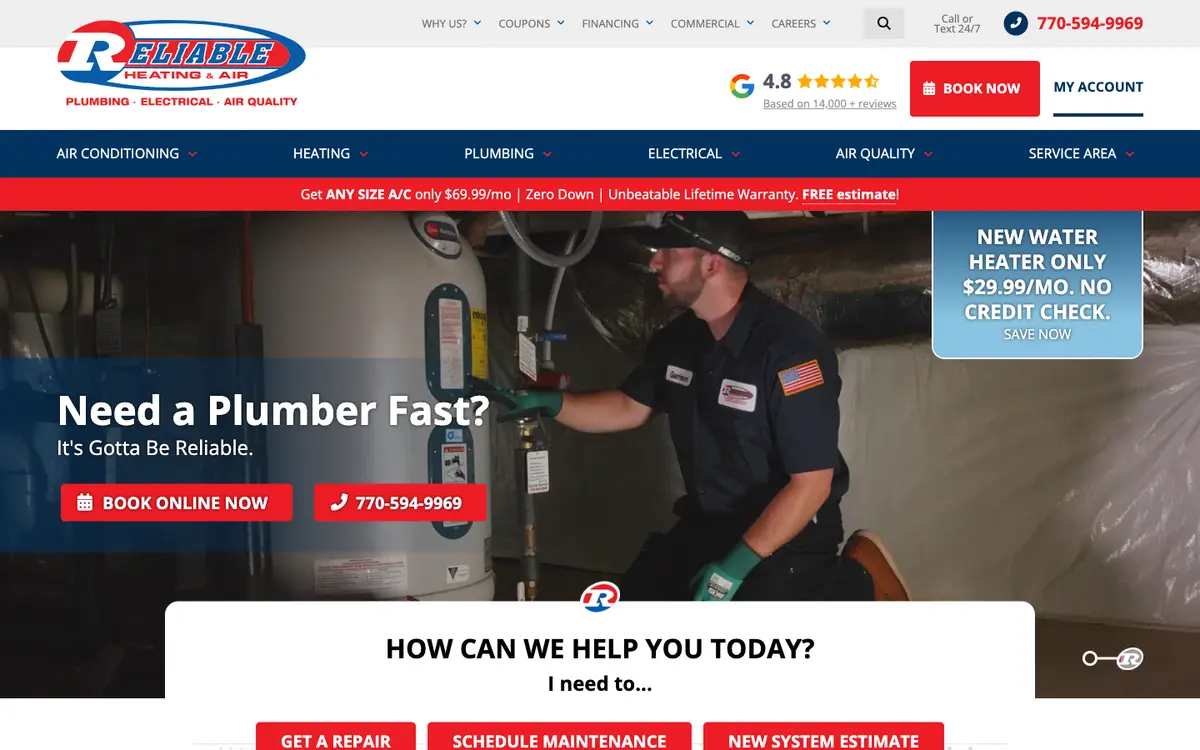
- First impression 18/20
- Trust and credibility 20/21
- Lead capture 17/20
- Mobile experience 14/15
- Content and SEO 12/15
- Accessibility 4/8
No. 3 · Best content depth for a single market
Vanheat Services
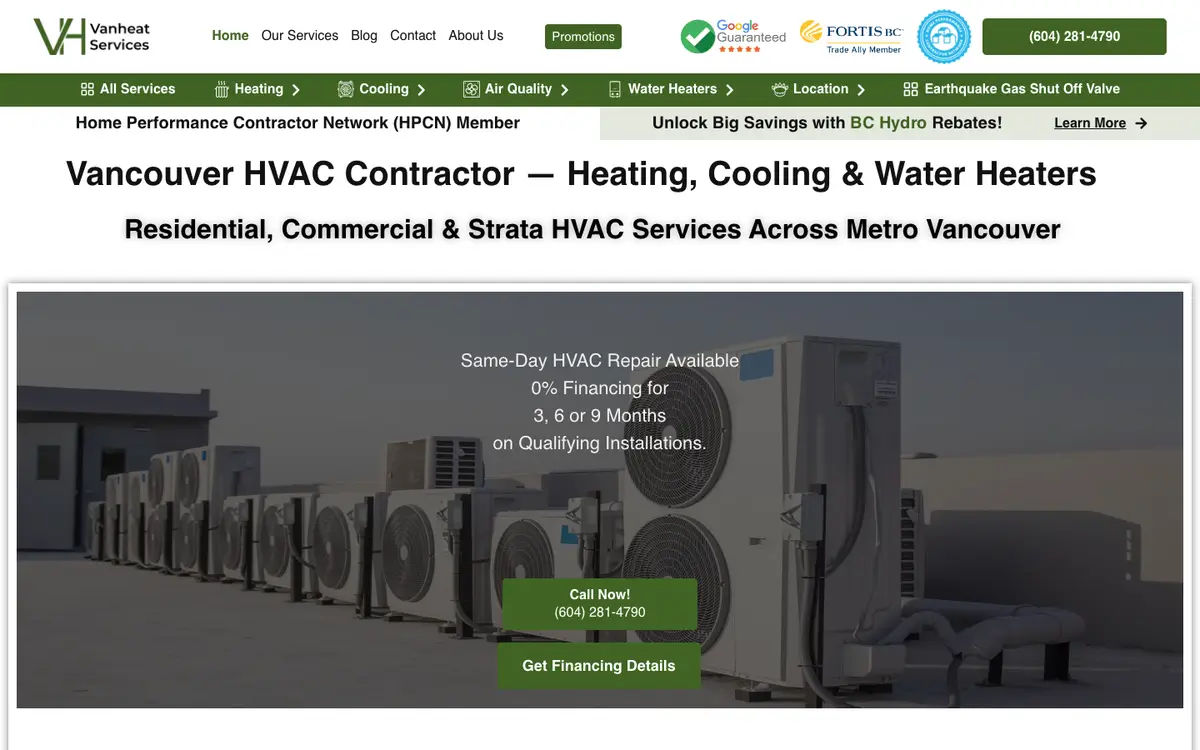
- First impression 17/20
- Trust and credibility 19/21
- Lead capture 17/20
- Mobile experience 12/15
- Content and SEO 13/15
- Accessibility 4/8
No. 4 · Best first impression on a broad service menu
BelRed Energy Solutions
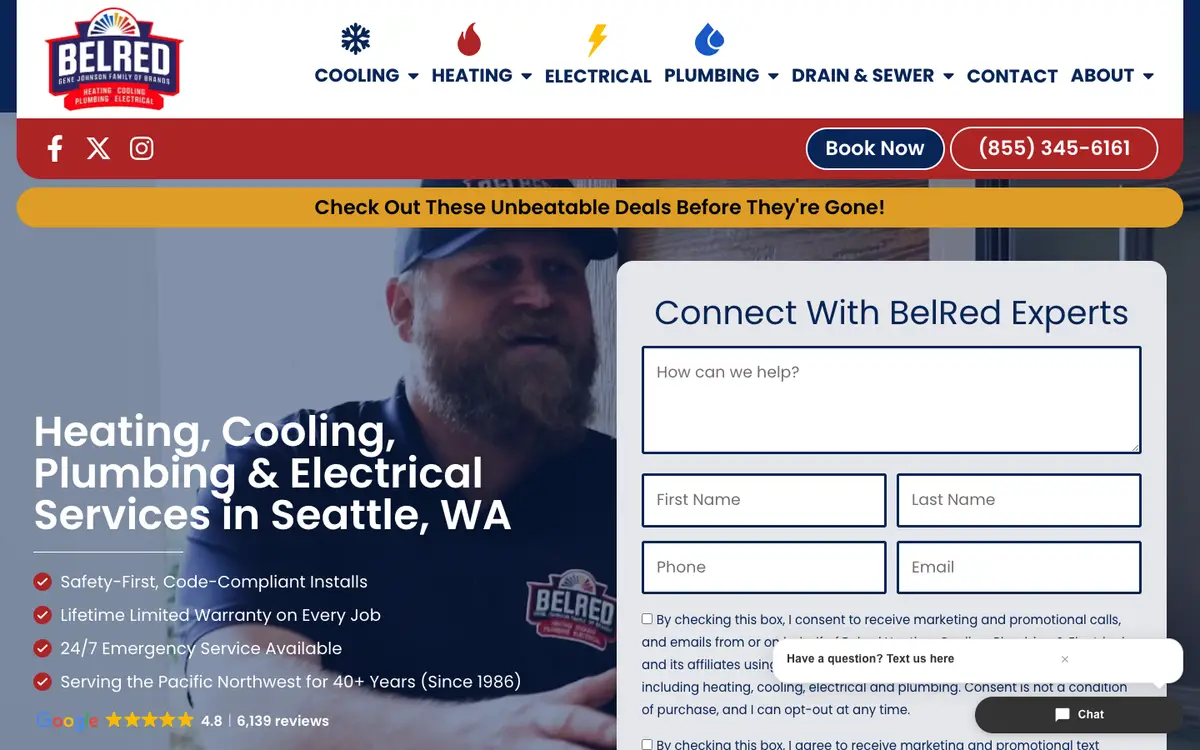
- First impression 17/20
- Trust and credibility 19/21
- Lead capture 14/20
- Mobile experience 13/15
- Content and SEO 11/15
- Accessibility 5/8
No. 5 · Best lead capture of the five
E Dennis Air, Plumbing & Electrical
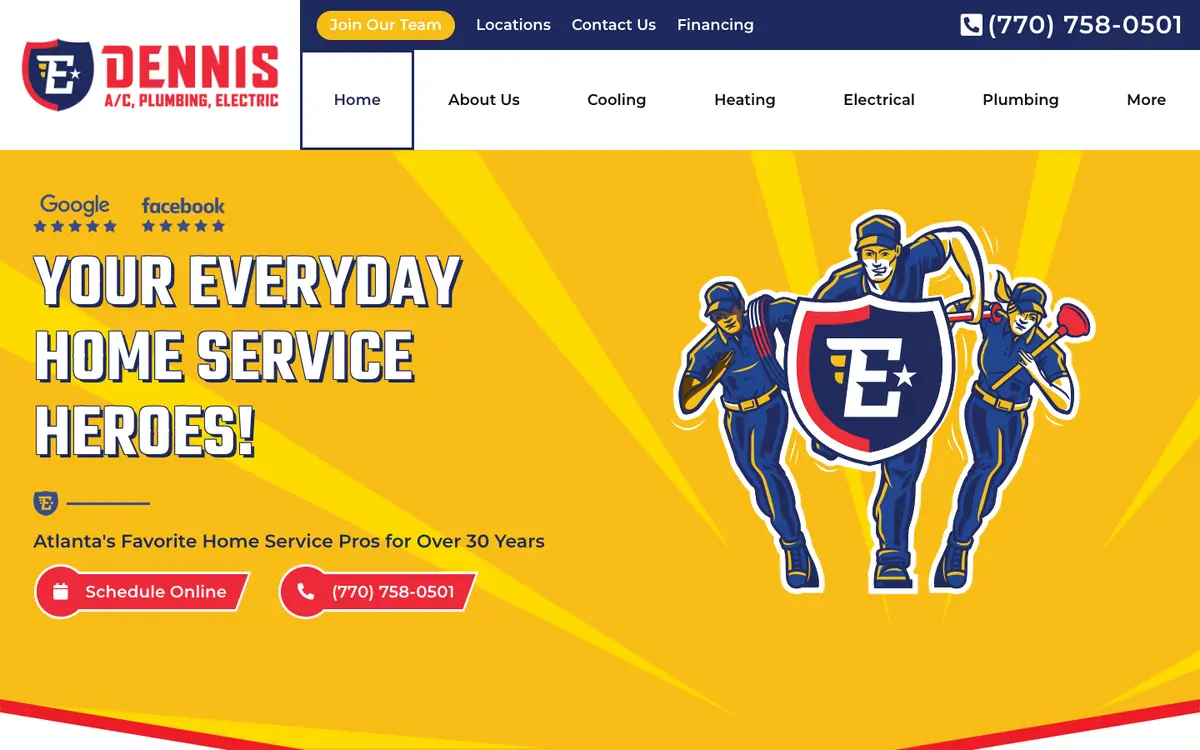
- First impression 15/20
- Trust and credibility 16/21
- Lead capture 18/20
- Mobile experience 13/15
- Content and SEO 11/15
- Accessibility 5/8
The write-ups below run in the same order. Each one explains what the score is actually measuring, then gives you two testing tracks depending on how much traffic you have.
Ratings act as a filter before they act as persuasion, and 68% of consumers will only consider a business rated 4 stars or better.
"68% of consumers will only use a business with a rating of 4 or more stars."
BrightLocal (2026)
How these five were picked
Six categories carry the score: first impression, trust and credibility, lead capture, mobile experience, content and SEO, and accessibility. Each one is weighted, and each one maps to something a homeowner actually does on the way to booking. And the categories matter more than the total, which is why every entry below leads with where that company is strongest rather than with its rank.
One thing worth saying up front. Exactly one HVAC company in the scored group cleared 90, which is where the A band starts. Everybody else on this list is a B. They're the top of a trade where most sites still miss at least one fundamental, so "best HVAC websites" here means best relative to a measured field, not perfect. The median HVAC site in the same scored group scored 67.
Calls are worth more than form fills, converting to roughly 10 to 15 times the revenue of a web lead.
"Phone calls convert to 10-15x more revenue than web leads for home services businesses."
BIA/Kelsey and Forrester (2025)
No. 1 · Anderson Plumbing, Heating & Air
Form length decides more than copy does, because 68% of people will not submit a form that asks for too much personal information.
"68% of users would not submit a form if it required too much personal information."
Baymard Institute (2024)
Why it converts
Anderson Plumbing, Heating & Air scores 15 out of 15 on mobile experience, which is full marks, and it's the only company in the 104-site group to pair that with a 20-out-of-21 trust score. Those two numbers travelling together is the whole story. An HVAC emergency is a phone-in-hand event, usually at a bad hour, and a site that loads clean on a phone while simultaneously answering "are these people legitimate" removes both objections in the same scroll.
But the interesting part is where it doesn't max out. Content and SEO sits at 10 out of 15, which is mid-pack. So this isn't a site winning on volume of published pages. It's winning on the mechanics of the pages it has. The page-role breakdown behind that number is published in full in the Anderson Plumbing, Heating & Air Site Inspection, scored the same way every other site in this piece was.
Load time is the cheapest fix on this list, and 53% of mobile visitors leave a site that takes more than 3 seconds to appear.
"53% of mobile users abandon sites that take longer than 3 seconds to load."
Google and SOASTA (2017)
What they did well
- Credibility arrives before the ask. The trust category is the highest-weighted band in the framework, and this is the only HVAC site in the scored group to score 20 on it. Whatever a homeowner needs to believe, the site settles it early.
- The phone is treated as the primary conversion, not a fallback. Lead capture scores 17 out of 20 alongside that full mobile score, which is the pattern you get when calling is engineered rather than tolerated.
- Nothing breaks at thumb size. Full marks on mobile experience is rare. In this scored group it's the exception, not the baseline.
- The first screen does one job. A 19-out-of-20 first impression score with a strong lead-capture score usually means the hero is not competing with itself.
- Accessibility is above the trade norm. At 6 out of 8 it isn't perfect, but most of the scored group is far worse, and the gap is worth a lot more than it costs to close.
Accessibility failures are close to universal, detectable on 96.3% of the top million homepages.
"96.3% of the top 1 million homepages had detectable WCAG 2 failures."
WebAIM (2025)
What to A/B test if you get 16,000+ visitors a month
A quick note on that number, because it gets waved around without arithmetic. If your lead form converts around 5% and you want to detect a 20% relative lift at 95% confidence and 80% power, you need roughly 8,200 sessions per variant. Two variants, one four-week window, so about 16,300 sessions. Under that, you aren't measuring a winner, you're measuring noise. The same threshold applies to all five sites on this page, so it's stated once here rather than repeated five times.
- A named arrival window in the hero versus the generic availability promise (for example "Technician at your door by 4pm today" against "24/7 emergency service"). Specificity is the variable, not urgency.
- Tap-to-call as the primary hero action versus a form as the primary hero action, with the other demoted to secondary rather than removed.
- Licence and insurance details surfaced in the header versus kept on the about page. Trust is this site's strongest category, so the test is whether pushing it earlier still pays.
- A single repeated call to action versus competing calls to action on the emergency service page.
A page repeating one goal beats a page with competing goals by roughly 20 to 30%.
"Pages with a single repeated CTA goal outperform pages with competing CTAs by 20 to 30% on average."
Apexure (2026)
What to test instead if you get fewer than 16,000 visitors a month
Almost no single-location HVAC company clears that bar, and that's fine. Low traffic makes quantitative A/B testing impractical, so the goal shifts to usability testing, semi-structured interviews, and observational testing. You're after directional feedback, user mindsets, and friction points rather than a p-value. Five to eight participants surfaces most of what's broken.
- Whether the arrival promise is understood at all
Method: five-second impression test.
Execution: show the homepage for five seconds to two groups of six, one seeing the current hero and one seeing a version with a named arrival window, then take it away and ask them to recall the promise.
Key question: "In your own words, when would somebody actually show up at your house, and how sure are you about that?" - What builds confidence in a stranger with a wrench
Method: observational scan-path study.
Execution: watch where six participants look first without prompting them, and note whether licence badges, review counts, or technician photos register before they scroll.
Key question: "What on this page makes you believe these people will actually fix it properly?" - The hesitation right before the call
Method: think-aloud friction protocol.
Execution: ask participants to get as far as the moment before they would tap the phone number, then stop and narrate everything going through their head.
Key question: "Right before you tap that number, what are you worried about, on price or on who picks up?" - Whether the emergency path and the maintenance path are distinguishable
Method: task-based comprehension audit.
Execution: give one group a no-heat emergency scenario and another a shoulder-season tune-up scenario, and time how long each takes to find their route.
Key question: "Which of these is for a broken furnace tonight, and which is for a checkup next month?"
Nobody reads a service page start to finish. About 79% of users scan it, and only 16% read word by word.
"79% of test users always scanned any new page they came across; only 16% read word-by-word."
Nielsen Norman Group (2024)
Nos. 2 through 5, and what each one is best at
No. 2 · Reliable Heating & Air
No. 3 · Vanheat Services
No. 4 · BelRed Energy Solutions
No. 5 · E Dennis Air, Plumbing & Electrical
Why they convert
Reliable Heating & Air scores 20 out of 21 on trust, matching the leader, but gives back ground on mobile at 14 out of 15. So it's a site that wins the credibility argument and then makes the phone work harder than it should have to. Vanheat Services inverts that shape: content and SEO at 13 out of 15 is the strongest of the five, which is what a single-market operator publishing real service depth looks like in the data.
And then BelRed Energy Solutions and E Dennis Air, Plumbing & Electrical split the difference in an instructive way. BelRed Energy Solutions carries a 17-out-of-20 first impression across a broad service menu, which is genuinely hard, because every service you add is another thing competing for the first screen. E Dennis Air, Plumbing & Electrical posts the best lead capture of the whole group at 18 out of 20 while scoring lowest of the five overall. Worth sitting with, that one. You can be the best on the page at asking for the job and still finish fifth, because the score is measuring whether people trusted you enough to get to the asking. If you want to see where the points actually moved, the E Dennis Air, Plumbing & Electrical Site Inspection breaks that trade-off out page by page.
What they did well
- Review depth is doing the heavy lifting. Every site in this group scores 16 or better on trust, and in a trade where a stranger enters your home, that band moves more than design polish does.
- Service pages are built as entry points, not as a menu. The content scores here cluster higher than the scored group norm, which happens when individual service pages are written to rank and convert on their own.
- Forms stay short enough to finish on a phone. The lead-capture scores in this group track with fewer fields, not more.
- Nobody hid the phone number. It sounds obvious. Half the scored group still gets it wrong.
What to A/B test if you get 16,000+ visitors a month
- Review count and average rating in the header versus review content further down the page (for example a persistent "4.9 from 1,200 reviews" line against a testimonial block below the fold).
- A four-field form versus the current longer form, holding the offer and the button copy constant so the field count is the only variable.
- Financing or price-range signalling above the fold versus on a dedicated page. HVAC replacement is a five-figure decision and the silence around cost is doing something measurable.
- A maintenance-plan entry point in the primary navigation versus inside the services dropdown.
What to test instead if you get fewer than 16,000 visitors a month
Same principle as above. You're gathering direction, not proof, so the methods change and the sample sizes get small enough to run in an afternoon.
- Whether price silence reads as expensive or as normal
Method: semi-structured interview, six to eight participants.
Execution: walk each participant to the point of enquiry, then ask what they expect this will cost and where they got that number.
Key question: "Nothing on this page mentions price. Does that make you want to ask, or make you want to check somebody else first?" - Whether the form length is the actual barrier
Method: think-aloud friction protocol on the form only.
Execution: have participants fill the form for a hypothetical repair and narrate at each field, noting the exact field where the tone shifts.
Key question: "Which of these questions felt like it was for you, and which felt like it was for them?" - Whether the maintenance plan is understood as a product
Method: comparative interview across two groups.
Execution: show one group the plan in the main navigation and one group the plan inside a dropdown, then ask each to explain what it includes and what it costs.
Key question: "What do you actually get for that every year, and would you sign up for it today?"
What separates the top five from the median HVAC site
The median HVAC site in this scored group scored 67. The gap between it and the five above is not budget, and it's not photography. It's that the top five resolve the two questions a homeowner has, in order, before asking for anything: can you come when I need you, and are you safe to let in the house. Sites in the middle of the scored group answer the second question eventually, on an about page nobody reaches.
So if you want the shortest version of what to copy: put the credibility earlier than feels comfortable, make the phone the easiest thing on the screen, and cut the form until it can be finished at a stoplight. That's most of the distance. And if somebody else is doing the building, we ranked the HVAC marketing agencies on whether they get to that work at all.
Methodology
How this ranking was built
Every company on this page was scored as part of the Contractor CRO Index, which grades 104 HVAC contractor websites against a published framework across six categories. The State of HVAC report documents the trade-level patterns the scores come from. Ranks on this page are computed from that dataset at build time, so the order is the data's order.
Scored against: first impression, trust and credibility, lead capture, mobile experience, content and SEO, and accessibility, each weighted, each assessed across multiple captured pages rather than the homepage alone.
Acknowledged: Fervor publishes the framework these ranks come from, which means the ranking is not independent of us. We think it's the more useful disclosure to say that plainly than to present the list as a neutral survey. The scores themselves are reproducible from the public index, and every company named here can be checked against it. The write-ups describe what the scoring found. They are not visual reviews of the sites, and nothing here should be read as a claim about a page element we did not measure. Grades follow American school bands, so an A begins at 90 and every B on this list is a B.
Want your own HVAC site scored the same way?
The Contractor CRO Index publishes the scoring system and the per-brand grades behind this ranking. If you want your own site run through the same six categories, the Site Inspection returns a specific list of structural gaps rather than a score alone.
Get My Free Inspection →What to check on your own HVAC website
What makes a good HVAC website?
It makes clear within seconds what the company does, where it works and how a homeowner takes the next step. Then it needs strong mobile usability, trust signals, real service information, fast access to phone and booking actions, and a structure that lets individual services and markets rank.
Can a beautiful contractor website still perform poorly?
Routinely. Visual quality and commercial performance are different things. A site can look premium while burying the phone number, weakening its calls to action, hiding service information or adding friction before an estimate request.
Why is my HVAC website getting traffic but not enough calls?
Traffic does not guarantee leads. Visitors run into weak calls to action, poor mobile usability, unclear service information, thin trust signals, confusing forms, slow pages or a mismatch between the search intent and the landing page. At that point, buying more traffic just sends more people into the same problem.
Should a HVAC company redesign its website or optimize the existing one?
A full redesign is often unnecessary. If the site is technically sound and already receives meaningful traffic, targeted conversion work is usually faster and cheaper. A redesign earns its cost when structure, technology, branding or user experience block incremental improvement.
Does web design affect local SEO?
Yes, sometimes directly. Site architecture, mobile usability, crawlability, internal linking, page speed and the way service and location content is organised all feed search performance.
What is conversion rate optimization for contractors?
Contractor CRO is the work of increasing the share of existing visitors who become calls, estimate requests or booked appointments. It covers messaging, trust signals, page structure, mobile experience, calls to action, forms and booking flows.
What should a HVAC company do if it already ranks well but is not getting enough leads?
Work out first whether the problem is traffic quality or conversion. If relevant homeowners are already arriving, conversion work will usually return more than additional SEO or ad spend, because the visitors you are paying for are already there.
Should contractors invest in SEO or CRO first?
It depends entirely on where the bottleneck sits. A contractor with little qualified traffic needs acquisition work first. A contractor already pulling meaningful search traffic but booking few jobs should investigate conversion before buying more traffic.
 Sep 28, 2026
 Agency Selection
Best Concrete Contractor CRO Agencies in 2026
A concrete site quietly serves two different buyers: a homeowner picking a patio pattern and a GC scoping a foundation pour. Here are 5 CRO agencies scored on the split.
Read Article Sep 27, 2026
 Agency Selection
Best Deck Builder CRO Agencies in 2026
Deck projects concentrate into a hard spring rush most builder sites are not built to catch. Here are 5 CRO agencies scored on whether they solve for it.
Read Article Sep 27, 2026
 Agency Selection
Best Landscaping CRO Agencies in 2026
A landscaping site has to sell a five-figure hardscape build and a renewing maintenance contract at the same time. Here are 5 CRO agencies scored on the split.
Read Article