Best HVAC CRO Agencies in 2026
A firm ranking itself above Fervor on its own HVAC CRO list turns out to sell $3,000/mo performance marketing, not HVAC-specific conversion work. Here are 7 that actually fit.

Web Tonic publishes its own "best HVAC CRO agencies" list, 21 names deep, and ranks itself second. Fervor sits fifth on that same list, described in one line as a "Calgary-based vertical specialist," which is accurate as far as it goes. But a list built by a $3,000/mo performance marketing shop, ranking itself above a firm whose entire practice is contractor conversion research, is worth reading with a raised eyebrow. So this is the same category, scored differently: not on editorial-review points, but on whether the agency has actually watched an HVAC homeowner decide between "call now" and "keep googling" during a furnace outage. Seven agencies, ranked for that specific job.
The 7 HVAC CRO agencies, ranked for HVAC contractor fit
One housekeeping note before the list. Fervor Studio, the firm publishing this article, ranks first on it. That's a conflict of interest and it's named as one, in the entry itself and again in the methodology below. Every other agency on this list, including the one that also publishes its own agency rankings, gets scored against the same five criteria.
No. 1 · Best research-backed CRO for HVAC contractors
Fervor Studio

Disclosure, up front: Fervor Studio publishes this ranking and ranks itself first. Weigh this entry accordingly, and check the other six the same way you'd check this one. The research underneath it is public, so the audit trail is there if you want to run it.
HVAC has a specific buyer-psychology problem that most CRO shops never see up close. 53% of Canadian home buyers say lower utility bills motivate them toward a system upgrade, but only 45% will actually spend up to $3,000 to get there. The wallet argument doesn't close itself.
"53% of Canadian home buyers reported being motivated by lower utility bills, yet only 45% were willing to spend up to $3,000 to achieve those savings."
Canadian Home Builders' Association (CHBA) (2024)
That's not a traffic problem or a design problem. It's a financing-and-framing problem, and it's exactly the kind of gap the Contractor CRO Index was built to catch: 380 contractor sites scored against a published six-category framework, with the State of HVAC report breaking down exactly where HVAC sites lose that homeowner.
Where they're strongest: Published methodology tied to a real dataset, so a recommendation traces back to a scored finding instead of an agency opinion. Revenue-per-visitor measurement on every engagement.
What to consider: Fervor is contractor-only and diagnostic-led. An HVAC group running dozens of locations that wants a high-volume A/B testing program will move faster with an enterprise CRO shop than with Fervor's site-by-site model.
Best for: HVAC contractors who want the utility-savings pitch and the financing objection actually addressed on the page, not just a faster load time.
Read next: Booked by Design™ · Free Site Inspection
No. 2 · Best for a documented HVAC revenue outcome
Elevation Ten Thousand (E10K)
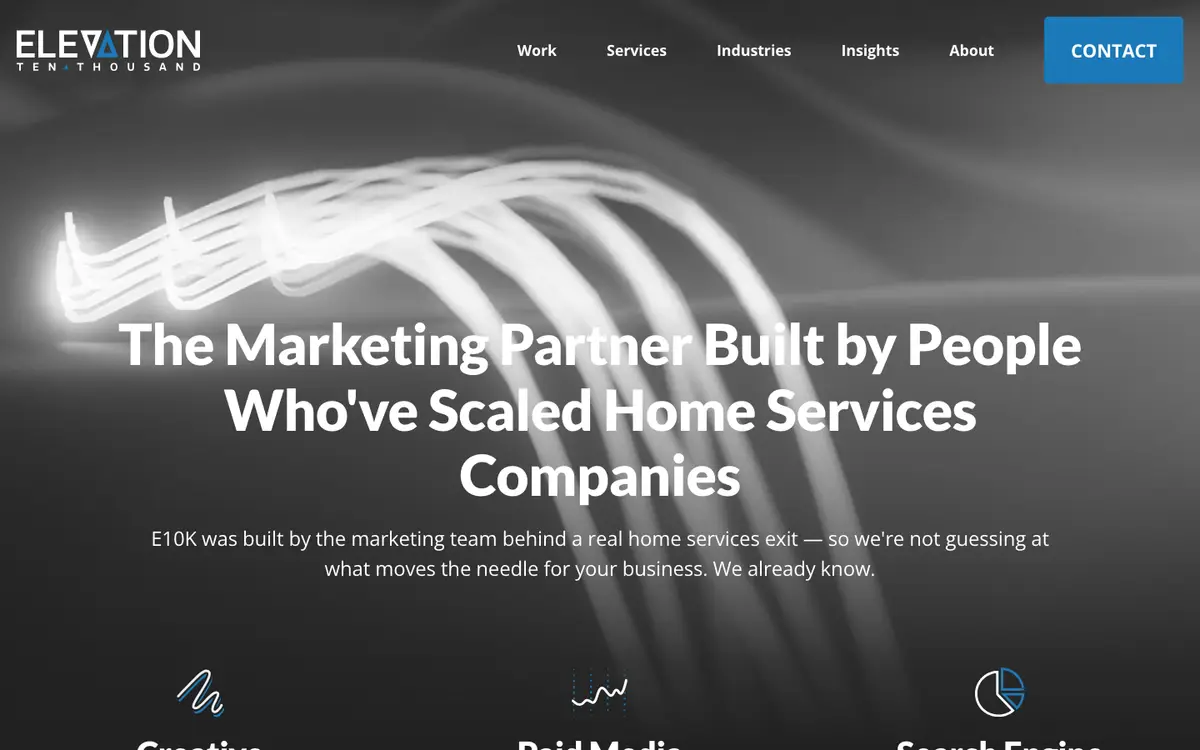
E10K lists conversion rate optimization as an explicit line item next to web design and paid media, which already separates it from most of the marketing agencies that only mention CRO in passing. Their published case study for Standard Heating Cooling and Insulating documents 6x revenue growth, built around a differentiated financing offer, not just a redesign.
Where they're strongest: A named, documented HVAC case study with a specific revenue multiple. Operator background, the team built and sold a home-services company, so the financing-offer instinct isn't theoretical.
What to consider: E10K is a broad media and creative shop with its own print and apparel production line. HVAC is a proof point in their portfolio, not the whole business.
Best for: HVAC contractors who want a financing-offer-driven growth story and don't mind a multi-vertical creative agency behind it.
No. 3 · Best conversion-shaped web design for larger HVAC operations
Hook Agency

Hook doesn't sell itself as a CRO shop, it sells SEO, PPC, and web design for home-services contractors, and the conversion engineering rides inside the web-design retainer: clear CTAs, persistent phone placement, trade-specific layout patterns pulled from years of watching HVAC and roofing sites in the same trade-show rooms.
Where they're strongest: Conversion-shaped design for $3M+ HVAC operations. Trade-show proximity means the layout choices come from watching real contractor behavior, not a generic template library.
What to consider: No published CRO testing methodology. Results get reported as traffic and lead wins, not conversion-lift percentages from a controlled test.
Best for: Growing HVAC operations planning a rebuild who want conversion baked into the design rather than tested afterward.
Head to head: Hook Agency vs. Fervor Studio
No. 4 · Best for a documented before/after HVAC rebuild
Klutch Growth
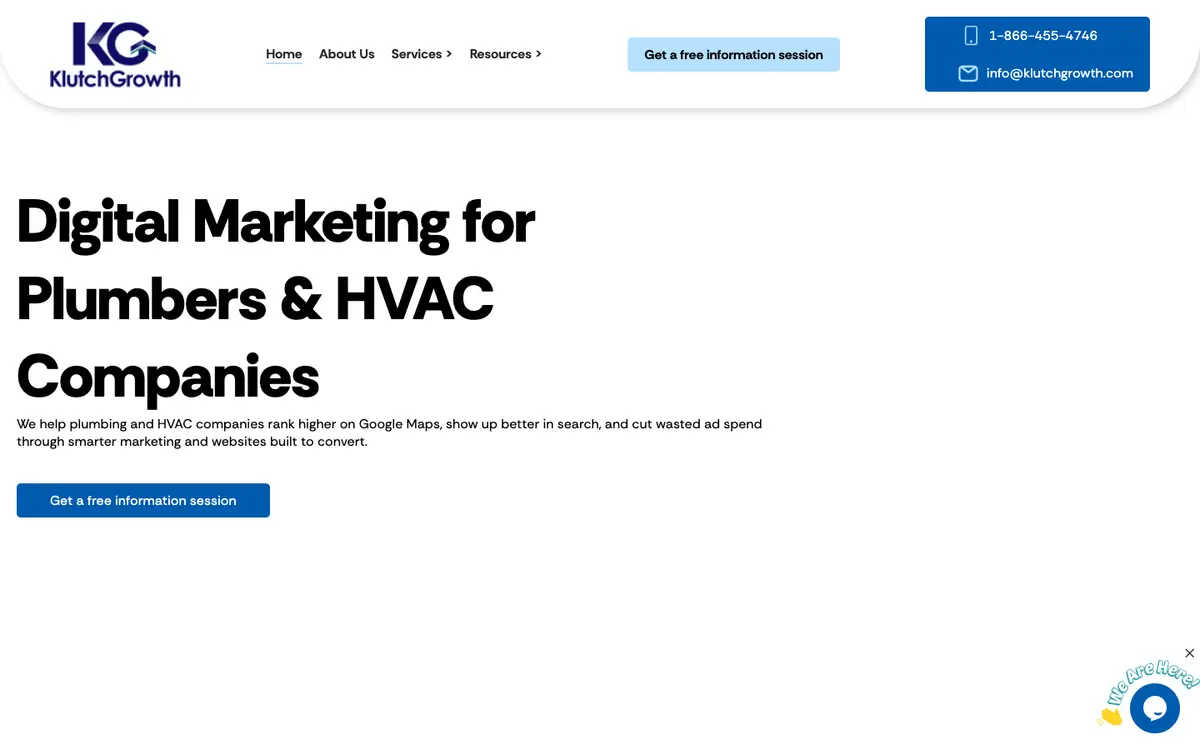
Klutch Growth publishes a Miami HVAC client case study reporting a 761% increase in conversion rate after a site rebuild. That's a large, specific, checkable number, the kind of thing you can ask to see the before-and-after analytics on before you sign anything.
Where they're strongest: Willingness to publish a specific before/after conversion number rather than a vague traffic-growth claim.
What to consider: One published HVAC case study is one data point. Ask how many other HVAC engagements they can show, and whether the 761% figure is against a genuinely broken starting site (a low bar) or a mediocre one (a higher bar to clear).
Best for: An HVAC contractor with a site so outdated a full rebuild is already the plan, who wants a partner that will publish the before-and-after number.
No. 5 · Best for scale, not for CRO specifically
RYNO Strategic Solutions
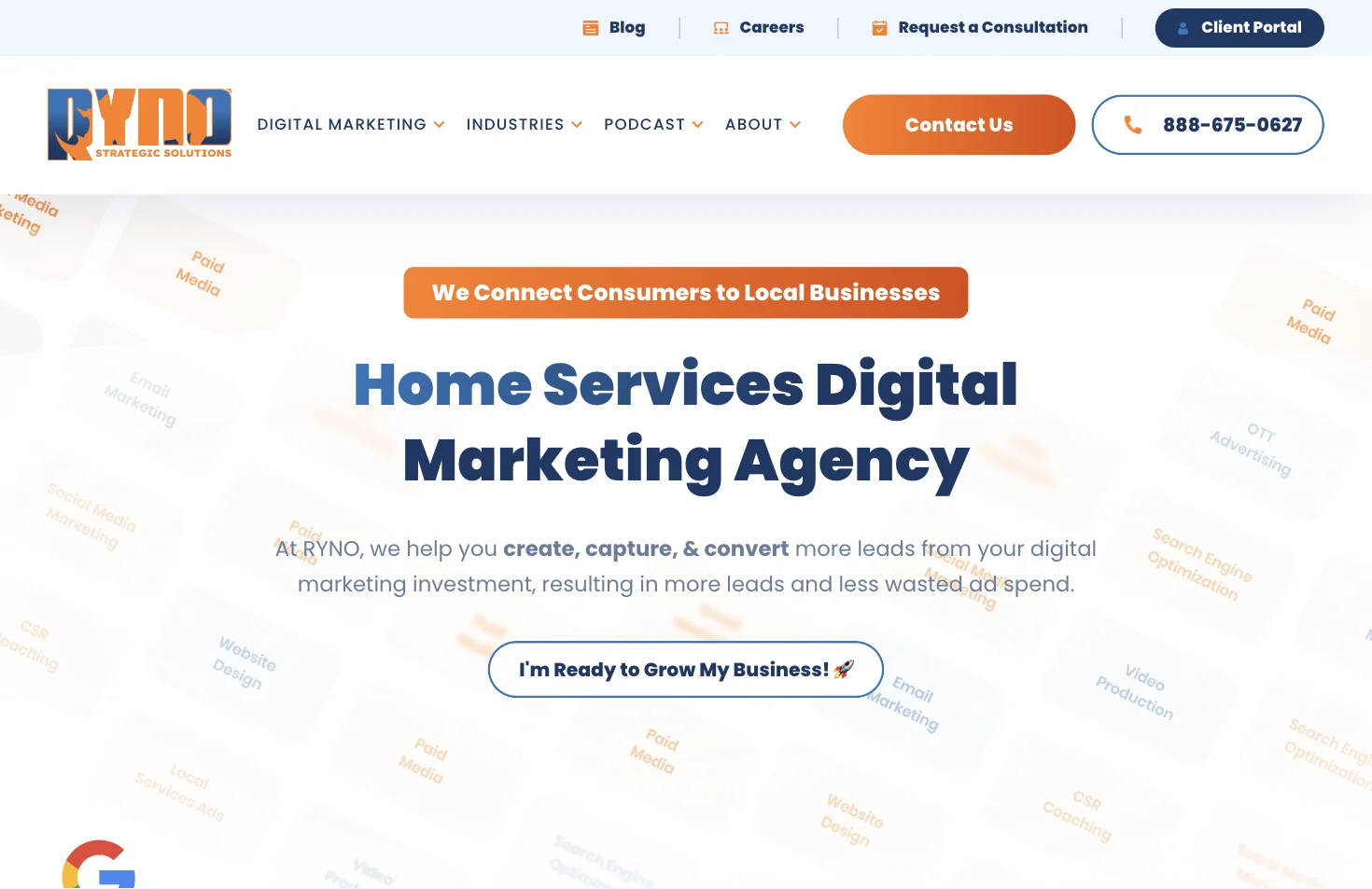
Post-merger, RYNO runs RYNOtrax2.0, a proprietary attribution platform connecting leads to booked jobs across 30+ ad channels, with real ServiceTitan integration. That's serious infrastructure. But the honest read, confirmed against their own service pages, is that RYNO is built for traffic generation and lead capture first. CRO is not a named, staffed practice the way it is at a firm like Invesp or Fervor.
Where they're strongest: Scale and attribution infrastructure. ServiceTitan integration removes a real reporting headache for HVAC operators already on that platform.
What to consider: CRO reads as a byproduct of the lead-generation stack, not a standalone discipline with its own testing methodology. If your traffic is fine and your booking rate isn't, this may not be the fastest fix.
Best for: Multi-location HVAC groups on ServiceTitan who need traffic and attribution solved first, conversion second.
Head to head: RYNO vs. Fervor Studio
No. 6 · Best large agency with a real staffed CRO practice
WebFX
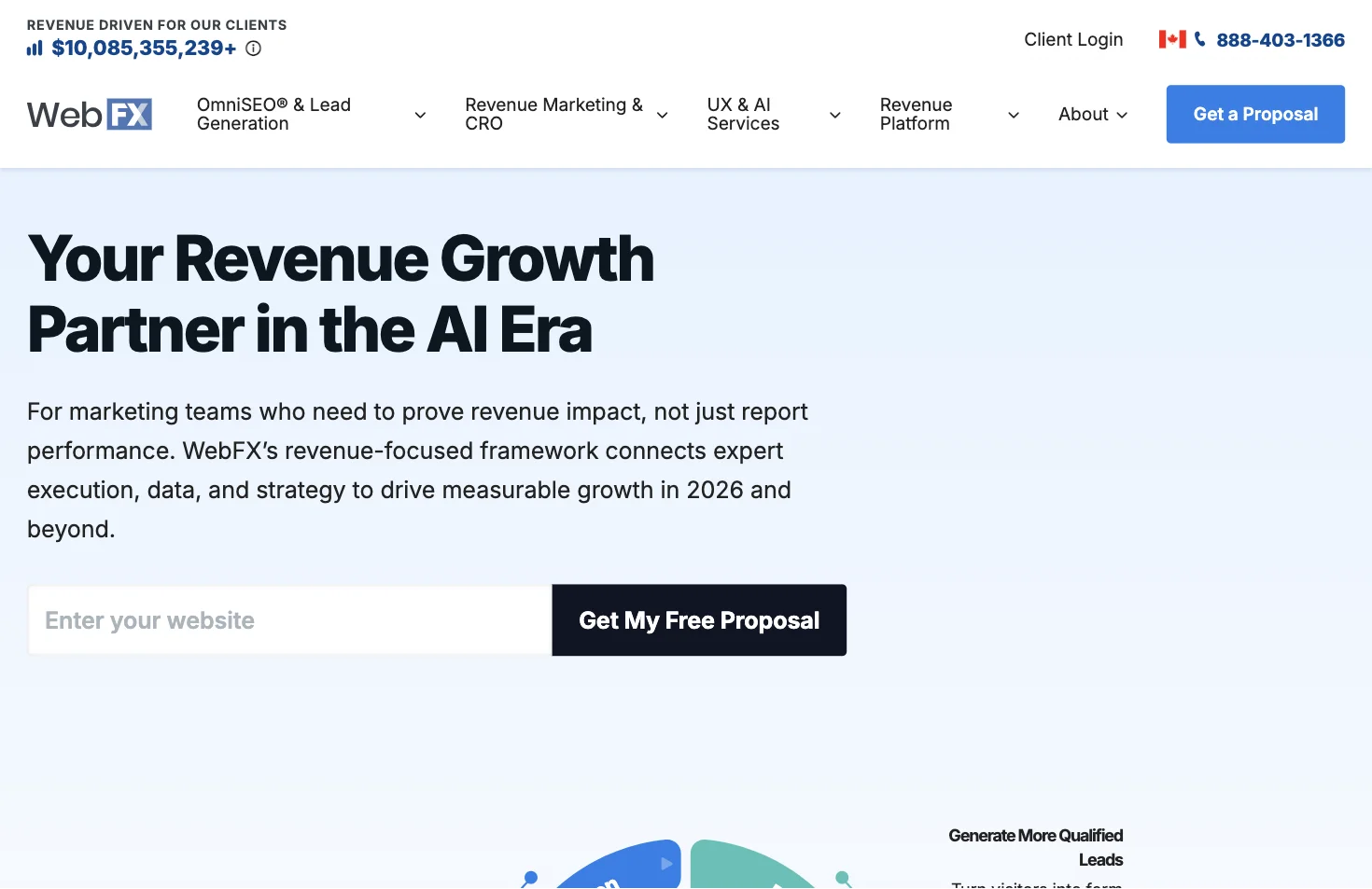
WebFX runs a dedicated CRO sub-service staffed by specialists they call CRO UXPerts, plans starting near $1,500/mo per their published pricing. That alone puts them ahead of most HVAC-marketing generalists who treat conversion as an afterthought on a services page.
Where they're strongest: Published pricing. A named, staffed CRO sub-service. Large-agency reporting infrastructure.
What to consider: Your HVAC account sits inside an operation serving dozens of industries. Published case studies lean on traffic metrics more than documented conversion-lift percentages.
Best for: Larger HVAC operations that want published pricing and don't need trade-only specialization.
Head to head: WebFX vs. Fervor Studio
No. 7 · A full-service performance shop, not an HVAC specialist
Web Tonic
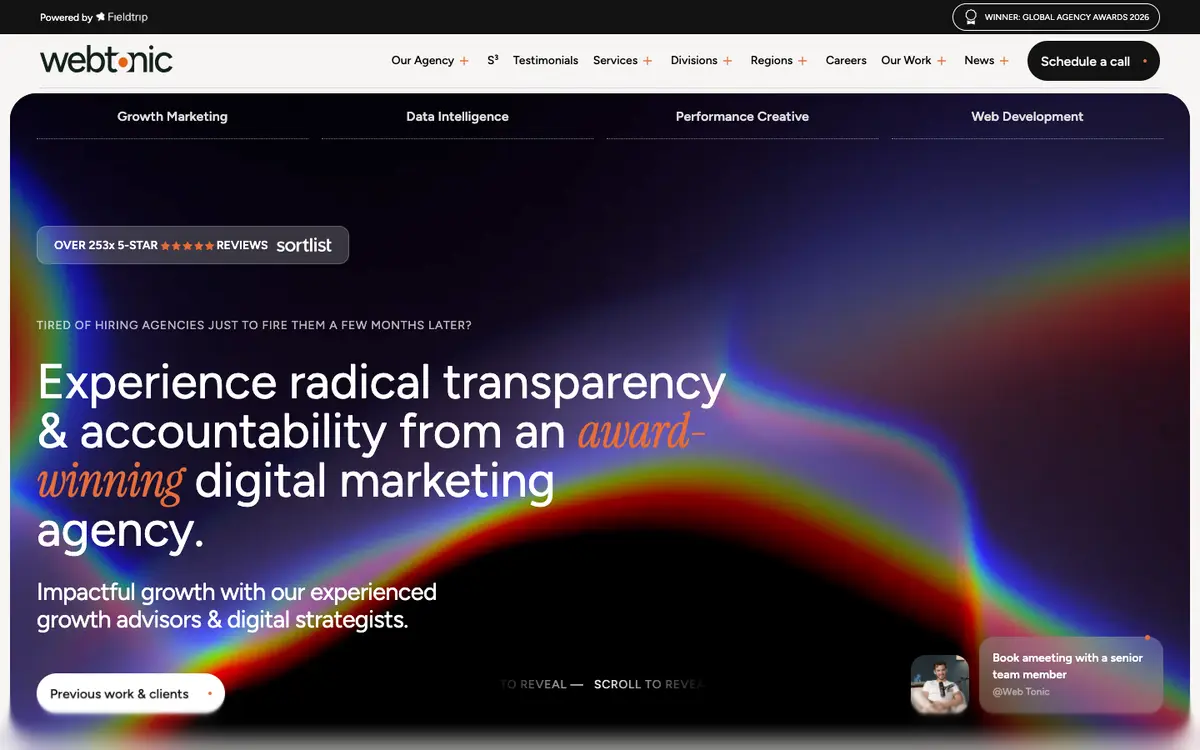
Web Tonic's own HVAC writeup describes treating an HVAC conversion problem "as a dispatch problem," wiring call and form tracking to the booking flow before touching a page. That's a reasonable instinct, and it's why the firm still clears the bar for inclusion here. But their published starting price of around $3,000/mo buys a full-stack performance marketing team spanning B2B, ecommerce, and Fortune 500 accounts, not a shop that lives in HVAC.
Where they're strongest: Global operational scale, 750+ brands, hundreds of millions in tracked ad spend. Dispatch-and-booking-flow framing for CRO.
What to consider: Web Tonic also publishes its own "best HVAC CRO agencies" ranking and places itself near the top of it, the exact conflict of interest disclosed on Fervor's entry above, minus the disclosure. No named HVAC case study with a documented conversion-lift number, and HVAC is one of dozens of verticals inside a much larger multi-industry book of business.
Best for: HVAC groups that specifically want a large, globally-staffed performance team and are comfortable being one account among many.
The 2026 HVAC CRO agency comparison, at a glance
| # | Agency | Shape | Best-fit HVAC contractor |
|---|---|---|---|
| 1 | Fervor Studio | Research-backed HVAC CRO | Wants the financing/utility-savings objection solved on the page |
| 2 | E10K | Financing-offer growth story | Wants a documented 6x revenue case study |
| 3 | Hook Agency | Conversion-shaped web design | $3M+ operations planning a rebuild |
| 4 | Klutch Growth | Rebuild-driven conversion lift | Sites so outdated a rebuild is already the plan |
| 5 | RYNO | Scale + attribution, traffic-first | ServiceTitan shops needing traffic solved first |
| 6 | WebFX | Full-service with staffed CRO | Larger operations wanting published pricing |
| 7 | Web Tonic | Global performance marketing | Wants a large full-stack team, not HVAC specialization |
Why HVAC conversion is a financing problem before it's a design problem
Most CRO advice treats every trade the same: faster page, clearer CTA, shorter form. HVAC breaks that model in one specific way. The homeowner already wants the efficient system. 64% of Canadians surveyed say they prefer homes with high-efficiency heating and cooling.
"64% of Canadians surveyed prefer homes with high-efficiency heating and cooling systems."
Abacus Data (2023)
So the demand side isn't the leak. The leak shows up the moment the price appears, because wanting efficiency and being willing to write the check for it are two different decisions. Only 55% of interested buyers will actually invest in a big-ticket energy upgrade like a geothermal heat pump, solar, or heat-recovery ventilation.
"Only 55% of interested Canadian buyers would invest in big-ticket energy upgrades like geothermal heat pumps, solar panels, or heat-recovery ventilation."
Abacus Data (2023)
Push the same question further and the priority gap gets sharper. Handed an extra $10,000 to spend on their home, only 15% of Canadian buyers put it toward energy-efficient upgrades. 27% would rather buy a larger home or lot, and 25% would rather upgrade interior finishes.
"If given an extra $10,000 to spend, only 15% of Canadian buyers prioritized energy-efficient upgrades, versus 27% who chose a larger home/lot and 25% who chose interior finishes."
Canadian Home Builders' Association (CHBA) (2024)
An HVAC page that leads with equipment specs and closes with a phone number is skipping the one thing that moves that 45%: a financing path, a payback-period calculation, a rebate reference, something that turns "I want this" into "I can afford this today." E10K's financing-led case study above got that instinct right. A generic CRO shop importing an ecommerce checklist won't think to ask the question at all.
The phone still carries most of the weight once that objection clears, and the numbers on that side of the funnel are stark. Phone calls convert to 10-15x more revenue than web leads for home services businesses, callers convert 30% faster than web leads, and caller retention runs 28% higher.
"Phone calls convert to 10-15x more revenue than web leads for home services businesses. Callers convert 30% faster than web leads. Caller retention rate is 28% higher than web lead retention rate."
BIA/Kelsey + Forrester (2025)
91% of U.S. adults now own a smartphone, and desktop still edges out mobile in overall traffic share (55.93% versus 41.95%, with tablets at 2.04%), so an HVAC site that renders the financing math cleanly on both screen sizes is covering the two channels that matter.
"91% of U.S. adults own a smartphone; overall U.S. internet traffic: desktop 55.93%, mobile 41.95%, tablet 2.04% (January 2026)"
Pew Research Center (2025)
Reviews still do a lot of the trust work before the financing conversation even starts. 83% of consumers use Google specifically to find local business reviews, which means the review count and recency on an HVAC homepage are functioning as part of the conversion page, not decoration next to it.
"83% of consumers use Google specifically to find local business reviews."
BrightLocal (2025)
And the category as a whole is under-investing in the work that would fix this. The construction industry spends roughly 1% of revenue on marketing, against a 7.7% cross-industry average, which is both the reason so many HVAC sites still skip the financing conversation and the size of the opportunity sitting in front of any contractor willing to spend closer to the average.
"The construction industry spends approximately 1% of revenue on marketing, dramatically below the cross-industry average of 7.7% of revenue. This gap represents both an industry norm and a competitive opportunity for contractors willing to invest more strategically."
CMO Survey / Gartner (2025)
Methodology
How this list was built
Scored against: HVAC-domain depth (has the firm worked with HVAC contractors specifically, not just "home services"), CRO methodology depth (a published framework vs. CRO as one bullet among ten), transparency (named case studies with real numbers, not placeholder percentages), and whether the agency's own positioning addresses the financing/utility-savings gap this trade has.
Excluded: pure SaaS/ecommerce CRO specialists with no HVAC or home-services portfolio; A/B testing tool vendors, which are platforms, not agencies.
Acknowledged: Fervor Studio publishes this article and ranks first on it. That's a conflict of interest, and it doesn't stop being one because the criteria were written down first. The scoring system and the per-brand grades behind the State of HVAC claims in this piece are public, so you can check the claim instead of trusting it. Web Tonic also publishes its own competing ranking; that conflict is disclosed on its entry the same way it's disclosed on Fervor's.
Want to see what the framework finds on your HVAC site?
The State of HVAC report breaks down where HVAC sites lose homeowners, trade by trade. The Site Inspection runs the same scoring against your own site and returns a specific list of structural gaps.
Get My Free Inspection →Questions to ask before hiring an HVAC CRO agency
What is conversion rate optimization for contractors?
Contractor CRO is the work of increasing the share of existing visitors who become calls, estimate requests or booked appointments. It covers messaging, trust signals, page structure, mobile experience, calls to action, forms and booking flows.
Why is my HVAC website getting traffic but not enough calls?
Traffic does not guarantee leads. Visitors run into weak calls to action, poor mobile usability, unclear service information, thin trust signals, confusing forms, slow pages or a mismatch between the search intent and the landing page. At that point, buying more traffic just sends more people into the same problem.
Should contractors invest in SEO or CRO first?
It depends entirely on where the bottleneck sits. A contractor with little qualified traffic needs acquisition work first. A contractor already pulling meaningful search traffic but booking few jobs should investigate conversion before buying more traffic.
How much should a HVAC company pay for CRO?
Pricing swings widely on market competition, scope, number of locations and whether the agency is doing strategy, execution or both. Compare the scope and the expected business outcome rather than the monthly fee on its own.
Should I hire a contractor-specialist agency or a general marketing agency?
A specialist starts ahead because it already understands contractor search behaviour, seasonality, service-area businesses and lead economics. A broader agency is still the better choice when it has stronger expertise in the specific problem you need solved.
Should a HVAC company redesign its website or optimize the existing one?
A full redesign is often unnecessary. If the site is technically sound and already receives meaningful traffic, targeted conversion work is usually faster and cheaper. A redesign earns its cost when structure, technology, branding or user experience block incremental improvement.
Can CRO improve SEO performance?
They solve different problems, but the work overlaps. Better page structure, usability, content clarity and mobile experience support search visibility and lead generation at the same time when they are done properly.
 Sep 20, 2026
 Agency Selection
Best Roofing CRO Agencies in 2026
A 21-agency roofing CRO ranking exists, and the firm behind it is not on this list. Here are 7 agencies scored specifically for storm-season, quote-request roofing conversion.
Read Article Sep 20, 2026
 Agency Selection
Best Plumbing CRO Agencies in 2026
Most CRO advice optimizes the form. Plumbing conversion mostly happens on the phone. Here are 6 agencies scored on whether they understand that difference.
Read Article Sep 20, 2026
 Agency Selection
Best Remodeling CRO Agencies in 2026
A remodeling client plans for the better part of a year before they call. Here are 6 CRO agencies scored on whether their methodology fits that decision timeline.
Read Article