Rank on Google for "roofer near me" in Iqaluit.
Right now, someone in Iqaluit is Googling "roofer near me." We get you showing up first, then turn that click into a booked job.
How Can We Help?
Choose the option that suits your needs.
Let’s Investigate
We will send your Site Inspection to the email you provided.
You’re in.
We’ll send your Site Inspection within 5 business days.
Let’s Chat
Book a time that works for you.

“Attentive, listened to every revision request, delivered on time. Would work with him again.”
- Hamza Najam

“Patient, on point, straightforward. Did amazing work. Would 100% recommend.”
- Ruben Mederos, HyperTemp HVAC

“Responsive, creative, exceeded expectations. Already seeing greater engagement from our clients.”
- George Jeorgy, Jeorgy's Landscape Construction

“Top-tier professionalism, real web design expertise, ideas I hadn't considered. Confidently recommend.”
- Aws Nassani, Four Eleven Contracting














































































Let’s talk about what your website could be doing for your business.
Call Us TodayThe Iqaluit, NU Roofing specifics your website needs.
Every angle below comes from how Iqaluit, NU homeowners search, evaluate, and buy, built into your site to help boost conversions.
Your Roof Arrives by Summer Barge
Iqaluit has no road or rail link to the rest of Canada, so your roofing materials come in on the annual sealift, ordered months ahead through the Government of Nunavut for delivery during the short late June to October shipping window. Miss that window and the only option is air freight, which runs roughly twelve to sixteen times the cost of sea. So a roof here is planned a year out, and one forgotten box of fasteners can stall the whole job.
Nunavut Runs the National Building Code
Nunavut adopts the National Building Code of Canada through its Building Code Act, with the territory's Office of the Chief Building Official acting as the authority having jurisdiction under Community and Government Services. Enforcement across Nunavut's communities has historically been thin, so the paper standard and the reality on the ground do not always match. So in Iqaluit you lean harder on a competent builder than on an inspector, because the code only protects you if someone actually applies it.
Iqaluit Winds Reach Hurricane Force
Blizzards regularly shut Iqaluit down, and the wind behind them is brutal, with gusts recorded around 150 kilometres per hour and sustained winds near 111, close to hurricane strength. That wind drives uplift on every roof edge and fastener in town. So Arctic roofs here favour low profiles, mechanically fastened metal, and detailing built to resist being peeled off. A roof that would pass in the south can simply leave in an Iqaluit gale.
Design for the Drift, Not the Depth
The National Building Code climatic data for Iqaluit puts the ground snow load around 2.9 kilopascals, and blowing snow piles far deeper in drifts against walls and roof steps than any flat measurement suggests. A roof framed too light for that uneven load is a slow structural failure waiting for a bad winter. So snow is not a nuisance detail in Iqaluit. It is the number your roof structure has to be engineered around from the first drawing.
Your Roof Rides on Permafrost Piles
Most buildings in Iqaluit stand on steel piles drilled into the permafrost rather than on slabs, because the frozen ground shifts as it thaws and refreezes. When that permafrost degrades, frost heave racks the whole structure, and doors stick, walls crack, and roof planes go out of true. So your roof's performance starts underground here. A roof stays watertight only as long as the frozen foundation beneath it holds still.
The North Has Its Own Building Rulebook
The Government of Nunavut publishes a Good Building Practices Guideline written specifically for Arctic construction, covering the ventilation, vapour control, and roof detailing that keep condensation and ice from wrecking a building from the inside in a place that spends months below freezing. Southern habits fail up here. So a roof in Iqaluit is designed against cold, wind, and moisture in ways no temperate code chapter teaches, and local knowledge is not optional. It is the whole job.
Storm Season Waits for No One
Search demand for roof repair surges the moment a major hailstorm hits, but a brand-new page can take months to rank, not days. Only a small fraction of fresh pages reach Google's top results within a year, so your storm-damage pages have to already exist when the storm rolls through.
One Roof, Two H1 Tags
90% of roofing sites Fervor tested ship more than one H1 heading somewhere on the site, a basic signal-clarity mistake search engines read as confusion about the page's main topic. It is the single most common technical failure in the trade, and usually a five-minute fix.
Why Roofing SEO in Iqaluit Decides Who Gets the Call
Here's the part that stings. The owner with the best crew in town often isn't the owner getting the calls. The numbers here come straight from our State of Roofing 2026.
Get My Site InspectionAnd the calls go to whoever Google decided to show in the top three of the map pack, a decision that has almost nothing to do with how well anyone shingles. That's why roofing SEO in Iqaluit matters more than the quality of your last reroof. The work gets you referrals. The search gets you strangers. Think about a single reroof. Call it a $14,000 job on a modest place out on Federal Road. So if you miss four of those a year because a competitor outranks you, that's $56,000 walking past your door. You never see it leave. There's no invoice for the work you didn't get a shot at. The same crew also handles Roofing Conversion Rate Optimization in Iqaluit, NU.
And that's what makes lost search so quietly brutal, it never shows up in your books as a loss. But the demand behind those searches is real, not imagined. "In 2024, 22% of renovating homeowners undertook roofing upgrades, with a median spend of $13,000." - Houzz Inc. (2025) More than one in five renovators put money into the roof, at a serious price point. So those buyers are picking from page one, and usually from the map pack at the top of it.
When someone in Tundra Valley searches for a roofer, the three businesses in that boxed map result soak up most of the clicks. Everyone below it might as well be on page nine. So the fight isn't really for "page one." It's for those three slots. Win one and your phone changes. But lose all three and you're invisible to the people closest to ready. Ranking gets you seen. What you do next gets you hired. "97% of roofing customers expect a callback within one week. More than 50% expect a callback within two days." - Roofing Contractor Magazine (2024)
Half your prospects want to hear back inside 48 hours. So if your site sends a form into an inbox nobody checks until Saturday, you've already lost the ones who matter. A fast lead path matters as much as the ranking that fed it. And the two have to be built together, or the leads you finally rank for leak right back out.
What Climbing the Local Rankings Actually Takes
People sell you tricks. Buy these keywords. Get these backlinks. Post three times a week. But ranking in a small northern market is a system you put in place once and keep fed, not a bag of one-off moves.
Get My Site Inspection
How Bigger Crews Steal Your Best Jobs
Picture two shops. You've roofed here for eleven years, certified, a crew that shows up clean and on time. The other outfit started two summers ago, half your experience, no real reputation yet on the street.
Get My Site Inspection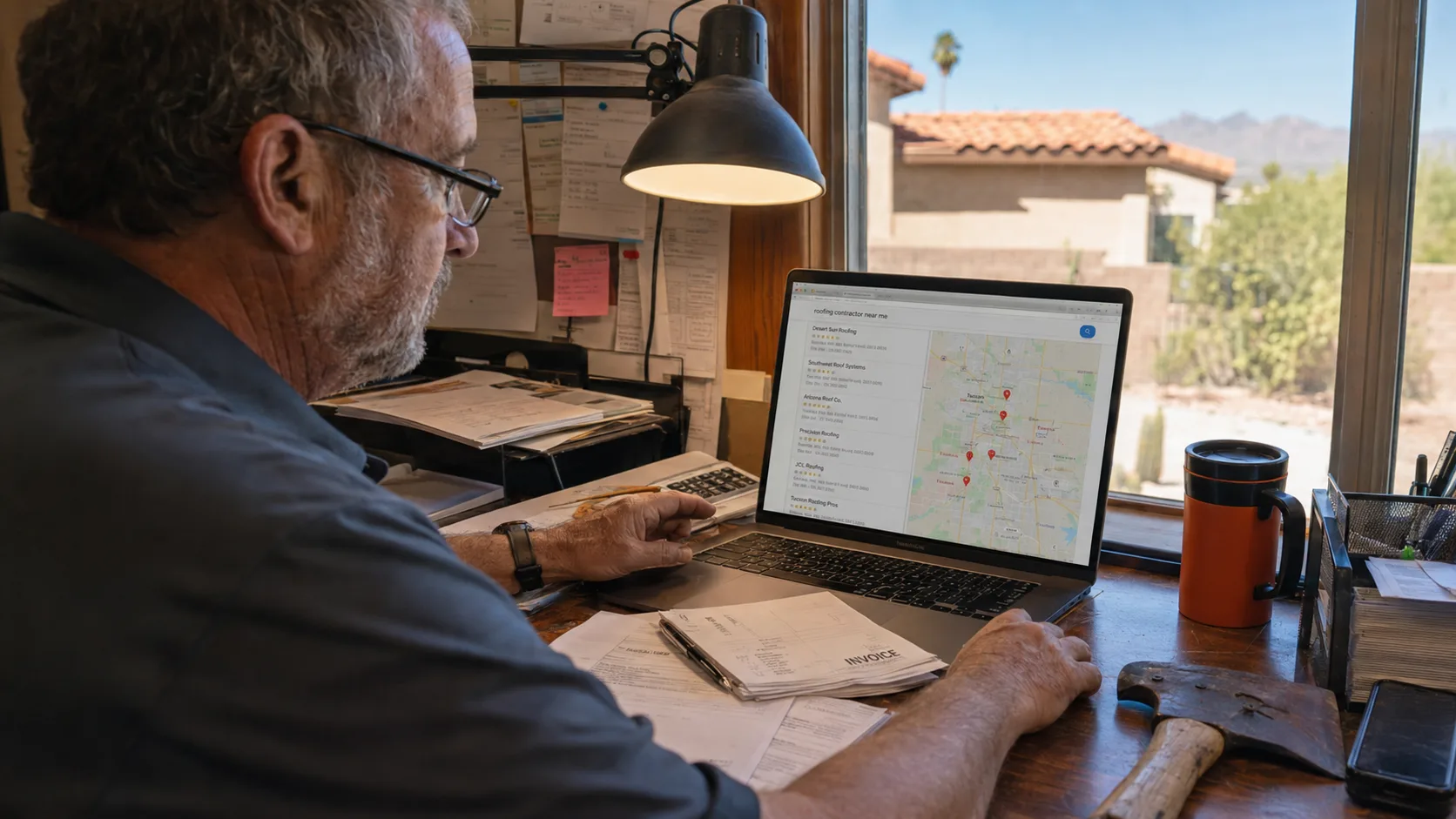
The Numbers Behind a Roof Decision
Before you decide where your marketing dollars go, it helps to know how homeowners choose. The patterns are remarkably consistent, and the volume is enormous.
Get My Site Inspection
Questions Contractors Ask Before Hiring Us
What does roofing SEO in Iqaluit actually get me?
Calls from homeowners in Iqaluit who are already searching for your trade. The work is to rank you for the high-intent local queries that move revenue, then make sure the page converts the click once it lands.
How is this different from the last agency that burned me?
You see the scoring framework, the benchmark data behind it, and your ranked fix list before any remediation work begins. It is a diagnosis you can evaluate, not a promise you have to trust.
How do you know this works for my trade?
The Fervor Grade framework was built by scoring 380 contractor sites across roofing, remodeling, and HVAC. Your trade's patterns are in the data, not borrowed from SaaS or dentists.
How long does it take?
The Site Inspection takes 5 business days, and it needs about three minutes from you. The ranking work that follows is ongoing, because search is.
Who owns the website and the accounts?
You do. The domain, the content, the analytics, every account we touch. Day one. No ownership traps, no holding your site hostage if you leave.
What if I do not like what the inspection finds?
Then you found out something that was already costing you, and now you know where. The inspection surfaces what is actually wrong on the site so you can decide what to fix.
Do you only work with contractors in Iqaluit?
No. We work with roofing contractors across the region, and the research covers national brands too, so the benchmark holds whether you are downtown or two towns over.
How much does it cost?
The Site Inspection is free. You only pay for the remediation work once you have seen the diagnosis and decided it is worth fixing.
Will the changes hurt my current rankings?
No. The work protects what already ranks. We map the URLs and the equity first, fix the conversion leaks, and improve the pages that search already trusts rather than wiping them.
What do I have to do during the project?
Very little. The intake takes minutes, and the build work is ours to run from there. You keep running crews. We will only ask for things no one else can give us, like your real service area and your best photos.
Still Have Questions?
Give us a call expressing your specific needs, and we’ll see if we are a good fit for each other.
Google's Local Pack ranking runs on review volume and how recent those reviews are. Contractors tend to under-collect reviews they've already earned, because asking after every job is easy to forget in a busy week. NiceJob sends the ask automatically once a job wraps, so new reviews keep flowing without you remembering. You can also set it up to ask your past clients for reviews. If your CRM already handles review requests, use that. Either way, it works better as a system than as a task on someone's to-do list.
Before you go, grade your own site
Get The Roofing Website Diagnostic Checklist: the nine checks we pulled from inspecting 130 Roofing contractor sites. It takes about ten minutes, and it shows you which fix wins back the most jobs first.
Your checklist is on its way.
Your copy of The Roofing Website Diagnostic Checklist is landing in your inbox now. And if you would rather not wait, grab it right here.
Download it now