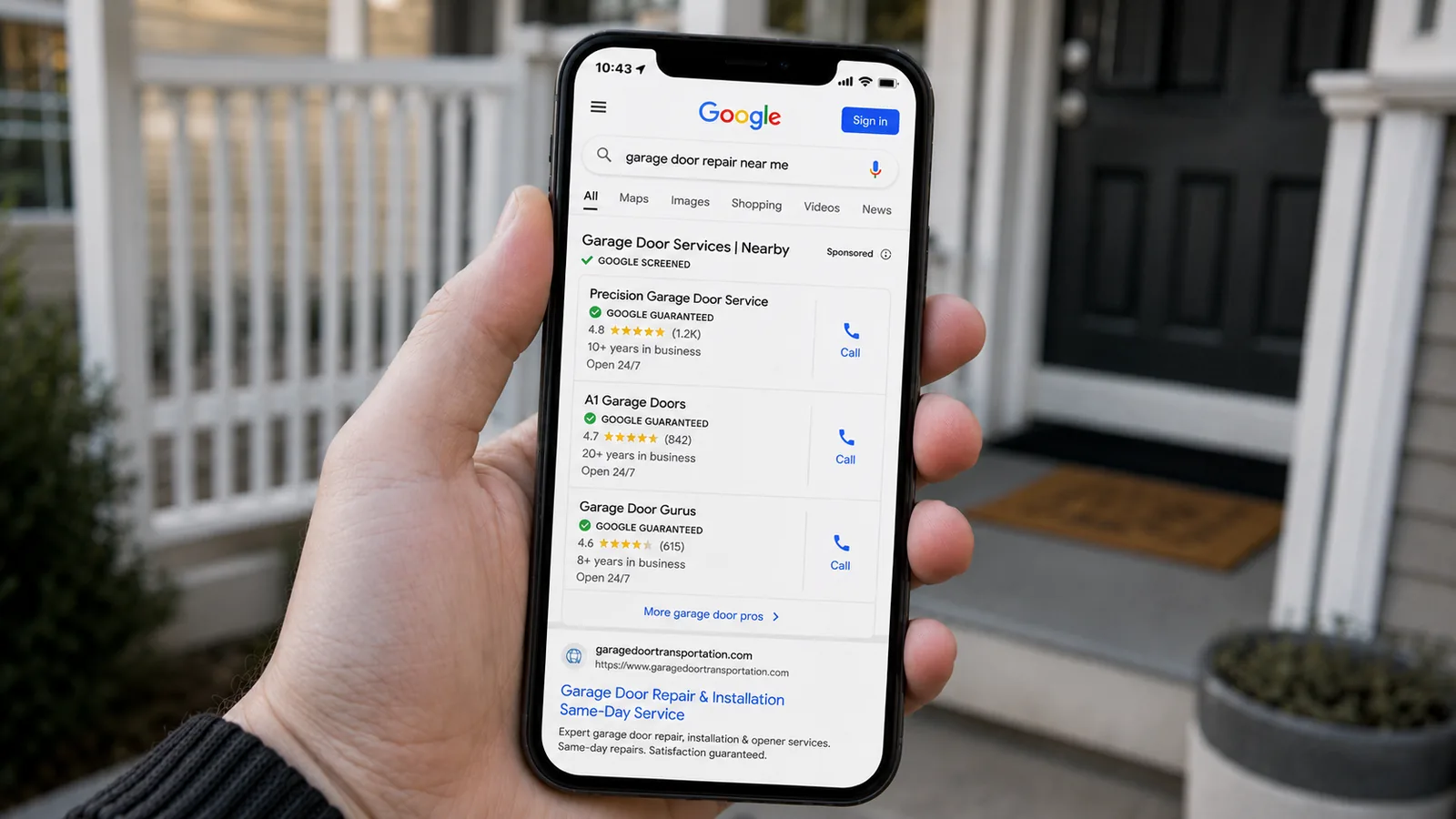
Rank on Google for "Garage Door near me" in Los Angeles.
Right now, someone in Los Angeles is Googling "Garage Door near me." We get you showing up first, then turn that click into a booked job.
How Can We Help?
Choose the option that suits your needs.
Let’s Investigate
We will send your Site Inspection to the email you provided.
You’re in.
We’ll send your Site Inspection within about three days.
Let’s Chat
Book a time that works for you.

“Attentive, listened to every revision request, delivered on time. Would work with him again.”
- Hamza Najam

“Patient, on point, straightforward. Did amazing work. Would 100% recommend.”
- Ruben Mederos, HyperTemp HVAC

“Responsive, creative, exceeded expectations. Already seeing greater engagement from our clients.”
- George Jeorgy, Jeorgy's Landscape Construction

“Top-tier professionalism, real web design expertise, ideas I hadn't considered. Confidently recommend.”
- Aws Nassani, Four Eleven Contracting














































































Let’s talk about what your website could be doing for your business.
Call Us TodayThe Los Angeles garage door specifics your website needs
D-28 Is the Licence Number
California licenses this trade as C-61/D-28, Doors, Gates and Activating Devices, and the classification sits in Title 16, Division 8, Article 3 of the state code. So a Los Angeles homeowner can check a contractor against the CSLB register in under a minute. And a page that names the D-28 by number earns searches the generic garage door page never sees.
Five Hundred Dollars Is the Line
The D-28 requirement starts when labour and materials on a job exceed five hundred dollars, which covers nearly every spring replacement and every opener swap in Los Angeles. So the unlicensed operator underbidding you is not cheaper, they are working outside the classification. And your customers can verify that themselves once you tell them the number to look for.
One Licence Covers Three Trades
The D-28 scope names gates, card activated equipment and other access control devices alongside overhead and sliding door assemblies. So in California the gate operator, the reader on a commercial entrance and the sectional door all sit under one licence number. And most Los Angeles sites market only the garage door, leaving the gate and access control searches to somebody else.
LADBS Issues Express Permits
Los Angeles runs an express permit track with no plan check, and the LADBS electronic permit system issues a building permit to replace doors of the same size, type and location as the existing ones. So the paperwork question your customer is dreading has a short answer here. And saying so on the page removes a real reason people stall.
Lock Work Is a Different Licence
California keeps C-28, Lock and Security Equipment, separate from the D-28 door classification. So a Los Angeles company selling keypad entry and smart locks alongside garage doors may need both, and a page that understands the split reads as written by somebody who holds one. And that distinction is invisible to every template site in the market.
Exposure D Is a Quarter Mile
DASMA puts a site in Exposure D when it sits within a quarter mile of a body of water more than a mile across, and a given wind speed produces more pressure there than in a sheltered inland subdivision. So the same door model is not the same specification in Venice and in Glendale. And almost nobody in this market explains that.
One Date Splits Every Opener
Federal law requires automatic residential garage door operators manufactured on or after January 1, 1991 to meet the entrapment protection rules in UL 325, carried into 16 CFR Part 1211. So an opener in a Los Angeles house older than that predates the requirement entirely, and that is a real reason for a homeowner to call, not a manufactured urgency.
Rolling Steel Is Another Keyword Set
DASMA splits its standards into a residential sectional family and a commercial family covering non fire rated rolling doors, fire rated rolling assemblies, rolling sheet doors and grilles. So the Los Angeles warehouse buyer searching rolling steel service is not searching garage door repair, and one page trying to catch both usually catches neither.
What this Los Angeles page is built from
Eight checkable facts about garage door work in Los Angeles, not national talking points.
Get My Site Inspection Questions Contractors Ask Before Hiring Us
What does Garage Door SEO in Los Angeles actually get me?
Calls from homeowners in Los Angeles who are already searching for your trade. The work is to rank you for the high-intent local queries that move revenue, then make sure the page converts the click once it lands.
How is this different from the last agency that burned me?
You see the scoring framework, the benchmark data behind it, and your ranked fix list before any remediation work begins. It is a diagnosis you can evaluate, not a promise you have to trust.
How do you know this works for my trade?
The Fervor Grade framework was built by scoring 380 contractor sites across roofing, remodeling, and HVAC. Your trade's patterns are in the data, not borrowed from SaaS or dentists.
How long does it take?
The Site Inspection takes about three days, and it needs about three minutes from you. The ranking work that follows is ongoing, because search is.
Who owns the website and the accounts?
You do. The domain, the content, the analytics, every account we touch. Day one. No ownership traps, no holding your site hostage if you leave.
What if I do not like what the inspection finds?
Then you found out something that was already costing you, and now you know where. The inspection surfaces what is actually wrong on the site so you can decide what to fix.
Do you only work with contractors in Los Angeles?
No. We work with Garage Door contractors across the region, and the research covers national brands too, so the benchmark holds whether you are downtown or two towns over.
How much does it cost?
The Site Inspection is scoped and quoted before it begins. You only pay for the remediation work once you have seen the diagnosis and decided it is worth fixing.
Will the changes hurt my current rankings?
No. The work protects what already ranks. We map the URLs and the equity first, fix the conversion leaks, and improve the pages that search already trusts rather than wiping them.
What do I have to do during the project?
Very little. The intake takes minutes, and the build work is ours to run from there. You keep running crews. We will only ask for things no one else can give us, like your real service area and your best photos.
Still Have Questions?
Give us a call expressing your specific needs, and we’ll see if we are a good fit for each other.
Google's Local Pack ranking runs on review volume and how recent those reviews are. Contractors tend to under-collect reviews they've already earned, because asking after every job is easy to forget in a busy week. NiceJob sends the ask automatically once a job wraps, so new reviews keep flowing without you remembering. You can also set it up to ask your past clients for reviews. If your CRM already handles review requests, use that. Either way, it works better as a system than as a task on someone's to-do list.