Best Remodeling Websites in 2026
Five remodeling websites ranked on a published scoring framework. What each gets right, plus what to test whether or not you have the traffic.
A remodeling website has a harder job than almost any other trade site, and the reason is time. A homeowner spends the better part of a year deciding, which means your site gets visited repeatedly by somebody who is not ready, and then once by somebody who suddenly is. The five companies below score highest out of 146 remodeling websites measured against the same published framework. And the order is the data's order, not a preference.
Remodeling buyers take their time, spending about 9.6 months planning a kitchen against 5.1 months building it.
The five best remodeling websites, ranked
No. 1 · Best opening screen in the trade
Capable Group Inc.
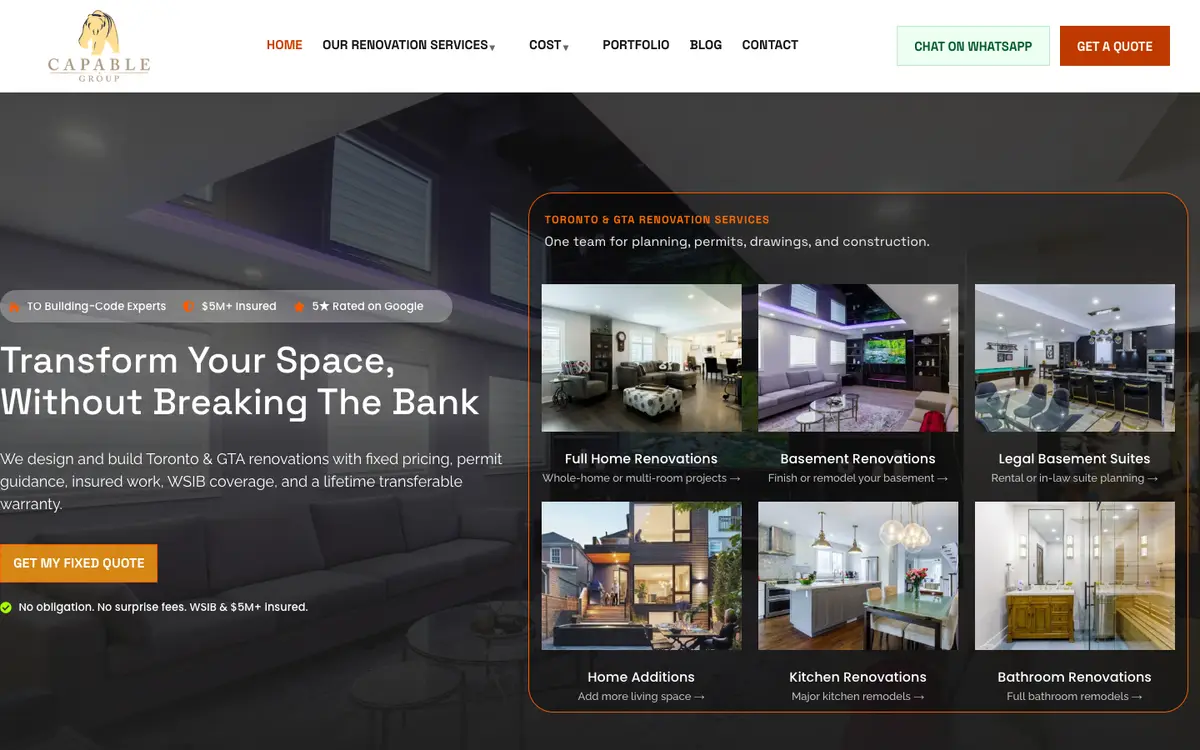
- First impression 18/20
- Trust and credibility 17/21
- Lead capture 16/20
- Mobile experience 12/15
- Content and SEO 12/15
- Accessibility 4/8
No. 2 · Best single-category positioning
Garage Living
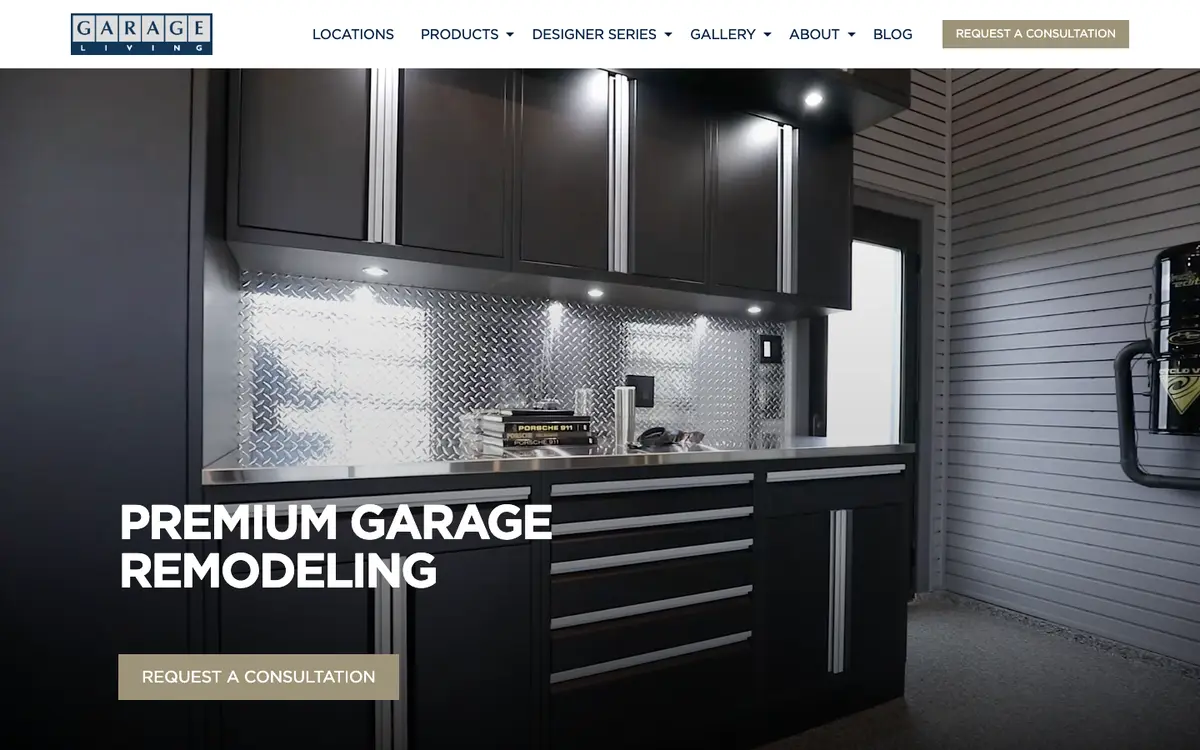
- First impression 18/20
- Trust and credibility 18/21
- Lead capture 16/20
- Mobile experience 13/15
- Content and SEO 11/15
- Accessibility 4/8
No. 3 · Best proof stack of the five
DFW Improved
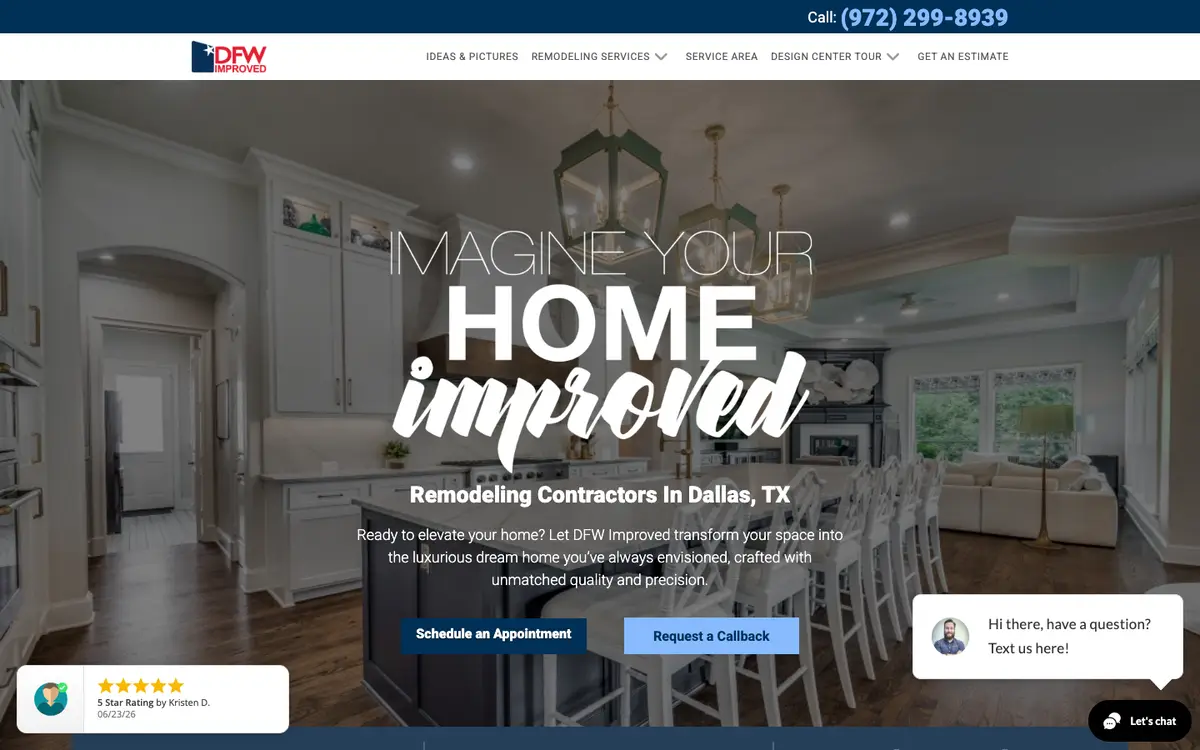
- First impression 19/20
- Trust and credibility 20/21
- Lead capture 17/20
- Mobile experience 13/15
- Content and SEO 12/15
- Accessibility 4/8
No. 4 · Best content depth for a design-build shop
Murray Lampert Design Build Remodel
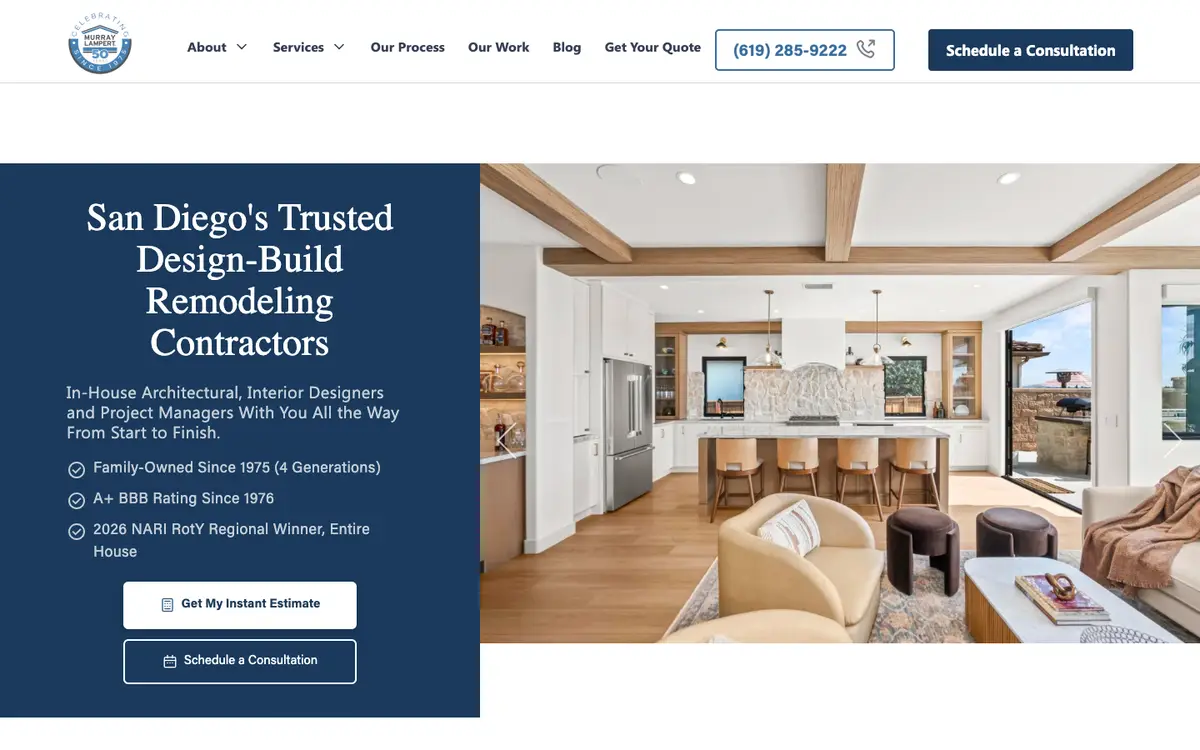
- First impression 18/20
- Trust and credibility 18/21
- Lead capture 17/20
- Mobile experience 13/15
- Content and SEO 13/15
- Accessibility 5/8
No. 5 · Best lead capture, and the only one near full accessibility marks
N-Hance

- First impression 19/20
- Trust and credibility 20/21
- Lead capture 18/20
- Mobile experience 14/15
- Content and SEO 11/15
- Accessibility 8/8
References outweigh anything you write about yourself, with 64% of homeowners calling them a top-three factor in choosing a contractor.
"64% of homeowners say having recommendations or references is a top-three factor in choosing a contractor."
Houzz Inc. (2025)
How these five were picked
Six weighted categories make up the score: first impression, trust and credibility, lead capture, mobile experience, content and SEO, and accessibility. Nothing here rewards photography for its own sake, which matters in remodeling more than anywhere else, because this is the trade most likely to mistake a beautiful gallery for a working website.
Now the honest caveat. Not one remodeling company in the scored group reached 90, so no remodeling site in this dataset gets every fundamental right. The best score on this page is 86, which is a B. These are the strongest sites in a measured field, not finished ones. The median remodeling site in the same scored group scored 71, so the gap between top and middle is real, but the ceiling is nowhere near reached.
Trust is the reported bottleneck, named by 48% of homeowners, ahead of clear proposals at 34% and communication at 30%.
"Homeowners' biggest struggles are finding someone they trust (48%), getting clear and detailed proposals (34%), and timely, accurate communication (30%)."
Houzz Inc. (2025)
Why these five convert
Capable Group Inc. and Garage Living tie at 86, and they get there by different routes. Both post a 18-out-of-20 first impression, which is the highest band in the trade, but Garage Living pairs it with a 18-out-of-21 trust score off the back of a single tightly defined category. Narrowing what you sell turns out to be a conversion decision, not just a positioning one. The narrower of the two routes is worked page by page in the Garage Living Site Inspection.
Then DFW Improved runs the strongest proof stack of the group at 20 out of 21, and Murray Lampert Design Build Remodel carries the content depth you would expect from a design-build shop at 13 out of 15. But the one worth studying is N-Hance, which posts 18 out of 20 on lead capture and 8 out of 8 on accessibility. That second number is close to full marks, and in this scored group that is genuinely unusual. The N-Hance Site Inspection shows exactly which markup decisions bought it.
Even a warm referral gets checked, because over 60% of homeowners research online before making contact.
"Even among homeowners who received a word-of-mouth referral, over 60% do due diligence online before deciding to contact the pro."
Houzz Inc. (2025)
What they did well
- The proof is specific, not decorative. Every one of the five scores 17 or better on trust, and in a trade where the buyer is handing over a five-figure sum and their house keys, that band is the whole ballgame.
- The first screen commits to something. The top two both score 18 out of 20. A remodeling hero that says what kind of work you do beats one that says you do everything.
- Lead capture survives a long decision. The strongest scores here belong to sites that give a not-ready visitor something to do besides request a quote.
- Somebody remembered the screen reader. N-Hance at 8 out of 8 is the exception that shows the ceiling is reachable.
- Nothing in the top five leads with the company's own history. The about-us-first homepage is a middle-of-the-group pattern.
Ratings act as a filter before they act as persuasion, and 68% of consumers will only consider a business rated 4 stars or better.
"68% of consumers will only use a business with a rating of 4 or more stars."
BrightLocal (2026)
What to A/B test if you get 16,000+ visitors a month
That threshold is arithmetic, not a vibe. At a 5% enquiry rate, detecting a 20% relative lift at 95% confidence and 80% power takes roughly 8,200 sessions per variant. Two variants across a four-week window puts you near 16,300. Below that you will get a result, it just will not mean anything, and remodeling sites are especially prone to this because the traffic is seasonal and the conversion event is rare.
- A project-scope qualifier in the hero versus a general remodeling promise (for example "Whole-home renovations from $150k" against "Transforming homes since 1998"). Scope filters the list, and a shorter list of the right people usually beats a longer list.
- A price range on the service page versus no price signal at all. This is the single most-avoided test in the trade and probably the most valuable.
- Gallery-first versus process-first on the primary service page, holding the photography identical so the sequence is the only variable.
- A low-commitment second action versus a single quote request (for example a downloadable planning guide beside "Request a consultation"), aimed at the visitor who is nine months out.
- Named designer or project-lead bios above the fold versus a company-level story.
Form length decides more than copy does, because 68% of people will not submit a form that asks for too much personal information.
"68% of users would not submit a form if it required too much personal information."
Baymard Institute (2024)
What to test instead if you get fewer than 16,000 visitors a month
Which is most remodelers, honestly. A regional design-build firm doing thirty projects a year will never see 16,000 monthly sessions, and waiting for statistical significance means never testing anything. So the goal shifts to usability testing, semi-structured user interviews, and observational testing. You're looking for directional feedback, the mindset the visitor arrives with, and the specific points where they hesitate. Six to eight participants gets you most of it.
- Whether the scope of work is understood in one pass
Method: five-second impression test with a comparative follow-up.
Execution: show two groups of six the homepage for five seconds, one with a scope-qualified headline and one with a general one, then ask each to describe what this company builds and roughly what it costs.
Key question: "In your own words, what kind of project is this company for, and do you think yours is big enough or too small?" - What the gallery actually communicates
Method: task-based comprehension and expectation audit.
Execution: ask participants to describe what working with this company would be like, day to day, based only on the project images, then compare that against what the process section actually says.
Key question: "Looking at these photos, do you have a clear picture of how this would go, or do you still not know what you'd be signing up for?" - The hesitation before the consultation request
Method: think-aloud friction protocol.
Execution: walk participants to the moment before submitting, then stop and have them voice every unspoken concern, paying attention to whether the worry is about money, about commitment, or about being sold to.
Key question: "Right before you send this, what are you afraid happens next?" - Whether trust survives the price silence
Method: semi-structured interview.
Execution: after a free browse, ask each participant to place the company on a price ladder against two competitors and explain what evidence they used.
Key question: "What on this page gave you confidence these people finish what they start?" - Decision clarity when there are two paths
Method: path-finding and decision clarity test.
Execution: present one group a single consultation call to action and another a paired call to action, then observe which group states a clear next step without prompting.
Key question: "Given these options, what would you do next, and does anything feel like it's rushing you?"
Placement decides what gets read, with 57% of viewing time above the fold and 74% inside the first two screenfuls.
"57% of page-viewing time is spent above the fold, and 74% of viewing time is spent in the first two screenfuls."
Nielsen Norman Group (2024)
What separates the top five from the median remodeling site
The median site in this scored group scored 71. And the distance between it and Capable Group Inc. at 86 is not spend. It's sequence. The five above resolve scope, then proof, then price posture, in that order, before asking for anything. Sites in the middle of the pack open with the company and close with the ask, which puts the two things a homeowner is actually deciding between somewhere in the middle where nobody scrolls. Sequencing is also the thing to interview an agency about, and it's how we sorted the remodeling marketing agencies.
Methodology
How this ranking was built
Every company here was scored as part of the Contractor CRO Index, which grades 146 remodeling contractor websites against a published framework across six categories. The State of Remodeling report documents the trade-level patterns behind the scores. Ranks are computed from that dataset at build time, so the order on this page is the order in the data.
Scored against: first impression, trust and credibility, lead capture, mobile experience, content and SEO, and accessibility, each weighted and each assessed across several captured pages rather than the homepage alone.
Acknowledged: Fervor publishes the framework these ranks come from, so this list is not an independent survey and we would rather say that than dress it up. Every score is reproducible from the public index. The write-ups describe what the scoring measured, not a visual review of each site, and nothing here should be read as a claim about a page element we did not measure. Grades use American school bands, so an A starts at 90, and every company on this page is a B.
One documented test cut four optional fields and saw submissions rise 160% with conversion up 120%.
"Removing four optional contact-form fields produced a 160% increase in submitted forms and a 120% lift in conversion rate."
Imaginary Landscape (2008)
Want your remodeling site scored the same way?
The Contractor CRO Index publishes the scoring system and the per-brand grades this ranking came from. If you want your own site run through the same six categories, the Site Inspection returns a specific list of structural gaps rather than a number on its own.
Get My Free Inspection →What to check on your own remodeling website
What makes a good remodeling website?
It makes clear within seconds what the company does, where it works and how a homeowner takes the next step. Then it needs strong mobile usability, trust signals, real service information, fast access to phone and booking actions, and a structure that lets individual services and markets rank.
Can a beautiful contractor website still perform poorly?
Routinely. Visual quality and commercial performance are different things. A site can look premium while burying the phone number, weakening its calls to action, hiding service information or adding friction before an estimate request.
Why is my remodeling website getting traffic but not enough calls?
Traffic does not guarantee leads. Visitors run into weak calls to action, poor mobile usability, unclear service information, thin trust signals, confusing forms, slow pages or a mismatch between the search intent and the landing page. At that point, buying more traffic just sends more people into the same problem.
Should a remodeling company redesign its website or optimize the existing one?
A full redesign is often unnecessary. If the site is technically sound and already receives meaningful traffic, targeted conversion work is usually faster and cheaper. A redesign earns its cost when structure, technology, branding or user experience block incremental improvement.
What is conversion rate optimization for contractors?
Contractor CRO is the work of increasing the share of existing visitors who become calls, estimate requests or booked appointments. It covers messaging, trust signals, page structure, mobile experience, calls to action, forms and booking flows.
Does a contractor need more traffic or a better website?
The data should answer that, not the agency. If the site receives very little relevant traffic, visibility is the priority. If it already attracts high-intent homeowners but produces few enquiries, the website itself is the larger opportunity.
Why does my competitor get more calls even though I rank higher?
Ranking position is one step in a longer journey. Reviews, brand recognition, offer strength, website experience, trust signals, how clearly price is communicated, response speed and conversion friction can all hand a lower-ranking competitor the call.
Should contractors invest in SEO or CRO first?
It depends entirely on where the bottleneck sits. A contractor with little qualified traffic needs acquisition work first. A contractor already pulling meaningful search traffic but booking few jobs should investigate conversion before buying more traffic.
 Sep 28, 2026
 Agency Selection
Best Concrete Contractor CRO Agencies in 2026
A concrete site quietly serves two different buyers: a homeowner picking a patio pattern and a GC scoping a foundation pour. Here are 5 CRO agencies scored on the split.
Read Article Sep 27, 2026
 Agency Selection
Best Deck Builder CRO Agencies in 2026
Deck projects concentrate into a hard spring rush most builder sites are not built to catch. Here are 5 CRO agencies scored on whether they solve for it.
Read Article Sep 27, 2026
 Agency Selection
Best Landscaping CRO Agencies in 2026
A landscaping site has to sell a five-figure hardscape build and a renewing maintenance contract at the same time. Here are 5 CRO agencies scored on the split.
Read Article