Best Solar CRO Agencies in 2026
Only 7% of U.S. homeowners have solar, but 28% have seriously considered it. Here are 6 CRO agencies scored on whether they show the savings math that fence-sitting group needs.
Only 7% of U.S. homeowners have solar installed, but another 28% say they've seriously considered it. That 28% is sitting on the fence over money, not enthusiasm; 92% of people who installed or seriously considered solar cite saving on electricity bills as the reason. A solar site that skips straight to panel specs and financing forms without ever showing the payback math is losing that fence-sitting majority before the pitch even starts. Here are 6 agencies, scored on whether they solve for that.
"7% of U.S. homeowners report having solar panels installed on their home, and an additional 28% say they have seriously considered it."
Pew Research Center (2024)
The 6 solar CRO agencies, ranked for solar installer fit
Fervor Studio publishes this article and ranks first on it. Disclosed here, disclosed again in the entry, disclosed a third time in the methodology below. The other five get scored against the same five criteria.
No. 1 · Best research-backed CRO for solar installers
Fervor Studio
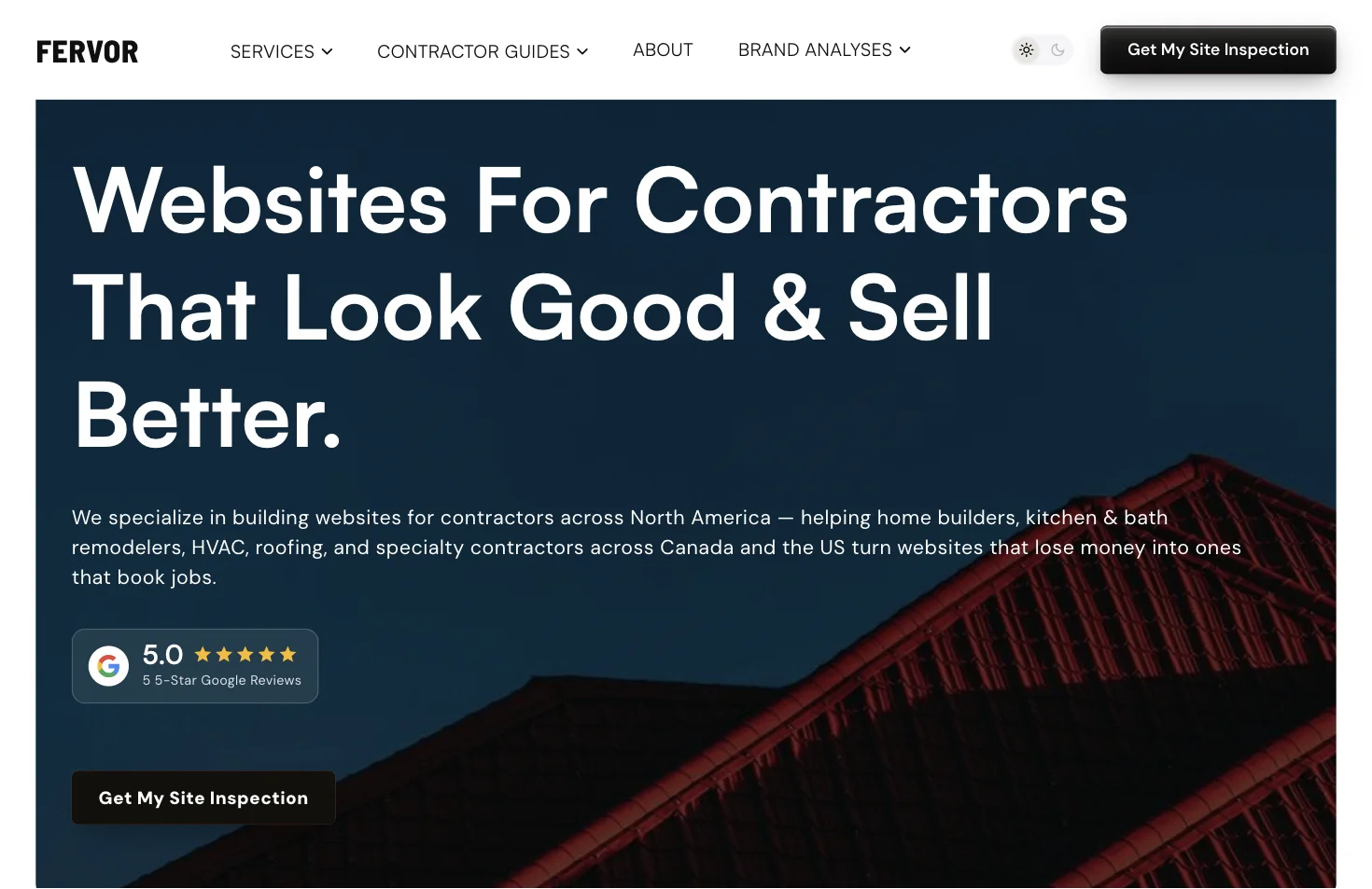
Disclosure, up front: Fervor Studio publishes this ranking and ranks itself first. Check this entry the hardest. The research behind it is public.
Solar buyers skew less affluent than the category's marketing usually assumes: 44% of U.S. solar adopters report household incomes under $100K. A page built around "invest in your future" language and no visible savings math is talking past a large share of the actual buyers.
"44% of U.S. solar adopters have household incomes under $100K."
Lawrence Berkeley National Laboratory (2024)
That's precisely the kind of buyer-psychology gap the Contractor CRO Index (380 contractor sites) was built to catch, category by category, instead of leaving every trade to the same generic conversion checklist.
Where they're strongest: Published methodology tied to a scored dataset. Revenue-per-visitor measurement instead of traffic-only reporting.
What to consider: Fervor is diagnostic-led and contractor-only. A solar installer running a high-volume, multi-state paid-media testing program will move faster with an enterprise CRO shop.
Best for: Solar installers who need the savings-and-payback math actually visible on the page, not buried behind a financing form.
Read next: Booked by Design™ · Free Site Inspection
No. 2 · Best diagnostic-first pick, solar named explicitly
Valve+Meter Performance Marketing
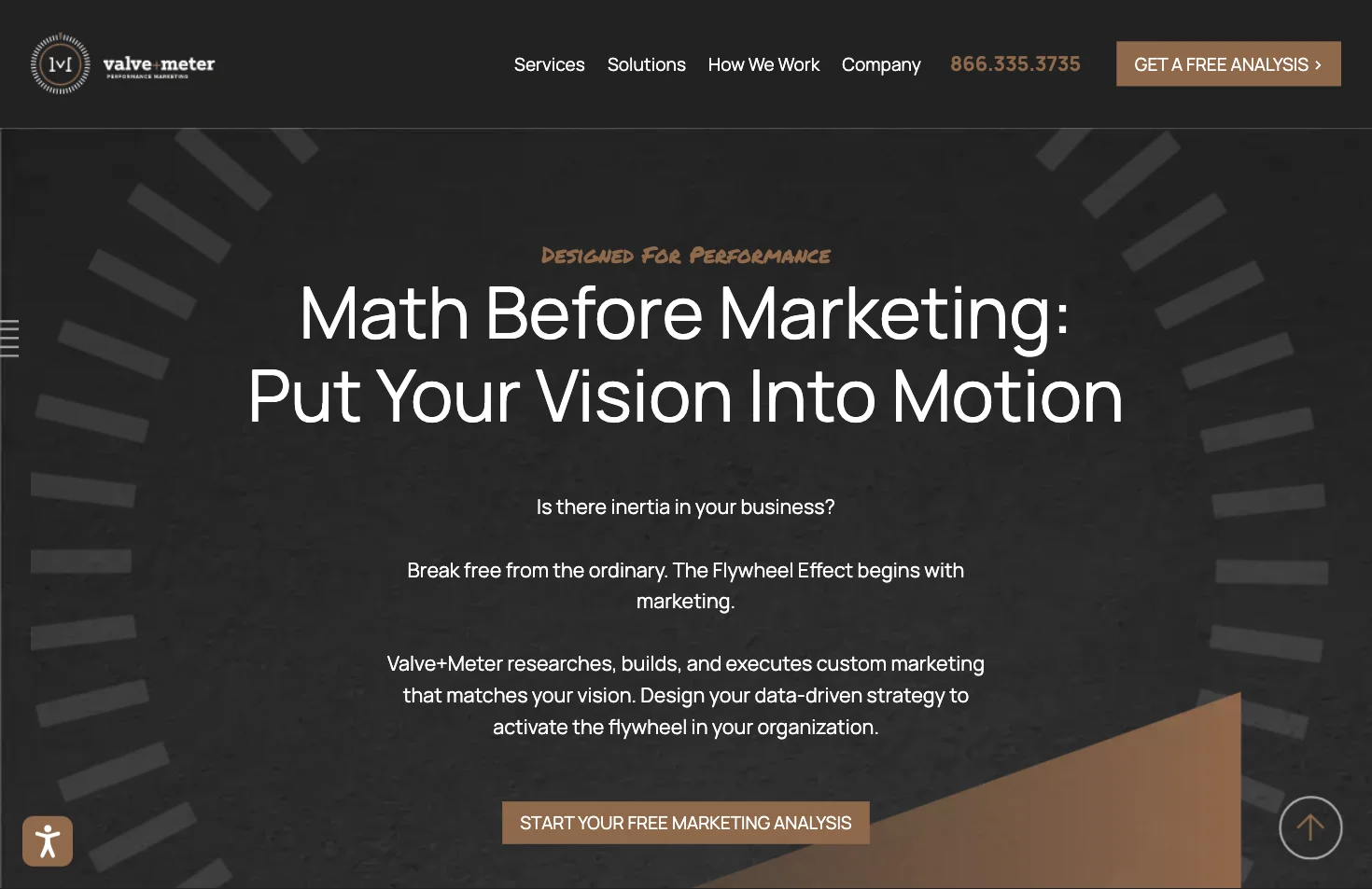
Solar sits directly in Valve+Meter's named vertical list, and its published client reporting describes consistent lead-cost reductions and conversion-rate improvement through a data-first optimization process built for solar's longer, higher-consideration sales cycle.
Where they're strongest: Solar named explicitly as a served vertical, not inferred from a "home services" catch-all. Diagnostic-first model before recommending a fix.
What to consider: Serves 15+ industries, so solar gets partial attention. Published figures describe directional improvement rather than one named, audited case study.
Best for: Solar installers who want a diagnosis of lead cost and conversion before committing budget to either channel.
Head to head: Valve+Meter vs. Fervor Studio
No. 3 · Best documented solar conversion lift
ConversionTeam
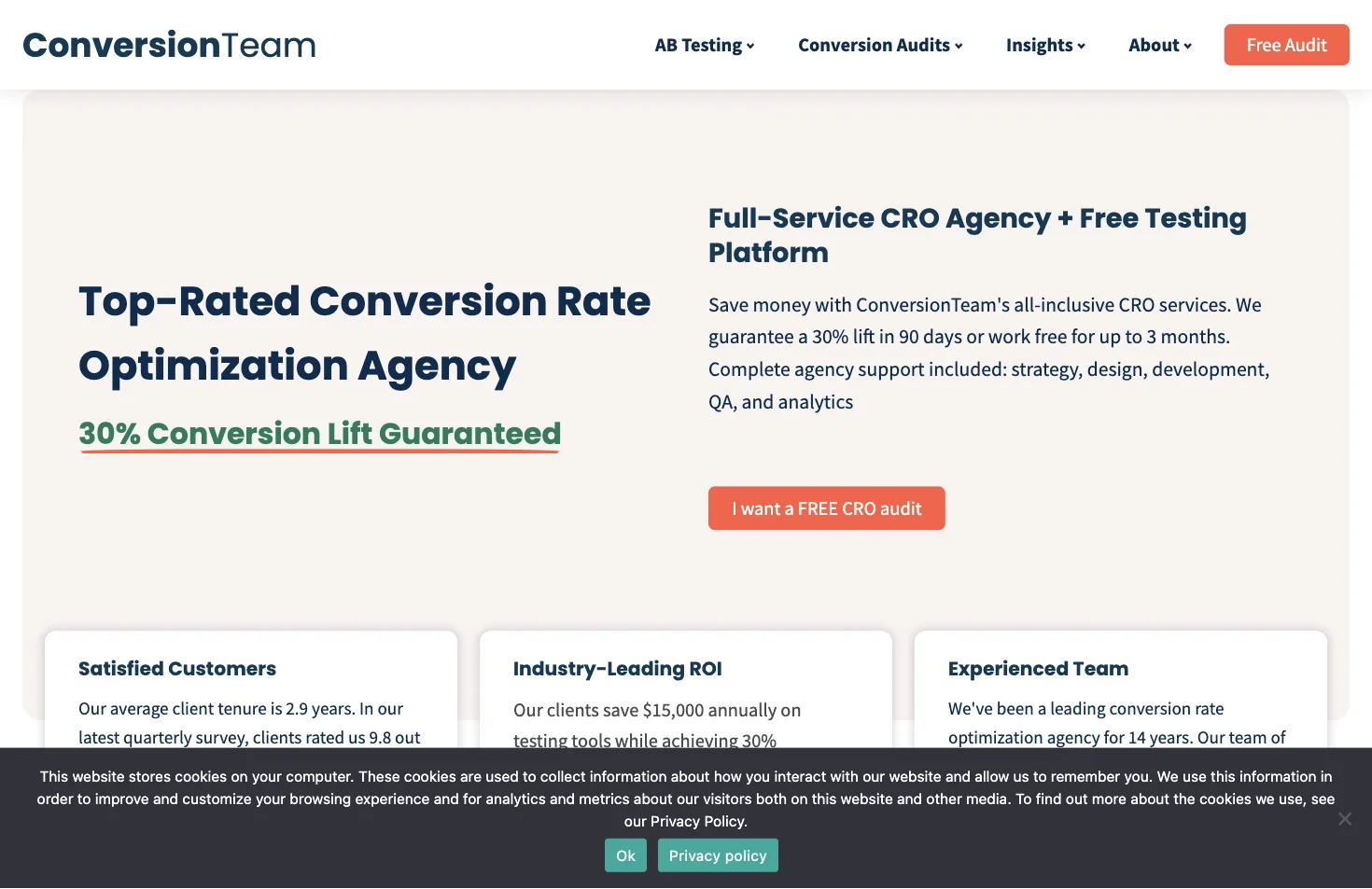
ConversionTeam publishes a specific result for a residential and commercial solar provider: a 167% lift in organic-search conversion, delivered by integrating CRO with the existing traffic strategy instead of testing in isolation from it.
Where they're strongest: A named, specific solar case study with a real percentage lift. Fourteen years of pure-CRO methodology to draw on.
What to consider: One published solar case study is one data point. ConversionTeam is a generalist CRO firm first, so ask how many other solar engagements back up the 167% figure.
Best for: Solar installers who want documented proof of a conversion-rate lift in this exact category, not just a promise.
No. 4 · Best performance-guarantee specialist
OnwardCraft
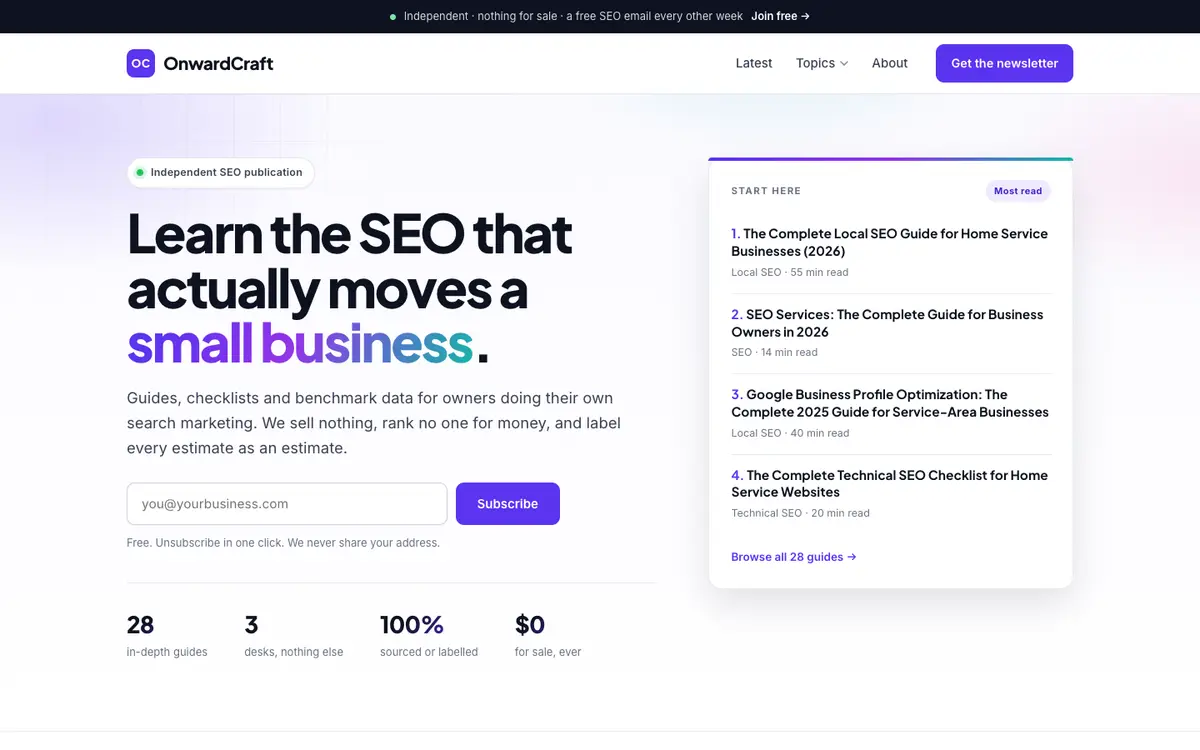
OnwardCraft opens with a recorded teardown of the current site, ranked by which leaks cost the most leads, before any money changes hands, and solar sits among its six named core trades rather than being an afterthought vertical.
Where they're strongest: A written performance guarantee tied to agreed metrics. Solar named explicitly as a core trade.
What to consider: A smaller, founder-led shop next to the larger multi-industry names on this list. Ask for solar-specific client references directly.
Best for: Solar installers who want a guarantee tied to real numbers before committing to a retainer.
No. 5 · Best for scale, not for CRO specifically
RYNO Strategic Solutions
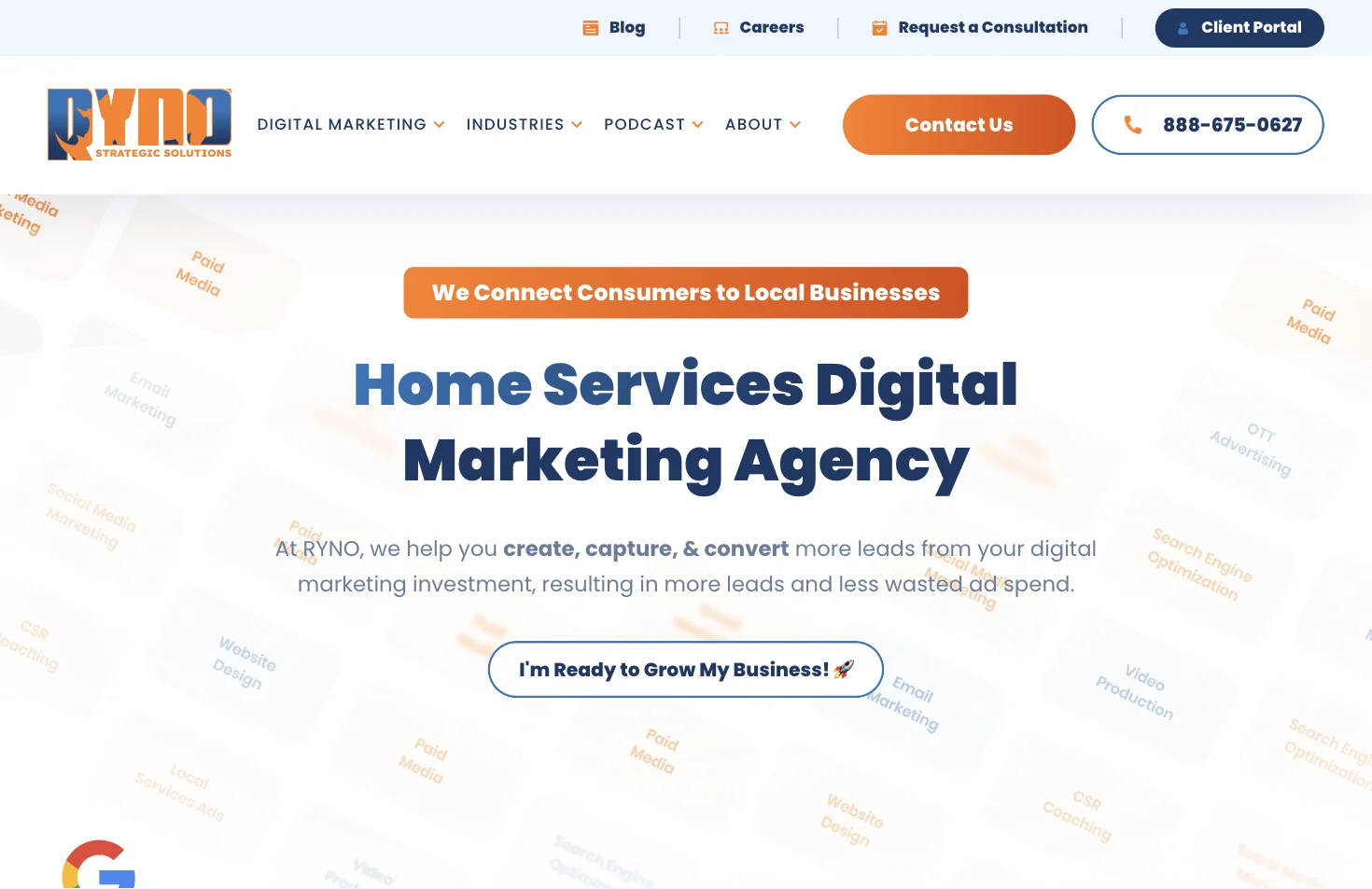
Solar clients report measurable improvements in qualified lead volume and cost-per-lead through refined keyword targeting and conversion-optimized landing pages, per RYNO's own reporting. That's real scale, but CRO doesn't stand alone in the service list the way lead generation and attribution do.
Where they're strongest: Scale and attribution infrastructure. Refined paid-search targeting specifically credited for solar lead-cost improvement.
What to consider: Conversion work reads as a byproduct of the traffic stack, not a named, tested discipline of its own.
Best for: Multi-market solar installers whose lead-cost problem is bigger than their conversion-rate problem right now.
Head to head: RYNO vs. Fervor Studio
No. 6 · Best large agency with a real staffed CRO practice
WebFX
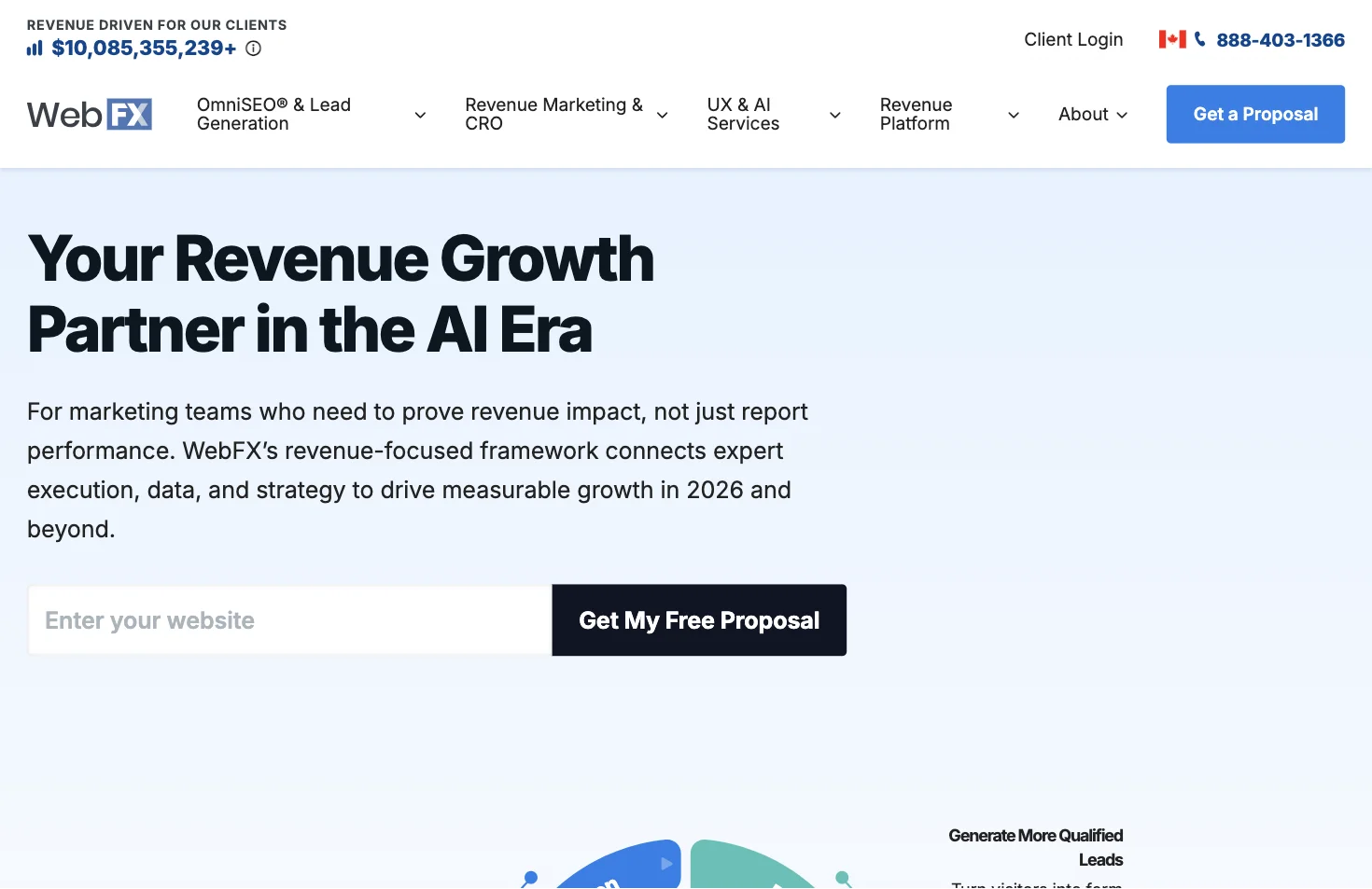
A staffed CRO sub-service and published pricing (plans from roughly $1,500/mo) separates WebFX from solar-marketing generalists who list conversion as a bullet point.
Where they're strongest: Published pricing. A named, staffed CRO team.
What to consider: Solar sits alongside dozens of other verticals. Case studies lean on traffic over documented conversion-lift figures.
Best for: Larger solar operations wanting published pricing without needing trade-only specialization.
Head to head: WebFX vs. Fervor Studio
The 2026 solar CRO agency comparison, at a glance
| # | Agency | Shape | Best-fit solar installer |
|---|---|---|---|
| 1 | Fervor Studio | Research-backed solar CRO | Needs visible savings-and-payback math |
| 2 | Valve+Meter | Diagnostic-first performance marketing | Wants lead cost and conversion diagnosed first |
| 3 | ConversionTeam | Pure CRO with a named solar case study | Wants documented conversion-lift proof |
| 4 | OnwardCraft | Performance-guarantee specialist | Wants a written guarantee tied to real metrics |
| 5 | RYNO | Scale + lead-cost improvement, traffic-first | Multi-market installers needing lead cost solved |
| 6 | WebFX | Full-service with staffed CRO | Larger operations wanting published pricing |
Why solar conversion is a math problem, not a values problem
Solar marketing leans hard on environmental framing, but the actual buyer research says the money is the reason. 92% of people who installed or seriously considered solar cite saving on electricity bills as their reason for doing it.
"92% of Americans who have installed or seriously considered solar cite saving money on electricity bills as a reason for solar."
Pew Research Center (2022)
Ownership context matters too: 96% of U.S. residential solar installed in 2023 went onto owner-occupied homes, and 97% of those were single-family detached houses, which narrows the buyer profile to someone who plans to stay long enough to see the payback period through.
"96% of U.S. residential solar PV systems installed in 2023 were on owner-occupied homes, and 97% of those were single-family detached houses."
Lawrence Berkeley National Laboratory (2024)
Grid reliability is pushing its way into the pitch too. 2024 saw the most power-outage hours in the U.S. in 10 years, with major-event interruptions averaging nearly nine hours against a four-hour average over the prior decade. Maine posted the worst reliability of any state at 1,863 outage minutes, followed by Arkansas at 911 and Oklahoma at 897.
"In 2024, hurricanes led to the most power-outage hours in the U.S. in 10 years; major-event interruptions averaged nearly 9 hours (vs 4-hour average over prior decade); worst state reliability: Maine (1,863 min), Arkansas (911 min), Oklahoma (897 min)"
U.S. Energy Information Administration (2024)
Market context varies sharply by state, and a solar page pitching a national audience without localizing it is losing credibility fast. California still leads installed capacity at 51,909 MW, with Texas at 41,459 MW and Florida at 18,622 MW, but California's own residential solar volume declined 45% in 2024 after net-billing policy changes, while 33 states now exceed 1 GW installed.
"Top solar states by installed capacity: California (#1, 51,909 MW), Texas (#2, 41,459 MW), Florida (#3, 18,622 MW); California residential solar declined 45% in 2024 due to net billing policy changes; 33 states now exceed 1 GW installed"
Solar Energy Industries Association (2024)
A CRO agency that treats every state's solar page the same, ignoring the policy shift that just cut California's residential volume nearly in half, is optimizing forms on a page whose actual problem is a stale value proposition.
Trust closes the loop once the math checks out. 64% of homeowners say recommendations or references are a top-three factor in choosing a contractor, and for a five-figure decision like solar, that trust signal has to sit right next to the savings calculator, not on a separate "about us" page.
"64% of homeowners say having recommendations or references is a top-three factor in choosing a contractor."
Houzz Inc. (2025)
68% of users won't submit a form that asks for too much personal information up front, which cuts against the instinct to gate the savings estimate behind a five-field lead form before showing a single number.
"68% of users would not submit a form if it required too much personal information."
Baymard Institute (2024)
Methodology
How this list was built
Scored against: solar-domain depth (has the firm worked with solar installers specifically, not just "home services"), CRO methodology depth (a published framework vs. CRO as one bullet among ten), transparency (named case studies with real numbers, not placeholder percentages), and whether the agency's approach addresses the savings-and-payback math this trade's buyers weigh.
Excluded: pure SaaS/ecommerce CRO specialists with no solar or home-services portfolio; A/B testing tool vendors, which are platforms, not agencies. Web Tonic is excluded from this list specifically: it publishes CRO agency rankings for HVAC, roofing, restoration, and pool builders, but no dedicated solar ranking or named solar case study could be verified, only generic landing-page statistics content.
Acknowledged: Fervor Studio publishes this article and ranks first on it, a conflict of interest regardless of when the criteria were set. The scoring behind the Contractor CRO Index claims here is public and checkable.
Want to see what the framework finds on your solar site?
The Contractor CRO Index scores lead capture and trust signals against a published framework. The Site Inspection runs the same scoring against your own site and returns a specific list of structural gaps.
Get My Free Inspection →Questions to ask before hiring a solar CRO agency
What is conversion rate optimization for contractors?
Contractor CRO is the work of increasing the share of existing visitors who become calls, estimate requests or booked appointments. It covers messaging, trust signals, page structure, mobile experience, calls to action, forms and booking flows.
Why is my solar website getting traffic but not enough calls?
Traffic does not guarantee leads. Visitors run into weak calls to action, poor mobile usability, unclear service information, thin trust signals, confusing forms, slow pages or a mismatch between the search intent and the landing page. At that point, buying more traffic just sends more people into the same problem.
What makes a good solar website?
It makes clear within seconds what the company does, where it works and how a homeowner takes the next step. Then it needs strong mobile usability, trust signals, real service information, fast access to phone and booking actions, and a structure that lets individual services and markets rank.
How much should a solar company pay for CRO?
Pricing swings widely on market competition, scope, number of locations and whether the agency is doing strategy, execution or both. Compare the scope and the expected business outcome rather than the monthly fee on its own.
Should I hire a contractor-specialist agency or a general marketing agency?
A specialist starts ahead because it already understands contractor search behaviour, seasonality, service-area businesses and lead economics. A broader agency is still the better choice when it has stronger expertise in the specific problem you need solved.
Is the cheapest CRO agency a bad choice?
Not automatically, but price only means something next to scope, specialisation and expected return. Two agencies both selling "CRO" can be doing substantially different work, which makes a price-only comparison misleading.
How do I know whether an SEO agency is actually generating business results?
Rankings and traffic have to connect to commercial outcomes. Track qualified calls, estimate requests, booked appointments and, where you can, revenue, rather than judging the work on keyword positions alone.
 Sep 21, 2026
 Agency Selection
Best Electrical CRO Agencies in 2026
Electrical conversion splits into an emergency call and a considered upgrade. Here are 6 CRO agencies scored on whether they build for both.
Read Article Sep 21, 2026
 Agency Selection
Best Foundation Repair CRO Agencies in 2026
A single headline change took one foundation repair page from 2% to 12.96% conversion. Here are 5 agencies scored on whether they understand why.
Read Article Sep 21, 2026
 Agency Selection
Best Restoration CRO Agencies in 2026
A restoration site has seconds, not minutes, to prove it can help. Here are 7 CRO agencies scored on whether they actually build for that window.
Read Article