Case study · Calgary, AB · General contracting & framing
Sealy Construction's Old Site Had No Phone Number on the Page That Mattered Most
Tori Sealy has run a general contracting and framing crew out of Calgary for more than twenty years. Fifteen people on the payroll, a second specialist brand in Calgary Framers, and real project history going back further than most contractors' entire career. None of that showed up on the old site. So Fervor built three pages around one job: get Tori's phone to ring.
The contractor
Twenty years of real work, behind a site that showed none of it.
Tori Sealy has been in business more than twenty years. His crew of fifteen carries eighty-plus combined years in the trade between them. Sealy Construction does general contracting, framing, and structural repair across Calgary and the towns around it, and runs a second brand, Calgary Framers, as a framing specialist under the same ownership. This is not a startup finding its footing. It is an established operation that never had a website doing its job.
The old site ran on a website builder. And it read like a company that had never needed the internet to find work, which, for twenty years, it mostly hadn't. Word of mouth and repeat commercial clients carried Sealy a long way. But a homeowner searching Calgary at ten at night for a contractor doesn't call on word of mouth. They land on whatever page comes up, and the old Sealy site gave that homeowner nothing to act on.
So before any design work started, Fervor ran the same Site Inspection it runs on every prospective client's site: pull it up on a phone, check every page for a phone number, a form, a reason to call.
The services page had none of the three.
Four icon-circle sections. Our History, Our Team, Our Services, Our Commitment. A block of generic paragraph copy under each. A cookie-consent banner. A plain copyright line in the footer. Nothing else. No tel link, no mailto, no form, no button. A visitor reading that page to decide whether to call Sealy had no way to act on it short of hunting down a separate contact page.
Twenty years on the tools, sitting behind a storefront built for nobody in particular.
The before
What the Site Inspection found
Fervor's Site Inspection scored the old site F · 27 out of 100. The findings below come straight from that inspection, confirmed against the archived screenshots, not a paraphrase of what the site might have had.
- 01
The services page had zero calls to action.
No phone number, no contact form, no button, anywhere on the page that describes what Sealy actually does. A visitor ready to call had to go find a different page first.
- 02
Calgary was never mentioned on the services page.
Twenty years of Calgary work, and the page describing the services didn't say where. For a local trade business, that's a page competing with nothing to say about its own market.
- 03
No emergency or after-hours path existed anywhere.
Structural repair and restoration work often starts with an emergency call. The old site had no path for that call to happen outside business hours, or inside them, from the page most likely to get a homeowner reading it.
- 04
No credentials were shown.
No WCB number, no insurance status, nothing that lets a homeowner evaluating a structural repair contractor confirm who they're hiring before they call.
The build
What we changed
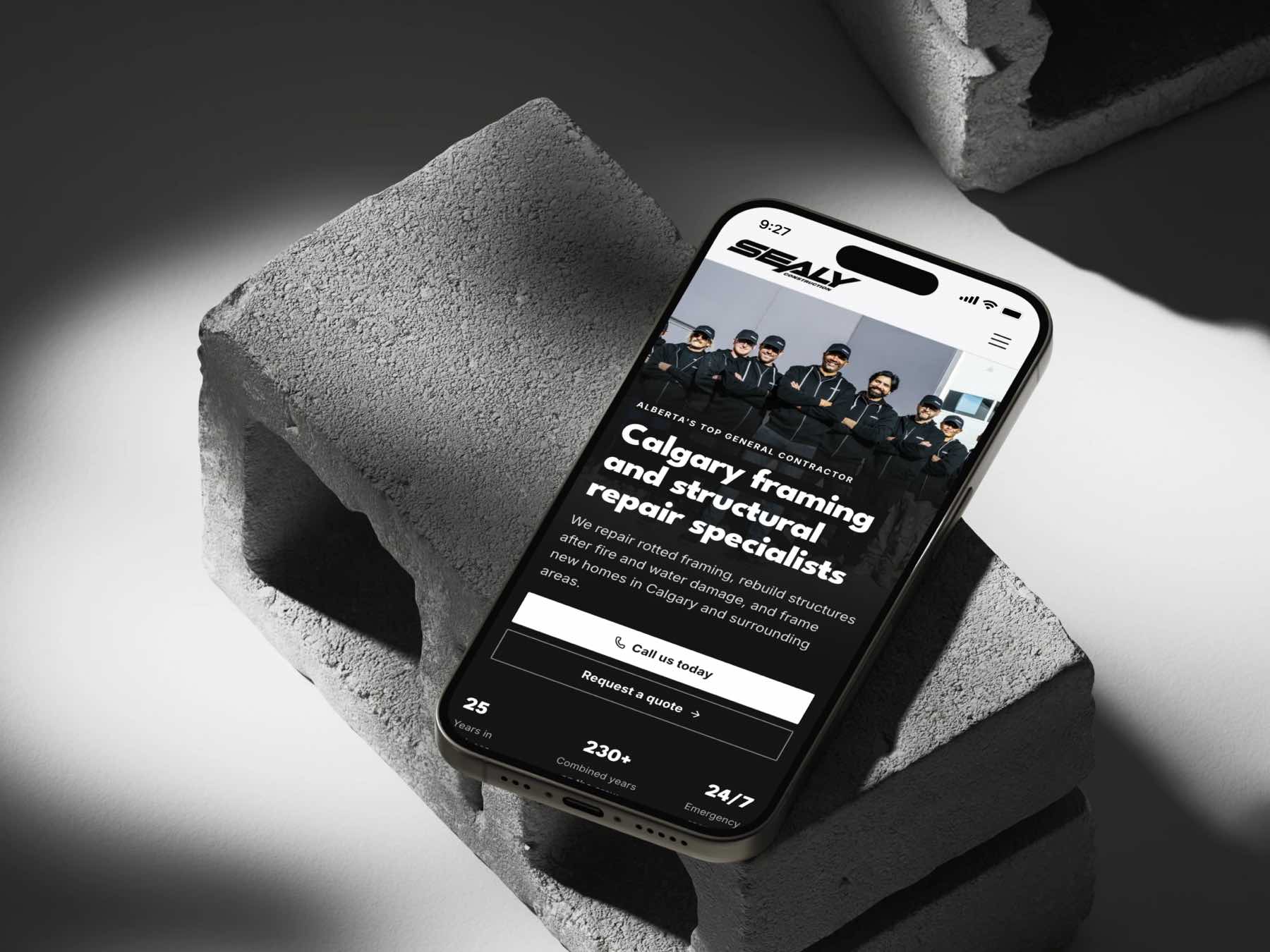
The new site lives at sealyconstruction.com, three pages, custom-coded with Astro, no page builder and no template underneath it. The signed agreement gave Fervor fourteen days from signature, payment, and materials. The site reached a stable, deployable build in under a week.
- A 24-hour emergency line, on every page. Wired into the footer, the emergency-service copy, the FAQ, and the page's structured data, so a homeowner mid-emergency finds the number no matter which page they land on.
- Real credentials, shown. A confirmed WCB account number and a Calgary street address, both on the About page. Nothing invented or placeholder where a real number wasn't confirmed yet.
- Seventeen real projects, not stock photography. Fourteen pulled from Tori's own project photos and write-ups, plus three original ones, in the client's own words. A filterable gallery with a full-screen viewer that keeps every project's photos and text in the page HTML, so the full project history stays readable to search crawlers and AI answer engines, not just to a visitor who clicks through.
- Swiss editorial design, black and white. The slate-blue accent in an early draft turned out to be a leftover from the old website-builder template, not a brand choice. Tori confirmed black and white directly, and the site now reflects that.
- One phone number, built for a thumb, not a mouse. Contractor sites get found and called from a phone far more than they get form-filled from a desktop. The mobile call path stays reachable from any scroll position on every page.
The after
What changed, line by line
The rebuild has been run back through the Site Inspection scoring pipeline. What changed is everything above it.
The lesson
Twenty real years don't show up on a site that was never built to show them
Sealy isn't a company that needed to invent credibility. It needed a website that stopped hiding the credibility it already had. That's a different job than most contractor rebuilds, and it's worth naming directly.
-
An established business can still have a startup's website.
Twenty years in business and a fifteen-person crew don't automatically translate onto a page. The old Sealy site read like it belonged to a company with no history at all, because nothing on it said otherwise.
-
Real project history beats generic trust copy.
"Our Commitment" as an icon-circle heading persuades nobody. Seventeen real, photographed, client-described projects do the persuading instead, without needing a single adjective to do it.
-
An emergency trade needs an emergency path, visible everywhere.
Structural and restoration work often starts with a call nobody planned to make. A 24-hour line that only lives on a contact page a visitor has to find first isn't really a 24-hour line.
The Sealy rebuild is one job. The thesis it proves is the same one behind every Fervor Site Inspection: a contractor's website should show the business that's actually there, not whatever template shipped with the account.
Early signal
The first week, honestly
sealyconstruction.com moved to the new build on November 6, 2026. This is a first-week read, not a conversion study. The sample is small, and it's reported here as early signal, not proof of lead growth.
In the first week live, the site logged 20 sessions from 12 active users, an 80 percent engagement rate, and just over two minutes of average engagement per user. Direct traffic led at 17 sessions, with organic search just beginning to register.
Search Console shows the domain already carrying branded search history, mostly "Sealy Construction" itself. The first non-branded impressions appeared in the same window: "house framing calgary" and "rot repair calgary," the kind of query a services page with zero mentions of Calgary was never going to be found for.
Source: Google Search Console
- Sessions20
- Active users12
- Engagement rate80%
Sealy Construction's old site couldn't tell a visitor how to reach them. Three pages later, it can't stop trying to.
Fervor Studio built the site that replaced Sealy's. If your contractor site has the same problem, zero calls to action on the page that matters most, the Site Inspection finds it for free.