0
contractor sites graded, one A
Across the whole CRO Index, a single site earned an A. The median landed at a D. The grade gap is a conversion gap.
Right now, someone in Yellowknife is Googling "HVAC near me." We get you showing up first — then turn that click into a booked job.
A written report and a ranked fix list, in about three days.
“Patient, on point, straightforward. Did amazing work. Would 100% recommend.” — Ruben Mederos, HyperTemp HVAC
“Responsive, creative, exceeded expectations. Already seeing greater engagement from our clients.” — George Jeorgy, Jeorgy's Landscape Construction
“Top-tier professionalism, real web design expertise, ideas I hadn't considered. Confidently recommend.” — Aws Nassani, Four Eleven Contracting




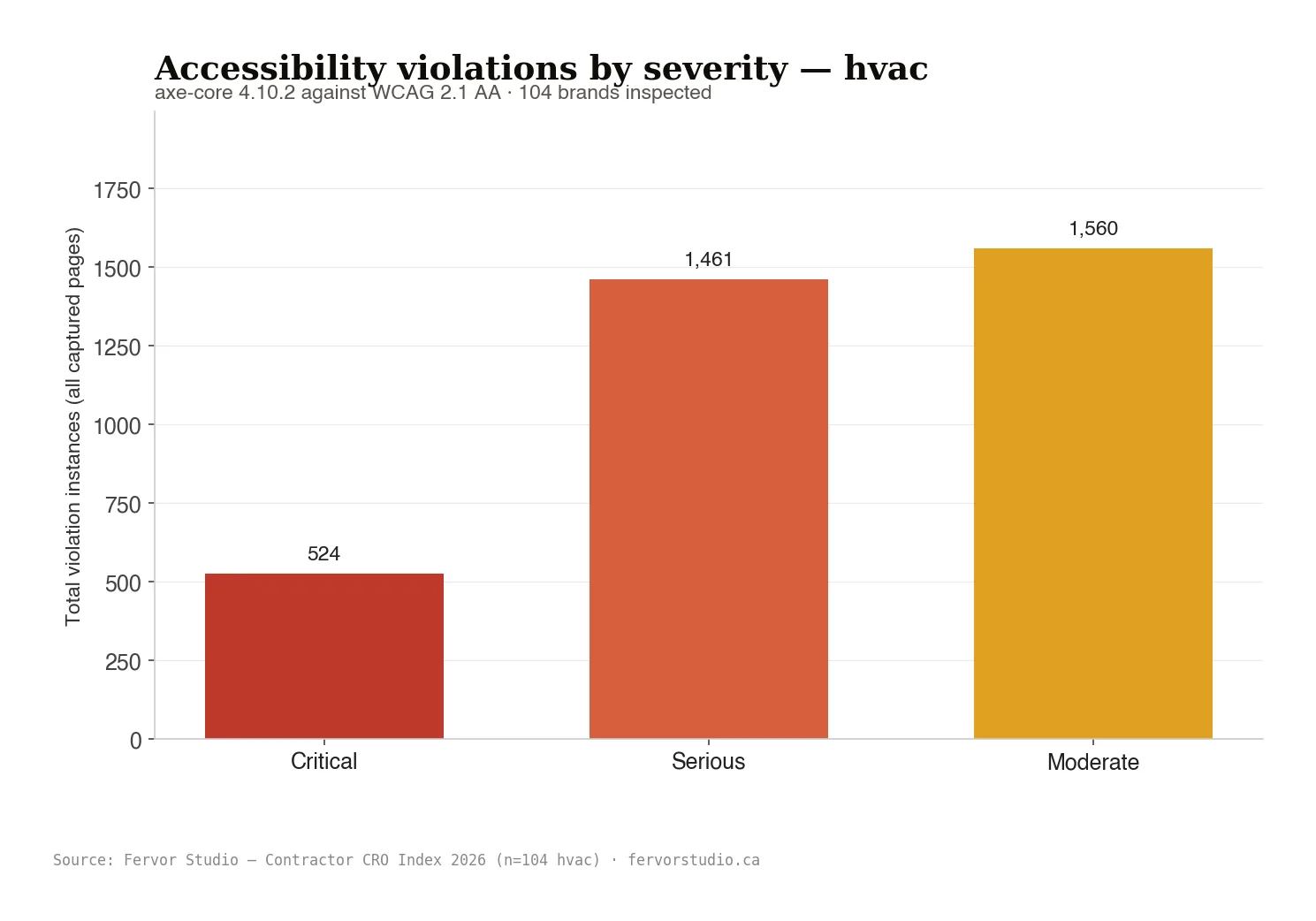
64.4% of HVAC sites we tested fail a critical accessibility check
Digital State of the HVAC Industry 2026A grade out of 380 contractor sites
We graded 380 of them against one framework. Exactly one earned an A: Crown Industrial Roofing in Toronto, at 90 out of 100. The rest left money on the table. Here is what separates the top from the bottom.
The local detail
Every angle below comes from how Yellowknife actually searches, buys, and regulates — built into the page, not bolted on.
Three facts define this market.
Whitespark’s 2026 Local Search Ranking Factors study puts Google Business Profile signals as the heaviest single category for Local Pack rankings, review signals…
Primary category: HVAC Contractor.
Here’s where hvac contractor seo yellowknife work separates from the southern template stuff.
The long winter (October through April).
And review velocity beats review total.
You've probably paid for SEO before. And if you run a shop anywhere from Old Town to Frame Lake, odds are the last agency billed you through a full heating season, sent content written for a market with a cooling season, and never learned that the Arctic Energy Alliance exists. So now you're wondering whether HVAC SEO Yellowknife is a real discipline or a southern template with the city name swapped in. Fair question. This page lays out what a Yellowknife HVAC SEO company should actually build: Google Business Profile work for a market where heating is life-safety, oil-and-pellet authority no southern shop can fake, and the rebate layer that actually exists north of sixty.
Three facts define this market. First, the cold: design temperatures around minus forty make heating failure a genuine emergency, oil and propane the backbone fuels, wood pellet boilers the renewable play that actually works here, and every southern heat pump headline an article that needs translating before it applies. Second, the economics: energy costs run multiples of southern rates, which makes efficiency arithmetic more persuasive per dollar here than anywhere south, and makes the household that masters it a customer for life. Third, the SERP: almost nobody in this market has published anything, which means the first shop to build real pages owns the whole Local Pack, not a slice of it.
So the first question for any HVAC SEO Yellowknife engagement isn't "what keywords do we target." It's whether your profile, pages, and reviews are built for the north's actual conditions. And in this market, most shops have no real web presence at all, which is the opportunity.
"64% of Canadians surveyed prefer homes with high-efficiency heating and cooling systems." — Abacus Data (2023)
Nearly two in three buyers already want what you install, and at northern energy prices the preference has teeth. The fight is over which contractor they find. And the Local Pack is where that fight happens in seconds: review count, review recency, response rate, photos that look like this year. A Yellowknife HVAC SEO programme that skips the trust layer hands the coldest mornings on the continent to whoever didn't.
Whitespark's 2026 Local Search Ranking Factors study puts Google Business Profile signals as the heaviest single category for Local Pack rankings, review signals close behind, and on-page third. Eight of the top ten Local Pack factors come straight from the profile. So more than half of your visibility when a Frame Lake homeowner searches "furnace repair" lives in GBP and reviews, not in your website.
And the website third is where the wider trade is weakest. Fervor's State of the Industry report for HVAC walks through what the industry's sites actually look like under inspection, page speed to call buttons to schema, and the bar is lower than you'd guess. In this market the bar is barely off the floor, which is exactly the point.
But the agencies selling hvac marketing yellowknife packages, the few that ever pitch this far north, usually lead with a site rebuild, because that's the line item they know how to sell. Sequence it the other way. Profile and reviews first, site second, and the phone behaviour moves before the big invoice lands.
And the territory's shape rewards shops that map it honestly. The city itself runs from Old Town and downtown through Frame Lake and Niven, small enough that one Local Pack covers it. The real map question is the fly-in and winter-road communities, Behchokǫ̀ to Fort Providence, where Yellowknife trades take territorial work: if you serve them, say so on a page, because nobody else has. Your seo for hvac yellowknife plan starts with an honest statement of where you actually work, then publishes it, which in this market is a competitive act all by itself.
One aside on Local Services Ads. The auction barely exists at this latitude, which means organic Local Pack position is even more decisive than down south: there's no paid layer muddying the results, so whoever Google trusts gets the call. Organic position, built on profile and reviews, is the whole game. In Yellowknife, HVAC SEO done in that order is the difference between renting the winter and owning it.
Primary category: HVAC Contractor. Even in a market with a three-week summer, because the category carries the heating queries too and the ventilation work that northern building science demands. Google caps you at four categories total, so pick secondaries off your actual ticket mix: Heating Contractor, Furnace Repair Service, and Heating Oil Supplier if that's part of your operation.
And service areas deserve real care north of sixty. Google allows up to twenty service-area entries. Name them: Yellowknife, Ndilǫ, Dettah, Behchokǫ̀, plus the communities you genuinely serve on contract or fly-in. Then put your territorial licensing and gas-fitter credentials in the business description, because in a small market trust signals compound fast.
But photos are the part everybody skips. Google reads photo recency as a liveness signal, and twelve photos from 2022 tell Google you might be gone. Two uploads a month of real local jobs (an oil boiler service in Old Town, a pellet boiler install, an HRV core swap in a Niven new-build, a minus-forty morning service call with the truck plugged in) keeps the listing visibly alive and unmistakably northern. And seed the Q&A field with what your dispatcher answers daily: do you charge a diagnostic fee, do you service pellet boilers, do you fly to the communities.
And wire the booking link if your scheduler supports it. A homeowner whose oil burner quit at minus forty will book the first shop that answers, full stop, and the booking link is how you answer at two in the morning. (After-hours booking is one of the most common leaks in the trade; the inspection data on scheduling shows how often it goes unfixed.)
"In Canada, heat pump shipments grew approximately 5% annually from 2020–2024 while furnace shipments fell approximately 3.4%, yielding 0.84 heat pumps shipped per furnace (up from 0.57 in 2020)." — Heating, Refrigeration and Air Conditioning Institute (HRAI) (2024)
That national curve mostly stops at the sixtieth parallel, and your market knows it, which is the content opportunity: the page that honestly explains what cold-climate heat pumps can and can't do at this latitude, where the cutoff temperatures sit, and why the oil burner stays as backup, becomes the reference document for the whole territory.
Here's where hvac contractor seo yellowknife work separates from the southern template stuff. One "Our Services" page listing nine offerings ranks for none of them, because Google matches queries to pages, not to businesses. The homeowner searching "oil furnace repair Yellowknife" should land on your oil page with northern content on it, not a bullet list and a phone number.
The build-out for this market: oil furnace and boiler service (the franchise page), oil tank inspection and replacement, propane systems, wood pellet boilers and stoves (the territory's renewable workhorse), HRV service and balancing (mandatory equipment in tight northern builds, and almost nobody has written the page), ventilation and sheet metal, and a frank cold-climate heat pump page that does the minus-forty translation honestly.
And the page this market needs most: the rebate layer explainer. The Arctic Energy Alliance runs the territory's rebate programmes, paying on energy-efficient heating equipment through its Energy-Efficient Products programme, on building improvements, and on renewables including biomass systems, with funding that has put millions back into NWT households. Quote the live programme pages at quote time, because northern programme years move with funding cycles. And retire the southern promises: the federal Oil to Heat Pump Affordability programme doesn't cover the territories' diesel-grid realities the way it covers the provinces, and the Canada Greener Homes Loan is fully committed and closed. The shop that lays the real money out plainly becomes the name NWT homeowners associate with a straight rebate answer, and that name is the one that books the install.
"Only 55% of interested Canadian buyers would invest in big-ticket energy upgrades like geothermal heat pumps, solar panels, or heat-recovery ventilation." — Abacus Data (2023)
Nearly half stall at the big-ticket line, and at northern install costs the stall is steeper. The shop that pairs the AEA rebate with honest payback math at territorial energy prices converts the hesitant half; the shops that quote southern numbers get the polite no.
A word on what a real community page contains. A Behchokǫ̀ page that says "we serve Behchokǫ̀" is thin; a real one names the housing stock, the fuel mix, the travel logistics and how billing works for fly-in service, and a job you've actually done there. In territorial work, the logistics paragraph is the conversion paragraph, because it answers the question every community client actually has: will you really come, and what does the trip cost.
The long winter (October through April). The season that is the business. No-heat calls at minus forty are life-safety emergencies, oil burners and boilers fail under continuous load, HRVs ice up, and the deep-cold snaps fail everything marginal at once while the trucks need plugging in between calls. Service tickets blanket the whole stock; replacement decisions follow the failures.
Breakup and the short summer (May through August). The maintenance window. Tank inspections, boiler overhauls, HRV servicing, pellet system installs, and every project job that needs ground access or open water for barge freight to the communities. Publish maintenance content in April, because the window is short and the booked-out shops win it before it opens.
Freeze-up (September). The last-chance rush: every system that limped through summer gets its tune-up now or fails in December. The shop whose September content says exactly that, with a booking link, harvests the rush.
"65% of Canadians interested in energy-efficient homes cite significant cost savings (lower utility bills) as a top-three motivation." — Abacus Data (2023)
Two-thirds of your market is doing bill math, and at territorial energy prices the math is vivid. So do the arithmetic on the page: what a high-efficiency boiler or a pellet conversion saves at this year's fuel prices, in dollars per month. The shop that publishes that table owns the conversation in a market where everyone compares fuel bills at the hockey rink anyway.
And say the financing part out loud on the page. A $12,000 boiler conversation goes very differently when the homeowner already knows the AEA rebate and the monthly payment before they call. Getting the northern money into print is what hvac marketing yellowknife should mean in practice: content that's current and complete the week the homeowner reads it.
And review velocity beats review total. A hundred reviews that stop in 2024 read worse, to Google and to a skeptical Niven homeowner, than forty with six from last month. But the fix is operational, not motivational: an automated ask after every closed ticket, timed for the evening, linked straight to the profile. Fervor wires this up with NiceJob as standard practice, because review velocity is the local SEO signal you can actually manufacture, one closed job at a time. And in a town of twenty thousand, every review is also word of mouth with a timestamp.
And responding matters as much as collecting. The owner who answers the angry two-star calmly, names the fix, and invites the customer back reads better to the next fifty readers than a wall of silent five-stars, and in a market where everyone knows everyone, the public response does triple duty. So write it for the audience, not the reviewer, and answer within days, because the timestamp shows.
The citation stack for this market, in order of weight: Google Business Profile first, then BBB, Yelp, and Houzz where they reach, but the territorial layer matters more: the NWT Chamber of Commerce directory, the Yellowknife Chamber of Commerce, and the Arctic Energy Alliance's contractor relationships, which double as a lead source because the programmes send homeowners to participating installers. Name, address, and phone identical everywhere.
And one move almost nobody makes: local press. Cabin Radio, the Yellowknifer, and CBC North run cold-snap, fuel-price, and energy-programme stories on schedule every single winter, and in a market with three outlets the backlink concentration is absolute. A shop owner quotable on "what the pellet conversion actually saves at this year's oil price" earns links that move rankings for years. That's a yellowknife hvac marketing play that costs an email and pays like a campaign.
"53% of Canadian home buyers reported being motivated by lower utility bills, yet only 45% were willing to spend up to $3,000 to achieve those savings." — Canadian Home Builders' Association (CHBA) (2024)
Motivation outruns willingness to pay, and at northern prices both numbers scale up. The gap is still closed the same way: live rebate math and a monthly payment, printed where the homeowner can find them at two in the morning.
The build sequence is the same one behind every Fervor location programme, tuned to this market.
Before any contract, we run your current site through the same inspection we've run on hundreds of contractor websites: load speed on a throttled connection (which up here is just the connection), call-to-action placement, Local Pack position, and where the leads leak. You get the findings whether or not you hire us.
Your ticket mix, your radius, your crew capacity, your community contracts. A shop with fly-in work needs the logistics pages first; a city-only shop needs the oil-and-pellet authority build; and everyone here needs the AEA explainer.
The full page map: one page per service per the architecture above, with the oil, pellet, and rebate pages built first, plus community pages for the territory you actually serve. Each page written against real northern search intent, with programme details quoted from the live AEA pages.
Mobile-first, because no-heat searches happen on phones in cold houses. Click-to-call above the fold, load times tested for northern bandwidth, schema markup for service area and reviews so Google reads the business the way the homeowner does.
You own everything: domain, content, hosting, analytics, the Google Business Profile. That's the policy, not a perk. If we part ways in a year, every asset stays with you. Ongoing work continues under Performance Partner if the numbers justify it, and you'll see those numbers monthly either way.
For a northern shop, the SEO-led entry point is The Local Pick at $2,497 one-time: the Google Business Profile rebuild, citation cleanup across the stack above, and the review pipeline, in roughly fourteen days. Ongoing ranking work, content production, and monthly reporting run under Performance Partner at $1,497 to $3,997 per month depending on scope.
So do the napkin math against your own numbers. Take your average boiler replacement ticket, multiply by its gross margin, and ask how many incremental booked jobs a month covers $1,497. At northern ticket sizes the answer is comfortably under one. Everything past it is return. No projections, no "brand awareness" line items, just calls you can count against a number you already know.
And if you've been burned before (most owners we talk to have a story about the agency that locked the domain, or the one that billed a year for "optimization" nobody can describe), the structure is built for that scar tissue. Month-to-month terms. Reporting that counts calls and booked jobs, not impressions. Assets in your name from the first invoice. You shouldn't have to trust us. You should be able to check.
"If given an extra $10,000 to spend, only 15% of Canadian buyers prioritized energy-efficient upgrades, versus 27% who chose a larger home/lot and 25% who chose interior finishes." — Canadian Home Builders' Association (CHBA) (2024)
Efficiency loses the spending fantasy to square footage and countertops even up here, which tells you how to write: lead with the minus-forty morning and the fuel bill, let efficiency ride along. Which is the argument for doing HVAC SEO Yellowknife now, while the whole northern SERP is still unclaimed and the first real page wins it outright.
If you want the broader system behind this page, start with the HVAC marketing hub. The full trade picture lives under mechanical contractors, and everything Fervor does for the trades starts at the contractor hub.
The Local Pick lands in about fourteen days, and GBP changes typically start moving Local Pack position within four to eight weeks. And in a market this thin, the curve moves faster than the southern averages, because there's almost nobody to outrank. The honest answer: first measurable movement inside two months, with the position essentially owned by the second winter.
$2,497 one-time for the setup tier, then $1,497 to $3,997 monthly if you continue into managed work. No long-term lock-in. The monthly number flexes with scope: a city-only shop needs less content volume than one publishing community pages across the territory.
Yes. Domain, site, content, GBP, analytics, all registered to you from day one. The hostage-asset model (where the agency owns your domain and you find out when you try to leave) is a horror story that travels badly in a town where everyone talks, and it's the first thing we contractually rule out.
The fuels and the field. Whitehorse runs on cheaper hydro with a genuine heat pump programme and a livelier competitive field; southern cities run rebate economies that mostly don't reach the territories. This market's distinctive conditions are oil-and-pellet dominance, life-safety stakes that make response time the brand, an Arctic Energy Alliance rebate layer nobody quotes, and a SERP so empty that the first serious page owns it. The page map has to follow the fuels and the freeze-up calendar, not a template.
The evidence
 Read the full report →
 0
contractor sites graded, one A
Across the whole CRO Index, a single site earned an A. The median landed at a D. The grade gap is a conversion gap.
0 %
of HVAC sites fail a critical accessibility check
Scored against WCAG 2.1 AA with axe-core. A page that blocks a screen reader also blocks a paying customer.
Fervor HVAC State of the Industry, 2026
0 %
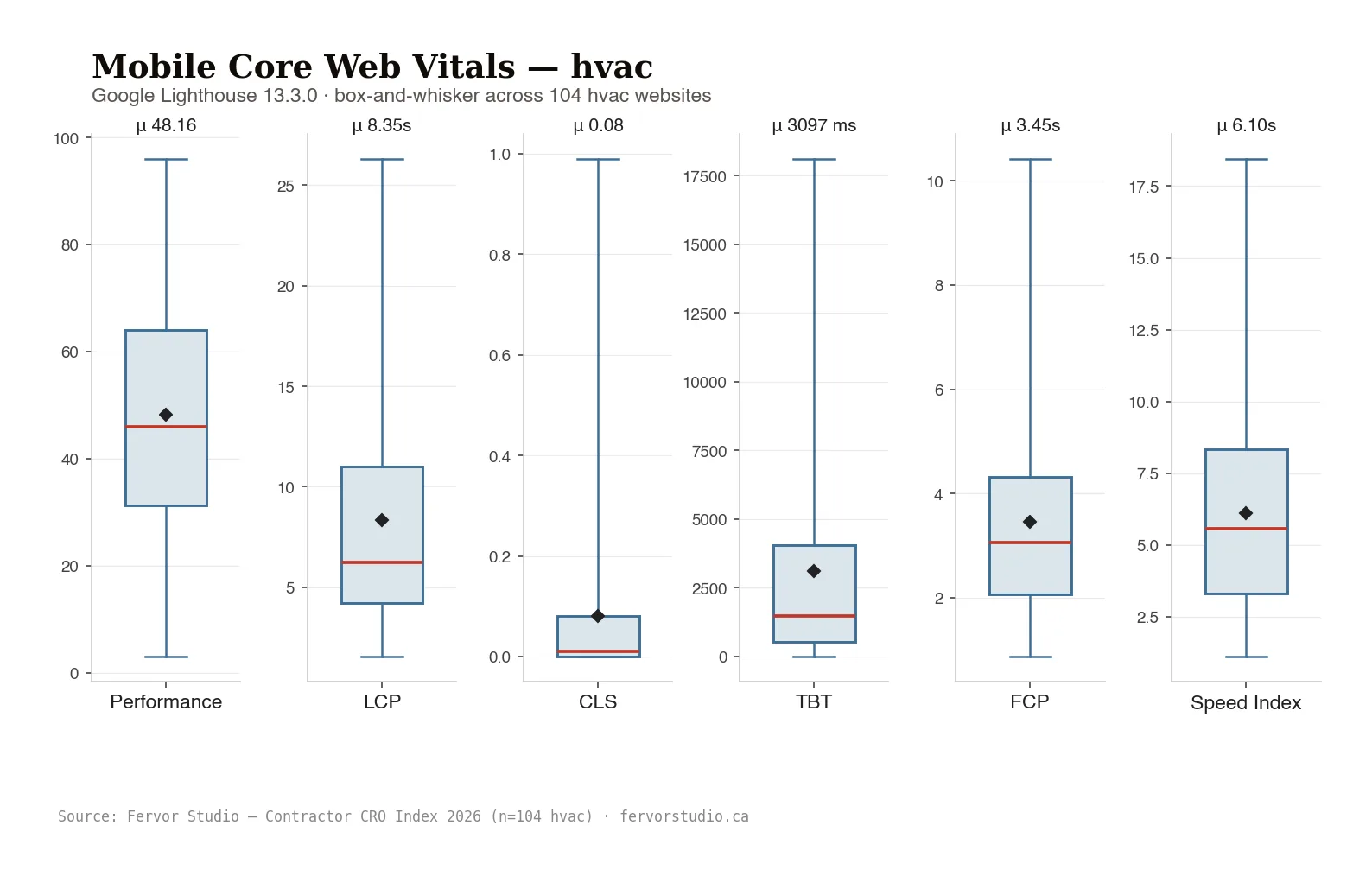
miss Google's mobile load-speed bar
Median mobile load lands at 6.24 seconds. Most of your traffic is on a phone, and most of them are gone before the hero paints.
Fervor HVAC State of the Industry, 2026
0 /100
is the average HVAC grade
That is a D. The sites booking the work are not the ones with the biggest crews. They are the ones a few points higher on the things homeowners feel.
Two ways to start
Tell us where you are. We point you at the right next step — no sales call to get there.
Client review
“Nay did an amazing job, you know. He was really patient. He got the work done the way I told him and he was just on point with the website. Pretty straightforward process. No going around the bush. He just did amazing work and I would 100% recommend.”
How Fervor can help
Monthly SEO, content, and CRO. Fixed deliverables. No credits, no rollover. The compound growth engine.
Complete website system built to convert storm leads, planned projects, and research-phase homeowners into booked jobs.
Identify and patch the top conversion killers on your existing site. No full rebuild needed.
GBP optimization, citation building, and review system foundation. The infrastructure that gets you into the Map Pack.
One conversion-built landing page for the referrals, paid clicks, and cold-call leads you send. They land on a page built to book them, not your generic homepage.
Your move
Tell us where you are. We point you at the right next step — no sales call to get there.
Keep going