0
contractor sites graded, one A
Across the whole CRO Index, a single site earned an A. The median landed at a D. The grade gap is a conversion gap.
Right now, someone in Fargo is Googling "HVAC near me." We get you showing up first — then turn that click into a booked job.
A written report and a ranked fix list, in about three days.
“Patient, on point, straightforward. Did amazing work. Would 100% recommend.” — Ruben Mederos, HyperTemp HVAC
“Responsive, creative, exceeded expectations. Already seeing greater engagement from our clients.” — George Jeorgy, Jeorgy's Landscape Construction
“Top-tier professionalism, real web design expertise, ideas I hadn't considered. Confidently recommend.” — Aws Nassani, Four Eleven Contracting




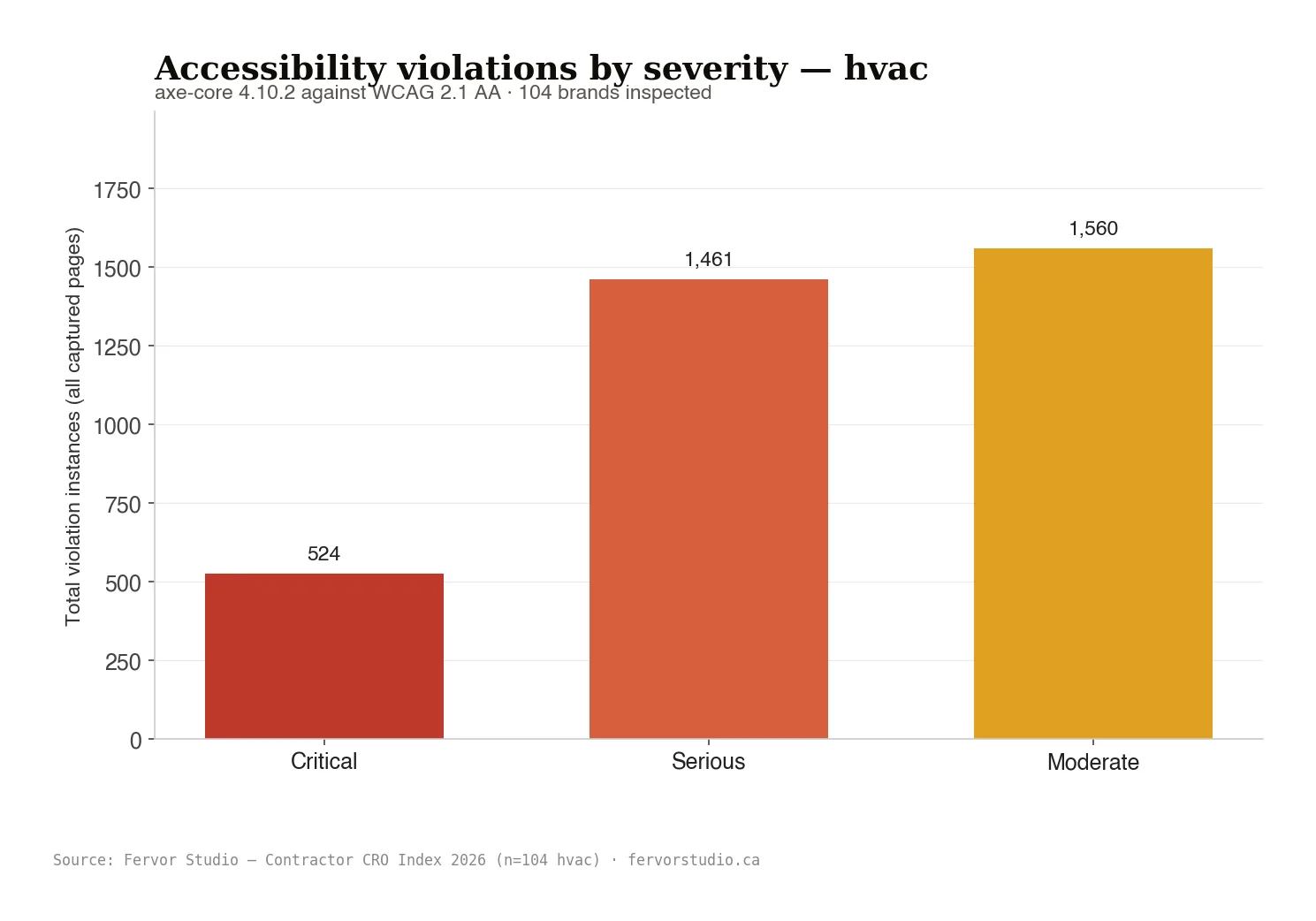
64.4% of HVAC sites we tested fail a critical accessibility check
Digital State of the HVAC Industry 2026A grade out of 380 contractor sites
We graded 380 of them against one framework. Exactly one earned an A: Crown Industrial Roofing in Toronto, at 90 out of 100. The rest left money on the table. Here is what separates the top from the bottom.
The local detail
Every angle below comes from how Fargo actually searches, buys, and regulates — built into the page, not bolted on.
Three facts define this market.
Whitespark’s 2026 Local Search Ranking Factors study puts Google Business Profile signals as the heaviest single category for Local Pack rankings, review signals…
Primary category: HVAC Contractor.
Here’s where hvac contractor seo fargo work separates from the template stuff.
Here’s the angle no fargo hvac seo company has bothered to write down, and it’s sitting in plain sight on the river.
Deep winter (November through March).
And review velocity beats review total.
You've probably paid for SEO before. And if you run a shop anywhere from downtown to Horace, odds are the last agency billed you through a winter that hit twenty below, sent a ranking report that never mentioned Moorhead, and didn't know the off-peak program from a furnace filter. So now you're wondering whether HVAC SEO Fargo is a real discipline or a template with the city name swapped in. Fair question. This page lays out what a Fargo HVAC SEO company should actually build: Google Business Profile work tuned to a two-state metro, service pages for the coldest design temperatures in the lower 48, and the rebate border at the Red River that almost no contractor has put into print.
Three facts define this market. First, the cold: design temperatures around twenty below zero make heating a life-safety category here, which means no-heat search behavior is more urgent, more mobile, and more winner-take-all than almost anywhere else you could run a shop. Second, the sprawl: the post-war stock near downtown and NDSU ages out its furnaces while south Fargo, West Fargo, and Horace pour new construction onto the prairie, and each pocket searches its own Local Pack. Third, the border: Moorhead and Dilworth sit one bridge away in Minnesota, where the rebate economics are a different country, and the metro's homeowners genuinely don't know which programs apply to their side of the river.
So the first question for any HVAC SEO Fargo engagement isn't "what keywords do we target." It's whether your profile, pages, and reviews are built for a metro that crosses a state line and a climate that breaks equipment on schedule. And most shops here are built for neither.
"25% of homeowners say trusting contractors is their top challenge when planning home improvement projects." — Houzz Inc. (2025)
One in four prospects is scoring you on trust before price ever comes up. And the Local Pack is where that scoring happens in seconds: review count, review recency, response rate, photos that look like this year. A Fargo HVAC SEO program that skips the trust layer hands the coldest mornings of the year to whoever didn't.
Whitespark's 2026 Local Search Ranking Factors study puts Google Business Profile signals as the heaviest single category for Local Pack rankings, review signals close behind, and on-page third. Eight of the top ten Local Pack factors come straight from the profile. So more than half of your visibility when a West Fargo homeowner searches "furnace repair" lives in GBP and reviews, not in your website.
And the website third is where the wider trade is weakest. Fervor's State of the Industry report for HVAC walks through what the industry's sites actually look like under inspection, page speed to call buttons to schema, and the bar is lower than you'd guess.
But the agencies selling hvac marketing fargo packages usually lead with a site rebuild, because that's the line item they know how to sell. Sequence it the other way. Profile and reviews first, site second, and the phone behavior moves before the big invoice lands.
And the market's shape rewards shops that map it honestly. Google draws Local Pack radii around the searcher, so a shop on Main Avenue can own downtown and be invisible in Horace, fifteen minutes south. West Fargo clusters its own results, Moorhead clusters its own, and the new-construction belt keeps moving the edge of the map outward every year. Your seo for hvac fargo plan starts with an honest map of where the trucks actually roll, then builds a service-area page per community instead of pretending one homepage covers Casselton to Dilworth.
One aside on Local Services Ads, since somebody always asks. The Google Guaranteed badge earns its keep when it's thirty below and it's worth running. But LSA sits on top of the organic stack, not instead of it. The auction gets pricier every cold snap, leads get disputed, and the moment you stop paying, the calls stop with it. Organic Local Pack position keeps answering after the budget runs dry, which is why it gets built first.
Primary category: HVAC Contractor. Not Heating Contractor alone, even at this latitude, because the dual-intent category ranks you for both buckets and the short, fierce summers still buy plenty of cooling. Google caps you at four categories total, so pick secondaries off your actual ticket mix: Furnace Repair Service, Heating Contractor, and Air Conditioning Contractor for most shops here.
And service areas deserve real care in a two-state metro. Google allows up to twenty service-area entries. Name them: Fargo, West Fargo, Horace, Moorhead, Dilworth, Casselton, Kindred, plus the neighborhoods you actually want. Putting Moorhead on the profile matters more than it looks, because Minnesota-side homeowners filter for contractors who clearly work their side of the river, licensing and rebates included.
But photos are the part everybody skips. Google reads photo recency as a liveness signal, and twelve photos from 2022 tell Google you might be gone. Two uploads a month of real local jobs (a high-efficiency furnace swap in a 1950s rambler near NDSU, a dual-fuel install south of town, a rooftop unit downtown) keeps the listing visibly alive. And seed the Q&A field with what your dispatcher answers daily: do you charge a diagnostic fee, do you service Moorhead, do you install on the off-peak program.
And wire the booking link if your scheduler supports it. A homeowner whose furnace quit at twenty below will book the first shop that lets them pick a time without a phone tree. Every step you remove between the search and the appointment is a competitor you remove with it. (After-hours booking is one of the most common leaks in the trade; the inspection data on scheduling shows how often it goes unfixed.)
"Mechanical equipment remains difficult to source for remodelers in 2025" — National Association of Home Builders (2025)
And sourcing friction changes search behavior. When cold-climate equipment runs short before a Red River Valley winter, homeowners call more shops per job hunting for stock. More Local Pack impressions in play, more reason the profile that answers fastest books the conversion.
Here's where hvac contractor seo fargo work separates from the template stuff. One "Our Services" page listing nine offerings ranks for none of them, because Google matches queries to pages, not to businesses. The homeowner searching "dual fuel heat pump cost" should land on your dual-fuel page with Red River Valley content on it, not a bullet list and a phone number.
The build-out for this market: high-efficiency furnace replacement, furnace repair, dual-fuel and cold-climate heat pump systems, ductwork for the new-construction belt, garage heaters (a genuine category at this latitude, and almost nobody builds the page), air conditioning for the short summer, and indoor air quality for houses sealed tight against eight months of weather. And the page with the best local math on it: off-peak heating. Cass County Electric's off-peak program runs participating homes at roughly half the standard electric rate and pays a $150-per-ton rebate on qualifying heat pump systems installed on the program, up to $1,500 per meter, with the fine print that matters: the backup has to qualify, gas dual-fuel doesn't, and electric stays the primary heat. The shop that explains that fine print in plain English owns the conversation in every CCEC service territory south and west of town.
"Mechanical system retrofits part of the $149B housing deficiency market" — Harvard Joint Center for Housing Studies (2025)
That deficiency backlog is your replacement pipeline: builder-grade furnaces from the 1990s annexations hitting end of life, post-war ramblers on their third furnace, new builds sold with the cheapest equipment that passed code. The shops that publish pages about those specific conditions get the searches those conditions generate.
A word on what a real community page contains, because this is where most local builds go thin. A West Fargo page that says "we proudly serve West Fargo" is a doorway page and Google treats it accordingly. A real one names the housing stock (the Shadow Wood and Eagle Run subdivisions and their fifteen-year-old builder-grade furnaces), the utility serving that pocket and what its program pays, the drive time from your shop, and a job you've actually done there with photos. Twenty minutes of specificity per page is the entire difference between a service-area strategy that ranks and one that gets filtered.
"Professional mechanical projects represent bulk of the 84.1% pro-spend share" — Harvard Joint Center for Housing Studies (2025)
Nobody is DIY-ing a furnace swap at this design temperature. When the spend happens it goes to a pro, and the entire fight is over which pro gets found. That's an HVAC SEO Fargo fight, page by page, query by query.
Here's the angle no fargo hvac seo company has bothered to write down, and it's sitting in plain sight on the river.
On the North Dakota side, the federal layer is empty. North Dakota's Home Energy Rebates have not launched; the state's $37.1 million HEAR allocation is still awaiting Department of Energy approval with no estimated launch date. And the federal 25C credit expired for installs after December 31, 2025. So a Fargo homeowner's math runs on utility programs: the CCEC off-peak economics above, and whatever Xcel Energy's current North Dakota residential programs pay on the equipment you're quoting, checked against the live program pages at quote time because the amounts move.
One bridge east, a Moorhead homeowner shopping the same week lives under Minnesota's rebate regime, where state and utility programs stack differently and pay differently. Same metro, same snowstorm, two entirely different quotes' worth of incentives.
And that asymmetry is a content goldmine for whichever shop publishes it first. A single page titled around "which rebates apply on your side of the river," kept current and quoting only live program pages, answers the exact question every metro homeowner asks and no agency template anticipates. It earns Minnesota-side searches a North Dakota shop would otherwise never see, and it reads as authority to both. That's the kind of asset a fargo hvac marketing engagement should produce in month one, because it compounds every season it stays current.
Deep winter (November through March). The franchise season, and here it's brutal. No-heat calls at twenty below are emergencies in the literal sense, and the cold snaps that hold for a week fail every marginal furnace in the valley at once. Replacement tickets cluster in the post-war neighborhoods near downtown and NDSU, and in the 1990s annexation belt where builder-grade equipment is aging out together.
Short summer (June through August). Compressed and real. The valley's heat waves are short but humid, the newer stock is fully air-conditioned, and the older stock buys in waves with every stretch above ninety. First-install and replacement AC tickets cluster in the older neighborhoods.
Shoulder seasons (April-May, September-October). Tune-ups, duct work, and the planning window. So publish furnace and dual-fuel content in September and cooling content in April, because a page stamped two seasons ago reads abandoned to both Google and the homeowner reading it next to a dead blower.
And say the financing part out loud on the page. A $9,000 furnace-and-AC conversation goes very differently when the homeowner already knows the off-peak math and the monthly payment before they call. The shops that publish real numbers get the calls from buyers who've already talked themselves into the project; the shops that hide pricing get the tire-kickers comparison-shopping all five Local Pack listings.
Getting the two-state rebate picture into print is what hvac marketing fargo should mean in practice: content that's current and complete the week the homeowner reads it.
And review velocity beats review total. A hundred reviews that stop in 2024 read worse, to Google and to a skeptical West Fargo homeowner, than forty with six from last month. But the fix is operational, not motivational: an automated ask after every closed ticket, timed for the evening, linked straight to the profile. Fervor wires this up with NiceJob as standard practice, because review velocity is the local SEO signal you can actually manufacture, one closed job at a time.
And responding matters as much as collecting. The owner who answers the angry two-star calmly, names the fix, and invites the customer back reads better to the next fifty readers than a wall of silent five-stars. So write the response for the audience, not the reviewer, and answer within days, because the timestamp shows.
The citation stack for this market, in order of weight: Google Business Profile first, then BBB serving Minnesota and North Dakota, Yelp, Angi, and Nextdoor, which does heavy contractor-picking duty in the south Fargo and West Fargo subdivisions. Second tier: Houzz, the FMWF Chamber directory, and the ACCA member directory. Name, address, and phone identical everywhere.
And one move almost nobody makes: local press. The Forum, Valley News Live, and WDAY run cold-snap, heating-cost, and rebate stories on schedule every single winter, and in a market this size the backlink concentration works for you. A shop owner quotable on "what off-peak actually saves a Horace homeowner in January" earns links that move rankings for years. That's a fargo hvac marketing play that costs an email and pays like a campaign.
"Mechanical sentiment contributed to a Current Conditions Index of 71 in 2025" — National Association of Home Builders (2026)
Sentiment at 71 means the renovation market your replacement work rides on is still expanding. The demand is real. Visibility is the variable you control.
The build sequence is the same one behind every Fervor location program, tuned to this market.
Before any contract, we run your current site through the same inspection we've run on hundreds of contractor websites: load speed on a throttled mobile connection, call-to-action placement, Local Pack position across both sides of the river, and where the leads leak. You get the findings whether or not you hire us.
Your ticket mix, your radius, your crew capacity, your utility-territory split. A shop running dual-fuel installs in CCEC territory needs the off-peak page first; a shop working both sides of the river needs the rebate-border asset; and everyone here needs the furnace pages current before November.
The full page map: one page per service per the architecture above, with the furnace, dual-fuel, and off-peak pages built first, plus community pages for the belt you actually serve on both sides of the state line. Each page written against real Red River Valley search intent, with program numbers quoted from the live pages.
Mobile-first, because no-heat searches happen on phones in cold houses. Click-to-call above the fold, load times tested under throttling, schema markup for service area and reviews so Google reads the business, and both states, the way the homeowner does.
You own everything: domain, content, hosting, analytics, the Google Business Profile. That's the policy, not a perk. If we part ways in a year, every asset stays with you. Ongoing work continues under Performance Partner if the numbers justify it, and you'll see those numbers monthly either way.
For a Red River Valley shop, the SEO-led entry point is The Local Pick at $2,497 one-time: the Google Business Profile rebuild, citation cleanup across the stack above, and the review pipeline, in roughly fourteen days. Ongoing ranking work, content production, and monthly reporting run under Performance Partner at $1,497 to $3,997 per month depending on scope.
So do the napkin math against your own numbers. Take your average replacement ticket, multiply by its gross margin, and ask how many incremental booked jobs a month covers $1,497. For most shops at this revenue band the answer is one. Everything past one is return. No projections, no "brand awareness" line items, just calls you can count against a number you already know.
And if you've been burned before (most owners we talk to have a story about the agency that locked the domain, or the one that billed a year for "optimization" nobody can describe), the structure is built for that scar tissue. Month-to-month terms. Reporting that counts calls and booked jobs, not impressions. Assets in your name from the first invoice. You shouldn't have to trust us. You should be able to check.
"1.9% easing of mechanical renovation growth projected for Q3 2026" — Harvard Joint Center for Housing Studies (2025)
Growth is easing, not reversing. And in a market that's flattening slightly, share shifts to whoever's most visible when the first hard freeze lands. Which is the argument for doing HVAC SEO Fargo now, while the rebate border still has no author and the off-peak math still surprises people.
If you want the broader system behind this page, start with the HVAC marketing hub. The full trade picture lives under mechanical contractors, and everything Fervor does for the trades starts at the contractor hub.
The Local Pick lands in about fourteen days, and GBP changes typically start moving Local Pack position within four to eight weeks. And content and citation work compounds over three to six months. So the honest answer: first measurable movement inside two months, with the curve steepening into the next heating season. Anyone promising page one in a week is selling you the report, not the ranking.
$2,497 one-time for the setup tier, then $1,497 to $3,997 monthly if you continue into managed work. No long-term lock-in. The monthly number flexes with scope: a city-focused shop needs less content volume than one covering both sides of the river from Casselton to Dilworth.
Yes. Domain, site, content, GBP, analytics, all registered to you from day one. The hostage-asset model (where the agency owns your domain and you find out when you try to leave) is the most common horror story we hear from upper-Midwest contractors, and it's the first thing we contractually rule out.
The border and the cold. Minneapolis runs Minnesota's full rebate economy at metropolitan scale and its Local Pack is a knife fight; Sioux Falls is a single-state market with milder design temps. This metro's distinctive opportunities are narrower and richer: a state line through the middle of the service area that changes the homeowner's math at the bridge, an off-peak program with genuinely unusual economics, and a design temperature that makes heating content a year-round authority play. The service-area plan has to follow the utility territories and the river, not a template.
The evidence
 Read the full report →
 0
contractor sites graded, one A
Across the whole CRO Index, a single site earned an A. The median landed at a D. The grade gap is a conversion gap.
0 %
of HVAC sites fail a critical accessibility check
Scored against WCAG 2.1 AA with axe-core. A page that blocks a screen reader also blocks a paying customer.
Fervor HVAC State of the Industry, 2026
0 %
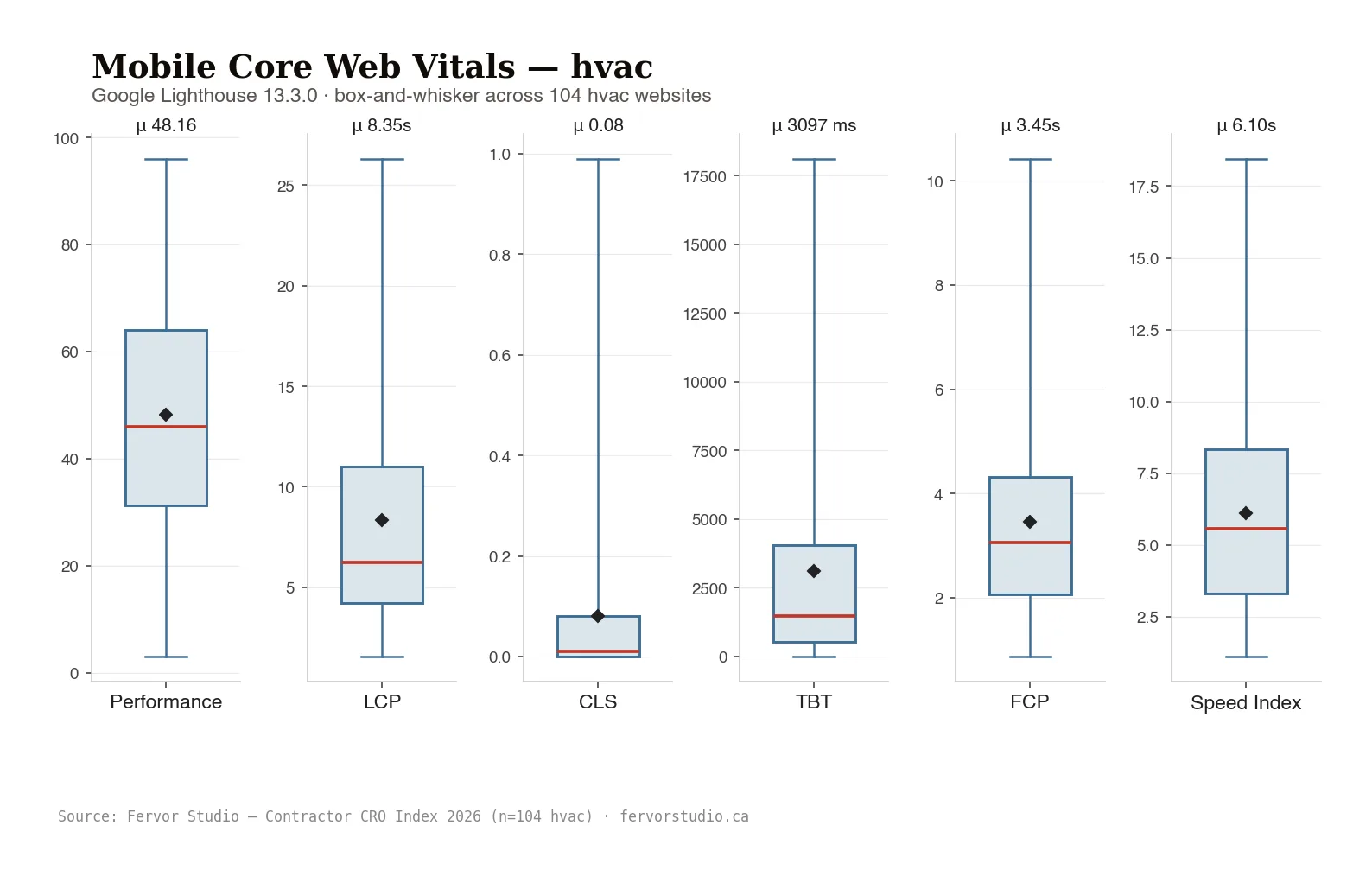
miss Google's mobile load-speed bar
Median mobile load lands at 6.24 seconds. Most of your traffic is on a phone, and most of them are gone before the hero paints.
Fervor HVAC State of the Industry, 2026
0 /100
is the average HVAC grade
That is a D. The sites booking the work are not the ones with the biggest crews. They are the ones a few points higher on the things homeowners feel.
Two ways to start
Tell us where you are. We point you at the right next step — no sales call to get there.
Client review
“Nay did an amazing job, you know. He was really patient. He got the work done the way I told him and he was just on point with the website. Pretty straightforward process. No going around the bush. He just did amazing work and I would 100% recommend.”
How Fervor can help
Monthly SEO, content, and CRO. Fixed deliverables. No credits, no rollover. The compound growth engine.
Complete website system built to convert storm leads, planned projects, and research-phase homeowners into booked jobs.
Identify and patch the top conversion killers on your existing site. No full rebuild needed.
GBP optimization, citation building, and review system foundation. The infrastructure that gets you into the Map Pack.
One conversion-built landing page for the referrals, paid clicks, and cold-call leads you send. They land on a page built to book them, not your generic homepage.
Your move
Tell us where you are. We point you at the right next step — no sales call to get there.
Keep going