0
contractor sites graded, one A
Across the whole CRO Index, a single site earned an A. The median landed at a D. The grade gap is a conversion gap.
You're getting clicks in Fargo. They're just not calling. We rebuild your site around the one job that matters: turning a visitor into a booked job.
Starts with a Site Inspection, so you see the plan before any build begins.
“Patient, on point, straightforward. Did amazing work. Would 100% recommend.” — Ruben Mederos, HyperTemp HVAC
“Responsive, creative, exceeded expectations. Already seeing greater engagement from our clients.” — George Jeorgy, Jeorgy's Landscape Construction
“Top-tier professionalism, real web design expertise, ideas I hadn't considered. Confidently recommend.” — Aws Nassani, Four Eleven Contracting



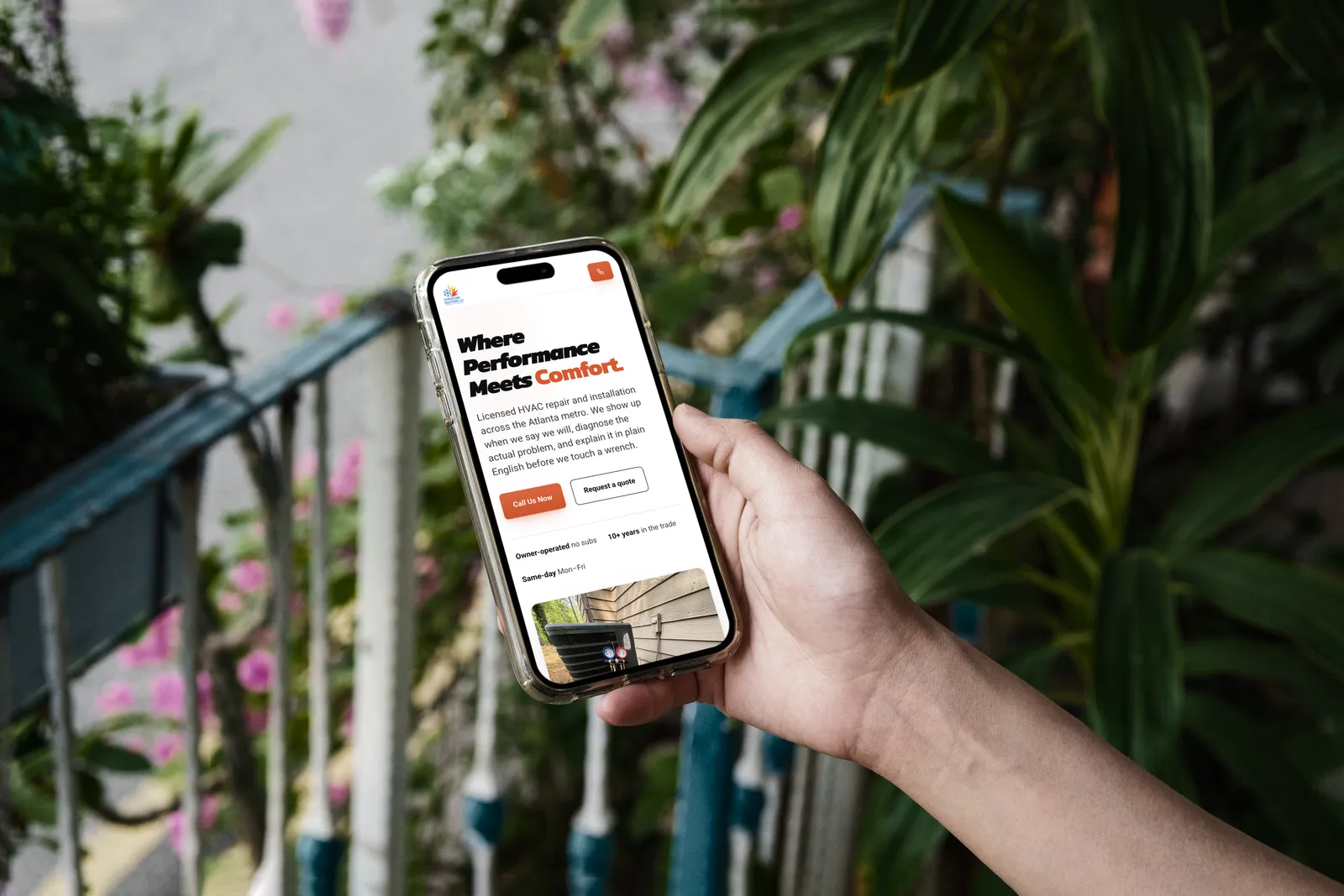
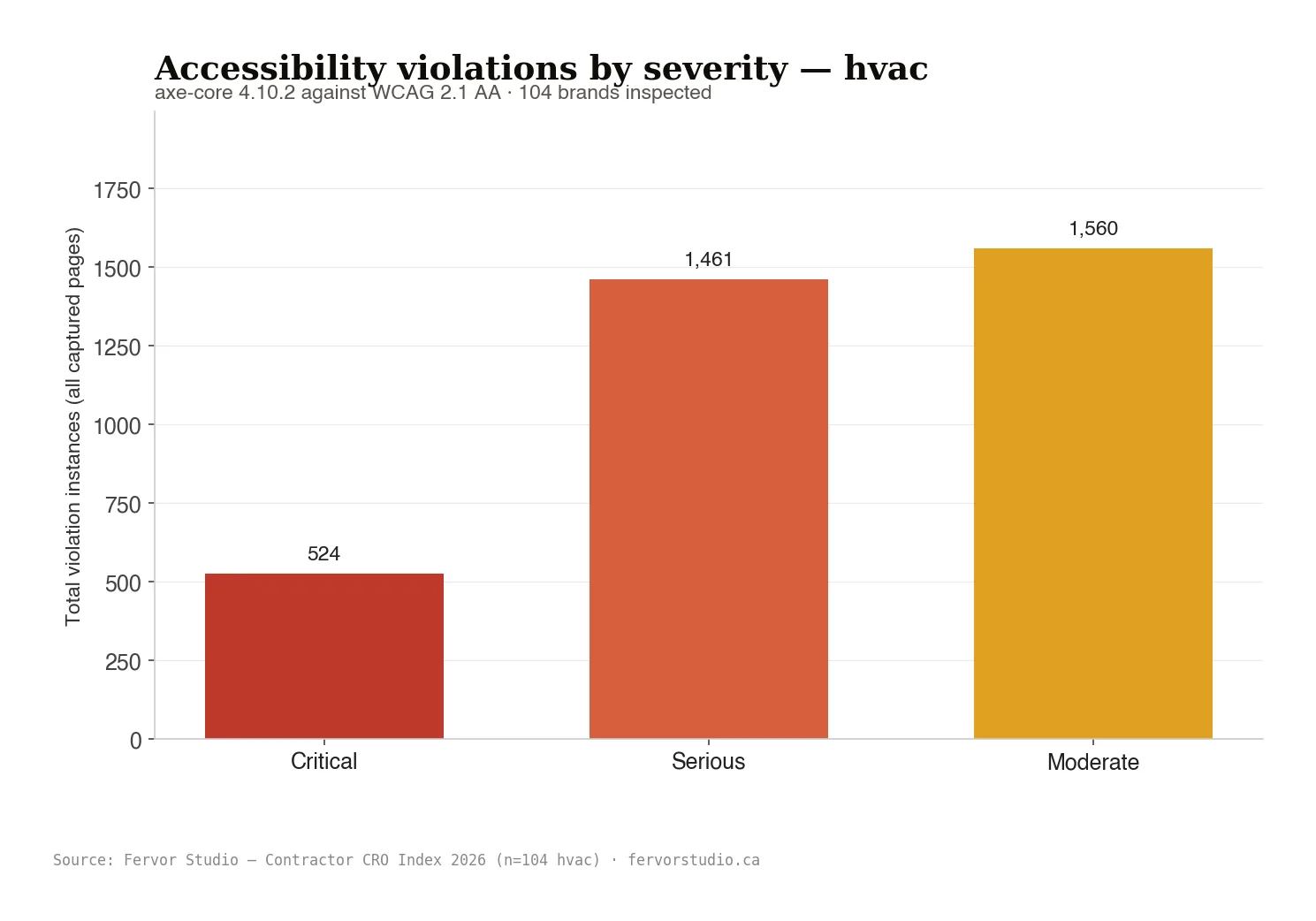
64.4% of HVAC sites we tested fail a critical accessibility check
Digital State of the HVAC Industry 2026A grade out of 380 contractor sites
We graded 380 of them against one framework. Exactly one earned an A: Crown Industrial Roofing in Toronto, at 90 out of 100. The rest left money on the table. Here is what separates the top from the bottom.
The local detail
Every angle below comes from how Fargo actually searches, buys, and regulates — built into the page, not bolted on.
So picture the visitor your site exists for.
But don’t take the urgency on faith.
Here’s the headline failure, and it’s the one your coldest, readiest customers feel first.
And once the page does load, the first screen has one job: tell a freezing homeowner she’s in the right place and show her what to tap.
Now the local layer, because HVAC websites in Fargo serve a metro the Red River splits into two rebate universes.
And here’s the layer where the trade fails hardest, and where a clean build laps the market quietly.
And the invisible layer earns its keep too.
You've probably been told your website "needs a refresh," by someone who has never dispatched a no-heat call at twenty below with the wind coming across the flats. And if you run a shop anywhere from downtown to Horace, odds are the refresh you bought last time was a prettier coat on the same slow skeleton — approved on office fiber, indifferent to the homeowner whose furnace quit on a January night against the coldest design temperatures in the lower 48. So here's what HVAC web design in Fargo actually has to survive: winters that make heating failure a same-night safety event, a two-state metro where the rebate math changes at the Red River, builder-grade furnaces from the 1990s annexations hitting end of life together, and a four-second cellular window before the visitor backs out to the next result. This page lays out the build that wins that moment, with the inspection numbers behind every recommendation.
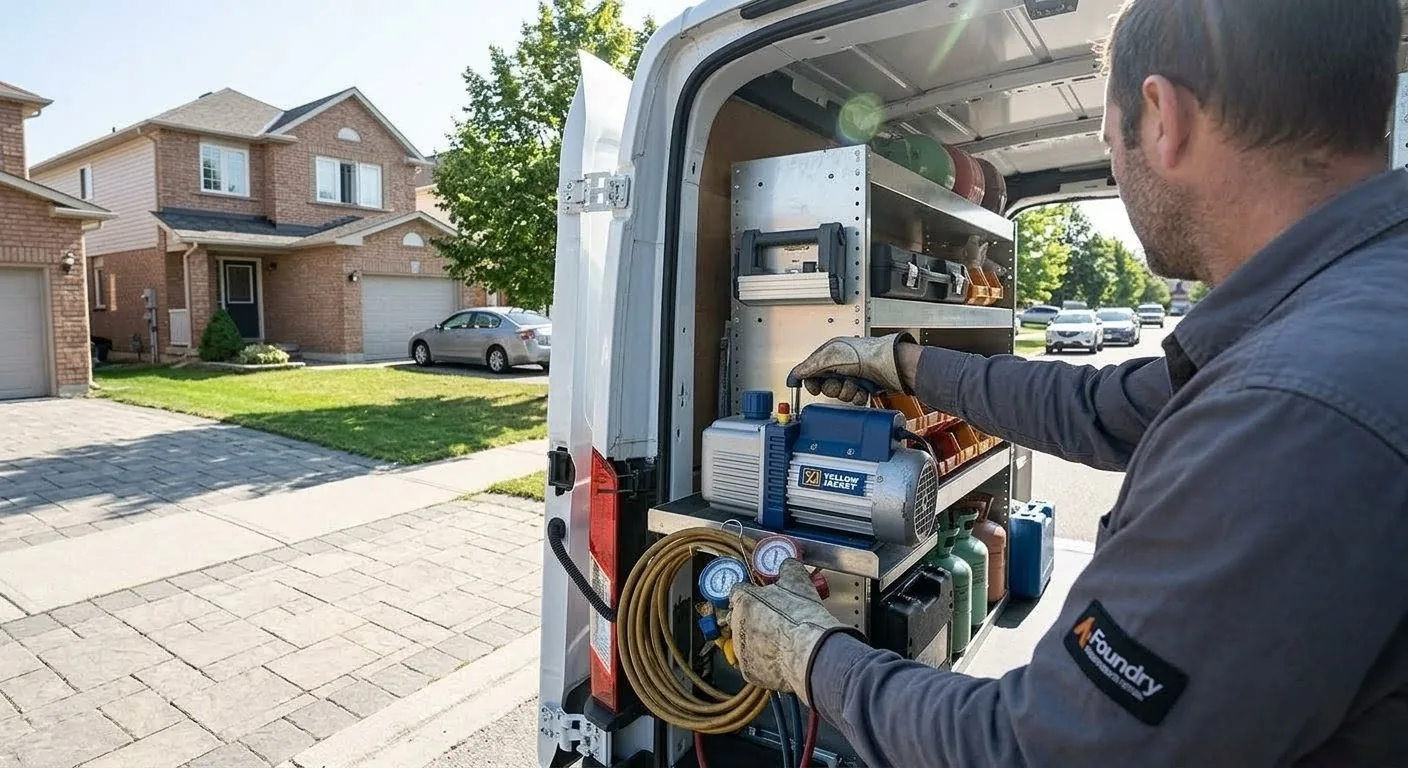
So picture the visitor your site exists for. A south-side furnace quits overnight in January, the house is dropping fast against the flats wind, and the search happens from under a blanket on a phone at 5am, not for the best price, but for whoever can come today. She taps your result. What renders in the next four seconds, a headline and a tappable number or a white screen buffering a hero video, decides whether your dispatcher ever hears about it.
And that's the moment most Fargo HVAC web design never plans for, because builds get approved in warm offices on fast connections by people who already know the company. The homeowner who pays the invoices judges the build in crisis, on cellular, in seconds. Web design for HVAC contractors in Fargo that starts from her moment and works backward wins before anyone compares logos. And across the river in Moorhead, the same build is being judged by a Minnesota homeowner whose rebates run on entirely different rules.
But don't take the urgency on faith. Take it from the inspection numbers. Fervor scored real HVAC contractor websites against one framework for the State of the HVAC Industry report, every site graded on the same categories, all evidence archived.
"Across 104 HVAC contractor websites inspected for the State of the HVAC Industry report, the average site earns 65.32 of 100 points." — Fervor, State of the HVAC Industry (2026)
A sixty-five. Not a disaster, not a build — a gentleman's C across an entire trade, and most of the lost points cluster in exactly the layers a hard-winter market punishes: mobile speed, above-the-fold clarity, accessibility. So the bar for HVAC web design in Fargo is genuinely low, which is the good news wearing work boots. A shop that ships a build clearing the failures below starts ahead of two-thirds of the trade before a single campaign dollar moves. (HVAC web design covers the trade-wide build discipline; if your problem is being found at all rather than what loads, start with Fargo HVAC SEO instead.)
Here's the headline failure, and it's the one your coldest, readiest customers feel first.
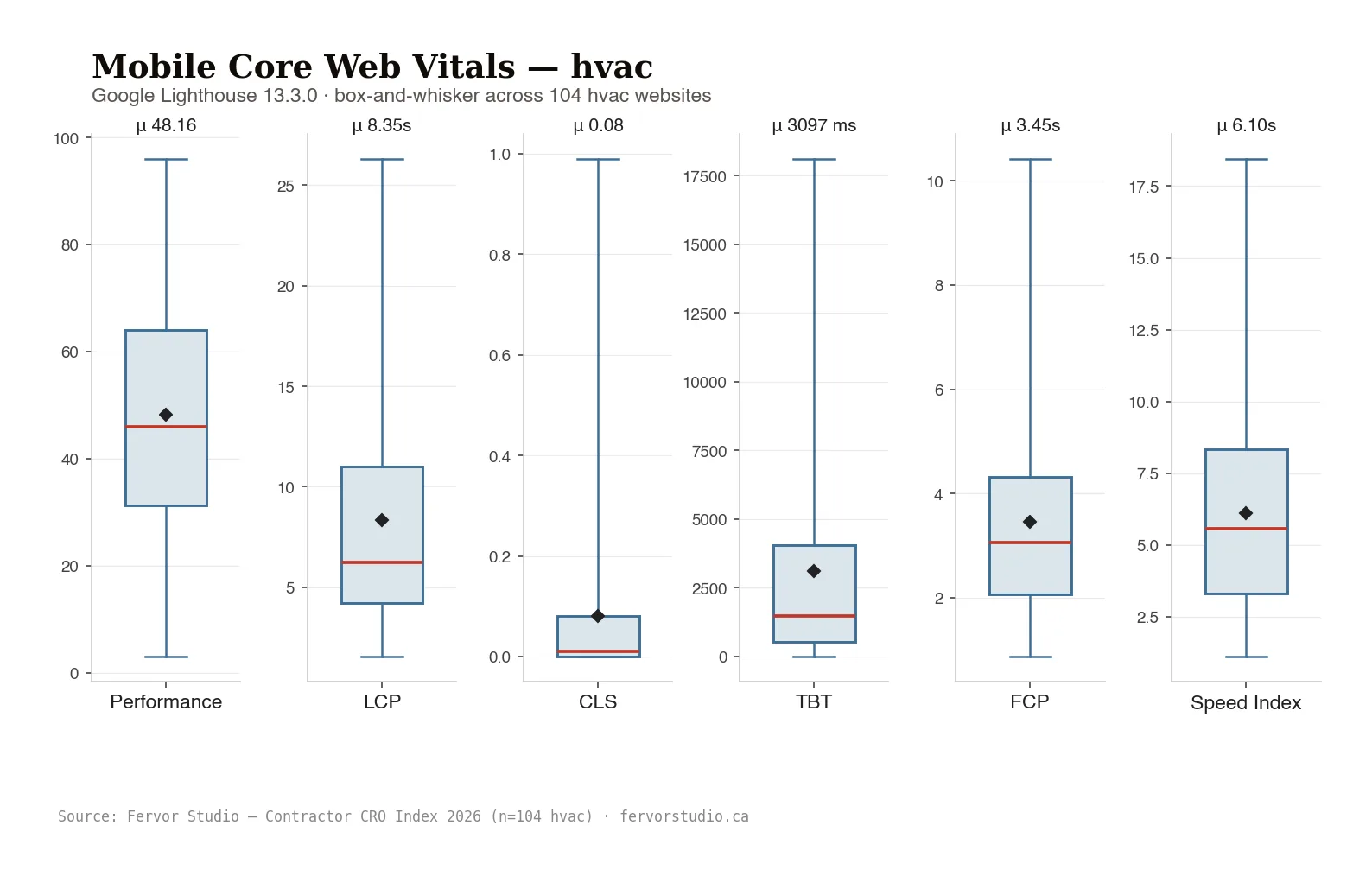
"The 104 HVAC contractor websites we inspected average a mobile Lighthouse performance score of 48.16 out of 100, against 75.54 on desktop." — Fervor, State of the HVAC Industry (2026)
Read that gap again. The trade builds sites that pass on the desktop where the owner approves the invoice and fail on the phone where the customer arrives. And the failure isn't subtle:
"80.8% of HVAC websites post a poor mobile Largest Contentful Paint, with the average main content taking 8.35 seconds to load." — Fervor, State of the HVAC Industry (2026)
Eight point three five seconds, against a visitor who decides in four — at twenty below, with the furnace already an hour dead. Four of five HVAC sites lose the emergency searcher before the page says a word, which means the average shop's marketing budget pays to deliver freezing homeowners to a door that doesn't open. So mobile-first isn't a preference in Fargo HVAC web design. It's the entire game in the coldest metro market in the lower 48, where the heating season writes nearly all the revenue and forgives none of the bloat. The build disciplines are boring and proven: compressed images, no render-blocking scripts, system fonts, the phone number painted in the first screenful of HTML rather than after the JavaScript wakes up. Boring wins the four-second window, every snap of the longest heating season any American metro template was never written for. And it keeps winning it long after the launch invoice clears, which is the whole point of treating speed as architecture.
And once the page does load, the first screen has one job: tell a freezing homeowner she's in the right place and show her what to tap. The framework scores that directly.
"The average HVAC website scores 14 of 20 on first impression, 70% of the available points for the above-the-fold experience." — Fervor, State of the HVAC Industry (2026)
Fourteen of twenty is a site that says who it is but never quite says what to tap next. But the spread matters more than the mean:
"On first impression, the top quartile of HVAC websites averages 16.36 points while the bottom quartile averages 11.89, a 4.47-point gap." — Fervor, State of the HVAC Industry (2026)
That 4.47-point gap is the visible difference between a build and a brochure, and a homeowner perceives it in under a second even though she'd never name it. The top-quartile pattern is consistent: a headline that names the trade and the place (and in Fargo, says same-day plainly), a tappable phone number, proof of legitimacy in the first screen, and a photo of an actual human who works here, dressed for here. So an hvac web design agency in Fargo pitching you should be able to show that first screen on a phone, on cellular, before showing you anything else. If the pitch opens with a desktop mockup, the build will too.
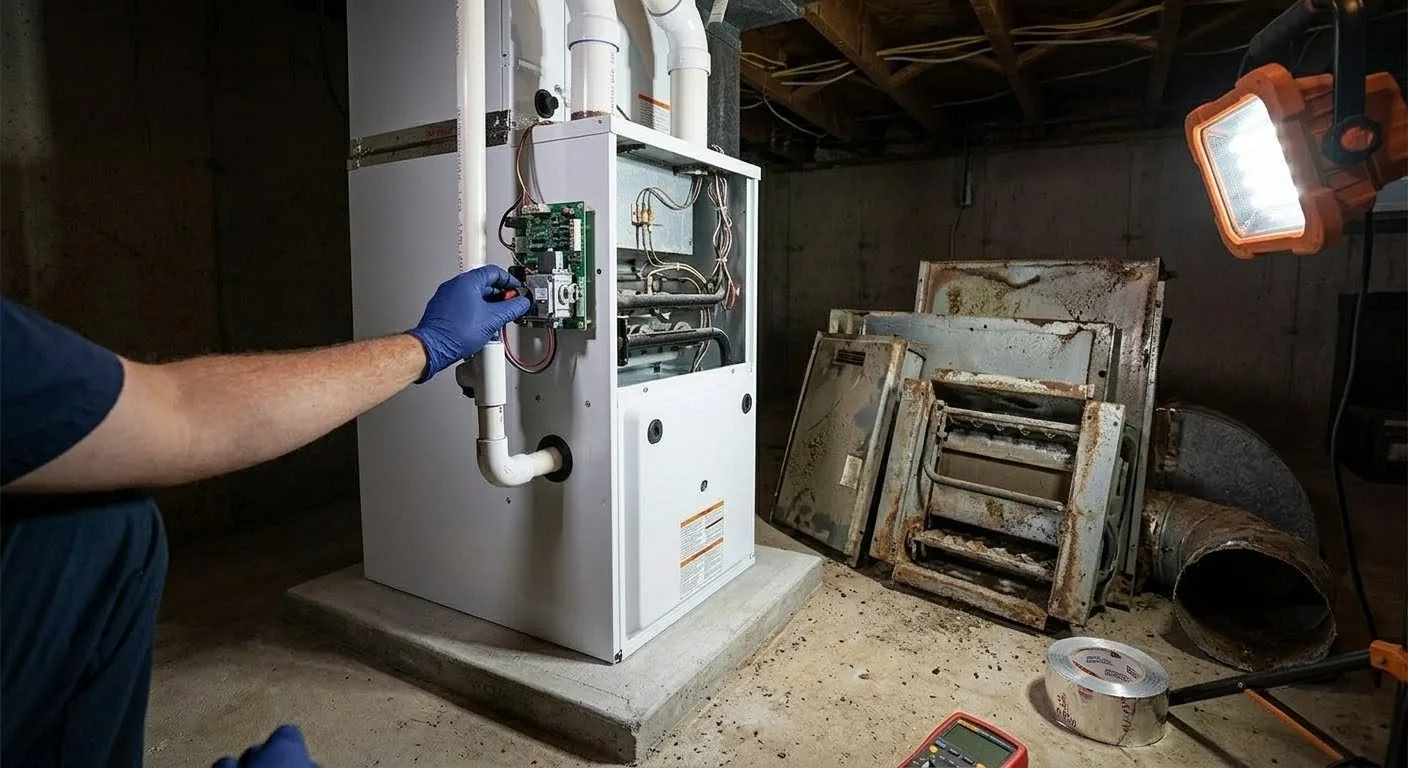
Now the local layer, because HVAC websites in Fargo serve a metro the Red River splits into two rebate universes. The North Dakota side and Moorhead run different incentive programs, different utility math, and the off-peak program adds a layer most providers can't even explain, which means the build that publishes the border math plainly wins searches and trust on both banks. Almost no contractor has put the rebate border into print; the first build that does owns it.
And the stock writes the rest of the map: builder-grade furnaces from the 1990s annexations hitting end of life together, post-war ramblers on their third furnace, and new builds sold with the cheapest equipment that passed code, failing years ahead of their owners' expectations. So HVAC web design in Fargo gets architected around that reality: a same-day emergency page that leads the site, replacement pages tuned to the annexation waves, an off-peak program page no template carries, and the two-state rebate math published honestly. One architected page per service, because Google matches queries to pages and so do homeowners. That's an HVAC website design company in Fargo earning its invoice.
So HVAC web design in Fargo starts with a bank question, not a colour question: which side of the river, and which wave, is your revenue actually riding? A shop living on annexation-belt replacements needs different franchise pages than one built on Moorhead service volume or new-build warranty work, and the build should put its deepest content where the dispatch board says the money is. But the proof layer matters everywhere: license display for both states, a service map that tells Horace and Moorhead the truth, photos of your techs on real winter jobs. And this is where field software enters the build: if your shop runs on Jobber, the build wires its scheduling module straight into the service pages during construction rather than bolting a form on after launch. Plumbing installed while the walls are open, which is the cheap time to do it.
And here's the layer where the trade fails hardest, and where a clean build laps the market quietly.
"64.4% of HVAC contractor websites carry at least one critical WCAG accessibility violation somewhere on the site." — Fervor, State of the HVAC Industry (2026)
Two-thirds of the trade ships critical accessibility failures, and the common ones are pure build sloppiness: text without contrast, links without names, headings out of order. Every one is a developer who never ran a free automated scan on a five-figure build.
"14.4% of HVAC contractor websites render more than one H1 on the page, a structural build error that muddies what the page is about." — Fervor, State of the HVAC Industry (2026)
One in seven can't get the page's title element right. So treat accessibility as the build-quality audit it is. The failures exclude the aging downtown homeowner who zooms her text and the screen-reader user in West Fargo, exactly the long-tenure customers with the oldest furnaces and the readiest replacement budgets. And the fixes overlap almost perfectly with what search engines reward, so clean builds win twice. Ask anyone selling hvac website design in Fargo the unglamorous question: does it pass an automated accessibility scan at launch? Then watch who changes the subject to mockups.
And the invisible layer earns its keep too. Structured data tells Google what the business is, in the format it parses directly: services, areas, hours, reviews, and only about a fifth of HVAC contractors ship HVACBusiness schema at all. A Fargo build that deploys complete structured data with the two-state service area mapped honestly, clean URLs, and one intent per page starts ahead of four-fifths of the market on pure build quality.
But honesty about the boundary: the build creates the conditions for ranking; the campaign does the ranking. Profile, reviews, the border-math content velocity, the town pages: that's the Fargo HVAC SEO discipline, and a good build hands it a site that doesn't fight back. A shop that ships clean structure and never feeds it content has bought a stadium and skipped the season.
The same honesty applies on the other side. A fast, accessible, well-structured site still has to convert its visitors: booking flows, capture channels, trust signals, the review velocity tools like NiceJob maintain. That's conversion work with its own page: the leak list and the 30-day fix live at HVAC website conversion in Fargo. Build the bones right here; plug the leaks there. In that order.
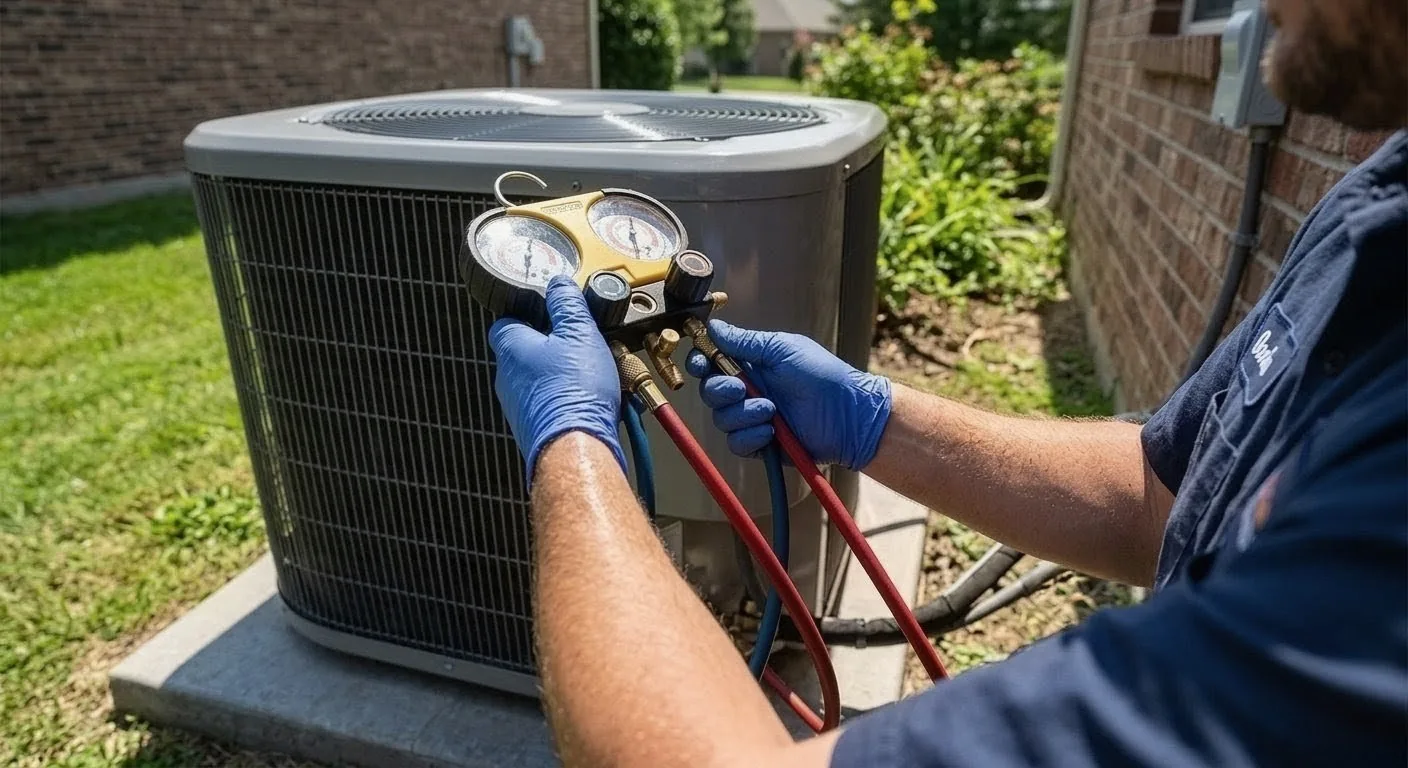
Fervor's build for a Red River Valley shop is Booked by Design™: $9,997 to $12,997 for HVAC, delivered in 30 to 60 days. Mobile-first against the speed numbers above, one architected page per service with the same-day and border-math pages treated as the franchise assets they are here, accessibility-clean on an automated scan from launch, structured data complete, and the two-state proof (licenses, real towns from Horace to Moorhead, techs on real winter jobs) designed in rather than sprinkled on. You own everything from the first invoice: domain, code, content, analytics. That's policy rather than a perk, because the hostage-asset story, the agency that owns your domain until you stop asking questions, comes up in first calls here more often than any design complaint.
And if you're comparing Fargo HVAC web design quotes, steal the vetting list. A mobile Lighthouse score on a build shipped this year, not a portfolio screenshot. An automated accessibility scan before launch. Who owns the domain and analytics the day the invoice clears. The redirect plan that protects existing rankings through migration. Builders answer all four without blinking; decorators show mockups, and a mockup has never once loaded at twenty below with the wind coming across the flats.
So run the napkin math at your ticket sizes: average replacement, times gross margin, times the three-to-five incremental jobs a season a faster, cleaner build recovers, measured against a one-time price, on an asset that works the hardest winter in the lower 48, every year after. Ongoing work after launch, when the monthly reporting has earned its keep against your own dispatch board, runs under Performance Partner at $1,497 to $3,997 per month, month to month.
Not sure whether the site is the real problem, or whether this year's budget belongs in the build at all? Then start with the free Site Inspection instead of a contract: your current build run through the very same framework behind the State of the HVAC Industry report, scored category by category, with every finding handed over whether or not you ever hire us for anything. If the bones are good and the leak is elsewhere, we'll say so and point at the cheaper fix first. You shouldn't have to trust us. You should be able to check.
If you want the broader system this build fits into, the campaigns that feed it traffic, the reviews that vouch for it, the measurement that proves all of it, start with the HVAC marketing hub. The full trade picture lives under mechanical contractors, and everything Fervor does for the trades starts at the contractor hub.
Booked by Design™ runs 30 to 60 days: architecture in week one, design and build through the middle weeks, content and proof assembled in parallel, then launch with the redirect map handled so existing rankings carry over. The variable is content volume. A shop wanting a dozen service pages plus town pages from West Fargo to Moorhead sits at the long end. And the calendar advice for the Red River Valley is blunt: launch in the brief shoulder, because owning a faster build through the heating season beats debugging one at twenty below. Nothing goes dark during the rebuild; the old site keeps serving every emergency until the new one cuts over in a single afternoon.
Sometimes, and the free Site Inspection exists to answer exactly that. The pattern in Fargo HVAC web design audits runs about half-and-half: half the sites need a focused speed-and-accessibility pass on sound bones, half are structurally past saving: page-builder bloat in every template, where optimization buys single points on a hundred-point problem. The inspection numbers make the call honestly; that's exactly what they exist to do for you.
It fixes the layer it controls: speed, first impression, structure, accessibility. And in the hardest winter market in the lower 48, those layers leak urgent jobs most of the year. But the build doesn't create visibility (the SEO campaign does) and doesn't finish the capture layer (booking, reviews, channels, all on the Fargo conversion page). Web design sets the ceiling; the campaigns decide how close you play to it.
The buyer, the device, and — in Fargo — the river. The defining visitor is freezing at design temperatures no other lower-48 metro plans for, on a phone, deciding in seconds, so the build optimizes for cellular speed, one-tap calling, and same-day-first architecture. Then the valley adds its own layer: two-state rebate math published plainly, off-peak program fluency, annexation-wave replacement content, proof a homeowner can verify from either bank. A generic agency can make it pretty. It takes trade data and local knowledge to make it book jobs at twenty below.
The evidence
 Read the full report →
 0
contractor sites graded, one A
Across the whole CRO Index, a single site earned an A. The median landed at a D. The grade gap is a conversion gap.
0 %
of HVAC sites fail a critical accessibility check
Scored against WCAG 2.1 AA with axe-core. A page that blocks a screen reader also blocks a paying customer.
Fervor HVAC State of the Industry, 2026
0 %
miss Google's mobile load-speed bar
Median mobile load lands at 6.24 seconds. Most of your traffic is on a phone, and most of them are gone before the hero paints.
Fervor HVAC State of the Industry, 2026
0 /100
is the average HVAC grade
That is a D. The sites booking the work are not the ones with the biggest crews. They are the ones a few points higher on the things homeowners feel.
Two ways to start
Tell us where you are. We point you at the right next step — no sales call to get there.
Client review
“Nay did an amazing job, you know. He was really patient. He got the work done the way I told him and he was just on point with the website. Pretty straightforward process. No going around the bush. He just did amazing work and I would 100% recommend.”
How Fervor can help
Complete website system built to convert storm leads, planned projects, and research-phase homeowners into booked jobs.
Identify and patch the top conversion killers on your existing site. No full rebuild needed.
Monthly SEO, content, and CRO. Fixed deliverables. No credits, no rollover. The compound growth engine.
GBP optimization, citation building, and review system foundation. The infrastructure that gets you into the Map Pack.
One conversion-built landing page for the referrals, paid clicks, and cold-call leads you send. They land on a page built to book them, not your generic homepage.
Your move
Tell us where you are. We point you at the right next step — no sales call to get there.
Keep going