0
contractor sites graded, one A
Across the whole CRO Index, a single site earned an A. The median landed at a D. The grade gap is a conversion gap.
Right now, someone in Honolulu is Googling "remodeler near me." We get you showing up first — then turn that click into a booked job.
A written report and a ranked fix list, in about three days.
“Patient, on point, straightforward. Did amazing work. Would 100% recommend.” — Ruben Mederos, HyperTemp HVAC
“Responsive, creative, exceeded expectations. Already seeing greater engagement from our clients.” — George Jeorgy, Jeorgy's Landscape Construction
“Top-tier professionalism, real web design expertise, ideas I hadn't considered. Confidently recommend.” — Aws Nassani, Four Eleven Contracting




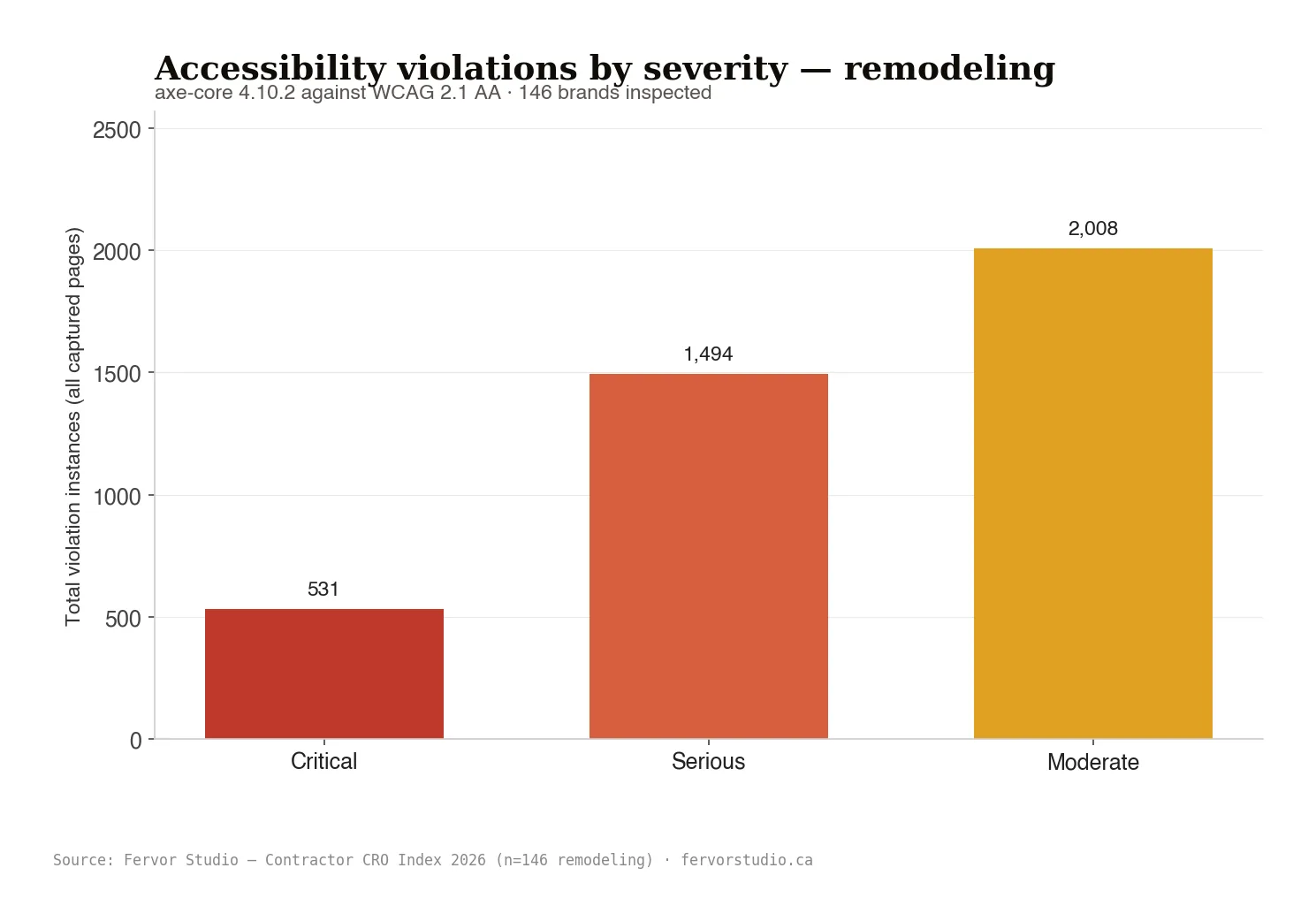
59.6% of remodeling sites we tested fail a critical accessibility check
Digital State of the Remodeling Industry 2026A grade out of 380 contractor sites
We graded 380 of them against one framework. Exactly one earned an A: Crown Industrial Roofing in Toronto, at 90 out of 100. The rest left money on the table. Here is what separates the top from the bottom.
The local detail
Every angle below comes from how Honolulu actually searches, buys, and regulates — built into the page, not bolted on.
Start with the single most important fact about how this trade gets bought, because every recommendation on this page hangs off it.
But before the tactics, know what’s driving the searches, because the stock writes the keywords, and Oahu’s stock exists nowhere else.
When the research window closes and she types the hiring query, most of what she sees is the map: three businesses, stars, review counts, photos.
Here’s where remodeling SEO Honolulu work separates from the template stuff.
Now the page only an island shop can own.
The planning buyer’s questions are wonderfully predictable: what does it cost, how long does it take, can we live in the house during it.
And before the engagement sequence, the anti-pattern list, because the failure modes here repeat island-wide.
The review stream feeds both machines at once: the pack’s ranking math and the shortlist decision of every buyer who reads it.
You've probably paid for SEO before. And if you run a remodeling shop anywhere from Kaimuki to Kapolei, odds are the last agency shipped you a mainland template — written for a market with a build season, stud cavities, and a permit office that answers in weeks. None of that describes Oahu. So now you're wondering whether remodeling SEO in Honolulu is a real discipline or a template with the city name swapped in. Fair question. This page lays out what it takes here specifically: a profile built for town, windward, and leeward as the separate markets they are, a single-wall page no mainland writer could fake, ADU and monster-home fluency, and the schedule honesty that starts every Honolulu remodel conversation with the DPP queue.

Start with the single most important fact about how this trade gets bought, because every recommendation on this page hangs off it.
"Homeowners spend roughly 9.6 months planning a kitchen remodel versus 5.1 months building it — nearly twice as long deciding as doing." — Houzz Inc. (2024)
Nearly ten months of planning, and in Honolulu the permit office matches it stride for stride. Residential permits through the Department of Planning and Permitting averaged 364 days in fiscal 2024, with the median wait around nine and a half months. Reform is genuinely underway: new permitting software launched in August 2025, an AI plan-review tool behind it, even a week-long counter shutdown that December to dig out the backlog. But the planning horizon here is still measured in seasons, not weeks. There's no build season on Oahu; work runs year-round. The real season is the queue. So the homeowner who wants a kitchen next winter is searching now, and remodeling SEO in Honolulu is largely the discipline of being findable the day that search begins.
And the money behind the patience is real:
"Major kitchen remodels have a median spend of $55,000, compared to $20,000 for minor kitchen projects." — Houzz Inc. (2026)
That's the national median. Honolulu carries shipped-material premiums of 15-25% over the mainland and some of the highest trade labor rates in the country, with the Kahala-tier work running far past the median.
But before the tactics, know what's driving the searches, because the stock writes the keywords, and Oahu's stock exists nowhere else. The plantation-era and pre-1980 homes from Kalihi to Manoa were built for trade winds: jalousie windows, no ducts, and thousands of them in single-wall construction — imported redwood planks, no stud cavity, no insulation — a building type mainland templates have never met. The leeward growth corridor through Mililani, Ewa, and Kapolei runs modern central-everything stock aging into its first renovations. And the condo towers from Waikiki through Kakaako are their own market, where every remodel lives or dies on the AOAO board's approval.
"38% of homeowners renovating their kitchen cite kitchen deterioration or dysfunction as a reason to renovate." — Houzz Inc. (2026)
"41% of homeowners renovating their kitchen cite dissatisfaction with the old kitchen style as a reason to renovate." — Houzz Inc. (2026)
Two buyers in those numbers, and the island supplies both: the deterioration buyer in a Kalihi single-wall whose kitchen has fought salt air and termites for fifty years, and the style buyer in a Mililani two-story whose builder package expired all at once. Your remodeling SEO in Honolulu has to feed both, because both end at the same consultation. And a gallery showing a Kaimuki single-wall opened up beside an Ewa Beach kitchen proves you've already worked on a house built like hers, which is the one thing a homepage can never say.
When the research window closes and she types the hiring query, most of what she sees is the map: three businesses, stars, review counts, photos. And Google draws that pack around the searcher. Town, East Honolulu, the windward side over the Pali, and the leeward corridor each render their own three-pack, and a shop with one profile pinned to one baseyard competes in exactly one of them. Kapolei to Kailua is forty minutes over the mountains on a good day; the H-1 strings together markets that behave separately, and the buyer can tell from your reviews which ones you actually drive to.
So remodeling SEO in Honolulu starts with an honest account of where your crews actually work, then matches the profile to it: the neighborhoods named the way locals name them (Kaimuki, Manoa, Makiki, Kahala), the sides called by their right names, and the condo market claimed only if you genuinely work AOAO boards. Your Hawaii contractor licence belongs in the business description, and photos on a cadence seal it: two uploads a month of real local jobs, a single-wall kitchen in Kaimuki, a windward bath, a leeward ADU framed against the ridge. The pack reads photo recency as a liveness signal, and in this trade the proof is already on your phone.
One more pack detail worth the hour it takes: the Q&A field on your profile. Seed it with the questions Oahu buyers actually ask, like whether you're licensed, whether you handle single-wall homes, how long permits really take, and answer each in plain English. The pack rewards completeness, and the buyer reads those answers as a preview of working with you.
Here's where remodeling SEO Honolulu work separates from the template stuff. Google matches queries to pages, not to businesses, so the homeowner searching "bathroom remodel" should land on your bathroom page, not a services pamphlet. The build-out this market wants: kitchens, baths, whole-home, additions, and then the pages no national template carries.
The condo remodel page, because the Kakaako and Waikiki towers run on AOAO approval, elevator bookings, and working-hours rules, a discipline of its own, and a market mainland templates don't even mention. The addition page with the monster-home honesty, because Ordinance 19-3 caps detached homes at 0.7 floor-area ratio and even limits wet bars to one per dwelling. Those rules, written to stop oversized builds, now shape every large addition in the older neighborhoods, and the shop that explains them up front reads like the shop that's been to the hearings. And the aging-in-place page:
"68% of homeowners consider special needs (accessibility) when planning their bathroom projects." — Houzz Inc. (2025)
Two-thirds of bathroom buyers are already thinking about it, and Hawaii's multigenerational households make it a first-class conversation here, not an afterthought. The page that addresses it plainly converts buyers the portfolio-only competition never speaks to.
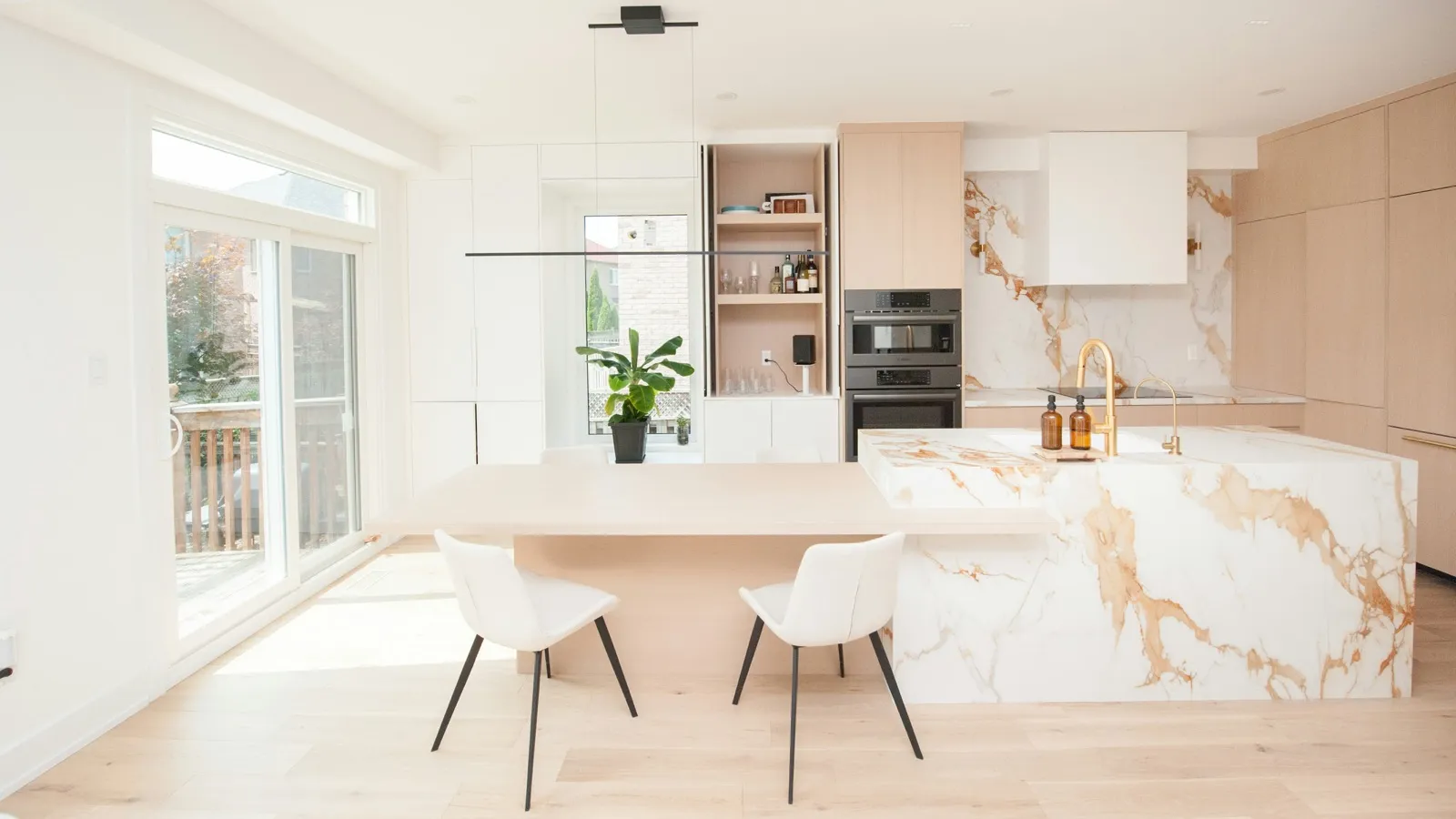
Now the page only an island shop can own. Single-wall construction, with its redwood plank walls, no cavity, no insulation, and termite-resistant lumber that stopped shipping decades ago, built thousands of Oahu homes through the 1970s, and every one of them eventually meets a remodel question the mainland internet cannot answer: how do you run plumbing and electrical in a wall with no inside? What does insulation retrofitting look like? When does a single-wall kitchen justify a hybrid double-wall rebuild, and what does Formosan termite pressure mean for the materials list?
So write it: the single-wall renovation guide, in plain English, with the salt-air and termite honesty and the realistic budget tiers at island prices. Pair it with the ADU explainer, because Ordinance 15-41 has allowed accessory dwelling units on residential lots since 2015: 400 square feet on smaller lots, 800 on lots of five thousand square feet and up, parking required unless you're near a rail station. In this housing market the backyard-unit math never stops being asked. The search results for both are forums and PDFs. The shop that publishes the plain-English version is the one a homeowner phones first, and that head start is the half of remodeling SEO in Honolulu no spreadsheet ever captures.
The planning buyer's questions are wonderfully predictable: what does it cost, how long does it take, can we live in the house during it. Every one is a page. The cost guide with honest island ranges and the shipped-material truth told plainly. The what-to-expect piece in the same language your lead carpenter uses. And the explainer this market rewards above all others: the DPP timeline. What averaged a year, what the new software and AI review are changing, which scopes ride faster lanes, what an SMA review adds near the shoreline, and how a shop sequences design and filing so the client's calendar survives. Schedule conversations in Honolulu start with the permit office, and the shop whose content starts there too reads like the only honest one on the island.
"76% of homeowners incorporate at least one built-in feature into their kitchen renovation." — Houzz Inc. (2026)
Detail like that is content fuel, and the calendar shapes the schedule differently here: with no build season, content works year-round, but the Kona-weather stretches from August into October spike comfort-driven interest, and every HECO bill is a recurring demand event for energy-touching scopes. That rhythm is remodeling SEO working with the Honolulu calendar instead of against it.
And before the engagement sequence, the anti-pattern list, because the failure modes here repeat island-wide. The mainland template: stud-cavity assumptions, seasonal copy, and zero mention of the queue that defines every schedule. The single-wall silence, in the market that invented the question. The monster-home surprise, left for the addition client to discover at plan review. The AOAO blindness, treating a Kakaako condo like a Mililani house. And the review wall that stopped last spring, reading like a business that left.
But every one of those is a competitor you pass simply by not doing it. That's the quiet math of remodeling SEO in Honolulu: the long-cycle researcher stops at the first page that already speaks her side of the island, her building type, and her budget tier. And the premium demand is real:
"Homeowners with larger kitchens spend more on major remodels (median $75,000) than those with smaller kitchens ($46,000)." — Houzz Inc. (2026)
The big-kitchen money concentrates in Kahala, Manoa, and East Honolulu, buyers who check licences, read reviews to the bottom, and reward the shop whose content proves it knows a single-wall plantation house from a Kapolei build. What settles their caution is concrete: the licence in the footer, the review stream with this month's date, and content only a local could have written.
The review stream feeds both machines at once: the pack's ranking math and the shortlist decision of every buyer who reads it. And velocity beats volume: forty reviews that stopped last spring read worse than twenty-five with three from this month, because the timestamp is the trust. Make the ask operational, automated after every project milestone, timed for the evening, linked straight to your profile. Fervor wires it with NiceJob as standard practice, because review velocity is the one ranking-and-trust signal a shop can manufacture one happy client at a time.
And put Hawaii's licence structure to work, because the state set the lowest handyman line in the country and most shops never explain it: anything over $1,500 in total project value requires a licensed contractor, and the remodeler's credential is the B General Building licence, earned with four years of supervisory experience and a two-part state exam, with liability and workers' comp behind it. "Licensed B with the state board, exam-tested, insured, and verifiable in the DCCA lookup, on an island where anything over $1,500 legally requires it" is a paragraph the unlicensed competition structurally cannot write. The buyer who learns the line from your page trusts the shop that taught her.
Fervor's entry point for a Honolulu shop is the The Local Pick: $2,497 one-time, delivered in about 14 days. The Google Business Profile rebuilt deliberately, with categories, side-honest service areas, photo cadence, review wiring, and citation cleanup, plus the tracking foundation, so the pack work that decides the hiring query is no longer running on defaults. Priced so the payback math works at a single signed kitchen. At island prices, one captured project returns the setup cost many times over before the container of cabinets clears the port.
The ongoing remodeling SEO engagement for a Honolulu shop covers the single-wall, condo, and ADU pages, the year-round content calendar, review velocity, and monthly reconciliation against your actual consultation pipeline. It runs under Performance Partner at $1,497 to $3,997 per month, month to month, every asset registered to you from day one. And the honest boundary: visibility fills the funnel, it doesn't fix the bucket. If your site can't book a 9pm consultation or show a before-and-after gallery, that's the capture layer at remodeling CRO; if the site itself is a slow template, the bones live at remodeling web design. Sequence it: bones, leaks, then visibility.
And it starts with the free Site Inspection: your current site run through the same 100-point framework behind the State of the Remodeling Industry report, scored category by category, every finding handed over whether or not you ever hire us. You shouldn't have to trust us. You should be able to check.
That's the full remodeling SEO Honolulu system. The broader playbook lives at remodeling SEO, the trade hub at remodeling marketing, under residential construction, starting from the contractor hub.
Set the expectation against the buyer's own timeline: she plans for the better part of a year, and the DPP queue stretches the runway further, which means the research window here is the longest in the country, and owning it pays the longest. Profile signals move within weeks of the The Local Pick; content compounds over a season. There's no November deadline on an island without a build season: every month is someone's month one, so the best time to be indexed is now.
Wherever your crews actually drive, said honestly, because the Pali and the H-1 make the sides real markets, and the buyer reads your reviews' geography before she reads your homepage. Town rewards old-stock and single-wall fluency; the windward side rewards salt-air and view-lot experience; the leeward corridor rewards package efficiency through newer builder-grade scopes. Pick your side, win it visibly, then expand with proof.
They averaged 364 days for residential work in fiscal 2024, and the reform is real too: new permitting software in 2025, AI-assisted plan review, a counter shutdown to clear backlog. The honest answer is "better, still slow, plan accordingly," and that honest answer is your best content: the page that explains which scopes move faster, what shoreline review adds, and how to sequence design against the queue converts the buyer everyone else left guessing.
Since 2015, Ordinance 15-41 has allowed accessory dwelling units on most residential lots, sized 400 to 800 square feet by lot size, with a parking stall unless you're within half a mile of rail. In the country's tightest housing market, the backyard-unit math never stops being asked, and the monster-home rules make professional guidance more valuable, not less. A plain-English eligibility-budget-permit page is the cheapest category ownership on the island.
The fundamentals, absolutely, and start this week regardless. Claim the profile, fix the categories, put the licence in the footer, photograph the current job, ask the last three happy clients for reviews. That's an afternoon, it's free, and it moves the pack. What's hard to sustain solo is the compounding layer: the single-wall, condo, and ADU pages written to rank, the publishing cadence, the monthly reconciliation. Do the trust fundamentals yourself; buy the content engine if owning the island's longest research window is worth more than the retainer.
The evidence
 Read the full report →
 0
contractor sites graded, one A
Across the whole CRO Index, a single site earned an A. The median landed at a D. The grade gap is a conversion gap.
0 %
of remodeling sites fail a critical accessibility check
Scored against WCAG 2.1 AA with axe-core. A page that blocks a screen reader also blocks a paying customer.
Fervor Remodeling State of the Industry, 2026
0 %
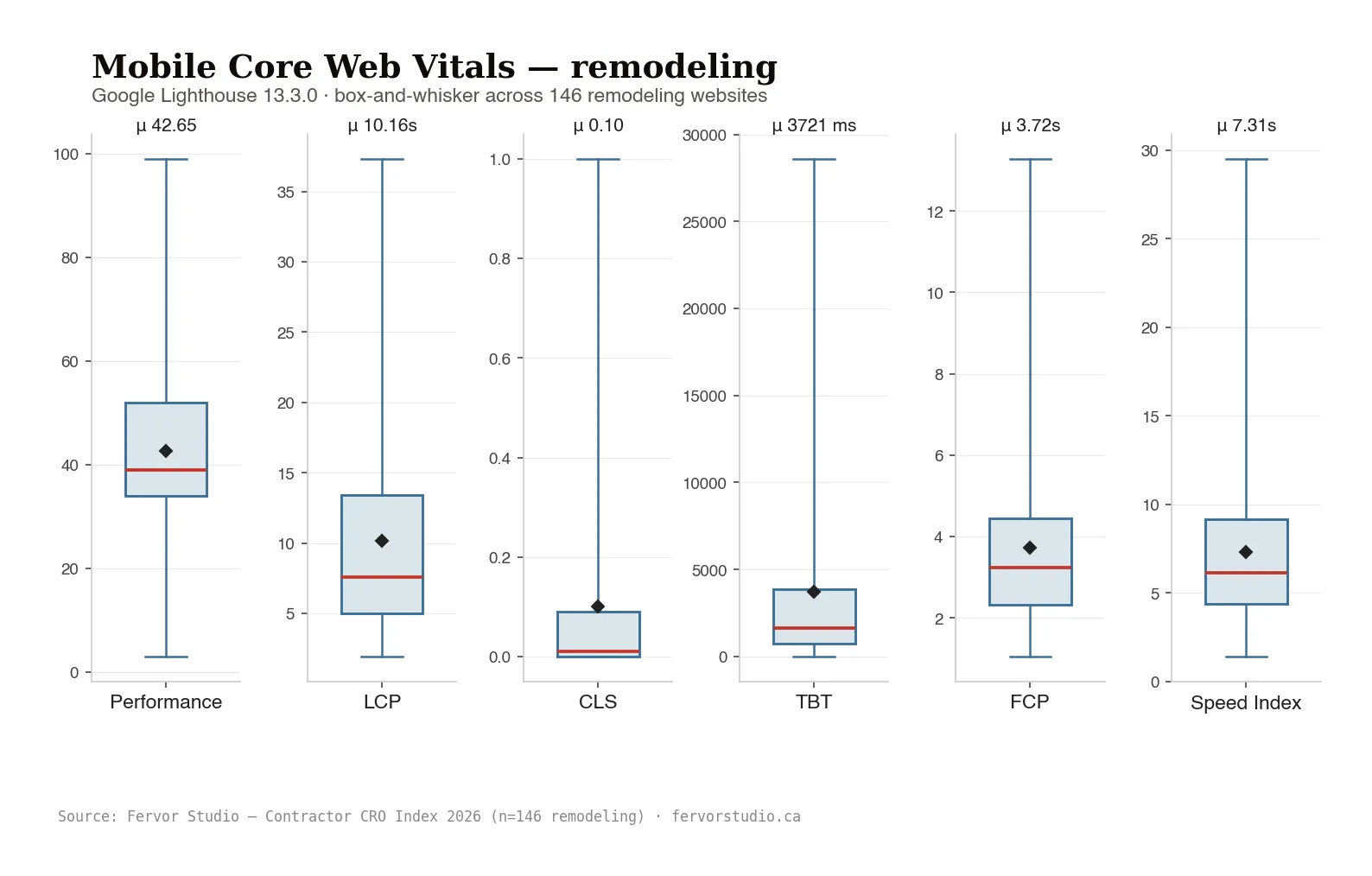
miss Google's mobile load-speed bar
Median mobile load lands at 7.57 seconds. Most of your traffic is on a phone, and most of them are gone before the hero paints.
Fervor Remodeling State of the Industry, 2026
0 /100
is the average remodeling grade
That is a D. The sites booking the work are not the ones with the biggest crews. They are the ones a few points higher on the things homeowners feel.
Two ways to start
Tell us where you are. We point you at the right next step — no sales call to get there.
Client review
“5 stars without hesitation. Working with Fervor has been an amazing experience from start to finish. The level of professionalism was genuinely top tier. Communication was excellent, quick replies, clear updates, and always open to feedback or changes without any problem. What stood out most is that you can tell he genuinely knows web design inside and out from real professional experience, not just someone throwing together templates. He put real effort, care, and thought into the project, even offering his own ideas and suggestions to improve things I hadn't even considered. On top of that, he's genuinely a great guy to deal with, easy to talk to, open-minded, helpful, and clearly passionate about what he does. I'd confidently recommend him to anyone looking for a professional website or branding help. Huge respect and appreciation.”
How Fervor can help
Monthly SEO, content, and CRO. Fixed deliverables. No credits, no rollover. The compound growth engine.
Complete website system built to convert storm leads, planned projects, and research-phase homeowners into booked jobs.
Identify and patch the top conversion killers on your existing site. No full rebuild needed.
GBP optimization, citation building, and review system foundation. The infrastructure that gets you into the Map Pack.
One conversion-built landing page for the referrals, paid clicks, and cold-call leads you send. They land on a page built to book them, not your generic homepage.
Your move
Tell us where you are. We point you at the right next step — no sales call to get there.
Keep going