0
contractor sites graded, one A
Across the whole CRO Index, a single site earned an A. The median landed at a D. The grade gap is a conversion gap.
Right now, a homeowner near you is Googling "remodeler near me." We get you showing up first — then turn that click into a booked job.
A written report and a ranked fix list, in about three days.
“Patient, on point, straightforward. Did amazing work. Would 100% recommend.” — Ruben Mederos, HyperTemp HVAC
“Responsive, creative, exceeded expectations. Already seeing greater engagement from our clients.” — George Jeorgy, Jeorgy's Landscape Construction
“Top-tier professionalism, real web design expertise, ideas I hadn't considered. Confidently recommend.” — Aws Nassani, Four Eleven Contracting




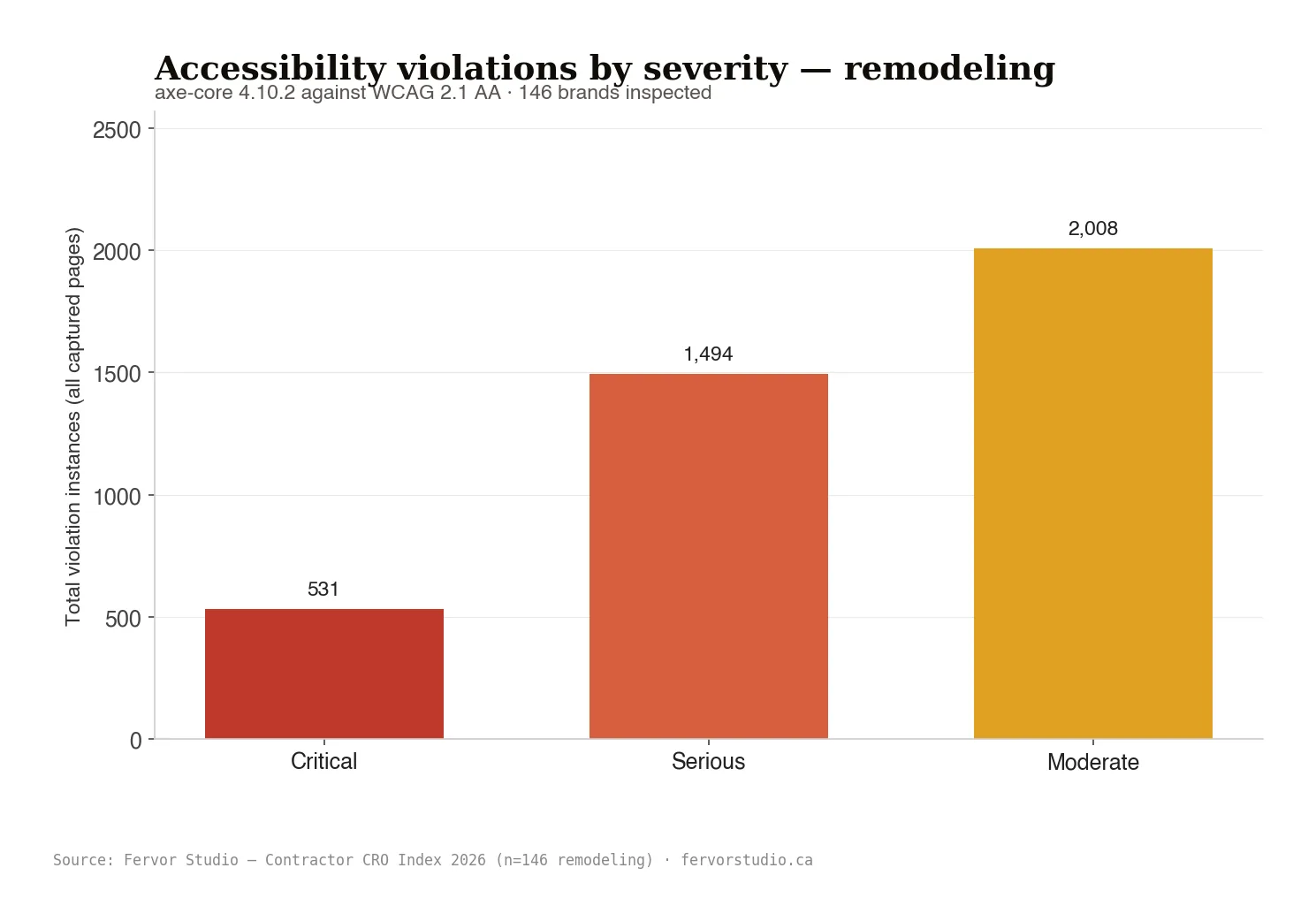
59.6% of remodeling sites we tested fail a critical accessibility check
Digital State of the Remodeling Industry 2026A grade out of 380 contractor sites
We graded 380 of them against one framework. Exactly one earned an A: Crown Industrial Roofing in Toronto, at 90 out of 100. The rest left money on the table. Here is what separates the top from the bottom.
The local detail
Every angle below is built into the page, not bolted on after.
Start with the single most important fact about how this trade gets bought, because every recommendation on this page hangs off it.
But before the tactics, it’s worth knowing what’s driving the searches, because the motivations write the keywords.
When the research window finally closes and she types the hiring query, most of what she sees isn’t websites at all.
Here’s where home remodeling seo separates from the template work.
Now the content layer that fills the ten-month window, and the calendar that times it.
The review stream feeds both machines at once, the local pack’s ranking math and the shortlist decision of every buyer who reads it.
A monthly report full of impressions and average positions is decoration.
One more surface, and it’s the one referrals live or die on.
You've probably paid for SEO before. And if you run a remodeling shop, odds are the last agency treated your trade like it was plumbing, chase the emergency keywords, win the quick call, count the clicks. But nobody hires a remodeler in an emergency. Your buyer researches for the better part of a year before she signs anything, and remodeling SEO is the discipline of being the shop she keeps finding, all the way through that long quiet stretch when she's planning, comparing, and talking herself into the project. This page lays out how that discipline actually works: the search behaviour behind it, the architecture that captures it, and what it costs to do properly.

Start with the single most important fact about how this trade gets bought, because every recommendation on this page hangs off it.
"Homeowners spend roughly 9.6 months planning a kitchen remodel versus 5.1 months building it, nearly twice as long deciding as doing." Houzz Inc. (2024)
Nearly ten months of planning. That's ten months of searches, "kitchen remodel cost," "how long does a kitchen remodel take," "kitchen remodeler near me," each query a little more serious than the last. And here's what that means for you: the shop that only shows up for the final "remodeler near me" search has skipped the nine months during which she formed her shortlist. By the time she types the hiring query, the tournament is half over, she's already met three companies through their content, their galleries, their reviews. Remodeling SEO done right gets you into the research window early and keeps you there, which is a completely different project than the emergency-trade SEO most agencies recycle.
So the timeline reframes the budget too. An SEO engagement that "takes three to six months to show results" sounds slow next to a Google Ads campaign, until you remember the buyer herself takes ten. You're not too late this season. You're early for the next one, and the next one is where the signed contracts live. Patience here isn't a virtue, it's just reading the customer's calendar correctly.
But before the tactics, it's worth knowing what's driving the searches, because the motivations write the keywords.
"38% of homeowners renovating their kitchen cite kitchen deterioration or dysfunction as a reason to renovate." Houzz Inc. (2026)
"41% of homeowners renovating their kitchen cite dissatisfaction with the old kitchen style as a reason to renovate." Houzz Inc. (2026)
Two different buyers hiding in those numbers. The deterioration buyer searches like a problem-solver: cabinets falling apart, layout doesn't work, something leaked once and never felt right since. The style buyer searches like a dreamer: ideas, trends, photos, before-and-afters. Your content has to feed both, because both end at the same consultation. And the money behind those searches is not small:
"Major kitchen remodels have a median spend of $55,000, compared to $20,000 for minor kitchen projects." Houzz Inc. (2026)
"Homeowners with larger kitchens spend more on major remodels (median $75,000) than those with smaller kitchens." Houzz Inc. (2026)
A single captured search, ten months patient, worth fifty-five to seventy-five thousand dollars at the median. That's the arithmetic that makes seo for remodeling contractors one of the highest-return line items in the budget, and the reason doing it half-heartedly is the most expensive option of all.
When the research window finally closes and she types the hiring query, most of what she sees isn't websites at all. It's the map: three local businesses, their stars, their review counts, their photos. The local pack is where remodeling SEO weight concentrates at the decision moment, and it runs on signals most shops never manage deliberately.
Your Google Business Profile is the franchise asset here. Primary category set precisely, Remodeler or Kitchen Remodeler, not a generic contractor bucket, secondary categories matched to your actual project mix, service areas named honestly, and photos uploaded on a cadence. Google reads photo recency as a liveness signal, and twelve photos from three years ago tell it you might be gone. Two uploads a month of real local projects keeps the listing visibly alive, and in this trade you have the most photogenic evidence in home services sitting on your phone already. A finished kitchen at golden hour does more for the pack ranking than a month of fiddling with the description field, and it does double duty in front of the buyer who opens the photo tab first, which, in remodeling, is most of them. The crew already takes the photos for the client handoff anyway; the only new habit is the upload.
And reviews dominate the pack math, which gets its own section below, because in remodeling the review isn't just a ranking signal. It's the product demo. A homeowner about to let a crew live in her house for five months reads reviews the way she'd read references for a nanny: slowly, suspiciously, and all the way down.
And two more profile layers most remodelers leave on defaults. Service areas, named honestly, the towns and neighbourhoods your trucks actually roll to, not a fifty-mile circle drawn around ambition, because Google cross-checks where your reviews and photos actually come from and a padded map dilutes all of it. Then the Q&A field, which almost nobody seeds: the five questions your office answers every week (do you charge for consultations, do you handle permits, can we live in the house during the work) sitting right on the profile, answered in your own words before a competitor or a stranger answers them for you. So the profile stops being a listing and starts being a salesperson, one that works the 9pm research shift without overtime.
Here's where home remodeling seo separates from the template work. Google matches queries to pages, not to businesses. The homeowner searching "bathroom remodel" should land on your bathroom page, bathroom projects, bathroom timelines, bathroom questions, not a services pamphlet listing nine offerings in one breath. One architected page per project type: kitchens, baths, basements, additions, whole-home. Each carrying its own gallery, its own process walkthrough, its own consultation path.
The bathroom data shows why the specificity pays:
"68% of homeowners consider special needs (accessibility) when planning their bathroom projects." Houzz Inc. (2025)
"25% of homeowners use their primary bathroom for rest and relaxation, and 24% for beauty/pampering." Houzz Inc. (2025)
Two-thirds of bathroom buyers are thinking about aging-in-place grab bars and curbless showers, and a quarter are thinking about a spa. A generic "we do bathrooms" page speaks to neither. A bathroom page that addresses accessibility planning in one section and the relaxation brief in another speaks to both, ranks for both, and reads like it was written by someone who's actually sat across a kitchen table from these buyers. Because that's the real function of project-page architecture, it lets you be specific, and specific is what ranks and what converts.
But the pages can't float alone; the linking between them is half the remodeling seo value. The kitchen page links the cost guide, the cost guide links the process walkthrough, the walkthrough links back to the gallery, and every one of them links the consultation path, a lattice Google reads as topical depth and the buyer experiences as "this company has answered everything I've thought of so far." One orphaned page is a leaflet. Eight interlinked ones are an authority. And the lattice compounds: each new planning-window piece you publish has seven established pages to draw strength from and feed strength back into, which is why month-nine content earns rankings month-one content had to fight for.
Now the content layer that fills the ten-month window, and the calendar that times it. The planning buyer's questions are wonderfully predictable: what does it cost, how long does it take, what's the process, can I live in the house during it, what goes wrong. Every one of those is a page, a cost guide with honest ranges, a process walkthrough with real timeline math, a what-to-expect piece written in the same plain language your estimator uses. Shops flinch at publishing costs. But hiding the number doesn't stop her wondering about it, it just sends her to the first competitor willing to answer in public, and the one who answers gets the consultation.
"76% of homeowners incorporate at least one built-in feature into their kitchen renovation." Houzz Inc. (2026)
Detail like that is content fuel, a piece on built-in choices, drawn from your own projects, is exactly the planning-window material that earns a bookmark in month two and a consultation in month nine. And the calendar matters: remodeling research moves in waves. The January planning surge when resolutions meet tax refunds. The spring push ahead of summer builds. The fall sprint to finish before the holidays. Publish ahead of the wave, not during it, because a cost guide indexed in December owns January, and one published in January is fighting for scraps by February. And there's a newer reason to publish the honest, specific answers: that's what the machine layer quotes now. Search has grown an answer engine on top of the results, and it assembles its summaries from pages that state facts plainly, real ranges, real timelines, named steps. The shops getting cited in those summaries are the ones whose content reads like a straight answer from someone who's done the work, because it is. Generic agency filler doesn't get quoted; it gets paraphrased into invisibility. So the same writing discipline that wins the buyer wins the machine, and you only have to do it once.
(Your before-and-after gallery, incidentally, is an SEO asset as much as a sales one, every project page with named, described images is another query surface. The build mechanics of doing that without wrecking your site speed live at remodeling web design.)
The review stream feeds both machines at once, the local pack's ranking math and the shortlist decision of every buyer who reads it. And velocity beats volume. Forty reviews that stopped a year ago read worse than twenty-five with three from this month, because the timestamp is the proof of life. A steady stream is operational, not motivational: an automated ask after every project milestone, timed for the evening, linked straight to your profile. Fervor wires it with NiceJob as standard practice, because review velocity is the one ranking-and-trust signal a shop can manufacture one happy client at a time.
But respond to them too, all of them, because the response is content. The homeowner reading your reviews in month seven of her research is also reading how you answer the rare three-star, whether you get defensive or get specific. In a trade where the fear is "what happens when something goes wrong mid-project," a calm, accountable reply to criticism is worth more than five more five-stars. It's the only place on the internet where she can watch you handle a problem before she hires you to handle hers.
A monthly report full of impressions and average positions is decoration. The numbers that matter reconcile against your pipeline: which pages produce consultation requests, which queries produce signed contracts, what each planning season actually delivered. Call tracking by page and source, form attribution, and a simple monthly reconciliation against the consult calendar, that's the whole dashboard, and you can read it without anyone translating.
So here's what a useful month actually looks like on paper. The kitchen page drew 412 visits, produced nine tracked calls and four form fills, and two of those thirteen became consultations, one signed at $48,000. The cost guide drew 380 visits and converted nothing directly, but six of the month's callers had it in their browsing path before they dialed. That second number is the one agency reports never show you, and it's the whole argument for the planning-window content: the pages that "don't convert" are the ones doing the convincing. Three lines of reconciliation, once a month, against your own consult calendar. If your current remodeling seo report can't be checked that way, it isn't reporting, it's wallpaper.
And the honest boundary: SEO fills the funnel, it doesn't fix the bucket. Rankings into a site that can't book a 9pm consultation or show a before-and-after gallery is paying for traffic you then leak, which is why the capture layer at remodeling CRO is usually the right spend before the campaign, not after. Sequence it the way the math wants: bones, leaks, then visibility. Most shops buy it in reverse, and most shops wonder where the money went.
One more surface, and it's the one referrals live or die on. Search your own company name tonight, in a private window, and look at the page the way a referred homeowner does. That page is your second handshake. The profile with the review count, the site link underneath, the photos, maybe a directory listing or two, every element either confirms what her neighbour told her or quietly contradicts it.
And the failure modes are specific. A near-namesake contractor two towns over ranking beside you, collecting your referrals' clicks. A years-old directory profile with a dead phone number outranking your own services page. Three reviews visible when your happy-client list runs to three hundred. None of these are exotic problems, they're maintenance problems, claiming and pruning the listings, consolidating the name variants, feeding the review stream until the count matches the reputation. An afternoon of cleanup, then an hour a quarter. But almost nobody does it, because no agency ever made money selling "search your own name and fix what you find."
So fold it into the routine: the name search is the cheapest remodeling seo audit there is, it costs nothing, and it grades the exact surface your warmest prospects check first. The cold-search work on the rest of this page brings strangers; the name search decides whether the people who already wanted to hire you still do after one look.
Fervor's entry point for a remodeling shop is the The Local Pick: $2,497 one-time, delivered in about 14 days. The Google Business Profile rebuilt deliberately, categories, services, areas, photo cadence, review wiring, plus the local citation cleanup and the tracking foundation, so the local pack work that decides the hiring query is no longer running on defaults. It's the highest-return two weeks in local visibility, and it's priced so the payback math works at a single consultation.
And run that math at your own tickets, because remodeling seo is where this trade's economics get almost unfair. Median major kitchen, $55,000; call your gross margin 35%, so roughly $19,000 per signed project. One incremental consultation a quarter that closes covers the entire year of Performance Partner with room left over, and visibility doesn't deliver one a quarter once it's compounding, it delivers the planning wave. The arithmetic isn't subtle. It just requires believing the buyer's ten-month timeline instead of demanding ad-campaign immediacy from an asset that behaves like real estate.
The ongoing engagement, project-page architecture, the planning-window content calendar, the review velocity system, monthly reconciliation against your actual pipeline, runs under Performance Partner at $1,497 to $3,997 per month, month to month, every asset registered to you from day one. No long contracts, because the reporting should be what keeps you, not the paperwork.
And it starts with the free Site Inspection: your current site run through the same 100-point framework behind the State of the Remodeling Industry report, scored category by category, every finding handed over whether or not you ever hire us. If the inspection says your visibility problem is actually a build problem, a site too slow to rank no matter how good the content gets, we'll say so plainly and route you to the web design page first. You shouldn't have to trust us. You should be able to check.

The broader system this fits into, the build standards, the conversion layer, the full trade picture, lives at the remodeling marketing hub, under residential construction, starting from the contractor hub.
Set the expectation against the buyer's own timeline: she plans for nearly ten months, so a campaign that starts today is planting in the research window that closes two and three quarters from now. The early signals come faster, local pack movement and profile actions within weeks of the The Local Pick, content indexing within the first month, but signed-contract attribution follows the trade's natural lag. And that lag is precisely why starting "next quarter" costs more than it appears to: every quarter you wait is a planning wave your competitors' content gets to own uncontested.
Referrals are the reason it pays twice. A referred homeowner doesn't skip the research, she compresses it, and the first thing she does with your name is search it. What she finds either confirms the referral or quietly undoes it: the review stream, the gallery, the project pages all get checked the same evening. So the same work that wins cold searches converts warm ones faster, the gallery she checks, the cost guide that answers what she was too polite to ask her neighbour, the review thread that confirms the story. Referral traffic without a search presence is a leaky handshake. And when the referral pipeline has a slow season, which every remodeler eventually meets, the search pipeline is the one that doesn't care who you know.
The buying cycle. Emergency trades win on speed-to-visibility for urgent queries; remodeling wins on presence across a ten-month research arc. That changes everything downstream: the content calendar tilts toward planning-window questions instead of emergency landing pages, the project-page architecture carries galleries and process depth a furnace-repair page never needs, and the review layer has to survive a buyer who reads all of it. An agency that hands you its standard contractor package is optimizing for a buyer who doesn't exist in your trade. And you can test for this in the first meeting with one question: ask how their plan treats the months before the hiring query. If the answer is a media schedule instead of a content map, they're selling you plumbing SEO with your logo on it.
Ads buy the moment; SEO owns the window. And in remodeling the moment is brutally expensive, because every agency in your market is bidding on the same handful of hiring queries while the ten months of research queries before them go almost uncontested. Paid placement at the hiring query is real and sometimes worth it, but it does nothing for the nine months of research before the click, and it stops the day the budget does. The planning-window content, the project pages, the review stream all compound: every season they run, they get cheaper per consultation. The honest answer for most shops is sequence, not either-or, fix the capture layer, build the organic foundation, then let ads top up the seasons when the calendar needs it.
The evidence
 Read the full report →
 0
contractor sites graded, one A
Across the whole CRO Index, a single site earned an A. The median landed at a D. The grade gap is a conversion gap.
0 %
of remodeling sites fail a critical accessibility check
Scored against WCAG 2.1 AA with axe-core. A page that blocks a screen reader also blocks a paying customer.
Fervor Remodeling State of the Industry, 2026
0 %
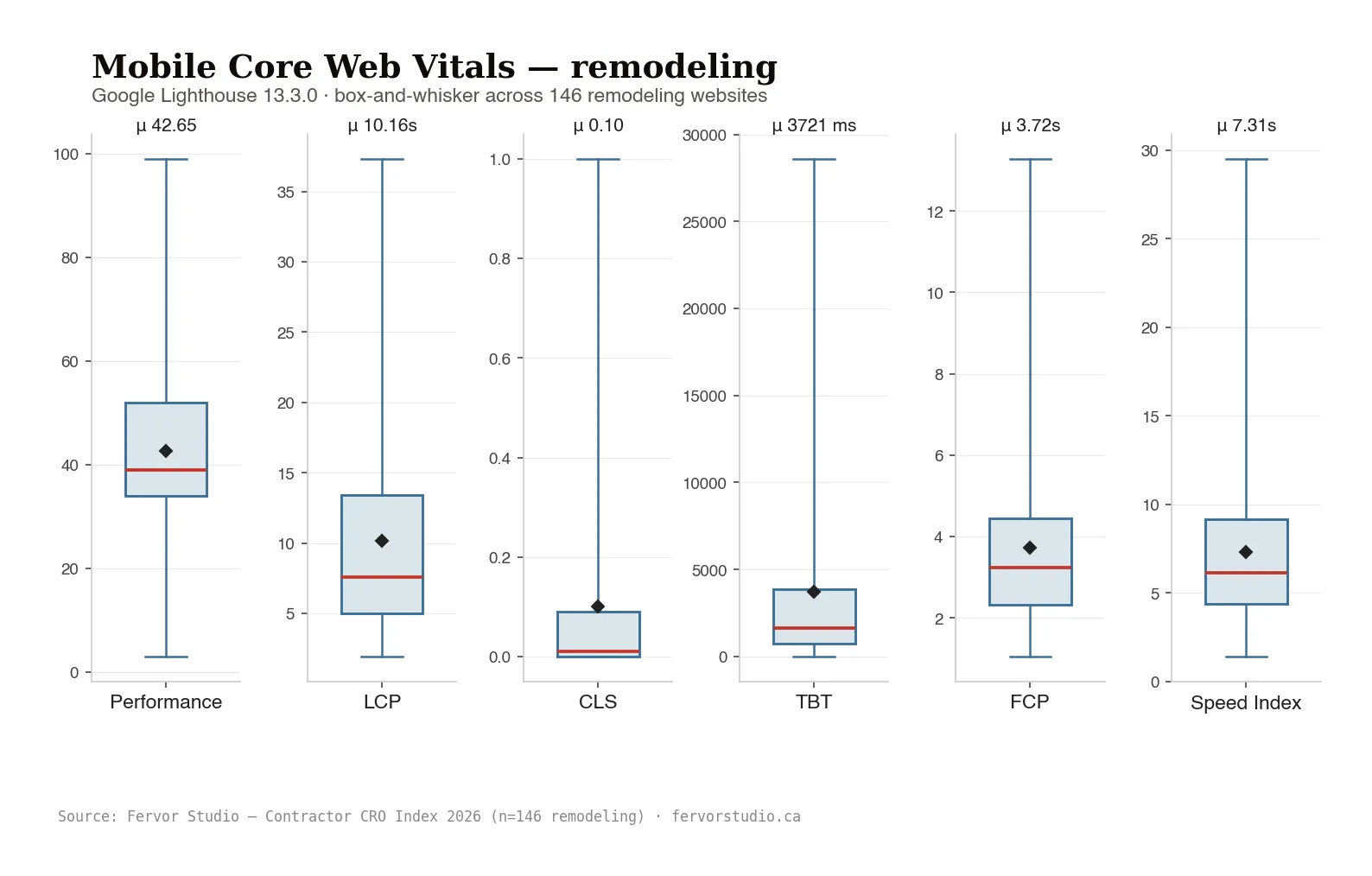
miss Google's mobile load-speed bar
Median mobile load lands at 7.57 seconds. Most of your traffic is on a phone, and most of them are gone before the hero paints.
Fervor Remodeling State of the Industry, 2026
0 /100
is the average remodeling grade
That is a D. The sites booking the work are not the ones with the biggest crews. They are the ones a few points higher on the things homeowners feel.
Two ways to start
Tell us where you are. We point you at the right next step — no sales call to get there.
Client review
“5 stars without hesitation. Working with Fervor has been an amazing experience from start to finish. The level of professionalism was genuinely top tier. Communication was excellent, quick replies, clear updates, and always open to feedback or changes without any problem. What stood out most is that you can tell he genuinely knows web design inside and out from real professional experience, not just someone throwing together templates. He put real effort, care, and thought into the project, even offering his own ideas and suggestions to improve things I hadn't even considered. On top of that, he's genuinely a great guy to deal with, easy to talk to, open-minded, helpful, and clearly passionate about what he does. I'd confidently recommend him to anyone looking for a professional website or branding help. Huge respect and appreciation.”
How Fervor can help
Monthly SEO, content, and CRO. Fixed deliverables. No credits, no rollover. The compound growth engine.
Complete website system built to convert storm leads, planned projects, and research-phase homeowners into booked jobs.
Identify and patch the top conversion killers on your existing site. No full rebuild needed.
GBP optimization, citation building, and review system foundation. The infrastructure that gets you into the Map Pack.
One conversion-built landing page for the referrals, paid clicks, and cold-call leads you send. They land on a page built to book them, not your generic homepage.
Your move
Tell us where you are. We point you at the right next step — no sales call to get there.
Keep going