0
contractor sites graded, one A
Across the whole CRO Index, a single site earned an A. The median landed at a D. The grade gap is a conversion gap.
Right now, someone in Columbus is Googling "remodeler near me." We get you showing up first — then turn that click into a booked job.
A written report and a ranked fix list, in about three days.
“Patient, on point, straightforward. Did amazing work. Would 100% recommend.” — Ruben Mederos, HyperTemp HVAC
“Responsive, creative, exceeded expectations. Already seeing greater engagement from our clients.” — George Jeorgy, Jeorgy's Landscape Construction
“Top-tier professionalism, real web design expertise, ideas I hadn't considered. Confidently recommend.” — Aws Nassani, Four Eleven Contracting




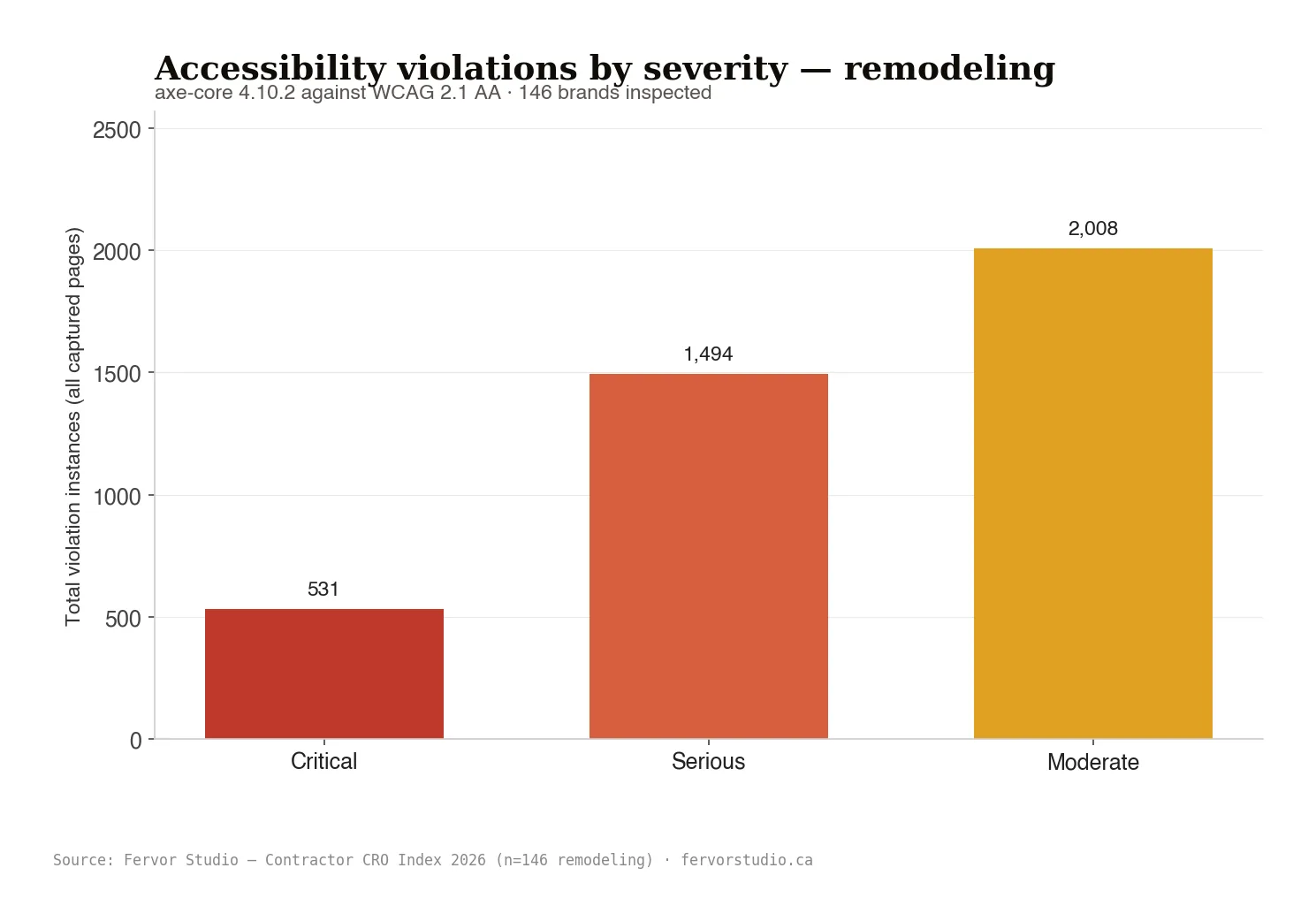
59.6% of remodeling sites we tested fail a critical accessibility check
Digital State of the Remodeling Industry 2026A grade out of 380 contractor sites
We graded 380 of them against one framework. Exactly one earned an A: Crown Industrial Roofing in Toronto, at 90 out of 100. The rest left money on the table. Here is what separates the top from the bottom.
The local detail
Every angle below comes from how Columbus actually searches, buys, and regulates — built into the page, not bolted on.
Start with the single most important fact about how this trade gets bought, because every recommendation on this page hangs off it.
But before the tactics, know what’s driving the searches, because the stock writes the keywords, and Columbus renovates in three eras at once.
When the research window closes and she types the hiring query, most of what she sees is the map: three businesses, stars, review counts, photos.
Here’s where remodeling SEO Columbus work separates from the template stuff.
Now the opportunity with a date on it.
The planning buyer’s questions are wonderfully predictable, what does it cost, how long does it take, can we live in the house during it, and every one is a page.
And before the engagement sequence, the anti-pattern list, because the failure modes here repeat around the outerbelt.
The review stream feeds both machines at once, the pack’s ranking math and the shortlist decision of every buyer who reads it.
You've probably paid for SEO before. And if you run a remodeling shop anywhere from German Village to Dublin, odds are the last agency treated this market like one audience — one homepage for a metro where 1840s brick cottages, 1920s Clintonville bungalows, and the outerbelt's builder-grade two-stories all renovate on different clocks. So now you're wondering whether remodeling SEO in Columbus is a real discipline or a template with the city name swapped in. Fair question. This page lays out what it takes here specifically: a profile built for a quadrant metro with a dozen permit offices, project pages for century homes and outerbelt renewals, ADU content in the first months of a brand-new ordinance, and the exam-backed licence trust play most shops never put into words.

Start with the single most important fact about how this trade gets bought, because every recommendation on this page hangs off it.
"Homeowners spend roughly 9.6 months planning a kitchen remodel versus 5.1 months building it — nearly twice as long deciding as doing." — Houzz Inc. (2024)
Nearly ten months of planning, and the Ohio calendar gives it shape: real winter runs November into March, exterior work concentrates April through October, and the planning-and-quoting wave runs winter-into-spring ahead of the build season. So the shop that's visible from Thanksgiving through the thaw owns the projects that frame in May. And this market just got handed a second planning wave with a date on it: ADUs went legal by right citywide on December 24, 2025, and the homeowners studying that math right now are hiring in the seasons ahead. Remodeling SEO in Columbus is largely the discipline of being findable during both waves.
And the money behind the patience is real:
"Major kitchen remodels have a median spend of $55,000, compared to $20,000 for minor kitchen projects." — Houzz Inc. (2026)
That's the national median. Columbus mid-range full kitchens commonly land $25,000 to $55,000 with high-end projects past $100,000, and the intown premium in Bexley and Upper Arlington runs the top of every band.
But before the tactics, know what's driving the searches, because the stock writes the keywords, and Columbus renovates in three eras at once. The pre-war core: German Village's brick cottages and Italianates built 1840-1914, the signature one-and-a-half-story gable-roofed cottage on a limestone foundation, plus Clintonville's bungalows and Tudors, Victorian Village, Italian Village, Old North, and Bexley. The mid-century inner ring, Westgate's early-60s ranches included. And the outerbelt: the 1990s-2000s two-stories off Polaris and across Dublin, Westerville, and Grove City, now hitting year twenty-five, where finishes and systems wear out together in trade sample.
"38% of homeowners renovating their kitchen cite kitchen deterioration or dysfunction as a reason to renovate." — Houzz Inc. (2026)
"41% of homeowners renovating their kitchen cite dissatisfaction with the old kitchen style as a reason to renovate." — Houzz Inc. (2026)
Two buyers in those numbers, and the metro supplies both, plus a third the locals can name: the deterioration buyer in a Westgate ranch whose kitchen predates the outerbelt, the style buyer in a Polaris-corridor two-story whose builder-grade finishes expired all at once, and the Intel-corridor newcomer up the New Albany side, picking a remodeler from the search shelf with no referral network at all. Your remodeling SEO in Columbus has to feed all three, because all three end at the same consultation.
When the research window closes and she types the hiring query, most of what she sees is the map: three businesses, stars, review counts, photos. And Google draws that pack around the searcher, Clintonville, Dublin, Westerville, and Grove City each render a different three-pack, and a shop with one profile pinned to one warehouse competes in exactly one of them. The I-270 outerbelt rings a market that behaves like quadrants, and every quadrant permits separately: Columbus Building and Zoning Services inside city limits, then Dublin, Hilliard, Westerville, and the rest each running their own office. The shop that names its jurisdictions honestly reads like the shop that's filed in all of them.
So remodeling SEO in Columbus starts with an honest account of where your crews actually work, then matches the profile to it: the intown neighborhoods named the way locals name them, German Village, Clintonville, Bexley, Victorian Village, and the outerbelt quadrants the trucks genuinely cover. Your Columbus Home Improvement Contractor licence belongs in the business description, and photos on a cadence seal it: two uploads a month of real local jobs, a Clintonville bungalow kitchen, a Dublin two-story bath, a German Village cottage done by the book. The pack reads photo recency as a liveness signal, and in this trade the proof is already on your phone.
One more pack detail worth the hour it takes: the Q&A field on your profile. Seed it with the questions Columbus buyers actually ask, like whether you're licenced with the city, handle German Village approvals, or build ADUs, and answer each in plain English. The pack rewards completeness, and the buyer reads those answers as a preview of working with you.
Here's where remodeling SEO Columbus work separates from the template stuff. Google matches queries to pages, not to businesses, the homeowner searching "bathroom remodel" should land on your bathroom page, not a services pamphlet. The build-out this market wants: kitchens, baths, whole-home, additions, and then the pages no national template carries.
The century-home page, because the pre-war core is its own discipline, brick on limestone foundations, boiler heat threading cast iron through every wall you open, pre-modern framing with surprises behind the plaster, and federal lead-safe rules riding along on everything pre-1978, which intown is nearly everything. A page that talks about it like someone who's opened those walls signals more than any badge. The outerbelt renewal page, because a 1998 Polaris two-story renovates as a package, kitchen, baths, flooring, systems, and the shop that names that pattern owns the cul-de-sac. And the aging-in-place page:
"68% of homeowners consider special needs (accessibility) when planning their bathroom projects." — Houzz Inc. (2025)
Two-thirds of bathroom buyers are already thinking about it, and the inner ring's long-tenured owners are exactly that demographic. The page that addresses it plainly converts buyers the portfolio-only competition never speaks to.
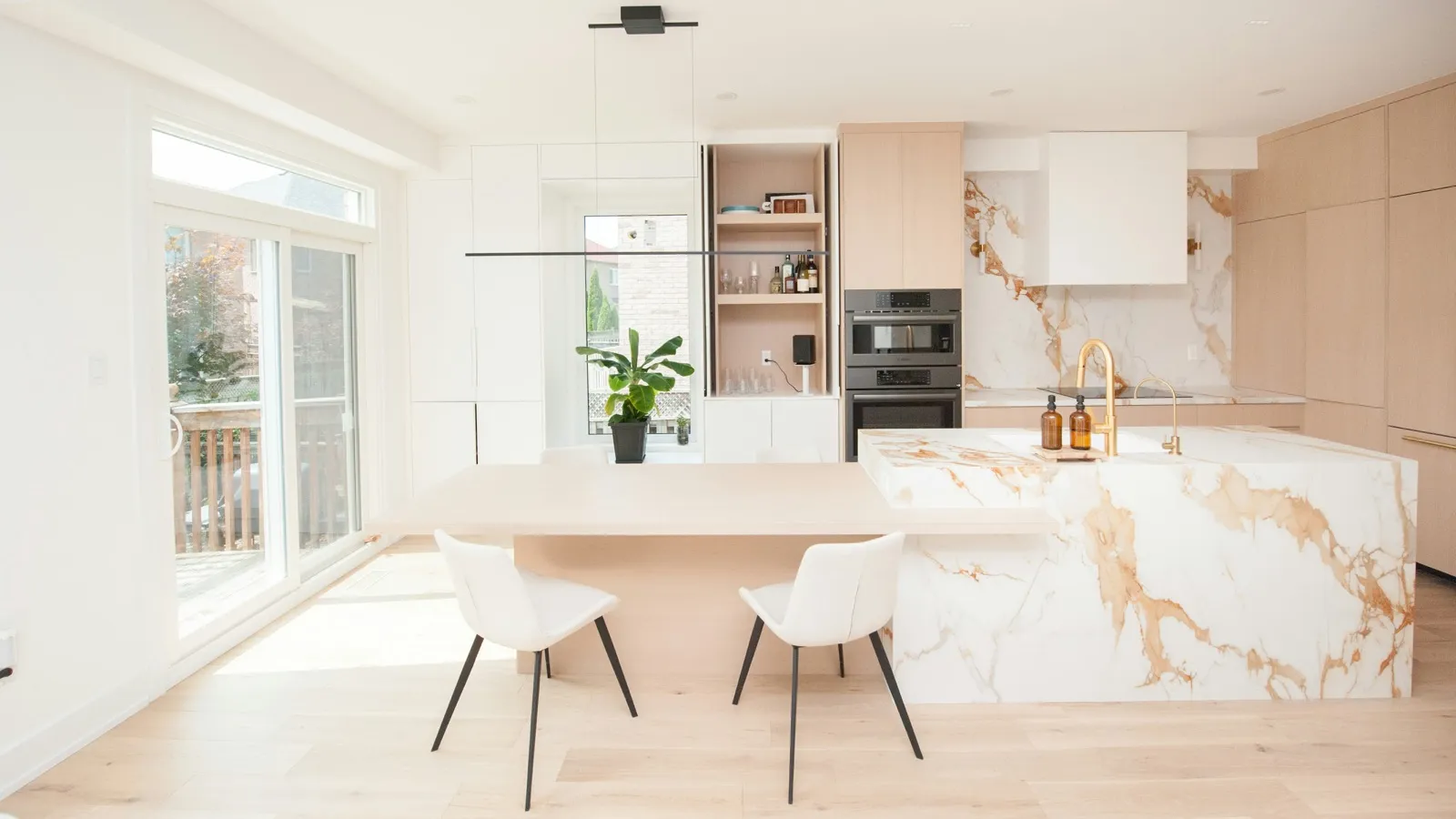
Now the opportunity with a date on it. Columbus legalized ADUs by right in every residential district effective December 24, 2025. Generally one per single-family lot, sized up to 65% of the main dwelling's floor area or 1,000 square feet, whichever is greater, which is the generous version of a cap most cities wrote stingier. Building permits still apply, and the historic commissions keep their full authority, a German Village carriage-house conversion still needs its certificate. But the demand math is brand new: in-law suites for the Intel-corridor influx, backyard units on Clintonville's deep lots, rental income against Columbus's rising values. And the search results are still ordinance text and news coverage.
So build the page that explains it like a local, now, while the SERP is soft: the by-right rules in plain English, the realistic budget at Columbus prices, the permit path by jurisdiction, and the historic-district caveat told straight. The shop that publishes the translation in the ordinance's first year becomes the name the next three years of ADU searches find, and that name gets the call. That's the half of remodeling SEO in Columbus no spreadsheet captures: the authority that compounds when your pages do the explaining the ordinance won't.
The planning buyer's questions are wonderfully predictable, what does it cost, how long does it take, can we live in the house during it, and every one is a page. The cost guide with honest Columbus ranges, tiered intown versus outerbelt. The process walkthrough with the multi-jurisdiction permit math. And the explainer this market specifically rewards: the German Village rulebook. The commission reviews any exterior change, window replacements come from an approved product list with simulated-divided-lite sashes and no faux-wood surfaces, removed brick gets replaced with brick, and concrete is discouraged as a non-historic material. Italian Village, Victorian Village, and the Brewery District run parallel commissions. The shop that publishes the plain-English version of those rules converts the cottage buyer who's heard the horror stories, and pre-empts the mid-project surprise that wrecks schedules and reviews alike.
"76% of homeowners incorporate at least one built-in feature into their kitchen renovation." — Houzz Inc. (2026)
Detail like that is content fuel, and the calendar shapes the schedule: winter is the content season. Cost guides and planning pieces indexed by November own the research months that become spring permits, and ADU explainers published now own a wave that just started. That rhythm is remodeling SEO working with the Columbus calendar instead of against it.
And before the engagement sequence, the anti-pattern list, because the failure modes here repeat around the outerbelt. The one-era portfolio, showing only outerbelt work to a century-home buyer, or vice versa. The jurisdiction vagueness, quoting permit timelines without naming the office. The German Village surprise, left for the client to discover after the deposit. The newcomer blindness, copy written for buyers with local knowledge, in a metro where the New Albany corridor fills with arrivals who have none. And the review wall that stopped last spring, reading like a business that left.
But every one of those is a competitor you pass simply by not doing it, which is the quiet math of remodeling SEO in Columbus: the ten-month researcher stops at the first page that already speaks her neighborhood, her building type, and her budget tier. And the premium demand is real:
"Homeowners with larger kitchens spend more on major remodels (median $75,000) than those with smaller kitchens ($46,000)." — Houzz Inc. (2026)
The big-kitchen money concentrates in Bexley, Upper Arlington, and the Dublin side. Buyers who check licences, read reviews to the bottom, and reward the shop whose content proves it knows a limestone-foundation cottage from a Polaris two-story. What settles that caution is verifiable, not a slogan: the licence in the footer, the review stream with this month's date, and content only a local could have written.
The review stream feeds both machines at once, the pack's ranking math and the shortlist decision of every buyer who reads it. And velocity beats volume: forty reviews that stopped last spring read worse than twenty-five with three from this month, because the timestamp is the trust. Make the ask operational, automated after every project milestone, timed for the evening, linked straight to your profile. Fervor wires it with NiceJob as standard practice, because review velocity is the one ranking-and-trust signal a shop can manufacture one happy client at a time.
And put Ohio's odd licensing landscape to work, because it's a trust asset most shops never explain: the state issues no residential general contractor licence, only the specialty trades carry state cards, so the bar that exists is the one Columbus built. The city's Home Improvement Contractor licence takes three years of verified hands-on experience, a passing score on the 767 exam, and liability insurance naming the city itself. Add the Ohio Attorney General's registration required on home construction contracts over $25,000, and you have a paragraph the truck-and-card competition structurally cannot write: "City-licenced against an exam and verified experience, insured to the city's own floor, registered with the Attorney General for the contracts that require it. Verify all of it." The buyer who learns the landscape from your page trusts the shop that taught her.
Fervor's entry point for a Columbus shop is the The Local Pick: $2,497 one-time, delivered in about 14 days. The Google Business Profile rebuilt deliberately, categories, quadrant-honest service areas, photo cadence, review wiring, citation cleanup, plus the tracking foundation, so the pack work that decides the hiring query is no longer running on defaults. Priced so the payback math works at a single signed kitchen, at Columbus's mid-range, one captured project returns the setup cost several times over before the dumpster hits the driveway.
The ongoing remodeling SEO engagement for a Columbus shop, the century-home, outerbelt, and ADU pages, the winter content calendar, review velocity, monthly reconciliation against your actual consultation pipeline, runs under Performance Partner at $1,497 to $3,997 per month, month to month, every asset registered to you from day one. And the honest boundary: visibility fills the funnel, it doesn't fix the bucket. If your site can't book a 9pm consultation or show a before-and-after gallery, that's the capture layer at remodeling CRO; if the site itself is a slow template, the bones live at remodeling web design. Sequence it: bones, leaks, then visibility.
And it starts with the free Site Inspection: your current site run through the same 100-point framework behind the State of the Remodeling Industry report, scored category by category, every finding handed over whether or not you ever hire us. You shouldn't have to trust us. You should be able to check.

That's the full remodeling SEO Columbus system, and the broader playbook lives at remodeling SEO, the trade hub at remodeling marketing, under residential construction, starting from the contractor hub.
Set the expectation against the buyer's own timeline: she plans for nearly ten months, and the Ohio calendar concentrates contract-signing ahead of the April-to-October build season. Profile signals move within weeks of the The Local Pick; content compounds over a season. The practical deadline is November. Pages indexed by then own the winter research months that become spring permits. And the ADU wave adds a second clock: first-year authority on a brand-new ordinance compounds for years.
Wherever your crews already win, said honestly, because the eras punish pretenders differently. Intown rewards century-home fluency, commission experience, and design literacy for buyers who interview three firms; the outerbelt rewards package efficiency, transparent pricing, and speed through builder-grade scopes that repeat street by street. The mistake is one thin homepage claiming all three eras, the pack reads your reviews' geography and your portfolio's architecture. Pick your era, win it visibly, then expand with proof.
Since December 24, 2025, yes, by right in every residential district, one per single-family lot, sized to 65% of the main dwelling or 1,000 square feet, whichever is greater. Building permits still apply, and the historic commissions keep their authority, so a German Village conversion still needs its certificate. The demand is structural: an Intel-driven influx, deep intown lots, and rental math that finally pencils. The SERP is still ordinance text, a plain-English eligibility-budget-permit page is the cheapest category ownership in the metro right now.
Any exterior change, yes, and the rules are specific enough to surprise: windows from an approved product list with simulated-divided-lite sashes, brick replaced with brick, concrete discouraged as non-historic. Italian Village, Victorian Village, and the Brewery District run parallel commissions. Interior work escapes review, but the moment a scope touches the envelope, the certificate comes first. The marketing answer is to be the shop that says so up front, the page that explains the process honestly converts the cottage owners who've heard the horror stories.
The fundamentals, absolutely, and start this week regardless. Claim the profile, fix the categories, put the licence in the footer, photograph the current job, ask the last three happy clients for reviews. That's an afternoon, it's free, and it moves the pack. What's hard to sustain solo is the compounding layer: the century-home, outerbelt, and ADU pages written to rank, the publishing cadence that survives the building season, the monthly reconciliation. Do the trust fundamentals yourself; buy the content engine if owning the winter planning season is worth more than the retainer.
The evidence
 Read the full report →
 0
contractor sites graded, one A
Across the whole CRO Index, a single site earned an A. The median landed at a D. The grade gap is a conversion gap.
0 %
of remodeling sites fail a critical accessibility check
Scored against WCAG 2.1 AA with axe-core. A page that blocks a screen reader also blocks a paying customer.
Fervor Remodeling State of the Industry, 2026
0 %
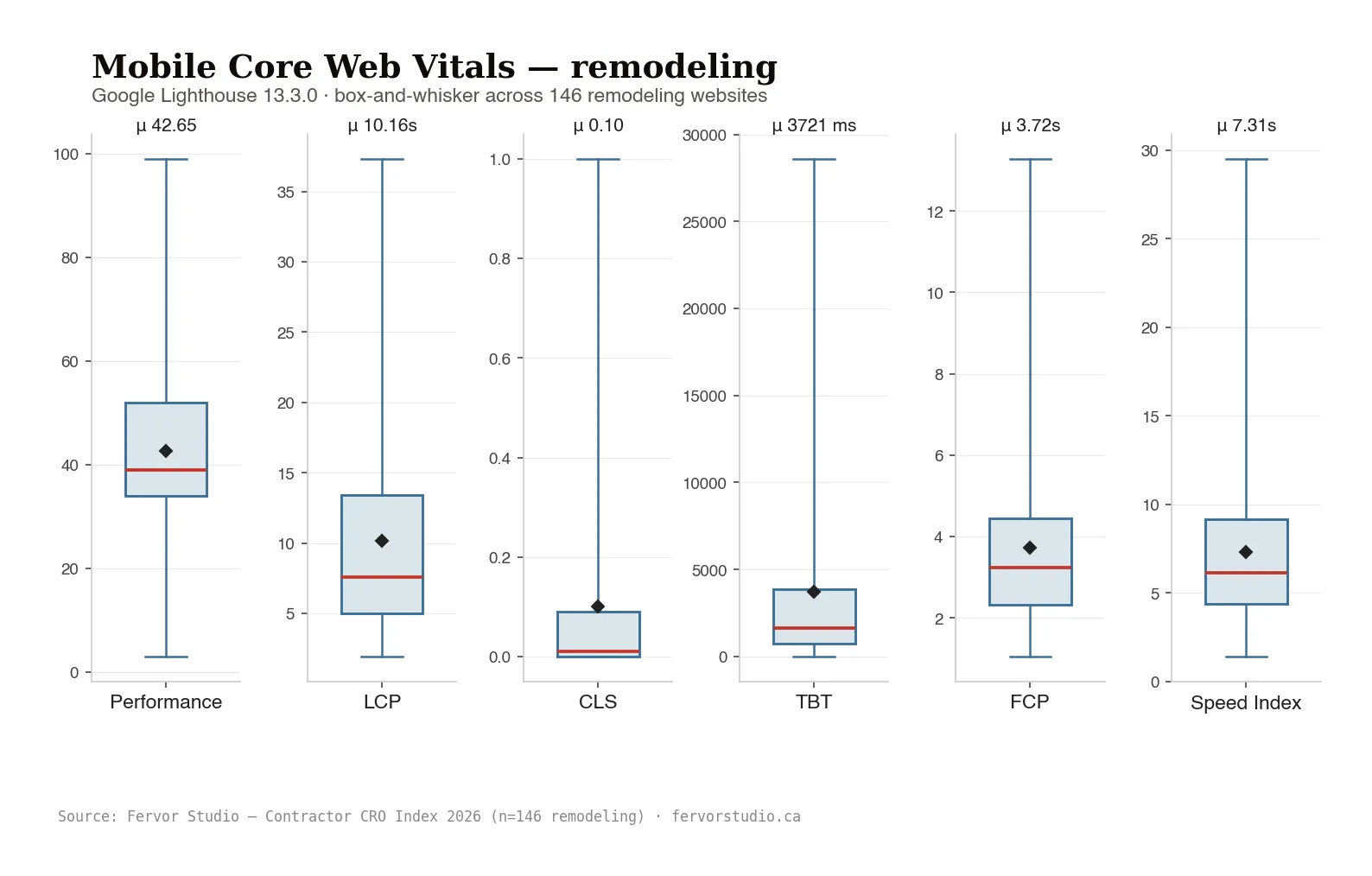
miss Google's mobile load-speed bar
Median mobile load lands at 7.57 seconds. Most of your traffic is on a phone, and most of them are gone before the hero paints.
Fervor Remodeling State of the Industry, 2026
0 /100
is the average remodeling grade
That is a D. The sites booking the work are not the ones with the biggest crews. They are the ones a few points higher on the things homeowners feel.
Two ways to start
Tell us where you are. We point you at the right next step — no sales call to get there.
Client review
“5 stars without hesitation. Working with Fervor has been an amazing experience from start to finish. The level of professionalism was genuinely top tier. Communication was excellent, quick replies, clear updates, and always open to feedback or changes without any problem. What stood out most is that you can tell he genuinely knows web design inside and out from real professional experience, not just someone throwing together templates. He put real effort, care, and thought into the project, even offering his own ideas and suggestions to improve things I hadn't even considered. On top of that, he's genuinely a great guy to deal with, easy to talk to, open-minded, helpful, and clearly passionate about what he does. I'd confidently recommend him to anyone looking for a professional website or branding help. Huge respect and appreciation.”
How Fervor can help
Monthly SEO, content, and CRO. Fixed deliverables. No credits, no rollover. The compound growth engine.
Complete website system built to convert storm leads, planned projects, and research-phase homeowners into booked jobs.
Identify and patch the top conversion killers on your existing site. No full rebuild needed.
GBP optimization, citation building, and review system foundation. The infrastructure that gets you into the Map Pack.
One conversion-built landing page for the referrals, paid clicks, and cold-call leads you send. They land on a page built to book them, not your generic homepage.
Your move
Tell us where you are. We point you at the right next step — no sales call to get there.
Keep going