0
contractor sites graded, one A
Across the whole CRO Index, a single site earned an A. The median landed at a D. The grade gap is a conversion gap.
Right now, someone in Cheyenne is Googling "remodeler near me." We get you showing up first — then turn that click into a booked job.
A written report and a ranked fix list, in about three days.
“Patient, on point, straightforward. Did amazing work. Would 100% recommend.” — Ruben Mederos, HyperTemp HVAC
“Responsive, creative, exceeded expectations. Already seeing greater engagement from our clients.” — George Jeorgy, Jeorgy's Landscape Construction
“Top-tier professionalism, real web design expertise, ideas I hadn't considered. Confidently recommend.” — Aws Nassani, Four Eleven Contracting




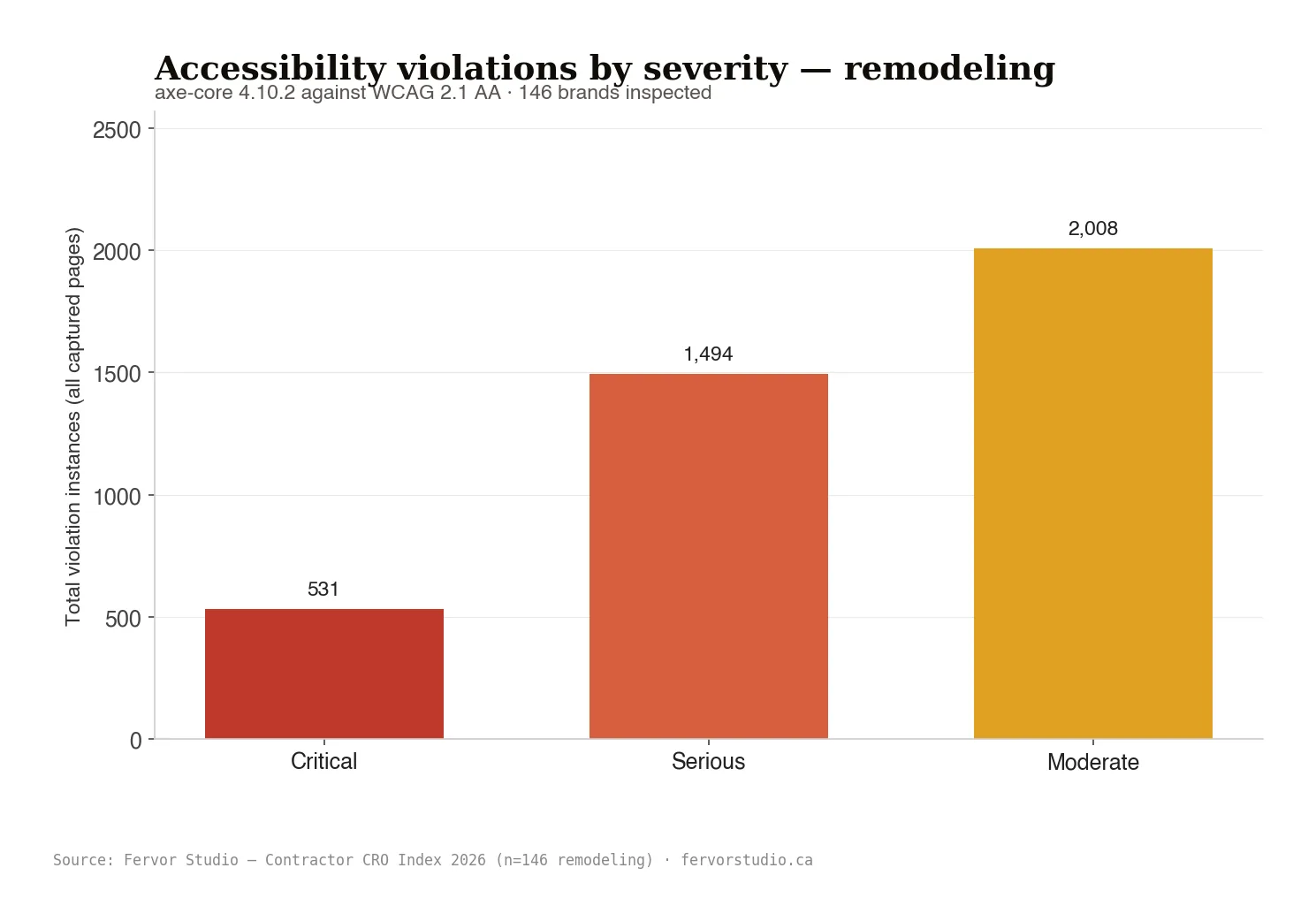
59.6% of remodeling sites we tested fail a critical accessibility check
Digital State of the Remodeling Industry 2026A grade out of 380 contractor sites
We graded 380 of them against one framework. Exactly one earned an A: Crown Industrial Roofing in Toronto, at 90 out of 100. The rest left money on the table. Here is what separates the top from the bottom.
The local detail
Every angle below comes from how Cheyenne actually searches, buys, and regulates — built into the page, not bolted on.
Start with the single most important fact about how this trade gets bought, because every recommendation on this page hangs off it.
But before the tactics, know what’s driving the searches, because the stock writes the keywords.
When the research window closes and she types the hiring query, most of what she sees is the map: three businesses, stars, review counts, photos.
Here’s where remodeling SEO Cheyenne work separates from the template stuff.
Now the page this market specifically rewards: the Ranchettes and the acreage properties north of town.
The planning buyer’s questions are wonderfully predictable, what does it cost, how long does it take, can we live in the house during it, and every one is a page.
And before the engagement sequence, the anti-pattern list, because the failure modes here repeat across the county.
The review stream feeds both machines at once, the pack’s ranking math and the shortlist decision of every buyer who reads it.
You've probably paid for SEO before. And if you run a remodeling shop anywhere from the Avenues to the Ranchettes, odds are the last agency treated this market like a small Denver — and never learned that Wyoming issues no state contractor licence, that the city does, or that half your service area permits through a different government entirely. So now you're wondering whether remodeling SEO in Cheyenne is a real discipline or a template with the city name swapped in. Fair question. This page lays out what it takes here specifically: a profile built for a two-jurisdiction market, project pages for cattle-baron Victorians and ranch-belt remodels, wind-smart exterior content, and the city-licence trust play almost no shop in town has noticed it owns.

Start with the single most important fact about how this trade gets bought, because every recommendation on this page hangs off it.
"Homeowners spend roughly 9.6 months planning a kitchen remodel versus 5.1 months building it — nearly twice as long deciding as doing." — Houzz Inc. (2024)
Nearly ten months of planning, and the high plains calendar compresses the doing into a window the planning has to respect. Exterior work runs roughly May through October before the wind and the ground blizzards take the season back, so the winter quoting wave decides whose summer is booked. The homeowner spends November through March indoors with her laptop, planning. The shop that's visible through those months owns the projects that break ground when the wind drops, and remodeling SEO in Cheyenne is largely the discipline of being that shop.
And this market has a buyer most cities don't: F.E. Warren rotates households in on permanent-change-of-station orders every year, and an arriving military family picks a remodeler the way a transplant does, from scratch, online, with no referral network and not much time. Search visibility is the whole introduction.
"Major kitchen remodels have a median spend of $55,000, compared to $20,000 for minor kitchen projects." — Houzz Inc. (2026)
That's the national median. Cheyenne's working ranges run leaner, with mid-level kitchens commonly in the twenties, which makes this a volume-and-trust market, and the shop that owns the search results owns the volume.
But before the tactics, know what's driving the searches, because the stock writes the keywords. The city's median home went up in 1976, and the layers renovate on different clocks: a small pre-war core east and north of downtown, the Avenues, Rainsford, Capitol North, where Victorian-era and early-1900s craft stock carries the town's architectural memory; a broad 1950s-70s ranch belt now deep into second-kitchen territory; the acreage properties out in the Ranchettes; and the newer subdivisions on the southeast edge aging toward their first refresh.
"38% of homeowners renovating their kitchen cite kitchen deterioration or dysfunction as a reason to renovate." — Houzz Inc. (2026)
"41% of homeowners renovating their kitchen cite dissatisfaction with the old kitchen style as a reason to renovate." — Houzz Inc. (2026)
Two buyers in those numbers, and the high plains supply both: the deterioration buyer in a Fox Farm ranch whose kitchen predates the interstate exits, and the style buyer in a Rainsford Victorian ready to undo a previous owner's 1980s choices respectfully. Your remodeling SEO in Cheyenne has to feed both, because both end at the same consultation. And in a town this size, a gallery showing an Avenues craftsman beside a Ranchettes acreage kitchen shows her you've built for her exact kind of house, the way no homepage can.
When the research window closes and she types the hiring query, most of what she sees is the map: three businesses, stars, review counts, photos. And Google draws that pack around the searcher, downtown, South Greeley, the Ranchettes, and the plains towns out toward Pine Bluffs each render their own version, and a shop with one profile pinned to one warehouse competes in exactly one of them. The I-25 corridor matters too: Colorado plates fill the home-improvement aisles, but a Cheyenne shop's pack presence stops working at the state line unless the profile says otherwise honestly.
So remodeling SEO in Cheyenne starts with an honest account of where your crews actually work, then matches the profile to it: the city neighborhoods named the way locals name them, the Avenues, Rainsford, Fox Farm, the Ranchettes if the trucks go north, and the plains towns only if you genuinely serve them. Your City of Cheyenne contractor licence class belongs in the business description, and photos on a cadence seal it: two uploads a month of real local jobs, a Capitol North kitchen, a ranch-belt bath, an acreage addition framed against that horizon. The pack reads photo recency as a liveness signal, and in this trade the proof is already on your phone.
One more pack detail worth the hour it takes: the Q&A field on your profile. Seed it with the questions local buyers actually ask, are you city-licenced, do you work in the county, can you handle wind-rated exteriors, and answer each in plain English. The pack rewards completeness, and the buyer reads those answers as a preview of working with you. Small move, real remodeling SEO signal for a Cheyenne shop.
Here's where remodeling SEO Cheyenne work separates from the template stuff. Google matches queries to pages, not to businesses, the homeowner searching "bathroom remodel" should land on your bathroom page, not a services pamphlet. The build-out this market wants: kitchens, baths, whole-home, additions, and then the pages no national template carries.
The pre-war craft page, because the Avenues and Rainsford stock is its own discipline. Plaster and balloon framing, foundations a century into Wyoming freeze-thaw, and the cautionary tale written into the Rainsford nomination itself: homes struck from contributing status by insensitive siding, window, and addition work. A page that explains how a sensitive remodel protects both the house and its standing signals more than any badge. And the aging-in-place page:
"68% of homeowners consider special needs (accessibility) when planning their bathroom projects." — Houzz Inc. (2025)
Two-thirds of bathroom buyers are already thinking about it, and the ranch belt's long-tenured owners are planning to stay on one level anyway, the high plains were ahead of that trend by accident. The page that addresses it plainly converts a demographic the portfolio-only competition never speaks to.
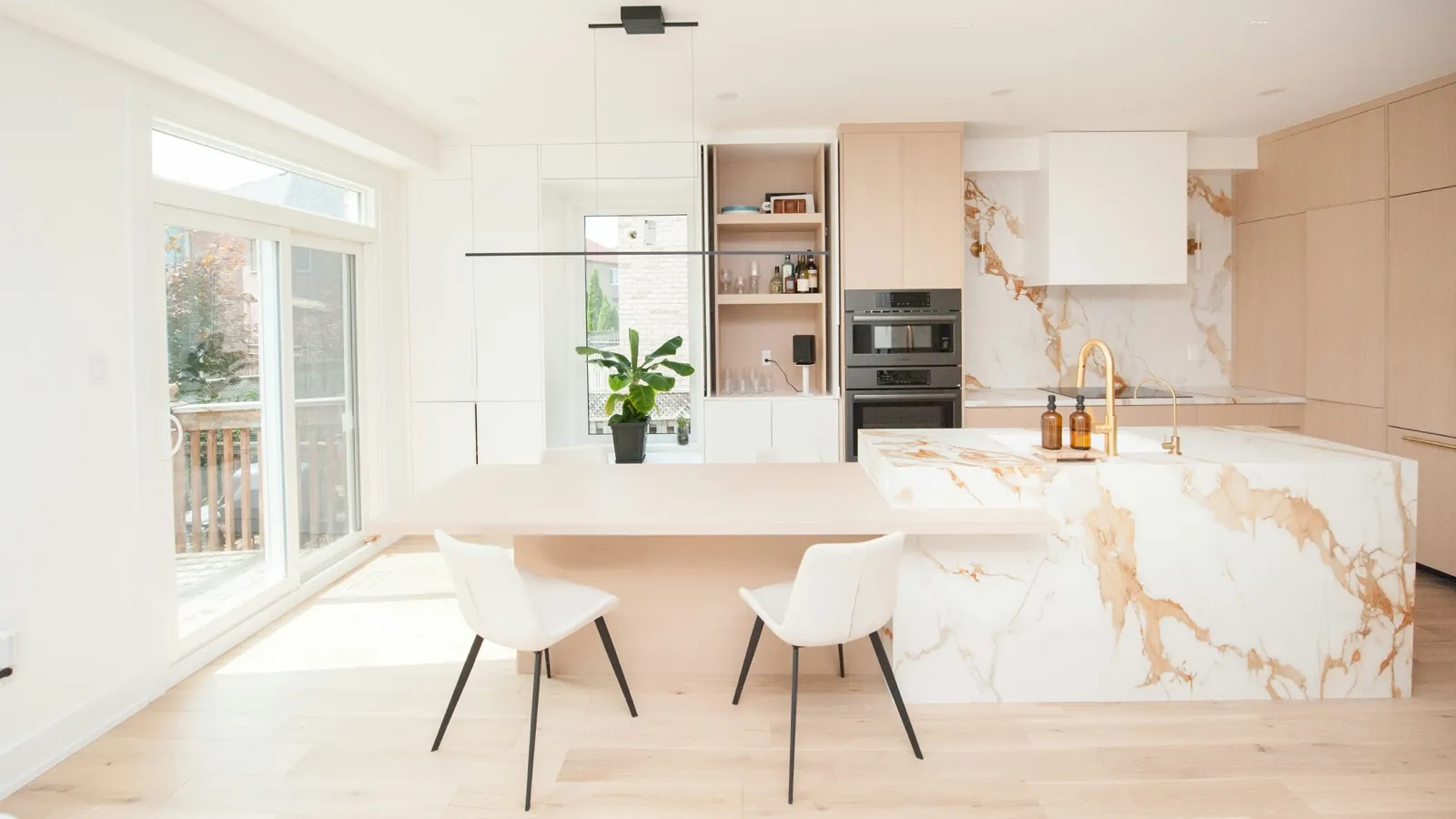
Now the page this market specifically rewards: the Ranchettes and the acreage properties north of town. Acreage remodeling is its own conversation, well and septic capacity deciding whether that second bath is feasible, outbuildings and shops that owners value like the house itself, wind exposure with no windbreak for miles, and it runs through a different government: unincorporated Laramie County permits through County Planning & Development, not the city. A Cheyenne remodeler routinely works both jurisdictions, and almost nobody explains that to the homeowner who only knows she's "in Cheyenne" until the permit comes back from the wrong office.
So build the page that explains it like a local: which addresses permit where, how the county path differs, what well-and-septic math means for bath and kitchen scopes, and how wind-rated materials change an acreage exterior. The search results for all of it are statutes and county PDFs. The shop that publishes the translation becomes the market's translator, and the translator fields the call. That's the half of remodeling SEO in Cheyenne no spreadsheet captures: the authority that compounds when your pages do the explaining the county won't.
The planning buyer's questions are wonderfully predictable, what does it cost, how long does it take, can we live in the house during it, and every one is a page. The cost guide with honest high-plains ranges told plainly. The process walkthrough with the two-jurisdiction permit math. The what-to-expect piece in the same language your lead carpenter uses. And the explainer nobody else in town has written: the wind. At six thousand feet with multi-day wind events, exterior materials, fasteners, and flashing live a harder life here than the catalog assumes, the page that explains what that means for siding, windows, decks, and additions reads like forty years of local experience, because it is.
"76% of homeowners incorporate at least one built-in feature into their kitchen renovation." — Houzz Inc. (2026)
Detail like that is content fuel, and the calendar shapes the schedule: winter is the content season. Cost guides and planning pieces indexed by November own the research months that become the May-to-October build sprint. That rhythm is remodeling SEO working with the Cheyenne calendar instead of against it. And internal links carry the authority where it's needed: every cost guide points to the project page it prices, every project page points back to the consultation path.
And before the engagement sequence, the anti-pattern list, because the failure modes here repeat across the county. The jurisdiction blindness, quoting a Ranchettes job on city permit assumptions. The licence silence, in the one state where the city licence IS the credential and most shops never say so. The catalog exterior, specifying materials the wind will eat in five years. The insensitive-remodel portfolio, showing the Rainsford buyer exactly the work that gets houses struck from the Register. And the review wall that stopped last spring, reading like a business that left.
But every one of those is a competitor you pass simply by not doing it, which is the quiet math of remodeling SEO in Cheyenne: the ten-month researcher stops at the first page that already speaks her neighborhood, her building type, and her budget. And the premium demand exists here too:
"Homeowners with larger kitchens spend more on major remodels (median $75,000) than those with smaller kitchens ($46,000)." — Houzz Inc. (2026)
The bigger-budget work concentrates in the historic core and out on the acreages, buyers who check credentials, read reviews to the bottom, and reward the shop whose content proves it knows a Rainsford Victorian from a southeast-edge build. Their caution eases on proof, not promises: the licence class in the footer, the review stream with this month's date, and content only a local could have written.
The review stream feeds both machines at once, the pack's ranking math and the shortlist decision of every buyer who reads it. And velocity beats volume: forty reviews that stopped last spring read worse than twenty-five with three from this month, because the timestamp is the trust. Make the ask operational. Automated after every project milestone, timed for the evening, linked straight to your profile. Fervor wires it with NiceJob as standard practice, because review velocity is the one ranking-and-trust signal a shop can manufacture one happy client at a time.
And put the licence structure to work, because it's the strangest trust asset in this rollout: Wyoming licenses no general contractors at the state level, electrical is the only state-licensed trade, so the City of Cheyenne's own Contractor Licensing Board and its experience-documented licence classes are the bar that exists. Most shops treat the city licence as paperwork. Treat it as marketing: "City-licenced Class B, experience verified by the licensing board, permits filed in the right jurisdiction every time, in a state with no licence requirement at all, we hold the one Cheyenne actually issues." The buyer who learns the licensing landscape from your page trusts the shop that taught her. The competition that treats it as paperwork structurally cannot.
Fervor's entry point for a Cheyenne shop is the The Local Pick: $2,497 one-time, delivered in about 14 days. The Google Business Profile rebuilt deliberately, categories, jurisdiction-honest service areas, photo cadence, review wiring, citation cleanup, plus the tracking foundation, so the pack work that decides the hiring query is no longer running on defaults. Priced so the payback math works at a single signed kitchen, even at high-plains prices.
The ongoing remodeling SEO engagement for a Cheyenne shop, covering the acreage and pre-war pages, the winter content calendar, review velocity, and monthly reconciliation against your actual consultation pipeline, runs under Performance Partner at $1,497 to $3,997 per month, month to month, every asset registered to you from day one. And the honest boundary: visibility fills the funnel, it doesn't fix the bucket. If your site can't book a 9pm consultation or show a before-and-after gallery, that's the capture layer at remodeling CRO; if the site itself is a slow template, the bones live at remodeling web design. Sequence it: bones, leaks, then visibility.
And it starts with the free Site Inspection: your current site run through the same 100-point framework behind the State of the Remodeling Industry report, scored category by category, every finding handed over whether or not you ever hire us. You shouldn't have to trust us. You should be able to check.
That's the full remodeling SEO Cheyenne system, and the broader playbook lives at remodeling SEO, the trade hub at remodeling marketing, under residential construction, starting from the contractor hub.
Set the expectation against the buyer's own timeline: she plans for nearly ten months, and the high plains calendar concentrates contract-signing ahead of the May-to-October build window. Profile signals move within weeks of the The Local Pick; content compounds over a season. The practical deadline is November, pages indexed by then own the winter research months that become spring contracts. And in a market this size, the compounding is visible fast: there simply aren't many shops publishing anything.
Both, but honestly and separately, because they're different jobs run through different governments. City work means city licence classes and city permits; the Ranchettes mean Laramie County permitting, well-and-septic math, and wind exposure with no windbreak. The mistake is one thin homepage blurring the two, the acreage buyer can tell within a paragraph whether you've actually worked north of town. Speak to each audience on its own page, and let the reviews' geography back you up.
At the state level, none for general contractors, electrical is the only state-licensed trade. The bar that exists is municipal: Cheyenne's own Contractor Licensing Board issues classed licences against documented experience, and unincorporated county work runs on county permits. That vacuum is your opportunity: the shop that explains the landscape and shows its city licence class converts the buyer who just learned, from your page, that nobody in Wyoming was checking otherwise.
Less than buyers fear, and more than shops admit. Rainsford and Capitol North are National Register districts. Listing alone doesn't impose city design review on a private remodel. The local-ordinance exception is the Governor's Mansion Protective Area, where the Historic Preservation Board must find work congruent with the 1890-1930 architecture before significant alteration, and downtown properties face their own design review. The honest page on what triggers review, and what merely deserves a sensitive hand, wins both the cautious buyer and the preservation-minded one.
The fundamentals, absolutely, and start this week regardless. Claim the profile, fix the categories, put the licence class in the footer, photograph the current job, ask the last three happy clients for reviews. That's an afternoon, it's free, and it moves the pack, especially here, where the competition is thin. What's hard to sustain solo is the compounding layer: the acreage and pre-war pages written to rank, the publishing cadence that survives the build sprint, the monthly reconciliation. Do the trust fundamentals yourself; buy the content engine if owning the winter research season is worth more than the retainer.
The evidence
 Read the full report →
 0
contractor sites graded, one A
Across the whole CRO Index, a single site earned an A. The median landed at a D. The grade gap is a conversion gap.
0 %
of remodeling sites fail a critical accessibility check
Scored against WCAG 2.1 AA with axe-core. A page that blocks a screen reader also blocks a paying customer.
Fervor Remodeling State of the Industry, 2026
0 %
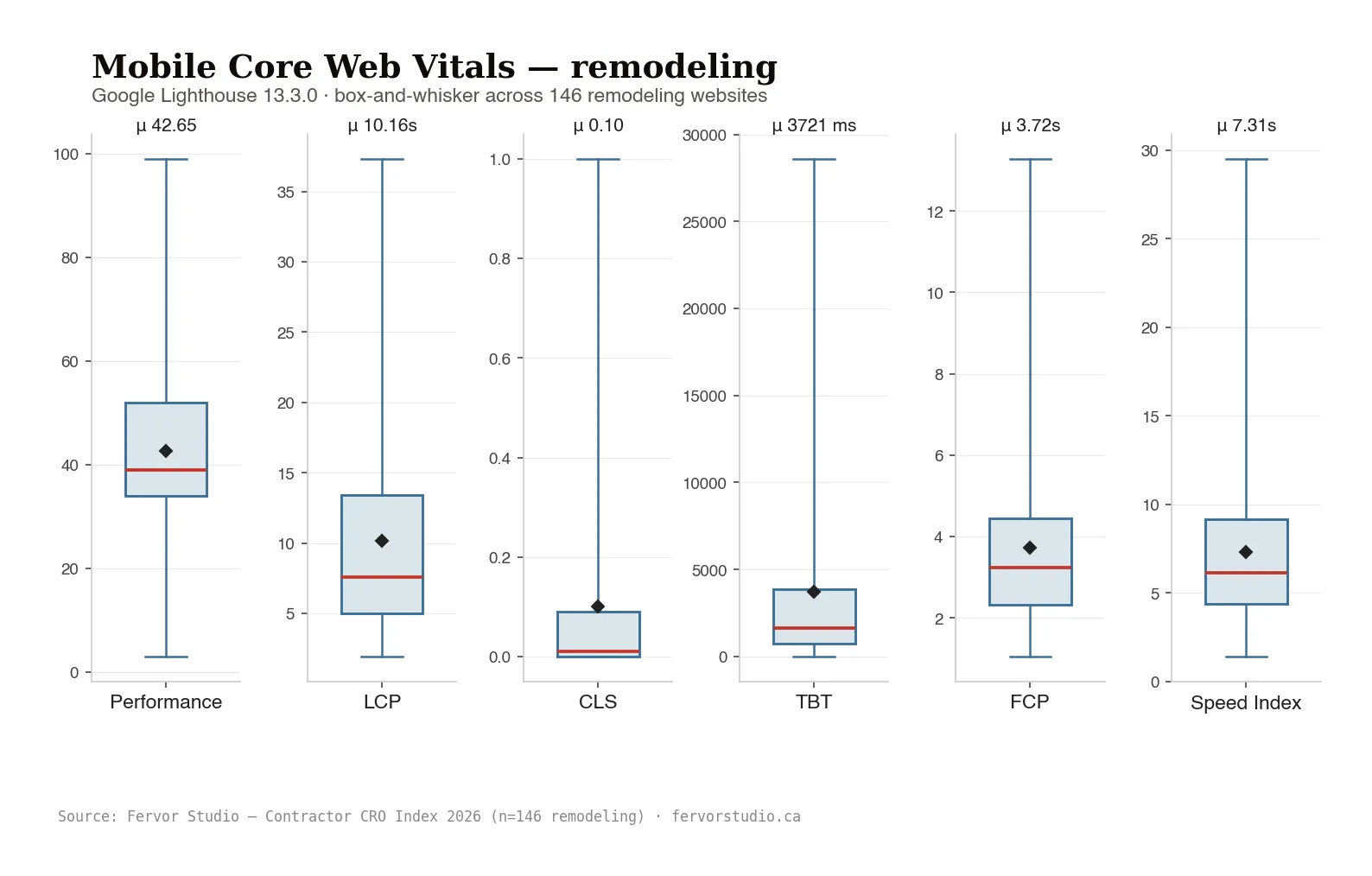
miss Google's mobile load-speed bar
Median mobile load lands at 7.57 seconds. Most of your traffic is on a phone, and most of them are gone before the hero paints.
Fervor Remodeling State of the Industry, 2026
0 /100
is the average remodeling grade
That is a D. The sites booking the work are not the ones with the biggest crews. They are the ones a few points higher on the things homeowners feel.
Two ways to start
Tell us where you are. We point you at the right next step — no sales call to get there.
Client review
“5 stars without hesitation. Working with Fervor has been an amazing experience from start to finish. The level of professionalism was genuinely top tier. Communication was excellent, quick replies, clear updates, and always open to feedback or changes without any problem. What stood out most is that you can tell he genuinely knows web design inside and out from real professional experience, not just someone throwing together templates. He put real effort, care, and thought into the project, even offering his own ideas and suggestions to improve things I hadn't even considered. On top of that, he's genuinely a great guy to deal with, easy to talk to, open-minded, helpful, and clearly passionate about what he does. I'd confidently recommend him to anyone looking for a professional website or branding help. Huge respect and appreciation.”
How Fervor can help
Monthly SEO, content, and CRO. Fixed deliverables. No credits, no rollover. The compound growth engine.
Complete website system built to convert storm leads, planned projects, and research-phase homeowners into booked jobs.
Identify and patch the top conversion killers on your existing site. No full rebuild needed.
GBP optimization, citation building, and review system foundation. The infrastructure that gets you into the Map Pack.
One conversion-built landing page for the referrals, paid clicks, and cold-call leads you send. They land on a page built to book them, not your generic homepage.
Your move
Tell us where you are. We point you at the right next step — no sales call to get there.
Keep going