0
contractor sites graded, one A
Across the whole CRO Index, a single site earned an A. The median landed at a D. The grade gap is a conversion gap.
Right now, someone in Atlanta is Googling "remodeler near me." We get you showing up first — then turn that click into a booked job.
A written report and a ranked fix list, in about three days.
“Patient, on point, straightforward. Did amazing work. Would 100% recommend.” — Ruben Mederos, HyperTemp HVAC
“Responsive, creative, exceeded expectations. Already seeing greater engagement from our clients.” — George Jeorgy, Jeorgy's Landscape Construction
“Top-tier professionalism, real web design expertise, ideas I hadn't considered. Confidently recommend.” — Aws Nassani, Four Eleven Contracting




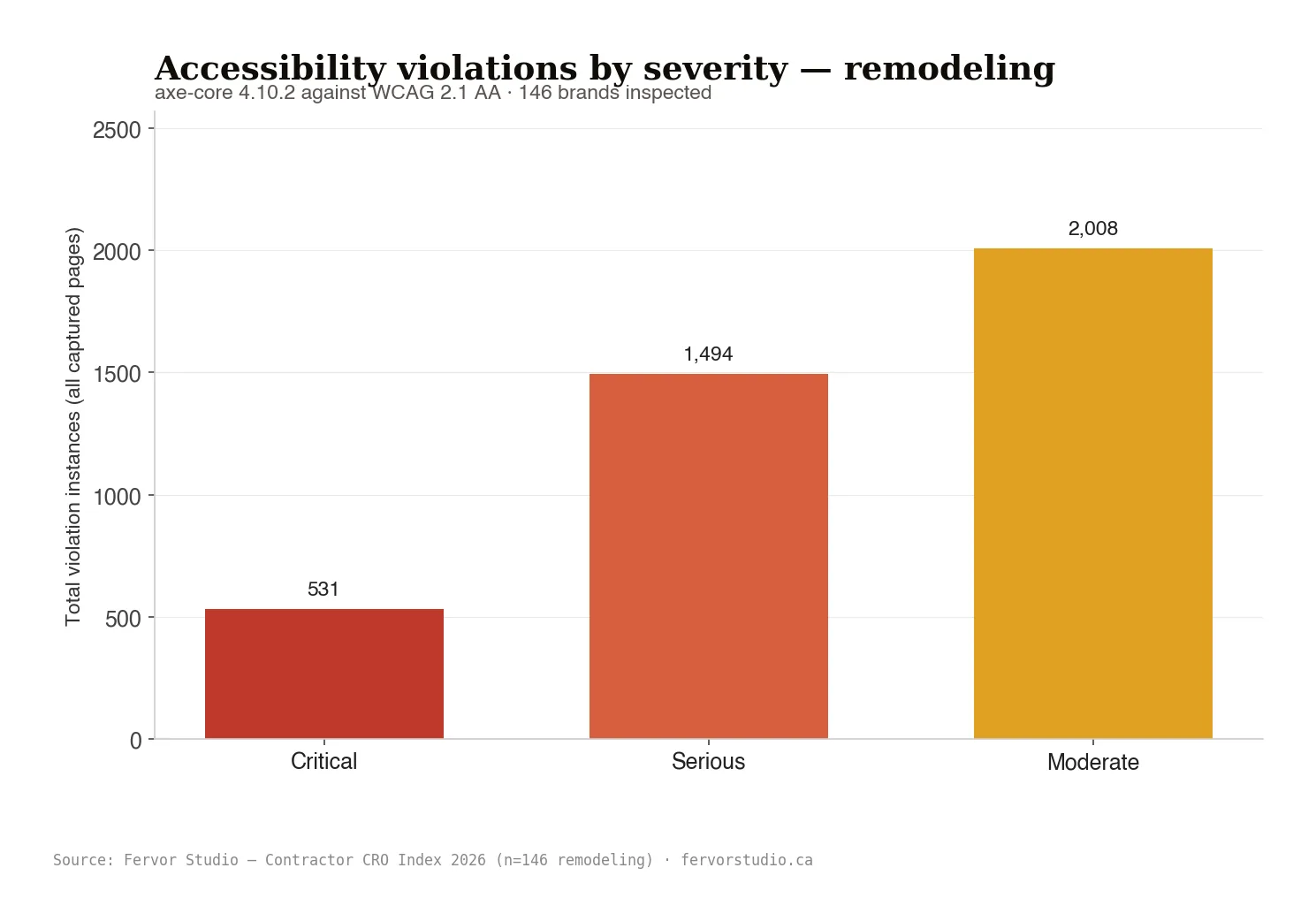
59.6% of remodeling sites we tested fail a critical accessibility check
Digital State of the Remodeling Industry 2026A grade out of 380 contractor sites
We graded 380 of them against one framework. Exactly one earned an A: Crown Industrial Roofing in Toronto, at 90 out of 100. The rest left money on the table. Here is what separates the top from the bottom.
The local detail
Every angle below comes from how Atlanta actually searches, buys, and regulates — built into the page, not bolted on.
Start with the single most important fact about how this trade gets bought, because every recommendation on this page hangs off it.
But before the tactics, know what’s driving the searches, because the stock writes the keywords.
When the research window closes and she types the hiring query, most of what she sees is the map: three businesses, stars, review counts, photos.
Here’s where remodeling seo atlanta work separates from the template stuff.
Now the content asset that separates the locals from the imports.
The planning buyer’s questions are wonderfully predictable.
And before the engagement sequence, the anti-pattern list, because the failure modes here repeat across the metro.
The review stream feeds both machines at once: the pack’s ranking math and the shortlist decision of every buyer who reads it.
You've probably paid for SEO before. And if you run a remodeling shop anywhere from Inman Park to Alpharetta, odds are the last agency treated Atlanta like one market. One homepage for a metro that organizes its entire identity around a highway ring, one strategy for a buyer pool split between 1920s Craftsman bungalows and 1980s Roswell Road traditionals. So now you're wondering whether remodeling SEO Atlanta is a real discipline or a template with the city name swapped in. Fair question. This page lays out what it takes here specifically: a Google Business Profile built for the ITP/OTP divide, project pages for the bungalow belt and the north-side money corridor, Certificate of Appropriateness fluency for the historic districts, and the review engine that decides who wins the renovation-heavy intown neighborhoods.

Start with the single most important fact about how this trade gets bought, because every recommendation on this page hangs off it.
"Homeowners spend roughly 9.6 months planning a kitchen remodel versus 5.1 months building it — nearly twice as long deciding as doing." — Houzz Inc. (2024)
Nearly ten months of planning. That's ten months of searches: cost guides, process questions, before-and-afters, neighborhood-specific worries about crawlspaces and COAs. And the shop that only shows up for the final "remodeler near me" query has skipped the nine months during which she built her shortlist. Remodeling SEO done right gets you into the research window early and keeps you there, which is a completely different project than the emergency-trade SEO most Atlanta agencies recycle from their HVAC accounts.
And the money behind the patience is real:
"Major kitchen remodels have a median spend of $55,000, compared to $20,000 for minor kitchen projects." — Houzz Inc. (2026)
A single captured search, ten months patient, worth five figures at the median. And Atlanta's renovation costs running below most major metros means budgets here stretch further, which keeps the project pipeline thick even when rates pinch. The buyers are out there doing the homework right now.
But before the tactics, know what's driving the searches, because the stock writes the keywords. Intown, the signature inventory is 1920s-1930s Craftsman bungalows: Virginia-Highland, Inman Park, Candler Park, Kirkwood, Grant Park, Cabbagetown, all sitting over vented crawlspaces, carrying unfinished basements and decades of partial renovations that complicate every scope. OTP, the stock skews postwar-to-1980s suburban: two-story traditionals off Roswell Road, the big square footage of Buckhead, Druid Hills, and the Vinings-to-Roswell arc. Two completely different renovation conversations, one metro.
"38% of homeowners renovating their kitchen cite kitchen deterioration or dysfunction as a reason to renovate." — Houzz Inc. (2026)
"41% of homeowners renovating their kitchen cite dissatisfaction with the old kitchen style as a reason to renovate." — Houzz Inc. (2026)
Two buyers in those numbers, and Atlanta has both in bulk: the deterioration buyer in a Kirkwood bungalow whose hundred-year-old kitchen finally surrendered, and the style buyer in a 1987 Sandy Springs traditional who's done living in oak-and-brass. Your content has to feed both, because both end at the same consultation.
When the research window closes and she types the hiring query, most of what she sees is the map: three businesses, stars, review counts, photos. And Google draws that pack around the searcher, which in this metro means Decatur, Buckhead, and Marietta each render a different three-pack, and a shop with one profile pinned to one warehouse competes in exactly one of them.
So remodeling SEO in Atlanta starts with an honest account of where your crews actually work, then matches the profile to it: the intown renovation belt and the BeltLine corridor if that's your book, the GA-400 money corridor from Buckhead through Dunwoody, or the OTP suburbs (Marietta, Smyrna, Alpharetta, Roswell, Lawrenceville), each of which, worth noting on the page itself, permits separately from the city. Your Georgia contractor licence belongs in the business description, because the state requires it for any project over $2,500 and the buyers who check are the ones with budgets. Photos on a cadence: two uploads a month of real local jobs. A bungalow kitchen opened to the dining room in Candler Park, a primary-suite addition in Sandy Springs, crawlspace framing done right, the kind of unglamorous photo that tells a bungalow owner you know what lives under her floor. The pack reads photo recency as a liveness signal, and in this trade you have the most photogenic proof in home services already on your phone.
Here's where remodeling seo atlanta work separates from the template stuff. Google matches queries to pages, not to businesses, so the homeowner searching "bathroom remodel" should land on your bathroom page, not a services pamphlet listing nine offerings in one breath. The build-out this market wants: kitchens, baths, whole-home, additions, basements. And then the two pages no national template carries.
The bungalow renovation page, because the pre-war intown stock is its own discipline: crawlspace realities, plaster walls, hundred-year framing, prior renovations layered like sediment, and the federal lead-safe work rules that govern everything pre-1978. A page that talks about it like someone who's opened those walls signals more than any badge. And the aging-in-place page, because the long-held stock is full of owners planning to stay:
"68% of homeowners consider special needs (accessibility) when planning their bathroom projects." — Houzz Inc. (2025)
Two-thirds of bathroom buyers are already thinking about curbless showers and grab bars. The page that addresses it plainly converts a demographic the portfolio-only competition never speaks to.
Now the content asset that separates the locals from the imports. Exterior changes visible from the street in the City of Atlanta's historic districts need a Certificate of Appropriateness from the Urban Design Commission before a building permit will issue. Minor scopes get approved at staff level, larger ones go through a public hearing of the eleven-member commission. Every bungalow-belt owner planning an addition has stumbled into that fact mid-research and gone looking for someone who knows the path.
So build the page that explains it like a local: which districts trigger review, what staff-level approval covers, the realistic timeline math (straightforward residential permits run weeks, kitchen and bath remodels commonly stretch six to fourteen weeks from submission to final inspection, and an inspection backlog can add days per cycle), and how your shop sequences COA before permit before demo. While you're at it, the ADU page: detached units are permitted in R-4, R-4A, and R-5 zones at up to 750 square feet and 20 feet of height, with full cooking facilities required and short-term rental gated behind owner occupancy. And the city has proposed expanding attached ADUs citywide, which means the search demand is about to grow into a near-empty SERP. The shop that publishes the translation becomes the name the bungalow belt passes around when a neighbor asks who finally made the Urban Design Commission make sense. No spreadsheet line item captures that kind of word-of-mouth, but it's the authority that compounds when your pages do the explaining the city won't.
The planning buyer's questions are wonderfully predictable. What does it cost, how long does it take, can we live in the house during it. And every one is a page. The cost guide with honest Atlanta ranges. The process walkthrough with real permit math, including the ITP/OTP jurisdiction difference nobody else writes down. The what-to-expect piece in the same plain language your estimator uses across a kitchen island.
"76% of homeowners incorporate at least one built-in feature into their kitchen renovation." — Houzz Inc. (2026)
Detail like that is content fuel, and Atlanta's calendar shapes the schedule: the mild winters keep interior and most exterior work running year-round, the spring pollen wave films every outdoor surface yellow and complicates exterior finishing windows, and the long humid summer is addition-and-basement season. Publish planning content through the winter, exterior-project content after the pollen clears, and keep the cadence steady, because a steady publishing rhythm is itself a ranking signal in a market where most contractor blogs died two years ago. And that abandonment is your opening: remodeling seo in atlanta is largely uncontested at the content layer, because the shops with the craft don't publish and the shops that publish don't have the craft.
And before the engagement sequence, the anti-pattern list, because the failure modes here repeat across the metro. The Perimeter flatten: one homepage claiming "metro Atlanta" from a shop that actually works three intown zip codes, with rankings to match. The bungalow-blind portfolio, showing nothing but new-build-style kitchens to a market whose most renovation-hungry neighborhoods are a century old. The COA silence, leaving every historic-district owner to figure out the Urban Design Commission alone, then hire whoever finally explained it. The jurisdiction blur, pretending Cobb, Gwinnett, and the city share a permit office. And the review wall that stopped last spring, reading like a business that left.
But every one of those is a competitor you pass simply by not doing it. That's the quiet math of remodeling seo atlanta work: the ten-month researcher stops at the first page that already speaks her neighborhood, her housing stock, and her approval process. And the demand skews toward exactly the buyers worth winning:
"Homeowners with larger kitchens spend more on major remodels (median $75,000) than those with smaller kitchens." — Houzz Inc. (2026)
The big-kitchen money concentrates in Buckhead, Druid Hills, and the north-side corridor. These are the same buyers who check licences, read reviews to the bottom, and reward specificity. What earns their trust is concrete: the licence in the footer, the review stream with this month's date on it, and content only a local could have written. Those are the remodeling seo atlanta fundamentals nobody can fake.
The review stream feeds both machines at once: the pack's ranking math and the shortlist decision of every buyer who reads it. And velocity beats volume: forty reviews that stopped last spring read worse than twenty-five with three from this month, because the timestamp is the trust. Make the ask operational. Automated after every project milestone, timed for the evening, linked straight to your profile. Fervor wires it with NiceJob as standard practice, because review velocity is the one ranking-and-trust signal a shop can manufacture one happy client at a time.
But respond to all of them, especially the rare three-star, because the response is content: it's the only place a Grant Park homeowner can watch you handle a problem before she hires you to handle hers. And put the credential where she can check it. Georgia's licence registry is public, your Residential Basic licence belongs in the footer beside the $25,000 financial-responsibility proof the state already made you carry. "Verify us yourself" is the cheapest trust move in a market where everyone has a bad-contractor story from the flip boom.
Fervor's entry point for a Atlanta shop is the The Local Pick: $2,497 one-time, delivered in about 14 days. The Google Business Profile rebuilt deliberately: categories, Perimeter-honest service areas, photo cadence, review wiring, citation cleanup, plus the tracking foundation, so the pack work that decides the hiring query is no longer running on defaults. Priced so the payback math works at a single signed kitchen.
The ongoing engagement (the bungalow and COA pages, the planning-window content calendar, review velocity, monthly reconciliation against your actual consultation pipeline) runs under Performance Partner at $1,497 to $3,997 per month, month to month, every asset registered to you from day one. And the honest boundary: visibility fills the funnel, it doesn't fix the bucket. If your site can't book a 9pm consultation or show a before-and-after gallery, that's the capture layer at remodeling CRO; if the site itself is a slow page-builder template, the bones live at remodeling web design. Sequence it: bones, leaks, then visibility.
And it starts with the free Site Inspection: your current site run through the same 100-point framework behind the State of the Remodeling Industry report, scored category by category, every finding handed over whether or not you ever hire us. You shouldn't have to trust us. You should be able to check.

That's the full remodeling seo atlanta system — and the broader playbook lives at remodeling SEO, the trade hub at remodeling marketing, under residential construction, starting from the contractor hub.
Set the remodeling SEO Atlanta expectation against the buyer's own timeline: she plans for nearly ten months, so a campaign starting today is planting in research windows that close two and three quarters out. Profile signals move within weeks of the The Local Pick; content compounds over a season. And the compounding is the point. A bungalow-renovation guide published this quarter earns rankings, links, and bookmarks for years, while the ads your competitors rent stop the day the budget does. Every quarter you wait is a planning wave their content gets to own uncontested.
Wherever your trucks already win, said honestly. The intown bungalow belt rewards craft specificity and COA fluency; the OTP suburbs reward addition-and-replacement depth on newer stock and respect for the county permit differences. The mistake is claiming both with one thin homepage. The pack reads your reviews' geography and your service-area list, and a shop that's really a Decatur operation pretending to cover Alpharetta ranks in neither. Pick the half that matches your pipeline, win it visibly, then expand with proof. And when you do expand, expand the way the metro grows, one suburb at a time, with a real page, real photos from real jobs there, and the county's actual permit office named. The pack rewards profiles whose claims match their evidence, and so do the neighbors comparing notes on the neighborhood Facebook group, which in this metro is half the referral economy anyway.
It's the single most valuable page an intown shop can own. Every historic-district project legally runs through the Urban Design Commission before a permit issues, every owner discovers that mid-research, and almost no contractor explains it in plain English. The page that does becomes the authority the whole bungalow belt forwards to their neighbors, and the projects it attracts are exactly the renovation-heavy, detail-tolerant clients worth having. Plus it compounds: COA fluency demonstrated in public is a differentiator no OTP-based competitor can fake.
The fundamentals, absolutely. And start this week regardless. Claim the profile, fix the categories, put the Georgia licence in the footer, photograph the current job, ask the last three happy clients for reviews. That's an afternoon, it's free, and it moves the pack. What's hard to sustain solo is the compounding layer: the bungalow and COA pages written to rank, the publishing cadence that survives your busy season, the reconciliation that tells you what's working. Most owners carry it for two months and then the dispatch board wins, which is rational. Do the trust fundamentals yourself; buy the content engine if owning the planning season is worth more than the retainer.
Treat it as its own demand stream, because buyers do. The corridor's renovation wave runs on walkability premiums and rising values, the stock is the same pre-war inventory as the rest of the belt, and "BeltLine" is a term locals actually search with. A corridor-aware page covering what renovations the overlay districts allow, what the premium stock rewards, and real projects within walking distance of the trail speaks to a buyer identity no generic Atlanta page touches. It's the same principle as everything else here: specificity is the whole game.
The evidence
 Read the full report →
 0
contractor sites graded, one A
Across the whole CRO Index, a single site earned an A. The median landed at a D. The grade gap is a conversion gap.
0 %
of remodeling sites fail a critical accessibility check
Scored against WCAG 2.1 AA with axe-core. A page that blocks a screen reader also blocks a paying customer.
Fervor Remodeling State of the Industry, 2026
0 %
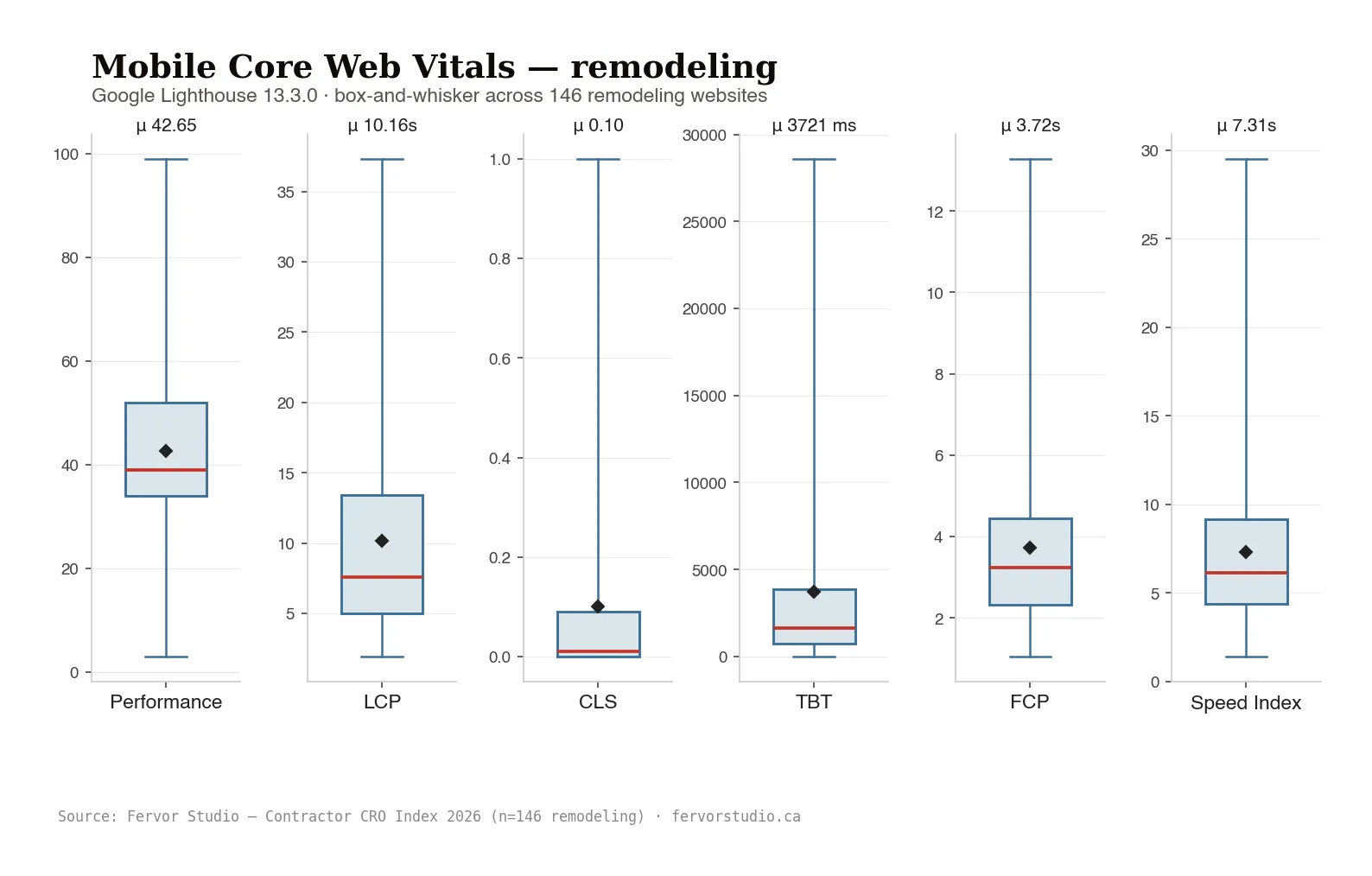
miss Google's mobile load-speed bar
Median mobile load lands at 7.57 seconds. Most of your traffic is on a phone, and most of them are gone before the hero paints.
Fervor Remodeling State of the Industry, 2026
0 /100
is the average remodeling grade
That is a D. The sites booking the work are not the ones with the biggest crews. They are the ones a few points higher on the things homeowners feel.
Two ways to start
Tell us where you are. We point you at the right next step — no sales call to get there.
Client review
“5 stars without hesitation. Working with Fervor has been an amazing experience from start to finish. The level of professionalism was genuinely top tier. Communication was excellent, quick replies, clear updates, and always open to feedback or changes without any problem. What stood out most is that you can tell he genuinely knows web design inside and out from real professional experience, not just someone throwing together templates. He put real effort, care, and thought into the project, even offering his own ideas and suggestions to improve things I hadn't even considered. On top of that, he's genuinely a great guy to deal with, easy to talk to, open-minded, helpful, and clearly passionate about what he does. I'd confidently recommend him to anyone looking for a professional website or branding help. Huge respect and appreciation.”
How Fervor can help
Monthly SEO, content, and CRO. Fixed deliverables. No credits, no rollover. The compound growth engine.
Complete website system built to convert storm leads, planned projects, and research-phase homeowners into booked jobs.
Identify and patch the top conversion killers on your existing site. No full rebuild needed.
GBP optimization, citation building, and review system foundation. The infrastructure that gets you into the Map Pack.
One conversion-built landing page for the referrals, paid clicks, and cold-call leads you send. They land on a page built to book them, not your generic homepage.
Your move
Tell us where you are. We point you at the right next step — no sales call to get there.
Keep going