0
contractor sites graded, one A
Across the whole CRO Index, a single site earned an A. The median landed at a D. The grade gap is a conversion gap.
You're getting clicks in Seattle. They're just not calling. We rebuild your site around the one job that matters: turning a visitor into a booked job.
Starts with a Site Inspection, so you see the plan before any build begins.
“Patient, on point, straightforward. Did amazing work. Would 100% recommend.” — Ruben Mederos, HyperTemp HVAC
“Responsive, creative, exceeded expectations. Already seeing greater engagement from our clients.” — George Jeorgy, Jeorgy's Landscape Construction
“Top-tier professionalism, real web design expertise, ideas I hadn't considered. Confidently recommend.” — Aws Nassani, Four Eleven Contracting




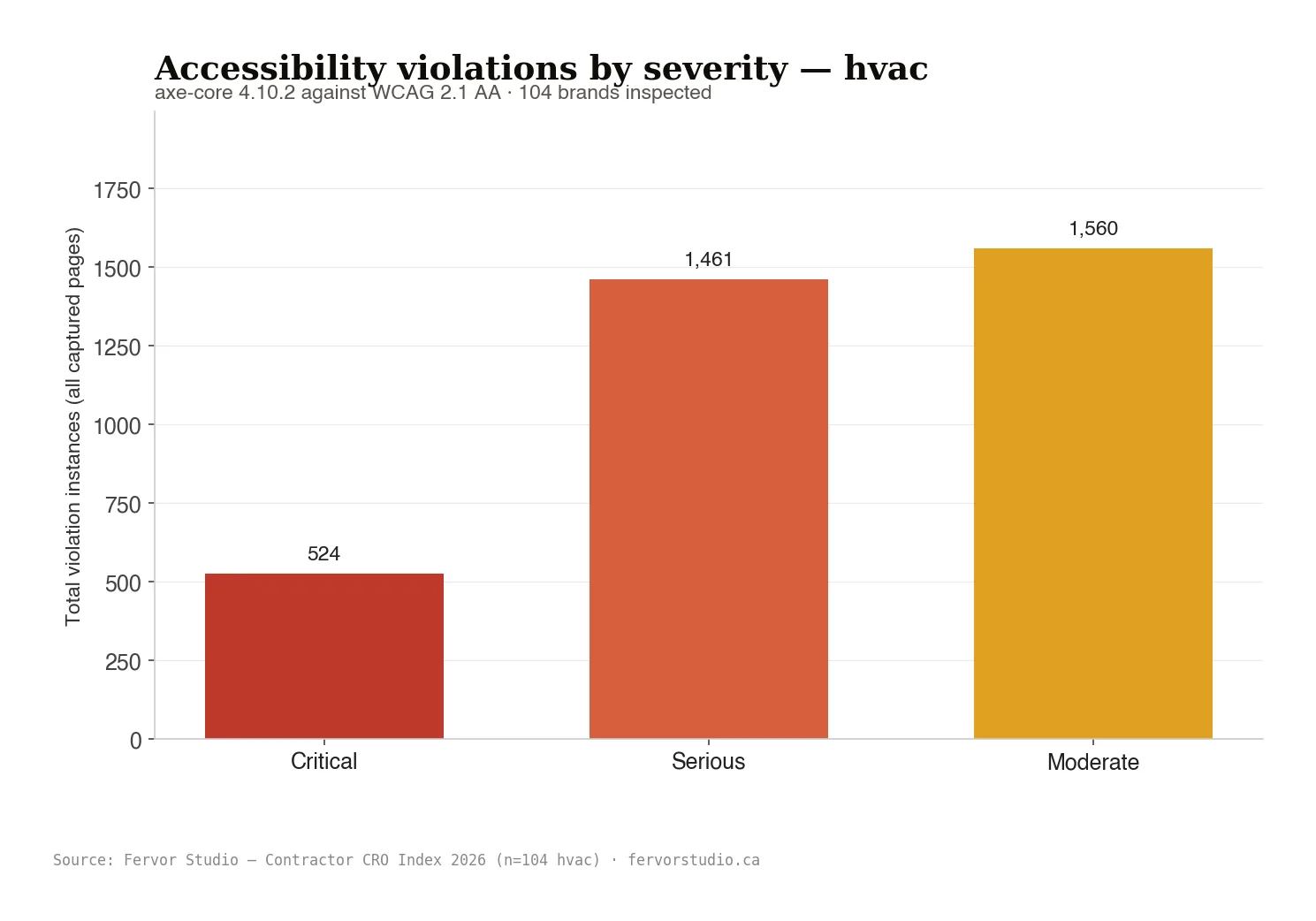
64.4% of HVAC sites we tested fail a critical accessibility check
Digital State of the HVAC Industry 2026A grade out of 380 contractor sites
We graded 380 of them against one framework. Exactly one earned an A: Crown Industrial Roofing in Toronto, at 90 out of 100. The rest left money on the table. Here is what separates the top from the bottom.
The local detail
Every angle below comes from how Seattle actually searches, buys, and regulates — built into the page, not bolted on.
Seattle doesn't have one busy season — it has several: heat-dome cooling adoption (June-September) → first-time AC/heat pump install in a historically no-AC city (June 2021: 108F record); wildfire smoke season (August-October) → IAQ, filtration, smoke infiltration; damp mild winter (November-March) → heat pump service, mold/moisture complaints, dehumidification. The pages are built so each one is already ranking when it hits.
Homeowners search rebates before they call: Seattle City Light heat pump (live), PSE heat pump (live) and Washington HEAR (Dept of Commerce) (live). We surface only what's actually live and link the source, instead of quoting numbers that expired.
Washington L&I contractor registration + electrical licensing. The site states it plainly — the trust signal local buyers look for before they book.
Seattle proper = Seattle City Light; most suburbs = Puget Sound Energy. Rebate eligibility follows the utility - service-area pages must say which side of the line a neighbourhood sits on.
Ductless mini-splits for duct-free pre-1960 stock, MERV-13+/ERV for wildfire smoke season and Heat pumps as full heating replacement (mild marine winters). The build speaks to the systems Seattle homeowners actually buy, not a generic catalogue.
So picture the visitor your site exists for, because this metro mints a new kind of HVAC customer every summer now.
Fervor inspected HVAC contractor websites across North America for the State of the HVAC Industry report: one framework, evidence archived, no self-reporting.
And Seattle’s demand curve makes the math unusual: the emergency season is new, growing, and concentrated.
You've probably been told your website "could use a refresh," by someone who didn't ask a single question about your business first. And if you run a shop anywhere from Ballard to Bellevue, odds are the refresh you bought last time was a prettier coat on the same slow skeleton, approved on a desktop in an office, useless to the Wallingford homeowner sweating through the third heat advisory in a city that never used to have them. So here's what HVAC web design in Seattle actually has to carry: the fastest residential heat-pump conversion wave on the West Coast, a housing stock that runs from 1910s Craftsman bungalows to Eastside new-builds, and a four-second cellular window before the visitor backs out to the next result. This page lays out the build that wins that moment, with the inspection numbers behind every recommendation.
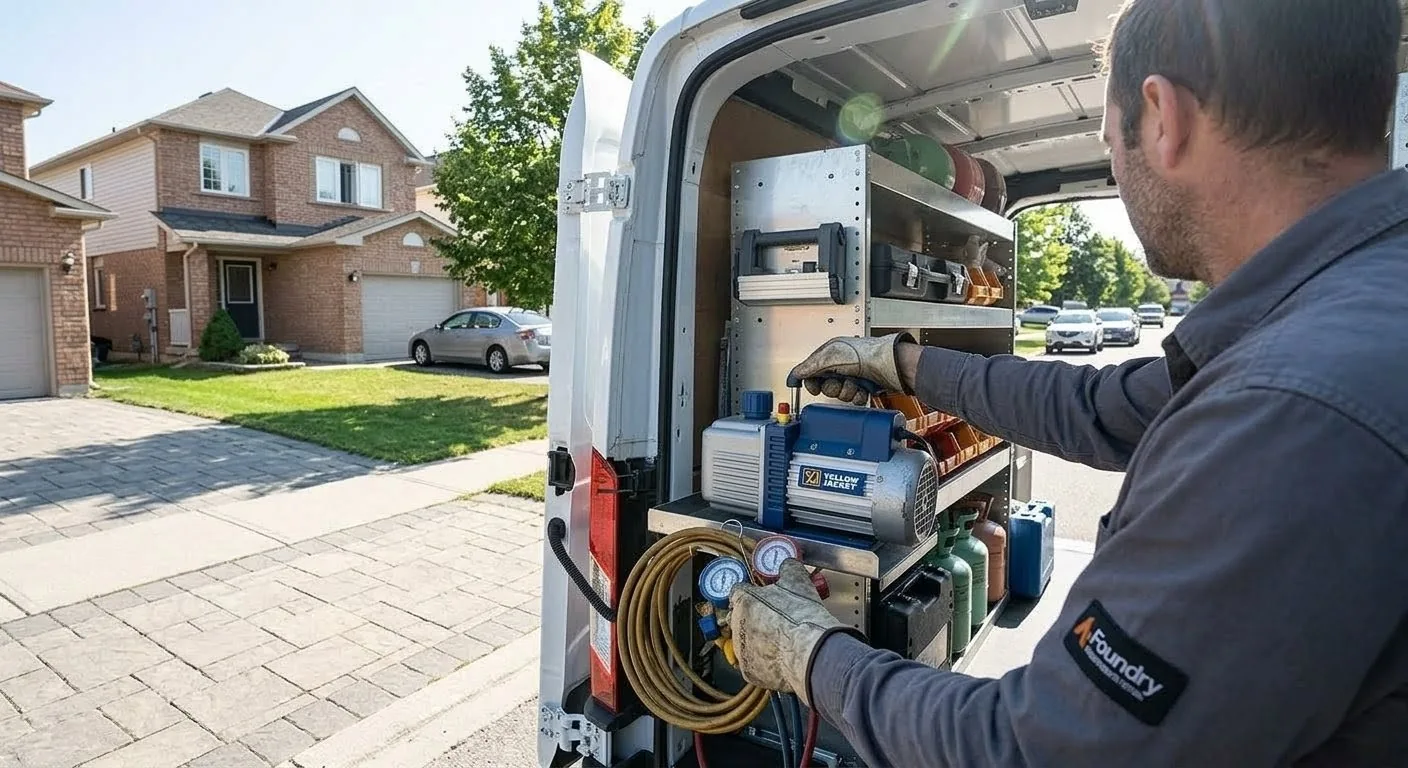
So picture the visitor your site exists for, because this metro mints a new kind of HVAC customer every summer now. A Green Lake homeowner in a 1920s bungalow that has never had cooling watches the forecast hit ninety-three, searches "heat pump installation" from her phone, and taps your result. What renders in the next four seconds, a headline and a tappable number, or a white screen buffering a hero video, decides whether your comfort advisor gets the visit.
And that's the moment most Seattle HVAC web design never plans for, because builds get approved in cool offices on fiber by people who already know the company. The homeowner who pays the invoices judges the build in heat, on cellular, in seconds. Web design that starts from her moment and works backward wins before anyone compares logos.
"The median HVAC contractor website scores 65 of 100, and the single best site in the study reached 90." — Fervor, State of the HVAC Industry (2026)
And that's the measured field — it isn't a high bar. A Seattle shop whose build clears the failures below doesn't need to out-spend anyone in a tech-literate, expensive market; the build itself becomes the moat. (If the problem is being found at all, that's the Seattle HVAC SEO conversation. The system-wide picture lives at the HVAC web design hub.)
Fervor inspected HVAC contractor websites across North America for the State of the HVAC Industry report: one framework, evidence archived, no self-reporting. And the design-layer findings argue for everything below.
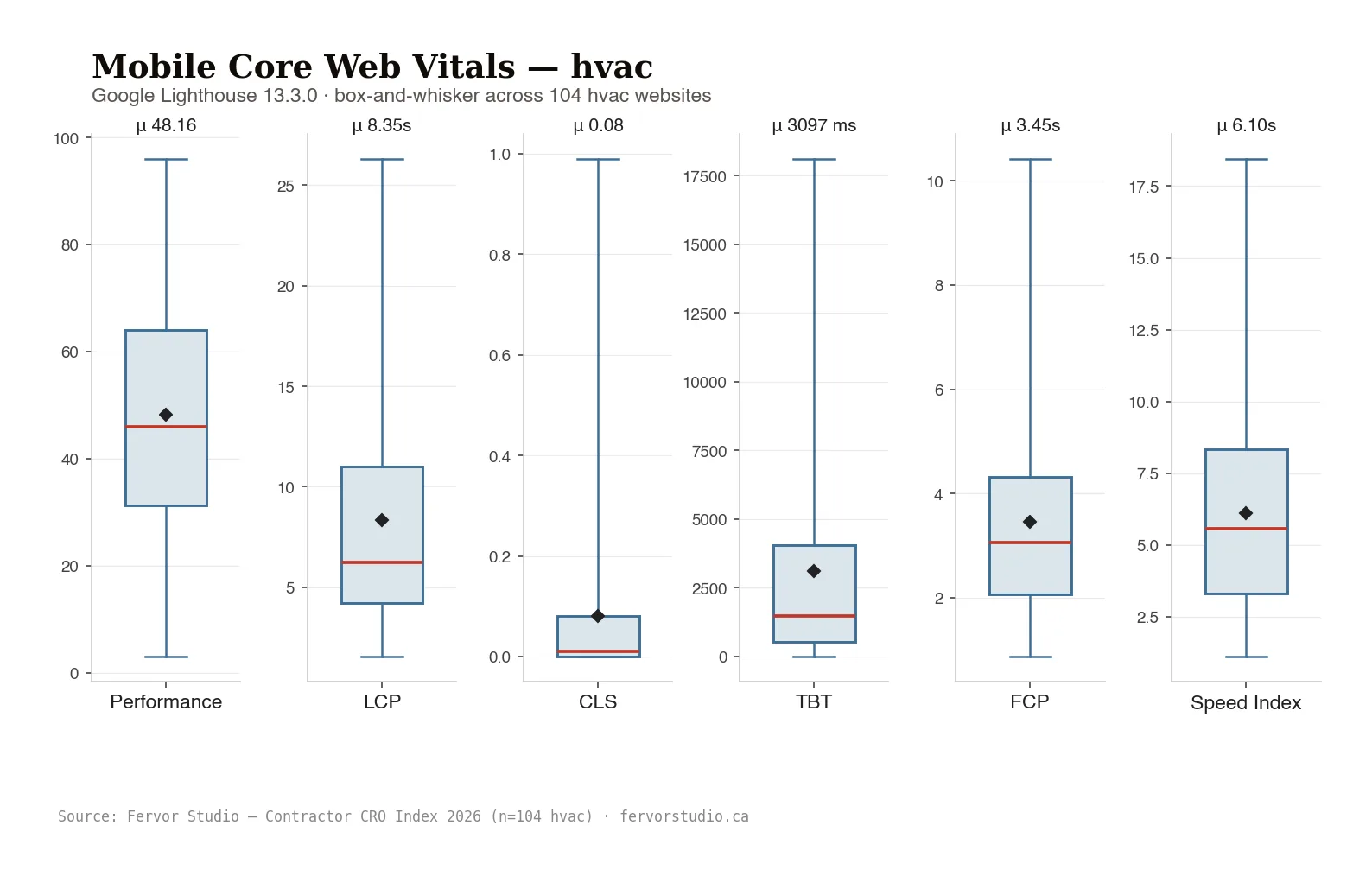
"80.8% of HVAC websites post a poor mobile Largest Contentful Paint, with the average main content taking 8.35 seconds to load." — Fervor, State of the HVAC Industry (2026)
And that's eight seconds, in the one metro where your customer might literally work on page speed for a living. Seattle's homeowners are the most build-quality-literate audience in the country: Amazon and Microsoft engineers who notice a janky site the way you'd notice a rattling compressor. Four of five trade sites fail Google's mobile speed test; here, the failure doesn't just lose the impatient, it actively signals incompetence to the technical.
"71.2% of HVAC websites fail Google's mobile Total Blocking Time threshold, so the page looks loaded while it ignores the homeowner's taps." — Fervor, State of the HVAC Industry (2026)
And that second number is the crueler one. But here's how it plays: the page paints, she taps the number, nothing happens. The main thread is still chewing a page builder's scripts. She taps twice and leaves. Your analytics counted a visit; your dispatcher heard silence. So when you evaluate HVAC web design in Seattle, the first question isn't "what will it look like." It's "what does it score on a throttled phone," because that's the design decision every heat-advisory visitor experiences first.
And Seattle's demand curve makes the math unusual: the emergency season is new, growing, and concentrated. The heat advisories that now arrive most summers send a no-AC housing stock searching in waves, the shoulder seasons run heat-pump conversion research year-round, and the mild winters still produce real no-heat mornings in the old stock. Every wave lands on phones.
So a speed-first Seattle HVAC web design build specifies the unglamorous list every passing site in the study shares: WebP images compressed and sized to the requesting screen, no drag-and-drop builder dragging its payload onto every page, self-hosted fonts, the phone number as tappable text in the first paint, a hero that ships the headline before the photograph. None of it is exotic. But all of it has to be chosen at architecture time, because retrofitting speed into a bloated build costs more than building clean the first time. That's the working definition of HVAC web design Seattle shops should hold their agencies to: speed as a specification, not an aspiration.
And approve the next build the way your customers will use it: on a phone, on cellular, in a hot upstairs bedroom. The desktop demo is how good shops end up with bad builds.
And what loads before the first scroll is a designed artifact: headline, proof, next step, in that order, fast. The framework scores it as its own category, and the trade's results show how few sites ever made a deliberate choice about it.
"Mobile experience averages 10.89 of 15 points across HVAC contractor websites, 72.6% of the category maximum." — Fervor, State of the HVAC Industry (2026)
But that's passable-sounding only until you watch the top of the field use the same screen. The best above-the-fold builds answer three questions in two seconds: what you do, where you do it, what to tap. For a Seattle build the answers write themselves: heat pumps and cooling first in a converting market, the neighborhoods and Eastside cities you actually run (Ballard, Wallingford, West Seattle, Bellevue, Kirkland, Redmond, Renton), and a thumb-sized call target. The bottom of the field opens with a stock photo of the Space Needle and the word "Welcome," and pays for that choice every advisory week.
So treat the first screen as the most expensive real estate the business owns. HVAC web design for a Seattle shop is mostly the craft of refusing to waste it — and in a metro where a decade of transplants knows no contractors at all, the first screen isn't competing with your reputation. It's standing in for it.
But a template doesn't know this market, and Seattle's stock punishes templates in a specific way: the city's defining product, the ductless or ducted heat pump retrofit into a house built without cooling, barely exists in national template libraries. Real HVAC web design in Seattle architects the pages around what the metro actually buys: heat pump conversion as the franchise page, ductless mini-splits for the Craftsman stock of Ballard, Wallingford, and West Seattle, electric-furnace swaps in the mid-century stock, gas furnace service for the holdouts, and IAQ with a wildfire-smoke angle that now arrives most Augusts.
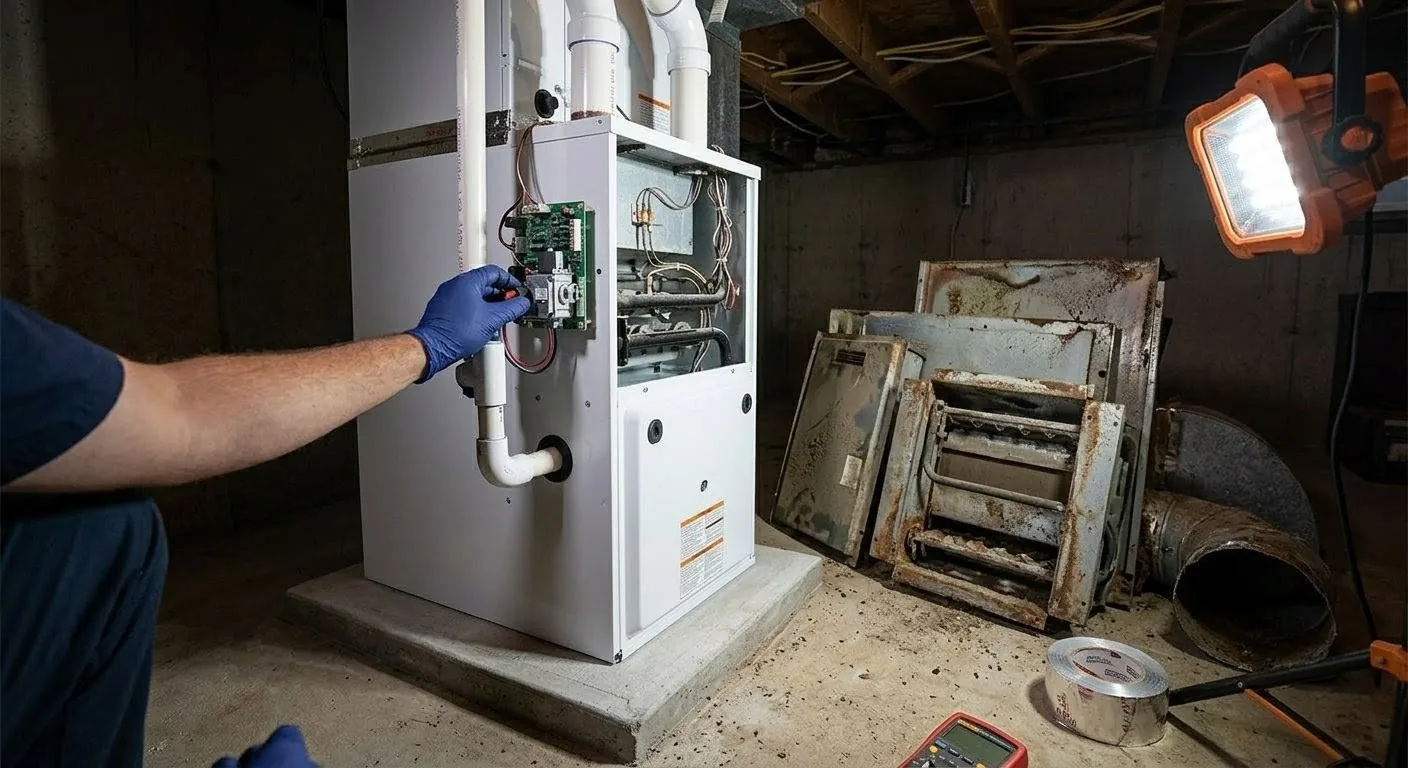
And each page carries Puget Sound proof: real jobs in named neighborhoods, the Washington license, an honest service map that respects the lake: a Seattle-side shop and an Eastside shop are different businesses in traffic terms, and the architecture should say which you are. But the conversion-wave pages deserve the deepest investment, because they're selling a five-figure decision to a homeowner doing months of research. The page that explains sizing for a no-duct bungalow, what a head in each bedroom actually costs, and what the install week looks like becomes the reference document the whole neighborhood passes around. That's also where field software enters the build: if your shop runs on Housecall Pro, the build should wire its scheduler in from day one, because integrations designed-in behave better than integrations bolted on.
A word on why the architecture matters beyond reading well: Google maps queries to pages, not businesses. The shop with a real ductless-retrofit page wins that search against the shop with a bullet point, every time — and in this metro that's the highest-value search there is. Structure is strategy.
And the build should carry a seasonal slot, because Seattle's new calendar is designable. A swappable homepage banner (conversion-planning content in spring, advisory-readiness from June, smoke-season IAQ in August, heating checks in November) keeps the site answering the question the metro is actually asking that month. But the slot has to exist in the web design itself, with someone assigned to flip it, or the spring banner greets the August searcher and the build reads abandoned.
Here's the design-layer finding that should embarrass the trade's agencies most.
"98.1% of HVAC websites we audited have at least one serious accessibility violation." — Fervor, State of the HVAC Industry (2026)
So effectively the whole trade ships builds with serious accessibility failures, and the common ones are pure sloppiness: text without contrast, links without names, headings out of order. Every one is a developer who never ran a free automated check on a five-figure build.
"HVAC websites average 3.5 of 8 available accessibility points, just 43.8% of the category maximum and the weakest result in the framework." — Fervor, State of the HVAC Industry (2026)
And it's the weakest category in the entire framework, which makes it the cheapest differentiation available — particularly in a city whose civic culture and whose employers take accessibility seriously enough that your customers notice. And clean builds overlap almost perfectly with what search engines reward, so they win twice. Ask anyone pitching Seattle HVAC web design the unglamorous question. Does it pass an automated accessibility scan at launch? Then watch who changes the subject to mockups.
And the build's invisible layer earns its keep too. Structured data tells Google what the business is (services, areas, hours, reviews) in the format it parses directly, and only about a fifth of HVAC contractors ship HVACBusiness schema at all. A Seattle build that deploys complete structured data, clean URLs, and one intent per page starts ahead of four-fifths of the market on pure build quality.
"Content and SEO scores average 8.79 of 15 across HVAC contractor websites, 58.6% of the available points." — Fervor, State of the HVAC Industry (2026)
And to be honest about the boundary of web design: the build creates the conditions for ranking; the campaign does the ranking. Profile, reviews, content velocity: that's the Seattle HVAC SEO discipline, and a good build hands it a site that doesn't fight back. A shop that ships clean structure and never feeds it content has bought a stadium and skipped the season.
The same honesty applies on the other side. A fast, accessible, well-structured site still has to convert its visitors: booking flows, capture channels, trust signals, the review velocity tools like NiceJob maintain. That's conversion work with its own page: the leak list and the 30-day fix live at HVAC website conversion in Seattle. Build the bones right here; plug the leaks there. In that order.
Fervor's build for a Puget Sound shop is Booked by Design™: $9,997 to $12,997 for HVAC, delivered in 30 to 60 days. Mobile-first against the speed numbers above, one architected page per service with the conversion-wave pages first, accessibility-clean on an automated scan from launch, structured data complete, and the Washington-specific proof (license, real neighborhoods, honest lake-aware service map) designed in rather than sprinkled on. You own everything from the first invoice: domain, code, content, analytics. That's policy rather than a perk, because the hostage-asset story (the agency that owns your domain until you stop asking questions) is the most common one Puget Sound owners bring us.
And if you're comparing Seattle HVAC web design quotes, steal the vetting list. A mobile Lighthouse score on a build shipped this year, not a portfolio screenshot. An automated accessibility scan before launch. Who owns the domain and analytics the day the invoice clears. The redirect plan that protects existing rankings through migration. Builders answer all four without blinking; decorators show mockups, and a mockup has never once loaded in a hot upstairs bedroom during an advisory.
And the napkin math: average conversion ticket (and Seattle heat-pump tickets run among the highest in the trade) times gross margin, times the three-to-five incremental jobs a season a faster, cleaner build recovers, all measured against a one-time price on an asset that keeps working every season after. Ongoing work after launch, when the monthly reporting has earned its keep against your own dispatch board, runs under Performance Partner at $1,497 to $3,997 per month, month to month.
Not sure the site is the problem? Then start with the free Site Inspection instead of a contract: your current build run through the same framework behind the State of the HVAC Industry report, scored category by category, with every finding handed over whether or not you ever hire us. If the bones are good and the leak is elsewhere, we'll say so and point at the cheaper fix first. You shouldn't have to trust us. You should be able to check.
If you want the broader system this build fits into, the campaigns that feed it, the reviews that vouch for it, the measurement that proves it, start with the HVAC marketing hub. The full trade picture lives under mechanical contractors, and everything Fervor does for the trades starts at the contractor hub.
Booked by Design™ runs 30 to 60 days: architecture in week one, design and build through the middle weeks, content and proof assembled in parallel, then launch with the redirect map handled so existing rankings carry over. The variable is content volume. A shop wanting a dozen service pages plus neighborhood pages on both sides of the lake sits at the long end. And the calendar advice is blunt: launch before June, because owning a faster build through the advisory season beats debugging one during it. Nothing goes dark during the rebuild; the old site keeps serving until the new one cuts over in an afternoon.
Sometimes, and the free Site Inspection exists to answer exactly that. The pattern in Seattle HVAC web design audits runs about half-and-half: half the sites need a focused speed-and-accessibility pass on sound bones, half are structurally past saving: page-builder bloat in every template, where optimization buys single points on a hundred-point problem. The inspection numbers make the call honestly; that's what they're for.
It fixes the layer it controls: speed, first impression, structure, accessibility — and in a market this build-literate, those layers carry more trust weight than anywhere. But the build doesn't create visibility (the SEO campaign does) and doesn't finish the capture layer (booking, reviews, channels: the Seattle conversion page covers that). Web design sets the ceiling; the campaigns decide how close you play to it.
The buyer, the device, and, in Seattle, the product. The defining visitor is heat-stressed in a house built without cooling, on a phone, deciding in seconds, so the build optimizes for cellular speed, one-tap calling, and emergency-first architecture. Then the market adds its own layer: heat-pump conversion as the franchise page, ductless retrofit content for a Craftsman stock no national template has met, smoke-season IAQ slots, a lake-split service map. A generic agency can make it pretty. It takes trade data and local knowledge to make it book the conversion wave.
The evidence
 Read the full report →
 0
contractor sites graded, one A
Across the whole CRO Index, a single site earned an A. The median landed at a D. The grade gap is a conversion gap.
0 %
of HVAC sites fail a critical accessibility check
Scored against WCAG 2.1 AA with axe-core. A page that blocks a screen reader also blocks a paying customer.
Fervor HVAC State of the Industry, 2026
0 %
miss Google's mobile load-speed bar
Median mobile load lands at 6.24 seconds. Most of your traffic is on a phone, and most of them are gone before the hero paints.
Fervor HVAC State of the Industry, 2026
0 /100
is the average HVAC grade
That is a D. The sites booking the work are not the ones with the biggest crews. They are the ones a few points higher on the things homeowners feel.
Two ways to start
Tell us where you are. We point you at the right next step — no sales call to get there.
Client review
“Nay did an amazing job, you know. He was really patient. He got the work done the way I told him and he was just on point with the website. Pretty straightforward process. No going around the bush. He just did amazing work and I would 100% recommend.”
How Fervor can help
Complete website system built to convert storm leads, planned projects, and research-phase homeowners into booked jobs.
Identify and patch the top conversion killers on your existing site. No full rebuild needed.
Monthly SEO, content, and CRO. Fixed deliverables. No credits, no rollover. The compound growth engine.
GBP optimization, citation building, and review system foundation. The infrastructure that gets you into the Map Pack.
One conversion-built landing page for the referrals, paid clicks, and cold-call leads you send. They land on a page built to book them, not your generic homepage.
Your move
Tell us where you are. We point you at the right next step — no sales call to get there.
Keep going