0
contractor sites graded, one A
Across the whole CRO Index, a single site earned an A. The median landed at a D. The grade gap is a conversion gap.
Right now, someone in New York City is Googling "HVAC near me." We get you showing up first — then turn that click into a booked job.
A written report and a ranked fix list, in about three days.
“Patient, on point, straightforward. Did amazing work. Would 100% recommend.” — Ruben Mederos, HyperTemp HVAC
“Responsive, creative, exceeded expectations. Already seeing greater engagement from our clients.” — George Jeorgy, Jeorgy's Landscape Construction
“Top-tier professionalism, real web design expertise, ideas I hadn't considered. Confidently recommend.” — Aws Nassani, Four Eleven Contracting




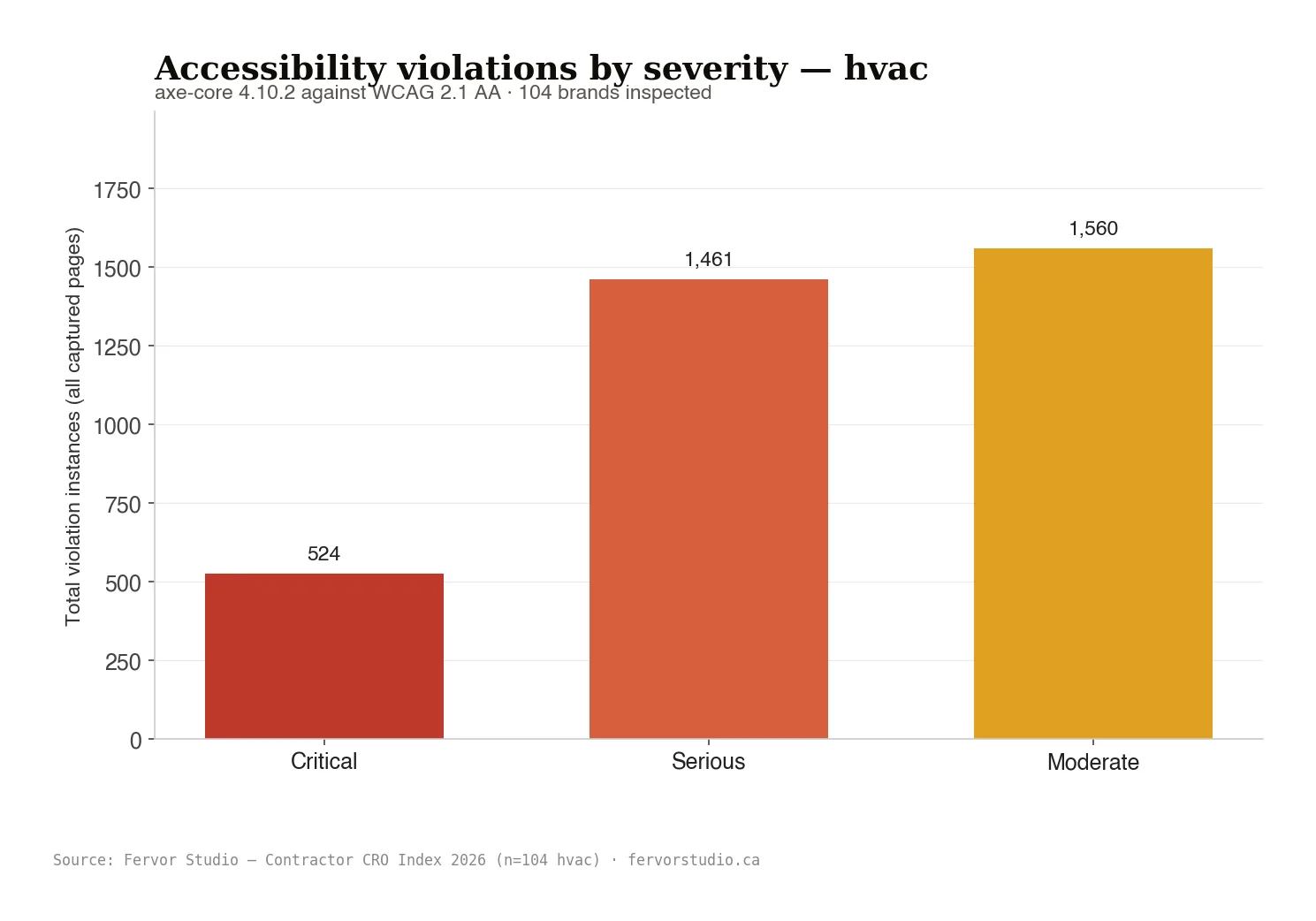
64.4% of HVAC sites we tested fail a critical accessibility check
Digital State of the HVAC Industry 2026A grade out of 380 contractor sites
We graded 380 of them against one framework. Exactly one earned an A: Crown Industrial Roofing in Toronto, at 90 out of 100. The rest left money on the table. Here is what separates the top from the bottom.
The local detail
Every angle below comes from how New York City actually searches, buys, and regulates — built into the page, not bolted on.
So start with the month that explains this market.
When the searcher types "boiler repair near me," most of what she sees isn’t websites.
The profile is the franchise asset of New York City HVAC SEO, so build it deliberately.
Here’s where hvac contractor seo new york city separates from the template work.
Winter heating emergencies (December–March).
Review velocity decides hvac seo new york city pack rankings and buying decisions at once.
And before the engagement sequence, the anti-pattern list, because the failure modes in this market are consistent enough to publish.
You've probably paid for SEO before. And if you run a shop anywhere from the brownstone belt to the Bronx, odds are the last agency handed you a strategy written for a forced-air suburb: furnace pages for a city where three-quarters of the multifamily stock runs on steam, homeowner funnels for a market where the buyer is often a co-op board, and not one word about the compliance deadlines that are quietly the biggest demand driver in the five boroughs. So now you're wondering whether HVAC SEO New York City is a real discipline or a template with the skyline swapped in. Fair question. This page lays out what it takes here specifically: a profile built for borough-by-borough packs, service pages for the steam-and-boiler universe, Local Law fluency while the deadlines are live, and the review engine that wins the most expensive ad market in the country without renting it.

So start with the month that explains this market. And October is the single biggest service-call month in the trade: the citywide boiler reactivation, when every steam system that sat cold since April gets lit and the marginal ones don't fire. And NYC's stock makes the surge steeper than anywhere: about 75% of buildings across the boroughs predate 1960, roughly three-quarters of the multifamily stock heats with steam, and forced-air ducts are the exception rather than the rule. When that reactivation wave hits, the super in Crown Heights and the brownstone owner in Park Slope search the same way the Tribeca board president does: the map, the reviews, the first three results.
"25% of homeowners say trusting contractors is their top challenge when planning home improvements." — Houzz Inc. (2024)
And a quarter of the market starts from distrust — in a city that's been burned by enough contractors to invent the phrase. So the visibility work and the trust work are the same work, and in the most expensive advertising market in the country, the owned version of that visibility is the whole pitch: every ranking you earn is a cost-per-lead you stop paying.
When the searcher types "boiler repair near me," most of what she sees isn't websites. It's the map: three businesses, stars, review counts, photos. And Google draws that pack around the searcher, which in this metro means Astoria, Park Slope, and Riverdale each render a different three-pack. A shop with one profile pinned to one Maspeth garage competes in exactly one of them.
So New York City HVAC SEO starts with an honest map of where your trucks actually roll, then matches the profile to it: the Manhattan premium belt (Upper East Side, Tribeca, the Village) where the work is board-approval retrofits; the pre-war corridors (Harlem, Washington Heights, the Lower East Side) running steam and oil conversions; the Brooklyn brownstone belt (Park Slope, Brooklyn Heights, Cobble Hill, Fort Greene) and its basement boiler swaps; Queens density from Astoria to Flushing; the more suburban Bronx and Staten Island stock where central systems actually fit; and the Westchester–Nassau money ring if you cross the line. Each cluster is its own demand profile and practically its own market. The agencies selling hvac marketing new york city packages flatten all of it into one homepage, and the rankings stop at the end of the block.
The profile is the franchise asset of New York City HVAC SEO, so build it deliberately. Primary category: HVAC Contractor, with secondaries drawn from your actual ticket mix. Heating Contractor and Boiler Supplier territory matters more here than in any forced-air market, alongside Air Conditioning Contractor for the summer book.
And the NYC-specific layers most profiles miss. Service areas named honestly by neighborhood. Google allows up to twenty entries, and "Astoria, Long Island City, Forest Hills" beats "New York and surrounding areas" in every pack that matters. The licensing reality stated plainly: New York has no statewide HVAC license, so the city regulates by specialty through the Department of Buildings. An Oil Burner Equipment Installer Class A on staff is a real credential worth naming in the description, because the buildings that check are the ones with budgets. Photos on a cadence: two uploads a month of real jobs (a boiler swap in a Carroll Gardens basement, a mini-split head threaded through a pre-war plaster wall, a rooftop condenser rigged above an air shaft) keeps the listing alive and unmistakably local. And seed the Q&A field with what your dispatcher answers daily: do you work with co-op boards, do you handle Local Law 152 gas inspections, can you get heat back on in Bushwick tonight.
But the platform layer runs wider here: Yelp is louder in NYC than in most American cities, and the press that moves local authority (Brick Underground, Gothamist, Crain's) actually covers buildings and heating. The citation work in this market has teeth. A Brick Underground mention moves more authority here than a hundred directory listings, and it's earned with exactly the kind of plain-language heating explainers this page keeps recommending.
Here's where hvac contractor seo new york city separates from the template work. Google matches queries to pages, not to businesses, and the equipment universe here doesn't exist in the suburbs. The build-out this market wants:
The steam and hot-water boiler page first, because it's the workhorse query of the pre-war stock and almost every national template skips it entirely. Then the oil-to-gas and oil-to-electric conversion page with the deadline math done honestly: Local Law 32 phases out No. 4 heating oil by July 2027 (about a year out), and every building still burning it has a forced decision with your phone number at the end. The PTAC and ductless mini-split pages for the cooling retrofits central air can't reach (most older buildings have neither the ducts nor the wiring, and mini-splits are the path through plaster). The heat pump conversion page with the live money quoted correctly: Con Edison's Clean Heat program pays up to $10,000 for qualifying residential air-source and mini-split projects, capped at 70% of project cost (85% in designated disadvantaged communities), filed by a participating contractor, and limited to 1–4 unit homes as of January 2026. And the compliance page that no Atlanta competitor will ever need: Local Law 97 charges large buildings $268 per ton of CO2e over their cap, the 2030 limits tighten roughly 40%, and while 92% of covered buildings met the 2024 limits, only about 43% are on track for 2030. That gap is a retrofit pipeline measured in thousands of buildings, and the contractor whose content explains it owns a demand stream with no season.
"Mechanical system retrofits part of the $149B housing deficiency market." — Harvard Joint Center for Housing Studies (2025)
The retrofit demand is structural and funded, and in this city, legislated. The only question is whose pages are standing in front of it.
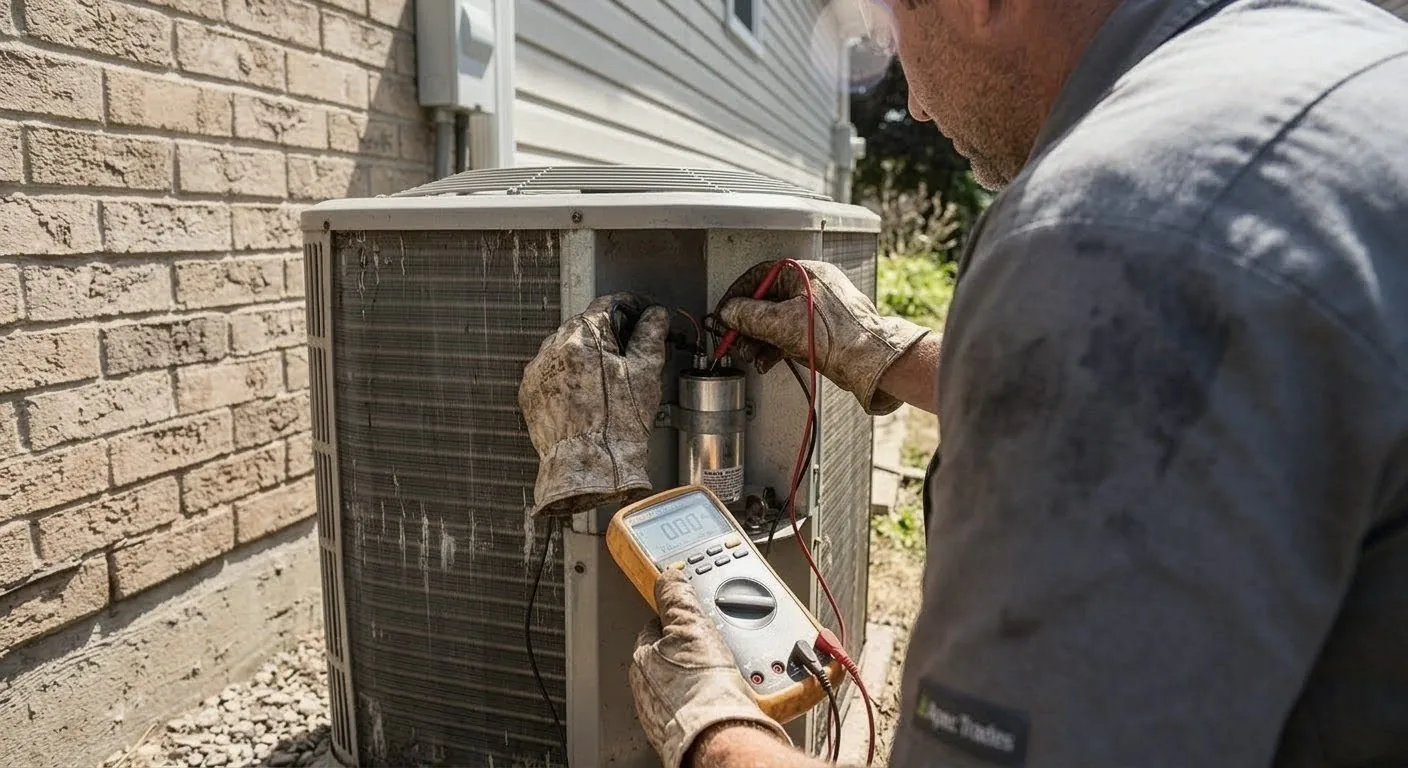
Winter heating emergencies (December–March). "No heat" searches spike with every cold snap, frozen pipes follow, and the steam stock fails loudest in the pre-war corridors. Your emergency pages and same-day signals carry this season, and the neighbourhood vocabulary matters most here, because a panicking super searches the way she talks, borough first, and lands on whoever's page already speaks Crown Heights instead of greater New York.
The October reactivation (September–October). The biggest service month of the year, citywide, as every boiler gets lit at once. The shop positioned for "boiler service" queries in September owns the surge; the one that starts optimizing in October watches it.
The humid summer (May–September). PTAC repair, window-unit upgrades to mini-splits, dehumidification, and the rooftop-condenser logistics that make NYC cooling its own trade. The Bronx and Staten Island single-family stock adds genuine central-AC volume.
The compliance cycle (year-round). LL97 filings, LL32 conversions, LL152 gas-piping inspections: deadline-driven demand that doesn't care about the weather. This is the mode almost no competitor targets at depth, which makes it the cheapest authority to own.
"1.9% easing of mechanical renovation growth projected for Q3 2026." — Harvard Joint Center for Housing Studies (2026)
And growth is flattening nationally. In a plateau, search position is a zero-sum fight, which is the honest argument for doing this work before a competitor does.
Review velocity decides hvac seo new york city pack rankings and buying decisions at once. And here the reviews get read twice, once by the homeowner and again by the co-op board her building requires to approve you. Velocity beats volume: forty reviews that stopped last winter read worse than twenty-five with three from this week, because the timestamp is the proof of life. Make the ask operational: automated after every closed ticket, timed for the evening, rotated across Google and Yelp since this market reads both. And respond to everything, especially the rare three-star, because a calm, accountable reply is the only place a board president can watch you handle a problem before voting to let you into the building.
"Mechanical equipment remains difficult to source for remodelers in 2025." — National Association of Home Builders (2025)
And supply friction is real, and the shops that explain a lead time honestly in their responses and FAQs convert more trust than the ones that pretend it away. But one more NYC-only note: high-ticket Manhattan retrofits are board-approval sales (alteration agreements, building engineers, freight elevator scheduling), and a single page that says "here's how we work with your board" speaks to a buyer no generic contractor site has ever addressed.
And before the engagement sequence, the anti-pattern list, because the failure modes in this market are consistent enough to publish. The forced-air template: furnace-repair pages for a city of steam, written by an agency that's never seen a one-pipe radiator. The single-homepage flatten, claiming "NYC and the tri-state area" and ranking in none of it. The dead-money rebate page, still promising federal credits that died for 2026 installs while the live Con Edison program goes unmentioned. The boardless pitch, selling Manhattan retrofit work with no page that acknowledges the co-op approval process every such job actually runs through. And the review wall that stopped in March, reading like a business that left town.
Every one of those is a competitor you pass simply by not doing it. Which is the quiet math of hvac seo new york city work: in a market where everyone overpays for the same rented clicks, the owned fundamentals are almost uncontested. And the demand is professional-grade to begin with:
"Professional mechanical projects represent bulk of the 84.1% pro-spend share" — Harvard Joint Center for Housing Studies (2025)
Homeowners and boards hand mechanical work to professionals at a rate most trades envy. The demand defaults to a contractor — the only question New York City HVAC SEO answers is which one they find first.
The sequence behind hvac seo company new york city engagements at Fervor is the same one behind every market, tuned to the boroughs. First the free Site Inspection: your current site run through the same 100-point framework behind the State of the HVAC Industry report, scored category by category, findings handed over whether or not you hire us. If the real problem is the build or the capture layer, we say so and route you to the cheaper fix first: HVAC web design in New York City for the bones, HVAC website conversion in New York City for the leaks.
Then the The Local Pick: $2,497 one-time, about 14 days. The profile rebuilt for the boroughs: categories, neighborhood-honest service areas, photo cadence, Q&A seeding, the Yelp layer, citation cleanup, and call tracking so every change is measurable against your dispatch board. Priced so the payback math works at a single recovered boiler swap: one October job that would otherwise have gone to whoever the pack trusted instead.
The ongoing engagement (the steam and compliance content layer, borough pages, review velocity across platforms, monthly reconciliation against actual booked jobs) runs under Performance Partner at $1,497 to $3,997 per month, month to month, every asset registered to you from day one. In the country's most expensive ad market, the entire strategy is simple: own what everyone else is renting.
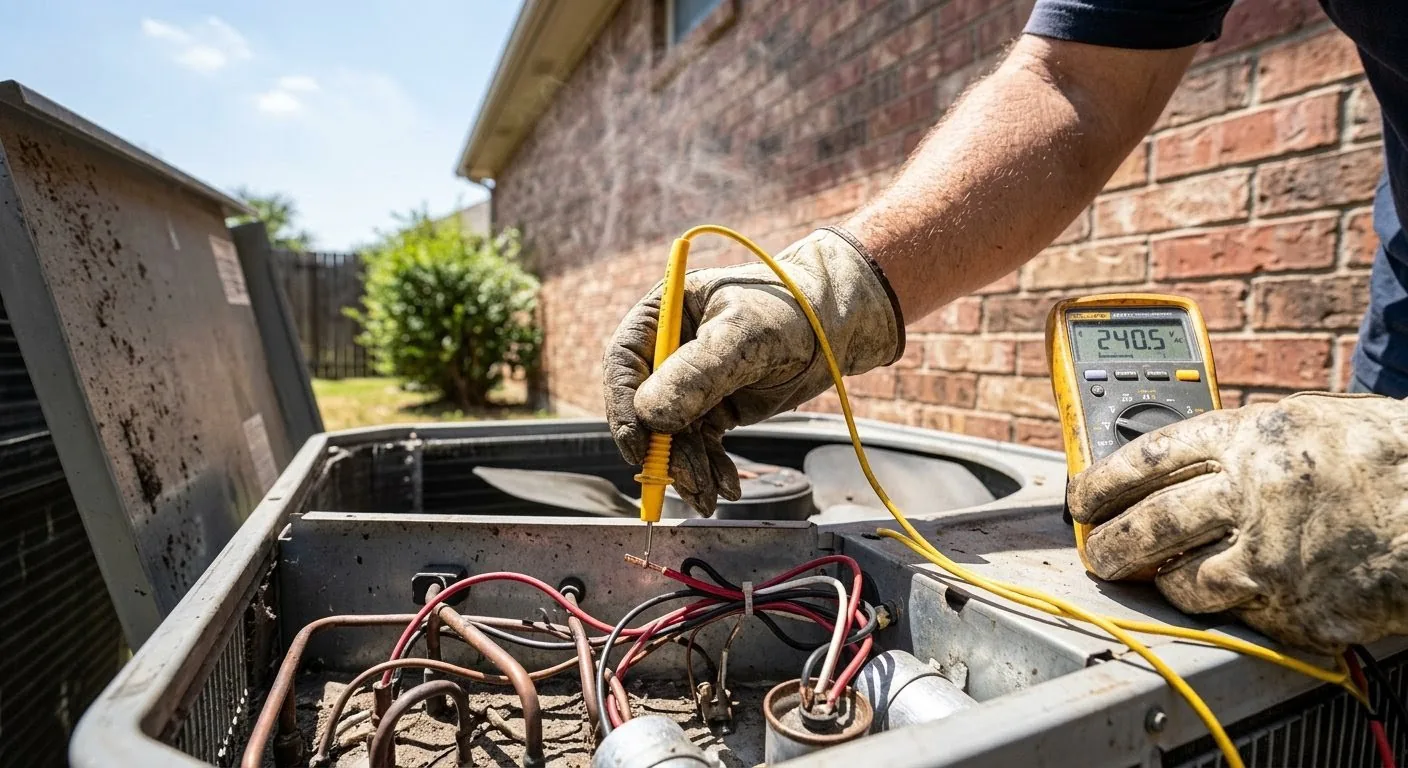
The broader system lives at the HVAC marketing hub, under mechanical contractors, starting from the contractor hub.
The The Local Pick moves profile signals within weeks — service-area corrections and review velocity show in the packs first. The content layer compounds over a season, and the calendar gives you the deadlines: a boiler-service page published in July owns the October reactivation; compliance content published this year rides the LL32 deadline and the LL97 2030 cliff for years. And that's the honest frame for the whole engagement. NYC demand arrives in waves and statutes, so the campaign's job is to be positioned before each one breaks rather than bidding against the whole city during it.
Functionally, yes. The packs render differently in Astoria, Park Slope, and Riverdale, and your service-area settings, review geography, and neighborhood content decide which ones you appear in. That doesn't mean five microsites; it means one profile configured honestly by cluster, service pages that name the neighborhoods you actually roll trucks to, and photos that prove it. The fragmentation is the moat once you've mapped it, because most competitors never do.
If you touch anything over 25,000 square feet, or want to, yes, because the numbers say the pipeline is barely tapped: 92% of covered buildings met the 2024 limits, but only about 43% are on track for the 2030 limits that tighten by roughly 40%. Boards and managers are searching for explanations right now, and the contractor who publishes the plain-language version becomes the one they call for the retrofit. For 1–4 family residential, the equivalent play is the Con Edison Clean Heat page with the live numbers and the honest conditions: up to $10,000, 70% cost cap, contractor-filed.
Only if the trucks actually go there. And if they do, say it like a local. The money ring outside the city line (Scarsdale, New Rochelle, Garden City, Great Neck) is real volume with more forced-air stock and bigger single-family installs, but Google cross-checks your claimed areas against where your reviews and photos actually originate, and a padded map dilutes the packs you genuinely serve. The clean play: list the suburban communities you've billed in the last year, build one honest page for each county you cross into, and let the borough work carry the core. A Bronx shop that pretends to cover Nassau ranks nowhere; one that proves Riverdale and adds Yonkers honestly ranks in both.
That's precisely why organic wins here. The ad auction is brutal because everyone rents the same few emergency keywords. But the steam pages, the compliance explainers, the borough content, and the review wall are owned assets that compound while the renters re-bid every month. An independent shop can't outspend the consolidators, and doesn't need to: it needs to own the queries they're too generic to answer: the brownstone boiler, the co-op board process, the LL32 deadline. And let the rented traffic stay rented.
The evidence
 Read the full report →
 0
contractor sites graded, one A
Across the whole CRO Index, a single site earned an A. The median landed at a D. The grade gap is a conversion gap.
0 %
of HVAC sites fail a critical accessibility check
Scored against WCAG 2.1 AA with axe-core. A page that blocks a screen reader also blocks a paying customer.
Fervor HVAC State of the Industry, 2026
0 %
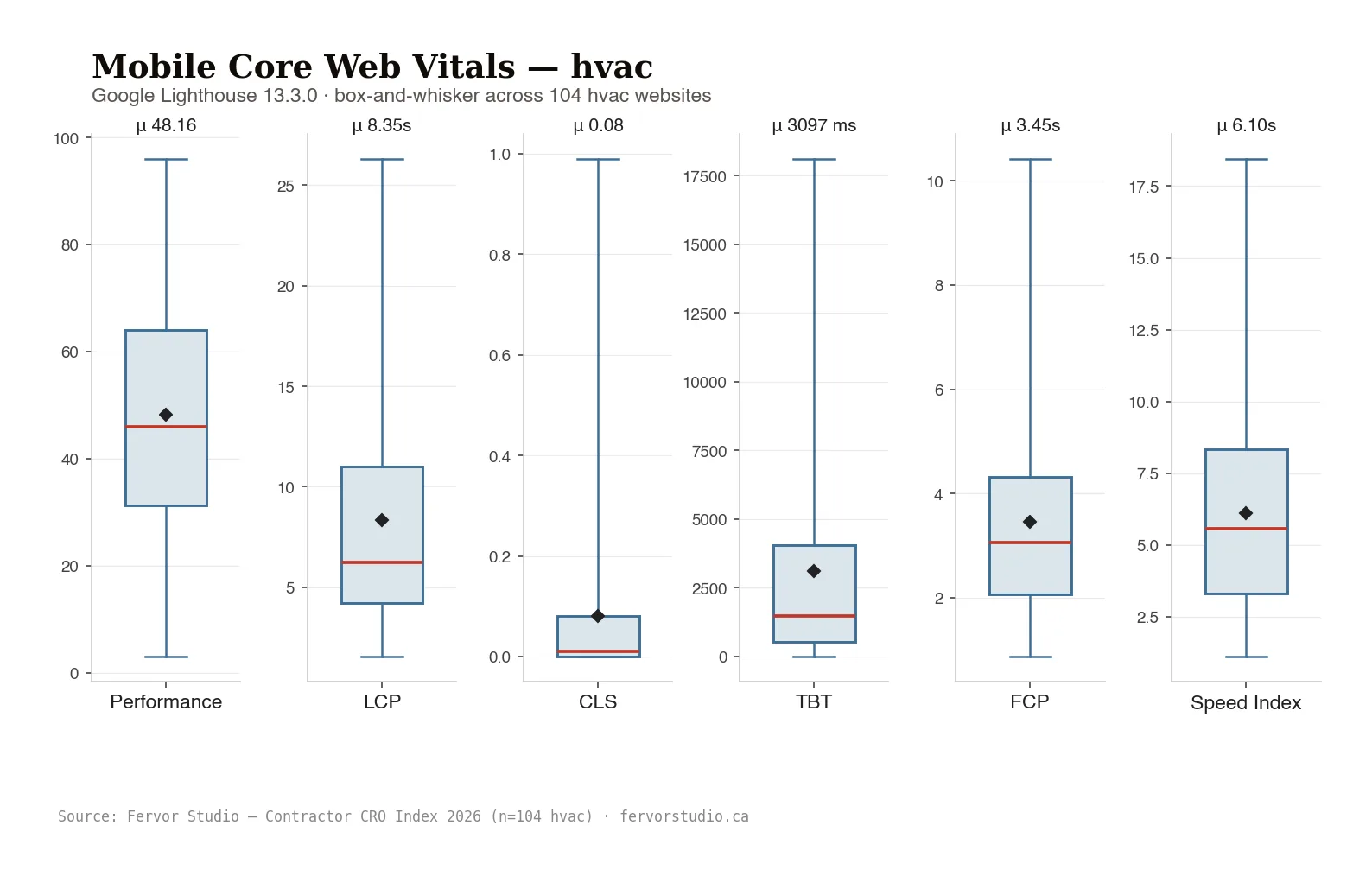
miss Google's mobile load-speed bar
Median mobile load lands at 6.24 seconds. Most of your traffic is on a phone, and most of them are gone before the hero paints.
Fervor HVAC State of the Industry, 2026
0 /100
is the average HVAC grade
That is a D. The sites booking the work are not the ones with the biggest crews. They are the ones a few points higher on the things homeowners feel.
Two ways to start
Tell us where you are. We point you at the right next step — no sales call to get there.
Client review
“Nay did an amazing job, you know. He was really patient. He got the work done the way I told him and he was just on point with the website. Pretty straightforward process. No going around the bush. He just did amazing work and I would 100% recommend.”
How Fervor can help
Monthly SEO, content, and CRO. Fixed deliverables. No credits, no rollover. The compound growth engine.
Complete website system built to convert storm leads, planned projects, and research-phase homeowners into booked jobs.
Identify and patch the top conversion killers on your existing site. No full rebuild needed.
GBP optimization, citation building, and review system foundation. The infrastructure that gets you into the Map Pack.
One conversion-built landing page for the referrals, paid clicks, and cold-call leads you send. They land on a page built to book them, not your generic homepage.
Your move
Tell us where you are. We point you at the right next step — no sales call to get there.
Keep going