We graded 380 of them against one framework. Exactly one earned an A: Crown Industrial Roofing in Toronto, at 90 out of 100. The rest left money on the table. Here is what separates the top from the bottom.
The local detail
The Calgary HVAC specifics most sites skip.
Every angle below comes from how Calgary actually searches, buys, and regulates — built into the page, not bolted on.
01
Why Most Calgary HVAC Websites Lose the Call Before the Phone Rings
Look at the last three searches you Googled for your own trade.
02
What a Calgary HVAC Website Needs in 2026
Six things, in this order:
03
The HVAC Demand Cycle and the Seasons Your Website Has to Surface
Demand here isn’t one curve.
04
Calgary HVAC Licensing, Code, and Trust Signals Your Website Must Surface
And this is the section most builds skip entirely.
05
Mobile-First Booking Flow Built for the Emergency Call
And this is where most HVAC website builds collapse.
06
Trust Signals Calgary HVAC Buyers Expect
License numbers display above.
You've already paid a web designer to build something that looks fine on a desktop in a meeting room. But if you run a HVAC shop here, the version that looks fine in that meeting room is probably the version losing furnace-failure calls at 11pm on a Sunday in January. So calgary hvac website design isn't a refresh that wins design awards. It's a build that captures the homeowner mid-panic, Chinook-cracked refrigerant lines, hail-bent condenser fins, a -28 Tuscany morning when the burner won't light, and routes them to a booked appointment before they thumb over to the next contractor in the Local Pack.
This page covers what real calgary hvac website design needs in 2026: the demand modes the build has to surface, the licensing and code signals Alberta homeowners check before they call, the booking flow that has to work at 11pm on a phone, and the trust signals separating a Calgary HVAC site that converts from one that gets sympathy clicks.
Why Most Calgary HVAC Websites Lose the Call Before the Phone Rings
Look at the last three searches you Googled for your own trade. Pretend you're a homeowner in Bridgeland whose 14-year-old mid-efficiency furnace died at 11:47pm. You hit furnace repair Calgary. You get three Local Pack listings, a flood of paid ads, then ten organic results. So you tap the first one that looks legit. The hero loads. There's a phone number, somewhere. Three carousel images of generic furnaces. A form asking for your full address, your email, your phone, your preferred contact time, and a 200-character description of the problem. You bounce. Tap the next one.
And that's the pattern. Buyers in panic mode aren't reading copy. They're scanning for a phone number, a license, and a sign you actually work in their quadrant. Most of these builds solve none of those.
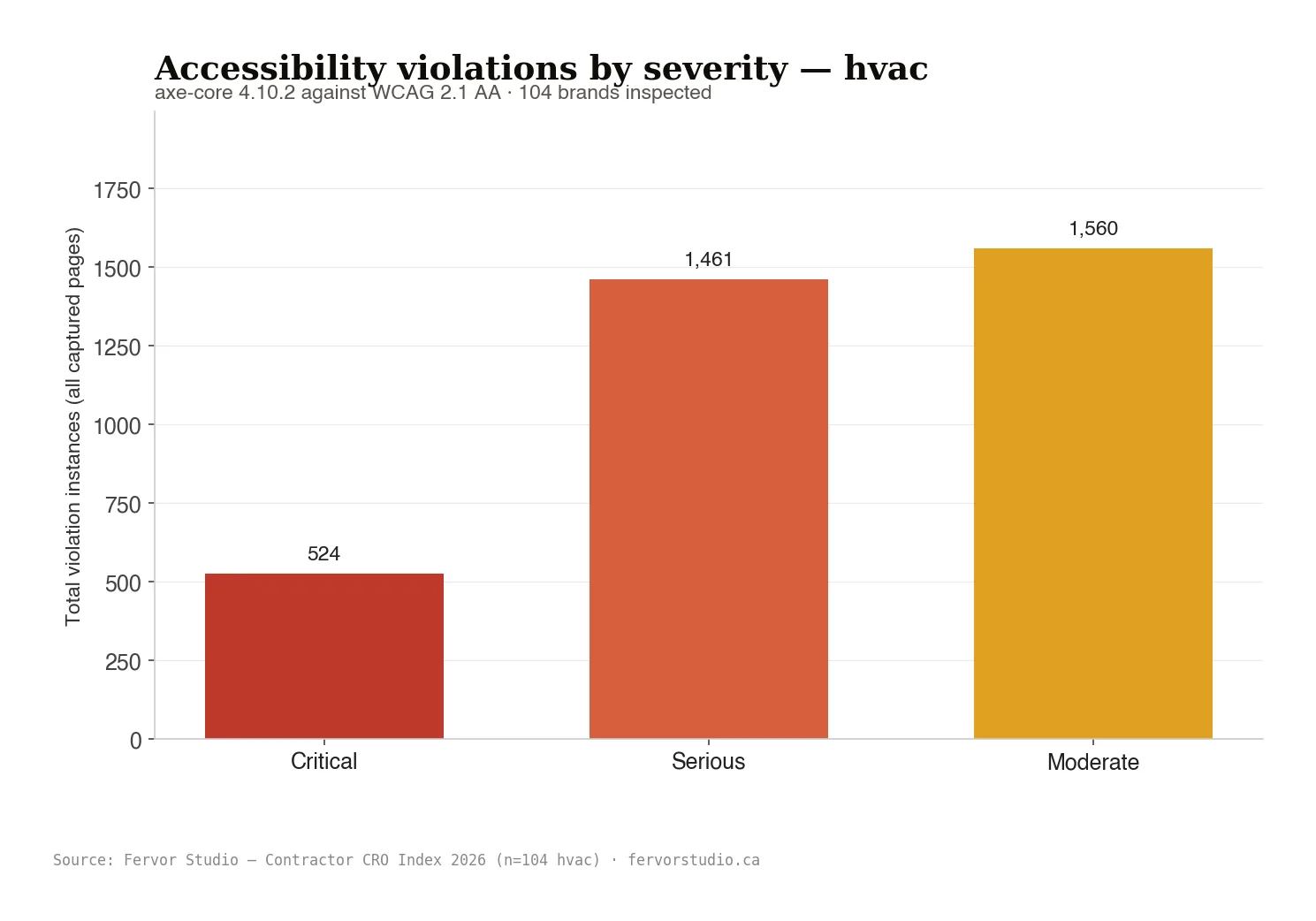
"Of 104 residential HVAC contractor websites Fervor audited in 2026, only 33.7% display a contractor license number on the site, and only 18.3% surface an inline form on the hero. The median Fervor Grade for HVAC websites was 65 out of 100." Fervor State of HVAC 2026
So one in three HVAC sites we audited shows a license. Fewer than one in five surfaces a form on the hero. The median site scores 65, with 24% scoring an F. When your HVAC site fails the first trust check (no visible Alberta gasfitter number, a stock photo where a job photo should be, a contact form longer than a sublease application), the homeowner doesn't pause to ask what they're missing. They just leave. And Google Analytics tells you the bounce was your fault. Which it was. But not in the way the analytics dashboard frames it.
Loss-framed: every week your HVAC site stays in its current state, you're paying the cost of replacement traffic. Google Ads CPCs in this vertical run $18 to $42 depending on intent. Each emergency call you don't capture is one your competitor on Stoney Trail just took. So the question isn't whether your website is "modern." It's whether it's built for the actual buyer search behavior in this metro, on a phone, in winter. So a real calgary hvac website design build accounts for those conditions, not for a desktop preview. Our sibling guide on HVAC SEO for Calgary covers the search-side mechanics that pair with the build covered here.
What a Calgary HVAC Website Needs in 2026
Six things, in this order:
A phone number above the fold. Big. Tap-to-call. Not buried behind a "Contact" nav item opening a 9-field form. HVAC emergencies happen on phones at hours when forms feel wrong. The HVAC website that gets this right is the one buyers call.
Service area signaling that names actual quadrants. Tuscany, Auburn Bay, Beltline, Bridgeland, Mahogany, Signal Hill, Inglewood, Sunnyside. Plus Mount Royal and Aspen Estates for the premium replacement market. Then the surrounding cities: Airdrie, Cochrane, Okotoks, Chestermere, Strathmore. Google reads the named-place density. So does the buyer.
One service page per equipment type. Furnace install. Furnace repair. AC install. Heat pump retrofit (the fastest-growing search cluster). Ductless mini-split. Tankless water heater. Combi boiler. So the single-page "Our Services" approach buries the long-tail queries that convert.
License + insurance + WCB display above the fold. Alberta gasfitter (Class A) number. WCB Alberta clearance status. Master Electrician number if your shop crosses into electrical work. Homeowners check.
A booking flow that works at 11pm on a phone. Three fields. Name. Phone. One-line problem. Everything else gets confirmed on the callback. Form length is the conversion lever.
Schema markup that tells Google you're a Calgary HVAC contractor. Service schema with areaServed, FAQPage schema for seasonal questions, BreadcrumbList for nav, Organization schema with verified address.
And the above is the baseline calgary hvac website design build. Anything below it is hobbyist work in a market where the call is worth $400 in the door and a furnace replacement closes at $6,200 plus.
The HVAC Demand Cycle and the Seasons Your Website Has to Surface
Demand here isn't one curve. It's three, and they overlap.
Heating peak (November to March). Furnace replacements, no-heat emergency calls, ignition failures, cracked heat exchanger diagnoses. So this is the dollar season. An HVAC site burying the emergency-call path in winter is leaving the entire annual margin on the table. Your home page in January should look different from your home page in July, or at minimum your hero CTA, your trust block, and your above-the-fold service mix should weight the heating-emergency side.
Heat pumps grew. Furnaces fell. That's the directional shift, and sites still treating heat pumps as a sub-bullet under "cooling" signal to Google (and to the homeowner) that they haven't caught up. So your calgary hvac website design build needs a real heat pump retrofit service page. Cold-climate units, dual-fuel systems with the gas furnace as backup, the Canada Greener Homes Grant plus ENMAX rebate stack, sizing math for the typical 1,800sqft Calgary infill.
Cooling shoulder (May to August). AC installs (short here but real, especially since 2021's heat dome rewired buyer expectations), AC tune-ups, ductless mini-split retrofits in finished basements where central air can't reach. Plus hail. June through August is hail season. A single July storm can write off 200 condenser units in an afternoon. So your HVAC site should have a dedicated hail-damage assessment page indexed by the time hail season starts, not built in September after the season already paid out.
Chinook-driven equipment-failure spikes (variable, mostly January-March and October-November). The Chinook flips outdoor temperatures 25-30°C inside twelve hours. Furnaces cycle hard. Heat exchangers crack. Pressure switches fail. Condensate lines that froze on Tuesday thaw on Wednesday and overflow on Thursday. But most HVAC website builds don't even mention Chinooks. Your HVAC website should, not as colour writing, but as a diagnostic explanation for why the homeowner's furnace failed this week. Naming the cause is half the trust build.
Calgary HVAC Licensing, Code, and Trust Signals Your Website Must Surface
And this is the section most builds skip entirely. Which is the section local homeowners actually check before they call. So we'll spend some real time here.
Alberta gasfitter certification (Class A or B). If you install, service, or alter natural-gas-fired equipment in Alberta, your gasfitter operates under a certification issued through Alberta Apprenticeship and Industry Training. The Safety Codes Act governs the work itself, and permits get issued by the City of Calgary (which is accredited to administer the Act) before any gas-fired install or major alteration. So your website should display the certification class of your lead gasfitter, the City of Calgary gas permit pathway you follow on every job, and at minimum a reference to Safety Codes Act compliance. HVAC buyers don't hire a contractor without that visible. Insurance companies don't pay claims involving work done by one without it.
Alberta Master Electrician number (for crossover work). Any HVAC shop touching the panel, running 240V to a condenser, or wiring a heat pump system is doing work requiring a Master Electrician on the certificate. So display the number. Alberta's Safety Codes Act requires permits for the electrical scope, and a clean municipal permit history is a quiet conversion signal in higher-ticket replacement bids.
WCB Alberta clearance certificate. The Workers' Compensation Board of Alberta issues clearance letters confirming a contractor is in good standing. A live, current WCB clearance status on the site tells the homeowner that if a tech falls off the roof installing their condenser pad, the HVAC homeowner's liability is bounded. Missing clearance is a sign the contractor either let coverage lapse or hires uninsured subs. Buyers ask. Now they don't have to.
Alberta Building Code 22 PSF roof snow load (the equipment-platform piece). Alberta's minimum design ground snow load sits at 1.06 kPa, roughly 22 pounds per square foot, and rooftop AC condensers, heat pump outdoor units, and exhaust flue terminations all interact with that load. So if your site quotes a rooftop condenser install, the proposal language should reference snow-load compliance and the platform spec. It's a small line. It demonstrates code literacy. Homeowners cross-check it.
Canada Greener Homes Grant + ENMAX rebates + Greener Homes Loan. The federal Greener Homes Grant has been the dominant rebate driver in local HVAC replacement spending. Plus the ENMAX local efficiency rebate stack. Plus the interest-free Greener Homes Loan (up to $40,000 amortized over 10 years). Buyers search the rebate names alongside the trade name. Greener Homes heat pump Calgary. ENMAX furnace rebate Calgary. Greener Homes Loan HVAC contractor. So your build needs explicit rebate-stack content, with current eligibility and application-process language. Not aspirational marketing copy. Specific steps.
Accessibility, the AODA cousin in Alberta plus federal Accessible Canada Act. Alberta doesn't have a direct AODA equivalent the way Ontario does, but the Alberta Human Rights Act covers service accessibility, and the federal Accessible Canada Act applies to federally-regulated entities. So the realistic compliance bar for a Calgary HVAC contractor website in 2026 is WCAG 2.1 AA: alt text on equipment photos, keyboard-navigable booking forms, sufficient colour contrast on CTAs, accessible form labels. If your current site fails colour-contrast checks or has booking forms screen readers can't parse, you're both leaving conversions on the table and exposing the business to a complaint risk that's rising every year.
Two practical examples for the reader who skimmed past the rest: (a) the Alberta Building Code snow load is 22 PSF and rooftop condenser platforms must be engineered to it; (b) every site here should display a current Alberta gasfitter (Class A) number to be taken seriously by a homeowner who knows the trade. So you can take both of those facts and check them. That's the bar.
Mobile-First Booking Flow Built for the Emergency Call
And this is where most HVAC website builds collapse. The desktop preview looks fine. The homeowner is on a phone. In bed. At 11:47pm. With a furnace that just shut off and a partner who's already in two layers of fleece. They're not filling out a 9-field form.
The phone-first booking flow:
Tap-to-call number persistent in the mobile header. Static across every page. Never collapsed behind a hamburger.
3-field booking form. Name. Phone. One-line problem. Submit. The dispatch confirms the rest on the callback. So every additional field is a measurable conversion loss.
Click-to-text fallback. Some HVAC buyers text before they call. Texting buys the contractor a 3-minute window to dispatch a tech and qualify the lead before competing contractors see the same search.
After-hours indicator. HVAC emergencies don't pause for business hours. Your website should explicitly surface 24/7 emergency availability, or if you don't run a true 24/7 desk, surface the realistic callback window. Lying about it converts once, then doesn't.
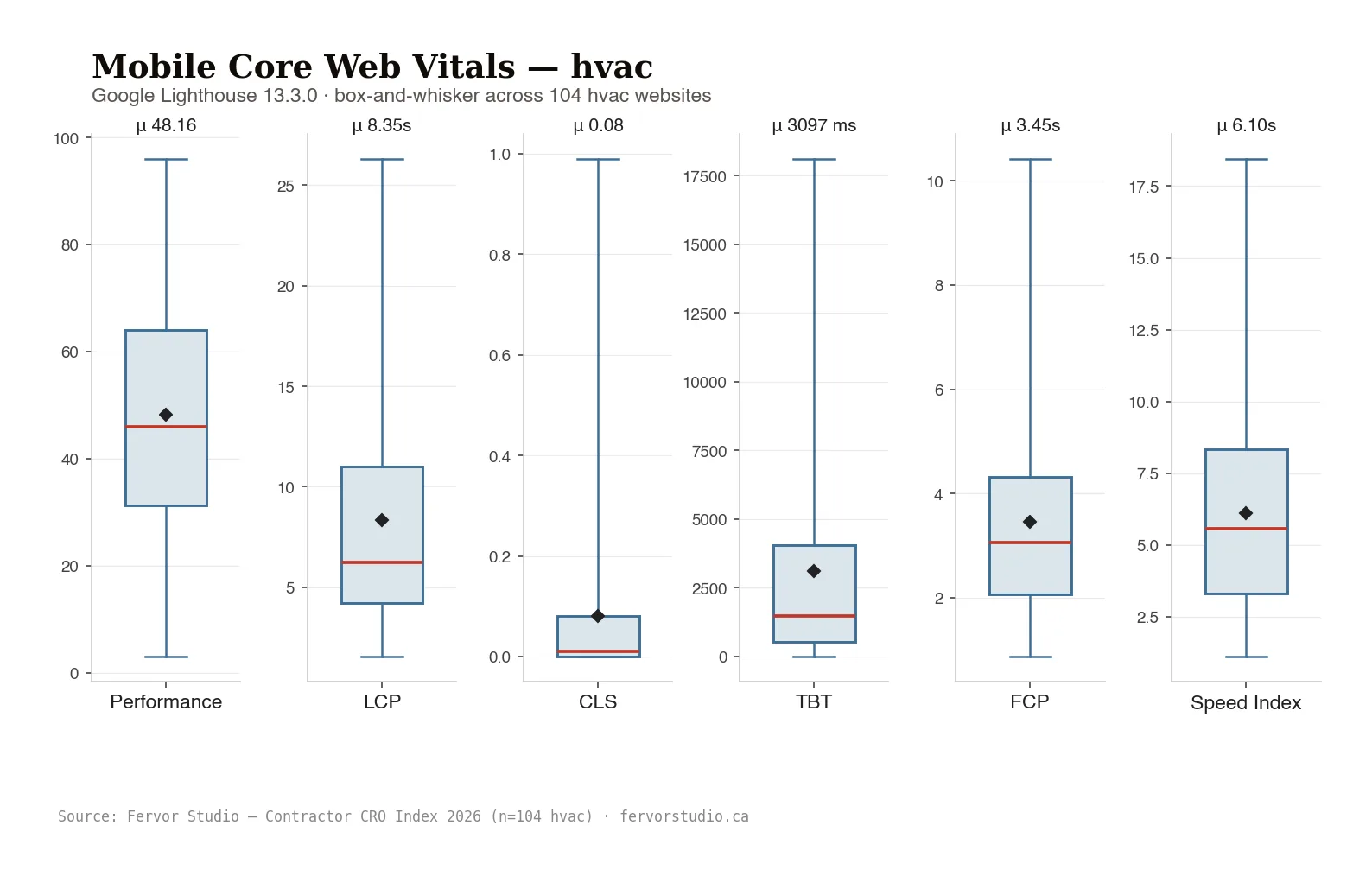
Sub-2-second mobile load. Compressed hero, WebP images, deferred non-critical scripts, no marketing-tag-manager bloat. Buyers on flaky LTE at -28 are not waiting for your hero to load.
So the conversion lever isn't copy. It's field count plus load speed plus visible phone number. The build that out-books the rest is the one that takes those three numbers seriously.
Trust Signals Calgary HVAC Buyers Expect
License numbers display above. Real job photos with EXIF data showing southern Alberta GPS coordinates. Named neighbourhood-tagged reviews (not just "Susan, Calgary," but "Susan, Tuscany NW"). NiceJob review velocity that demonstrates current operations, not 11 reviews from 2019. BBB Calgary listing if you're accredited. HomeStars Calgary profile linked. Calgary Chamber of Commerce membership badge if relevant.
"64% of Canadians surveyed prefer homes with high-efficiency heating and cooling systems." Abacus Data (2023)
So the trust signal tying everything together is content demonstrating you understand the high-efficiency conversation. A contractor who can explain HSPF ratings on cold-climate heat pumps, who quotes the Greener Homes Grant's exact eligibility math, and who shows a job photo of an installed cold-climate unit in an Auburn Bay backyard outranks the contractor whose website talks about "quality service" in the abstract. Specificity is the trust signal for any HVAC contractor.
How Fervor Builds Calgary HVAC Websites
Five steps. No mystery. No 14-week creative discovery loop billing hourly until you stop asking what the timeline is.
Step 1: Free Site Inspection
We score your current Calgary HVAC website across six conversion categories. So you'll see where the booking path leaks, which service pages aren't ranking for the long-tail queries that pay, how your site compares to the contractors actually in the Local Pack, and exactly how many emergency calls you're losing to competitors with better infrastructure. Free. About three days. You own the report regardless of what happens next.
Step 2: HVAC + Local Discovery
We study your HVAC market. Who's ranking in your service area? What seasonal content lives on competing sites and what doesn't? We pull your ServiceTitan, Housecall Pro, or Jobber data to understand your job mix, average ticket, and seasonal patterns. A Tuscany-and-NW shop doing 60% furnace replacements needs a different site than a Beltline-focused shop doing 60% mini-split retrofits.
Step 3: Content Architecture and SEO Strategy
Site structure, page hierarchy, every word of copy. Written before any design work begins. Every service page, every quadrant service-area page, every Alberta-specific rebate and code page mapped to actual search demand. So calgary hvac website design isn't bolted on after the site looks pretty. It's the foundation.
Step 4: Design and Development
Mobile-first. Sub-2-second load times. HVAC booking flow tested on actual phones in actual winter conditions (we have someone hold a phone outside in January). ServiceTitan-compatible CallRail call tracking installed. So every CTA tested with the thumb-zone rule: if a homeowner can't tap your booking form one-handed while putting on a parka in their entryway, the CTA fails.
Step 5: Launch, Handoff, and What's Next
Your HVAC website launches with CallRail tracking, all logins transferred, and documentation for routine updates. You own the domain, content, hosting, GBP, everything. So if you ever leave Fervor, you take all of it with you. And if you want compound growth from ongoing seasonal content after the build, Performance Partner is a separate retainer that picks up where the website rebuild leaves off.
What This Looks Like for a Real Residential HVAC Client
Specificity over claims for HVAC contractors. Here's what the rebuild looked like for one residential HVAC contractor on a similar build path who came to us with the same problems most local shops have. Different city, same trade, same HVAC website template trap.
[CASESTUDY_PLACEHOLDER]
And the Atlanta build isn't the Calgary build. Climate is different, code is different, the rebate stack is different. But the structural mistake (paying for a template that hides the things buyers actually came to find) is the same one most local HVAC website builds are making right now. And the calgary hvac website design work that fixes it follows the same diagnostic logic regardless of which metro the build lands in.
Calgary HVAC Website Design Pricing
Two engagement options for calgary hvac website design work. Both built on website ownership and no long-term contracts. Pick the one that matches your bottleneck.
Optimize your Current Website
Leak Plug Sprint
Fix the leaks on your current HVAC website in 30 days. GBP, citations, NiceJob reviews, schema, and rebate content layered onto the site you already own.
Cochrane, west of the city, distinct Foothills micro-climate, often colder than central Calgary in winter
Okotoks, south of the city, larger lot sizes, more rural HVAC website service patterns
Chestermere, east of the city, lakeside community, premium HVAC replacement market
Strathmore, further east, smaller market but underserved by full-service contractors
So the broader build also routes contractors into Edmonton, Red Deer, and Lethbridge as we expand the Alberta page set.
Frequently Asked Questions
How long until this work shows real call volume?
Local Pack movement and emergency-call increases from a freshly built HVAC website service-area page typically start within 30-60 days. Full SERP positioning for primary terms takes 4-9 months depending on existing domain authority, citation profile, and review velocity. So seasonal content (heat pump, hail-damage assessment, Chinook-cycle furnace failure) compounds month over month. The work is best measured in booked calls per quarter, not rankings on day 30.
Do I have to display my gasfitter certification on every page?
Not legally on every page, but practically yes. At minimum in the footer of every page, and prominently on the home page and any service page involving gas-fired work. Calgary homeowners cross-check gasfitter certification class and ask for the City of Calgary gas permit number before they call. Insurance claim adjusters check before they pay. So the display cost is zero. The conversion cost of not displaying is meaningful.
How does Fervor handle the Canada Greener Homes Grant content?
Dedicated rebate page per program: Greener Homes Grant, Greener Homes Loan, ENMAX residential rebates, Government of Alberta Home Energy Plan. Each page covers current eligibility, the application steps, what documentation the homeowner needs from you (model numbers, AHRI certificates, post-install inspection reports), and the realistic timeline from application to deposit. So the content gets refreshed quarterly because eligibility shifts.
What if my shop is in Airdrie or Cochrane, not central Calgary?
The build adapts. We build your primary service area around your actual geography (Airdrie plus Cochrane plus the suburbs you serve), and the city-named long-tail search content ("furnace repair Airdrie," "heat pump install Cochrane") gets prioritized over the central Calgary terms. So same template structure, different geographic weighting.
Do you build for AODA / WCAG accessibility compliance?
Yes. Every site we build hits WCAG 2.1 AA: alt text on equipment imagery, keyboard-navigable booking forms, sufficient colour contrast on CTAs, accessible form labels, ARIA roles where structure requires them. Alberta doesn't have an AODA-equivalent directly mandating WCAG, but the Alberta Human Rights Act and the federal Accessible Canada Act both apply, and the conversion lift from accessible forms alone (older homeowners filling out 11pm booking forms) typically pays back the compliance work in the first month.
How is this pricing different from a generic web design quote?
A generic web design quote gives you a template, a logo refresh, and a four-page site that looks fine. So calgary hvac website design quotes from Fervor include service-page architecture for every equipment type you install, quadrant location pages, schema markup, NiceJob review automation, GBP optimization for the HVAC categories, Canada Greener Homes Grant rebate content, and a booking flow tested on actual phones in actual conditions. So the price reflects the conversion engineering on the HVAC website, not the design polish.
The evidence
What separates the sites that book work from the ones that do not.
A full websiteA complete rebuild aimed at the pages that pay it back. Let's scope it on a call.
Client review
What working with Fervor looks like.
“Nay did an amazing job, you know. He was really patient. He got the work done the way I told him and he was just on point with the website. Pretty straightforward process. No going around the bush. He just did amazing work and I would 100% recommend.”
One conversion-built landing page for the referrals, paid clicks, and cold-call leads you send. They land on a page built to book them, not your generic homepage.
One dedicated, conversion-built landing page
Built for referral, paid, and cold-outreach traffic
Click-to-call, lead form, and trust proof above the fold