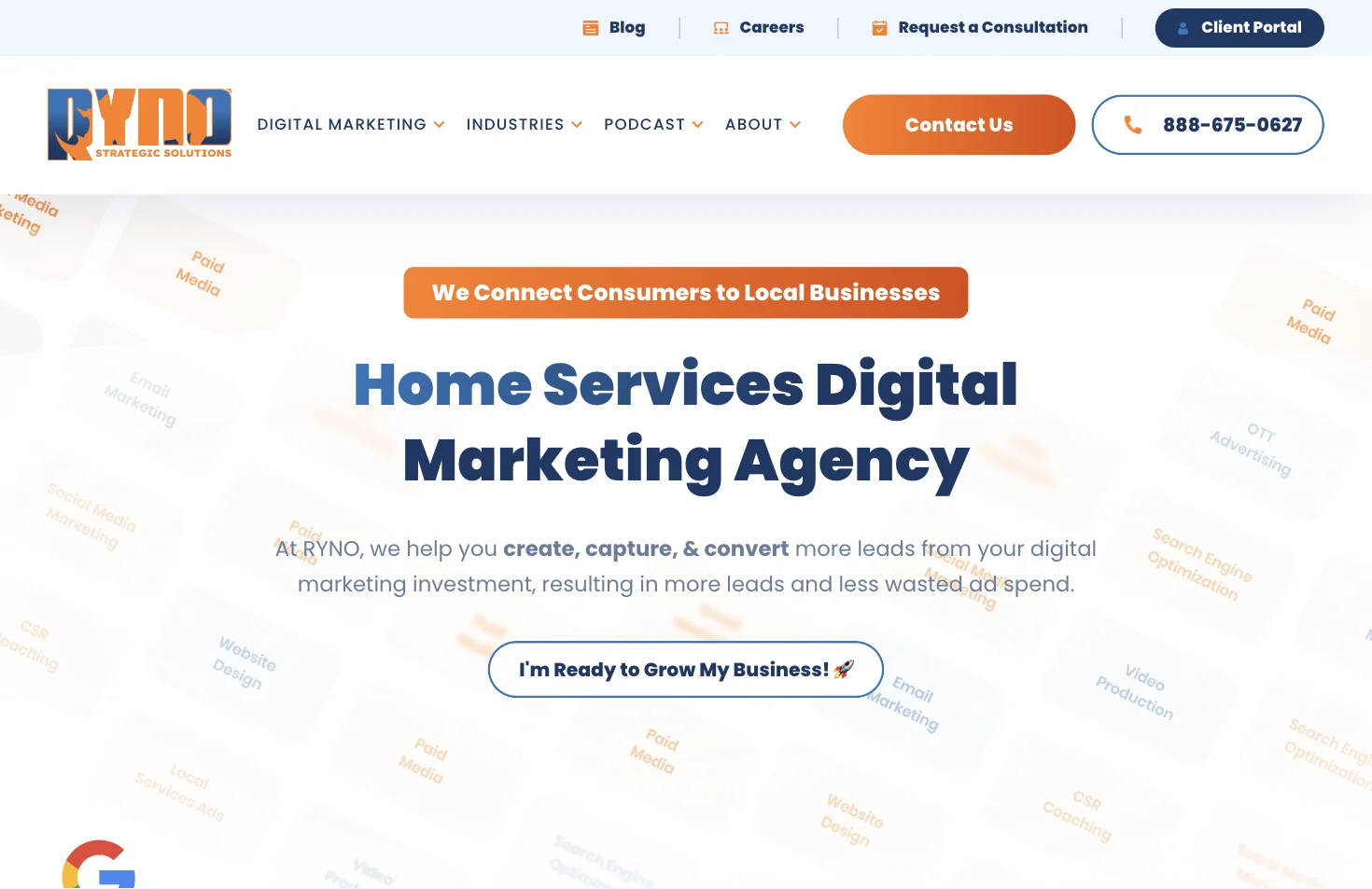
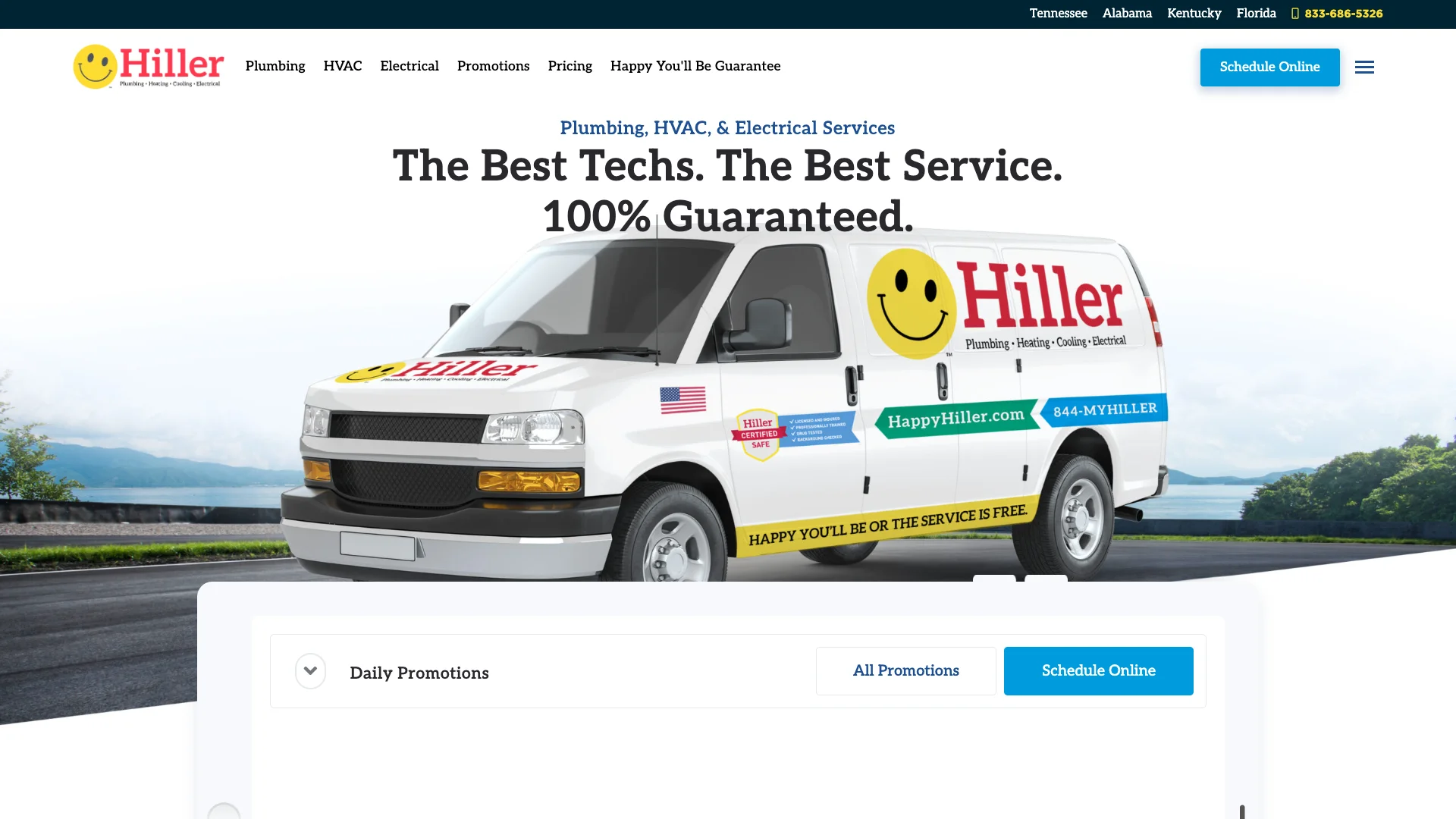
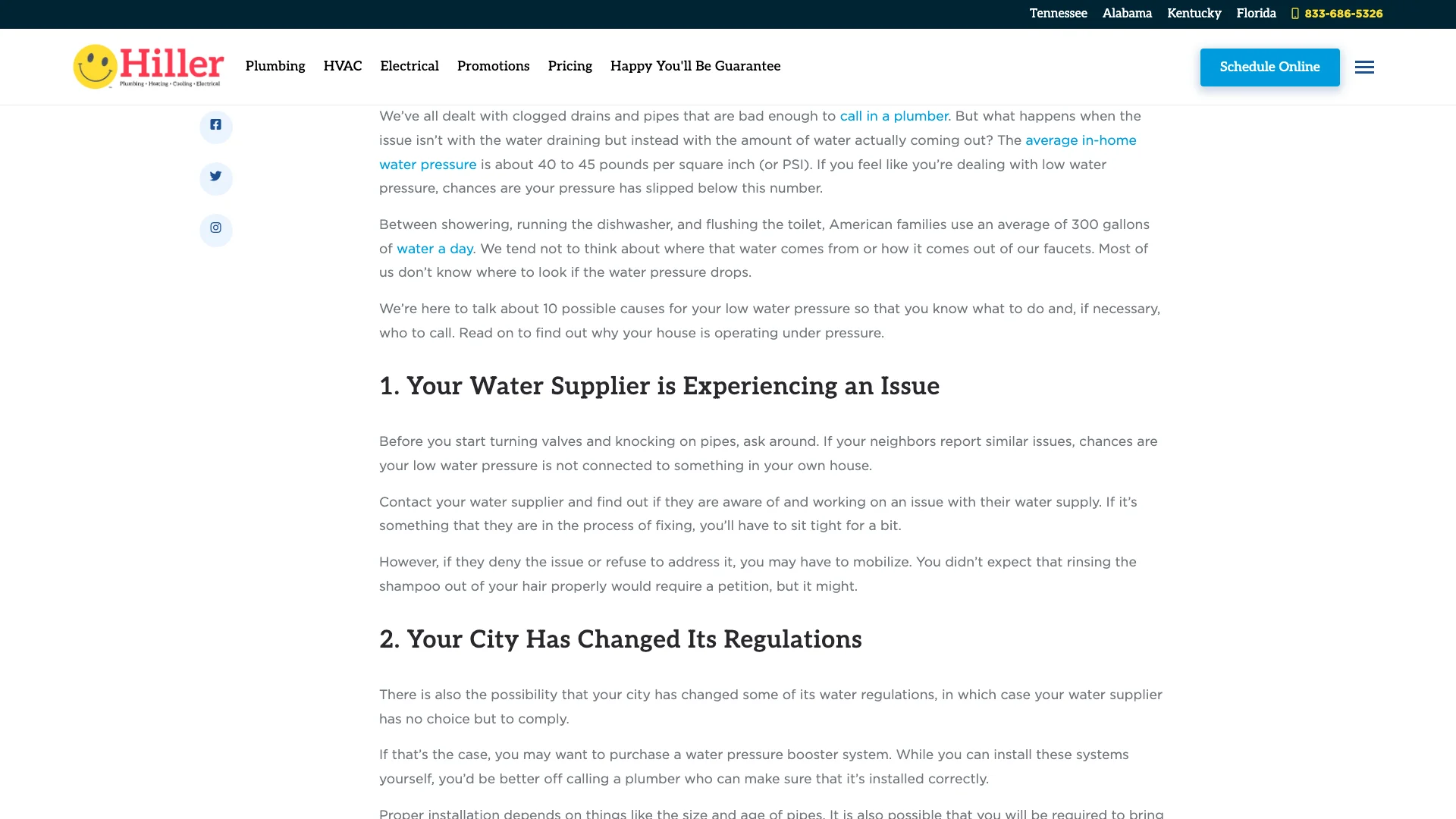
He searches "why is my water pressure low Nashville." Happy Hiller comes up. He clicks. The article is genuinely useful — seven potential causes, each explained clearly, each with a corresponding fix. He reads to Cause 7: corroded pipes. That's the one that fits his situation, his symptoms, his seventeen-year-old galvanized plumbing in East Nashville.
He wants to book service. He scrolls for a next step. There's nothing. No inline CTA, no "sounds like your situation? Here's how to book," no sentence that connects what he just learned to the people who can fix it. So he goes back to Google and searches again. Whoever has the right sentence in the right place wins that call.
That's the gap this Site Inspection documents. Not a broken website — Happy Hiller's site is legitimately above average. A 7-step progressive booking modal, transparent pricing on the homepage, editorial content getting real traffic. But there are five places where a homeowner with intent meets dead air, and the second search goes somewhere else.
"25% of homeowners say trusting contractors is their top challenge when hiring."
— Houzz (2025)
A quarter of the homeowners arriving on Happy Hiller's pages already have their guard up. They're looking for reasons to trust, and the site has real assets to offer them. The issue isn't the assets. It's that they don't show up in the right place at the right moment.
What Happy Hiller actually gets right

Before the gaps: credit where it's due. Because the problems here are fixable exactly because the foundation is real.
The 7-step progressive booking modal is genuinely strong. Visual progress bar at each step, a step counter so the homeowner knows where they are in the flow, conditional logic that adjusts the path based on service type, a named confirmation screen at the end. That's not a contact form with a success page. That's a booking flow someone actually engineered.
The homepage pricing comparison is also genuinely good. Showing transparent pricing tiers and letting homeowners see how Happy Hiller stacks up against alternatives takes real confidence. Most regional HVAC companies either hide pricing entirely or bury it behind a "call for quote" wall. Happy Hiller puts it on the homepage. That works.
And the brand equity is real. The "Happy You'll Be or the Service is Free" guarantee is legitimately differentiated — most regional competitors don't offer anything close to it. The Happy Hiller Club membership program gives returning customers a reason to stay. A history going back to 1990 in a tight-knit Tennessee market means the offline reputation is earned, not claimed.
So this isn't a Site Inspection of a weak brand or a broken site. It is a Site Inspection of a strong brand whose site loses homeowners at five specific structural moments — all of which are fixable in the copy layer, not the infrastructure layer.
Gap 1: Sticky bar does identical work on every page
Happy Hiller's sticky bar is present site-wide. It follows the visitor as they scroll. It promotes booking. All of that is correct conversion architecture.
But it doesn't know what page the visitor just read.
Three Happy Hiller blog posts pull 3,529 combined monthly visitors. Those visitors arrive with a named problem in their head — water pressure, drain clogs, HVAC efficiency, whatever the article diagnosed. And the sticky bar shows them the same generic "Schedule Service" prompt it shows everyone on the homepage, the contact page, and every service category page.
The homeowner reading about corroded pipes doesn't need to be reminded that Happy Hiller offers scheduling. They need a sentence that says: if this sounds like your situation, here's what to do next. That sentence is the difference between a visitor who bounces back to Google and one who enters the booking flow.
An inline CTA at the end of each article body — specific to the problem the article just diagnosed, linking to the relevant service page or directly into the booking modal — does what the sticky bar can't. The bar keeps doing its job. The inline CTA catches the intent the bar misses.
Three blog posts, 3,529 monthly visitors, zero inline conversion prompts in any article body. That's the gap.
Gap 2: Booking modal finishes without a trust signal
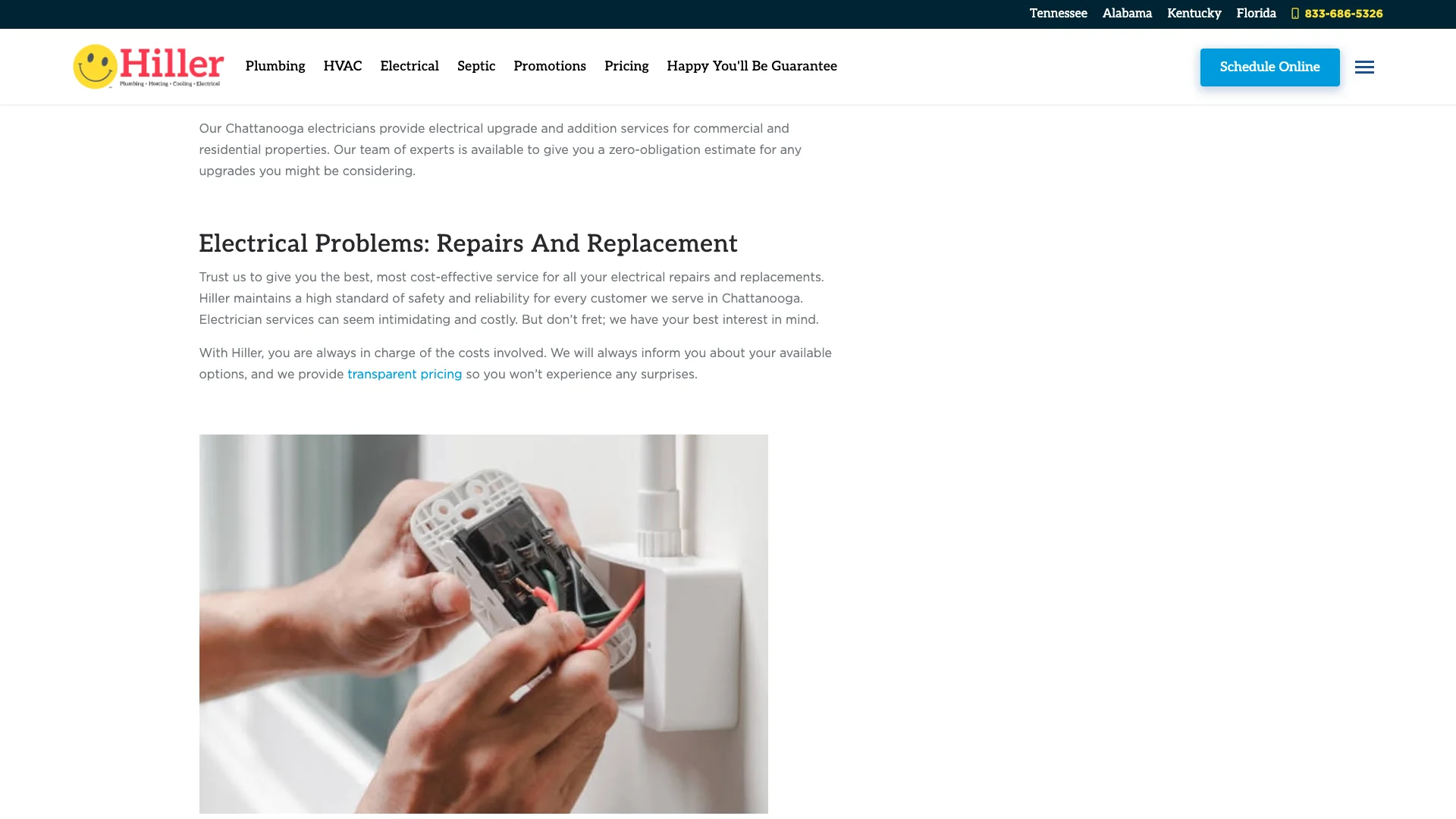
The 7-step booking modal is Happy Hiller's strongest conversion asset. Step 7 is where the homeowner has committed — address entered, service type chosen, time selected. They're about to submit. That's the highest-anxiety moment in the entire flow, and it's where two things go wrong.
First: the modal header is truncated. It reads "HILLER PLUMBING, HEATING, COOLI..." — the company name cut off mid-word because the header container is too narrow for the full string. That's a small thing. But small things erode trust at exactly the wrong moment. A homeowner about to hand over their contact information sees a branded header that looks broken. The brain processing "they can't fit their own name on their own booking form" is the same brain deciding whether to hit Submit.
Second: the guarantee is missing. "Happy You'll Be or the Service is Free" is Happy Hiller's core differentiating promise. It appears in marketing materials, in brand copy, in the pitch for why you should choose them over Lee Company or ARS. But it's not at Step 7. The one moment when reassurance does the most conversion work — the moment of commitment — is the one moment the guarantee isn't there.
Both fixes are copy-level and CSS-level. Truncation fix: widen the container or shorten the header text. Guarantee fix: one line of copy added to the Step 7 screen. Two hours of work on a flow that's otherwise genuinely well-built.
Gap 3: Blog content that teaches homeowners not to call
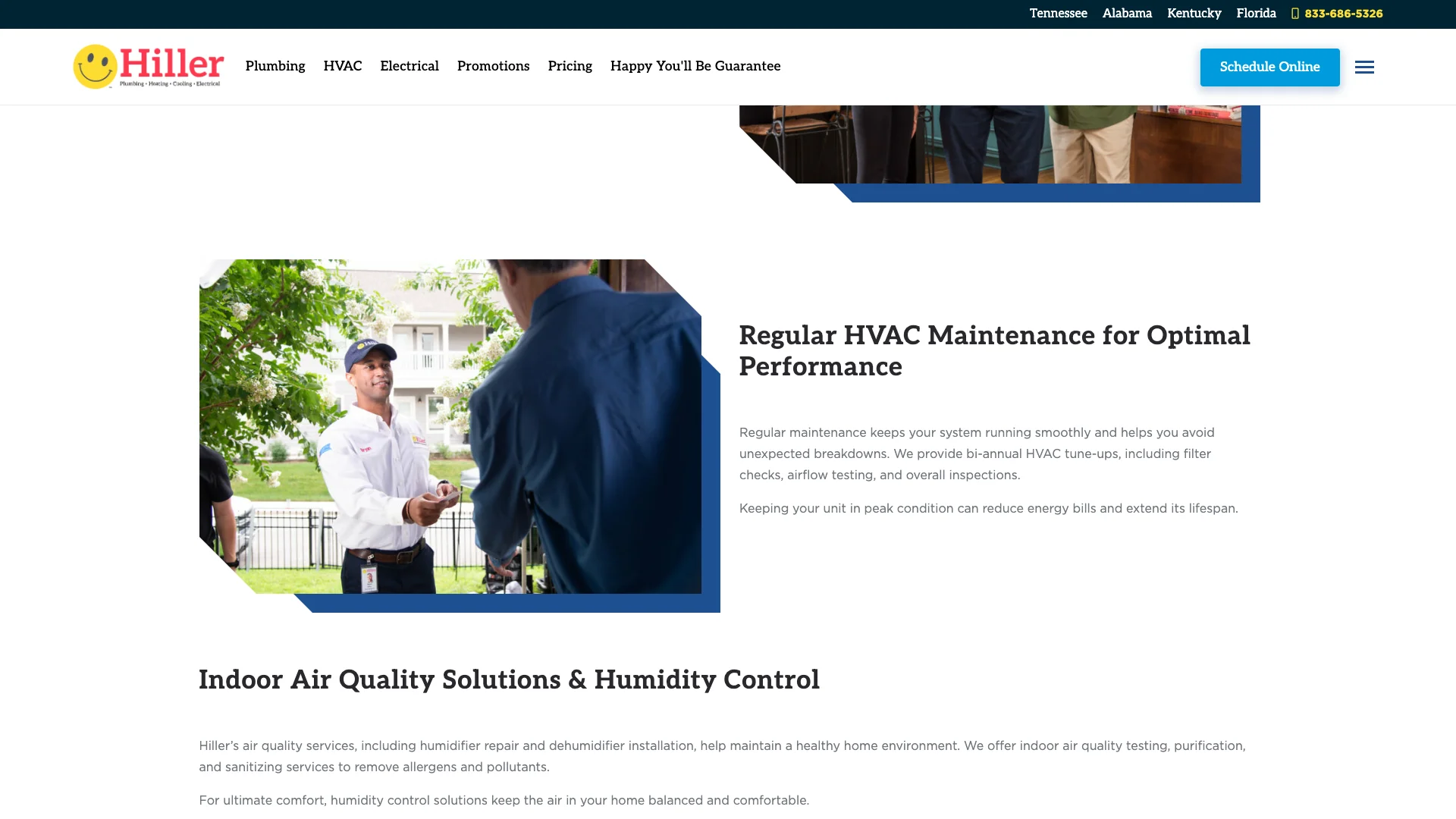
Happy Hiller's blog articles are well-written. Genuinely useful. The kind of editorial content that earns organic rankings because it actually answers the questions homeowners are asking.
The unclog-a-sink article walks through five DIY methods, including P-bend disassembly. It teaches this clearly and correctly. And at the end, when the homeowner has been fully educated on how to solve their own problem, the article ends.
There's no moment where it says: "If you've tried these and the clog is still there, that's when you call us." No acknowledgment that corroded pipes or deep-line blockages are outside what a homeowner should attempt. No CTA that connects the article's diagnosis to the service that fixes the cases where DIY doesn't work.
So what the article actually teaches is: plumbing problems are approachable, here are your options, good luck. Professional service is framed as the option you try after self-help fails. Not the first call. Not the smart call. Not the safe call for anything beyond the simplest fix.
The lead capture score for these blog articles is 3 out of 18. That's not a rounding error. Articles framed around DIY-first, professional-second produce fewer leads than articles that position professional service as the correct call for anything real. The content is doing the job of educating homeowners at the expense of connecting them to the service that should follow.
Rewriting the article conclusions doesn't mean removing the DIY content — that's why the articles rank. But a paragraph before the close that says "here's the line between what a homeowner should tackle and what needs a professional," plus a CTA that says "if you're past that line, here's how to book" — changes the conversion math without touching the SEO value.
Gap 4: Newsletter popup where an appointment prompt should be
The mid-scroll popup on Happy Hiller's blog articles offers "helpful hints, tricks and savings." Subscribe to the newsletter. Useful for a homeowner browsing casually on a Sunday afternoon.
Not useful for a homeowner who searched "why is my water pressure low Nashville" at 7 PM because the pressure dropped this morning and it's been getting worse.
The timing logic is right — mid-scroll is when a visitor has established intent. They've read past the fold, they're engaged, they're not bouncing. That's the correct moment to present a prompt. But the popup doesn't know whether the visitor is in research mode or emergency mode. It shows the same offer to both.
A popup that reads "Is this an urgent issue? We have same-day availability" captures the visitor who's ready to book instead of asking them to subscribe to something they'll probably never open. The simplest version is a copy change with the same trigger logic. A more sophisticated version adds URL-parameter or query-string logic that shows a different popup variant to visitors arriving from high-urgency searches. Either way, it's the same moment — the question is what you ask for in it.
The newsletter popup isn't wrong in principle. Using the highest-engagement moment in the scroll to ask for a subscription, when a meaningful share of those visitors have an active problem, is the wrong offer at the right time. Timing is half the equation. The offer is the other half.
Gap 5: Reviews that depend on JavaScript to exist
Happy Hiller has real reviews. Real volume. A review profile that most regional HVAC companies would spend years building. And if a visitor arrives with JavaScript disabled, on a slow mobile connection where JS loads late, or with an ad blocker that catches the review widget's third-party script — they see nothing. Two empty grey boxes where the social proof should be.
The Google and Facebook rating widgets are JavaScript-rendered with no server-rendered fallback. When the script doesn't fire, the container is present but empty. The homeowner gets the frame without the picture.
"98% of consumers read online reviews before hiring a local service business."
— BrightLocal (2025)
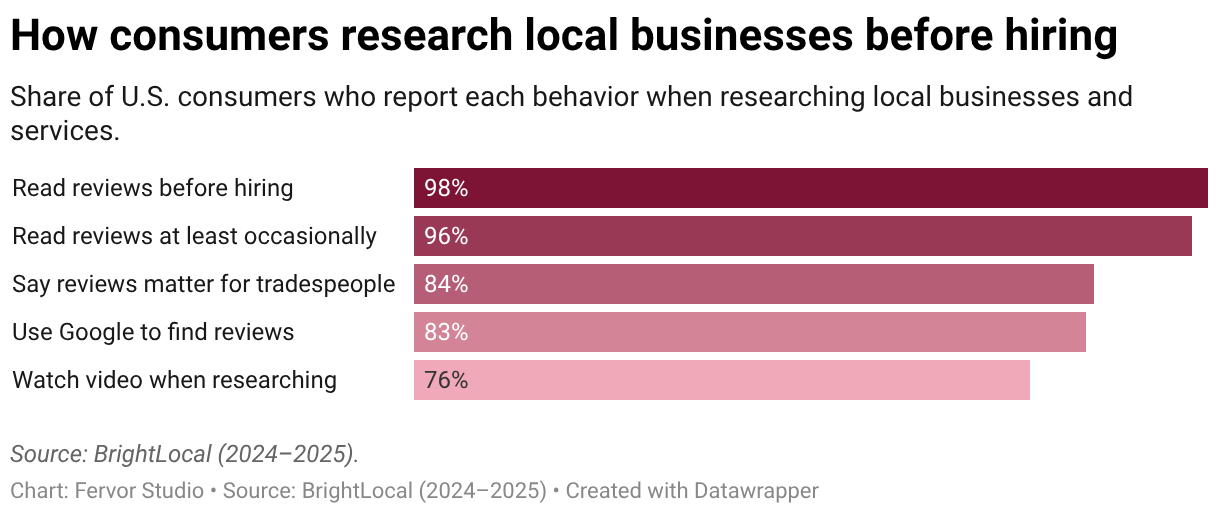
Virtually every homeowner evaluating Happy Hiller is looking for review confirmation before they call. If the widget renders, they get it. If it doesn't, they leave and check Google directly — and at that point, they may find a competitor before they come back. The review data exists. The delivery mechanism has a single point of failure with no fallback.
Server-rendered HTML for three to five review excerpts — static text, star ratings, customer names — loads with the page regardless of JS status. The JavaScript widget can still load on top of it for visitors where it works. But the fallback ensures the trust signal is present for everyone, not just everyone whose browser cooperates.
The five-gap fix list
Here's what these five gaps look like as a prioritized fix list, in order of implementation effort versus conversion impact:
1. Add a problem-specific inline CTA at the end of each blog article body. Not a generic "Schedule Service" button. A sentence that references the specific problem the article diagnosed, with a link to the relevant service page or direct to the booking modal. One line of copy per article. Zero infrastructure change.
2. Add guarantee copy to Step 7 of the booking modal. "Happy You'll Be or the Service is Free" belongs at the moment of commitment, not in the marketing materials. One line on the confirmation screen. Fix the header truncation in the same session — that's a CSS width adjustment. Two-hour job on a flow that's otherwise well-built.
3. Rewrite blog article conclusions. Add a paragraph before the close that distinguishes what a homeowner can safely DIY from what needs a professional. Position professional service as the correct call for anything beyond the simplest fix — not the fallback. This changes the conversion framing without removing any of the DIY content that drives the rankings.
4. Replace the newsletter popup with an appointment CTA for high-urgency visitors. Simplest version: change the popup copy from "helpful hints, tricks and savings" to "Is this an urgent issue? We have same-day availability." Same trigger timing. Different offer.
5. Add a server-rendered review fallback. Three to five review excerpts as static HTML — text, star rating, customer name — that load with the page. The JavaScript widget loads on top for visitors where it works. The static fallback ensures the trust signal is present for everyone else.
The uncomfortable part
Happy Hiller has done the hard things right. The 7-step booking modal took real engineering investment. Transparent pricing on the homepage takes real organizational confidence. A "Happy You'll Be or the Service is Free" guarantee takes real operational commitment to back it up. A blog with editorial content that actually ranks took real content work over real time.
And a homeowner with a real problem still closed the tab.
None of these five gaps are infrastructure problems. They're copy problems. Placement problems. They're the last ten feet of a journey the site already built the road for. The homeowner arrived because Happy Hiller earned the SEO. They stayed because the content was useful. They left because nothing told them what to do next in the specific language of the specific problem they came with.
That's not a 60/100 brand problem. It's a 60/100 sentence problem.
If you're a Nashville HVAC or plumbing contractor reading this: Happy Hiller has resources, brand equity, and engineering capacity you probably don't. And they're still leaving homeowners at the door because the copy didn't close what the infrastructure opened. You don't need their booking modal. You need the sentence they forgot to write.
Methodology and sources
How this Site Inspection was conducted
This Site Inspection is based on automated scraper data collected against happyhiller.com, manual browser verification, and structural analysis of the booking modal flow and blog content architecture. Specific data points — visitor counts, lead capture scores, modal step observations — were collected through direct browser inspection of the pages as they rendered.
Methodology flags
FLAG 1: Traffic estimates. The 3,529 monthly visitor figure for the three blog posts is drawn from third-party traffic estimation data, not Happy Hiller's internal analytics. Actual traffic may differ.
FLAG 2: Lead capture scoring. The 3 out of 18 lead capture score for the blog content reflects Fervor's internal scoring framework applied to the structural elements present on the inspected pages — inline CTAs, booking links, appointment prompts, urgency copy, form placements. It is not a measured conversion rate from Happy Hiller's analytics.
FLAG 3: Modal observations. The booking modal header truncation and the absence of guarantee copy at Step 7 were observed during direct browser inspection of the booking flow. Modal behavior may vary across devices, browsers, or subsequent site updates.
FLAG 4: JavaScript review behavior. The empty grey outline rendering was observed under conditions where the JavaScript widget failed to load. Behavior may differ across browser configurations, connection speeds, and geographic locations.
FLAG 5: Page elements may have changed. All observations reflect the state of happyhiller.com as of the data collection dates. Happy Hiller may have modified their pages, booking modal, or content since this Site Inspection was conducted.
Sources and citations
Statistics cited via StatChart components throughout this article come from third-party web sources, with publication year and verification URL embedded in each citation. The Houzz 2025 figure (25% of homeowners cite trust as their top challenge when hiring a contractor) comes from the 2025 U.S. Houzz and Home Renovation Trends Study. The BrightLocal 2025 figure (98% of consumers read online reviews before hiring a local service business) comes from BrightLocal's Local Consumer Review Survey.
Frequently asked questions
What is Happy Hiller's Fervor Grade™?
Happy Hiller scores 60 out of 100 on the Fervor Grade — Grade C, Conditional. The score reflects genuine conversion potential, including a 7-step progressive booking modal and transparent pricing comparison, alongside five structural gaps that let homeowners leave without booking. The 60/100 places Happy Hiller above the regional HVAC average but well below what its brand equity and engineering investment should produce.
What is the booking modal gap?
The 7-step booking modal is one of the stronger-built booking flows in home services. But the modal header reads "HILLER PLUMBING, HEATING, COOLI..." — truncated mid-word — and the core guarantee, "Happy You'll Be or the Service is Free," is absent from Step 7, the final confirmation screen. Step 7 is the highest-anxiety moment in the booking flow. The trust signal that should close it isn't there. Both are fixable in under two hours.
Why does the blog content reduce leads?
The articles teach homeowners how to solve plumbing and HVAC problems themselves before calling a professional. One article walks through five DIY unclogging methods including P-bend disassembly. There are no inline CTAs in any of the article bodies. The lead capture score for these articles is 3 out of 18. The content frames professional service as the option you try after self-help fails — which is the wrong positioning for a company that wants to be the first call, not the last resort.
What happens to the reviews when JavaScript doesn't load?
The Google and Facebook rating widgets are JavaScript-rendered with no server-rendered fallback. When the script doesn't load — due to a slow connection, an ad blocker, or a browser configuration — both widgets render as empty grey outlines. The trust data exists. The delivery mechanism has a single point of failure. Three to five server-rendered HTML review excerpts as a static fallback would ensure the social proof is present regardless of JS status.
What can a Nashville contractor do with these gaps?
Five moves, in order of implementation effort: add problem-specific inline CTAs to blog article bodies; add guarantee copy to the final step of your booking flow; reframe your blog conclusions to position professional service as the correct call for anything beyond a simple fix; replace generic newsletter popups with appointment CTAs for high-urgency queries; and add server-rendered HTML fallbacks for any JavaScript-dependent review widgets. None of these require a site rebuild. All of them are conversion work in the copy layer.