What Roto-Rooter gets right on their service pages
Roto-Rooter is probably the most recognized plumbing brand in the United States. According to Ahrefs estimates, the domain pulls roughly 652,600 organic visitors every month. The estimated traffic value sits around $4 million. So we built this Roto-Rooter lead generation strategy breakdown around their three highest-traffic service pages to see what a plumbing brand with that kind of budget actually puts in front of homeowners.
And here's what surprised us. The pages are good. Genuinely good.
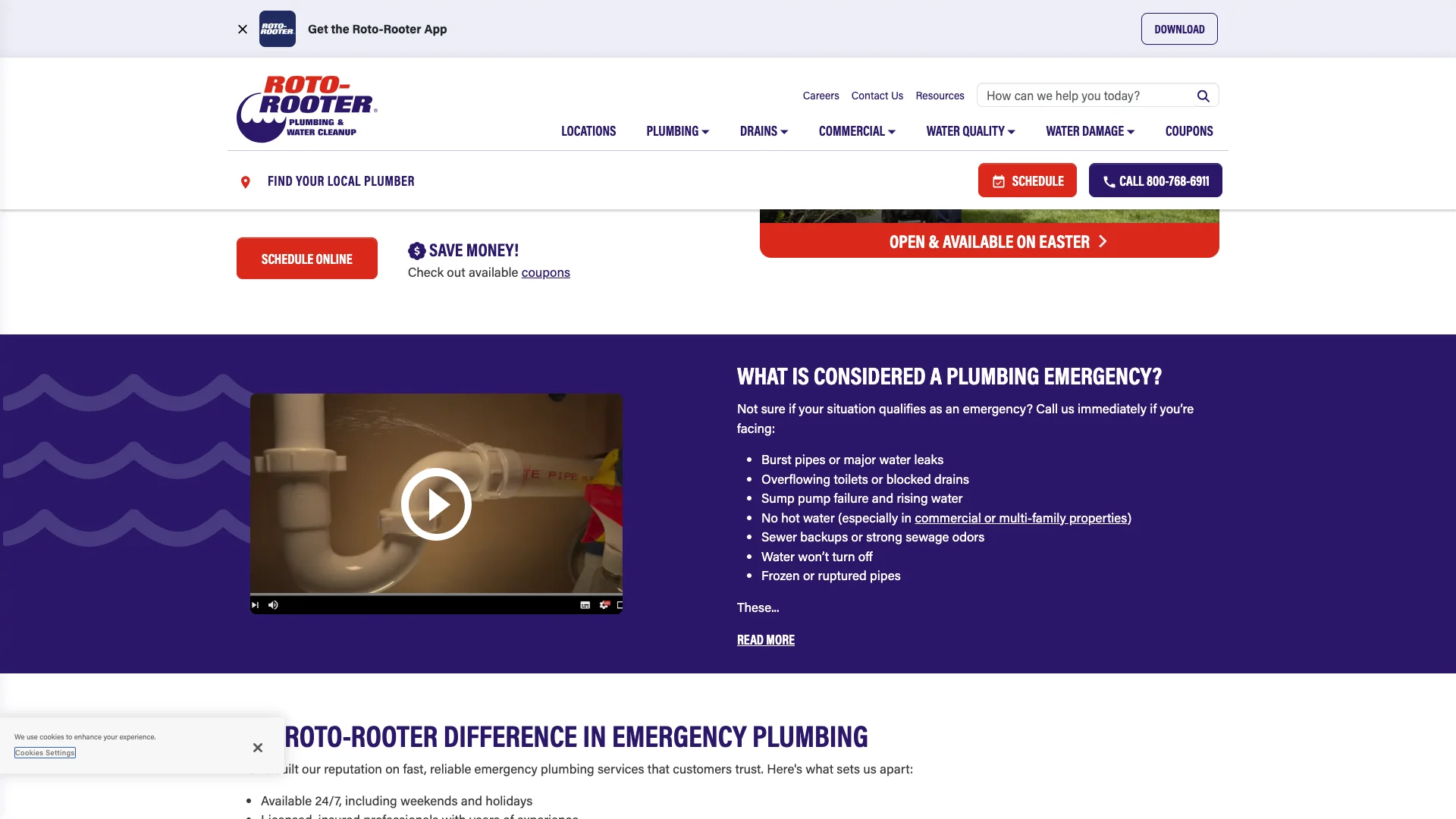
The emergency plumber page (about 77,000 monthly visitors) opens with a service description, then moves into a section explaining what qualifies as a plumbing emergency. Below that, a video. Below that, "The Roto-Rooter Difference in Emergency Plumbing" with a bullet list of what they offer. A full list of emergency services. Guidance on when to call. And then, near the bottom, three five-star customer reviews from real people. Amanda K. Jannica H. Jamie S. Named reviewers with detailed accounts of their experience. Plus a frequently asked questions section with five expandable questions.
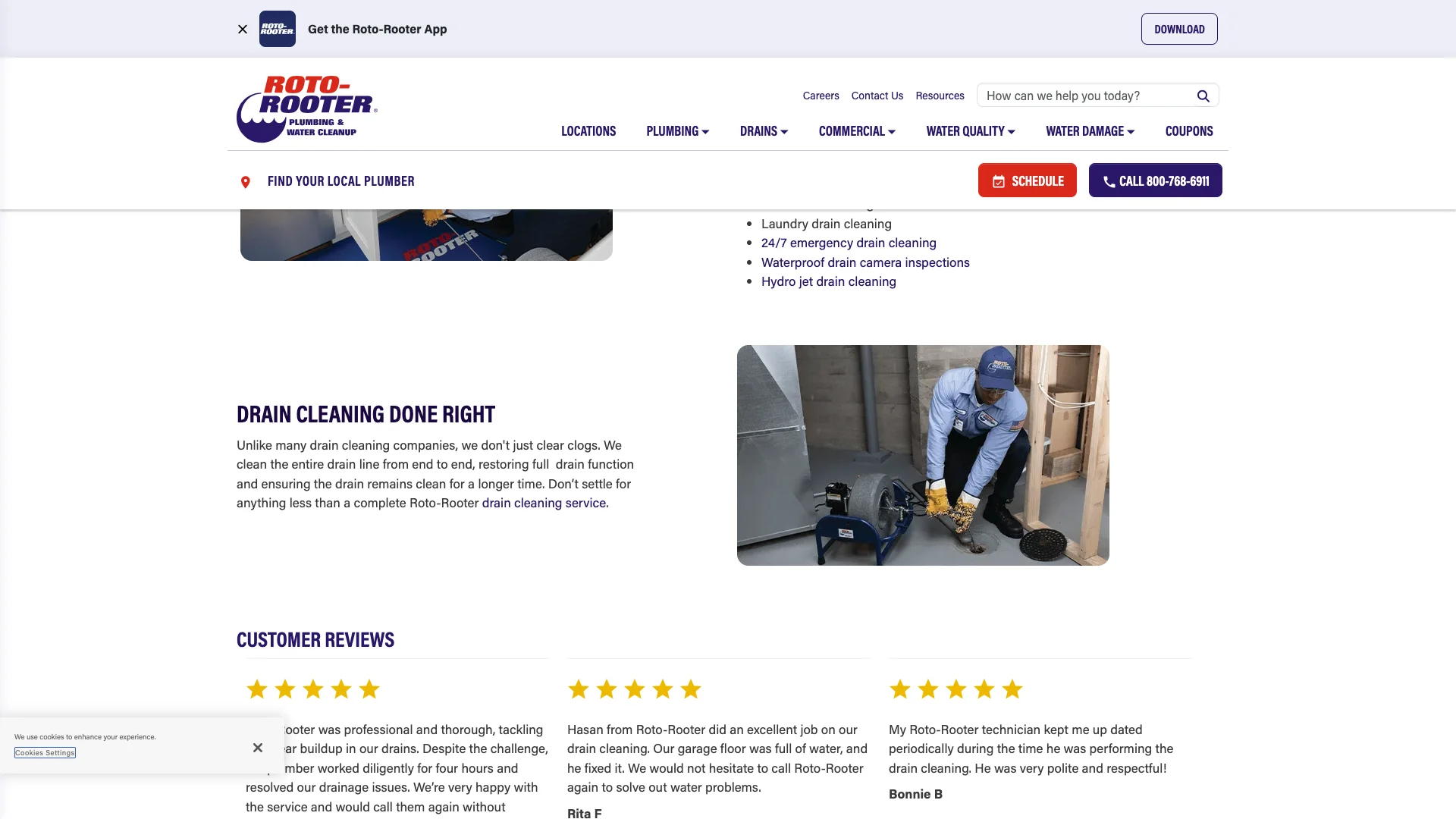
The drain cleaning page (about 64,700 monthly visitors) follows the same pattern. Service description at the top. A section about their founder inventing the drain cleaning machine in 1933. (That's a nice history touch, actually.) Content comparing real drain cleaning to cheap alternatives. A full service list. Then three five-star reviews. Fabian G. Rita F. Bonnie B. And five more FAQs.
The septic tank page (about 42,100 monthly visitors) has septic pumping details, a video, service information, and three more five-star reviews. Ken M. Kelly L. Billy W.
So across all three pages, that's nine named customer reviews, all five stars, all with specific details about their experience. FAQ sections on the emergency and drain cleaning pages. Video content on all three. Deep service descriptions throughout. Roto-Rooter's service pages don't look like franchise templates. They look like someone actually thought about what a homeowner searching "emergency plumber" at 2 AM would need to read before making a call.
But then you look for the one thing every service page should have alongside those reviews, and it's not there.
The one thing every service page is missing
There's no form on the page.
None of the three highest-traffic service pages on rotorooter.com has an inline booking form. The form exists, but it's behind a button on a completely different page. The homeowner reads the content. They see the reviews. They scroll through the FAQs. They watch the video. There are CTAs everywhere. A "Schedule Online" button. A "Schedule Now" banner. A phone number in the header. A coupon link. But every single booking path either requires a phone call or sends the homeowner to a separate URL to fill out a form. No form on the page itself. Not one field.
That's the gap. Roto-Rooter builds the entire case for hiring them on the service page, then makes the homeowner leave that page to actually do it.
Think about the experience. You've been reading about Roto-Rooter's emergency plumbing services. You've seen the reviews from Amanda K and Jamie S. You've read the FAQ about response times. You're convinced. And now, to book, you have to click "Schedule Online," which opens a different URL entirely. The service page you just spent three minutes reading? Gone. You're somewhere else now.
For the homeowner who calls, this doesn't matter. The phone number is right there, prominent, on every page. And phone calls convert at dramatically higher rates than web forms in plumbing. But not everyone calls. Some people are at work. Some are browsing at 2 AM and don't want to wake anyone up. Some just prefer typing over talking. For those people, the path from "I'm convinced" to "here's my info" has a gap in the middle. A navigation event. A new page. A new context.
The four-step scheduling wizard on a separate page
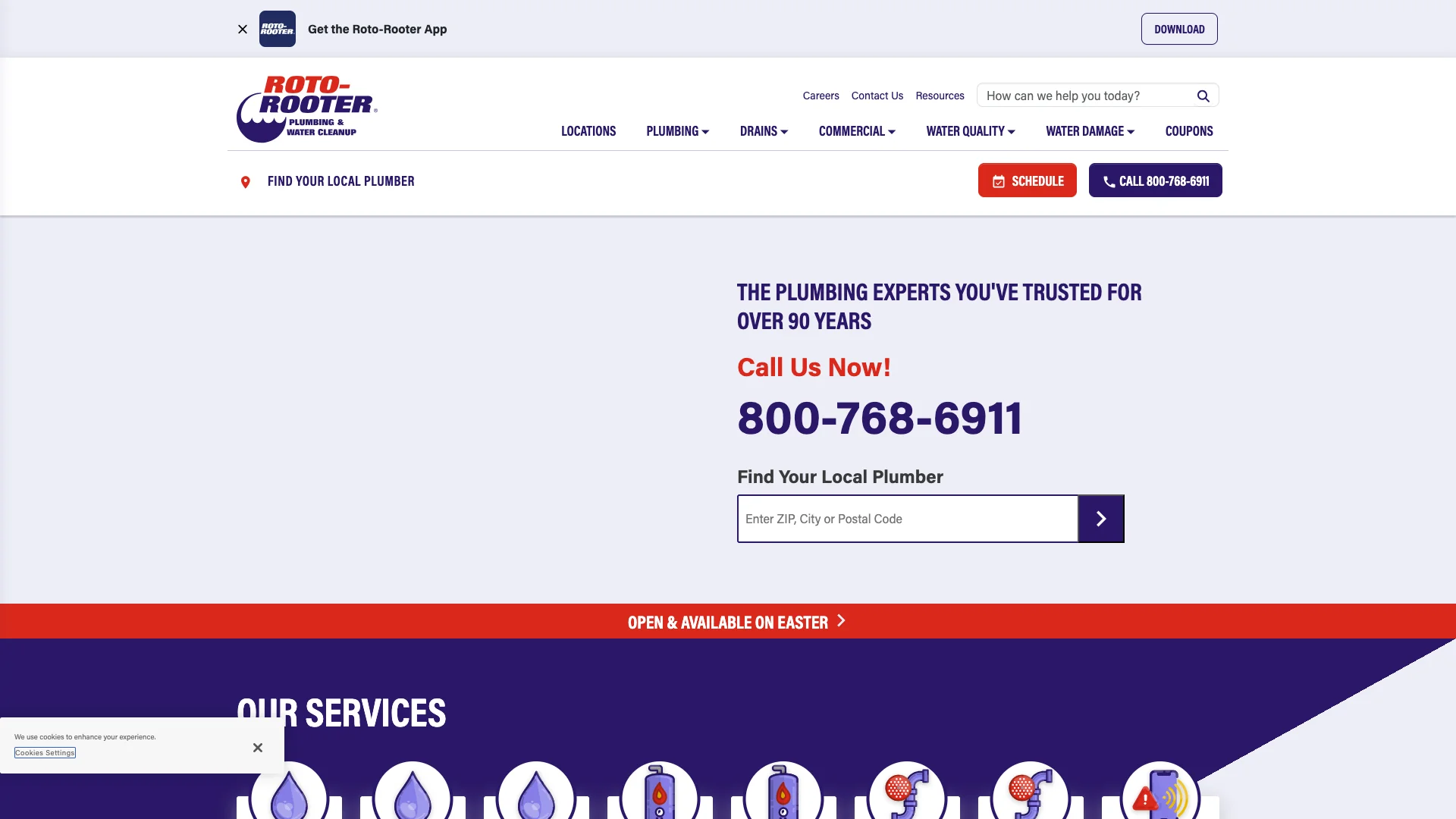
Click "Schedule Online" from any service page and you land on rotorooter.com/schedule-service/. The scheduling wizard runs four steps. Step one: full name. Step two: address, city, state, zip code. Step three: email and phone number. Step four: preferred date, preferred time, and a text box to describe the problem. That's ten fields across four screens before you hit "Submit."
Below the form on this page, there are additional trust signals. A customer testimonial section with star ratings and a named review from Greg R. A BBB badge. A "Secure" badge. A third verification badge. So the scheduling page has its own trust layer on top of what the service pages already showed.
Ten fields isn't unreasonable for a scheduling form. Roto-Rooter needs the address to route the request to the right franchise location. They need the date and time for availability. Those fields earn their keep. The friction isn't the field count. The friction is the path to the form.
And here's the architectural question. The service page already earned the homeowner's attention. It showed them reviews. It answered their questions. It described the service. All of that trust-building happened on one page. And then the conversion happens on a completely different page, with its own separate trust signals. Two pages doing related but disconnected jobs.
A three-field form at the bottom of the service page (name, phone, zip) right below those five-star reviews would collapse both jobs into one scroll. The homeowner reads the reviews, fills in three fields, and they're done. No navigation. No context switch. No four screens of fields.
How the performance scores complicate the picture
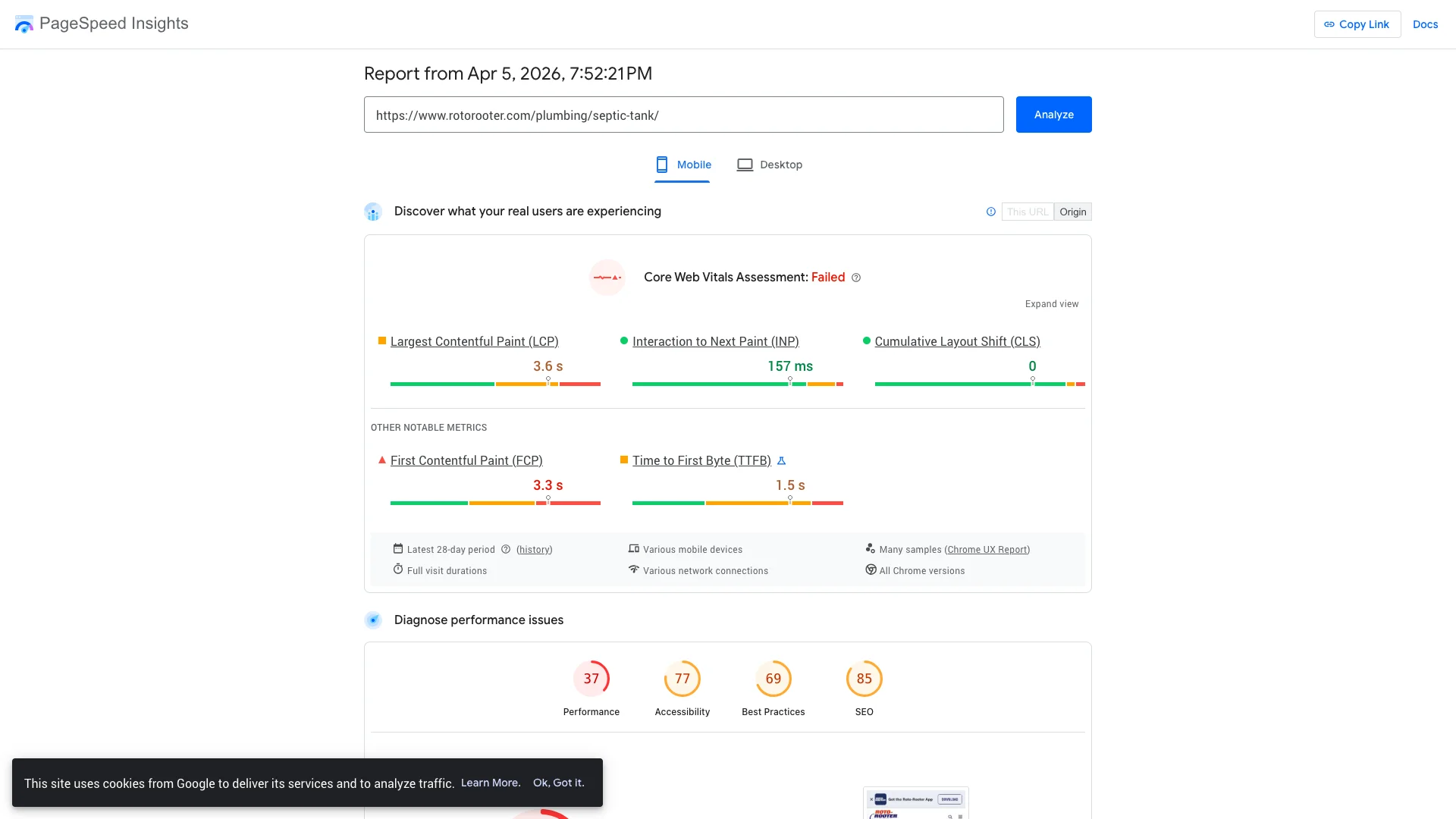
We ran all three service pages through Google's mobile lab test. The emergency plumber page scored 38 out of 100. Drain cleaning scored 38. Septic tank scored 37.
Those scores mean the main content takes roughly 5.6 seconds to appear on the emergency page in Google's simulated test. The septic page takes about 9.4 seconds. On a page ranked for "emergency plumber," the highest-urgency search in plumbing, that's a long wait.
But one number is genuinely good across all three. Zero layout shift. The pages don't rearrange while they load. Nothing jumps around. Nothing pushes content off the screen mid-read. For pages carrying reviews, FAQs, video embeds, and image-heavy content sections, that stability is harder to achieve than it looks.
And here's where Roto-Rooter's brand does the heavy lifting. A local plumber with a 38 on Google's mobile test would lose visitors to whoever loads faster. Roto-Rooter keeps those visitors because the homeowner recognizes the name. The brand earns patience the site hasn't technically earned. That's not a strategy you can replicate. But loading faster IS something you can do, and we'll come back to that.
Mr. Rooter proves the form and the trust can sit on the same page
Mr. Rooter Plumbing, the Neighborly franchise brand, pulls about 165,700 monthly organic visitors. About a quarter of Roto-Rooter's traffic. Their estimated traffic value is $771,400 a month.
And here's where the comparison gets interesting. Mr. Rooter's emergency plumber page opens with a "Let Us Call You" form right under the header. Six fields. Last name, phone, email, best days to reach you, street address, zip code. The same form repeats again at the bottom of the page. So the homeowner sees the form when they land. Then they scroll through content. Then they see the form again before they leave. Two inline opportunities to submit without ever clicking to a separate page.
Below and around those forms, Mr. Rooter packs in everything else. A "Why Choose Us" section with their three value props. A "When to Call for an Emergency Plumber Service" section. A "Residential & Commercial Services" grid. A city list for finding the nearest provider. Blog post previews. Expert Tips. A "Customer Reviews" block with three five-star reviews in branded red cards. And a frequently asked questions accordion with full answers. (Yes, I scrolled the whole thing. The layout is denser than Roto-Rooter's.)
So the accurate comparison is this. Mr. Rooter has reviews. Mr. Rooter has FAQs. Mr. Rooter has deep content. AND Mr. Rooter has inline forms at the top and bottom of every service page. Roto-Rooter has reviews, FAQs, and deep content too. But the form lives somewhere else.
And real-world load times back this up. We ran Mr. Rooter's three service pages through PageSpeed Insights on April 15, 2026 and pulled the real-user data. All three passed Core Web Vitals. Main content appeared between 1.5 and 1.8 seconds on actual homeowner devices. Interaction delays sat between 188 and 194 milliseconds. Layout shift was essentially zero. The dense content didn't cost the page its speed. So a homeowner lands on the emergency plumber page, sees the form, and the form is ready to use quickly.
And that's the part that matters most. Same trade. Same franchise model. Same reliance on a corporate network of locations. Mr. Rooter chose to put the form where the traffic lands. Roto-Rooter chose to put it on a separate URL. Both chose. Neither had the template force their hand. The architecture is a decision.
And then there's SERVPRO. Restoration, not plumbing, but the traffic pattern tells a story. SERVPRO pulls 643,700 monthly visitors. Nearly identical to Roto-Rooter's 652,600. Traffic value of $3.1 million. And their service pages? Zero forms. Zero inline reviews. Phone-only conversion. The two highest-traffic home services brands in our index, running the same play: deep content, phone number, no inline form on the service page. So Roto-Rooter isn't an outlier. But Mr. Rooter isn't either. Two different answers to the same question, both scaled, both working. The question is which answer catches more of the homeowners who won't call.
The revenue leak math
Let's do the math. Not the fuzzy kind. The napkin kind. The kind where you write down real numbers and multiply them together and either the answer makes you act or it doesn't.
We don't have Roto-Rooter's internal data. So we're going to use their published pricing, their publicly estimated traffic, and industry conversion benchmarks. And we're going to run three scenarios: one where we give Roto-Rooter every possible advantage, one that's realistic, and one where things are worse than they probably are. Then you decide which one you believe.
But first, the inputs. These don't change across scenarios.
The traffic. Those three service pages draw about 183,800 visitors a month combined (Ahrefs estimate, March 2026). Emergency plumber gets 77,000. Drain cleaning gets 64,700. Septic gets 42,100.
The pricing. We're using the bottom of Roto-Rooter's published ranges. Not the midpoint. The floor. Emergency plumbing starts at $1,000. Drain cleaning starts at $225. Septic pumping starts at $280. (HomeGuide and Angi, 2026.)
The close rate. 25% on web form leads. WebFX reports 50% or higher for exclusive leads in home services. But web form leads close lower than phone calls, so we're cutting it roughly in half. 25%.
The phone callers. This is important. Most people who convert on a plumbing site call. Phone calls convert 10 to 15 times more revenue than web leads in home services (BIA/Kelsey, 2025). Plumbing is the trade most likely to produce a call from search (Google via Invoca, 2025). And mobile emergency searches convert 60 to 80% higher than planned services (Cube Creative, 2025). Roto-Rooter's phone number is on every page (localized by market, so the homeowner sees their nearest location's number), there's no extra charge for nights or weekends, and the brand recognition is massive. So we're estimating that 12% of visitors call. That's generous. That's giving Roto-Rooter credit for a phone operation that's probably one of the best in the industry.
12% of 183,800 is about 22,056 callers a month. They're converted. They're out of the math. That leaves roughly 161,744 non-callers. These are the people still on the page who didn't pick up the phone. The scheduling form is competing for THIS pool.
The change we're measuring. Not a different form. Not fewer fields. The exact same four-step, ten-field scheduling wizard that Roto-Rooter already uses. Same name field. Same address fields. Same date and time picker. Same problem description box. The only difference: instead of living on a separate page (which takes about 1.3 seconds before anything appears, based on a PageSpeed Insights test run on April 15, 2026), the wizard is embedded on the service page itself, below the reviews. The 1.3 seconds isn't the issue. It's that the homeowner leaves the page where they just read nine five-star reviews and lands on a different URL with a blank form. The context resets. Same form. Different location.
Where the conversion numbers come from. Before the scenarios, here's the benchmark band we're working inside. First Page Sage's 2026 CTA conversion analysis across 71 companies and 24 CTA types found huge variance by placement. An inline link pointing to a separate Contact Us page converts at 0.2%. A contact form in a sidebar converts at 0.4%. A Contact Us banner mid-page converts at 0.9%. A contact form in a slide-in converts at 1.5%. Average CTA button click-through across the industry sits around 4.23%. Unbounce's conversion benchmark report for home improvement landing pages shows a 3.8% median and a 7.2% average across all conversion types. WebFX's 2026 home services benchmarks put optimized plumbing sites at 12 to 16% total conversion (phone plus web combined). So the observable range for "percent of visitors who complete any conversion action" on plumbing sites runs from 0.2% at the worst-case CTA type up to 17% at the top. The scenario numbers below all sit inside that band, weighted toward the low end because we're isolating web form conversion specifically after phone callers have already converted. (Every source behind those numbers is listed in the Citations tab of the Page at a Glance block at the top of this article.)
Now the three scenarios.
Best case for Roto-Rooter (near-perfect world)
Give them everything. Assume their current web conversion is already at 4% of total visitors despite the form living on a separate page. That means their brand recognition is fully compensating for the architectural friction. The "Schedule Online" button is working beautifully. People are clicking through, filling out all four steps, submitting. 4% of 183,800 is about 7,352 form leads a month through the current flow.
Now embed the same form on the service page. Eliminate the page navigation. Eliminate the context switch. The form appears right below the five-star reviews instead of on a different URL. Even in this near-perfect scenario, removing a page change lifts conversion at least half a percentage point. That's the smallest reasonable estimate for eliminating an entire navigation step from a conversion funnel. So web conversion goes from 4% to 4.5%.
Half a point on 183,800 visitors is 919 additional form leads per month.
919 leads. Weighted by page traffic and job value. At floor pricing. At 25% close rate.
- Emergency plumber page: about 386 incremental leads times $1,000 times 25%. $96,500 a month.
- Drain cleaning page: about 322 leads times $225 times 25%. $18,100 a month.
- Septic tank page: about 211 leads times $280 times 25%. $14,800 a month.
Best case total: $129,400 a month. About $1.55 million a year.
That's the scenario where everything is already going right for Roto-Rooter. Where the separate page barely matters. Where the brand is doing all the heavy lifting. And the gap is still $1.55 million a year. From three pages.
Realistic scenario
Now let's be honest about what's probably happening. Plumbing sites convert at 12 to 16% total across all channels (WebFX, 2026). With 12% of visitors calling, total conversion is probably around 14%. That means web conversion is about 2% of total visitors. Not 4%. The separate-page form is creating real friction, and a lot of non-callers are leaving without scheduling.
2% of 183,800 is about 3,676 form leads a month through the current flow.
Embed the same wizard on the service page and web conversion lifts to 3%. One full percentage point. Still well below the 12 to 16% total benchmark, but a meaningful improvement from eliminating the page change.
One point on 183,800 visitors is 1,838 additional form leads per month.
- Emergency: about 772 incremental leads times $1,000 times 25%. $193,000 a month.
- Drain cleaning: about 643 leads times $225 times 25%. $36,200 a month.
- Septic: about 423 leads times $280 times 25%. $29,600 a month.
Realistic total: $258,800 a month. About $3.1 million a year.
Worst case (for Roto-Rooter)
What if the separate-page form is actually costing them more than we think? What if their web conversion is sitting at 1.5% because a lot of non-callers bounce the moment they land on a separate scheduling URL? What if brand recognition gets people to the service page but doesn't carry them through a four-step wizard on a different domain path?
In this scenario, current web conversion is 1.5%. Embedding the wizard on the service page lifts it to 3.5%. A two-point lift, which is still conservative given that optimized plumbing sites convert at 12 to 16% total.
Two points on 183,800 visitors is 3,676 additional form leads per month.
- Emergency: about 1,544 incremental leads times $1,000 times 25%. $386,000 a month.
- Drain cleaning: about 1,287 leads times $225 times 25%. $72,400 a month.
- Septic: about 845 leads times $280 times 25%. $59,200 a month.
Worst case total: $517,600 a month. About $6.2 million a year.
The range
Three scenarios. Same form. Same fields. Same wizard. Just embedded on the page instead of behind a click.
- Best case for Roto-Rooter (everything's already working): $1.55 million a year.
- Realistic: $3.1 million a year.
- Worst case (the separate page is costing them more than they think): $6.2 million a year.
Pick whichever number you believe. The floor is still $1.55 million. And that's from three pages on a site with dozens of service pages running the same architecture.
What this math doesn't account for. Two honest caveats that shrink the number if you want to be conservative. First, cannibalization. Some percentage of inline form submitters would have called the phone number anyway. Those aren't incremental leads, they're shifted leads. And phone leads close at higher rates than form leads in home services, so a shifted lead is actually worth less than a captured call. We don't have the data to size that overlap precisely, and industry research doesn't produce a clean benchmark for it either. Second, operational capacity. Capturing more leads than a company can service doesn't create revenue, it creates angry customers and missed callbacks. Roto-Rooter likely has capacity at scale, but the capture-to-revenue conversion isn't 100%.
One more thing. Roto-Rooter's phone operation is probably excellent. The phone number is doing massive work. Nobody is questioning that. The form gap is the secondary conversion path, not the primary one. But "secondary" at Roto-Rooter's traffic volume still means real revenue sitting in the space between where the reviews are and where the form is.
What this means if you're a local plumber with 300 visitors a month
You don't have 652,000 visitors. You don't have $4 million in traffic value. And you don't have a jingle. What you do have is the ability to make the same choice Mr. Rooter made without needing corporate approval.
Roto-Rooter's architecture separates two things that belong together: the trust-building content (reviews, FAQs, service details on the service page) and the booking form (ten fields across four screens on a separate page). The homeowner earns confidence on one page and acts on it somewhere else. Mr. Rooter runs the same franchise model and puts the form on the page anyway. You can too, faster than either of them.
You can put those on the same page. And that's not a small advantage. That's a structural one.
Put a three-field form on your emergency plumber page, right below your Google reviews. Name, phone number, zip code. "Describe your issue" as an optional fourth field. The homeowner who finds you at 2 AM and doesn't want to make a phone call can submit their info and expect a callback. Roto-Rooter makes that same person navigate to a different page and fill out four screens.
Keep your phone number as the primary conversion path. Phone calls convert at dramatically higher rates in plumbing. But the form catches the people who won't call. The 2 AM browser. The person at work. The person who wants to describe the problem in writing before talking to anyone. Roto-Rooter's service pages lose every one of those people because there's nothing to fill out without leaving the page.
And then there's the speed advantage. Roto-Rooter's pages score 37 to 38 on Google's mobile test. If your service page scores 85 or above and loads in under three seconds, the homeowner sees your complete pitch (reviews, form, phone number, service description) before Roto-Rooter's page finishes loading. Brand recognition buys Roto-Rooter patience. Speed buys you the same thing, without the jingle.
And here's the positioning angle that seals it. Roto-Rooter's service pages show technician photos in branded uniforms, but no one specific. No name. No bio. No "this is the person who'll show up at your house." The homeowner sees the brand, not the individual. You can put "Call Mike directly" with your photo at the top of your emergency page. Not a stock image of a uniformed crew. Your face. Your name. Your license number. 48% of homeowners say trust is their biggest challenge when hiring a contractor (Houzz, 2025). A named owner with a photo addresses that in a way a branded uniform photo structurally cannot.
Five questions to ask about your own plumbing website right now
These come directly from the Roto-Rooter lead generation strategy breakdown above. Not generic advice. Specific gaps you can check against your own site in the next ten minutes.
1. Can a homeowner book from your service page without leaving it? Open your most-visited service page. Is there a form on it? Or does the visitor have to click to a contact page first? Roto-Rooter has reviews, FAQs, and deep content on their service pages. But the homeowner still has to navigate away to book. If your form is on the same page as your reviews, you've already shortened a path that the biggest plumber in America hasn't figured out.
2. Are your reviews visible on the page where the homeowner makes their decision? Roto-Rooter puts reviews near the bottom of each service page. That's better than hiding them entirely, but it means the homeowner has to scroll past the service description, the videos, and the FAQs before seeing proof from other customers. If your reviews are above the fold or directly after the service description, the trust arrives earlier in the scroll.
3. Does your site load its main content in under three seconds on a mobile phone? Run your top service page through PageSpeed Insights. Pull the real-user data, not just the lab score. If the main content appears in under three seconds on actual devices, you're in the company of Mr. Rooter (1.5 to 1.8 seconds, Core Web Vitals passed). If it loads slower, you're in the company of a lot of national brands who let their speed slip when they added content.
4. If a homeowner finds your site at 2 AM, can they request a callback without calling? "Enter your name and number and we'll call you first thing in the morning." That one sentence and a two-field form create an inline conversion path that Roto-Rooter doesn't offer without a page change. Their answer to the 2 AM homeowner is "call our phone number" or "click Schedule and fill out four pages of fields." Yours can be simpler.
5. Does your site make it obvious that a real person owns this company? Roto-Rooter's pages show uniformed technicians, but no specific person the homeowner will actually meet. You can show the owner. "Call Mike directly" with YOUR photo at the top of your emergency page. That named, personal accountability is something a franchise structurally cannot offer. And for the homeowner who's been burned by a faceless company before, knowing exactly who's showing up is the strongest trust signal on the page.
The pages earn the decision. Then they let you leave.
Roto-Rooter's service pages are better than most national brands we've broken down. Reviews on every page. FAQs that answer real questions. Content that explains the service without sounding like a brochure. They've built the trust case. The case works.
But the booking form is on a different page. And it asks for ten fields across four screens. That gap between earning the homeowner's confidence and capturing their information is where leads quietly disappear. Not because the trust isn't there. Because the form isn't on the same page.
The pages earn the decision. Then they let you leave to act on it.
How we collected this data
Methodology
This page breakdown is based on two data sources: automated scraper data collected March 29, 2026, and manual Chrome browser verification conducted April 14, 2026. Where the two sources conflict, the Chrome verification data is treated as ground truth. The Chrome verification corrected significant errors in our initial analysis regarding review presence and trust signal placement.
Editorial flags
FLAG 1: Ahrefs traffic estimates. All traffic figures (652,600 monthly visitors, $4 million traffic value, per-page visitor counts) are Ahrefs estimates from March 2026, not Roto-Rooter's internal analytics. Actual traffic may differ. These figures are used for relative comparison, not as exact measurements.
FLAG 2: Scraper vs. Chrome discrepancy on forms. The automated scraper found only search bar forms on the three inspected service pages. Chrome verification confirmed this is accurate for those pages. Chrome also confirmed a four-step scheduling wizard at rotorooter.com/schedule-service/ with ten fields. The service pages have no inline forms. The scheduling page does.
FLAG 3: Scraper vs. Chrome discrepancy on reviews. The automated scraper reported "Google Reviews: true" on all three service pages but could not extract review counts or reviewer names. Chrome verification confirmed three five-star customer reviews with named reviewers on each service page (nine total across the three pages). An earlier version of this analysis incorrectly characterized the service pages as having "zero reviews." That was wrong. The reviews are there, near the bottom of each page.
FLAG 4: Additional trust signals on scheduling page. Chrome verification confirmed that the scheduling page at /schedule-service/ displays BBB, Secure, and third-party verification badges, plus customer testimonials with star ratings, below the form. These additional signals are separate from the service-page reviews.
FLAG 5: Google mobile lab test scores. Performance scores (37, 38, 38) are from Google's lab simulation using a throttled mobile connection. Real phones on real networks typically load faster. These scores are useful for relative comparison between brands, not as absolute speed measurements.
FLAG 6: Architectural inference. The characterization of Roto-Rooter's form placement as an architectural choice (rather than a template constraint) is an editorial inference based on observing Mr. Rooter, another Neighborly-adjacent franchise plumbing brand of comparable scale, making the opposite choice. We do not have access to either company's internal development processes. The inference is supported by the observable pattern but is not confirmed by either company.
FLAG 7: Mr. Rooter data. Mr. Rooter traffic estimates come from the automated scraper protocol, collected March 29, 2026. Form, review, and FAQ presence on Mr. Rooter's service pages was Chrome-verified April 15, 2026. The scraper reported four forms per page with up to nine fields each; Chrome verification found two visible "Let Us Call You" form instances per page (top and bottom placement) with six visible fields each (last name, phone, email, best days, street address, zip). Mr. Rooter's real-user performance metrics (LCP 1.5 to 1.8 seconds, INP 188 to 194 milliseconds, CLS 0 to 0.01, Core Web Vitals passed) come from PageSpeed Insights tests run April 15, 2026 pulling Chrome User Experience Report field data for each page. Earlier lab-simulated scores of 31 to 33 from the initial scraper protocol are not used in this article because they reflect throttled simulation conditions, not real user experience. Where scraper and Chrome data conflict, Chrome data is used. SERVPRO data has not been Chrome-verified and remains scraper-based.
FLAG 8: Citation context. The BIA/Kelsey phone conversion statistic is from home services research broadly, not plumbing-specific. The 48% trust statistic from Houzz covers all home improvement trades, not plumbing alone. Both are applied as directional indicators.
FLAG 9: Revenue leak math assumptions. The three-scenario revenue calculation uses published Roto-Rooter pricing from HomeGuide and Angi (2026), Ahrefs traffic estimates, and industry conversion benchmarks. We do not have access to Roto-Rooter's internal conversion rates, form completion rates, or phone call volume. The 12% phone caller estimate, 25% web lead close rate, and conversion lift assumptions (0.5 to 2 percentage points) are editorial estimates based on industry data, not Roto-Rooter-specific measurements. The "best case for Roto-Rooter" scenario deliberately gives them every advantage to establish a defensible floor. All job values use the lowest published price in each range.
FLAG 10: Revenue math external sources. The revenue leak section references data from First Page Sage (CTA conversion rates, 2026), WebFX (home services marketing benchmarks, 2026), Unbounce (landing page conversion benchmarks, 2024), and Cube Creative (mobile emergency conversion rates, 2025). They are third-party web sources used for the revenue calculation only and are cited inline with their original sources.
FLAG 11: Cube Creative emergency stat. The statistic that "mobile emergency service searches convert at rates 60 to 80% higher than planned services" is from Cube Creative's own analysis, not primary research. No underlying study is cited. It is used as a directional indicator supporting the higher phone conversion estimate for emergency plumbing pages.
FLAG 12: Page elements may have changed. All observations reflect rotorooter.com as of the collection dates noted above. Roto-Rooter may modify their pages at any time. Chrome verification screenshots were captured April 14, 2026.
Sources and citations
Every statistic referenced in this article is listed in the Citations tab of the Page at a Glance block at the top of this article, with the full stat, source organization, publication year, and a verification URL for each. Primary sources include First Page Sage CTA Conversion Rates Report (2026), WebFX Home Services Marketing Benchmarks (2026), Unbounce Conversion Benchmark Report (2024), Cube Creative Home Services CTA Stats (2025), HomeGuide Roto-Rooter Prices (2026), Angi Roto-Rooter Cost Data (2026), BIA/Kelsey and Forrester (via Invoca, 2025), Google (via Invoca, 2025), Houzz Inc. (2025), and BrightLocal Local Consumer Review Surveys (2024 and 2026).