0
contractor sites graded, one A
Across the whole CRO Index, a single site earned an A. The median landed at a D. The grade gap is a conversion gap.
Right now, someone in Virginia Beach is Googling "roofer near me." We get you showing up first — then turn that click into a booked job.
A written report and a ranked fix list, in about three days.
“Patient, on point, straightforward. Did amazing work. Would 100% recommend.” — Ruben Mederos, HyperTemp HVAC
“Responsive, creative, exceeded expectations. Already seeing greater engagement from our clients.” — George Jeorgy, Jeorgy's Landscape Construction
“Top-tier professionalism, real web design expertise, ideas I hadn't considered. Confidently recommend.” — Aws Nassani, Four Eleven Contracting



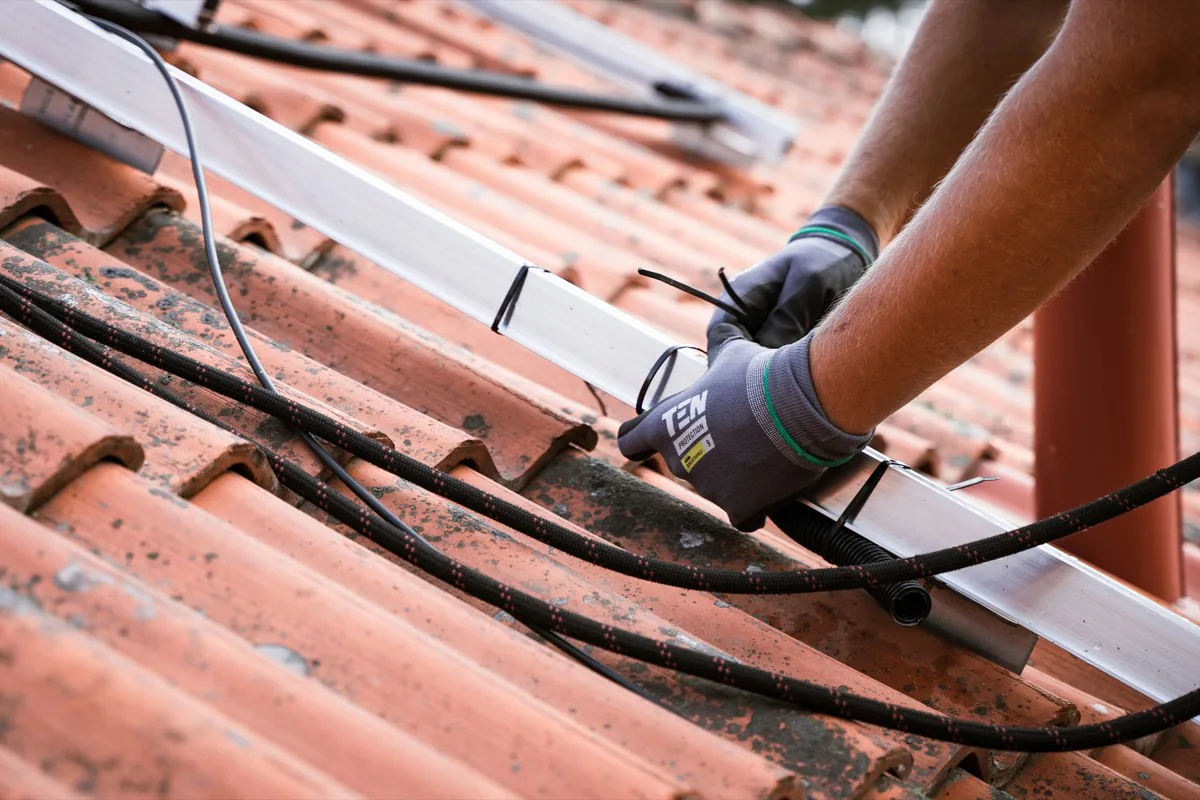
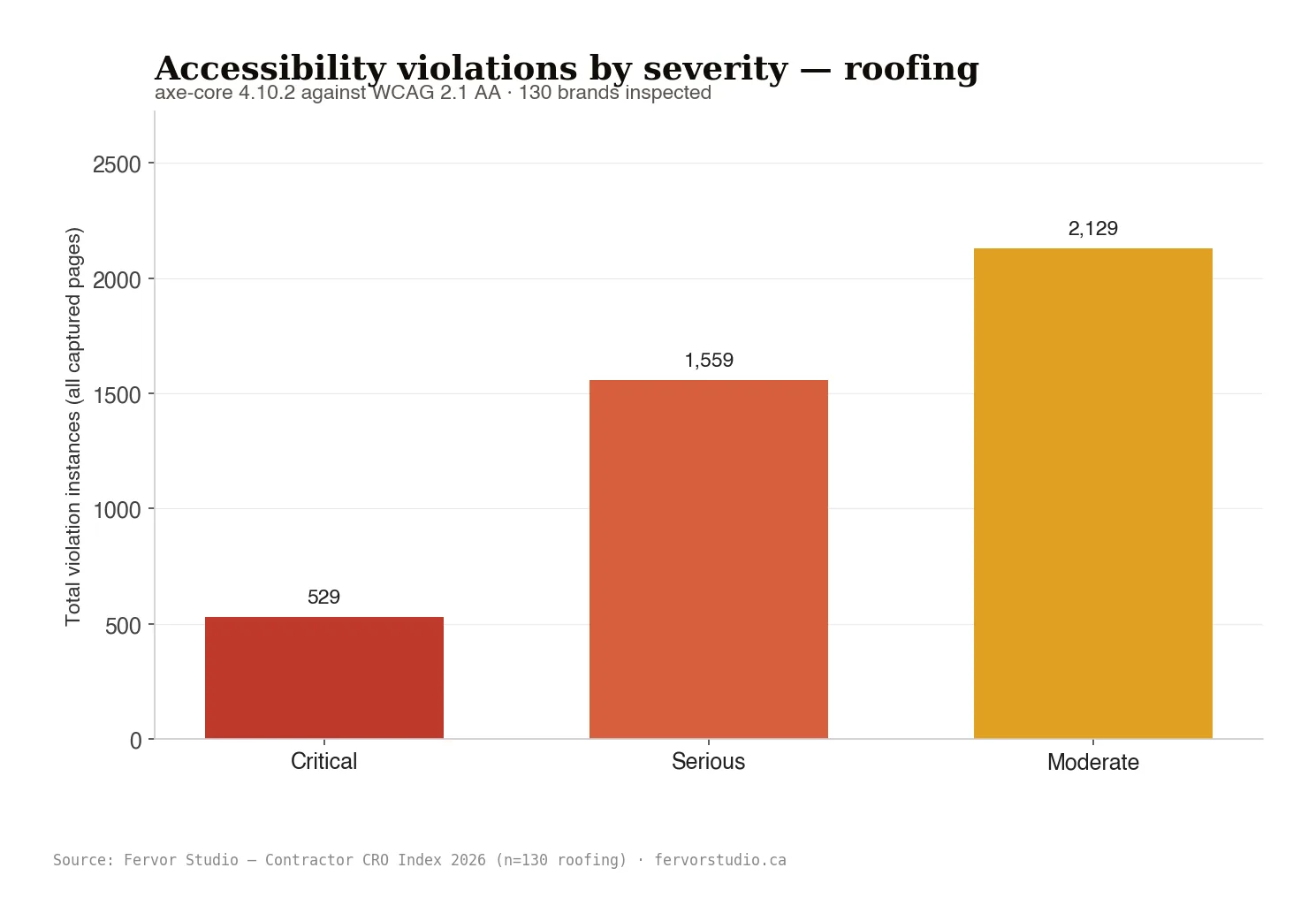
60.8% of roofing sites we tested fail a critical accessibility check
Digital State of the Roofing Industry 2026A grade out of 380 contractor sites
We graded 380 of them against one framework. Exactly one earned an A: Crown Industrial Roofing in Toronto, at 90 out of 100. The rest left money on the table. Here is what separates the top from the bottom.
The local detail
Every angle below comes from how Virginia Beach actually searches, buys, and regulates — built into the page, not bolted on.
So let us start with the math, because owners respond to math.
So before we touch a single page on your site, you have to understand the seasonal rhythm here.
So I pulled the top 10 organic results for four adjacent searches last week.
So let us get into the specific page-level work.
So a specialist who only talks about on-page work is missing the bigger lever.
So let us picture a realistic timeline.
So here is the picture I see when I open Google from a Sandbridge driveway on a Tuesday morning. You search "roofing seo virginia beach" or "roof leak repair near me," and the first thing that loads is a map pack with three pins, then a row of ads, then the organic results. Your shop is probably on page two. And the three pins on top are the ones who treated their Google presence like a job site.
But most owners I talk to in Hampton Roads think this whole topic is some abstract marketing thing. It is not. It is the difference between the phone ringing at 7:45 a.m. on a Monday after a nor'easter and the phone staying quiet while your crew sits in the yard off the Boulevard waiting for a callback that never comes.
So in this guide I want to walk you through how local search really works for a roofer here, what your competitors in Kempsville and Great Neck are doing, and the small fixes that move the needle in 60 to 90 days. No fluff. Just the stuff I would tell you at your kitchen table.
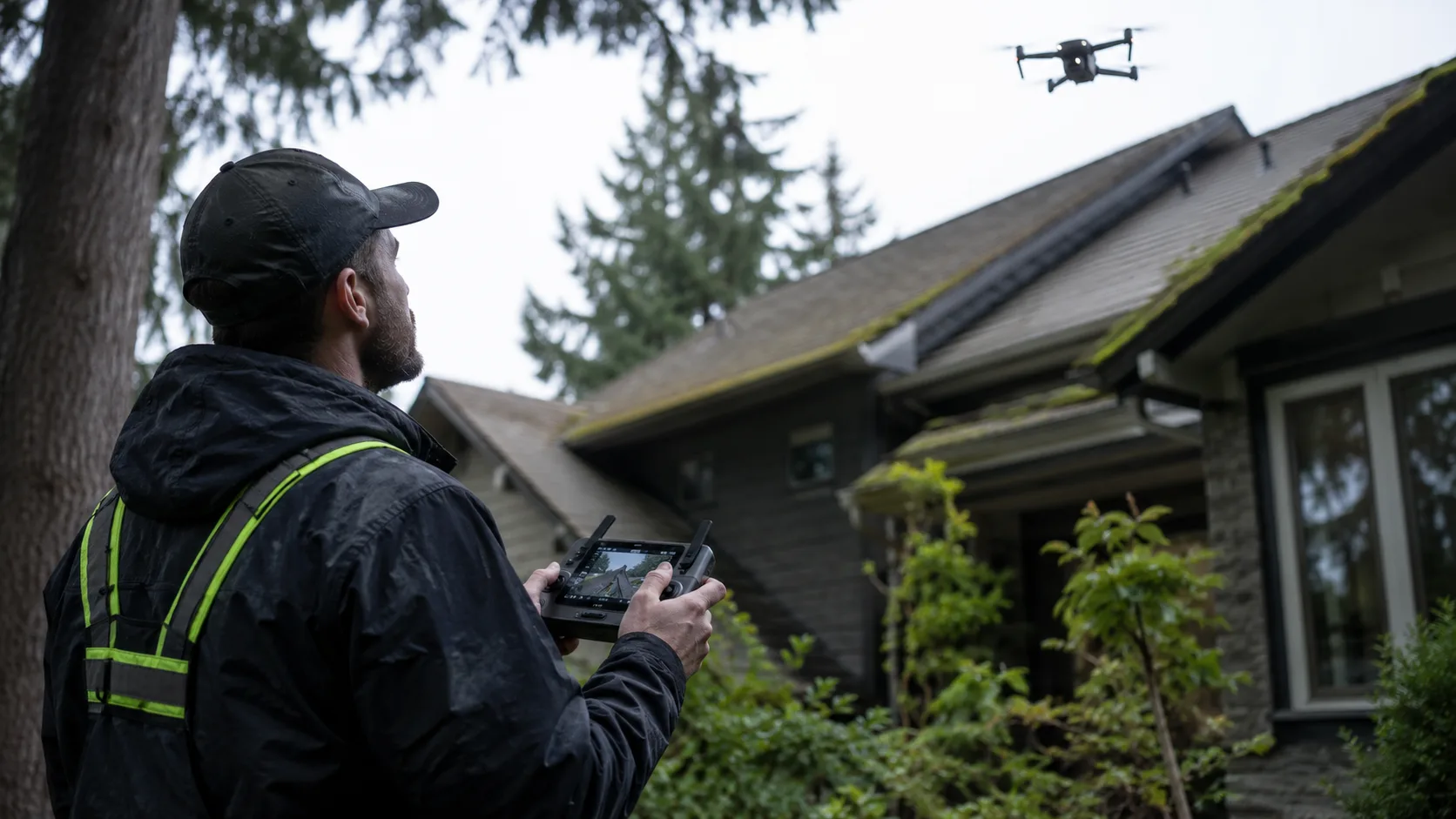
So let us start with the math, because owners respond to math. Say your average reroof in town runs $14,000, and your close rate on a warm inbound lead sits around 35%. And if local search brings you three extra estimate requests a week, and you close one, that is roughly $56,000 a month in revenue you were leaving on the table.
"In 2024, 22% of renovating homeowners undertook roofing upgrades, with a median spend of $13,000." — Houzz Inc. (2025)
And that is the conservative version. Because in coastal Virginia, where wind-driven rain and salt air age shingles faster than the inland averages, the demand curve is steeper than the national one. The homeowners in Bay Colony and North End are looking for someone they can trust. So the question is whether your shop shows up when those homeowners look.
So there are three places a homeowner here finds a roofer on Google, and they all behave a little differently:
Your shop needs to show up in at least two of those three. And the work to rank in each one is different, which is why a generic template never works. So the map pack is driven by your Google Business Profile, review velocity, and proximity to the searcher. But organic is driven by your site's content depth and authority. And AI Overviews pull from whoever already ranks well in the first two.
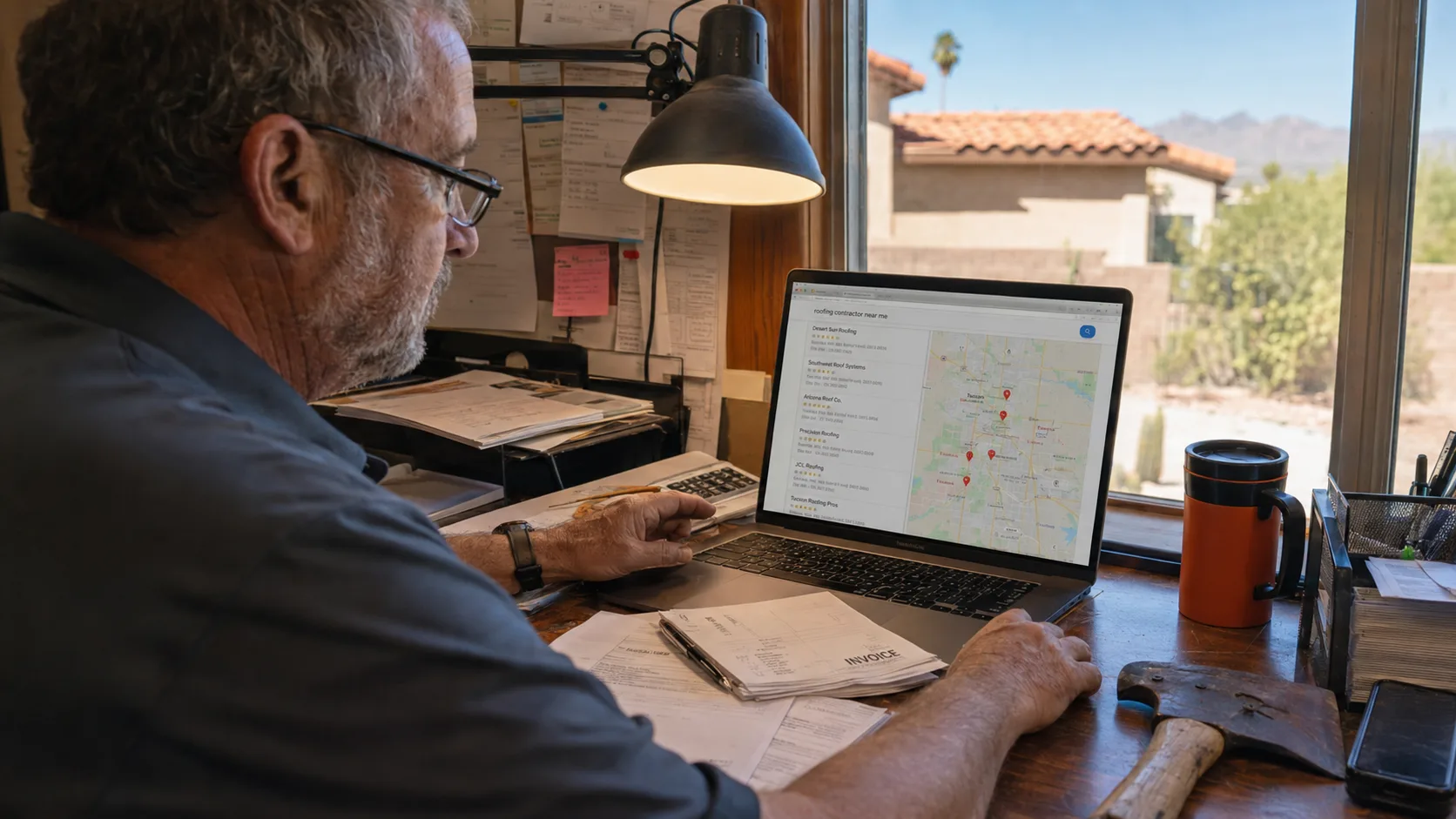
So before we touch a single page on your site, you have to understand the seasonal rhythm here. Hampton Roads gets hit by a different storm mix than Richmond or Roanoke. You get nor'easters in winter, hurricane remnants late summer through October, hail less often than the Midwest but enough to matter, and the constant salt-spray creep on every house east of the Lynnhaven River.
"In hail-prone states, average roof lifespan is 15 years vs 22 years in milder western states; 38% of U.S. homes have roofs in moderate to poor condition (Roofing Contractor) with 60% higher loss costs" — Verisk Analytics (2025)
So your homeowner in Thoroughgood is not on the same replacement clock as one in Charlottesville. They are calling sooner, calling more often, and they expect the contractor on the other end of the line to know what a 3-second wind gust off the Chesapeake does to a 17-year-old architectural shingle. Your content needs to sound like you know that too.
So here is a mistake I see on roughly 80% of the sites we inspect: one giant "service area" page that lists 40 neighborhoods in a comma-separated paragraph. And that tells Google nothing. And it tells the homeowner in Pungo even less.
Your site needs a real, separate page for each major area you cover. At minimum that means Kempsville, Sandbridge, Great Neck, Bay Colony, Thoroughgood, North End, Red Mill, Pungo, and the Oceanfront. And each page should reference local landmarks, the type of housing stock in that area (Sandbridge is mostly elevated coastal homes with metal accents, Kempsville is brick ranches and split-levels from the 70s and 80s), and the storm events that affected it.
And no, you do not need to write War and Peace for each one. So 600 to 900 words per page is fine, as long as it sounds like a contractor wrote it.
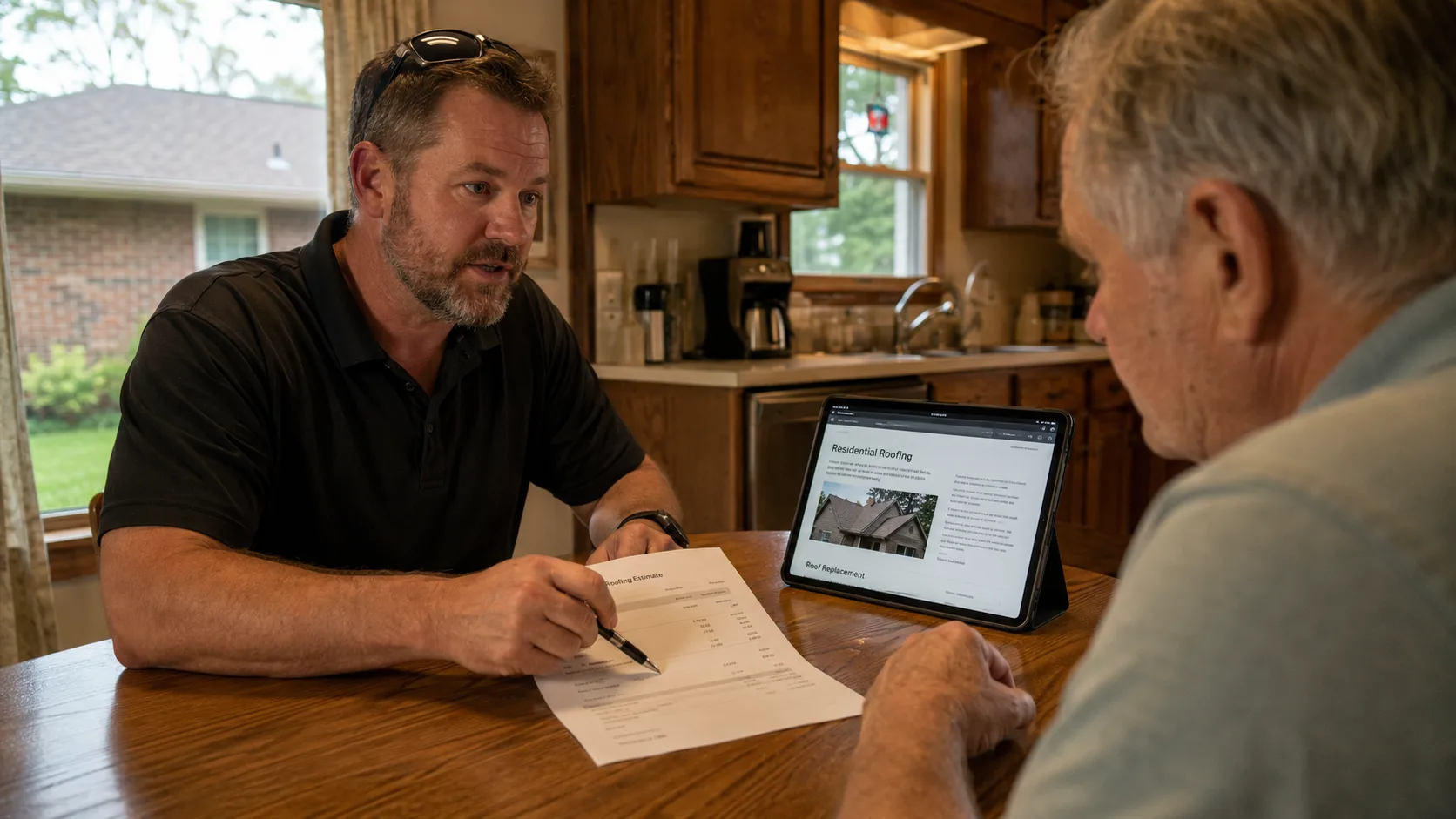
So I pulled the top 10 organic results for four adjacent searches last week. Here is what stood out.
So about half of the shops ranking on page one have fewer than 30 Google reviews. Their average review count is 23. Which means the bar to compete in the map pack here is much lower than in markets like Atlanta or Dallas. So you are not climbing Everest. But you are climbing First Landing.
"97% of roofing customers expect a callback within one week. More than 50% expect a callback within two days." — Roofing Contractor Magazine (2024)
But almost none of those shops respond to their reviews. And none have a fresh blog post from the last six months. And maybe two have a real neighborhood page beyond a citywide landing template. So the gap between "site that ranks" and "site that converts" is wide open. And you can walk through it with a checklist and 60 days of disciplined work.
So if you want a shorthand for what the algorithm rewards in Hampton Roads right now, here it is:
And that fourth signal is where most owners fall apart. They chase national directories and "DA 60 backlinks" from offshore services when a single mention in the Virginian-Pilot or a sponsorship link from the Home and Garden Show would do more for ranking than 30 spammy ones.
So let us get into the specific page-level work. Because the first 30 days of any engagement should be spent fixing the foundation, not chasing rankings.
So look at your homepage source code. Right now. Open your site, right-click, View Page Source, and search for the <title> tag. And if it says "Home | Smith Roofing LLC" or just your business name, you are leaking traffic. So that title tag is the headline Google uses in the search result. But it should read something like "Roofing Contractor in Virginia Beach, VA | [Your Shop Name]" and it should sit under 60 characters.
"From 2021–2023, homeowners spent $93.5B on roofing across 8.3 million projects (AHS-based estimates)." — U.S. Census Bureau and U.S. Department of Housing and Urban Development (2024)
And that $93.5B figure is the pool of demand you are fighting for a share of. The shops that win it are doing the boring stuff: one H1 per page, descriptive headings, alt text on every photo, schema markup for LocalBusiness with the right NAP. Not glamorous. Just disciplined.
So most sites in the trade have a "Services" page that lists "Roof Repair, Roof Replacement, Gutters" in a bulleted list. But that bullet list is really just a sticky note. And each service needs its own page, with the actual process you follow, the materials you carry, the typical price range a homeowner should expect, and at least one photo of your crew doing that work.
"Among homeowners undertaking a roofing project, 63% choose asphalt roofing material (dimensional shingles 34%, three-tab shingles 19%, luxury shingles 10%), while 14% choose metal and 11% choose synthetic material or rubber." — Houzz Inc. (2024)
So your dimensional shingle page should look different from your standing-seam metal page. Different products, different prices, different homeowner intent. Sandbridge homeowners search for metal more often than Kempsville homeowners do, because the salt-spray situation is different. Your pages should reflect that.
So a specialist who only talks about on-page work is missing the bigger lever. The map pack is downstream of trust signals, and trust signals are mostly reviews, mentions, and links.
So here is the system that works for every roofer I have ever helped: a printed leave-behind card with a QR code that opens directly to your Google review page, given to every customer at signoff, plus one text follow-up 48 hours after the final inspection. And that is it. No fancy software. No three-email drip.
So the shops in Norfolk and Chesapeake that out-rank you on review count are not doing anything magical. But they are just asking, every job, every time. And out of 100 completed jobs, you should expect 25 to 40 new reviews if your ask is consistent.
"Among homeowners who renovated in 2024, 84% used cash from savings and 29% used a credit card to fund renovation projects (multiple funding sources allowed)." — Houzz Inc. (2025)
And those reviews matter more than financing pitches because, as the data shows, most homeowners pay cash anyway. They are looking for proof that the last 30 people you worked with did not get the runaround.
So citations are mentions of your business name, address, and phone number across the web. And they need to be consistent everywhere: your Google profile, the BBB, the Hampton Roads Realtors Association, your Yelp, your Angi page, your Nextdoor business page. But one inconsistent suite address and your map pack ranking sags.
And then the real prize is local links. A link from VirginiaBeach.com, the Tidewater chapter of the NRCA, or a sponsorship listing for a youth sports league in Princess Anne does more for your rankings than 200 directory links from generic packages. Done right, this work is mostly a year of slow, real relationship-building.
"Among renovating homeowners, 44% add or redo a roof as part of their exterior projects." — Houzz Inc. (2024)
So nearly half of every exterior renovation includes a roof. That means your link partners are painters, gutter installers, window companies, siding crews, and home inspectors who all serve the same homeowners. A reciprocal blog mention from a Great Neck painter is worth its weight in gold.
So let us picture a realistic timeline. You start in early March, ahead of hurricane season prep. By June you should see real movement.
So audit the foundation: title tags, H1s, schema, page speed, mobile experience. And stand up a real Google Business Profile if yours is half-built. Photograph 10 recent jobs across at least 5 neighborhoods.
So build out the neighborhood pages, one per week. And roll out the review-request system on every completed job. Reach out to three potential link partners a week. Publish one blog post a month answering a real homeowner question.
So measure. Watch map pack movement for your top 5 keywords. And track form submissions and call volume by source. Most shops see their first map-pack appearance for at least 2 neighborhood searches by day 75. But this kind of work compounds slowly, then quickly.
So if you have read this far, you know the work boils down to disciplined execution over a 90-day window. Most shops in Hampton Roads cannot do all of it in-house, and most agencies template your shop into something that looks like 40 other contractors.
So the way we work at Fervor is to start with an inspection of roofing websites across the trade so you can see exactly where your site sits against the 380 home services brands we have already graded. And then we build the neighborhood pages, the review engine, and the link plan around your actual crew capacity, not a one-size-fits-all package.
And the first step is a free Site Inspection of your current site. No sales call, no obligation. So you get a written diagnosis of what is leaking leads, what is ranking-blocked, and what 90 days of focused work would realistically deliver. And if you want to take that diagnosis and run it in-house, that is fine. But if you want help executing, we will talk about it then.
Either way, the goal is the same: the phone ringing at 7:45 a.m. on Monday, and your crew dispatched before lunch.
The evidence
 Read the full report →
 0
contractor sites graded, one A
Across the whole CRO Index, a single site earned an A. The median landed at a D. The grade gap is a conversion gap.
0 %
of roofing sites fail a critical accessibility check
Scored against WCAG 2.1 AA with axe-core. A page that blocks a screen reader also blocks a paying customer.
Fervor Roofing State of the Industry, 2026
0 %
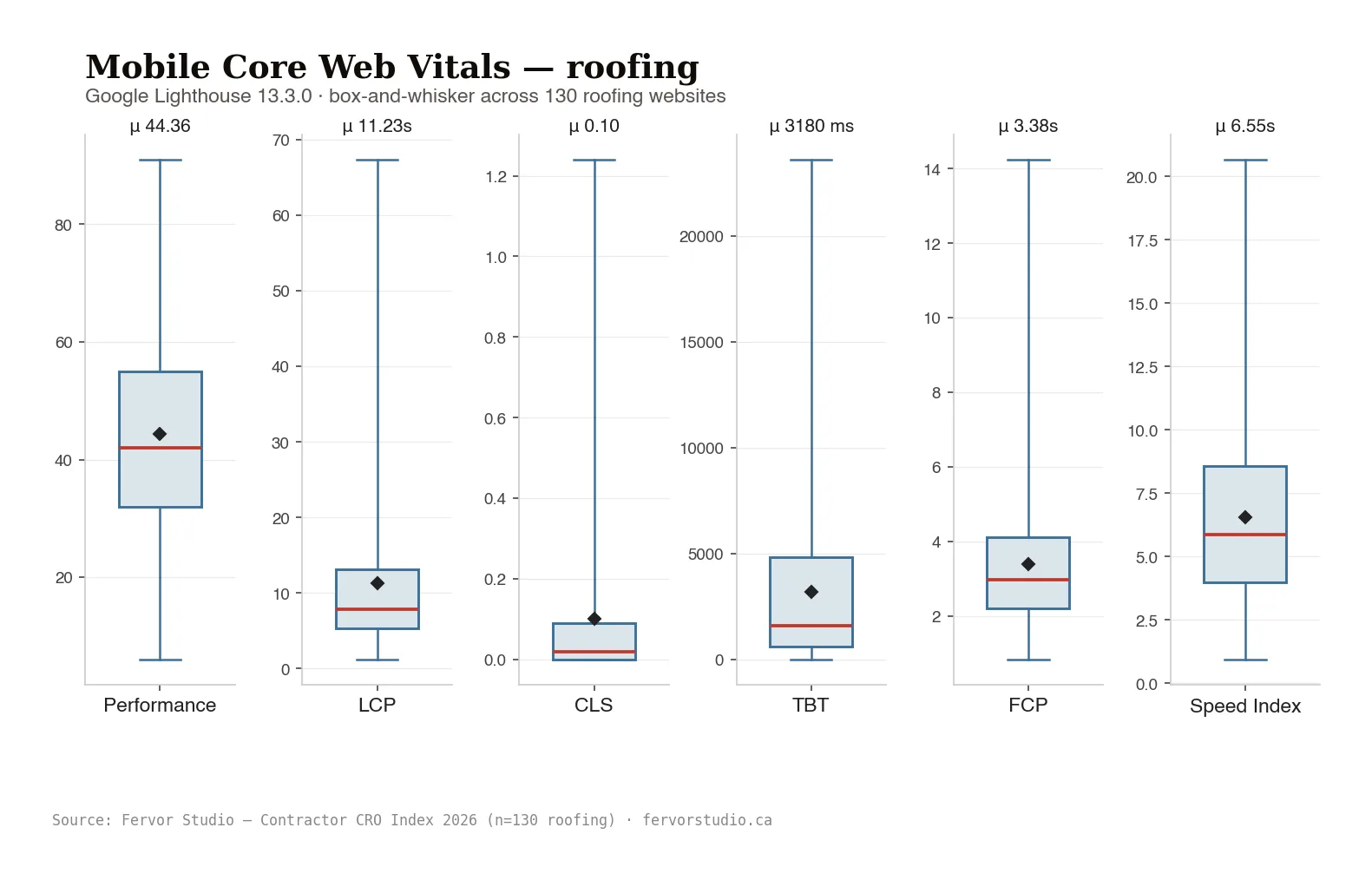
miss Google's mobile load-speed bar
Median mobile load lands at 7.88 seconds. Most of your traffic is on a phone, and most of them are gone before the hero paints.
Fervor Roofing State of the Industry, 2026
0 /100
is the average roofing grade
That is a D. The sites booking the work are not the ones with the biggest crews. They are the ones a few points higher on the things homeowners feel.
Two ways to start
Tell us where you are. We point you at the right next step — no sales call to get there.
Client review
“Nay did an amazing job, you know. He was really patient. He got the work done the way I told him and he was just on point with the website. Pretty straightforward process. No going around the bush. He just did amazing work and I would 100% recommend.”
How Fervor can help
Monthly SEO, content, and CRO. Fixed deliverables. No credits, no rollover. The compound growth engine.
Complete website system built to convert storm leads, planned projects, and research-phase homeowners into booked jobs.
Identify and patch the top conversion killers on your existing site. No full rebuild needed.
GBP optimization, citation building, and review system foundation. The infrastructure that gets you into the Map Pack.
One conversion-built landing page for the referrals, paid clicks, and cold-call leads you send. They land on a page built to book them, not your generic homepage.
Your move
Tell us where you are. We point you at the right next step — no sales call to get there.
Keep going